National newspapers were ‘unimpressed by Jeremy Corbyn’s victory’ in the Labour leadership election, Roy Greenslade noted in the Guardian, surprising no-one. Corbyn secured almost 62% of the 506,000 votes cast, up from the 59% share he won in 2015, ‘with virtually no press backing whatsoever’.
In reality, of course, Corbyn did not just lack press backing. He won in the face of more than one year of relentless corporate media campaigning to politically, ethically, professionally, psychologically and even sartorially discredit him. That Corbyn survived is impressive. That he won again, increased his vote-share, and took Labour Party membership from 200,000 to more than 500,000, is astonishing.
None of this moves journalists like the BBC’s political editor, Laura Kuenssberg, who commented: ‘there’s been no big new idea or vision this week that Labour can suddenly rally round’.
Polly Toynbee explained: ‘I and many Guardian colleagues can’t just get behind Corbyn’. Why? ‘Because Corbyn and McDonnell, burdened by their history, will never ever earn the trust of enough voters to make any plans happen.’
Toynbee fails to recognise the nature and scale of the problem. In supporting Corbyn, the public is attempting to shape a genuinely democratic choice out of the sham choices of corporate-owned politics. This awesome task begins with the public waking up to the anti-democratic role of the corporate media in defending, of course, corporate-owned politics. So-called ‘mainstream media’ are primarily conduits for power rather than information; they are political enforcers, not political communicators. To the extent that the public understands this, change is possible.
Supported by non-corporate, web-based media activism, Corbyn has already smoked out these media to an extent that is without precedent. Many people can see that he is a reasonable, compassionate, decent individual generating immense grassroots support. And they can see that all ‘mainstream’ media oppose him. It could hardly be more obvious that the corporate media speak as a single biased, elitist voice.
The Benghazi Massacre – No Real Evidence
The smearing of Corbyn fits well with the similarly uniform propaganda campaign taking the ‘threat’ of Iraqi ‘WMD’ seriously in 2002 and 2003. Then, also, the entire corporate media system assailed the public with a long litany of fraudulent claims. And then there was Libya.
Coming so soon after the incomplete but still damning exposure of the Iraq deception – with the bloodbath still warm – the media’s deep conformity and wilful gullibility on the 2011 Libyan war left even jaundiced observers aghast. It was clear that we were faced with a pathological system of propaganda on Perpetual War autopilot.
The pathology has been starkly exposed by a September 9 report into the war from the foreign affairs committee of the House of Commons. As with Iraq, this was no mere common-or-garden disaster; we are again discussing the destruction of an entire country. The report summarised:
The result was political and economic collapse, inter-militia and inter-tribal warfare, humanitarian and migrant crises, widespread human rights violations, the spread of Gaddafi regime weapons across the region and the growth of ISIL in North Africa.
The rationale for ‘intervention’, of course, was the alleged threat of a massacre by Gaddafi’s forces in Benghazi. The report commented:
The evidence base: our assessment
Despite his rhetoric, the proposition that Muammar Gaddafi would have ordered the massacre of civilians in Benghazi was not supported by the available evidence… Gaddafi regime forces targeted male combatants in a civil war and did not indiscriminately attack civilians. More widely, Muammar Gaddafi’s 40-year record of appalling human rights abuses did not include large-scale attacks on Libyan civilians. (Our emphasis)
And:
Professor Joffé [Visiting Professor at King’s College London] told us that:
the rhetoric that was used was quite blood-curdling, but again there were past examples of the way in which Gaddafi would actually behave… The evidence is that he was well aware of the insecurity of parts of the country and of the unlikelihood that he could control them through sheer violence. Therefore, he would have been very careful in the actual response… the fear of the massacre of civilians was vastly overstated.’
Analyst and author Alison Pargeter agreed with Professor Joffé, concluding that there was no ‘real evidence at that time that Gaddafi was preparing to launch a massacre against his own civilians’. Related claims, that Gaddafi used African mercenaries, launched air strikes on civilians in Benghazi, and employed Viagra-fuelled mass rape as a weapon of war, were also invented.
These are astonishing comments. But according to the Lexis-Nexis media database, neither Professor Joffé nor Pargeter has been quoted by name in the press, with only the Express and Independent reporting that ‘available evidence’ had shown Gaddafi had no record of massacres; a different, less damning, point.
As disturbingly, the report noted:
We have seen no evidence that the UK Government carried out a proper analysis of the nature of the rebellion in Libya… It could not verify the actual threat to civilians posed by the Gaddafi regime….
In other words, the UK government’s relentless insistence on the need to support freedom-loving rebels against a genocidal tyranny were invented ‘facts’ fixed around policy.
That the war was a crime is hardly in doubt. Lord Richards (Baron Richards of Herstmonceux), chief of the defence staff at the time of the conflict, told the BBC that Cameron asked him ‘how long it might take to depose, regime change, get rid of Gaddafi’. British historian Mark Curtis describes the significance:
Three weeks after Cameron assured parliament in March 2011 that the object of the intervention was not regime change, he signed a joint letter with President Obama and French President Sarkozy committing to “a future without Gaddafi”.
That these were policies were illegal is confirmed by Cameron himself. He told Parliament on 21 March 2011 that the UN resolution “explicitly does not provide legal authority for action to bring about Gaddafi’s removal from power by military means”.
Cameron, then, like Blair, is a war criminal.
The ‘Moral Glow’ From a ‘Triumphant End’
The foreign affairs committee’s report is awesomely embarrassing for the disciplined murmuration of corporate journalists who promoted war.
At a crucial time in February and March 2011, the Guardian published a long list of news reports boosting government propaganda and opinion pieces advocating ‘intervention’ on the basis of the West’s supposed ‘responsibility to protect’, or ‘R2P’. Guardian columnist, later comment editor (2014-2016), Jonathan Freedland, wrote an article titled: ‘Though the risks are very real, the case for intervention remains strong.’
Brian Whitaker, the Guardian’s former Middle East editor, wrote: ‘the scale and nature of the Gaddafi regime’s actions have impelled the UN’s “responsibility to protect”.’
Menzies Campbell, former leader of the Liberal Democrats, and Philippe Sands, professor of law at University College London, wrote in the Guardian: ‘International law does not require the world to stand by and do nothing as civilians are massacred on the orders of Colonel Gaddafi…’
An Observerleader agreed: ‘The west can’t let Gaddafi destroy his people.’ And thus: ‘this particular tyranny will not be allowed to stand’.
No doubt with tongue firmly in Wodehousian cheek, as usual, Boris Johnson wrote in the Telegraph :
The cause is noble and right, and we are surely bound by our common humanity to help the people of Benghazi.
David Aaronovitch, already haunted by his warmongering on Iraq, wrote an article for The Times titled: ‘Go for a no-fly zone over Libya or regret it.’ He commented:
If Colonel Gaddafi is permitted to murder hundreds or thousands of his citizens from the air, and we stand by and let it happen, then our inaction will return to haunt us… We have a side here, let’s be on it. (Aaronovitch, ‘Go for a no-fly zone or regret it,’ The Times, February 24, 2011)
But it can now reasonably be said that in narrow military terms it worked, and that politically there was some retrospective justification for its advocates as the crowds poured into the streets of Tripoli to welcome the rebel convoys earlier this week.
Simon Tisdall commented in the same newspaper: ‘The risky western intervention had worked. And Libya was liberated at last.’
An Observereditorial declared: ‘An honourable intervention. A hopeful future.’
The BBC’s Nick Robinson observed that Downing Street ‘will see this, I’m sure, as a triumphant end’. (BBC, News at Six, October 20, 2011) Robinson appeared to channel Churchill:
Libya was David Cameron’s first war. Col. Gaddafi his first foe. Today, his first real taste of military victory.
The BBC’s chief political correspondent, Norman Smith, declared that Cameron ‘must surely feel vindicated’. (BBC News online, October 21, 2011) In Washington, the BBC’s Ian Pannell surmised that Obama ‘is feeling that his foreign policy strategy has been vindicated – that his critics have been proven wrong’. (BBC News online, October 21, 2011)
The BBC’s John Humphrys asked: ‘What apart from a sort of moral glow… have we got out of it?’ (BBC Radio 4 Today, October 21, 2011)
Andrew Grice, political editor of the Independent, declared that Cameron had ‘proved the doubters wrong.’ Bitterly ironic then, even more so now, Grice added: ‘By calling Libya right, Mr Cameron invites a neat contrast with Tony Blair.’
An editorial in the Telegraph argued that Gaddafi’s death ‘vindicates the swift action of David Cameron and Nicolas Sarkozy in halting the attack on Benghazi’. Telegraph columnist Matthew d’Ancona (now writing for the Guardian) agreed: ‘It is surely a matter for quiet national pride that an Arab Srebrenica was prevented by a coalition in which Britain played an important part…’
Concern was real enough that a Srebrenica-style massacre could unfold in Benghazi, and the UK Government was right to insist that we would not allow this.
The Times, of course, joined the corporate herd in affirming that without ‘intervention’, there ‘would have been a massacre in Benghazi on the scale of Srebrenica’. (Leading article, ‘Death of a dictator,’ The Times, October 21, 2011)
But even voices to the left of the ‘mainstream’ got Libya badly wrong. Most cringe-makingly, Professor Juan Cole declared:
The Libya intervention is legal and was necessary to prevent further massacres… If NATO needs me, I’m there.
Robert Fisk commented in the Independent that, had ‘Messrs Cameron, Sarkozy and Obama stopped short after they saved Benghazi’, disaster could have been avoided.
Ironically, in an article ostensibly challenging the warmongers’ hysterical claims, Mehdi Hasan wrote in the New Statesman:
The innocent people of Benghazi deserve protection from Gaddafi’s murderous wrath.
Even Noam Chomsky observed:
The no-fly zone prevented a likely massacre… (Chomsky, ‘Making the Future: Occupations, Interventions, Empire and Resistance,’ Hamish Hamilton e-book, 2012, p.372)
To his credit, then Guardian columnist Seumas Milne (now Corbyn’s director of communications and strategy) was more sceptical. He wrote in October 2011:
But there is in fact no evidence – including from other rebel-held towns Gaddafi re-captured – to suggest he had either the capability or even the intention to carry out such an atrocity against an armed city of 700,000.
We were labelled ‘useful idiots’ for challenging these and other atrocity claims in a June 2011 media alert here, here and here.
Media Reaction to the Report
The media reaction to the MPs’ demolition of their case for war made just five years earlier inevitably included some ugly evasions. A Guardianeditorial commented of Libya:
It is easy in retrospect to lump it in with Iraq as a foreign folly…
It is indeed easy ‘to lump it in’, it is near-identical in key respects. But as a major war crime, not a ‘folly’.
… and there are important parallels – not least the failure to plan for stabilisation and reconstruction.
The preferred media focus being, as usual, so-called ‘mistakes’, lack of planning; rather than the fact that both wars were launched on outrageous lies, ended in the destruction of entire countries, and were driven by greed for resources. With impressive audacity, the Guardian preferred to cling to deceptions exposed by the very report under review:
But it is also important to note differences between a gratuitous, proactive invasion and a response to a direct threat to the citizens of Benghazi, triggered by the spontaneous uprising of the Libyan people. Memories of Srebrenica spurred on decision-makers. (Our emphasis)
In fact, propagandistic use of Srebrenica from sources like the Guardian ‘spurred on decision-makers’. The whole point of the MPs’ report is that it found no ‘real evidence‘ for a massacre in Benghazi. Similarly, the Guardian’s ‘spontaneous uprising’ is a debunked version of events peddled by government officials and media allies in 2011, despite the fact that there is ‘no evidence that the UK Government carried out a proper analysis of the nature of the rebellion in Libya’. In fact, the MPs’ report makes a nonsense of the Guardian’s claims for a humanitarian motive, noting:
On 2 April 2011, Sidney Blumenthal, adviser and unofficial intelligence analyst to the then United States Secretary of State Hillary Clinton, reported this conversation with French intelligence officers to the Secretary of State:
According to these individuals Sarkozy’s plans are driven by the following issues:
a. A desire to gain a greater share of Libya oil production,
b. Increase French influence in North Africa,
c. Improve his internal political situation in France,
d. Provide the French military with an opportunity to reassert its position in the world,
e. Address the concern of his advisors over Qaddafi’s long term plans to supplant France as the dominant power in Francophone Africa.
The Guardian apologetic continued:
Perhaps most critically, western intervention – fronted by France and the UK, but powered by the US – came under a United Nations security council resolution for the protection of civilians, after the Arab League called for a no-fly zone.’
But this, again, is absurd because the resolution, UNSCR 1973, ‘neither explicitly authorised the deployment of ground forces nor addressed the questions of regime change’, as the MPs’ report noted. NATO had no more right to overthrow the Libyan government than the American and British governments had the right to invade Iraq.
In 2011, it was deeply disturbing to us that the barrage of political and media propaganda on Libya received far less challenge even than the earlier propaganda on Iraq. With Guardian and BBC ‘humanitarian interventionists’ leading the way, many people were misled on the need for ‘action’. In a House of Commons vote on March 21, 2011, 557 MPs voted for war with just 13 opposing. Two names stand out among the 13 opponents: Jeremy Corbyn and John McDonnell.
Predictably, last month’s exposure of the great Libya war fraud has done nothing to prompt corporate journalists to rethink their case for war in Syria – arguments based on similar claims from similar sources promoting similar ‘humanitarian intervention’. Indeed, as this alert was being completed, the Guardian published an opinion piece by former Labour foreign secretary David Owen, calling for ‘a no-fly zone (NFZ), with protected land corridors for humanitarian aid’ in Syria, because: ‘The humanitarian imperative is for the region to act and the world to help.’
In February 2003, the Guardian published a piece by the same David Owen titled: ‘Wage war in Iraq for the sake of peace in the Middle East.’ In 2011, Owen published an article in the Telegraph, titled: ‘We have proved in Libya that intervention can still work.’ He had himself ‘called for… intervention’ that February.
The Perpetual War machine rolls on.
Media Lens is a UK-based media watchdog group headed by David Edwards and David Cromwell. The second Media Lens book, Newspeak: In the 21st Century by David Edwards and David Cromwell, was published in 2009 by Pluto Press.
Shimon Peres is being eulogized around the world as Israel’s philosopher-king, its elegant worldly face to the world, the last of the Founding Fathers. The NY Times has published a news story, an op-ed by Tzipi Livni, and a Roger Cohen column, all of which amount to little more than hagiography. But there is a sizablenumber of criticalappraisals like this one which have been published presenting Peres’ darker side and which are very important reading.
What follows is a newly published note which Peres sent to Israel’s leading nuclear historian, Avner Cohen. In 1999, Cohen had sent the Israeli leader a copy of his first book, Israel and the Bomb. In the book, Cohen offered an inscription portraying Peres’ unique role in the creation of Israel nuclear weapons arsenal. Because Cohen hadn’t used Peres as a source for this authoritative history of Israel’s first nuclear weapon (he hadn’t thought an individual who had so many nuclear secrets would be able or willing to speak candidly), he didn’t think Peres would respond. But he did and wrote the following:
To: Avner Cohen:
Thank you for your book, Israel and the Bomb, and for your fine dedication. I’ve gone through the first half of your book and find it interesting and absorbing. I believe you’ve done some fundamental research in which, as with other historical research–the narrative depends on the willingness of various individuals [sources] to reveal things. According to what was said to you, the proportions may not be quite exact. However, this is not your fault.
Essentially, I do not find fault with this because until now I have not felt able to reveal the full story.
But one thing I must say: we didn’t build Dimona [Israel’s nuclear weapons production facility] to make a Hiroshima, but rather to achieve Oslo [the note was written six years after the Oslo Accords were signed]: in Oslo I felt the full justification of this effort [to create The Bomb].
This represents yet another part of the Peres effort to project a civilized, liberal Israeli face to the world. We didn’t build the bomb for destruction. We built it to enable us to be strong enough to compromise for peace. Whatever Peres may’ve really believed about why he built the Bomb, the result wasn’t at all what he portrayed above. Israel’s 200 nuclear weapons have served as a bulwark against compromise. In a phone conversation, Cohen told me that they “promoted Occupation.” Instead of relying on peace or compromise, the nuclear arsenal has forced Israel to live (and die) “by the sword.” The whole enterprise, Cohen told me, is built on “arrogance.”
In parsing the original intent of Ben Gurion, who first set forth the race for nuclear weapons, Cohen believes Israelis needed a forceful tool to force the Arab states to admit that Israel could never be wiped off the map. A nuclear weapon would, so Israel’s founder believed, would persuade his enemies that his country was “here to stay.” It would be the ultimate “persuader.” But it turned out to be much more than that.
Cohen believes that Israel’s first nuclear weapon, hastily put together just before the 1967 War, directly led to that conflict. Having it, offered the Israelis a heady tonic that persuaded them they would be invincible; that regardless of what happened on the field of battle, they had a Doomsday weapon that would ultimately ensure victory.
Since no other regional power had or has WMD, Israel can never be forced to compromise against its will. Every front-line state, including Israel’s allies like the U.S., know that if its back was up against the wall it could reject any solution that didn’t accord with its perceived interests, because it possessed the ultimate weapon. This is a good deal of what lies behind the rejectionism of almost all previous Israeli prime ministers, all of whom have turned away from multiple opportunities to reach a final accord.
Dimona Succeeded, but Oslo Failed
Further, Oslo failed (though Peres couldn’t have known that in 1999, when he wrote that note). It failed because Israeli leaders, including those in his own Labor Party, refused to honor the terms of the deal. Later, they refused to offer enough to the Palestinians at the second Camp David. They refused to make the necessary compromises to satisfy their peace partner. They knew they could get away with this, because they had a card in their back pocket that no one else in the region had. They knew they could walk away from the table and that there would be no meaningful consequences for doing so.
Those who support Israel’s nuclear weapons may argue that the above claim is false because Israel never threatened or used nuclear weapons, as the U.S. did against Japan. But this argument rings hollow because in 1973, at the outset of the October War, Israeli forces were being overrun in the Golan and Sinai. Defense minister Moshe Dayan went to Golda Meir with a plan to detonate a nuclear weapon in the desert to warn the Arabs that if they overran Israel, it would use The Bomb. Thankfully, Meir and her other advisors rejected Dayan’s advice as that of a man under severe stress and a possible mental breakdown. But had Meir been a different person, Israel may very well have detonated at least one of its nukes.
There is absolutely no guarantee that in the future, should it face a similar threat, Israel would not use a nuclear weapon. After all, as distinguished an Israeli historian as Benny Morris advocated just such a prospect against Iran in the pages of none other than the New York Times.
After Peres’, recent stroke, which eventually led to his death, I published this appraisal, which reveals another little-known element of Peres’ pursuit of the Bomb with the connivance of the French during the run-up to the 1956 Suez War, of which Peres, Ben Gurion and Israel were eager partners.
Peres and the Theft of the Yemenite Children
An equally little-known darker side to the Peres legacy involved a scandal which has tainted Israel for decades. In the early 1950s, Israel airlifted 50,000 Yemenite Jews to the new state under the Orientalist rubric, Operation Magic Carpet. It did so in order to buttress its Jewish population, as Israel’s leadership sought to balance the large numbers of Palestinians who remained in Israel after the 1948 Nakba.
Though Israel heralded the airlift to the world as its heroic effort to save an ancient Jewish community, in truth it treated the new immigrants shabbily. It sent them to camps little better than the DP camps to which Holocaust survivors were consigned after WWII. Later, it sent them to development towns which consisted of little more than tents and basic services. Over time, the Yemenites became part of the Israeli Mizrahi minority which faced severe discrimination at the hands of the Ashkenazi (European) majority.
But Israeli authorities committed a far worse crime against these immigrants. It systematically stole Yemenite children from their families and offered them to Ashkenazi couples who were unable to conceive or sought to adopt babies. Some of these children (estimates range as high as 1,000 were stolen) were even sent abroad (one was tracked to Belgium). Authorities at the time believed the Yemenite were primitive people who would not integrate into a superior “western” society. Israel wanted them to assimilate quickly and believed if the newborn were given to Ashkenazi families they would have a proper, civilized upbringing that would bring them into the modern, advanced world.
The racism of this project is now clear. Projects with similar tragic consequences were played out in other countries in that era, including Native American and Aboriginal children taken from families to be raised in government schools. The difference is that Israel has consistently refused to make an accounting of what happened leaving an open, weeping sore where there should be healing, repentance and restitution.
Israel has investigated this scandal several times but has never fully exposed the reason for the kidnapping, who orchestrated the plan, or who were the victims. So historians do not know precisely how many children were stolen. This has left an indelible stain on the Israeli Yemenite community and a severe breach between it and the State. Mothers who were told lies that their babies died after childbirth, have never had a proper accounting of what happened. They know they have children in the world, but they don’t know who or where they are.
Shimon Peres, when he was prime minister, refused to appoint a commission with full powers to investigate the child theft. Instead, he hand-picked three mid-level bureaucrats in 1985, who were given extremely limited resources, to investigate. One of them was a senior police officer, Amon Navot. Sampson Giat, then president of the Yemenite Jewish Federation, wrote a 1993 book about the scandal in which he said:
In 1985, Arnon Navot, a high-ranking policeman, was the head of the country’s missing persons’ bureau. There was increased pressure on Prime Minister Shimon Peres to have another committee investigation after the lack of results of the former Bahalul Minkovsky Committee came up with only 342 missing children. Afterwards, 600 more children’s names were added.
Peres, rather than forming another government committee instructed Arnon Navot to head a task force with two others. Since Peres had no intention of creating a public committee, he did not give Navot the tools necessary to investigate.
Navot claims that his superiors put hurdles in front of him. He was not allowed to store information on his computer; his official car was taken from him so that he had to carry loads of documents on public transportation.
Navot found evidence that a child, whose parents were told he had died, had been illegally adopted by a family in Belgium. His superiors would not allow him to follow up on his findings.
Navot was convinced that Shimon Peres, like most politicians, was afraid of the political fallout resulting from any discoveries. The cover up started.
When you read glowing encomium’s like those in the NY Times, remember the darker side of Shimon Peres. Whatever good he may’ve done is more than outweighed by his profound lapses in judgment and morality.
The Pentagon paid a UK PR firm half a billion dollars to create fake terrorist videos in Iraq in a secret propaganda campaign exposed by the Bureau of Investigative Journalism.
PR firm Bell Pottinger, known for its array of controversial clients including the Saudi government and Chilean dictator Augusto Pinochet’s foundation, worked with the US military to create the propaganda in a secretive operation.
The firm reported to the CIA, the National Security Council and the Pentagon on the project with a mandate to portray Al-Qaeda in a negative light and track suspected sympathizers.
Both the White House and General David Petraeus, the former general who shared classified information with his mistress, signed off on the content produced by the agency.
The Bell Pottinger operation started soon after the US invasion of Iraq and was tasked with promoting the “democratic elections” for the administration before moving on to more lucrative psychological and information operations.
Former employee Martin Wells told the Bureau how he found himself working in Iraq after being hired as a video editor by Bell Pottinger. Within 48 hours, he was landing in Baghdad to edit content for secret “psychological operations” at Camp Victory.
The firm created television ads showing Al-Qaeda in a negative light as well as creating content to look as though it had come from “Arabic TV”. Crews were sent out to film bombings with low quality video. The firm would then edit it to make it look like news footage.
They would craft scripts for Arabic soap operas where characters would reject terrorism with happy consequences. The firm also created fake Al-Qaeda propaganda videos, which were then planted by the military in homes they raided.
Employees were given specific instructions to create the videos. “We need to make this style of video and we’ve got to use Al-Qaeda’s footage,” Wells was told. “We need it to be 10 minutes long, and it needs to be in this file format, and we need to encode it in this manner.”
The videos were created to play on Real Player which needs an internet connection to run. The CDs were embedded with a code linking to Google Analytics which allowed the military to track IP addresses that the videos were played on.
According to Wells, the videos were picked up in Iran, Syria and the US.
“If one, 48 hours or a week later shows up in another part of the world, then that’s the more interesting one,” Wells explained. “And that’s what they’re looking for more, because that gives you a trail.”
The Pentagon confirmed the PR firm did work for them under the Information Operations Task Force (IOTF) creating content they say was “truthful”. The firm also worked under the Joint Psychological Operations Task Force (JPOTF). The Pentagon said it could not comment on JPOTF operations.
US law prohibits the government from using propaganda on its population, hence the use of an outside firm to create the content.
Documents show the Pentagon paid $540 million to Bell Pottinger in contracts between 2007 and 2011, with another contract for $120 million in 2006. The firm ended its work with the Pentagon in 2011.
In 2009, it was reported that the Pentagon had hired controversial PR firm, The Rendon Group, to monitor the reporting of journalists embedded with the U.S. military, to assess whether they were giving “positive” coverage to its missions.
It was also revealed in 2005 that Washington based PR company the Lincoln Group had been placing articles in newspapers in Iraq which were secretly written by the US military. A Pentagon investigation cleared the group of any wrongdoing.
It is hard to imagine a more resilient, more heroic nation than Syria!
With only 17 million inhabitants (according to the 2014 estimate), Syria is now facing the mightiest coalition on Earth – a coalition that consists of virtually all traditional Western colonialist and neo-colonialist nations.
It is also facing some of the cruelest and deadliest inventions of the West – the extremist and murderous post- and pseudo-Islamic groupings, similar to those that were already unleashed against the Soviet Union during the war in Afghanistan.
Because of the tremendous determination of its people, Syria is still standing! But it is standing against all odds. Its Golan Heights are illegally occupied by Israel, its borders constantly violated by the Turkish military, and by the West’s ‘special forces’ and air force.
Syria’s “political opposition” was created, then groomed and financed by the United States and Europe, in the style of “Color Revolutions”, as has happened in all other socialist countries that the West has been trying to destabilize and return under its deadly rule. Millions of Syrian people have been, during the last six deadly years, terrorized, slaughtered and intimidated by jihadi cadres, implanted by the West and its regional allies: Saudi Arabia, Turkey, Qatar, Israel and others.
It is a terrible and uneven fight! Some of the greatest historical cities on Earth, like Aleppo and Palmira, now lie in ruins and ashes. What the European Christian crusaders failed to fully destroy, is now collapsing under the imperialist onslaught. Like everywhere else on Earth, everything that dares to struggle against Western colonialism is being consistently devastated and burned. Almost everyone who resists is mercilessly slaughtered. Hundreds of thousands of Syrian people have already lost their lives. And with each new day, the awful count is rising.
But Syria is standing!
5 million Syrian people have already been forced to leave their country. Now they are being scattered all over the Middle East: throughout Lebanon, Jordan, Iraq, Egypt, and Turkey. Some have even gone as far as Europe, Canada and Chile.
How much more can one country endure?
And how can the rest of the world just stand by and watch as it is put through hell?
The answer is obvious: the rest of the world does not know; it does not understand! The propaganda coming out of the Western mass media outlets and indoctrination-spreading institutions is so thorough, so professional, that to most people all over the world everything related to Syria appears to be blurry, murky, and incredibly complex. President al-Assad is demonized on a daily basis. Heroic resistance is called the “regime’s brutal actions”, pro-western terror groups are described as “moderate opposition.”
In reality, Syria is suffering because it is refusing to kneel; because it is unwilling to prostitute itself; because it will never beg its torturers to stop, allowing them to grab everything above and under the surface.
The Empire never forgives disobedience. Its fundamentalist terror methods are the most brutal ever invented and implemented on Earth.
All around Syria, countries already lie in ashes. The Middle East hardly exists, anymore. And most of the Syrian people understand: it is perhaps better to die standing, than to live in shackles, on one’s knees, controlled by the kleptomaniacal Western colonialist states!
*
The more terrible the terror that the West is spreading worldwide in general and in this part of the world in particular, the more vicious its vitriolic propaganda is, the brainwashing indoctrination that flows incessantly from London, New York and Paris.
If one watches the BBC, there is no hint of objectivity left, anymore. The ranks are closed and the West is united in its final drive to discredit absolutely everything that is still fighting for survival, against its global terrorist exploits.
President al-Assad of Syria, the heroic Syrian army and the closest Syria’s allies – Russia and Iran – are being relentlessly demonized, as if it were them who began that monstrous war! And Hezbollah, which is fighting countless epic battles against the ISIS, sits firmly on the West’s terrorist list.
Everything seems to be twisted and perverted, upside down.
But what really should one expect from the expansionist hordes, from the bastions of imperialism? Or has the British (or French) propaganda been any different, when their colonialist countries have for centuries been grabbing and devastating countless foreign states and territories, slaughtering hundreds of millions of innocent people? Wasn’t anyone who resisted Western conquest always thoroughly ridiculed and demonized?
Countries like UK, France, Germany, Belgium, Holland, Spain, Portugal and others, have centuries of experience in how to humiliate victims, how to justify their own heinous acts, how to brainwash their own populations and even some of their victims! And the United States, the direct product of Europe, its muscular offspring, is just using the same, only a bit more vulgar, propaganda tactics.
Nothing rational and objective can be expected from the people of Europe or North America, anymore. Except for a few of those insignificant protests and rebellious acts, the Western population is in a total slumber, indifferent towards the horrors that are being administered by its regime all over the globe. There is hardly any pressure to stop acts of terror against Syria. The only thing that seems to matter to Europeans is how to stop the flow of refugees from the devastated countries.
What a shame! What a thorough shame, people of Europe and North America! Your regime is murdering millions, in one country after another, and you are not even capable of recognizing what goes on… instead you are blaming the victims and those rushing to their rescue!
Now your biggest enemy is Russia. Because Russia (same as China) is clearly unwilling to dance to your fatal tune! Because Russia, for many decades, stood by almost all oppressed countries, and supported the de-colonization of the world, in all of its corners. Like China, Cuba and North Korea have always done.
Russia is now defending Syria. Not because it needs natural resources, not because it wants to plunder. It is doing so simply because it is right thing to do. It does it because if the world is abandoned fully to Western imperialism, there will actually soon be no world at all, or at least there will be no world worth inhabiting!
*
“Our country is a socialist country. For us it’s more important to consider the benefits to the entire nation than to particular individuals. I have spent more than 50 years dedicating my life to education, which is the backbone of our country, especially now… Sometimes I feel like quitting my job and returning to teaching at Damascus University, but I know that I am still needed where I am now,” I was told by Dr. Farah Motlak, Deputy Minister of Education of the Syrian Arab Republic.
We met in Cairo, Egypt, at a regional conference. I asked him about the Western propaganda against his country. He replied, shaking his head:
“I am not even angry… I am just endlessly sad. The media attacks; the propaganda that is pouring from the West is clearly designed to destroy our country. But we have hope, and we will continue our struggle.”
The international meetings and conferences clearly show how divided even the Arab world is itself. Syria is a symbol. To some, it is a symbol of resilience, of heroism. To others, mainly to those who are funded and consequently conditioned by the West, it represents everything that is evil.
*
But Egypt itself (where I’m writing this essay), just three years after the pro-Western military coup, is in ruins. Economically it has become a basket case. It is completely devastated, socially.
Of course its destruction is on a “lighter scale”, compared to Iraq, Libya or Yemen. But it is still bad enough: during the coup in 2013, at least 1,000 but most likely 2,000 people were murdered by the junta, while tens of thousands were injured. An estimated 10,000 people are now in prisons all over the country; most of them in terrible conditions; many are being tortured, women prisoners are habitually raped.
“The counter revolution has triumphed,” explained Dr. Mohammed Shafik, a member of the Revolutionary Socialist Movement. “All opposition parties and organizations have been squashed. Thousands of revolutionaries have been imprisoned; hundreds executed by court orders or liquidated by the police… Neoliberalism is taking hold… people are suffering.”
But Western propaganda shows no appetite for criticizing the Egyptian military junta. It is, after all, essentially pro-Western; it is capitalist and to a great extent it is submissive to the Empire and to its allies, including Israel and Saudi Arabia.
As with almost all ‘client’ states of the West, Egypt will never be able to truly improve the lives of the majority of its citizens. The country is already stuck deeply and has been, for decades, in a perpetual social slumber. Those benefiting from the situation are the Western powers and their regional allies, as well as the servile Egyptian elites and the grotesquely colossal, omnipotent military.
If Syria were to surrender, the Egyptian scenario would be ‘the best’ it could hope for. But most likely, it would meet the terrible fate of Iraq or Libya.
*
62 Syrian soldiers were reported killed in a U.S.-led coalition airstrike on the Syrian military base Deir el-Zour, on September 17, in Eastern Syria.
The planes destroyed the base housing soldiers that were involved in a battle with ISIS. Almost immediately, the ISIS took over the hill and the area, in what appeared to be a clearly coordinated operation between the West and the “Islamic State”, against the Syrian government forces.
A few days later, a humanitarian convoy was hit near the city of Aleppo. Without presenting any evidence, the West immediately pointed a finger at the Syrian government and Russia. But the Russian Ministry of Defense released images of a US predator drone operating in the area during the attack, and called for a thorough investigation.
The war goes on. The suffering of Syrian people continues.
There is one simple point that is being constantly overlooked by the West:
The legitimate government of Syria invited Russia, its close ally. It asked Moscow for help, to fight ISIS and other terrorist groups implanted by the West and its allies.
Nobody invited the West!
Or perhaps those groups that the West itself created and supported inside Syria invited it?
Both Syrian government forces and Russia are fighting brutal foreign invaders who are attempting to destroy one of the oldest nations on Earth and take control over the entire Middle East.
Syria is at the frontline of the battle against Western imperialism. And so is Russia. And also Iran, while China is joining!
The sacrifice made by the Syrian people is tremendous. But against all odds, the deadly advance of the imperialists may be stopped here, after all.
As I wrote earlier, the price may be terrible. Aleppo is turning into the Middle-Eastern Stalingrad. But the heroic Syrian nation has made its choice: it will fight brutal and barbaric invaders, as it fought the crusaders under the leadership of great Sultan Saladin.
The alternative would be slavery, something unacceptable for the Syrian people!
An ambassador is a … gentleman sent to lie abroad for the good of his country.
— Attributed to Sir Henry Wotton, 1568-1639
When Vitaly Churkin, Russia’s Permanent Representative to the United Nations (“We the people of the United Nations, determined to save succeeding generations from the scourge of war …”) rose to speak at the UN to address Syria’s ongoing tragedy, on Sunday September 25th, US Ambassador to the UN, Samantha Power, François Delattre, Permanent Representative for France and British Permanent Representative, Matthew Rycroft, metaphorically threw their toys out of the pram and walked out. Anything more infantile and further away from the UN’s founding aspirations would be hard to find.
They would have done well to hear Mr Churkin’s full address. It lays out home truths and the reality of international State sponsored terrorism – resulting in Syria’s living nightmare – in succinct detail. He began:
It is the sixth year that the Syrian people have been suffering a grave tragedy. In 2011, Washington and some other Western capitals decided to continue the reshaping of the geopolitical space of the Middle East and North Africa, which started with the US and UK criminal invasion in Iraq in 2003. Besides, both in Libya and Syria they continued to ‘use an axe’ without any disdain for the support of terrorist groups … consequences of countries’ break-ups and flows of millions of refugees were qualified as an unforeseen ‘irritant’.
Samantha Power, however, has never seemingly found a conflict she would not embrace (safely, from afar, of course.) The Balkans, Afghanistan, Iraq, Libya and now Syria, “liberation” by annihilation seemingly ever her preferred option. The UN welcomes some unlikely Representatives to uphold its founding aspirations.
“What Russia is sponsoring and doing in Aleppo is not counter terrorism, it is barbarism”, railed Ms Power. Clearly she has forgotten the US led, multi-country barbarisms above and further that Russia has been invited to work with Syria to attempt to resolve the country’s terrorist crisis. The US and their “allies” – in the air and on the ground – are illegals, in contravention of a swathe of international law.
She appears to also have forgotten the numerous substantiations of the US (and allies) funding and arming the head chopping, organ eating, child murdering and other illegal immigrants from over one hundred foreign countries, according to varying analysts. Another irony is America appointing itself the “world’s policeman” – as the world is seeing what its policemen are doing at home.
Also dropped through Ms Powell and her fellow UN absconders memory hole seems to be General Wesley Clark’s near immediate post 9/11 revelation from a Pentagon colleague that:
… we’re going to take out seven countries in five years, starting with Iraq, and then Syria, Lebanon, Libya, Somalia, Sudan and, finishing off, Iran.” Moreover, not to be forgotten is that the plans for Syria’s destruction were plotted in detail from within the then US Embassy in Damascus.
Interesting is also the UK walkout Representative’s background, recalling that the UK is ever a willing killer-in-arms with the US. Matthew Rycroft has trailed around varying war zones or war enablers in a “diplomatic” capacity since graduation from Oxford University in 1989.
An early placement was at the NATO desk in the British government’s bailiwick, Whitehall. After various Foreign Office placements he joined the British Embassy in Washington in 1998, from where he was seconded to both the US State Department and US Congress. On returning to the UK he became, in February 2002, Private Secretary Foreign Affairs, to the then Prime Minister, Tony Blair, according to his evidence to the Chilcot Inquiry on Iraq.
February 2002 was, of course, the time the planning in the Foreign Office was concentrating on Tony Blair’s now infamous meeting with George W. Bush in Crawford Texas in the coming April. Rycroft denied having any involvement in those plans; however, he had integral involvement in the infamous Downing Street memo of July 23rd, 2002.
The memo related to the plans to overthrow Saddam Hussein, discussed at a meeting held by Tony Blair at which Rycroft was one of the attendees. His memo began:
“SECRET AND STRICTLY PERSONAL – UK EYES ONLY
“DAVID MANNING
From: Matthew Rycroft
Date: 23 July 2002
S 195 /02
cc: Defence Secretary, Foreign Secretary, Attorney-General, Sir Richard Wilson, John Scarlett, Francis Richards, CDS, C, Jonathan Powell, Sally Morgan, Alastair Campbell
IRAQ: PRIME MINISTER’S MEETING, 23 JULY
Copy addressees and you met the Prime Minister on 23 July to discuss Iraq.
This record is extremely sensitive. No further copies should be made. It should be shown only to those with a genuine need to know its contents.
John Scarlett summarised the intelligence and latest (Joint Intelligence Committee) assessment. Saddam’s regime was tough and based on extreme fear. The only way to overthrow it was likely to be by massive military action …
C reported on his recent talks in Washington. There was a perceptible shift in attitude. Military action was now seen as inevitable. Bush wanted to remove Saddam, through military action, justified by the conjunction of terrorism and WMD. But the intelligence and facts were being fixed around the policy. The NSC had no patience with the UN route, and no enthusiasm for publishing material on the Iraqi regime’s record. There was little discussion in Washington of the aftermath after military action. (Emphasis added.)
In the memo’s “Conclusions” Rycroft’s first is:
(a) We should work on the assumption that the UK would take part in any military action …
The rest is Nuremberg’s “supreme international crime …” and bloody, genocidal history. Ongoing.
Rycroft has now turned his attentions to Syria. On walk-out day, September 25th, in a speech to the UN which includes too many inaccurate and misleading statements (many might say mistruths) to address here, he includes:
… the death and destruction that the sectarian Assad regime has unleashed upon them. Nor will they forget that Russia aided and abetted this ruthless sectarian dictator in waging war against his own people.
Goodness, word for word out of the US-UK Saddam Hussein hand book – “waging a war against his own people”, “sectarian dictator.” As Saddam Hussein’s Iraq, Syria is secular and the government is fighting a war to rid the country of the terrorists who flooded in as a result of the fruition of the US plans formulated in 2006.
Rycroft also alleged the use by the government of chlorine bombs – he had clearly not read, or chosen to ignore the various reports, including by the UN, categorically disproving this.
Iraq had the US inspired “Iraq Liberation Act” of 1998 held over the nation’s head until destroyed by the US and UK in 2003. Syria has the “Syria Accountability and Liberation Act” of July 2009. Apart from imposing draconian sanctions of the sort that resulted in the deaths of half a million children between August 6th 1990 and May 12th 1996 in Iraq, the Act:
Sets forth diplomatic measures intended to isolate the government of Syria.
And:
Authorizes the (US) President to provide assistance to support a democratic transition in Syria.
In another re-run of the Iraq lies, Rycroft adapts the “Saddam starves his own people” line – when, in fact, the US-UK driven embargo even denied baby formula – and accuses President Assad of “failing to stop starvation.”
Incidentally, in 2003, after the invasion of Iraq, Matthew Rycroft was awarded the CBE: “… an honour awarded to an individual by the Queen for a leading role at a regional level or a prominent … role at a national level in any activity. The definition of CBE is Commander of the Most Excellent Order of the British Empire.” The cynic might speculate that his part in “Empire’s” Iraq slaughter might have been a contributory factor.
But he has not lost talent for plotting and economy with the truth, it would seem. But then, between experience in the Foreign Office, the State Department and Congress would be a peerless education. An example:
On 12 September, the eve of the ill-fated ceasefire:
President Dr. Bashar Al-Assad vowed to regain every inch of Syria from the terrorist forces.
The Syrian President made this promise during his visit to the rural Damascus town of Darayya on Monday.
In addition to his promise to recover every inch of the country, the Syrian President stated that his government will rebuild Darayya after the four year long battle left the town in ruins.
On September 15th, Matthew Rycroft translated this statement in a address to the UN as:
Earlier this week, Assad said it was his objective to regain the entire country by force …
He surely learned well from his part in Iraq plotting.
Meanwhile, on September 25th (clearly a very busy plotting day) the UK’s new Foreign Secretary (it is hard to think of anyone less suitable to be a diplomat) was in Turkey. He tweeted:
Boris Johnson
@BorisJohnson
Follow #Turkey is a vital partner to the UK. Pleased to visit for first time as Foreign Sec for talks with Govt, civil society & #Syrian Opposition 9:34 AM – 25 Sep 2016
Meeting “opposition” head choppers, eh? Another shocking international conspiracy against a small, proud nation, which threatens no one. The onslaught against Syria, the betrayal of a fellow Member of the United Nations will be added to the list of crimes of enormity laid at the feet of the “Special relationship” – the barbarism of the US-UK alliance.
Incidentally, diplomacy: “The art of dealing with people in a sensitive and tactful way.”
The world saw him as a friendly diplomat who called for peace and talked about the importance of future generations in his speeches, using phrases such as “the future of our children and their children”. Well, Shimon Peres went AWOL and we can all see what became of the political “peace” project, which reinforced the dominance of the Israeli occupation over the land and destroyed the chances of the Palestinians ever having a bright future, or even a viable state.
The truth is that Israel’s occupation could not have done without a politician like Peres, who climbed the ladder to a civil role that is usually reserved for retired generals holding leadership positions. He was forced, in the autumn of his life, to take a lead on Israeli diplomacy, even when a vengeful, racist and arrogant man – Avigdor Lieberman – was the foreign minister.
Peres was keen on being seen in the corridors of power in the guise of a peacemaker and he seemed to be a political visionary who spoke about the future in the way of a dreamer. He spoke tirelessly about the culture of forgiveness and he wanted his name to be associated with peace by means of multiple acts, including an eponymous centre dedicated to peace.
However, the reality speaks another language. Shimon Peres was always an example of those Israeli officials who ignore throughout their decades in prominent positions the rights of the Palestinian people, international humanitarian law and UN resolutions. He completely disregarded the Geneva Conventions and continuously and repeatedly violated them at the cost of innocent lives and human rights.
Peres was Israel’s president – head of state – during successive military offensives against the Palestinian people, such as the so-called Operation Cast Lead (2008-2009) against the civilians of Gaza. He never shied away from the atrocities committed by the Israel Defence Forces (IDF). Indeed, he often publicised them, even at the World Economic Forum in Davos. He gave his backing to the appalling attacks on civilians, and always sought to justify them. In this, he played a part in Israel’s propaganda machine; you will not find a single example of him being critical of the violations committed by the IDF.
As prime minister, Peres ordered the invasion of Lebanon in spring 1996, which was known as Operation Grapes of Wrath, during which Israeli troops shelled a UN base at which refugees were sheltering. The bloody massacre killed 106 civilians and UN peacekeepers from Fiji, and wounded many more. Peres remained as prime minister even after the massacre for which he was ultimately responsible. This set a precedent for him to act with impunity, as was the case with his predecessors and successors. The same base was attacked by Israel a decade later.
Two years before the Qana massacre, Peres was awarded the Nobel Peace Prize, but for what exactly? For his role in reaching the Oslo Accords with a weakened and exhausted Palestinian leadership. The agreement promoted slogans of peace and security, but it lacked important terms such as human rights, fairness and justice for the Palestinian people. There is no need for me to explain, today, what Israel meant by peace in this agreement, because the reality on the ground is enough to explain what ultimately resulted from the implementation of the agreement. The occupation has been entrenched even further, with ongoing settlement expansion under an Apartheid-style government. The Palestinians, meanwhile, fell for it and were trapped; Israel restrains them with Oslo’s unfair clauses.
Peres was hailed as a visionary in his view of “The New Middle East”, which was the title of his 1995 book. The idea around which his theory revolved was that the volatile region should allow Israel to act as the intelligent brain with the others following its instructions. This is basically what one can conclude given the overtones of superiority that are consistent with the logic upon which the Israeli state was founded.
After that, Peres remained an implicit partner of the extreme right-wing Israeli governments made up of ministers who adopted neo-fascist policies and positions; he acted in his capacity as Israeli president in a manner that reinforced the programmes of such governments. The “patron of peace” did not object to the expansion of illegal Israeli settlements in East Jerusalem and the West Bank, despite international condemnation, including that from the “Quartet” – the UN, EU, US and Russian Federation.
Similarly, Peres colluded with the construction of the Apartheid Wall built by Israel on Palestinian land in the occupied West Bank and East Jerusalem, despite the 2004 advisory opinion of the International Court of Justice in The Hague and the decision of the UN General Assembly (2005) against the construction of the structure. Peres also played a part in the suffocating siege, collective punishment and closure imposed on Palestinians in the Gaza Strip, despite the fact that this entails serious violations of international human rights law, the UN Charter and the logic of peace itself. All of this is just the tip of the iceberg of his support for the ethnic cleansing of Palestine throughout his long political career.
Within Israel he made no objections known to the series of racist laws introduced by the Israeli government or passed by the Knesset (parliament) since 2009. Nor did he oppose the measures to restrict independent human rights organisations and gag civil society organisations that are opposed to occupation policies and record and document Israeli government violations.
Despite all of this, Peres will be honoured after his death and will be glorified as a patron of peace. However, before believing what you see, hear or read about him in the mainstream, why not ask the Palestinians what they think about him, or the people of Lebanon? He may have been awarded the Nobel Peace Prize, but Shimon Peres was far from peaceful.
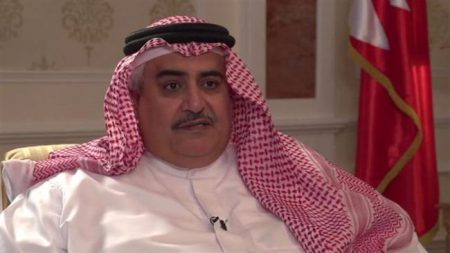
The Bahraini foreign minister’s surprising tribute to former Israeli president Shimon Peres who died Wednesday has triggered a wave of outcry in the region where he is known as a criminal.
“Rest in Peace President Shimon Peres, a Man of War and a Man of the still elusive Peace in the Middle East,” Sheikh Khaled bin Ahmed al-Khalifa posted on his Twitter account.
The tribute drew the ire of many online users as well as opposition figures, given that a large number of Arabs view Peres as the man responsible for the successive wars that have rocked the Middle East.
“The foreign minister is paying tribute and praying for the Zionist terrorist and the killer of children,” complained former opposition lawmaker Jalal Fairooz.
Another critic, Khalil Buhazaa, tweeted, “Diplomacy does not mean rudeness.”
Manama does not have diplomatic relations with Tel Aviv but some Arab states, chiefly Saudi Arabia, have recently moved to warm relations with the Israeli regime.
Bahrain is under the heavy influence of Saudi Arabia which is spearheading the push for rapprochement with Israel.
Among Arab leaders, only Palestinian Authority President Mahmoud Abbas has offered condolences to Peres’s family, describing him as a partner in peace.
However, many across the world would remember Peres as a “war criminal” especially in light of the 1996 Qana massacre. In that Israeli attack on a southern Lebanese village, at least 106 people were killed. Peres was then prime minister.
Born in Poland in 1923, Peres emigrated to what was then British-mandated Palestine when he was 11. He joined the Zionist movement and met David Ben-Gurion, who would become his mentor and Israel’s first prime minister.
Peres became director general of the nascent ministry of military affairs at just 29. He was also seen as a driving force in the development of the Israel’s undeclared nuclear program.
Palestinians say Peres has their blood on his hands. Like other Zionist leaders, Peres also allowed Israeli settlement construction to take place in Palestinian land during his years in leadership positions.
The impoverished Gaza Strip witnessed two full-scale wars under Peres’s tenure as president, which claimed the lives of more than 3,700 Palestinians in total.
The Palestinian resistance movement Hamas has called on Palestinians to hold a “Day of Rage” on Friday which will coincide with the funeral of Peres.
The call is meant to mark the one-year anniversary of the beginning of what is described as the third Intifada throughout the occupied West Bank and Jerusalem al-Quds.
There are oh so many varieties of Zio-washing: pink-washing, green-washing, Black-washing, even Muslim-washing. Now, there’s another to add to the treasury of hasbara promoted by Israel to the world: nuke-washing. I wrote about a similar domestic effort at cleansing Israel’s nuclear warheads of the stench of potential mass murder.
The IAEA celebrated its 60th anniversary in Vienna, its headquarters, recently. And Israel was there with its very own exhibit featuring the innovations and contributions which Israel’s nuclear program has bestowed on humanity. No mention, of course, of Israel’s 200 nuclear weapons and the legacy that they’ve given the world. No mention, of course, that Israel has refused to join the only international agreement limiting the proliferation of nuclear weapons, the NPT. No mention of the fact that Israel has torpedoed a U.S. and Arab effort to hold a regional conference leading to declaring the Mideast a nuclear-free zone.
Instead, we have Rays of Hope (get it? radiation=rays), Israel’s latest marketing effort to persuade the world to ignore its worst deeds and focus instead on deeds that are marginal at best in their overall impact on Israel or the world. A press release from the prime minister’s office hails this as Israel’s first international exhibit of its accomplishments in the field. Here’s some of the marketing jargon, which is about as revoltingly hypocritical as any political statement can be:
The Israeli pavilion highlights Israel as a master of research innovation in the areas of nuclear use for educational, scientific, and agricultural purposes, and for production of clean energy. Director of the Israeli Atomic Energy Commission, Brig. Gen. (res.) Zeev Snir told the attendees:
“Israeli developments in the nuclear field have spread Rays of Hope and inspiration to many people. Our scientific achievements permit us to manufacture critical equipment for medical treatment, agriculture, security, and safety throughout the world. Our future in the Middle East must include cooperation and joint responsibility for the health and well-being of the people’s of the region. In the spirit of the IAEA, I call upon our neighbors to join to join us and transform a dream into reality.”
Really? Cooperation? Like Israel’s rejection of the NPT? Responsibility for the health and well-being of the region? Does that include the massive poisoning of the environment surrounding the Dimona nuclear reactor and the hundreds, if not thousands of workers who’ve died of lethal doses of radiation? Does it include the impact that Israel’s 200 warheads might have on the region if even one of them was used, as Moshe Dayan advocated during a bleak moment at the outset of the 1973 War?
More nuke-washing: happy shiny Dimona’s website home page
Contrary to the incessant grandstanding by US and British politicians that they are committed to promoting freedom, democracy and peace around the world, the evidence proves that the Anglo-American establishment is in the business of war, destabilization and conflict creation. On top of the numerous imperial wars in the Middle East and North Africa that the Anglo-American establishment has spearheaded, the true nature of these two powers is further confirmed by the fact that Britain is now officially the second biggest arms dealer on the planet, second only to the US.
On average over the last decade, Britain has sold more weapons than Russia, China and France, according to the UK Trade and Investment department. Two-thirds of the weapons have been sold to Middle Eastern countries since 2010, fuelling many of the deadly conflicts in the region. Recipients of British weapons include 22 of the 30 countries on the UK governments own human rights watch list, further illustrating the complete hypocrisy of British politicians.
Britain has supplied an array of deplorable powers with military hardware, many of which are involved in committing atrocities with those weapons: including illegally supplying Saudi Arabia with Eurofighter Typhoon jets and missiles that have been used in the abhorrent war on Yemen; supplying Israel with arms that have been used in the IDF’s frequent massacres of Palestinians; in addition to selling shotguns, stun grenades and teargas, to the regime in Bahrain – which have been used to suppress protests in the country.
When the US and Britain are not busy killing Syrian soldiers who are fighting against ISIS, they are flooding the most war-torn region on earth (thanks to Western wars) with weapons. The likes of Raytheon, Lockheed Martin, Northrop Grumman, Boeing and BAE Systems, have been making a killing off the perennial wars we have seen in the 21st century. The new Western-manufactured Cold War 2.0 has also proved to be beneficial for the war giants, as this is used to justify exorbitant defense/war budgets.
The power and influence of war contractors is nothing new in the West however. In his farewell address to the nation in 1961, the 34th President of the US, Dwight D. Eisenhower, warned the American people of the dangers of this insidious “military-industrial complex:”
“This conjunction, of an immense military establishment and a large arms industry, is new in the American experience. The total influence – economic, political, even spiritual – is felt in every city, every state house, every office of the federal government. We recognise the imperative need for this development, yet we must not fail to comprehend its grave implications… In the councils of government, we must guard against the acquisition of unwarranted influence, whether sought or unsought, by the military-industrial complex. The potential for the disastrous rise of misplaced power exists, and will persist. We must never let the weight of this combination endanger our liberties or democratic processes.”
It is clear that Eisenhower’s warning fell on deaf ears, as the nefarious influence of the military-industrial complex has only grown since he made his historic speech. The amount of money the US spends on defence is staggering comparative to the rest of the world, with the 2015 US defense budget more than three times the size of China’s, and more than nine times the size of Russia’s. The American taxpayer has been filling the pockets of the CEOs of the war giants for too long now, with the decade-and-a-half since 9/11 proving to be an immensely profitable period for these immoral contractors.
Russia Now Earns More from Agriculture than Arms
Whilst the US and Britain are leading the world in arms sales, Russia is now earning more from agricultural exports than arms sales. Last year, Russia replaced the US as the largest producer and exporter of wheat, with grain production increasing in Russia over the past six years. Russia has also established herself as one of the main leaders of the organic revolution that we have seen sweep the world in recent years, as the toxicity of GMO becomes blatantly evident for all to see.
Western aggression is, and will continue to be, the most destructive force on earth. The wars in Afghanistan, Iraq and Libya, have brought nothing but misery and devastation to these countries. The West’s proxy war in Syria brought further destabilization and chaos to the region, as well causing the refugee and migrant crisis that has gripped Europe. The 2013-14 colour revolution in Ukraine and the subsequent war in the country serves as yet another example of the pernicious fruits of Western imperialism. If we add on top of all this carnage, the US-led drone wars and the Anglo-American dominated arms industry, there is no question that the Anglo-American war machine is the greatest impediment to global stability today.
“I’m going to give you credit for the ‘peaceful’ protests” wrote Huma Abedin to Hillary Clinton in the lead up to the collapse of the Mubarak regime in Egypt as evidence mounts that the United States manufactured the overthrow of an ally.
New documents first analyzed by Breitbart News show that the US State Department under Hillary Clinton developed and forged a program first started in the last months of the Bush presidency focused on training radical groups, including the controversial Muslim Brotherhood, on how to effectively use social media and other communication outlets to cause disruption and even topple governments.
The program known as Alliance of Youth Movements Summit was co-founded by a close adviser to Clinton, Jared Cohen, during his tenure with the State Department at the end of George W. Bush’s presidency, which enabled anti-Mubarak activists to organize and plot the eventual overthrow of Egyptian leader Hosni Mubarak.
The program was forged on November 18, 2008, only two weeks after Barack Obama was elected US President but during the “lame-duck” portion of the Bush administration with the first summit held at Columbia Law School in New York.
The seminar focused on using social media outlets including Facebook and MySpace to engage in a tactic called “smart mobbing” in which mobile devices are used to quickly assemble and coordinate mass rallies and protests before authorities are able to fully respond according to Cohen.
The controversy surrounds a particular attendant of the event, a Muslim Brotherhood activist, who was allowed to attend the summit, speak before the audience, network and was introduced to US government officials despite expressing his interest in removing Mubarak from power. Government documents show that officials were aware that the activist had intentions to use social media with acute precision, including systematically alternating sim cards to avoid government detection and avoidance, to forge a movement capable of overthrowing the Mubarak regime.
One of the US government dispatches regarding the individual was even titled “Washington Meetings and April 6 Ideas for Regime Change” and detailed that the activist had met with a “variety” of congressional staffers, two US Senate staffers, and several think tanks and was even invited to speak at a US Congress hearing on House Resolution 1303 on political and religious rights in Egypt.
The US State Department under Hillary Clinton took bold steps to execute the vision initially laid out by Cohen partnering with Google, Facebook and other tech companies to sponsor the 2009 Alliance of Youth Movements in Mexico City on October 16, 2009 in Mexico City addressing that summit for “citizen activists” interested in creating change in their countries via video message.
The Alliance of Youth Movements later spawned into Movements.org in 2011 which has been credited with playing a key role in enabling Egyptian activists to organize rapidly beyond the stretch of government surveillance and before the country’s officials could orchestrate an appropriate response.
The reality that the protesters behind the Arab Spring movement received Western training in how to effectively organize and coordinate using social media hardly comes as a surprise given the unprecedented level of sophistication employed by the activists, but the fact that the US State Department knew and accepted that the training may be employed to overthrow the government of an ally does represent a shocking and untoward revelation.
British Labour Party leader Jeremy Corbyn has retained the leadership of the opposition political party after a bruising campaign.
Corbyn, who was initially elected last year, took 62 percent of the vote, beating challenger Owen Smith on Saturday.
Surveys had indicated that Corbyn would easily defeat his challenger as he maintained widespread support of party members attracted by his socialist anti-austerity policies and “authentic” image.
On Wednesday, Corbyn urged for the party to unite behind his leadership. He reminded lawmakers that he has the support of rank-and-file members of the party and warned them not to challenge him again.
“We owe it to the millions of people Labour exists to represent to end the sniping and personal attacks, and work together for all those who depend on the election of a Labour government. Anything else would be destructive self-indulgence,” Corbyn said in a statement.
“All Labour Party members and MPs have a responsibility to work within the democracy of our party and respect the leadership of whoever is elected.”
The 67-year-old socialist and peace campaigner has shown little interest for Britain’s special relationship with the US and is opposed to nuclear weapons, including the costly Trident nuclear missile system that is maintained by the US.
Corbyn also is a critic of Israel and NATO. As member of the Palestine Solidarity Campaign, he invited members of the Hezbollah and Hamas resistance movements in 2009 to parliament where he called them “friends.”
By Jon Vale | The Independent | September 23, 2016
The Campaign Against Anti-semitism (CAA) has filed a formal complaint against Labour leader Jeremy Corbyn.
The group has taken action over a video posted on Mr Corbyn’s official Facebook and Twitter accounts.
In the video, Mr Corbyn’s supporters answer questions on topics they are “tired of hearing” about, which includes whether they promote anti-semitism.
The video has subsequently been deleted from social media.
The CAA said this is the latest in a long of line of incidents where Mr Corbyn and his supporters have failed to address anti-semitism. […]
The letter accuses Mr Corbyn of “committing acts that are grossly detrimental to the party, namely characterising Jewish people as dissembling and dishonest in their reporting of anti-semitism, and by using the influence and prestige of his office to disseminate and normalise that lie”.
It continues: “The allegation that Jews lie and deceive in order to further hidden agendas is an age-old anti-semitic trope.
“It has now been manifestly deployed by Mr Corbyn in his leadership campaign video.” … Full article
Manipulation of public perception has risen to a new level with the emergence of powerful social media. Facebook, Twitter and Google are multibillion dollar corporate giants hugely influencing public understanding. Social media campaigns include paid ‘boosting’ of Facebook posts, paid promotion of Tweets, and biased results from search engines. Marketing and advertising companies use social media to promote their clients. U.S. foreign policy managers hire these companies to influence public perception to support U.S. foreign policy goals. For example, Secretary of State Hillary Clinton made sure that Twitter was primed for street protests in Iran following the 2009 election. She insured that Twitter was ready to spread and manage news of protests following the election and strange killing of a young woman. (p 423, Hard Choices hardback).
The results of media manipulation can be seen in the widespread misunderstanding of the conflict in Syria. One element of propaganda around Syria is the demonization of the Syrian government and leadership. Influenced by the mainstream and much alternative media, most in the West do not know that Bashar al Assad is popular with most Syrians. There were three contestants in the Syrian presidential election of June 2014. Turnout was 73% of the registered voters, with 88% voting for Assad. In Beirut, the streets were clogged with tens of thousands of Syrian refugees marching through the city to vote at the Syrian Embassy. Hundreds of Syrian citizens from the USA and other western countries flew to Syria to vote because Syrian Embassies in Washington and other western capitals were shut down. While John Kerry was condemning the Syrian election as a “farce” before it had even happened, a marketing company known as The Syria Campaign waged a campaign to block knowledge of the Syrian election. Along with demonizing President Assad, they launched a campaign which led to Facebook censoring information about the Syrian election.
The Syria Campaign was created by a larger company named “Purpose”. According to their own website they “incubated” The Syria Campaign.
The major achievement of The Syria Campaign has been the branding and promotion of the “White Helmets”. The “White Helmets”, also known as “Syria Civil Defense”, began with a British military contractor, James LeMesurier, giving some rescue training to Syrians in Turkey. Funding was provided by the US and UK. They appropriated the name from a real Syria Civil Defense.
The “White Helmets” are marketed in the West as civilian volunteers doing rescue work. On 22 September 2016 it was announced that the Right Livelihood Award, the so called “Alternative Nobel Prize”, is being given to the US/UK created White Helmets “for their outstanding bravery, compassion and humanitarian engagement in rescuing civilians from the destruction of the Syrian civil war.”
The Right Livelihood organizers may come to regret their selection of the White Helmets because the group is not who they claim to be. In fact, the White Helmets are largely a propaganda tool promoting western intervention against Syria. Unlike a legitimate rescue organization such as the Red Cross or Red Crescent, the “White Helmets” only work in areas controlled by the armed opposition. As shown in this video, the White Helmets pick up the bodies of individuals executed by the terrorists, they claim to be unarmed but are not, and they falsely claim to be neutral. Many of the videos from AlQaeda/terrorist dominated areas of Syria have the “White Helmets” logo because the White Helmets work in alliance with them. This primarily is a media marketing tool to raise public support for continuing the support to the armed opposition as well as the demonization of the Syrian government.
The Rights Livelihood press release says the White Helmets “remain outspoken in calling for an end to hostilities in the country.” That is false. The White Helmets actively call for US/NATO intervention through a “No Fly Zone” which would begin with attacks and destruction of anti-aircraft positions. Taking over the skies above another country is an act of war as confirmed by US General Dempsey. The White Helmets have never criticized or called for the end of funding to extremist organizations including Nusra/AlQaeda. On the contrary, White Helmets is generally embedded with this organization which is defined as “terrorist” by even the USA. That is likely why the head of the White Helmets, Raed Saleh, was denied entry to the USA.
The foreign and marketing company origins of the White Helmets was exposed over one and a half years ago. Since then, Vanessa Beeley has revealed the organization in more depth in articles such as “Who Are the White Helmets?” and “War by Way of Deception“.
Despite these exposes, understanding of the White Helmets is limited. Many liberal and progressive people have uncritically accepted the propaganda and misinformation around Syria. Much of the progressive media has effectively blocked or censored critical examinations amid a flood of propaganda about “barrel bombs” dropped by the ‘brutal dictator” and his “regime”.
In the last week, Netflix started showing a 40 minute documentary movie about the “White Helmets”. It is actually a promotion video. A substantial portion of it takes place in Turkey where we see trainees in hotel rooms making impassioned phone calls to inquire about their family in Syria. The “family values” theme is evident throughout. It’s a good marketing angle, especially effective with females. The political message of the video is also clear: after a bombing attack “It’s the Russians …. they say they are fighting ISIS but they are targeting civilians”. The movie includes video previously promoted by the White Helmets such as the “Miracle Baby” rescue. It’s debatable whether this incident is real or staged. The video includes self promoting proclamations such as “You are real heroes”. While no doubt there are some real rescues in the midst of war, many of the videos purporting to show the heroes at work have an unrealistic and contrived look to them as revealed here.
“Alternative media” in the West has sadly echoed mainstream media regarding the Syria conflict. The result is that many progressive individuals and groups are confused or worse. For example, the activist group CodePink recently issued a media release promoting the Netflix White Helmets propaganda video.
The White Helmets video is produced by Grain Media and Violet Films/Ultra-Violet Consulting. The latter advertises itself as a marketing corporation specializing in social media management, grant writing, crowd building and campaign implementation. The only question is who paid them to produce this video.
There is growing resistance to this manipulation and deception. In response to a petition to give the Nobel Peace Prize to the White Helmets, there is a counter petition at Change.org. The Right Livelihood Awards have just been announced and there will soon be a petition demanding retraction of the award to the White Helmets.
The story of the White Helmets is principally a “feel good” hoax to manipulate public perception about the conflict in Syria and continue the drive for “regime change”. That’s why big money was paid to “Purpose” to “incubate” The Syria Campaign to brand and promote the White Helmets using Facebook, Twitter, etc. That’s why big money was paid to create a self-promotional documentary. The judges at Rights Livelihood were probably influenced by the documentary since critical examination of facts around Syria is so rare. It’s a sad commentary on the media. As Stephen Kinzer recently said,
“Coverage of the Syrian war will be remembered as one of the most shameful episodes in the history of the American press.”
UK Contractor
White Helmets and Nusra
White Helmets After Execution
PurposeIncubation The Syrian Campaign
Rick Sterling is a retired aerospace engineer who now does research/writing on international issues. He can be reached at rsterling1@gmail.com.
By Jamal Kanj – Intifada-Palestine.com – January 14, 2011
Israel’s survival kit is: perpetuate conflict, insecurity to rationalize collective hate and finally playing victim.
Devoid of conflict, Israel implodes internally; without hate, Zionism loses its justification; and playing eternal victim to continue blackmailing the West. Absence of this holy trinity, Israel ceases to exist.
From its inception, the house of Zion has mastered exploiting adversarial powers to advance Israel’s cause. For instance, their influence over the Democratic Party in the US began with President Truman’s bid for 2nd term election in 1948.
Responding to strong opposition from Secretary of State General George Marshall and Department experts urging against recognition of Israel, President Truman replied: “I’m sorry gentlemen but I have to answer to hundreds of thousands [Jewish voters] who are anxious for the success of Zionism. I do not have hundreds of thousands of [voting] Arabs among my constituents”
Zionists influence over liberal American politics was matched with the doctrinal school of Conservative theoreticians aligning the Republican Party’s platform with Israel’s objectives. The Neoconservative Zionists, coined Zioncons, invented the “Clash of Civilization” concept to fight Israel’s wars. … continue
This site is provided as a research and reference tool. Although we make every reasonable effort to ensure that the information and data provided at this site are useful, accurate, and current, we cannot guarantee that the information and data provided here will be error-free. By using this site, you assume all responsibility for and risk arising from your use of and reliance upon the contents of this site.
This site and the information available through it do not, and are not intended to constitute legal advice. Should you require legal advice, you should consult your own attorney.
Nothing within this site or linked to by this site constitutes investment advice or medical advice.
Materials accessible from or added to this site by third parties, such as comments posted, are strictly the responsibility of the third party who added such materials or made them accessible and we neither endorse nor undertake to control, monitor, edit or assume responsibility for any such third-party material.
The posting of stories, commentaries, reports, documents and links (embedded or otherwise) on this site does not in any way, shape or form, implied or otherwise, necessarily express or suggest endorsement or support of any of such posted material or parts therein.
The word “alleged” is deemed to occur before the word “fraud.” Since the rule of law still applies. To peasants, at least.
Fair Use
This site contains copyrighted material the use of which has not always been specifically authorized by the copyright owner. We are making such material available in our efforts to advance understanding of environmental, political, human rights, economic, democracy, scientific, and social justice issues, etc. We believe this constitutes a ‘fair use’ of any such copyrighted material as provided for in section 107 of the US Copyright Law. In accordance with Title 17 U.S.C. Section 107, the material on this site is distributed without profit to those who have expressed a prior interest in receiving the included information for research and educational purposes. For more info go to: http://www.law.cornell.edu/uscode/17/107.shtml. If you wish to use copyrighted material from this site for purposes of your own that go beyond ‘fair use’, you must obtain permission from the copyright owner.
DMCA Contact
This is information for anyone that wishes to challenge our “fair use” of copyrighted material.
If you are a legal copyright holder or a designated agent for such and you believe that content residing on or accessible through our website infringes a copyright and falls outside the boundaries of “Fair Use”, please send a notice of infringement by contacting atheonews@gmail.com.
We will respond and take necessary action immediately.
If notice is given of an alleged copyright violation we will act expeditiously to remove or disable access to the material(s) in question.
All 3rd party material posted on this website is copyright the respective owners / authors. Aletho News makes no claim of copyright on such material.