Western governments considering easing nuclear demands on Iran: EU
Al-Akhbar | October 2, 2013
Western governments are considering allowing Iran to continue some uranium enrichment, as part of a possible deal to resolve a decade-old dispute that Tehran says it wants to reach within six months, a senior EU diplomat said.
The new stance – a reaction to President Hassan Rohani’s overtures to the West – would mean easing a long-standing demand that Iran suspend all enrichment, due to concerns Tehran could be developing nuclear weapons.
In an interview with Reuters, Lithuanian Foreign Minister Linas Linkevicius said: “I believe part of the game is that if the Iranians prove that whatever they are doing is peaceful, it will, as I understand, be possible for them to conduct it.”
“It’s conditional. It is not a done deal, but nevertheless it is a possibility to explore,” he said. “Thanks to this rapprochement. How it will look, we don’t know.”
Lithuania holds the rotating presidency of the European Union until the end of this year, giving Linkevicius a closer insight into many internal policy debates.
A series of UN Security Council resolutions call on Iran to halt enrichment. One of them demands “full and sustained suspension of all enrichment-related and reprocessing activities.”
Iran has refused to comply, saying its membership of the Nuclear Non-Proliferation treaty (NPT) gives it the right to pursue peaceful nuclear technology. That refusal has drawn several rounds of UN and Western sanctions.
Rohani, a moderate elected in June, has reiterated Iran’s insistence that it does not seek nuclear weapons, but has promised to clear up international concerns, hoping for an easing of sanctions that have hit its ability to export oil.
Western diplomats are cautious about the rapprochement, saying Iran has yet to offer any concrete proposals.
But, privately, many acknowledge that Tehran would likely need to be allowed to keep some lower-level enrichment activity as part of a broader political settlement, as long as UN inspectors were allowed sufficient oversight powers.
Israel, which claims the prospect of a nuclear-armed Iran is a threat to its existence, is insistent that nothing short of an end to enrichment is acceptable.
Israeli Prime Minister Benjamin Netanyahu told a UN summit Tuesday that the Jewish state was ready to act alone to halt Iranian efforts to build a nuclear bomb, a charge Tehran vehemently denies.
“Israel will not allow Iran to get nuclear weapons. If Israel is forced to stand alone, Israel will stand alone,” Netanyahu said in an attack on overtures made by Rohani.
Israel is widely believed to have a nuclear weapons arsenal. It is the only country in the Middle East that hasn’t signed the NPT treaty.
Iran’s top general on Wednesday rejected Israel’s threat of military strikes.
“Today the choice of military option is rusted, old and blunt. It is put on a broken table that lacks stability,” said armed forces chief-of-staff Hassan Firouzabadi, quoted by Fars news agency.
“Such remarks stem out of desperation,” he said, slamming Netanyahu as a “warmonger.”
In a series of negotiations since April last year, six world powers have told Iran to stop enriching uranium to 20 percent fissile purity – a level that closes an important technological gap towards making weapons-grade material.
That demand will not change, diplomats say. But, in theory, Iran could be allowed to continue lower-level enrichment, up to 5 percent, to produce fuel suitable for nuclear power plants.
The next round of the talks between Iran and the six world powers, will be held in Geneva on October 15 and 16.
(Reuters, AFP, Al-Akhbar)
Related articles
Democracy Syrian-style
By Ken Meyercord | Dissident Voice | September 27, 2013
One thing about the ongoing crisis in Syria almost never mentioned in our media — even the alternative media — is the role of the nonviolent opposition to the Baathist regime. After the uprising began in the spring of 2011, the government engaged this opposition in discussions about reform of the Syrian political system. Out of these discussions came a new constitution, approved in February 2012 by 90% of the electorate in a popular referendum with a 57% turnout rate.
Prior to the new constitution, Syria was officially a one-party state: the Baathist party, to which the current and former president belonged, being that party. In 2007 the nomination by the Syrian parliament of Bashar al-Assad as President of Syria was approved by 98% of the electorate with a 96% turnout rate — just the sort of mandate you would expect of an authoritarian regime. Under the new constitution Syria became a multiparty state; elections to parliament were open to any political party.
In May of last year parliamentary elections under the new constitution were held. There were two blocs contending for the vote: the pro-government National Progressive Front, comprised of 6 parties, and the oppositional Popular Front for Change and Liberation, which included two parties. Of the 250 seats in the assembly, the Baathists won 134 seats with 34 seats distributed among the other parties in the National Front, including 6 seats for the two factions of the Communist Party. The opposition shared 5 seats. Seventy-seven members of the new parliament were not affiliated with any party. The constitution stipulates that at least half of the members of the assembly must be workers or farmers.
In other words, the Syrian parliament encompasses a diversity of opinion we can only dream of seeing in our own Congress — quite a coup for the nonviolent opposition. An election for President is scheduled for next May, quite a concession for a man our media labels a “thug”, “dictator”, “tyrant”, especially as most governments, including our own, when facing a stressful situation become more authoritarian (e.g., Lincoln’s suspension of habeas corpus, Palmer Raids of the 1920s, the Patriot Act, etc.) . What more does the violent opposition want? No wonder they have to rely on foreign Jihadists to do their fighting!
Critics of the Syrian regime will claim the elections were fraudulent, or, as the Obama administration put it, “ludicrous”. I have no idea whether this is the case and would welcome the views of those better informed than me. I suspect critics of the elections seldom offer any supporting evidence for their claims. Every country grapples with seeing that their elections are fair (cf. Voter ID laws). Before we dismiss the newfound democracy in Syria as a sham, maybe we should give it a chance, especially as the lives of thousands of people — mostly Syrian but perhaps some of our own — are at risk. If the administration’s goal in Syria is regime change, maybe it should wait and see whether the Syrian people effect it in a peaceful manner next spring or, if the incumbent is re-elected, accept the fact that democracy doesn’t always work out the way we would like.
Postscript: If you didn’t know about recent political developments in Syria, don’t feel bad. I attended an event today where none of the speakers — neither Cole Bockenfeld and Stephen McInerney of the Project on Middle East Democracy (POMED) nor Shadi Hamid, Fellow at the Saban Center for Middle East Policy at the Brookings Institution — were aware of the elections held under the new Syrian constitution.
~
Ken Meyercord is an avid follower of foreign affairs who has visited over 70 countries and worked in four of them. He has a Master’s in Middle East History from the American University of Beirut. He produces a public access TV show called Worlddocs which he bills as “bringing the world to the people of the Washington, DC area through documentaries you won’t see broadcast on corporate TV.”
Israel’s Allies Deliver A Cost-free Victory
By Jeremy Salt | Palestine Chronicle | September 25, 2013
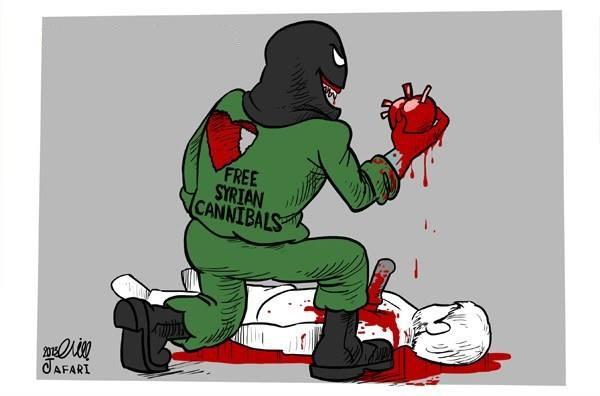
Until joined by the Islamic government in 1979 and then by Hizbullah in the 1980s, Syria was Israel’s most visceral enemy. This enemy is now being destroyed but not by Israel. So-called Muslims backed by so-called Muslim governments – Saudi Arabia, Qatar and Turkey – are doing the job for it, in alliance with the traditional western enemies of the Arabs. Syria’s cities and towns have been devastated. An estimated 100,000 people have been killed. Millions more have been displaced, scattered across Syria or seeking refuge beyond its borders. Reconstruction will cost hundreds of billions of dollars. Recovery will take decades. Without spending a penny or losing a life, Israel has been handed one of the greatest strategic victories in its existence.
Michael Oren let the scarcely concealed cat out of the bag the other day when he said Israel would prefer a Syria without Bashar al Assad to a Syria in the hands of the jihadists. The outgoing Israeli ambassador in Washington, Oren was only bringing something to the surface that could be seen underneath it despite the vociferous denials of Israel’s lobbyists. Israel wants the government in Damascus destroyed. Netanyahu has been trying to hide its interest behind a mask of indifference but as the likelihood of a US military ‘strike’ – for a war that would engulf the region – slipped away, the lobbyists in Washington broke cover. They buttonholed every congressman and women, only for the vote on war to be postponed indefinitely, much to the chagrin of the gulf and Turkish governments, their armed and political protégés and the Israeli government.
While the Syrian army continues to grind the armed groups down, there seems no end to the volume of money, armaments and men outside governments are still prepared to pour into this conflict. Obama is still trying hard to get Russian agreement on a UNSC resolution that would allow the US to begin another war in the Middle East by attacking Syria. In the meantime the armed groups are continuing with the war they are waging. In his recent interview with former US congressman Dennis Kucinich and Fox news correspondent Greg Palkot, Bashar al Assad estimated that 80 to 90 percent of the armed men are Al Qaida-type takfiri jihadists. The ‘defence’ consultancy HIS- Janes puts the figure at about 50 per cent but whether it is 50 per cent or 90 cent, whether they are foreign or Syrian, the jihadists are dominating the fighting. Talk of moderates is deception. Only in the last few days the main fighting groups – all takfiri – have again rejected the authority of the exile Syrian National Coalition and the so-called Free Syrian Army. This is presented as something new when at least a year ago the very same groups issued the same kind of declaration saying the same things. The so-called FSA is the western standard bearer for ‘moderation’ in this struggle even though its brigades are every bit as fanatical as Jabhat al Nusra or any of the other takfiri groups.
If the Syrian government does fall – and at the moment it is not only holding its ground but steadily driving the takfiris back – chaos would prevail in Syria on a far greater scale than Libya at present or Algeria in the 1980s. The country would implode. This is so self-evident that the US and its allies must know it and if they know it, one has to presume that this is what they want. Saudi Arabia is out to destroy the Syrian government regardless of the consequences. Britain and France are following the US and US policy on any issue in the Middle East is largely fashioned according to the interests of Israel. Turkey is the odd man out. Whatever Recep Tayyip Erdogan thought he was going to get out of confronting Syria his own country has been very adversely affected by his decisions. The breakdown of Arab states into sectarian enclaves permanently at war with each other has been an Israeli strategic objective for decades. It has happened in Iraq and now the specter of the collapse of another unitary Arab state hovers over Syria.
While the takfiris do their best to destroy Syria, Israel is getting on with the colonization of Palestinian territories as fast as it can. The current wave of settlement expansion is the greatest since 1967. In the past year edicts have been pouring out of the Housing Ministry authorizing the construction of thousands of housing ‘units’ in East Jerusalem and across the West Bank. The strategic focus is on settlement expansion in and around East Jerusalem and the construction of highways and roads that will simultaneously integrate the settlements into the greater Jerusalem municipality (enlarged immediately after the 1967 war) and, along with the Separation Wall, further cut the Palestinians off from the city. In the first quarter of 2013 alone there was a 176 per cent increase in settlement expansion over the same quarter for 2012.
In August this year, just as the ‘peace talks’ were resuming, Israel announced the construction of thousands more housing ‘units’ in East Jerusalem settlements. The mainstream media tells us that settlement expansion is ‘impeding’ peace, ‘threatening’ the peace talks and the ‘two state’ solution. The plain fact is that there are no ‘peace talks’. They are the camouflage for the war Israel has been waging against the Palestinians for seven decades. To their discredit and dishonor Mahmud Abbas and Saib Urayqat are giving these ‘talks’ a Palestinian face. By announcing settlement construction in the same breath as announcing the resumption of ‘peace talks’ Israel shows its absolute contempt for both of them.
Land expropriation and development for agricultural purposes continues unabated. So does the theft of water. The Council for European Palestinian Relations estimated recently that the settlers consume an average of 280 liters of water a day compared to 86 liters for the Palestinians, below the World Health Organization’s recommended minimum of 100 liters. Only 60 per cent of the water allocated to the Palestinians is potable. While taking their land Israel simultaneously uses it as a rubbish dump, with solid waste from West Jerusalem being dumped at Abu Dis, once set up by Israel as the Palestinian ‘capital’ of East Jerusalem even though it was not even inside the municipality until Israel put it there. The settlers do the same, dumping their rubbish and household waste water on Palestinian land in the valleys below their settlements on the hilltops.
In a statement handed to the UN Human Rights Council fact-finding mission to Palestine in February this year, Al Haq (Law in the Service of Man) presented some statistics. In 2012, 202 ‘incidents’ of settler violence along with dispossession, home demolitions, forcible evictions and intimidation; more than 200 settlements established since 1967, including 14 in East Jerusalem, and more than 500,000 settlers now living in them; and more than 42 per cent of the land of the West Bank as well as most of its resources allocated to Jewish settlements. Al Haq notes that the Israeli High Court ‘has rendered the question of the settlements non-justiciable’.
The Council for European Palestinian Relations estimates that the population in the West Bank settlements is growing at an average of five per cent a year compared to 1.8 per cent for the rest of occupied Palestine. It puts the total number of settlers at 467,000, of which number 385,000 are living in between the Separation Wall and the 1967 ‘green line.’
Every brick laid by Israel on the West Bank, every liter of water pumped out for settlements swimming pools and lawns and the presence of every settler represents a violation of international law. Yet, says Naftali Bennett, the Religious Services Minister and leader of the Jewish Home Party: ‘We will continue building and you will see this soon.’ He was speaking before the August announcement that more housing ‘units’ would be added to Jewish colonies in East Jerusalem. ‘I am sending the message from here to all the parties in the negotiations: the land of Israel belongs to the nation of Israel’. He has pledged to do ‘everything in my power to make sure they never get a state.’
In a leaked exchange with another cabinet minister Bennett said that ‘I’ve killed many Arabs in my life and there’s no problem with that.’ He complained that the conversation had been taken out of context, because what he meant was that he had ‘only’ killed them in the context of operations. There was one such ‘operation’ on the West Bank last week. Heavily armed soldiers stormed into the Jenin refugee camp, broke into the house of the Tubaisi family, shot Islam al Tubaisi, 19, in the leg, dragged him downstairs, his head banging on every step and shot him dead before an ambulance took him to hospital. Perhaps in time the members of this unit will be bragging in time about how they also have killed many ‘Arabs’.
Dig deep enough into the crises in Iraq, Syria and Lebanon and the confrontation with Iran and eventually you will find Palestine. It remains the central issue, the pivot on which US policies, dominated by Israeli interests and demands, has turned for more than six decades, yet for the takfiris affiliated with Al Qaida, killing other Muslims (and Christians) in a variety of countries takes precedence. It is striking that the same heads of government inveighing against terrorism and expressing their outrage at the slaughter of innocents in Nairobi have not once expressed outrage at the slaughter of innocents in Syria unless they thought they could blame the Syrian government.
The call of unity sounds through modern Arab history like the cry of a lost bird. United the Arabs will stand and divided they will continue to fall. As long as they are not able to put common interests first they are going to be ripe for the plucking. What is at stake in Syria is not the political system but Syria itself and for the past three years it has been systematically and deliberately destroyed by an unholy coalition of outside governments and the gangs of armed men doing their dirty work in the name of Islam.
The dominant Arab actors in this deliberately induced catastrophe are the regimes in Riyadh and Doha. They engage with Israel behind the scenes even as it colonizes Palestinian land and sends uniformed gangsters into the Haram al Sharif to beat Muslim worshipers trying to protect one of the holiest sites in Islam. While consorting with the enemy and abandoning the Palestinians these two regimes – infinitely less representative of the will of the people than the government in Damascus – take the lead in the destruction of an Arab state. The greatest beneficiary of their actions on one hand and their inaction and neglect on the other is Israel. This is surely as great a disgrace as any in Arab and Islamic history.
– Jeremy Salt is an associate professor of Middle Eastern history and politics at Bilkent University in Ankara, Turkey.
One-third of Palestinian homes in Jerusalem are threatened with demolition
MEMO | September 26, 2013
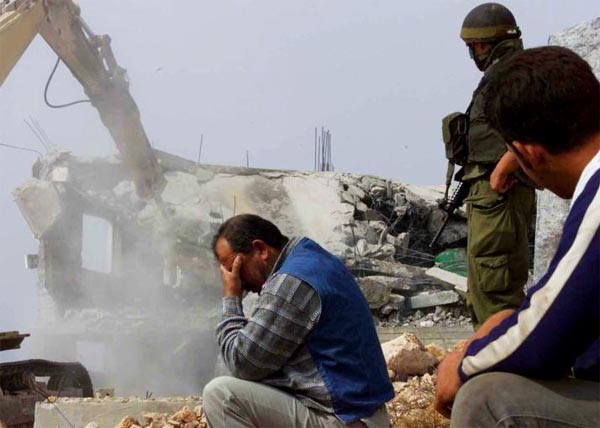
An international human rights organisation has revealed that one-third of the Palestinian-owned houses in Jerusalem face demolition under the pretext that applications for building permits were incomplete. This, claims Euro-Mid Observer for Human Rights, is a way for the Israeli authorities to continue their demographic war against Palestinians in the Holy City. Israel gives Jerusalemite Palestinians the right to use just 13 per cent of the area of occupied East Jerusalem to meet the needs of their growing population.
A report from Euro-Mid shed some light on the widespread Israeli settlement programme in Jerusalem. It mentioned that the financial committee of the Israeli-controlled Jerusalem municipality decided to support 1,500 new settlement units in the city at the end of August. The human rights group also pointed out that Israel’s bulldozers are still razing Palestinian homes in Al-Tour neighbourhood because the authorities plan to set up the “National Israeli Park”.
According to the UN, poverty is getting worse among Palestinians in Jerusalem. Euro-Mid noted that the unemployment rate rose to 78 per cent in 2012 compared with 64 per cent in 2006. More than 40 per cent of Palestinian Jerusalemites now live below the official poverty line; one of the reasons is the disparity in wage rates between Israeli and Palestinian labourers.
Euro-Mid has called upon Israel to stop its frenzy of settlement construction in the occupied territories and to protect Palestinian sovereignty over East Jerusalem, as the potential capital of a Palestinian state.
Related articles
- Israel levels 7 Palestinian homes in East Jerusalem (worldbulletin.net)
- Jewish settlers occupy Palestinian land in Al-Quds (worldbulletin.net)
- Dozens Injured In Jerusalem, Two Kidnapped (imemc.org)
- Palestinians Attacked By Soldiers In Jerusalem’s Old City (imemc.org)
NYTimes Op-Ed Never Appeared in US Edition
NYTimes eXaminer · September 26, 2013
Dear Public Editor,
Many activists who follow the nuclear weapons issue, and the tortured path to nuclear disarmament, were really gratified to see, that for the first time Israel’s nuclear arsenal was discussed in the NY Times in the context of present events in Syria and Iran. However, I was shocked and disappointed to see that this educational op-ed, which sheds so much light on the nuclear disarmament situation today, only appeared in the International Edition of the NY Times, and the people in the US remain ignorant and unenlightened about a significant provocation in the middle east. This news should be published so American citizens can have a broader understanding of what’s involved in actually getting rid of nuclear weapons and stopping further proliferation.
Sincerely,
Alice Slater
Op-Ed that never made it to the US edition:
Let’s Be Honest About Israel’s Nukes
By VICTOR GILINSKY and HENRY D. SOKOLSKI
THE recent agreement between the United States and Russia on Syria’s chemical weapons made clear what should have been obvious long ago: President Obama’s effort to uphold international norms against weapons of mass destruction in the Middle East will entangle the United States in a diplomatic and strategic maze that is about much more than Syria’s chemical arsenal. … Read more
Obama reeks of sulfur at the UN
A Black Agenda Radio commentary by BAR executive editor Glen Ford | September 25, 2013
President Obama went to the United Nations this week and declared war against the UN’s most fundamental founding principles, all the while claiming the U.S. is the world’s one indispensable, unique and exceptional nation.
The speech was a reminder of the reason rich people in America financed and sponsored Obama’s rise to the presidency in the first place, as the new, non-white face of U.S. imperial power. Obama’s foreign policy mission was to subvert United Nations prohibitions against the use of force except in self-defense, and to substitute a so-called “humanitarian” rationale justifying aggression by Washington and its allies. This constitutes a fundamental break with the UN Charter, signifying that the U.S. realizes it can no longer dominate the world by economic and other “soft power” and must, therefore, sweep away the accumulated structures of international law that inhibit America’s ability to smash its adversaries with raw military force.
Obama’s speech was one long threat against world order and the rule of law. He baldly stated that the U.S. is prepared to “use all elements of [its] power, including military force, to secure [its] core interests in the region” – a statement that is, on its face, a violation of the UN’s prohibition against the threat of the use of force against other nations. International law forbids the powerful from rattling their sabers over perceived challenges to their “interests” in other people’s countries. Obama, like the honey badger, doesn’t give a damn about international law.
He says that, “wherever possible” he will try to “respect the sovereignty of nations,” but will “take direct action” – meaning, military force – “when it is necessary to defend the United States against terrorist attacks.” That’s another way of saying the U.S. reserves the right to send drones anywhere in the world to kill whoever it wants, whenever it wants, for its own reasons that are nobody else’s business – which is the behavior of an outlaw, rogue state.
Among the “interests” that the U.S. sees as just cause for going to war, is the promotion of what Obama calls “democracy, human rights, and open markets” in the Middle East and North Africa. “These objectives,” says Obama, “are best achieved when we partner with the international community and with countries and people of the region.” Translation: The U.S. will continue to form “coalitions of the willing” to use military force for regime change or to preserve the status quo, circumventing the United Nations – a gross violation of international law.
Obama claims that “America is exceptional” precisely because it will go to war for so-called “humanitarian” reasons in order to prevent violence to civilians before it has occurred – that is, wars based on Washington’s readings of its own crystal balls, such as NATO’s war against Libya. This is actually the doctrine of pre-emptive war, which is a blatant violation of the UN Charter whether the rationale is “humanitarian” or some other excuse.
In a final obscenity, Obama concludes with a shameless reference to Dr. Martin Luther King’s “dream.” Forty-six years ago, Dr. King declared that the U.S. was the “greatest purveyor of violence in the world.” That is what is so exceptional about America: its relentless quest for military domination of the planet and utter disregard for the norms of law and civilization. Barack Obama is the planetary Warmonger-in-Chief. His breath smells of sulfur, just as George Bush’s did when he addressed the UN, seven years ago.
Glen Ford can be contacted at Glen.Ford@BlackAgendaReport.com.
Related article
Is the Israel Lobby Only a Chimp Among Gorillas?
By DIANA JOHNSTONE | CounterPunch | September 23, 2013
Some friendly criticism of our article “The People Against the 800 Pound Gorilla” provides a welcome opportunity to clarify the discussion. Shamus Cooke, while largely agreeing with the points made by Jean Bricmont and myself, reproaches us for focusing on the pro-Israel lobby as the major factor promoting U.S. war against Syria to the detriment of much bigger factors: the U.S. capitalist class, the big banks, “empire”, oil, the military-industrial complex – in a word, capitalism.
The problem with our article, writes Shamus Cooke, “is that the authors elevate the Israeli gorilla to a weight class it doesn’t belong in; and in so doing the authors are forced to minimize the size of several other giant gorillas, whose combined weight overshadows the Israeli chimp.”
Of course, “capitalism”, however you want to define it, vastly dwarfs the Israel lobby. So do the military-industrial complex, the oil business, or U.S. imperialism, all of which have existed prior to and independently of the Israel lobby.
But is weighing the Israel lobby against “capitalism” a valid comparison? The Israel lobby is a clearly identifiable pressure group, with names, addresses and policies that are clearly stated. Capitalism is an economic system that at present, since the collapse of the Soviet Union, prevails in almost the entire world. Today, every specific policy in most countries is defined within a capitalist context, and some of those policies, notably on highly emotional issues, are opposed to each other, without challenging for a moment the existence of “capitalism”.
So it is with policy toward the Middle East and the war in Syria. Capitalism is not at stake in those conflicts, and “the system” is resilient and elastic enough to profit from whatever policy is adopted.
The very existence of the gigantic U.S. military machine constitutes a constant danger of being used to meet some “threat” cooked up by think tanks, interest groups and foreign lobbies. At the start of the Cold War, the notorious China Lobby personified by Mme Chiang Kai-Shek exerted a negative influence on U.S. policy in the Far East. More recently the Cuban lobby of anti-Castro exiles has influenced US policy to the detriment of U.S. export sectors such as agribusiness. Today, the politically powerful Israel lobby stimulates and exacerbates the worst tendencies in a divided political establishment. If the American people had the awareness, and American politicians the courage, to say “no” to that lobby and its specious arguments, the less belligerent forces in Washington would have a better chance of prevailing.
A century ago, denouncing capitalism as the source of war found an echo in large, active political parties which theoretically aspired to replacing capitalism with socialism. But even those massive parties failed to prevent the First World War. And today, there is no significant political force in any Western country prepared to carry out a coherent program of replacing capitalism with something else. So if stopping war depends on first getting rid of capitalism, we are doomed.
One can always argue that capitalism is an underlying factor that promotes war. Perhaps one can say the same about “human nature”. But we do not care to wait until capitalism collapses or human nature changes in order to prevent the disaster of greater war in the Middle East.
What interests us now is to expose and oppose the single most significant political influence promoting ongoing war in the Middle East. That is unquestionably the Israel lobby, which overlaps on the right with the so-called neo-conservatives, and on the left with the “humanitarian” interventionists. To argue against war, it is therefore the Israel lobby that needs to be confronted.
Shamus Cooke says that strategists “such as the Project for a New American Century” (the neo-cons who dominated the Bush II administration) are “the ‘vanguard’ of American capitalism, and their geopolitical outlook is firmly rooted in the economic interests of the corporations that most benefit from overseas investing.”
I would say, rather, that PNAC, and its various reincarnations, is a cohort of fanatically pro-Israel strategists aspiring to control U.S. foreign policy by claiming to promote the interests of a capitalist class which has no unified strategic outlook of its own. There is no reason for American capitalism, which has interests on all continents, to focus so single-mindedly, and so aggressively, on the Middle East. The United States needs Middle Eastern oil less than those countries need to sell it. Many sectors of Western capitalism actually suffer from the sanctions imposed on a country like Iran. The focus on the alleged Iranian “threat” serves only to maintain Israel’s status as sole nuclear power dominating the Middle East, backed up by the United States.
To oppose war, it is necessary to oppose those who advocate it. And that is the Israel lobby, not “capitalism”. Why is there so much more reluctance to criticize the Israel lobby than to criticize capitalism? These days, criticism of capitalism is accepted even in mainstream media. But criticism of capitalism has never stopped a war.
Defeating the Israel lobby and changing U.S. policy in the Middle East from a policy of bullying, sanctions and bombing to a policy of diplomacy and compromise would not put an end to capitalism, to the military-industrial complex or to U.S. imperialism. But such a victory would be a good basis for going on to oppose the huge network of overseas U.S. military bases, the encircling of Russia and China, the exploitation of Africa and any return to the traditional imperialist treatment of Latin America.
The political fight against the Israel lobby is not the only campaign for peace, but it is the one that is most urgently necessary today.
Diana Johnstone can be reached at diana.josto@yahoo.fr
Related articles
The Conservative Canadian Contradiction: Claiming to be for Democracy and Monarchy
By Yves Engler | Dissident Voice | September 20th, 2013
Harper’s Conservatives have a thing for monarchy, the more absolute the better, it seems.
At home they’ve put up portraits of Queen Elizabeth II and added the moniker “royal” to the Canadian Navy and Air Force while in the Middle East they’ve strengthened Canada’s ties to kingdoms from Morocco to Saudi Arabia.
Jordan’s pro-US/pro-Israel King Abdullah II has been the focus of significant attention with the Conservatives signing a free trade and military cooperation agreement with that country last year. Now the Conservatives are strengthening Canada’s ties to a monarchy confronted by an influx of Syrian refugees, volatile regional geopolitics and popular protests. Even the aid the Conservatives are sending to Jordan for Syrian refugees is largely designed to bolster the country’s monarchy.
Over the past year Jordan has become a central staging ground for Syrian rebel groups. Weapons from the Gulf monarchies and the US are flowing through Jordan and the CIA is training Syrian rebels there. According to France’s Le Figaro, Jordan has opened its airspace to armed Israeli drones monitoring Syria while the Financial Times reports that the US has 1,000 troops and a number of F-16 fighter jets in the country.
While Jordanian officials say they will not let their country be used as a launchpad for any Western military intervention against Syria, they recently allowed the US (and others) to conduct war games near that country’s border. And three weeks ago Jordan hosted the military chiefs from the main opponents of Bashar al-Assad — the US, Saudi Arabia, Qatar, Turkey, France, Canada etc. — to discuss the conflict.
Not surprisingly, the Syrian regime is unhappy with its southern neighbour. Syrian officials have said Jordan was “playing with fire” in allowing the US and others to train and arm its opponents, which includes many jihadists who could end up turning on Jordan’s regime. While King Abdullah II likely doesn’t trust the Syrian rebels and is fearful of retaliation from his larger neighbour, Jordan is under significant pressure from Ryadh and Washington to back Syria’s opposition.
As it contributes to instability in Syria, Jordan is also a victim of the conflict. At least 600,000 Syrian refugees have crossed into the country of 6.3 million people. This has added to the pressure on a Jordanian monarchy that’s faced a series of pro-democracy protests over the past two years. Additionally, the US military’s growing presence in the country is not popular.
Worried about the Jordanian monarchy’s ability to survive this volatile political climate, Canada has worked to bolster the regime. Under the guise of helping Syrian refugees, Ottawa (alongside Saudi Arabia, Qatar and the US) has made a series of major aid announcements over the past year. $6.5 million for Syrian refugees in Jordan in August 2012, then another $13 million in March and in June Ottawa announced a three-year $100-million aid package to Jordan.
Buried in Ottawa’s announcements about the Syrian refugee crisis is the fact that much of the money on offer is for “security programming”. Foreign Affairs explains: “Canada is providing equipment and vehicles to the Jordanian Armed Forces (JAF) to assist in their efforts to transport Syrian refugees from the border to registration centres. Canada will also provide equipment and infrastructure support to the Public Security Directorate (PSD), the Gendarmerie Forces (GF) and the Civil Defence Directorate, which provide security and other essential services within new and expanding refugee camps.
“This [$25 million in] support builds upon a previous Canadian contribution … $9.5 million in material support was provided to the JAF to respond to initial transportation needs of Syrian refugees coming across the border, and $2 million in material support was provided to the PSD and the GF in their efforts to manage security within Zaatari refugee camp.”
On top of this $36.5 million in support for Jordan’s security forces, Ottawa is working “to mitigate the threat posed by Syria’s stockpile of weapons of mass destruction”, which will include more “equipment, infrastructure, technology and training to the JAF, the Civil Defence Directorate, the Ministry of Health and other relevant ministries.”
Ottawa isn’t openly admitting that its aid to Jordan for Syrian refugees is designed to prop up the monarchy, but it’s obvious. In June the Globe and Mail’s John Ibbitson noted, “Ottawa is concerned that Syrian violence could infect and endanger neighbouring countries, especially the Hashemite Kingdom [Jordan], with which Canada has good relations.”
But there isn’t equal concern for “neighbouring countries”. For instance, there is a striking incongruence in the amount of aid Ottawa has allotted to Jordan versus Lebanon. Though it hosts 20% more Syrian refugees and is only 65% of Jordan’s population, Lebanon has received much less Canadian aid for Syrian refugees. (It should be noted that Lebanon is wealthier than Jordan, but nonetheless the World Bank is estimating that “Syria’s conflict will cost Lebanon $7.5 billion in cumulative economic losses by the end” of 2014)
Ottawa’s aid to Jordan is part of a series of efforts to back the monarchy. In 2012 the Conservatives voted into law a free-trade accord, which Foreign Affairs noted “shows Canada’s support for Jordan as a moderate Arab state that promotes peace and security in the Middle East.”
In addition to the trade accord, the Jordanian military has benefited from Canadian military support. Canada and Jordan signed a defence co-operation memorandum of understanding in the spring of 2012. At the end of last month the Chief of the Defence Staff, Gen. Tom Lawson, met his Jordanian counterpart and, according to the Jordan Times, “discussed ways to boost cooperation and coordination between the two countries’ armed forces.” This meeting followed on the heels of another meeting between the heads of the two countries militaries in April and Canada’s participation in a military exercise with 17 other “friendly” countries, Eager Lion 2013, hosted by Jordan’s armed forces.
Foreign minister John Baird has visited Jordan three times since last August to discuss “the ongoing turmoil in Syria” among other issues. What Baird and Jordanian officials almost certainly don’t talk about is the country’s pro-democracy struggles, which have flared up over the past two and a half years. The Conservatives were silent when thousands of Jordanians marched against the monarchy and for better social conditions in March and April 2011. A handful of protesters were killed and hundreds arrested in a country that prosecutes individuals for “extending one’s tongue” (having a big mouth) against the King.
A few months after the “Arab Spring” protests Foreign minister Baird claimed: “King Abdullah II in Jordan has really expedited reforms they were already working on.” But Baird’s positive portrayal of Jordan’s reforms doesn’t withstand scrutiny. Labour unions and independent media are heavily restricted while elections mean little. In short, Jordan remains an absolute monarchy with power concentrated in the hands of a ruling clique.
Just the way Harper’s Conservatives like it.
~
Yves Engler is the author of Lester Pearson’s Peacekeeping: The Truth May Hurt. His latest book is The Ugly Canadian: Stephen Harper’s foreign policy.
Israel’s latest Syria ‘game-changer’ — ‘The al-Qaeda-Assad alliance’
By Maidhc Ó Cathail | The Passionate Attachment | September 21, 2013
In a highly speculative September 12 report entitled “Game-Changer: Signs of the al-Qaeda-Assad Alliance,” PJ Media’s Washington editor Bridget Johnson attempts to turn conventional wisdom about the current Syria debate on its head by asserting that “al-Qaeda is working not against Bashar al-Assad but in concert with the dictator.”
In support of this rather tendentious claim, Johnson cites a “student dissident” named Ahed Al Hendi whom she says fled Syria five years ago after imprisonment and torture by the Assad regime. According to Al Hendi, Damascus was secretly collaborating with Al-Qaeda during the Iraq War even as it sought to convince the U.S. that it was serious about fighting terrorism. That covert alliance persists to this day, asserts Johnson:
Assad appears OK with losing a building now and then by a car bomb — bombings that never hit too close to his home and that come with ample warning anyway. Al-Qaeda units, meanwhile, get left alone by Assad’s forces. “They never touch them,” Al Hendi said.
PJ Media’s spurious effort to persuade readers that Al-Qaeda is an ally rather than a foe of Assad makes a lot more sense, however, when you know that both the “conservative” American website and its seemingly objective Syrian source both have intimate ties to the country that has done most to induce Washington to use military force against Syria.
The effort to raise the $3.5 million in venture capital to start Pajamas Media [the original name for PJ Media] was led by Aubrey Chernick. A former trustee of the Washington Institute for Near East Policy, a think tank created by the American-Israel Public Affairs Committee, Chernick provides funding for a broad spectrum of pro-Israel organizations from the supposedly liberal Anti-Defamation League to the extremist Islamophobia-promoting Jihad Watch.
Ahed Al Hendi is Arabic Program Manager for a organization called Cyberdissidents.org. As I wrote in a May 2011 piece entitled “Arab Dissidents’ Strange Bedfellows”:
CyberDissidents.org is a project launched in 2008 by the Jerusalem-based Adelson Institute for Strategic Studies “to research and focus attention on the online activities of democracy advocates and dissidents in the Middle East, in the hope of empowering them at home and raising awareness of their plight abroad.” Until its demise in 2009, the Adelson Institute was located at the Shalem Center, a controversial research institute associated with right wing Zionist causes.
While Israel and its media assets might like Americans to believe that Assad and al-Qaeda are allies, there is far more reason to suspect an al-Qaeda-Israeli alliance in Syria. As Israel’s outgoing ambassador to the U.S. Michael Oren recently admitted to the Jerusalem Post:
“The initial message about the Syrian issue was that we always wanted [President] Bashar Assad to go, we always preferred the bad guys who weren’t backed by Iran to the bad guys who were backed by Iran,” he said.
This was the case, he said, even if the other “bad guys” were affiliated to al-Qaida.
Maidhc Ó Cathail is an investigative journalist and Middle East analyst. He is also the creator and editor of The Passionate Attachment blog, which focuses primarily on the U.S.-Israeli relationship. You can follow him on Facebook and Twitter @O_Cathail.
Related articles
- Syria and the ‘devious’ Israeli connection – Dr. Olmert doth protest too much, methinks (alethonews.wordpress.com)
- Was Kerry’s ‘Munich moment’ on Syria created by a protégé of the Israel lobby? (alethonews.wordpress.com)
- Israelis Flying Aid to Syrian Rebels Under the Cover of Humanitarianism (thepassionateattachment.com)
Syria and the ‘devious’ Israeli connection — Dr. Olmert doth protest too much, methinks
By Maidhc Ó Cathail | The Passionate Attachment | September 18, 2013
In a September 9 blog for The Huffington Post, Dr. Josef Olmert seizes on Professor Stephen Walt’s open letter to Congressman Joseph Kennnedy, urging him to oppose the use of military force against Syria, as an opportunity to attack Walt and Mearsheimer’s thesis that the influential — not “demonic” as Olmert chooses to misrepresent it — Israel Lobby has managed to skew U.S. foreign policy from its national interest. Writes Olmert:
So, under these circumstances, I eagerly expected to read about the Israeli connection of the Syrian problem, as well as it being behind the President’s decision to attack in Syria. Nothing of the kind in the open letter, and for good reason. The Syrian conflict has nothing to do with Israel. So was the case in Tunisia, where the Arab Spring started, so it was in Libya, where the US intervened ” from behind,” so it was in Egypt, where the secular-liberal Tamarud movement agitates against the Egyptian-Israeli Peace Treaty and the deposed Muhammad Morsi related to Jews as descendants of pigs and monkeys.
Well, Israel has not been involved in all these situations, as well as in Yemen, Bahrain etc. because the Arab Spring had nothing to do with the Arab-Palestinian-Israeli conflict. It has to do with poverty, corruption, authoritarianism and sectarianism — all are huge issues which are concerned with the very fabric of the Arab state system, with basic ills of Arab societies; in sum, with issues that are mostly the makings of the Arabs, ones which ought to be solved by them.
The Arab Spring has been a cataclysmic, formative event, the most important to have happened in the Middle East since the heydays of Nasserism, back in the 1950′s. Such a huge event and no Israel connection, so where is the big thesis of Walt and Mearsheimer? How is it connected to the Middle East circa 2013? Well, it is not.
Dr. Olmert’s denial of an Israeli connection to the so-called “Arab Spring” is undermined, however, by his own biography. Although omitted from his “full bio” page at the HuffPost, the adjunct professor at the University of South Carolina is a contributor to an “online community” known as Fikra Forum, “that aims to generate ideas to support Arab democrats in their struggle with authoritarians and extremists.” Notwithstanding the high-sounding self-description, the pro-democracy “Arab” forum is in fact a creation of the Washington Institute for Near East Policy, a think tank that was itself created by the American-Israel Public Affairs Committee (AIPAC), the most powerful and best known organization in the Israel Lobby.
Among Olmert’s fellow Fikra Forum contributors is Mouaz Moustafa, the executive director of the Syrian Emergency Task Force (SETF), a group that lobbies Washington for military intervention on behalf of the Syrian opposition. As Moustafa’s Israeli Fikra co-contributor no doubt remembers, an op-ed piece in the Wall Street Journal by SETF’s recently resigned political director, “Doctor” Elizabeth O’Bagy, was touted by John McCain and John Kerry during a Senate Foreign Relations hearing to bolster the dubious case for intervention in support of the supposedly “moderate” rebels.
So who does the one-time advisor to former Israeli Prime Minister Yitzhak Shamir and the brother of former Prime Minister Ehud Olmert think he’s fooling when he claims there’s no “ever devious” Israeli connection to the Syrian problem?
Maidhc Ó Cathail is an investigative journalist and Middle East analyst. He is also the creator and editor of The Passionate Attachment blog, which focuses primarily on the U.S.-Israeli relationship. You can follow him on Facebook and Twitter @O_Cathail.
Related articles
- A brief insight into the Israel Lobby’s non-transparent reinforcement of a ‘red line’ on Syria (thepassionateattachment.com)
- Israelis Flying Aid to Syrian Rebels Under the Cover of Humanitarianism (thepassionateattachment.com)
Featured Video

Dan Dicks with James Corbett on Solutions Watch
or go to
Aletho News Archives – Video-Images
From the Archives
Secret document reveals plans for civil war in Lebanon, Israeli false flags, and invasion
By Randi Nord | Geopolitics Alert | April 5, 2019
Beirut – During his visit with US Secretary of State, Mike Pompeo, Lebanese President Michael Aoun reportedly received a US-Israeli document detailing plans for creating a civil war in Lebanon with covert false flag operations and possible Israeli invasion.
Although the source of the document is Israeli and created in partnership with Washington, no one knows who presented it to Aoun. The Lebanese TV station, Al-Jadeed, initially reported the document on Lebanese TV and a video on its website. Geopolitics Alert translated the report for this article. … continue
Blog Roll
 Aletho News
- How to MAKE THE CONSPIRATORS PAY for their crimes! Dan Dicks with James Corbett on Solutions Watch
- There’s a drought in academia: A drought in honest research on the subject of drought and other weather extremes
- Department of War Awards $20.7 Billion Contract to Raytheon for Air-to-Air Missiles
- ‘Distance yourselves from Israel’: IRGC urges US population to question govt policies
- America’s Greenland deal has a radioactive backstory
- The RAF Fairford ‘terror plot’: Unpacking escalation in the UK echo-chamber
- EU Council Advances Chat Control 2.0 Scanning Proposal
- Ex-Greek MEP files complaint against Israeli spyware firm over alleged Pegasus surveillance
- Troubling ideas throughout the Torah, Talmud, Mishneh Torah and Tanya
- ‘Grave, alarming’: Iran mission on Trump’s UNGA ‘annihilation’ threats
- If Americans Knew
- New Report: “Scholasticide and Genocide in Gaza: Assessment, Testimonies and Legal Analysis”
- Ex-Biden officials are desperate for a Gaza scapegoat
- Israeli “settlers” Invade Al-Aqsa; Pour Boiling Water on 75-Year-Old
- Israel Has Kidnapped Another American Teenager
- US arms sales to Israel worth $21.6 billion in 20 months
- Three Palestinians Killed in Israeli Attacks on Gaza
- Revealed: German “Anti-Semitism Expert” Driving Crackdown on Palestine Solidarity is Former Israeli Spy
- Egypt’s Warning to Israel Before Oct 7
- Israel’s siege signals another cruel winter for 1.8 million Gazans – Daily Update
- Netanyahu Asked UAE Leader to Deny Report on Oct. 7 Warning in Secret Visit, Sources Say
- No Tricks Zone
- New Study: Earth And Venus Surface Warmth Largely Explained By Convection And Lapse Rate, Not CO2 Or Radiation
- 2025 Nature Paper Claiming Worsening Global Drought Gets RETRACTED …Heavily Flawed
- New Study: ‘Global Drought Shows No Detectable Recent Acceleration Under Climate Warming’
- Economic Masterminds: German Socialists Suggest Taxing Productivity Gains Stemming From Using AI
- The South China Sea Has Not Been Cooperating With The Climate Change Narrative
- Energy Crisis: Germany Enters Heating Season With Historically Low Gas Reserve Fill Levels
- New Study: The Antarctic Ice Sheet Gained Mass From 2020-2024 Due To Staggering Snow And Ice Accumulation
- Study: Ocean Heating Rates From Thousands Of Years Ago ‘Dwarf’ Modern Ocean Heating Rates
- Climate Extremists Target, Attack Large-Scale Power Grid Infrastructure In Germany!
- New Study: Antarctic Ice Melt Has Contributed Less Than 1 Centimeter To Sea Level Rise In The Last 30 Years

