IRAN’s NOT GOING BACK, New Demands Are Clear /Professor Seyed Marandi
Daniel Davis / Deep Dive – August 19, 2026
Press TV – August 26, 2026
Iranian missile and drone strikes during the US-Israeli aggression caused unprecedented damage to Central Intelligence Agency (CIA) facilities and equipment across West Asia, a report says.
Four officials familiar with the damage told NBC News that the destruction represents an unprecedented setback for US intelligence agencies.
Since CIA was established in 1947, it has never experienced attacks on its facilities and equipment on a similar scale, the officials said.
Iranian missiles and drones hit intelligence sites as well as conventional military targets, including a CIA office in Riyadh, Saudi Arabia, and an intelligence center in Iraq’s Sulaymaniyah Province.
Radar systems and other surveillance equipment were also struck, along with fixed electronic intelligence stations, satellite communications systems and data-processing centers.
Power lines and cooling systems needed to operate high-technology equipment were damaged, reducing Washington’s ability to monitor developments across West Asia.
The strikes also spread across a wide geographic area, with an earlier assessment finding more than 100 targets.
Those countries included Qatar, the United Arab Emirates (UAE), Bahrain, Jordan, Kuwait, Iraq and Saudi Arabia, the report said while it put the number of damaged US bases at 16.
The financial toll is enormous, with the American Enterprise Institute estimating that infrastructure repairs alone could exceed $5 billion, excluding damaged equipment and weapons.
The US Department of War requested $67 billion in emergency funding in late July, including $18.2 billion to replenish Patriot, Terminal High Altitude Area Defense (THAAD), Standard Missile-6 (SM-6) and other advanced missiles.
The cost of the wider war has also been staggering, with Bloomberg reporting that the US fired 13,629 munitions at Iranian targets between February and April.
CBS News estimated the total cost of the aggression at no less than $50 billion, while Joint Chiefs Chairman Daniel Caine warned that renewed fighting could dangerously deplete US interceptor supplies.
The attacks have also exposed failures in American preparations, prompting questions over why US facilities were not better protected against Iran’s growing missile and drone capabilities.
Seth Jones of the American Enterprise Institute offered a blunt assessment, saying, “The US walked into this war and had not sufficiently thought through base defense in any way, shape or form, and we got hammered.”
The latest round of US-Israeli aggression against Iran began on February 28, when Washington and Tel Aviv forces launched large-scale strikes on Iranian territory.
Iran responded with daily waves of missiles and drones targeting US and Israeli assets.
Although Iran and the US signed a Memorandum of Understanding (MoU) on June 17 in an effort to end the aggression, repeated US attacks on southern Iran violated the agreement.
Iranian authorities have since suspended all contact with Washington until it ends its military attacks and hostile rhetoric.
By Sam Fraser | Responsible Statecraft | August 25, 2026
For decades, the potential closure of the Strait of Hormuz has been considered the ultimate doomsday scenario for global oil markets. So, when Iran effectively closed the Strait earlier this year in response to the joint U.S.-Israeli assault, many analysts warned that oil prices could skyrocket to record highs.
The logic was straightforward. Prior to the war, about 20% of the global oil supply transited the Strait. A loss of supply on this scale could easily have pushed oil prices to $150 or even $200 per barrel — but it didn’t. Instead, prices peaked around $120 per barrel in April and have largely stayed below $100 since June.
To understand the dynamics that have so far prevented an even higher price spike, and to get a sense of where oil supply and prices may be headed as the conflict drags on, I spoke with Rory Johnston, a leading oil markets analyst and the author of the Commodity Context blog. Our conversation has been edited for length and clarity.
Sam Fraser: Let’s talk about why we haven’t seen the $150-200 per barrel oil prices that you warned about early in the war. You’ve pointed to a few reasons, including China’s massive import cuts. As we understand it, what has China done with their oil imports and how have they managed it?
Rory Johnston: It’s a bit of a mystery. At this stage, what we know for sure is that China reduced its crude oil imports by over five million barrels a day, roughly 45% of their total pre-war import appetite. For China, there’s two endpoints of that crude oil balance: into a refinery or into storage. We know that China had been building up a massive volume of strategic reserves prior to the war.
Essentially half of the 5 million barrels a day reduction can be explained roughly by reductions in refining runs in China. The remainder is a question of balancing in and out of stockpiles. Some of it would’ve been likely a drawdown of less visible or underground stockpiles. And the other portion of it is the halting of that prior pace of stockpile building. The main debate is how much each of these factors is contributing. If, let’s say, 80% of that remainder is a halt to prior purchases that were building strategic stocks, that is a bearish outcome for oil prices because it means that Beijing doesn’t need to replace those volumes anytime soon. But if they are aggressively drawing down less visible strategic stocks right now, that’s a much more bullish interpretation because it means they can’t keep going on forever and they’re going to need to replace those stockpiles.
On the refined product side, they cut refining runs by about 2.5 to 3 million barrels a day. What are they doing with that prior flow of diesel, jet fuel, et cetera? And that’s where we start to get even more speculative. Above-ground storage tanks for refined products don’t have floating roofs. We can’t independently verify their fill.
It comes down to the apparent consumption and the apparent available supply of these fuels within China. For gasoline and diesel, each of those supplies have apparently fallen by about 20%, which is a stark reduction. There’s no evidence that people in China are just driving a fifth less. If they aren’t actually cutting back that much on consumption, where is the fuel coming from? Prior to the war, we suspected that China was also building strategic reserves of refined fuels. Again, we can’t verify that, but if they had built that up, they could be drawing it down. We’re then faced with that same question as in crude oil, how much of this is a cessation of prior stock building and how much of this is the drawdown of existing stock?
For reference, the last moment we saw anything like this in terms of apparent consumption collapse was COVID zero in 2022 when the country was entirely locked down.
Fraser: So we can say that stockpiles of refined products must exist, but we have no insight into their size or how much is being drawn down or how sustainable those drawdowns would be?
Johnston: Correct. There are mixed estimates, but I think they are at best estimates. It’s funny, I think in some ways the lack of verifiable data allows people to speak very confidently about what’s happening in China, because there’s no data to rebut virtually any argument. That’s just allowing people to run with it without any kind of real pushback.
Fraser: How have we seen the Chinese buying patterns change since the U.S.-Iran Memorandum of Understanding and since it collapsed?
Johnston: What we saw following the MOU was a surge of exiting cargoes from Hormuz. The vast majority of that seems to have routed towards China. What we saw was that, at the very bottom, Chinese crude oil imports fell to around 6 million barrels a day in June. And then those spiked back up to more than 10 million barrels a day in July, or at least that was the high point in July. Roughly a month later, those imports are back down around six. You’ve seen a rollover back to where we stood pre-MOU.
Fraser: Do we know how long this import suppression can continue?
Johnston:. Let’s say this has been entirely a drawdown of stocks, which seems implausible. Even then, they have more than a billion barrels of crude oil stocks that we know about for sure. If they want to support the market to their maximum ability, they can do that for months further. But in doing so, they would deplete the entirety of the energy security blanket they’ve spent almost two decades constructing.
Fraser: Let’s move on to the strategic petroleum reserve releases by the U.S. and other partners. To what degree have those been instrumental in keeping prices from going a lot higher?
Johnston: It’s part of the suite that the world has kind of engaged in to blunt those effects. This is the largest release of strategic stocks on record. Depending on the exact month you’re talking about, it has potentially been over 3 million barrels a day of incremental supply coming from OECD SPRs. Without that, the market would’ve been much tighter and we likely wouldn’t have experienced the same relief even with China’s import cut at the same time.
Fraser: Last week the U.S. SPR dipped under 300 million barrels. There’s a lot of discussion of what the physical limits on those stockpiles are given that they’re stored in salt caverns. They need a certain amount of fill to maintain structural integrity. Are we anywhere close to pushing up against the U.S. ability to continue drawing down from those stockpiles?
Johnston: I do not believe we are. I think that you have probably at least another 200 million barrels that can be readily drawn down. With the required fill level, absolutely it would be a massive issue if you just drew it down and left a vacuum in there. It would implode on itself. But they don’t do that. They one-to-one replace a barrel of crude oil extracted with a barrel of saturated brine. So theoretically it should maintain the same fill. The issue for SPRs is not necessarily fill level, but number of refill and empty cycles. It’s the actual up-and-down motion that disturbs and further erodes the walls and structural integrity.
I think that the SPR caverns can get below 100 million barrels of fill before we run into any issues.
Fraser: So if we continued the current rate of drawdown, that would take us well into next year.
Johnston: Correct.
Fraser: Over the course of the war, Trump or someone in his administration will make a statement about how diplomacy is progressing or about how much oil is coming out of the strait. And even if those are quickly disproven, there is a downward impact on prices. So why do these traders keep listening to Trump? Has there been a change in the reaction of markets over the course of this war?
Johnston: You definitely get smaller drawdowns to these kinds of jawboning attempts today than you would have, say, in March and April, where there are multiple days that you saw $15 to $20 per barrel reductions in the span of a day.
When you look at the history of oil, there’s a tendency on these geopolitical events to overdo it. That’s a natural kind of fear-driven phenomenon. In some ways Trump has short-circuited that normal behavior in oil markets. Because while you’re right that it’s never coming true, the price action is coming true. At the end of the day, for prices to go higher, you need traders to bid higher. And if they bid higher and they get blown out of the water and they lose their jobs, they’re going to be replaced by someone that doesn’t bid higher on geopolitical risk. It has successfully arrested the upside volatility. But if we keep getting tighter, markets will continue to respond higher; we just won’t get those runaway phenomena that we would’ve seen historically.
Fraser: Since the start of the war, we’ve seen Saudi Arabia and the UAE successfully use pipelines as an alternative route to get oil out of the Gulf. How much oil are those getting out at this point? And has the Houthi blockade of Saudi shipping in the Red Sea had a meaningful effect on this?
Johnston: The total volume coming out of Emirates at Fujairah and then the west coast of Saudi Arabia and the Red Sea rose to about 6-7 million barrels. It was about 2-3 million before, so that was an incremental change of 4-5 million barrels.
To your question with the Houthis, it has absolutely been having an effect. As soon as they started attacking Saudi ships, the entire Red Sea fleet went dark. Everyone turned off their transponders, making it much harder to verify flows out of Saudi Arabia. Verifiable transits of Saudi tankers through the Bab al-Mandab have gone functionally to zero. They still are probably getting some out, but we’re also seeing evidence of flows north into the Mediterranean. Pre-war flows here were around a million barrels a day, give or take. That’s jumped over the past week or two to around 2.5 million barrels a day, presumed Saudi flow.
Over the past two weeks, we’ve also seen Saudi Arabia begin loading tankers in the Gulf again, which they hadn’t done since the collapse of the MOU. And the question is, does Riyadh know something? Is something big going to break in the Hormuz negotiations? Or are they being forced back into the Gulf? You’re seeing reports now that they are participating in the Emirati-led shuttle trade, ship-to-ship transfers in the Gulf of Oman. It seems likely that some of that is displaced barrels coming back from the Red Sea. So Saudi Arabia is needing to diversify away from its diversification. There’s a poetic side to it.
Fraser: Pulling all these factors together, where are we left in terms of a kind of global supply shortage? And what kinds of price impacts can we expect if that persists over the next few months?
Johnston: It’s very hard to estimate global balance right now. My bet would be 2-4 million barrels a day undersupplied on a global basis.
The rub on top of that is that we now have a parallel crisis that’s emerging on the refining side of the slate. So even if we’ve sorted out what was happening on the crude oil side, we have the Ukrainian hammering of Russian refineries, the attacks in the Black Sea, the reduction in U.S. exports now that stocks have drawn down, and China is not exporting refined products either. All together this further tightens global refined product markets.
If this persists and we keep drawing down crude oil stocks, the crude oil price is going to keep rising. On top of that, we could see refined product prices independently going higher. So that’s just an amplification. For consumers, it’s refined product prices and not crude oil that are going to drive those economic issues.
Fraser: So even though these factors we’ve discussed have kept oil prices down so far, and the biggest of these can persist for a while, we could still be looking at those extremely elevated prices by a few months from now.
Johnston: Easily. We’re already feeling it. Refined prices are already at demand-destructive levels. It’s just a question of whether they are at sufficiently demand-destructive levels. It’s the same fundamental concern I would’ve had back in April, playing out on a much longer timeline and now more on the product side than the entire oil complex.
Sam Fraser is a writer based in New York City. He holds a Master’s in International Finance and Economic Policy from Columbia University’s School of International and Public Affairs, where his studies focused on the changing global trade system. Previously, Sam worked as Senior Communications Associate and Publications Manager at the Quincy Institute.
Al Mayadeen | August 24, 2026
Iran will strike US bases in European countries if those nations participate in aggression against it, Iran’s Foreign Ministry spokesman Esmail Baghaei warned on Monday.
During his weekly press briefing, Baghaei emphasized that “Iran does not accept that the aggressor sets the conditions for ending the war,” adding, “there is no justification for any country to fear Iran unless that country opens its territory to the United States for aggression against Iran.”
He stressed that “it is Iran’s right to target the source and origin of any aggressive action against the Islamic Republic.”
Baghaei also affirmed that “Iran did not start the war and was exercising its legitimate right to self-defense, and will not allow the war to end on the aggressor’s terms,” explaining that “Iran used all diplomatic tools to prevent war”.
He stated that, “we did not start the war, and we should not blame ourselves for the continuation of this situation”.
Iran did everything to pursue diplomacy, US violated agreements
Baghaei noted that “Iran did everything possible through the diplomatic path to prevent war and secure national interests and benefits. In many cases, arrangements and agreements were reached, but the US side violated all of them”.
He pointed out that “the memorandum of understanding did not last more than three weeks, after which America revoked all its provisions”.
Baghaei stressed that “Iran’s power and the cohesion of its people are the shield of the Islamic Republic”, affirming that “Iran was able to thwart all the enemy’s plans”.
Regarding the Mecca agreement, Baghaei noted that “Iran did not receive an official invitation to join the Mecca agreement, but proposals were presented to it in this regard.”
US Naval blockade considered aggressive act
Responding to reports of several million barrels of oil crossing through Hormuz daily, Baghaei said: “This is part of the enemy’s psychological warfare, and there is no such thing.” He continued: “Regarding what America calls the economic war, they used to say economic sanctions, and we used to say this is economic terrorism.”
Baghaei noted that “America uses every tool to punish Iranians simply for their insistence on their sovereignty, national independence, and dignity,” adding that, “the Iranian government is mobilizing all its capabilities to alleviate living pressures on the people”. He affirmed that “the naval blockade on Iran at the present time is in itself an aggressive act, and escalation of this situation will certainly have its own repercussions”.
Iran-Pakistan relations at their best stages
Regarding bilateral relations between Iran and Pakistan, Baghaei said they are “going through one of the best stages, and both sides are determined to expand these relations.” He added: “The visit of Oman’s Foreign Minister to Tehran has no connection to the visit of the Pakistani army chief. They coincided only in terms of timing.”
Baghaei continued: “During the visit of Oman’s Foreign Minister to Tehran, we will discuss bilateral relations and issues related to the security of the Strait of Hormuz and transit routes”. He concluded: “Iran and Afghanistan will expand their commercial dealings”.
Al Mayadeen | August 24, 2026
Israeli officials and analysts have expressed alarm over Iran being invited to join a regional defense pact, warning that Tehran’s entry would fundamentally shift the balance of the alliance and undermine US standing in West Asia.
Mehdi Rahimi, the head of the Iranian parliament’s official news agency, told Al Mayadeen that Iran received an invitation to join the “Mecca Defense Agreement”, raising concerns in “Israel”, according to reports.
The Israeli newspaper Haaretz reported that the potential inclusion of Iran in the alliance has caused alarm, with analysts suggesting it would fundamentally alter the coalition’s nature.
Iran joining pact represents fundamental transformation
Ksenia Svetlova, director of the “Israel”-Middle East Relations Program at the Mitvim Institute and a researcher at the Atlantic Council, stated that Iran’s accession to the agreement, if it materializes, would represent “a fundamental transformation” in the nature of the alliance, Haaretz reported.
According to Svetlova, US President Donald Trump is “furious” because he cannot change the equation that emerged after the war.
Svetlova further stated that Iran’s accession would harm “US prestige”, adding that neither the United States, nor “Israel”, nor the United Arab Emirates, nor others would accept such a development.
Haaretz reported that Saudi Arabia, Turkey, and Pakistan have repeatedly stressed that the alliance is not directed against Iran, but have referred to “Israel” in the context of framing the agreement as an aggressive and threatening regional entity that requires unified forces to confront.
Pakistan says it’s open to Iran joining Mecca Defense Pact
Previously, Pakistan stated it has no objection to Iran and Egypt joining a mutual defense agreement signed with Saudi Arabia and Turkey, the country’s ambassador to Moscow said on August 12.
Ambassador Faisal Niaz Tirmizi told Al Mayadeen that the agreement with Saudi Arabia and Turkey “is not a hostile pact directed against any country, but rather an effort to establish a regional security architecture.”
He stressed that “Pakistan welcomes the participation of other countries in the region that are committed to achieving peace and stability.” “No development can be achieved without the participation of influential regional actors,” he stressed.
Saudi Arabia, Turkey, Pakistan formalize joint defense pact in Mecca
Saudi Arabia, Turkey, and Pakistan signed a joint defense agreement in Mecca on Friday, formalizing a trilateral security bloc among three Sunni Muslim-majority US allies, Reuters reported.
The pact, dubbed the Mecca Joint Defense Agreement, stipulates that an attack on any one of the three signatories will be treated as an attack on all, the countries said in a joint statement. The agreement is framed as a collective-deterrence mechanism meant to shore up regional security, though the three governments have not disclosed the specific obligations each side has taken on.
A Turkish official told Reuters the pact is purely defensive, is not aimed at any particular state, remains open to other countries in the region, and does not supersede existing bilateral or multilateral arrangements Ankara, Riyadh, or Islamabad already hold.
The deal caps roughly a year of talks first flagged by Reuters in January, when Turkish Foreign Minister Hakan Fidan said Ankara was pushing for a wider regional security platform.
Daniel Davis / Deep Dive – August 21, 2026
Press TV – August 20, 2026
Israel has issued a veiled threat against Turkey following airstrikes on a Syrian military airbase near the Turkish border, with war minister Israel Katz warning President Tayyip Erdogan against “dragging Turkey into dangerous adventures in Syria.”
The Israeli air force has completed the transfer of its Apache helicopter squadron from southern Israeli occupied territories to the Ramat David airbase in the north—the first such move in 25 years.
Israeli military officials have acknowledged that the reorganization was prompted in part by the perceived threat from Turkey.
The strikes on the Abu al-Duhur airbase in northern Syria, about 70 km from the Turkish border, come amid mounting tension over Ankara’s role in rebuilding military capabilities of the current regime in Syria.
Israel has accused Syria of allowing Turkish troops to deploy at the base, a charge both Turkish and Syrian officials have denied.
But beyond the immediate dispute, regional analysts and Turkish officials see a broader strategic realignment where Israel now views Turkey as the primary obstacle to its expanding plans in Syria.
Israeli officials have increasingly described Turkey in terms once reserved for Iran. Regime voices in Tel Aviv have referred to Ankara as the “new Iran.”
“Turkey may become the next target,” warned one Turkish expert, cited in Japanese media.
The warning echoes a view gaining traction among international observers that Israel’s strategy in Syria has evolved to containing Turkey’s growing military and political footprint in the country.
At the heart of the dispute lies a fundamental disagreement over what kind of Syrian state should emerge from years of conflict.
“Israel sees the fragmentation of its neighbors as a security strategy,” one analysis noted.
Turkish officials have made clear that any Israeli advance toward their interests in Syria would cross a red line.
Foreign Minister Hakan Fidan said Israel’s interest in Syrian territory “has not disappeared” but has been temporarily set aside while Tel Aviv focuses on other priorities.
“When the time comes, they will act,” he warned. “This is a vital interest and security zone for us. We must be prepared for any situation.”
Earlier this year, Ankara and Tel Aviv held rare “technical talks” in Azerbaijan to establish deconfliction mechanisms and prevent accidental clashes in Syria.
Israeli officials made clear during those talks that any Turkish military deployment in Syria, particularly around Palmyra, would be unacceptable.
Analysts and regional observers have linked Israel’s actions in Syria to broader colonial ambitions, noting that Israeli officials have openly declared forces will remain in southern Syria “forever.”
“What Israel wants, with US support, is a submissive Syria, stripped of national identity and armed forces, under Israeli occupation—just like the Golan Heights,” wrote Abdulbari Atwan, editor-in-chief of Rai al-Youm, in a commentary on the Abu al-Duhur strikes.
Greece, Cyprus, and Israel signed a military cooperation agreement in late 2025, forming what Turkish media has dubbed an “anti-Turkish alliance.”
Syria, according to observers, is just one front in Israel’s broader plan to expand its colonial ambitions across the region.
Tel Aviv sees both Iran and Turkey as the most serious hurdles to its “Greater Israel” aspirations—a vision that envisions Israeli dominance stretching from the Nile to the Euphrates.
After dragging the US into a large-scale war which it could not afford to wage alone against Iran, observers say Israel is now positioning itself for a potential confrontation with Turkey.
Daniel Davis / Deep Dive – August 19, 2026
Daniel Davis / Deep Dive – August 19, 2026
Daniel Davis / Deep Dive – August 19, 2026
By Robert Inlakesh – The Palestine Chronicle – August 16, 2026
While the US Trump administration insists that the very much closed Strait of Hormuz is in fact open and grapples with domestic pushback against his war losses, Iran has been busy pursuing a military strategy that is placing a chokehold on their opposition.
Although the ongoing regional war has been experiencing a lull in direct confrontations between the Islamic Republic of Iran and the US-Israeli alliance, a series of other fronts have become the focus of Tehran’s recent efforts.
Contrary to what you would be led to believe by the corporate media, Iran’s ballistic missile and drone fire has not ceased. Instead, officials belonging to the Islamic Revolutionary Guard Corps (IRGC) have made it clear that there is no ceasefire in effect and that their operations are therefore being carried out in a coordinated fashion.
One of the fronts Iran has chosen to keep open is northern Iraq, where it has consistently launched short-range ballistic missiles and drone waves, targeting headquarters, hideouts, bases and weapons depots belonging to Kurdish-Iranian opposition factions backed by the United States. Powerful blasts are being reported on a near-daily basis in Suleimaniyeh and Erbil, with footage often confirming direct impacts on strategic targets.
US President Donald Trump has been vocal since the first weeks of the war on Iran, which began on February 28 of this year, that he was expecting action from his Kurdish allies that he armed during the riots in Iran a month prior. Leaked reports in the American press suggested that a plan was being drawn up that would see the use of these Kurdish militant groups to invade the Iranian mainland, triggering a process that would – in their minds – lead to the disintegration of the Islamic Republic.
A Kurdish breakaway State project was one major card that the US and Israel – which was revealed to have established bases in Iraqi Kurdistan – were hoping to play against Tehran. The IRGC and Iranian Regular Army have not let that go, choosing to launch persistent strikes and even deploy special forces units to carry out operations on the ground against these groups.
Meanwhile, Iran’s Yemeni allies have mobilized their forces and are committing major offensive operations against their Saudi-backed opposition. They have also imposed an unprecedented equation on Saudi Arabia, where they are now implementing a counter-blockade that places a further chokehold on global oil supplies, while striking Saudi oil facilities in retaliation to violations of Yemeni airspace alone.
The threats of Iraqi factions to intervene in Syria, if the leadership in Damascus follows Trump’s orders to attack Lebanon, combined with reports that Iran will launch strikes on targets belonging to the Syrian regime, also appear to be an effort to prevent this step from taking place.
In the Strait of Hormuz, the IRGC Navy continues to take out tankers with drones and missiles if they choose to attempt to break the blockade with US coordination. When this occurs, US Central Command refrains from even making regular comments, a far cry from its previous threats to bomb Iranian civilian infrastructure in retaliation for every tanker struck.
As this has all been happening, the US is scrambling to replace its USS Abraham Lincoln Aircraft Carrier, after reports emerge that chaos is erupting on board. The vessel has been deployed for over 9 months and is now facing a food shortage that has impacted around 5,000 sailors. The situation is so bad that some reports even indicated that the first fights broke out on the ship, deaths have occurred, and that some service members either attempted or were considering suicide.
Recent reports also indicate that Iran has destroyed at least 45 US MQ-9 Reaper Drones, costing roughly $1.3 billion in total; this is on top of the US military expending most of its long-range precision missiles and depleting 80% of its THAAD interceptor stockpile.
The Israelis are currently refusing to budge when it comes to Lebanon, Gaza and Syria, while escalating their attacks on Palestinians in the occupied West Bank, fronts that could all escalate very quickly and drain more resources.
Iran has demonstrated that it is far from depleting its weapons stockpiles and even Israeli intelligence estimates assess that it has rapidly recovered from the 40-day war period. What has become clear is that the US President has to make a choice sooner or later: either he signs what will effectively be a surrender agreement and pushes back against the Israel Lobby, or he decides to try an all-out war one last time.
The Cradle | August 18, 2026
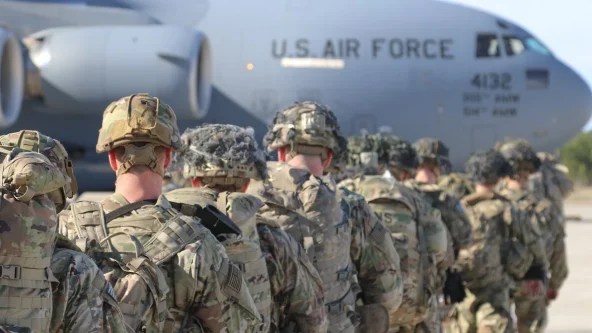
The Pentagon is reassessing its military footprint in Persian Gulf countries after months of losses inflicted by Iran, the Washington Post reported on 18 August.
Two people familiar with the ongoing analysis told The Post that one of the central questions before the Pentagon is whether to pull troops back from the Persian Gulf, where the largest US bases overseas have absorbed much of the Iranian retaliatory strikes.
The scale of damage suffered by those installations has compelled Washington to rethink where its forces should be located.
The Gulf holds the biggest and most entrenched US bases in the region, with Bahrain hosting the headquarters of the US Fifth Fleet, while Kuwait and other states house Army and Air Force assets.
Six US soldiers were killed in a March strike on Port Shuaiba in Kuwait, and more than 200 US facilities have been damaged or destroyed since the war began in February.
Washington has also lost at least 45 MQ-9 Reaper drones, accounting for a quarter of the entire fleet, at a replacement cost of up to $2.25 billion, and has burned through more than 1,000 advanced air-defense interceptors, draining nearly its entire stockpile of Patriot and THAAD missiles.
The Pentagon has already indicated it may not rebuild the damaged bases as they stood, and is instead weighing a shift of troops westward.
Michael Ratney, a former US ambassador to Saudi Arabia, named Jordan, Israel, and Saudi Arabia’s Red Sea coast as possible destinations, though he acknowledged the added distance was no perfect fix, as Iranian missiles have already reached all three throughout the US war on Iran.
A regional intelligence source told Press TV that the Pentagon has concluded that no military plan currently exists that would guarantee open shipping through the Strait of Hormuz or secure energy stability in the Persian Gulf, an admission that acknowledges Iran’s advantage in the waterway that carries roughly one-fifth of the world’s oil.
CNN reported in early August that the US Central Command’s (CENTCOM) intelligence branch had emailed military analysts asking for “creative and unconventional” ideas for pressuring Iran, after commanders concluded that continued US strikes were failing to achieve Washington’s goals.
Sputnik – 18.08.2026
The MIC intends to “milk” “older and sometimes antiquated systems for as much profit as possible before a real paradigm shift towards actual 21st century defense strategy evolves – and will fight this evolution as long as they can,” former DoD analyst and Air Force Lt. Col. Karen Kwiatkowski told Sputnik.
That was her response to the US military’s massive new $84.5B shopping spree for Patriot, THAAD and Tomahawk missiles.
“The MIC is in reaction mode, as is the Trump administration, trying to rapidly deal with an unexpected loss to Iran which has wiped out CENTCOM’s basing infrastructure, alongside an unexpected massive shortfall of [munition] consumables for scalable, combat and defense operations.”
“Slow by design” in fielding “weapons of any kind,” especially munitions which are “much less profitable” than contracts for the nuclear triad and carrier power projection, the munitions sector has become “kind of an economic backwater,” hence the sluggish production and limited scalability.
The new seven-year contracts for Patriots and THAADs are designed “to capture revenue, not win wars,” Kwiatkowski argues, as the conflicts in the Middle East and Ukraine have shown that “these defense systems have proven overly expensive and incapable of defending against mass launches of cheap drones, or modern hypersonic missiles.”
Kwiatkowski predicts that the Pentagon and MIC will continue to spend money the US doesn’t have on “20th century tech, with the minor exception of off-the-shelf and modified drones and the AI to operate them,” until a “reckoning” forces a “complete paradigm change,” associated “with a new national defense strategy and abandonment of imperial aspirations.”
Unfortunately, the “dramatic” loss in Iran won’t be enough for that to happen, she believes. “It is a wake-up call. But our political system and military lobbies, as well as the Israel lobby which sees the US as a vassal industrial state for its own defense, are not oriented for strategy shifts or even modification.”
For now, the reality is that the MIC controls strategies and encourages “imperial war for short-term profit, and expensive never-ending contracts.”
or go to
Aletho News Archives – Video-Images

Global Times | October 25, 2026
By portraying Chinese characters as perpetrators of ruthless violence while casting Japanese Self-Defense Forces (SDF) intelligence operatives as defenders, the season 2 of the Japanese drama Vivant has recently drawn criticism from Chinese netizens, who argue that its depiction turns historical reality on its head while ignoring Japan’s wartime atrocities.
The TBS drama series – a spy suspense story in which an alleged unofficial intelligence unit of the SDF operates across the globe — has attracted a passionate fanbase. Its currently airing season 2 opened with a household rating of 18.8 percent, the highest for a TV drama this year, according toa commentary article by Japanese media Toyo Keizai.
What draws attention is the portrayal of the enemies in the series, the article noted. Scenes in which the Chinese organization subjects kidnapped members of the SDF unit to brutal torture are repeated with unrelenting intensity.
It is rare for Japanese TV dramas to explicitly portray a real-life country as the enemy, the article noted.
Japanese Prime Minister Sanae Takaichi also made a reference to the drama, saying that she has been recording Vivant and hopes to binge-watch it over the year-end and New Year holidays, according to Japanese media outlets.
China’s CCTV News report on Sunday revealed that the drama features scenes in which Chinese personnel cut off the fingers of and stab Japanese intelligence operatives in the abdomen. Such acts bear striking similarities to the torture inflicted on Chinese nationals by invading Japanese troops during the World War II.
The drama distorts the truth by attributing these atrocities to modern Chinese characters. Beneath the surface, it subtly glorifies Japan’s cross-border overseas operations, blurs the functional boundaries of the SDF and implicitly promotes an expansionist narrative, per CCTV News. … continue
 Aletho News If Americans Knew No Tricks Zone
