The Math Is In: Why the US Has Already Lost Two Wars /Lt Col Daniel Davis
Daniel Davis / Deep Dive – August 13, 2026
Al Mayadeen | August 17, 2026
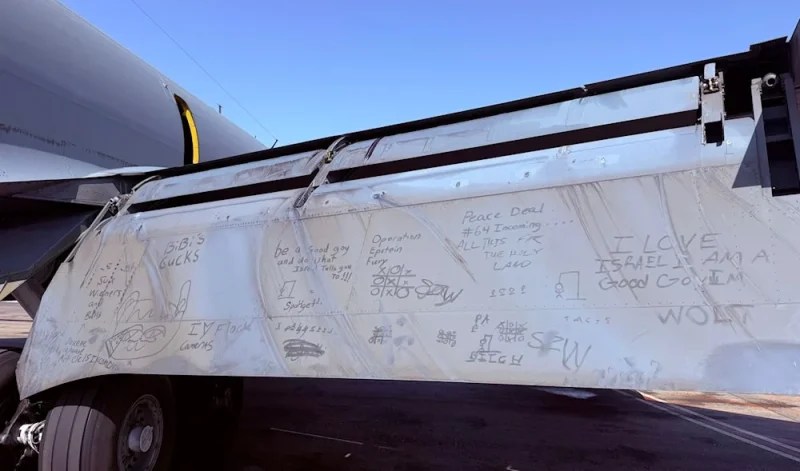
The Executive Vice President and co-founder of the Quincy Institute for Responsible Statecraft, Dr. Trita Parsi, said messages reportedly written by US servicemen on an aircraft flap in the Gulf reflect growing discontent among troops deployed to the region, including frustration over the indefinite nature of their assignments.
Parsi, who said the image had been sent to him from the field, shared photographs showing messages written in the dust on an aircraft flap. The messages included: “Be a good guy and do what Israel tells you to,” “Operation Epstein Fury,” and “Peace deal #64 incoming… ALL THIS FOR THE HOLY LAND.”
Parsi said he had no basis for comparing the sentiments expressed in the messages with those of US service members in previous wars, but suggested they could represent either new attitudes or a greater willingness to express such views openly.
He also cited what he said was a comment from a serviceman about the morale of troops involved in the operation.
“What people in the media don’t understand when they compare past conflicts to this one, is this operation has no morale behind it. That makes a world of difference to service members deployed to undesirable locations indefinitely,” as one serviceman told Parsi.
Furthermore, he highlighted the serviceman’s reference to a lack of morale and indefinite deployments, arguing that these conditions could shape how troops view the war.
“My own conclusion: When a war has no morale behind it, winning means that you simply end it. There is no other “winning” in such an unjust war,” Parsi concluded.
The developments come amid growing scrutiny of poor conditions aboard the USS Abraham Lincoln and calls from lawmakers for answers from the War Department.
Glenn Diesen | August 16, 2026
Prof. Seyed Mohammad Marandi is a professor at Tehran University and a former advisor to Iran’s nuclear negotiation team.
Glenn Diesen clip channel: https://www.youtube.com/@Prof.GlennDiesenClips
Follow Prof. Glenn Diesen:
Support the research by Prof. Glenn Diesen:
By Robert Inlakesh – Al Mayadeen – August 16, 2026
The Yemeni Armed Forces’ campaign to liberate their nation and end the Saudi-led blockade could be one of the most important events for the Arab world in decades. Not only will it have major implications for the ongoing regional war, but it also has the potential to dramatically reshape the region.
In July, the collapse of the Yemen-Saudi ceasefire agreement, which had been in place since 2022, was triggered by a strategic mistake committed by Riyadh. While Iran sought to break the inhuman blockade on Yemen through landing civilian airliners in the nation’s capital, Saudi Arabia’s air force rushed to bombard Sanaa International Airport. The Saudis may not have known it, but their irrational actions strung them up in a strategically placed trap.
Not only had the Sanaa government been coordinating a general mobilization, but its Armed Forces decided to directly retaliate by striking vital Saudi oil infrastructure and imposing a counter-blockade on their opponents to the north. The Yemeni Armed Forces then decided to take it a step further, committing round-the-clock ballistic missile and drone strikes that inflicted hundreds of casualties on Saudi-proxy forces inside Yemen and even advanced to liberate more of their nation’s territory.
Saudi Arabia is now unable to transit the Bab al-Mandab Strait, and its ability to export oil has been severed, representing a serious economic blow. Riyadh is now facing an unprecedented predicament, as Ansar Allah imposes an equation whereby Saudi violations of Yemeni airspace are met with direct strikes on oil infrastructure.
The reason why this all matters so much is that since 2015, the so-called “International Community” has rallied behind Saudi Arabia and its GCC allies. The global media have also participated in the facade, pretending as if some rebel group that they call “the Houthis” were fighting against an “internationally recognized government.” Why they kept up their lies is simple: without full control over their nation and its resources, the Sanaa government was simply not as valuable a partner as the Arab Gulf States, so everyone played along.
Nobody cared to point out that “the Houthis” is not an accurate name for Ansar Allah, that they aren’t simply a group of “rebels” but run a government that rules over the largest portion of the Yemeni population, or that two-thirds of the nation’s Armed Forces sided with them. Neither will they tell you that the so-called “Yemen Presidential Leadership Council” was created in the Ritz-Carlton Hotel in Riyadh and that its undemocratically selected leader lives in Saudi Arabia.
In fact, the idea that the Saudi-proxy forces in Yemen are the legitimate representatives of the nation and are somehow a sovereign government is even more outlandish than when most of the Western world randomly decided that Juan Guaidó was the “internationally recognised” President of Venezuela.
But none of this will even end up mattering if Ansar Allah succeeds in uniting Yemen and reaching an agreement to liberate its territory from its US-Israeli-backed aggressors. The reason why the Arab regimes, alongside the US-UK-EU-Israeli alliance, have fought against the government in Sanaa is that they all fear the consequences of their success.
Yemen will be the only Arab nation that will not only oppose US imperialism and support the regional resistance, but will also actively fight the Israelis and work to combat the “Greater Israel Project.” The only Arab government that dared to open fire on the Israelis or impose a blockade on them, in support of Gaza, was the Sanaa government in Yemen. All the others that fought for Gaza were non-state actors.
A strong and united Yemen, with access to its resources and the ability to continue developing its military capabilities, will without a doubt be the biggest threat to US-Israeli hegemony in the Arab World. Yet, it will also spell another equation: it could well serve as an example to populations throughout the region, as to what is possible if the people fight for their liberation. No prospect frightens the Arab regimes more than this.
The impact Yemen can have on global trade, oil markets, regional power equations and ultimately the Palestinian cause for national liberation, all have the Zionist allied powers shaking in their boots. For so long, the Yemeni issue has been ignored, but that could soon dramatically change.
Daniel Davis / Deep Dive – August 14, 2026
Daniel Davis / Deep Dive – August 13, 2026
Press TV – August 15, 2026
The United States has been forced to relocate much of its naval logistics operations to a remote base in the Indian Ocean following heavy attacks by Iran on its key military installation in Bahrain, according to reports.
The reports and analyses, published on Saturday by The New York Times and Defense Security Asia, indicated that the Pentagon had moved its primary naval logistics hub to Diego Garcia, an island in the central Indian Ocean shared between the US and the United Kingdom and under British command.
The reports showed that Iran’s missile and drone strikes, which began in late February after the launch of a joint US-Israeli aggression on the country, had severely damaged the Fifth Fleet command, which hosts US Naval Support Activity Bahrain.
This development means that the US Navy must now rely on a 2,200-mile logistics chain, instead of a short sustainment network in the Persian Gulf, to supply the massive aircraft carriers deployed near Iranian waters for carrying out attacks on the country.
This comes amid reports of shortages aboard the USS Abraham Lincoln, a carrier with 5,000 sailors and US Marines that is approaching nine months on deployment.
Those reports have indicated acute problems with food, hygiene, mail, plumbing, and laundry aboard the carrier, leading to unrest and even attempted suicides among the service members deployed on the ship.
“…reported shortages aboard USS Abraham Lincoln demonstrate how destroying shore infrastructure can progressively degrade combat endurance without directly striking a nuclear-powered aircraft carrier,” Defense Security Asia said in its report.
The US is planning to replace the USS Abraham Lincoln with the USS George Washington in the region, although experts warn that the deployment could further expose the vulnerabilities of the US Navy during the ongoing confrontation with Iran.
The report by The New York Times said that Iran’s devastating attacks on the Fifth Fleet facilities in Bahrain have been the main reason behind the difficulties reported by US warships in the region.
“The loss of the hub in Bahrain has contributed to a host of reported problems on carriers supporting operations against Iran,” it said.
Both reports acknowledged that another regional logistics hub capable of supporting US aircraft carriers, located in the Emirati port of Fujairah, is well within the reach of Iranian missile and drone attacks.
They also said that the base in Diego Garcia could itself become a target of Iranian attacks, pointing to the firing of Iranian medium-range missiles at the base in March, just after Britain authorized the conditional use of the base by the US.
The reports come as many in the US and around the world, including families of the sailors aboard US aircraft carriers and lawmakers, continue to question the purpose of the prolonged deployment of US Navy assets near Iran, arguing that the war of aggression on the country has resulted in no tangible achievement for the US nearly six months after it began.
By W.M. Peterson |
“When you read Jewish law in many places, you might understand that gentiles can be killed freely without any problems.” — Rabbi Yitzhak Shapira, Radio Kol Hai (July 2011)
In January 2012, Andrew Adler, the owner and publisher of a small weekly newspaper called the Atlanta Jewish Times, sparked considerable controversy when he penned an article titled ‘What Would You Do?’ in which he put forth three possible responses Israel might pursue if Iran were to acquire a nuclear weapon. The first two — pre-emptive strikes on Hezbollah and Hamas and disobeying the US Secretary of Defense to destroy Iran’s nuclear facilities — failed to raise any eyebrows. Adler’s third suggestion, however, would result in his immediate resignation as editor and the subsequent sale of his newspaper:
“Three, give the go-ahead for U.S.-based Mossad agents to take out a president deemed unfriendly to Israel in order for the current vice president to take his place, and forcefully dictate that the United States policy includes its helping the Jewish state obliterate its enemies. Yes, you read “three” correctly. Order a hit on a president in order to preserve Israel’s existence. Think about it. If I have thought of this Tom Clancy-type scenario, don’t you think that this almost unfathomable idea has been discussed in Israel’s most inner circles?… You have got to believe, like I do, that all options are on the table.“
Almost immediately, the article became headline news around the country forcing major Jewish organizations like the ADL and AJC to feign indignation, and within a week the US Secret Service had launched an ‘investigation’ into the matter while a teary-eyed Adler appeared on the Atlanta Interfaith Broadcasting network’s cable TV show to disavow his column and explain that he actually held a favorable view of President Obama!
Adler’s straight-talk, shocking though it may seem to some, provides crucial insight into the mentality of God’s chosen people and the candor they often use when speaking amongst themselves. Killing a foreign or domestic head of state who presents a perceived obstacle to the preservation of fragile little Israel is not unknown to history, as any reader of Laurent Guyenot’s indispensable book The Unspoken Kennedy Truth or Ronen Bergman’s 2018 bestseller Rise and Kill First: The Secret History of Israel’s Targeted Assassinations can assure you.
A few months ago I met up for lunch with an old friend who, after years of intransigence, has finally reclaimed his mind from the Zionist propagandists and taken a deeper interest in topics like Israel/Palestine and Jewish influence in American affairs. During the course of our conversation, I casually mentioned the likelihood that Israeli leaders have considered assassinating Donald Trump for the purpose of expanding US involvement in the war with Iran. My friend, visibly stunned by the idea, asked why in the world Israel would do such a thing when Trump is by all appearances Israel’s Top Goy, performing nearly every trick demanded of him by Netanyahu and the Israel Lobby. I responded that it doesn’t matter what Trump does for Israel, the minute he’s deemed more valuable dead than alive the Zionists will begin workshopping a scenario in which the increasingly unpopular ‘leader of the free world’ can be eliminated in such a way that Iran can be blamed and the American military can be dragged deeper into the conflict upon the pretext of revenge. Indeed, Israeli intelligence has been priming the pump for an “Iranian” assassination of Trump since 2024, absurdly trying to link the events in Butler, PA and Ryan Routh’s golf course shenanigans to Tehran. I told my friend that while I believe the chances of an assassination actually happening are low, I do think it’s probable the Jews will develop a plan, if they haven’t already, to have in the back pocket as a last resort. Certainly, there’s no shortage of historical precedent supporting the notion.
My hypothetical took on new life this past week when it was reported in the mainstream media that Israeli intelligence had alerted the US that Iranian agents were planning to shoot down Trump’s plane with shoulder-fired missiles as he departed the NATO summit in Ankara, Turkey on July 8. The warning was taken seriously enough that the Secret Service had Trump switch planes twice before finally leaving in the hopes of deceiving any would-be attackers. According to The Times of Israel :
“Israel told the United States about the Iranian assassination threat that prompted the US Secret Service to take President Donald Trump off Air Force One and transfer him in a catering truck to a military plane as he prepared to fly out of Turkey last month, the Wall Street Journal reported Tuesday, citing an unnamed US official.
Later Tuesday, Trump confirmed that he had indeed been smuggled off Air Force One in Ankara because the Secret Service and US military told him to switch planes. Israeli intelligence indicated that Iran was plotting to use shoulder-to-air missiles to take down Trump’s plane, according to the WSJ report. Senior Trump aides, including Secretary of State Marco Rubio, remained on the plane despite the threat, the official said. The WSJ reported last month that Israeli intelligence had indicated a new plot was in development to assassinate the US president, but did not provide details. … Trump had flown to the NATO summit in Ankara aboard a newly-renovated Qatari-donated jet. The trip was the first international travel for the new plane, whose speedy upgrades triggered questions over its cost and security, and took place as hostilities escalated with Iran, which borders Turkey.
Before departing the Turkish capital, Trump said he would instead use an older baby blue Air Force One plane “for old time’s sake” to RAF Mildenhall in Britain, while the new Qatari-gifted plane stopped at the same base so US service members stationed there could tour the aircraft. But after Trump boarded the old Air Force One in front of cameras in Ankara, he was secretly shuttled by an airport catering truck to a smaller plane, an Air Force C-32A, the Washington Post revealed Monday.“
Probably not coincidentally, all of this transpired a mere day after Trump and Turkish President Recep Erdogan held a private bilateral meeting during which Trump discussed the possibility of Turkey’s reentry into the F-35 Lightning II program, while also announcing his commitment to lift the CAATSA sanctions placed on Turkey by the US government seven years ago. Originally a co-producer and buyer in the fighter jet program, Turkey was removed in 2020 following its acquisition of the Russian S-400 missile defense system. Trump remarked that his administration is “certainly” considering the sale of F-35s to Turkey and openly praised Erdogan as “a great friend,” telling reporters at the NATO summit: “Turkey has been much more loyal than other countries that we think would be loyal.”
Considering the fact that Turkey is rapidly emerging as one of Israel’s biggest strategic adversaries, these developments likely sent shockwaves through Tel Aviv. An August 10 article on the Quincy Institute’s Responsible Statecraft website points out that:
“Within 72 hours of the Ankara summit, Netanyahu took his objections to three American networks, arguing that Erdogan was ‘not a friend’ and could not be trusted… Israeli leaders, eager to drive a wedge into Ankara’s relationship with Washington, appear determined to cast Turkey as the next Iran.“
It’s possible that at least part of the reason for Trump’s flirtation with Erdogan is to antagonize Israel at a time when the Zionist state is doing almost everything it can to scupper US peace agreements with Iran. It’s just as possible that Israel, by way of retaliation, is seeding the narrative that Iran is striving to help the vainglorious 47th President off this mortal coil as a way of threatening Trump back into line. It should be pointed out that immediately following the great plane switcheroo in Ankara, the US military conducted a heavy wave of airstrikes, hitting 90 targets across Iran. Two days later, the US initiated a bombing campaign that lasted for 13 consecutive nights. If the intent of the “Iranian threat” was to bring Trump back under heel, it would seem he got the message.
While the CIA considers the Iranian threat to Air Force One dubious, the thought of shooting down an aircraft with innocent lives onboard to kill but one man is not a novel one in Israel. On pp. 272-273 of his aforementioned bestseller, Israeli journalist Ronen Bergman describes how Israel’s Minister of Defense Ariel ‘Butcher of Beirut’ Sharon once hatched a plan to shoot down a commercial airliner carrying PLO leader Yasser Arafat:
“When the Mossad reported that Arafat was flying more commercial flights… Sharon decided that one of those would make a legitimate target. He ordered Eitan, the air force, and the operations branch to come up with a plan to shoot down a civilian jetliner.
Sharon sketched out the broad parameters. The flight would have to be shot down over the open sea, far from the coast, so that it would take investigators a long time to find the wreckage and establish whether it had been hit by a missile or had crashed due to engine failure. Deep water would be preferable, to make recovery even more difficult… The air force drew up a detailed plan to shoot down an airliner. Its representatives at the Goldfish forum explained that they had chosen a precise spot on the commercial air route across the Mediterranean, one where there was no continuous radar coverage by any nation and where the sea below was a daunting three miles deep. A salvage operation there would be extremely difficult, perhaps impossible, with the technology of the time. This complex plan set strict parameters for where the Israeli aircraft could shoot down Arafat’s plane undetected, which meant there would be a fairly narrow window of opportunity for executing the attack. … General Gilboa expressed his sharp opposition to these operations time and again. ‘It was clear to me that the air force would execute it as well as could be, and the plane would vanish forever. They do what they are told, and if you give them an order to build a pipeline to move blood from Haifa to the Negev, they’ll do it excellently and won’t for a moment ask whose blood it is…‘”
Whether he knows it or not, Trump, the one-time casino mogul, is dicing with death, playing into the hands of potential Israeli assassins by repeatedly claiming that the US would “completely decimate and destroy” Iran if it ever were to succeed in knocking him off. Quite foolishly, Trump has told journalists he’s “left instructions” to “literally bomb them at levels they’ve never seen before” if such an event were to occur. One can only imagine the frenzied Happy Merchant-style hand-rubbing taking place among members of Netanyahu’s cabinet when they hear remarks like these.

I’m sure there are many Iranians who would like to see Trump bite the dust. After all, he is responsible for the murder of the country’s military hero General Qasem Soleimani and its Supreme Leader Ali Khamenei, whose family members were also killed and maimed in the joint US/Israeli airstrikes on his residential compound in February. Trump made these decisions entirely on behalf of Israel and we’re left to wonder whether or not he realizes with the benefit of hindsight that he’s bumbled his way into a carefully laid trap. With Iran’s victory in the war all but assured absent the use of nuclear weapons or a ground invasion by US forces, Israel is getting desperate to increase America’s military presence in the region. Would they go so far as to assassinate a sitting US president for at least the second time in history? I don’t know, but in the words of Andrew Adler: “Think about it. If I have thought of this Tom Clancy-type scenario, don’t you think that this almost unfathomable idea has been discussed in Israel’s most inner circles?… You have got to believe, like I do, that all options are on the table.“
The Cradle | August 14, 2026
US investment bank JPMorgan has suggested that Iran and Oman’s strategy of imposing mandatory “navigational safety” fees to transit the Strait of Hormuz may be legally justified, the Financial Times (FT) reported earlier this month.
JPMorgan explained in a memo that international law grants ships the right of “innocent passage” through territorial waters, making it illegal to charge fees simply for transit (tolls).
However, charging fees for specific navigational and security services may be permissible, the memo argued.
For example, Denmark and Sweden currently levy charges on vessels transiting the Danish Straits. Rather than charging a toll, which would be illegal, they charge for services.
Denmark’s Pilotage Act makes pilotage mandatory for vessels carrying hazardous cargo – such as oil, chemicals, or gases – or more than 5,000 metric tons of bunker oil.
Pilotage refers to the service of guiding a ship or aircraft through hazardous, confined, or coastal waters and local areas using visual landmarks, charts, and specialized local knowledge. The pilotage fees are paid to the Danish Ministry of Business and range from $10,000 to $25,000 per transit for a Balticmax tanker.
Another country operating “a de facto tollbooth” on oil tankers is Turkiye, a US ally and NATO member, JPMorgan wrote.
Turkish authorities have “broad regulatory powers in the Turkish Straits and can charge for services under the 1936 Montreux Convention Regarding the Regime of the Straits.”
Ankara charges a Suezmax oil tanker approximately $130,000 for a round-trip passage, roughly $0.13 per barrel of crude.
In exchange for the fee, Turkiye provides lighthouses, light, and channel buoys, as well as sanitary control and emergency rescue services.
According to JPMorgan, these precedents indicate that Iran and Oman’s plan to impose mandatory charges for “navigational safety” to transit Hormuz could be legally justified.
In a previous note published in May, the investment bank’s analysts wrote: “By structuring the measure as a service fee rather than a transit toll, and by coordinating with Oman as the other littoral state, Iran could attempt to create a legal framework that appears consistent with international maritime law.”
Amir Handjani of Responsible Statecraft (RS) argues that establishing an Iran–Oman transit authority would benefit commercial shippers.
“Ships get a predictable process instead of IRGC commanders deciding by whim who passes, who doesn’t, and an unpredictable pricing mechanism,” Handjani wrote.
At the same time, US sanctions and restrictive insurance clauses may pose severe compliance issues for international oil and shipping firms seeking to traverse the Strait of Hormuz under such a proposal.
Reuters reported on 6 August that if shipping firms pay service fees to Iran to pass Hormuz, this would trigger US sanctions imposed unilaterally on the Persian Gulf Strait Authority (PGSA).
“Any payment could lead to asset freezes,” Reuters quoted unnamed industry sources as saying.
Major shipping firms have also raised concerns over a clause introduced last month by Lloyd’s Market Association (LMA) that terminates vessel insurance if it pays a toll or charge for passage through the Strait of Hormuz.
Tales of the American Empire | August 13, 2026
American foreign policy has supported the Greater Israel project since the 9-11 terror attacks. This would greatly expand the size of Israel and kill or displace millions of Arabs. Iran is not a target for Israeli expansion, but is a powerful nation that supports resistance to the genocidal Greater Israel agenda. When the Trump administration entered office in early 2025, there was news they may fulfill the Zionist dream of attacking and destroying Iran.
Since President Trump ran as an anti-war candidate, war with Iran was irrational because it was risky and unlikely to succeed. A year ago, Tales of the American Empire produced “War with Iran is Foolish”, which is linked in the description. It explains that attacking Iran would fail and lead to an economic disaster. Unfortunately, greedy and insane people have taken control our nation, to include Donald Trump and most US Congressmen.
_______________________________________
Related Tales:
“War with Iran is Foolish”;  • War with Iran is Foolish
“Why the Strait of Hormuz is Not Irrelevant”; What’s Going on With Shipping?; August 9, 2026; • Why the Strait of Hormuz is Not “Irrelevan…
“The MOST DANGEROUS WARHAWKS in MEDIA /Lt Col Daniel Davis”; Deep Dive; August 3, 2026; • The MOST DANGEROUS WARHAWKS in MEDIA /Lt C…
Al Mayadeen | August 13, 2026
Iran has thwarted a planned Syrian military intervention in Lebanon that was being prepared at the request of the United States, delivering a direct warning to Damascus that any Syrian military entry into Lebanese territory would be met with a regional response, according to Iranian sources cited by U News.
The Iranian warning included threats to stir up the Syrian–Iraqi border, open a confrontation line in Homs, support Alawite movements in the Syrian coastal region, and encourage the Kurds to return militarily to the outskirts of Aleppo.
The warning was not directed solely at Damascus; it also reached Ankara, Baghdad, Doha, and Riyadh, carrying the message that any Syrian adventure against Hezbollah in Lebanon would not remain confined to the Bekaa Valley but could turn into a broad regional confrontation within Syrian territory.
Iran succeeded in transforming any potential Syrian intervention in Lebanon from a military option that could be marketed to the US into a high-cost regional adventure, sources said. The Iranian warning, which reached Damascus through Turkish channels, included a threat of Iranian ballistic missile strikes that would begin from Damascus and include, in the first wave, more than 100 strategic targets, foremost among them the Syrian presidential palace.
The US-backed scenario: a three-pronged offensive into Lebanon
The scenario promoted by figures linked to the US embassy in Lebanon involves sending Syrian armed units from the Masnaa crossing toward Chtoura in the Lebanese Bekaa and on to the city of Zahle, simultaneously with mobilization from the eastern highlands toward the city of Baalbek.
The proposed scenario also includes declaring the city of Tripoli a Syrian zone of influence, with advancing forces benefiting from local environments, particularly in some Sunni-majority areas.
The presumed goal of the operation is to strike Hezbollah’s rocket infrastructure in the Bekaa and to create military and political pressure that would force the party to withdraw or accept new security arrangements.
Hezbollah prepared, treats potential Syrian operation as US-Israeli pressure
Iran’s warning has prompted regional parties to reassess the cost of the scenario, especially since Syria, emerging from deep military and political transformations, does not appear capable of enduring a new internal war.
Hezbollah is treating the information about a potential Syrian intervention extremely seriously and has taken precautionary measures in the Bekaa in anticipation of any possible Syrian incursion.
Hezbollah does not view the scenario as a separate Syrian operation, but rather as part of US–Israeli–regional pressure aimed at dismantling the structure of resistance in Lebanon from the east, following Israel’s failure to achieve a decisive result in the south.
Iraq’s rejection, UAE’s enthusiasm, and Saudi caution
Iraqi intelligence chief Hamid al-Shatri visited Damascus and informed Syrian officials of Baghdad’s rejection of any Syrian military expansion into Lebanese territory. Al-Shatri warned that Iraqi forces, primarily factions of the Popular Mobilization Forces, might enter Syrian territory if an intervention against Hezbollah occurred.
The Iraqi position added a further layer of deterrence to the Iranian warning, signalling that Damascus could face military pressure not only from within Syria but also from its eastern border.
The UAE is enthusiastic about funding any Syrian military operation in Lebanon, with officials quoted as ready to pay troop salaries as well as finance combat operations. This financial backing suggests that the UAE views the intervention as an opportunity to curtail Hezbollah’s influence in Lebanon, despite the broader regional risks that Iran has highlighted.
Qatar rejects Syrian intervention in Lebanon, while Saudi Arabia does not object to an intervention as long as it is within arrangements that weaken Hezbollah without igniting the region. The divergent positions among Gulf states underscore the complex calculations at play, with Riyadh appearing to balance its opposition to Hezbollah against the dangers of a wider conflict that Iran has explicitly threatened to unleash on Syrian soil.
Daniel Davis / Deep Dive – August 12, 2026
Daniel Davis / Deep Dive – August 12, 2026
Daniel Davis / Deep Dive – August 11, 2026
Eli Clifton and Ian Lustick Reveal How The Israel Lobby Paved The Way For A U.S. War On Iran
By Justin K.P. | The Dissident | August 11, 2026
Investigative journalist Eli Clifton and political scientist Ian Lustick have released a detailed history of the Israel lobby’s influence on U.S. foreign policy titled “Israel’s Lobby: America in the Grip of a Foreign Power”.
The book contains a detailed history of the Israel lobby’s influence over various U.S. administrations going back to its creation.
Among the book’s most interesting revelations is how the Israel Lobby pushed anti-Iran propaganda in the United States in order to destroy U.S. diplomacy with Iran.
This campaign- the book noted- began when the Obama administration was negotiating the 2015 nuclear deal with Iran, aka the JCPOA.
The authors note that Israel Lobby groups attempted to end the deal with Iran, writing “The Republican Jewish Coalition, whose board included Sheldon Adelson and Home Depot cofounder Bernie Marcus, immediately attacked Obama as ‘misguided’ and ‘giving cheer to Tehran’s rogue regime and causing alarm among our friends in the region, including Israel, Saudi Arabia and most other Gulf States.’”
The Republican Jewish Coalition, the book noted, was joined by other Zionist lobby groups, such as The Foundation for Defense of Democracies (FDD) and United Against Nuclear Iran (UANI) in trying to prevent U.S. diplomacy with Iran.
The authors wrote, “The Foundation for Defense of Democracies (FDD), a heavy promoter of the Iraq War and the Global War on Terror before that, followed suit the next day, opposing the proposed deal as ‘a gamble on Western optimism.’ It was joined by a shadowy pressure group, United Against Nuclear Iran (UANI). ‘Tonight’s events are a disappointment for those of us who have worked to pressure Iran’s economy and impose the toughest sanctions in history on Iran—the same sanctions that brought the regime to the negotiating table,’ its statement said. ‘Those touting this agreement do not appear to understand the fragility of sanctions, or the dangers of rolling them back and easing the economic pressure on Iran.’”
These groups, the book noted, were “funded by a small, overlapping set of donors with deep ties to Israel”.
United Against Nuclear Iran (UANI) it noted, “according to a 2013 document, received $500,000 from the Adelsons that year alone. Another $843,000 was contributed by a series of trusts controlled by billionaire precious metals speculator Thomas Kaplan, a citizen of the United States, France, the Republic of the Seychelles, and the United Arab Emirates, and his wife, Daphne Recanati, the daughter of Israeli financier Leon Recanati.”
The book noted that Thomas Kaplan told former Israeli Prime Minister and Jeffery Epstein’s Israeli handler Ehud Barak that “A nuclear Iran ‘represents a psychological threat that will have untold consequences on the Israeli economy and population flows’” in a leaked email.
As for the FDD, the book noted that it was “formed originally in 2001 as Emet (‘Truth’ in Hebrew) with a mission that included ‘provid[ing] education to enhance Israel’s image in North America.’ That name and mission, while submitted to the IRS in its founding documents, was nowhere to be found on its website. By the time the JCPOA debate was occurring, the group had also removed evidence of its advocacy for the Iraq War. Articles with statements including ‘that Saddam still has weapons of mass destruction cannot be seriously doubted’ and language claiming ‘we know Saddam Hussein is making weapons of mass destruction’ were long removed, focusing attention on the alleged threat posed by Iran instead. Al Jazeera hidden cameras captured Sima Vaknin-Gil, the director general of Israel’s Ministry of Strategic Affairs, speaking in blunt terms about Israel’s relationship with the FDD. ‘We have FDD. We have others working on’ projects including ‘data gathering, working on activist organizations, money trail,’ said Vaknin-Gil to an audience of American pro-Israel advocates in 2016. ‘This is something that only a country, with its resources, can do the best’”.
The Israel Lobby cutout, the book noted, “wasn’t just a producer of research papers and op-eds advocating against the JCPOA and for more sanctions and military threats against Iran. It also served as an important element of an echo chamber informing the public and Congress about Middle East policy,” noting that, “In an eighteen-month period preceding and immediately following the signing of the JCPOA in 2015, FDD staff and fellows provided congressional testimony opposing the deal seventeen times.”
The FDD was also primarily funded by Israel’s first billionaire donors, the book noted, writing “a misfiled document revealed that Bernie Marcus contributed $10.7 million, Paul Singer contributed $3.6 million, and Sheldon Adelson contributed $1.5 million in a five-year period ending in 2011. The three men were the three largest donors to the FDD in that time frame, the only period in which the group’s top donors have been disclosed.”
Meanwhile, the book documented how AIPAC’s messaging became more explicitly anti-Iran.
In 2010, the book noted, “AIPAC-contracted telemarketers were directed to say: ‘Iran is rejecting international calls to end its nuclear pursuit.’”
It added, “By 2014, the emphasis had shifted to warning about Iranian president Rouhani’s diplomatic engagement with US and European diplomats. The script read: ‘Regional dangers continue to grow for Israel. In Iran, President Rouhani’s rhetoric continues to charm world leaders, while the regime has not slowed its nuclear pursuits.’”
This was ramped up further in the following years.
The book noted that, “the threat of an Iranian nuclear weapon continued to appear in AIPAC’s fundraising scripts even as the group worked against the JCPOA—a joint agreement with the US and other world leaders that sought to limit Iran’s uranium enrichment with verifiable safeguards and put in place provisions to extend Iran’s breakout time to produce enough highly enriched uranium or plutonium for a nuclear weapon from two to three months to one year or more” with the 2015 AIPAC script reading, “Iran continues to pose a grave threat of attaining a nuclear weapons capability”.
The book added that, “After the signing of the JCPOA in 2015, the fundraising scripts became even more vivid in the violence and existential threats described and either ignored or stood in direct opposition to the foreign policy agenda undertaken by the Obama administration. The 2016 script read: ‘… and Iran continues to develop intercontinental ballistic missiles capable of striking the U.S.’”
The authors added that, “Iran had not in fact developed such a missile”.
While the Zionist lobby did not initially get its way on the Iran deal, the book documents how the lobby made inroads with the Trump 2016 campaign, eventually getting him to rip up the deal.
The book meticulously documented how Trump in 2016 changed his platform after massive funding from pro-Israel donors.
“ (Sheldon) Adelson told reporters that Trump ‘will be good for Israel.’ Trump’s support for Israel was not mentioned in Adelson’s endorsement of Trump later that month in a Washington Post op-ed. But he once again acknowledged the centrality of US policy in the Middle East as a driving motivation for his political engagement, characterizing himself as ‘hawkish on Israel’ and having ‘waged battles’ over the Iran nuclear deal, ‘an issue of paramount importance to me personally and to many others around the world.’ In an email sent to fellow Republican Jewish leaders, Adelson urged them to support the presumptive nominee, saying he was convinced Trump would be a ‘tremendous president when it comes to the safety and security of Israel.’”, the book noted.
The book noted how Trump changed his 2016 platform after major donations from the Israel Lobby, writing, “The Adelsons and Marcus quickly came around, donating $25 million and $7 million, respectively, to support Trump’s general election candidacy. That flow of support from the pro-Israel billionaires came alongside a flurry of movement from the campaign to bring Trump’s platform in line with that of his new biggest donors. Just before the July GOP convention and Trump’s formal nomination, the Republican Platform Committee unanimously omitted any reference to a two-state solution from the party’s Israel planks. Trump met with Netanyahu in September and promised that, if elected president, he would ‘recognize Jerusalem as the undivided capital of the State of Israel.’ The campaign reported that Trump agreed with Netanyahu that peace between Israelis and Palestinians required ‘the Palestinians [to] renounce hatred and violence and accept Israel as a Jewish State.’ Six days before the election, Trump’s ‘Israel Advisory Committee’ published a position paper proposing a break from the Israel policy of previous Republican and Democratic administrations, celebrating ‘the unbreakable bond between the United States and Israel’ based on ‘shared values of democracy, freedom of speech, respect for minorities, cherishing life, and the opportunity for all citizens to pursue their dreams.’”
The book added, “As for ‘never Trump’ pro-Israel donors who held out on endorsing Trump, even Paul Singer, who had warned that Trump’s policies would lead to a ‘widespread global depression,’ ultimately made amends with the new president-elect. Singer donated $1 million to the president-elect’s inaugural committee.”
Trump, during his first term, enacted every policy these pro Israel donors demanded, including by ripping up the Iran deal, the book noted, writing, “Trump, in his first term, enacted a series of wish-list items for Israel, including a unilateral withdrawal from the Iran nuclear deal, recognition of Israel’s sovereignty over the Golan Heights, and, at the repeated urging of the Adelsons, the promised move of the US embassy from Tel Aviv to Jerusalem.” (Emphasis: Mine)
The destruction of U.S. diplomacy with Iran, bought by Zionist donors like Sheldon and Miriam Adelson, Bernie Marcus and Paul Singer, eventually led to the U.S. war on Iran for Israel.
Daniel Davis / Deep Dive – August 10, 2026
Al-Mayadeen | August 10, 2026
Iran believes it has fundamentally altered the balance of power with the United States and now has a narrow opportunity to convert its position into lasting strategic and economic gains, Johns Hopkins University Professor Vali Nasr argued in an interview on Switzerland with Tom Switzer.
Speaking alongside University of Chicago political scientist John Mearsheimer, Nasr said Washington has struggled to accept how dramatically its position has changed following the prolonged war on Iran, particularly as Tehran retains leverage over the Strait of Hormuz. The interview was conducted by host Tom Switzer, who introduced Nasr as a leading Iran expert and Mearsheimer as a political scientist.
“There’s a consensus that they have defeated the superpower, at least put it on its heels,” Nasr said of the view inside Iran, arguing that Tehran sees little reason to moderate its position while it holds the advantage.
Iran sees narrow window to press advantage
Nasr rejected arguments circulating in Washington that Tehran is “overplaying its hand,” saying such assessments reflected disbelief at the extent to which the balance had shifted.
“In reality, Iran is not overplaying its hands. It’s just playing its hand,” he said.
According to Nasr, Iranian policymakers believe they have a limited period in which to secure the maximum possible strategic advantage.
“They think they have a narrow window to get the maximum amount of strategic advantage from having turned the table on the US,” he said, adding that Iranian leaders would consider it a major mistake not to press their advantage while Washington remains on the defensive.
That calculation extends to sanctions relief, frozen Iranian assets, compensation, and Iran’s position in the Strait of Hormuz. Nasr described Tehran’s approach as accepting immediate economic hardship in exchange for potentially much greater long-term gains.
Mearsheimer: US has ‘no choice’
Mearsheimer offered an even sharper assessment, arguing that Washington no longer possesses an effective means of forcing Tehran to abandon its position over the Strait.
Asked why US President Donald Trump would accept an arrangement under which Iran exercises substantial control over passage through Hormuz, Mearsheimer replied, “It’s very simple, Tom. He has no choice. He lost the war. This is a devastating defeat for the United States.”
He added that Trump “has no cards here,” arguing that Washington’s principal threat — further military escalation — had become increasingly difficult to carry out.
According to Mearsheimer, the United States faces both depleted munitions stocks and resistance from Gulf allies fearful that another escalation would trigger Iranian attacks on oil infrastructure, desalination facilities, and other critical installations.
Weapons shortages expose limits of US campaign
Nasr similarly argued that Washington’s weapons shortages had sharply reduced its ability to continue the campaign.
“It’s clear that the US doesn’t have the munitions, either offensive munitions or defensive munitions to keep bombing Iran,” he said, arguing that another month of fighting ultimately left Iran stronger and Washington weaker.
Mearsheimer said US military leaders had warned Trump before the war about limited stocks and the dangers of a prolonged confrontation. He argued that a major factor behind the end of the 40-day air campaign was that Washington was “running out of munitions.”
Nasr said the implications reach beyond West Asia, arguing that China and Russia would draw conclusions from the United States’ difficulty rapidly replacing sophisticated weapons during a prolonged war.
Distrust shapes Tehran’s negotiating position
Nasr stressed that Iran’s negotiating posture is also being driven by deep distrust of Trump and Washington.
He cited Trump’s withdrawal from the 2015 nuclear agreement in 2018, attacks launched while negotiations were underway, and what Tehran viewed as Washington’s failure to uphold subsequent understandings.
Trump has created “such distrust about himself with Iranians” that even accepting Tehran’s terms might no longer be enough without guarantees that Washington would implement an agreement, Nasr said.
That distrust, he argued, explains why Iran wants concessions delivered upfront rather than postponed to future negotiations.
The earlier June 17 memorandum had envisaged reopening the Strait, lifting oil sanctions, and establishing a ceasefire that also covered Lebanon, while wider sanctions, reparations, and frozen assets would be addressed later.
Nasr said Tehran concluded that Washington subsequently undermined that arrangement, including its provisions related to Lebanon, reinforcing the view that Iran should secure tangible benefits before relinquishing leverage.
‘Even bigger defeat for Israel’
Both scholars also framed the outcome as a major strategic setback for “Israel”.
Mearsheimer described the result as a “humiliating defeat” for Washington before adding, “I believe it’s an even bigger defeat for Israel.”
He argued that Israeli officials were reluctant to acknowledge “the extent to which Iran has defeated not just the United States, but Israel,” predicting that both “Israel” and its supporters in Washington would seek to undo any agreement favorable to Tehran in the future.
Nasr later argued that Israeli Prime Minister Benjamin Netanyahu had “overreached in Lebanon and Iran,” describing them as wars “Israel” could not win and saying “Israel” had been “strategically defeated”.
For Nasr, the larger consequence is a regional order increasingly different from the one Washington sought to impose. Iran, he argued, now sees an opportunity not simply to end the current confrontation, but to use the outcome to reduce the US military threat around its borders, ease its economic isolation and consolidate its position as a major regional power.

or go to
Aletho News Archives – Video-Images

Global Times | October 25, 2026
By portraying Chinese characters as perpetrators of ruthless violence while casting Japanese Self-Defense Forces (SDF) intelligence operatives as defenders, the season 2 of the Japanese drama Vivant has recently drawn criticism from Chinese netizens, who argue that its depiction turns historical reality on its head while ignoring Japan’s wartime atrocities.
The TBS drama series – a spy suspense story in which an alleged unofficial intelligence unit of the SDF operates across the globe — has attracted a passionate fanbase. Its currently airing season 2 opened with a household rating of 18.8 percent, the highest for a TV drama this year, according toa commentary article by Japanese media Toyo Keizai.
What draws attention is the portrayal of the enemies in the series, the article noted. Scenes in which the Chinese organization subjects kidnapped members of the SDF unit to brutal torture are repeated with unrelenting intensity.
It is rare for Japanese TV dramas to explicitly portray a real-life country as the enemy, the article noted.
Japanese Prime Minister Sanae Takaichi also made a reference to the drama, saying that she has been recording Vivant and hopes to binge-watch it over the year-end and New Year holidays, according to Japanese media outlets.
China’s CCTV News report on Sunday revealed that the drama features scenes in which Chinese personnel cut off the fingers of and stab Japanese intelligence operatives in the abdomen. Such acts bear striking similarities to the torture inflicted on Chinese nationals by invading Japanese troops during the World War II.
The drama distorts the truth by attributing these atrocities to modern Chinese characters. Beneath the surface, it subtly glorifies Japan’s cross-border overseas operations, blurs the functional boundaries of the SDF and implicitly promotes an expansionist narrative, per CCTV News. … continue
 Aletho News If Americans Knew No Tricks Zone
