Moscow accuses West of breaking ‘grain deal’ pledge
Samizdat – September 6, 2022
Western countries have not fulfilled their promise to lift sanctions on Russian grain and fertilizers to allow them reach world markets, the country’s foreign minister, Sergey Lavrov, said on Tuesday.
The commitment was part of a deal brokered by the UN and Turkey and signed in Istanbul in July to unblock Ukraine’s grain exports and ease a looming global food crisis.
Lavrov stressed that “artificially inflated” Western claims that Russian actions in Ukraine had undermined the stability of the global food market are “absolutely not the case.”
“On the contrary, our Western colleagues are not doing what we were promised by the UN secretary general, namely, they are not making a decision to remove logistical sanctions that prevent free access of Russian grain and fertilizers to world markets,” the minister pointed out at a joint press conference with his Thai counterpart, Don Pramudwinai.
Lavrov added that Russia continues to work with UN Secretary-General Antonio Guterres and his team to ensure the organization fulfills its obligations under the Istanbul agreements.
Wheat deliveries from Ukraine, a major producer, were disrupted after Russia launched its military operation in the neighboring state in late February. The two sides traded accusations over who was responsible for the stoppage of cargo traffic out of Ukrainian ports. Since August 1, however, when shipments from the ports resumed, 92 vessels have departed, bringing more than 2 million tons of food goods to global markets.
Anti-NATO protests in Europe likely to increase
By Lucas Leiroz | September 5, 2022
The consequences of the anti-Russian sanctions are causing revolt and indignation among European citizens. In recent days, thousands of protesters have taken to the streets of Prague demanding an end to the coercive measures against Russia. Similar situations have been also seen in other important cities of Europe. Intelligence agencies already predict that the situation will worsen in the near future, with serious risks of an escalation in internal tensions in European countries. Indeed, these facts make it clear that the European people absolutely reject the interventionist ambitions of the EU and NATO.
On the 3rd of September, one of the biggest mass protests in recent years was seen in the streets of Prague. Current problems such as rising gas prices and security crises have taken thousands of Czech citizens to the streets in protests against the EU and NATO. Official Czech government sources claim 70,000 people attended the demonstrations, but protest organizers say the actual number of participants exceeded 100,000.
Members of different political ideologies and different social movements participated in the event. Nationalists, conservatives, social reformers, leftists, and moderate liberals have united in the common cause of combating negative foreign influence on the Czech government, which is leading the country to adopt an anti-Russian international policy that greatly harms the interests of the population. Not by chance, the slogan of the protesters was “Czech Republic First”, which succinctly expresses the popular and patriotic urges of the activists.
As expected, the main demand was that the Prime Minister Petr Fiala coalition impose limits on the price of gas as a way of controlling the worsening of the energy crisis. Some groups involved have openly called for a circumvention of EU policies, so that Prague could negotiate directly with Moscow for energy supplies. In fact, some groups seemed to hold more moderate opinions and others more radical, however all converged on the need for the Czech Republic to maintain an independent foreign policy that prioritizes national interests, instead of simply adhering to sanctions packages planned by think tanks in Brussels, London and Washington.
A common cause for all participants was the demand for absolute military neutrality, which is an extremely important issue considering that the Czech government was the first to violate NATO’s self-imposed rule of not taking direct action in the Ukrainian conflict. In April, before all other countries in the Western alliance, Prague sent a wide range of war equipment to Ukraine, mainly tanks and other armored vehicles. Until then, the West was only sending financial and humanitarian aid to Ukraine, but Prague started an unlimited military escalation, which has resulted in the prolongation of the conflict with the sending of Western weapons.
In an official statement, Fiala said citizens have the right to protest, but arrogantly asserted that the Czech people are being manipulated by pro-Russian forces. The head of government simply ignored the wishes of the people he was chosen to represent, which is a very problematic issue and reveals a serious status of democracy crisis in the country. No action was announced after the protests, with Prague continuing to suffer all the consequences of anti-Russian sanctions.
Prague, however, was not the only place to witness popular revolt against Western interventionism. In Germany, the day before, violent protests took place in some cities, most notably in Kassel, where 200 protesters faced heavy police brutality as they protested against the supply of weapons to Kiev. Eight protesters were arrested after violent clashes. Also, it is necessary to remember that similar situations had already occurred in many regions of Europe in recent months. In Madrid, the June NATO summit was responded to with large protests by the Spanish population, for example. And, according to the German intelligence, this situation of popular indignation will only get worse and worse.
Sources from security departments in Germany allege that the country is close to facing violent protests. German intelligence seems to have obtained privileged information that different parties would be coming together exceptionally in order to demand solutions to the energy crisis. The mass protests would be being organized by absolutely antagonistic groups, such as Die Linke and AfD, and would still be receiving support from more moderate organizations, such as the CDU’s Christian Democrats.
The German situation reflects the same scenario seen in Spain and the Czech Republic: antagonistic ideologies and parties are ignoring their rivalries and uniting for a common cause. In practice, this tends to make the protests really massive and strong, attracting citizens from all ideological affiliations.
“So what we saw during the coronavirus pandemic might look like a children’s party in comparison to what is to come”, a German intelligence officer commented during an interview to Die Welt about the protests to come.
For all European countries, the question is the same: abandon the sanctions or face social chaos. The coercive measures against Moscow do not benefit European citizens and do not influence the military scenario in Ukraine, so they simply have no reason to exist. Either European countries adopt a sovereign stance and prioritize their own interests in foreign policy, or the bloc will suffer irreversible damage in its social structures.
Lucas Leiroz is a researcher in Social Sciences at the Rural Federal University of Rio de Janeiro; geopolitical consultant.
American and NATO Disinformation and Lies Fuel Never Ending War In Ukraine
By Boyd Cathey | My Corner | September 4, 2022
There is perhaps no better-informed military geostrategic authority on the war in Ukraine today than Swiss intelligence analyst, Jacques Baud (Colonel, Swiss Army, ret.). His long and exceptional experiences over the years in evaluating military intelligence and strategy for a variety of national and international agencies, in particular the geopolitics of Eastern Europe after the fall of Communism, have given him an enhanced and realistic insight into current events in that part of the world.
Recently, Amnesty International—of all sources!—came out with a critical report, largely ignored by the American and Western media, which documented the fact that Ukraine is actively engaged in terrorism and war crimes in its present conflict with Russia. One of the few Western media sources, Newsweek, quoted the report “that the Ukrainian military’s tactics ‘violate international humanitarian law and endanger civilians’ by operating weapons out of bases established in residential areas while civilians are present.” That is exactly what some of us have been saying and charging for some time, especially in reference to the accusation of Russian “war crimes” in Mariupol and Bucha, to mention but two prominent examples.
Now, an international agency, not known for its rightwing or pro-Russian bias, has come out and admitted the very same thing: it is the policy of the Ukrainian government to use civilians as human shields, to place potentially rich military target in the midst of unprotected civilians, many of whom become hostages to the Ukrainian military. The objective, of course, is to inflame Western and American media and political types: “See how evil and barbaric those Russians are!” goes the refrain. And that disinformation campaign has been fairly successful, if you watch most of Fox News (e.g., General Jack Keene, Brian Kilmeade, etc.) which is joined at the hip with the entirety of the hysterical (mostly leftwing) anti-Russian media, not to mention the Deep State cabal in Washington, which includes such deranged armchair warriors as Senators Lindsey Graham and Chuck Schumer.
Of course, Ukraine has attempted to push back against the report, employing it minions in the West and in the American media. But numerous analyses have surfaced, and, although ignored by our media, they confirm Amnesty International’s study.
In his most recent analysis, Colonel Baud examines the issue of terrorism as employed as a military tactic, and largely on the part of the Ukrainian military and its violent militia groups, in the current conflict with Russia. In an interview with the journal, The Postil, he explores in detail that question, as well as other critical issues—issues about which most Americans (and Western Europeans) have little reliable information.
There is a zealously pro-Ukrainian historical blackout framing Western media. It is openly admitted by Joe Biden and his Secretary of State Anthony Blinken and Secretary of Defense Lloyd Austin (since they visited Kiev back in late April, 2022) that the American strategy (and thus that of our NATO satraps) in Ukraine is “to bleed Russia dry, if it takes the death of every Ukrainian to do it.” In other words, Ukraine is a kind of “piege de mort,” a death trap for the Russians to facilitate a radical change in Kremlin leadership, to install by whatever means possible a pliant government which will essentially take orders from the globalist cabal which seeks to implement “the Great Reset.”
Colonel Baud’s interview is detailed, providing accurate and detailed information that most Westerners and Americans don’t see or hear in our controlled media. His wide-ranging interview is fairly long—9,000 words—but well worth reading and pondering. The goal of our elites in Eastern Europe has nothing at all to do with “protecting democracy”—Ukraine is the least democratic nation in all of Europe. It has everything to do with cementing globalist control, a unitary world where agencies like an empowered World Economic Forum (which Volodymyr Zelensky now pays homage to), the European Union, and a reconfigured and aggressive NATO, abroad, and an FBI and CIA, which have become our equivalents of the East German Stasi of Communist KGB secret police, domestically.
I pass on Colonel Baud’s interview below:
https://www.thepostil.com/our-latest-interview-with-jacques-baud/
Tens of Thousands Take to Prague’s Streets to Protest Against EU & NATO
Sputnik – 03.09.2022
Earlier in the week, Czech Prime Minister Petr Fiala’s government faced yet another vote of no-confidence in parliament, in what is the opposition’s second bid to oust the center-right coalition this year.
An estimated 70,000 people took to the streets of the Czech capital Prague on Saturday, protesting against the government, the European Union and NATO.
The leaders of the protests slammed the government’s inaction in dealing with record-high inflation in the country, including soaring gas and electricity prices, and demanded that Prague signs direct contracts with gas suppliers – Russia included – notwithstanding Brussels’ policies.
“The aim of our demonstration is to demand change, mainly in solving the issue of energy prices, especially electricity and gas, which will destroy our economy this autumn,” one of the demonstration’s organizers, Jiri Havel, stated.
Czech Prime Minister Petr Fiala dismissed the protesters’ demands, claiming that they did not hold “the interests of the Czech Republic” at their hearts and accused them of being “pro-Russian”. Fiala did not elaborate on how rapidly growing prices are in the country’s best interests.
Fiala’s government recently survived a parliamentary no-confidence vote called by the opposition in light of his cabinet’s inaction in the face of soaring inflation. Fiala won the vote, which was preceded by a 22-hour-long marathon debate. His coalition holds an eight-seat edge over the opposition in the 200-seat parliament.
Energy crisis worsening in Finland
Government declares “war economy” due to consequences of unnecessary anti-Russian sanctions
By Lucas Leiroz – September 2, 2022
The side effects of anti-Russian sanctions are becoming increasingly unbearable for Western countries. Finland has activated maximum alert levels due to the energy crisis, initiating exceptional measures to manage supply difficulties. The head of government even stated that the country would be experiencing a “war economy”, despite the fact that Finland is obviously not at war with any other state. This scenario reveals the disastrous path that the West chose to follow by its own decision.
On 1 September, Finnish Prime Minister Sanna Marin described the economic situation in her country in the midst of the gas supply crisis as a “war economy”. Interestingly, in her speech, Marin blamed Russian President Vladimir Putin for the crisis, despite the fact that the decision to sanction Moscow was taken unilaterally by Western countries. According to her, the gas crisis is occurring because the Russian government is using energy as a weapon in the current conflict.
“We seem to be living in a war economy. This is not a normal economic situation”, she said during a press conference.
She also added that this is the third calamity her country has faced since she took power in 2019:
“The first [crisis] was the pandemic, the second was the tide of war coming in Europe, and the third is the energy crisis, which both Finland and all other European countries in the grip of, due to the war and the fact that Putin is using energy as a weapon against Europe”.
Marin did not explain exactly how the gas was being used as a weapon by the Russians. She just blamed Putin in a generic and unjustified way. In fact, her words sounded like a desperate attempt to make a kind of scapegoat for the impending crisis that will damage her country. Marin just tried to evade her responsibility as the Finland’s head of government, pointing to the president of a foreign country as the cause of the problems.
However, it is necessary to emphasize that there is no validity in Marin’s rhetoric. Russia initially had no intention of using energy as a strategic point in its international disputes. On the contrary, it was the West itself that imposed a series of sanctions to which Moscow was forced to respond with some measures, such as demanding payment in rubles, controlling prices and even banning sales in some more serious cases.
If the West had not taken the initiative to try to “punish” Russia for starting the special operation in Ukraine, Moscow would certainly have kept the European energy supply intact. All Russian actions arose in response to Western provocations. The problem is that European countries do not seem to have acted with prudence and strategy, they simply adhered to the American plan to sanction Russia even though they are dependent on Russia’s energy resources and lacking alternative sources of gas. Now, Marin tries to “blame” the Russians, but imposing sanctions and even asking for NATO membership was her government’s unilateral initiative.
The Finnish case is quite emblematic and sums up well the abyss that Europe has chosen for itself. Before the escalation of the Ukrainian conflict, the Nordic country depended on Moscow for the supply of 70% of its natural gas and 35% of its oil, in addition to 14% of its electricity. Without the partnership with Moscow, Helsinki would simply not have been able to meet the energy demands of the production chains and the population, but even so, the country chose to sanction Russia, ban imports and denied any form of dialogue. There is no way to analyze these facts and conclude that Russian President Vladimir Putin is the one “to blame” for the crisis. The responsibility undoubtedly lies with the Finnish government itself.
On the “war economy” situation, in fact, an unprecedented crisis threatens Helsinki. And the most curious thing is that the government takes measures that will only worsen the situation even more, instead of seeking improvement. Finland was one of the first states to impose restrictions on the entry of Russian tourists, halving the number of visas. Under the recently announced new rules, only 500 visas can be granted per day to Russian citizens, 100 of which are reserved for tourists and 400 for work, study and family trips. It is important to remember that more than 20% of all Finnish tourism income comes from Russian citizens. According to official sources, the country will lose more than 600 million euros with the new visa rules.
In addition, Finland remains firm in its application to join the Western military alliance. In fact, the more the country is affected by tensions with Russia, the more it seems to be willing to worsen these tensions. Moscow at no time showed any sign of threat to Helsinki, but the Nordic country appears to be absolutely influenced by the fallacious Western rhetoric that the operation in Ukraine will “expand” throughout Europe, so it prefers to go into recession and economic crisis instead of simply being diplomatic with Russia.
For now, Marin will certainly continue to try to make Putin the scapegoat for her administration’s mistakes. But that won’t convince the public for long. The PM has been heavily criticized for both mismanagement and scandals in her private life. Her popularity is likely to drop further as the country sinks into a “war economy” without being at war.
Lucas Leiroz is a researcher in Social Sciences at the Rural Federal University of Rio de Janeiro; geopolitical consultant.
Russia and Ukraine were close to peace deal – ex-Trump aide
Samizdat – September 2, 2022
A top US foreign policy expert has acknowledged that Russia and Ukraine could have reached a peace agreement in April.
The admission came this week from Fiona Hill, a veteran US diplomat who served as the US National Security Council’s senior director for Europe and Russia in the Donald Trump administration. An article that she co-wrote with Georgetown University Professor Angela Stent for Foreign Affairs magazine said Russian-Ukrainian peace talks in April were apparently conducted by the Russian side in good faith.
“According to multiple former senior US officials we spoke with, in April 2022, Russian and Ukrainian negotiators appeared to have tentatively agreed on the outlines of a negotiated interim settlement: Russia would withdraw to its position on February 23, when it controlled part of the Donbass region and all of Crimea, and in exchange, Ukraine would promise not to seek NATO membership and instead receive security guarantees from a number of countries,” the article said.
A peace-for-neutrality agreement was proposed by Ukraine in a draft document that it delivered to Russia during the March 29 talks in Istanbul, Turkey. The Russian military announced its withdrawal from some parts of Ukraine as a gesture of good will, right after the offer was made.
Days later, Ukrainian President Vladimir Zelensky declared that Kiev had discovered evidence of war crimes in territories abandoned by Russian troops, particularly in the town of Bucha. He claimed that the Ukrainian public would not allow him to negotiate with a nation that, according to him, was committing a genocide of his people.
Russia said the evidence of war crimes had been fabricated and considered that Kiev had used the allegations as a pretext to ditch peace talks and continue fighting in the hope that Western military aid would allow it to win on the battlefield. According to Russian diplomats, Moscow wrote up a formal peace agreement based on Ukrainian proposals and sent it to Kiev, but never heard anything back.
In May, some Ukrainian media linked the collapse of the negotiations with pressure imposed on Kiev by British Prime Minister Boris Johnson. The UK leader publicly opposed a negotiated solution to the crisis in Ukraine and urged Kiev to fight on to obtain a stronger position in future talks.
Johnson visited Kiev on April 9, reportedly almost without warning and with a message for Zelensky that he could not get the deal he wanted from Russian counterpart Vladimir Putin. According to the Ukrainskaya Pravda newspaper, he branded Putin a war criminal who could not be trusted and said that “even if Ukraine is ready to sign some agreements on guarantees with Putin, they [the West] are not.” Security guarantees for a neutral Ukraine from major world powers were the cornerstone of the proposed peace deal.
Senior Russian officials repeatedly stated that Moscow was willing to settle the conflict and warned that the decision to terminate talks only made the final conditions worse for Ukraine. The leadership in Kiev insisted that talks could only happen after Russia fully withdrew its troops, including from Crimea, which Moscow considers its territory.
Study Exposes Misinformation Campaign Pushing Pro-American Narratives on Twitter, Facebook
By Kyle Anzalone | The Libertarian Institute | August 24, 2022
Graphika and the Stanford Internet Observatory released a study showing a “series of covert campaigns over a period of almost five years” that pushed pro-Western misinformation on Twitter, Facebook and five other social media platforms. The operations targeted people living in Central Asia and the Middle East.
An investigation was launched after Twitter and Merta turned over the data on two overlapping accounts to Graphika and the Stanford Internet Observatory. The accounts were removed in July and August for violating teams of services, including “platform manipulation” and “inauthentic behavior.” The fake accounts deployed misinformation to set narratives supporting Western geopolitical goals.
According to the executive summary, “Our joint investigation found an interconnected web of accounts on Twitter, Facebook, Instagram, and five other social media platforms that used deceptive tactics to promote pro-Western narratives in the Middle East and Central Asia.” It continues, “The platforms’ datasets appear to cover a series of covert campaigns over a period of almost five years rather than one homogeneous operation.”
One operation by the covert accounts was directed at Central Asia. A narrative the fake accounts tried to spread was painting Russia as the looming enemy. “Assets in the group consistently portrayed Russia as a threat to Central Asia. A recurring narrative claimed that Russia is abusing Russian-Central Asian partnerships, namely the CSTO, to extract one-sided benefits…The assets also said Central Asian countries must leave these organizations if they wish to retake their full sovereignty from Russia.”
The Central Asia operations also sought to portray Russia as a villain and support the Ukrainian war effort. On several occasions, the accounts attempted to generate hashtag campaigns supporting Kiev.
The covert accounts campaigns against Iran linked to articles from fake media outlets to spread misinformation. The report says, “Several suspended accounts were linked to two sham media outlets operating in Persian.” However, not all the posts are linked to phony media outlets. The accounts frequently linked to stories from US government-funded sources like Voice of America.
A different operation attempted to set the discourse on the war in Yemen. “These accounts shared content critical of Iranian and Houthi rebel activity in Yemen. Posts accused Houthi rebel leaders of blocking humanitarian aid deliveries, acting as proxies for Iran and Hezbollah,” the report authors wrote.
While Graphika and the Stanford Internet Observatory do not name a culprit for the misinformation campaigns, they say the accounts were likely ineffective at spreading misinformation. “The data also shows the limitations of using inauthentic tactics to generate engagement and build influence online. The vast majority of posts and tweets we reviewed received no more than a handful of likes or retweets.”
Democrats and Republicans Pretend They Have Massive, Unbridgeable Differences So They Can Unite Seamlessly on War

Bernie and Lindsey share a moment of collegiality. Photo by Matt Stone via Getty Images
By Michael Tracey | August 24, 2022
After endless rounds of Hamlet-style legislative tedium, Congressional Democrats finally muscled through a $430 billion spending bill this month which deals with a smattering of their domestic policy priorities. Because Republicans opposed the bill en masse, and Democrats supported it en masse, one might look at this development and conclude that standard-fare partisanship is just as indelible a feature of US politics as it’s ever been. After all, the partisan affiliation of Senators and House members was perfectly predictive of their voting behavior vis-a-vis the “Inflation Reduction Act.” When the rubber hits the road, it turns out Republicans and Democrats really do have competing, irreconcilable interests — right?
Thanks to these occasional instances of classically polarized partisan sausage-making, elected officials and media operatives can claim at least some basis for their frantic insistence that some titanic gulf separates the two parties. The ever-presence of bi-directional Culture War agitation can heighten this impression — upon which it always becomes existentially crucial that one or the other party gets put into power at the next election. Make sure to vote in the upcoming Midterms, because these Midterms just happen to be the most consequential Midterms of all time, at least since the 2018 Midterms. The fate of humanity hinges on whether Chuck Schumer or Mitch McConnell controls the Senate, didn’t you know?
On the other hand, if you’re one of the vanishingly few Americans who’d like to think that your vote this year could meaningfully alter the course of US foreign policy, you’re bound for disappointment. Because even as both parties tried to make it seem like the “Inflation Reduction Act” vividly demonstrated the intractable differences between them, they were simultaneously demonstrating the exact opposite: that at least in regards to another set of issues which genuinely are “existential,” in that they impinge on such matters as whether you’re likely to get incinerated in a large radiation blast anytime soon, there is almost no meaningful distance at all between Democrats and the GOP. Over time, if anything, whatever distance might have previously existed has meaningfully shrunk. Because with limited and marginalized exceptions, both Democrats and Republicans are increasingly functioning as a unified bloc on the questions which most centrally bear on America’s posture as a global military and economic hegemon. As that posture becomes more fraught and antagonistic across multiple theaters, the two parties have become more and more ardent in constricting the range of acceptable debate. Democrats may spend the bulk of their time on social media or in front of TV cameras piously shrieking that the empowerment of Republicans would guarantee the implosion of “democracy,” and Republicans may make funhouse-mirror versions of the same argument. But this phony baloney two-way theater obscures just how much their worldviews have converged.
Earlier this month, the Senate approved the accession of Finland and Sweden to NATO by a vote of 95-1 — formalizing the process by which those two countries have opted to repudiate their historic doctrines of military neutrality. (Finland is abandoning the precedent it adhered to throughout the entirety of the Cold War, while Sweden is abandoning the precedent it has adhered to since the reign of Napoleon.) Speaking from the Senate floor ahead of the vote, Sen. Tom Carper (D-DE) joyously declared how “glad” he was that NATO enlargement is something “we can all pretty much agree on.” In a touching moment, Carper noted that he had both the “same initials” and the “same views” on the subject as his colleague Sen. Tom Cotton (R-AR) — perhaps the most ideologically zealous interventionist in the Senate. Cotton also happens to be one of the few remaining US political figures of any notoriety who’s still refused to budge in his conviction that it was a really great idea for George W. Bush to invade Iraq. And unless he just happens to have an unusually specific fondness for Iowa and New Hampshire, Cotton is clearly preparing to run for president — so it should bring Democrats great pleasure that someone they’re in such fundamental agreement with is gearing up to throw his hat in the ring.
“Probably one of the easiest votes I’ll ever make in the United States Senate,” announced Sen. Jim Risch (R-ID), who seemed particularly appreciative that he barely had to give the Finland/Sweden issue more than a moment’s thought. “John McCain, I wish you were alive today to celebrate,” chimed in Sen. Lindsey Graham (R-SC). And indeed, there’s little doubt that McCain would have reason to celebrate from beyond the grave: the US political class, whatever their surface-level partisan or factional disagreements, is barreling toward unshakable “unity” on the expansion of US hegemonic power, now arrayed with growing fervor against the reviled tandem of Russia and China. One of McCain’s favorite themes was always “unity,” but a peculiar kind of “unity” whose purpose was mainly to facilitate wars.
Even the lone senator who did vote against the accession of Finland and Sweden this month, Josh Hawley (R-MO), did so on grounds that made abundantly clear he had no objection on principle to the expansion of NATO — much less to the accelerated deployment of coercive US power around the world. What he objected to was simply that expanding NATO at this juncture reflected ineffectual resource allocation, as Hawley preferred that whatever the US may now be obliged to expend in Scandinavia should instead be expended in East Asia, to prepare for an allegedly looming war with China. Hawley stressed that he opposed bringing Finland and Sweden into NATO only insofar as it would be a hindrance to the US implementing “a coherent strategy for stopping China’s dominance in the Pacific, beginning with the possible invasion of Taiwan.”
Hawley explained, “Our military forces in Asia are not postured as they should be,” whether because “we don’t have enough advanced munitions” or because the current fleet of US attack submarines is “sinking.” Fundamentally, Hawley argued, the US is “simply not sized to handle two simultaneous conflicts.” And his objection to NATO expansion boils down to a preference for “handling” a conflict in the Pacific over one in Europe — not, it should be noted, a preference for mitigating conflict in the first place. But even going by his own stated rationale, it’s unclear what the operating principle is for Hawley: in 2019, he voted for the accession of well-known military powerhouse North Macedonia to NATO. All that’s seemingly changed in the interim is that Hawley has taken to framing his views more in terms of opposing what he calls a “globalist foreign policy” — which somehow coincides with his advocacy for dramatically ramping up US militarization on the other side of the globe in East Asia.
Even Sen. Rand Paul (R-KY), among the dwindling group of national politicians one might expect to raise at least a perfunctory objection to NATO expansion, conceded during the Senate debate this month: “In this new world I am less adamant about preventing NATO’s expansion.”
It wasn’t always this way. In 1998, 19 senators voted against the accession to NATO of Poland, Hungary, and the Czech Republic — not enough to prevent the proposal from obtaining the required two-thirds majority, but enough to at least prompt a reasonably robust debate, one which far exceeded the pittance that accompanied this month’s vote. Figures as high-profile as Sen. Daniel Patrick Moynihan (D-NY), Hillary Clinton’s predecessor, argued against NATO expansion on the floor of the Senate in extremely stark terms: Moynihan declared his opposition stemmed from a keen wariness about “the dangers of nuclear war in the years ahead,” and said NATO expansion needlessly “put ourselves at risk of getting into a nuclear engagement, a nuclear war, with Russia — wholly unanticipated, for which we are not prepared, about which we are not thinking.”
Moynihan’s primary sparring partner during that 1998 debate was none other than Joe Biden, then the top Democrat on the Senate Foreign Relations Committee, who appointed himself point-person for the entire process of shepherding NATO expansion through the necessary procedural formalities. In fact, Biden’s conviction in the eternal virtue of NATO expansion seems to be one of the few positions he’s held consistently over the course of his comically long, decades-spanning career. That first round of expansion in 1998, Biden declared at the time, would mark “the beginning of another 50 years of peace” — a prophecy that today some might quibble with.
Though he didn’t succeed, Moynihan’s opposition showed it wasn’t an automatic career-ender to be associated with skepticism of this particular strand of US military expansionism — nor was raising concerns about the specter of nuclear war considered contemptibly “cringe.” Moynihan remained a highly revered figure among his colleagues; a new expansion of Penn Station in NYC was even just named after him last year. With a hot war raging today in Ukraine, in which the US is effectively the leading co-combatant against Russia, the risk of nuclear war is much more acute than when Moynihan warned about it 24 years ago. But almost no political figure of any prominence even appears to be “thinking” about the matter anymore. Indulge in such “thinking,” and you’re liable to be denounced as a Putin agent for your trouble, and/or field a barrage of angry accusations that you’re somehow in league with right-wing “insurrectionists.”
A few who voted against NATO expansion in 1998 are still in the Senate, like Pat Leahy (D-VT), Ron Wyden (D-OR), and Jim Inhofe (R-OK) — all of whom just supported Finland/Sweden accession this month, apparently without a second thought. (Leahy, at age 82, was technically absent for the vote due to hip problems.) Even Harry Reid (D-NV), who’d later become the Senate Majority Leader and therefore presumably could not be dismissed as some fringe agitator, voted against NATO expansion in 1998. There were weeks of formal debate back then — Senators actually engaged one another directly with arguments and counter-arguments, an extreme rarity in an otherwise stultified environment. And while Biden’s side prevailed, there was at least some notional sense that another “side” existed. Today, there is functionally just one “side,” with politicians flocking in unison to install another 830 miles of NATO “security umbrella” (by way of Finland) right smack dab on the border with Russia. This would’ve been almost unthinkable in 1998, even for the most ardent NATO expansion advocates — but today the move was swiftly ratified with hardly a critical word uttered.
Bernie Sanders (I-VT) was in the House at the time, not the Senate, and therefore did not specifically vote on the provision to amend the NATO treaty. But in 1997 he made a point to put some observations on the record concerning a concurrent measure that set the groundwork for Estonia, Latvia, and Lithuania to join NATO (which ultimately happened in 2004, thanks to the friendly bipartisan cooperation of Biden and George W. Bush). Sanders asked on the floor of the House: “First of all, Russia clearly perceives that the expansion of NATO into the Baltics would be an aggressive, wholly unjustifiable move by the United States… since the Cold War is over, why are we militarily provoking Russia?”
Today, Bernie is essentially mute on the subject — except when he votes unfalteringly in favor of the latest NATO-related initiative, such as the Finland/Sweden measure this month, or the $40 billion Ukraine war funding bill in May. And for the most part, he can’t even be bothered to explain his reasoning — which in a way is understandable, since it’s not like there’s some steady drumbeat of “progressive” activists/media holding his feet to the fire on these issues. Could figures who opposed NATO expansion in 1998 theoretically argue that conditions in 2022 have changed so radically that they’ve in turn changed their position? Yes, they could theoretically argue that. But they’re barely even asked to justify their positions, as the near-total eradication of any dissension on the matter has given way to an impenetrable consensus, such that no justification need be given.
The Washington Post was candid in 1998 about the reasons “approval was virtually assured” for NATO expansion, notwithstanding the minority of opposition led by Moynihan. “Pressure from ethnic constituencies and the prospect of new markets for the American defense industry at a time of shrinking US demand,” the newspaper reported, had already sealed the deal. Try mentioning either of those factors in polite company today with regard to the current posture of US foreign policy in Eastern Europe. You’ll probably find you’d prefer to stick with more standard-fare squabbling about things like the “Inflation Reduction Act.”
Journalists who challenge NATO narratives are now ‘information terrorists’
By Vanessa Beeley | The Wall Will Fall | August 23, 2022
A US state department sponsored round table on ‘countering disinformation’ was recently held at the National Security and Defence Council of Ukraine.
According to the press release – “NGOs, mass media and international experts” took part in the round table discussions. Delegates discussed ‘disinformation methods’ used in Ukraine and abroad. On the agenda was legal and state prevention of ‘fakes and disinformation in the context of cyber security’.
Andrii Shapovalov, head of the Ukrainian Centre for Combatting Disinformation emphasized that those who ‘deliberately spread disinformation are information terrorists’. Shapovalov recommended changes to the legislation to crack down on these terrorists – reminiscent of the pre-WW2 Nazi Germany suppression of media and information channels. Shapovalov determined that ‘information terrorists should know that they will have to answer to the law as war criminals’.
It goes without saying that the crushing of dissent is essential for public support for NATO’s proxy war in Ukraine to be maintained. Russian media has already been wiped from the Western-controlled internet sphere. Ukrainian ‘kill lists’ such as the infamous Myrotvorets already include the courageous Canadian independent journalist Eva Bartlett and outspoken Pink Floyd co-founder Roger Waters.
Bartlett was also doxxed on Twitter by former UK Conservative Party MP Louise Mensch who alerted Ukrainian Special Forces to her presence in Donetsk. A few days later an attack was carried out on the hotel in Donetsk housing multiple journalists including Bartlett – coincidence?
German journalist Alina Lipp has been effectively sanctioned and threatened with prosecution by the German government for reporting on the daily atrocities committed by Ukrainian Nazi forces against civilians in Donetsk and Lughansk. Lipp told Stalkerzone :
“They just closed my bank account. Then they closed my father’s account. A month ago, I noticed that all the money disappeared from my account – 1,600 euros. I realised that something was happening in Germany. A few days ago, I received a notification from the prosecutor’s office, and a criminal case was opened against me for supporting the special operation. In Germany, special operations are considered a crime, and I am also a criminal. I face three years in prison or a huge fine.”
British journalist Graham Philips has illegally been sanctioned by the UK regime without any investigation or Philips being given a ‘right to reply’. Most mainstream media reports on this violation of his human rights describe Philips as ‘one of the most prominent pro-Kremlin online conspiracy theorists’. A familiar smear deployed by NATO-aligned media outlets to dehumanise and discredit challenging voices.
Philips like many other journalists being targeted lives in Donbass which has been threatened with brutal ethnic cleansing by the NATO proxy Ukrainian Nazi and ultra-nationalist forces since Washington’s Victoria Nuland- engineered coup in 2014.
These journalists transmit the voices of the Russian-speaking Ukrainians who have been subjected to horrendous war crimes, torture, detention and persecution for eight years and ignored by the West. For this they are now to be designated ‘information terrorists’ – because they expose terrorism sanctioned by NATO member states.
Organisations are springing up in the UK like Molfar Global whose ‘Book of Orcs’ project employs 200 alleged volunteers to identify ‘Russian (Orcs) war criminals’ and to compile a legal ‘kill list’. The ‘Orc’ terminology is another dehumanisation process, converting Russian citizens and military into fantasy science fiction monsters to soften western publics to the measures being taken to silence and punish them for… being Russian or speaking Russian. They state on their website homepage:
“Every Russian occupier must be identified and punished according to the law. War crimes and and crimes against Humanity have no statute of limitations. That is why we set ourselves the goal of finding everyone and preventing them from escaping justice”
Who determines who should be put on the list? Who determines their fate? What justice? In a country like Ukraine steeped in corruption – where executions or the disappearance of dissidents and political or media opposition is a regular occurrence – who is to be made accountable for action taken against those listed on the ‘Orc hit list’? This is lawless justice that falls under the umbrella of US “rules based global governance” – comply or die and newly furnished legislation will make your death or state-sanctioned assassination a legal one.
The organisers of the round table were the National Security Service Academy, the US State Department/Department of Defence-funded Civilian Research and Development Fund (CRDF Global Urkaine), the International Academy of Information, the US state department-linked National Cyber Security Cluster.
The tentacles of US and UK dominated intelligence agencies are spreading further and deeper into society trying to strangle kick back against their respective regime oppressive domestic policies and foreign policy perpetual war objectives. We are all under attack, we are all facing the same fate as Julian Assange if we do not break the cycle and start to fight back.
If you oppose imperialist wars, racism, Nazism, terrorism, violent extremism, global health tyranny, technocratic supremacy, predator class elitism and pharmaceutical-controlled Eugenics- you are a ‘terrorist’. We are all ‘terrorists’.
NATO Abandons Diplomacy, Says No Longer ‘At Peace’
By Bas Spliet | The Libertarian Institute | August 23, 2022
At the end of its annual summit in Madrid in late June, NATO adopted a new strategic concept. The guidance document is the eighth of its kind since the founding of the alliance in 1949. It radically breaks with the three previous post-Cold War security briefs, however, which observed that “the Euro-Atlantic area is at peace” because “the threat of a conventional attack against NATO territory is low.” In the eyes of NATO, Russia’s invasion of Ukraine has changed that calculus, claiming that the military organization can no longer discount the possibility of an assault on sovereign NATO states. Continuing the same cryptic language, the new strategic concept concludes that the Euro-Atlantic area now is “not at peace,” in spite of no NATO member being in a state of war with Russia.
Behind this word play, a more dangerous policy change has been codified in the document. Since the adoption of the Harmel Report in 1967, NATO has always officially included diplomacy in one form or another (with political dialogue and strategic partnership being interchangeable labels) as one of its “core” or “fundamental” tasks. The “NATO 2030” report from November 2020, for instance, unequivocally stated that “NATO should continue the dual-track approach of deterrence and dialogue with Russia.”
In the new strategic concept, the core tasks have been purged of the need for diplomacy, except for one or two throw-away lines about “meaningful and reciprocal political dialogue” about arms control issues buried in the middle of the text. Rather, in addition to its original function of deterrence and defense, NATO now fully embraces “crisis prevention and management,” which it has spearheaded since the 1990s with its legally dubious and morally questionable interventions in the Balkans, Afghanistan, and Libya; and “cooperative security,” referring to NATO’s enlargement in Eastern Europe and its Partnership for Peace cooperation with countries in ever further-away regions, including the Black Sea, the Middle East, North Africa, and even the Indo-Pacific, which the British have been pushing to include in a “global NATO.”
Russia was the first country to sign up for the Partnership for Peace program back in 1994. The new NATO doctrine, however, states that Russia can no longer be considered a partner “in light of its hostile policies and actions.” The strategic concept ignores the fact that NATO’s enlargement and new core tasks, which the alliance adopted after the Cold War in an effort to justify its continued existence, have likewise long been seen as hostile in Moscow, nor does it offer any reflection on how the new policies might have contributed to the current unpeaceful “strategic environment.” Instead, it hails the “historic success” of NATO’s expansion in terms of space and substance and insists that the alliance “does not seek confrontation and poses no threat to the Russian federation.”
The logic behind this reasoning is that NATO’s enlargement, or its Partnership for Peace program for that matter, is an outflow of the West’s innocent and well-meant efforts to spread its values of liberal democracy around the world. New member states joined the alliance in a voluntary capacity, after all. In a sense, this logic holds true. It is difficult to see how extending a war guarantee to East European and Balkan nations contribute to the security of Western Europe, let alone the United States. And from Clinton to Bush and Obama, NATO’s Open Door policy has been couched in a Wilsonian rhetoric of the United States as a benign hegemon. Joe Biden, too, steered last year’s NATO conference in Brussels in the direction of proclaiming a global fight between democracy and authoritarianism.
What proponents of this Wilsonian liberalism fail to realize, however, is that their benevolent actions might antagonize other nations. Now, NATO apologists, like Ukrainian President Volodymyr Zelensky, argue that if the alliance had not expanded eastward, Vladimir Putin would have been even bolder in his imperial ambitions. But as John Mearsheimer pointed out back in 2014, there is virtually no evidence that Putin aimed to incorporate Crimea before the Maidan coup. Rather, his offensive foreign policy in Ukraine since 2014, culminating in the 2022 invasion, is one of reaction to NATO creeping up to Russia’s borders. Bringing Ukraine into the NATO fold has long been a big fat redline for Russia, and we crossed it.
First of all, West-European officials promised the Soviets after the fall of the Berlin Wall that NATO’s borders would not move “one inch” eastward. But then all former Warsaw Pact countries and even some former Soviet Republics were incorporated in the 1990s and early 2000s. In addition to the evidence the National Security Archive assembled on this issue a few years ago, recent archival research has once again confirmed these broken promises.
Next, in 2008, Russian Foreign Minister Sergei Lavrov warned American diplomats that further NATO enlargement, particularly to Ukraine, would constitute a “potential military threat.” William J. Burns, who is now the CIA chief but at the time served as the U.S. ambassador to Russia, translated Lavrov’s message succinctly in a diplomatic cable: “Nyet means nyet: Russia’s NATO enlargement redlines.” He further gave voice to the opinion of State Department experts, who warned that “the strong division in Ukraine over NATO membership, with much of the ethnic-Russian community against membership, could lead to a major split, involving violence or at worst, civil war.” The Bush administration ignored these warnings and pushed for the inclusion of Georgia and Ukraine at a summit in Bucharest, where the alliance codified that “these countries will become members of NATO.” Ultimately, war followed in both countries, in Georgia in 2008, and in Ukraine in 2014. In the process, Russia annexed Crimea and supported a separatist war in the Donbass, which dragged on in protracted fashion until the 2022 invasion.
After 2014, Ukraine started to become a de facto member of NATO, which bolstered the Ukrainian regime to take a tough stance against Russia. In 2017, Trump decided to sell “defensive weapons” to Kyiv. Other NATO countries got in on the act, shipping weapons to Ukraine, training its military and teaming up with it in joint air and naval exercises. In June 2021, a British destroyer sailed through the Black Sea in an effort to shore up support for Ukraine, precipitating a diplomatic stand-off with Russia. NATO was undeterred, however, because a total of 32 countries participated in a major naval exercise in the Black Sea one month later.
In response, Russia decided to engage in coercive diplomacy, much like the Obama administration had done to get Iran to sign on to the 2015 nuclear deal. Putin amassed troops on the Ukrainian border, demanding guarantees that no offensive missiles would be installed in Eastern Europe and Ukraine not to join NATO. When the crisis was not solved diplomatically, Russia invaded Ukraine. Up until recently, there was hardly any diplomatic intercourse between Washington and Moscow in order to resolve the conflict. The UK’s Boris Johnson, too, “urged against negotiations” during a trip to Kyiv in April. Other NATO members, such as France, Germany, Italy and Hungary, have warmed to negotiations. But as long as there is no bigger push to re-establish diplomacy as a core task of the military alliance, Wilsonian rhetoric is likely to continue to make the world unsafe.
Bas Spliet is a historian and PhD candidate at the University of Antwerp in Belgium. He writes about a variety of topics from a historical angle. Find all his work on (Re)writing history, his Substack website. You can e-mail him at Bas.Spliet@UAntwerpen.be.
MEET THE EX-CIA AGENTS DECIDING FACEBOOK’S CONTENT POLICY
By Alan Macleod | MintPress News | July 12, 2022
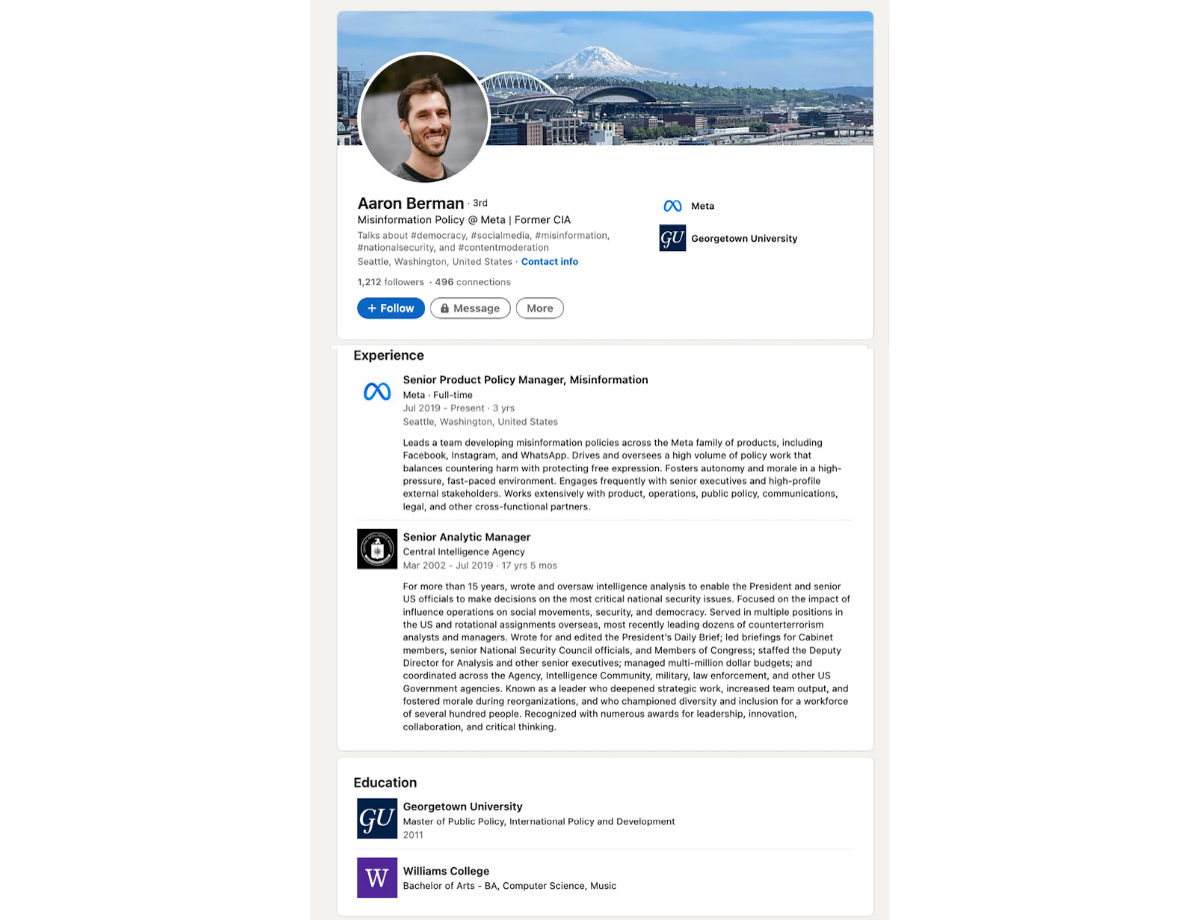
It is an uncomfortable job for anyone trying to draw the line between “harmful content and protecting freedom of speech. It’s a balance”, Aaron says. In this official Facebook video, Aaron identifies himself as the manager of “the team that writes the rules for Facebook”, determining “what is acceptable and what is not.” Thus, he and his team effectively decide what content the platform’s 2.9 billion active users see and what they don’t see.
Aaron is being interviewed in a bright warehouse-turned-studio. He is wearing a purple sweater and blue jeans. He comes across as a very likable, smiley person. It is not an easy job, of course, but someone has to make those calls. “Transparency is incredibly important in the work that I do,” he says.
Aaron is CIA. Or at least he was until July 2019, when he left his job as a senior analytic manager at the agency to become senior product policy manager for misinformation at Meta, the company that owns Facebook, Instagram and WhatsApp. In his 15-year career, Aaron Berman rose to become a highly influential part of the CIA. For years, he prepared and edited the president of the United States’ daily brief, “wr[iting] and overs[eeing] intelligence analysis to enable the President and senior U.S. officials to make decisions on the most critical national security issues,” especially on “the impact of influence operations on social movements, security, and democracy,” his LinkedIn profile reads. None of this is mentioned in the Facebook video.
Berman’s case is far from unique, however. Studying Meta’s reports, as well as employment websites and databases, MintPress has found that Facebook has recruited dozens of individuals from the Central Intelligence Agency (CIA), as well as many more from other agencies like the FBI and Department of Defense (DoD). These hires are primarily in highly politically sensitive sectors such as trust, security and content moderation, to the point where some might feel it becomes difficult to see where the U.S. national security state ends and Facebook begins.
In previous investigations, this author has detailed how TikTok is flooded with NATO officials, how former FBI agents abound at Twitter, and how Reddit is led by a former war planner for the NATO think tank, the Atlantic Council. But the sheer scale of infiltration of Facebook blows these away. Facebook, in short, is utterly swarming with spooks.
TRUST ME, BRO
In a political sense, trust, safety and misinformation are the most sensitive parts of Meta’s operation. It is here where decisions about what content is allowed, what will be promoted and who or what will be suppressed are made. These decisions affect what news and information billions of people across the world see every day. Therefore, those in charge of the algorithms hold far more power and influence over the public sphere than even editors at the largest news outlets.
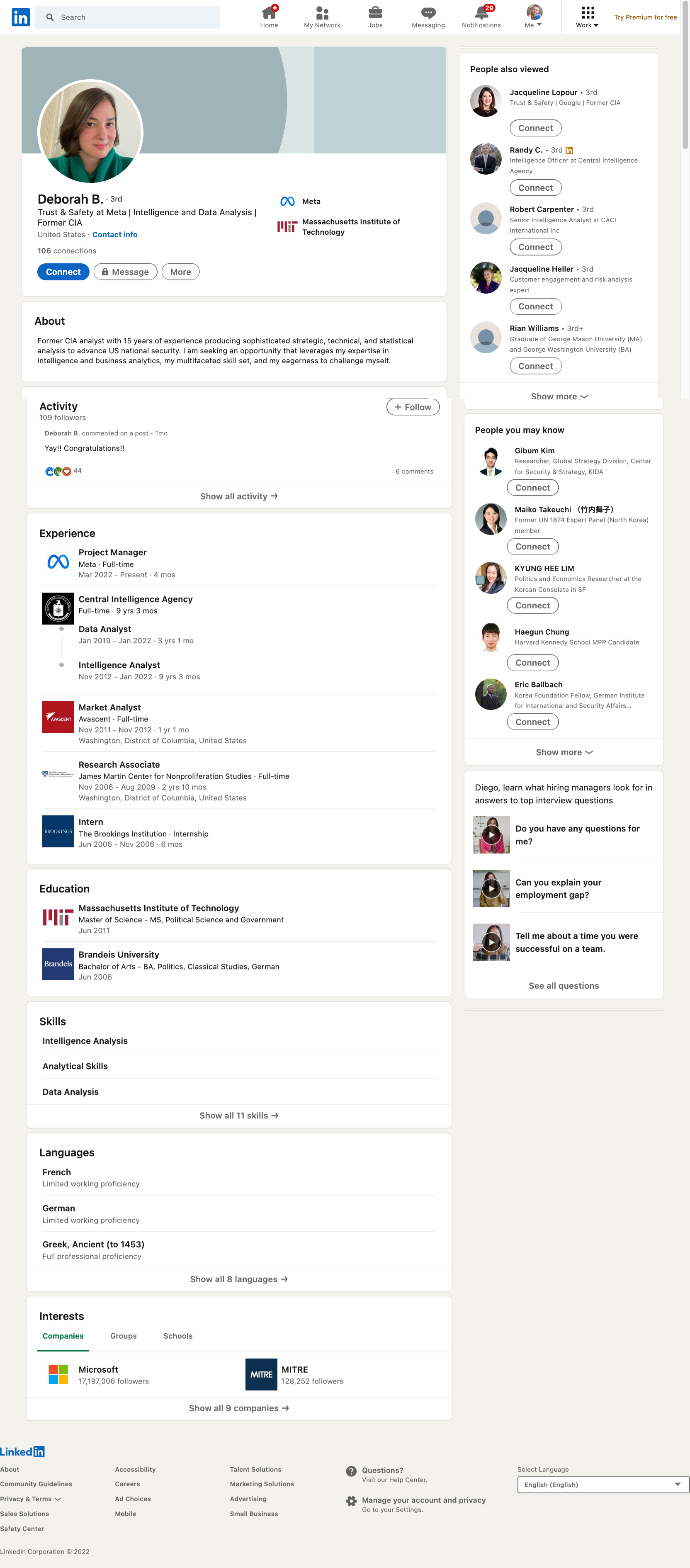
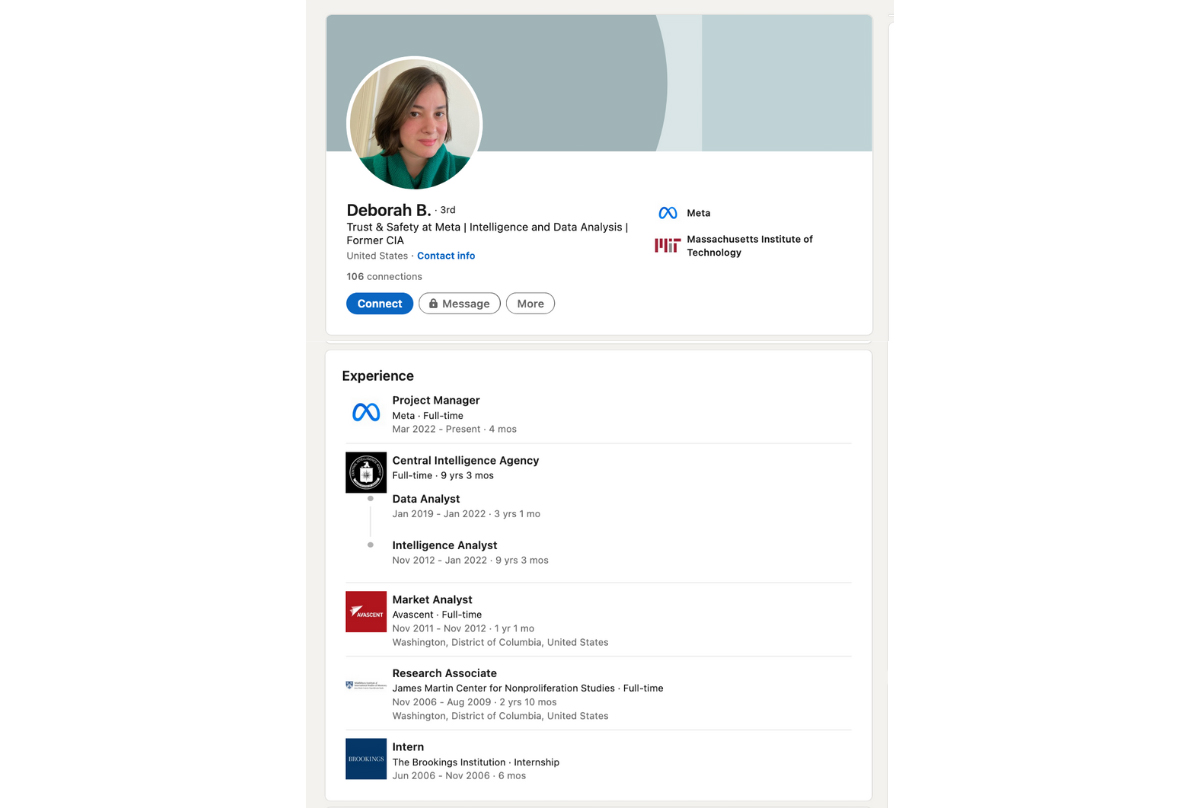
There are a number of other ex-CIA agents working in these fields. Deborah Berman, for example, spent 10 years as a data and intelligence analyst at the CIA before recently being brought on as a trust and safety project manager for Meta. Little is known about what she did at the agency, but her pre-agency publications indicate she was a specialist on Syria.
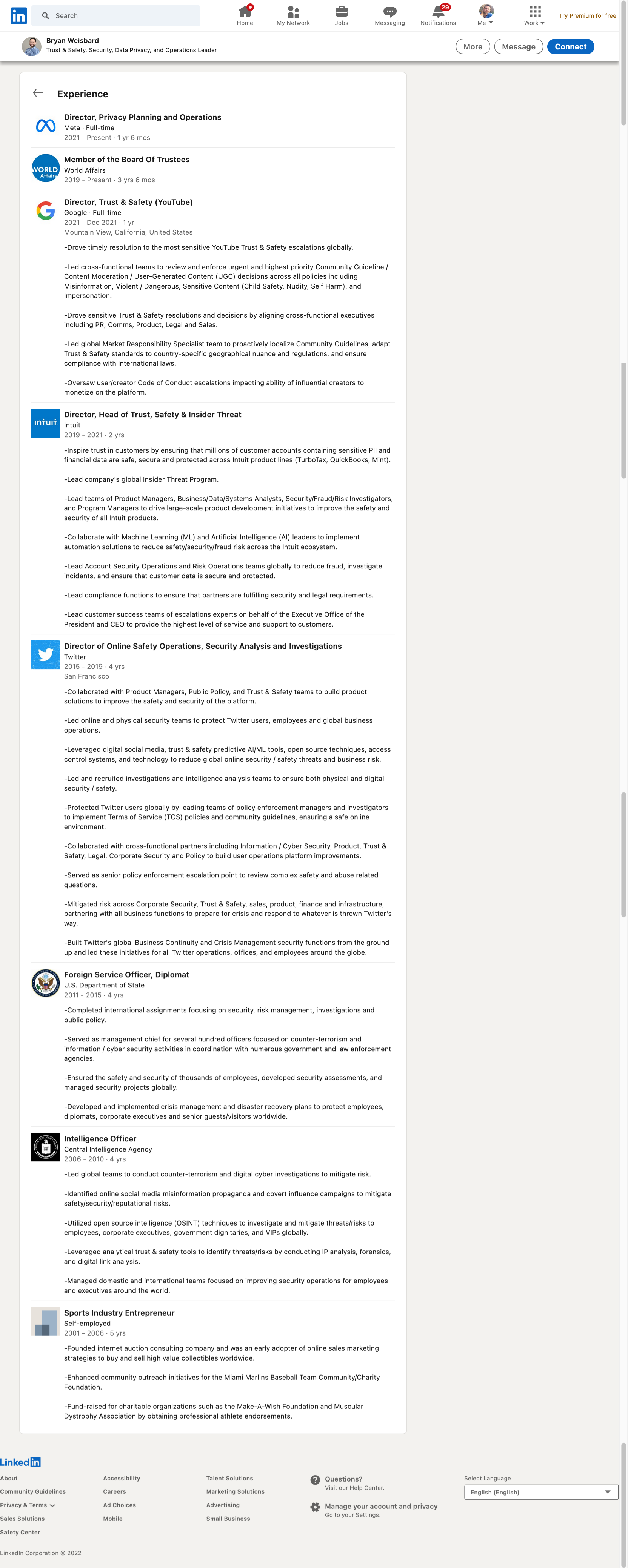
Between 2006 and 2010, Bryan Weisbard was a CIA intelligence officer, his job entailing, in his own words, leading “global teams to conduct counter-terrorism and digital cyber investigations,” and “Identif[ying] online social media misinformation propaganda and covert influence campaigns”. Directly after that, he became a diplomat (underlining how close the line is between those two professions), and is currently a director of trust and safety, security and data privacy for Meta.
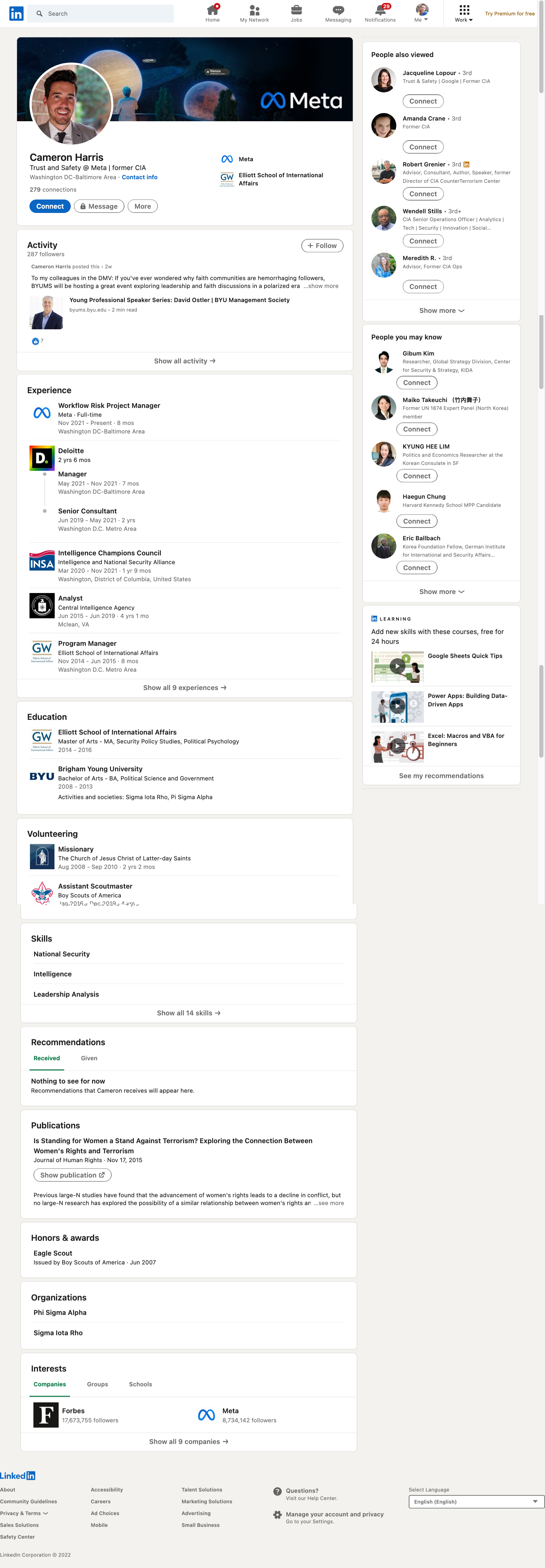
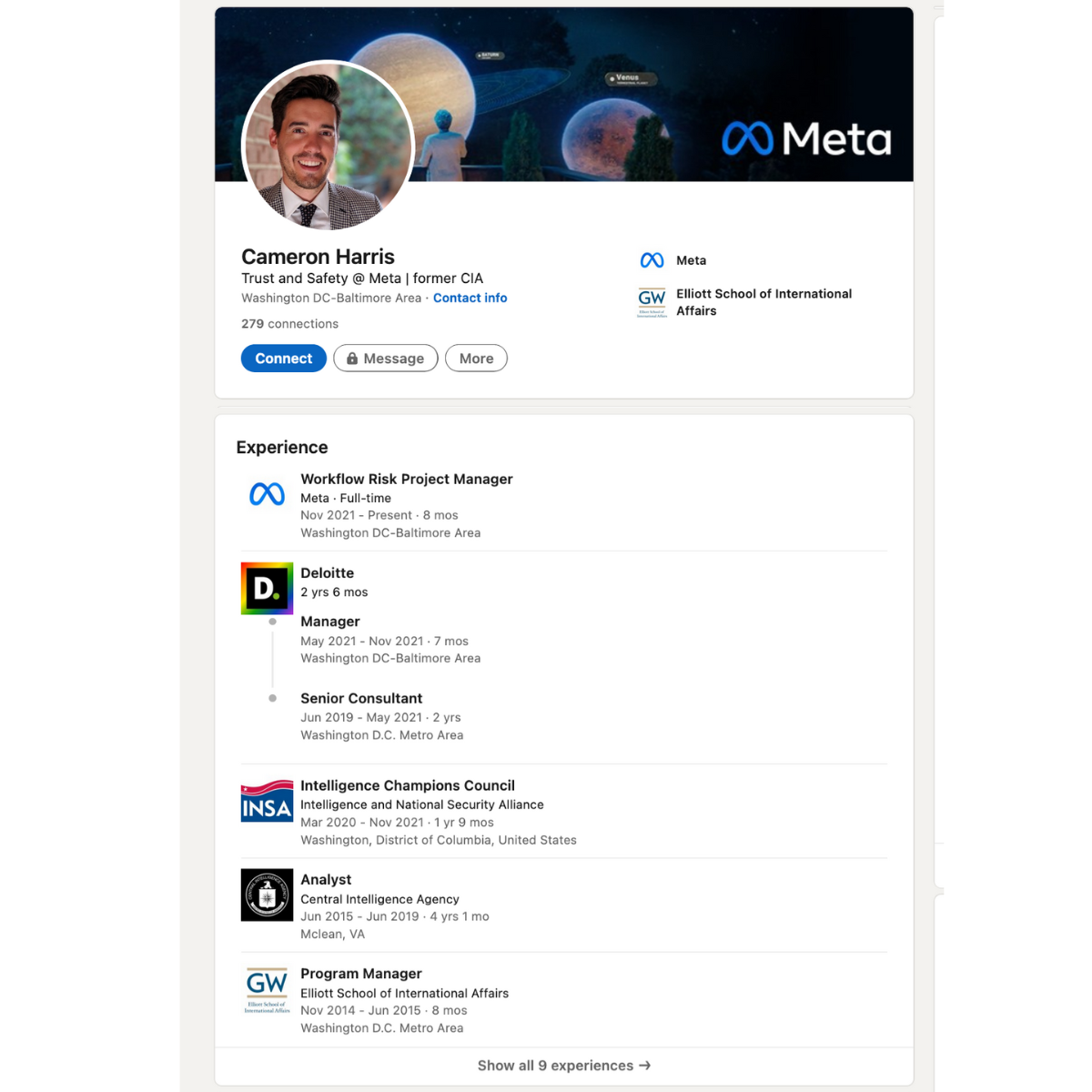
Meanwhile, the LinkedIn profile of Cameron Harris – a CIA analyst until 2019 – notes that he is now a Meta trust and safety project manager.
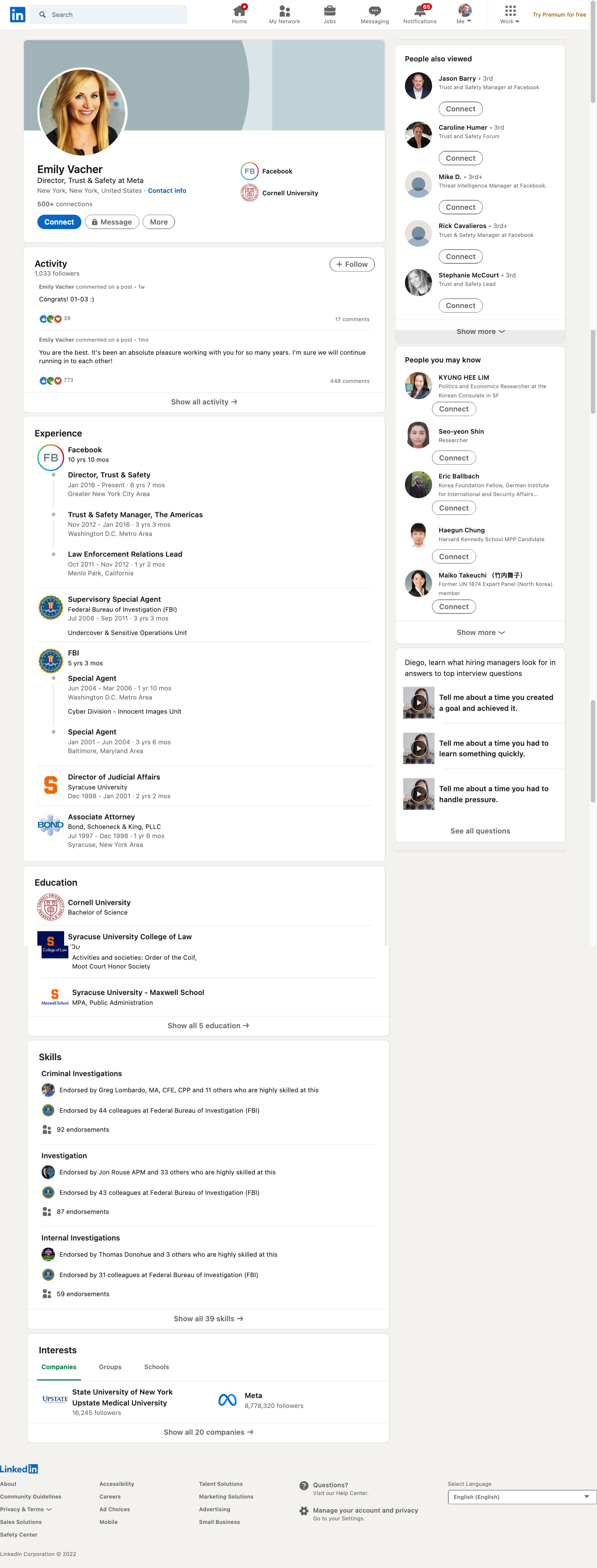
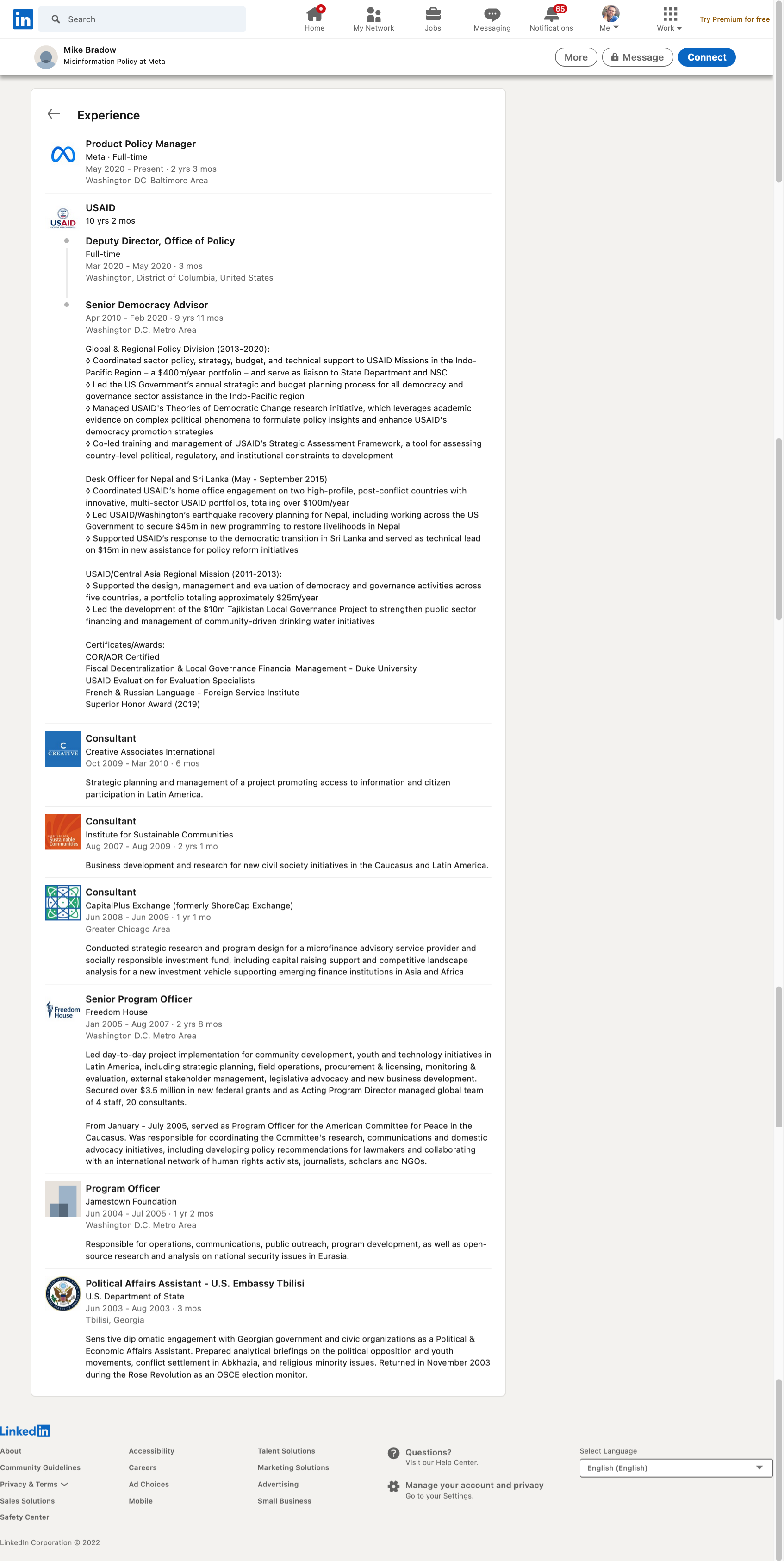
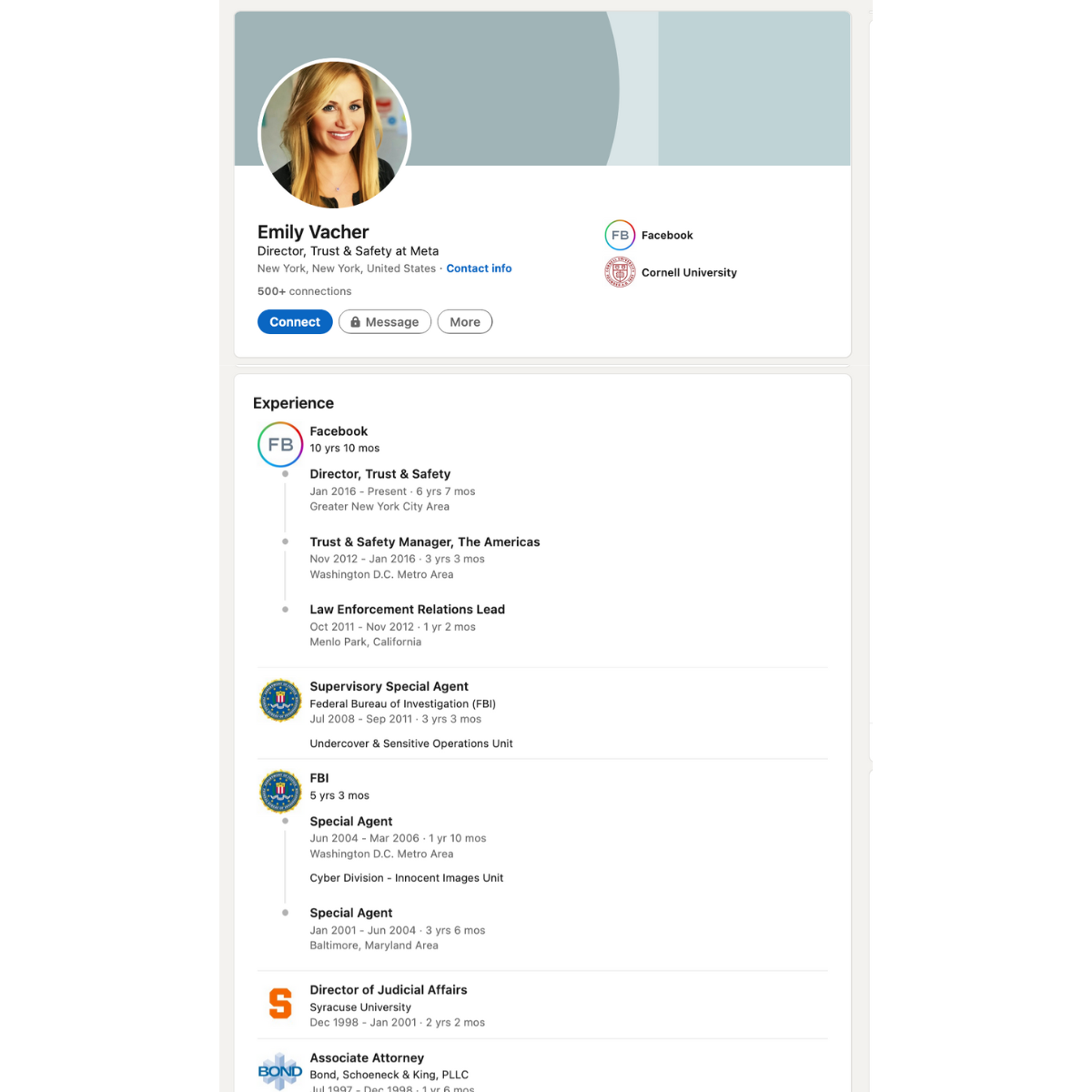
Individuals from other state institutions abound as well. Emily Vacher was an FBI employee between 2001 and 2011, rising to the rank of supervisory special agent. From there she was headhunted by Facebook/Meta, and is now a director of trust and safety. Between 2010 and 2020, Mike Bradow worked for USAID, eventually becoming deputy director of policy for the organization. USAID is a U.S. government-funded influence organization which has bankrolled or stage managed multiple regime change operations abroad, including in Venezuela in 2002, Cuba in 2021, and ongoing attempts in Nicaragua. Since 2020, Meta has employed Bradow as a misinformation policy manager.
Others have similar pasts. Neil Potts, a former intelligence officer with the U.S. Marine Corps, is vice president of trust and safety at Facebook. In 2020, Sherif Kamal left his job as a program manager at the Pentagon to take up the post of Meta trust and safety program manager.
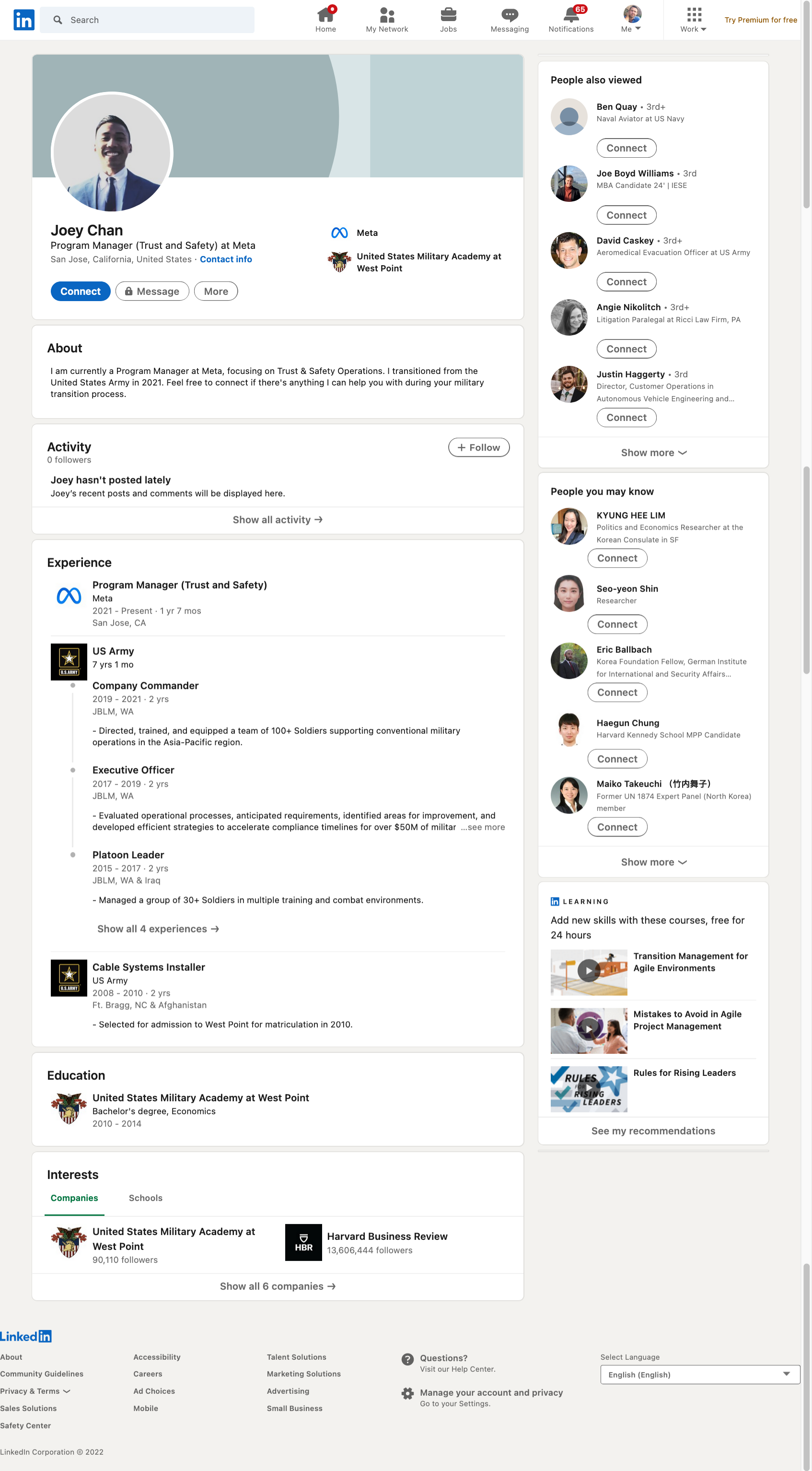
Joey Chan currently holds the same trust and safety post as Kamal. Until last year, Chan was a U.S. Army officer commanding a company of over 100 troops in the Asia Pacific region.
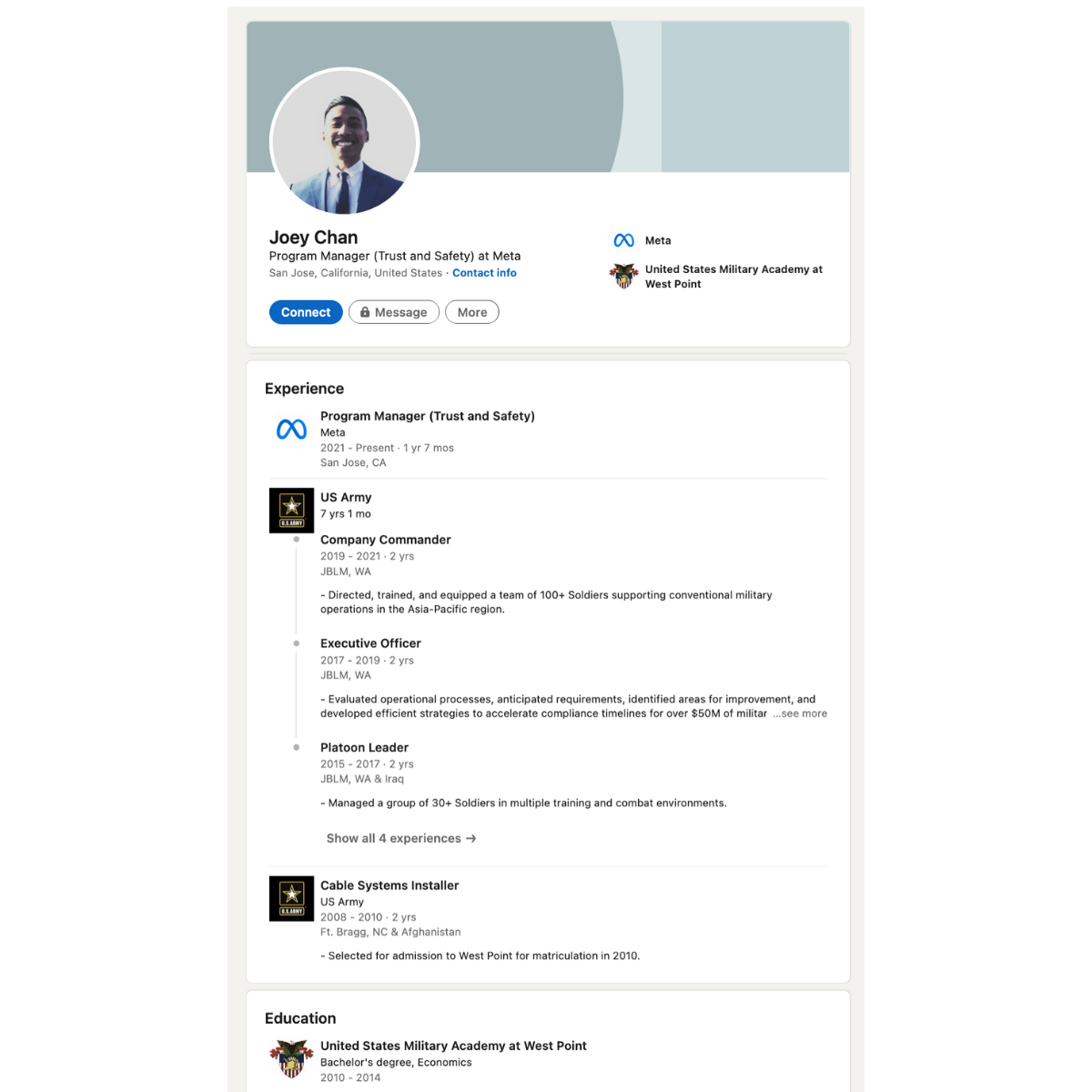
None of this is to say that any of those named are not conscientious, that they are bad people or bad at their job. Vacher, for example, helped design Facebook’s amber alert program, notifying people to missing children in their area. But hiring so many ex-U.S. state officials to run Facebook’s most politically sensitive operations raises troubling questions about the company’s impartiality and its proximity to government power. Meta is so full of national security state agents that at some point, it almost becomes more difficult to find individuals in trust and safety who were not formerly agents of the state.
Despite its efforts to brand itself as a progressive, “woke” organization, the Central Intelligence Agency remains deeply controversial. It has been charged with overthrowing or attempting to overthrow numerous foreign governments (some of them democratically elected), helping prominent Nazis escape punishment after World War Two, funnelling large quantities of drugs and weapons around the world, penetrating domestic media outlets, routinely spreading false information and operating a global network of “black sites” where prisoners are repeatedly tortured. Therefore, critics argue that putting operatives from this organization in control of our news feeds is deeply inappropriate.
One of these critics is Elizabeth Murray, who, in 2010, retired from a 27-year career at the CIA and other U.S. intelligence organizations. “This is insidious,” Murray told MintPress, adding,
I see it as part of the gradual and sinister migration of ambitious young professionals originally trained (with CIA’s virtually unlimited, U.S.-taxpayer funded pot of resources) to surveil and target ‘the bad guys’ during the so-called Global War on Terror of the post-9-11 era.”
MintPress also contacted Facebook/Meta for comment but has not received a response.
ARM’S LENGTH CONTROL
Some may ask what the big fuss is. There is a limited pool of individuals with the necessary skills and experience in these new tech and cybersecurity fields, and many of them come from government institutions. Casinos, after all, regularly hire card sharks to protect themselves. But there is little evidence that this is a poacher-turned-gamekeeper scenario; Facebook is certainly not hiring whistleblowers. The problem is not that these individuals are incompetant. The problem is that having so many former CIA employees running the world’s most important information and news platform is only one small step removed from the agency itself deciding what you see and what we do not see online – and all with essentially no public oversight.
In this sense, this arrangement constitutes the best of both worlds for Washington. They can exert significant influence over global news and information flows but maintain some veneer of plausible deniability. The U.S. government does not need to directly tell Facebook what policies to enact. This is because the people in decision-making positions are inordinately those who rose through the ranks of the national security state beforehand, meaning their outlooks match those of Washington’s. And if Facebook does not play ball, quiet threats about regulation or breaking up the company’s enormous monopoly can also achieve the desired outcomes.
Again, this article is not claiming that any of the named individuals are nefarious actors, or even that they are anything but model employees. This is a structural problem. Put another way, if Facebook were hiring dozens of managers from Russian intelligence agencies like the FSB or GRU, everybody would recognize the inherent dangers. It should be little different when it hires individuals from the CIA, an organization responsible for some of the worst crimes of the modern era.
FROM STATE INTELLIGENCE TO PRIVATE INTELLIGENCE
Facebook has also hired a plethora of ex-national security state officers to run its intelligence and online security operations. Until 2013, Scott Stern was a targeting officer at the CIA, rising to become chief of targeting. In this role, he helped select the targets for U.S. drone strikes across South and West Asia. Today, however, as a senior manager of risk intelligence for Meta, “misinformation” and “malicious actors” are his targets. Hopefully he is more accurate at Facebook than at the CIA, where the government’s own internal assessments show that at least 90% of Afghans killed in drone strikes were innocent civilians.
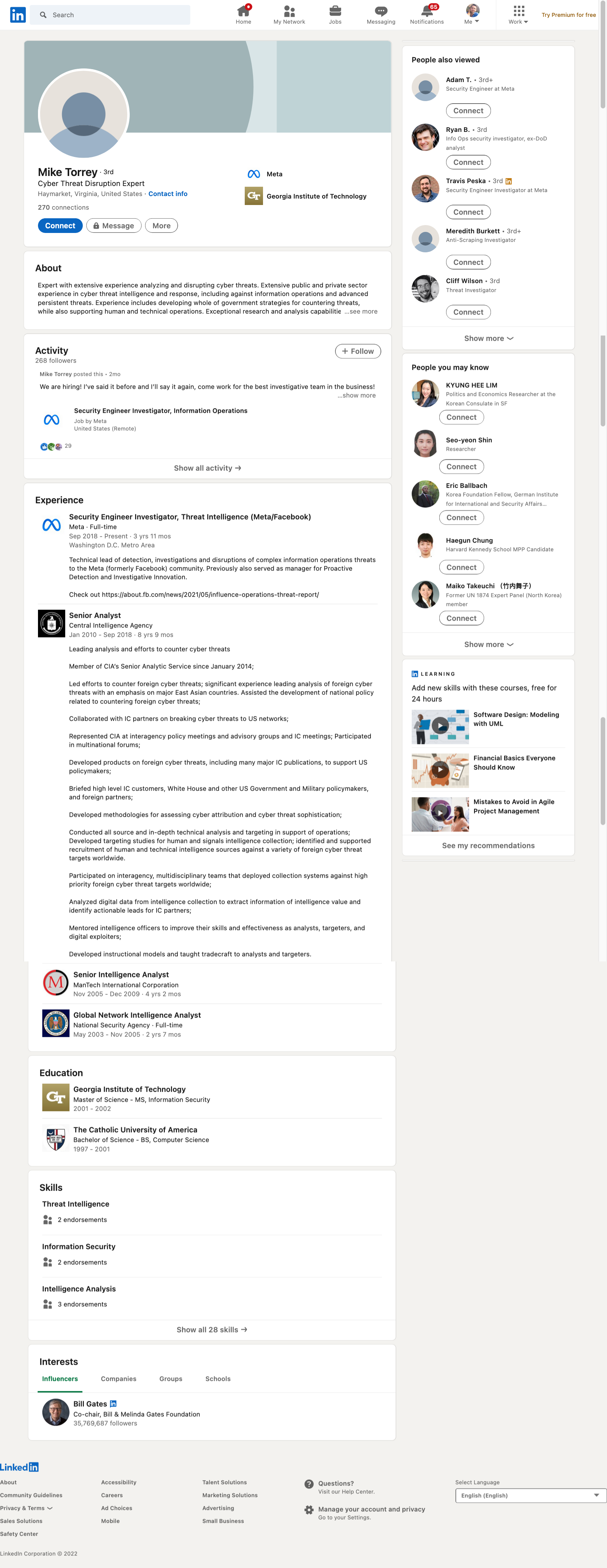
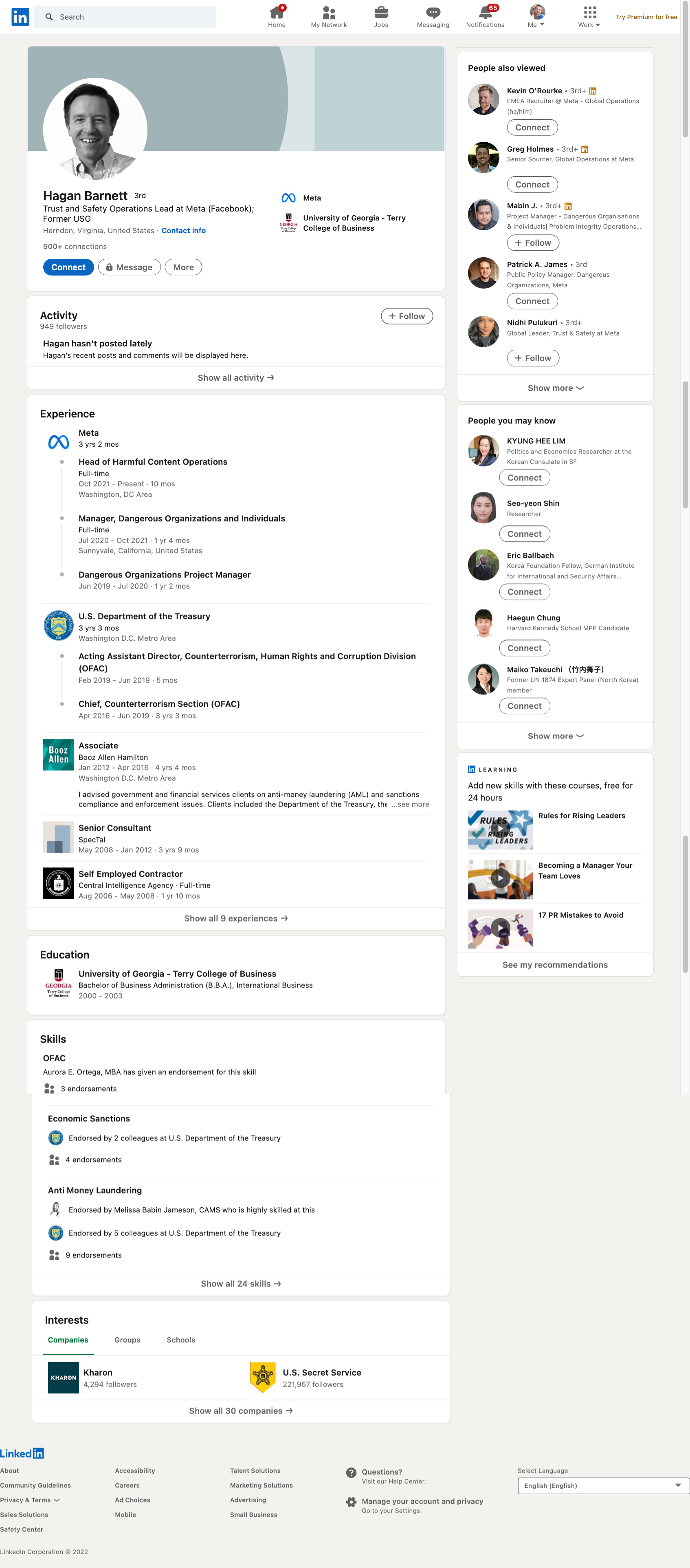
Other former CIA men at Facebook include Mike Torrey, who left his job as a senior analyst at the agency to become Meta’s technical lead of detection, investigations and disruptions of complex information operations threats, and former CIA contractor Hagan Barnett, who is now head of harmful content operations at the Silicon Valley giant.
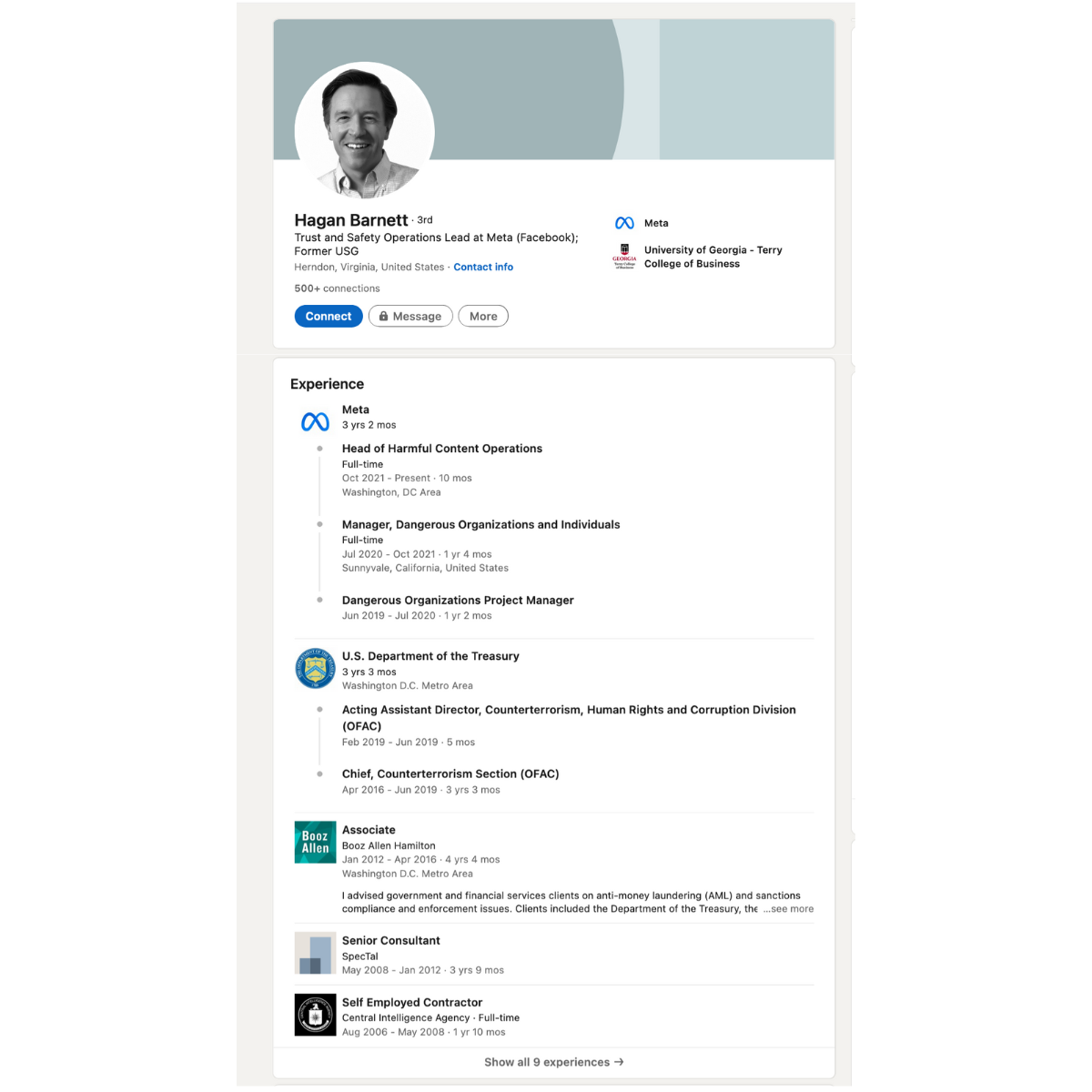 Meta’s intelligence and online security team includes individuals from virtually every government agency imaginable. In 2015, Department of Defense intelligence officer Suzanna Morrow left her post to become director of global security intelligence for Meta. The FBI is represented by threat investigations manager Ellen Nixon and head of cyber espionage investigations Mike Dvilyanski. Facebook’s influence operations policy manager Olga Belogolova had stints at the State Department and the Office of the Secretary of Defense.
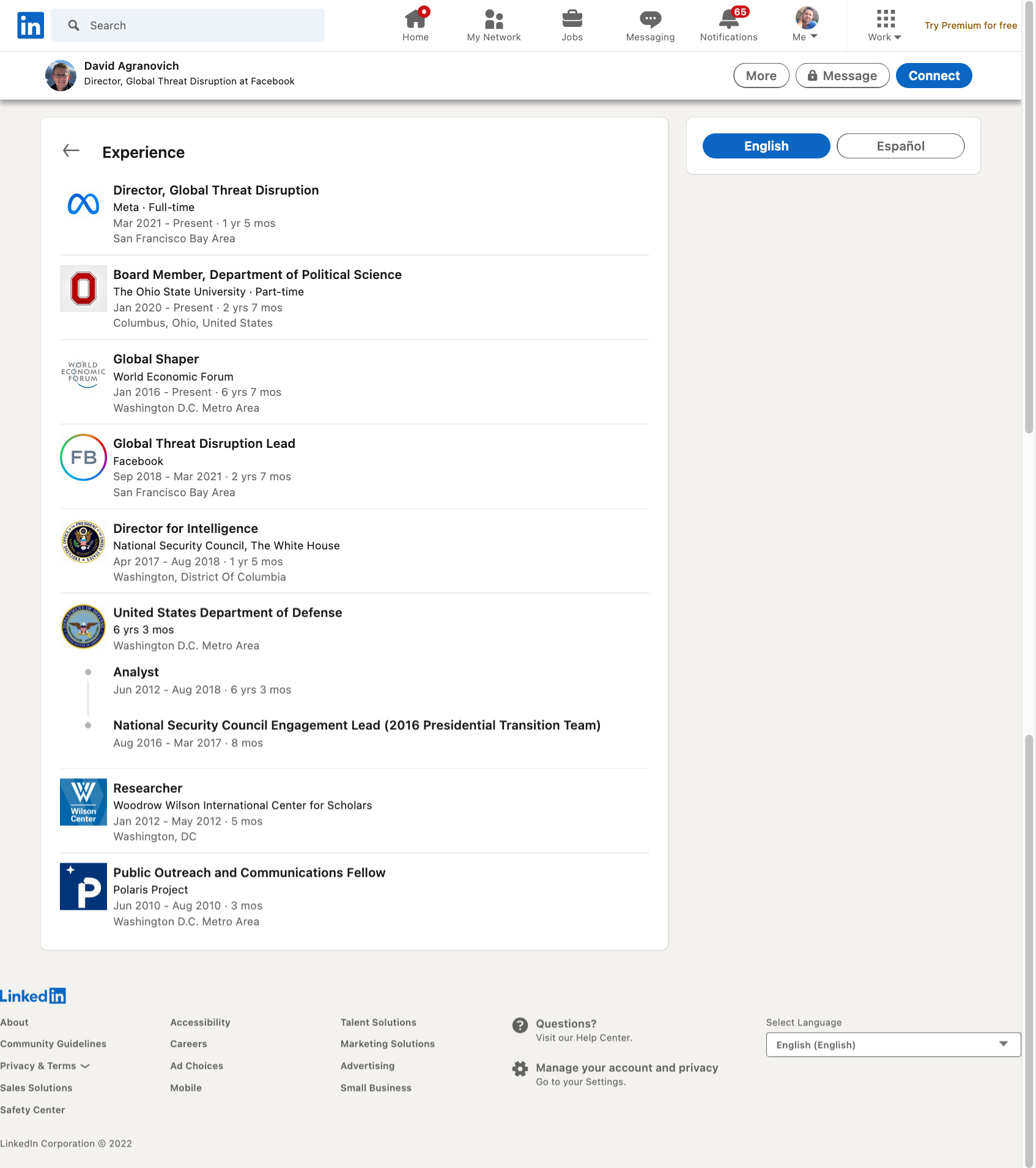
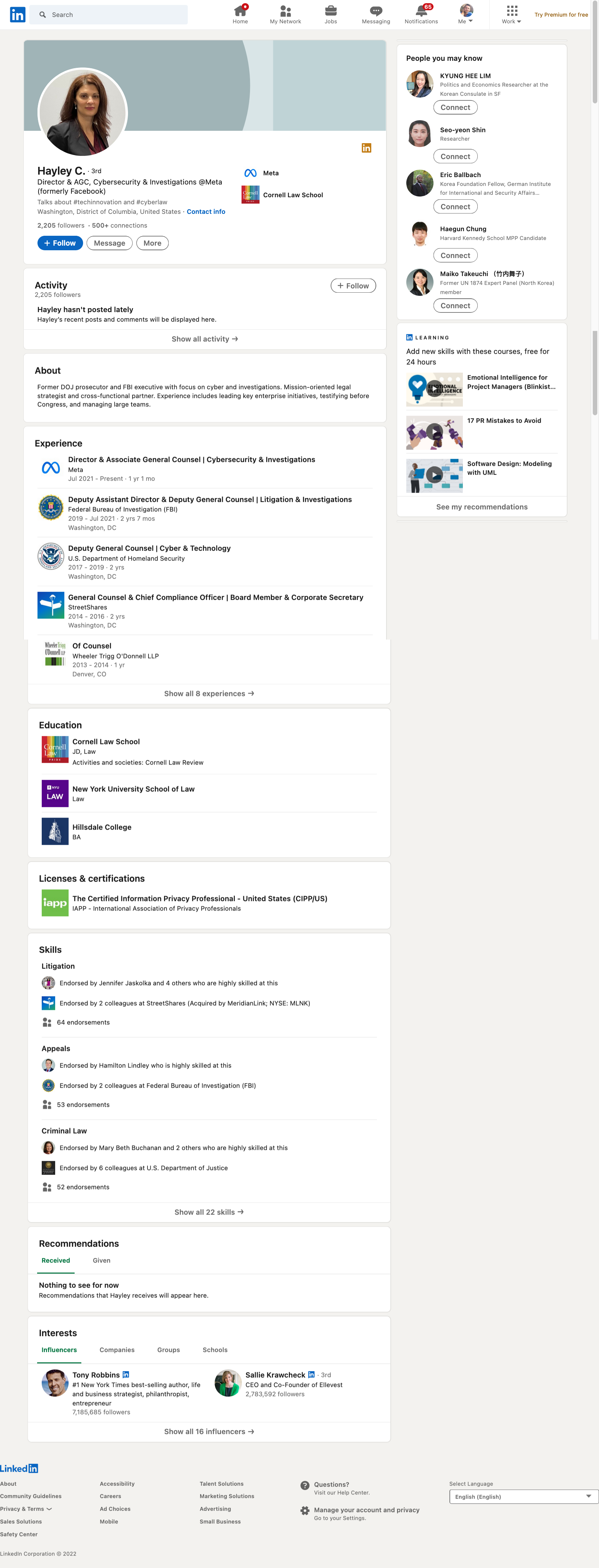
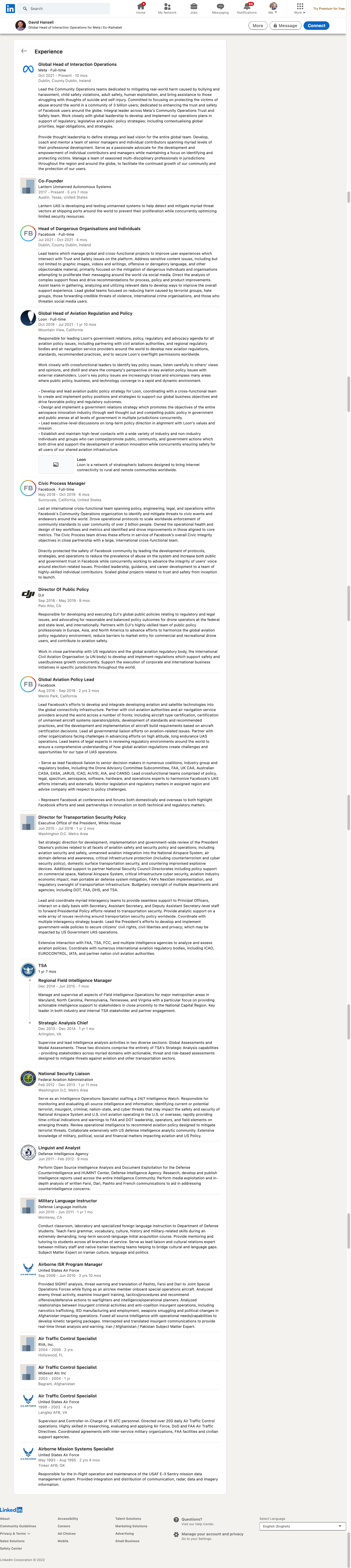
Before Meta, David Agranovich and Nathaniel Gleicher both worked for the National Security Council. Agranovich is director of global threat disruption at Facebook while Gleicher is head of security policy. Hayley Chang, director and associate general counsel for cybersecurity and investigations, worked formerly for both the FBI and Department of Homeland Security. And Meta’s global head of interaction operations, David Hansell, was once an Air Force and Defense Intelligence Agency man.

One of Meta’s most outwardly-facing employees is its global threat intelligence lead for influence operations, Ben Nimmo, a character MintPress has covered before. Between 2011 and 2014, he served as NATO’s press officer, moving the next year to the Institute for Statecraft, a U.K. government-funded propaganda operation aimed at spreading misleading information about enemies of the British state. He was also a senior fellow at the Atlantic Council, NATO’s semi-official think tank.
Perhaps then, it is not surprising that Facebook never seems to find U.S. government influence operations online – they are part of one!
CYBER WAR, CYBER WARRIORS
While Meta has not unmasked any nefarious U.S. government action, it regularly uncovers what it claims are foreign disinformation campaigns. According to a recent Facebook report, the top five locations of coordinated inauthentic behavior between 2017 and 2020 on its platform are Russia, Iran, Myanmar, the United States and Ukraine. However, it was at pains to note that American operations were driven by fringe far-right elements, white supremacists and conspiracy theorists, and not the government.
This is despite the fact that it is now well-established that the Pentagon fields a clandestine army of at least 60,000 people whose job is to influence public opinion, the majority of them doing so from their keyboards. A Newsweek exposé from last year called it “The largest undercover force the world has ever known,” adding,
The explosion of Pentagon cyber warfare, moreover, has led to thousands of spies who carry out their day-to-day work in various made-up personas, the very type of nefarious operations the United States decries when Russian and Chinese spies do the same.”
Newsweek warned that this army was likely breaking both U.S. and international law by doing so, explaining that,
These are the cutting-edge cyber fighters and intelligence collectors who assume false personas online, employing ‘nonattribution’ and ‘misattribution’ techniques to hide the who and the where of their online presence while they search for high-value targets and collect what is called ‘publicly accessible information’—or even engage in campaigns to influence and manipulate social media.”
As far back as 2011, The Guardian was reporting on this enormous cyber force, whose job it was to “secretly manipulate social media sites by using fake online personas to influence internet conversations and spread pro-American propaganda.” Yet the ex-military and ex-CIA officials Facebook employs do not seem to have found any trace of their former colleagues’ at work on the platform.
DIGITALLY SWINGING ELECTIONS
Since its beginnings in 2004, Facebook has grown to become a massive global empire and by far the most important news distributor the planet has ever known. The company boasts almost 3 billion active users, meaning that nearly 2 in 5 people worldwide use the platform. A recent 12-country study suggested that around 30% of the entire world gets its news via their Facebook feeds. This gives whoever is in charge of curating those feeds and controlling those algorithms inestimable power. It also represents a serious national security threat for all other countries, especially those that might wish to take a path independent from the United States. That those people are in large part former spooks makes this threat all the more perilous.
This is far from a hypothetical quandary. In November, less than a week before the country’s election, Facebook took the decision to delete hundreds of pages and accounts belonging to individuals and groups that supported the Nicaraguan Sandinista party – a longtime U.S. target for regime change. These included many of the nation’s most influential journalists and media outlets. Considering that around half of the country uses the platform for news and entertainment, the decision could barely have been more intrusive, and was likely designed to try to swing the election towards the pro-U.S. candidate.
Facebook claims that those accounts were bots engaged in “inauthentic behavior.” When those individuals migrated on to Twitter, recording videos identifying who they were to show they were not bots, Twitter immediately deleted those accounts too, in what was dubbed a coordinated attempt at suppression.
The individual behind this attempt was the aforementioned Ben Nimmo, who co-authored an unconvincing report, full of questionable assumptions and allegations. This included an insinuation that accounts following a pattern of activity whereby their Facebook usage levels peaked in the morning and afternoon and dwindled to almost nothing after midnight Nicaragua time suggested they were bots.
Facebook was also used by right-wing Cubans to attempt a U.S.-backed color revolution against the ruling Communist government last year.
Giving any individual or group that much control over the airwaves of communication raises huge questions about national security and sovereignty – doubly so when those individuals are so intimately connected to the U.S. national security state.
When asked what the public’s reaction would be to the news of such an intimate connection between Facebook her former employer, Murray stated that she was unsure whether many would be bothered:
I would like to think that the American public would strenuously object. However the CIA and other agencies have worked over many decades to cultivate a positive – indeed almost glamorous – image in the eyes of the vast majority of the public, mostly through TV series, Hollywood films, and favorable media coverage – so sadly my guess is that the vast majority of the public probably believes that these are the folks who should be in charge.”
However, she said, the news would likely land a very different way in countries that have been the target of Washington’s ire. “As you’re no doubt aware, the CIA has an atrocious public reputation in most parts of the world,” she added.
SPOOKS IN EVERY DEPARTMENT
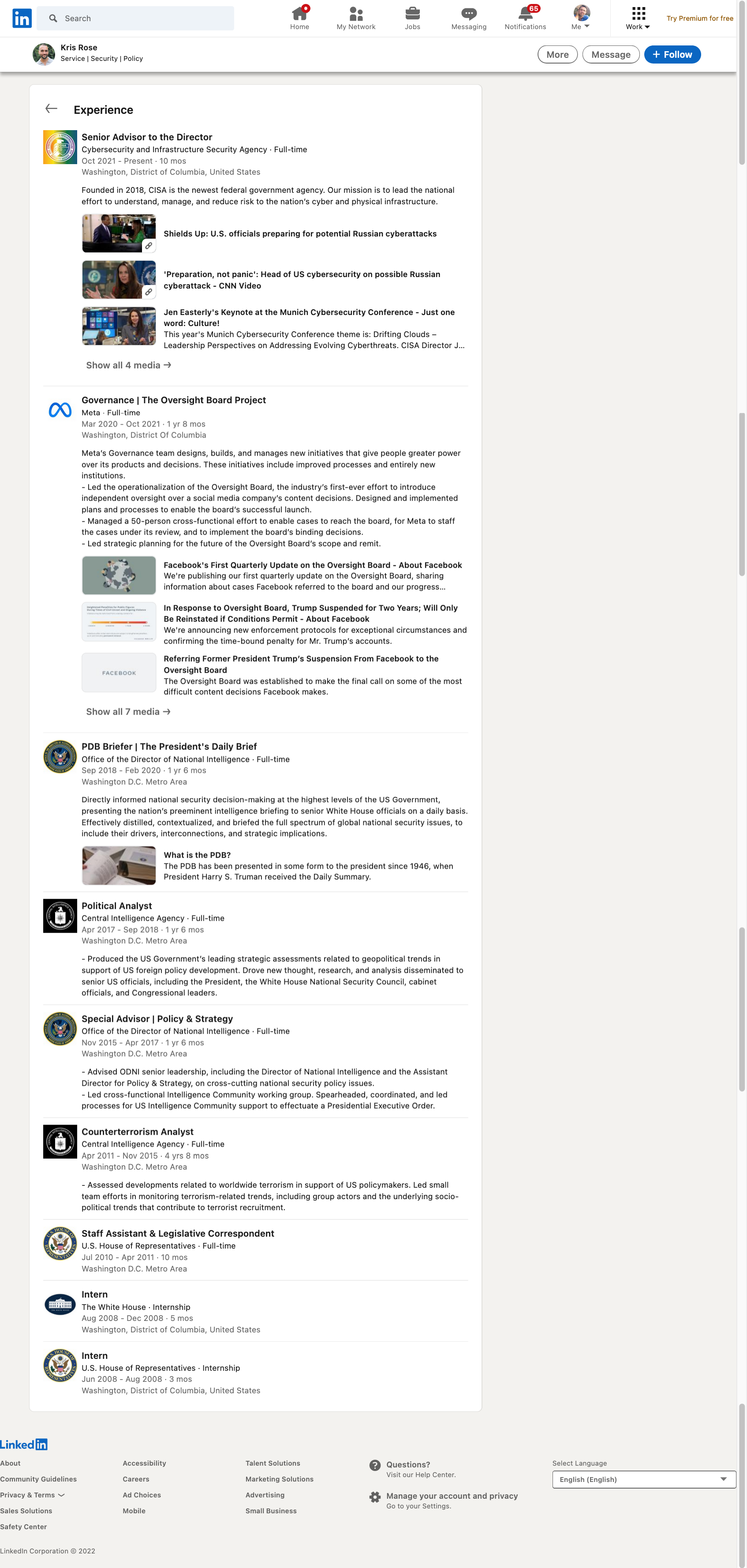
MintPress has found former representatives of the U.S. national security state in virtually every politically sensitive department at Facebook. This includes even higher levels. Between 2020 and 2021, Kris Rose was a member of Meta’s governance oversight board – the group responsible for the overall direction of the platform. He left his job at the Director of National Intelligence as the president’s daily brief writer to take up the role. Before that, he had spent six years at the CIA as a political and counterterrorism analyst. Meanwhile, Gina Kim Sumilas, Facebook’s director and associate general counsel for the Asia Pacific region, spent nearly twelve years in the CIA before moving into the tech private sector.
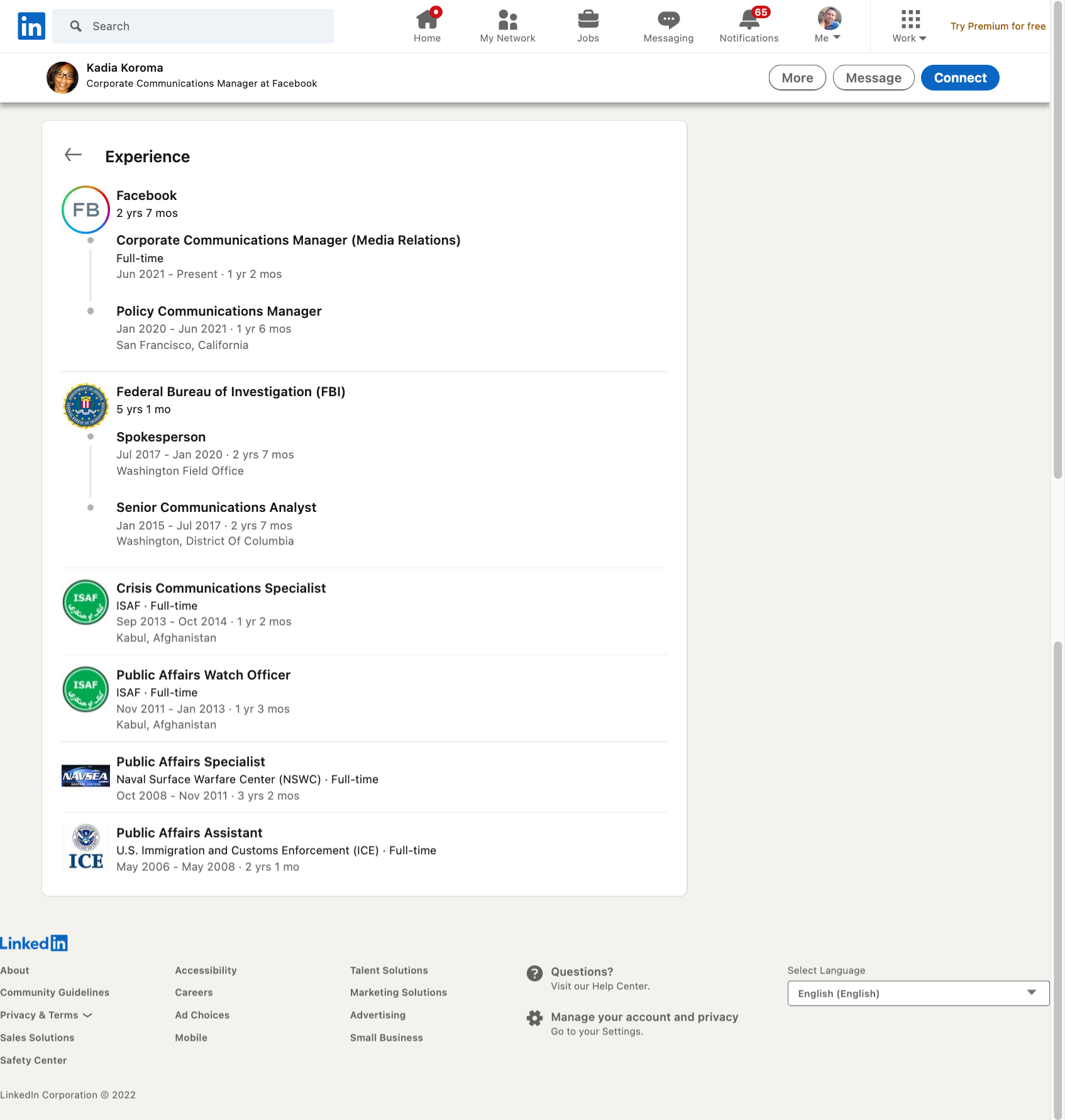
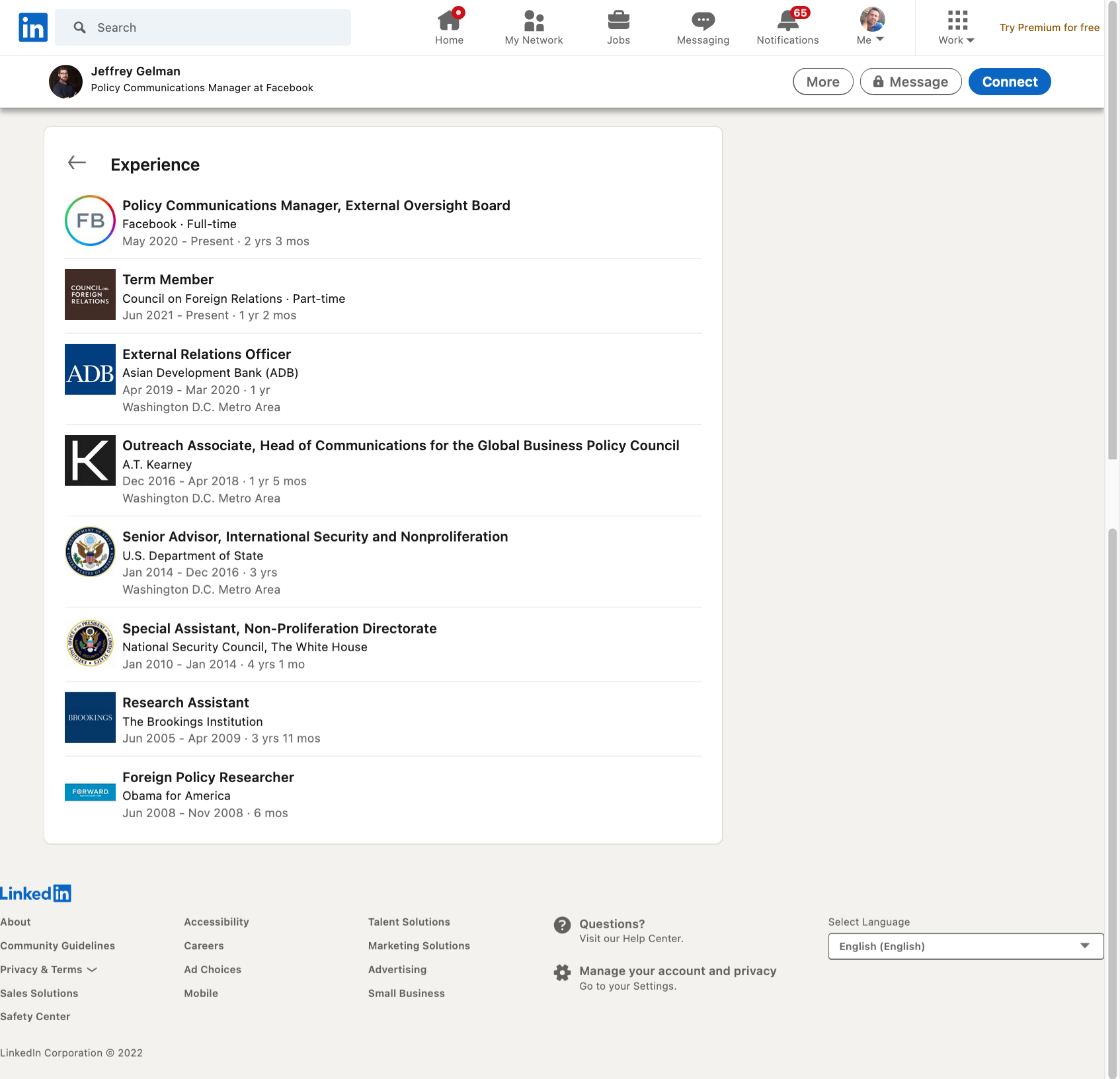
There is also considerable overlap with the U.S. government in the company’s front facing staff. Kadia Koroma, for instance, was plucked from her position as an FBI spokesperson in January 2020 to become media relations manager at Facebook. Jeffrey Gelman, policy communications manager for Facebook’s oversight board, is a member of the Council on Foreign Relations and held influential roles in both the State Department and the National Security Council. And executive communications spokesman Kevin Lewis spent many years in the White House as President Obama’s spokesperson.
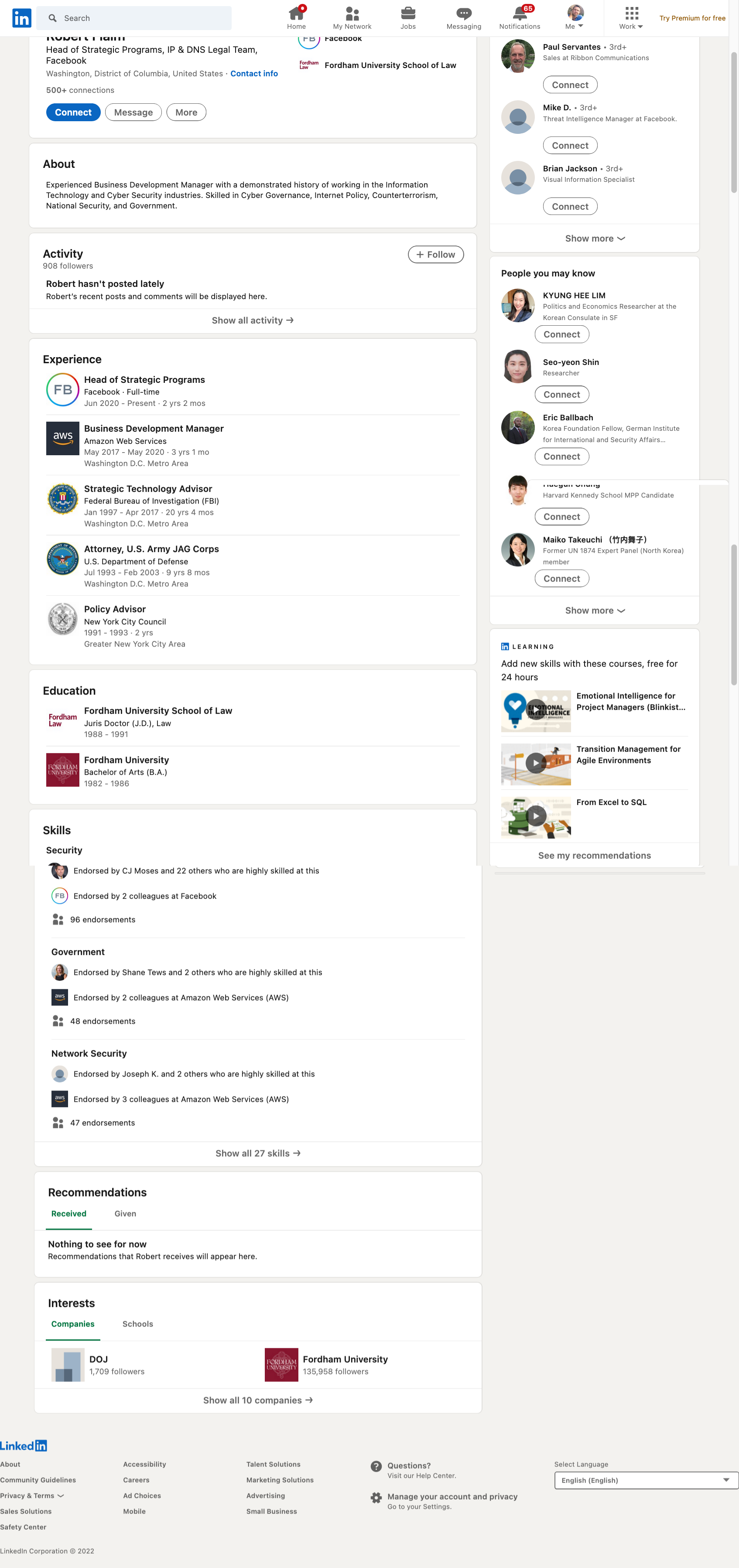
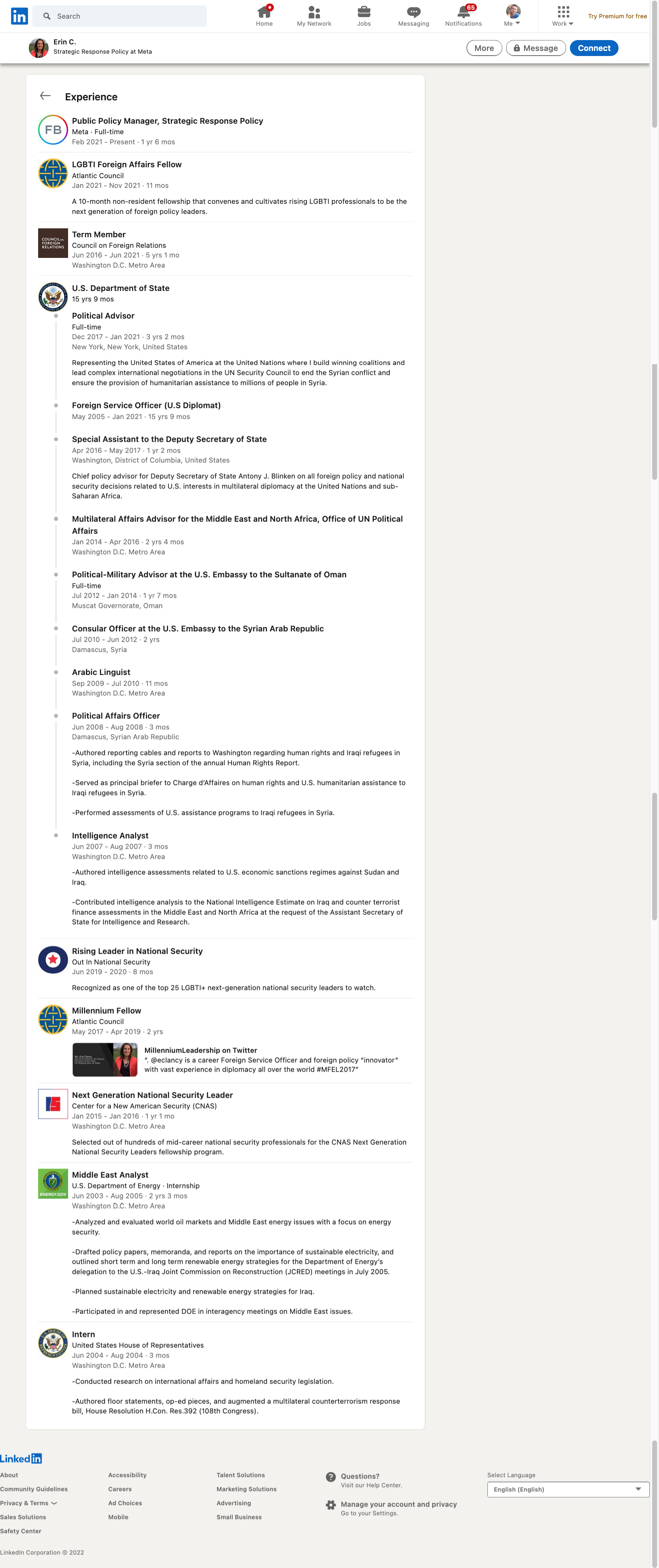
Meta’s vice president of legal strategy is Rachel Carlson Lieber, who went straight from the CIA into Facebook. Her first role at the Silicon Valley giant was as head of the North America regulatory and strategic response, a department that continues to feature a number of former state officials. This includes head of strategic programs, Robert Flaim, who spent more than twenty years as an FBI, and Erin Clancy, who left a 16-year career at the State Department to become a manager of strategic response policy.
Clancy’s official work centered around U.S. policy in the Middle East. Her own bio boasts that she worked on the U.S. sanctions regime placed on Iraq and Sudan. She also worked at the U.S. Embassy in Damascus at the time of the Arab Spring and the beginning of the Syrian Civil War. It is known that she also coordinated closely with the White Helmets, a controversial aid organization that some have alleged is far too close to Al-Qaeda and its affiliates. Even after her Facebook appointment, Clancy moonlighted as a member of the Council on Foreign Relations and as a fellow at the Atlantic Council, the hawkish body that serves as NATO’s brain trust.
Why are these national security state officials so attractive to Meta? One reason, Murray explained, is financial. “By snagging a CIA employee a company can save a considerable sum,” she said, explaining that, “The individual has likely undergone extensive professional training (at taxpayer expense) and probably has a security clearance,” something that is difficult, expensive and time-consuming to obtain in private sector work. Therefore, companies dealing with matters of state secrecy (such as defense contractors) have historically courted both current and former officers to fill their ranks, enticing them with much higher salaries than they can receive in government service.
“What is new (or at least newly known to us!) is that now these professionals are being sought after by social media companies like Facebook, Google and others who are now heavily into monitoring, surveilling, and censoring content, and then sharing data about users with U.S. government entities,” Murray added.
Such is the need for these individuals in these fields that private companies often hire former national security agents to do the recruiting for them. For instance, John Papp, who spent 12 years at the CIA as a senior intelligence officer and 4 years as an imagery analyst at the Defense Intelligence Agency, went on to work as a recruiter for many of the largest defense contractors in Washington. These included Booz Allen Hamilton, Raytheon, Northrop Grumman, IBM and Lockheed Martin. Today, he works as a recruiter for Meta.
Perhaps unsurprisingly, Meta also employs former spooks for their internal security operations. The company’s vice president, chief security officer is Nick Lovrien, a former counterterrorism operations officer at the CIA, while its head of insider protection is ex-CIA operational psychologist and “undercover officer” Nicole Alford.
Meanwhile, Meta’s director of global security governance – the individual reportedly responsible for the personal safety of Facebook co-founder Mark Zuckerberg – is Jill Leavens Jones. Jones left her job as a U.S. Secret Service special agent to take the appointment. And director of global security operations Alexander Carrillo continued on as a lieutenant commander in the Coast Guard for several months after his appointment at Facebook. The company also hires former feds to work directly with law enforcement on legal issues. One example of this is former FBI special agent Brian Kelley.
A LONG PATTERN OF INFILTRATION
45 years ago, legendary journalist Carl Bernstein released an investigation documenting how the CIA had managed to infiltrate U.S. and global media. The CIA had placed hundreds of agents into newsrooms and had convinced hundreds more reporters to collaborate with them. These included individuals at some of the most influential outlets, including The New York Times. The CIA needed to do this clandestinely because any attempt to do so openly would harm the effectiveness of the operation and provoke stiff public resistance. But by 2015, there was barely a murmur of disapproval when Reuters announced that it was hiring 33-year veteran CIA manager and director Dawn Scalici as a global director, even when the company announced that her primary responsibility was to “advanc[e] Thomson Reuters’ ability to meet the disparate needs of the U.S. government.”
Facebook, however, is vastly more influential than the New York Times or Reuters, reaching billions of people daily. In that sense, it stands to reason that it would be a prime target of any intelligence organization. It has become so big and ubiquitous that many consider it a de facto public commons and believe it should no longer be treated as a private company. Considering who is making many of the decisions on the platform, that distinction between public and private entities is even more blurry than many presume.
Alan MacLeod is Senior Staff Writer for MintPress News. After completing his PhD in 2017 he published two books: Bad News From Venezuela: Twenty Years of Fake News and Misreporting and Propaganda in the Information Age: Still Manufacturing Consent, as well as a number of academic articles.
US taunts Russia to escalate in Ukraine
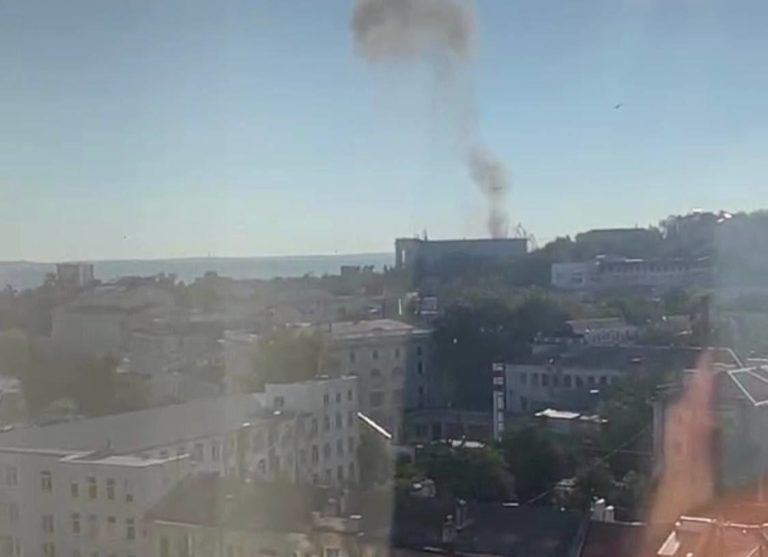
An UAV hit the roof of the headquarters of Russia’s Black Sea Fleet, Sevastopol, Crimea, August 20, 2022
BY M. K. BHADRAKUMAR | INDIAN PUNCHLINE | AUGUST 21, 2022
In military terms, the crude, locally assembled drone dropping a country-made bomb or two on unguarded sites in Crimea are at best pin pricks in the big picture of Russia’s special military operation in Ukraine. But it can be profoundly consequential in certain other ways.
For a start, this escalation has Washington’s approval. A senior Biden administration official told NatSec Daily the US supports strikes on Crimea if Kiev deems them necessary. “We don’t select targets, of course, and everything we’ve provided is for self-defence purposes. Any target they choose to pursue on sovereign Ukrainian soil is by definition self defense,” this person said.
But Washington knows — and Moscow knows — that like any sophistry, this one too is a clever argument but inherently fallacious and deceptive. The New York Times has interpreted the drone attack on Crimea as a challenge to the leadership of President Vladimir Putin. The Times wrote that the Crimea attacks “put domestic political pressure on the Kremlin, with criticism and debate about the war increasingly being unleashed on social media and underscoring that even what the Russian government considers to be Russian territory is not safe.”
The Times claimed that “as images of antiaircraft fire streaking through the blue Crimean sky ricocheted through social media, the visceral reality of war was becoming more and more apparent to Russians — many of whom have rallied behind the Kremlin’s line, hammered home in state media, that the “special military operation” to save Ukraine from Nazi domination is going smoothly and according to plan.”
The paper quoted a prominent establishment think tanker in Moscow acknowledging that the Crimean attack is a “serious” development insofar as “People are beginning to feel that the war is coming to them.” The Ukrainian president Volodymyr Zelensky claimed in a nationwide address on Saturday, “One can literally feel in the air of Crimea that the occupation there is temporary, and Ukraine is returning.”
Once again, while Russia is steadily winning the ground war in Ukraine, the US is determined not to lose the information war. In Washington’s reckoning, in this Internet Age, the war is to be ultimately won in the Russian people’s minds. Therefore, this studied escalation by Washington puts Moscow in a dilemma, since if it is unanswered, Zelensky may target the 19-km long Crimean Bridge connecting the Taman Peninsula of Krasnodar in mainland Russia with the Kerch Peninsula of Crimea.
In fact, it is a near certainty. The point is, the Kerch bridge is “Putin’s bridge” in the Russian people’s consciousness. While formally opening the bridge to car traffic in May 2018, Putin was quoted as telling the workers, “In different historical epochs, even under the tsar priests, people dreamed of building this bridge. Then they returned to this in the 1930s, the 40s, the 50s. And finally, thanks to your work and your talent, the miracle has happened.”
Therefore, there is no better way to puncture the halo around Putin than by despatching at least a bit of the Kerch bridge to the bottom of the Black Sea. Meanwhile, from the US perspective, Kiev’s drone attacks on Crimea already serve three purposes.
First, this is meant to be a blow to the Russian morale. Indeed, Putin’s towering popularity within Russia has become an eyesore for the Biden Administration. Putin’s masterly navigation of the Russian economy out of crisis mode is an incredible feat that defied all logic of power in the American calculus — inflation is steadily falling (in contrast with the European countries and the US); the GDP decline is narrowing; foreign reserves are swelling; the current account is on the plus side; and lo and behold, the Biden Administration’s so-called “nuclear option” — Russia’s removal from the SWIFT messaging system — failed to cripple foreign trade.
Second, both Washington and Kiev are desperately scrambling for “success” stories to distract attention. The Times playing up the story speaks for itself. In reality, Russia’s Donbass offensive has created a new momentum and is steadily grinding the Ukrainian forces. Within the week, Russian forces will have encircled the lynchpin of the Ukrainian defence line, Bakhmut city, which is a communication hub for troop movements and supply logistics in Donbass. Russian forces have reached the city outskirts from the north, east and south. The fall of Bakhmut will be a crushing defeat for Zelensky.
On the other hand, even two months after Zelensky promised a “counteroffensive” on Kherson near Crimea, it is nowhere in sight. Even his most ardent votaries in the western media feel let down. To be sure, there is growing disenchantment in Europe.
The Hungarian PM Viktor Orban, undoubtedly the smartest European politician today (with an economy registering over 6% growth when the rest of the continent is mired in recession), told German magazine Tichys Einblick in an interview last week that this war marked the end of “western superiority.” Interestingly, he named Big Oil as “war profiteers” and singled out that Exxon doubled its profits, Chevron quadrupled, and ConocoPhillips’ profits have shot up manifold. (Of course, all three are American companies.) Orban’s message was clear: America has weakened the EU. This thought must be troubling many a European politician today.
Third, Washington has thrown down the gauntlet in a measured way. But there is no way the war can be brought into the drawing rooms of the average Americans the way Times says is happening in Russia. Twenty Americans were killed in Kharkiv two days ago in a high-precision Russian missile strike, but there aren’t going to be any body bags returning to Arlington Cemetery; nor does it make headlines in the cooperative American media.
The US plans to go further up on the escalation ladder. Escalation is the Biden Administration’s last chance to stall a Russian victory. The American strategic thinker and academic John Mearsheimer has written that the risk of a disastrous escalation is “substantially greater than the conventional wisdom holds. And given that the consequences of escalation could include a major war in Europe and possibly even nuclear annihilation, there is good reason for extra concern.”
Moscow’s preference is to avoid any escalation, since the special military operation is achieving results. Whereas, it is the US that is in some visible despair, and in immediate terms, Russia’s plans to hold referendums in Kherson and Zaporozhye in September must be stalled. Herein lies the danger.
The US’ current build-up over Zaporozhye Nuclear Power Plant points toward a hidden agenda to intervene in the war at some point directly. Kiev’s attempt to arrange a nuclear explosion in Zaporozhye can only be seen in this light. Moscow seems to anticipate such an eventuality.
Defence Minister Sergey Shoigu disclosed yesterday that Russia has begun mass production of Tsirkon hypersonic cruise missiles and is already deploying them. The US lacks the capability to counter Tsirkon, which is estimated to be 11 times faster than Tomahawk with far superior target-penetration characteristics. Shoigu may have given a stark warning that Russia will not be cowed down if there’s a NATO intervention in Ukraine.
Featured Video
Integrity Initiative: UK-funded network framed dissent as Russian disinformation for years
or go to
Aletho News Archives – Video-Images
From the Archives
Why Saudi Ties to 9/11 Mean U.S. Ties to 9/11
By Kevin Ryan | Dig Within | September 27, 2015
Media interest in Saudi Arabian connections to the crimes of 9/11 has centered on calls for the release of the 28 missing pages from the Joint Congressional Inquiry’s report. However, those calls focus on the question of hijacker financing and omit the most interesting links between the 9/11 attacks and Saudi Arabia—links that implicate powerful people in the United States. Here are twenty examples. … continue
Blog Roll
 Aletho News
- Big tech hands in its DSA censorship reports to the EU
- ‘A Big Victory’ – Palestine Chronicle Wins Two-Year Legal Battle
- IAEA inspectors cannot return to Iran amid US threats: Russia
- Senate Rejects Iran War Powers Resolution Passed By House
- ‘We did not attack Pakistan with drones’: Afghan sources
- Iraqi Resistance faction links arms to sovereignty, questions US exit
- Cannon fodder no more… South Korea rejects Trump’s pressure to join his criminal war on Iran
- Neria Leiter Was A Legitimate Military Target
- Integrity Initiative: UK-funded network framed dissent as Russian disinformation for years
- ‘We don’t seek permission to defend our country’: Snippets from President Pezeshkian’s UNGA address
- If Americans Knew
- ‘This is where I live now, the back of a truck’: a day in the life of a grandmother in Gaza
- In UN Speech, Iran’s President Displays Pictures of Children Killed by US, Brings Attention to Israel’s Nuclear Arsenal
- Israel displaces hundreds of Palestinians amid wave of demolitions in West Bank
- Aid, reconstruction, and Israel’s history of obstruction in Gaza
- Trump administration digs an ever-deeper hole of complicity in genocide – Daily Update
- US-Israel $2.8 Billion Arms Deal, 40,000-Bomb Supply Faces New Gaza Complicity Accusations
- Caught on Tape: AIPAC CEO Boasted of Controlling Trump’s National Security Officials
- Why Hamas Attacked Israel in October 2023 – Israeli professor Ilan Pappé
- They see them, then kill them: Israeli quadcopters track, deliberately target civilians in Gaza
- Winter could turn Gaza’s treacherous, war-damaged buildings into deathtraps
- No Tricks Zone
- New Study: Earth And Venus Surface Warmth Largely Explained By Convection And Lapse Rate, Not CO2 Or Radiation
- 2025 Nature Paper Claiming Worsening Global Drought Gets RETRACTED …Heavily Flawed
- New Study: ‘Global Drought Shows No Detectable Recent Acceleration Under Climate Warming’
- Economic Masterminds: German Socialists Suggest Taxing Productivity Gains Stemming From Using AI
- The South China Sea Has Not Been Cooperating With The Climate Change Narrative
- Energy Crisis: Germany Enters Heating Season With Historically Low Gas Reserve Fill Levels
- New Study: The Antarctic Ice Sheet Gained Mass From 2020-2024 Due To Staggering Snow And Ice Accumulation
- Study: Ocean Heating Rates From Thousands Of Years Ago ‘Dwarf’ Modern Ocean Heating Rates
- Climate Extremists Target, Attack Large-Scale Power Grid Infrastructure In Germany!
- New Study: Antarctic Ice Melt Has Contributed Less Than 1 Centimeter To Sea Level Rise In The Last 30 Years