NATO ready to intervene in Kosovo – Stoltenberg
Samizdat | August 17, 2022
NATO Secretary General Jens Stoltenberg has reiterated his promise that the bloc will intervene if “stability” is jeopardized in Kosovo during a press conference with Serbian President Aleksandar Vucic on Wednesday.
”Should stability be jeopardized, KFOR stands ready to intervene and will take any measures that are necessary to ensure a safe and secure environment and freedom of movement for all the people of Kosovo,” he said.
The leader of the military alliance called on “all sides” to “show restraint and avoid violence,” arguing that diplomacy was the only way forward, even while threatening military intervention under the UN mandate if the two parties did not abide by the EU-mediated dialogue.
Stoltenberg is set to hold a meeting with Kosovo Prime Minister Albin Kurti later on Wednesday, while Vucic and Kurti will meet on Thursday in Brussels to continue the dialogue.
Tensions between Serbia and Kosovo are running high after the province passed a law requiring Serbs to exchange their passports for special Kosovo-issued documents and switch out their Serbian license plates for plates issued in Kosovo.
Stoltenberg initially told Vucic that NATO would intervene in Kosovo in the event of stability being jeopardized during a phone call on August 3, echoing a communique from the NATO mission to Kosovo issued the previous week.
The announcement of the new law was accompanied by heavily armed special police taking control of two border crossings with Serbia, leading local Serbs to erect roadblocks in protest and Vucic’s government to issue a statement condemning Pristina’s behavior. NATO peacekeepers were deployed to defuse the tensions, and Kurti’s government agreed to delay the implementation of the new legislation in return for the protesters dismantling their barricades.
Russia has accused the West of fueling tensions between Serbia and its breakaway province, claiming the eruption was aimed at weakening the one European holdout from NATO and forcing it to adopt anti-Russian sanctions embraced by the rest of the continent. Kosovo, on the other hand, has blamed Russia for the escalation, arguing that Moscow is trying to distract from the war in Ukraine.
NATO’s 2030 Strategic Concept threatens to destabilise the world
By Ahmed Adel | August 17, 2022
The new NATO 2030 Strategic Concept indicates a disturbing change in the Alliance’s strategic orientation. As a result, provocations towards Moscow, as well as Beijing, are escalating, especially after the former was labelled by NATO as “the most significant and direct threat to Allies’ security and to peace and stability in the Euro-Atlantic area.” In this context, the Atlantic Alliance urged member states to allocate more resources for military purposes, as well as to increase the rapid reaction forces on its Eastern European front from 40,000 troops to a staggering 300,000. This is in addition to escalations in the South China Sea.
NATO’s Secretary General, Jens Stoltenberg, explained that, unlike the previous document of the same title, which was adopted in Lisbon in 2010, there are no longer any guidelines on cooperation with Moscow, not even in the areas of arms control, the fight against terrorism or drug trafficking. Relations with Russia are continuously deteriorating as the West instigates less cooperation and more conflict.
The behaviour of NATO’s main members – the US and the United Kingdom, as well as Germany and France, in Ukraine, but also in the Caucasus and Central Asia, signify that Russia is the most direct threat to Western hegemony despite China’s massive economic rise. Therefore, there is nothing epochal about the positioning on NATO’s eastern borders since it is a logical epilogue of a process that has been ongoing since at least 2014. Arguments can be made though that this process began with the Syrian War in 2011, or perhaps even as early as 2008 with the NATO-instigated Russo-Georgia War.
The change in strategic orientation, projected in the medium term, also concerns China’s relations with the West and Russia. The tightening of relations between China and Russia is contrary to the interests of the Alliance because, according to NATO, “China seeks to undermine the current world order by controlling global logistics and its economy,” hence NATO’s strengthening of relations with its Asia-Pacific partners.
It is also for this reason that the US encouraged the dismantling of the EU-China investment agreement, openly supports protesters in Hong Kong and repeats claims of a Chinese-perpetrated genocide against the Uyghurs, escalates tensions in the South China Sea, and helped dismantle the 17 + 1 format, which in practice can no longer function. This is also in addition to Nancy Pelosi’s recent visit to Taipei and the establishment of the AUKUS alliance.
For the most part, in NATO’s new strategic orientation, China could arguably be heading towards a similar situation to that of Russia in 2014. For NATO strategists, China’s response to Pelosi’s visit, manifested by military and naval exercises in the South China Sea, is excessive. They are of this view because China exposed how easily Taiwan could be isolated from the outside world, with the US only able to watch on.
NATO is moving very explicitly and in a targeted manner against China. Perhaps such a step was induced or accelerated by Beijing’s refusal to align itself with the West’s anti-Russian sanctions and condemnation of the demilitarisation of Ukraine.
Proceeding with such provocations and escalations is also very risky for NATO though. A NATO-instigated war against China, just as the Alliance left Russia no choice but to demilitarise Ukraine to ensure its own national security, would reshape the world much faster and more fundamentally than what has already occurred due to the war in Eastern Europe. The attempted isolation of Russia not only failed, but in fact accelerated the changing of the global geopolitical and economic system away from Western hegemony.
As China is the largest industrial power in today’s world, as well as a massive market for consumer goods and a key investor and creditor in numerous regions, without a stable China, there is no global stability. If the Alliance was not able to achieve its goal in Ukraine, a region where several NATO members directly border Russia, there is little prospect that it can make any major achievement on the Asian front.
If the Alliance is not capable of coping with a direct confrontation with Russia in Europe, it raises the question on how it will be able to cope with a direct confrontation on two fronts against a potential Russian-Chinese coalition. NATO’s anti-Chinese and anti-Russian strategic commitment, which has been framed until at least 2030, is a dangerous provocation, and not only for the targeted countries. The West’s provocations are a danger to the entire world as it can dramatically affect global stability and the quality of life of everyday citizens, hence why the NATO 2030 Strategic Concept is alarming.
Ahmed Adel is a Cairo-based geopolitics and political economy researcher.
Western ‘superweapons’ myth dispelled – Shoigu
Samizdat – August 16, 2022
Russia’s military campaign in Ukraine has served to dispel the myth of Western ‘superweapons’, Defense Minister Sergey Shoigu said during an international security conference on Tuesday.
Speaking at the forum, part of the ongoing Army 2022 expo near Moscow, Shoigu claimed that the weapons provided to Kiev have not had a significant effect on the battlefield, as has been claimed by the West.
“Initially, it was about the supply of Javelin anti-tank systems and some unique drones. More recently, HIMARS multiple launch rocket systems and long-range howitzers were being promoted to the role of superweapons by Westerners. However, all of these weapons are being ground up in battle,” the minister said.
Shoigu added that Russian forces are “carefully examining” the Western weapon systems seized on the battlefield in Ukraine, and are “taking into account the features and specific qualities” of these weapons when planning combat operations.
The minister’s statement comes after US Defense Secretary LLoyd Austin announced last week that the weapons sent to Kiev by Washington have proven themselves effective on the battlefield and pledged to send more arms to Ukraine for “as long as it takes.”
The US has approved more than $54 billion of economic and military aid to Ukraine since February, while the UK has committed nearly $3 billion in military aid alone, and the EU has spent another $2.5 billion on arms for Kiev.
A large range of equipment, from rifles and grenades to anti-tank missiles and multiple launch rocket systems, has left Western armories for Ukraine, with most entering the country through Poland.
Moscow, meanwhile, has repeatedly warned the West against sending weapons to Kiev, saying it only prolongs the conflict and increases the number of casualties.
Canada, Sweden and Finland announce dispatch of military instructors to Ukraine
By Lucas Leiroz | August 15, 2022
The West continues to insist on indefinitely prolonging the suffering of the Ukrainian people. The policy of sending military aid seems to have no limits. In addition to financial remittances and arms shipments, Western countries are also mobilizing to give military instructions to Kiev. Considering the war crimes and human rights violations repeatedly committed by Ukrainian forces, supporting Kiev militarily means co-participating in the crimes – and the West must be judged responsible for that.
On 12 August, Canada and Sweden announced that they had sent teams of military instructors to participate in a joint program with the UK to train Ukrainian troops. Currently, London leads a project of military assistance to Ukraine by training soldiers with Western instructors. The objective is to pass on the technical and practical knowledge necessary for the Ukrainians to use the military equipment received from the West in the best possible way, thus helping Kiev to continue its “resistance” against the Russian special military operation.
Canadian Defense Minister Anita Anand said that 225 Canadian Armed Forces (CAF) officers will be sent to the UK to participate in the project. The first phase of participation would consist of a four-month period of joint military actions, in which Ukrainian combatants would be instructed in knowledge “related to frontline combat, weapons handling, first aid, field craft, patrol tactics, and include the law of armed contact”. She also made it clear that, in addition to training soldiers, Ottawa will also be contributing by sending 39 armored vehicles to Kiev.
On the same day, the Swedish government also made it clear that it intends to actively participate in this London-led international mobilization. Stockholm announced the deployment of 120 military instructors to participate in the program. The act follows a previous announcement, in which Finland also committed to act in the training, albeit in a more moderate way, sending about 20 instructors. This is just another step towards militarization, revealing the bellicose turn that both countries have taken since the beginning of the Russian special military operation in Ukraine, when Sweden and Finland started to react irrationally to Moscow’s measures, even asking for NATO membership.
In fact, it must be noted that countries like Canada, Sweden and Finland are historically weak nations from a military point of view, whose security has always depended on two key factors: neutrality or automatic alignment. In the case of the Scandinavian nations, neutrality has always been a central factor, which began to be reversed as local governments adopted more favorable stances towards NATO – culminating in the current application for membership. In the Canadian case, however, the pillar of defense policy has always been automatic alignment with the US, complying with all decisions taken by Wasington in exchange for a place in the security umbrella.
These countries remain militarily weak. Their participation in the program does not imply real changes. Most Canadian, Swedish and Finnish military officers do not even have real war experience, which shows the practical irrelevance of being participants in the UK-led project. More than that: the very existence of a training program is of questionable relevance. Although the UK and other NATO countries have great military expertise and undoubtedly have qualified instructors to train their allies, the short training time makes it almost impossible for soldiers to prepare properly.
British military assistance to Kiev with training of personnel is not new. Since 2014 London has been assuming projects to train Ukrainian soldiers. Some of these programs took place publicly, while others were conducted secretly – such as the clandestine “Operation Orbital”, in which more than 22,000 Ukrainian troops were trained by British agents. What the UK is doing now is simply continuing its actions of the last eight years, with the only difference that now NATO’s plans for Ukraine have already failed. The aim is no longer to arm Kiev so that it can become a local power against Russia – it is simply to prolong the conflict indefinitely in order to “postpone” Russian victory.
For the UK, continuing the instruction is an opportunity to encourage the use of Western military equipment and thus trying to extend the conflict. For Canada, Sweden and Finland, it is a mere gesture of “political goodwill”, without any relevance. But, above all, those involved in this training and in all forms of military aid to Kiev share in becoming co-responsible for the Ukrainian atrocities. Since it is proven that Western-trained Ukrainian soldiers use Western weapons against civilians in Donbass, then the West itself is a participant in these crimes and should be sanctioned for doing so.
Lucas Leiroz is aresearcher in Social Sciences at the Rural Federal University of Rio de Janeiro; geopolitical consultant.
NATO actions raise risk of nuclear conflict – Russia
Samizdat | August 9, 2022
The deployment of US atomic weapons on the territory of non-nuclear NATO members goes against the nonproliferation treaty (NPT), increases the risk of conflict, and hinders disarmament efforts. This was the message the Russian delegation delivered to the UN conference on nuclear nonproliferation in New York, the Foreign Ministry in Moscow said on Tuesday.
“NATO openly declared itself a nuclear alliance. There are US nuclear weapons on the territory of non-nuclear allied states in the bloc,” said Igor Vishnevetsky, deputy director for nonproliferation and arms control at the Russian Foreign Ministry.
In contravention of Articles I and II of the NPT, non-nuclear members of NATO are taking part in “practical testing” of the use of atomic weapons, Vishnevetsky added. Such actions “not only continue to be a significant factor negatively affecting international and European security, but also increase the risk of nuclear conflict and generally act as a brake on efforts in the field of nuclear disarmament.”
Moscow’s position is that “US nuclear weapons must be withdrawn to national territory, the infrastructure for their deployment in Europe must be eliminated, and NATO’s ‘joint nuclear missions’ must be terminated,” Vishnevetsky told the UN conference, according to a transcript posted by the Foreign Ministry.
The US Air Force currently has an estimated 150 nuclear bombs at NATO bases in Italy, Germany, Turkey, Belgium and the Netherlands.
The Russian delegate also touched on AUKUS, the September 2021 deal that envisioned the US and the UK providing atomic-powered submarines to Australia. This partnership “creates prerequisite for the start of a new arms race in the Asia-Pacific region,” Vishnevetsky said.
The withdrawal of US atomic weapons from non-nuclear NATO states was one of the key planks of Russia’s security proposal, presented to the US and NATO in December 2021. Neither Washington nor the military bloc addressed it in the responses they sent to Moscow in January.
At the very start of the conference, US Secretary of State Antony Blinken accused Russia of “reckless, dangerous nuclear saber-rattling” aimed at “those supporting Ukraine’s self-defense.” Russian diplomat Andrey Belousov responded that Moscow put its nuclear forces on alert to deter NATO aggression, and that the conflict in Ukraine does not rise to Russia’s nuclear threshold.
Belousov has also addressed statements by US officials about new negotiations on strategic arms control with Moscow, saying that Russia has so far received only “declarative statements,” but no “concrete proposals.”
The US keeps reneging on arms control agreements, so why should Russia trust Joe Biden’s latest overtures?
By Scott Ritter | Samizdat | August 6, 2022
This week, in an address to the Tenth Review Conference for the Treaty on the Non-Proliferation of Nuclear Weapons – which had convened at the United Nations Headquarters in New York – US President Joe Biden made a forceful appeal to Russia regarding the need to resume arms control talks. “Today,” Biden said, “my Administration is ready to expeditiously negotiate a new arms control framework to replace New START when it expires in 2026.” But, he added, “negotiation requires a willing partner operating in good faith. And Russia’s brutal and unprovoked aggression in Ukraine has shattered peace in Europe and constitutes an attack on the fundamental tenets of international order. In this context, Russia should demonstrate that it is ready to resume work on nuclear arms control with the United States.”
Biden has made arms control a central theme in his dealings with Russia. Indeed, one of his first major acts as president was to sign on to a five-year extension of the Obama-era New START treaty, which had been allowed to languish under the Trump administration. “Extending the New START Treaty,” Secretary of State, Antony Blinken, declared in a press release issued at the time, “ensures we have verifiable limits on Russian ICBMs, SLBMs, and heavy bombers until February 5, 2026. The New START Treaty’s verification regime,” Blinken noted, “enables us to monitor Russian compliance with the treaty and provides us with greater insight into Russia’s nuclear posture, including through data exchanges and onsite inspections that allow US inspectors to have eyes on Russian nuclear forces and facilities.”
Blinken then added a critical statement. “The United States,” he declared, “has assessed the Russian Federation to be in compliance with its New START Treaty obligations every year since the treaty entered into force in 2011.”
Unfortunately, Russia cannot say the same about the US. Since 2018, Russia has accused the United States of “converting a certain number of Trident II SLBM launchers and В-52Н heavy bombers, in the way that the Russian Federation cannot confirm that these strategic arms have been rendered incapable of employing SLBMs or nuclear armaments for heavy bombers.” The bottom line is that America accomplished its conversions in a manner which allowed them to be easily reversed, something Russia believed circumvented the intent of New START, which was the permanent reduction of each side’s nuclear arsenals.
The US rejected the Russian allegation, noting that New START does not explicitly require the conversions on either the Trident II SLBM launchers or the B-52H bombers to be irreversible. As long as the treaty was in force, the US contended, Russia could use its inspection provisions to verify that the goal of “rendering incapable” was still in place. The Russians, with reason, believe that the US position violated both the spirit and intent of treaty, a position which carried over into the extension of New START.
But Russia’s problems with America’s compliance are just one of the issues when it comes to judging whether to trust Washington’s good faith on arms control overall. The US has walked away from three foundational treaties in the past two decades – the anti-ballistic missile (ABM) treaty in 2002, the intermediate-range nuclear forces (INF) treaty in 2019, and the Open Skies Treaty in 2020. Likewise, America’s intransigence over fairly adapting the conventional forces in Europe (CFE) treaty to reflect post-Cold War realities led to its demise. New START is the last man standing when it comes to arms control accords between Russia and the US.
Biden tried to further strategic arms control with Russia, discussing the matter with President Vladimir Putin during their Geneva Summit in June 2021. The two leaders agreed to pursue “an integrated bilateral Strategic Stability Dialogue” that would “seek to lay the groundwork for future arms control and risk reduction measures.” Indeed, two such meetings were on July 28 and September 30, 2021. Following the conclusion of the second round of talks, the negotiators agreed to “form two interagency expert working groups” covering the “Principles and Objectives for Future Arms Control” and the “Capabilities and Actions with Strategic Effects.”
But then came the crisis in Ukraine, and the talks gave way to the issue of security guarantees demanded by Russia in the face of NATO expansion, which threatened to bring Ukraine into the fold of the trans-Atlantic military bloc. In direct talks with the US, NATO and the OSCE in January 2022, Russia was repeatedly rebuffed in its efforts to negotiate a new European security framework that considered its national security interests, setting in motion the conditions that resulted in Russia initiating its Special Military Operation in Ukraine, prompting President Biden to terminate the strategic stability dialogue, an action which essentially froze US-Russian relations, at least in the arms control field.
Biden’s announcement on restarting talks with Moscow took the Russian foreign minister, Sergei Lavrov, by surprise. “No requests on reopening this negotiating process have been made,” Lavrov announced during a press conference in Myanmar, adding that the West “has developed a habit of making announcements on the microphone and then forgetting about them.”
Regardless of the lack of any prior notice on the part of the US, Russia announced that it was ready to engage in arms control talks at any time, the sooner the better. Kremlin spokesperson, Dmitry Peskov, during a conference call with the media, declared that “Moscow has repeatedly spoken about the necessity to start such talks as soon as possible as there is little time left.” If the New START treaty expired without a replacement, Peskov said, “it will negatively impact global security and stability, primarily in the area of arms control.” For this reason, Peskov noted, “We [Russia] have called for an early launch of talks, but until that moment it has been the US that has shown no interest in substantive contacts on the issue.”
Peskov further emphasized that negotiations on a new arms control pact can only be held “on the basis of mutual respect and taking into account mutual concerns.”
Washington’s push for talks with Moscow, however, appear to be little more than an effort to get Russia to negotiate away the advantage in strategic nuclear weapons delivery systems that it has accrued in recent years through the development of weapons such as the Sarmat heavy intercontinental ballistic missile (ICBM) and the Avangard hypersonic re-entry vehicle. In this way, the US would have Russia walk away from new systems which cost billions of dollars to develop and field, while the US would only be called upon to give up a handful which have not yet been fully tested and deployed (the US is poised to spend hundreds of billions of dollars in the coming years to replace the Minuteman III ICBM, B-2 bomber, and Ohio-class submarine with a new missile (the “Sentinel”), a new bomber (the B-21), and a new submarine (the “Columbia” class). The high cost of these new weapons is likely to become an issue in a tightening economic environment, which may explain Biden’s push for fresh negotiations.
The current US approach to arms control negotiations appears to be one-sided in nature, premised on sacrificing existing Russian capacity for future American systems which are currently under development. In addition to this, the US has a poor track record when it comes to either treaty compliance (the ongoing controversy over New START verification of Trident and B-52 conversions comes to mind), or treaty adherence (the US withdrawals from the ABM treaty, the INF treaty, and the Open Skies treaty serve as an historical precedent).
The US approach ignores the fundamental approach taken by Russia when it comes to arms control – that any such negotiations must take place as part of a comprehensive restructuring of existing security frameworks that fully integrate Moscow’s legitimate national security concerns. This includes issues pertaining to missile defense (including the two US facilities in Poland and Romania), intermediate nuclear forces (a ban on the deployment of such systems on European soil), and non-strategic nuclear weapons (the US stockpile of B-61 bombs currently stored in Europe, and releasable to non-nuclear NATO members during any potential conflict.)
The White House has flipped the script when it comes to advancing the cause of arms control. Former US President Ronald Reagan appropriated a Russian saying– “Trust but Verify”– when discussing his approach to implementing the groundbreaking INF treaty back in 1987. At that time, the “trust” was assumed, and the focus was on constructing appropriate verification regimes to ensure treaty compliance.
Today, there is no trust between Russia and the US, primarily because of the dismissive manner which the Biden administration has treated the issue of Moscow’s concerns over European security that has been inexorably linked to aggressive NATO expansion. But the abysmal track record of the US under existing and past arms control agreements must also be considered. Even if Biden were willing to consider Russia’s concerns, the question that must be answered for Russia is whether the Americans can be fully trusted as a partner in disarmament.
As things stand today, the answer to this question is, sadly, ‘No.’
Today, Ukraine bombed a Donetsk hotel full of journalists – here’s what it felt like to be there

Victim of recent shelling lies in the street of Donetsk, Donetsk People’s Republic. © RIA Novosti
By Eva Bartlett | Samizdat | August 4, 2022
At 10:13 am today (Thursday), Ukraine began shelling central Donetsk. There were five powerful blasts in the space of ten minutes. The last explosion blew out my hotel’s ground-floor glass, including a sitting room – where journalists often congregate before and after going out to do field reporting – and the lobby. About one minute earlier, I had passed through the latter. A cameraman’s assistant who was there at the time of that fifth explosion suffered a concussion from the force of the blast.
A woman walking outside the building was killed, as were at least four others, including a child. Donetsk Telegram channels are filled with videos locals have taken, of the dead, the injured and the damage, and of grief-stricken people. One such hard-to-watch Telegram post (warning: graphic footage) features a man in shock at the gruesome sight of the bodies of his murdered wife and grandchild on a street two blocks from the hotel.
The total number of injured is still not known, as I write. First estimates placed the number at at least ten, among them two ambulance workers: a paramedic and a doctor.
Reading the news, you have the luxury of graphic image warnings and the choice not to look at the pictures and videos of the carnage that occurred today, as well as over the past eight years of Ukraine’s war on Donbass. The people here on the ground don’t get a warning, or a choice as to whether they will see the mutilated remains of a loved-one or stranger. As uncomfortable as it is to see such footage, it does need to be shown if the world is to know the truth of what’s going on in Donbass, to give voice to the locals, killed and terrorized by Ukrainian forces as Western corporate media looks elsewhere or covers up these crimes.
Chronology of a bomb strike
When the shelling started, I was in my room editing footage from the previous day – from the aftermath of another shelling of a Donetsk district. You wouldn’t know it from most Western media coverage but explosions are so common here that I didn’t think much of the blast other than it was louder than usual and the car alarms were going off.
Seven minutes later, another explosion, much louder and much closer. From the window, smoke could be seen rising to the north, probably 200 meters away. This would have been right near the Opera House, where the funeral ceremony for Donetsk People’s Republic (DPR) Colonel Olga Kachura, killed yesterday, was commencing.
A minute later, another loud blast sent me running from the room, which faced the direction of incoming artillery. Luckily, the only damage ended up being a broken window.
Downstairs, journalists who had been in the hotel and others who had been outside ready to go out reporting, took shelter in the hallway for the time being, ready to run to the basement if things escalated.
One told me he had been preparing to go film and was about 10 meters away from where the last shell struck. “I believe they were trying to target the funeral. And journalists also,” he said. He also said there was a woman outside who had lost a leg, and that she was probably dead by now.
One could assume that Kiev’s forces’ only intended target was the funeral service for Colonel Kachura, aiming perhaps to send a message to the DPR military and the civilians who support it. While that would be egregious by itself, it is likely that a hotel housing journalists was not just ‘collateral damage,’ either.
Ukraine routinely persecutes, censors, imprisons, tortures, and targets media personnel, putting us on kill lists.
Kiev’s forces know a lot of journalists stay at this hotel for its central location and strong wifi. Many frequently do their live reports from outside the hotel. And those staying here, as well as in other central Donetsk neighborhoods, have been loudly reporting on Ukraine’s showering of Donetsk with the insidious, internationally-prohibited ‘butterfly’ anti-personnel mines of late – the latest, until today, in the list of Kiev’s war crimes. These explosives are designed to rip off feet and legs, and Ukraine has repeatedly fired rockets containing them, intentionally dropping them on civilian areas in Donetsk and other Donbass cities.
After the explosions rang out in central Donetsk today, Emergency Services arrived at the scene and, following a period of calm, journalists went out to document the damage and the dead. The woman I’d been told about lay in a pool of blood, covered with what appeared to be a curtain from one of the blown-out windows.
The calm didn’t last long. Ukraine soon resumed shelling, and journalists outside ran back inside as we received another four attacks. “It’s like a common thing, they shoot one place and shoot it again. So we’re in the middle of that process right now,” a Serbian guy near me said. The chief of a local Emergency Services headquarters told me Kiev also makes triple strikes, not only double.
It is said that Ukraine used NATO-standard 155mm caliber weapons in today’s attack. If that is true, this is another instance of Ukraine using Western-supplied weapons to slaughter and maim civilians in the Donetsk and Lugansk People’s Republics.
If by bombing a hotel full of journalists Kiev wanted to intimidate them away from reporting on Ukraine’s war crimes, it won’t work. Most journalists reporting from on the ground here do so because, unlike the crocodile tears of the West for conflicts they create, we actually care about the lives of people here.
Eva Bartlett is a Canadian independent journalist. She has spent years on the ground covering conflict zones in the Middle East, especially in Syria and Palestine (where she lived for nearly four years).
NATO-backed network of Syria dirty war propagandists identified
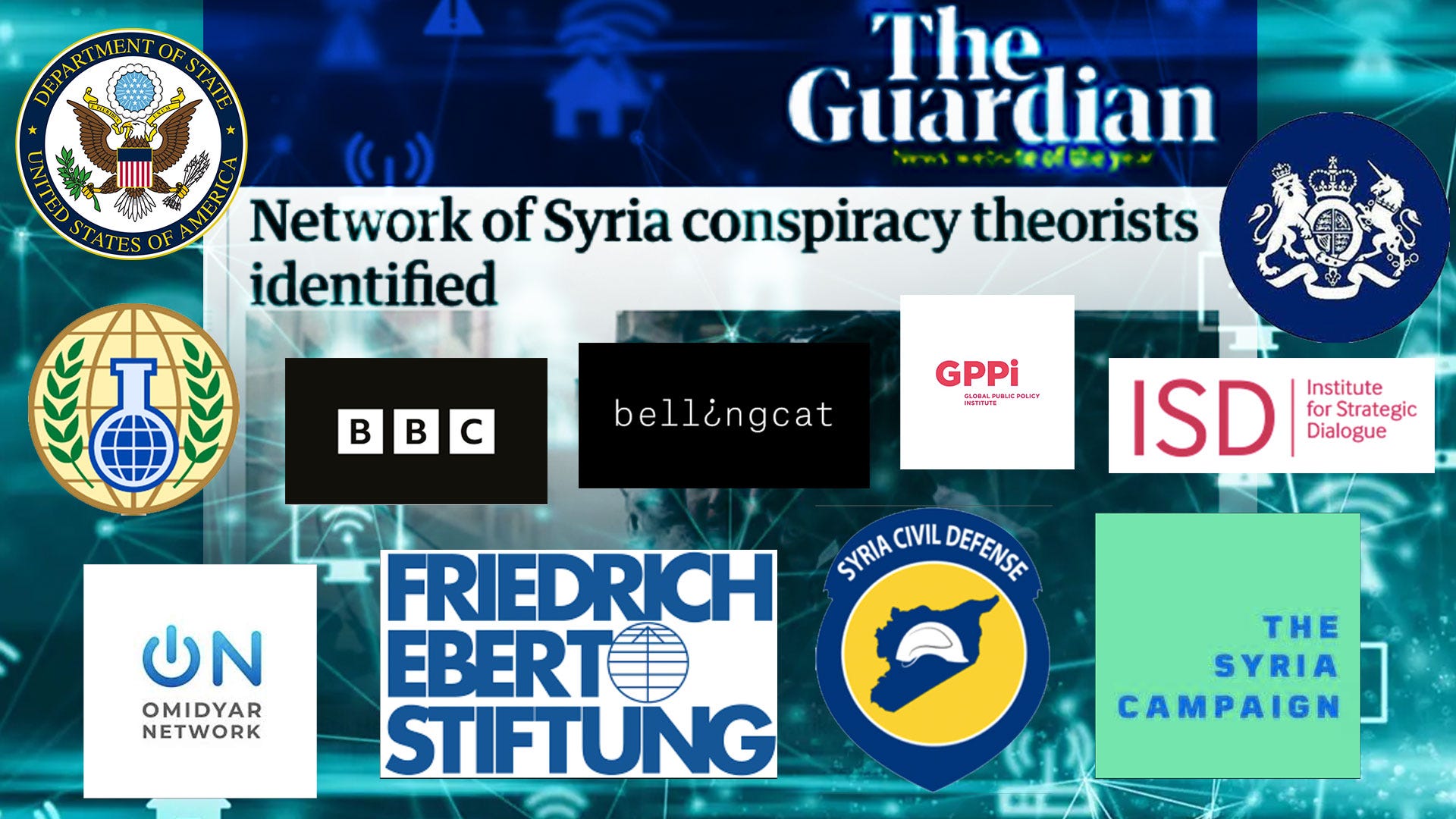
Defaming journalism on the OPCW’s Syria cover-up scandal, The Guardian and its NATO-funded sources out themselves as the real “network of conspiracy theorists.”
By Aaron Maté | August 1, 2022
On June 10th, The Guardian’s Mark Townsend published an article headlined “Russia-backed network of Syria conspiracy theorists identified.” (“Russia-backed” has since been removed).
The article is based on what Townsend calls a “new analysis” that “reveals” a “network more than two dozen conspiracy theorists, frequently backed by a coordinated Russian campaign.” This network, Townsend claims, is “focused on the denial or distortion of facts about the Syrian regime’s use of chemical weapons and on attacking the findings of the world’s foremost chemical weapons watchdog,” the Organization for the Prohibition of Chemical Weapons (OPCW). According to Townsend, I am named “as the most prolific spreader of disinformation” among the nefarious bunch.
In hawking this purported exposé of “disinformation”, Townsend violated every basic standard of journalism. He did not contact me before publishing his allegations; fails to offer a shred of evidence for them; and does not cite a single example of my alleged “prolific” disinformation. Instead, Townsend bases his claims entirely on a think-tank report that also provides no evidence, nor even assert that I have said anything false. In the process, Townsend failed to disclose that the report’s authors — the Institute for Strategic Dialogue (ISD) and the Syria Campaign — are groups funded by the US government and other belligerents in the Syria proxy war. To top it off, Townsend fabricates additional allegations that his state-funded sources do not even make.
As a result, Townsend and the Guardian have engaged in the exact sort of conduct that they falsely impute to me and others: spreading Syria-related disinformation with coordinated support from state-funded actors. The aim of this propaganda network is transparent: defaming journalism that exposes the OPCW’s ongoing Syria cover-up scandal and the dirty war waged by Western powers on Syria.
The OPCW cover-up is arguably the most copiously documented pro-war deception since the US-led drive to invade Iraq. In Western media, as The Guardian’s behavior newly demonstrates, it is also without question the most suppressed.
At the center of the story are two veteran OPCW scientists, Dr. Brendan Whelan and Ian Henderson. The pair were among a team that deployed to Syria in April 2018 to investigate an alleged chemical attack in the town of Douma. They have since accused senior OPCW officials of manipulating the Douma probe to reach a conclusion that baselessly implicated the Syrian government in a chlorine gas attack. Their claims are backed up by a trove of leaked documents and emails that show extensive doctoring and censoring of the Douma team’s findings.
The Douma cover-up extends far beyond the OPCW’s executive suite. It also implicates NATO governments led by the US, which bombed Syria over the Douma chemical weapons allegation, and then, weeks later, privately pressured the OPCW to validate it. Since the OPCW scandal became public, the US and its allies have thwarted efforts to address it.
At the most criminal level, the scandal implicates sectarian death squads armed and funded by the US and allies during their decade-long campaign for regime change in Syria.
At the time of the incident, Douma was occupied by the Saudi-backed jihadi militia Jaysh-al-Islam and under bombardment from Syrian army forces attempting to retake control. Shortly before their surrender, local allies of Jaysh-al-Islam accused Syrian forces of using chemical weapons. They released gruesome footage of an apartment building filled with slain civilians. A gas cylinder was filmed positioned above a crater on the roof. Concurrently, the White Helmets, a NATO and Gulf state-funded, insurgent-adjacent organization, released footage of what it claimed were gas attack victims in a Douma field hospital. Several journalists, including Riam Dalati of the BBC, Robert Fisk of the Independent, and James Harkin of the Intercept, found evidence that the hospital scene was staged. (In February 2019, Dalati claimed that he can “prove without a doubt that the Douma Hospital scene was staged.” Oddly, more than three years later, he has not released his findings).
The White Helmets’ alleged fakery of a chemical attack aftermath, coupled with the censored OPCW findings showing no evidence that a chemical attack occurred, suggest the inescapable conclusion that insurgents in Douma carried out a deception to frame the Syrian government. And given the unexplained deaths of the more than 40 victims filmed in the Douma apartment building, that deception may have entailed a murderous war crime.
Unlike the Iraq WMD hoax, the very existence of the OPCW’s Douma scandal is unknown to much of the Western world. With few exceptions, establishment media outlets have refused to acknowledge the OPCW whistleblowers and the leaks that brought their story to light.
After largely ignoring the OPCW cover-up since it first surfaced in May 2019, the Guardian has now published defamatory claims about journalists, myself included, who have dared to report on the censored facts.
When I wrote The Guardian about the Townsend article’s journalistic lapses, I did not get a response. One week later, I phoned Townsend, who was now back in the office but had yet to reply. In our conservation, which I recorded and recently published, I repeatedly asked Townsend to substantiate his claims about me and identify even a single example of my alleged disinformation.
Townsend did not attempt to defend his article’s assertions, beyond claiming that they were based on what was “in a report.” When I pressed further, he claimed that he had to “dash for a meeting” and promised that I would soon hear from the paper’s reader’s editor. (Before I published our phone call, and this article, I emailed Townsend a detailed list of questions and invited him to offer any additional comment. He did not respond).
“Deadly Disinformation”
Townsend could not provide any evidence for his assertions because the report that he parroted offers none as well.
The report, titled “Deadly Disinformation” and authored by The Institute for Strategic Dialogue (ISD) and the Syria Campaign, contains bare references to my reporting and makes no effort to refute it. Nowhere does the report even claim that I have said anything false. It simply claims to have “identified 28 individuals, outlets and organisations who have spread disinformation about the Syrian conflict,” and that I am “the most prolific spreader of disinformation” among them.
When the report bothers to mention of anything that I have actually said, it engages in distortion. In its first mention, the report states that I wrote an article that “attacks Bellingcat for its contributions to the Organization for the Prohibition of Chemical Weapons (OPCW).” Here, they not only fail to assert that I said anything false, but offer a false portrayal of what happened.
As for “attacking” Bellingcat — a website that, like the report’s authors, is funded by NATO states that were belligerents in the Syria dirty war – what I really did was expose its disinformation.
In this case, Bellingcat fraudulently attacked Whelan (the key OPCW whistleblower), along with several journalists (myself included) by falsely accusing us of concealing an OPCW letter that, I quickly revealed, did not in fact exist. Bellingcat was forced to add a correction, delete embarrassing tweets, and apologize to one of the article’s targets, the journalist Peter Hitchens (who resides in the UK, home to strict libel laws). I later exposed that Bellingcat copied a hidden, external author for some of their false material.
In short, the ISD/Syria Campaign’s first purported example of my alleged “disinformation” is an easily verifiable case where I’ve exposed state-backed lies.
The report’s only other substantive example comes when it notes that I have argued that the OPCW probe’s Douma probe “was flawed.” This far understates my case: the OPCW’s Douma investigation wasn’t “flawed”; it’s a scandalous cover-up worthy of global attention. Regardless, yet again, the report does not even assert that my argument is false, let alone try to explain why.
In a July 13th email, I asked the ISD to substantiate their claim that I have spread disinformation, and provide even one example of it. On its website, the ISD claims to “take complaints seriously,” and promises a response “within ten working days.” As of this writing, after 13 working days, I have not heard back.
At The Guardian, OPCW leaks are “problematic”
When I emailed a complaint about Townsend’s reporting, The Guardian admitted fault only on failing to contact me before publishing his evidence-free allegations. This was the result, they claimed, of a “breakdown of communication internally.” I was then offered the chance to respond to the article in 200 words.
A key point in my reply (which can be read here) was that The Guardian and its state-funded source is unable to identify any falsehoods in anything I’ve written “because my reporting on the OPCW’s Douma cover-up scandal is based on damning OPCW leaks.” These leaks, I added, “reveal that veteran inspectors found no evidence of a chemical attack in Douma, and that expert toxicologists ruled out chlorine gas as the victims’ cause of death. But these findings were doctored and censored by senior OPCW officials.”
At The Guardian, this passage set off an apparent alarm. After disparaging my reporting on the OPCW leaks, The Guardian informed me that they would now prevent me from even mentioning them. In a July 8 email, a Guardian editor wrote that the “the part about the OPCW” in my reply “continues to be problematic.” My reference to the OPCW leaks, the editor claimed, “makes an assertion that has been rebutted by an independent inquiry.”
I responded by asking the editor to specify exactly which “assertion” of mine has been rebutted. I also proposed that, if they believe that I have said anything “problematic,” they publish their own rebuttal.
In multiple follow-up emails, the editor failed to identify any “rebutted” assertion of mine. Despite that, the Guardian proceeded to publish my reply without its reference to the OPCW leaks. But this raised a new problem: in censoring my statement, they misquoted me. When I pointed out that error, they updated my reply to finally allow a (minimal) mention of the OPCW leaks.
The Guardian also took me up on my proposal that they publish their own rebuttal:
Editor’s note: Both the ISD and the Syria Campaign list a diverse range of funders and describe themselves as “fiercely independent”. In 2020 the OPCW rebutted claims about its investigation into the Douma incident (Inquiry strikes blow to Russian denials of Syria chemical attack).
As for the “inquiry” that The Guardian claims “rebutted claims about its investigation into the Douma incident,” the inquiry was not independent, and did not rebut anything.
The “inquiry” was appointed by the OPCW’s Director General’s office, the very body that presided over the cover-up. It was also staffed by two “investigators” from the US and UK. These happen to be the two states that bombed Syria based on the Douma allegations that the OPCW fraudulently validated, and that have since tried to bury the scandal at every stage.
Accordingly, the OPCW “inquiry” avoided the allegations of censorship in the Douma probe and instead disingenuously minimized the whistleblowers’ role. The whistleblowers themselves have rebutted the inquiry’s claims about them, as have I in subsequent reporting.
A network of NATO disinformation
As for what the Guardian calls the ISD and Syria Campaign’s “diverse range of funders,” both groups indeed enjoy a diverse range of funders: everyone from NATO governments to NATO government-funded organizations. They also receive support from billionaire-funded foundations that often work in concert with these same NATO governments’ foreign policy objectives.
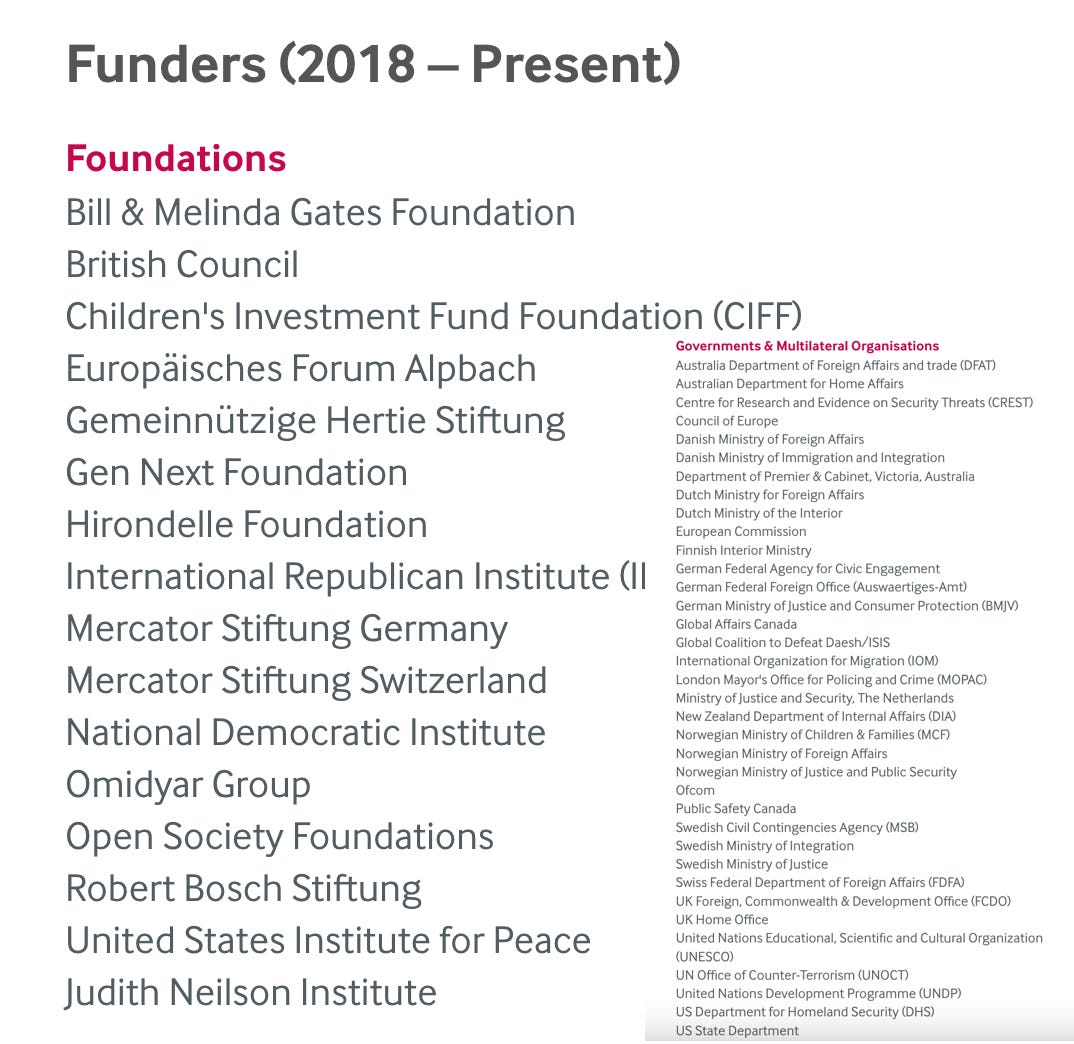
The Institute for Strategic Dialogue’s “diverse range of funders,” according to The Guardian.
The ISD’s “diverse” funders include the US State Department, the US Department of Homeland Security, three other US state-funded organizations, and more than two dozen other NATO government agencies. On the private side, the ISD’s funders include the foundations of three of the world’s richest oligarchs: Pierre Omidyar’s Omidyar Group, George Soros’ Open Society Foundations, and the Bill and Melinda Gates Foundation.
In using the ISD as a source, The Guardian has a conflict of interest that its article did not disclose. The latter two ISD donors have also given sizeable grants to The Guardian: at least $625,000 from Open Society Foundations since 2019, and at least $12.9 million from the Bill and Melinda Gates Foundation since 2011.
Omidyar’s foundation has a direct role in the ISD/Syria Campaign report. The Omidyar Group’s Luminate Strategic Initiatives is listed alongside the German government-funded Friedrich-Ebert-Stiftung foundation as the report’s fiscal sponsor.
Omidyar’s sponsorship of an attack on journalism about the OPCW scandal is highly fitting. The Intercept, the self-described “fearless and adversarial” outlet that Omidyar also funds with his vast fortune, has never once acknowledged the OPCW leaks or whistleblowers’ existence. While ignoring the OPCW scandal for more than three years, The Intercept has published multiple articles promoting the allegation that Syria committed a chemical attack in Douma.
Like the ISD, the Syria Campaign is also funded by governments and other belligerents in the Syria dirty war. As The Grayzone’s Max Blumenthal reported in 2017, the Syria Campaign was founded by Ayman Asfari, a Syrian-British billionaire oil tycoon and leading financial supporter of the Syrian National Coalition, the largest government-in-exile group established after the Syria conflict erupted in 2011. The Syria Campaign has also done extensive P.R. and fundraising for the White Helmets, the insurgent-adjacent, NATO state-funded organization implicated in the Douma incident.
That these two state-funded groups “describe themselves as ‘fiercely independent'” is apparently enough for The Guardian. I trust that the Guardian would feel differently if they were dealing with self-described “fiercely independent” groups funded by the Russian and Syrian governments.
Unsurprisingly, the vast majority of sources quoted in the ISD/Syria Campaign report are funded or employed by the same NATO state and private sponsors. This includes the White Helmets; the Global Public Policy Institute; Syrian American Medical Society (SAMS); self-described journalist Chloe Hadjimatheou of the BBC, who produced a podcast series that disparaged the OPCW whistleblowers and whitewashed the Douma cover-up; and James Jeffrey, the former US Special Envoy for Syria.
For a report that claims to be concerned with protecting Syrians from “real-world harm,” Jeffrey is a particularly interesting interview subject. Few US officials have been as candid about their willingness to immiserate Syrian civilians in pursuit of hegemonic US goals in their country.
Jeffrey has declared that al-Qaeda is a US “asset” in Syria, and has admitted to misleading the Trump White House to undermine an effort to withdraw the US military, whose illegal occupation deliberately deprives Syria of its own wheat and fuel. Jeffrey has openly bragged about his “effective strategy” to ensure “no reconstruction assistance” in Syria — even though the war-ravaged country is “desperate for it.” And he has also taken credit for helping to impose crippling US sanctions on Syria that have “crushed the country’s economy.”
Jeffrey’s proudly self-acknowledged real-world harms on millions of Syrians don’t seem to bother the study’s authors, presumably because their Western state sponsors implement them.
The report is so invested in its state funders’ aims in Syria that it approvingly airs frustration that other governments are failing to toe the NATO line. A “former Western diplomat” complains that “disinformation” on Syria is helping states “avoid making the decisions that we want them to make, say in the Security Council or elsewhere.” (emphasis added). From the point of view of Western officials, the anonymous diplomat is employing an accurate operative definition of what constitutes “disinformation”: any information that causes those deemed subordinate to “avoid making the decisions that we want them to make.”
Fittingly, another anonymous “senior diplomat” laments that supposed Syria disinformation is intended “ultimately to cast doubt upon the legitimacy and integrity of the people doing this kind of [policy] work.” Daring to question the “legitimacy and integrity” of Western policymakers who oversaw a multi-billion dollar CIA-led dirty war on Syria that knowingly empowered al-Qaeda and other sectarian death squads while leaving hundreds of thousands dead — another intolerable act that can only result from “disinformation.”
A member of the US-funded, insurgent-adjacent White Helmets is also given space to lament that alleged “disinformation” is hurting its donations. “We hear about billions of dollars for aid at conferences on Syria but most of that funding goes to the UN,” a White Helmets manager complains. Unmentioned is that European governments have cut funding to the group after their late founder, the lavishly paid UK military veteran James le Mesurier, admitted to pocketing donor funds and financial fraud right before he took his own life.
Having promoted the hegemonic agenda of its state sponsors, the report closes with a thinly veiled call to censor the dissenting voices it targets.
The ISD and Syria Campaign urge policymakers to “adopt a whole-of-government approach in tackling disinformation” and “ensure that loopholes or special privileges are not created for ‘media’ which would only exacerbate the spread of disinformation.” These “privileges” presumably refer to free speech. The report also notes favorably that platforms have addressed “thematic harms such as public health disinformation or foreign interference in elections.” As a result, the report calls on these platforms to “commit to applying similar levels of resourcing… in the context of the ongoing Syrian conflict.” Perhaps they have in mind the censorship of journalism about Hunter Biden’s laptop before the 2020 election, on the fake grounds that the story was “Russian disinformation.”
The fact that this network of state-funded actors is devoting energy to disparaging journalism about the OPCW’s Syria cover-up — and even advocating that it be censored – reflects their powerful sponsors’ desperation to bury a damning scandal.
In public, OPCW Director General Fernando Arias has provided misleading and outright false answers about the Douma probe, including why he refuses to meet with the dissenting inspectors and the rest of the original investigative team.
On top of the two known whistleblowers, Arias has ignored calls for accountability from his original predecessor, founding OPCW chief Jose Bustani, as well as four other former senior OPCW officials. Along with Bustani, former senior UN official Hans von Sponeck has spearheaded the Berlin Group 21, a global initiative to address the OPCW scandal. The US has responded to Bustani by blocking his testimony at the United Nations. Arias meanwhile refused to open a letter that he received from Sponeck’s group, returning it back to sender.
The response of Western media outlets like the Guardian to the stonewalling of these veteran diplomats and senior OPCW officials has simply been to ignore it.
In whitewashing the OPCW cover-up, the preponderance of state sources parroted by The Guardian reveals the ultimate irony in its allegations. While claiming to “identify” a fictional network of Russia-backed disinformation actors about Syria, The Guardian’s Townsend is himself spreading the disinformation of a NATO-funded network that defames voices who expose the dirty war on Syria.
In fact, one of Townsend’s central allegations goes well beyond his state-funded sources. Although Townsend’s article is premised on identifying a “network of conspiracy theorists,” Townsend’s sole source – the ISD/Syria Campaign report – never alleges that such a “network” exists. Nowhere in the report does the word “network” even appear.
Thus, Townsend has not only parroted state-funded sources, but concocted an additional allegation in the service of their narrative. This is not just an ordinary fabrication: in creating the fantasy of a “coordinated”, “Russia-backed”, “network of conspiracy theorists,” Townsend also reveals himself to be the very thing that he accuses his targets of being: a conspiracy theorist.
And given that Townsend not only parrots his state-backed sources but works for an outlet funded by some of the same sponsors, it is fair to say that The Guardian and these state-funded think tanks are a part of the same network.
Consequently, reading the article’s headline — “Network of Syria conspiracy theorists identified”—as a description of The Guardian and the NATO-funded sources that it relied on, the claim is no longer inaccurate.
Policing the World Is a Full-Time Job
BY PHILIP GIRALDI • UNZ REVIEW • AUGUST 2, 2022
Every leader and top official now in power in the so-called Western World seems to have forgotten that the North Atlantic Treaty Organization (NATO) was founded in 1949 as an alliance that was ostensibly defensive in nature, intended to counter the expansion of Soviet style communism in Europe. That role continued to be the raison d’etre of the organization until communist governments themselves collapsed in both Russia and in the Eastern European states that collectively made up the Warsaw Pact during the 1990s. After that point, NATO no longer had any reason to exist at all as the alleged military threat posed by the Kremlin and its allies vanished virtually overnight.
But clever politicians were quick to put the alliance on life support instead of simply dismantling it. Lacking the threat posed by the Warsaw Pact, NATO was forced to come up with other reasons to maintain military forces at levels that could quickly be enhanced and placed on a wartime footing. Washington and London took the lead in this, citing the now shopworn defense of a “rules based international order” as well as of “democracy” and “freedom.” And fortunately for the national defense industries and the generals, it soon proved possible to find new enemies that provided justification for additional military spending. The first major engagement outside the obligations defined by the original treaty took place in Europe to be sure, but it was in the Balkans where of NATO during the 1995 Operation Deliberate Force. The war ended after the signing of the General Framework Agreement for Peace in Bosnia and Herzegovina in Paris on December 14th 1995. Peace negotiations were finalized a week later but fighting resumed between Kosovo and Serbia in the following year, which led to another NATO intervention that eventually ended with the restoration of Kosovo’s autonomy and the deployment of NATO forces, which bombed the Serbs to compel their compliance with a draft cease fire agreement.
NATO also played a role improbably enough in the US invasion and occupation of Afghanistan, which was justified by claiming that an Afghanistan free to set its own course would become a hotbed of terrorism which would inevitably impact on the United States and Europe. It was a paper-thin argument, but it was the best they could come up with at the time and it also eventually involved soldiers from additional friendly countries like Australia. As we have subsequently seen, however, it was all an argument without merit as Afghanistan became a money pit and a graveyard for thousands of locals and foreign soldiers. It is now again in the hands of the Taliban after a bungled withdrawal of US forces and the collapse of the puppet government in Kabul that Washington had installed.
Turn the clock forward to the present. As everyone but President Joe Biden has recognized, the United States and NATO are currently engaged in a proxy war against Russia in Ukraine, which many observers already believe has some of the attributes of World War III. As Russia neither threatened nor attacked any NATO member state, the argument that the response in arming and training Ukraine was defensive was rendered irrelevant. Nor can it be credibly claimed that Russia is a haven for terrorists, quite the contrary. Nevertheless, Biden has stated that the US will be in the fight on behalf of Ukraine for “as long as it takes.” Does he mean years, and all done without a declaration of war by Congress as required by the US Constitution?
And more appears to be coming. Joe Biden, during last week’s trip to Israel, made clear that the United States is “prepared to use all elements of its national power” to stop Iran from getting a nuclear weapon and has signed a pledge with the Israeli government to commit itself to do so. If Biden presses the argument that Iran is an international threat due to its impending development of nuclear weapons, will he appeal to NATO to support a joint military option to disarm it? I believe he just might do that. And he might just want to consider how the entire set-up and framing of the issue by Israel is somewhat of a trap. Israel considers Iran’s current nuclear program to be intended to create a weapon, which “they continue to develop,” and there are plenty in the US Congress who would agree with that.
So, if Iran is clearly creating a thermonuclear device, the time to strike is now, isn’t it? And bear in mind how the US/Israeli campaign to condemn is multifaceted. Shortly before the meetings held by Biden and his crew with the Israelis, US government sources set the stage for what was to come by going on the offensive regarding reports that Iran may be selling highly capable offensive drones to Russia for use in Ukraine as well as subsequent claims coming out of Washington that the Iranians are seeking to assassinate senior US officials in revenge for the killing of Revolutionary Guards General Qassem Soleimani in January 2020. One wonders why they waited so long and why the White House has chosen to publicize these stories at this point.
And the US and NATO are also getting involved with China’s geopolitical policies, on a path that Beijing is warning is extremely hypocritical and which might lead to armed conflict. The signs that the Chinese might be targeted by NATO, possibly over the Taiwan independence issue, came following a stark warning by US Secretary of State Tony Blinken delivered at the NATO summit in Madrid at the end of June. Blinken accused China of “seeking to undermine the rules-based international order,” the same type of critique recently leveled against Russia and Iran. Blinken’s comment was elaborated on by NATO Secretary General Jens Stoltenberg, who observed how “China is substantially building up its military forces, including nuclear weapons, bullying its neighbors, threatening Taiwan … monitoring and controlling its own citizens through advanced technology, and spreading Russian lies and disinformation.”
Stoltenberg’s indictment of China was followed by a NATO issued “strategic concept” document last that declared for the first time that China poses a “systemic challenge” to the alliance, alongside a primary “threat” coming from Russia. The document copied Blinken’s language, citing “The deepening strategic partnership between the People’s Republic of China and the Russian Federation and their mutually reinforcing attempts to undercut the rules-based international order run counter to our values and interests.”
Finally, the US and British governments collaborated to condemn China as the “biggest long-term threat to our economic and national security.” The declaration came in a July 6th joint news conference in London, where Christopher Wray, director of the FBI, and Ken McCallum, director general of Britain’s MI5, accused China, like Russia, of interfering in US and UK elections. Wray also warned the business leaders in the audience that the Chinese government has been “set on stealing your technology, whatever it is that makes your industry tick, and using it to undercut your business and dominate your market.”
Chinese Foreign Ministry spokesman Zhao Lijian initially responded a few days after the NATO summit, observing that the “so-called rules-based international order is actually a family rule made by a handful of countries to serve the US self-interest,” adding that “[Washington]observes international rules only as it sees fit.” Addressing the issue of the role of NATO specifically, Zhao accused Blinken of using NATO to “hype up competition with China and stoke group confrontation.” He added that “The history of NATO is one about creating conflicts and waging wars… arbitrarily launching wars and killing innocent civilians, even to this day. Facts have proven that it isn’t China that poses a systemic challenge to NATO, and instead it is NATO that brings a looming systemic challenge to world peace and security. Thirty years after the end of the Cold War, [NATO] has not yet abandoned its thinking and practice of creating ‘enemies’ … It is NATO that is creating problems around the world.”
China has a point. What NATO is threatening is war, as it is a military alliance. The Chinese appear to understand that NATO is the world’s largest military bureaucracy which has developed since 1991 an overriding institutional commitment to ensuring its permanent existence, if not expansion, even after it has clearly outlived its own usefulness. So Beijing might justifiably wonder, how does China – on the other side of the globe – fit into NATO’s historic “defensive” mission? How are Chinese troops or missiles now threatening Europe or the US in ways they weren’t before? How are the Americans and Europeans suddenly under military threat coming from China?
The Chinese appear to understand that if there is no threat to “defend” against, then a threat must be manufactured, and that is precisely what we are seeing vis-à-vis Russia, China, Iran and even Venezuela. Washington has become addicted to war and NATO is the chosen tool to give those wars the patina of legitimacy. To launch those conflicts requires either inventing an imaginary threat, or, as in the case of Russia, provoking the very threat the “defensive” bureaucracy was designed to deter or thwart. All indications are that NATO – now embracing 30 countries – is doing both and the results could easily be disastrous for all parties involved. Former congresswoman Tulsi Gabbard particularly abhors the cynical recklessness of the Biden Administration driving the process, explaining how “The reality is, President Biden, members of Congress, leaders in our country, the wealthy, they will have a safe place to be in the event of a nuclear war that they are behind causing while the rest of us in America and Russia, people around the world, will be decimated from this event.”
Prize winning journalist Chris Hedges has also defined the unthinkable that is at stake, and it is past time for Americans and Europeans to take note and stop the madness. Hedges opines that “The massive expansion of NATO, not only in Eastern and Central Europe but the Middle East, Latin America, Africa and Asia, presages endless war and a potential nuclear holocaust.” One might also note that New Yorkers are now being informed about what to do if there is a nuclear attack. Yes, that is precisely the problem – we have an administration in Washington that should be protecting the people living in this country, not setting up scenarios that might lead to their slaughter. Will someone please point that out to Joe Biden?
Philip M. Giraldi, Ph.D., is Executive Director of the Council for the National Interest, a 501(c)3 tax deductible educational foundation (Federal ID Number #52-1739023) that seeks a more interests-based U.S. foreign policy in the Middle East. Website is councilforthenationalinterest.org, address is P.O. Box 2157, Purcellville VA 20134 and its email is inform@cnionline.org.
Western experts urge US to start talks with Russia before “it’s too late”
By Ahmed Adel | August 2, 2022
With the war in Ukraine waging since February 24 and no immediate end in sight, Western commentators and experts have begun urging the US and its allies to start talks with Russia over the situation in Ukraine before its “too late.”
Samuel Charap, senior political scientist at the RAND Corporation, and Jeremy Shapiro, research director at the European Council on Foreign Relations, urged in an opinion piece published in the New York Times for the West to continue providing material support for the Ukrainian military, but in close consultation with Kiev to “begin opening channels of communication with Russia” as “an eventual cease-fire should be the goal, even as the path to it remains uncertain.”
With the US having pledged about $24 billion in military aid to Ukraine, more than four times Ukraine’s 2021 defence budget, in addition to other countries pledging another $12 billion, the authors claim that although the West are committed to helping Ukraine, they do not want to escalate the conflict into a major power war.
“For as long as both Russia and the West are determined to prevail over the other in Ukraine and prepared to devote their deep reserves of weapons to achieve that goal, further escalation seems almost preordained,” the experts wrote.
They stress that discussions are absolutely necessary, despite being politically risky, as the war in Ukraine has the potential to bring Russia and NATO into direct conflict. An argument can be made that Russia and NATO are already in direct conflict as the Atlantic bloc already provides weapons and training to the Ukrainian military and encourages former soldiers and volunteers to fight against Russian forces. This is in addition to espionage and surveillance assistance, diplomatic and political support, and medical aid.
According to the authors, Russia has red lines, which although are not exactly known in their entirety, they can be assumed. The experts give the example that if the Ukrainians are given particular systems or capabilities that could directly target Russian territory, it is likely that Moscow will consider that as a red line being crossed. It is for this reason that when US President Joe Biden recently announced that Ukraine would be supplied with multiple-launch rocket systems, the longest-range munitions that could strike Russia were withheld.
“The premise of the decision was that Moscow will escalate — i.e. launch an attack against NATO — only if certain types of weapons are provided or if they are used to target Russian territory,” they claimed. “The goal is to be careful to stop short of that line while giving the Ukrainians what they need to ‘defend their territory from Russian advances,’ as Mr. Biden said in a statement in June.”
To the experts, this creates a conundrum as for now the West is unwilling to send their military forces directly to Ukraine, but a Russian victory is unacceptable. At the same time, if Ukraine somehow succeeded in halting Russia’s advance thanks to the help of Western weapons, that would constitute an unacceptable defeat for Moscow, which could compel the Russian military to “double down” in its operation.
Charap and Shapiro stress that “The determination of both the West and Russia to do whatever it takes to prevail in Ukraine is the main driver of escalation” and that only through talks can a de-escalation begin. As they say, “The best way to prevent that dynamic from getting out of control is to start talking before it’s too late.”
Although the pair are undoubtedly correct in their analysis that talks are the best way to resolve the conflict, what they do omit is the complete unwillingness from the Ukrainian side since 2014 to discuss issues, as well as the encouragement Kiev receives from Washington and London to not engage in negotiations with Moscow. The very crisis in Ukraine today is because of Kiev’s refusal to negotiate and discuss, whilst committing towards a path of ultra-nationalism, militarisation and even nuclearization.
The two analysts in this way do not necessarily say anything profound as discussions were always the way to resolve the issues between Moscow and Kiev, even before the events of 2014. The problem is that they do not highlight that Kiev, with encouragement from Washington, is completely unwilling to engage in discussions despite Moscow’s willingness.
There may be some gaps in their analysis, but more importantly, having experts from RAND and the European Council on Foreign Relations urging in the New York Times for discussions to begin to end the war in Ukraine is a major narrative shift from the encouragement for prolonged fighting usually found in influential Western think tanks and media outlets, including by these three aforementioned institutions.
With the special military operation continuing for half a year and with no end in sight, Western analysts grossly underestimated Russia’s determination, overestimated Ukraine’s capabilities and miscalculated the effectiveness of sanctions. Now there is a growing acceptance in the academic and media sphere that Russia is in full control of the situation in Ukraine and it alone decides when its military operation will conclude. Because of this reality, it may be in the best interest of the West to open serious negotiations as it could be the only way to have any influence over the outcome of the conflict. The political classes of the West are yet to accept this reality though.
Ahmed Adel is a Cairo-based geopolitics and political economy researcher.
Featured Video
Integrity Initiative: UK-funded network framed dissent as Russian disinformation for years
or go to
Aletho News Archives – Video-Images
From the Archives
Why Saudi Ties to 9/11 Mean U.S. Ties to 9/11
By Kevin Ryan | Dig Within | September 27, 2015
Media interest in Saudi Arabian connections to the crimes of 9/11 has centered on calls for the release of the 28 missing pages from the Joint Congressional Inquiry’s report. However, those calls focus on the question of hijacker financing and omit the most interesting links between the 9/11 attacks and Saudi Arabia—links that implicate powerful people in the United States. Here are twenty examples. … continue
Blog Roll
 Aletho News
- EUROPE FEARS RUSSIA’S NEXT MOVE / Ian Proud
- Big tech hands in its DSA censorship reports to the EU
- ‘A Big Victory’ – Palestine Chronicle Wins Two-Year Legal Battle
- IAEA inspectors cannot return to Iran amid US threats: Russia
- Senate Rejects Iran War Powers Resolution Passed By House
- ‘We did not attack Pakistan with drones’: Afghan sources
- Iraqi Resistance faction links arms to sovereignty, questions US exit
- Cannon fodder no more… South Korea rejects Trump’s pressure to join his criminal war on Iran
- Neria Leiter Was A Legitimate Military Target
- Integrity Initiative: UK-funded network framed dissent as Russian disinformation for years
- If Americans Knew
- ‘This is where I live now, the back of a truck’: a day in the life of a grandmother in Gaza
- In UN Speech, Iran’s President Displays Pictures of Children Killed by US, Brings Attention to Israel’s Nuclear Arsenal
- Israel displaces hundreds of Palestinians amid wave of demolitions in West Bank
- Aid, reconstruction, and Israel’s history of obstruction in Gaza
- Trump administration digs an ever-deeper hole of complicity in genocide – Daily Update
- US-Israel $2.8 Billion Arms Deal, 40,000-Bomb Supply Faces New Gaza Complicity Accusations
- Caught on Tape: AIPAC CEO Boasted of Controlling Trump’s National Security Officials
- Why Hamas Attacked Israel in October 2023 – Israeli professor Ilan Pappé
- They see them, then kill them: Israeli quadcopters track, deliberately target civilians in Gaza
- Winter could turn Gaza’s treacherous, war-damaged buildings into deathtraps
- No Tricks Zone
- New Study: Earth And Venus Surface Warmth Largely Explained By Convection And Lapse Rate, Not CO2 Or Radiation
- 2025 Nature Paper Claiming Worsening Global Drought Gets RETRACTED …Heavily Flawed
- New Study: ‘Global Drought Shows No Detectable Recent Acceleration Under Climate Warming’
- Economic Masterminds: German Socialists Suggest Taxing Productivity Gains Stemming From Using AI
- The South China Sea Has Not Been Cooperating With The Climate Change Narrative
- Energy Crisis: Germany Enters Heating Season With Historically Low Gas Reserve Fill Levels
- New Study: The Antarctic Ice Sheet Gained Mass From 2020-2024 Due To Staggering Snow And Ice Accumulation
- Study: Ocean Heating Rates From Thousands Of Years Ago ‘Dwarf’ Modern Ocean Heating Rates
- Climate Extremists Target, Attack Large-Scale Power Grid Infrastructure In Germany!
- New Study: Antarctic Ice Melt Has Contributed Less Than 1 Centimeter To Sea Level Rise In The Last 30 Years

