Policing the World Is a Full-Time Job
BY PHILIP GIRALDI • UNZ REVIEW • AUGUST 2, 2022
Every leader and top official now in power in the so-called Western World seems to have forgotten that the North Atlantic Treaty Organization (NATO) was founded in 1949 as an alliance that was ostensibly defensive in nature, intended to counter the expansion of Soviet style communism in Europe. That role continued to be the raison d’etre of the organization until communist governments themselves collapsed in both Russia and in the Eastern European states that collectively made up the Warsaw Pact during the 1990s. After that point, NATO no longer had any reason to exist at all as the alleged military threat posed by the Kremlin and its allies vanished virtually overnight.
But clever politicians were quick to put the alliance on life support instead of simply dismantling it. Lacking the threat posed by the Warsaw Pact, NATO was forced to come up with other reasons to maintain military forces at levels that could quickly be enhanced and placed on a wartime footing. Washington and London took the lead in this, citing the now shopworn defense of a “rules based international order” as well as of “democracy” and “freedom.” And fortunately for the national defense industries and the generals, it soon proved possible to find new enemies that provided justification for additional military spending. The first major engagement outside the obligations defined by the original treaty took place in Europe to be sure, but it was in the Balkans where of NATO during the 1995 Operation Deliberate Force. The war ended after the signing of the General Framework Agreement for Peace in Bosnia and Herzegovina in Paris on December 14th 1995. Peace negotiations were finalized a week later but fighting resumed between Kosovo and Serbia in the following year, which led to another NATO intervention that eventually ended with the restoration of Kosovo’s autonomy and the deployment of NATO forces, which bombed the Serbs to compel their compliance with a draft cease fire agreement.
NATO also played a role improbably enough in the US invasion and occupation of Afghanistan, which was justified by claiming that an Afghanistan free to set its own course would become a hotbed of terrorism which would inevitably impact on the United States and Europe. It was a paper-thin argument, but it was the best they could come up with at the time and it also eventually involved soldiers from additional friendly countries like Australia. As we have subsequently seen, however, it was all an argument without merit as Afghanistan became a money pit and a graveyard for thousands of locals and foreign soldiers. It is now again in the hands of the Taliban after a bungled withdrawal of US forces and the collapse of the puppet government in Kabul that Washington had installed.
Turn the clock forward to the present. As everyone but President Joe Biden has recognized, the United States and NATO are currently engaged in a proxy war against Russia in Ukraine, which many observers already believe has some of the attributes of World War III. As Russia neither threatened nor attacked any NATO member state, the argument that the response in arming and training Ukraine was defensive was rendered irrelevant. Nor can it be credibly claimed that Russia is a haven for terrorists, quite the contrary. Nevertheless, Biden has stated that the US will be in the fight on behalf of Ukraine for “as long as it takes.” Does he mean years, and all done without a declaration of war by Congress as required by the US Constitution?
And more appears to be coming. Joe Biden, during last week’s trip to Israel, made clear that the United States is “prepared to use all elements of its national power” to stop Iran from getting a nuclear weapon and has signed a pledge with the Israeli government to commit itself to do so. If Biden presses the argument that Iran is an international threat due to its impending development of nuclear weapons, will he appeal to NATO to support a joint military option to disarm it? I believe he just might do that. And he might just want to consider how the entire set-up and framing of the issue by Israel is somewhat of a trap. Israel considers Iran’s current nuclear program to be intended to create a weapon, which “they continue to develop,” and there are plenty in the US Congress who would agree with that.
So, if Iran is clearly creating a thermonuclear device, the time to strike is now, isn’t it? And bear in mind how the US/Israeli campaign to condemn is multifaceted. Shortly before the meetings held by Biden and his crew with the Israelis, US government sources set the stage for what was to come by going on the offensive regarding reports that Iran may be selling highly capable offensive drones to Russia for use in Ukraine as well as subsequent claims coming out of Washington that the Iranians are seeking to assassinate senior US officials in revenge for the killing of Revolutionary Guards General Qassem Soleimani in January 2020. One wonders why they waited so long and why the White House has chosen to publicize these stories at this point.
And the US and NATO are also getting involved with China’s geopolitical policies, on a path that Beijing is warning is extremely hypocritical and which might lead to armed conflict. The signs that the Chinese might be targeted by NATO, possibly over the Taiwan independence issue, came following a stark warning by US Secretary of State Tony Blinken delivered at the NATO summit in Madrid at the end of June. Blinken accused China of “seeking to undermine the rules-based international order,” the same type of critique recently leveled against Russia and Iran. Blinken’s comment was elaborated on by NATO Secretary General Jens Stoltenberg, who observed how “China is substantially building up its military forces, including nuclear weapons, bullying its neighbors, threatening Taiwan … monitoring and controlling its own citizens through advanced technology, and spreading Russian lies and disinformation.”
Stoltenberg’s indictment of China was followed by a NATO issued “strategic concept” document last that declared for the first time that China poses a “systemic challenge” to the alliance, alongside a primary “threat” coming from Russia. The document copied Blinken’s language, citing “The deepening strategic partnership between the People’s Republic of China and the Russian Federation and their mutually reinforcing attempts to undercut the rules-based international order run counter to our values and interests.”
Finally, the US and British governments collaborated to condemn China as the “biggest long-term threat to our economic and national security.” The declaration came in a July 6th joint news conference in London, where Christopher Wray, director of the FBI, and Ken McCallum, director general of Britain’s MI5, accused China, like Russia, of interfering in US and UK elections. Wray also warned the business leaders in the audience that the Chinese government has been “set on stealing your technology, whatever it is that makes your industry tick, and using it to undercut your business and dominate your market.”
Chinese Foreign Ministry spokesman Zhao Lijian initially responded a few days after the NATO summit, observing that the “so-called rules-based international order is actually a family rule made by a handful of countries to serve the US self-interest,” adding that “[Washington]observes international rules only as it sees fit.” Addressing the issue of the role of NATO specifically, Zhao accused Blinken of using NATO to “hype up competition with China and stoke group confrontation.” He added that “The history of NATO is one about creating conflicts and waging wars… arbitrarily launching wars and killing innocent civilians, even to this day. Facts have proven that it isn’t China that poses a systemic challenge to NATO, and instead it is NATO that brings a looming systemic challenge to world peace and security. Thirty years after the end of the Cold War, [NATO] has not yet abandoned its thinking and practice of creating ‘enemies’ … It is NATO that is creating problems around the world.”
China has a point. What NATO is threatening is war, as it is a military alliance. The Chinese appear to understand that NATO is the world’s largest military bureaucracy which has developed since 1991 an overriding institutional commitment to ensuring its permanent existence, if not expansion, even after it has clearly outlived its own usefulness. So Beijing might justifiably wonder, how does China – on the other side of the globe – fit into NATO’s historic “defensive” mission? How are Chinese troops or missiles now threatening Europe or the US in ways they weren’t before? How are the Americans and Europeans suddenly under military threat coming from China?
The Chinese appear to understand that if there is no threat to “defend” against, then a threat must be manufactured, and that is precisely what we are seeing vis-à-vis Russia, China, Iran and even Venezuela. Washington has become addicted to war and NATO is the chosen tool to give those wars the patina of legitimacy. To launch those conflicts requires either inventing an imaginary threat, or, as in the case of Russia, provoking the very threat the “defensive” bureaucracy was designed to deter or thwart. All indications are that NATO – now embracing 30 countries – is doing both and the results could easily be disastrous for all parties involved. Former congresswoman Tulsi Gabbard particularly abhors the cynical recklessness of the Biden Administration driving the process, explaining how “The reality is, President Biden, members of Congress, leaders in our country, the wealthy, they will have a safe place to be in the event of a nuclear war that they are behind causing while the rest of us in America and Russia, people around the world, will be decimated from this event.”
Prize winning journalist Chris Hedges has also defined the unthinkable that is at stake, and it is past time for Americans and Europeans to take note and stop the madness. Hedges opines that “The massive expansion of NATO, not only in Eastern and Central Europe but the Middle East, Latin America, Africa and Asia, presages endless war and a potential nuclear holocaust.” One might also note that New Yorkers are now being informed about what to do if there is a nuclear attack. Yes, that is precisely the problem – we have an administration in Washington that should be protecting the people living in this country, not setting up scenarios that might lead to their slaughter. Will someone please point that out to Joe Biden?
Philip M. Giraldi, Ph.D., is Executive Director of the Council for the National Interest, a 501(c)3 tax deductible educational foundation (Federal ID Number #52-1739023) that seeks a more interests-based U.S. foreign policy in the Middle East. Website is councilforthenationalinterest.org, address is P.O. Box 2157, Purcellville VA 20134 and its email is inform@cnionline.org.
Western experts urge US to start talks with Russia before “it’s too late”
By Ahmed Adel | August 2, 2022
With the war in Ukraine waging since February 24 and no immediate end in sight, Western commentators and experts have begun urging the US and its allies to start talks with Russia over the situation in Ukraine before its “too late.”
Samuel Charap, senior political scientist at the RAND Corporation, and Jeremy Shapiro, research director at the European Council on Foreign Relations, urged in an opinion piece published in the New York Times for the West to continue providing material support for the Ukrainian military, but in close consultation with Kiev to “begin opening channels of communication with Russia” as “an eventual cease-fire should be the goal, even as the path to it remains uncertain.”
With the US having pledged about $24 billion in military aid to Ukraine, more than four times Ukraine’s 2021 defence budget, in addition to other countries pledging another $12 billion, the authors claim that although the West are committed to helping Ukraine, they do not want to escalate the conflict into a major power war.
“For as long as both Russia and the West are determined to prevail over the other in Ukraine and prepared to devote their deep reserves of weapons to achieve that goal, further escalation seems almost preordained,” the experts wrote.
They stress that discussions are absolutely necessary, despite being politically risky, as the war in Ukraine has the potential to bring Russia and NATO into direct conflict. An argument can be made that Russia and NATO are already in direct conflict as the Atlantic bloc already provides weapons and training to the Ukrainian military and encourages former soldiers and volunteers to fight against Russian forces. This is in addition to espionage and surveillance assistance, diplomatic and political support, and medical aid.
According to the authors, Russia has red lines, which although are not exactly known in their entirety, they can be assumed. The experts give the example that if the Ukrainians are given particular systems or capabilities that could directly target Russian territory, it is likely that Moscow will consider that as a red line being crossed. It is for this reason that when US President Joe Biden recently announced that Ukraine would be supplied with multiple-launch rocket systems, the longest-range munitions that could strike Russia were withheld.
“The premise of the decision was that Moscow will escalate — i.e. launch an attack against NATO — only if certain types of weapons are provided or if they are used to target Russian territory,” they claimed. “The goal is to be careful to stop short of that line while giving the Ukrainians what they need to ‘defend their territory from Russian advances,’ as Mr. Biden said in a statement in June.”
To the experts, this creates a conundrum as for now the West is unwilling to send their military forces directly to Ukraine, but a Russian victory is unacceptable. At the same time, if Ukraine somehow succeeded in halting Russia’s advance thanks to the help of Western weapons, that would constitute an unacceptable defeat for Moscow, which could compel the Russian military to “double down” in its operation.
Charap and Shapiro stress that “The determination of both the West and Russia to do whatever it takes to prevail in Ukraine is the main driver of escalation” and that only through talks can a de-escalation begin. As they say, “The best way to prevent that dynamic from getting out of control is to start talking before it’s too late.”
Although the pair are undoubtedly correct in their analysis that talks are the best way to resolve the conflict, what they do omit is the complete unwillingness from the Ukrainian side since 2014 to discuss issues, as well as the encouragement Kiev receives from Washington and London to not engage in negotiations with Moscow. The very crisis in Ukraine today is because of Kiev’s refusal to negotiate and discuss, whilst committing towards a path of ultra-nationalism, militarisation and even nuclearization.
The two analysts in this way do not necessarily say anything profound as discussions were always the way to resolve the issues between Moscow and Kiev, even before the events of 2014. The problem is that they do not highlight that Kiev, with encouragement from Washington, is completely unwilling to engage in discussions despite Moscow’s willingness.
There may be some gaps in their analysis, but more importantly, having experts from RAND and the European Council on Foreign Relations urging in the New York Times for discussions to begin to end the war in Ukraine is a major narrative shift from the encouragement for prolonged fighting usually found in influential Western think tanks and media outlets, including by these three aforementioned institutions.
With the special military operation continuing for half a year and with no end in sight, Western analysts grossly underestimated Russia’s determination, overestimated Ukraine’s capabilities and miscalculated the effectiveness of sanctions. Now there is a growing acceptance in the academic and media sphere that Russia is in full control of the situation in Ukraine and it alone decides when its military operation will conclude. Because of this reality, it may be in the best interest of the West to open serious negotiations as it could be the only way to have any influence over the outcome of the conflict. The political classes of the West are yet to accept this reality though.
Ahmed Adel is a Cairo-based geopolitics and political economy researcher.
Is Pelosi’s Trip to Taiwan the ‘Pearl Harbour Moment’ Jake Sullivan Called for?
By Cynthia Chung | Strategic Culture Foundation | July 30, 2022
In October 2019, Jake Sullivan, who became U.S. National Security Advisor in 2021, stated in an interview that the U.S. needed a clear threat to rally the world and play the role of saviour of mankind and that China could be that organizing principle for U.S. foreign policy. In the 2019 interview, he acknowledges that the problem was that people were not going to believe that China is a global threat, that their view of China is too positive and that the United States would need a “Pearl Harbour moment,” a real focusing event to change their minds, something he calmly stated that “would scare the hell out of the American people.”
According to Sullivan, from the same man who called for Libyan and Syrian military interventionism, American exceptionalism needed “rescuing” and “reclaiming,” not of course with actual qualitative actions that would earn one’s position as a model of true democratic governance with American citizens and the world, but rather through ever aggressive PR and media shame-based social conditioning, labeling whoever points out the clear hypocrisy of these statements as “threats to national security.” Actors like Sullivan have shown that they are willing to do anything to achieve that “Pearl Harbour moment,” even if acts of terrorism on their own people are required in order to paint their “enemy” as a monster in the eyes of their citizens.
This is by no means a new strategy. Operation Gladio is a perfect example of how NATO conducted a decades-long secret war against its own European citizens and elected governments under the guise of “communist terrorism.”
In 1962, General Lyman L. Lemnitzer, head of the Joint Chiefs of Staff, proposed Operation Northwoods, which was a proposed false-flag operation against American citizens, which called for CIA operatives to both stage and actually commit acts of terrorism against American military and civilian targets and subsequently blame the Cuban government in order to justify a war against Cuba. The plan was drafted by General Lemnitzer specifically and has a striking similarity with NATO’s Operation Gladio.
The logic of Northwoods was the stripe of Gladio. The general staff inclined towards prefabricated violence because they believed benefits gained by the state count more than injustice against individuals. The only important criterion is reaching the objective and the objective was right-wing government.
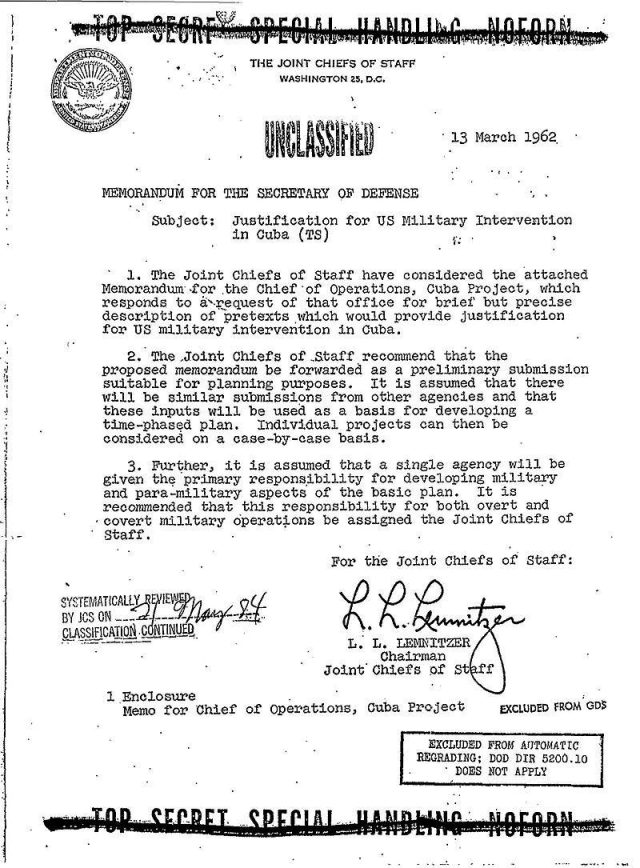
Operation Northwoods memorandum March 13, 1962.
There was not a single item in the Northwoods manual that did not amount to a blatant act of treason, yet the U.S. military establishment dispatched “Top Secret – Justification for U.S. military Intervention in Cuba” straight to the desk of Secretary of Defense Robert McNamara, for onward transmission to President Kennedy.
Needless to say, President Kennedy rejected the proposal and a few months later General Lemnitzer’s term was not renewed as chairman of the Joint Chiefs of Staff, having served from October 1st 1960 to September 30th 1962.
However, NATO lost no time, and in November 1962 Lemnitzer was appointed commander of U.S. European Command and as Supreme Allied Commander Europe of NATO, the latter to which he served from January 1st, 1963 to July 1st, 1969.
Lemnitzer’s was a perfect fit to oversee the cross-continental Gladio operations in Europe. Lemnitzer was a prime motivating force in setting up the Special Forces Group in 1952 at Fort Bragg, where commandos were trained in the arts of guerilla insurgency in the event of a Soviet invasion of Europe. Before long, the men who proudly wore distinctive green berets were cooperating discreetly with the armed forces of a string of European countries and participating in direct military operations, some of them extremely sensitive and of highly dubious legality.
The New American Century
Jake Sullivan’s statement that we need a “Pearl Harbour moment” is nothing new.
In September 2000 a report titled “Rebuilding America’s Defenses: Strategy, Forces and Resources For a New Century” was published by none other than The Project for the New American Century. In the report it is written (pg. 51):
“… the process of transformation, even if it brings revolutionary change, is likely to be a long one, absent some catastrophic and catalyzing event – like a new Pearl Harbor.”

Interestingly, within this same report, published by The Project for the New American Century, it is written (pg. 60):
“Although it may take several decades for the process of transformation to unfold, in time, the art of warfare on air, land, and sea will be vastly different than it is today, and ‘combat’ likely will take place in a new dimensions: in space, ‘cyber-space,’ and perhaps the world of microbes… advanced forms of biological warfare that can ‘target’ specific genotypes may transform biological warfare from the realm of terror to a politically useful tool.”
Richard Perle, called the “Prince of Darkness,” by his adversaries and the “Pentagon’s Brains” by his admirers was an acolyte of Albert Wohlstetter, you could say the “brains” behind the RAND Corporation (for more on this refer here). Paul Wolfowitz was another of Wohlstetter’s acolytes. The followers of Wohlstetter were so numerous, whom Perle said Donald Rumsfeld was among (1), that they called themselves “the St. Andrews prep” boys. (2)
Perle stated (3) the 2003 invasion of Iraq was “the first war that’s been fought in a way that would recognize Albert [Wohlstetter]’s vision of future wars. That it was won so quickly and decisively, with so few casualties and so little damage, was in fact an implementation of his strategy and his vision.”
In fact, this call for the need of a “Pearl Harbour moment” originally came from the Wohlstetters themselves.
A New Pearl Harbour Moment
In the mid-1950s, Roberta Wohlstetter, Albert’s wife and RAND peer, produced her seminal analysis of Pearl Harbour, recognised by the Pentagon as a definitive work of twentieth-century American military history. The study began as an internal RAND document based on unclassified documents drawn from the congressional record.
Warner Schilling noted in his perceptive review of Roberta’s work on Pearl Harbour that “The main concept that Mrs. Wohlstetter brings to bear on these events [is that]… the pictures of the world that government officials build from intelligence… are not so much a matter of the ‘facts’ their sources make available as they are a function of the ‘theories’ about politics already in their minds which guide both their recognition and their interpretation of said ‘facts’.”
The primary practical lesson of Roberta’s Pearl Harbour was that the United States should invest in rapid and aggressive means for responding to surprise attacks (for more on this story refer here).
On January 12, 2003, Los Angeles Times published an article titled “Agenda Unmasked,” where they write:
“In the hours immediately after the Sept. 11 attacks, long before anyone was certain who was responsible for them, Secretary of Defense Donald H. Rumsfeld reportedly asked that plans be drawn up for an American assault on Iraq…
At first consideration, Rumsfeld’s early targeting of Iraq seems odd. Too little was known, too much uncertain. But the Defense secretary’s desire to attack Iraq was neither impulsive nor reactive. In fact, ever since the first American war against Iraq in 1991, Rumsfeld and others who planned and executed that war have wanted to go back and finish what they started. They said so in reports written for then-Secretary of Defense Dick Cheney in the last years of the George H.W. Bush administration, and they continued the push when they were out of power during the Clinton years. In the spring of 1997, their efforts coalesced when Rumsfeld, Cheney and others joined together to form the Project for the New American Century, or PNAC, and began concerted lobbying for regime change in Iraq.
In an open letter to President Clinton dated Jan. 26, 1998, the group called for “the removal of Saddam Hussein’s regime from power,” and in a letter dated May 29, 1998, to then-Speaker of the House Newt Gingrich (R-Ga.) and then-Senate Majority Leader Trent Lott (R-Miss.)… Signatories to one or both letters included Rumsfeld; William Kristol, editor of the conservative Weekly Standard magazine and chairman of the PNAC; Elliott Abrams, the convicted Iran-Contra conspirator whom President Bush last year named director of Middle Eastern policy for the National Security Council; Paul D. Wolfowitz, now Rumsfeld’s deputy at the Pentagon; John R. Bolton, now undersecretary of state for arms control; Richard N. Perle, now chairman of the Defense Science Board; Richard Armitage, now Colin Powell’s deputy at the State Department; and Zalmay Khalilzad [another Wohlstetter acolyte(4)], former Unocal Corp. consultant and now special envoy to Afghanistan.
… They expected that the radical changes in U.S. military policy they favored would have to come slowly in the absence of, as the PNAC report “Rebuilding America’s Defenses” put it, a “catastrophic and catalyzing event – like a new Pearl Harbor.” On Sept. 11, 2001, they got their Pearl Harbor.”
As the Los Angeles Times article also observes, without 9/11 as their Pearl Harbor, their entire campaign against terror in the Middle East could never have been justified.
In fact, since the disastrous PR campaign of the Vietnam War, most Americans had become horrified at the prospect of entering any more foreign wars on the clearly false and hypocritical terms of bringers of “peace” and “freedom.”
9/11 changed all that.
Thus, when Jake Sullivan observes that there is not enough anti-China sentiment to bolster an image of the United States as a “saviour of mankind” against China and that America is in need of a “Pearl Harbour moment” I would be very wary.
The circus around Pelosi’s trip to Taiwan in the coming days, and evident glee that is coming forth from many of these neocons frothing at the mouth over this prospect is a clear sign that something incredibly reckless and stupid is about to happen.
Pelosi’s airplane might indeed be shot down on her completely irrelevant and unnecessary trip to Taiwan, and if it is, don’t be surprised if it was the Americans themselves who are behind it, who have shown they are willing to do anything for that “Pearl Harbour moment.”
Russia would help Serbia if conflict were to break out – senator
Samizdat | August 1, 2022
If Serbia-Kosovo tensions spiral into an outright conflict, Moscow is ready to assist Belgrade without playing a direct role, a Russian senator has said. The two sides clashed on Sunday, with demonstrators building barricades and unknown gunmen reportedly firing on Kosovo police.
“It is very dangerous, it is the center of Europe, and everything can end in a very sad way, because NATO forces are stationed there (in Kosovo),” Russian Federation Council member Vladimir Dzhabarov said in an interview with RIA Novosti news agency on Monday.
According to the lawmaker, the situation “may end in an armed conflict, and as soon as NATO countries get in there, of course, there is a danger that other countries that are allies of Serbia will be drawn in.”
His remarks were in response to a feud between Serbia and its breakaway province, officially called the Autonomous Province of Kosovo and Metohija in the Serbian constitution, which received recognition by several Western powers in 2008.
The government in Kosovo planned to ban the use of Serbian-issued license plates and ID papers starting from August 1, and to prohibit entry for anyone using Serbian-issued plates or documents, while also refusing to print temporary papers for travelers.
Belgrade officials have called it an attack on Kosovo’s Serb minority, and President Aleksandar Vucic accused Pristina of violating the rights of local Serbs, who “will not suffer any more atrocities.” While offering a chance for peace, he warned on Sunday that his government would not sit idly by if Serbs were targeted.
Kosovo has denied a crackdown on Serbs and accused Belgrade officials of undermining “the rule of law” on their territory. Prime Minister Albin Kurti has accused local Serbs of opening fire on police, and claimed his government is facing “Serbian national-chauvinism” and “misinformation” from Belgrade.
Tensions flared on Sunday on the Kosovo-Serbia border. Serbs in the north of the breakaway province set up roadblocks and rang alarm bells, as heavily armed special police under Pristina’s authority took control of two administrative crossings with Serbia.
After a discussion with Washington, Kosovo officials decided to postpone the implementation of the controversial law for 30 days on the condition that Serbia remove barricades from the de facto border.
Kosovo planning to attack Serbs – Belgrade
Samizdat – July 31, 2022
Serbian President Aleksandar Vucic has issued a plea for peace in Kosovo amid rising tensions with Pristina. However, he also vowed to fight to the death if ethnic Serbs in the self-proclaimed republic are targeted for another pogrom.
“The atmosphere has been heated up, and the Serbs will not suffer any more atrocities,” Vucic said in Belgrade on Sunday. “My plea to everyone is to try to keep the peace at almost any cost. I am asking the Albanians to come to their senses, the Serbs not to fall for provocations, but I am also asking the representatives of powerful and large countries, which have recognized the so-called independence of Kosovo, to pay a little attention to international law and reality on the ground and not to allow their wards to cause conflict.”
Vucic’s comments came as Pristina prepared to implement a controversial law requiring ethnic Serbs living in the disputed territory to replace their Serbian-issued vehicle registrations with Kosovo plates, starting on Monday. Kosovo also may require the replacement of other types of Serbian-issued documents, such as identification cards, and it will make a renewed attempt to ban entry or issue temporary papers to travelers with Serbian-issued documents or license plates.
Church bells rang in alarm across the northern part of the province on Sunday, amid reports that armed ethnic Albanians were gathering for another pogrom of the remaining Serbs – as had happened in 2004.
The Serbian president claimed last month that the registration policy was part of an effort to force remaining Serbs out of Kosovo. He referred to the move as “a new Storm,” in reference to the Croatian military operation in 1995 that forced most Serbs to flee Croatia.
Serbian Foreign Minister Nikola Selakovic told reporters on Saturday that “the Albanian side in Kosovo and Metohija is literally preparing to raise hell for Serbs.”
Kosovo’s prime minister Albin Kurti, an ethnic Albanian, has denied that the transition to non-Serbian documents is anything more than applying “law and justice” equally to all citizens.
“Trust your government,” he said in a videotaped message in Serbian.
Vucic has claimed that “provocations” against Serbs living in Kosovo have increased since Kurti, a nationalist who champions the idea of Albanian unification, became prime minister last year. The number of such incidents, including attacks by ethnic Albanians on Serbian cemeteries and Orthodox churches, has jumped 50%, he told reporters on Sunday.
“We do not want conflicts and we do not want war,” Vucic said in his speech. “We will pray for peace and seek peace, but let me tell you right away: There will be no surrender, and Serbia will win. If they dare to start persecuting, harassing and killing Serbs, Serbia will win.”
Vucic also speculated that Pristina is trying to take advantage of the Ukraine crisis by provoking a conflict in which Kurti would be portrayed sympathetically as Kosovo’s version of Ukrainian President Vladimir Zelensky, with the Serbs cast in the role of Russia and President Vladimir Putin.
NATO occupied Kosovo in 1999, after a 78-day air war against what was then Yugoslavia. The province declared independence in 2008, with Western support. While the US and most of its allies have recognized it, Serbia, Russia, China and the UN in general have not.
NATO arsonist-in-chief Jens Stoltenberg wants the Western public to pay for a Ukrainian fire he helped ignite
By Scott Ritter | Samizdat | July 27, 2022
The General Secretary of NATO, Jens Stoltenberg, took it upon himself recently to lecture the members of the European Parliament about the need to “pay the price” necessary to keep Ukraine able to function and fight in its ongoing conflict with Russia. What he failed to admit was the major role he himself played in bringing about this conflict.
The Norwegian has an important role. In many ways, one can liken it to that of a fire commissioner whose job is to bring together various neighborhood fire departments into a large mutual aid pact, where a fire in one district automatically causes the resources of the neighboring districts to be dispatched in response. That’s Article 5 of NATO’s Charter in a nutshell.
Like any membership-based bureaucracy, joining a fire district, like joining NATO, involves a process which requires specific undertakings by all parties involved. The mutual aid pact, like Article 5, can’t be triggered unless the involved party is a member.
Now imagine a scenario where a fire commissioner was pushing for the membership of a questionable fire district, and in the middle of the processes involved in making this district a member, a giant fire breaks out. The fire commissioner encourages his constituent districts to turn over equipment and resources (but not manpower) to the non-member district to fight the fire. The fire is big. The fire commissioner asks for more resources.
And now imagine that it turns out that the fire commissioner is an arsonist who helped set the fire in the first place.
That’s pretty much the scenario which faces NATO today, where the US-led bloc is struggling to deal with the consequences of 14 years of fundamentally flawed policy which saw it promise Ukraine eventual membership, despite knowing that Russia was adamantly opposed to such a move. NATO then watched as its constituent members helped conduct a coup in Ukraine in February 2014, replacing a duly elected president with a cohort of politicians hand-picked by Washington.
The coup in question was made possible only with the involvement of radical Ukrainian right-wing nationalists whose lineage can be traced back to Nazi Germany and, post-World War Two, covert CIA backing which lasted from 1945 through the present. The involvement of these neo-Nazi elements can be likened to the fire commissioner dispatching a team of fellow arsonists to ostensibly help prepare the prospective member for joining the fire district, only to have them secretly conspire amongst themselves to instead burn down entire neighborhoods within the territory of the candidate district.
For eight years Jens Stoltenberg oversaw a system which pretended to pursue peace in Ukraine post-coup through the Minsk Accords, only to secretly conspire with Ukraine, France, and Germany to prevent closure on the accords for the purpose of buying time for Ukraine to build a NATO-standard military capable of delivering a massive knockout blow to the breakaway Donbass region, and perhaps even Crimea.
Stoltenberg helped light the match that set Ukraine ablaze. And now it turns out, during a meeting with members of the European Parliament, the secretary general of NATO chastised the parliamentarians to “stop complaining and step up and provide support to Ukraine”.
The arsonist-in-chief was lecturing the insurance underwriters of Europe to suck it up and pay the price of his handiwork.
His hypocrisy was sickening. “The price we pay as the European Union, as NATO,” he declared, “is the price we can measure in currency, in money. The price they [Ukrainians] pay is measured in lives lost every day. We should stop complaining and step up and provide support, full stop.”
Left unsaid was the fact that Stoltenberg and NATO were responsible for the conflagration which has swept over Ukraine. With Kiev gearing up for an offensive against the Donbass, only Russia’s decision to launch its own special military operation prevented the NATO/Ukrainian plan from reaching fruition.
But the arsonist cannot admit that he started the fire. Instead, Stoltenberg not only shifted responsibility for the Ukraine conflict onto Russia, but then had the audacity to state that the fire he started posed a threat to all of NATO. “It is in our interest to help Ukraine,” Stoltenberg declared to the European parliamentarians, “because you have to understand that if Ukraine loses this, that’s a danger for us.”
Ignoring the fact that he was largely responsible for the disaster that struck Ukraine when Russia initiated its military operation, Stoltenberg planted his banner firmly onto a hill of hypocrisy, proclaiming: “If you don’t care about the moral aspect of this, supporting the people of Ukraine, you should care about your own security interests. Pay for the support, pay for the humanitarian aid, pay the consequences of the economic sanctions, because the alternative is to pay a much higher price later on.”
What Stoltenberg was really saying was: “pay for my mistakes, your mistakes, our mistakes.”
But admitting a mistake is not part of the moral fiber of an arsonist.
Black Sea and three musketeers
BY M. K. BHADRAKUMAR | INDIAN PUNCHLINE | JULY 26, 2022
As the conflict in Ukraine slouches toward Odessa, the war gets elevated to the sphere of a romantic adventure. If Alexander Dumas was alive, the idea might have struck him to write a sequel to his Three Musketeers, the historical novel written in 1844, which has heroic, chivalrous swordsmen who fight for justice, highlighting the absurdities of the Ancient Régime in a setting when the debate in France between republicans and monarchists was still fierce.
The absurdity of raking up a non-existent controversy over the Russian missile strike on Odessa on Friday casts Ukrainian President Volodymyr Zelensky for the second time in a lead role with three swashbuckling musketeers — US Secretary of State Antony Blinken, UN Secretary-General António Guterres and EU foreign policy chief Josep Borrell.
The first time was when Zelensky acted in a Russian musical film based on Dumas’ novel, with three beautiful Soviet actresses — Anna Ardova, Ruslana Pysanka and Alyona Sviridova — as musketeers, which was released in Moscow on New Year’s Eve in 2004.
Coming back to time present, on Friday, it was a controversy waiting to happen when Russia fired four high precision Kalibr missiles and destroyed Ukrainian military infrastructure in Odessa Port just a day after the Russia-Ukraine grain deal was signed in Istanbul, which provides for the resumption of grain exports from the region.
Zelensky promptly shouted that the missile strike was a “barbaric” act. And Blinken came on the line to level charges against Russia; Guterres jumped into the fray “unequivocally” condemning the Russian strike; and, Borrell lazily wrote on Tweeter that the missile strike was “particularly reprehensible & again demonstrates Russia’s total disregard for international law & commitments.”
As for the Russians, well, they slept over it — that is, until Sunday, when late in the afternoon, the Defence Ministry in Moscow inserted two tersely-worded sentences into its customary daily bulletin on the day’s operations in Ukraine:
“Attack launched by high-precision long-range sea-based missiles has resulted in the elimination of Ukrainian military ship and a depot of Harpoon anti-ship missiles delivered by USA to the Kiev regime in the seaport of Odessa. The list of neutralised targets also includes the production facilities of an entity specialised in repairing and modernising the fleet of Ukrainian Navy.”
Zelensky soon issued a clarification that the implementation of the grain deal from Odessa Port was not in doubt. Apparently, he hadn’t coordinated with the three musketeers sitting elsewhere who reacted prematurely. Blinken probably did the logical thing by distracting attention from the corruption concerns being revived in the Beltway regarding America’s gravy train to Ukraine.
Fundamentally, the grain deal is an eyesore for the Biden administration, which in the first instance never expected an agreement could be negotiated that requires great flexibility on the Russian military’s side. Even more galling is that the deal is turning out to be a political victory for Russia.
Moscow is getting good publicity over its pragmatism to lift its naval blockade for addressing the global food crisis. But what is not obvious to most people is that the grain deal is also a back-to-back deal which commits the UN to get the restrictions being put by the EU and the US on Russia’s grain and fertiliser exports lifted.
Besides, apart from the big income out of grain and fertiliser exports, there is that unquantifiable goodwill that Moscow earns from so many countries which critically depend on Russian wheat, especially in West Asia and Africa. Evidently, the itch to spoil the party in Moscow was found irresistible by Blinken & Co.
Enter Sergey Lavrov. From Oyo, Republic of the Congo, deep in the heart of Africa, where he was travelling to follow up on the grain deal — Russia is the number 1 grain supplier to Africa — Foreign Minister Lavrov sensed immense potentials in the emergent situation. Lavrov made three points while flying out of Oyo in the direction of Kampala:
- The grain deal contains nothing “to bar us from continuing the special military operation and hit military infrastructure and other military targets. And the United Nations secretariat representatives… confirmed this interpretation of the documents yesterday.” (Guterres was apparently unaware.)
- The missile strike was aimed at “a separate part of the Odessa port, the so-called military part” and, therefore, “there are no obstacles for shipping grain to contractors under the Istanbul agreements and we have created none.” (Indeed, Zelensky himself is acknowledging it.)
- The missile strike was aimed at the depot where the Pentagon’s Harpoon anti-ship missiles were stored. “These missiles were delivered to pose threats to the Russian Black Sea Fleet. Now, they pose no threats.”
What Lavrov didn’t say but would have implied is that the Odessa war theatre has now become “kinetic” and Friday’s attack sets a precedent. The missile strike underscores that Moscow likely anticipated Pentagon’s antics to use the grain deal to shield its deployment of advanced Harpoon missiles in Odessa Port.
Curiously, off Bulgaria, next door to Odessa, on July 14-25, the US took part in a multinational maritime exercise, Breeze 2022, involving 24 warships, cutters, auxiliary vessels, five planes, and four helicopters manned by 1,390 naval personnel from eleven NATO member countries!
The controversy over the missile strike highlights that Russia’s special military operations in Ukraine will remain incomplete and inconclusive until Moscow altogether cuts off the US’ and NATO’s access to Odessa Port and cripples the alliance’s capability in the Black Sea. Obviously, that’s still some way off.
Meanwhile, the great game is accelerating in the Black Sea with Blinken doubling down to woo Azerbaijan. He spoke with President Aliyev on Monday to press Washington’s pending offer “in helping facilitate the opening of regional transportation and communication linkages.” Azerbaijan is the chosen bridgehead for NATO in southern Caucasus. (See my blog Ukraine’s Great Game surfaces in Transcaucasia.)
US is Trying to Drive Erdogan into a Corner – but Without Success
By Vladimir Platov – New Eastern Outlook – 23.07.2022
Joe Biden’s administration is currently losing on all its foreign policy fronts, but he is still hoping for success, if nowhere else, in his confrontation with the Turkish leader Recep Erdoğan, so that he can demonstrate to the world and the US public, that there is still some “gunpowder left in the barrel.” This consideration took on a special importance for Joe Biden and his team in the days leading up to the US President’s Middle East trip, which promised little chance of victory for the White House. Joe Biden’s trip to Saudi Arabia did, in fact, turn out to be a total failure – it did nothing to improve his image and yielded no positive results either in terms of oil deals or in terms of reining in Russia’s influence in the region. In view of this failure, Washington needed to find a scapegoat, and picked on Recep Erdoğan.
The White House has realized that getting rid of the Turkish president, as it had hoped, is not going to be an easy matter, and has therefore stepped up its machinations in a bid to entrap him. One of its tactics was to inflame tensions between Turkey and Greece in the Eastern Mediterranean. Relations between the two countries are not easy at the moment, given Turkey’s demands for Athens to demilitarize certain Aegean islands near the Turkish border and its challenges to Greece’s sovereignty over these islands. At the end of June Recep Erdoğan took the rather undiplomatic approach of publishing threatening tweets in Greek, demanding that Greece give up its territorial claims in the Aegean Sea, and referring to the 1919-1922 war between the two countries: “We warn Greece once more to avoid dreams, statements and actions that will lead to regret, as it did a century ago… .” He also warned Turkey will “not hesitate to enact rights recognized by international agreements on the demilitarization of the islands.” In a later tweet he accused Greece of “oppressing” the Turkish minorities in Western Thrace, Rhodes, and Kos, and supporting international terrorism, a reference to Athens’ relations with the Kurds. Greece, in turn, accuses Turkey of violating Greek airspace, and of carrying out illegal hydrocarbon exploration activities off the coast of Cyprus – a region that, Greece claims, falls within its exclusive economic area.
Over the last 200 years there have been numerous wars between Greece and Turkey – the Greek War of Independence in 1821-1829, and subsequent conflicts in 1897, 1912–1913, 1919–1922, and, in Cyprus, 1974. But Greece was only able to win with support from powerful allies, including Russia. Currently, however, as one of the key supporters of the West’s sanctions against Russia, Greece cannot rely on support from Moscow. Athens is unlikely to get much support from the US either, as recent years have seen a marked shift in Washington’s attitude to its vassal states and even to its obligations under international agreements. Washington’s recent decision to support Greece rather than Turkey in the Eastern Mediterranean region is a striking example of such a change.
As for the relative strengths of the Greek and Turkish militaries, here Athens clearly lags behind Istanbul – the Greek army may be large, but due to lack of funding its weaponry is very out of date and its troops are poorly trained. Turkey, on the other hand, has the second most powerful military in NATO, after the US.
The standoff between Greece and Turkey, both members of NATO, has been going on for a long time, but it has intensified in recent years as relations between Washington and Turkey have deteriorated and Greece has replaced Turkey as the main US ally in the region. The new military alliance in the Eastern Mediterranean was recently formalized by an agreement between the two countries on long-term military support, under which Greece will host additional four US military bases.
Washington was perhaps hoping that the heightened tensions with Greece will encourage domestic opposition to Recep Erdoğan’s policies, but the effect has in fact been quite the opposite – the Turkish public have rallied round their president. On June 20 the Turkish opposition newspaper Cumhuriyet published an article by Mehmet Ali Guler, calling on Turkey to “sever ties with NATO” and looking at how its departure from the alliance might affect the balance of powers in the region. And, according to the Greek newspaper Vima, citing an interview with the commentator Erdoğan Karakuş for the Turkish television channel Haber Global, there have even been belligerent calls within Turkey for the country to “attack the US” if the latter were to provide assistance to Greece.
Well aware of Turkey’s need to update its Air Force, Washington is making use of the situation to put pressure on Ankara. Thus, even though following the meeting between Joe Biden and Recep Erdoğan in Madrid earlier this year Congress approved the supply of F-16 fighter jets to Turkey, Washington has recently made the supply conditional on Turkey demonstrating its willingness to toe the White House policy line. First, a group of US Congressmen signed a statement objecting to the sale of the jets to Turkey. And then Washington required Ankara to break off its relations with Russia as a precondition for the supply of the jets. It appears that the US is only ready to sell its military hardware to countries that share its values. According to a report from the Greek press agency AMNA, that was the stance taken by Senator Robert Menendez, Chair of the US Senate’s Foreign Relations Committee.
The US House of Representatives has also obstructed the sale, by approving an amendment to the defense budget preventing the US from transferring the jets to Turkey unless the Turkish government guarantees that they will not be used in order to violate Greek airspace.
In response to these moves, Turkey reiterated its support for Recep Erdoğan’s policies, making no secret of the fact that anti-American sentiments are growing in the country. For example, according to the Turkish newspaper Aydınlık, Doğu Perinçek, President of the Vatan Partisi, or Patriotic Party, called on the Turkish government to cancel its order for the F-16s on national security grounds.
Given the above background, it is interesting to speculate about the content of the private meeting between Recep Erdoğan and Russian President Vladimir Putin on July 19. Especially since Russian military aircraft have demonstrated their clear superiority of US jets both in Syria and in Ukraine. Moreover, Turkey and Russia have in recent months been stepping up their cooperation on defense industry projects, and, in an interview published in Turkey’s Milliyet newspaper last December, Ismail Demir, President of Turkey’s Defense Industries, stated that the two countries may work together on the development of Turkish TF-X jets. Unlike the US, Russia will not impose any conditions on Turkey that go against its interests, nor will it push the Turkish Air Force into a corner by refusing to service its aircraft when Turkey most needs them, as the US is quite capable of doing should its strategic interests so require.
The war ‘diplomat’: How the West lost the ‘global battle of narratives’
By Ramzy Baroud | MEMO | July 20, 2022
In a blog entry, reflecting on the G20 Foreign Ministers’ meeting in Bali, Indonesia, on 7-8 July, the High Representative of the European Union, Josep Borrell, seems to have accepted the painful truth that the West is losing what he termed “the global battle of narratives”.
“The global battle of narratives is in full swing and, for now, we are not winning,” Borrell admitted. The solution: “As the EU, we have to engage further to refute Russian lies and war propaganda,” the EU’s top diplomat added.
Borrell’s piece is a testimony to the very erroneous logic that led to the so-called ‘battle of narratives’ to be lost in the first place.
Borrell starts by reassuring his readers that, despite the fact that many countries in the Global South refuse to join the West’s sanctions on Russia, “everybody agrees”, though in “abstract terms”, on the “need for multilateralism and defending principles such as territorial sovereignty”.
The immediate impression that such a statement gives is that the West is the global vanguard of multilateralism and territorial sovereignty. The opposite is true. The US-western military interventions in Iraq, Bosnia, Afghanistan, Syria, Libya and many other regions around the world have largely taken place without international consent and without any regard for the sovereignty of nations. In the case of the NATO war on Libya, a massively destructive military campaign was initiated based on the intentional misinterpretation of United Nations Security Council resolution 1973, which called for the use of “all means necessary to protect civilians”.
Borrell, like other western diplomats, conveniently omits the West’s repeated – and ongoing – interventions in the affairs of other nations, while painting the Russian-Ukraine war as the starkest example of “blatant violations of international law, contravening the basic tenets of the UN Charter and endangering the global economic recovery”.
Would Borrell employ such strong language to depict the numerous ongoing war crimes in parts of the world involving European countries or their allies? For example, France’s despicable war record in Mali? Or, even more obvious, the 75-year-old Israeli occupation of Palestine?
When addressing “food and energy security”, Borrell lamented that many in the G20 have bought into the “propaganda and lies coming from the Kremlin” regarding the actual cause of the food crisis. He concluded that it is not the EU but “Russia’s war of aggression against Ukraine that is dramatically aggravating the food crisis.”
Again, Borrell was selective with his logic. While naturally, a war between two countries that contribute a large share of the world’s basic food supplies will detrimentally impact food security, Borrell made no mention that the thousands of sanctions imposed by the West on Moscow have disrupted the supply chain of many critical products, raw material and basic food items.
When the West imposed those sanctions, it only thought of its national interests, erroneously centered around defeating Russia. Neither the people of Sri Lanka, Somalia, Lebanon, nor, frankly, Ukraine were relevant factors in the West’s decision.
Borrell, whose job as a diplomat suggests that he should be investing in diplomacy to resolve conflicts, has repeatedly called for widening the scope of the war on Russia, insisting that the war can only be “won on the battlefield”. Such statements were made with western interests in mind, despite the obvious devastating consequences that Borrell’s battlefield would have on the rest of the world.
Still, Borrell had the audacity to chastise G20 members for behaving in ways that seemed, to him, focused solely on their national interests. “The hard truth is that national interests often outweigh general commitments to bigger ideals,” he wrote. If defeating Russia is central to Borrell’s and the EU’s “bigger ideals”, why should the rest of the world, especially in the Global South, embrace the West’s self-serving priorities?
Borrell also needs to be reminded that the West’s “global battle of narratives” had been lost well before 24 February. Much of the Global South rightly sees the West’s interests at odds with its own. This seemingly cynical view is an outcome of decades – in fact, hundreds of years – of real experiences, starting with colonialism and ending, presently, with the routine military and political interventions.
Borrell speaks of ‘bigger ideals’, as if the West is the only morally mature entity that is capable of thinking about rights and wrongs in a selfless, detached manner. In addition to there being no evidence to support Borrell’s claim, such condescending language, itself an expression of cultural arrogance, makes it impossible for non-western countries to accept, or even engage, with the West regarding the morality of its politics.
Borrell, for example, accuses Russia of a “deliberate attempt to use food as a weapon against the most vulnerable countries in the world, especially in Africa”. Even if we accept this problematic premise as a morally driven position, how can Borrell justify the West’s sanctions that have effectively starved many people in “vulnerable countries” around the world?
Perhaps, Afghans are the most vulnerable people in the world today, thanks to 20 years of a devastating US/NATO war which has killed and maimed tens of thousands. Though the US and its western allies were forced out of Afghanistan last August, billions of dollars of Afghan money are illegally frozen in Western bank accounts, pushing the whole country to the brink of starvation. Why can Borrell not apply his ‘bigger ideals’ in this particular scenario, demanding immediate unfreezing of Afghan money?
In truth, Borrell, the EU, NATO and the West are not only losing the global battle of narratives, they never won it in the first place. Winning or losing that battle never mattered to Western leaders in the past, because the Global South was hardly considered when the West made its unilateral decisions regarding war, military invasions or economic sanctions.
The Global South matters now, simply because the West is no longer determining all political outcomes, as was often the case. Russia, China, India and others are now relevant, because they can collectively balance out the skewed global order that has been dominated by Borrell and his likes for far too long.
NATO would have attacked Crimea if not stopped – Iran
Samizdat | July 19, 2022
Iranian Supreme Leader Ayatollah Ali Khamenei declared on Tuesday that had Russian President Vladimir Putin not “taken the initiative” in Ukraine, the NATO alliance would have launched a war with Russia over Crimea, which Kiev claims as its own land.
Speaking alongside Putin in Tehran, Khamenei stated that “as regards Ukraine, if you did not take the initiative, the other side would have initiated the war.”
Describing the West as “completely opposed to a strong and independent Russia” and NATO as “a dangerous entity that sees no boundaries in its expansionist policy,” the Iranian leader added that “had they not been stopped in Ukraine, they would have launched the same war sometime later under the pretext of the Crimea issue.”
Considered Russian land since imperial times, Crimea was an autonomous republic within the Soviet Union until it was ceded to the Ukrainian SSR by Soviet Premier Nikita Kruschev in 1954. The region fell under Ukrainian control after the breakup of the USSR, and voted to join Russia in 2014.
NATO considers Crimea to be “illegally annexed” Ukrainian territory. While the alliance has not threatened Russia with open war, it has demanded that Moscow return the region to Ukrainian control and a number of decisions made by its leaders and the government in Kiev suggest a possible path to war over Crimea.
NATO first established a partnership with Ukraine in 1997, and in the 2008 Bucharest Declaration stated that Ukraine and Georgia “will become members of NATO” at an unspecified future date. The Declaration remains alliance policy, and were Ukraine to join NATO, its 30 other members would instantly become parties to a territorial dispute with Russia.
For its part, Ukraine has signaled that it both intends to join NATO and intends to act on this dispute. Under President Pyotr Poroshenko, the country wrote its goal of becoming a NATO member into its constitution in 2019, despite Moscow’s warnings that having the alliance’s forces and weapons on its border would constitute an unacceptable security threat. Two years later, President Vladimir Zelensky signed a decree ordering his government to “prepare and implement measures to ensure the de-occupation and reintegration” of Crimea.
Ukraine’s ambitions of joining NATO appear to have fallen by the wayside, with Igor Zhovkva, an adviser to Zelensky, telling Financial Times last month that Kiev won’t pursue accession any further. Its ambitions of seizing Crimea, however, persist. Zelensky announced last month that he intends to “liberate” Crimea, and a spokesman for Ukraine’s Ministry of Defense, Vadim Skibitskiy, declared on Saturday that his forces may use American missiles to strike the peninsula.
Ukraine’s ‘Great Game’ surfaces in Transcaucasia
BY M. K. BHADRAKUMAR | INDIAN PUNCHLINE | JULY 19, 2022
If the metaphor of the “Great Game” can be applied to the Ukrainian crisis, with the expansion of the North Atlantic Treaty Organisation (NATO) at its core, it has begun causing reverberations across the entire Eurasian space. The great game lurking in the shade in the Caucasus and Central Asian regions in recent years is visibly accelerating.
The edge of the game is above everything else the targeting of Russia and China by the United States. This unfolding game cannot be underestimated, as its outcome may impact the shaping of a new model of the world order.
Starting with the Caspian Summit in Ashgabat on June 29, the inter-connected templates of the great game in the Caucasus began surfacing. The fact that the summit was scheduled at all despite the raging conflict in Ukraine — and that Russian President Vladimir Putin took time out to attend it — testified to the high importance of the event.
Basically, the presidents of the 5 littoral states — Kazakhstan, Iran, Turkmenistan, Azerbaijan and Russia — synchronised their watches, based on the Convention on the Legal Status of the Caspian Sea — the Constitution of the Caspian Sea — that was signed at their last summit in 2018. While doing so, they considered the current international situation and geopolitical processes worldwide.
Thus, one of the key points of the Final Communiqué of the Ashgabat Summit was the reiteration of a fundamental principle regarding the total exclusion of the armed forces of all extra-regional powers from the Caspian Sea (which primarily meets the geopolitical interests of Russia and Iran.) The fact that the heads of the Caspian countries confirmed this in writing can be regarded as the main result of the Summit. Secondly, the leaders focused on the Caspian transport communications and agreed that the region could become a hub for the East-West and North-South corridors.
The Caspian Summit was held just 5 weeks after Russian forces gained control of Mariupol port city (May 21), which established its total supremacy over the Sea of Azov and the Kerch Strait in eastern Crimea. Kerch Strait has a strategic role in Russian policies, being the narrow maritime gateway (5 kms in length and 4.5 km. wide at the narrowest point) which links the Black Sea via the Sea of Azov to Russia’s major waterways including the Don and the Volga.
In effect, it is yet to sink in that in the geopolitics of the entire Eurasian landmass, the liberation of Mariupol by Russian forces was a pivotal event in the great game, since the Kerch Strait ensures maritime transit from the Black Sea all the way to Moscow and St Petersburg, not to mention the strategic maritime route between the Caspian Sea (via the Volga-Don Canal) to the Black Sea and the Mediterranean.
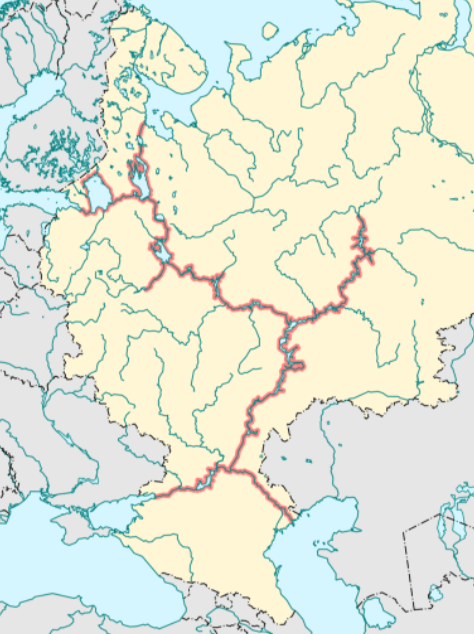
United Deep Waterway System of European Russia linking Sea of Azov and Caspian Sea to Baltic Sea and the Northern Sea Route
Now, to get the “big picture” here, factor in that the Volga River also links the Caspian Sea to the Baltic Sea as well as the Northern Sea Route (via the Volga–Baltic Waterway). Suffice to say, Russia has gained control of an integrated system of waterways, which connects the Black Sea and the Caspian Sea to the Baltic and the Northern Sea Route (which is a 4800 km long shipping lane that connects the Atlantic with the Pacific Ocean, passing along the Russian coasts of Siberia and the Far East.)
No doubt, it is a stupendous consolidation of the so-called “heartland” — per Sir Halford Mackinder’s theory (1904) that whoever controls Eastern Europe controls the Heartland and controls the “world island.”
Looking back, therefore, there is no question that the reunion of Crimea with the Russian Federation in 2014 was a major setback for the US and NATO. Putin caught Washington and its allies by total surprise. It complicated their objective to integrate Ukraine into the NATO.
The US was caught unawares for the second time when in the early days of the current special military operation, when all western eyes were trained on the Kiev region, Russian troops captured the highly strategic southern city of Kherson as early as on March 2. The significance of it was understood only by those who could perceive the great game unfolding in Ukraine as something much more than a mere military conflict. (Most Americans still don’t get it.)
The capture of Kherson in early March practically spelt doom for NATO’s design to extend its military presence in the Black Sea basin. Today, the game is practically over for the US and NATO, once Russia took control of the entire basin of the Sea of Azov. Russia now de facto controls the access of Dniepr to and from the Black Sea. And Dniepr happens to be the main river way for Ukraine’s transportation links to the world market.
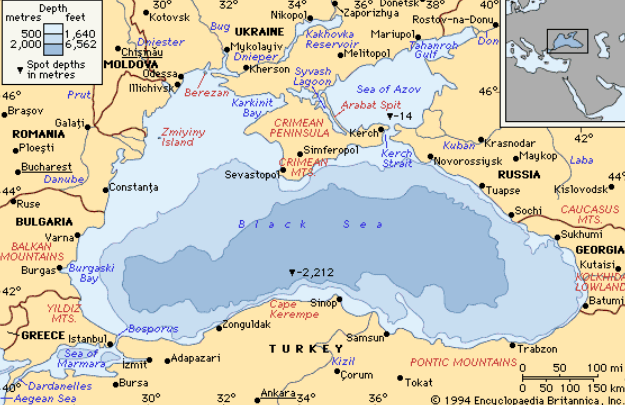
To the immediate east of the Kerch Strait is Russia’s Krasnodar region, which extends southwards to Russia’s largest commercial port on the Black Sea, Novorossiysk at the cross-roads of major oil and gas pipelines between the Black Sea and the Caspian Sea. In sum, control of the Kerch Strait gives Russia a big say with regard to the transportation routes linking Western and Eastern Europe to the Caspian Sea basin, Kazakhstan and China. Put differently, this part of the Russian special military operation becomes an integral part of Moscow’s Eurasian project linking up with China’s Belt and Road Initiative.
Washington has belatedly understood that Russia has outwitted the western alliance and gained the upper hand in the great game in the eastern Black Sea region. So, the Western strategy towards the Caucasus and Central Asia is being reworked. The NATO Secretary-General Jens Stoltenberg scheduled a meeting in Brussels today with the foreign minister of Azerbaijan Jeyhun Bayramov.
Importantly, Bayramov also attended a meeting of the EU-Azerbaijan Cooperation Council today in Brussels. The EU foreign policy chief Josep Borrell later said at a joint news conference with Bayramov that “Azerbaijan is an important partner for the European Union and our cooperation is intensifying.” Meanwhile, yesterday, the European Commission President Ursula von der Leyen visited Baku to sign a memorandum of understanding with Azerbaijan on energy cooperation.
All this is taking place against the backdrop of Charles Michel, the president of the European Council, spearheading efforts to mediate between arch rivals Azerbaijan and Armenia. As part of the EU’s diplomatic efforts, Michel hosted in April a meeting in Brussels between Azerbaijan’s President Aliyev and Armenia’s Prime Minister Nikol Pashinyan where the two sides expressed willingness to secure a peace agreement. Last week, CIA Director William Burns paid an unpublicised visit to Yerevan in this connection. Evidently, Washington and Brussels are jointly strategising a game plan to replace Russia and Turkey, which have hitherto taken the lead roles in Transcaucasia.
There should be no doubt that Moscow is watching closely the synchronised US-EU-NATO moves in the Caucasus targeting Azerbaijan with a view to undermine Russia’s consolidation in the Black Sea and the Caspian Sea regions, which poses a formidable hurdle to the advancement of the NATO strategies toward Central Asia and Xinjiang. This is a high-stakes game.
It will be recalled that on February 22, just two days prior to the launch of the special military operation in Ukraine, Putin hosted the president of Azerbaijan Ilham Aliyev in the Kremlin. They signed “a wide-ranging agreement,” the details of which were not divulged. The document is titled the Declaration on Allied Interaction.
Clearly, oil-rich Azerbaijan, which is not only a littoral state of the Caspian Sea but a gateway to both Central Asia and Russia’s Volga region, is destined to play a key role in the great game in the period ahead.
Featured Video

EUROPE FEARS RUSSIA’S NEXT MOVE / Ian Proud
or go to
Aletho News Archives – Video-Images
New Book
New Book: No Autoimmunity The Body Doesn’t Attack Itself
Lies are Unbekoming | September 24, 2026
 The label for Humira, once the best-selling drug in the world, lists its risks in plain print. One of them, in the label’s own words, is new “autoimmune” disease.
A drug prescribed for a condition labelled autoimmune carries a warning that it can cause a condition labelled autoimmune. That contradiction sits in every box, on a folded paper almost nobody reads.
My new book starts there.
No Autoimmunity: The Body Doesn’t Attack Itself
For seventy years, “your body is attacking itself, and we don’t know why” has ended the conversation for people diagnosed with multiple sclerosis, lupus, rheumatoid arthritis, Hashimoto’s, Type 1 diabetes, Crohn’s and psoriasis. More than eighty conditions now carry the autoimmune label. The diagnosis comes with a prescription for life. It almost never comes with a question about cause.
This book asks the question and answers it from the framework’s own records: its drug labels, its journals, its regulatory filings, and its own experiments. … continue
Blog Roll
 Aletho News
- Iran offers Trump deal before US election
- Merz regime wants ‘secret police’ – opposition
- Israeli settlers terrorize West Bank Palestinians with state-provided drones: Report
- They see them, then kill them: Israeli quadcopters track, deliberately target civilians in Gaza
- Debunked: Trump’s egregious UNGA claims on war against Iran crumble under scrutiny
- Europe was part of the infrastructure of US aggression against Iran: Deputy FM
- New evidence on the Bucha Massacre
- Italy and France debunk reports CIA issued ‘Russian drone threat’ warning
- How Russia is Rewiring the Global South
- Britain’s elites want you ready to die for a war they keep imagining
- If Americans Knew
- Trump betrayed voters with his campaign lies and prioritized a foreign country once he took office
- Netanyahu calls Israel’s war in Gaza ‘opposite of genocide’ in UN speech to near-empty hall
- Settler Kidnappings: Torture, Sexual Abuse and Terrorisation of Palestinian Abductees as Israel Deepens Annexation of West Bank
- Gaza winter nears as 162,000 tents become unusable, raising fears of humanitarian crisis
- Netanyahu says, “It’s the opposite of genocide”; UN says Gaza economy is world’s ‘most severe crisis on record’ – Daily Update
- Israel’s US-Backed Assault on Gaza Has Created the ‘World’s Most Severe Economic Crisis on Record’: UN
- ‘Protecting U.S. Citizens’… From Israel
- ‘This is where I live now, the back of a truck’: a day in the life of a grandmother in Gaza
- In UN Speech, Iran’s President Displays Pictures of Children Killed by US, Brings Attention to Israel’s Nuclear Arsenal
- Israel displaces hundreds of Palestinians amid wave of demolitions in West Bank
- No Tricks Zone
- New Study: Earth And Venus Surface Warmth Largely Explained By Convection And Lapse Rate, Not CO2 Or Radiation
- 2025 Nature Paper Claiming Worsening Global Drought Gets RETRACTED …Heavily Flawed
- New Study: ‘Global Drought Shows No Detectable Recent Acceleration Under Climate Warming’
- Economic Masterminds: German Socialists Suggest Taxing Productivity Gains Stemming From Using AI
- The South China Sea Has Not Been Cooperating With The Climate Change Narrative
- Energy Crisis: Germany Enters Heating Season With Historically Low Gas Reserve Fill Levels
- New Study: The Antarctic Ice Sheet Gained Mass From 2020-2024 Due To Staggering Snow And Ice Accumulation
- Study: Ocean Heating Rates From Thousands Of Years Ago ‘Dwarf’ Modern Ocean Heating Rates
- Climate Extremists Target, Attack Large-Scale Power Grid Infrastructure In Germany!
- New Study: Antarctic Ice Melt Has Contributed Less Than 1 Centimeter To Sea Level Rise In The Last 30 Years

