Ukraine War Frenzy Proves: It’s Still John McCain’s GOP
By Michael Tracey | April 7, 2022
“The senator from Kentucky is now working for Vladimir Putin,” fumed John McCain back in March 2017. His target: Rand Paul, who had committed the unforgivable offense of momentarily delaying the latest round of NATO expansion. Montenegro, a tiny country in southeastern Europe that most Americans have never heard of, was about to join the sprawling military alliance — and McCain was determined to see the final ratification ritual proceed with as little debate as possible. So he hurled the time-honored “working for Putin” accusation, and sure enough, Paul quickly withdrew his minor procedural objection. The glorious ascension of Montenegro to NATO membership status was thereby assured.
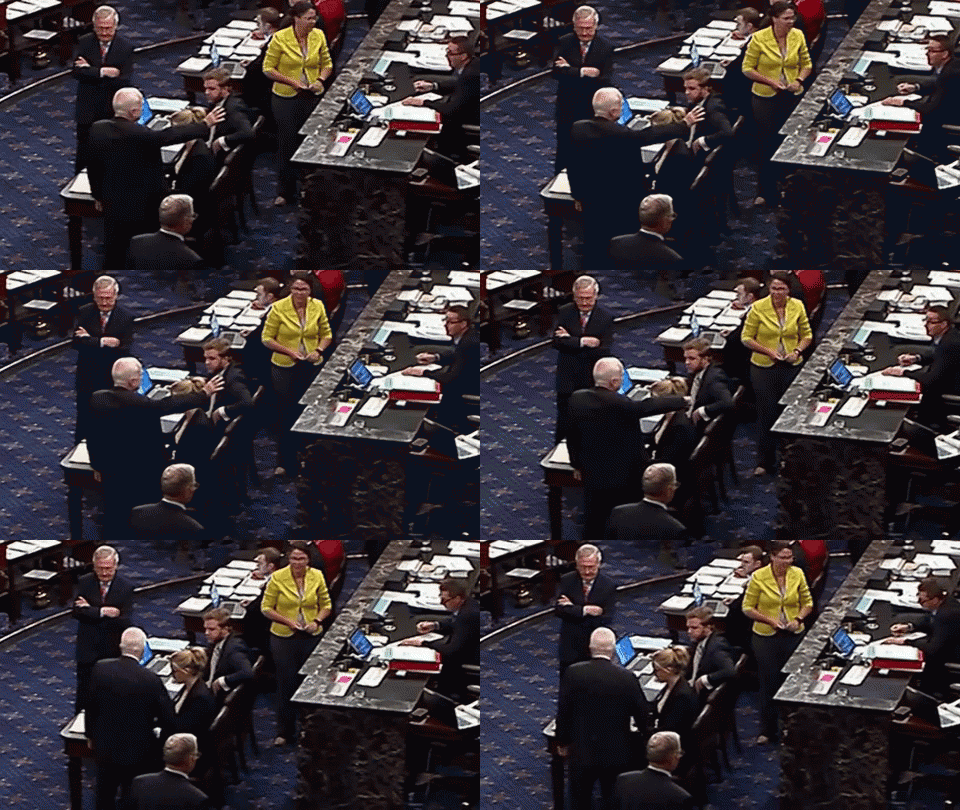
Since that episode, a lot has transpired regarding the public perception of McCain. He delighted liberals by feuding regularly with Donald Trump — even going so far as to denounce Trump for engaging in “disgraceful” and “pathetic” flattery of Putin. “No prior president has ever abased himself more abjectly before a tyrant,” McCain raged. He undermined Congressional Republicans’ legislative agenda during the brief window in Trump’s presidency when the party had unified control of government — famously delivering a dramatic thumbs-down gesture to derail GOP hopes of repealing Obamacare, as a chagrined Mitch McConnell watched powerlessly on.
McCain had returned to his most natural state. After annoying Democrats by running against Barack Obama in the 2008 election, and being surly about his defeat for some time afterwards, he had once again resumed playing the “maverick” role he so relished — reviled by “his own side,” and loved by the “other side.” His death in 2018 brought forth the most effusive display of state-sanctioned grief that any US political figure had received since Ronald Reagan died in 2004, with all the universal media adulation that entails. Trump’s exclusion from the funeral proceedings, at McCain’s posthumous direction, was just the icing on the cake.
But nowadays, if you bring up McCain in certain GOP circles, it will often be claimed that his influence has mercifully dissipated. The Republican Party experienced a bonafide ideological upheaval under Trump, they’ll say, and the McCain worldview — defined mainly by his unwavering commitment to a hyper-interventionist US foreign policy — has since fallen starkly out of favor. (Back when opposing interventionist foreign policy was still considered something of a “progressive” virtue, Mother Jones would routinely mock McCain by merely counting up the comically large number of countries he’d expressed a desire to attack. Did you know McCain once wanted to impose a No Fly Zone in Sudan?)
By “conservative opinion elites,” I refer roughly to the kind of people who write for obscure magazines with obscure funding sources, earnestly enjoy Think Tank social hours, and incessantly convene panels to discuss “the future of conservatism.” These types have a particular incentive to believe that McCain’s foreign policy paradigm has really been purged from the party. They’re deeply invested in the idea that the GOP underwent a genuine transformation in the past decade or so — discarding the outmoded “neocon” dogmas associated with the reign of George W. Bush, and embracing the hardened, nationalist realism associated with Donald Trump.
For a particular kind of ambitious professional conservative, this is a very flattering theory. Because if true, it means the GOP old guard is being slowly but surely displaced, and all kinds of new, innovative ideas are in the offing. Ideally with lots of ambiguous sinecures, TV gigs, and consultant opportunities attached. There’s just one problem though: when it comes to the issue area that always animated McCain the most — which was without a doubt foreign policy — recent events demonstrate that his influence is far from buried. On the contrary, it couldn’t be more alive and well. The year might be 2022, and he might have been physically dead for a while. But it’s still John McCain’s GOP.
A common fallacy heard among conservative opinion-makers who might wish to disassociate from McCain goes something like this: yes, there’s a contingent of the Republican Party that stubbornly hews to McCain-like foreign policy dogma, but it’s really only a limited handful of wackadoodles like Lindsey Graham. In other words, “the neocons” are a small, dwindling faction of the party, and aren’t representative of the typical Republican elected official or rank-and-file voter, who tend to be increasingly skeptical of US interventionism.
That’s a clever little exercise in self-rationalization, but also a bunch of baloney. On the one hand, it’s true that Graham is a… unique figure in various respects. He’s the person currently in elected office who had the closest political and personal association with McCain. Alongside their former cherished colleague, Joe Lieberman, these “three amigos” bonded over a shared, impassioned commitment to omni-directional foreign policy belligerence. (Right on cue, Lieberman was rolled out of semi-retirement last month to demand a “No Fly Zone.”)

But while Graham occasionally blurts out something uniquely insane, such as his tweeted call for the assassination of Putin — he’s far from some kind of wild outlier. In fact, his foreign policy views are comfortably ensconced in the mainstream of the GOP, notwithstanding the popular conceit that “MAGA” has supplanted “neocon” as the party’s dominant sensibility. Because if Graham is the closest living incarnation of the traditional McCain worldview, then perhaps that worldview isn’t nearly as incompatible with “MAGA” as some may want to think.
Recall: even as McCain and Trump brawled over what was essentially a clash of personalities, Graham successfully insinuated himself as one of Trump’s most trusted confidants — regularly hitting the golf links with him, and advising him on key policy matters. This has continued even into Trump’s post-presidency, with Graham operating as one of the most ardent advocates of another Trump run in 2024. “I think he’s the best person in the Republican Party to take up the cause in 2024,” Graham exuberantly told Fox News in January. “I expect him to run… I’ll take bets if anybody wants to bet. I’ll give odds.”
Do you really think Graham would be staking out this position if he viewed Trump’s foreign policy outlook as antithetical to his own?
If there’s some kind of enormous ideological conflict between Trump and Graham — who, remember, proudly carries on the McCain mantle — it has not been at all evident for a long time. It would also be weird to characterize Graham as some kind of aberrational nuisance within the GOP, considering that Graham raked in a record-shattering amount of donations for a GOP Senate candidate during his 2020 re-election campaign in South Carolina. And he accomplished this mostly by utilizing conservative media and direct-mailing lists to hammer home the pledge that he would serve in office as an unflinchingly loyal backer of Trump.
For a vivid illustration of persistent McCain/Graham influence as it relates to current events, take a look at this video that recently resurfaced from December 2016, featuring the esteemed Senatorial pals on a trip to Ukraine. Joined in wonderfully “bipartisan” fashion by Amy Klobuchar, the trio delivered a searing address to a unit of Ukrainian soldiers. If you haven’t seen the video, please do watch, because it confirms the extent to which a vocal faction of the US establishment — with McCain and Graham at the forefront — had invested ideologically and militarily in the cause of Ukraine, and by extension the cause of defeating Russia. Graham proclaims to the assembled soldiers: “Your fight is our fight. 2017 will be the year of offense. All of us will go back to Washington, and we will push the case against Russia.” McCain similarly declared, “I am convinced you will win. And we will do everything we can to provide you with what you need to win.”
While in 2016 the cause of arming Ukraine to defeat Russia on the battlefield was a somewhat more marginal preoccupation, today it’s been sanctified as virtually unshakable consensus in both parties. Funneling weapons to Ukraine was once seen as cranky McCain’s pet cause, a fixation that stemmed from his peculiarly hyper-interventionist worldview. Now, whether the US should be waging a proxy war against Russia in Ukraine is barely even considered a debatable proposition: just another McCain priority eventually consecrated as mainstream orthodoxy. “It’s bringing Congress together in a way, frankly, I haven’t seen in my 12 years,” Chris Coons, the Democratic senator from Delaware and Biden advisor, reverentially told the New York Times. “You’d have to go back to 9/11 to see such a unified commitment.” McCain is no doubt smiling down from the heavens at this great outbreak of “unification.” Because it’s proof of his enduring legacy; with his worldview and geopolitical objectives having arguably become more widely adopted than ever before.
But the coalescence of McCain-like consensus didn’t start with Russia’s invasion in February 2022. For one thing, Graham was proven right when he prophesied that 2017 would be the “year of offense” — because that was the year he, McCain, and other hawks successfully lobbied Trump to sign off on transfers of lethal weapons to Ukraine. Whatever personality conflict existed between McCain and Trump, the actual policy portfolio enacted by Trump vis-a-vis Russia wasn’t all that different from what McCain’s might’ve been. Indeed, when Trump announced the weapons transfers, McCain showered him with praise. And when Trump abrogated the INF Treaty, he was fulfilling another longtime McCain goal.
Listening to Republican politicians comment on Ukraine policy today, you can almost close your eyes and hear McCain’s irascible voice. For an example of how the McCain worldview is far from limited to so-called “neocons,” but instead a feature of entirely mainstream GOP thinking, consider the recent activities of Sen. Rick Scott (R-FL). If there’s any apt descriptor for Scott, it’s that he’s basically a conventional Republican. Not some kind of overly-ideological “neocon,” but rather a business guy who made a huge fortune defrauding Medicare, somehow leveraged that into becoming Governor of Florida, and is now in the US Senate. He also appears to have higher ambitions, as evidenced by his position running the National Republican Senatorial Committee — the campaign wing of the Senate GOP caucus. Scott isn’t especially bright, but he’s more or less able to articulate the standard bromides aimed squarely at the median Republican, and is thus capable of formulating strategy on behalf of the party for the upcoming midterm elections. He also released a manifesto outlining his bold vision for conservatism, which among other things includes that all Americans be made to pay income tax regardless of their income bracket.
The point is, Scott is situating himself at the center of the party in service of some future gambit, may be to challenge Mitch McConnell for GOP Leader (which Trump has encouraged) or maybe even to launch his own presidential campaign at some point, which I’m sure would be a barrel of laughs.
So what is Rick Scott’s big proposal on the Ukraine issue? You guessed it: demanding a No Fly Zone, or short of that, demanding the US send fighter jets into Ukraine. This is apparently the position that Scott calculates will resonate most potently with the prototypical GOP donor and voter. Again, Scott isn’t intrinsically some sort of deeply ideological McCain-Graham foreign policy fanatic. Yet, he’s espousing views that could have been directly pilfered from the McCain-Graham school of thought — just because that school of thought is so thoroughly mainstream within the GOP, whatever superficial animosities some party members may still harbor against McCain.
Part of this owes to standard partisan reflex. Desperately seeking some angle of attack against Biden in relation to Ukraine, Republicans have settled on denouncing him for not escalating the US proxy war aggressively enough. It’s incredibly easy to imagine the ghost of McCain making the exact same criticisms as, say, Ted Cruz is making at the moment. Days after Biden committed the threshold-crossing act of calling for regime change in Russia — thereby announcing that the policy of the US is to depose Putin — Cruz went on Newsmax and complained that Biden’s “approach to every enemy of America is weakness and appeasement.” Only in a McCain-inflected universe does it make even the faintest sense for a president orchestrating a giant weapons-funneling operation, and waging a proxy war of unprecedented scale — which continues intensifying by the day — to be accused of “appeasement.” But it’s clearly still McCain’s world that the GOP is living in. That was always McCain’s tack: his problem with any given US intervention was of course never the intervention itself, but rather that it wasn’t going far enough, and if you weren’t willing to go as far as he wanted, you were some sort of abject appeaser.
On the subject of Ukraine, this pattern gets repeated over and over by GOP chieftains. Biden proposes the biggest Pentagon budget in US history, and right on cue, Mitch McConnell denounces it as somehow “soft” on Russia and “far-left.” Biden announces yet another massive tranche of missiles, grenades, and heavy artillery being dispatched to Ukraine, and Kevin McCarthy, the House Minority Leader, immediately ridicules him for not giving Ukraine fighter jets. “Provide them the planes where they can create a No Fly Zone,” McCarthy demanded in a March 16 press conference. (It’s unclear whether McCarthy is satisfied with Biden’s latest decision to send tanks.)
Though it is now common to characterize Russia as committing “genocide” since footage emerged in the past several days purporting to show Russian attacks on Ukrainian civilians, Steve Scalise, the House Republican Whip, led the charge in making that designation weeks ago. “There’s nothing less than genocide going on in Ukraine,” he alleged during that same March 16 press conference, alongside McCarthy. Scalise had been so profoundly moved by Zelensky’s expertly-crafted Zoom address to Congress earlier in the day that he was compelled to issue the “genocide” allegation immediately thereafter. (No word on what independent investigative mission Scalise carried out in order to ascertain the relevant facts.)
Biden may have caused a stir when he condemned Putin as a “war criminal” — thus confirming a complete lack of interest in facilitating any kind of negotiated settlement to the conflict — but first out of the gate in making this accusation was Elise Stefanik, the New York GOP Congresswoman who serves as the chair of the House Republican Conference. Initially viewed as a “moderate,” Stefanik gamely generated big attention in recent years as a bombastic defender of Trump, raising a ton of money in the process. “As a new mom, it is heart-wrenching to watch the video that President Zelensky just played in terms of the bombing of maternity wards,” Stefanik weepily inveighed, also during the March 16 press conference with McCarthy and Scalise. “Make no mistake, there will be consequences on the global stage for Vladimir Putin, who is a war criminal and a thug,” she cried. The pattern is clear: all throughout the run-up to the invasion and ever since, it’s generally been the GOP which employs the most extreme rhetoric and makes the most extreme policy demands, with Biden eventually coming around not long afterwards. In taking this tack, Republicans could hardly pay a more fitting tribute to McCain.
Joni Ernst, the GOP Senator from Iowa, recently debuted a new criticism: apparently, the Biden Administration hasn’t been forthcoming enough about the weapons it’s transferring to Ukraine. But don’t be silly: seeking actual transparency on behalf of the American public is the farthest thing from Ernst’s mind. She totally supports the Biden Administration’s secrecy — she just wants to make sure that the US is dumping what she regards as a sufficient quantity of weapons. “Certainly, we do need to keep it secret, what is being transferred,” Ernst clarified during an appearance on Fox. “And that’s why we’ve asked to have those numbers provided to us in a classified setting.” Explaining the ultimate objective for these efforts, Ernst might as well have been paying direct homage to McCain: “We want to make sure that [Ukrainians] win this war, and they can win this war,” she roared.
But the biggest blow dealt to those conservative opinion elites — the guys who cling to the conceit that the GOP has really and truly changed its foreign policy orientation — comes in the form of Josh Hawley, one of their great hopes for a supposed convention-defying thinker willing to buck party consensus. Because when push comes to shove, it turns out Hawley is just another McCain mini-me.
A central venue for the recurring attempt to “re-imagine conservatism,” or something to that effect, is currently this outfit called “National Conservatism” (NatCon for short) which hosts occasional conferences. I actually attended one in Orlando last October out of morbid curiosity, and the big tell that maybe soaring intellectual heights would not be achieved there was the organizers’ decision to anoint Dave Rubin as a featured speaker. In all honesty, I have never once heard Dave Rubin utter anything resembling an original thought — but there he was, at the podium, sharing his keen insights on behalf of this exciting new GOP faction.
The three GOP elected officials chosen by NatCon to exemplify a re-invigorated “national conservatism” — presumably one which departed from the legacy of old fogies like McCain — were Hawley, Cruz, and Marco Rubio. Few would be surprised that Rubio soon thereafter turned around and started beating the standard war drums. And Cruz will just do whatever best positions him to win the GOP presidential nomination at some point. But Hawley in particular is often touted as a sort of tribune for the emerging “heterodox” wing of the GOP, alienated from the tired ideological construct that weds together military intervention and free markets. Yet, all three NatCon speakers joined the majority of their Senate GOP colleagues in signing a letter last month to demand that Joe Biden send fighter jets into Ukraine — exactly the kind of escalation you’d think these enlightened “NatCons” would be eager to reject. (Surprise! The letter was organized by Lindsey Graham.)
While there are some NatCon types who really do go against the grain, ultimately the larger enterprise functions as an attempt by the same old GOP establishment forces to perpetually re-brand themselves. Kind of like the Tea Party in the early 2010s, which was initially painted as some sort of revolutionary force, but immediately got subsumed into the Republican National Committee and conservative infotainment complex. The NatCon movement’s three elected standard-bearers behaving exactly as McCain would have wanted them to is good evidence that there really has not been any profound break from the past.
Just look at the latest super-serious “Policy Brief” issued by the Heritage Foundation — still the in-house “Think Tank” of official Washington, DC movement conservatism. It’s basically a litany of generic interventionist prescriptions for how the US can “do much more” to ensure Ukraine’s battlefield victory. Suggestions include facilitating “the free and unrestricted transfer of weapons, munitions, and other supplies to the Ukrainians, including a continuous flow of intelligence” — which just translates to an endorsement of the Biden Administration’s status quo, except a degree or two more aggressive. If there really is this wave of insidious anti-interventionism that we’re always being warned is on the brink of taking over the GOP, nowhere is it evident at the GOP’s most influential Think Tank, the place dopey members of Congress — most of whom barely ever thought about the concept of Ukraine before February 2022 — go to receive their talking points.
Then there’s conservative media, which has returned triumphantly to its 2003 heyday as a reliable organ for pro-war agitprop. Republican “id” Sean Hannity is predictably leading the charge. One day he’s calling on NATO to bomb a Russian convoy in Ukraine; the next he’s having a friendly on-air chat with Sean Penn of all people, discussing their mutual support for sending in fighter jets. Meanwhile, in order to keep up the facade that the GOP is somehow nefariously pro-Putin, the non-conservative media continuously seeks out the handful of marginal exceptions who ultimately have no real influence at all on the priorities of the party. (Yes, I’m aware that Tucker Carlson exists, as I appear on his show occasionally. But to whatever extent he’s skeptical of US intervention in Ukraine, this is not reflected in the behavior of the mainline GOP.)
Which brings us to Donald Trump himself. To the degree that Trump appears to have any criticisms of Biden Administration policy in relation to Ukraine, it consists of the retrospective counter-factual whereby Trump claims Putin never would’ve invaded on his watch. Which is possible, but unprovable. With the invasion having happened, though, Trump now assails Biden for “allowing” Putin “to get away with this travesty and assault on humanity.” In a speech shortly after the invasion, Trump insinuated that the US should be threatening to “blow him to pieces” — i.e., threatening nuclear retaliation.
“No president was ever as tough on Russia as I was,” Trump declared on February 28. Those convinced he was compromised by Putin in some sort of extravagant collusion plot never seem to have noticed, but many of the key US actions which precipitated the invasion were committed under Trump: the most obvious being the successful McCain-Graham lobbying effort to get him to start sending Ukraine lethal weaponry. Trump still brags about the decision to this day, stating, “We also gave a lot of the javelins that you’re hearing so much about, we gave those javelins when President Obama was giving sheets and pillows and I guess blankets. That didn’t help too much. But we gave javelins, and a lot of them too, and I guess that’s helping a lot.”
Well, maybe it would’ve been a smarter idea to stick with the blankets. At least if the goal was to avert war. Because for years, Putin warned that these kinds of US weapons shipments were going to drastically heighten tensions. In his speech announcing the invasion, Putin couldn’t have been more explicit about one of his primary motivations to launch the war: “Any further expansion of the North Atlantic alliance’s infrastructure or the ongoing efforts to gain a military foothold of the Ukrainian territory are unacceptable for us.”
It was under Trump that Ukraine was elevated to “Enhanced Opportunities Partner” status within NATO — exactly the sort of military-infrastructural encroachment that Putin denounced. Trump also happens to be the one who formally effectuated the accession of Montenegro into NATO, which McCain had fulminated against Rand Paul for temporarily impeding, as well as the subsequent accession of North Macedonia — thereby continuing the process of NATO expansion which Putin also angrily cites as a central reason for the invasion. When Putin reproaches the US/NATO “military machine” for expanding so much that it is now “approaching our very border” — that’s a process which culminated under Trump!
Even as Democrats screamed that Trump was somehow surreptitiously governing on Putin’s behalf, what he was really doing was enacting a McCain-like policy agenda that cratered US-Russia relations — a trend which proceeded apace under Biden. While the media obsessed over their delusional theory that Trump was collusively enabling Putin, the real issue was always that his Administration did everything in its policy capacity to fray the US-Russia relationship. Hence the diplomatic impasse on bitter display right now.
Oh and by the way, half of the hawks that are constantly on TV demanding more confrontational action against Russia — including Mike Pompeo, H.R. McMaster, Fiona Hill, Kurt Volker, and of course uber-hawk John Bolton — were all hired by Trump.
Unsurprisingly, this McCain-inspired frenzy engulfing Republican elected officials and conservative media is also reflected in the sentiments of rank-and-file GOP voters. During the Trump years, it was Democrats who led the way in declaring Russia a top “enemy,” convinced as they were that Putin had “interfered” in the 2016 election to malevolently install Trump in power. Today, according to recent polling, Republicans now match or surpass Democrats in their antipathy for Russia.
“Crises” such as the one currently underway are always clarifying. One thing they can do is peel back a veneer. And in the case of the GOP, when that veneer is peeled back — beneath all the bogus rhetorical conceits and phony re-branding exercises — what’s revealed is the smiling, satisfied visage of John McCain. Still getting his way in the afterlife.
Russia willing to investigate Bucha’s tragedy
By Lucas Leiroz | April 5, 2022
The alleged massacre of civilians in Bucha is one of the most talked about topics around the world in recent hours. Russia has been repeatedly accused by Western governments and mainstream media, and there are already calls for Russian President Vladimir Putin to be prosecuted for war crimes and human rights violations. However, there is a series of controversies in the case, from possible falsifications in the images released by Ukrainian forces to incoherent information about the dates of the massacre, which demands a deep investigation.
According to the official Kremlin’s position, the Russian government categorically denies any involvement by its forces in operations that killed civilians in Bucha. Spokesperson Dmistry Peskov stated on Monday, April 4, about the case, making it clear that Moscow, in addition to denying participation in the massacre, supports the immediate launch of high-level investigations on the occurrence. The Russian authorities also committed to take the discussion forward to the UN Security Council in order conduct an international investigation in the grave tragedy.
Furthermore, Peskov made it clear that the Russian government does not trust the veracity of all the information contained in the videos and photos of dead civilians released by the Ukrainian government. There are reports from Russian experts pointing out possible forgeries and frauds in the content of the videos. Other Russian officials also commented on the case, pointing out that there is evidence that the videos were forged or performed. Russian Foreign Minister Sergei Lavrov, for example, claimed during a meeting with UN Under-Secretary-General for Humanitarian Affairs Martin Griffiths that the Ukrainian press had released fake videos about Russian operations in Bucha, and that there had been a staging organized by Kiev’s forces in the region days after the departure of Russian troops.
In the same vein, the official representative of the Russian Ministry of Foreign Affairs, Maria Zakharova, said that the videos and photos released by the Ukrainian press and the Western statements about them appear to be a “custom-made story”. Defense Minister Sergei Shoigu also spoke out, claiming that the case is a production by the Kiev regime for Western media that sounds like a provocation against Russia. Finally, the head of the Russian Investigative Committee, Alexander Bastrykin, also expressed distrust about the veracity of the material released by Kiev and requested a procedural assessment on the possible massacre of civilians.
Despite the distrust, which seems justified in the face of a long history of fake news and information warfare on the part of the NATO-Kiev axis, Moscow seems open to hearing contrary opinions, which is precisely why the government seems so interested in launching an investigation, both using its official experts and international agents convoked by the UNSC. It is possible that, in addition to the obviously fake and staged videos, there is also real material, with actual images of dead people. The Kremlin’s main point is that, regardless of whether the videos and photos are real or not, there is no Russian involvement in cases of massacre of civilians.
Considering the evident victory of the Special Operation in Bucha region, there would be no strategic advantage for the Russian military to shoot civilians, which would cause unnecessary harm to the country. Now, Zelensky, Biden and other Western leaders are calling for Putin to be condemned by international courts and planning an increase in sanctions. So, it does not seem at all reasonable that Russian forces would have deliberately planned and carried out a massacre of civilians, considering that these would be the obvious consequences of such acts.
Another point that needs to be mentioned is that there is an evident time lapse in the case. The Russians withdrew from Bucha on 30 March. The Ukrainians entered Bucha on March 31, and the “retake” of the city was announced by the mayor on the same day. Azov’s paramilitaries entered the city only on April 1. So how were the “bodies in the streets” found only on April 3?
If international society is really interested in the truth, it must heed the Russian request for an investigation at the UNSC. If Western governments refuse to cooperate with the investigation, it will be possible to conclude that they have something to hide. The UN must remain neutral and commit itself to the search for the truth of the facts, even if this truth is unpleasant for the West.
Lucas Leiroz is a researcher in Social Sciences at the Rural Federal University of Rio de Janeiro; geopolitical consultant.
NATO and Asian nations plot response to China’s ‘systemic challenge to security’
Samizdat | April 5, 2022
NATO plans to deepen its cooperation with partners in Asia as a response to a rising “security challenge” coming from China, which refuses to condemn Russia’s ongoing military operation in Ukraine, Secretary General Jens Stoltenberg said during a press conference on Tuesday.
He announced that the bloc will host foreign ministers from member states as well as Finland, Sweden, Georgia, and the EU. However, he also noted that NATO’s Asia-Pacific partners such as Australia, New Zealand, Japan, and South Korea have been invited as well, stating that the current security crisis has “global implications.”
The ministers will discuss new strategic concepts which will account for the military conflict in Ukraine, but will also include for the first time the issue of China’s “growing influence and coercive policies on the global stage which pose a systemic challenge to our security and to our democracies.”
“We see that China has been unwilling to condemn Russia’s aggression and has joined Moscow in questioning the right of nations to choose their own path,” said Stoltenberg, urging that democracies must stand up for their values against “authoritarian powers.”
He expressed hope that NATO would be able to deepen its cooperation with its Asia-Pacific partners in areas such as “arms control, cyber, hybrid and technology.”
Since the start of Russia’s military offensive against Ukraine, Beijing has held off on taking a particular stance on the issue, calling for a peaceful resolution to the conflict but refusing to condemn Moscow’s actions or join the sweeping economic sanctions imposed on Russia by the likes of the US, Canada, the UK, the EU, Japan, Australia, and other nations.
For the last few weeks, the US has increasingly been putting more pressure on China to “pick a side,” with Joe Biden warning Beijing of potential “consequences” and “costs” should China choose to back Russia in the Ukraine conflict, either militarily or by helping circumvent international sanctions.
Biden, Zelensky and the Neocons

BY PHILIP GIRALDI • UNZ REVIEW • APRIL 5, 2022
There are many backstories surfacing from what is going on in Ukraine and Washington that have been largely ignored amid the drumbeat of casualty counts combined with claims and counter-claims from the two sides. Two stories that I believe have received insufficient attention are the US government’s three decades long obsession with weakening and de facto destroying the Russian state and the dominant neocon plus associate liberal democracy promoter role in what has become American foreign policy.
To be sure, anyone who doubts that the US is currently on a course to not only replace President Vladimir Putin but also to crash the Russian economy is delusional. Washington has been trying to deconstruct the former Soviet Union ever since 1991, beginning with President Bill Clinton’s expansion of NATO into Eastern Europe in spite of a pledge not to do so and his unleashing the oligarchs who looted the country’s natural resources under President Boris Yeltsin. The pressure continued under the beatified President Barack Obama, who appointed as Ambassador Michael McFaul, who saw his mission as connecting with dissidents and opposition forces inside Russia, a role incompatible with his promotion of US interests and protecting US persons.
And then we had the redoubtable President Donald Trump undoing confidence building agreements with Russia followed by the current disaster that is unfolding before our very eyes. One should not ignore the fact that the fighting in Ukraine came about largely because the Biden Administration refused to negotiate seriously regarding the mostly reasonable demands that the Kremlin was making to enhance its own security. Former US arms inspector Scott Ritter cites a reported comment by a senior Biden Administration official which sums up the current policy, such as it is: “The only end game now is the end of Putin regime. Until then, all the time Putin stays, [Russia] will be a pariah state that will never be welcomed back into the community of nations.”
Indeed, President Joe Biden’s recent disastrous trip to Europe can likely be characterized as one wishes to see it and the media has certainly done considerable spinning, but Biden left behind a legacy of various gaffes and lapsus linguae that made clear that the US is in the game to defeat Russia however long it will take to play out. And Biden has considerable support from brain dead congressmen like Republican Senator Lindsey Graham who has called for someone to murder Putin, lamenting “Is there a Brutus in Russia?”
On his trip, Biden revealed that he expects US combat troops to go to Ukraine’s assistance and he has also taken delight in denouncing Putin as a “killer,” a “thug,” a “murderous dictator” and a “man who cannot remain in power.” In so doing, he has openly called for Putin’s removal from office, i.e. regime change, while also opening the door to an obvious false flag operation in his unwillingness to reveal when questioned by a reporter how the US might respond if Russia were to use chemical weapons in Ukraine. That he has taken those positions means that it will be impossible to restore manageable relations with Moscow post Ukraine. It is a heavy price to pay for something that is little more than posturing.
The chemical weapon issue is particularly important as President Donald Trump bombed Syria with cruise missiles in the wake of a fabricated report that Bashar al-Assad had used such weapons in an attack on Khan Shaykhun in 2017. It turned out that the anti-regime terrorists who were occupying the city at the time had themselves staged the attack and deliberately blamed it on the Syrian government to produce an expected US response.
Based on what I am seeing and hearing, I would conclude that the neoconservatives and their liberal democracy promoting friends are working hard from the inside to make something like a war with Russia happen. Note in particular that we are talking about war with shooting and deaths, not just a reincarnation or extension of the Cold War of yore. News on April 1st, admittedly April Fools’ Day, suggests that Ukraine has staged helicopter launched missile attacks on a fuel storage depot inside Russia, which, if true, could produce a massive escalation from the Kremlin. It would be a typical neocon maneuver to dramatically increase the level of the fighting and draw the United States into the conflict.
In addition to that, I know I am not the only one who has noticed the pace and focus of Ukrainian President Volodymyr Zelenskys’ widely promoted appeals to groups and world governments to come to his country’s aid, to include establishment of a no-fly zone. The appeals are slick, convincing and carefully focused, with Zelensky being framed as a “hero” fighting valiantly against savage invaders. To put it mildly they are way beyond the capabilities and experience level of a former comedian, whose performances featured erotic dancing and playing a piano with his penis, corruptly placed on the presidential hotseat by a billionaire oligarch Israeli citizen.
The US media is, of course, lavishly praising Zelensky, but I would bet that he has a cadre of American and possibly Israeli neoconservatives working diligently behind him to get it right, coaching him on what to say and do. There might be US government players also in on the act, to include NED (National Endowment for Democracy), CIA information specialists, State Department media consultants and observers from the National Security Council. Indeed, there is as much a war going on over the airwaves and internet to influence thinking internationally as there is fighting taking place on the ground.
One should conclude that the CIA is playing the central role in the “Russia Project” because of its ability to shield what it is doing from scrutiny. Based on previous operations to overthrow governments in various places, one might assume that the so-called covert action approach is multi-level. It consists of media placements that are intended to sway opinion both inside and outside Russia and produce unrest, the identification and recruitment of Russian government officials when they travel overseas, and the support of dissidents both internally and externally who share a negative view of Moscow and its policies. A major component in the approach is to obtain Western liberal support for harsh sanctions and other repressive measures against the Kremlin based on the fraudulent proposition that Putin and his associates are out to destroy “democracy” and “freedom.” Ironically, Americans are less “free” and also poorer because of the actions of their own government since 2001, not because of Vladimir Putin.
As was the case with Iraq, Afghanistan and the long list of American interventions, it is the neocons who are in front demanding a powerful military response, both to Russia and, inevitably, to Iran. What is particularly noticeable is how the neocons and their liberal democracy promoting counterparts have in several areas dominated the foreign policies of both parties. Leading neocon Bill Kristol, who called the Biden speech “a historic call to action on par with Ronald Reagan[‘s] ‘Mr. Gorbachev, tear down this wall speech,’” recently also contributed “There would be no real prospect of an awakening in the United States and Europe were it not for the stand the Ukrainians have made. We would still be denying the threats we face. We would still be turning away from the urgency of the task we face. We would even, I daresay, still fail to appreciate the preciousness of the freedom and decency we have the obligation—and the honor—to defend. It is the Ukrainians who have shown us what free men and women can do, and what they are sometimes required to do, in defense of that freedom. It is the Ukrainians who have shown the world that we are in a new period of consequences. It is the Ukrainians who have given us the example of what it means today to fight back against brutality, and to fight for freedom.”
Kristol is, as so often, full of flag waving, chest puffing nonsense, peddling the notion that the United States has an obligation to police the world. Another leading neocon and regular Washington Post and The Atlantic contributor Anne Applebaum puts it this way and in so doing expands the playing field to include much of the world: “Unless democracies defend themselves together, the forces of autocracy will destroy them. I am using the word forces, in the plural, deliberately. Many American politicians would understandably prefer to focus on the long-term competition with China. But as long as Russia is ruled by Putin, then Russia is at war with us too. So are Belarus, North Korea, Venezuela, Iran, Nicaragua, Hungary, and potentially many others.”
It would be nice, for a change, to end an article on a high note, but high notes are hard to find these days. If there is anything beyond Ukraine to demonstrate the insanity of US foreign policy it would have to be, inevitably, recent news out of Israel. US Secretary of State Tony Blinken was recently in Israel trying in part to sell the possibility that the Biden Administration might actually come to a non-proliferation agreement with Iran over its nuclear program. Israel strongly opposes any such move and its lobby in the US led by various neocon think tanks has been working hard to kill any deal. So, what did Blinken do? He asked Israeli Prime Minister Naftali Bennett for suggestions of what might be done in lieu of an actual agreement. Naftali reportedly suggested harsher sanctions on Iran. Cut it any way you want, but the renewal of 2015’s Joint Comprehensive Plan of Action (JCPOA) is beneficial for both the United States and all of Iran’s neighbors, and here the US senior-most representative involved in the negotiations is asking the head of a foreign government to tell him what to do. Something is very wrong in Washington.
Philip M. Giraldi, Ph.D., is Executive Director of the Council for the National Interest, a 501(c)3 tax deductible educational foundation (Federal ID Number #52-1739023) that seeks a more interests-based U.S. foreign policy in the Middle East. Website is councilforthenationalinterest.org, address is P.O. Box 2157, Purcellville VA 20134 and its email is inform@cnionline.org.
Ukrainian Police Said They Conducted “Clearing Op” in Bucha a Day Before Dead Body Videos Emerged
Narrative fail
By Paul Joseph Watson | Summit News | April 4, 2022
Ukrainian police posted on Facebook that they had conducted a “clearing op” in Bucha the day before videos emerged showing dead bodies scattered around the settlement, as the war of words over the alleged “war crime” continues.
NATO powers and pro-Ukraine commentators have seized upon the alleged atrocity in a bid to escalate the war, with MSNBC hosts and guests even asserting that it justifies directly attacking Russia and putting American boots on the ground in Ukraine.
MSNBC host Ali Velshi demanded “direct military involvement,” something that would almost inevitably kick off World War III, in response to the alleged incident.
Former Army Major John Spencer also appeared on the same show to demand American “boots on the ground” in Ukraine.
Moscow has vehemently denied involvement, claiming Ukraine shelled the city after Russian troops had already withdrawn.
The only evidence offered so far pointing to Russian responsibility is the claims of Ukrainian authorities, with are being breathlessly amplified by the mainstream media without an ounce of skepticism.
Margaret Brennan of CBS admitted that Ukrainian President Zelensky’s team had “handed” her the videos and they were broadcast, as journalist Michael Tracey wrote, with “zero independent corroboration.”
The notion that Ukrainian authorities, who have been caught staging innumerable incidents already in a bid to lobby for more NATO military involvement, would lie about this is seemingly not even a consideration.
A timeline provided from reporting by the New York Times suggests that pro-Ukrainian Azov neo-nazi militants entered Bucha after Russian troops left and after the Mayor of Bucha had announced the town’s liberation with no mention of any atrocities.
One member of Azov was reportedly heard asking if he could shoot individuals who weren’t wearing blue armbands.
Another report asserts that Ukrainian national police posted on Facebook how they had conducted a “clearing operation” in Bucha before the alleged atrocities occurred accompanied by a video of their men walking around the town.
“Today, on 2 April, in the liberated city of Bucha, Kiev region, special units of the Ukrainian National Police began clearing the area of saboteurs and accomplices of Russian troops,” the Facebook post said.
As ever, with propaganda on both sides, it is virtually impossible to know what happened in Bucha, but to claim it’s an open and shut case of “war crimes” as the western media proclaims without any independent evidence is clearly ludicrous.
NATO reveals scale of its involvement in training Ukrainian troops
Samizdat | April 3, 2022
Several NATO states have been providing military training to the Ukrainian army “for years” prior to Russia’s military campaign against the eastern European country, the alliance’s secretary general has said.
Speaking to CNN’s Dana Bash on Sunday, Jens Stoltenberg said that “NATO allies have supported Ukraine for many, many years,” adding that military aid has been “stepped up over the last weeks since the invasion.” The official clarified that “NATO allies like the United States, but also the United Kingdom and Canada and some others, have trained Ukrainian troops for years.”
According to Stoltenberg’s estimates, “tens of thousands of Ukrainian troops” had received such training, and are now “at the front fighting against invading Russian forces.” The secretary general went on to credit the Brussels-based alliance with the fact that the “Ukrainian armed forces are much bigger, much better equipped, much better trained and much better led now than ever before.”
In fact, Stoltenberg’s remark came after the host asked him to comment on recent reports that the alliance was allegedly planning to provide Ukraine with “Soviet-era tanks,” despite French President, Emmanuel Macron last month describing such a move as a “red line” which could potentially make NATO a “co-belligerent in the war.” When asked the same question again directly, the NATO chief refused to either confirm or deny the claims, adding that it would be unwise for him to go into detail regarding the kind of military aid the alliance was supplying Ukraine with.
Stoltenberg simply noted that “allies provide support with modern advanced weapons systems,” which are “making a difference on the battlefield every day.” The official emphasized that it was thanks to the “systems they receive from NATO allies” that the Ukrainian military was “able to take out Russian armored vehicles, Russian planes.” He also noted that NATO member states had confirmed, during the March 24 summit in Brussels, their commitment to providing support to Kiev.
Since February 24, when Russian forces crossed the Ukrainian border, several NATO member states, including the US, UK, Germany and a few others, have been delivering large amounts of ammunition and lethal weapons to Ukraine, including anti-tank and anti-aircraft missile systems.
Following the coup in 2014, several consecutive administrations in Kiev had pronounced NATO membership as one of the key foreign-policy objectives of Ukraine. The country’s military has participated in a number of joint military drills with alliance forces.
Russia considers the prospect of NATO military bases popping up on its border as a threat to its security.
Ukraine has now apparently given up on its NATO aspirations, as members of both Russian and Ukrainian negotiating teams have revealed that the two warring nations agreed in principle to a future neutral status for Ukraine, akin to those of Austria and Sweden.
NATO should have been dissolved after Soviet collapse: China
Press TV – April 1, 2022
China has criticized the eastward expansion of NATO, saying that the US-led military alliance should have been dissolved after the collapse of the Soviet Union more than three decades ago.
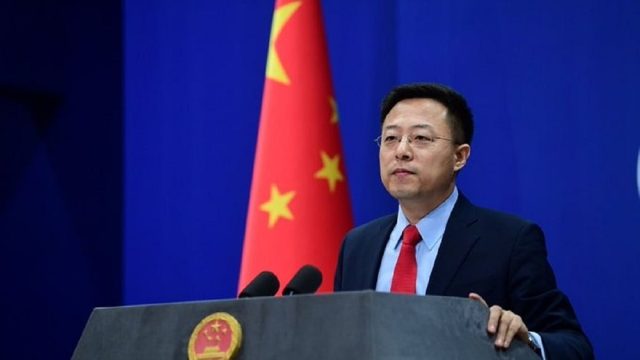
Chinese Foreign Ministry spokesman Zhao Lijian said at a news conference on Friday that the North Atlantic Treaty Organization (NATO), as a product of the Cold War, should have become history when the Soviet Union dissolved in 1991.
“In the early 1990s, then-US Secretary of State James Baker promised to former Soviet leader Mikhail Gorbachev that NATO would not expand even an inch eastward,” Zhao said.
As the initiator and biggest “behind-the-scene planner” for the Ukraine conflict, the US has led NATO to engage in five rounds of eastward expansion in over 20 years, he added.
“The number of NATO members increased from 16 to 30, advancing more than 1,000 kilometers eastward to the Russian border,” Zhao said.
He said that the world does not need a new Cold War, neither does Europe. He called on NATO to reflect on its role in the Ukraine crisis and the security of Europe itself.
NATO was formed in 1949 by 12 countries, including the US, Canada, the UK and France. Following the collapse of the Soviet Union, a number of former Warsaw Pact countries switched sides and joined the military alliance. It currently consists of 30 independent member countries, who are committed to protect each other.
NATO’s eastward expansion has long been a concern for world powers China and Russia, who have constantly warned that the move would lead to a war.
Russia has constantly been warning against membership of many parts of the old Soviet Bloc in NATO, especially the prospective membership of Ukraine in the Western military alliance, something that eventually pit Moscow against the Kiev government.
Russian President Vladimir Putin, who ordered the military campaign in Ukraine in February 24, has been clear for many years that if continued, the expansion would likely be met with serious resistance by the Russians.
Before the military conflict, Moscow had put forward a set of security proposals to de-escalate the tensions, including a guarantee that Ukraine will not join NATO.
The proposals were rejected.
NATO bases in Central Asia ‘unacceptable,’ Lavrov says
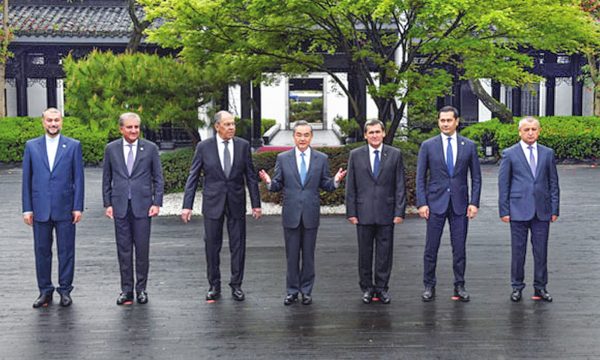
Chinese Foreign Minister Wang Yi and Russian Foreign Minister Sergey Lavrov stand with officials from Afghanistan’s neighboring countries and the Afghan Taliban as China-hosted talks on Afghanistan concluded in East China’s Tunxi, Anhui Province on March 31, 2022. Photo: Chinese Foreign Ministry
Samizdat | March 31, 2022
Russian Foreign Minister Sergey Lavrov said on Thursday that any NATO military presence in Central Asia will undermine the security of the Russian-led bloc in the region.
The minister made his comment at an Afghanistan-themed summit in Tunxi, China.
“We believe it’s unacceptable to have any US and NATO military infrastructure, or their Afghan helpers, on the territory of neighboring states, especially in Central Asia,” Lavrov said, adding that “such designs go against the security interests of our countries.”
He added that the existence of Western military sites would contradict the interests of the Collective Security Treaty Organization (CSTO), a Russian-led regional bloc.
RAND Report Prescribed US Provocations Against Russia and Predicted Russia Might Retaliate in Ukraine
By Rick Sterling | Global Research | March 28, 2022
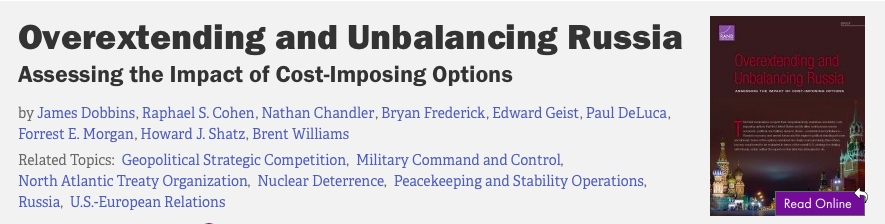
According to a 2019 Rand report titled “Overextending and Unbalancing Russia”, the US goal is to undermine Russia just as it did the Soviet Union in the cold war. Rather than “trying to stay ahead” or trying to improve the US domestically or in international relations, the emphasis is on efforts and actions to undermine the designated adversary Russia. Rand is a quasi-US governmental think tank that receives three-quarters of its funding from the US military.
The report lists anti-Russia measures divided into the following areas: economic, geopolitical, ideological/informational, and military. They are assessed according to the perceived risks, benefits and “likelihood of success”.
Screenshot from RAND
The report notes that Russia has “deep seated” anxieties about western interference and potential military attack. These anxieties are deemed to be a vulnerability to exploit. There is no mention of the cause of the Russian anxieties: they have have been invaded multiple times and had 27 million deaths in WW2.
Significance of Ukraine
Ukraine is important to Russia. The two countries share much common heritage and a long common border. One of the most important leaders of the Soviet Union, Nikita Khrushchev, was Ukrainian. During WW2, Ukraine was one of Hitler’s invasion routes and there was a small but active number of Ukrainian collaborators with Nazi Germany. The distance from the capital of Ukraine, Kiev, to Moscow is less than 500 miles.
For these same reasons of geography and history, Ukraine is a major component of a US/NATO effort to undermine Russia. Current Under Secretary for Political Affairs, Victoria Nuland, said that over 20 years the US invested $5 billion in the project to turn Ukraine. The culmination was a violent coup in February 2014. Since 2015, the US has been training ultra nationalist and Neo-Nazi militias. This has been documented in articles such as “U.S. House admits Nazi role in Ukraine” (Robert Parry, 2015), “The US is arming and assisting neo-nazis in Ukraine while the House debates prohibition”(Max Blumenthal, 2018), “Neo Nazis and the far right are on the march in Ukraine” (Lev Golinken in 2019) and “The CIA may be breeding Nazi terror in Ukraine” (Branko Marcetic Jan. 2022).
Rand suggested provocations
Prior to 2018, the US only provided “defensive” military weaponry to Ukraine. The Rand report assesses that providing lethal (offensive) military aid to Ukraine will have a high risk but also a high benefit. Accordingly, US lethal weaponry skyrocketed from near zero to $250M in 2019, to $303M in 2020, to $350M in 2021. Total military aid is much higher. A few weeks ago, The Hill reported, “The U.S. has contributed more than $1 billion to help Ukraine’s military over the past year”.
The Rand report lists many techniques and “measures” to provoke and threaten Russia. Some of the steps include:
- Repositioning bombers within easy striking range of key Russian strategic targets
- Deploying additional tactical nuclear weapons to locations in Europe and Asia
- Increasing US and allied naval force posture and presence in Russia’s operating areas (Black Sea)
- Holding NATO war exercises on Russia’s borders
- Withdrawing from the Intermediate Nuclear Forces (INF) Treaty
These and many other provocations suggested by Rand have, in fact, been implemented. For example, NATO conducted massive war exercises dubbed “Defender 2021” right up to Russia’s border. NATO has started “patrolling” the Black Sea and engaging in provocative intrusions into Crimean waters. The US has withdrawn from the INF Treaty.
Since 2008, when NATO “welcomed” the membership aspirations of Ukraine and Georgia, Russia has said this would cross a red line and threaten its security. In recent years NATO has provided advisers, training and ever increasing amounts of military hardware. While Ukraine is not a formal member of NATO, it has increasingly been treated like one. The full Rand report says “While NATO’s requirement for unanimity makes it unlikely that Ukraine could gain membership in the foreseeable future, Washington’s pushing this possibility could boost Ukrainian resolve while leading Russia to redouble its efforts to forestall such a development.”
The alternative, which could have prevented or at least forestalled the current Russian intervention in Ukraine, would have been to declare Ukraine ineligible for NATO. But this would have been contrary to the US intention of deliberately stressing, provoking and threatening Russia.
Ukraine as US client
In November 2021, the US and Ukraine signed a Charter on Strategic Partnership. This agreement confirmed Ukrainian aspirations to join NATO and rejection of the Crimean peoples decision to re-unify with Russia following the 2014 Kiev coup. The agreement signaled a consolidation of Washington’s economic, political and military influence.
December 2021 Russia red lines followed by military action
In December 2021, Russia proposed a treaty with the US and NATO. The central Russian proposal was a written agreement that Ukraine would not join the NATO military alliance.
When the proposed treaty was rebuffed by Washington, it seems the die was cast. On February 21, Putin delivered a speech detailing their grievances. On February 24, Putin delivered another speech announcing the justification and objectives of the military intervention to “demilitarize” and “denazify” Ukraine.
As Russian Foreign Minister Lavrov later said, “This is not about Ukraine. This is the end result of a policy that the West has carried out since the early 1990’s.”
Afghanistan again?
As earlier indicated, the Rand report assesses the costs and benefits of various US actions. It is considered a “benefit” if increased US assistance to Ukraine results in the loss of Russian blood and resources. Speculating on the possibility of Russian troop presence in Ukraine, the report suggests that it could become “quite controversial at home, as it did when the Soviets invaded Afghanistan.” (p 99 of full report)
That historical reference is significant. Beginning in 1979, the US and Saudi Arabia funded and trained sectarian foreign fighters to invade and destabilize the progressive Afghan government. The goals were to overthrow the socialist inclined government and lure the Soviet Union into supporting the destabilized government. It achieved these Machiavellian goals at the cost of millions of Afghan citizens whose country has never been the same.
It appears that Ukrainian citizens are similarly being manipulated to serve US goals.
A “disadvantageous peace settlement”
The Rand report says, “Increasing U.S. military aid would certainly drive up the Russian costs, but doing so could also increase the loss of Ukrainian lives and territory or result in a disadvantageous peace settlement.”
But who would a peace settlement be “disadvantageous” for? Ukrainian lives and territory are currently being lost. Over fourteen thousand Ukrainian lives have been lost in the eastern Donbass region since the 2014 coup.
A peace settlement that guaranteed basic rights for all Ukrainians and state neutrality in the rivalry of big powers, would be advantageous to most Ukrainians. It is only the US foreign policy establishment including the US military media industrial complex and Ukrainian ultra-nationalists who would be “disadvantaged”.
Since Ukraine is a multi-ethnic state, it would seem best to accept that reality and find a compromise national solution which facilitates all Ukrainians. Being a client of a distant foreign power is not in Ukraine’s national best interest.
The Rand report shows how US policy focuses on actions to hurt Russia and manipulates third party countries (Ukraine) toward that task.
*
Rick Sterling is an independent journalist based in the San Francisco Bay Area. He can be contacted at rsterling1@protonmail.com.
Biden’s Reckless Words Underscore the Dangers of the U.S.’s Use of Ukraine As a Proxy War
By Glenn Greenwald | March 27, 2022
As grave of a threat as deliberate war is, unintended escalation from miscommunication and misperception can be as bad. Biden is the perfect vessel for such risks.
The central question for Americans from the start of the war in Ukraine was what role, if any, should the U.S. government play in that war? A necessarily related question: if the U.S. is going to involve itself in this war, what objectives should drive that involvement?
Prior to the U.S.’s jumping directly into this war, those questions were never meaningfully considered. Instead, the emotions deliberately stoked by the relentless media attention to the horrors of this war — horrors which, contrary to the West’s media propaganda, are common to all wars, including its own — left little to no space for public discussion of those questions. The only acceptable modes of expression in U.S. discourse were to pronounce that the Russian invasion was unjustified, and, using parlance which the 2011 version of Chris Hayes correctly dismissed as adolescent, that Putin is a “bad guy.” Those denunciation rituals, no matter how cathartic and applause-inducing, supplied no useful information about what actions the U.S. should or should not take when it came to this increasingly dangerous conflict.
That was the purpose of so severely restricting discourse to those simple moral claims: to allow policymakers in Washington free rein to do whatever they wanted in the name of stopping Putin without being questioned. Indeed, as so often happens when war breaks out, anyone questioning U.S. political leaders instantly had their patriotism and loyalty impugned (unless one was complaining that the U.S. should become more involved in the conflict than it already was, a form of pro-war “dissent” that is always permissible in American discourse).
With these discourse rules firmly implanted, those who attempted to invoke former President Obama’s own arguments about a conflict between Russia and Ukraine — namely, that “Ukraine is a core Russian interest but not an American one” and therefore the U.S. should not risk confrontation with Moscow over it — were widely maligned as Kremlin assets if not agents. Others who urged the U.S. to try to avert war through diplomacy — by, for instance, formally vowing that NATO membership would not be offered to Ukraine and that Kyiv would remain neutral in the new Cold War pursued by the West with Moscow — faced the same set of accusations about their loyalty and patriotism.
Most taboo of all was any discussion of the heavy involvement of the U.S. in Ukraine beginning in 2014 up to the invasion: from micro-managing Ukrainian politics, to arming its military, to placing military advisers and intelligence officers on the ground to train its soldiers how to fight (something Biden announced he was considering last November) — all of which amounted to a form of de facto NATO expansion without the formal membership. And that leaves to the side the still-unanswered yet supremely repressed question of what Undersecretary of State Victoria Nuland referred to as the Ukrainians’ “biological research facilities” so dangerous and beyond current Russian bio-research capabilities that she gravely feared they would “fall into Russian hands.”
As a result of the media’s embracing of moral righteousness in lieu of debating these crucial geopolitical questions, the U.S. government has consistently and aggressively escalated its participation in this war with barely any questioning let alone opposition. U.S. officials are boastfully leading the effort to collapse the Russian economy. Along with its NATO allies, the U.S. has flooded Ukraine with billions of dollars of sophisticated weaponry, with at least some of those arms ending up in the hands of actual neo-Nazi battalions integrated into the Ukrainian government and military. It is providing surveillance technology in the form of drones and its own intelligence to enable Ukrainian targeting of Russian forces. President Biden threatened Russia with a response “in kind” if Russia were to use chemical weapons. Meanwhile, reports The New York Times, “C.I.A. officers are helping to ensure that crates of weapons are delivered into the hands of vetted Ukrainian military units.”
The U.S. is, by definition, waging a proxy war against Russia, using Ukrainians as their instrument, with the goal of not ending the war but prolonging it. So obvious is this fact about U.S. objectives that even The New York Times last Sunday explicitly reported that the the Biden administration “seeks to help Ukraine lock Russia in a quagmire” (albeit with care not to escalate into a nuclear exchange). Indeed, even “some American officials assert that as a matter of international law, the provision of weaponry and intelligence to the Ukrainian Army has made the United States a cobelligerent,” though this is “an argument that some legal experts dispute.” Surveying all this evidence as well as discussions with his own U.S. and British sources, Niall Ferguson, writing in Bloomberg, proclaimed: “I conclude that the U.S. intends to keep this war going.” UK officials similarly told him that “the U.K.’s No. 1 option is for the conflict to be extended and thereby bleed Putin.”
In sum, the Biden administration is doing exactly that which former President Obama warned in 2016 should never be done: risking war between the world’s two largest nuclear powers over Ukraine. Yet if any pathology defines the last five years of U.S. mainstream discourse, it is that any claim that undercuts the interests of U.S. liberal elites — no matter how true — is dismissed as “Russian disinformation.”
As we witnessed most vividly in the run-up to the 2020 election — when that label was unquestioningly yet falsely applied by the union of the CIA, corporate media and Big Tech to the laptop archive revealing Joe Biden’s political and financial activities in Ukraine and China — any facts which establishment power centers want to demonize or suppress are reflexively labelled “Russian disinformation.” Hence, the DNC propaganda arm Media Matters now lists as “pro-Russian propaganda” the indisputable fact that the U.S. is not defending Ukraine but rather exploiting and sacrificing it to fight a proxy war with Moscow. The more true a claim is, the more likely it is to receive this designation in U.S. establishment discourse.
That there are few if any risks graver or more reckless than a direct U.S./Russia military confrontation should be too obvious to require explanation. Yet that seems to have been completely forgotten in the zeal, arousal, purpose and excitement which war always triggers. It takes little to no effort to recognize the current emergence of the dynamic about which Adam Smith so fervently warned 244 years ago in Wealth of Nations:
In great empires the people who live in the capital, and in the provinces remote from the scene of action, feel, many of them scarce any inconveniency from the war; but enjoy, at their ease, the amusement of reading in the newspapers the exploits of their own fleets and armies. To them this amusement compensates the small difference between the taxes which they pay on account of the war, and those which they had been accustomed to pay in time of peace. They are commonly dissatisfied with the return of peace, which puts an end to their amusement, and to a thousand visionary hopes of conquest and national glory, from a longer continuance of the war.
The grave dangers of the world’s two largest nuclear-armed powers acting on opposite sides of a hot war extend far beyond any intention by the U.S. to deliberately engage Russia directly. Such a war, even with the U.S. waging it “only” through its proxies, severely escalates tensions, distrust, hostilities, and a climate of paranoia. That is particularly true given that — ever since Democrats decided to blame Putin for Hillary’s 2016 loss — at least half of Americans have been feeding on a non-stop, toxic diet of anti-Russian hatred under the guise of “Russiagate.” As recently as 2018, 2/3 of Democrats believed that Russia hacked into voting machines and altered the 2016 vote count to help Trump win. This cultivation of extreme anti-Russian animus in Washington has been made even more dangerous by the virtual prohibition on dialogue with Russian officials, which during Russiagate was deemed inherently suspect if not criminal.
And all of those preexisting dangers are, in turn, severely exacerbated by an American president who so often is too age-addled to speak clearly or predictably. That condition is inherently dangerous, made all the more so by the fact that it leaves him vulnerable to manipulation by the Democratic Party’s national security advisers who will never forget 2016 and seem more intent than ever on finally attaining vengeance against Putin, no matter the risks. Speaking to U.S. troops in Poland on Friday, a visibly exhausted and rambling President Biden — after extensive travel, time-zone hopping, protracted meetings and speeches — appeared to tell U.S. troops that they were on their way to see first-hand the resistance of Ukrainians, meaning they were headed into Ukraine:
It seems clear that this was not some planned decision to have the U.S. president casually announce his intention to send U.S. troops to fight Russians in Ukraine. This was, instead, an old man, more tired, unpredictable and incoherent than usual due to intense overseas travel, accidentally mumbling out various phrases that could be and almost certainly were highly alarming to Moscow and other countries.
But accidental or unintentional escalation — from misperception or miscommunication — is always at least as serious a danger for war as the deliberate intention to directly engage militarily. In January of this year, the Bulletin of Atomic Scientists announced that its so-called “doomsday clock” was set to 100 seconds before midnight, the metaphorical time they used to signify an extinction-level event for humanity. They warned that the prospect of a cataclysmic nuclear exchange among the U.S., Russia and/or China was dangerously possible, and specifically warned: “Ukraine remains a potential flashpoint, and Russian troop deployments to the Ukrainian border heighten day-to-day tensions.”
In 2018, when the clock was “only” at two minutes before midnight, they emphasized tensions between Russia and the U.S. as one of the primary causes: “The United States and Russia remained at odds, continuing military exercises along the borders of NATO, undermining the Intermediate-Range Nuclear Forces Treaty (INF), upgrading their nuclear arsenals, and eschewing arms control negotiations.” They urged recognition of this specific danger: “Major nuclear actors are on the cusp of a new arms race, one that will be very expensive and will increase the likelihood of accidents and misperceptions.”
That Biden’s “gaffe” about U.S. troops headed into Ukraine could generate exactly this sort of “misperception” seems self-evident. So do the grave dangers from Biden’s sudden yet emphatic declaration on Saturday that Putin “cannot remain in power” — the classic language of declared U.S. policy of regime change:
That clear declaration of regime change as the U.S. goal for Putin was quickly walked back by Biden’s aides, who absurdly claimed he only meant that Putin cannot remain in power in Ukraine and other parts of Eastern Europe, not that he can no longer govern Russia. But this episode marked at least the third time in the past couple weeks that White House officials had to walk back Biden’s comments, following his clear decree that U.S. troops would soon be back in Ukraine and his prior warning that the U.S. would use chemical weapons against Russia if they used them first.
That Biden seems to be stumbling and bumbling rather than following scripted recklessness seems likely in some of these cases but not all. The White House’s vehement denial, in the wake of Biden’s speech, that regime change in Russia is its goal was contradicted by Ferguson’s reporting in Bloomberg last week:
Reading this carefully, I conclude that the U.S. intends to keep this war going… I have evidence from other sources to corroborate this. “The only end game now,” a senior administration official was heard to say at a private event earlier this month, “is the end of Putin regime”… I gather that senior British figures are talking in similar terms. There is a belief that “the U.K.’s No. 1 option is for the conflict to be extended and thereby bleed Putin.” Again and again, I hear such language. It helps explain, among other things, the lack of any diplomatic effort by the U.S. to secure a cease-fire. It also explains the readiness of President Joe Biden to call Putin a war criminal.
Whether deliberate or unintentional, these escalatory statements — particularly when combined with the U.S.’s escalatory actions — are dangerous beyond what can be described. As an Australian news outlet reported on Sunday, “Russia has launched a missile strike near Poland in what appears to be a deadly warning to the United States.” The accompanying video shows at least three long-range cruise missiles, launched from a Russian submarine in the Black Sea, precisely striking targets in western Ukraine, near to where Biden was in Poland. That missile launch, the outlet reasonably concluded, “appears to be a deadly warning to the United States.”
Whatever else is true, the U.S. and Russia are now in waters uncharted since the Cuban missile crisis. Even the savage US/USSR proxy wars of the 1980s in Latin America and Afghanistan did not entail these sorts of rapidly escalating threats. A Russian president who, validly or not, feels threatened by NATO expansion in the region and driven by questions of his legacy, on the other side of a U.S. president with a long record of hawkishness and war fever which is now hobbled by the carelessness and infirmities of old age, is a remarkably volatile combination. As former Greek finance minister Yanis Varoufakis put it on Saturday: “A U.S. President who, during an atrocious war, does not mean what he says on matters of War and Peace, and must be corrected by his hyperventilating staff, is a clear and present danger to all.”
Hovering above all of these grave dangers is the question of why? What interests does the U.S. have in Ukraine that are sufficiently vital or substantial to justify trifling with risks of this magnitude? Why did the U.S. not do more to try to diplomatically avert this horrific war, instead seemingly opting for the opposite: namely, discouraging Ukrainian President Zelensky from pursuing such talks on the alleged grounds of futility and rewarding Russian aggression, and not even exploring whether a vow of non-NATO-membership for Ukraine would suffice? How does growing U.S. involvement in this war benefit the people of the United States, particularly as they were already — before this war — weighed down by the dual burdens of pandemic-based economic depravations and rapidly escalating inflation?
These are precisely the questions that a healthy nation discusses and examines before jumping head-first into a major war. But these were precisely the questions declared to be unpatriotic, proof of one’s status as a traitor or pro-Russia propagandist, as the hallmark of being pro-Putin. These are the standard tactics used to squash dissent or questioning when war breaks out. That neocons, who perfected these smear tactics, are back in the saddle as discourse and policy leaders — due to their six-year project of ingratiating themselves back into American liberalism with performative anti-Trump agitprop — makes it inevitable that such sleazy attacks will prevail.
As a result, the U.S. now finds itself more deeply enmeshed than ever in the most dangerous war it has fought in years if not decades. It may be too late for those questions to be meaningfully examined. But given the stakes, this is as clear a case of better late than never as one will ever encounter.
Featured Video

Death Spikes & Rising Cancer In Our Youth Explained
or go to
Aletho News Archives – Video-Images
From the Archives
Politicians lie
By Mazin Qumsiyeh | Popular Resistance | August 18, 2013
There is no way to say this truth nicely: Politicians lie. That includes Japanese, American, Egyptian, Israeli, and Palestinian politicians! Is there something more common sense than that? Yet, so many citizens around the world believe their own politicians or wistfully acknowledge lies but think it is part of the job needed to run things. They believe even when politicians contradict themselves blatantly. This phenomenon is rather remarkable. It is a dissonance and disconnect from reality that many seem oblivious to. It is very dangerous because it can lead to accepting rationales for going to war. These can be deadly wars that lead to millions of lives lost as happened in what was called World War 1 and WW2. Even when incredible and declassified evidence abound, politicians continue to lie and old mythologies refuse to die. Here are just a few of the countless lies told to us over the past few decades… continue
Blog Roll
 Aletho News
- From Unipolar Universalism to Multipolar Civilizational Distinctiveness
- RSF military group defects, joins Sudanese army: State media
- Ireland goalkeeper refuses to play ‘Israel’ as squad weighs boycott
- China pushes back against US on Cuba, Iran
- Ukrainian Soldiers, Potential Mercenaries: Have Gun, Will Travel!
- Burnham’s UN debut… A masterclass in British disinformation
- Iran flights continue despite US aviation sanctions
- Global Tipping Points Lead the World Into a State of Entropy
- The day-after at the White House: USA and Xi Jinping
- The Geopolitical Balance in the Red Sea: The UAE Being Displaced by New Players
- If Americans Knew
- Deconstructing Netanyahu’s pants-on-fire UN rant – Daily Update
- Trump betrayed voters with his campaign lies and prioritized a foreign country once he took office
- Netanyahu calls Israel’s war in Gaza ‘opposite of genocide’ in UN speech to near-empty hall
- Settler Kidnappings: Torture, Sexual Abuse and Terrorisation of Palestinian Abductees as Israel Deepens Annexation of West Bank
- Gaza winter nears as 162,000 tents become unusable, raising fears of humanitarian crisis
- Netanyahu says, “It’s the opposite of genocide”; UN says Gaza economy is world’s ‘most severe crisis on record’ – Daily Update
- Israel’s US-Backed Assault on Gaza Has Created the ‘World’s Most Severe Economic Crisis on Record’: UN
- ‘Protecting U.S. Citizens’… From Israel
- ‘This is where I live now, the back of a truck’: a day in the life of a grandmother in Gaza
- In UN Speech, Iran’s President Displays Pictures of Children Killed by US, Brings Attention to Israel’s Nuclear Arsenal
- No Tricks Zone
- New Study: Earth And Venus Surface Warmth Largely Explained By Convection And Lapse Rate, Not CO2 Or Radiation
- 2025 Nature Paper Claiming Worsening Global Drought Gets RETRACTED …Heavily Flawed
- New Study: ‘Global Drought Shows No Detectable Recent Acceleration Under Climate Warming’
- Economic Masterminds: German Socialists Suggest Taxing Productivity Gains Stemming From Using AI
- The South China Sea Has Not Been Cooperating With The Climate Change Narrative
- Energy Crisis: Germany Enters Heating Season With Historically Low Gas Reserve Fill Levels
- New Study: The Antarctic Ice Sheet Gained Mass From 2020-2024 Due To Staggering Snow And Ice Accumulation
- Study: Ocean Heating Rates From Thousands Of Years Ago ‘Dwarf’ Modern Ocean Heating Rates
- Climate Extremists Target, Attack Large-Scale Power Grid Infrastructure In Germany!
- New Study: Antarctic Ice Melt Has Contributed Less Than 1 Centimeter To Sea Level Rise In The Last 30 Years