The West doesn’t want peace in Ukraine
By Timur Fomenko | Samizdat | April 15, 2022
Late Thursday, the Russian Ministry of Defence confirmed that the Russian Black Sea flagship the Moskva had sunk after a fire was triggered by an unconfirmed cause. There is no independent confirmation of what happened amidst the sea of Ukrainian propaganda, which was quick to claim Kiev’s forces had struck the vessel with a Neptune missile. Meanwhile, the United States had also confirmed a new $800 million package of military aid to Kiev, including new heavier weapons, while EU foreign policy chief Josep Borrell had recently affirmed a commitment for Kiev to win on the ‘battlefield’. As Moscow gears up for a new offensive to secure the Donbass region, it should be abundantly clear that the Western powers are not seeking to resolve the conflict or secure peace, but to escalate it and transform it into a fully-fledged proxy war against Russia.
Apart from its own invasions, bombings, coups, and regime change attempts imposed on countries around the world, one of America’s preferred methods of confronting its adversaries is to ‘wage war by proxy’ against them, that is, to support the war of a group or country against them without militarily engaging themselves. The history of the Cold War is littered with such examples, such as America’s backing of the Mujahideen against the Soviets in Afghanistan, its backing of Saddam Hussein against Iran in the Iran-Iraq War, or, on a more contemporary note, its failed attempt to overthrow Syrian President Bashar Assad via the local rebels. Proxy wars allow the US to minimize its own losses by having someone else die for them while also procuring geopolitical gain for themselves by undermining rival states, at the same time maximizing profits for the military-industrial complex by keeping the arms flowing.
After spending the first month of the Russia-Ukraine conflict calling for Russia to withdraw, it is now increasingly apparent that the US and its allies have changed course and are set on an ambition to drag out the conflict to impose as much damage on Russia as possible, in particular by intensifying weapon supplies, and providing training and intelligence for the Ukrainian Army. Although it was, of course, Moscow that made the choice to initiate the conflict in the first place, it has always been abundantly clear that the US viewed the situation in absolutist terms. Washington opposed any kind of prior compromise between Russia and Ukraine that may have helped avoid hostilities, which encouraged Zelensky’s overconfidence in refusing to negotiate. The same situation is panning out now. Washington does not want the war to end in a swift settlement whereby Ukraine makes concessions to Russia, because the ideal outcome is to ensure Moscow takes as much damage as possible, which means that a war of increasing escalation is in fact in the US’ interests.
There are several reasons for this. First of all, Russia’s tactical withdrawal from the north of Ukraine and a renewed focus on Donbass appears to give confidence to the West they can succeed in undermining Putin’s ‘core war goals’. Secondly, intensifying the conflict and escalation gives the West the political space to continue to impose more sanctions on Moscow and allows the US to impose more ‘unity’ on its European allies. Washington has also calculated that the broader context of this conflict will allow it to push harder for China’s isolation, force countries to take sides and expand military blocs. It has been reported recently that the US is seeking for Japan to join the AUKUS alliance and to expand the military containment of China. Recent comments by Janet Yellen also demanded Beijing oppose the Russian offensive in Ukraine or risk “losing standing” in the world. In other words, the more the US can prolong this, the more geopolitical outcomes it can get in its favour.
This escalation scenario for Russia, however, risks turning the Ukraine crisis into a new ‘great patriotic war’ – that is, a conflict in which the survival of the nation itself is at stake. Why so? The United States and its allies have made it no secret that they want the war to end in failure for Russia. Some of them would like nothing more than for a military failure to precipitate the downfall of President Putin and the government – even if the only straight-up regime change call was ostensibly a slip of the tongue by US President Joe Biden. This confirms the Kremlin’s long-held suspicions about the true intentions of the West and the goals behind the expansion of NATO.
In conclusion, this means we’re now going into very dangerous territory. The US and its allies could not be clearer that they never wanted peace or compromise and are escalating the situation in Ukraine as a bid to affirm their own geopolitical hegemony over the world, be it against Russia, India, or China. For Russia, this becomes an ever-growing struggle against the Western bid to dominate, coerce, and subjugate their country, with Ukraine as the sacrificial pawn.
Google limits what publishers can say about the Ukraine war if they want to stay monetized
By Cindy Harper | Reclaim The Net | April 14, 2022
Google’s Adsense this week sent an email to publishers reminding them of the new policy about monetization of content related to the Russian invasion of Ukraine. Google will not allow publishers to show ads on content that condones the war.
“Due to the war in Ukraine, we will pause monetization of content that exploits, dismisses, or condones the war,” the email read.
“This pause includes, but is not limited to, claims that imply victims are responsible for their own tragedy or similar instances of victim blaming, such as claims that Ukraine is committing genocide or deliberately attacking its own citizens.”
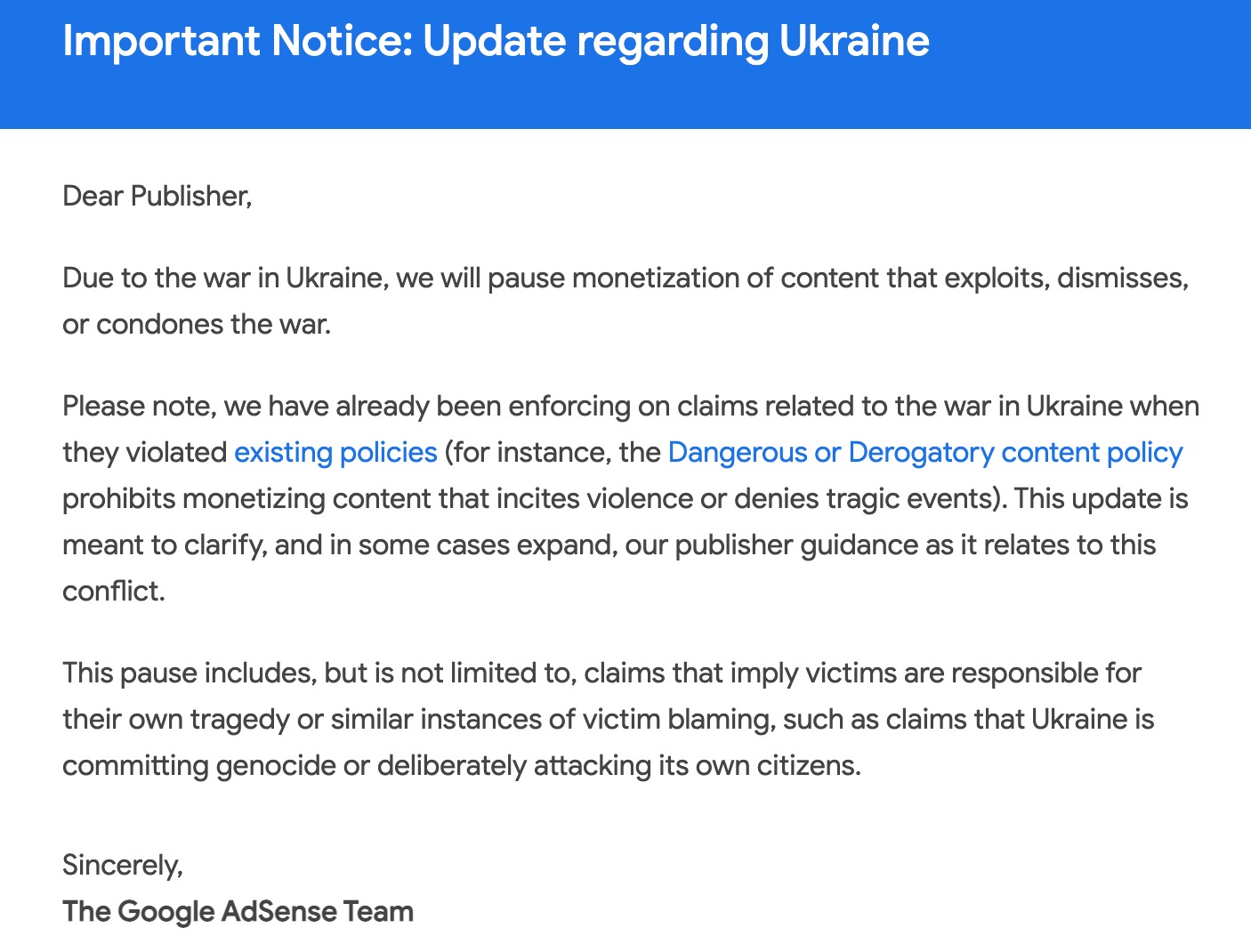
The email was a reminder of a previous policy that stated: “Due to the war in Ukraine, we will pause monetization of content that exploits, dismisses, or condones the war.”
If a publisher insists on posting content that condones the war, Google ads will be removed from such pages, and Google has a monopoly on website advertising infrastructure.
“Google helps to enable a free and open web by helping publishers monetize their content and advertisers reach prospective customers with useful, relevant products and services,” the policy states. “Maintaining trust in the ads ecosystem requires setting limits on what we will monetize.”
Failure to comply with the policy could result in a publisher’s monetization being terminated.
“Failure to comply with these policies may result in Google blocking ads from appearing against your content, or suspending or terminating your account,” the policy says.
NATO pins nuclear plans on F-35
Samizdat | April 15, 2022
NATO planners are updating the US “nuclear sharing” program to account for most European allies planning to buy F-35 joint strike fighter jets, the alliance’s director of nuclear policy said this week. Lockheed Martin’s fifth-generation fighter has been embraced by multiple US allies, including most recently Germany, despite the Pentagon’s own misgivings about the program.
“We’re moving fast and furiously towards F-35 modernization and incorporating those into our planning and into our exercising and things like that as those capabilities come online,” Jessica Cox, director of the NATO nuclear policy directorate in Brussels, said on Wednesday, adding that “By the end of the decade, most if not all of our allies will have transitioned” to the F-35.,
Cox spoke during an online discussion hosted by the Advanced Nuclear Weapons Alliance Deterrence Center (ANWA DC), a US think tank, according to Defense News.
Her remarks come a month after Berlin said Germany would replace its aging Tornado jets with F-35s, committing to buy up to three dozen and specifically citing the nuclear sharing mission as factoring in the decision.
Cox said that other NATO allies currently operating the F-35, such as Poland, Denmark or Norway, might be asked to support nuclear sharing missions in the future, adding that NATO “will also have some operational advantages with the F-35 since there will be opportunities for enhanced networking and integration across the force.”
In addition to Germany, Belgium, the Netherlands, Italy and Turkey are currently hosting an estimated 150 US nuclear weapons – mainly B-61 gravity bombs, intended to be carried by smaller fighter-bombers like the Tornado or the F-16 – according to estimates by the British think tank Chatham House.
Finland and Sweden have recently voiced a desire to join NATO, and Helsinki already announced it would buy some 60 F-35s in early February. Russia has responded by saying it would reposition some of its troops and nuclear deterrent accordingly.
The US first deployed some of its nuclear bombs in Europe in the 1960s. Ending this program was high on the list of security demands Moscow presented to the US and NATO in December 2021, which were rejected in January – a month before the escalation of hostilities in Ukraine.
The F-35 was originally proposed as a cost-effective modular design that could replace multiple older models in service with the US Air Force, Navy and the Marines. In reality, it turned into three distinct designs with a lifetime project cost of over $1.7 trillion, the most expensive weapons program in US history.
In addition to the price tag, the fifth-generation stealth fighter has also been plagued with performance issues, to the point where the new USAF chief of staff requested a study into a different aircraft in February 2021.
General Charles Q. Brown Jr. compared the F-35 to a “high end” sports car, a Ferrari one drives on Sundays only, and sought proposals for a “clean sheet design” of a “5th-gen minus” workhorse jet instead. Multiple US outlets characterized his proposal as a “tacit admission” that the F-35 program had failed.
Russia launched its military offensive in Ukraine on February 24, following Kiev’s failure to implement the terms of the 2014 German and French-brokered Minsk Protocols, designed to give the breakaway regions of Donetsk and Lugansk special status within the Ukrainian state. Moscow has now recognized the Donbass republics as independent states, and demanded that Ukraine officially declare itself a neutral country that will never join the US-led NATO military bloc.
China rejects US ‘pressure or coercion’ over Russia
Samizdat | April 14, 2022
Beijing won’t sanction or condemn Russia over the conflict in Ukraine, and will reject American “pressure or coercion” to change its relationship with Moscow, Chinese Foreign Ministry spokesman Zhao Lijian told reporters on Thursday. China has remained publicly neutral on the conflict, with Zhao saying this position puts it “on the right side of history.”
“China is playing a constructive role in the Ukraine issue,” Zhao told a press briefing, claiming that Beijing has “made considerable efforts to de-escalate the situation, defuse the crisis and rebuild peace.”
“We oppose unfounded accusations and suspicions against China, nor will we accept any pressure or coercion,” Zhao continued. “Time will tell that China’s claims are on the right side of history.”
China has from the outset called for a negotiated settlement to the conflict in Ukraine, and has affirmed both Ukraine’s right to territorial integrity and Russia’s legitimate security concerns. It has continued to trade with Russia, and has joined Moscow in urging the investigation of the US’ alleged biological weapons development in Ukraine. Furthermore, Beijing’s diplomats have opposed or abstained from UN resolutions condemning Russia.
This stance has incurred the scorn of leaders in the US and Brussels. White House Press Secretary Jen Psaki has repeatedly called on China’s leaders to “assess where they want to stand as the history books are written,” NATO Secretary General Jens Stoltenberg has declared that China now poses a “challenge” to the alliance, and most recently, US Treasury Secretary Janet Yellen called for Beijing to use its “special relationship with Russia” to force an end to the conflict.
“The world’s attitude towards China and its willingness to embrace further economic integration may well be affected by China’s reaction to our call for resolute action on Russia,” Yellen told the Atlantic Council, a pro-NATO think tank partly funded by the weapons industry, on Wednesday.
China’s stance is unlikely to change. In addition to reaping the opportunities for trade that Russia’s excommunication from western markets has presented, Beijing has vowed to resist potential US sanctions on its companies as a result of this trade. Furthermore, China has dismissed US media reports suggesting it is preparing to offer Russia military assistance. US officials later admitted that these reports were based on faulty intelligence, and released to the press to win an “info war” against the Kremlin.
Western Dissent from US/NATO Policy on Ukraine is Small, Yet the Censorship Campaign is Extreme
Preventing us from asking who benefits from a protracted proxy war, and who pays the price, is paramount. A closed propaganda system achieves that.
By Glenn Greenwald | April 13, 2022
If one wishes to be exposed to news, information or perspective that contravenes the prevailing US/NATO view on the war in Ukraine, a rigorous search is required. And there is no guarantee that search will succeed. That is because the state/corporate censorship regime that has been imposed in the West with regard to this war is stunningly aggressive, rapid and comprehensive.
On a virtually daily basis, any off-key news agency, independent platform or individual citizen is liable to be banished from the internet. In early March, barely a week after Russia’s invasion of Ukraine, the twenty-seven nation European Union — citing “disinformation” and “public order and security” — officially banned the Russian state-news outlets RT and Sputnik from being heard anywhere in Europe. In what Reuters called “an unprecedented move,” all television and online platforms were barred by force of law from airing content from those two outlets. Even prior to that censorship order from the state, Facebook and Google were already banning those outlets, and Twitter immediately announced they would as well, in compliance with the new EU law.
But what was “unprecedented” just six weeks ago has now become commonplace, even normalized. Any platform devoted to offering inconvenient-to-NATO news or alternative perspectives is guaranteed a very short lifespan. Less than two weeks after the EU’s decree, Google announced that it was voluntarily banning all Russian-affiliated media worldwide, meaning Americans and all other non-Europeans were now blocked from viewing those channels on YouTube if they wished to. As so often happens with Big Tech censorship, much of the pressure on Google to more aggressively censor content about the war in Ukraine came from its own workforce: “Workers across Google had been urging YouTube to take additional punitive measures against Russian channels.”
So prolific and fast-moving is this censorship regime that it is virtually impossible to count how many platforms, agencies and individuals have been banished for the crime of expressing views deemed “pro-Russian.” On Tuesday, Twitter, with no explanation as usual, suddenly banned one of the most informative, reliable and careful dissident accounts, named “Russians With Attitude.” Created in late 2020 by two English-speaking Russians, the account exploded in popularity since the start of the war, from roughly 20,000 followers before the invasion to more than 125,000 followers at the time Twitter banned it. An accompanying podcast with the same name also exploded in popularity and, at least as of now, can still be heard on Patreon.
What makes this outburst of Western censorship so notable — and what is at least partially driving it — is that there is a clear, demonstrable hunger in the West for news and information that is banished by Western news sources, ones which loyally and unquestioningly mimic claims from the U.S. government, NATO, and Ukrainian officials. As The Washington Post acknowledged when reporting Big Tech’s “unprecedented” banning of RT, Sputnik and other Russian sources of news: “In the first four days of Russia’s invasion of Ukraine, viewership of more than a dozen Russian state-backed propaganda channels on YouTube spiked to unusually high levels.”
Note that this censorship regime is completely one-sided and, as usual, entirely aligned with U.S. foreign policy. Western news outlets and social media platforms have been flooded with pro-Ukrainian propaganda and outright lies from the start of the war. A New York Times article from early March put it very delicately in its headline: “Fact and Mythmaking Blend in Ukraine’s Information War.” Axios was similarly understated in recognizing this fact: “Ukraine misinformation is spreading — and not just from Russia.” Members of the U.S. Congress have gleefully spread fabrications that went viral to millions of people, with no action from censorship-happy Silicon Valley corporations. That is not a surprise: all participants in war use disinformation and propaganda to manipulate public opinion in their favor, and that certainly includes all direct and proxy-war belligerents in the war in Ukraine.
Yet there is little to no censorship — either by Western states or by Silicon Valley monopolies — of pro-Ukrainian disinformation, propaganda and lies. The censorship goes only in one direction: to silence any voices deemed “pro-Russian,” regardless of whether they spread disinformation. The “Russians With Attitude” Twitter account became popular in part because they sometimes criticized Russia, in part because they were more careful with facts and viral claims that most U.S. corporate media outlets, and in part because there is such a paucity of outlets that are willing to offer any information that undercuts what the U.S. Government and NATO want you to believe about the war.
Their crime, like the crime of so many other banished accounts, was not disinformation but skepticism about the US/NATO propaganda campaign. Put another way, it is not “disinformation” but rather viewpoint-error that is targeted for silencing. One can spread as many lies and as much disinformation as one wants provided that it is designed to advance the NATO agenda in Ukraine (just as one is free to spread disinformation provided that its purpose is to strengthen the Democratic Party, which wields its majoritarian power in Washington to demand greater censorship and commands the support of most of Silicon Valley). But what one cannot do is question the NATO/Ukrainian propaganda framework without running a very substantial risk of banishment.
It is unsurprising that Silicon Valley monopolies exercise their censorship power in full alignment with the foreign policy interests of the U.S. Government. Many of the key tech monopolies — such as Google and Amazon — routinely seek and obtain highly lucrative contracts with the U.S. security state, including both the CIA and NSA. Their top executives enjoy very close relationships with top Democratic Party officials. And Congressional Democrats have repeatedly hauled tech executives before their various Committees to explicitly threaten them with legal and regulatory reprisals if they do not censor more in accordance with the policy goals and political interests of that party.
But one question lingers: why is there so much urgency about silencing the small pockets of dissenting voices about the war in Ukraine? This war has united the establishment wings of both parties and virtually the entire corporate media with a lockstep consensus not seen since the days and weeks after the 9/11 attack. One can count on both hands the number of prominent political and media figures who have been willing to dissent even minimally from that bipartisan Washington consensus — dissent that instantly provokes vilification in the form of attacks on one’s patriotism and loyalties. Why is there such fear of allowing these isolated and demonized voices to be heard at all?
The answer seems clear. The benefits from this war for multiple key Washington power centers cannot be overstated. The billions of dollars in aid and weapons being sent by the U.S. to Ukraine are flying so fast and with such seeming randomness that it is difficult to track. “Biden approves $350 million in military aid for Ukraine,” Reuters said on February 26; “Biden announces $800 million in military aid for Ukraine,” announced The New York Times on March 16; on March 30, NBC’s headline read: “Ukraine to receive additional $500 million in aid from U.S., Biden announces”; on Tuesday, Reuters announced: “U.S. to announce $750 million more in weapons for Ukraine, officials say.” By design, these gigantic numbers have long ago lost any meaning and provoke barely a peep of questioning let alone objection.
It is not a mystery who is benefiting from this orgy of military spending. On Tuesday, Reuters reported that “the Pentagon will host leaders from the top eight U.S. weapons manufacturers on Wednesday to discuss the industry’s capacity to meet Ukraine’s weapons needs if the war with Russia lasts years.” Among those participating in this meeting about the need to increase weapons manufacturing to feed the proxy war in Ukraine is Raytheon, which is fortunate to have retired General Lloyd Austin as Defense Secretary, a position to which he ascended from the Raytheon Board of Directors. It is virtually impossible to imagine an event more favorable to the weapons manufacturer industry than this war in Ukraine:
Demand for weapons has shot up after Russia’s invasion on Feb. 24 spurred U.S. and allied weapons transfers to Ukraine. Resupplying as well as planning for a longer war is expected to be discussed at the meeting, the sources told Reuters on condition of anonymity. . .
Resupplying as well as planning for a longer war is expected to be discussed at the meeting. . . The White House said last week that it has provided more than $1.7 billion in security assistance to Ukraine since the invasion, including over 5,000 Javelins and more than 1,400 Stingers.
This permanent power faction is far from the only one to be reaping benefits from the war in Ukraine and to have its fortunes depend upon prolonging the war as long as possible. The union of the U.S. security state, Democratic Party neocons, and their media allies has not been riding this high since the glory days of 2002. One of MSNBC’s most vocal DNC boosters, Chris Hayes, gushed that the war in Ukraine has revitalized faith and trust in the CIA and intelligence community more than any event in recent memory — deservedly so, he said: “The last few weeks have been like the Iraq War in reverse for US intelligence.” One can barely read a mainstream newspaper or watch a corporate news outlet without seeing the nation’s most bloodthirsty warmongering band of neocons — David Frum, Bill Kristol, Liz Cheney, Wesley Clark, Anne Applebaum, Adam Kinzinger — being celebrated as wise experts and heroic warriors for freedom.
This war has been very good indeed for the permanent Washington political and media class. And although it was taboo for weeks to say so, it is now beyond clear that the only goal that the U.S. and its allies have when it comes to the war in Ukraine is to keep it dragging on for as long as possible. Not only are there no serious American diplomatic efforts to end the war, but the goal is to ensure that does not happen. They are now saying that explicitly, and it is not hard to understand why.
The benefits from endless quagmire in Ukraine are as immense as they are obvious. The military budget skyrockets. Punishment is imposed on the arch-nemesis of the Democratic Party — Russia and Putin — while they are bogged down in a war from which Ukrainians suffer most. The citizenry unites behind their leaders and is distracted.
Russia’s Ukraine operation has no deadline
BY M. K. BHADRAKUMAR | INDIAN PUNCHLINE | APRIL 13, 2022
In his first extended remarks in nearly a month about the conflict in Ukraine, Russian President Vladimir Putin said on Tuesday that peace talks had reached a “dead end” and pledged that Russia’s “military operation will continue until its full completion.”
Putin defined a more limited aim for the war, focusing on control of the Donbass — and not all of Ukraine. Putin reiterated that Russia’s actions so far in several regions of Ukraine were intended only to tie down enemy forces and carry out missile strikes with the purpose of destroying the Ukrainian military’s infrastructure, so as to “create conditions for more active operations on the territory of Donbass.”
In his words, “Our goal is to provide aid to the people of Donbass, who feel an unbreakable bond with Russia and have been the subjects of genocide for eight years.”
Asked why the operation cannot be speeded up, Putin told reporters: “I often get these questions, ‘can’t we hurry it up?’ We can. But it depends on the intensity of hostilities and, any way you put it, the intensity of hostilities is directly related to casualties.”
He made it clear that “our task is to achieve the set goals while minimising these losses. We will act rhythmically, calmly, and according to the plan that was initially proposed by the General Staff.” He added, “The operation is going according to plan.”
Clearly, Mariupol port city in the south of Donbass could have been conquered with brute force. But that would have caused horrific casualties. Instead, the enemy forces — Ukrainian military, neo-Nazi Azov battalion and foreign mercenaries — have been steadily cornered and entrapped in two main locations, namely, Azovstal steel mills and the city’s main port.
The Russian forces have gained control of the port, while in Azovstal, about 3000-strong enemy forces have been surrounded, who include possibly dozens or hundreds of military officers from the NATO countries — and, surprisingly, Sweden. The experts estimate that the fall of the city into Russian hands is imminent. The Russian Ministry of Defence announced on Wednesday that over 1,000 Ukrainian troops, including 162 officers, surrendered earlier in the day in Mariupol.
In retrospect, the main purpose behind the frantic diplomatic efforts by some of the NATO countries (France and Germany, in particular) to sponsor “humanitarian corridors” out of Mariupol had a nefarious agenda to exfiltrate the Western officers trapped in the city. The heart of the matter is, NATO forces are de facto deployed in Ukraine, as foreign volunteers or as military instructors, and, equipped with heavy military equipment, they are fighting the Russian Army.
A French journalist who managed to sneak in with French “volunteers” has since come out with a video showing that American military personnel coordinate the foreign military in Ukraine and are directly handling the training and enrolment of the foreign “volunteers” in the Ukrainian forces.
In such conditions, quite obviously, peace talks between Moscow and Kiev cannot progress. The big question is: Does the Biden administration want the conflict to end and a peace agreement to be negotiated? The answer seems ‘no’. In fact, the US is fuelling this conflict.
The US Senate has approved a draft law on lend-lease, which will greatly simplify supplies to Ukraine. The Wall Street Journal reported that the US will provide Ukraine with heavy equipment, including Soviet air defence systems. The Biden administration is said to be preparing to announce more than $700 million in additional military assistance to Ukraine, which is likely to include heavy ground artillery systems, helicopters and armoured vehicles. The US had provided more than $2.4 billion in military assistance to Ukraine during Biden’s presidency, including $1.7 billion since Russia began its special operation in Ukraine in late February.
Interestingly, Putin confirmed yesterday the reports that British intelligence had stage-managed the so-called Bucha killings to pillory Russian military and create an international ruckus. The Pentagon had ostentatiously distanced itself from the controversy riveted on what turned out to be fake news. Putin said:
“There is a lot of commotion, but they (EU and US) just needed to adopt a new package of sanctions, as we know very well. Today, we discussed their special operation, the psychological operation carried out by the British.
“If you want to know the addresses, the secret meeting places, the licence plate numbers, the brands of vehicles they used in Bucha, and how they did it, the FSB of Russia can provide this information. If not, we can help. We exposed that ugly, disgusting position of the West together with our Russian friends, in full and from the beginning to the end.”
The Russian and Ukrainian forces have been regrouping and strengthening their positions in Eastern Ukraine through the past fortnight in preparation for a decisive battle for the Donbass. The Russian forces are preparing to encircle a huge concentration of Ukrainian troops, estimated to be in the region of 100,000 servicemen drawn from the best units of the armed forces. Kiev is also transferring all available forces to the eastern front in order to stop the Russian offensive.
Putin’s remarks yesterday suggest that Russia is not looking for a quick victory at any cost. Putin said on Tuesday that Moscow “had no other choice” and that the operation aimed to protect people in parts of eastern Ukraine and to “ensure Russia’s own security”. He vowed it would “continue until its full completion and the fulfilment of the tasks that have been set.”
To be sure, fighting in eastern Ukraine will intensify over the next two to three weeks but the final outcome will take time. The Ukrainian forces and the foreign fighters who have flocked to the eastern region are well-equipped and will not only put up stiff resistance but may even carry the fight into Russian territory.
This grim scenario is fraught with the real danger that NATO may increasingly be finding itself at war with Russia in Ukraine. According to Western media reports, elite British and US special forces units are deployed in Ukraine, including servicemen of the British Special Air Service (SAS) and soldiers of the First Operational Unit of Special Forces “Delta” of the US Army.
There have been reports that the operations in Mariupol were under the command of an American general who attempted to escape by helicopter sent to rescue him a week ago, but was intercepted by the Donetsk militia involved in the operation alongside the Russian forces, and was taken into their custody. It is entirely conceivable that the Austrian Chancellor Karl Nehammer’s Moscow mission on Monday and his “very direct, open and tough” talks with Putin at a one-to-one meeting at the latter’s Novo-Ogaryovo residence near Moscow was in coordination with Washington. There has been no readout of the 75-minute meeting from the Kremlin.
Britain’s military facilities being enhanced to host new US nukes: Report
Press TV – April 13, 2022
British underground military facilities are being upgraded for use in storing US nuclear weapons as part of an extensive nuclear arms modernization program pursued by Washington, US military budget documents show.
In the Biden administration’s 2023 military budget request, the UK was added to the list of countries where infrastructure investment is under way at “special weapons” storage sites, alongside Turkey, Belgium, Germany, Italy, and the Netherlands – all countries where the US stores an estimated 100 B61 atomic bombs, the UK-based The Guardian daily reported Tuesday.
The report cites Hans Kristensen, the director of the nuclear information project at the Federation of American Scientists (FAS), as saying that the British site being upgraded to host the nukes is the US airbase at RAF Lakenheath, located 100 kilometers northeast of London.
As part of the US nuclear arms modernization bid, the report says, “The B61 has been given a new lease of life with a guidance system, the B61-12 variant, due to go into full production in May.”
Washington’s 2023 budget request states that NATO “is wrapping up a 13-year, $384m infrastructure investment program at storage sites in Belgium, Germany, Italy, the Netherlands, the UK, and Turkey to upgrade security measures, communication systems, and facilities.”
This is while Britain has become anxious to assume a more assertive role when it comes to its own nuclear deterrent, according to the report, which noted that London announced last year that it would boost its own stockpile of Trident nuclear warheads by 40 percent to 260 – the first such increase since the end of the cold war.
It further cited British government sources as saying that the UK has “a clearer appreciation” of its role as a nuclear weapons state in a renewed era of state competition with Russia and China.
According to the daily, the British Defense Ministry did not comment on the upgrade mentioned in the US budget, though one official said, “We won’t provide anything on this as it relates to the storage of nuclear weapons.”
It then underlined that the development comes “just four months after the arrival in Lakenheath of the first of a new generation of nuclear-capable US combat aircraft, the F-35A Lightning II, the first such deployment in Europe.”
The report further cited Daryl Kimball, the executive director of the Arms Control Association, as saying that the upgrade of the British storage facilities is “an early sign that the US and NATO are preparing to engage in a protracted and maybe heightened standoff with Putin’s Russia.”
“The administration should provide some clarity about the military necessity and goals of possibly bringing nuclear weapons back to the UK,” Kimball emphasized.
The developments in Europe are part of a broader retreat from arms control, the daily also noted, adding that the Biden administration’s nuclear posture review – which has been sent to Congress but not yet declassified – reportedly do not include the changes the US president pledged during his campaign.
In 2020, Biden claimed he would formally declare the sole purpose of nuclear weapons to be deterrence of a nuclear attack against the US or its allies. But the review leaves open the option of using nuclear arms to respond to non-nuclear threats as well.
However, the nuclear disarmament group CND said the “quiet announcement” by the US amounted to more militarization at a time of growing risk and would add to the risks faced by the British public. CND’s General Secretary Kate Hudson said she feared it could lead to US warheads being redeployed in Britain, insisting, “Nuclear weapons don’t make us safe – they make us a target.”
The US withdrew its B61 munitions from Lakenheath in 2008, marking the end of more than half a century of maintaining a US nuclear stockpile in Britain. At the time of the withdrawal, the gravity bombs were widely considered as militarily obsolete and hopes were higher for further disarmament by major holders of nuclear weapons.
In the 1990s, RAF Lakenheath had 33 underground storage vaults, where 110 B61 bombs were stored, according to the FAS. Since their withdrawal, the vaults have been dormant. Kristensen said he believed the vaults are now being upgraded so the new B61-12 bombs can be stored there.
According to Kristensen, when the new B61-12 bombs are delivered – expected next year – they will replace older models already there, noting that the Lakenheath upgrade is intended to provide more flexibility to move the nuclear weapons around Europe.
“One of the things they have talked about is protecting the deterrent against Russia’s improved cruise missiles capabilities,” Kristensen asserted. “So they could be trying to beef up the readiness of more sites without them necessarily receiving nukes, so that they have the options to move things around in a contingency if they need to.”
Ukrainian opposition leader arrested, Zelensky shares photo of rival in handcuffs
Samizdat | April 12, 2022
Ukrainian President Volodymyr Zelensky expressed his delight on Tuesday after Kiev’s successor to the Soviet-era KGB arrested the country’s most prominent opposition leader.
The President shared a photo of his handcuffed rival Viktor Medvedchuk on social media, with the caption: “A special operation was carried out by the SBU. Well done! Details to follow.”
Medvedchuk heads the second largest party in the national parliament, the “Opposition Platform – For Life.” He was previously placed under house arrest, last year, as part of Zelensky’s clampdown on dissent, which was granted tacit approval by the regime’s Western supporters.
Formed in 1991, to replace the KGB, the SBU is Ukraine’s main intelligence and security agency.
Medvedchuk, who opposed the 2014 Kiev Maidan, and believes the country’s Western turn to be detrimental to Ukraine’s interests, has led his party since 2018. He previously served as Chief of Staff to former President Leonid Kuchma, in the early 2000s.
Some Western commentators have labelled him as Vladimir Putin’s “closest ally in Ukraine.” However, the Russian President has described Medvechuk as a “Ukrainian nationalist.”
In 2019, Opposition Platform – For Life won 13% of the vote in a parliamentary election, making it the country’s largest opposition faction. Last year, polls showed that it had passed Zelensky’s Servant of the People as the most popular party in the state.
That seemed to prompt a crackdown by Zelensky, who closed media outlets associated with Medvedchuk. Soon after, the politician was arrested on politically motivated “treason” charges.
Medvedchuk has rejected accusations of being “pro-Russian,” insisting his party represents millions of ordinary Ukrainians. In February 2021, he accused Zelensky of seeking to establish a dictatorship in Ukraine and suppress the legally elected opposition.
Authorities in Kiev also charged Zelensky’s predecessor Petro Poroshenko with treason, back in December 2021 – on the same charge as Medvedchuk: illegally buying coal from the breakaway regions of Donetsk and Lugansk and thus “financing terrorism.” Poroshenko made a big deal out of publicly returning to Ukraine in January, and a Kiev court refused to jail him.
Unlike Medvedchuk, Poroshenko has substantial support in the West.
The US and its allies have sought to justify their support for Ukraine by saying Zelensky is a democrat fighting for freedom, and have presented Russia’s actions towards Kiev as motivated by a fear of democracy.
Moscow sent troops into Ukraine on February 24, following a seven-year standoff over Kiev’s failure to implement the terms of the Minsk agreements and end the conflict with the breakaway regions of Donetsk and Lugansk. Russia ended up recognizing the two as independent states, at which point they asked for military aid.
Russia demands that Ukraine officially declare itself a neutral country that will never join the US-led NATO military bloc. Kiev insists the Russian offensive was completely unprovoked and has denied claims it was planning to retake the two Donbass republics by force.
NATO member-supplied S-300 launchers obliterated – Russia
Samizdat | April 11, 2022
Russian forces have destroyed foreign-supplied S-300 anti-aircraft launchers in a number of precision strikes on Ukraine, the Defense Ministry, in Moscow, claimed on Monday. Days earlier, Slovakia reported the donation of a battery of old Soviet-made S-300 air defense missiles to Kiev.
In its regular briefing on the ongoing military action in Ukraine, the Russian Defense Ministry reported hitting a hangar “on the southern outskirts of the city of Dnepropetrovsk,” where “equipment from an S-300 battery supplied to the Ukrainian regime by one of the European nations” was hidden.
The barrage of sea-launched Kalibr missiles destroyed four S-300 launchers and as many as 25 Ukrainian troops in the Sunday strike, ministry spokesman Major General Igor Konashenkov claimed. He used the old name of the city, which Ukrainian authorities renamed Dnepro in 2016 to distance it from the Soviet period of the country’s history.
The Russian official also reported destroying an S-300 targeting radar in a separate overnight precision airstrike near Uspenovka. The general didn’t specify which of the multiple villages of that name in Ukraine he was referring to, and didn’t say whether the radar was part of the battery supplied by the foreign nation.
Last Friday, Slovakia announced that it had donated its only S-300 battery to Ukraine. The weapon system was part of the NATO member’s legacy from the Warsaw Pact days, when it formed part of Czechoslovakia. It was not clear how many vehicles were sent to Ukraine. A regular S-300 battery can have as few as four and as many as 12 launchers using a single radar to identify targets, and is controlled by a single command post.
Prime Minister Eduard Heger assured citizens that the country’s national security would not be compromised since “allies” agreed to boost its air defense in return. US President Joe Biden said his country would provide an American Patriot missile battery as a replacement and thanked Bratislava for agreeing to give the S-300 to Kiev. Elements of the Patriot system started arriving in Slovakia three weeks ago, according to its defense minister.
Responding to Russian claims on Twitter, Prime Minister Heger called them a “hoax” and “Russian propaganda.” The statement was apparently based on a denial that Slovakia received from Kiev.
Washington reportedly wanted another NATO member, Turkey, to strike a similar deal with Ukraine and send it a Russian-supplied S-400, which is more advanced than the S-300. Ankara rejected the idea, saying the system would remain in its possession. In 2020, the US imposed sanctions on Turkey for buying the S-400s from Russia under a deal signed in 2017.
The Ukrainian Conflict Is a U.S./NATO Proxy War, but One Which Russia Is Poised to Win Decisively – Scott Ritter
By Finian Cunningham – Strategic Culture Foundation – April 9, 2022
Scott Ritter is a former U.S. Marine Corps intelligence officer who has gained international respect for his independence and integrity as a commentator on conflicts and foreign relations.
Question: Do you think that Russia has a just cause in launching its “special military operation” in Ukraine on February 24?
Scott Ritter: I believe Russia has articulated a cognizable claim of preemptive collective self-defense under Article 51 of the UN Charter. The threat posed by NATO expansion, and Ukraine’s eight-year bombardment of the civilians of the Donbass fall under this umbrella.
Question: Do you think Russia has legitimate concerns about the Pentagon sponsoring biological weapons programs in laboratories in Ukraine?
Scott Ritter: The Pentagon denies any biological weapons program, but admits biological research programs on Ukrainian soil. Documents captured by Russia have allegedly uncovered the existence of programs the components of which could be construed as having offensive biological warfare applications. The U.S. should be required to explain the purpose of these programs.
Question: What do you make of allegations in Western media that Russian troops committed war crimes in Bucha and other Ukrainian cities? It is claimed that Russian forces summarily executed civilians.
Scott Ritter: All claims of war crimes must be thoroughly investigated, including Ukrainian allegations that Russia killed Ukrainian civilians in Bucha. However, the data available about the Bucha incident does not sustain the Ukrainian claims, and as such, the media should refrain from echoing these claims as fact until a proper investigation of the evidence is conducted, either by the media, or unbiased authorities.
Question: Do you think the alleged Russian bombing of a hospital and an art theater in Mariupol were false-flag provocations?
Scott Ritter: Both locations are available for detailed forensic examination that would either confirm or refute Ukrainian allegations that these locations were struck by Russian aerial bombs. Other data, such as the existence of any NATO radar data that would put Russian aircraft over these two locations at the time of the alleged attack, should be collected. A detailed forensic examination of each site would go a long way in proving or disproving the Ukrainian claims through the collection of weapons fragments and the evaluation of environmental samples which would show the chemical composition of any explosive used, thereby allowing a better idea of what weapon or explosive was used to destroy the sites.
Question: Western governments and mainstream media have denigrated Russian objectives to “demilitarize and deNazify” Ukraine. The West says Russia has invented or grossly exaggerated these problems as a pretext for invasion. Do you think this Western denialism is because it doesn’t want to acknowledge that Russia may indeed have legitimate concerns, and secondly that to acknowledge would mean admitting that the West is part of the problem in the current war?
Scott Ritter: The irony is that the West had thoroughly documented the extent of the Nazi ideology in Ukraine’s civil, political, and military structures during and after the 2014 Maidan coup. This documented reality was deliberately obscured by the same sources that had previously documented its existence once the Russian invasion occurred. To acknowledge the existence of this odious ideology by NATO would require NATO to acknowledge the role it played in training and equipping Azov regiment personnel since 2015. The Russian documentation of its ongoing de-Nazification effort in Ukraine is a source of continual embarrassment to NATO, as it exposes the scope and scale of NATO’s role in empowering the militarization of Nazi ideology in Ukraine.
Question: For about four months before the Russian intervention in Ukraine, the Biden administration was asserting non-stop that Moscow was planning an invasion. Do you think this is a case of great intelligence on the part of Washington or the culmination of provocation by Washington resulting in Russian military action in Ukraine?
Scott Ritter: We now know that the U.S. intelligence community under the Biden administration is committed to a policy of haphazardly “declassifying” intelligence for the purpose of shaping public opinion (so-called “getting ahead of the story”). There is no evidence that the intelligence regarding potential Russian military action was based upon anything other than politicized speculation derived from a crude analysis of Russian military dispositions void of any context. Any genuine intelligence assessment regarding the timing of any Russian military action would have incorporated the domestic political imperative of getting Duma [Russian parliamentary] approval for the deployment of Russian forces outside the borders of Russia, which carries with it the requirement of a cognizable justification for this military action under the UN Charter. This required political steps such as Donetsk and Lugansk declaring independence, and then petitioning the Russian parliament to recognize this independence, so that Russia could legitimately invoke Article 51. None of these factors was knowable when the Biden administration was issuing its warnings of imminent attack, thereby certifying the “intelligence” as being derived from fact-free speculation, and not intelligence at all.
Question: The Western media are reporting that the Russian military operation in Ukraine is floundering because it has not over-run Ukraine entirely. As a military expert, how do you see the Russian operation proceeding?
Scott Ritter: Russia is fighting a very difficult campaign hampered by its own constraint designed to limit civilian casualties and damage to infrastructure and the fact that Ukraine possesses a very well-trained military that is well led and equipped. Russia deployed some 200,000 troops in support of this operation. They are facing some 600,000 Ukrainian forces. The first phase of the Russian operation was designed to shape the battlefield to Russia’s advantage while diminishing the size and capacity of the Ukrainian ability to wage large-scale conflict. The second phase is focused on destroying the main Ukrainian force concentration in eastern Ukraine. Russia is well on its way to accomplishing this task.
Question: Do you see danger from Ukraine being turned into a proxy war by the United States and NATO partners against Russia in a way that attempts to repeat the West’s covert war in Syria or the Afghanistan war (1979-89) with the Soviet Union? There are reports of foreign legions being sent to Ukraine via NATO countries. Do you think there is a Western plan to embroil Russia in a proxy war that is aimed at sapping Russia politically, economically, and militarily?
Scott Ritter: The Ukrainian conflict is a proxy war, but one which Russia is poised to win decisively. While there appears to be a NATO/western plan to embroil Russia in a “new Afghanistan”, I don’t see any risk of this conflict dragging on for more than a few more weeks at the most before Russia accomplishes a strategic victory over Ukraine.
Question: There is an arrogant assumption among Western governments that they can impose crippling economic sanctions on Russia in a similar way to what they did on Iran, Venezuela, and North Korea among others. But would you agree that if Russia begins to impose its own counter-sanctions by restricting oil and gas exports then the Western states may end up reaping a whirlwind that is devastating to their societies?
Scott Ritter: Russia was warned well in advance about the scope and scale of U.S.-led sanctions that would be imposed if Russia were to invade Ukraine. Russia has prepared its own counter-sanction strategy which will not only defeat the Western sanctions but further strengthen Russia’s economy by decoupling it from the West and Western control/influence. We see evidence of the effectiveness of this counter-campaign as the Russian ruble is strengthened, the Russian stock market enjoys positive traction, and Europe and the U.S. flounder economically. The West has sown the wind in sanctioning Russia; Russia will not reap the whirlwind.
oscow denies the claims, as have other independent analysts who point to evidence that the incident was a false-flag provocation perpetrated by NATO-backed Ukrainian Nazi regiments to undermine Russia internationally and bolster Western objectives. It is a foreboding sign of the times that Ritter should be banned for daring to question dubious narratives. (He was later reinstated following a public outcry against censorship.)
Scott Ritter is a critical commentator on U.S. conflicts and foreign relations. He is a former Marine Corps intelligence officer who served in the Soviet Union implementing nuclear arms control treaties, in the Persian Gulf during Operation Desert Storm, and as a UN inspector in Iraq (1991-98) overseeing the disarmament of weapons of mass destruction. He is the author of Scorpion King: America’s Suicidal Embrace of Nuclear Weapons from FDR to Trump (Clarity Press, 2020).
Featured Video

Death Spikes & Rising Cancer In Our Youth Explained
or go to
Aletho News Archives – Video-Images
From the Archives
Politicians lie
By Mazin Qumsiyeh | Popular Resistance | August 18, 2013
There is no way to say this truth nicely: Politicians lie. That includes Japanese, American, Egyptian, Israeli, and Palestinian politicians! Is there something more common sense than that? Yet, so many citizens around the world believe their own politicians or wistfully acknowledge lies but think it is part of the job needed to run things. They believe even when politicians contradict themselves blatantly. This phenomenon is rather remarkable. It is a dissonance and disconnect from reality that many seem oblivious to. It is very dangerous because it can lead to accepting rationales for going to war. These can be deadly wars that lead to millions of lives lost as happened in what was called World War 1 and WW2. Even when incredible and declassified evidence abound, politicians continue to lie and old mythologies refuse to die. Here are just a few of the countless lies told to us over the past few decades… continue
Blog Roll
 Aletho News
- From Unipolar Universalism to Multipolar Civilizational Distinctiveness
- RSF military group defects, joins Sudanese army: State media
- Ireland goalkeeper refuses to play ‘Israel’ as squad weighs boycott
- China pushes back against US on Cuba, Iran
- Ukrainian Soldiers, Potential Mercenaries: Have Gun, Will Travel!
- Burnham’s UN debut… A masterclass in British disinformation
- Iran flights continue despite US aviation sanctions
- Global Tipping Points Lead the World Into a State of Entropy
- The day-after at the White House: USA and Xi Jinping
- The Geopolitical Balance in the Red Sea: The UAE Being Displaced by New Players
- If Americans Knew
- Deconstructing Netanyahu’s pants-on-fire UN rant – Daily Update
- Trump betrayed voters with his campaign lies and prioritized a foreign country once he took office
- Netanyahu calls Israel’s war in Gaza ‘opposite of genocide’ in UN speech to near-empty hall
- Settler Kidnappings: Torture, Sexual Abuse and Terrorisation of Palestinian Abductees as Israel Deepens Annexation of West Bank
- Gaza winter nears as 162,000 tents become unusable, raising fears of humanitarian crisis
- Netanyahu says, “It’s the opposite of genocide”; UN says Gaza economy is world’s ‘most severe crisis on record’ – Daily Update
- Israel’s US-Backed Assault on Gaza Has Created the ‘World’s Most Severe Economic Crisis on Record’: UN
- ‘Protecting U.S. Citizens’… From Israel
- ‘This is where I live now, the back of a truck’: a day in the life of a grandmother in Gaza
- In UN Speech, Iran’s President Displays Pictures of Children Killed by US, Brings Attention to Israel’s Nuclear Arsenal
- No Tricks Zone
- New Study: Earth And Venus Surface Warmth Largely Explained By Convection And Lapse Rate, Not CO2 Or Radiation
- 2025 Nature Paper Claiming Worsening Global Drought Gets RETRACTED …Heavily Flawed
- New Study: ‘Global Drought Shows No Detectable Recent Acceleration Under Climate Warming’
- Economic Masterminds: German Socialists Suggest Taxing Productivity Gains Stemming From Using AI
- The South China Sea Has Not Been Cooperating With The Climate Change Narrative
- Energy Crisis: Germany Enters Heating Season With Historically Low Gas Reserve Fill Levels
- New Study: The Antarctic Ice Sheet Gained Mass From 2020-2024 Due To Staggering Snow And Ice Accumulation
- Study: Ocean Heating Rates From Thousands Of Years Ago ‘Dwarf’ Modern Ocean Heating Rates
- Climate Extremists Target, Attack Large-Scale Power Grid Infrastructure In Germany!
- New Study: Antarctic Ice Melt Has Contributed Less Than 1 Centimeter To Sea Level Rise In The Last 30 Years

