US sees Turkey’s S-400 deal as fait accompli
By M. K. BHADRAKUMAR | Indian Punchline | June 8, 2019
Three developments in quick succession in the weekend bring closer to a flashpoint the brewing discord between the US and Turkey on account of the latter’s purchase of the S-400 air defence system.
First, Russia disclosed on Friday that the delivery of the S-400 missile defense system will begin within two months. Turkey has made the advance payments and the Turkish military personnel have completed their training in Russia to operate the system. It appears that the die is cast.
Second, Washington has reacted instantaneously, as if anticipating that Turkey is sticking to its decision despite immense American pressure.
The US Acting Defence Secretary Patrick Shanahan has addressed a letter to his Turkish counterpart Hulusi Akar — and simultaneously leaked it to the media — intimating that “Turkey will not receive the F-35 if Turkey takes delivery of the S-400. You still have the option to change course on the S-400.”
Shanahan added that “Turkish F-35 students currently in training” in the US will be sent back by July 31 and no new training programme for Turkish personnel is being scheduled “as we anticipate they would be recalled in the near future.” Meanwhile, in immediate terms, “To facilitate an orderly cessation of Turkish participation in the programmatic management activities of the F-35 program, we will not plan for Turkish participation in the annual F-35 Chief Executive Officer Roundtable on June 12, 2019 and planned updates to the program’s governing programs will proceed without Turkey’s participation.”
Shanahan referred to the Russia-related Countering America’s Adversaries Through Sanctions Act (CAATSA), but concluded that the two countries should endeavour to “manage this matter in a respectful way, to preserve other aspects of our deep security cooperation.”
Third, an innocuous-sounding US State Department readout on June 6 said: “Deputy Secretary of State John J. Sullivan met today with Greek Defense Minister Evangelos Apostolakis to reaffirm the U.S. and Greek commitment to cooperation that strengthens bilateral defense and security and NATO, and to continue discussions started at the December 2018 U.S.-Greece Strategic Dialogue. Deputy Secretary Sullivan underscored the strategic importance of the Eastern Mediterranean and Balkans and highlighted Greece’s role as a pillar of stability and key partner in the region.”
Considering that Turkey’s hostile relations with Greece are even more ancient than India-Pakistan enmity, it is at once apparent that Washington is hitting back at Turkey on the geopolitical plane. Turkey’s principal motivation to procure the S-400 missile defence system is its unmatched capability to threaten aircraft up to 200 miles away—giving it so-called anti-access/area-denial (A2AD) (A2AD) potential.
The Turkish motivation is comparable to India’s (except that India has problematic relationships with two countries.) In layman’s terms, Turkey’s interest in the S-400 needs to be understood in terms of its ongoing rivalry with fellow NATO member Greece, with which it has nearly fought a war over the island of Cyprus. The S-400’s anti-access capabilities strengthen Turkey’s hand in its security competition with Greece.
Quite simply, S-400 system is peerless. The Patriot system that the US has offered Turkey as an alternative is optimised for relatively short-range (less than 40 kms) ballistic missile defence, lacking in A2AD potential.
Like any divorce, this is going to be a messy affair. Out of all the issues complicating the Turkish-American relationship — starting with the US-backed failed coup d’état attempt in July 2016 to kill President Recep Erdogan and overthrow his nationalist government — the S-400 issue has surged as the coup de grâce.
To be sure, if the US cancels the collaboration with Turkey on the development and production of F-35 fighter jets, the latter will look for alternate sources of stealth technology. The fact of the matter is that Turkey seems unperturbed that it is parting ways with the US’ program to develop the F35 fighter and buy 100 planes. But Turkey would like the US to initiate the break-up so that it is free to develop options. In the Turkish assessment, F-35 has serious deficiencies.
Equally, Turkey (like India) has already stated its ambitions to develop a domestic stealth fighter and knows that the US will never transfer such cutting edge technology. In all probability, Turkey may approach Russia. Speculation is rife.
Quite obviously, all this has very serious implications for India, which merit a separate analysis.
Latest attempt to prosecute President Assad at the ICC is further criminalisation of “international justice”

Toby Cadman. Co-founder of Guernica Chambers 37, one of legal entities bringing latest case against President Assad at the ICC. (Photo: The ICC and our politics)
By Vanessa Beeley | 21st Century Wire | May 28, 2019
In March 2019 two law firms filed cases at the ICC against Syria’s President Bashar Al Assad and unnamed members of the Syrian government. Toby Cadman of Guernica Chambers and Rodney Dixon of Temple Garden Chambers were the protagonists in this latest attempt to criminalise the Syrian President and government.
These law firms are basing their case upon the testimony of 28 “refugees” from Syria who claim they were “forced” to flee to Jordan during the war that has been waged against Syria by a collective of interventionist mafia states that form the U.S coalition, determined to achieve regime change in Syria.
Syria is not a signatory to the ICC in the Hague but precedent was set by the ICC when a preliminary investigation was opened into military leaders of Myanmar for alleged crimes against humanity involving deportation of Rohingya people. Refugees fled to Bangladesh which is party to the Rome statute that established the ICC, as is Jordan where more than 1 million Syrian refugees now reside. Guernica Chambers and Rodney Dixon are clearly hoping that the Rohingya precedent will open up the legal avenue for their case.
Both legal firms are claiming the intended deportation of Syrian civillians by the Syrian government as part of their cases.
However, even some members of the legal profession, have already remarked upon possible holes in the case being presented by both legal entities. Kevin John Heller is Associate Professor of Public International Law at Amsterdam University. According to Heller, there is a vital element of the Syrian situation that distinguishes it from the Myanmar situation. Heller argues that in Myanmar, it is evident that the government “intended to drive the Rohingya into Bangladesh” while in Syria it is not evident that the Syrian government intended (in the legal sense) that their civilians end up in other countries. Heller points out that without sufficient evidence, the Syrian government may only be accused of “forcible transfer” but not “deportation”. “Forcible transfer” falls outside the ICC’s jurisdiction because it takes place uniquely on Syrian territory.
“In other words: for the Court to investigate the forcible displacement of Syrian civilians proprio motu, it is deportation or bust.” ~ Kevin John Heller
This is not the first time that Guernica Chambers (GC) have attempted such a legal attack against the Syrian government. In March 2017, the Madrid offices of GC tried to bring a case against eight members of the Syrian security and intelligence services. The case was based upon the testimony of a Syrian national’s sister who had Spanish citizenship. Spain is party to the Rome Statute of the ICC. The woman allegedly identified the body of her brother among the photos that were “smuggled out of Syria” and formed part of the Caesar Report which I will discuss later in this article.
Who is really behind the legal war being waged against Syria?
I asked Peter Ford, former UK Ambassador to Syria and outspoken critic of the UK government’s role in the eight year regime change campaign in Syria, to comment on the timing of this legal initiative. Ford told me:
Nothing could be more likely to bring the ICC into disrepute than this attempted action by actors transparently serving the political agenda of the British and Qatari governments. Having failed in attempted regime change via miltant proxies Syria’s enemies are now embarked on an enterprise to secure the same result by waging economic war which must be justified by constant demonizing of Assad. That is the game being played here.
“if the ICC goes along with it, that will provide more justification for those who accuse the ICC of being a tool of the rich and powerful, and an incentive to Assad to halt any move towards elections in Syria which might see him removed from power. This is just a cheap trick designed to make political capital out of the remaining credibility of the ICC, such as it is.”
Ford pinpointed the drivers behind these legal cases and the UK Government and intelligence services must be considered as primary players. The UK/US-led intervention alliance have seen their terrorist-proxy-military-campaign fail dismally after hitting the brick wall of the axis of resistance -Syria, Hezbollah, Iran and Russia with China offering diplomatic and technological support.
What will follow is perhaps an even more destructive economic warfare campaign that will capitalise upon the post war dissonance in Syria to pressurise the Syrian state and to further foment discontent among civilians now struggling to cope with life in a Syria that has been severely impacted by 8 years of terrorist occupation and destruction of infrastructure.
“I believe that the reason why this attempt is being made to circumvent the fact that the International Criminal Court has no jurisdiction over Syria, is to remove Assad from power and to de-legitimise him as part of the future of Syria. This has been the goal of the jihadists from the very beginning.”
Historian and analyst, Dr Marcus Papadopoulos, further expanded upon the timing of the legal case:
Well, talk of war crimes cases being brought against President Assad, at the International Criminal Court, has been in the air for some years now. Indeed, I remember how such talk was emanating from Western capitals in 2012. However, there is no doubt that the today’s timing of lawyers, acting on behalf of Syrian refugees in Jordan, submitting lawsuits against the Syrian president at the ICC, is not coincidental. Because today, the Syrian people have all but won the war against Western-backed terrorism and so by submitting cases now to the ICC is a way of Western governments subtly informing President Assad that whilst the military war against him has been lost, the legal, media and communications war against him will continue.
Furthermore, I suspect that by initiating ICC proceedings against the Syrian leader – which will only increase in volume and go on indefinitely – may be a way of the Americans and the British maintaining their military presence in Syria, as well as their sanctions on the Arab country, on the pretext that the region has a leader in power who ‘waged war against his own people, destabilising not just his country but the wider region’ hence the presence of American and British forces in Syria is a means to limiting any future ‘carnage’ that the Syrian ‘strongman’ (a favoured word from the West’s lexicon to describe leaders whom it disapproves of) can inflict on both Syria and the region.” (Emphasis added)
International criminal lawyer, Christopher C. Black, pointed out the importance of the NATO and UK government links of the legal firms:
“The answer is revealed in the lawyers who are behind this scheme to try to drag the ICC into the picture. Rodney Dixon and Toby Cadman, and, it seems, from your information, Geoffrey Nice. All of them have links to the British governent and NATO through acting for them in various capacities.”
Links to UK Foreign Office, NATO and the CIA
Guernica Chambers – offices in London, Spain and Washington.

Toby Cadman. (Photo: Guernica 37 website)
Toby Cadman is the Co-founder and Head of Guernica 37 International Justice Chambers in London. According to the International Forum for Democracy and Human Rights (IFDHR), Cadman was hired by the UK Foreign Office in 2012 to “head a team to investigate crimes committed in the Syrian Arab Republic“.
I would challenge Cadman to demonstrate any serious investigation by Guernica into the ongoing crimes committed by the terrorist/extremist groups in Syria, armed and financed by the U.S Coalition. The fact that Cadman is a hired legal hand of one of the central players in the international campaign to reduce Syria to another Libya-style failed state, should immediately raise the alarm.
Doctors Under Fire – cluster of anti-Syria medical, legal and chemical “experts”
Cadman is also on the board of directors of Doctors Under Fire (formerly Medics Under Fire). Alongside him are Hamish De Bretton Gordon, Dr David Nott (Nott Foundation) and Dr Saleyha Ahsan.

Dr David Nott. (Photo: Nott Foundation website)
Nott has run UK Government-endorsed training courses for Syrian doctors in Gaziantep, Turkey – the hub of UK intelligence training for Syrian “opposition”, with a reputation for being the centre of ISIS organ and human trafficking operations. The flight from Istanbul to Gaziantep was known as the Jihad Express. The town itself was reported to be the area where new ISIS recruits from around the world would gather before being transported into Syria. The UK FCO-midwived and financed White Helmet propaganda construct also have their base in Gaziantep, established in 2013 by former MI6-turned-private-security expert, James Le Mesurier.
In 2013, Nott was largely responsible for the rumours that Syrian Arab Army snipers were targeting pregnant women in East Aleppo, which was freshly under control of the armed extremist gangs that included Al Qaeda in Syria, Nusra Front. The photo of a bullet lodged in an alleged foetal brain was published by most mainstream media outlets in the West without any expert second opinion regarding the credibility of such an image. Nott has operated on ISIS fighters during his forays (exclusively) into terrorist held territory of Syria.

Nott also amplified the discredited narrative surrounding Omran Daqneesh during the final moments before liberations of East Aleppo from terrorist rule. This story is now known to be another of the fraudulent campaigns to criminalise the Syrian government. This article by journalist, Steven Sahiounie, goes into depth about the bias and misprepresentation of reality by Nott during his time in the terrorist-held enclaves of Aleppo and Idlib.

Dr Saleyha Ahsan’s contradictory accounts of alleged chemical attack, showcased in BBC Panorama’s Saving Syria’s Children – forensically investigated by researcher, Robert Stuart.
Dr Saleyha Ahsan’s role in the BBC Panorama documentary, Saving Syria’s Children, has been exposed as potentially fraudulent by independent researcher, Robert Stuart. Actor and director Keith Allen is fronting a new crowdfunding campaign for a documentary examining the 2013 BBC Panorama programme Saving Syria’s Children. The project is in collaboration with British film, TV and radio producer, Victor Lewis-Smith. In 2017 Lewis-Smith challenged the BBC Panorama office over the issue. Failing to get satisfactory answers, Victor tore up a contract for a forthcoming comedy pilot with BBC Radio 4.

Hamish de Bretton Gordon. The media establishment go-to expert on chemical weapons.
Hamish de Bretton Gordon has been the go-to expert for the majority of corporate media outlets, particularly with regard to the alleged chemical weapon attacks in Syria that BG invariably blames upon the Syrian government. David Miller, Professor of Political Sociology at the University of Bristol and a member of the Academic-established Working Group on Syria, Propaganda and Media, stated very clearly in a recent interview that HBG:
“is an operative for MI6. He’s not a staff member of MI6 but he works very closely with MI6 in Syria trying to create evidence of chemical and biological weapons’ attacks.”
The full briefing note by the WGSPM can be found at this link: The alleged chemical attack in Douma on 7 April 2018, and other alleged chlorine attacks in Syria since 2014.
Doctors Under Fire appears to be another compromised organisation with a focus on misleading the British public into approving further military intervention in Syria under a familiar “humanitarian” pretext. Its ties to state media and intelligence services should be examined closely before their “expert” opinions be given serious consideration.
Toby Cadman – Ibrahim Olabi – White Helmets

Ibrahim Olabi. Joined Guernica Chambers in November 2018 as a pupil barrister. (Photo: Guernica Chambers website)
The Guernica inks to UK Government intellligence operations in Syria continue. Ibrahim Olabi joined Guernica Chambers in November 2018 as a pupil barrister. According to his bio on the GC website, Ibrahim Olabi “has worked extensively on international legal matters related to the Syrian conflict, including international humanitarian law, international criminal law and international human rights law” for the last five years.
Olabi is UK educated, having completed his LLB and LLM (Security and International Law) at the University of Manchester. Olabi is the director of the Syrian Legal Development Programme (SLDP). According to the GC website:
SLDP has provided legal expertise to Syrian NGOs, including training that Ibrahim delivered to more than 550 trainees on a range of complex legal surrounding forced displacement, torture, UN mechanisms, facilitation of humanitarian aid and other matters. He has trained both in Syria, near the front lines, and in neighbouring countries.
SLDP has received funding from the Swiss Ministry of Foreign Affairs and the Dutch Ministry. What seems extraordinary for a “pupil barrister” who only joined GC in November 2018, Olabi has an impressive track record of influencing major global institutions and state-linked think tanks on the Syrian conflict:
Ibrahim has also advocated in Geneva, Brussels, Washington and London on human rights issues relevant to Syria. He received personal invitations from the Heads of States such as Germany and The United Kingdom, and from the UN Secretary General. Ibrahim has spoken and chaired panels in forums such as Chatham House and Amnesty International, and delivered presentations at UK universities such as UCL, SOAS, Nottingham and Manchester amongst others. He also spoken on TV channels such as the CNN and the BBC.

Training the White Helmets. (Photo from SLDP website)
Among those trained by the SLDP are the primarily UK FCO-cultivated White Helmets who are exposed as terrorist group-auxiliaries and stand accused of committing crimes against the Syrian people that include child abduction and running organ trafficking operations from inside the terrorist-occupied territories.
The White Helmets have also been instrumental in producing the Syrian “chemical weapon” narratives supported by Cadman and his associate directors at Doctors Under Fire – designed to criminalise the Syrian government, often during the closing stages of military campaigns to liberate areas under control of the Western-sponsored armed groups.
The most recent White Helmet chemical attack narrative was in Douma, Eastern Ghouta, April 2018 – an alleged attack that precipitated the French, UK, US unlawful bombing of Syria before an investigation had been carried out by the OPCW (Organisation for the Prohibition of Chemical Weapons).
Since this event, it has been demonstrated that the White Helmets had staged the hospital scenes that were widely published by western media to support the shaky narrative. Furthermore, a leaked engineers report, omitted from the OPCW final report, has raised alarming questions over OPCW’s impartiality and independence. The revelatory engineers report was sent to the aforementioned Working Group on Syria, Propaganda and Media who produced the briefing note which can be found here.
Guernica Chambers Advisory Board – Steve Rapp – CIA

Ambassador Stephen J. Rapp. (Photo: Guernica Chambers)
A look at the Guernica Chambers Advisory Board members reveals that Ambassador Stephen J. Rapp is listed as a board member. International criminal lawyer, Christopher Black, had clashed with Rapp during the Rwanda tribunal when Rapp was in charge of prosecutions:
“Stephen Rapp-well, there is your link to the CIA, US government. Rapp was at one time the guy in charge of prosecutions at the Rwanda tribunal. During his tenure, 2 of his henchmen-“investigators” began interviewing a former Rwandan cabinet minister in Lille, France. The investigators were two ex Montreal cops kicked off the force for corruption. There were rumours when I was there they had murdered witnesses.
Well at some point their interview of this guy became too heavy and he wrote a letter to the President of the tribunal stating that Rapp and his men were pressuring him to give false testimony against accused before the tribunal and that if he did not they were threatening to kill him and cut his body into pieces.
Two weeks later he disappeared after going to a final interview. We raised this letter in court. Two weeks after that his body was found in a canal in Brussels naked with his hands cut off. I asked that Rapp and his men be detained pending an investigation into that murder as they were the prime suspects.” ~ Christopher Black

Stephen Rapp with Mouaz Moustafa of the Syrian Emergency Task Force (SETF) responsible for bringing John McCain into Syria illegally in 2013. (Photo: Zoom info)
Rapp is included in an index of contact profiles for the Syrian Emergency Task Force (SETF) whose executive director is Mouaz Moustafa. Moustafa is probably best known for his role in bringing neocon warhawk, John McCain, into Syria illegally in 2013. McCain’s trip was dogged with controversy after he met with recognised militant kidnappers:
“US Senator John McCain was photographed with a known affiliate of the rebel group responsible for the kidnapping of 11 Lebanese Shiite pilgrims one year ago, during a brief and highly publicized visit inside Syria this week.” ~ Daily Star

Salim Idris, chief of the Supreme Military Council of the Free Syrian Army and Mouaz Moustafa on right with John McCain.
Rapp and Moustafa were both heavily involved in the promotion of the Caesar report – Caesar is a codename for an alleged Syrian police photographer who apparently smuggled 53,275 photographs out of Syria implicating the Syrian government in a campaign of torture. This story has been investigated and discredited by independent researcher and journalist, Rick Sterling, his findings can be read here. Prof. Tim Hayward also analysed the credibility of the Caesar report in his more recent article in April 2019.

Caesar with Mouaz Moustafa in Washington DC. (Photo: Syrian American Council)
Having taken into account the glaring anomalies in Caesar’s accounts and in the identification of the photographs of “tortured” corpses attributed exclusively and erroneously to alleged victims of the Syrian government – Hayward drew the following conclusions:
“To put bluntly this contextualised concern about Operation Caesar: not only may it already have altered the historical record, and not only may its effects have served to alter somewhat the course of history to date, but in serving to influence decision makers, it may contribute more indelibly to shifting the baseline of normative consensus in a direction favourable to ousting non-compliant leaders of sovereign states. That is effectively to bestow legitimacy on imperialist regime change projects.”
The FBI conducted its investigations into the Caesar report at Rapp’s request. The FBI carried out standard authentification analysis of 27,000 of the photographs and concluded that it could not “definitively rule out the possibility of tampering“. The report emerged at a crucial juncture in the dirty war being waged against Syria – just as members of Congress were pushing for increased “aid” for “rebels” and the creation of No-Fly-Zones and safe-zones for the U.S terrorist proxies disguised as “moderates”. Those members — including House Foreign Affairs Committee Chairman Rep. Ed Royce and ranking minority member Rep. Eliot Engelwere sponsor and co-sponsor of the subsequent Caesar bill, introduced in March 2017.
The bill had previously hit obstacles within the Obama administration in October 2016, when it was perceived that Obama was effectively trying to weaken the bill in favour of maintaining the ceasefire agreement with Moscow that was still active at that time.
The Caesar bill – Caesar Syria Civilian Protection Act of 2017/2018 was a means of increasing economic sanctions against Syria – never anything more than collective punishment for the Syrian people who have resisted eight years of regime change war that has decimated their infrastructure and severely affected their ability to survive economically.
Rapp defended the Caesar bill:
“It’s important to send the signal that those who engage in war crimes and those who aid and abet them are held to account with tools that are effective, and in the short term the most effective is sanctions”
Historically, sanctions are never effective as leverage against a target government, they are always “effective” against the people of a nation that is struggling to resist the machinations of U.S neo-colonialism. Sanctions are economic terrorism, designed to increase the pressure on those most affected by war and the associated poverty and homelessness. They amount to abject cruelty, compounding an already desperate situation brought about by the military adventurism of globalist nations.
So, Rapp alongside Cadman, has a clear intention to criminalise the Syrian government and to weaken the Syrian nation in preparation for a U.S-friendly regime change operation.
As Peter Ford has remarked – the latest attempt to prosecute President Assad and members of the Syrian government in the ICC is another element in the long running and insidious economic war that has been waged alongside the (failed) miliary campaign to destabilise Syria:
“Having failed in attempted regime change via miltant proxies Syria’s enemies are now embarked on an enterprise to secure the same result by waging economic war which must be justified by constant demonizing of Assad. That is the game being played here.”
Rodney Dixon – Qatar – Rwanda – Former Yugoslavia

Rodney Dixon, lawyer acting for Temple Garden Chambers.
Rodney Dixon is lawyer acting for Temple Garden Chambers who have also submitted a case against President Assad and the Syrian government at the ICC. According to his biography at Legal 500, Dixon appears to have had a long career protecting NATO interests, including:
He has prosecuted and defended before the International Criminal Tribunal for the former Yugoslavia (ICTY) including as defence counsel on behalf of the former Prime Minister of Kosovo in protracted trial, appellate and retrial proceedings. He acted on behalf of the government of Rwanda before the International Criminal Tribunal for Rwanda (ICTR).
Christopher Black interpreted this career path as follows:
“So Dixon acted for mass muderer and KLA leader, Hashim Thaci, in a staged trial the ICTY, arranged so that Thaci could be charged but aquitted-a game to give the ICTY some credibility. Thaci is a NATO asset. Dixon also acted as agent for mass murderer Paul Kagame the dictator of Rwanda put in power by the US, UK, Canada etc. and was his agent at the Rwanda tribunal (ICTR) which framed all the accused there as scapegoats for the crimes of Kagame and his western allies.
So, Dixon has been used by the NATO powers to protect their interests and that is his role in the scheme regarding Syria. Looking back on events, if he was at the ICTR in 2007 then he may have been behind the Rwandan government’s demand to have me arrested during my defence of General Nindiliyimana (Chief of Staff, Rwanda Gendarmerie, acquitted on all counts in 2014) when I demanded Kagame be charged with war crimes.”
Dixon has a history of working for Qatari clients. In 2017 Dixon represented three prominent Qatari nationals – who were unlawfully detained and tortured in the UAE between 2013 and 2015 by UAE security officials. In 2018, Dixon chaired a panel of experts calling for an end to the blockade of Qatar by Saudi Arabia, Bahrain, Egypt and the UAE. The event was organised by the Arab Organisation for Human Rights in the UK and was held at University College, London.
Qatar has been one of the primary financiers of the terrorist forces that have invaded and occupied areas of Syria during the eight year conflict. The Caesar report was commissioned by London law firm, Carter-Ruck on contract to Qatar. Guy Martin, a specialist in sanctions in international law and partner at Carter Ruck Solicitors was also speaking on the panel protesting the sanctions against Qatar, chaired by Dixon.
According to French investigative journalist, Thierry Meyssan, Dixon had already declared an interest in pursuing the Syrian goverment for alleged war crimes, based upon the Carter Ruck-orchestrated Caesar Report:
“Mr. Dixon had already declared that he intended to pursue the Syrian leaders for « crimes against humanity ». He based his case on the Caesar Report; a document made public by Qatar, via the London cabinet Carter-Ruck, on 20 January 2014, two days before the peace negotiations of Geneva 2.”
The only conclusion to be drawn after examining the origins and motives of the cases being brought against President Assad at the ICC – is that the driver behind them is not international justice but regime change which is the ultimate goal of the U.S alliance in Syria. This renders any “humanitarian” outrage expressed by the legal entities involved nothing more than hollow rhetoric, a marketing ploy to elicit sympathy for the further persecution of a nation that has refused to submit to an unprecedented level of military pressure by terrorist proxy.
Expert opinions
I asked John Laughland how this case, if accepted by the ICC, reflects the nature and state of “international justice” in our world today. Laughland replied:
“International justice is political justice. Typically, heads of state are judged by international courts for acts of state. They are never judged as actual perpetrators and therefore the acts adjudicated are state acts for which they have state responsibility. The trials are therefore not criminal trials in the proper sense of the word because state acts cannot be compared to private crimes, as they often are by the ideologues of international justice. I have explained this at length in the final chapter of the second edition of my book, “A History of Political Trials from Charles I to Charles Taylor” (Oxford: Peter Lang, 2016).
Much of what I have been warning about for over a decade has now been proved true. For instance, Laurent Gbagbo, the former president of Ivory Coast, was the subject of a political indictment in 2011, the same year as Gaddafi, and this indictment was used to get him out of his home country (just as Charles Taylor was removed from Liberia for explicitly political reasons – again, see my book). Yet earlier this year, more than eight years later, he was found innocent and released. A court which imprisons and innocent man for eight years should be immediately closed down.”
Like Ford, Laughland argued that if the case is accepted “the re-integration of Syria into the international or regional system will be impeded. Some states will back off from building bridges with Damascus” – another example of the weaponisation of “international justice” to punish an independent nation for protecting its interests and refusing to comply with U.S demands for ultimate control over their internal and external affairs.
Laughland did not believe that Syria could succeed with a positive engagement with the ICC, he believes that Damascus should ignore any proceedings at the ICC, “especially as they would be clearly illegal under international law”. Laughland cited the case of President Al-Bashir of Sudan:
“Ignoring the ICC was what President Al-Bashir of Sudan has done, and it has worked very well. Other states have ignored the warrant against him too, notably South Africa, which refused to arrest him on a visit there. This is one of the reasons why the ICC is in such spectacular crisis.”
Christopher Black also referred to the case of Laurent Gbagbo:
“If the prosecutor accepted the case on clearly trumped up evidence as it did with regard to President Gbagbo of Ivory Coast then it would confirm once again that the ICC is not an organ of international justice but a propaganda organ of US and British and EU imperialism.”
Black also concurred that there would be negative implications for President Assad and the Syrian government should the case be accepted by the ICC:
“President Assad can expect that he will be labeled in the western mass media as a war criminal in a mass propaganda campaign, and that this propaganda will bombard the Syrian people to undermine the Syrian government. To try to overcome that I suggest the formation of an international committee for his defence as we formed for President Milosevic to include not only international lawyers who support Syria but also artists, intellectuals, poets, etc who can try to counter this propaganda because Syrian denials will just be dismissed.”
Dr Marcus Papadopoulos had a more optimistic viewpoint:
“From the time I began giving television interviews on Syria, beginning in 2011, I have said that most Syrians, either actively or passively, support President Assad. And I hold the view that even more Syrians support their leader today. There are numerous factors in accounting for the Syrian people’s support of their president, and a key one is that Mr Assad guarantees Syria’s traditional status as a secular, multi-confessional country.
In light of their support, together with how they repelled Western, Turkish, Israeli and Saudi aggression, I do not believe that the Syrian people will pay any notice to what happens at the ICC regarding President Assad. Indeed, I know that Syrians are asking – demanding, in fact – for Barack Obama, Erdogan and Mohammad bin Salman to be tried for crimes against Syrian civilians and Syrian prisoners of war by Islamist terrorists, such as the so-called Free Syrian Army, who all three leaders were supporting in Syria.”
Papadopoulos drew parallels between the politically motivated case against former Yugoslav leader, President Slobadan Milosevic and the threat of an equally politically motivated case against President Assad and members of the Syrian government:
“There are most certainly precedents, most notably the unfounded and politically-motivated case against President Slobodan Milosevic. That case against the former Yugoslav leader laid the foundation for what may very well transpire at the ICC against President Assad. But, Mr Milosevic faced Western aggression on his own, at a time when Russia was incapable of finding fuel for its tanks so that they could parade on Red Square. Conversely, Mr Assad faced Western aggression with Russia by his side, with Moscow capable of finding fuel for its aircraft so that they could fly all the way to Syria and take part in the fight against Wahhabi terrorism there.
So if the ICC does indict the Syrian president, it will not alter the reality on the ground in Syria – namely, that the Syrian people have prevailed over the hordes of Al-Qaeda and ISIS. Turning to whether the ICC will proceed to hear the case against President Assad, this probably will happen. But consider this: America, Britain, France, Turkey and Saudi Arabia are keen to start doing business with Syria again. In light of that, dropping the case against President Assad might be in the interests of the aforementioned countries.”
Conclusions – the U.S is riding roughshod over international justice
In April 2019, President Trump and the U.S administration revoked the visa of the ICC’s chief prosecutor, Fatou Bensouda. The U.S warned that they would take action against anyone from the ICC who dared to investigate allegations of war crimes levied against U.S personnel in Afghanistan.
Ironically the U.S claimed its citizens and military personnel are outside the ICC’s jurisdiction – the ICC claims that Afghanistan is within its purview because the country had ratified the Rome Statute which established the court in 2003. A prime example of the perversion of “international justice” to serve the powerful global hegemons.
Shortly after, Israeli media reported that Trump had decreed that Israel should be exempt from prosecution at the ICC. One exceptionalist nation protecting another while both are guilty of violations of international law, human rights law and have committed a catalogue of war crimes and violated UN resolutions throughout their history. The United States and Israel are effectively exploiting the ICC without any intention of recognising its jurisdiction in relation to their own transparent criminality.
So, while the U.S legal machinery is determined to crush the Syrian government under the weight of its global tyranny, the same entity will not entertain any investigation into its bloody record of military interference abroad nor will it permit any legal pursuance of its allies for the human rights crimes they are persistently committing. This renders the entire concept of “international justice” a travesty and nothing more than a rogue state protectionist racket.
The campaign to prosecute President Assad at the ICC is a misdirection away from the real criminals in the UK/U.S Coalition who have violated every related element of international law in their campaign to destabilise Syria and the region. Without international law we are living in a world of the utmost insecurity where the most powerful can denigrate human rights in their surge to dominance and resource plundering at will from weaker and less supported nations.
The case against Syria at the ICC is the weaponisation of “international justice” to pressurise a militarily undefeated nation into submitting to and complying with U.S geopolitical doctrine. This process will benefit those within the interventionist alliance whose goal is regime change in Syria, it will not benefit the more rational political players who do, perhaps, accept that working with President Assad is the only way to re-establish bilateral economic relations with Syria.
As always, this is all about propaganda and the mobilisation of bias and not about “justice”. It is a colossal act of misdirection. Those countries and individuals who have armed, financed and promoted the terrorist extremism and savagery that has ravaged Syria and her people for eight years should be in the dock.
While the ICC is effectively controlled by the US/UK criminal ruling classes, there will be no true “international justice” only the facade of justice meted out against nations that are deliberately deprived of the opportunity to defend themselves.
Global Elites Started The Russia Nonsense

Ted Eytan (Flickr/CC)
By Thomas Farnan | Human Events | May 24, 2019
Attorney General William Barr has turned the attention of the Russia probe to its origin: who started this and why? The answer, as in all the best crime dramas, is probably hiding in plain sight.
On July 13, 2016, British academic Dr. Andrew Foxall penned an op-ed in the New York Times, “Why Putin Loves Brexit.” He blamed Russia for the previous month’s Brexit vote, adding in a little noted aside:
The United States is so concerned over Moscow’s determination to exploit European disunity that in January, James R. Clapper Jr., the director of national intelligence, began a review of Russia’s clandestine funding of European parties.
The British aristocracy has a condescending view of the hoi polloi who voted for Brexit, regarding them as easily manipulated Pygmalion-like by smarter people.
Bingo! The Obama administration was spying on conservative European political parties. Which means, almost necessarily under the Five Eyes Agreement, foreign agents were returning the favor and spying on the Trump campaign.
On August 11, 2018, I wrote:
The British aristocracy has a condescending view of the hoi polloi who voted for Brexit, regarding them as easily manipulated Pygmalion-like by smarter people. They assumed Vladimir Putin was somehow playing Professor Henry Higgins to the flower girls who voted to reject the EU, because that’s how they see the world. Among the Cambridge class, this simple prejudice renders Russian collusion a first principle with no need for supporting evidence….
Without supporting evidence to prove their fantastical worldview, the global elite set out to manufacture some.
First up was Christopher Steele, who hasn’t set foot in Russia since 2009. He wears as a badge the claim that Putin hates him which, if true, means he has no real Russian sources. Maybe because of that, Steele’s farcical dossier on Trump was not enough for the FBI to open an investigation, and these international men of mystery needed something more.
They invited George Papadopoulos to London, used a Maltese asset disguised as a Russian agent – Joseph Mifsud – to feed him a whopper about Hillary Clinton’s emails, then claimed he repeated the lie to Andrew Downer, an Australian diplomat with ties to the Clinton Foundation.
That was the final straw that caused lovestruck counterintelligence specialist Peter Strzok to open an FBI investigation into the Trump campaign which he called “Crossfire Hurricane.” Apropos, because when MI6 was joined on its flank by an FBI investigation, it was officially a crossfire: two rogue intelligence services raining fire upon Trump.
Conspiracies are mere abstractions unless they do something criminal. The Russian interference fantasy needed a crime. The DNC sold a doozy of an actus reus to the FBI after John Podesta’s negligent disclosure of damaging Clinton campaign emails: Putin did it.
Conveniently, the FBI delegated the inspection of the computer servers to CrowdStrike, an insider paid by the DNC. James Comey testified to the Senate Intelligence Committee in January 2017 that CrowdStrike was “a highly respected private company.”
What he failed to mention was that a month before his testimony, CrowdStrike had been caught falsely blaming Russia for a hack into a Ukrainian artillery computer app.
In other words, at the same time this “highly respected private company” was blaming the Russians for stealing the Clinton campaign’s emails, it was fabricating a different Russian hack to serve Ukrainian misinformation.
Why all the fuss about Russia? Liberal elites – who tended to love the Soviet Union – hate present day Russia, which dares to assert nationality and culture against the pieties of the one-world-order crowd.
The Patriarch of the Orthodox Church passes on all legislation in the country. Putin put the girl rock band Pussy Riot in prison for desecrating an altar, a crime that has not been punished since the 13th century. President Obama sent gay representatives to the Sochi Olympics on his behalf, in protest.
That explains the leftists, but how about Republican elites? Mitch McConnell recently took to the floor of the U.S. Senate to declare the “case closed” on collusion, urging republicans and democrats to unite against Putin’s election interference.
That’s a problem. If Trump was a product of KGB-esque intrigue, then Hillary is a victim of meddling. Trump is merely an un-indicted hapless beneficiary. The deplorables are not only racist, stupid losers, they are also Putin’s unwitting stooges.
The same non-evidence cited to show collusion, though, undergirds the “but Russia interfered” stupidity. It is a three-legged stool that teetered for a while upon Christopher Steele, Joseph Mifsud, and CrowdStrike, and has now crashed to the ground.
President Eisenhower – the furthest thing from a conspiracy theorist America has ever produced – famously warned in his farewell address to beware “the military industrial complex.”
The great funding pipeline that makes Washington D.C. the wealthiest region in America feeds mostly on military spending which still, nearly thirty years removed from the Cold War, requires a Russian enemy.
Unconventional candidate Donald Trump rattled Washington to its core in March 2016 when he wondered about NATO’s continued relevance and questioned America’s foreign policy in Ukraine.
That’s when this “Putin’s candidate” stuff started among both Republicans and Democrats, egged on by Ukrainians – who almost certainly fed Steele the fake kompromat in the dossier.
Russia may be a convenient boogeyman that serves as a necessary foil to both sides in the Washington establishment. But, for once, let’s fight the real enemy: the global elites who started this nonsense.
EU Establishment Set for Popular Rebuke in Elections
Strategic Culture Foundation | May 24, 2019
Over this weekend 28 member states of the European Union go to the polls in an impressive exercise of democracy. Polling takes place over four days, ending on Sunday. The full results won’t be finalized until next week. But already it is widely anticipated that so-called populist parties across the bloc will make significant gains in winning seats in the 751-member chamber of the European Parliament.
One glaring anomaly is that Britain is participating in these elections, even though, in theory, it was supposed to have departed the EU in March. The Brexit wrangling has persisted without a clear result, meaning that the United Kingdom is obliged to hold EU parliamentary elections like the other 27 member states. European parliamentarians elected in Britain may not actually take their seats in Brussels or Strasburg because the Brexit process when complete – whenever that happens – will make their seats redundant.
Another anomaly is that the 2019 elections have been overshadowed with political and media claims in the run-up to the polls that Russia would launch an “interference campaign” to sway voters to vote for political parties opposed to the EU status quo.
Yet on the eve of the ballots being cast, Western news media and various EU security pundits have had to admit that there has been no evidence of the anticipated “Kremlin influence campaign”. Such an alleged Russian meddling campaign in the EU is an echo of the long-running, baseless narrative applied to the US presidential elections in 2016. No evidence has ever been produced to substantiate either scenario.
Russia has consistently and vehemently denied any such notion of “peddling influence” over Western voters. But the great anomaly is that Western media and European security agencies are having to admit that there is no indication that Russia has targeted the EU elections with a campaign of media interference.
The rise of nationalist, anti-immigrant, Eurosceptic, anti-austerity, anti-war, anti-capitalist political movements across Europe is simply due to this: a surge in anti-establishment parties. The surge of protests among European citizens against a neoliberal establishment has nothing to do with alleged “Russian interference” and everything to do with an inherent democratic deficit in the 28-member bloc.
By trying to blame Russia for “malignly influencing” EU citizens and funding “anti-EU parties”, as the government scandal in Austria sought to do this week, is an act of desperate denial politics by the EU establishment as to its own dire political and economic failings. Such official denial and scapegoating of Moscow is only fueling even more popular protest and instability within the EU.
French President Emmanuel Macron this week typically blamed “collusion between nationalist parties and foreign interests for threatening the existence of Europe”. Macron’s elitist views are symptomatic of the establishment malaise which is actually at the core of the problem in the EU’s crumbling cohesion and authority.
Britain’s Brexit referendum held in 2016 was a forewarning of the popular dissent across the EU towards an establishment in Brussels perceived as anti-democratic, beholden to big finance and Neo-liberal capitalist austerity, as well as kowtowing to a Washington-led consensus for illegal overseas wars and NATO expansionism.
The EU status quo has led to massive problems of immigration from pandering to America’s illegal warmongering in the Middle East and North Africa. European citizens have become awake to those problems and are opposed to the degeneration of Europe as an adjunct of Washington’s imperialism. That dissent is also manifest in many European citizens being opposed to the EU’s compliance with US-led sanctions and hostility towards Russia. The fact of that does not mean that Russia is somehow influencing opposition movements. It is simply a fact that European citizens are in revolt against an anti-democratic status quo that is all too often servile to a transatlantic axis that is not in their fundamental democratic interests, like so many other policies that the EU status quo slavishly adheres to.
Emmanuel Macron and other EU establishment figures may push the fantasy that the bloc is under threat from “far-right nationalist parties in cahoots with the Kremlin”.
The fact is that the EU is simply perceived by a growing number of its 512 million citizens as a monolith that is unresponsive to democratic needs. That’s why they are rebelling against the status quo by voting for a range of anti-establishment parties. If the EU can’t recognize the democratic impulse from within its own bloc then its future is destined for further disruption as the Brexit movement portends. Blaming “external enemies” like Russia for its own inherent political problems is being proven for the desperate denial that it is.
The people are speaking this weekend. The EU establishment better listen.
Rand Corp: how to destroy Russia
By Manlio Dinucci | Voltairenet | May 21, 2019
The conclusions of the latest confidential report by the Rand Corporation were recently made public in a « Brief ». They explain how to wage a new Cold War against Russia. Certain recommendations have already been implemented, but this systemic exposure enables us to understand their true objective.
Force the adversary to expand recklessly in order to unbalance him, and then destroy him. This is not the description of a judo hold, but a plan against Russia elaborated by the Rand Corporation, the most influential think tank in the USA. With a staff of thousands of experts, Rand presents itself as the world’s most reliable source for Intelligence and political analysis for the leaders of the United States and their allies.
The Rand Corp prides itself on having contributed to the elaboration of the long-term strategy which enabled the United States to win the Cold War, by forcing the Soviet Union to consume its own economic resources in the strategic confrontation. It is this model which was the inspiration for the new plan, Overextending and Unbalancing Russia, published by Rand [1]. According to their analysts, Russia remains a powerful adversary for the United States in certain fundamental sectors. To handle this opposition, the USA and their allies will have to pursue a joint long-term strategy which exploits Russia’s vulnerabilities. So Rand analyses the various means with which to unbalance Russia, indicating for each the probabilities of success, the benefits, the cost, and the risks for the USA.
Rand analysts estimate that Russia’s greatest vulnerability is that of its economy, due to its heavy dependency on oil and gas exports. The income from these exports can be reduced by strengthening sanctions and increasing the energy exports of the United States. The goal is to oblige Europe to diminish its importation of Russian natural gas, and replace it by liquefied natural gas transported by sea from other countries.
Another way of destabilising the Russian economy in the long run is to encourage the emigration of qualified personnel, particularly young Russians with a high level of education. In the ideological and information sectors, it would be necessary to encourage internal contestation and at the same time, to undermine Russia’s image on the exterior, by excluding it from international forums and boycotting the international sporting events that it organises.
In the geopolitical sector, arming Ukraine would enable the USA to exploit the central point of Russia’s exterior vulnerability, but this would have to be carefully calculated in order to hold Russia under pressure without slipping into a major conflict, which it would win.
In the military sector, the USA could enjoy high benefits, with low costs and risks, by increasing the number of land-based troops from the NATO countries working in an anti-Russian function. The USA can enjoy high probabilities of success and high benefits, with moderate risks, especially by investing mainly in strategic bombers and long-range attack missiles directed against Russia.
Leaving the INF Treaty and deploying in Europe new intermediate-range nuclear missiles pointed at Russia would lead to high probabilities of success, but would also present high risks. By calibrating each option to gain the desired effect – conclude the Rand analysts – Russia would end up by paying the hardest price in a confrontation, but the USA would also have to invest huge resources, which would therefore no longer be available for other objectives. This is also prior warning of a coming major increase in USA/NATO military spending, to the disadvantage of social budgets.
This is the future that is planned out for us by the Rand Corporation, the most influential think tank of the Deep State – in other words the underground centre of real power gripped by the economic, financial, and military oligarchies – which determines the strategic choices not only of the USA, but all of the Western world.
The « options » set out by the plan are in reality no more than variants of the same war strategy, of which the price in sacrifices and risks is paid by us all.
Translation by Pete Kimberley
Source: Il Manifesto (Italy)
[1] Overextending and Unbalancing Russia. Assessing the Impact of Cost-Imposing Options, by James Dobbins, Raphael S. Cohen, Nathan Chandler, Bryan Frederick, Edward Geist, Paul DeLuca, Forrest E. Morgan, Howard J. Shatz, Brent Williams, Rand Corporation, May 2019.
UK to warn NATO allies of Russian cyber attack campaign
Press TV | May 23, 2019
Britain is providing information to 16 allies in the NATO military alliance about Russia’s cyber activities in their territories over the last 18 months, Foreign Minister Jeremy Hunt will announce later on Thursday, a statement that is expected to further muddy the waters between London and Moscow.
Hunt will make the remarks during a speech at the NATO Cyber Defense Pledge Conference in London, where he is expected to accuse Russia’s intelligence services of running a “global campaign” that has targeted the critical infrastructure of at least 16 member-states, according to extracts of the speech released by his department.
“This global campaign also seeks to compromise central government networks,” he will warn the meeting, which is to be attended by the alliance’s head Jens Stoltenberg.
“I can disclose that in the last 18 months, the National Cyber Security Centre has shared information and assessments with 16 NATO Allies — and even more nations outside the Alliance — of Russian cyber activity in their countries,” Hunt will add.
The British FM will call on NATO’s all 29 members to team up against Moscow and deliver a “proportionate” response if Russia ever attacks.
“Together, we possess options for responding to any attacks. We should be prepared to use them.”
The remarks come as ties between London and Moscow are at a deadlock. Tensions began last year, when the UK accused Russia of orchestrating a poison attack against former double agen Sergey Novichok in Salisbury.
London expelled 23 Russian diplomats in March after accusing Moscow of masterminding a nerve agent attack against Russia’s former double agent Sergei Skripal and his daughter Yulia on the British soil in March.
Russia has denied any involvement in the attack, dismissing the UK accusations as an extension of the anti-Russia propaganda campaign by the West.
London since the Salisbury attack has stepped up its anti-Russia rhetoric by backing a NATO buildup on Russia’s borders while siding with Ukraine in a standoff with the government of Russian President Vladimir Putin.
How Madeleine Albright Got the War the U.S. Wanted

By Gregory Elich | Global Research | May 13, 2019
Twenty years have passed since the U.S.-orchestrated NATO attack on Yugoslavia. As the United States readied its forces for war in 1999, it organized a peace conference that was ostensibly intended to resolve differences between the Yugoslav government and secessionist ethnic Albanians in Kosovo on the future status of the province. A different scenario was being played out behind the scenes, however. U.S. officials wanted war and deliberately set up the process to fail, which they planned to use as a pretext for war.
The talks opened on February 6, 1999, in Rambouillet, France. Officially, the negotiations were led by a Contact Group comprised of U.S. Ambassador to Macedonia Christopher Hill, European Union envoy Wolfgang Petritsch, and Russian diplomat Boris Mayorsky. All decisions were supposed to be jointly agreed upon by all three members of the Contact Group. In actual practice, the U.S. ran the show all the way and routinely bypassed Petritsch and Mayorsky on essential matters.
Ibrahim Rugova, an ethnic Albanian activist who advocated nonviolence, was expected to play a major role in the Albanian secessionist delegation. Joining him at Rambouillet was Fehmi Agani, a fellow member of Rugova’s Democratic League of Kosovo.
U.S. Secretary of State Madeleine Albright regularly sidelined Rugova, however, preferring to rely on delegation members from the hardline Kosovo Liberation Army (KLA), which had routinely murdered Serbs, Roma, and Albanians in Kosovo who worked for the government or opposed separatism. Only a few months before the conference, KLA spokesman Bardhyl Mahmuti spelled out his organization’s vision of a future Kosovo as separate and ethnically pure: “The independence of Kosovo is the only solution… We cannot live together. That is excluded.” [1]
Rugova had at one time engaged in fairly productive talks with Yugoslav officials, and his willingness to negotiate was no doubt precisely the reason Albright relegated him to a background role. Yugoslav Minister of Information Milan Komnenić accompanied the Yugoslav delegation to Rambouillet. He recalls, “With Rugova and Fehmi Agani it was possible to talk; they were flexible. In Rambouillet, [KLA leader Hashim] Thaçi appears instead of Rugova. A beast.” [2] There was no love between Thaçi and Rugova, whose party members were the targets of threats and assassination attempts at the hands of the KLA. Rugova himself would survive an assassination attempt six years later.
The composition of the Yugoslav delegation reflected its position that many ethnic groups resided in Kosovo, and any agreement arrived at should take into account the interests of all parties. All of Kosovo’s major ethnic groups were represented in the delegation. Faik Jashari, one of the Albanian members in the Yugoslav delegation, was president of the Kosovo Democratic Initiative and an official in the Provisional Executive Council, which was Yugoslavia’s government in Kosovo. Jashari observed that Albright was startled when she saw the composition of the Yugoslav delegation, apparently because it went against the U.S. propaganda narrative. [3] Throughout the talks, Albright displayed a dismissive attitude towards the delegation’s Albanian, Roma, Egyptian, Goran, Turkish, and Slavic Muslim members.
U.S. mediators habitually referred to the Yugoslav delegation as “the Serbs,” even though they constituted a minority of the members. The Americans persisted in trying to cast events in Kosovo as a simplistic binary relationship of Serb versus Albanian, disregarding the presence of other ethnic groups in the province, and ignoring the fact that while some ethnic Albanians favored separation, others wished to remain in multiethnic Yugoslavia.
After arriving at Rambouillet, the secessionist Albanian delegation informed U.S. diplomats that it did not want to meet with the Yugoslav side. Aside from a brief ceremonial meeting, there was no direct contact between the two groups. The Yugoslav and Albanian delegations were placed on two different floors to eliminate nearly all contact. U.S. mediators Richard Holbrooke and Christopher Hill ran from one delegation to the other, conveying notes and verbal messages between the two sides but mostly trying to coerce the Yugoslav delegation. [4]
Luan Koka, a Roma member of the Yugoslav delegation, noted that the U.S. was operating an electronic jamming device. “We knew exactly when Madeleine Albright was coming. Connections on our mobile phones were breaking up and going crazy.” [5] It is probable that the U.S. was also operating electronic listening equipment and that U.S. mediators knew everything the delegations were saying in private.
Albright, Jashari said, would not listen to anyone. “She had her task, and she saw only that task. You couldn’t say anything to her. She didn’t want to talk with us and didn’t want to listen to our arguments.” [6]
One day it was Koka’s birthday, and the Yugoslav delegation wanted to encourage a more relaxed atmosphere with U.S. mediators, inviting them to a cocktail party to mark the occasion. “It was a slightly more pleasant atmosphere, and I was singing,” Koka recalled. “I remember Madeleine Albright saying: ‘I really like partisan songs. But if you don’t accept this, the bombs will fall.’” [7] According to delegation member Nikola Šainović, “Madeleine Albright told us all the time: ‘If the Yugoslav delegation does not accept what we offer, you will be bombed.’” Šainović added, “We agreed in Rambouillet to any form of autonomy for Kosovo,” but sovereignty remained the red line. [8]
From the beginning of the conference, U.S. mediator Christopher Hill “decided that what we really needed was an Albanian approval of a document, and a Serb refusal. If both refused, there could be no further action by NATO or any other organization for that matter.” [9] It was not peace that the U.S. team was seeking, but war.
As the conference progressed, U.S. negotiators were faced with an alarming problem, in that the Yugoslav delegation had accepted all of the Contact Group’s fundamental political principles for an agreement, balking only at a NATO presence in Kosovo. On the other hand, the secessionist delegation rejected the Contact Group’s political principles. Something had to be done to reverse this pattern.
On the second day of the conference, U.S. officials presented the Yugoslav delegation with the framework text of a provisional agreement for peace and self-rule in Kosovo, but it was missing some of the annexes. The Yugoslavs requested a copy of the complete document. As delegation head Ratko Marković pointed out, “Any objections to the text of the agreement could be made only after an insight into the text as a whole had been obtained.” Nearly one week passed before the group received one of the missing annexes. That came on the day the conference had originally been set to end. The deadline was extended, and two days later a second missing annex was provided to the Yugoslav delegation.[10]
When the Yugoslavs next met with the Contact Group, they were assured that all elements of the text had now been given to them. Several more days passed and at 7:00 PM on February 22, the penultimate day of the conference, the Contact Group presented three new annexes, which the Yugoslavs had never seen before. According to Marković, “Russian Ambassador Boris Mayorsky informed our delegation that Annexes 2 and 7 had not been discussed or approved by the Contact Group and that they were not the texts drafted by the Contact Group but by certain Contact Group members, while Annex 5 was discussed, but no decision was made on it at the Contact Group meeting.” The Yugoslav delegation refused to accept the new annexes, as their introduction had violated the process whereby all proposals had to be agreed upon by the three Contact Group members. [11]
At 9:30 AM on February 23, the final day of the conference, U.S. officials presented the full text of the proposal, containing yet more provisions that were being communicated for the first time. The accompanying note identified the package as the definitive text while adding that Russia did not support two of the articles. The letter demanded the Yugoslav delegation’s decision by 1:00 PM that same day.[12] There was barely time enough to carefully read the text, let alone negotiate. In essence, it was an ultimatum.
Quite intentionally, U.S. mediators included provisions in the final version of the text that no sovereign nation could be expected to accept. Neoliberal economic interests are always front and center when U.S. officials are involved, and they surely were not unaware of Kosovo’s abundant reserves of mineral resources, ripe for exploitation. The first point in Article 1 of the Economic Issues section of the text states: “The economy of Kosovo shall function in accordance with free market principles.” Western investors were favored with a provision stating that authorities shall “ensure the free movement of persons, goods, services, and capital to Kosovo, including from international sources.” [13] One may wonder what these stipulations had to do with peace negotiations, but then the talks had far more to do with U.S. interests than anything to do with the needs of the people in the region.
The document called for a Western-led Joint Commission including local representatives to monitor and coordinate the implementation of the plan. However, if commission members failed to reach consensus on a matter, the Western-appointed Chair would have the power to impose his decision unilaterally. [14] Local representatives would serve as little more than window-dressing for Western dictate, as they could adopt no measure that went against the Chair’s wishes.
The Chair of the Implementation Mission was authorized to “recommend” the “removal and appointment of officials and the curtailment of operations of existing institutions in Kosovo.” If the Chair’s command was not obeyed “in the time requested, the Joint Commission may decide to take the recommended action,” and since the Chair had the authority to impose his will on the Joint Commission, there was no check on his power. He could remove elected and appointed officials at will and replace them with handpicked lackeys. The Chair was also authorized to order the “curtailment of operations of existing institutions.” [15] Any organization that failed to bend to U.S. demands could be shut down.
Chapter 7 of the plan called for the parties to “invite NATO to constitute and lead a military force” in Kosovo. [16] The choice of words was interesting. In language reminiscent of gangsters, Yugoslavia was told to “invite” NATO to take over the province of Kosovo or suffer the consequences.
Yugoslavia was required “to provide, at no cost, the use of all facilities and services required” by NATO. [17] Within six months, Yugoslavia would have to withdraw all of its military forces from Kosovo, other than a small number of border guards. [18]
The plan granted NATO “unrestricted use of the entire electromagnetic spectrum” to “communicate.” Although the document indicated NATO would make “reasonable efforts to coordinate,” there were no constraints on its power. [19] Yugoslav officials, “upon simple request,” would be required to grant NATO “all telecommunication services, including broadcast services…free of cost.” [20] NATO could take over any radio and television facilities and transmission wavelengths it chose, knocking local stations off the air.
The plan did not restrict NATO’s presence to Kosovo. It granted NATO, with its “vehicles, vessels, aircraft, and equipment, free and unrestricted passage and unimpeded access throughout the FRY [Federal Republic of Yugoslavia].” [21] NATO would be “granted the use of airports, roads, rails, and ports without payment of fees, duties, dues, tools, or charges.” [22]
The agreement guaranteed that NATO would have “complete and unimpeded freedom of movement by ground, air, and water into and throughout Kosovo.” Furthermore, NATO personnel could not be held “liable for any damages to public or private property.” [23] NATO as a whole would also be “immune from all legal process, whether civil, administrative, or criminal,” regardless of its actions anywhere on the territory of Yugoslavia. [24] Nor could NATO personnel be arrested, detained, or investigated. [25]
Acceptance of the plan would have brought NATO troops swarming throughout Yugoslavia and interfering in every institution.
There were several other objectionable elements in the plan, but one that stood out was the call for an “international” (meaning, Western-led) meeting to be held after three years “to determine a mechanism for a final settlement for Kosovo.” [26] It was no mystery to the Yugoslav delegation what conclusion Western officials would arrive at in that meeting. The intent was clearly to redraw Yugoslavia’s borders to further break apart the nation.
U.S. officials knew the Yugoslav delegation could not possibly accept such a plan. “We deliberately set the bar higher than the Serbs could accept,” Madeleine Albright confided to a group of journalists, “because they needed a little bombing.” [27]
At a meeting in Belgrade on March 5, the Yugoslav delegation issued a statement which declared: “A great deceit was looming, orchestrated by the United States. They demanded that the agreement be signed, even though much of this agreement, that is, over 56 pages, had never been discussed, either within the Contact Group or during the negotiations.” [28]
Serbian President Milan Milutinović announced at a press conference that in Rambouillet the Yugoslav delegation had “proposed solutions meeting the demands of the Contact Group for broad autonomy within Serbia, advocating full equality of all national communities.” But “agreement was not what they were after.” Instead, Western officials engaged in “open aggression,” and this was a game “about troops and troops alone.” [29]
While U.S. officials were working assiduously to avoid a peaceful resolution, they needed the Albanians to agree to the plan so that they could accuse the Yugoslav delegation of being the stumbling block to peace. U.S. mainstream media could be counted on to unquestioningly repeat the government’s line and overlook who the real architects of failure were. U.S. officials knew the media would act in their customary role as cheerleaders for war, which indeed, they did.
British Foreign Secretary Robin Cook revealed the nature of the message Western officials were conveying to the Albanian delegation when he said, “We are certainly saying to the Kosovo Albanians that if you don’t sign up to these texts, it’s extremely difficult to see how NATO could then take action against Belgrade.” [30] Western officials were practically begging the secessionists to sign the plan. According to inside sources, the Americans assured the Albanian delegation that disarmament of the KLA would be merely symbolic and that it could keep the bulk of its weaponry so long as it was concealed. [31]
Albright spent hours trying to convince Thaçi to change his mind, telling him: “If you say yes and the Serbs say no, NATO will strike and go on striking until the Serb forces are out and NATO can go in. You will have security. And you will be able to govern yourselves.” [32] That was a clear enough signal that the intent was to rip the province away from Yugoslavia and create an artificial state. Despite such assurances, Thaçi feared the wrath of fellow KLA members if he were to sign a document that did not explicitly call for separation. When U.S. negotiators asked Thaçi why he would not sign, he responded: “If I agree to this, I will go home and they will kill me.” [33] This was not hyperbole. The KLA had threatened and murdered a great many Albanians who in its eyes fell short of full-throated support for its policy of violent secession and ethnic exclusion.
Even NATO Commander Wesley Clark, who flew in from Belgium, was unable to change Thaçi’s mind. [34] U.S. officials were exasperated with the Albanian delegation, and its recalcitrance threatened to capsize plans for war. “Rambouillet was supposed to be about putting the screws to Belgrade,” a senior U.S. official said. “But it went off the rails because of the miscalculation we made about the Albanians.” [35]
On the last day at Rambouillet, it was agreed that the Albanian delegation would return to Kosovo for discussions with fellow KLA leaders on the need to sign the document. In the days that followed, Western officials paid repeated visits to Kosovo to encourage the Albanians to sign.
So-called “negotiations” reconvened in Paris on March 15. Upon its arrival, the Yugoslav delegation objected that it was “incomprehensible” that “no direct talks between the two delegations had been facilitated.” In response to the Yugoslavs’ proposal for modifications to the plan, the Contact Group informed them that no changes would be accepted. The document must be accepted as a whole. [36]
The Yugoslav position, delegation head Ratko Marković maintained, was that “first one needs to determine what is to be implemented, and only then to determine the methods of implementation.” [37] The delegation asked the Americans what there was to talk about regarding implementation “when there was no agreement because the Albanians did not accept anything.” U.S. officials responded that the Yugoslav delegation “cannot negotiate,” adding that it would only be allowed to make grammatical changes to the text. [38]
From the U.S. perspective, the presence of the Yugoslav delegation in Paris was irrelevant other than to maintain the pretense that negotiations were taking place. Not permitted to negotiate, there was little the Yugoslavs could do but await the inevitable result, which soon came. The moment U.S. officials obtained the Albanian delegation’s signatures to the plan on March 18, they aborted the Paris Conference. There was no reason to continue engaging with the Yugoslav delegation, as the U.S. had what it needed: a pretext for war.
On the day after the U.S. pulled the plug on the Paris talks, Milan Milutinović held a press conference in the Yugoslav embassy, condemning the Paris meeting as “a kind of show,” which was meant “to deceive public opinion in the whole world.” [39]
While the United States and its NATO allies prepared for war, Yugoslavia was making last-ditch efforts to stave off attack, including reaching out to intermediaries. Greek Foreign Minister Theodoros Pangalos contacted Madeleine Albright and told her that Yugoslav President Slobodan Milošević had offered to engage in further negotiations. But Albright told him that the decision to bomb had already been made. “In fact,” Pangalos reported, “she told me to ‘desist, you’re just being a nuisance.’” [40] In a final act of desperation to save the people from bombing, Milutinović contacted Christopher Hill and made an extraordinary offer: Yugoslavia would join NATO if the United States would allow Yugoslavia to remain whole, including the province of Kosovo. Hill responded that this was not a topic for discussion and he would not talk about it. [41]
Madeleine Albright got her war, which brought death, destruction, and misery to Yugoslavia. But NATO had a new role, and the United States further extended its hegemony over the Balkans.
In the years following the demise of the Warsaw Pact and the Soviet Union, NATO was intent on redefining its mission. The absence of the socialist bloc presented NATO not only with the need to construct a new rationale for existence but also with the opportunity to expand Western domination over other nations.
Bosnia offered the first opportunity for NATO to begin its transformation, as it took part in a war that presented no threat to member nations.
Bombing Yugoslavia was meant to solidify the new role for NATO as an offensive military force, acting on behalf of U.S. imperial interests. Since that time, NATO has attacked Libya, and engaged in military operations in Afghanistan, Iraq, and a variety of nations in Africa. Despite NATO’s claim that it is “committed to the peaceful resolution of disputes,” the record shows otherwise.
‘Too much money invested in war’: US defense industry drives global military spending spree
RT | April 30, 2019
Global military expenditures reached their peak in 2018, and the driving force behind this increase is the growing appetite of the US military-industrial complex rather than real threats, analysts say.
The world spent $1.8 trillion on its military in 2018, the latest report by the acclaimed Stockholm International Peace Research Institute (SIPRI). The US and its NATO allies – the self-proclaimed defenders of freedom and democracy – account for more than half of this whopping amount.
Washington’s other close friend Saudi Arabia is the third largest military spender, coming ahead of India.
“A lot of this spending, particularly in the case of Saudi Arabia and India, is for political reasons,” Michael Maloof, a former senior security policy analyst at the Pentagon, told RT. New Delhi and Riyadh seek to “curry favor” with Washington by purchasing the US weapons in hope for concessions in other areas, he explained.
Washington’s NATO allies have seen pressure from the US related to their military spending ever since Donald Trump came to power in the White House. Maloof believes it has less to do with security of the alliance and more with the interests of the US arms manufacturers.
“A lot of that is aimed at trying to help the US defense industry to stay ahead [of their competitors] and hire more people,” he explained, adding that the issue of the military expenditures has a “clear economic dimension.”
In its desire to sate the always-hungry domestic military industrial complex, the US risks escalating tensions on the international arena, analysts warn. Washington’s hawks typically justify the need for ever-increasing military expenditures with some perceived threats from Russia or China, portraying them as war mongers.
“There is no good reason” for larger defense budgets, Ted Seay, a former US diplomat and senior policy consultant with the British American Security Information Council (BASIC), told RT. It is the West’s fear of the perceived ‘Russian threat’ that has in fact led to destabilization on the European continent, he noted.
“There are military provocations taking place between NATO and Russia where there should not be any far in the 21th century when there is no logical reason for any confrontation between Europe and Russia,” Seay said.
The former US diplomat also denounced as senseless the NATO “formula” demanding that member states spend two percent of their GDP on defense.
There is not a military situation that necessitates [the likes of] Latvia or Poland to find a solution in greater military spending. It simply does not exist in this age. But there are people who seem to be intent on creating confrontation and encouraging the NATO countries to spend more money with no good reason.
Yet, it is precisely Poland and the Baltic States that top the list of nations with the highest annual defense spending increases in Europe over the recent years.
Poland’s military budget rose by 8.9 per cent in 2018 to $11.6 billion, according to SIPRI, while Latvia upped its military expenditures by staggering 24 percent over the same period. Bulgaria and Ukraine – which is not in NATO – followed closely, increasing their spending by 23 and 21 percent respectively.
Meanwhile, the US and its allies grossly outspend all the nations they perceive as alleged threats. The US expenditures alone accounted for 36 percent of global defense spending while exceeding the expenditures of the next eight largest-spending countries combined in 2018. NATO’s total military spending accounted for 53 percent of the global defense expenditures.
China was the only Washington’s perceived rival that made it into top 5 military spenders in 2018. However, Beijing’s defense budget amounted to only a fraction of the US one and accounted for 14 percent of the global military spending.
Russia, meanwhile, came it at number six by spending some $61.4 billion on the military in 2018, following consecutive defense budget cuts in the last two years. However, these facts do not stop the biggest military spender in the world to accuse Moscow of somehow initiating an “arms race.”
Anyway, the latest trends show that the world is unlikely to see easing of tensions on the international arena anytime soon, Seay warns.
The US-NATO Alliance Has Georgia on Its Mind
By Brian Cloughley | Strategic Culture Foundation | April 29, 2019
Britain’s Daily Express newspaper is a bizarre publication that specialises in sensationalist raving. Some of its reports are weird beyond imagination, and it went even further than usual into fogs of delusion on April 21 when one of its headlines announced “World War 3: UK CONFRONTS Russia by sending warship to Black Sea.”
The vessel despatched on a “freedom of navigation manoeuvre” by the UK’s Royal Navy is HMS Echo, which cannot be described as a warship. It is “designed to carry out a wide range of survey work, including support to submarine and amphibious operations” and it carries a few cannon and machine guns, but it is difficult to see how it could confront anything more deadly than a prawn-boat. It is, however, part of the grand plan of the US-NATO military alliance which on April 4 “agreed a package of measures to improve NATO’s situational awareness in the Black Sea region and strengthen support for partners Georgia and Ukraine.”
HQ NATO much regrets that its encirclement of Russia does not yet include Georgia or Ukraine. The Brussels sub-office of the Pentagon is trying hard to formally enlist both countries and announced on March 26 that “Georgia is one of the Alliance’s closest partners. It aspires to join the Alliance. The country actively contributes to NATO-led operations and cooperates with the Allies and other partner countries in many other areas. Over time, a broad range of practical cooperation has developed between NATO and Georgia, which supports Georgia’s reform efforts and its goal of Euro-Atlantic integration.”
The day before NATO’s declaration the globe-trotting head of the organisation, Jens Stoltenberg, was in Georgia to attend military exercises. At a meeting with Prime Minister Mamuka Bakhtadze he declared it had been “clearly stated that Georgia will become a member of NATO” and “We will continue working together to prepare for Georgia’s NATO membership,” which was first mooted in 2008 but somehow has never come about.
Non-US NATO military spending totals $264 billion a year, four times that of Russia, and the US will splurge $750 billion next year, so Georgia’s 37,000 military personnel, ten Su-25 combat aircraft and military budget of $380 million are not going to make much of a contribution to NATO, but that’s not the point. What the US-NATO grouping wants is to deploy its armed forces even closer to Russia than at present. When Georgia joins, there will be an opportunity to base tanks, aircraft and missiles right up against the Russian border, as in the Baltic states.
The most interesting observation about Georgia by Radio Free Europe in its account of the Stoltenberg visit was that “The country of some 3.7 million people fought a brief war with Russia in August 2008, and Moscow’s continued military presence on the country’s territory adds to tensions in the region.”
It is never mentioned by the Pentagon, Brussels or the Western media that the “brief war” was entirely the fault of Georgia. Nor is it admitted that if Russia had wished to do so, it could have swept through and occupied the whole of Georgia in a few days without interference by NATO or anyone else.
The European Union decided to conduct an inquiry into the conflict, and in 2009 produced a report which, deep down in its 1,000 pages, states that Georgia initiated the war. This was not at all what the Western world wanted to be told, and the paper is full of observations intended to disguise or excuse Georgia’s military antics. The UK’s Independent online newspaper reported that “The first authoritative study of the war over South Ossetia has concluded that Georgia started the conflict with Russia with an attack that was in violation of international law,” but there are very few people in the Western Establishment who will admit that Georgia was to blame, and they steadfastly support Georgia’s foolhardy aggression.
The EU noted that “There were reportedly more than a hundred US military advisers in the Georgian armed forces when the conflict erupted in August 2008, and an even larger number of US specialists and advisors are thought to have been active in different branches of the Georgian power structures and administration. Considerable military support in terms of equipment and to some extent training was provided by a number of other countries led by Ukraine, the Czech Republic and Israel.” In other words, Georgia was considered a prime ally because it opposed Russia, and the US and its allies helped it prepare for its futile attack.
This is not surprising, given the speech by President George W Bush in Georgia’s capital, Tbilisi, in May 2005. The man who ordered the invasions of Afghanistan in 2001 and Iraq in 2003 was eloquent about Georgia’s military contribution to these disastrous conflicts, and observed that “last year, when terrorist violence in Iraq was escalating, Georgia showed her courage. You increased your troop commitment in Iraq fivefold. The Iraqi people are grateful and so are your American and coalition allies.” Indeed Washington is so grateful to the Georgian government for contributing to its wars (which involved the needless deaths of 32 Georgian soldiers in Afghanistan and five in Iraq), it provides generous aid packages, both civil and military.
A US Congressional Research Service Report of April 2019 notes that in this financial year Congress approved $89 million in civil aid and that in 2018 military aid was $40 million. These amounts don’t seem much at first glance, especially when compared to the mega-billions doled out to Afghanistan, Israel and Iraq — but given that its population is only 3.7 million, Georgia is doing very nicely.
In June 2018, the US Assistant Secretary of State for European and Eurasian Affairs said US policy is to “check Russian aggression,” including by “building up the means of self-defence for those states most directly threatened by Russia militarily: Ukraine and Georgia,” which repay US financial patronage not only by sacrificing their soldiers in Washington’s wars (18 Ukrainian soldiers were killed in Iraq), but in more intriguing ways, including in UN forums.
For obvious reasons it has long been thought by most countries that there should be international agreement to ban weapons in space, and a Russian-Chinese draft treaty proposing such legislation was submitted to the UN in February 2008. Washington refused to consider it, and when an amended version was presented at the UN’s First Committee in 2015 it was voted against by the US — along with its well-paid puppets, Israel, Georgia and Ukraine.
The US-NATO alliance is determined to encircle Russia more tightly, and Georgia wants to help it do so. Such provocative cooperation in these endeavours heightens tension between Georgia and Russia, which in the eyes of the western media serves to justify yet more NATO expansion. It is reminiscent of the 1930 song whose last verse is “Whoa, Georgia, Georgia, No peace, no peace I find; Just this old sweet song, Keeps Georgia on my mind…”
Twenty Years Since NATO Massacred 16 Employees of Serbian State Television
By Grey Carter | Big ‘N’ Mighty Nose | April 23, 2019
Today marks 16 years since US-led NATO coalition struck Serbian state television – Radio and Television of Serbia (RTS), murdering 16 of its employees. There was 16 employees and staff who were brutally massacred one night. Someone somewhere decided that those people had to die. Nineteen more were wounded.
In mid-April, NATO Air Commander, David Wilby, announced that NATO was sick of the Serb ‘propaganda’ televised to every household and warned that unless Serb Television broadcast three hours of US programming in the daytime and another three hours in the evening, the TV station would be blown-up. Even pro-war TV reporters phrased the announcement as an outlandish question. The idea didn’t go over. When Belgrade offered to accept the six hours in exchange for six minutes of Yugoslav news on Western networks, NATO backtracked, saying it had only meant it would bomb transmitters also used for military communications. NATO also explicitly assured the International Federation of Journalists it would not target media workers.5 Even so, against the wishes of other NATO leaders, General Wesley Clark gave orders to bomb.
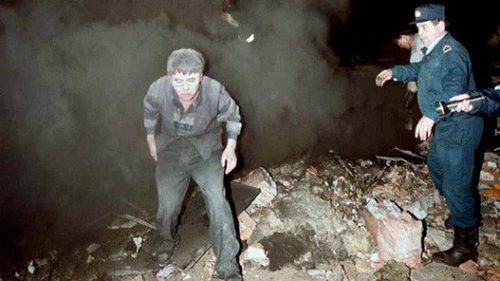
NATO attack on Serbian Radio-television which took 16 lives.
In the early morning hours of April 23, as RTS was airing a taped American interview with President Milosevic and former Pentagon official turned KHOU-TV defence analysts, Ron Hatchett, there was a thunderous explosion as cruise missiles slammed into the building causing a mile-high cloud of dust.
What had been the four-story headquarters of Serbian TV was turned into a 15-foot pile of cement, plastic, iron, and the dead and wounded. Among the dead were two men hanging upside-down from the wreckage. A young woman technician was burned alive in the make-up room.
A young man could only be extracted from the tons of wreckage by amputating both of his legs. He died.
Thirteen other technicians and secretaries working the night shift were killed in their studios and taping rooms, or died in the hospital. At dawn, a group of several hundred Yugoslav citizens stood silently bearing witness in front of the smouldering wreckage, at a loss for words.
Six hours later the U.K. Secretary of State for International Development, Clare Short, said RTS was a “legitimate target” a “propaganda machine” and “causing untold suffering to the people of Kosovo”. In England Tony Blair said the attack was “entirely justified,” ( Serb TV station was a legitimate target, Guardian, 24 April 1999 issue), and went on to assert that television is part of the apparatus which keeps a political leader in power, so camera operators, make-up ladies and janitors are therefore legitimate targets.
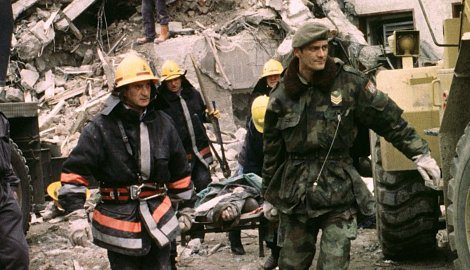
NATO terrorist attack on Radio-television of Serbia, April 1999.
RTS broadcasts had included a patriotic programme, showing Yugoslav soldiers defending their country, President Milosevic meeting Russian envoys and the Kosovo Albanian leader Ibrahim Rugova, and others.
For artistic expression, they showed computer animations of the NATO cross logo turning into a swastika, and Madeleine Albright growing Dracula teeth in front of a burning building.
But the station also broadcast to the world dramatic images of destruction caused by the NATO bombing and gave credible estimates of civilian casualties. RTS scooped the world press when it disclosed that a NATO aircraft had killed scores of Albanian refugees in a bombing attack.
After RTS broadcast the scenes of the civilian carnage, NATO flip-flopped through the next 24-hour news cycle. NATO’s first response was: “We didn’t do it, the Serbs did it.” That changed to “we did bomb the column, but the Serbs killed the refugees.” Again lies.
Finally, NATO accepted fault and apologized. Still, NATO’s glib cockney spokesman, Jamie Shea, pushed the edges of Orwellian doublespeak when he declared that the pilot had “dropped his bombs (on the Albanian column) in good faith.”
Later, NATO played an audio-tape supposedly of the pilot in question. But it turned out that the recorded pilot was involved in a completely different operation. The real tape was withheld.
Contrary to Pentagon reports, NATO programming could be seen on 21st UHF channel throughout the northern Serbia and Belgrade area. Other radio and TV stations which had carried some NATO broadcasts were housed in the Business Centre USCE, which NATO destroyed on April 22.
The content of RTS broadcasts also was more complicated than NATO has asserted.
It’s important to stress that RTS was a center of cultural identity for the Serb nation. With the destruction of RTS headquarters, thousands of tapes and films have now been crushed to rubble, videos that once helped tell the Serbs and their children who they are — and provide some small comfort in their difficult lives.
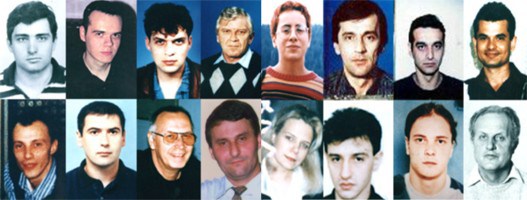
On April 23, 1999, with permission of World leaders, Jelica Munitlak (28) make-up artist, Ksenija Bankovic (28) video mixer, Darko Stiomenovski (26) Technician in exchange, Nebojsa Stojanovic (27) and Branislav Jovanovic (50) TV technicians, Dragorad Dragojevic (27), Dejan Markovic (39) and Milan Joksimovic (47) security guards, Dragan Tasic (31) electrician, Aleksandar Deletic (31) cameraman, Slavisa Stevanovic (32) and Ivan Stukalo (34) technicians, Sinisa Medic (32) Programme designer, Milan Jankovic (59) technician, Tomislav Mitrovic (61)Programme Director and Slobodan Jontic (54) technician have been killed, at 2:06 a.m.
Memory eternal.
source:
http://serbiasos.blogspot.com/2013/04/bombing-of-rts-freedom-of-expression.html
http://inserbia.info/today/2014/04/anniversary-of-nato-bombing-of-the-radio-television-of-serbia/
The Strategy of Controlled Chaos
By Manlio Dinucci | Global Research* | April 18, 2019
Everyone against everyone else – this is the media image of chaos which is spreading across the Southern shores of the Mediterranean, from Libya to Syria. It is a situation before which even Washington seems powerless. But in reality, Washington is not the sorcerer’s apprentice unable to control the forces now in motion. It is the central motor of a strategy – the strategy of chaos – which, by demolishing entire States, is provoking a chain reaction of conflicts which can be used in the manner of the ancient method of “divide and rule”.
Emerging victorious from the Cold War in 1991, the USA self-appointed themselves as “the only State with power, reach, and influence in all dimensions – political, economic and military – which are truly global”, and proposed to “prevent any hostile power from dominating any region – Western Europe, Eastern Asia, the territories of the ex-Soviet Union, and South-Western Asia (the Middle East) – whose resources could be enough to generate a world power”.
Since then, the United States, with NATO under their command, have fragmented or destroyed by war, one by one, the states they considered to represent an obstacle to their plan for world domination – Iraq, Yugoslavia, Afghanistan, Libya, Syria and others – while still others are in their sights (among which are Iran and Venezuela).
In the same strategy came the coup d’État in Ukraine under the direction of the USA and NATO, in order to provoke a new Cold War in Europe intended to isolate Russia and reinforce the influence of the United States in Europe.
While we concentrate politico-media attention on the fighting in Libya, we leave in the shadows the increasingly threatening scenario of NATO’s escalation against Russia. The meeting of the 29 Ministers for Foreign Affairs, convened in Washington on 4 April to celebrate the 70th anniversary of the Alliance, reaffirmed, without any proof, that “Russia violated the FNI Treaty by deploying new missiles with a nuclear capacity in Europe”.
One week later, on 11 April, NATO announced that the “update” of the US Aegis “anti-missile defence system”, based at Deveselu in Romania, would be implemented this summer, assuring that it would “not add any offensive capacity to the system”.
On the contrary, this system, installed in Romania and Poland, as well as on board ships, is able to launch not only interceptor missiles, but also nuclear missiles. Moscow issued a warning – if the USA were to deploy nuclear missiles in Europe, Russia would deploy – on its own territory – similar missiles pointed at European bases.
Consequently, NATO’s spending for « defence » has skyrocketed – the military budgets of European allies and those of Canada will rise to 100 billion dollars in 2020.
The Ministers for Foreign Affairs, united in Washington on 4 April, agreed in particular to “face up to Russia’s aggressive actions in the Black Sea”, by establishing “new measures of support for our close partners, Georgia and Ukraine”.
The following day, dozens of warships and fighter-bombers from the United States, Canada, Greece, Holland, Turkey, Romania and Bulgaria began a NATO aero-naval war exercise in the Black Sea at the limit of Russian territorial waters, using the ports of Odessa (Ukraine) and Poti (Georgia).
Simultaneously, more than 50 fighter-bombers from the United States, Germany, the United Kingdom, France, and Holland, taking off from a Dutch airbase and refuelling in flight, practised “offensive aerial missions of attack against earth-based or sea-based objectives”. Italian Eurofighter fighter-bombers were once again sent by NATO to patrol the Baltic region to counter the “threat” of Russian warplanes.
The situation is increasingly tense and can explode (or be exploded) at any moment, dragging us down into a chaos much worse that of Libya.
Manlio Dinucci is a Research Associate of the Centre for Research on Globalization.
* This article was originally published on Il Manifesto. Translated by Pete Kimberley.
Featured Video

AIDS Inc. by Gary Null (2007)
or go to
Aletho News Archives – Video-Images
From the Archives
Clash of Civilization, Iran Part II
By Jamal Kanj – Intifada-Palestine.com – January 14, 2011
Israel’s survival kit is: perpetuate conflict, insecurity to rationalize collective hate and finally playing victim.
Devoid of conflict, Israel implodes internally; without hate, Zionism loses its justification; and playing eternal victim to continue blackmailing the West. Absence of this holy trinity, Israel ceases to exist.
From its inception, the house of Zion has mastered exploiting adversarial powers to advance Israel’s cause. For instance, their influence over the Democratic Party in the US began with President Truman’s bid for 2nd term election in 1948.
Responding to strong opposition from Secretary of State General George Marshall and Department experts urging against recognition of Israel, President Truman replied: “I’m sorry gentlemen but I have to answer to hundreds of thousands [Jewish voters] who are anxious for the success of Zionism. I do not have hundreds of thousands of [voting] Arabs among my constituents”
Zionists influence over liberal American politics was matched with the doctrinal school of Conservative theoreticians aligning the Republican Party’s platform with Israel’s objectives. The Neoconservative Zionists, coined Zioncons, invented the “Clash of Civilization” concept to fight Israel’s wars. … continue
Blog Roll
 Aletho News
- Merck Virologists Admitted to Falsely Certifying Vaccine Efficacy
- Mandatory Folic Acid for every man, woman & child
- Pro-Palestine protesters arrested outside UK’s ruling Labour Conference in Liverpool
- Mauritius denies landing permit to flight from Israel, forcing cancellation: Tour operator
- Israeli finance minister calls for genocidal war on West Bank, annexation of south Lebanon
- 12 Things Your Psychiatrist Was Trained Not to Tell You
- From Unipolar Universalism to Multipolar Civilizational Distinctiveness
- RSF military group defects, joins Sudanese army: State media
- Ireland goalkeeper refuses to play ‘Israel’ as squad weighs boycott
- China pushes back against US on Cuba, Iran
- If Americans Knew
- Israel forces Gazans to live in constant peril – Daily Update
- Deconstructing Netanyahu’s pants-on-fire UN rant – Daily Update
- Trump betrayed voters with his campaign lies and prioritized a foreign country once he took office
- Netanyahu calls Israel’s war in Gaza ‘opposite of genocide’ in UN speech to near-empty hall
- Settler Kidnappings: Torture, Sexual Abuse and Terrorisation of Palestinian Abductees as Israel Deepens Annexation of West Bank
- Gaza winter nears as 162,000 tents become unusable, raising fears of humanitarian crisis
- Netanyahu says, “It’s the opposite of genocide”; UN says Gaza economy is world’s ‘most severe crisis on record’ – Daily Update
- Israel’s US-Backed Assault on Gaza Has Created the ‘World’s Most Severe Economic Crisis on Record’: UN
- ‘Protecting U.S. Citizens’… From Israel
- ‘This is where I live now, the back of a truck’: a day in the life of a grandmother in Gaza
- No Tricks Zone
- New Study: Earth And Venus Surface Warmth Largely Explained By Convection And Lapse Rate, Not CO2 Or Radiation
- 2025 Nature Paper Claiming Worsening Global Drought Gets RETRACTED …Heavily Flawed
- New Study: ‘Global Drought Shows No Detectable Recent Acceleration Under Climate Warming’
- Economic Masterminds: German Socialists Suggest Taxing Productivity Gains Stemming From Using AI
- The South China Sea Has Not Been Cooperating With The Climate Change Narrative
- Energy Crisis: Germany Enters Heating Season With Historically Low Gas Reserve Fill Levels
- New Study: The Antarctic Ice Sheet Gained Mass From 2020-2024 Due To Staggering Snow And Ice Accumulation
- Study: Ocean Heating Rates From Thousands Of Years Ago ‘Dwarf’ Modern Ocean Heating Rates
- Climate Extremists Target, Attack Large-Scale Power Grid Infrastructure In Germany!
- New Study: Antarctic Ice Melt Has Contributed Less Than 1 Centimeter To Sea Level Rise In The Last 30 Years

