US anti-tank missiles found at former Al-Nusra facility in Syria – Russian MoD
RT | May 21, 2018
US-made TOW anti-tank missiles, along with other weapons, have been found in facilities once controlled by Al-Nusra militants in Syria’s Homs province, the Russian Defense Ministry said.
The trove was located in a former observation point of the Al-Nusra Front terrorist group in the liberated Zaafaran settlement in Homs province, the Russian Center for Reconciliation in Syria said on Monday. “[We] can see here a large number of gas masks, weapons produced abroad, for example, TOW-2 anti-tank guided missiles. The facilities are very well-equipped,” Andrey Nekipelov, an official at the center, stated.
The BGM-71 TOW (Tube-launched, Optically tracked, Wire-guided) is one of the most widely used anti-tank missiles, which has been produced in the US since the 1970s. The missile has an operational range of more than 3,000 meters and an armor penetration of up to 800 millimeters, depending on the model. The TOW-2 referred to by the Russian MoD is an advanced and upgraded version of the missile.
Hundreds of the missiles have fallen into the hands of various rebel factions during the Syrian conflict. The US-made TOW was reportedly used in an attack on an RT crew in Syria back in 2015.
In 2016, another video published by a Syrian rebel group showed what appeared to be a direct hit by a US-made BGM-71 TOW on the turret of a Russian-supplied T-90 tank of the Syrian Army. A TOW usually devastates its target after a direct hit, causing ammo to explode and killing the crew. The alleged T-90, however, seemed to have been saved by its reactive armor.
TOW was reportedly deployed in the Vietnam War in 1970s, as well as in Afghanistan, Iraq, and a number of other conflict zones where Washington has been engaged in recent decades. Syria has become one of the recent locations where anti-tank missiles were spotted.
Speaking to RT back in 2016, German journalist Jurgen Todenhofer suggested that the US knows that the weapons it delivers to rebels end up with terrorists. “Everybody knows that they are using allies and they are allowing allies… It doesn’t matter if a TOW rocket or a TOW missile, which is an American missile, comes [to terrorists] from another group,” he said at the time. – Video
Spend on schools or bow to US demands? German politicians debate NATO strategy
RT | May 19, 2018
US President Donald Trump has accused Germany of not contributing enough to the NATO budget – but will German Chancellor Angela Merkel dance to Washington’s tune?
Politicians on both sides of Germany’s political spectrum shared their views with RT.
On Thursday, Trump warned NATO members that they will be “dealt with” if they fail to fulfill their financial obligations to the US-led military alliance. Germany was singled out as one of those said to be delinquent on their obligations.
Speaking to RT, Martin Dolzer of Die Linke (Left Party) said that buying into Trump’s ideas may send the world order “into chaos,” citing US policy in the Middle East as evidence. Dolzer stressed that Germans do not want war, and said that more vital issues should be on agenda instead of boosting military spending.
“The German population does not want any more military expenses, the German population needs money for kindergartens, for education, for the growth of civil society organizations and the social sector,” Dolzer said. “There has to be a change. And the people in Germany, I think most of them want this change, but the government does not follow it.”
Though Merkel has shown no interest to raising defense spending, Alternative for Germany (AfD) chief whip Hansjorg Mueller believes she is poised to “bend down before the wish of the big brother” – a reference to Trump and the US.
“Our government is the government of a vassal state and governments of vassal states always obey to the wish of the big brother,” Mueller said.
Mueller believes a rise in defense spending would only further split German society, which is already divided over the chancellor’s immigration policy, and significantly weaken Merkel’s position. “We are viewing the doom of her leadership over Germany,” he told RT.
Apart from its reluctance in meeting Washington’s demands, Berlin is also at odds with its ally over the Nord Stream 2 gas pipeline from Russia to Germany. The US is opposed to the project and signaled that it might be targeted by sanctions. The measures could also affect German companies.
The situation with the project is “pure blackmail,” said Mueller, adding that he hopes Merkel does not give in the “dead-end game.”
Meanwhile, Dolzer believes the pipeline is necessary for stability. “If we want to have stable organization of the industry this is very, very necessary to build this Nord Stream pipeline and to not follow the sanctions,” Dolzer said, adding that the US government must be reminded that it cannot act like “a monopoly power” around the globe.
With Iran sanctions Trump made Europeans look like the fools they are
By John Laughland | RT | May 18, 2018
The attacks by European leaders against US President Donald Trump are getting sharper by the day.
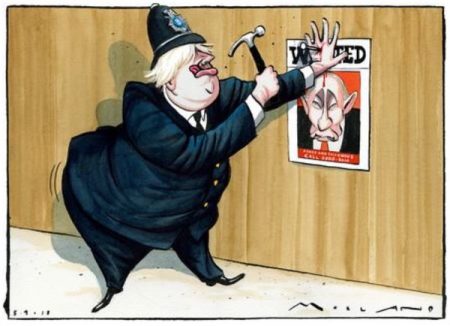
On the day Trump announced that he was ripping up the Iran deal, and that the US would impose sanctions on European companies trading with that country, the French finance minister Bruno Le Maire said that European states refused to be treated like “vassals” of the US.
At Aachen on 11 May, Emmanuel Macron effectively accused the US of blackmail. On 17 May, the president of the European Council, Donald Tusk, asked, “With friends like that (i.e. Trump), who needs enemies?”
The temperature only rose further when the French energy giant Total announced that it would pull out of a multi-billion dollar gas deal with Iran unless European diplomacy succeeds in obtaining a specific waiver from US sanctions. Other European behemoths including Allianz and Siemens have also announced either that they will wind down operations in Iran or that they will not start any new ones.
These statements show that Trump’s decision is a slap in the face for the EU politically, economically and – perhaps above all – ideologically. Politically, because both Emmanuel Macron and Angela Merkel made special trips to Washington to plead with Trump, to no avail whatever. Moreover, the EU is itself a signatory to the Iran deal, which it regards as a major diplomatic triumph from which it draws credibility: its disavowal by Trump is a deep insult to the diplomatic status of the EU as such.
Economically, because of the gigantic contracts which European companies could lose. For years, following the nearly $9 billion fine imposed by the US on Paribas in 2015, European companies and banks have been terrified of engaging in any business activity likely to attract the ire of the Americans. Deals with Russia, for instance, are shunned. The effect of this latest decision could be like many Paribas situations at once.
Ideologically, because the EU draws its entire legitimacy from the belief that by pooling sovereignty and by merging its states into one entity, it has advanced beyond the age when international relations were decided by force. It believes that it embodies instead a new international system based on rules and agreements, and that any other system leads to war. It is impossible to exaggerate the importance of this belief for European leaders; yet Donald Trump has just driven a coach and horses through it.
The angry statements by European leaders might lead one to think that we are on the cusp of a major reappraisal of trans-Atlantic relations. However, the reality is that the EU and its leaders have painted themselves into a corner from which it will be very difficult, perhaps impossible, to extricate themselves.
First, the links between the EU and the US are not only very long-standing, they are also set in stone. NATO and the EU are in reality Siamese twins, two bodies born at the same time which are joined at the hip. The first European community was created with overt and covert US support in 1950 in order to militarize Western Europe and to prepare it to fight a land war against the Soviet Union; NATO acquired its integrated command structure a few months later and its Supreme Commander is always an American.
Today the two organizations are legally inseparable because the consolidated Treaty on European Union, in the form adopted at Lisbon in 2009, states that EU foreign policy “shall respect” the obligations of NATO member states and that it shall “be compatible” with NATO policy. In other words, the constitutional charter of the EU subordinates it to NATO, which the USA dominates legally and structurally. In such circumstances, European states can only liberate themselves from US hegemony, as Donald Tusk said they should, by leaving the EU. It is obvious that they are not prepared to do that.
Second, EU leaders have burned their own bridges with other potential partners, especially Russia. Angela Merkel traveled to Russia on Friday but only a few weeks ago more than half of the EU member states expelled scores of Russian diplomats and encouraged non-EU European states like Ukraine and Montenegro to do the same, in retaliation for the poisoning in Salisbury of Sergei and Julia Skripal.
How is Mrs Merkel going to convince Mr Putin to join her in keeping Iran’s nuclear program under control if she officially thinks that Mr Putin is guilty of secretly stockpiling and using chemical weapons for assassinations in the West? Only a few weeks later, in mid-April, Britain and France, together with the US, attacked Syria on the basis that its army had used chemical weapons at Douma with Russian backing. If they try to turn on the charm now in Sochi or in Moscow, do they really expect the Russians can take them seriously?
Third, how can EU leaders complain about US sanctions against their companies when they themselves have applied sanctions against Russian companies causing major economic disruptions in that country? EU states have also introduced punitive sanctions against Syria since 2011, one of the biggest programs of sanctions ever, whose effect and purpose is to disrupt the activities of the Syrian state including its ability to provide public goods like health.
Britain and France, who are, with Germany, the European signatories of the Iran deal, have been pursuing regime change in Syria for half a decade. By what right do they protest now that the US administration is taking decisions whose goal is to provoke regime change in Iran?
As if these external issues were not bad enough, the EU is currently riven by internal divisions too. Donald Tusk may say “Europe must be united economically, politically and also militarily like never before … either we are together or we are not at all” but Europe is indeed not “together” at all. The Brussels commission is hounding Poland and Hungary on what are clearly internal political matters beyond the Commission’s remit; the EU is about to lose one of its most important member states; and a new government is going to take power in Rome whose economic policies (a flat tax at 15%) will blow the eurozone’s borrowing rules out of the water and perhaps cause Italy to leave the euro.
The Italian 5-Star / League government also wants an end to the EU sanctions against Russia; these are voted by a unanimity which, although fragile, has held until now but which, if the new power in Rome keeps its word, will shortly collapse. In other words, what Trump has done is to make the Europeans look like the fools they are. In circumstances in which the EU has placed all its eggs in one basket, a basket which Trump has now overturned, it will be impossible for it to come together. On the contrary, it is falling apart.
John Laughland, who has a doctorate in philosophy from the University of Oxford and who has taught at universities in Paris and Rome, is a historian and specialist in international affairs.
Washington and NATO Are Escalating to Conflict
By Brian CLOUGHLEY | Strategic Culture Foundation | 16.05.2018
The Trump Administration in Washington is ramping up confrontation and preparing for war all over the globe, from the South China Sea to the Baltic via the Persian Gulf. The countries of the US-NATO military alliance have vastly increased their military spending and are boosting deployment of their forces in Europe in accordance with the policy of Enhanced Forward Presence — the positioning of strike aircraft, missile-armed ships and armoured formations as close as possible to Russia’s border.
In March 2018 NATO’s Deputy Secretary General, former US Under Secretary of State Rose Gottemoeller, spoke to the media at Warsaw’s military airport and was effusive about the forward movement of US-NATO troops. She “wanted to say what an honour it was to visit the battlegroup that is deployed here in Poland today… I have had the opportunity… over the past few months to visit all four of the battlegroups, and I can see that that promise made among all Allies in Warsaw in 2016 has resulted in certified, effective battlegroups that are training every single day of the week, to provide for the deterrence and defence of this Alliance. So I was very proud to be here.”
It is hugely expensive to move and maintain military forces in foreign countries and the Stockholm International Peace Research Institute (SIPRI) records that in 2016 “NATO’s collective military expenditure rose to $881 billion” while “European NATO members spent $254 billion in 2016 — over 3 times more than Russia.”
Russia’s $69.2 billion defence outlay in 2016 was one twelfth of US-NATO’s spending on armaments and preparations for war.
In January 2018 the US Department of Defence published its National Defence Strategy which conveyed the message that “the central challenge to US prosperity and security is re-emergence of long-term strategic competition” from Russia and China who are “revisionist powers” and a “growing threat” requiring a vast surge in US military expenditure. The Pentagon’s Mission involves “restoring America’s competitive military advantage to deter Russia and China from challenging the United States, its allies or seeking to overturn the international order that has served so well since the end of World War II.”
That is the US-enforced “international order” that involved its disastrous war in Vietnam, the invasion of Iraq that propelled the Middle East to its current state of chaos, and a continuing, sixteen-year catastrophe in Afghanistan, all of which military forays by the global gendarme caused massive destruction and the deaths of uncountable numbers of innocent citizens.
And now the US has some 1.3 million people in the army, navy, air force and Marine Corps, with about 200,000 stationed in over 800 overseas military bases, in order to continue enforcement of “international order.”
The Nuclear Posture Review that was published on February 2, 2018, just after the defence strategy paper (January 19) also makes it clear who the Pentagon considers to be its enemies, mentioning China 47 times, Iran 39 times and Russia 127 times, which makes nonsense of the claim by the State Department that “we do not want to consider Russia an adversary . . . This not a Russia-centric NPR.”
Trump’s “America First” policy has alienated longtime US allies and increased distrust by the many countries being confronted militarily. The irony about this drum-thumping slogan is the US claim that “It is increasingly clear that China and Russia want to shape a world consistent with their authoritarian model, gaining veto authority over other nations’ economic, diplomatic, and security decisions,” because this is precisely what “America First” is about : military domination and total ascendancy over the economies of the entire world.
A further irony became apparent just two months after notification of the Nuclear Posture and the equally confrontational National Defence Strategy, when SIPRI published its statistics concerning international military expenditure. There was extensive cover of most of its findings in the Western media, but strangely enough little mention was made of the fact that “at $66.3 billion, Russia’s military spending in 2017 was 20 per cent lower than in 2016.”
SIPRI reported that in the year in which Russia reduced its defence expenditure by twenty per cent, “military spending in both Central and Western Europe increased by 12 and 1.7 per cent, respectively . . . total military spending by all 29 NATO members was $900 billion in 2017, accounting for 52 per cent of world spending.”
SIPRI further noted that “The United States continues to have the highest military expenditure in the world. In 2017 the USA spent more on its military than the next seven highest-spending countries combined.”
The Western media’s reporting of President Putin’s speech to Russia’s Federal Assembly on March 1 was intriguing. It concentrated almost entirely on Russia’s weapons’ developments, with the New York Times, for example, reporting that the President “used the speech to reassure Russians that the military buildup was taking place.” The 1,500 words of that report were almost entirely devoted to his description of Russian weapons designed to deter US-NATO adventurism, and a mere 65 covered the social improvement programmes he described.
In outlining his priorities the President declared that “the main, key development factor is the well-being of the people and the prosperity of Russian families. Let me remind you that in 2000, 42 million people lived below the poverty line, which amounted to nearly 30 percent – 29 percent of the population. In 2012, this indicator fell to 10 percent. Poverty has increased slightly against the backdrop of the economic crisis. Today, 20 million Russian nationals live in poverty. Of course, this is much fewer than the 42 million people in 2000, but it is still way too many.”
Of course Russia wants to improve the lives of its citizens, and intends to do this, no matter the military buildup round its borders. But it isn’t going to stand back and do nothing while the US-NATO military bloc expands and accelerates towards conflict. Certainly there has been a massive reduction in Russia’s defence budget, while the US and the rest of NATO are vastly increasing military expenditure, but it remains necessary for Russia to maintain its defence capabilities to counter the provocations of the US-NATO’s Enhanced Forward Presence menacing its borders.
As noted by the US independent platform Veterans Today, President Putin stated that “American submarines are on permanent alert off the Norwegian coast; they are equipped with missiles that can reach Moscow in 17 minutes. But we dismantled all of our bases in Cuba a long time ago, even the non-strategic ones. And you would call us aggressive?”
Yes, they do, in spite of all the aggression being displayed by US-NATO military deployments and manoeuvres in eastern Europe.
For example, Exercise Siil 2018 was held in Estonia from 2-13 May 2018, involving over 15,000 troops from 10 NATO countries — the UK, US, Belgium, Canada, Denmark, France, Germany, Latvia, Lithuania and Poland — and the five supposedly neutral countries of Finland, Georgia, Ireland, Sweden and Ukraine.
There could not be a plainer signal that the Pentagon and its sub-branch in Brussels are escalating to conflict.
Iran Deal Abandoned, INF Next. US Steadily Dismantling Arms Control
By Alex GORKA | Strategic Culture Foundation | 16.05.2018
The US has just pulled out of the Iran deal. The INF Treaty is next. The campaign to render defunct yet another major arms-control agreement is already gaining momentum. On May 10, the House Armed Services Committee endorsed a measure authorizing President Donald Trump to decide the fate of the INF Treaty with Russia. This addition to a draft defense bill states that the agreement is no longer binding. The bill includes funds for developing a ground-launched cruise missile (GLCM), which, if tested, will violate the treaty terms.
The US has accused Russia of noncompliance but has never publicly provided any evidence to back up its claim. The alleged violations are used to justify the hawks’ newest favorite thing — low–yield nuclear munitions installed on SLBMs and sea-based long-range cruise missiles. And this isn’t just an empty wish or fantasy but an actual recommendation from the 2018 Nuclear Posture Review. Actually, the idea to abandon the treaty is not new; that’s something that’s been floated for some time, pushing that landmark agreement toward the brink of oblivion.
The plan for a nuclear-tipped cruise missile is another example of how the US is chipping away at the arms-control regime — the Presidential Nuclear Initiatives (PNI). These initiatives are not agreements, but rather commitments that have done much to deter the potential threat of sea-based tactical nuclear weapons, including intermediate-range cruise missiles. The initiatives have been more efficient and more important than any of the agreements that have been approved or ratified by parliaments. Once they have been unraveled, the genie will be out of the bottle, triggering an unprecedented arms race.
It won’t exactly make the US safer if Russia puts nuclear warheads on its technologically advanced Kalibr naval missiles. So why provoke it? The PNIs have been a success story, a good example of what can be achieved if both sides want it. But no, Gen. John Hyten, commander of U.S. Strategic Command, “strongly agrees” that the Pentagon should procure the above-mentioned weapons, including the sea-based cruise missile.
A low-yield warhead on an SLBM may not be strategic but since there is no way to know, any launch would probably trigger a response from the entire Russian nuclear arsenal, sending them hurtling toward US shores. Such a warhead would be a very destabilizing weapon, especially given the overall superiority of US and NATO conventional forces. There is no reasonable explanation why the US would need non-strategic munitions installed on strategic delivery vehicles, when it has air-based tactical nuclear weapons already in its Air Force inventory? It has “mothers” and “fathers” of all bombs, bunker busters, and other conventional weapons that are able to work wonders, so why should it use a nuclear weapon, low-yield or high-yield, when the same missions can be carried out without any nukes at all?
Another angle worth mentioning here is that the desire for low-yield weapons reflects the US readiness to use nukes against non-nuclear adversaries. Just imagine how irresistibly tempting it might be to strike Iran’s key infrastructure sites with low-yield munitions! And what if N. Korea becomes a problem again?
According to Gen. Robert Brown, commander of the US Army Pacific, the American military needs ground-based missiles with a range of over 500 km, the range prohibited by the bilateral agreement. “I know there’s the INF Treaty … but we need to push beyond that,” he says. “The INF Treaty today unfairly puts the United States at a disadvantage and places our forces at risk because China is not a signatory,” claims Admiral Phil Davidson, the incoming commander of Pacific Command. “Deploying conventionally-armed ground-launched intermediate-range missiles may be key to reasserting US military superiority in East Asia,” emphasizes Eric Sayers, a CSIS expert.
The Army is working on long-range artillery rockets that can exceed the 500 km range. This weapon could be easily stationed in Europe. There would be no way to know whether or not it is nuclear or the extent of its operational range. If a projectile does not fall into the category of intermediate missiles, it is not covered by any treaty, but the effect is the same as if a medium-range missile were fired.
Actually, the INF Treaty is being violated right now in broad daylight. There is no need to declassify any hush-hush information to prove it. The Aegis Ashore Mk-41 launchers, which have already been installed in Romania and are soon to be deployed in Poland (2020), are also being used by the Navy to fire intermediate-range weapons as well as air-to-surface interceptors. This is an undeniable fact. The discussions that have been held under the auspices of the INF Treaty’s Special Verification Commission have not led anywhere.
If the INF Treaty is no longer binding, Russia would be free to deploy intermediate-range missiles to compensate for the West’s superiority in other weapons. The Iskander-M launchers can be used for firing intermediate-range missiles. This will include targets in Europe, although the US will be out of their range. This could lead to another rift among the allies at a time when that relationship is at a nadir because of trade wars and the rift over the Iran deal.
Finally, the unraveling of the INF Treaty will greatly complicate if not eliminate, any prospects, for the New START. And without the latter, there will be no agreement to curb the arms race at all. Arms control will be dead. We’ll be back to where we were in the late 1950s-early 60s. And if a spark should kindle a fire, we’ll all find ourselves back in the Stone Age.
US, Sweden and Finland Boost Military Cooperation to Form New Alliance
By Alex GORKA | Strategic Culture Foundation | 14.05.2018
The US, Swedish, and Finnish defense ministers signed a trilateral Statement of Intent (SOI) to expand defense cooperation on all fronts. The signing ceremony took place in Washington on May 8. In 2016, the two Scandinavian nations finalized separate defense SOIs with America. Now they have signed a joint document to unify those previous agreements and enhance their interoperability.
The Scandinavian visitors claimed this was just a starting point for a more mature relationship. The agreement emphasizes the countries’ combined joint exercises and streamlines the procedures that have been established to manage them.
Other issues covered by the SOI include regular trilateral meetings at all levels, the exchange of information (including about weapons systems), increased practical interaction, cooperation in multinational operations, improved communications, and the promotion of the EU-NATO strategic partnership. The latter issue will transform the Scandinavians into a connecting link that will eliminate the chance of any European deterrent that could operate with any real independence from its North American “big brother.” Washington wants to make sure that the PESCO agreement will not protect Europe’s defense industry from US companies.
Sweden hosted the Aurora military exercise in September 2017, the largest such event on its soil. The US supplied most of the visiting troops. The American military has also taken part in a number of drills in Finland recently. That country will host a large-scale NATO exercise as early as 2020 or 2021. The US has already been invited. The militarization of the Scandinavian Peninsula is moving full speed ahead.
The recently signed SOI actually transforms the bilateral agreements into enhanced trilateral cooperation. For Stockholm and Helsinki, joining NATO is not an option for domestic political reasons. At least not for now. Instead, a new US-led defense alliance has emerged.
The increased tempo of exercises anticipates a larger US presence. It has far-reaching implications. With American military personnel rotating in and out of Sweden and Finland, any offensive action against one of those states would officially be an attack on a NATO member. It would trigger a response as envisaged by Article 5 of the Washington Treaty. Russia considers any American military presence there as provocative. The US is not a Scandinavian country. If an incident took place that resulted in a clash between Russian and US forces, the two Scandinavian nations would be pulled against their will into a conflict they may have nothing to do with. The American soldiers on their soil will never be under the control of their national commands. More US presence means less sovereignty and more risk.
Actually, since they are EU members they don’t even need Article 5, because Article 42.7 of the EU treaty also contains a binding mutual-assistance clause. France invoked it after the 2015 Paris terror attacks.
Last year Sweden and Finland joined the UK-led Joint Expeditionary Force (JEF). All other participants in the nine-nation formation are NATO members. It means that in an emergency their armed forces will operate under NATO command, becoming parties to a conflict they could avoid if they were really neutral. The two also cooperate with Washington through the Northern Group (NG), which consists of 12 countries, although Sweden and Finland are the only non-NATO participants. That organization holds its own dialog with the US. Another venue is the five-nation Nordic Countries group, that includes these two non-aligned members.
In reality, Sweden and Finland have already joined NATO through other groups and agreements. They did so informally, avoiding referendums and the relevant parliamentary procedures at home. This should be viewed as part of a broader picture. In early April, the first-ever US-Baltic States summit took place in Washington. It was an unprecedented event that somehow was kept out of the media spotlight.
The leaders of NATO’s “frontline states” called for a permanent US military presence in the region. They want that to be much larger than just American participation in multinational battalions. They are asking for a permanent presence on a much wider scale. Washington, which already has forces deployed in Norway and Poland, is considering rotating American troops through the Baltic nations as well. Poland and the Baltic states are a focus of NATO’S bellicose preparations. One might as well forget about the 1997 Russia-NATO Founding Act (1997), which states that no substantial forces should be deployed in the proximity of the borders. That document has already been breached by NATO.
The US guests have provided advice on how to promote American influence (they call it “democracy”) in Georgia, Moldova, and Ukraine, the members of a newly formed anti-Russian alliance. And it’s not just the defense sector. Last year, Lithuania began importing liquefied natural gas (LNG) from America. Poland has also built an LNG terminal to expand the shipments of American gas to Europe, which compete with Russia’s energy supplies.
The withdrawal from the Iran deal is not the only time a US position on an issue has been opposed by the leading European nations. There are many more points of disagreement. Old Europe is gradually creating an independent deterrent. A rift between the EU and the US is deepening. But as one can see, Washington is building another pro-American alliance on the continent. It does not mean it will replace the North Atlantic alliance. Certainly not. On the contrary, it will strengthen the US position in the bloc.
But aside from NATO, Washington also leads an informal alliance of “frontline states” that are intimidated by a nonexistent threat. The idea of the Russia bogeyman is being exploited by the US in order to reach its foreign-policy goals. Northern Europe is being turned into a hornet’s nest, with its good-neighbor policy gradually being replaced with confrontation that benefits the US but makes the region less secure.
Atlantic Council Explains Why We Need to Be Propagandized for Our Own Good
By Caitlin JOHNSTONE | Rogue Journalist | May 4, 2018
I sometimes try to get establishment loyalists to explain to me exactly why we’re all meant to be terrified of this “Russian propaganda” thing they keep carrying on about. What is the threat, specifically? That it makes the public less willing to go to war with Russia and its allies? That it makes us less trusting of lying, torturing, coup-staging intelligence agencies? Does accidentally catching a glimpse of that green RT logo turn you to stone like Medusa, or melt your face like in Raiders of the Lost Ark ?

“Well, it makes us lose trust in our institutions,” is the most common reply.
Okay. So? Where’s the threat there? We know for a fact that we’ve been lied to by those institutions. Iraq isn’t just something we imagined. We should be skeptical of claims made by western governments, intelligence agencies and mass media. How specifically is that skepticism dangerous?
Trying to get answers to such questions from rank-and-file empire loyalists is like pulling teeth, and they are equally lacking in the mass media who are constantly sounding the alarm about Russian propaganda. All I see are stories about Russia funding environmentalists (the horror!), giving a voice to civil rights activists (oh noes!), and retweeting articles supportive of Jeremy Corbyn (think of the children!). At its very most dramatic, this horrifying, dangerous epidemic of Russian propaganda is telling westerners to be skeptical of what they’re being told about the Skripal poisoning and the alleged Douma gas attack, both of which do happen to have some very significant causes for skepticism.
When you try to get down to the brass tacks of the actual argument being made and demand specific details about the specific threats we’re meant to be worried about, there aren’t any to be found. Nobody’s been able to tell me what specifically is so dangerous about westerners being exposed to the Russian side of international debates, or of Russians giving a platform to one or both sides of an American domestic debate. Even if every single one of the allegations about Russian bots and disinformation are true (and they aren’t), where is the actual clear and present danger? No one can say.
No one, that is, except the Atlantic Council.
In an absolutely jaw-dropping article that you should definitely read in its entirety, Elizabeth Braw took it upon herself to finally answer the question of why Russian propaganda is so dangerous, using the following hypothetical scenario:
What if Russia suddenly announced that its Baltic Fleet had dispatched an armada towards Britain? Would most people greet the news with steely resolve in the knowledge that their governments would know what to do, or would constant Kremlin-influenced reports about the incompetence of British institutions make them conclude that any resistance was pointless?
I mean, wow. Wow! Just wow. Where to even begin with this?
Before I continue, I should note that Braw is a Senior Fellow at the Atlantic Council, the shady NATO-aligned think tank with ties to powerful oligarchs whose name comes up when you look into many of the mainstream anti-Russia narratives, from the DNC hack to the discredited war propaganda firm Bellingcat to Russian trolls to the notorious PropOrNot blacklist publicized by the Washington Post. Her article, published by Defense One, is titled “We Need a NATO for Infowar”, and it argues that westerners need to be propagandized by an alliance of western governments for our own good.
Back to the aforementioned excerpt. Braw claims that if Russian propaganda isn’t shut down or counteracted, Russia could send a fleet of war ships to attack Britain, and the British people would… react unenthusiastically? Wouldn’t cheer loudly enough as the British Navy fought the Russians? Would have a defeatist emotional demeanor? What exactly is the argument here?
That’s seriously her only attempt to directly address the question of where the actual danger is. Even in the most cartoonishly dramatic hypothetical scenario this Atlantic Council member can possibly imagine, there’s still no tangible threat of any kind. Even if Russia was directly attacking the United Kingdom at home, and Russian propaganda had somehow magically dominated all British airwaves and been believed by the entire country, that still wouldn’t have any impact on the British military’s ability to fight a naval battle. There’s literally no extent to which you can inflate this “Russian propaganda” hysteria to turn it into a possible threat to actual people in real life.
It gets better. Check out this excerpt:
Such responses to disinformation are like swatting flies: time-consuming and ineffective. But not addressing disinformation is ineffective, too. “Western media still have this thing where they try to be completely balanced, so they’ll say, ‘the Russians say this, but on the other hand the Americans say this is not true,’ They end up giving a lie and the truth the same value,” noted Toomas Hendrik Ilves, the former president of Estonia.
I just have so many questions. Like, how desperate does a writer have to be for an expert who can lend credibility to their argument that they have to reach all the way over to a former president of Estonia? And on what planet are these people living where Russian narratives are given the same weight as western narratives by western mainstream media? How can I get to this fantastical parallel dimension where western media “try to be completely balanced” and give equal coverage to all perspectives?
Braw argues that, because Russian propaganda is so dangerous (what with the threat of British people having insufficient emotional exuberance during a possible naval battle and all), what is required is a “NATO of infowar”, an alliance of western state media that is tasked with combatting Russian counter-narratives. Because, in the strange Dungeons & Dragons fantasy fairy world in which Braw penned her article, this isn’t already happening.
And of course, here in the real world, it is already happening. As I wrote recently, mainstream media outlets have been going out of their minds churning out attack editorials on anyone who questions the establishment narrative about what happened in Douma. A BBC reporter recently admonished a retired British naval officer for voicing skepticism of what we’re being told about Syria on the grounds that it might “muddy the waters” of the “information war” that is being fought against Russia. All day, every day, western mass media are pummeling the public with stories about how awful and scary Russians are and how everything they say is a lie.
This is because western mass media outlets are owned by western plutocrats, and those plutocrats have built their empires upon a status quo that they have a vested interest in preserving, often to the point where they will form alliances with defense and intelligence agencies to do so. They hire executives and editors who subscribe to a pro-establishment worldview, who in turn hire journalists who subscribe to a pro-establishment worldview, and in that way they ensure that all plutocrat-owned media outlets are advancing pro-plutocrat agendas.
The western empire is ruled by a loose transnational alliance of plutocrats and secretive government agencies. That loose alliance is your real government, and that government has the largest state media network in the history of civilization. The mass media propaganda machine of the western empire makes RT look like your grandmother’s Facebook wall.
In that way, we are being propagandized constantly by the people who really rule us. All this panic about Russian propaganda doesn’t exist because our dear leaders have a problem with propaganda, it exists because they believe only they should be allowed to propagandize us.
And, unlike Russian propaganda, western establishment propaganda actually does pose a direct threat to us. By using mass media to manipulate the ways we think and vote, our true rulers can persuade us to consent to crushing austerity measures and political impotence while the oligarchs grow richer and medicine money is spent on bombs. When we should all be revolting against an oppressive Orwellian oligarchy, we are instead lulled to sleep by those same oligarchs and their hired talking heads lying to us about freedom and democracy.

Russian propaganda is not dangerous. Having access to other ways of looking at global geopolitics is not dangerous. What absolutely is dangerous is a vast empire concerning itself with the information and ideas that its citizenry have access to. Get your rapey, manipulative fingers out of our minds, please.
If our dear leaders are so worried about our losing faith in our institutions, they shouldn’t be concerning themselves with manipulating us into trusting them, they should be making those institutions more trustworthy.
Don’t manipulate better, be better. The fact that an influential think tank is now openly advocating the former over the latter should concern us all.
A Furtive Glance at the US’s Ongoing War Preparations Against Russia
By Arkady SAVITSKY | Strategic Culture Foundation | 24.04.2018
While the world’s attention is riveted on Syria, the US is significantly boosting its forces in Europe. And these are not just divisions streaming in to take part in some exercises that will leave once those are over. This is a serious buildup to create a potentially offensive posture. The beefing up of the US forces is taking place amid preparations for a Russia-US summit. That’s a rather peculiar background for the event, to put it mildly!
The 4th Combat Aviation Brigade and the 4th Infantry Division will deploy to Europe as part of its Operation Atlantic Resolve. Based in Germany, the forces will participate in multiple exercises, most of which will be held very near the Russian border in Poland, Hungary, Romania, and the Baltic States. The Army is considering deploying an entire division in a Reforger type of exercise, with troops coming over to use the pre-positioned hardware. Those forces could potentially see a surge, with a division-level deployment in late 2018 or 2019.
The plans include the creation of a rear-area operations command to be hosted by Germany. Another command is planned that will ensure mobility in the North Atlantic shipping lanes. A “military Schengen” to allow easy movement across borders is under consideration. NATO is rotating four battalion-size, combat-ready, air-power-supported battle groups throughout Poland — which is hosting 800 American troops — and the Baltic States.
In February, the US Army held the largest artillery exercise in Europe since the Cold War. The event was dubbed Dynamic Front 18 and involved seven rocket-launching systems, 94 artillery pieces, including eight German Panzerhaubitze 2000 armored howitzers, 14 British L118 light guns, and 18 US M777 155 mm howitzers.
The US military command is weighing the option of keeping the USS Harry S. Truman carrier strike group in the Mediterranean, the European command’s area of responsibility, instead of deploying it to the Middle East, which is under the control of Central Command. The group left Norfolk on April 11. This move would be intended to “check Russia,” freeing other American naval assets to carry out missions in the Baltic and the Black Sea. Defense Secretary Jim Mattis told the House Armed Services Committee on April 12 that he was studying the possibility of shaking up his department’s employment of carrier groups. The rotational deployments have been increased from the traditional six to ten months. A large number of US ships are concentrated in the vicinity of Syria.
Poland will host Anakonda 2018, the largest ever NATO military exercise, the scale of which is truly exceptional this year. It will involve about 100,000 troops, 5,000 vehicles, 150 aircraft, and 45 warships. The event was much smaller two years ago. The scenario is based on the premise of a surprise attack against Russia. Obviously this huge force will be assembled for offensive, not defensive operations. One hundred thousand troops, just imagine! This is the most flagrant violation of the NATO-Russia Founding Act, signed between NATO and Russia in 1997, which contains a passage about NATO refraining from the “stationing of substantial combat forces.”
Meanwhile, around 3,600 American soldiers have landed in Jordan. They are participating in the two-week US-Jordanian exercise, Eager Lion, which kicked off on April 15. The training event is a drill for AV-8B Harriers, MV-22 Ospreys, and attack helicopters. It follows the US, UK, and French air strikes on Syria. The situation in southern Syria is fraught with conflict, which might easily pull in US and Russian armed forces.
In his remarks about a possible Russia-US summit, Russian Foreign Minister Sergei Lavrov stated that he is confident Russian and American military leaders will prevent an armed conflict. US officials have said many times they are ready to do anything to keep hostilities from erupting. Well, that’s what they say, but actions speak louder than words. Forces are amassing that are poised for attack. The US deployments cannot be seen as anything other than war preparations that are already well underway, and Moscow has to be doubly vigilant.
The two nations’ leaders will have a host of urgent issues to discuss, but moving to tame the heightened tensions would be a step in the right direction. Some things could be done without delay, reviving some existing agreements that have been undeservedly forgotten for instance, such as the 1989 Prevention of Dangerous Military Activities Agreement or the Incidents at Sea (INCSEA) agreement of 1972. The INCSEA stood both parties in good stead, preventing a military clash between the Soviet and US navies during the 1973 Yom Kippur War. It can do so again in the same region.
Provocative military deployments in Europe are hardly the way to create a propitious environment for a summit. Nor do they enhance the security of the United States. But they are taking place, poisoning the atmosphere and creating a big problem.
Abolish the FBI, America’s KGB
By Jacob G. Hornberger | FFF | April 18, 2018
In his ongoing fight with President Trump, former FBI Director James Comey is now speculating that the reason that President Trump hasn’t adopted the fierce anti-Russia mindset of the U.S. national-security establishment is because the Russians might have secret dirt on the president and are blackmailing him into establishing normal relations between the United States and Russia.
There is another possibility — one also involving blackmail of the president — that unfortunately Comey doesn’t seem to consider: that the U.S. national-security establishment, including the FBI, has acquired secret dirt on the president and has blackmailed him into embracing and supporting their forever wars and their permanent control over the U.S. government and the American people.
Before one cries “Conspiracy theory, Jacob!” let us keep in mind two things:
First, if the Russian Deep State is capable of blackmail, as Comey suggests, so is the U.S. Deep State. I haven’t seen anyone in the establishment press say, “Conspiracy theory, James!” in response to Comey’s assertion. That’s because the establishment press believes that blackmail by the Russian Deep State is a reasonable possibility. It’s only when it comes to the U.S. Deep State that they react with horror and exclaim, “My Deep State would never do such a nefarious thing. It’s only the Russian Deep State that would do such thing.”
Second, the FBI was founded on dirt and blackmail. That’s what J. Edgar Hoover, the longtime FBI director specialized in — spying on people with the intent of discovering their dark secrets and then blackmailing them with it, with the intent of maintaining Hoover’s and the FBI’s ever-expanding power within the U.S. government and ever-growing control over American society.
Don’t forget COINTELPRO, the infamous FBI program that involved illegal surveillance of the American people, just like the KGB did to the Russian people. In fact, President Truman even compared the FBI to the Gestapo, the national police force of the Nazi regime, writing “We want no Gestapo or Secret Police. F.B.I. is tending in that direction.”
For an excellent example of the use of secret dirt and blackmail on the part of the FBI, just recall what these people did to Martin Luther King (who they now conveniently extol as a great American). They illegally spied on him because they were convinced that he was part of a worldwide communist conspiracy to take over America and the world. In the process of doing that, they learned that King had apparently engaged in extra-marital relations. They then used that illegally acquired dirt to blackmail King into hopefully committing suicide. It was all done under the supervision and with the full support of none other than the FBI director himself, J. Edgar Hoover.
The crimes that the FBI enforces, like kidnapping or transporting underaged girls across state lines for nefarious reasons, were always just a veneer to justify the existence of a national police force that specialized in illegal surveillance, dirt, and blackmail. They wanted to make it look like law enforcement was what the FBI was all about. In reality, the FBI was about secret surveillance, acquiring dirt on people, and then blackmailing them to maintain Hoover’s and the FBI’s grip on power.
Ancient history? Come on! They have named their building after their icon. It’s called the J. Edgar Hoover Building. Any normal person would be ashamed of having had a scoundrel and blackmailer in charge of his agency. Not the FBI. They glorify Hoover. They revere him. They honor him by having their building named after him.
In his presidential campaign, Trump made it clear that he was opposed to the forever wars in which the U.S. national-security establishment has embroiled America. Trump was going to put a stop to them. He was going to bring the troops home. He was questioning America’s roll in NATO, the Cold War dinosaur that should have gone out of existence with the end of the Cold War.
But once he got into office, Trump flipped completely. He became one of them. His presidency, insofar as foreign policy is concerned, is nothing more than a continuation of Bush-Obama.
Was it because Trump suddenly became a believer in the Pentagon’s and CIA’s forever wars and interventionist, imperialist foreign policy? Or could it be because the FBI, the NSA, or the CIA is blackmailing Trump into supporting their forever wars with secretly acquired dirt regarding either Trump’s business practices or his personal life or both?
Or consider the JFK-assassination related records, which the CIA and other federal agencies have succeeded in keeping secret from the American people for more than 50 years. The law required the National Archives to release them to the public last October. President Trump made two public announcements all the way up to the release date stating that he intended to follow the law and release the records.
At the last minute, Trump changed his mind and ordered that the records could be kept secret, at least for another six months. Was that change of heart because he suddenly became convinced that “national security” would be gravely threatened by the release of 50-year-old records? Or could it be that the Deep State blackmailed him into changing his mind by threatening the release of long-secret dirt that they had discovered about him and his personal or business life?
Our American ancestors had it right: A free society and a national police force are not reconcilable. The same holds true with a national-security state. That’s why the United States had no FBI, Pentagon, military-industrial complex, CIA, and NSA for more than a century.
It’s time to restore a limited-government republic to our land. It’s time to restore liberty to America. It’s time to abolish the FBI and dismantle America’s Deep State. It’s time to return to founding principles.
For more information, see:
Yes, The FBI Is America’s Secret Police by James Bovard
Has the FBI “Become America’s Secret Police, Like the KBG? by Louis Jacobson
Featured Video
New positive ivermectin evidence
or go to
Aletho News Archives – Video-Images
From the Archives
Fanatical Followers of the Covid Regime: A Jim Jones-Style Cult?
By Professor Roger Watson and Dr. Niall McCrae | The Daily Sceptic | November 15, 2021
As scholars at leading British universities over recent decades, we witnessed the replacement of critical thinking and debate by narrative: facts are discrimination and scientific method is imperialism; truth, instead, is derived from ‘progressive’ values. This educational trend may be a major contributory factor to the ease in which society has been inculcated to the Covid ‘new normal’ of masking, testing, and repeated doses of vaccines for a disease of similar risk to severe influenza.
One doesn’t need much critical reasoning to observe the flawed logic of some vaccination enthusiasts, such as people who respond to experiencing any side effects, however debilitating, by saying “at least I know it’s working”, or, after contracting the disease despite their promised inoculation (over 90% effective, according to initial drug company claims), “I’d have been worse off without the jab.” … continue
Blog Roll
 Aletho News
- The Coming GOP Bloodbath?
- Arctic Scare Stories Melt Away
- Wrong, Euronews: Climate Change Has Not Created a Food, Energy, and Economic “Meta-Crisis”
- New positive ivermectin evidence
- Met Office Caught Fabricating Daily Temperature Record Claims
- Merck Virologists Admitted to Falsely Certifying Vaccine Efficacy
- Mandatory Folic Acid for every man, woman & child
- Pro-Palestine protesters arrested outside UK’s ruling Labour Conference in Liverpool
- Mauritius denies landing permit to flight from Israel, forcing cancellation: Tour operator
- Israeli finance minister calls for genocidal war on West Bank, annexation of south Lebanon
- If Americans Knew
- In Gaza, ‘Whoever Survives the Bombing Won’t Survive the Rubble’
- Israel kills more Palestinians, amid push to resettle Gaza – Daily Update
- Israel forces Gazans to live in constant peril – Daily Update
- Deconstructing Netanyahu’s pants-on-fire UN rant – Daily Update
- Trump betrayed voters with his campaign lies and prioritized a foreign country once he took office
- Netanyahu calls Israel’s war in Gaza ‘opposite of genocide’ in UN speech to near-empty hall
- Settler Kidnappings: Torture, Sexual Abuse and Terrorisation of Palestinian Abductees as Israel Deepens Annexation of West Bank
- Gaza winter nears as 162,000 tents become unusable, raising fears of humanitarian crisis
- Netanyahu says, “It’s the opposite of genocide”; UN says Gaza economy is world’s ‘most severe crisis on record’ – Daily Update
- Israel’s US-Backed Assault on Gaza Has Created the ‘World’s Most Severe Economic Crisis on Record’: UN
- No Tricks Zone
- New Study: Earth And Venus Surface Warmth Largely Explained By Convection And Lapse Rate, Not CO2 Or Radiation
- 2025 Nature Paper Claiming Worsening Global Drought Gets RETRACTED …Heavily Flawed
- New Study: ‘Global Drought Shows No Detectable Recent Acceleration Under Climate Warming’
- Economic Masterminds: German Socialists Suggest Taxing Productivity Gains Stemming From Using AI
- The South China Sea Has Not Been Cooperating With The Climate Change Narrative
- Energy Crisis: Germany Enters Heating Season With Historically Low Gas Reserve Fill Levels
- New Study: The Antarctic Ice Sheet Gained Mass From 2020-2024 Due To Staggering Snow And Ice Accumulation
- Study: Ocean Heating Rates From Thousands Of Years Ago ‘Dwarf’ Modern Ocean Heating Rates
- Climate Extremists Target, Attack Large-Scale Power Grid Infrastructure In Germany!
- New Study: Antarctic Ice Melt Has Contributed Less Than 1 Centimeter To Sea Level Rise In The Last 30 Years

