Progress Report on the US-Russian War
The Saker • Unz Review • December 1, 2017
I am often asked if the US and Russia will go to war with each other. I always reply that they are already at war. Not a war like WWII, but a war nonetheless. This war is, at least for the time being, roughly 80% informational, 15% economic and 5% kinetic. But in political terms the outcome for the loser of this war will be no less dramatic than the outcome of WWII was for Germany: the losing country will not survive it, at least not in its present shape: either Russia will become a US colony again or the AngloZionist Empire will collapse.
In my very first column for the Unz Review entitled “A Tale of Two World Orders” I described the kind of multipolar international system regulated by the rule of law that Russia, China and their allies and friends worldwide (whether overt or covert) are trying to build and how dramatically different it was from the single World Hegemony that the AngloZionists have attempted to establish (and almost successfully imposed upon our suffering planet!). In a way, the US imperial leaders are right, Russia does represent an existential threat, not for the United States as a country or for its people, but for the AngloZionist Empire, just as the latter represents an existential threat to Russia. Furthermore, Russia represents a fundamental civilizational challenge to what is normally called the “West” as she openly rejects its post-Christian (and, I would add, also viscerally anti-Islamic) values. This is why both sides are making an immense effort at prevailing in this struggle.
Last week the anti-imperial camp scored a major victory with the meeting between Presidents Putin, Rouhani and Erdogan in Sochi: they declared themselves the guarantors of a peace plan which will end the war against the Syrian people (the so-called “civil war”, which this never was) and they did so without inviting the US to participate in the negotiations. Even worse, their final statement did not even mention the US, not once. The “indispensable nation” was seen as so irrelevant to even be mentioned.
To fully measure how offensive all this is we need to stress a number of points:
First, led by Obama, all the leaders of the West declared urbi et orbi and with immense confidence that Assad had no future, that he had to go, that he was already a political corpse and that he would have no role whatsoever to play in the future of Syria.
Second, the Empire created a “coalition” of 59 (!) countries, which failed to achieve anything, anything at all: a gigantic multi-billion dollar “gang that could not shoot straight” led by CENTCOM and NATO, which only proved its most abject incompetence. In contrast, Russia never had more than 35 combat aircraft in Syria at any time and turned the course of the war (with a lot of Iranian and Hezbollah help on the ground).
Next, the Empire decreed that Russia was “isolated” and her economy “in tatters” – all of which the Ziomedia parroted with total fidelity. Iran was, of course, part of the famous “Axis of Evil,” while Hezbollah was the “A-Team of terrorism”. As for Erdogan, the AngloZionists tried to overthrow and kill him. And now it is Russia, Iran, Hezbollah and Turkey who defeated the terrorists and will call the shots in Syria.
Finally, when the US realized that putting Daesh in power in Damascus was not going to happen, they first tried to break up Syria (Plan B) and then tried to create a Kurdish statelet in Iraq and Syria (Plan C). All these plans failed, Assad is in Russia giving hugs to Putin, while Iranian Revolutionary Guards Corp Quds Force Commander General Soleimani is taking a stroll through the last Syrian city to be liberated from Daesh.
Can you imagine how totally humiliated, ridiculed, and beaten the US leaders feel today? Being hated or resisted is one thing, but being totally ignored – now that hurts!
As for a strategy, the best they could come up with was what I would call a “petty harassment of Russia”: making RT sign up as a foreign agent, stealing ancient art from Russia, stripping Russian athletes from medals en masse, trying to ban the Russian flag and anthem from the Olympics in Seoul or banning Russian military aircraft from the next Farnborough airshow. And all these efforts have achieved is making Putin even more popular, the West even more hated, and the Olympics even more boring (ditto for Farnborough – the MAKS and the Dubai Air Shows are so much ‘sexier’ anyway). Oh, I almost forgot, the “new Europeans” will continue their mini-war against old Soviet statues to their liberators. It’s just like the US mini-war on the Russian representations in the US, a clear sign of weakness.
Speaking of weakness.
This is becoming comical. The US media, especially CNN, cannot let a day go by without mentioning the evil Russians, the US Congress is engaged in mass hysteria trying to figure out which of the Republicans and the Democrats have had more contacts with the Russians, NATO commanders are crapping their pants in abject terror (or so they say!) every time the Russian military organizes any exercise, the US Navy and Air Force representatives regularly whine about Russian pilots making “unprofessional intercepts”, the British Navy goes into full combat mode when a single (and rather modest) Russian aircraft carrier transits through the English Channel – but Russia is, supposedly, the “weak” country here.
Does that make sense to you?
The truth is that the Russians are laughing. From the Kremlin, to the media, to the social media – they are even make hilarious sketches about how almighty they are and how they control everything. But mostly the Russians are laughing their heads off wondering what in the world the folks in the West are smoking to be so totally terrified (at least officially) by a non-existing threat.
You know what else they are seeing?
That western political leaders are seeking safety in numbers. Hence the ridiculously bloated “coalitions” and all the resolutions coming out of various European and trans-Atlantic bodies. Western politicians are like schoolyard nerds who, fearing the tough kid, huddle together to look bigger. Every Russian kid knows that seeking safety in numbers is a surefire sign of a scared wimp. In contrast, the Russians also remember how a tiny nation of less than 2 million people had the courage to declare war on Russia and how they fought the Russians hard, really hard. I am talking about the Chechens of course. Yeah, love them or hate them – but there is no denying that Chechens are courageous. Ditto for the Northern Alliance in Afghanistan. The Russians were impressed. And even though the Nazis inflicted an unspeakable amount of suffering on the Russian people, the Russians never deny that the German soldiers and officers were skilled and courageous. There is even a Russian saying “I love/respect the courageous man in the Tatar/Mongol” (люблю молодца и в татарине). So Russians have no problem seeing courage in their enemies.
But US/NATO armies? They all act as if Conchita Wurst was their Commander in Chief!
Remember this:
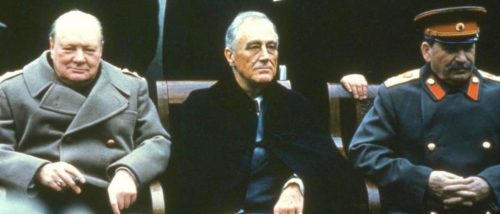
None of these men were kind or “nice” in any way. But they mattered. They were relevant. And they wielded some very real power.
Today, real power looks like this:
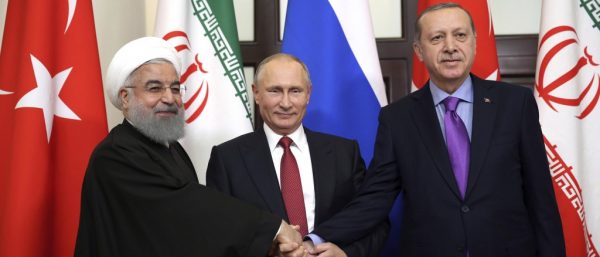
And you know what is really offensive to the AngloZionist leaders?
That this photo shows one Orthodox Christian and two Muslims.
Now that’s offensive. And very frightening, of course.
We are very, very far from the “birth of a new Middle East” promised by Condi Rice (it is a new Middle East alright, just not the one Rice and the Neocons had in mind!)
As for the “only democracy in the Middle East” it is now in full panic mode, hence its now overt plan to work with the Saudis against Iran and its clearly staged leaks about bombing all Iranian assets up to 40km from the Israeli border. But that train has already left the station: the Syrians won and no amount of airstrikes will change that. So just to make sure they still look really fierce, the Israelis are now adding that in case of a war between Israel and Hezbollah, Secretary General Hassan Nasrallah would be a target. Wow! Who would have thought?!
Can you hear the giggles coming out of Beirut?
The scary thing is that the folks in DC, Riyadh and Jerusalem hear them loud and clear which means that sooner or later they will have to do something about it and that “something” will be the usual nonsensical bloodbath this “Axis of Kindness” has been made famous for: if you can’t beat their military, make their civilians pay (think Kosovo 1999, Lebanon 2006, Yemen 2015). Either that or beat the shit out of a tiny, defenseless victim (Grenada 1983, Gaza 2008, Bahrain 2011). Nothing like a good massacre of defenseless civilians to make them feel manly, respected and powerful (and, for US Americans – “indispensable”, of course).
Setting aside the case of the Middle East, I think we can begin to see the outlines of what the US and Russia will be doing in the next couple of years.
Russia: the Russian strategy towards the Empire is simple:
- Try to avoid as much as possible and for as long as possible any direct military confrontation with the US because Russia is still the weaker side (mostly in quantitative terms). That, and actively preparing for war under the ancient si vis pacem para bellum strategy.
- Try to cope as best can be with all the “petty harassment”: the US still has infinitely more “soft power” than Russia and Russia simply does not have the means to strike back in kind. So she does the minimum to try to deter or weaken the effects of that kind of “petty harassment” but, in truth, there is not much she can do about it besides accepting it as a fact of life.
- Rather than trying to disengage from the AngloZionist controlled Empire (economically, financially, politically), Russia will very deliberately contribute to the gradual emergence of an alternative realm. A good example of that is the Chinese-promoted New Silk Road which is being built without any meaningful role for the Empire.
US: the US strategy is equally simple:
- Use the Russian “threat” to give a meaning and a purpose to the Empire, especially NATO.
- Continue and expand the “petty harassment” against Russia on all levels.
- Subvert and weaken as much as possible any country or politician showing any signs of independence or disobedience (including New Silk Road countries)
Both sides are using delaying tactics, but for diametrically opposite reasons: Russia, because time is on her side and the US, because they have run out of options.
It is important to stress here that in this struggle Russia is at a major disadvantage: whereas the Russians want to build something, the Americans only want to destroy it (examples include Syria, of course, but also the Ukraine or, for that matter, a united Europe). Another major disadvantage for Russia is that most governments out there as still afraid of antagonizing the Empire in any way, thus the deafening silence and supine submissiveness of the “concert of nations” when Uncle Sam goes on one of his usual rampages in total violation of international law and the UN Charter. This is probably changing, but very, very slowly. Most world politicians are just like US Congressmen: prostitutes (and cheap ones at that).
The biggest advantage for Russia is that the United States are internally falling apart economically, socially, politically – you name it. With every passing year the once most prosperous US is starting to look more and more like some backwater Third World country. Oh sure, the US economy is still huge (but rapidly shrinking!), but that is meaningless when financial wealth and social wealth are conflated into one completely misleading index of pseudo-prosperity. This is sad, really, a country that ought to be prosperous and happy is being bled to death by the, shall we say, “imperial parasite” feeding on it.
At the end of the day, political regimes can only survive by the consent of those they rule. In the United States this consent is clearly in the process of being withdrawn. In Russia it has never been stronger. This translates into a major fragility of the US and, therefore, the Empire (the US is by far the biggest host of the AngloZionist imperial parasite) and a major source of staying power for Russia.
All of the above applies only to political regimes, of course. The people of Russia and of the US have exactly the same interests: bringing down the Empire with the least amount of violence and suffering as possible. Like all Empires, the US Empire mostly abused others in its formative and peak years, but as any decaying Empire it is now mostly abusing its own people. It is therefore vital to always repeat that an “Empire-free US” would have no reason to see an enemy in Russia and vice-versa. In fact, Russia and the US could be ideal partners, but the “imperial parasites” will not allow that to happen. Thus we are all stuck in an absurd and dangerous situation which could result in a war which would completely destroy most of our planet.
For whatever it’s worth, and in spite of the constant hysterical Russophobia in the US Ziomedia, I detect absolutely no sign whatsoever that this campaign is having any success with the people in the US. At most, some of them naively buy into the “the Russians tried to interfere in our elections” fairy tale, but even in this case this belief is mitigated by “no big deal, we also do that in other countries”. I have yet to meet an American who would seriously believe that Russia is any kind of danger. I don’t even detect superficial reactions of hostility when, for example, I speak Russian with my family in a public place. Typically, we are asked what language we are speaking and when we reply “Russian” the reaction normally is “cool!”. Quite often I even hear “what do you think of Putin? I really like him”. This is in severe contrast with the federal government whom the vast majority of Americans seem to hate with a passion.
To summarize it all, I would say that at this point in time of the US-Russian war, Russia is winning, the Empire is losing and the US is suffering. As for the EU it is “enjoying” a much deserved irrelevance while being mostly busy absorbing wave after wave of society-destroying refugees proving, yet again, the truth of the saying that if your head is in the sand, your ass is in the air.
This war is far from over, I don’t even think that we have reached its peak yet and things are going to get worse before they get better again. But all in all, I am very optimistic that the Axis of Kindness will bite the dust in a relatively not too distant future.
Canada Becomes Party to Ukraine’s Conflict
By Alex GORKA | Strategic Culture Foundation | 17.12.2017
The Canadian government has given the green light for national defence contractors to sell weapons to Ukraine. This makes Canada a party to the conflict with all ensuing consequences. The decision sets no preconditions for selling the armaments to Ukraine. It has been taken despite the fact that Project Ploughshare and Amnesty International Canada opposed the plan, saying Kiev has so far failed to improve the human rights situation. Canada’s Standing Committee on National Defense has published a report entitled “Canada’s Support to Ukraine in Crisis and Armed Conflict,” which recommends that the government provide lethal weapons to Ukraine if it demonstrates active work on fighting corruption in the country. The recommendations include providing lethal weapons, intelligence exchange, cooperation in defense industry, support in countering cyberattacks, and in resisting to the dissemination of foreign propaganda and disinformation through the media. Granting visa-free travel to Canada for Ukrainians and promotion of Ukrainian interests at the G7 is also on the recommendations’ list.
The Canadian Cabinet hopes its decision will influence the US Administration to follow suit. The move puts Canada out ahead of the United States, which is considering its own arms sales. Kurt Volker, the US Special Representative to Ukraine, believes there’s no reason to continue the prohibition on delivering lethal weapons.
Ukraine is particularly interested in anti-tank weapons, counter-battery artillery radar, and armoured patrol vehicles like the US-made Humvees.
On December 12, US President Donald Trump signed a defense budget for 2018 providing for the possibility of offering Ukraine lethal weapons of a “defensive nature”. Congress has approved $500 million in “defensive lethal assistance” to Ukraine. Congress authorized $350 million more than the $150 million originally proposed by the administration. Now, the president can start arms supplies any time he chooses. Former President Barack Obama was unconvinced that granting Ukraine lethal defensive weapons would be the right decision in view of corruption widespread in Ukraine.
The two events – Canada’s decision and signing the US defense budget bill into law – come in the context of the failed US-Russia talks on the recently proposed UN peacekeeping mission in Donbass. Now the US weapons could be exported to Ukraine through Canada, including the much-desired Javelin anti-tank systems. “After this government decree, Canada can sell or transfer Javelin to Ukraine,” said James Bezan, Canadian MP from the Conservative Party. The US has been sending to Ukraine a variety of non-lethal military help, including equipment like Humvees, medical supplies, bulletproof vests, and radars to track the hundreds of artillery shells.
North America’s assistance to Ukraine is not limited to weapons only; it encompasses other domains as well. The Ukraine Cybersecurity Cooperation Act [H.R. 1997], the bipartisan legislation introduced by Congressmen Brian Fitzpatrick (PA-8) and Brendan F. Boyle (PA-13), unanimously passed the House Foreign Affairs Committee on Dec. 14. The bill encourages cooperation between the United States and Ukraine on matters of cybersecurity and requires State Department reporting to Congress on best practices to protect against future cyber-attacks. “Helping Ukraine buttress its cyber defenses will also help the United States in developing new and more effective technologies and strategies in dealing with cyber security on the modern battlefield,” said Boyle, explaining the goal to be achieved, if the legislation becomes law. It will make Ukraine a part of NATO cyber warfare effort being implemented according to its Cyber Defense Pledge.
The bloc is implementing the Capability Package 120 which aims by 2024 to fund everything from encryption for tactical radios to cloud-integrated storage for the millions of cyber events. Eventually, NATO will move to the public cloud for virtually everything that it does as an alliance. The “centralized patch management” will control all the cyber activities.
For more than two years, the US military’s contingent of roughly 300 military instructors have been quietly training Ukrainian military in the western part of the country to prepare them for fighting in the east. Every 55 days a new Ukrainian battalion comes in to go through a training course at Yavoriv Combat Training Center in western Ukraine. Since 2014, the US and partner militaries have helped grow Ukraine’s forces from just over 100,000 troops to nearly 250,000 today. The US-run maritime operations center at Ochakov Naval Base, Ukraine, became operational in July to serve as a major planning and operational hub during future military exercises hosted by Ukraine. A US military facility near Russia’s borders is a very serious threat to regional security. Its presence turns the Black Sea into a hot spot. US warships visit the sea regularly to provide NATO with long-range first strike capability. The Romania-based Aegis Ashore BMD system uses the Mk-41 launcher capable of firing Tomahawk long-range precision-guided missiles against land targets.
Also in July, two US Navy warships, a P-8A Poseidon patrol aircraft, and a Navy SEALs team took part in the 12-day Sea Breeze 2017 joint NATO naval exercise off Ukraine. The multinational war games took place in the northwestern part of the Black Sea, near the Ukrainian port city of Odessa. 17 nations took part in the training event. The preparations are on the way to hold another Sea Breeze exercise in 2018. Step by step, Ukraine is becoming an element of NATO’s military infrastructure, which could be used as a springboard for a cross-border attack against Russia.
Turkey switches to full defiance of US, continues Putin courtship
By M.K. Bhadrakumar | Asia Times | December 14, 2017
On Monday, US National Security Advisor HR McMaster added to tensions in the Middle East when he condemned Turkey and Qatar as prime sponsors of extremist Islamist ideology.
He tore into the Turkish leadership, saying the country’s growing problems with the West are largely due to the rise of the Justice and Development Party in Ankara.
A few days ago, McMaster had described China and Russia as “revisionist powers” encroaching on US allies and undermining the international order, and castigated Iran and North Korea as outlaw regimes that “support terror and are seeking weapons of mass destruction.”
McMaster now rounds on Turkey and Qatar for mentoring a radical Islamist ideology that “is obviously a grave threat to all civilized people.” The stunning part is that Turkey is a NATO ally, while the US Central Command is headquartered in Qatar.
Arguably, Turkey no longer qualifies to be a NATO member. McMaster spoke at a rare public policy platform with his British counterpart Mark Sedwill, at an event hosted by the Policy Exchange think tank in Washington. How any of this transmutes into Anglo-American policy will bear watching. (Interestingly, on a visit to Greece last week, Erdogan publicly sought a revision of the 1923 Treaty of Lausanne, which was negotiated under the tutelage of Britain and the US and ceded, amongst other things, all Turkish claims on the Dodecanese Islands and Cyprus.
Significantly, McMaster’s outburst came within hours of a meeting in Ankara between Erdogan and Russian President Vladimir Putin, their eighth this year, during a combined day-long trip by the Russian leader which included stops in Egypt, Turkey and the Hmeimim airbase in Syria.
Ironically, if it was the perceived Soviet threat to Turkey that Harry Truman and Dean Acheson blew out of proportion to lay the ground for an enthusiastically pro-American Turkish prime minister, Adnan Menderes, to bring Turkey into the NATO fold in 1952, 55 years later the blossoming of Russo-Turkish cooperation prompts Washington to doubt Turkey’s credentials as an ally.
But then, NATO has no precedents of ousting a member state and its decisions are taken unanimously. To be sure, Erdogan will only leave the NATO tent kicking and screaming. His intent is to shake off US hegemony, which he can do better while inside the NATO tent. He is in turn taunting, provoking, snubbing, defying and – worse still –ridiculing US regional strategies.
Erdogan’s talks with Putin on Monday suggest a new stage in their coordination to undermine US interests in the Middle East. Putin announced that they agreed on a loan agreement, which will be signed “very shortly,” to pursue the “significant prospects for expanding our military and technical cooperation.”
Erdogan added that “the relevant agencies of our two countries are expected to complete what needs to be done this week” with regard to Turkey’s purchase of Russia’s S-400 missile system. It is a huge snub to Washington and some of its NATO allies that the Russian system cannot be integrated into the alliance’s defenses.
Again, Erdogan announced that Turkey and Russia are “determined to complete in the shortest possible time” the Turkish Stream (which will bring more Russian gas to Turkey and use Turkey as a hub to supply southern Europe) and the US$25 billion Akkuyu Nuclear Power Plant. The US opposes the Turkish Stream, which will frustrate its plans to export LNG to Europe.
Putin joined Erdogan to criticize the US decision regarding Jerusalem. Putin said, “It is destabilizing the region and wiping out the prospect of peace”; Erdogan said he was “pleased” by Putin’s stand. Erdogan said the OIC (Organization of Islamic Cooperation) summit in Istanbul on Wednesday would be a “turning point” on the crisis; Putin promised to send a representative.
Most stunning, though, are the emerging contours of a profound Russo-Turkish action plan in Syria. They attribute centrality to the Astana peace process, which also includes Iran but leaves the US and its regional allies in the cold. Following Putin-Erdogan talks, the next meeting at Astana has been announced.
Equally, Russia and Turkey are collaborating to organize a congress of Syrian National Dialogue in Sochi. Foreign Minister Mevlut Cavusoglu signaled on Tuesday that Turkey no longer objects to Kurdish participation. Evidently, Russia is leveraging its influence with the Kurdish groups. This badly isolates the US, which is increasingly left with rump elements of Kurdish militant groups as its remaining allies. An open-ended US military presence in Syria becomes pointless since the capacity to influence a Syrian settlement is nearing zero.
After returning to Moscow, Putin submitted to the Duma a new agreement on expanding the Russian base in the Syrian port city of Tartus. The balance of forces in the Mediterranean region is dramatically shifting even before a Syrian settlement is negotiated.
Meanwhile, Cavusoglu hinted that Turkey and Russia plan to create new facts on the ground in northern Syria. “Threats for Turkey are coming from Afrin. We may enter this region without a warning. If we carry out the operation there, we will agree on all its aspects with our allies, including Russia.”
Putin apparently heeded Erdogan’s concerns that Afrin is a crucial region for Turkish national security. This is a paradigm shift. If Turkey kicks out the Kurdish militia from Afrin in coordination with Russia, it is a slap to America’s face. A flashpoint may arise.
What emerges is that denying the US any form of land access to Syria’s Mediterranean coast and reducing the American bases in Syria as remote and isolated pockets would be a Russo-Turkish enterprise. McMaster’s rage is understandable.
US Views the Balkans As Battlefield to Fight Russia
By Peter KORZUN | Strategic Culture Foundation | 06.12.2017
Otto von Bismarck, the legendary first Chancellor of Germany, scoffed at the notion of intervening in the Balkans. He believed that the region was “not worth the bones of a single Pomeranian grenadier.” The US appears to hold quite a different view on the matter. With a resurgent Russia on the international stage, it plans to ramp up the attempts aimed at establishing its dominance in the Balkan region.
Moscow is concerned over Washington’s attempts to increase its influence on the politics of the Balkan states and draw them into NATO. Andrey Kelin, Director of the Russian Foreign Ministry’s Department of European Cooperation, said that the US wants to “fully master the Western Balkans, and, after Montenegro, to draw other countries into its orbit too.” According to him, any wave of NATO expansion, especially at a time of poor relations between the bloc and Russia “is an additional factor complicating European security.”
The statement comes after the report entitled ‘Balkans Forward: A New US Strategy for the Region’, was published by the Washington-based Atlantic Council on Nov.28. It warns of increased Russia’s influence, blaming Moscow for “attempts by Russia to capitalize on the region’s lingering pathologies to undermine the European project” and other alleged wrongdoings. The authors claim that Russia is seeking “leverage” by making “as big a mess as possible” in the Balkans region, citing unconfirmed assertions and invented stories as evidence. For instance, the report states that Moscow has been “cultivating a client” in Milorad Dodik, the leader of Bosnia’s Serb-dominated entity of Republika Srpska. Russia’s “playing games” in Kosovo is another example. The list can go on. Not a single fact is adduced to support the stories.
The Russia bogie is used as a pretext to justify the calls for a permanent American military presence in the Balkans, a “historic rapprochement” between the US and Serbia, and for the US to regain its reputation as an “honest broker”. The authors believe that establishing a permanent US military presence in the region would “anchor the United States’ ability to influence developments”. Camp Bondsteel in Kosovo, which is built on Serbian land without consulting with the government of Serbia, is believed to be ideal for this purpose.
The report does not shy away from advocating outright interference into internal affairs. It singles out Serbia, saying “Belgrade can and should be a close partner and ally in the region, but it can only become one if it begins to meaningfully distance itself from Russia.”
The Atlantic Council is a meeting place for heads of state, military leaders, and international leaders from both sides of the Atlantic. It has great influence on the US foreign policy decision-making process. Some proposals unveiled in the report align with prior calls by US policy hawks, such as Senator John McCain, who in April called for a substantially strengthened US commitment to the region.
Looks like his calls are heard and recommendations are followed. Hoyt Brian Yee, US Deputy Assistant Secretary of State, will soon take up the post of US Ambassador to Macedonian capital Skopje. “For a long time, the United States is present in the Western Balkans, and we are planning to stay there,” he said at the conference organized by the Atlantic Council in Washington the next day after the report was published.
James Jay Carafano, a Heritage Foundation Vice President, has come up with a plan of his own, offering guidelines to boost US diplomatic, economic and military efforts to drive Russia from the region and make it dominated by the United States. He believes that “The Balkans remain a soft spot in US transatlantic policy. We need to be more proactive there – and sooner rather than later.”
With Montenegro having joint NATO recently, Macedonia appears to be next. The Atlantic Council’s report offers to launch mediation efforts aimed at putting an end the long-standing row between Athens and Skopje over Macedonia name and, thus, unblock Greece’s ongoing objections to the latter’s membership in NATO. The center-left government, which came to power in late May, sees NATO membership as a top priority. The Macedonian people think otherwise. According to a recent poll by the International Republican Institute (IRI), Macedonian support for NATO membership is at its lowest level since 2008.
It all goes to show that the US views the Balkans not as a region with prospects of economic cooperation and partnership on equal terms but rather as a battlefield against Russia. What the United States does is enforcing an openly destructive choice between the West and Russia on the Balkan countries. Such a policy will lead to increased tensions and destabilization on the European continent as well as in the region. The last thing the region needs is US military presence to oppose Russia – the country with strong historic and cultural ties to the Balkan states.
Turkey’s Erdogan won’t capitulate
By M K Bhadrakumar | Indian Punchline | December 2, 2017
As the countdown begins for the trial in a Manhattan federal court next week of the Turkish-Iranian millionaire gold trader Reza Zarrab over violations of US sanctions against Iran, Turkey is hardening its stance. President Recep Erdogan has said that Turkey cannot be prosecuted in a fake court. (See my article in Asia Times, Gold dealer’s testimony puts Erdogan on shaky ground.)
Importantly, on Friday, the Istanbul Chief Prosecutor’s Office issued an arrest warrant for a former top CIA official Graham Fuller alleging his involvement in the failed coup attempt in Turkey in July last year. The Turkish security is apparently in possession of information that Fuller was in the country during the coup attempt on July 15 and abruptly left after the coup failed. Fuller participated in a secret meeting of the coup plotters on July 15-16, which was held in the Buyukada Island in the Sea of Marmara off Istanbul.
For the first time, Ankara is inches away from hinting that last year’s was a CIA-sponsored coup attempt, aimed at overthrowing Erdogan’s government. The government has alleged previously that the coup plotters intended to “eliminate” Erdogan.
This is an extremely serious development insofar as Turkey is, in effect, alleging that the spy agency of a major NATO ally, which swears by Article 5 of the alliance’s charter on collective security, actually conspired to overthrow its established government which enjoyed a democratic mandate.
From all indications, Turkish intelligence would have collected a lot of evidence regarding the coup before making the move to seek Fuller’s arrest. At least some of the evidence would also have been provided by friendly countries such as Russia and Iran. We will never know whether the Russian and Iranian intelligence are in possession of hard information pointing at CIA involvement in the coup attempt in Turkey, but the possibility cannot be ruled out. The Iranian Foreign Minister Mohammed Zarif was constantly interacting telephonically with his Turkish counterpart through the fateful night of the coup attempt when things were on razor’s edge.
Ankara announced on Friday that Turkish Foreign Minister Mevlut Cavusoglu will be attending the NATO Foreign Ministers’ meeting in Brussels on December 5-6. Cavusoglu is sure to bump into US Secretary of State Rex Tillerson. One can only wish to be a fly on the wall at the NATO Hqs. Indeed, if the US plan is to leverage the Zarrab case to pressure Turkey to change course in its foreign policies and revert to its cold-war era role as the West’s junior partner in the region, it may boomarang. Turkey may be preparing to go on the offensive.
Make no mistake, Turkey will follow up on the arrest warrant for Fuller. Fuller was a mentor of the controversial Islamist preacher Fetullah Gulen. According to Turkish reports, Fuller had recommended Gulen’s application for the Green Card, which in turn enabled the latter to live in exile in the US for almost two decades after he fled Turkey in 1998. Turkish intelligence keeps a close tab on Gulen’s activities Ankara has often hinted that Gulen is actively in contact with the US establishment.
If Erdogan wants to hit the Americans hard, he won’t have to look beyond next-door Syria. Erdogan’s key advisor Ibrahim Kalin has written in the pro-government Sabah newspaper today that with the defeat of ISIS, the US has no justification to support the Syrian Kurds. To quote Kalin,
- This question was discussed during a recent phone call between President Recep Tayyip Erdogan and U.S. President Donald Trump on Nov. 24. Trump’s response was affirmative, adding that the huge military support the U.S. is providing to the YPG should have ended before. His statement was contradicted only a few days later by the Pentagon.
There is an implicit warning here that Turkey is drawing a red line. Kalin disclosed in the article that Pentagon is using the pictures of Kurdish women fighters to “romanticize” the US-Kurdish alliance. Kalin wrote, “[It is] a useful instrument to sell propaganda to Western audiences, but an affront to the female body and personality. Among the many ironies of this policy, this one is stunning: America’s best ally in Syria is a Marxist-Leninist terrorist organization that fights against Turkey, a key U.S. ally, and seeks autonomy and eventual independence in Syria.”
The Turkish intelligence has got through to the chief spokesman of the US-backed Kuridsh alliance (known as the Syrian Democratic Front) Talal Silo who has “defected” to Turkey recently. In an interview with the Anadolu news agency today, Silo has spilt the beans, exposing the Pentagon’s nefarious activities in Syria that threaten Turkish national security interests. The transcript of the interview is here.
US Uses ‘Mythical’ Security Threats to Deploy Patriot Systems in Poland – Moscow
Sputnik – November 16, 2107
While the US had justified the Patriot missiles’ deployment by the threat allegedly posed by Tehran prior to the Iran nuclear deal was reached, Moscow has repeatedly questioned the claim and accused NATO of building up its military presence on the borders with Russia.
The plans to deploy US Patriot systems in Poland are a part of the US strategic intention to surround Russia with missile defense systems “under the pretext of mythical threats to security”, Russian First Deputy Foreign Minister Vladimir Titov told Sputnik.
According to the senior diplomat, in reality the deployment of anti-missile defense network posed a threat to stability and undermined international trust “which has been lacking over the past years.”
“We have repeatedly, but, unfortunately, futilely pointed out this fact to our Western interlocutors,” Titov said.
An agreement on the deliveries of Patriot missile defense systems to Poland was signed by the Polish National Defense Ministry and the US State Department of Defense during US President Donald Trump’s visit to Warsaw in early July, with the military hardware set to be handed over to Poland by 2022.
Moscow has repeatedly said that the deployment of air defense systems near Russia’s borders undoubtedly poses a threat to the country, with Russian President Vladimir Putin reminding that the US and European officials previously linked the missile shield deployment to Iran’s nuclear program, which was no longer present due to the deal reached in 2015 with Tehran.
Afghanistan war crimes probe a sham and cover-up for US
By Finian Cunningham | RT | November 14, 2017
When The Hague-based International Criminal Court (ICC) announced it was planning to investigate alleged war crimes in Afghanistan, the timing seemed appropriate.
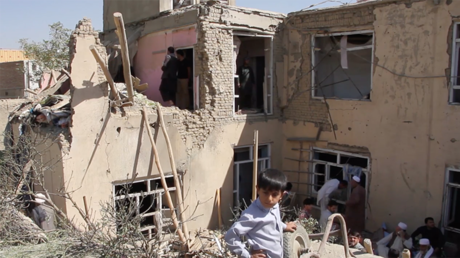
The announcement by the ICC on November 3 came within days of a deadly airstrike by US forces in northern Afghanistan, which UN officials say killed ten civilians.
But the history of the intergovernmental court since it was set up some 15 years ago gives pause to hope that it might deliver justice in Afghanistan. For many critics, the ICC is a byword for self-serving Western political control, either whitewashing crimes or smearing designated opponents. A pertinent question is: why has it taken the ICC so long to investigate alleged crimes in Afghanistan’s war?
The Pentagon claimed the air raid near the city of Kunduz on November 4 killed only Taliban militants. However, last week the United Nations Assistance Mission in Afghanistan (UNAMA) provided a very different version of events. UNAMA said extensive interviews with local residents and medics show that at least ten civilians died in the airstrike.
The incident would, therefore, be a prime case to investigate. ICC chief prosecutor Fatou Bensouda has promised an investigation into any alleged war crimes in Afghanistan would be “independent, impartial and objective.”
As a Reuters report stated, the ICC “could examine the role of US forces” in Afghanistan, which have been occupying the country for the past 16 years since October 2001, following the 9/11 terror attacks in Washington DC and New York City.
US torture practices conducted during CIA interrogations and renditions could also be probed, according to reports. An earlier announcement by the ICC said it would be looking into alleged violations committed by three parties: US military, Afghan security forces, and Taliban militants.
If the ICC did carry out an earnest probe into alleged war crimes in Afghanistan, it would have its work cut out – even if it just restricted itself to incidents involving US forces and the CIA.
Two years ago, in October 2015, the northern city of Kunduz was the location of another apparent atrocity committed by the US air force. A hospital run by the French-based Medecins Sans Frontieres (MSF) was bombed and machine-gunned by US aircraft, killing 42 medical staff and patients. MSF condemned the attack as a violation of the Geneva Convention – a war crime. Though, the Pentagon maintained that its forces made a mistake while targeting militants.
There is very little clarity on the number of Afghan civilians who have been killed by US forces over the past 16 years, from gun battles, house raids, drone strikes, and airstrikes. One estimate puts the total number of civilian deaths in the war at over 31,000. Many of them are victims of Taliban shootings, and bombings or operations carried out by the US-backed Afghan security forces.
Nevertheless, there are abundant incidents involving civilians being killed by US operations in what could merit war crimes prosecutions. This is especially so given the renewal of American military operations in the country ordered by President Trump in August this year – three years after the US forces were officially supposed to wind down.
Trump’s defense secretary James Mattis, on a trip to the Afghan capital Kabul in September, warned that US airstrikes would be ramped up in the coming months. Already this year, the UN reports that there was a surge in civilian casualties from American-backed air raids. The situation has an ominous resonance with how civilian casualties have escalated from increased US airstrikes in Iraq and Syria under the Trump administration’s wider authorization to the Pentagon to mount operations.
So, it seems clear that if the ICC were to open prosecution cases in Afghanistan it would, to say the least, be kept busy. However, critics of the ICC say that its intentions are not motivated by seeking justice.
It’s a political move, says international criminal lawyer Christopher Black.
Since its establishment in 2002, the international court has come in for much criticism that it is a “political tool” of the United States and European allies. Virtually all of the court’s prosecutions and indictments have been against African leaders. For example, Omar Bashir (Sudan), Uhuru Kenyatta (Kenya), Muammar Gaddafi (Libya), and Laurent Gbagbo (Ivory Coast) are among those indicted by the ICC.
The US is not a member of the 123-nation ICC. Neither are Russia, China, and India. However, the US exerts a controlling influence over the court’s prosecution office via European governments and the European Union, which are dominant in the administration of the ICC.
“The United States and its European allies use the ICC as a means of political control, not for justice,” says Christopher Black who is registered on the defense counsel for the court, but who has vociferously criticized its political subservience.
Black says the ICC has a similar function to several other ad hoc international tribunals, such as those which purportedly investigated war crimes in Rwanda and former Yugoslavia.
“These courts serve to cover-up actual crimes committed by Western powers while criminalizing political enemies of the West,” says Black.
In the case of former Yugoslavia, he points out, the Hague-based court did not examine the putative crimes of NATO bombing Belgrade in 1999. It only went after former Yugoslav President Slobodan Milosevic whom Washington and the European governments wanted to criminalize to justify NATO’s illegal intervention in the Balkans.
With regard to Afghanistan, the declared intention of the ICC to divide its investigations between US and Afghan parties raises the suspicion the court will seek to mitigate violations carried out by American forces by embroiling other criminal actors.
Even if the ICC were to find US forces guilty of war crimes, it is doubtful that Washington would take any notice of such rulings.
As Christopher Black points out too, the focus of any forthcoming investigation is misplaced in its entire framework. “The focus of a war crimes investigation should be looking at the way the US launched this military occupation back in 2001. A case can be made that the US is guilty of the supreme crime of war of aggression. All other violations stem from Washington committing the ultimate crime of going to war in Afghanistan.”
He says the ICC planned investigation is a piecemeal approach which will serve to conceal the primary responsibility of the US in Afghanistan.
So why then would the ICC bother to set up such a probe into Afghanistan?
The answer is simply to salvage much-needed credibility for the court. Because of its lop-sided focus in prosecuting African leaders, the ICC has come under fire from African members for “double standards” and serving as a neocolonial instrument for Western powers.
Beginning last year, several African nations threatened to walk away from the ICC, including Kenya, Namibia, South Africa, Gambia, and Uganda. Last month, Burundi formally completed its withdrawal from the ICC.
In other words, the court is in danger of imploding from lack of credibility. Hence, the announcement to go into Afghanistan is an attempt to salvage authority and public image by appearing to, at last, investigate alleged American war crimes.
“This is all about giving the ICC some badly needed credibility as it unravels in the face of a mass African walk-out,” says lawyer Christopher Black.
As such US and NATO states have nothing to fear from this proposed war crimes investigation in Afghanistan. It’s a cover-up and a sham driven by political interests, not by justice.
Finian Cunningham (born 1963) has written extensively on international affairs, with articles published in several languages. Originally from Belfast, Ireland, he is a Master’s graduate in Agricultural Chemistry and worked as a scientific editor for the Royal Society of Chemistry, Cambridge, England, before pursuing a career in newspaper journalism. For over 20 years he worked as an editor and writer in major news media organizations, including The Mirror, Irish Times and Independent. Now a freelance journalist based in East Africa, his columns appear on RT, Sputnik, Strategic Culture Foundation and Press TV.
Read more:
Theresa May does Russophobia
By Neil Clark | RT | November 14, 2017
It was Dr Samuel Johnson who famously declared in 1775 that patriotism was the last refuge of the scoundrel. The 2017 variant is to make unsubstantiated claims about the ‘Russian threat’ to Western democracies.
In her speech at the Lord Mayor’s Banquet in the City of London on Monday evening, British Prime Minister Theresa May escalated the anti-Russian rhetoric still further with a deeply paranoid address that sounded as if it had been penned in 1953 by the late Senator Joe McCarthy during one of his drunken binges.
Any psychologists watching Mrs May would have had a field day identifying plenty of examples of what mind doctors call ‘projection’ – i.e. attributing to others what you are guilty of yourself. In fact every one of May’s claims against Russia can be more accurately applied to the UK and its closest allies.
The prime minister stated, “It is Russia’s actions which threaten the international order on which we all depend.”
Really, Mrs May? Was it Russia who illegally invaded Iraq in 2003, causing the deaths of up to 1 million people and the rise of Islamic State (IS, formerly ISIS/ISIL)? Was it Russia who destroyed Libya in 2011, turning the country with the highest HDI in Africa into a failed state and jihadist playground on the shores of the Mediterranean? Was it Russia who illegally bombed Yugoslavia, without UN approval, in 1999? Or Russia who backed radical jihadists – many of them linked to Al-Qaeda – to overthrow the Syrian government? In fact it was the US, the UK and its allies who did all these things. But let’s not mention them, shall we, prime minister?
May says her aim is “to defend the rules-based international order against irresponsible states that seek to erode it.” That’s just like the American gangster John Dillinger saying his aim in 1933 was “to defend banks against individuals who seek to rob them.”
The truth is that it’s been British governments – acting in tandem with the US – who have done most to erode international law in recent decades – and not Russia.
The prime minister boldly declared that “Russia has fomented conflict in the Donbass,” but it was the Americans and their NATO/EU allies who fomented conflict in Ukraine in 2014 by supporting and bankrolling an uprising against the democratically-elected government of Viktor Yanukovich – in which neo-Nazis and virulently anti-Russian ultra-Nationalists provided the cutting edge.
Concern over these developments among the Russian population of Ukraine led to a referendum, in which the people of Crimea overwhelmingly – and quite understandably – voted to return to Russia. The Maybot – who “consistently voted” for the illegal invasion of Iraq in 2002/3 – characterizes this exercise in democracy as “Russia’s illegal annexation of Ukraine.” If you’re going down this line, you may as well talk about “Britain’s illegal annexation of Gibraltar,” or the “UK invasion of the Isle of Wight.”
May declared that “Russia’s illegal annexation of Crimea was the first time since the Second World War that one sovereign nation has forcibly taken territory from another in Europe”. Well, that’ll be news to the people of Serbia who saw resource-rich Kosovo – the cradle of their civilization – forcibly taken away from them following a NATO bombing campaign.
May – like the good neocon she is – accuses Russian “state-run media” of planting “fake stories,” but interestingly fails to come up with a single example.
Well, I’m a kind soul, so let me help her. Here are some examples of ‘fake news’ – all of which have appeared in the Western media.
The fake news that Iraq possessed WMDs in 2003 – which led to the illegal invasion of that country and catastrophic consequences for the whole world. The fake news that Muammar Gaddafi was about to massacre the civilians of Benghazi in 2011 – which again led to another bloody Western military intervention. The fake news in 2010 and other times too that Iran was on the brink of developing a nuclear bomb. The fake news that Russians had hacked into the Vermont electricity grid. Or (no sniggering at the back, please) the news that Russia used ‘Pokemon GO’ to try to “sow division” in the run-up to the US election.
Is that enough examples of fake news for you Theresa, or would you like some more? Yes, fake news is threatening democracy, but its Western Establishment-approved and Establishment-disseminated fake news – the sort you read in neocon-approved ‘sensible newspapers’ and media outlets – which has caused the most damage. Where did those Iraqi WMDs get to, I wonder?
As for unsubstantiated accusations of Russian meddling in Western elections, again the chutzpah of Mrs May is off the scale. Britain and the US have seen it as their right to meddle in elections around the globe for decades. Political scientist Dov H. Levin calculated that the US attempted to influence foreign elections 81 times in the period 1946-2000, and that figure does not include support for military coups and other ‘regime change’ ops.
The UK has often been heavily involved in these nefarious anti-democratic schemes too – for example, in Iran in 1953 when Mohammed Mossadeq was toppled and in Yugoslavia in 2000. In his biography of Slobodan Milosevic, the ousted Yugoslav leader, Adam LeBor notes that over $70 million was paid to the anti-Socialist Serbian opposition – with the ‘Otpor‘ youth movement receiving much of the funding. “And who was behind Otpor?” LeBor writes, quoting a “high-level Serbian source.” The answer: “The US and Britain.” What a surprise.
Again, being accused by a prominent member of the UK Establishment of interfering in other countries’ elections is like being accused of tax evasion by Al Capone or being told to sit up straight by the Hunchback of Notre Dame. The hypocrisy is truly mind-boggling.
The prime minister, having accused the Kremlin of trying to “sow discord” in the West then came over all Churchillian, by declaring she had a “very simple message for Russia.”
“We know what you are doing. And you will not succeed. Because you underestimate the resilience of our democracies, the enduring attraction of free and open societies, and the commitment of Western nations to the alliances that bind us.”
Well, I and millions of Britons have a very simple message for Theresa May. We know what you are doing too. You are not ‘strong and stable’ but a weak and wobbly prime minister who is trying to distract us from the domestic failings of your own government by trying to scare us witless over a non-existent Russian threat. You are hoping that by raising the specter of the Big Bad Russian Bear we will forget about your promise to cap household energy bills, the scandal of rip-off train fares and the impact of cruel and heartless austerity policies on millions of people across the country. And ignore the fact that you’re giving the country absolutely no leadership or direction on the issue of Brexit.
The safety and security of Britain is indeed threatened, prime minister, not by the bogeyman Putin but by the disastrous policies that yours and other British governments have followed in recent years. Policies such as illegally invading Middle Eastern countries and backing violent jihadist groups to topple secular governments as in Libya and Syria. Or lifting control orders on terrorist organizations like the Libyan Islamic Fighting Group and allowing them to travel unhindered in and out of the country. Who was the British home secretary when that happened? Why, one Theresa May!
Ironically on the day that May was trying to give us sleepless nights about the Russian ‘threat,’ the BBC – the national state broadcaster – had revealed details of something truly nightmarish. Namely a secret deal which allowed some 250 fanatical IS fighters to safely leave the city of Raqqa – under the gaze of US and British-led forces.
We know too that the British authorities have said that Britons returning from formerly IS-held territories in Syria and Iraq should not be prosecuted. The security implications of these policies are very clear. Once again, who is it that’s putting British citizens’ lives at risk?
Follow Neil Clark @NeilClark66
Read more:
Russia’s Alleged Meddling in Catalan Vote: Playing the Blame Game

By Alex GORKA | Strategic Culture Foundation | 14.11.2017
Few people are able to recognize their own mistakes. Many prefer to deny the truth becoming willfully oblivious to obvious facts. Why assume responsibility if there is such a thing as blame shifting – a true-and-tried method to get away with it? Pointing a finger at someone else to divert attention serves the purpose. There is method to this madness and Western politicians have been resorting to the blame-shifting tactic increasingly often. Each and everything going awry in the world is the fault of Russia. The drive of peoples for independence is a good example. Take Catalonia to illustrate the point.
The Spanish government said on Nov.10 that it had noted news manipulation about the Catalan crisis on social media originating from Russia’s territory. Spain’s government spokesman Inigo Mendez de Vigo said disinformation on social networks was a “serious issue.” According to Spanish Defence Minister Maria Dolores de Cospedal, the government had established that “many messages and interventions via social networks come from Russian territory.” She did not offer any specific examples to confirm the affirmation. Foreign Minister Alfonso Dastis said there was evidence of activity by Russian networks and hackers. The trolls are said to be spreading misinformation across social media to further “destabilize” Spain and the EU.
The issue was even raised at the EU foreign and defense ministers meeting on Nov.13-14, where Spain briefed the EU on the alleged interference. The debate comes after eight member states urged EU foreign service chief Federica Mogherini to build up the counter-propaganda cell in her service.
Spanish media have many times attacked Russia Today (RT) and Sputnik Spanish language services for instigating tensions in Catalonia, supporting the separatist movement. El Pais daily wrote an editorial on Nov. 10 denouncing “the intense campaign by Russian media that are close to the Kremlin,” whose “propaganda machine” it accused of siding with the pro-independence movement.
NATO leadership chimed in. On Nov.9, US General Curtis Scaparrotti, the commander of NATO forces in Europe, called on Russia to stop “meddling” into European elections. He was concerned over Russia’s “malign influence” in other countries. The Atlantic Council, a US-based think-tank close to NATO, has published a report suggesting that Russia was seeking to meddle in support of Catalan independence and to discredit the Spanish central government’s position that the referendum on independence held on Oct. 1 was illegal. El Pais, the Washington Times and Politico all issued publications alleging that an army of Russian bots had perfected their techniques of online influence and thus ensured the October 1 vote went down the path of separation.
If the accusations were true, it would mean that Russia-backed media networks operate to undermine Russia’s official position on the issue made clear in a Foreign Ministry’s statement. Russia has consistently voiced its respect for Spain’s territorial integrity.
Can anyone of sane mind believe that Russia’s “meddling” is the real reason to make over 40 percent of Catalans support independence? Has Russia been behind the 95-year-old independence movement in Catalonia? Has Russia made the Catalans’ language and culture distinct? Did Russia make Francisco Franco oppress the Catalan people? Has Russia provoked the economic crisis in Spain, which has served to magnify calls for Catalan independence? Has Russia made Catalans believe that the current tax structure is unfair? Has Russia made Madrid unwilling to renegotiate Catalonia’s autonomy agreement? Has Russia written Spain’s constitution, which expressly prohibits a region from breaking away unilaterally? Did Moscow order Spanish police to use brutal force, while preventing the unconstitutional vote? If it didn’t count, why take such pains to stop it?
Several world leaders and political figures condemned the violence specifically. Did Russia make them do it? Did Russia make the EU abstain from mediation effort? And, finally, does Russia stand to gain from an independent Catalonia?
With many publications on the issue, no evidence has been produced to demonstrate a link between the Russian government and Catalonia vote. Obviously, the use of the “Russian meddling” narrative seems to work as a distraction from the wrongdoing of the Spanish government. The fantasy provides a convenient scapegoat to avoid responsibility of the Spanish government for missing opportunities to launch meaningful political dialogue with Catalonia and mishandling of the vote. Spain is by far not the only country to use the narrative to its own advantage. As Karl Sharro, a well-known British architect and satirist, commented on the results of UK elections, “The most disappointing thing about the UK election is there wasn’t even a hint of Russian interference. It’s like we don’t matter at all.”
Featured Video
New positive ivermectin evidence
or go to
Aletho News Archives – Video-Images
From the Archives
Fanatical Followers of the Covid Regime: A Jim Jones-Style Cult?
By Professor Roger Watson and Dr. Niall McCrae | The Daily Sceptic | November 15, 2021
As scholars at leading British universities over recent decades, we witnessed the replacement of critical thinking and debate by narrative: facts are discrimination and scientific method is imperialism; truth, instead, is derived from ‘progressive’ values. This educational trend may be a major contributory factor to the ease in which society has been inculcated to the Covid ‘new normal’ of masking, testing, and repeated doses of vaccines for a disease of similar risk to severe influenza.
One doesn’t need much critical reasoning to observe the flawed logic of some vaccination enthusiasts, such as people who respond to experiencing any side effects, however debilitating, by saying “at least I know it’s working”, or, after contracting the disease despite their promised inoculation (over 90% effective, according to initial drug company claims), “I’d have been worse off without the jab.” … continue
Blog Roll
 Aletho News
- Najaf airport to reopen to Iranian flights within 24 hours: Ambassador
- From ‘How Will This End For Iran’ to ‘When America Walks Away’: A tale of two Economist covers
- Tehran blasts ‘baseless’ speculation linking Iran to alleged bomb plot at UK air base
- The Rise And… Rise Of ‘Color Revolutions’
- The Coming GOP Bloodbath?
- Arctic Scare Stories Melt Away
- Wrong, Euronews: Climate Change Has Not Created a Food, Energy, and Economic “Meta-Crisis”
- New positive ivermectin evidence
- Met Office Caught Fabricating Daily Temperature Record Claims
- Merck Virologists Admitted to Falsely Certifying Vaccine Efficacy
- If Americans Knew
- Netanyahu Asked UAE Leader to Deny Report on Oct. 7 Warning in Secret Visit, Sources Say
- CNN Chief Int’l Correspondent Clarissa Ward on Journalists in Gaza
- Democratic Party Consultants Surround Troy Jackson with Pro-Israel Donors
- Christian Leader Responds To Netanyahu’s Claims Regarding Palestinian Christians
- In Gaza, ‘Whoever Survives the Bombing Won’t Survive the Rubble’
- Israel kills more Palestinians, amid push to resettle Gaza – Daily Update
- Israel forces Gazans to live in constant peril – Daily Update
- Deconstructing Netanyahu’s pants-on-fire UN rant – Daily Update
- Trump betrayed voters with his campaign lies and prioritized a foreign country once he took office
- Netanyahu calls Israel’s war in Gaza ‘opposite of genocide’ in UN speech to near-empty hall
- No Tricks Zone
- New Study: Earth And Venus Surface Warmth Largely Explained By Convection And Lapse Rate, Not CO2 Or Radiation
- 2025 Nature Paper Claiming Worsening Global Drought Gets RETRACTED …Heavily Flawed
- New Study: ‘Global Drought Shows No Detectable Recent Acceleration Under Climate Warming’
- Economic Masterminds: German Socialists Suggest Taxing Productivity Gains Stemming From Using AI
- The South China Sea Has Not Been Cooperating With The Climate Change Narrative
- Energy Crisis: Germany Enters Heating Season With Historically Low Gas Reserve Fill Levels
- New Study: The Antarctic Ice Sheet Gained Mass From 2020-2024 Due To Staggering Snow And Ice Accumulation
- Study: Ocean Heating Rates From Thousands Of Years Ago ‘Dwarf’ Modern Ocean Heating Rates
- Climate Extremists Target, Attack Large-Scale Power Grid Infrastructure In Germany!
- New Study: Antarctic Ice Melt Has Contributed Less Than 1 Centimeter To Sea Level Rise In The Last 30 Years

