Back to the future… NATO self-fulfilling war plans for Russia
By Finian Cunningham | RT | November 10, 2017
Defense ministers of the US-led NATO alliance this week endorsed proposals to set up two new military commands – and it is clear Russia is the target of what are, in effect, war plans.
The setting up of an Atlantic command and a logistical hub in Europe to facilitate the transfer of troops and weapons was openly discussed by NATO officials as being aimed at Russia during their two-day summit in Brussels this week.
The two new commands being proposed are the first expansion of NATO’s command structure since the end of the Cold War more than 25 years ago. It’s a retrograde move that is not only an unnecessary, dangerous provocation to Russia, risking self-fulfilling war threats. Moreover, NATO’s renewed organizational cranking is openly calling for the integration of European societies and economies into its madcap military escalation.
European citizens, whether they like it or not, are effectively being dragooned into a state of war, with attendant social burdens to pay for that state of war, let alone being made to live with the risk of ultimate catastrophe, from all-out hostilities erupting.
Alexander Grushko, Russia’s official on NATO matters, said: “It is evident now that, by making such decisions, NATO members are apparently inspired by Cold War-era strategies.” He added: “It is evident that the task of confrontation with Russia lies at the core of those efforts.”
Grushko also put the new NATO organizational expansion in the context of an ongoing aggressive buildup over several years carried out by the US-led military alliance along Russia’s borders.
In typical fashion, however, Western news media readily turned reality on its head by echoing NATO officials in their justification for the planned military expansion as being (allegedly) necessitated by “Russian aggression.”
Reuters called the new command posts a “deterrent factor against Russia.” While US government-run Radio Free Europe said, the expansion was “to counter the growing threat from Russia.”
Western media gave NATO Secretary-General Jens Stoltenberg free rein to accuse Russia of “attacking” Ukraine, “annexing” Crimea, and recently holding threatening war maneuvers on “NATO’s eastern flank.” The latter was a reference to the Zapad military defense exercises carried out by Russia every four years – held on its own territory or that of an ally. Idiotic “NATO’s eastern flank” made apparently intelligible by Western media.
As befitting a propaganda service, rather than news services, the Western media uniformly omit any mention of how NATO states were instrumental in staging a coup d’état in Ukraine in February 2014, overthrowing an elected government back then with neo-Nazis who had designs on viciously suppressing ethnic Russians in Crimea and eastern Ukraine.
RFE reported: “Russia occupied and seized Ukraine’s Crimean Peninsula in March 2014 and backs separatists whose war against Kiev’s forces has killed more than 10,000 people in eastern Ukraine since April of that year.”
Note how Russia and separatists are subtly blamed for killing 10,000 people.
RFE added: “A series of potentially dangerous close encounters between Russian and NATO warplanes and navy ships in recent months has added to the tension, with the alliance accusing Moscow of aggressive maneuvers in the air and at sea.
Well, perhaps “close encounters” would not happen if the NATO alliance could refrain from its escalation of warplanes and navy patrols in the Baltic and Black Seas.
Stoltenberg “explained” the purpose of NATO’s two new command structures. “It is about how to move [American] forces across the Atlantic and how to move forces across Europe,” he said.
He added: “We have been very focused on out-of-area expeditionary military operations, now we have to… increase the focus on collective defense in Europe, and that’s the reason why we are adapting the command structure.”
You have to admire the former Norwegian prime minister’s verbal skills for euphemism. By “out-of-area expeditionary military operations,” he was referring to US-led NATO wars in Afghanistan, Iraq, and Libya, among other overseas operations, which have resulted in the destruction of nation-states, over a million civilian deaths, the spread of terrorism and the chaos of mass human displacement and refugees.
Now by “increasing focus on the defense of Europe,” the 29-member NATO club – officially charged with maintaining security – will be further ratcheting up tensions with Russia to the point where an outbreak of war is a grave risk.
Earlier, Stoltenberg claimed that the world was more dangerous than ever since the end of the Cold War. Provocatively, and recklessly, he cited “Russian aggression” alongside North Korea’s nuclear program and international terrorism as the three reasons for his morbid outlook.
“We have proliferation of weapons of mass destruction in North Korea, we have terrorists, instability, and we have a more assertive Russia. It is a more dangerous world,” said Stoltenberg in an interview with Britain’s Guardian newspaper, which, of course, did not challenge any of his assertions.
Perhaps if US President Donald Trump were to hold a full summit with Russian counterpart Vladimir Putin, the de facto leader of NATO might get Russia’s perspective and assurance that it has no such malicious plans for “invading Europe.”
But such is the relentless Russophobia and media hysteria over “Russian aggression” that Trump and Putin – the leaders of the two most powerful nuclear states – are confined to only having a glancing conversation on the sidelines of international summits, such as the APEC conference in Vietnam this week.
Last month, German publication Der Spiegel reported on a secret NATO document which showed the alliance “is preparing for a possible war with Russia.” Such is the irremediable propaganda spouted by NATO officials and regurgitated by Western media that these war plans are becoming self-fulfilling.
What is even more sinister is that NATO is militarizing the entire European society and civilian infrastructure to accommodate its ludicrous war mania. At the summit this week in Brussels, NATO officials said European governments and the private sector must coordinate policies, infrastructure, and laws to be able to facilitate the new transmission belt of military operations from the Atlantic to Russia’s borders.
Jens Stoltenberg said “any new command must ensure that legislation easing the transportation of troops and equipment across various national borders is fully implemented.”
He added: “And we need to improve infrastructure, such as roads, bridges, railways, runways, and ports. So NATO is now updating the military requirements for civilian infrastructure.”
So, let’s get this straight: in an era of economic austerity when the European public is being clobbered with cutbacks and hardships, the NATO military machine wants governments to orient society and infrastructure to serve its war objectives against Russia.
The irrational, insatiable NATO wants to turn Europe into an entire garrison for war with Russia – a war which the majority of European citizens do not want or believe is in any way based on credible reasons.
NATO is not just going back to the future by revamping old Cold War strategies and Russophobia. It is destroying the future for European democratic and social development. Even more dastardly, it could obliterate the future by driving recklessly toward a wholly unnecessary war with Russia.
Finian Cunningham (born 1963) has written extensively on international affairs, with articles published in several languages. Originally from Belfast, Ireland, he is a Master’s graduate in Agricultural Chemistry and worked as a scientific editor for the Royal Society of Chemistry, Cambridge, England, before pursuing a career in newspaper journalism. For over 20 years he worked as an editor and writer in major news media organizations, including The Mirror, Irish Times and Independent. Now a freelance journalist based in East Africa, his columns appear on RT, Sputnik, Strategic Culture Foundation and Press TV.
NATO Defense Chiefs and US Lawmakers Take New Steps to Fuel Arms Race
By Andrei AKULOV | Strategic Culture Foundation | 10.11.2017
For the first time since the end of the Cold War, NATO is expanding its command structure. A plan to establish two new military headquarters designed to improve the movement of troops across the Atlantic and within Europe to counter Russia was endorsed at the November 8-9 meeting of NATO defense ministers in Brussels. One of the planned new NATO command centers will be tasked with ensuring the security of “sea lines of communication” between North America and Europe. The other command will “improve the movement of military forces across Europe” and strengthen logistical functions across NATO. Military commanders would “flesh out the details” and present them to defense ministers in February 2018.
“This is not only about commands,” said Secretary General Jens Stoltenberg. According to him, it is vital that European roads, bridges and rail networks are able to carry tanks and heavy military equipment. “We are now much more focused on moving heavy equipment across Europe,” he explained.
The locations are due to be chosen next year. Germany has expressed interest in hosting the logistics base. Portugal, Spain, France, and the United States could be potential hosts for the new Atlantic command. The ministers also agreed on the creation of a new Cyberoperations Center to strengthen cyberdefenses and help integrate cybercapabilities into NATO planning and operations at all levels.
NATO nations deployed about 4,000 troops this year across Estonia, Latvia and Lithuania, and Poland – the alliance members which share borders with Russia.
The NATO event coincided in time with the United States House and Senate Armed Services Committees’ approval (Nov.8) of the National Defense Authorization Act (NDAA) for Fiscal Year 2018. The NDAA supports a topline of $692 billion for national defense—a $26 billion increase above the President’s combined initial and amended budget requests. The NDAA also authorizes $4.6 billion for the European Deterrence Initiative (EDI) to boost military capability to counter Russia, including accelerating procurement of Army prepositioned equipment and munitions stocks in Europe. The bill limits military-to-military cooperation with Moscow.
The legislation authorizes $350 million to provide security assistance to Ukraine, including defensive lethal weapons. $100 million will be spent on military aid to the Baltic States.
The bill includes the allocation of $58 million to counter Russia’s alleged non-compliance with the Intermediate-Range Nuclear Forces (INF) Treaty, including a research and development program on a ground-launched intermediate-range missile, “which would not place the United States in violation of the treaty.” Section 1635 of NDAA allows the Pentagon to establish “a research and development program for a dual-capable road-mobile ground-launched missile system with a maximum range of 5,500 kilometers.” This is the first step to jettison the treaty. True, the development of a ground-based mid-range missile is not yet a violation but rather a demonstration of intent to do so. But once allocated, money cannot be wasted.
The deployment of NATO ground-based nuclear-tipped intermediate forces in the Old Continent is a European problem as NATO allies will become targets for Russia’s retaliatory strikes. Then why should the US tackle it if Europeans don’t ask it to do so? After all, the pretext for development of the missile is the need to defend European allies but no European NATO member has asked the US for protection. Why should the US take the initiative into its hands without European nuclear powers, such as the UK and France, participating in the program? Perhaps, the situation when Europeans fully depend on the US to protect them from “Russia’s nuclear threat” serves the American interests boosting Washington’s influence over European affairs.
With the INF Treaty effective no more, Moscow will be free to deploy intermediate-range missiles without restriction. No European NATO member has given consent to have the weapons on its territory. The decision to develop a ground-based mid-range missile may spark a backlash from European allies. The deployment of US intermediate-range weapons on the Old Continent will hit them in the same way the extension of American sanctions on European energy companies runs counter to their economic interests.
The fact that the NDAA authorizes the development of the weapon banned by the treaty will inevitably impact Russia’s military planning.
True, Russia and the US have problems with the INF Treaty. Each side accuses the other of non-compliance at the time the general state of the bilateral relations hinders the attempts to find common language on any issue. Expanding the European Deterrence Initiative is also not the best way to ease tensions with Russia.
Despite that, opportunities offered by the Special Verification Commission (SVC) envisioned by the INF Treaty are far from being exhausted. The parties could use the SVC venue to consider additional confidence-building measures and information exchanges. Contemporary technical means of verification make violations impossible to conceal. Evidence can be presented and differences can be ironed out. But, if signed by President as it is, the NDAA will include first practical steps to tear up the INF Treaty.
The violation of the treaty will negatively affect the prospects for strategic offensive forces (SOF) control. The INF and New START are the only two remaining nuclear arms control treaties in force. The capability of the US to knock out elements of command and control structure as well as at least some ground-based Russian strategic nuclear assets from Europe without using its intercontinental capability will influence the balance of SOF. One thing will lead to another eroding the entire nuclear arms control regime. Looks like the views of Heritage Foundation calling for withdrawal from the treaty prevail in the US Congress.
The NATO defense chiefs and US lawmakers have just taken new steps on the way to making the probability of war an uncomfortably real prospect.
Lessons of the Cuban Missile Crisis
By Neil Clark | RT | October 28, 2017
Fifty-five years ago this weekend the world appeared to be on the brink of nuclear war as the Cuban missile crisis unfolded. What are the lessons that can be learned today about the events of October 1962?
It was the great filmmaker Charles Chaplin who commented that life is a tragedy when seen in close-up but a comedy in long-shot. Perspective is everything. If we take a ‘close-up’ view of the Cuban missile crisis, we fail to see the wider issues involved. We’re also likely to fall for the dominant narrative, which has the Soviet Union as the aggressor and the US as the side acting in self-defense. In fact, it was the other way round.
We call it the ‘Cuban missile crisis, ’ but in truth, it was only partly about Cuba. It was just as much about Turkey, and in particular, the fifteen offensive nuclear-tipped intermediate-range Jupiter missiles that had been provocatively deployed there by the US in 1961.
The Soviet Union felt threatened by them and rightly so. They could if launched in a pre-emptive ‘first-strike,’ obliterate entire cities in the western USSR, such as Minsk, Kiev, and Moscow, within minutes.
Moreover, the so-called ‘missile gap’ which Kennedy had campaigned on in 1960 against Richard Nixon, actually existed in the US’ favor. The US had around nine times as many nuclear warheads as the Soviet Union. “By 1962, a million US soldiers were stationed in two hundred foreign bases, all threatening the Soviet Union, from Greenland to Turkey, from Portugal to the Philippines,” write Jeremy Isaacs and Taylor Downing, in their book ‘Cold War.’ “Three and a half million troops belonging to America’s allies were garrisoned around the Soviet Union’s borders. There were American nuclear warheads in Italy, the United Kingdom, and Turkey.”
Nikita Khrushchev, the Soviet leader in 1962, had to do something to quickly change the situation, or else his country was in danger of nuclear annihilation. Remember President Kennedy had already seriously considered the ‘first-strike’ option. Fred Kaplan, the author of The Wizards of Armageddon, records how on July 13, 1961, Kennedy held a National Security Council meeting. Among the items on the agenda: “steps to prepare war plans which would permit the discriminating use of nuclear weapons in Central Europe and… against the USSR.”
America’s aggressive policies toward Cuba gave Khrushchev an opportunity to improve his country‘s security. When the cigar-smoking Fidel Castro first come to power in 1959, sweeping away the US-backed leader Batista in a popular uprising, he had not declared his revolution to be a Marxist one. But his program which involved nationalization and clamping down on the business activities of mobsters like Meyer Lansky, inevitably put him on a collision course with Washington.
In December 1960, the Eisenhower administration had already endorsed a scheme to invade Cuba to topple Fidel. John Kennedy, who became President in January 1961, inherited this ’cunning plan’ and went along with it. The result was the Bay of Pigs fiasco. Blackadder’s Baldrick really couldn’t have come up with anything more disastrous.
Understandably, Castro now declared a socialist revolution and turned to Moscow for assistance. Khrushchev saw a golden opportunity to “throw a hedgehog at Uncle Sam’s pants.”
An agreement was made with the Castro brothers, whereby Cuba would be a site for Soviet missiles. They would not only defend the island from a US-led invasion- but also in Khrushchev’s own words help to “equalize” the balance of power with the US.
Of course, when the US learned what was going on, there was indignant outrage of the sort US leaders do best. The second best quote from the whole of the Cuban missile crisis (after Khrushchev’s hedgehog one), came from Kennedy when he was told about the missile sites under construction. “It’s just as if we suddenly began to put a major number of MRBMs (missiles) in Turkey! Now that’d be goddamned dangerous, I would think.”’
To which his National Security Adviser, George Bundy replied: “Well, we did, Mr. President.”
Kennedy mulled over his options and decided that a blockade, to stop Soviet ships delivering their missiles, was the best call. Never mind that the Soviet action to ship missiles to an ally was legal and that a blockade most certainly wasn’t. But what to do about the missiles that had already arrived?
The President was presented with plans from his generals for air strikes and a full-scale invasion of Cuba. “But it was estimated that the ten days of fighting tied to an invasion, the US would suffer 18,500 casualties. Kennedy would have to do a deal,” note Isaacs and Downing.
A deal was done, but it was not one which the US administration could publicly acknowledge. In return for Soviet missiles being withdrawn from Cuba, the US agreed not to invade the island and to remove its Jupiters from Turkey which it did about six months later.
The US media hailed a great victory, but in fact, Washington had been forced to make concessions. It’s likely that if Khrushchev hadn’t played such a high line in 1961, the Soviet Union would have faced a pre-emptive strike sometime in the 1960s, very probably from the missiles situated in Turkey. The citizens of Moscow, Minsk, and Kiev have much to thank him for.
After 1962, the US knew that they had to tread warily. For the next seventeen years, détente was pursued by both Democratic and Republican administrations. Yes, the CIA continued to plot to overthrow the Cuban government, and of course subvert democratic processes around the world if the wrong candidates got elected, or look like they were going to get elected, but after the events of October 1962, the US was more frightened of directly provoking the Kremlin.
It was only in the late 1970s that the position began to change once again. A pivotal battle as I noted in an earlier OpEdge was between Secretary of State Cyrus Vance, a man of peace who genuinely wanted to maintain good relations with Moscow, and the uber-hawkish Russophobe Zbigniew Brzezinski, who had been appointed President Carter’s National Security Adviser. ‘Zbig’ won, and the results for mankind were catastrophic.
Neocons who had loathed détente began to crawl out of the woodwork. Again there were calls for a ‘pre-emptive’ strike on the Soviet Union.
Mikhail Gorbachev, a genuinely nice man who sadly had learned nothing from history, became Soviet leader in 1985 and surrendered his country’s bargaining chips in return for promises which weren’t worth the paper they weren’t written on.
The subsequent fall of the USSR was toasted by ‘muscular’ liberals and Trotskyites alike, but older and wiser heads knew that with no real counterbalance to US power we were heading for perilous waters. I always remember reading an article by the conservative commentator and staunch anti-communist Peregrine Worsthorne, in the Sunday Telegraph from around this time in which he said that in time people might well look back at the Cold War with some nostalgia as a period of relative peace and stability. He was absolutely right.
With no Soviet Union around to keep them in check The Project for a New American Century crowd got going. The result was two decades of wars and ‘liberal interventions’ which killed millions, hugely boosting the cause of terrorism and leading to a refugee crisis of Biblical proportions. It’s obvious none of this would have occurred if the USSR had still existed, but of course, in the name of ‘freedom’ and ‘democracy,’ we weren’t supposed to say it.
Things have only changed in recent years, as Russia, under the leadership of Vladimir Putin, has re-emerged as a global player and a counterweight to US imperialism. Syria is the first place since the end of the old Cold War where the ambitions of US neocons have been thwarted. Aleppo will hopefully prove to be their Stalingrad.
When we look back at the events of October 1962, is that it’s clear the US only cedes ground when it fears what the other side can threaten it with. To get Uncle Sam to stop being such an obnoxious bully, you have to throw or threaten to throw a hedgehog at his pants, to use Khrushchev’s memorable phrase. Being nice, like Gorbachev was, only gets you trampled on.
Gaddafi, like Saddam, surrendered his weapons program and was rewarded with a bayonet up his anus and the cackling laughter of US Secretary of State Hillary Clinton. Milosevic generously hosted ’The Balkans Bull’ Dick Holbrooke offering him his best slivovitz, and ended up being denied the proper medical treatment during his US-instigated show trial at The Hague.
Kim Jong-un, by contrast, tests missiles for fun and shows Washington the finger and his country hasn’t been bombarded. He’s clearly studied closely what happened fifty-five years ago and also since 1990.
Khrushchev’s decision to send missiles to Cuba, a country under genuine threat of invasion, was not only legal but also wise. Far from endangering the peace, it actually made war less likely. The nuclear Armageddon that was feared in Cold War 1.0 didn’t occur because the US feared the Soviet response. In fact looking back at 1962 the only regret was that more missiles hadn’t arrived. Then Moscow would have been able to gain even more concessions.
Which brings us back to today. Could a new Russian deployment of missiles to Cuba as the Communist Party of Russia called for last year in response to the Pentagon’s plan to deploy HIMARS (High Mobility Artillery Rocket System) in Turkey be a means of obtaining the removal of NATO from Russia’s borders, and getting US hawks to pipe down?
Put another way, if there were already Russian missiles situated just 90 miles off the coast of Florida, do we think the US would be quite so belligerent in its foreign policy? Merely to ask the question is to answer it.
Follow Neil Clark @NeilClark66
Budapest vetoes Ukraine-NATO summit, says Kiev’s new law a ‘stab in the back’
RT | October 28, 2017
Budapest has vetoed the upcoming NATO-Ukraine summit, the Hungarian foreign minister said, adding it is impossible to support the country’s bid to join the alliance after Kiev adopted a controversial education law “brutally mutilating” minority rights.
“Hungary cannot support Ukraine’s integration aspirations, so it vetoed the NATO-Ukraine summit in December,” Foreign Minister Peter Szijjarto said on Friday.
Szijjarto said there is no way to bypass Hungary’s veto, as a unanimous vote of all members is needed to call a meeting of NATO-Ukraine Commission (NUC). The commission is the decision-making body responsible for developing the NATO-Ukraine relationship.
Ukraine enjoyed a non-aligned status up until 2014, meaning the country abstained from joining military blocs and nurtured ties with both Russia and the West. Things changed dramatically after the Euromaidan coup, with the new government taking a decidedly pro-Western course.
Earlier in July, Kiev officially proclaimed that NATO membership is a key foreign policy goal. Draft legislation supported by the parliament asserted that the move would help Ukraine “strengthen national security, sovereignty and territorial integrity” and “stop Russian aggression.”
In the Friday statement, Szijjarto also said Budapest had been the most vocal supporter of Kiev’s NATO accession bid, but considered the adoption of a new Ukrainian education law that outlaws education in minority languages as a “stab in the back.” The law is a serious step backwards in safeguarding “minority rights,” the minister said, adding that “we cannot leave it without speaking up.”
Earlier in September, the minister also announced that Budapest “will block all steps within the European Union that would represent a step forward in Ukraine’s European integration process.”
The law that all classes in secondary schools will be taught in Ukrainian is expected to gradually enter into force between September 2018 and September 2020. It was approved by parliament in early September and signed into law by President Petro Poroshenko.
It is expected to affect hundreds of thousands of children studying in over 700 public schools which offer instruction in minority languages. The majority of these children are ethnic Russians, but other minorities include Romanians, Hungarians, Moldovans, and Poles. The law provides minor concessions for “EU languages,” English, and some minorities that have no national states of their own.
Russia-China Tandem Changes the World
By Gilbert Doctorow | Consortium News | October 23, 2017
Much of what Western “experts” assert about Russia – especially its supposed economic and political fragility and its allegedly unsustainable partnership with China – is wrong, resulting not only from the limited knowledge of the real situation on the ground but from a prejudicial mindset that does not want to get at the facts, i.e. from wishful thinking.
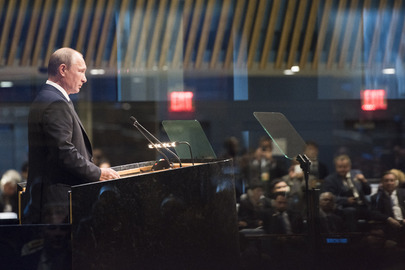
Russian President Vladimir Putin (UN Photo)
Russia may not be experiencing dynamic growth, but over the past two years it has survived a crisis of circumstance in depressed oil prices and economic warfare against it by the West that would have felled less competently managed governments enjoying less robust popularity than is the case in Vladimir Putin’s Russia. Moreover, as stagnant as Russia’s GNP has been, the numbers have been on a par with Western Europe’s very slow growth.
Meanwhile, Russian agriculture is booming, with the 2017 grain harvest the best in 100 years despite very adverse climatic conditions from early spring. In parallel, domestically produced farm machinery has been going from strength to strength. Other major Industrial sectors like civil aircraft production have revived with the launch of new and credible models for both domestic and export markets.
Major infrastructure projects representing phenomenal engineering feats like the bridge across the Kerch straits to Crimea are proceeding on schedule to successful termination in the full glare of regular television broadcasts. So where is this decrepit Russia that our Western commentators describe daily?
The chief reason for the many wrongheaded observations is not so hard to discover. The ongoing rampant conformism in American and Western thinking about Russia has taken control not only of our journalists and commentators but also of our academic specialists who serve up to their students and to the general public what is expected and demanded: proof of the viciousness of the “Putin regime” and celebration of the brave souls in Russia who go up against this regime, such as the blogger-turned-politician Alexander Navalny or Russia’s own Paris Hilton, the socialite-turned-political-activist Ksenia Sochak.
Although vast amounts of information are available about Russia in open sources, meaning the Russian press and commercial as well as state television, these are largely ignored. The sour grapes Russian opposition personalities who have settled in the United States are instead given the microphone to sound off about their former homeland. Meanwhile, anyone taking care to read, hear and analyze the words of Vladimir Putin becomes in these circles a “stooge.” All of this limits greatly the accuracy and usefulness of what passes for expertise about Russia.
In short, the field of Russia studies suffers, as it also did during the heyday of the Cold War, from a narrow ideological perspective and from the failure to put information about Russia in some factually anchored framework of how Russia fits in a comparative international setting.
Just what this means was brought into perspective last week by a rare moment of erudition regarding Russia when professor emeritus of the London School of Economics Dominic Lieven delivered a lecture in Sochi at the latest Valdai Club annual meeting summarizing his take on the Russian Revolution of 1917.
Lieven, arguably the greatest living historian of imperial Russia, is one of the very rare birds who brought to his Russian studies a profound knowledge of the rest of the world and in particular of the other imperial powers of the Nineteenth Century with which Russia was competing. This knowledge takes in both hard and soft power, meaning on the one hand, military and diplomatic prowess and, on the other, the intellectual processes which are used to justify imperial domination and constitute a world view if not a full-fledged ideology.
Self-blinded ‘Experts’
By contrast, today’s international relations “experts” lack the in-depth knowledge of Russia to say something serious and valuable for policy formulation. The whole field of area studies has atrophied in the United States over the past 20 years, with actual knowledge of history, languages, cultures being largely scuttled in favor of numerical skills that will provide sure employment in banks and NGOs upon graduation. The diplomas have been systematically depreciated.
The result of the foregoing is that there are very few academics who can put the emerging Russian-Chinese alliance into a comparative context. And those who do exist are systematically excluded from establishment publications and roundtable public discussions in the United States for not being sufficiently hostile to Russia.
If that were not the case, one could look at the Russian-Chinese partnership as it compares firstly with the American-Chinese partnership created by Richard Nixon and Henry Kissinger, which is now being replaced by the emerging Russian-Chinese relationship. Kissinger was fully capable of doing this when he wrote his book On China in 2011, but Kissinger chose to ignore the Russian-Chinese partnership though its existence was perfectly clear when he was writing his text. Perhaps he did not want to face the reality of how his legacy from the 1970s had been squandered.
What we find in Kissinger’s description of his accomplishments in the 1970s is that the American-Chinese partnership was all done at arm’s length. There was no alliance properly speaking, no treaty, in keeping with China’s firm commitment not to accept entanglement in mutual obligations with other powers. The relationship was two sovereign states conferring regularly on international developments of mutual interest and pursuing policies that in practice proceeded in parallel to influence global affairs in a coherent manner.
This bare minimum of a relationship was overtaken and surpassed by Russia and China some time ago. The relationship has moved on to ever larger joint investments in major infrastructure projects having great importance to both parties, none more so than the gas pipelines that will bring very large volumes of Siberian gas to Chinese markets in a deal valued at $400 billion.
Meanwhile, in parallel, Russia has displaced Saudi Arabia as China’s biggest supplier of crude oil, and trading is now being done in yuan rather than petrodollars. There is also a good deal of joint investment in high technology civilian and military projects. And there are joint military exercises in areas ever farther from the home bases of both countries.
I think it is helpful to look at this partnership as resembling the French-German partnership that steered the creation and development of what is now the European Union. From the very beginning, Germany was the stronger partner economically with France’s economy experiencing relative stagnation. Indeed, one might well have wondered why the two countries remained in this partnership as nominal equals.
The answer was never hard to find: with its historical burden from the Nazi epoch, Germany was, and to this day remains, incapable of taking responsibility in its own name for the European Union. The French served as the smokescreen for German power. Since the 1990s, that role has largely been transferred to the E.U. central bodies in Brussels, where key decision-making positions are in fact appointed by Berlin. Yet, France remains an important junior partner in the German-driven process.
The Russian-Chinese Tandem
One may say much the same about the Russian-Chinese tandem. Russia is essential to China because of Moscow’s long experience managing global relations going back to the period of the Cold War and because of its willingness and ability today to stand up directly to the American hegemon, whereas China, with its heavy dependence on its vast exports to the U.S., cannot do so without endangering vital interests. Moreover, since the Western establishment sees China as the long-term challenge to its supremacy, it is best for Beijing to exercise its influence through another power, which today is Russia.
Of course, in light of the E.U.’s Brexit troubles and Trump’s abandonment of world leadership, it is undeniably possible that China will step out of the shadows and seek to assume direction of global governance. But that would be problematic. China faces major domestic challenges including the transition of its economy from being led by exports to relying more on domestic consumption. That will absorb the attention of its political leadership for some time.
Kissinger, who has been an adviser to Trump, whispers in Trump’s ear about the importance of separating Russia from China, but Kissinger’s limited and outdated knowledge of Russia has caused him to underestimate the powerful motives behind the Russian-Chinese relationship. America’s less gifted and informed pundits are even more clueless.
For one thing, given the sustained hostility directed at Russia from the West in general and from Washington in particular, it is inconceivable that Putin would be wooed away from Beijing by some flirtatious “come hither” gestures from the Trump administration even if that were politically possible for Trump to do. One of Putin’s outstanding features is his loyalty to his friends and his principles as well as to his nation’s interests.
As Putin revealed during his address and Q&A at the Valdai Club gathering this past week, he now bears a deep distrust of the West in light of its having taken crude advantage of Russia’s weakness in the 1990s and by its expansion of NATO to Russian borders and other threatening actions. Whatever hopes Putin once may have held for warmer relations with the West, those hopes have been dashed over the past several years.
Putting personalities aside, Russian foreign policy has a commonality that is rare to see on the world stage: actions first, diplomatic charters later. Russia’s political relations with China come on top of massive mutual investments that have taken many years to agree on and execute.
In the same way, Russia is proceeding with Japan to work towards a formal peace treaty by first putting in place massive trade and investment projects. It is entirely foreseeable that the first step to the treaty will be the start of construction in 2018 of a railway bridge in the Far East linking the Russian island of Sakhalin with the mainland. The general contractor and engineering team is also in place: Arkady Rotenberg and his SGM Group. That bridge is the prerequisite for Japan and Russia signing a $50 billion deal to build a railway bridge linking Sakhalin and Hokkaido. This bridge will draw the attention of the whole region to Russian-Japanese cooperation. It could be the foundation for a durable and not merely paper peace treaty resolving the territorial dispute over the Kurile Islands.
Lost Opportunities
In light of these realities, it is puerile to speak of detaching Russia from China with the promise of normalized relations with the West. The opportunity to do that existed in the 1990s, when President Boris Yeltsin and his “Mr. Yes” Foreign Minister Andrei Kozyrev did everything possible to win U.S. agreement to Russian accession to NATO immediately following accession by Poland. To no avail.
Then again early in Putin’s presidency, the Russians made a determined effort to win admission to the Western alliance. Again to no avail. Russia was excluded, and measures were taken to contain it, to place it in a small box as just another European regional power.
Finally, following the confrontation with the United States and Europe over their backing of the 2014 coup in Ukraine, followed by the Russian annexation/merger with Crimea, and Russian support for the insurgency in Ukraine’s Donbas region, Russia openly was cast as the enemy. It was compelled to mobilize all of its friendships internationally to stay afloat. No state was more helpful in this regard than China. Such moments are not forgotten or betrayed.
The Kremlin understands full well that the West has nothing substantial to offer Russia as long as the U.S. elites insist on maintaining global hegemony at all costs. The only thing that could get the Kremlin’s attention would be consultations to revise the security architecture of Europe with a view to bringing Russia in from the cold. This was the proposal of then President Dmitry Medvedev in 2010, but his initiative was met by stony silence from the West. Bringing in Russia would mean according it influence proportionate to its military weight, and that is something NATO has opposed tooth and nail to this day.
It is for this reason, the failure to seek solutions to the big issue of Russia’s place in overall security, that the re-set initiative under Barack Obama failed. It is for this reason that Henry Kissinger’s advice to Donald Trump at the start of his presidency to offer relief from sanctions in return for progress on disarmament rather than implementation of the Minsk accords regarding the Ukraine crisis also failed, with Vladimir Putin giving a firm “nyet.”
Implicit in the few American “carrots” being extended to Russia these days is its acceptance of the anti-Russian regime in Ukraine and its authority over the heavily ethnic Russian areas of the Donbas and Crimea, concessions that would be politically devastating to Putin inside Russia. Yet, that “normalization” would still leave the much milder but still nasty “human rights” sanctions that the U.S. imposed in 2012 through the Magnitsky Act, driven by what the Kremlin regards as false propaganda surrounding the criminal case and death of accountant Sergei Magnitsky.
The sting of the Magnitsky Act was to discredit Russia and prepare the way for it being designated a pariah state. It came amidst an already longstanding campaign of demonization of the Russian president in the U.S. media. In fact, to begin to find a halfway normal period of bilateral relations, you would have to go back to before George W. Bush’s invasion of Iraq, which Russia denounced along with Germany and France. The latter two powers got a tap on the wrist from Washington. For Russia, it was the start of a period of reckoning for its uncooperativeness with American global domination.
Demonizing Russia
As for Europe and Russia, the question is very similar. To find mention of a strategic relationship, firstly from the German Foreign Ministry, you have to go back to before 2012. And what constituted normality then? At the time, renewal of the E.U.-Russia cooperation agreement was already being held up for years, nominally over a difference of views on the provisions of E.U. law governing gas deliveries through Russian-owned pipelines. Behind this difference was the total opposition of the Baltic States and Poland to anything resembling normal relations with Russia, for which they received full encouragement from the U.S.
The rallying cry was to put a stop to Russia’s status as “monopoly supplier” to Europe as regards gas, but also oil. Of course, no monopoly ever existed, nor does it exist today, but determined geopolitical actors never let such details stand in the way of policy formulation.
This hostility also played out in the contest of wills between the E.U. and Russia over introduction of a visa-free regime for travel by their respective citizens. Here the opposition of Germany’s Angela Merkel, justified by her vicious characterization of Russia as a mafia state, doomed the visa-free regime and by the same token doomed normal relations.
All of this unfinished business has to be addressed and put right for there to be any possibility of the U.S. and the E.U. ending their hostility toward Russia and for the Kremlin to regain any trust toward the West. Even then, however, Russia would not surrender its valued relationship with China.
In my view, the de facto Russian-Chinese alliance matches the de jure US-West European alliance. The net result of both is the partition of the world into two camps. We now have, in effect, a bipolar world that broadly resembles that of the Cold War, though still in a formative stage since many countries have not signed on definitively to one side or another.
Of course, more-or-less neutral states were also a feature of the Cold War, creating what was called the group of Nonaligned Nations, led back then by India and Yugoslavia. Yugoslavia no longer exists, but India has continued its tradition of let both poles court it, trying to eke out the greatest benefit to itself.
To be sure, a great many political scientists in the U.S., in Europe and in Russia as well, insist that we already have a multipolar world, saying that power is too diffuse in the world today, especially considering the rise of non-state actors after 1991. But the reality is that very few states or non-states can project power outside their own region. Only the two big blocs can do that.
The theoreticians defending multipolarity speak of a return to the balance of power of the Nineteenth Century, invoking the Congress of Vienna as a possible model for today’s world governance. This is an approach that Henry Kissinger laid out in 1994 in his book Diplomacy.
Within Russia, this concept has found support in some influential think tanks and is most notably associated with Sergei Karaganov, head of the Council of Foreign and Defense Policy. Nonetheless, I maintain that everyday realities of power will decide this question. And is there anything inherently wrong with this de facto bipolar world, assuming the tensions can be managed and a major war averted?
In my view, two large blocs are more likely to keep global order because the scope of activities by proxies can be reined in – as often happened during the Cold War – by big powers not wanting their various clients to disrupt a functioning world order. The tails are less likely to wag the dog.
Moreover, as regards the Russia-China strategic partnership or alliance, Western observers should take comfort and not take alarm. The rise of China is a given whatever the constellation of great powers may wish. The close embrace of Russia and China also can serve as a moderating influence on China, given Russia’s greater experience in world leadership.
For all of the above positive and negative reasons, the Russia-China relationship should be viewed with equanimity in Western capitals.
Gilbert Doctorow is an independent political analyst based in Brussels. His latest book, Does the United States Have a Future? was just published.
US Targets Russian Nord Stream-2 Gas Project: Déjà Vu Story
By Peter KORZUN | Strategic Culture Foundation | 23.10.2017
The US Countering Iran’s Destabilizing Activities Act of 2017 contains a separate section called the Countering Russian Influence in Europe and Eurasia Act (“CRIEEA”). CRIEEA authorizes – and at times requires – the President to impose significant new sanctions on the Russian energy, financial, and defense sectors, imperiling the completion of the Russian Nord Stream 2 gas pipeline. It also hits European businesses involved in the project. The legislation can impact a potentially large number of European companies doing legitimate business under EU measures with Russian entities in the railways, financial, shipping or mining sectors, among others. Now the US punitive measures could include the pipelines crossing the territory of Ukraine, as well as pipeline projects in the Caspian region and the development of the Zohr gas field off the coast of Egypt. The law negatively affected the US relationship with European allies.
Russian President Vladimir Putin believes that the world is witnessing an increasing number of examples of politics crudely interfering with economic, market relations. In his address to the final plenary session of the 14th annual meeting of the Valdai Discussion Club on October 19, Putin said “Some do not even conceal that they are using political pretexts to promote their strictly commercial interests. For instance, the recent package of sanctions adopted by the US Congress is openly aimed at ousting Russia from European energy markets and compelling Europe to buy more expensive US-produced LNG although the scale of its production is still too small.”
The US is striving to control the EU decision-making process. According to Washington’s logic, building a pipeline to reduce costs and raise reliability and efficiency proves that Russia is politically motivated, unlike the US with its new law adopted to pave the way for American LNG exports to Europe using coercive measures! The US staunch allies ready to cede economic profits for Washington’s friendship – Poland, the Baltic States, and, since recently, Denmark – are mobilized to hinder Nord Stream-2. Not an EU member, but a member of Energy Community, Ukraine also goes to any length to obstruct the project.
Poland tried to reverse the EU decision through courts but to no avail. In July, a court in Duesseldorf, Germany, lifted restrictions on Russian gas company Gazprom’s access to the German Opal gas pipeline, online documentation by the court showed, echoing a ruling on July 21 by the European Union General Court.
Defying the US pressure, the EU exempted OPAL gas pipeline (delivering gas from Russian Nord Stream to Europe) from the Third Energy Package after 6 years of debates. The decision opened the way for Russian plans to expand Nord Stream’s capacity and bypass both Ukraine and Poland as a gas transit route. The Western companies have immediate interests in Nord Stream 2, which is a joint venture between Gazprom (50% share) and five of the largest European energy companies: E.ON, OMV, Shell, BASF/Wintershall and Engie (each 10% share).
Actually, this is a déjà vu story. Washington has a long history of meddling into European energy policy. The Yamal and Nord Stream 2 gas projects present several striking similarities. In 1980-81, the Yamal pipeline (Urengoy-Pomary-Uzhgorod) project was presented to be negotiated between the Soviet Union (Soyuzgazexport) and Western Europeans (Ruhrgas and Gaz de France). Back then, West Germany’s Chancellor Helmut Schmidt was willing to preserve the achievements of Willy Brandt’s Ostpolitik. The USSR and West Germany concluded an agreement on the deal in November 1981.
The joint project was fiercely fought by President Ronald Reagan. He saw Yamal through a geopolitical lens and considered it one of the Soviet Union’s significant tools aimed at spreading Moscow’s influence over the Europeans, and in particularly over NATO. The US launched a coordinated diplomatic offensive aimed at convincing European allies to abandon their participation in the Yamal project. It offered to supply West Germany with energy in the form of coal, but his proposal was turned down as not viable economically.
Those were the days of great tensions between the West and the East marked by NATO’s deployment of intermediate range ground-based missiles in Italy, the UK, West Germany, the Netherlands and Belgium. In 1979, the USSR launched an operation in Afghanistan.
The US insisted the Yamal project threatened NATO security just like nowadays Nord Stream-2 does amid the Russia-West divisions over Ukraine and a host of other issues. President Reagan used the geopolitical tensions as a pretext to deprive the Soviet Union of profits. With Germany refusing to bow, the US administration used the Polish crisis in 1980-1981 to impose sanctions banning sales of equipment to the USSR.
In December, 1981, President Reagan banned all the gas and oil equipment and technology exports produced in the United States to the Soviet Union. In June, 1982, the US administration announced the extension of the sanctions on all foreign companies exporting equipment involving American technologies. The US sanctions drove a wedge between the United States and its Western European allies, as the latter refused to follow the lead. The landmark deal went through to be joined by France, Austria and Italy. West German, French, Italian and British companies won multi-million contracts for pipes and various equipment orders. The America embargo was lifted in 1982. In 1984, the Yamal pipeline became operational to benefit all.
Today, the US uses Ukraine instead of Poland but the goal and the methods to achieve it remain the same.
If Germany had not had the advantage of stable gas supplies from Russia, it would not have become the locomotive driving the European economy and the EU leader defining the decision making process. Other European countries have also gained a lot. Today, the demand for Russian gas keeps on growing to make Moscow increase supplies via the pipeline going through Ukraine and Nord Stream. Europe badly needs the stable supplies, if it wants to achieve economic progress. To protect its vital interests it has to defy the United States. The history appears to repeat itself.
How Much America’s Tax Payers Pay for the Pentagon’s Global Presence
By Denis Bototsky | Sputnik | October 20, 2017
America’s military presence has been the cause of protests in many countries where US troops are stationed – among them Japan, South Korea and Germany. But besides problems with the allies, maintaining military infrastructure overseas is a heavy burden for US taxpayers, costing them billions of dollars annually.
At the turn of the millennium, the United States went on a massive military spending binge. According to the 2010 report “Debt, Deficits & Defense”, within several years of 9/11, the budget of the Department of Defense grew by 119%. Barack Obama and his predecessor George W. Bush were ruling a nation which was fighting wars in Iraq and Afghanistan, but even with war costs subtracted, the increase was at 68%, which is 13% more than the sum allocated for health and human services.
Pentagon’s global military presence has always been a costly affair. David Vine is the author of the book “Base Nation: How U.S. Military Bases Abroad Harm America and the World”. In his 2015 New York Times Op-Ed he wrote that the US taxpayers spent 10 to 40 thousand dollars a year more for each service member stationed abroad, compared with those at home.
Even though Barack Obama promised to withdraw American troops from the conflict zones, the process of closing US overseas military facilities looked like a shell game. While some bases, like the ones in Europe, were closed, Uncle Sam spent billions building new military infrastructure in other locations, such as the Persian Gulf and Asia Pacific.Ron Paul – a former US congressman and the founder of the Ron Paul Peace Institute – addressed the wasteful military spending in one of his columns in November of 2016, saying that military expenses should not be confused with the defense budget. While defense expenses are vital, military spending, according to Paul, is the money spent not to defend the United States, but “to enrich the military-industrial complex, benefit special interests, regime-change countries overseas.” In his article, the former politician wrote that some activities of the US military and intelligence services abroad may lead to the country’s economic collapse:
“Do we really need 800 US military bases in more than 70 countries overseas? Do we need to continue to serve as the military protection force for our wealthy NATO partners even though they are more than capable of defending themselves? Do we need our CIA to continue to provoke revolutions like in Ukraine or armed insurgencies like in Syria? If the answer to these questions is “yes,” then I am afraid we should prepare for economic collapse in very short order.”
Donald Trump shared the same concerns about America’s NATO allies, when he called the organization obsolete during his campaign. Trump upheld some of his criticism during the 2017 NATO summit in Brussels when he called on the wealthy organization members to increase their defense spending.
However, it seems that Trump’s words have fallen on deaf ears. Germany still spends just 1.26% of its GDP on defense (which is much less than the 2% pledge made by NATO member states in 2014), so paying for the maintenance of the large military facilities, such as Ramstein Airforce Base, which also hosts NATO Allied Air Command, is a heavy burden for America’s taxpayers.
In 2015, David Vine estimated that the annual price for maintaining US military facilities and troops abroad was about $85 billion. He wrote that closing down foreign and domestic military facilities will contribute to improving the country’s financial and physical security.
However, with Donald Trump’s recent proposals to increase military spending, it seems that the chances of seeing major changes in the US global military presence strategy in the near future are slim.
Yet Another ‘Russian Invasion’ Reported, Debunked in Norway
Sputnik | October 20, 2017
A Norwegian defense portal has caused a hullaballoo with its claims that Russia staged a mock invasion of the key Arctic archipelago of Svalbard, despite the Nordic country’s own defense and intelligence bosses vehemently denying such assertions.
Amid the recent cooling between Russia and the West, the Norwegian defense portal Aldri Mer (“Never again”) shocked compatriots with claims that the Russians “trained to invade” Svalbard, a crucial Norwegian archipelago, during the recent exercise Zapad 17. According to Aldri Mer, Russia waged not one but two simulated attacks on Svalbard. Norwegian forces were allegedly taken by surprise, with Norwegian jets reportedly being unable to fend off the intruder.
Aldri Mer based its allegations on information by six anonymous sources from within the Norwegian defense establishment and NATO. According to Alrig Mer, Norway’s inability to provide intelligence irritated NATO officials and set off a series of crisis meetings to discuss what was described as a “complete loss of situational awareness in the north.”
Lieutenant Colonel Ivar Moen of the Norwegian Joint Military Headquarters outside Bodø said that Norwegian authorities did not want to speculate over exercise scenarios employed by Russian forces. Furthermore, Lieutenant General Morten Haga Lunde of Norway’s military intelligence unit (E-tjenesten) repudiated Aldrig Mer’s report as erroneous, while insisting that his intelligence unit had “extremely good oversight and understanding of the situation,” especially before, during and after Russian drills, Norwegian national broadcaster NRK reported. Former Defense Minister Ine Eriksen Søreide, who recently went on to become Norway’s first female Foreign Minister, claimed that no type of simulated attack was either seen or reported, stressing that her country received much praise from NATO for its good surveillance capacity.
Aldig Mer’s editor-in-chief Kjetil Stormark nevertheless held his ground, citing “clarification problems” on E-tjenesten’s part and referring to “entirely different Russian training patterns” established by NATO specialists.
Meanwhile, the wholly unsubstantiated idea of Russian “hostile takeover” is often being pedaled in Nordic media to justify increased military spending or increased cooperation with NATO. In 2014 and 2015, Russian troops were thus claimed to have staged a huge military exercise in the Baltic that simulated an occupation of Denmark’s Bornholm, Sweden’s Gotland, Finland’s Åland and northern Norway.
The Zapad-2017 maneuvers were held on September 14-20 on the territory of Russia and Belarus and were highlighted as a threat amung Norway’s fellow Nordic countries, such as Sweden, which held simultaneous drills featuring US tanks and aircraft.The Svalbard archipelago lies halfway between northernmost Norway and the North Pole and boasts a population of 2,600. According to the Svalbard treaty signed in the 1920s, the archipelago of Svalbard is under Norwegian control. However, the USSR (and by extension Russia) has historically had a physical presence on the archipelago. The community of Barentsburg has been long limited to coal mining operations, but has been recently boosted by investment and renovation for, among other things, scientific purposes.
According to Norway’s military doctrine, Russia is identified as a major threat, which has led to the Nordic country boosting its spying capacity with a reconnaissance ship, the MS Marjata, and surveillance aircraft.
The goal of the Aldri Mer website is to ensure that Norway never gets invaded again, as it was by Nazi German forces in 1940. Ironically, it was the Russians who liberated northern Norway in 1944.
Fueling More Bloodshed in Ukraine
By James W. Carden | Consortium News | October 14, 2017
Last January, Sen. John McCain led a delegation along with his longtime sidekick, Sen. Lindsey Graham, to a contingent of Ukrainian troops not far from the front line in eastern Ukraine. In the presence of Ukrainian President Petro Poroshenko, Graham told the soldiers: “Your fight is our fight … 2017 will be the year of offense. All of us will go back to Washington and we will push the case against Russia.”
McCain promised the assembled troops, “we will do everything we can to provide you with what you need to win.”
When contemplating the long careers of the two Republican senators, it is hard to escape the conclusion that McGeorge Bundy’s quip about the famed Cold War columnist Joe Alsop – that he had “never known him to go to any area where blood could be spilled that he didn’t come back and say more blood” – applies equally to McCain and Graham.
Indeed, last month’s National Defense Authorization Act shows that – if nothing else – McCain and Graham are as good as their word: the recently passed defense appropriations bill provides for $500 million, including “defensive lethal assistance” to Kiev, as part of a $640 billion overall spending package.
The aid comes at a good time for the embattled Ukrainian President Poroshenko, whose approval rating hovers around 16 percent. In a bid to stave off the possibility of a far-right coup d’etat, Poroshenko is back to banging the war drums, promising, well, more blood.
In a little covered speech at the U.S. Military Academy at West Point on Sept. 19, Poroshenko promised that “American weapons will help us liberate the Donbas and return Ukrainian territories.” He also noted that Ukraine spends roughly 6 percent of its GDP on defense, “a figure,” he observed, “much bigger than the obligation for the NATO members.”
Clearly Washington’s condemnation of governments that wage war “against their own people” remains selective, contingent upon who is doing the killing and who is doing the dying. In this case, it would seem that Russian-speaking Ukrainians simply don’t rate.
In addition to promising a wider war in the Donbas, Poroshenko has repeatedly promised that he will seek NATO membership. In August, during a visit by U.S. Defense Secretary James Mattis, Poroshenko declared: “Our Ukrainian caravan is on a roll and we have one road to travel upon — a wide Euro-Atlantic highway, leading to membership in the European Union and NATO.”
Ukraine’s Human Rights Abuses
There are a number of objections to yet another round of NATO expansion. As I reported in February 2015: “The current [Ukrainian] government has, according to organizations that could hardly be described as Kremlin friendly (Human Rights Watch, Amnesty International, the Organization for Security and Cooperation in Europe), committed war crimes in its attempt to defeat the Russian-backed separatists in the Donbas. … NATO’s principal consideration should not be whether NATO will make Ukraine more secure, but whether Ukraine will make NATO more secure. The answer is self-evident.”
It is true that NATO Secretary General Jens Stoltenberg, as recently as this month, insisted to Russian state media that NATO is not contemplating Ukrainian membership, telling Sputnik that “There is no MAP [membership action plan] on the agenda.” Yet Stoltenberg has also said, as he did in a speech to the Ukrainian parliament in July, that he believes Ukraine “has the right to choose its own security arrangements” further noting that “last month, NATO welcomed Montenegro as the 29th member of our Alliance. This shows that NATO’s door remains open.”
So the issue doesn’t seem to be going away.
Poroshenko’s push to join NATO, which is being made against the backdrop of ever-worsening relations between the U.S. and Russia, ignores, perhaps purposefully, one of the principal causes of the morass in which Kiev and Moscow find themselves. It was Moscow’s not unfounded fear that Ukraine might join NATO that helped spark the Ukrainian crisis in early 2014.
In the weeks prior to Russia’s annexation of Crimea (and just over a month before the outbreak of full hostilities in the Donbas), three former presidents of Ukraine (Leonid Kravchuk, Leonid Kuchma and Viktor Yushchenko) called on the post-Maidan regime to renounce the 2010 Kharkiv agreement which allowed for Russia to base its Black Sea naval fleet in Crimea (in return for discounted prices on Russian natural gas).
It is perhaps not unreasonable that this last move, in addition to the foreign policy and security protocols embedded within the European Union Association agreement (which Poroshenko signed in June 2014), would cause the Russian government to at the very least suspect that NATO was setting the stage for Ukraine’s eventual absorption into the alliance.
Indeed, Kiev’s launch of its violent and indiscriminate “Anti-Terrorist Operation” against the Donbas – with the effect of intimidating and alienating otherwise loyal Russian-speaking citizens in the eastern part of the country – surely played a role in the Kremlin’s decision to come to the aid of the rebels later in the summer of 2014 and again at Debaltseve early the following year.
Less Dangerous Options
One reasonable alternative to NATO membership would be a treaty along the lines of the 1955 Austrian State Treaty, which was an agreement reached between the four post-World War II occupying powers (U.S., USSR, Great Britain and France) that granted Austria its independence “with the understanding,” according to the U.S. State Department, “that the newly independent state of Austria would declare its neutrality, creating a buffer zone between the East and the West,” meaning it would join neither NATO nor the Soviet-run Warsaw Pact.
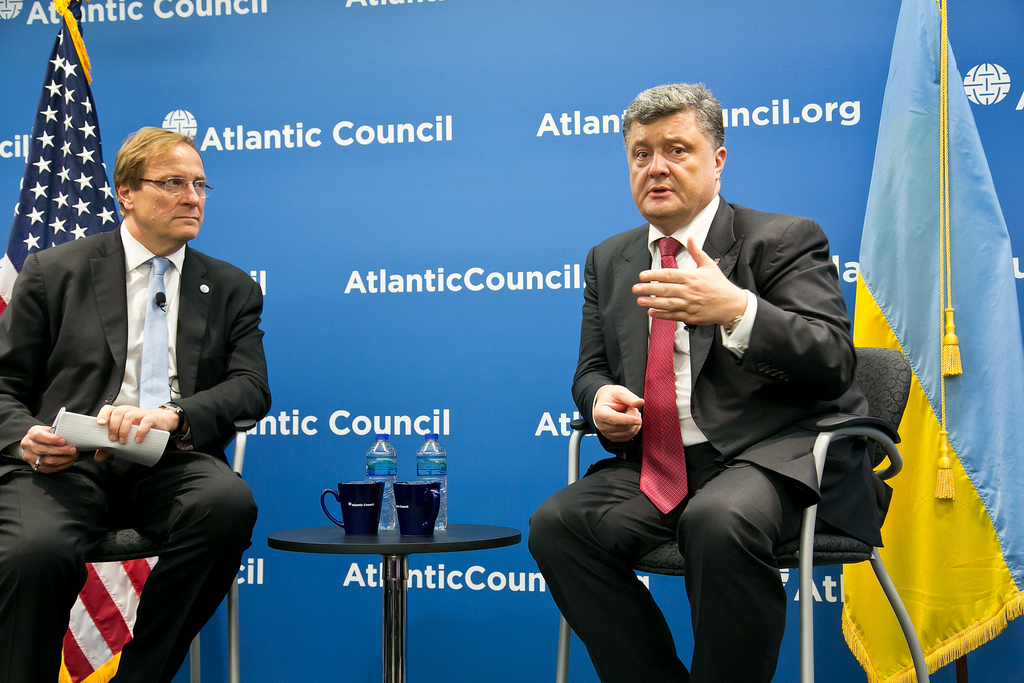
Petro Poroshenko in 2014 (Photo credit: Atlantic Council)
Charles Bohlen, the legendary American diplomat who served as ambassador to Moscow from 1953-57, recalled in his memoir Witness To History that, with regard to the Austrian State Treaty, he believed “that the Kremlin leaders, and probably the Soviet military chiefs, decided that a genuinely neutral Austria was of more value to Soviet Russia than the maintenance of a divided country where the Red Army would occupy only the poorer half.”
The situation in postwar Austria – occupied by East and West – is not perfectly analogous to the situation that obtains in Ukraine today, but there seem to be lessons from what Bohlen intuited were the Kremlin’s motives that might be drawn upon to inform Western diplomacy.
But instead of trying to implement the Minsk peace agreement (which calls for the Donbas to remain as part of Ukraine but with more autonomy from Kiev) or search for a reasonable alternative to what are indeed perplexing and pressing matters of national security, Poroshenko has continued to ring one alarm over another, this time illusory, Russian invasion.
In a recent speech before the Ukrainian parliament, Poroshenko claimed “there is more and more evidence for [Russia’s] preparations for an offensive war of continental proportions.”
Yet perhaps the danger isn’t as clear and present as Poroshenko portrayed it. As Mary Dejevesky of the U.K.’s Independent has observed: “NATO itself had held exercises in the Black Sea and before that in and around the western borderlands of Ukraine. Who, it has to be asked here, is threatening whom?”
Indeed, if Russia was on the precipice of launching a land war in Eastern Europe, would it have cut its defense budget by 25 percent to $48 billion a year, as was recently announced by the Kremlin?
As difficult as it might be for our hearty band on new cold warriors to believe (some of whom have scant knowledge about the topic of U.S.-Russia relations on which they so frequently choose to declaim), the push for a peaceable settlement in Ukraine is coming not from Washington, but from Moscow and Berlin.
Nevertheless, the stalemate continues: a resolution to the Ukrainian conflict – through the implementation of the Minsk agreements, as well as a settlement of the outstanding security concerns of all parties to the conflict – seems to remain tragically out of reach.
James W. Carden served as an adviser on Russia policy at the US State Department. Currently a contributing writer at The Nation magazine, his work has appeared in the Los Angeles Times, Quartz, The American Conservative and The National Interest.
Featured Video
New positive ivermectin evidence
or go to
Aletho News Archives – Video-Images
From the Archives
Fanatical Followers of the Covid Regime: A Jim Jones-Style Cult?
By Professor Roger Watson and Dr. Niall McCrae | The Daily Sceptic | November 15, 2021
As scholars at leading British universities over recent decades, we witnessed the replacement of critical thinking and debate by narrative: facts are discrimination and scientific method is imperialism; truth, instead, is derived from ‘progressive’ values. This educational trend may be a major contributory factor to the ease in which society has been inculcated to the Covid ‘new normal’ of masking, testing, and repeated doses of vaccines for a disease of similar risk to severe influenza.
One doesn’t need much critical reasoning to observe the flawed logic of some vaccination enthusiasts, such as people who respond to experiencing any side effects, however debilitating, by saying “at least I know it’s working”, or, after contracting the disease despite their promised inoculation (over 90% effective, according to initial drug company claims), “I’d have been worse off without the jab.” … continue
Blog Roll
 Aletho News
- Najaf airport to reopen to Iranian flights within 24 hours: Ambassador
- From ‘How Will This End For Iran’ to ‘When America Walks Away’: A tale of two Economist covers
- Tehran blasts ‘baseless’ speculation linking Iran to alleged bomb plot at UK air base
- The Rise And… Rise Of ‘Color Revolutions’
- The Coming GOP Bloodbath?
- Arctic Scare Stories Melt Away
- Wrong, Euronews: Climate Change Has Not Created a Food, Energy, and Economic “Meta-Crisis”
- New positive ivermectin evidence
- Met Office Caught Fabricating Daily Temperature Record Claims
- Merck Virologists Admitted to Falsely Certifying Vaccine Efficacy
- If Americans Knew
- Netanyahu Asked UAE Leader to Deny Report on Oct. 7 Warning in Secret Visit, Sources Say
- CNN Chief Int’l Correspondent Clarissa Ward on Journalists in Gaza
- Democratic Party Consultants Surround Troy Jackson with Pro-Israel Donors
- Christian Leader Responds To Netanyahu’s Claims Regarding Palestinian Christians
- In Gaza, ‘Whoever Survives the Bombing Won’t Survive the Rubble’
- Israel kills more Palestinians, amid push to resettle Gaza – Daily Update
- Israel forces Gazans to live in constant peril – Daily Update
- Deconstructing Netanyahu’s pants-on-fire UN rant – Daily Update
- Trump betrayed voters with his campaign lies and prioritized a foreign country once he took office
- Netanyahu calls Israel’s war in Gaza ‘opposite of genocide’ in UN speech to near-empty hall
- No Tricks Zone
- New Study: Earth And Venus Surface Warmth Largely Explained By Convection And Lapse Rate, Not CO2 Or Radiation
- 2025 Nature Paper Claiming Worsening Global Drought Gets RETRACTED …Heavily Flawed
- New Study: ‘Global Drought Shows No Detectable Recent Acceleration Under Climate Warming’
- Economic Masterminds: German Socialists Suggest Taxing Productivity Gains Stemming From Using AI
- The South China Sea Has Not Been Cooperating With The Climate Change Narrative
- Energy Crisis: Germany Enters Heating Season With Historically Low Gas Reserve Fill Levels
- New Study: The Antarctic Ice Sheet Gained Mass From 2020-2024 Due To Staggering Snow And Ice Accumulation
- Study: Ocean Heating Rates From Thousands Of Years Ago ‘Dwarf’ Modern Ocean Heating Rates
- Climate Extremists Target, Attack Large-Scale Power Grid Infrastructure In Germany!
- New Study: Antarctic Ice Melt Has Contributed Less Than 1 Centimeter To Sea Level Rise In The Last 30 Years


