Draining the Swamp at State
Photo by thierry ehrmann | CC BY 2.0
By Renee Parsons | CounterPunch | November 22, 2016
If there is one hopeful sign in the Presidency of Donald Trump, it is his pledge to ‘drain the swamp’ as it relates to those special insider interests who run the show and those outsider interests who own the show.
It is a hugely ambitious task and hardly achievable in four short years but there is a branch of the Federal government where the President-elect (PE) would find immediate results and bring the satisfaction that American foreign policy would no longer be dependent on globalization or spreading unwinnable wars on wasteful adventurism overseas. If the PE is, in fact, favorable towards a non-interventionist role, the opportunity for a thorough housecleaning and a reshape of the State Department is Now. According to current reports, the struggle is underway within the transition team for the soul of the State Department and ultimately the Trump Administration.
As HRC continued her crazed war talk about Syria and defended NATO encroachment on Russian borders while uttering unprovoked attacks on Russian President Vladimir Putin, there was every reason to believe that minutes after concluding her inaugural address, HRC would have walked off the stage and signed the order initiating a No-Fly Zone over Syria, right then and there. And bingo-bango-bongo, Putin would have responded. I knew it as sure as I know my own name. At some point it became clear, as Green Party candidate Jill Stein said so precisely, HRC would be more dangerous than Donald Trump.
Even as he talked about modernizing the US military, Trump’s campaign rhetoric about disentangling from foreign entanglements, making NATO nations pay their fair share and dialogue with Putin rather than the usual “Blame it on the Russians” bombast, struck a chord; there was reason for hope. Unlike Bernie Sanders who has proven to be just another Democrat, Trump dared to question whether there were any ‘moderate’ rebels (aka terrorists) in Syria, the mythical existence of which justified the Obama administration’s lust to overthrow the Assad government. Trump’s positions, limited elucidation though there was, were always far more reasonable than HRC’s inflammatory saber rattling and aggressive militarism that stirred justified fears of WW III. If anyone bothered to listen, Trump was voicing foreign policy concerns that not one Democrat in Congress has dared to articulate in the last eight years.
While I am in the ‘wait and see’ category of pragmatists regarding the PE, I agree with Robert Parry’s point that Trump has the opportunity to be a truly great president IF, and it’s a big IF, he uses his inner grit and a street savvy to break the globalist/neoliberal/neocon stranglehold (with its links to shadow government) on foreign policy at the State Department, a concept that President Barack Obama never understood or even aspired to. The PE appointment for Secretary of State which is currently an intense subject of debate within the transition will indicate which direction the PE will take US foreign policy.
In the early days after the election Trump communication advisor Jason Miller offered reassurance with the following:
“There will be non-traditional names, a number of people who have had wide-ranging success in a number of different fields; wide-ranging success in business … People will be excited when they see the type of leaders the President-elect brings into this administration.”
One not so non-traditional and not so exciting appointment is that of Rep. Mike Pompeo (R-KS), a member of the House Intelligence Committee and the Select Committee on Benghazi, as Director of the CIA. Pompeo, who graduated first in his class at West Point and then Harvard Law School and was a backer of Sen. Marco Rubio (R-Fl) during the primaries, would hardly qualify as anything more than the ‘same old’ school of CIA Directors that have dominated the agency for decades under the Republicrats. Pompeo, known as a rabid political ideologue, is not expected to break with the past and can be expected to continue the agency’s widespread unconstitutional violations with an unabashed torture program as if that ever revealed reliable ‘actionable intelligence’ or curtailed dedicated terrorists. So what message does that appointment send?
During their interview, it would be interesting to know if there was discussion that PE Trump’s opposition to the Iran nuclear treaty has been largely based on non-inclusive trade concerns. If, in fact, the PE’s view of foreign policy includes trade as a legitimate tool for negotiations, the House of Representatives recent party-line vote in rejection (a plum for Israel) of the sale of Boeing and Airbus commercial jets to Iran would be considered a diplomatic setback (under a Trump Administration).
Yet to be determined is whether Trump will roll over and appoint his good friend Rudy Giuliani who has no diplomatic experience whatsoever to qualify him and will inevitably be utterly lost in the State Department’s bureaucracy and political snake pit – or will the President-elect allow himself to be pressured to accept former Bush UN Ambassador, the wacky conniving John Bolton who will owe his allegiance to the professional warmongering neocons. Sen. Rand Paul (R-SC) who frequently shows some good Libertarian common sense on foreign policy issues, has announced his intention to block either nomination.
While former Presidential candidate Mitt Romney who has been recently added to the list for Secretary of State would add a certain gravitas, he is another not non-traditional name with little first hand, on the ground knowledge of today’s foreign policy complexities. More importantly, does Romney know how to clean house?
As soon as the votes were counted, certain neo-cons jumped Clinton’s sinking ship without so much as a fond adieu and, being shy, retiring types, sought to elbow their way onto the Trump Ship of State. More recently, Eliot Cohen’s attempts at a tryst soured as he expressed displeasure after having ‘made the case that young conservatives should volunteer to serve” now concluded he ‘was wrong’.
Other neo-con names floating as transition team members have been the especially slimy, Richard Perle known appropriately as the Prince of Darkness, foreign policy analyst Michael Ledeen who supports the use violence to spread democracy and noted Islamaphobe Frank Gaffney, who denied he was on the transition team and had ever been contacted.
If the PE and his closest aides are naïve enough to believe that a conciliatory gesture will engender cooperation from the foreign policy establishment, they are woefully misguided. If Trump fails to rein in the neocons and war hawk neolibs (including assistant secretaries, deputy assistant secretaries and lower level staff) with dispatch, they will quickly discover that if you get into the swamp with alligators, you had better be prepared to wrestle alligators.
At the same time, the reality is that the estimated hundreds of embedded neocons and neolibs at State have the potential, as they clean out their desks, to pilfer (an ultra serious legal violation) the last decade worth of top secret and confidential memos, notes and reports, contacts and network names and other vital information necessary for the transition of foreign policy to the Trump administration. It would not be surprising for a situation to develop similar to some months ago when fifty plus State mid level careerists ‘leaked’ an internal memo criticizing President Obama’s policy on Syria without any apparent repercussions. If the Trump Administration takes foreign policy in a new, improved direction, how will the new President deal with being subtly, or not so subtly, undermined by his own staff? There is no reason to believe that the most virulent elements of the US foreign policy establishment closely tied to Israel will ‘go quietly into that good night.’
Less than a week after the election, PE had his first phone conversation with Putin and they reportedly talked extensively about Syria and promised a face-to-face in the near future. Moscow reported that Putin told Trump he was ready for “dialogue of partnership based on principles of equality, mutual response and non-interference in the internal affairs of each other.” The Trump transition team statement said that the PE told Putin ‘he is very much looking forward to having a strong and enduring relationship with Russia and the people of Russia” which is considerably more encouraging than what HRC would have told Putin if she had been elected.
In a Wall Street Journal interview three days after the election, Trump suggested a shift from Obama’s foreign policy objectives regarding support for the Syrian opposition and its insistence on ousting Syrian president Bashar al Assad. “We’re backing rebels against Syria and we have no idea who these people are.”
Not unexpectedly, Trump named retired Lt. Gen. Michael Flynn, former director of the Defense Intelligence Agency (2012-2014), as his National Security Adviser succeeding Obama NSA Susan Rice. Flynn resigned or was pushed out of the DIA because of a public difference of opinion regarding the Obama Syria strategy which was to support those mythical ‘moderate’ Syrian rebels to oust Assad rather than focus on the destruction of ISIS. Flynn is being portrayed by the NY Times and others as ‘hotheaded’ and irresponsible with ‘poor judgment’ as well as an “alarming pick” for NSA.
In an interview with Fareed Zakaria in 2015 which was replayed on CNN since his appointment, Flynn spoke about threats from ISIS: “We are not winning, we are participating. We need to do more to defeat this problem than just go kill a couple more radical Islamists.” Flynn took the discussion beyond a military solution citing the need for an “economic transformation beyond building schools” while creating “other aspects of energy to achieve that economic transformation” and the use of “water as a means to increase the economic health of the region.”
Zakaria debunked Flynn’s thoughts with “that would require a huge transformation of the whole region” and would be “incredibly costly, laborious and generational. I think the Obama Administration would say it’s not worth the effort; not the kind of existential threat to the US that would warrant that massive expenditure of time, money and resources.” As if the US war-related $20 trillion deficit is peanuts.
Currently, Flynn is being criticized for comments referring to radical Islamists as ‘a political ideology hiding behind the notion of it being a religion” which brings to mind a discussion re the true tenets of Islam that I had with a Florida Imam. His comparison was that as certain fundamental Christians have distorted Christianity to suit their political agenda; so too have certain Moslems used their religion to justify their ideology. The fact that Flynn sees that distinction is encouraging.
Renee Parsons has been a member of the ACLU’s Florida State Board of Directors and president of the ACLU Treasure Coast Chapter. She has been an elected public official in Colorado, an environmental lobbyist and staff member of the US House of Representatives in Washington DC. She can be found on Twitter @reneedove31
Does Clinton’s Defeat Mean the Decline of US Interventionism?

Photo by The U.S. Army | CC BY 2.0
By Marwen Bouassida | CounterPunch | November 22, 2016
Carthage, Tunisia – No one knows what the future will bring. Yet, many observers have been quick to announce the decline of American interventionism and the revival of isolationism–the end of an era and the beginning of another.
Rightly or wrongly, Hillary Clinton’s defeat by Donald Trump fuels this prediction, which depresses some and delights other. The conflicted responses to Trump’s victory, based on ideological interests and values, register even within families. However, the most dramatic split reactions to Trump’s victory are exemplified by the left’s reception—liberal or socialist—in the global North versus the global South. If the North reacted to Trump’s victory with suffocated apprehension, the South experienced it as a breath of fresh air, not out of sympathy for Trump but as a rejection of Clinton.
The global South associates the name of Clinton—Bill or Hillary—with the heralds of humanitarian intervention. If the discourse of humanitarianism seduced the North, it has not been so in the South, even less in the Near and Middle East, which no longer believe in it. The patent humanitarian disasters in Kosovo, Iraq, Libya, and Syria have disillusioned them.
It is in this sense that Trump’s victory is felt as a release, a hope for change, and a rupture from the policy of Clinton, Bush, and Obama. This policy, in the name of edifying nations (“nation building”), has destroyed some of the oldest nations and civilizations on earth; in the name of delivering well-being, it has delivered misery; in the name of liberal values, it has galvanized religious zeal; in the name of democracy and human rights, it has installed autocracies and Sharia law.
Who is to blame?
Did the United States not know that intervening in “the lands of Islam” would act as a catalyst for Jihad? Was it by chance that the United States intervened only in secular states, turning them into manholes of religious extremism? Is it a coincidence that these interventions were and are often supported by regimes that sponsor political Islam? Conspiracy theory, you say? No, these are historical facts.
Can the United States not learn from history, or does it just doom itself to repeat it? Does it not pose itself the question of how al-Qaeda and Daesh originated? How did they organize themselves? Who trained them? What is their mobilizing discourse? (1) Why is the US their target? None of this seems to matter to the US: all it cares about is projecting its own idealism. (2)
The death of thousands of people in Yugoslavia, Iraq, Libya or Syria, has it contributed to the well being of these peoples? Or does the United States perhaps respond to this question in the manner of Madeleine Albright, Bill Clinton’s Secretary of State, who regretted the death of five-hundred-thousand Iraqi children, deprived of medications by the American embargo, to conclude with the infamous sentence, “[But] it was worth it “?
Was it worth it that people came to perceive humanitarian intervention as the new crusades? Was it worth it that they now perceive democracy as a pagan, pre-Islamic model, abjured by their belief? Was it worth it that they now perceive modernity as deviating believers from the “true” path? Was it worth that they now perceive human rights as human standards as contrary to the divine will? Was it worth it that people now perceive secularism as atheism whose defenders are punishable by beheading?
Have universal values become a problem rather than a solution? What then to think of making war in their name? Has humanitarian intervention become punishment rather than help?
The South has understood where the North has not: the selective nature of humanitarian interventions reflects their punitive nature; sanctions go to non-client regimes; interventions seem to be a new excuse for the hegemonic ambitions of the United States and its allies; they are a new rationale for NATO after the collapse of the Soviet Union; they are a way to suppress Russia and deprive it of its zones of influence. (3)
What a far-sighted motion was that of the coalition of the countries of the Third World (G77) at the Havana Summit in 2000! It declared its rejection of any intervention, including humanitarian, which did not respect the sovereignty of the states concerned. (4) This was nothing other than a rejection of the Clinton Doctrine, announced in 1999, in the wake of the war of Kosovo, which made “humanitarian intervention” the new bedrock, or perhaps the new facade, of the foreign policy of the United States. It was the same policy followed and developed by Hillary Clinton during her tenure as secretary of state. (5)
The end of interventionism?
But are Clinton’s defeat and Trump’s accession to power sufficient reasons to declare the decline of interventionism?
Donald Trump is a nationalist, whose rise has been the result of a coalition of anti-interventionists within the Republican Party. They profess a foreign policy that Trump has summarized in these words: “We will use military force only in cases of vital necessity to the national security of the United States. We will put an end to attempts of imposing democracy and overthrowing regimes abroad, as well as involving ourselves in situations in which we have no right to intervene.” (6)
But drawing conclusions about the foreign policy of the United States from unofficial statements seems simplistic. At the moment of this writing, any speculation as to the policy choices of Trump’s foreign policy is premature. One can’t predict his policy with regard to the Near and Middle East, since he has not yet even formed his cabinet. Moreover, presidents in office can change their tune in the course of their tenure. The case of George W. Bush provides an excellent example.
Like Donald Trump, George W. Bush was a conservative Republican non-interventionist. He advocated “America First,” called for a more subdued foreign policy and adopted Colin Powell’s realism “to attend without stress” (7) with regard to the Near and Middle East. But his policy shifted to become the most aggressive and most brutal in the history of the United States. Many international observers argue that this shift came as a response to the September 11 attacks, but they fail to note that the aggressive germs already existed within Bush’s cabinet and advisers: the neo-conservatives occupied key functions in his administration. (8)
Up until now, Trump’s links with the neo-cons remain unclear. The best-known neo-cons, Paul Wolfowitz, William Kristol, and Robert Kagan, appear to have lost their bet by supporting Hillary Clinton’s candidacy. But others, less prominent or influential, seem to have won it by supporting Trump: Dick Cheney, Norman Podhoretz, and James Woolsey, his adviser and one of the architects of the wars in the Middle East.
These indices show that nothing seems to have been gained by the South, still less by the Near and Middle East. There appears to be no guarantee that the situation will improve.
The non-interventionism promised by Trump may not necessarily equate to a policy of isolationism. A non-interventionist policy does not automatically mean that the United States will stop protecting their interests abroad, strategic or otherwise. Rather, it could mean that the United States will not intervene abroad except to defend their own interests, unilaterally–and perhaps even more aggressively. Such a potential is implied in Trump’s promise to increase the budget for the army and the military-industrial complex. Thus, it is more realistic to suppose that as long as the United States has interests in the countries of the South and the Near and Middle East, so long it will not hesitate to intervene.
In this context, Clinton’s defeat and Trump’s accession are not sufficient reasons to declare the decline of interventionism—the end of an era and the beginning of another. The political reality is too complex to be reduced to statements by a presidential candidate campaigning for election, by an elected president, or even by a president in the course of performing his office.
No one knows what the future will bring.
Marwen Bouassida is a researcher in international law at North African-European relations, University of Carthage, Tunisia. He regularly contributes to the online magazine Kapitalis.
(Translated from the French by Luciana Bohne)
Works Cited
1 The Declaration of 77 South Summit, Havana – Cuba, 10 – 14 April 2000: http://www.g77.org/summit/Declaration_G77Summit.htm
2 See : Diana Johnstone, Queen of Chaos : The misadventure of Hillary Clinton, CounterPunch, 2015.
3 Actualité : « Trump mettra fin aux ingérences US s’il est élu », Suptniknews (Novembre 04, 2016) En ligne : http://sptnkne.ws/cBzJ
4 Gilles Kepel, Fitna : Guerre au cœur de l’islam, Gallimard, 2004, p.90.
5 Ted Galen Carpenter, “Donald Trump’s foreign policy: What will he really do?” The National Interest (Novembre 12, 2016) Online: http://nationalinterest.org/blog/the-skeptics/donald-trumps-foreign-policy-what-will-he-really-do-18378
6 Sputniknews, « Trump mettra fin aux ingérences US s’il est élu », Novembre 04, 2016. http://sptnkne.ws/cBzJ (last seen: November 17, 2016)
7 Gilles Kepel, Fitna : Guerre au cœur de l’islam, Gallimard, 2004, p.90
8 Ted Galen Carpenter, “Donald Trump’s foreign policy: What will he really do?”, The National Interest, Novembre 12, 2016 http://nationalinterest.org/blog/the-skeptics/donald-trumps-foreign-policy-what-will-he-really-do-18378 (last seen: Novembre 17, 2016)
‘Fake news’ & ‘post-truth’ politics? What about those Iraqi WMDs?

By Neil Clark | RT | November 21, 2016
The Oxford Dictionaries have named ‘post-truth’ as the word of the year. ‘Fake news’ and ‘post-truth’ politics have been blamed for both the Brexit vote in the UK and the victory of Donald Trump in America.
It seems the uneducated plebs are falling for ’fake news’ they read in ’new media’ and the lies of dreadful rabble-rousing populist politicians who are relying on people’s emotions, instead of ’objective facts,’ to get votes. It’s all terribly worrying and poses a dire threat to Western civilization as we know it.
Well, forgive me for laughing out loud. For this establishment ‘fake news’/’post-truth politics’ concern is the funniest thing I’ve come across in politics since Lord Jenkins of Hillhead, the very grand Chancellor of the University of Oxford, repeatedly called distinguished Sheldonian guest Mikhail Gorbachev, “Mr. Brezhnev.”
Why is it so hilarious? Because the people and the outlets warning of the dangers of ‘fake news’ and ‘post-truth politics’ have been the biggest peddlers of ‘fake news’ and ‘post-truth politics’ out there. It’s like receiving lectures on the immorality of bootlegging from Al Capone or being told to sit up straight by the Hunchback of Notre Dame.
Without a doubt the best, or rather the worst example of ‘fake news’ in the last 25 years or so, was the neocon lie that Iraq had WMDs in 2002/3. That wasn’t peddled by ‘obscure bloggers’ and ‘new media,’ but by mainstream Western politicians, from ‘mainstream’ political parties, establishment-approved ‘experts’ on the BBC/ITV/CNN, etc., and Op-ed columnists in ‘serious’ and ‘respectable’ media outlets.
There was absolutely no evidence that Saddam possessed WMDs. The story was complete and utter BS. Yet this fake news dominated the headlines for months in 2002/3 and led to an illegal invasion in which many people lost their lives. Unlike today’s manufactured ‘fake news’ hysteria the Iraq war was no joke. An entire country was destroyed.
And guess what? Those who pushed the ‘Iraq has WMDs line’ are now coming on television to express their concern over ‘fake news’!
John Hilley notes “The BBC even had Alastair Campbell (Tony Blair’s spin doctor), in the studio defending the term ‘post-truth’ as a way of exposing the ‘dangers’ of ‘fake news.'”
Campbell stated: “It’s acknowledging that politics, which has always been rough, has moved to a different phase where politicians who lie now appear to get rewarded for it.” (BBC2 Jeremy Vine Show, 16/11/2016).
What might Orwell have said about Campbell, master spinner and Blairite warmonger, sitting inside the BBC being rewarded for his thoughts on ‘post-truth and ‘fake news?’ Hilley asks.
Once again, I’m sure old George is spinning in his grave in Sutton Courtenay.
Then there’s that serial warmonger Bernard-Henri Levy. The Sunday Telegraph today told us in its headlines: ‘Leading French philosopher: Marine Le Pen may win election as people have lost interest in whether politicians tell the truth.’
Oh, the irony!
Because if the French people really have ‘lost interest in whether politicians tell the truth,’ Henri-Levy and his fellow liberal interventionist ‘regime changers’ have got a lot to do with it.
Think back to the war against Libya, which the ‘leading French philosopher’ lobbied hard for. To sell the war to the Western public, we were told that Muammar Gaddafi was about to commit a ‘Srebrenica-style’ massacre in Benghazi. Media Lens noted the claims that were made at the time.
But again it was a load of ‘rollocks.’ Five years after Libya, like Iraq before it, had been destroyed by Western ‘interventionists,’ a report of the Foreign Affairs Committee of the House of Commons declared: “the proposition that Muammar Gaddafi would have ordered the massacre of civilians in Benghazi was not supported by the available evidence.”
It wasn’t the only claim made about Libya by Western politicians that was ‘not supported by the available evidence.’ In February 2011, UK Foreign Secretary William Hague insisted that he had seen ‘information’ which suggested that Gaddafi was on his way to Venezuela. An unnamed ‘diplomat’ said that this was ‘credible information.’ But it wasn’t. It was the same old fake news that we get every time the Western elites are trying to achieve ‘regime change.’
In April 2011 we heard that the devilish Gaddafi (who had not, after all, fled to Caracas), was supplying his troops with Viagra “to encourage mass rape.”
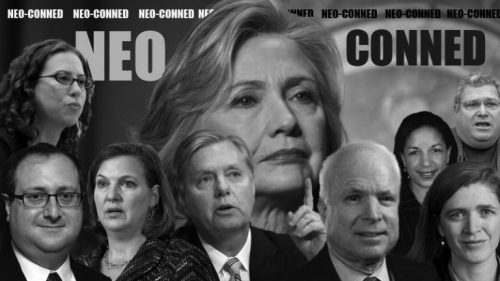 “Gaddafi’s security forces and other groups in the region are trying to divide the people by using violence against women and rape as tools of war, and the United States condemns this in the strongest possible terms,” declared Secretary of State Hillary Clinton, whose supporters are now complaining about ‘post-truth politics.
Again, no evidence was put forward for the Viagra/mass rape claim and, surprise, surprise, none was ever found.
A clear pattern can be discerned. To get public support for its illegal regime change wars, the Western establishment energetically promotes a number of ‘fake news’ stories. These stories are usually reported unquestioningly in ‘respectable’ outlets and are regularly cited by neocon/liberal interventionist commentators as a reason for taking action against the target state. ‘Anonymous’ sources feature heavily in these stories, which like MI6’s ‘Operation Mass Appeal’ are often planted by the security services.
Meanwhile, people’s emotions are shamelessly played upon by the ‘something must be done’ brigade of ‘liberal’ laptop bombardiers, the same crowd, note well, who accuse ‘populist’ politicians of ignoring ‘objective facts’ and playing on people’s emotions.
The fake news continues while the regime change operation is ongoing. After its over, we’re all meant to forget about the false stories we were fed and focus on the next ’New Hitler’ who needs to be dealt with. In 2011, it was the despicable Gaddafi, now it’s the despicable Assad and the despicable Putin who we’re told: “have to be stopped.”
The term ‘post-truth’ politics implies there was a time when politics was truthful. I doubt if that ever was the case, but certainly in the last 25 years, thanks to the influence of neocons and ‘liberal interventionists’, the lies have been off the scale. Remember the Niger uranium forgeries? And Saddam’s horrific ‘People Shredder‘?
And before the Iraq war, we had the ‘humanitarian’ NATO bombing of Yugoslavia, where again fake news dominated. US Defense Secretary William Cohen claimed “about 100,000 military-aged” Kosovan Albanians were missing… “they may have been murdered.”
As John Pilger reminded us, “Kosovo, the site of a genocide that never was, is now a violent “free market” in drugs and prostitution.”
It wasn’t the only lurid claim that was made to sell the war. But again the ‘genocide’ and hundreds of thousands killed stories were false, as a UN court itself ruled in 2001.
Fake news also featured heavily in the neocon campaign to get Iran sanctioned for an entirely unproven nuclear weapons program. It’s dominated the coverage of recent events in Ukraine, with Russia’s non-existent ‘invasion of Ukraine’ routinely referred to as a fact. The conflict in Syria too has been marked by ‘fake news,’ and theories being reported as if they’re 100 percent proven. How many times have you read that “Assad gassed his own people” at Ghouta in 2013, even though we still don’t know for sure who carried out the attack?
If it’s ‘official enemies’ we’re talking about ‘fact-checking’ and citing sources isn’t all that important for those who pounce on a mere typo if it’s an anti-war writer who’s making a claim.
Now, the same people who have disseminated fake news for so long and who are still, even after Iraq and Libya, embedded in the West’s political and media establishments, are lashing out because they no longer control the narrative as they used to. The public is getting their news from a much wider variety of sources and voting for ‘populist,’ i.e., non-neocon/liberal interventionist-anointed candidates/parties at elections.
Instead of admitting that it’s their ’fake news’ and ‘post-truth politics’ which has caused people to switch off from establishment media and to stop voting for status quo candidates, the endless war lobby has the effrontery to accuse others of the things they have been guilty of.
Concern over ‘fake news’ and ‘post-truth politics’ from the West’s endless war propagandists?
It’s hard to think of a better example of what psychologists call ‘projection.’
Follow Neil Clark @NeilClark66
4,000 NATO troops take part in Lithuania’s largest exercise near Russia’s border
RT | November 20, 2016
Eleven NATO countries have sent 4,000 troops to Lithuania, the largest Baltic nation, to participate in this year’s Iron Sword exercises. The war games are meant to test the country’s ability to rapidly deploy a large number of troops.
The exercise, which started on Sunday and is set to last till December 2, involves training at two separate sites in Lithuania.
“This time poses new unexpected challenges before our military. We have to prepare units and their commanders to efficiently respond to conventional military threats,” General Waldemar Rupšys, the head of Lithuania’s Land Forces, told journalists ahead of the exercise.
This year’s Iron Sword maneuver, which is the third and, by far, largest held so far, involves almost 4,000 troops from the US, the UK, Germany, Canada, Poland, Romania, Slovenia, Luxemburg, and the three Baltic states. The exercises held in the last two years had 2,500 and just over 2,000 troops participating, respectively.
The troops will train to execute offensive and defensive operations, rapid deployments, and other tasks, Lithuania’s Defense Ministry said.
Iron Sword 2016 is Lithuania’s first chance to test its new Žemaitija (Iron Wolf) brigade, which was formed earlier this year. It currently has two battalions and support units, but is to add two more battalions next year. The brigade consists of soldiers conscripted after Lithuania reinstated mandatory military service in March of 2015.
NATO is placing additional military assets in Eastern Europe and conducting intensified training there, claiming that such measures are necessary to deter what it calls “Russian aggression.” However, Moscow denies threatening its neighbors and says the alliance is using the notion as a pretext to justify increased military spending and encroach on Russia’s border.
Lithuania, like some other European NATO members, is struggling to meet its obligation to spend two percent of its GDP on defense, but the government says it will be able to meet this benchmark by 2018.
Stability Battles Chaos: From London to Aleppo
By Caleb Maupin – New Eastern Outlook – 17.11.2016
For over five years the leaders of the United States, Britain, France, and Germany have been working to topple the Syrian Arab Republic. In their efforts to remove the independent nationalist government led by the Baath Arab Socialist Party, the western imperialist powers have enlisted their collection of petroleum vassals and despots in the nearby area. The Kingdom of Saudi Arabia, Qatar, the United Arab Emirates, and Dubai; absolute monarchies that routinely behead, torture, and deny their populations even basic rights like freedom of speech are all sending weapons and training foreign fighters to destabilize Syria in what western leaders still pretend is a fight for “democracy.”
300,000 people are dead. Millions have become refugees. Among the fanatical colossus of anti-government forces in Syria, vile ISIL terrorist organization has emerged, unleashing horrors in Lebanon, Belgium, France, and elsewhere. Yet, western leaders do not end their mantra of “Assad Must Go!” and continue efforts to make the country less stable. It seems not to matter how many innocent people have to die, or how strong the dangerous terrorist “opposition” gets, western leaders seem unwilling to abandon their goal of regime change.
If the Syrian government were to fall, the results would be grim. The Al-Nusra Front, ISIL, and even a number of the forces the US has called “moderate” are devoted to establishing a Sunni caliphate. Syria’s religious minorities, the Christians, the Alawites, and others could face either forced deportation, or even outright extermination.
Russia, along with Iran, China, and Venezuela, have come to the aid of the secular, internationally recognized Syrian government, in the hopes of holding back the wave of extremism. The Syrian city of Aleppo is now divided, with the eastern section of the city under the control of various anti-government factions, including the US backed so-called “moderate” rebels, as well as the Al-Nusra terrorists, who were directly linked to Al-Queda until recent months.
Russia repeatedly requested that a humanitarian corridor be created so that civilians could flee Aleppo and escape the fighting, as the Iraqi forces did when fighting in Mosul. Neither the Al-Nusra terrorists, the US backed “moderate rebels”, or the United Nations, or the western powers would comply with Russia’s request. The call for a humanitarian corridor in Aleppo was denied. When speaking of the citizens of Aleppo, John Kirby of the US State Department insisted “they shouldn’t have to leave.”
Despite their efforts to protect innocent life, Russia and the Syrian government have been forced to fight against the Al-Nusra terrorists and their allies in close proximity to civilians. As Russia fights to retake the city from anti-government extremists, the US media suddenly has developed a concern for the civilian casualties of war. Allegations of Russian war crimes in Aleppo have filled the airwaves and the speeches of western leaders. Meanwhile, anti-government forces continue to shell civilian areas in the western side of the city. Western media ignores the cries of these civilians, while doing everything to demonize the Syrian government and Russia. The hypocrisy shouldn’t be missed by anyone. Some of very same individuals that backed the US invasion of Iraq which caused hundreds of thousands of innocent civilians to die, now voice “humanitarian” outrage about Aleppo. The leaders of NATO, who reduced Libya, then the most prosperous African country, to rubble, now bemoan the impact of war on civilian populations. The very same voices that long dismissed civilians killed by airstrikes, have now discovered that what they once called “collateral damage” indeed has human rights.
At the same time that Russia works with the Syrian government to retake Aleppo, the Kingdom of Saudi Arabia is conducting a relentless bombing campaign against the people of Yemen. There is no dispute that the Saudi attack on Yemen is violating human rights. The UN has documented that civilian targets are being intentionally hit. But no pressure whatsoever is being placed on Saudi Arabia to end its slaughter of Yemeni civilians. The western governments continue to actively assist their Saudi “allies” as they violate international law in Yemen, while demonizing Russia’s cooperation with Syria against terrorism.
When speaking of Aleppo, western leaders employ language that is quite similar to the kind often used by left-wing anti-war activists. The British Foreign Secretary, Boris Johnson, even called for anti-war protests targeting Russia when speaking before parliament on October 11th.
The November 3rd Provocation
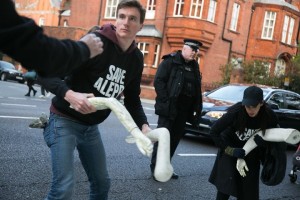 On November 3rd, a group of 25 people wearing “Save Aleppo” T-Shirt presented themselves outside of the Russian embassy in London, and appeared to be following Johnson’s directive. They brought with them a truck full of manikin arms and legs. They proceeded to dump these arms and legs in pile in front of the embassy, effectively blocking its doors and preventing anyone from leaving or entering.
The manikin arms and legs were said to symbolize the innocent people of Aleppo, whose deaths they blamed on Russia. The police did not halt this demonstration, which appeared to have barricaded a foreign mission. As the protest continued, some of the provocative individuals in “Save Aleppo” T-shirts are reported to have chained themselves to the fence surrounding the embassy’s perimeter. Yet, it appears that not a single arrest was made. The police, who were on hand, apparently did not stop the individuals.
So, who were these individuals? The money for the protest was supplied by “Syria Campaign.” This is a non-profit organization funded by a Syrian billionaire named Ayman Asfari, in addition to other anonymous sponsors. It makes sense that a billionaire of Syrian descent, residing in Britain, would want to topple the “Baath Arab Socialist Party” that has run his country for many decades. Parallels between Asfari and the many wealthy Cuban residents of Miami are easy to make. The Syrian government, like the Cuban government, has provided housing, healthcare, and education to its population, achieving this with policies that make the richest people quite uncomfortable.
But beyond Asfari’s well-funded “Syria Campaign” that uses its huge endowment to spread propaganda against the Syrian government and its allies, who were the individuals in the T-shirts? Very few of them appeared to be of Syrian origin, but one cannot assume they were merely hired stooges either.
The answer to this question can be found in the name of an organization that co-sponsored the malicious provocation. The organization “Syria Solidarity UK,” which took credit for the action on its website, is well known to be a front group for the Socialist Workers Party of Britain. This “socialist” organization follows the teachings of Tony Cliff and Leon Trotsky, has its grip on Britain’s “Stop The War Coalition” as well. It is safe to surmise that a decent percentage of those who barricaded the Russian embassy’s entrance were Trotskyites.
Two Currents of Communism
So, who are the Trotskyists? To answer this question we must begin to examine the anatomy of the political left throughout the course of the 20th century.
Within the mass movements associated with Marxism, there are a wide variety of sects, ideologies, and interpretations. However, among the individuals who envision and work toward the overthrow of capitalism there are two distinct personal or psychological categories. These two trends often work in concert with each other. The two trends often do not even intentionally dissociate with each other, and can often be found within the same political parties and movements, despite the huge differences between them. The differences are found in motivation.
Among the political left, the primary and constant current is an extremely alienated minority from within the privileged sectors of society. In Russia it was a current among the children of the aristocracy, as well as from within the emerging bourgeoisie, who made up much of the cadre of the Bolshevik Party in its early years. While they were born in relatively comfortable positions, they knew that things in society at large were deeply wrong. They saw the suffering of the poor, and the many other injustices that existed, and were filled with anger and motivation to correct them. While other members of their social caste could be at peace with society, they could not.
Whether it is due to their unique access to education, or the fact that they are encouraged to ponder political and philosophical questions while other strata are not; regardless of the reason, a section of the most privileged people always seems to be drawn to revolutionary anti-capitalist politics. The trend is not restricted to pre-revolutionary Russia. One can think of the young French radicals depicted in Victor Hugo’s novel Les Miserable, or even the radicals of Students for a Democratic Society or the Weather Underground in the United States, who came from some of the prestigious Universities. No matter how strong or weak the leftist current is in society at large, a certain sector of the privileged classes exists as a kind of “radical intelligentsia.” This is true even in under the most repressive anti-communist dictatorships.
The second current, which constitutes a very solid majority of those attracted to leftist and anti-capitalist currents around the world, are those among the working and impoverished classes. While in times of prosperity they are less politicized, as they see their conditions deteriorating, they become motivated to take action and embrace anti-capitalist and revolutionary ideology.
Unlike the first current, their motivation is not a moralistic impulse based on alienation, but rather the basic desire to see their lives improve. This does not mean that such people do not have political depth or brilliance. Often these forces are actually much more politically effective and ideological. However, their introduction to revolutionary politics originates in a basic material need.
While these two distinct political currents espouse the same phrases and philosophies, they seem to crave two different things. The privileged children of the wealthy who embrace revolutionary politics often have a deep desire to create chaos. They see the world as unjust and cruel. They want it to be smashed, shattered, burned to the ground, and rebuilt anew.
The second current, while espousing the same political line, tends to crave the opposite. They are motivated to take political action as society is becoming less stable. The economic crisis has made their lives more painful and unpredictable, intensifying the suffering all around them, pushing them toward a desperate need for radical change. They embrace anti-capitalism because it offers stability beyond the “anarchy of production.” The revolutionary left is for them, not the road to chaos and revenge, but the path toward a new order with a centrally planned economy, in which justice is created and the chaos is ended.
The Origins of “Trotskyism”
Lenin’s book “What Is To Be Done?,” which laid the foundation for the Bolshevik project of a Central Committee and a “Party of a New Type,” was largely directed at members of the first, moralistic, and privileged group. It urged them to look past their own motivations, abandon terrorism and tailism, and build an highly disciplined organization that could push the broader masses of Russian workers and peasants toward a full revolution.
The October Revolution of 1917 was successful because it merged the two trends. In a time of crisis, the revolutionary intelligentsia who longed to smash the old order, were able to mobilize the workers and peasants who were suffering and desperately wanted “Peace, Land and Bread.” The effective convergence of these two currents created a new political and economic system.
However, almost immediately after the Soviet Union was founded, political space began to develop between the two trends. Lenin banned factions in the Bolshevik Party during the early 1920s in order to hold an increasingly divided ruling party together. Despite the ban on factions, the two trends did not cease to exist. After Lenin’s death, the two poles became personified in Leon Trotsky and Joseph Stalin.
Trotsky, the son of wealthy landowners in Ukraine, who had lived in exile most of his life and was beloved among the world’s cosmopolitan intellectuals, called for “Permanent Revolution.” The Soviet Union, in his view, should exist simply as a temporary hold out in a global revolutionary explosion. In his view, Soviet society should be organized around the military, and focus primarily on seizing the western financial centers of Germany, Britain, and France for the global socialist project to remake all humanity.
Stalin on the other hand called for “Socialism in one country.” He advocated for the Soviet Union to focus on building a good society for the people of Russia and the surrounding countries, while offering limited support to revolutionary forces around the world. “Socialism in One Country” would require signing treaties with the western countries, restoring the traditional family, and eventually even legalizing the Russian Orthodox Church. For Stalin and the majority of the Communist Party of the Soviet Union, socialism did not mean an endless global crusade to behead every last king and capitalist, but rather, building a peaceful, prosperous society with a planned economy in Russia and the surrounding countries.
When Stalin was victorious, the world communist movement began to shed the most adherent members of the first revolutionary category. The Communist parties began building unemployment councils, trade unions, and other organizations dedicated to aiding working people and fighting for direct material gains as capitalism collapsed into a “great depression.” Eventually the “Stalinists” built a People’s Front of anti-fascists that played a decisive role in the Second World War.
Meanwhile, Trotsky took a significant number of western intellectuals out of the Communist International and into his “Fourth International.” The Trotskyists worked to antagonize and isolate the Soviet aligned Communist Parties, while at the same time presenting a negative perception of the Soviet Union as a “totalitarian” and “repressive” society that did to live up to the utopian dreams of middle class radicals.
Trotsky saw the USSR as a “degenerated workers state,” socialist in its economic foundations but “bureaucratized” in its politics. In the final years of his life, a number of Trotsky’s followers disagreed with this assessment and argued that the USSR was capitalist. Max Shachtman, Irving Kristol, and a number of the more middle class elements broke with Leon Trotsky, arguing that the USSR was not a “worker’s state” but rather “bureaucratic collectivism”, “state capitalism”, or fascism. These elements called themselves “Third Camp” or “Neo-Trotskyists.” The International Socialist Tendency, of which the British Socialist Workers Party is aligned, along with the US International Socialist Organization, is the largest group continuing these politics. It is “Third Camp Trotskyists” in Britain who have built the organization called “Syria Solidarity UK” which conducted the recent protests against the Russian embassy.
Interestingly, it is from within the “Trotskyists” who broke with Trotsky, and completely denounced the USSR, that one can find the origins of Neo-Conservative thought in the United States. James Burnham, Edmund Wilson, Max Eastman, and many of the leading right-wing intellectuals of the Cold War were era were originally Trotskyists.
Brzezinski’s Permanent Revolution
Zbigniew Brzezinski, one of the leading CIA strategists during the Cold War, can largely be credited for defeat of the Soviet Union. Brzezinski’s career involved fomenting dissent and unrest in Soviet aligned countries. The gap between revolutionary intellectuals who crave chaos and revolution, and the pragmatic approach of Soviet leaders who wanted a stable, planned economy was a great asset to his activities. The CIA launched the “Congress for Cultural Freedom” to fund anti-Soviet leftists and artists, and further the space between them and the USSR.
In Hungary, Poland, Czechoslovakia, East Germany, and many other socialist countries, the US Central Intelligence Agency enflamed and exploited the grievances of artists and intellectuals, who felt stifled by the Marxist-Leninist political set up, and longed for the “freedom” of the west. It has become almost cliché to talk about the role of Beatles music and other western counter-cultural icons in “the fall of Communism.”
Brzezinski openly bragged that he was “giving the USSR its Vietnam War” in Afghanistan. When the People’s Democratic Party took power in 1978, the CIA worked with the Saudi monarchy to launch a global campaign of Wahabbi Muslims against it. The USSR sent its forces into Afghanistan to protect the People’s Democratic Party.
In the global media, it was a different story. The press painted the Taliban and other forces organized by Osama Bin Laden as romantic guerilla fighters, battling against the USSR, portrayed as a crude, repressive invading force. The “Trotskyists” of the world embraced the Mujahadeen Wahabbi fanatics in much the same manner that such forces now embrace the Free Syrian Army and the Al-Nusra Front. Among the organized left, pro-Soviet sentiments were left only to a small minority, dubbed “Stalinists” and “Hardliners.” The long-haired, counter-cultural “New Left” bought into the CIA narrative, and believed that Osama Bin Laden was some kind of Che Guevara.
In the 21st century, Anti-imperialist governments, even those who completely reject Marxism-Leninism, have a lot in common with the political and economic system developed by Stalin during the 1930s. Anti-imperialist countries tend have five year economic plans or other mobilizations of the population toward raising the living standards. They tend to have a ruling party with a very complex and specific ideology, that sits at the center of a tightly organized and politicized population. The strength of the various anti-imperialist regimes is their ability to control the centers of economic power, raise the standard of living, and provide a comfortable life for the majority of their people.
In China, each child is given a red scarf when they begin their education. They are told that this red scarf is their own piece of the Chinese flag, and that it represents a political project toward building a prosperous society, which they are automatically part of it. Similar rituals exist in the Bolivarian countries, the Arab Nationalist states, and almost every other country where the government can trace its origin to an anti-capitalist revolution.
Meanwhile, the primary strategy of Wall Street for toppling these governments has been to employ the rhetorical style of Trotskyists, and appeal to the alienation and anxiety of the privileged elite. The CIA and its network of aligned NGOs has discovered key methods of manipulating and unleashing the desire for chaos among the middle class. Figures like Samantha Power talk about “mobilizing” for human rights around the world.
The primary way the US has attacked independent countries in recent years has been fomenting revolts such as Euro-Maiden in Ukraine, the “Green Movement” in Iran, the “revolution” in Libya. These uprisings are supported by Non-Governmental Organizations and carried out to serve the interests of the western financial elite. While they effectively maintain the global status quo, they are decorated with the most Guevara and Trotsky-esque propaganda on social media and western television. It seems pretty clear that the vaguely emotional lust for revolution and unrest among the alienated middle class has been effectively harnessed as a mechanism for defeating “Stalinism” and ensuring the rule of western capitalists.
Foreign Affairs: “Open International System” vs. “Populism”
The Council on Foreign Relations, the CIA-linked think tank, shed light on its worldview and strategy in the latest issue of their publication Foreign Affairs. In an essay by Anne-Marie Slaughter, one of the primary architects of the US backed regime change operation in Libya, she described her prescription for the ailments of the global situation.
“The people must come first,” she tells us, like a soap-box agitator. “When they do not, sooner or later they will overthrow their governments.” According to Slaughter, the job of western countries is to facilitate the free flow of information through social media, in order to allow these uprising to come about.
Furthermore, Slaughter argues that the Treaty of Westphalia, and the concept of the nation state is out of date. Rather “responsibility to protect” or R2P has replaced it. The NATO states and their military must intervene in order to strengthen these revolutions, and topple regimes that get in Wall Street’s way. The strategy is global revolution, endless destruction and chaos until “open governments, open societies and an open international system” can be erected. We can almost hear echoes of Trotsky’s fantasy of “permanent revolution” in Slaughter’s writing, though Trotsky’s stated goal was to overturn capitalism, not secure its grip on the planet.
And who are the villains in the CFR narrative? They are “Populists.” The entire issue of “Foreign Affairs” is titled “The Power of Populism.” Listed among them are Hugo Chavez, Evo Morales, the Supreme Leader of Iran, as well as Russian President Vladimir Putin and Chinese President Xi Jinping. According the analysis, it is these dangerous “demagogues” who reject the “open international system” of the World Bank and the International Monetary Fund, but instead mobilize their populations and preside over centrally planned economies that must be smashed. With the word “Populism”, the CFR seeks to link these governments to racism and anti-immigrant bigotry in western countries, and urge “progressive” and “enlightened” people to oppose them in the same manner.
Indeed, political navigation in the 21st Century can be quite difficult. The compass by which analysts have long determined left and right is broken. The defenders of free market capitalism and the rule of internationalist bankers have embraced the revolutionary blood-lust which was long a staple of the political left. Meanwhile, the anti-imperialists and advocates of planned economies now often position themselves as social conservatives and defenders of stability, morality, religion, and tradition.
While it is no longer exactly clear which way is “left” or “progressive,” it is blatantly obvious which way is better for the human race. The NATO regimes, despite mouthing left-sounding rhetoric in the process, have reduced Iraq, Afghanistan, Libya, and Syria to civil war and chaos. The fruits of their imposed vision of an “open society” with “free markets” is not prosperity and freedom but poverty, chaos, and endless civil war.
However right-wing and conservative the governments of China, Russia, and Iran may seem, the societies they have created are ones in which profits are not in total command, and providing a decent life for the masses of people remains a priority. In the anti-imperialist regimes, the state is independent of market forces, and has the ability to restrict and control their actions. Meanwhile, a sense of collective vision and obligation exists, and people are not left isolated to fend for themselves.
Yes, the CFR’s vision of a clash between the “open international community” and the “populists” is certainly accurate as it is playing out before the world. Syria is simply the most visible battlefield.
Caleb Maupin is a political analyst and activist based in New York. He studied political science at Baldwin-Wallace College and was inspired and involved in the Occupy Wall Street movement.
Euro-Atlanticist course fails in Bulgaria
Katehon | 14.11.2016
In Bulgaria, the country’s first direct elections in the second round of presidential elections were won by the candidate who has been called pro-Russian. General Rumen Radev won the overwhelming majority of votes.
A former chief of the Bulgarian Air Force and the presidential candidate of the Socialist Party, General Rumen Radev emphasizes his independence from both Russia and the United States. Before the second round of the elections, he said: “Until recently, I was flying a Soviet-made fighter. I am a graduate of a US military academy, but I am a citizen of Bulgaria, and Bulgaria is my main priority.”
Despite the fact that he is called the pro-Russian candidate due to his policy of lifting the anti-Russian sanctions, reality is different. Moreover, Radev supports his country gaining NATO membership and continuing close ties with the West. However, he is certainly a more advantageous president for Moscow than Tsetska Tsacheva, who represented the ruling liberals.
In Bulgaria, the president does not play a serious role. However, Prime Minister Boyko Borisov announced his resignation and the dissolution of the government over the defeat of their candidate. He stressed that he would be going into the opposition and that “there will no longer be any compromises.” The current president, Rosen Plevneliev, began to make quite sharp anti-Russian statements several days before the election.
It is premature to expect any major changes before the new government is formed. But many agree that relations with Moscow will actually significantly improve even if the new president does not initiate the lifting of the EU sanctions against Russia.
In addition, the socialist Radev’s victory comes alongside the victory of the socialist Dodon in Moldova and, of course, against the backdrop of the high-profile election results in the US. Taken together, all of these new elections and their results allow one to speak of impending global changes across the whole world.
‘Trump effect’ divides European opinion
By M K Bhadrakumar | Indian Punchline | November 14, 2016
The results of the two presidential elections held on Sunday in Bulgaria and Moldova underscore the winds of change blowing over the western edges of Eurasia. To an extent they can be called the early signs of the ‘Trump effect’. In both elections, ‘pro-Russian’ candidates won convincingly. (here and here)
In both cases, the contestation essentially boiled down to whether Bulgaria and Moldova would be better off casting their lot with the European Union or whether they need to realign with Russia. The answer is clear.
The open-ended quest for EU membership no longer holds attraction for Moldova, whereas, Bulgaria appears to be disheartened with its EU membership. On the other hand, Russia is real and it is next-door. The election results yesterday constitute a blow to the EU’s prestige. Indeed, Moscow’s influence is spreading in Eastern Europe.
This is also a swing to the Left in political terms. There is much discontent with ‘reforms’, rampant corruption, etc. in both countries. The Russophile sentiment is very substantial, and there is eagerness to boost trade with Russia to overcome economic difficulties. Also, the local partisans of the West and EU stand discredited in both countries.
In Moldova, only around 30% of population find EU attractive, while 44% would support their country joining the Moscow-led Eurasian Economic Union. Curiously, 66% of Moldovans trust Vladimir Putin; in comparison, only 22% place trust in Barack Obama’s words.
Against the backdrop of the election victory of Donald Trump in the US, how these trends are going to play out will be interesting to watch. Bulgaria’s president-elect Rumen Radev has called for an end to the EU sanctions against Russia. He argues that Sofia should be pragmatic in its approach to Russia’s annexation of Crimea. (This is notwithstanding Bulgaria’s long history of divided loyalties between Russia and Europe.)
The Obama administration in its lame duck phase will endeavour to pressure the EU to extend the sanctions against Russia for yet another 6-month period beyond December. But will Trump follow Obama’s footfalls when the issue crops up again toward the middle of next year? He is unlikely to show Obama’s messianic zeal to ‘contain’ Russia. That is how the EU consensus on sanctions against Russia can break down because many countries in Europe resent the American pressure and prefer to restore trade and economic ties with Russia.
Interestingly, Trump may get resonance in Old Europe as well. The Labour leader in Britain, Jeremy Corbyn made a stunning call in the weekend for Western leaders to ‘demilitarize’ the border between Eastern Europe and Russia or risk a New Cold War. He said the West didn’t have to pile up forces on Russia’s border. Corbyn told the BBC:
I have many, many criticisms of Putin, of the human rights abuses in Russia, of the militarisation of society. But I do think there has to be a process that we try –demilitarise the border between what are now the NATO states and Russia, so that we drive apart those forces and keep them further apart in order to bring about some kind of accommodation. We can’t descend into a new Cold War.
Corbyn also made a thoughtful suggestion that that the Organisation for Security and Co-operation in Europe, which includes Russia, could replace NATO as a forum for solving issues in the region.
Indeed, some churning has already begun regarding European security even before Trump takes over in the Oval Office. By the way, Czech Prime Minister Bohuslav Sobotka said on Sunday that American statements about possible deployment of a U.S. global missile shield’s radar in the Czech Republic are pure fiction.
He said, “A radar in the Czech territory would mean further escalation in relations with Russia. We need to use the window opening after Donald Trump’s election to have the United States and Russia sit down at one table.” Sobotka pointed out that Eastern Europe’s main security problem today is about putting an end to the war in Syria.
“The United States has considerable influence on the situation in Syria, Russia has considerable influence. So, it is necessary to use this,” he said, adding that Donald Trump can establish more efficient cooperation with Russia on Syria.
However, the fact of the matter is that neither has Trump taken his position yet on NATO nor is it going to be easy for him to seek a separation for America from the western alliance. Simply put, Europe is not ready for a post-NATO future. There is palpable fear in many quarters (both in the US and in Europe) that if the US were to withdraw from Europe, Russia would advance and exercise more assertive behaviour in Eastern Europe.
In an article in the weekend, NATO secretary-general Jens Stoltenberg made an impassioned appeal to Trump that now is not the time for the US to abandon NATO. He pointedly invoked the threat perceptions from “a more assertive” Russia. Read the opinion piece here.
The bottom line is that European opinion stands divided. Britain, France and Hungary refused to attend a contentious EU ministerial meeting last night in Brussels, backed by Germany, to align the bloc’s approach to Trump’s election. The rift within the EU on the US vote stands exposed. The irrepressible British Foreign Secretary Boris Johnson has publicly chided EU politicians to end their ‘whinge-o-rama’ over Trump. (Daily Mail )
Interestingly, the first politician from abroad whom Trump met after the election has been Nigel Farage, the populist Brexit campaigner.
Why Trump’s Presidency Is a Win for Europe
By Finian CUNNINGHAM | Strategic Culture Foundation | 12.11.2016
By vowing to rebuild American society, scale back foreign militarism, de-escalate NATO and seek friendly cooperative relations with Russia, a United States of America under Donald Trump would not only be a boon for America’s best interests. It would also be a win for Europe.
In such a new international outlook, the European bloc would be freed from its atlanticist subservience which has been dominant and deleterious for several decades. European governments would be freer to have more independent foreign policy, instead of toeing the dubious line that up to now has been ordained from Washington. It has been a disaster for the EU to have adhered so slavishly to US foreign policy. Much of the current discontent and disaffection among EU citizens towards the Brussels-based bloc stems from this unnatural and unhealthy subservience to Washington.
Wars in the Middle East, North Africa and Central Asia and the attendant problems of blowback terrorism and influx of refugees are direct results of European governments following Washington’s foreign policy of regime change and so-called «democracy promotion». Even though these wars have been illegal and vile transgressions of international law.
Financial and economic policies adopted by European governments have been straitjacketed by neoliberal capitalist doctrine dictated by Wall Street and successive US governments. This boils down to misery and austerity for the masses, while a tiny oligarchy become ever bloated with wealth. In short, stagnation.
Deteriorating relations with Russia – Europe’s biggest energy supplier – have also stemmed from the EU following Washington’s confrontational agenda towards Moscow. European governments have bought into the spurious US official narrative of Russia being «aggressive» and «expansionist». Admittedly, certain EU members such as the Baltic states are all too willingly Russophobic. But for many others, such hostility between the EU and Russia does not make sense. While economic impacts on the US have been minimal, the tensions between the EU and Russia have badly hit European businesses, exporters, farmers and workers.
The looming threat of war on European territory from the irrational enlargement of the US-led NATO military alliance along Russia’s border is also seen by many citizens as another demonstration of the EU’s reckless subservience to Washington. It is Washington, of course, that has been the main advocate of increasing NATO forces in Europe, augmented by atlanticist EU governments like Britain, Germany and France, as well as the anti-Russian paranoid Baltic states. Some 500 million EU citizens are held ransom to war policies by a coterie of governments who behave like vassals to Washington.
In many ways, the political, economic and cultural problems challenging Europe arise directly from the EU’s lack of independence from the US. Often it seems that Brussels is acting as a rubber-stamp for foreign policies authored in Washington. No wonder then that in the view of many EU citizens the functioning of the bloc is seen to be undemocratic and unrepresentative of their immediate needs. This explains the soaring rise of anti-EU parties right across the bloc. The phenomenon has less to do with an inherent popular affinity for parties labelled «far right» or «xenophobic» and more to do with a popular desire for democratic governance that attends to urgent social interests.
There is much overlap with the political rise of Donald Trump in the US. As in Europe, the mass of ordinary working-class American citizens have been disenfranchised, politically and economically, over several decades. A rarefied political class has become ossified and is seen to be self-enriching and servile to a tiny wealthy elite of financiers, corporations and the military machine that underpins this oligarchy. Integral to the oligarchy are the corporate-controlled media monopolies that pontificate to the masses on how they should vote in elections – elections that have become inconsequential to democratic needs.
All that now appears to be changing. A revolt is underway.
Trump’s election, like the Brexit before in Britain earlier this year, is a popular revolt against the oligarchy. The mass of people have become sickened and wearied by endless wars and endless economic austerity, while the rich elite become ever more obscenely wealthy, and all the while the media propaganda system cynically instructs the people who to vote for and who not to, knowing full well there will really be no «hope and change».
This time around though, the US election, like the Brexit, was infused with righteous, raw popular anger against the oligarchy.
Trump struck a deep popular chord when he called US-led wars in the Middle East a «disservice to our country and a disservice to humanity». People got it when he lamented how much American infrastructure, schools, hospitals, roads, jobs, would have benefited if the trillions of dollars wasted on wars had instead been invested at home. Despite media concealment, a large section of the American people concurred with Trump’s angry denunciation of Obama and past US administrations for criminally stoking terrorism and conflicts. His presidential rival Hillary Clinton was fixed right at the center of this culpability among the Washington oligarchy, which straddles both the Republican and Democrat parties.
Voting Trump into the White House – a property tycoon who has never held an elected office before – is an historic repudiation of the political establishment. It is a political earthquake.
On the eve of election day on November 8, Trump declared that «this will be our independence day… when the American working class will strike back». It may seem incongruous that a billionaire capitalist should exhort the working class to strike. But strike they did.
Trump also said his election would be «Brexit plus, plus, plus». That remark has turned out to be prescient too. The American election earthquake has rocked Europe with greater force than did Britain’s vote to quit the bloc in July. A crevice has been torn open between atlanticist governments and more independently minded ones.
Germany and France in particular have been caught off-side. Chancellor Angela Merkel expressed «shock» at Trump being elected, while French President Francois Hollande – also disapproving the result – called for «united European values» to confront the new American president. Hollande’s bravado for «liberal values» makes him look even more fatuous.
Britain, the other atlanticist voice in Europe, was more congratulatory to President-elect Trump. No doubt, that’s because Britain is seeking to shore up badly needed bilateral trade deals with the US in light of its departure from the EU and therefore it needs to keep Trump sweet.
What really alarms Germany and France is that Trump is no atlanticist or NATO advocate. His nationalist views and tougher stance on immigration controls resonate with EU members like Hungary, Czech Republic, Slovakia, Slovenia, Greece and Austria.
Trump’s views also give a boost to anti-EU parties in Germany and France who are challenging incumbents Merkel and Hollande in elections next year. It was telling that while Merkel and Hollande deprecated Trump’s election, he was heartily congratulated by the anti-EU Alternative for Germany and Marine Le Pen’s National Front in France, as well as Nigel Farage’s UK Independence Party in Britain. These parties also tend to share Trump’s more sanguine view of friendlier relations with Russia.
If Donald Trump can deliver on his avowed program of rebuilding American society and economy from within while abandoning US imperialist hegemony around the world that will potentially transform world relations. For Russia and China it will lead to a much needed normalization of relations, away from the current Cold War-type hostility that threatens to ignite world war. Both Russian and Chinese leaders Vladimir Putin and Xi Jinping were quick to express congratulations and readiness to work with new president Donald Trump.
The political establishment, including the media, in the EU that is dominated by woefully misguided atlanticism has deplored the election of Trump in the US. There is a snobbish handwringing attitude that Trump’s movement is all about racist, white trash numbskulls. There may be some unsavory elements to Trump’s support, as there are in some anti-EU movements. But in the main what it is about is reclaiming democratic power for the mass of people. What the Americans have done in electing Trump is what the Europeans also need to do in order to sack a corrupt and venal establishment that up to now has only served Washington and the atlanticist elite.
If Trump’s victory invigorates similar trends across Europe then that would be a good thing. And especially if it led to Europe having a more independent foreign policy from Washington and in particular gaining a more normal, mutual relationship with Russia.
US sends largest ammo shipment in 20yrs to Germany amid ongoing European buildup
RT | November 10, 2016
The US military sent over 600 containers of ammunition to Europe, the largest single shipment in more than 20 years. The move comes just a week after the Pentagon announced the deployment of a 6,000-strong tank brigade to Eastern Europe next year.
Some 620 shipping containers packed with ammunition arrived at the northern German port of Nordenham at the end of October. There they were loaded onto trains and transported to the Miesau Army Depot for storage and distribution to other locations across Europe, the US Army said in a statement.
“This is about deterrence. We could have 1,000 tanks over here, but if we didn’t have the ammunition for them they would not have any deterrent effect,” said Lt. Gen. Ben Hodges, commander of US Army Europe.
He added that German military and civilian staff have been helpful in moving the ammunition supplies to the Miesau depot, which was “only possible because our ally, Germany, allows it to happen.”
By enabling the movement of US Army ammunition and equipment through its territory, Germany is contributing to “deterrence,” Gen. Hodges said.
“We’re bringing ammunition into the theater to resupply and set the stage for the European theater for any type of exercises or potential future missions that may come about,” said Lt. Col. Brad Culligan, commander of the US Army’s 838th Transportation Battalion.
The shipment is yet another part of the massive military buildup taking place in Eastern Europe, where the US and NATO are developing military infrastructure and headquarters as well as building weapons and ammunition stockpiles to defend the region against what they describe as “Russian aggression.”
Earlier in November, the Pentagon announced deployment of two heavily-armed army units, the 3rd Armored Brigade Combat Team (3rd ABCT) of the Colorado-based 4th Infantry Division as well as the New York-based 10th Combat Aviation Brigade, to Europe in January 2017.
Meanwhile, Gen. Hodges said in early October that he also wants to see anti-drone weapons systems in future arms deliveries to counter Russia, according to Military.com.
Those weapons systems would include the Avenger, a Humvee equipped with eight FIM-92 Stinger missiles, as well as the German-made Gepard, a twin-33mm cannon mounted on a Leopard tank chassis.
The US Army also plans to equip the 2nd Cavalry Regiment in Europe with the new version of the M1126 Stryker infantry fighting vehicle armed with a more powerful 30mm cannon in May of 2018, according to the website.
Armaments aside, the buildup is also coupled with numerous exercises taking place in the Baltic states, Poland and in the Black Sea, with the stated goal of assuring Eastern European allies of NATO’s commitment to defending them.
Russia has consistently referred to the buildup as a provocative measure which undermines European security, promising to take reciprocal steps.
Featured Video
New positive ivermectin evidence
or go to
Aletho News Archives – Video-Images
From the Archives
Fanatical Followers of the Covid Regime: A Jim Jones-Style Cult?
By Professor Roger Watson and Dr. Niall McCrae | The Daily Sceptic | November 15, 2021
As scholars at leading British universities over recent decades, we witnessed the replacement of critical thinking and debate by narrative: facts are discrimination and scientific method is imperialism; truth, instead, is derived from ‘progressive’ values. This educational trend may be a major contributory factor to the ease in which society has been inculcated to the Covid ‘new normal’ of masking, testing, and repeated doses of vaccines for a disease of similar risk to severe influenza.
One doesn’t need much critical reasoning to observe the flawed logic of some vaccination enthusiasts, such as people who respond to experiencing any side effects, however debilitating, by saying “at least I know it’s working”, or, after contracting the disease despite their promised inoculation (over 90% effective, according to initial drug company claims), “I’d have been worse off without the jab.” … continue
Blog Roll
 Aletho News
- EU Council Advances Chat Control 2.0 Scanning Proposal
- Ex-Greek MEP files complaint against Israeli spyware firm over alleged Pegasus surveillance
- Troubling ideas throughout the Torah, Talmud, Mishneh Torah and Tanya
- ‘Grave, alarming’: Iran mission on Trump’s UNGA ‘annihilation’ threats
- Najaf airport to reopen to Iranian flights within 24 hours: Ambassador
- From ‘How Will This End For Iran’ to ‘When America Walks Away’: A tale of two Economist covers
- Tehran blasts ‘baseless’ speculation linking Iran to alleged bomb plot at UK air base
- The Rise And… Rise Of ‘Color Revolutions’
- The Coming GOP Bloodbath?
- Arctic Scare Stories Melt Away
- If Americans Knew
- Netanyahu Asked UAE Leader to Deny Report on Oct. 7 Warning in Secret Visit, Sources Say
- CNN Chief Int’l Correspondent Clarissa Ward on Journalists in Gaza
- Democratic Party Consultants Surround Troy Jackson with Pro-Israel Donors
- Christian Leader Responds To Netanyahu’s Claims Regarding Palestinian Christians
- In Gaza, ‘Whoever Survives the Bombing Won’t Survive the Rubble’
- Israel kills more Palestinians, amid push to resettle Gaza – Daily Update
- Israel forces Gazans to live in constant peril – Daily Update
- Deconstructing Netanyahu’s pants-on-fire UN rant – Daily Update
- Trump betrayed voters with his campaign lies and prioritized a foreign country once he took office
- Netanyahu calls Israel’s war in Gaza ‘opposite of genocide’ in UN speech to near-empty hall
- No Tricks Zone
- New Study: Earth And Venus Surface Warmth Largely Explained By Convection And Lapse Rate, Not CO2 Or Radiation
- 2025 Nature Paper Claiming Worsening Global Drought Gets RETRACTED …Heavily Flawed
- New Study: ‘Global Drought Shows No Detectable Recent Acceleration Under Climate Warming’
- Economic Masterminds: German Socialists Suggest Taxing Productivity Gains Stemming From Using AI
- The South China Sea Has Not Been Cooperating With The Climate Change Narrative
- Energy Crisis: Germany Enters Heating Season With Historically Low Gas Reserve Fill Levels
- New Study: The Antarctic Ice Sheet Gained Mass From 2020-2024 Due To Staggering Snow And Ice Accumulation
- Study: Ocean Heating Rates From Thousands Of Years Ago ‘Dwarf’ Modern Ocean Heating Rates
- Climate Extremists Target, Attack Large-Scale Power Grid Infrastructure In Germany!
- New Study: Antarctic Ice Melt Has Contributed Less Than 1 Centimeter To Sea Level Rise In The Last 30 Years

