NATO’s record 6,000-strong drills kick off in Estonia amid Ukraine tensions
RT | May 5, 2014
NATO’s three-week ‘Spring Storm’ drills, involving a record-breaking number of 6,000 troops, have begun in Estonia. For the first time, a cyber security team from France is participating in the military exercises.
“This year’s Spring Storm brings together a record number of allied troops – infantry from the Duke of Lancaster’s Regiment, soldiers from Latvia, soldiers from the 173rd Airborne Brigade Combat Team of the US army, as well as soldiers from Lithuania,” the Estonian Defense Ministry said in a statement.
In addition, Poland has sent three of its Sukhoi Su-22 attack aircraft and a division of missile defense system unit SA-8, which will be tasked with protecting an air base near Tallinn and the surrounding airspace.
Just like last year, the exercise also involves anti-aircraft personnel from Belgium.
The main goal of the military exercises is to assess the skills of the infantry battalions, rehearse cooperation between different units, and improve management methods of staff divisions, the ministry stressed.
The Spring Storm drills have been held annually in different parts of Estonia since 2003.
This year, military maneuvers will be held in 5 out of 15 Estonian counties, including southern and southeastern regions close to the border with Russia. The exercises are scheduled to finish on May 23.
Britain, France, and the US have been deploying troops to the Baltic region since April 29, a week ahead of the drills in Estonia. A day earlier, around 150 personnel of the US airborne division arrived in a military transport aircraft to Amari airbase. Upon completion of the maneuvers, the US Marines will remain in Estonia at least until the end of 2014.
Amid rising tensions in Ukraine, the UK and France deployed eight fighter jets to Lithuania and Poland to strengthen NATO air defense over the Baltic regions.
On May 2, a group of NATO ships arrived in the Lithuanian port of Klaipeda to “ensure regional security.”
Russia considers the increase of NATO forces so close to its border a provocation, and believes it is counter-productive in the struggle to de-escalate tensions in Ukraine.
On Monday, Russian Minister of Defense Sergey Shoigu called on his American counterpart, Chuck Hagel, to cool down the rhetoric over Ukraine and work together to defuse the situation.
Sweden’s elite more loyal to NATO, the US and EU than to its people
By Jan Oberg | Transnational Foundation for Peace & Future Research | May 2, 2014
Over the last 25-30 years Sweden’s military, security and foreign policy elite has changed Sweden’s policy 180 degrees.
These fundamental changes were initiated by the Social Democratic government under Goran Persson and foreign minister Anna Lindh and have been carried through virtually without public debate.
The rapproachment with interventionism, militarism and US/NATO in all fields has been planned, incremental, furtive and dishonest; in short, unworthy of a democracy.
This elite is more loyal with Brussels and Washington than with the Swedes.
If your image of Sweden is that it is a progressive, innovative and peace-promoting country with a global mind-set and advocate of international law, it is – sad to say – outdated.
How Sweden has changed
Sweden is no longer neutral and it is only formally non-aligned; there is no closer ally than US/NATO. It has stopped developing policies of its own and basically positions itself in the EU and NATO framework. It no longer produces important new thinking – the last was Olof Palme’s Commission on Common Security (1982).
It has no disarmament ambassador and does not consider the UN important; it does not have a single Swede among the UN Blue Helmets. None of its top-level politicians make themselves available as mediators in international conflicts.
Nuclear abolition is far down the agenda, problematic as a NATO-aspiring country. But one thing has not changed: Sweden remains the world’s largest arms exporter per capita.
Sweden no longer contributes to the protection of smaller states through a a commitment to international law. Its elites wholeheartedly supported the bombing of Serbia/Kosovo. It thought – also under social democratic leadership – that the mass-killing sanctions on Iraq and the occupation were appropriate.
Since Sweden cannot legally export arms to a country in war but upholds a close military technological co-operation with the U.S., its parliament decided to make the US an exception.
Sweden supported the destruction of Libya – participating with its planes there, however only conducting reconnaissance, not bombing, missions.
Sweden did not support the planned war on Syria but also did not voice any audible criticism of the West’s support of only the militant opposition, including Al-Qaeda affiliates.
Carl Bildt
Sweden’s foreign minister Carl Bildt operates mainly as an eminently well-informed international affairs traveler and blogger who doesn’t seem to want to waste too much of his precious time on being a minister. And when he does, he isn’t known for consulting many people around him.
That could be a reason that his comments on various events repeatedly attract laughable media attention. If you compare, as he has, Ukraine’s former President Yanokovich with Norway’s Quisling and thereby make Putin equivalent to Hitler and Russia to Nazi-Germany you no longer operate as a statesman but, rather, as an emotional hothead or a marketing consultant. (Add to that that Bildt recently refused in the Swedish Broadcasting’s ”Saturday Interview” to distance himself from neo-Nazi elements in Kiev).
Bildt’s simplifying, twisted interpretation of Georgia 2008 is revealing of his biased emotionality where earlier – for instance during his position as High Rep in Bosnia – he deserved respect for operating in an intellectually sober manner.
If you don’t have your own thinking and policies, Russophobic platitudes is all you need. And it qualifies for CNN’s Christiane Amanpour.
Sweden is heading for NATO membership
Here follow a few recent events/news which emphasize further the deplorable path Sweden – its elites rather than its people – have decided to follow.
1. Sweden’s security political elite these years ”considers broader alliances with NATO and the EU” as Defence News recently informed us.
How enigmatic! After having been neutral and non-aligned during tough confrontation and tension in the Cold War years, Sweden now needs to join NATO when there is no single analysis anywhere that makes it likely that Sweden, in the foreseeable future, will be faced with a threat.
While the intelligent security and defence discourse is now about human security, the environment and high-tech challenges, Sweden’s elites talk about defence as weapons only.
This is dangerous ”group think” steered by bureaucratic vested interests and paid for by tax payers who are de facto threatened more by these interests than by Putin. A reality check would lead to a reality chock.
Cruise missiles for “deterrence”
2. Swedish planes shall now, in the light of a conveniently hysteric interpretation of the crisis in Ukraine, equip its planes with cruise missiles. (Defense News)
Incredibly, decisions like this are taken with the intellectually sloppy mantra that it adds to the country’s ‘deterrence’ capacity.
The security priesthood of the country consists of some researchers of military affairs at huge, well-financed state institutes in close contact with politicians and the military to whom military-loyal journalists have close bonds. Everybody, follow the party line! Saty in the box! Don’t challenge the domain assumptions!
Sweden now jumps on a sinking ship
The country that once did something for a better world, has joined the militarist world. In a time when both NATO and the US is getting weaker, Sweden’s elite foolishly plans to put all Sweden’s eggs there.
It has no policy vis-a-vis, say, the BRICS countries or any vision of the world in 20 years to navigate towards. It has no ideals, values or commitments, only a ”follow-the-US/NATO and EU” flock mentality.
The US Ambassador is invited to blackmail
3. The US ambassador to Sweden, Mark Brzezinski, recently told Sweden to join NATO, otherwise it won’t get any help in the event of an attack – in short, Mafiosi blackmailing disguised as deep concern and generous offer to bring (conditional, however) help. This was revealed by the conservative Swedish daily, Svenska Dagbladet, Google translation here.
How many – and which – ambassador’s are given the opportunity to speak directly to all parties of the Swedish parliament?
The message is pure blackmail – and based on fearology – because everybody knows that should Russia attack anyone, Sweden would not be the first target and it would be in the interest of NATO to control Swedish territory before any spreading of Russian forces from somewhere else to the Nordic area.
In short, NATO’s interests in Sweden are much larger than Sweden’s in NATO. Whatever one may think of these fantasies, they are just that: No one has thought up a credible scenario for how Sweden would be invaded by Russia and remain defenceless.
If one of largest militaries per capita can’t defend its people there is something wrong with it
But this is the military-fundamentalist propaganda the Swedes are the target of these years: We must join NATO because we have such a weak defence that we can’t defend ourselves!
The liberal party’s defence spokesman, Allan Widman, recently stated this in a manner indicative of the low intellectual level of defence discussions here: ”I can only state the fact that Russia is about 140 million people and Sweden is 9 million. We won’t be able to manage serious challenges from outside on our own…”
Now if the Swedish military can’t provide any protection of the 9 million Swedes with a budget of 8 billion dollars (among the 10% highest per capita in the world) at its disposal, it’s time to ask how inefficient and cost-maximising it can be without its leadership being fired.
4. Just this week it was decided that AWACS planes can pass through Swedish airspace in connection with its Ukraine crisis missions.
5. Sweden (and Finland) is discussing how to receive military aid, including troops, from NATO (see Dagens Nyheter April 27, 2014). This goes beyond what NATO members Denmark, Norway and Iceland have ever accepted. And Sweden is not a NATO member! (You may see a petition against this here)
It’s time to begin to think
Take the money, prestige, privileges and funds from the Military-Industrial-Media-Academic Complexes – MIMAC – of the world – and in Sweden too – and force them to think:
• Think for the common good and not for their vested interests.
• Think for the world and not for their parochial psycho-political nationalism.
• Think of the people’s human security and make violence-prevention the top goal.
• Think first of non-violent policies and use militry as the last resort in accordance with the UN Charter.
• Think as you should in a democracy, with the people, for the people and by the people.
As long as all you have on your shelves is fighter planes, the world’s problems will be seen as bombing missions.
And that’s when peace, co-operation and mutual understanding is dropped and cold – even warm – wars become ”realistic”. This must not be Sweden’s future.
Contact:
Dr. Jan Oberg, TFF director
0046 738 525200
Trans-Atlantic global leadership at stake in Ukraine – Kerry
“NATO, the planet’s strongest alliance… can absolutely take advantage of the opportunities that are presented by crisis”
RT | April 30, 2014
NATO must return to its original goal of fending off Russia, seizing the chance presented by the Ukrainian crisis to sever Europe from Moscow and move it closer to America, the US secretary of state said. Or else the bloc’s global leadership may be lost.
John Kerry delivered the confrontational call in a speech to the Atlantic Council think tank in Washington, DC. He said the stand-off in Ukraine had resulted from a “uniquely personally-driven set of choices” and is “a wake-up call” for NATO. He added that now the military bloc must turn the page on two decades of focusing on expeditionary operations and take a stand against “Putin’s Russia.”
“After two decades of focusing primarily on our expeditionary missions, the crisis in Ukraine now call us back to the work that this alliance was originally created to perform,” Kerry told the audience.
NATO’s original purpose was to oppose the Communist Soviet Union, giving the West the military backbone to the ideologically-driven stand-off with the East. Kerry described it as “to defend alliance territory and advance trans-Atlantic security.”
“Today, Putin’s Russia is playing by a different set of rules,” the secretary stated. “Through its occupation of Crimea and its subsequent destabilization of eastern Ukraine, Russia seeks to change the security landscape of Eastern and Central Europe.”
“Together we have to push back against those who try to change sovereign border by force. Together we have to support those who simply want to live as we do,” he added.
Kerry didn’t mention NATO’s own operations against Yugoslavia, which helped change sovereign borders in Europe. But he said NATO must not allow that the situation continue to develop as it is, because Russia is challenging the position NATO members have held since the end of the Cold War.
“Our entire model of global leadership is at stake. If we stand together, if we draw strength from the example of the past and refuse to be complacent in the present, then I am confident that NATO, the planet’s strongest alliance, can meet the challenges, can absolutely take advantage of the opportunities that are presented by crisis,” he stressed.
Kerry suggested three points on how trans-Atlantic partners can preserve their leadership and contain Russia. He said all NATO members must comply with the alliance’s benchmark of 2 percent GDP defense spending, which is not observed by many European members of the alliance, including European economic powerhouse Germany.
“Clearly, not all allies are going to meet the NATO benchmark of 2 percent of GDP overnight or even next year,” Kerry said. “But it’s time for allies, who are below that level to make credible commitments to increase their spending on defense over the next five years.”
NATO members must also help Europe reduce its dependence on Russian energy and develop economic ties with America by speeding down the pipeline the Trans-Atlantic Trade and Investment Partnership Agreement, Kerry said.
The agreement would certainly give more access to European markets to some US corporations, as it would require freeing up European regulations on things like fracking, GMOs, copyright and finance.
Kerry’s policy remarks are in line with those made recently by some other members of the US political establishment. For example Senator John McCain, one of the most vocal critics of Russia, went on the same lines of presenting Russia’s stance on Ukraine a personal choice by President Vladimir Putin and calling for more defense spending in Europe in his speech at Vilnius University, Lithuania, on Wednesday last week.
“Considering what President Putin is doing right now in Ukraine, it is more important than ever for every NATO ally to spend at least 2 percent of its GDP on defense,” McCain said. “I’m pleased that Lithuania has pledged and is planning to do this, and the sooner you follow through on that commitment the better.”
The US and Russia have been trading accusations of meddling with Ukrainian crisis lately. Washington says Moscow is sowing dissent in eastern Ukraine, fanning up anti-government protests there. Russia says the US sponsored the February coup in Kiev, which brought into power the current Ukrainian central authorities and has been playing a dominant role in defining the policies of the new government.
Canada deploys six fighter jets to Romania
Canada has sent six fighter jets to Romania as part of its contribution to NATO’s military presence in Eastern and Central Europe.
The six CF-18 fighter jets were deployed from Canadian Forces Base Bagotville in Quebec on Tuesday.
Canada’s Defense Minister Rob Nicholson, who was present for the aircrafts takeoff, told the pilots and their support staff that they were being sent in response to the crisis in Ukraine.
“Soon you will join our allies as part of Canada’s contribution to NATO’s efforts to reassure our allies in Central and Eastern Europe,” Nicholson said. “The work will be key in supporting international efforts to find a solution that respects the democratic aspirations of the Ukrainian people.”
Meanwhile, Denmark has also sent four warplanes to the region.
On April 28, Russian Defense Minister Sergei Shoigu expressed concern about what he described as an unparalleled increase in US and NATO military activity along Russia’s borders.
The planes, along with support staff, will be stationed in Romania, and will take part in NATO air patrols of the Baltic region and training activities. The air patrols operate on a rotational schedule, and the six Canadian CF-18s will be rotating in.
According to reports, some 150 US troops have been deployed in western Estonia and another 450 are presently stationed in Latvia, Lithuania and Poland.
Tensions between Moscow and the Western-backed interim government in Kiev heightened after Crimea declared independence from Ukraine and rejoined Russia following a referendum on March 16, in which almost 97 percent of the participants voted for rejoining the Russian Federation.
As the Light Unto the Nations
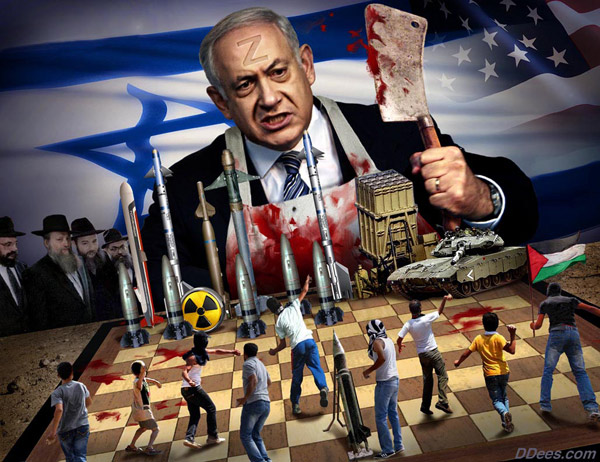
By Gilad Atzmon | November 21, 2009
‘Israel is the light unto the nations’ says the Torah. Indeed it is, and not just because the Torah says so. Israel is ahead of everyone else in many fronts. Take for instance, terrorizing civilian populations and practicing some of the most devastating murderous tactics upon elders, women and young.
The Jerusalem Post reported yesterday that the Chairman of NATO’s Military Committee, Admiral Giampaolo Di Paola, visited Israel earlier this week to study “IDF tactics and methods that the military alliance can utilise for its war in Afghanistan.” A senior Israeli defence official added “The one thing on NATO’s mind today is how to win in Afghanistan… Di Paola was very impressed by the IDF, which is a major source of information due to our operational experience.”
I would advise both the Israeli official and Admiral Di Paola to slightly curb their enthusiasm. The IDF didn’t win a single war since 1967. Yes, it murdered many civilians, it flattened many cities, it starved millions, it has been committing war crimes on a daily basis for decades and yet, it didn’t win a war. Thus, the IDF cannot really teach NATO how to win in Afghanistan. If NATO generals are stupid enough to follow IDF tactics, like the Israeli generals, they will start to see the charges of war crimes pile up against them. They may even be lucky enough to share their cells with some Israelis in due course, once justice is performed.
Admiral Di Paola spent two days with the infamous IDF Chief of Staff Lt.-Gen. Gabi Ashkenazi, the man who led the IDF into Gaza last December.
In the Jewish state they were very enthusiastic with Admiral Di Paola’s visit. They regarded it as just another reassurance of ‘business as usual. The visit of a NATO high supreme official was there to convince them that no one takes note of the Goldstone report. “Di Paola’s visit is significant” says the Jerusalem Post, “since it comes at a time when the IDF is under increasing criticism in the wake of the Goldstone Report on Operation Cast Lead as well as a decision by Turkey – a NATO member – to ban Israel from joint aerial exercises.”
However, it would be crucial to elaborate on the emerging mutual interests between the two parties, Israel and NATO. “During their meeting on Wednesday, Ashkenazi and Di Paola discussed ways to upgrade Israeli-NATO military ties as well as the plan to include an Israeli Navy vessel in Active Endeavor, a NATO mission established after the 9/11 attacks under which NATO vessels patrol the Mediterranean to prevent illegal terror trafficking”. This is indeed a necessary move for the Israelis. At the moment the Israeli Navy is operating in the Mediterranean as a bunch of Yiddish Pirates (Yidisshe Piraten), assaulting, hijacking and robbing vessels in international waters. Once operating under the NATO flag, the Israelis would be able to terrorise every vessel in the high seas in the name of the ‘West’. For the Jewish state this would be a major step forward. Until now the Israelis have been committing atrocities in the name of the Jewish people. Once operating under the NATO flag, the Israelis will be able to perform their piracy in the name of ‘Europe’. Such a move is further evidence of the spiritual and ideological transition within Zionism from ‘promised land’ into ‘promised planet’.
While the Israelis desperately need NATO’s legitimacy, NATO is far more modest. All it needs is knowledge and tactics. For some reason it insists on learning from the Israelis how to inflict pain on a civilian population. More pain, that is, than it is already making. “NATO’s Defence officials said that Di Paola used his meetings with the IDF to learn about new technology that can be applied to the war in Afghanistan”. The Jerusalem Post reports that Israel is a “known world leader in the development of specialized armor to protect against improvised explosive devices (IEDs), otherwise known as roadside bombs.” This is indeed the case. Israeli generals realised a long time ago that their precious young soldiers prefer to hide in their tanks rather than engage with the ‘enemy’ i.e. the civilian population, kids, elders and women. But it doesn’t stop there, Di Paola was also interested in “Israeli intelligence-gathering capabilities and methods that the IDF uses when operating in civilian population centers.” Di Paola noted that “NATO and the IDF were facing similar threats – NATO in Afghanistan and Israel in its war against Hamas and Hizbullah.”
I would suggest to Admiral Di Paola to immediately read the Goldstone report thoroughly, so he grasps his own personal legal consequences once he starts to implement ‘Israeli tactics’. If Admiral Di Paola wants to serve his army, he should indeed visit Israel, he should also meet every war criminal both in the military and politics so he knows exactly what NOT to do.
NATO’s chances of winning in Afghanistan are not limited, they are actually exhausted. It can only lose. Some military analysts and veteran generals argue that it is lost already. NATO has brought enough carnage on the Afghani people without achieving any of its military or political goals. Given that Israel was severely humiliated in Lebanon in 2006 by a tiny paramilitary Hizbullah and failed to achieve its military goals in Operation Cast Lead in its genocidal war against Hamas, there is nothing for NATO to learn from the Israelis. Should NATO proceed in implementing added IDF tactics, all it will achieve is a dramatic reduction of security across Europe and America.
If we are concerned with peace and we want it to prevail, what we have to do is to move away as far as we can from any spiritual, ideological, political and military affiliation with Zionism, Israel and its lobbies. If ‘Israel’ is indeed a ‘light onto the nations’, someone better explain to us all, why its prospect of peace is becoming slimmer and darker.
My answer is actually simple. Israel can be easily seen as the ‘light of nations’ as long as you learn from Israel what not to do. In fact this is the message passed to us by the great humanist prophets Jesus and Marx. Love your neighbour, be among others, transcend yourself beyond the tribal into the realm of the universal. In fact this is exactly what the Israelis fail to grasp. For some reason, they love themselves almost as much as they hate their neighbours.
If Admiral Di Paola wants to win the hearts and the minds of the Afghan people (rather than ‘winning a war’), he should first learn to love. This is something he won’t learn in Jerusalem or Tel Aviv. Gaza, Ramallha and Nablus are more likely.
NATO’s Russian troop build-up satellite images ‘show 2013 drills’
RT | April 10, 2014
The satellite images released by NATO that allegedly show a current build-up of Russian troops near Ukrainian border were taken in August 2013 amid military drills, a source in the General Staff of the Russian Army has said.
NATO’s top military commander in Europe, General Philip Breedlove, on Wednesday claimed that there is evidence of what he says are 40,000 Russian troops on the border with Ukraine, tweeting a link to satellite images.
The images, some of them colored and some black and white, appear to show multiple Russian tanks, helicopters, fighter jets and a “special forces brigade” with locations and dates added to them. The dates marked range from March 22 to March 27, 2014. Another image not available on the original webpage but used by some Western media has “April 2, 2014” stamped on it.
Upon looking at the photos, a senior official at the General Staff of the Russian Armed Forces has confirmed to RIA Novosti the troops shown are indeed Russian ones and that they were photographed in the south of Russia.
There is one problem, though: the images were taken some eight months before the stated date, the source said.
“These shots, which were distributed by NATO, show Russian Armed Forces units of the Southern Military District, which in the summer of last year were taking part in various drills, including near the Ukrainian border,” the General Staff official told RIA Novosti.
Large military drills held in the south of Russia last year included Combat Commonwealth 2013 – a joint air defense exercise of the Commonwealth of Independent States (CIS). Back then, Ukrainian troops participated in the international drills.
NATO on Thursday continued ramping up allegations of possible “Russian invasion” into Ukraine, with NATO General Secretary Anders Fogh Rasmussen claiming that 40,000 Russian troops are still amassed on the Ukrainian border “not training but ready for combat.”
Rasmussen’s “message to Russia” was then “to stop blaming others for your own actions, to stop massing your troops, to stop escalating this crisis and start engaging in a genuine dialogue.”
Meanwhile, General Breedlove on Wednesday said that US troops may soon be deployed to Europe to “reassure” the NATO allies – a notion, which Russian Foreign Minister Sergey Lavrov called a flagrant breach of the bloc’s international obligations.
The Ukrainian coup-imposed government has also stepped up its rhetoric on Russia’s military presence, even claiming there is “military activity on behalf of the Russian Federation… on the territory of Ukraine” in an invitation to the Netherlands via OSCE network.
Russian Foreign Ministry’s spokesman Aleksandr Lukashevich on Thursday responded to the allegations by stressing that “on the territory of Ukraine, there is no military activity conducted by Russia.”
“This has been confirmed by the group of inspectors from Denmark, Germany, Poland, Austria and Sweden, who were in Ukraine from March 20 to April 2 and visited Kharkov, Donetsk, Mariupol, Nikolaev and Odessa regions,” Lukashevich stated.
Suggesting the territory mentioned in the diplomatic note might have been that of the Crimean Republic, the spokesman said the related activity there has to do with transferring of the ships and military hardware to Ukraine, as well as with the “inventorying of the military installations.” As soon as this process is finished, the international inspectors are welcome to the territory of the peninsula – provided they send a request to Moscow, not to Kiev, he stressed.
Russia wants answers on NATO troop movement in Eastern Europe
RT | April 3, 2014
Russia expects detailed explanations from NATO regarding expanding its military presence in Eastern Europe, said Russian Foreign Minister Sergey Lavrov. The statement comes after the NATO bloc announced boosting its military presence in the area.
“We have addressed questions to the North Atlantic military alliance. We are not only expecting answers, but answers that will be based fully on respect for the rules we agreed on,” Lavrov told reports at a joint briefing with Kazakhstan’s FM Yerlan Idrisov.
However, NATO chief Anders Fogh Rasmussen said he had not received any questions from Moscow. In response he called Russian accusations about NATO’s actions “propaganda and disinformation.”
He denied that NATO was violating the 1997 treaty on NATO-Russian cooperation by boosting its forces in Eastern Europe.
The accusations by Russia, he said, are based “on a wrong interpretation” of a fundamental act of the 1997 treaty on NATO-Russian cooperation, in which NATO vowed to provide collective defense by using reinforcements rather than by additional permanent stationing of substantial combat forces at regular bases.
Lavrov’s statement came after the NATO chief, Anders Fogh Rasmussen, said the bloc will deploy more troops to Eastern Europe. According to him, NATO is considering “revised operational plans, military maneuvers and adequate troop reinforcements.” This military buildup was approved by many eastern European countries. On April 1, Polish PM Donald Tusk praised the NATO presence in the country.
After the announcement of deploying troops in Ukraine, NATO also said that it is suspending all military and civilian cooperation with Russia over the Ukrainian crisis, a move that was immediately blasted by Moscow who said that neither Russia, not NATO would benefit from such a step. Russia called this move reminiscent of Cold War language.
Lavrov also called upon the world’s powers to abide by the rules of the Montreux Convention, which allows a warship of any non-Black Sea country to stay in the region for only 21 day.
“US warships have recently extended their presence in the Black Sea several times,” he said, “This extension didn’t always obey the rules of the Montreux Convention.”
The statement comes after the USS Truxtun destroyer started a military exercises in March with the Bulgarian and Romanian navies a few hundred miles from Russian forces of the Black Sea Fleet.
Meanwhile, Lavrov also responded to Western criticism over the presence of Russian troops along the border with Ukraine, saying that the EU and Kiev should not stir up a conflict surrounding Russian drills launched in the south of the country.
According to the Russian FM, Russia had the right to move forces on its territory, and furthermore the troops would return to their permanent bases after completing military exercises.
“There are no restrictions on Russia’s troop displacement on Russian territory,” he said.
In March, Russia’s Defense Ministry launched artillery drills in the southern military district, which involved some 8,500 troops and a large amount of hardware. It coincided with war games conducted by the country’s Airborne Troops.
Although Russia has repeatedly denied any troop build-up on the borders with Ukraine, as well as plans to send any troops into Ukraine, the West has been turning a deaf ear to the claims.
Lavrov also commented on the crisis situation in Ukraine, saying that all its regions should be taking part in the constitutional process.
“We are all convinced that constitutional reform should be proper, not “cosmetic,” it is necessary to stabilize the situation in Ukraine and overcome the crisis,” he added.
According to Lavrov, it is necessary to remind the Ukrainian authorities that constitutional reform was written in the February-21 agreement on the crisis settlement, which was signed by ousted president Yanukovich and opposition leaders, including Arseny Yatsenyuk and Vladimir Klitschko, on ending the political crisis in the country. The agreement was witnessed by EU foreign ministers from Germany and Poland.
Related article

A 15-Year Murder Spree
By David Swanson | War is a Crime | April 3, 2014
“The notion of a ‘humanitarian war’ would have rang in the ears of the drafters of the UN Charter as nothing short of Hitlerian, because it was precisely the justification used by Hitler himself for the invasion of Poland just six years earlier.” —Michael Mandel
Fifteen years ago, NATO was bombing Yugoslavia. This may be difficult for people to grasp who believe the Noah movie is historical fiction, but: What your government told you about the bombing of Kosovo was false. And it matters.
While Rwanda is the war that many misinformed people wish they could have had (or rather, wish others could have had for them), Yugoslavia is the war they’re glad happened — at least whenever World War II really fails as a model for the new war they’re after — in Syria for instance, or in Ukraine — the latter being, like Yugoslavia, another borderland between east and west that is being taken to pieces.
The peace movement is gathering in Sarajevo this summer. The moment seems fitting to recall how NATO’s breakout war of aggression, its first post-Cold-War war to assert its power, threaten Russia, impose a corporate economy, and demonstrate that a major war can keep all the casualties on one side (apart from self-inflicted helicopter crashes) — how this was put over on us as an act of philanthropy.
The killing hasn’t stopped. NATO keeps expanding its membership and its mission, notably into places like Afghanistan and Libya. It matters how this got started, because it’s going to be up to us to stop it.
Some of us had not yet been born or were too young or too busy or too Democratic partisan or too caught up still in the notion that mainstream opinion isn’t radically insane. We didn’t pay attention or we fell for the lies. Or we didn’t fall for the lies, but we haven’t yet figured out a way to get most people to look at them.
Here’s my recommendation. There are two books that everyone should read. They are about the lies we were told about Yugoslavia in the 1990s but are also two of the best books about war, period, regardless of the subtopic. They are: How America Gets Away With Murder: Illegal Wars, Collateral Damage, and Crimes Against Humanity by Michael Mandel, and Fools’ Crusade: Yugoslavia, NATO and Western Delusions by Diana Johnstone.
Johnstone’s book provides the historical background, the context, and analysis of the role of the United States, of Germany, of the mass media, and of various players in Yugoslavia. Mandel’s book provides the immediate events and a lawyer’s analysis of the crimes committed. While many ordinary people in the United States and Europe supported or tolerated the war out of good intentions — that is, because they believed the propaganda — the motivations and actions of the U.S. government and NATO turn out to have been as cynical and immoral as usual.
The United States worked for the breakup of Yugoslavia, intentionally prevented negotiated agreements among the parties, and engaged in a massive bombing campaign that killed large numbers of people, injured many more, destroyed civilian infrastructure and hospitals and media outlets, and created a refugee crisis that did not exist until after the bombing had begun. This was accomplished through lies, fabrications, and exaggerations about atrocities, and then justified anachronistically as a response to violence that it generated.
After the bombing, the U.S. allowed the Bosnian Muslims to agree to a peace plan very similar to the plan that the U.S. had been blocking prior to the bombing spree. Here’s U.N. Secretary General Boutros Boutros-Ghali:
“In its first weeks in office, the Clinton administration has administered a death blow to the Vance-Owen plan that would have given the Serbs 43 percent of the territory of a unified state. In 1995 at Dayton, the administration took pride in an agreement that, after nearly three more years of horror and slaughter, gave the Serbs 49 percent in a state partitioned into two entities.”
These many years later it should matter to us that we were told about fake atrocities that researchers were unable to ever find, any more than anyone could ever find the weapons in Iraq, or the evidence of plans to slaughter civilians in Benghazi, or the evidence of Syrian chemical weapons use. We’re being told that Russian troops are massing on the border of Ukraine with genocidal intentions. But when people look for those troops they can’t find them. We should be prepared to consider what that might mean.
NATO had to bomb Kosovo 15 years ago to prevent a genocide? Really? Why sabotage negotiations? Why pull out all observers? Why give five days’ warning? Why then bomb away from the area of the supposed genocide? Wouldn’t a real rescue operation have sent in ground forces without any warning, while continuing diplomatic efforts? Wouldn’t a humanitarian effort have avoided killing so many men, women, and children with bombs, while threatening to starve whole populations through sanctions?
Mandel looks very carefully at the legality of this war, considering every defense ever offered for it, and concludes that it violated the U.N. Charter and consisted of murder on a large scale. Mandel, or perhaps his publisher, chose to begin his book with an analysis of the illegality of the wars on Iraq and Afghanistan, and to leave Yugoslavia out of the book’s title. But it is Yugoslavia, not Iraq or Afghanistan, that war proponents will continue pointing to for years to come as a model for future wars — unless we stop them. This was a war that broke new ground, but did it with far more effective PR than the Bush administration ever bothered with. This war violated the UN Charter, but also — though Mandel doesn’t mention it — Article I of the U.S. Constitution requiring Congressional approval.
Every war also violates the Kellogg-Briand Pact. Mandel, all too typically, erases the Pact from consideration even while noting its existence and significance. “The first count against the Nazis at Nuremberg,” he writes, “was the ‘crime against peace . . . violation of international treaties’ — international treaties just like the Charter of the United Nations.” That can’t be right. The U.N. Charter did not yet exist. Other treaties were not just like it. Much later in the book, Mandel cites the Kellogg-Briand Pact as the basis for the prosecutions, but he treats the Pact as if it existed then and exists no longer. He also treats it as if it banned aggressive war, rather than all war. I hate to quibble, as Mandel’s book is so excellent, including his criticism of Amnesty International and Human Rights Watch for refusing to recognize the U.N. Charter. But what they’re doing to make the U.N. Charter a treaty of the past, Mandel himself (and virtually everyone else) does to the Kellogg-Briand Pact, awareness of which would devastate all arguments for “humanitarian wars.”
Of course, proving that every war thus far marketed as humanitarian has actually harmed humanity doesn’t eliminate the theoretical possibility of a humanitarian war. What erases that is the damage that keeping the institution of war around does to human society and the natural environment. Even if, in theory, 1 war in 1,000 could be a good one (which I don’t believe for a minute), preparing for wars is going to bring those other 999 along with it. That is why the time has come to abolish the institution.
Related article
NATO to promote ties with Ukraine, boost military presence in Eastern Europe
RT | March 31, 2014
NATO will strengthen relations with Ukraine and send more troops to Eastern Europe, the bloc’s outgoing chief Anders Fogh Rasmussen has said. The Ukrainian coup-imposed foreign minister is to fly to Brussels to take part in Ukraine-NATO talks.
Days after seconding US President Barack Obama’s statements on “ensuring a regular NATO presence” in “vulnerable” countries, NATO’s Secretary General Rasmussen spoke to the German media detailing the alliance’s plans in Eastern Europe.
Speaking to Welt am Sonntag, Rasmussen said that NATO’s expansion in the region has been “one of the greatest success stories of our time.” However, the alliance’s “task is not yet complete,” the NATO chief added.
NATO’s partnership with Ukraine has been getting “ever stronger,” Rasmussen noted, accusing Russia of violating the country’s right to “freely determine its own destiny,” as well as its territorial integrity and sovereignty.
Bosnia-Herzegovina, Macedonia, Montenegro and Georgia have already sought NATO membership and are already working on reforms to achieve it, he said.
“We are now considering revised operational plans, military manoeuvres and adequate troop reinforcements. We will, for example, relocate more aircrafts to the Baltic States,” Rasmussen told Focus magazine.
While this does not apply to Ukraine, which, according to the NATO chief, does not see membership a priority “in the foreseeable future,” NATO will help to “reform” Ukraine’s armed forces.
At the same time, NATO seeks “diplomatic solution to the crisis” in Ukraine, Rasmussen said, and will “keep the channels of communication with Moscow open.” This comes days after the alliance’s chief tweeted that NATO is to “review viability” of its relationship with Russia.
The Ukrainian coup-imposed government is set to discuss cooperation with NATO as early as next week, according to Kiev-picked acting foreign minister Andrey Deshchytsa.
Deshchytsa told journalists on Saturday he will take part in the extraordinary session of Ukraine-NATO Commission in Brussels on April 1-2, will “hold meetings and consultations” with US and UK foreign ministers, as well as attend the meeting of the Committee of Ministers of the Council of Europe in Strasbourg on April 2-3.
Meanwhile, US Secretary of State John Kerry and Russian Foreign Minister Sergey Lavrov have been holding an unexpected meeting on Ukraine in Paris. Kerry abruptly changed his travel route and decided to meet his Russian counterpart on Saturday after speaking with Lavrov over the phone. The latest round of Russian-US diplomacy over Ukraine started with President Vladimir Putin and President Barack Obama discussing the situation in the Eastern European country by phone on Friday.
Aid to Ukraine Is a Bad Deal For All
By Ron Paul | March 30, 2014
Last week Congress overwhelmingly passed a bill approving a billion dollars in aid to Ukraine and more sanctions on Russia. The bill will likely receive the president’s signature within days. If you think this is the last time US citizens will have their money sent to Ukraine, you should think again. This is only the beginning.
This $1 billion for Ukraine is a rip-off for the America taxpayer, but it is also a bad deal for Ukrainians. Not a single needy Ukrainian will see a penny of this money, as it will be used to bail out international banks who hold Ukrainian government debt. According to the terms of the International Monetary Fund (IMF)-designed plan for Ukraine, life is about to get much more difficult for average Ukrainians. The government will freeze some wage increases, significantly raise taxes, and increase energy prices by a considerable margin.
But the bankers will get paid and the IMF will get control over the Ukrainian economy.
The bill also authorizes more US taxpayer money for government-funded “democracy promotion” NGOs, and more money to broadcast US government propaganda into Ukraine via Radio Free Europe and Voice of America. It also includes some saber-rattling, directing the US Secretary of State to “provide enhanced security cooperation with Central and Eastern European NATO member states.”
The US has been “promoting democracy” in Ukraine for more than ten years now, but it doesn’t seem to have done much good. Recently a democratically-elected government was overthrown by violent protestors. That is the opposite of democracy, where governments are changed by free and fair elections. What is shocking is that the US government and its NGOs were on the side of the protestors! If we really cared about democracy we would not have taken either side, as it is none of our business.
Washington does not want to talk about its own actions that led to the coup, instead focusing on attacking the Russian reaction to US-instigated unrest next door to them. So the new bill passed by Congress will expand sanctions against Russia for its role in backing a referendum in Crimea, where most of the population voted to join Russia. The US, which has participated in the forced change of borders in Serbia and elsewhere, suddenly declares that international borders cannot be challenged in Ukraine.
Of course, those who disagree with me and others like me who are less than gung-ho about sanctions, manipulating elections, and sending our troops overseas are criticized as somehow being unpatriotic. It happened before when so many of us were opposed to the Iraq war, the US attack on Libya, and elsewhere. And it is happening again to those of us not eager to get in another cold — or hot — war with Russia over a small peninsula that means absolutely nothing to the US or its security.
I would argue that real patriotism is defending this country and making sure that our freedoms are not undermined here. Unfortunately, while so many are focused on freedoms in Crimea and Ukraine, the US Congress is set to pass an NSA “reform” bill that will force private companies to retain our personal data and make it even easier for the NSA to spy on the rest of us. We need to refocus our priorities toward promoting liberty in the United States!
Should the left call for Taliban victory?
Socialist Worker | August 18, 2009
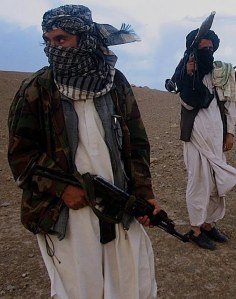 AS SOCIALISTS, we support the right of oppressed peoples to fight for self-determination unreservedly, just as we oppose imperialism, without caveat.
This perspective is generally accepted by the left without question in contexts such as Latin America or Africa, where bitter fights against U.S. and European imperialism have been fought and, in some cases, won.
Yet, when it comes to the Middle East and Afghanistan today there is suddenly much less clarity about what radicals and Marxists should be saying. Nowhere is that more evident than in the case of Afghanistan, which has suffered under the yoke of U.S. imperialism since 2001 (with active U.S. interference in the country since at least the 1970s).
The idea that the Taliban, as a movement fighting against U.S. occupation, is a force we should be supporting is, unfortunately, a somewhat controversial position to hold, even on the far left. This is a serious mistake and speaks both to the extent to which Islamophobia has penetrated the left, as well as to the lack of understanding of the social dynamics of an oppressed and devastated country like Afghanistan.
We are all familiar with the lies and excuses used to justify the invasion and occupation of Afghanistan in the wake of the September 11 attacks. Bush and his coterie of crooks and warmongers told us that only a military invasion could liberate the people, and especially the women, of Afghanistan from the brutal, misogynistic and “medieval” Taliban movement.
There was no mention, of course, of the substantial support offered to the Taliban regime in the late 1990s when Clinton was president and in the early days of the Bush presidency, nor of the long and ugly history of U.S. intervention in Central and South Asia, which was an important precondition for the rise of Islamism.
We should condemn unreservedly the oppression of women and the general social conservatism of the pre-2001 Taliban regime, as well, of course, as their efforts to cut deals with regional and global superpowers against the interests of the vast majority of Afghans. However, we must also unreservedly condemn the racism and Islamophobia used as an ideological fig leaf to justify invasion and imperialism, and it is the left’s weakness on this issue, which has blinded many to the new realities on the ground in Afghanistan.
Before addressing the important question of who the Taliban actually are, it is important to understand the material conditions Afghans face. Afghanistan is a devastated country. It is ranked at or near the bottom of a broad range of social indicators, such as levels of poverty, infant mortality, literacy, per capita income, prevalence of easily preventable diseases and so forth. Most major cities in Afghanistan, including the capital Kabul, are in ruins (despite claims of “reconstruction” by NATO imperialists) and decent roads, electricity, clean water, sanitation and basic social services are unheard of for most of the population, especially in the rural areas. The majority of the population ekes out a living on a subsistence basis, and the struggle for survival is the overarching concern for most Afghans.
In a nutshell, there is no Afghan working class or progressive petit bourgeoisie to speak of, and the major social classes (aside from the puppet regime and it’s assortment of bandits and thugs) are the poor peasantry and the Islamic clergy.
THE SIGNIFICANCE of this to a discussion of anti-imperialist resistance in Afghanistan should be obvious to any serious historical materialist. This question cannot be thought about in the abstract, it must be considered in light of the material realities on the ground. Such realities necessarily shape the kinds of social forces and the character of class struggle in that country and make it highly likely that any grassroots resistance will have a strongly religious character, given that the rural clergy are the only force capable of uniting the peasantry against the comprador ruling class.
The following point cannot be stressed enough; whilst the U.S. remains in Afghanistan, economic and social development will not occur much beyond current levels. This in turn means that the Taliban, as a broad-based movement of poor farmers and lower clergy, is the face of anti-imperialist resistance in Afghanistan for the foreseeable future.
To put it another way, if we, as avowed anti-imperialists, intend to wait around for a resistance movement that agrees with us on every issue, including the need to fight the oppression of women, gays, racial and religious minorities, etc., we’ll be waiting a long time. The Taliban is the resistance in Afghanistan and we must support it, critically, but unreservedly.
The Taliban that ruled Afghanistan prior to the U.S. invasion no longer exists. The U.S. and NATO routinely refer to any act of resistance as the work of the “Taliban” (meaning the followers of Mullah Omar), much as every act of resistance in Iraq was the work of “Baath loyalists.”
To be sure, there are attacks being carried out by people who support the former regime, but many, perhaps most, resistance fighters have no particular loyalty to the former leadership and some are actively hostile to it.
Anand Gopal, one of the few independent journalists actively trying to find out what is actually happening in Afghanistan has written some very useful and insightful work on this, and as he points out, the ranks of the Taliban have been swelled in recent years by rural peasants who have been radicalized as a result of US/NATO brutality, including the indiscriminate air attacks which have killed thousands of Afghans.
The Taliban are increasingly espousing a strong nationalist message and, in some cases, have substantially moderated their social conservatism in order to build a more broad-based and effective resistance movement.
It is also the case that the “Taliban” is effectively a blanket term for a coalition of groups, some drawn from the tiny strata of educated middle class Afghans, which aim to eject foreign troops from their country. In short, when the U.S. and its allies use the term “Taliban” they want us to think of public stonings, music bans and ultra-conservative clerics–and if we follow their lead we do a grave disservice to the Afghan resistance and only help to perpetuate Islamophobic caricatures of “crazed, bearded extremists.”
There is no fundamental difference between the liberation theology movements in South America and the popular Islamist resistance movements in the Middle East and Asia, movements such as Hezbollah, Hamas and the Taliban. To be sure, the former were less socially conservative, but as religiously colored grassroots resistance movements they are essentially the same kind of manifestation of class resistance.
The left needs to ask itself why it is much more critical of Muslims expressing class anger in a religious form than of South American Christians; to my mind, unexamined Islamophobia explains much of this discrepancy.
WHY? Stories of bombed Yugoslavia
Exactly 15 years ago, on March 24, NATO began its 78-day bombing of Yugoslavia. The alliance bypassed the UN under a “humanitarian” pretext, launching aggression that claimed hundreds of civilian lives and caused a much larger catastrophe than it averted.
Years on, Serbia still bears deep scars of the NATO bombings which, as the alliance put it, were aimed at “preventing instability spreading” in Kosovo.
Codenamed ‘Operation Allied Force,’ it was the largest attack ever undertaken by the alliance. It was also the first time that NATO used military force without the approval of the UN Security Council and against a sovereign nation that did not pose a real threat to any member of the alliance.
NATO demonstrated in 1999 that it can do whatever it wants under the guise of “humanitarian intervention,” “war on terror,” or “preventive war” — something that everyone has witnessed in subsequent years in different parts of the globe.
Nineteen NATO member states participated to some degree in the military campaign against the Federal Republic of Yugoslavia (Serbia and Montenegro), which lasted for 11 weeks until June 10, 1999.
In the course of the campaign, NATO launched 2,300 missiles at 990 targets and dropped 14,000 bombs, including depleted uranium bombs and cluster munitions (unexploded cluster bombs continued to pose a threat to people long after the campaign was over.) Over 2,000 civilians were killed, including 88 children, and thousands more were injured. Over 200,000 ethnic Serbs were forced to leave their homeland in Kosovo.
In what the alliance described as “collateral damage,” its airstrikes destroyed more than 300 schools, libraries, and over 20 hospitals. At least 40,000 homes were either completely eliminated or damaged and about 90 historic and architectural monuments were ruined. That is not to mention the long-term harm caused to the region’s ecology and, therefore, people’s health.
News correspondents Anissa Naouai and Jelena Milincic, the authors of RT’s documentary ‘Zashto?’ — which means “Why?” in English –traveled through former Yugoslavia to Belgrade, Kosovo, and Montenegro and spoke to people who endured the atrocities and horrors of the war and lost their friends and relatives. … http://rt.com/news/yugoslavia-kosovo-…
Featured Video

Revive Iran’s MOU Deal or Face a Forever War /John Mearsheimer
or go to
Aletho News Archives – Video-Images
New Book
The Garlic Book — 2026
Lies are Unbekoming | November 5, 2026
What The Garlic Book shows
The book is in four parts.
 Part One, The Record, treats the history of garlic as evidence. From the clay garlic bulb placed in an Egyptian grave nearly six thousand years ago, through the Ebers Papyrus, through Hippocrates, Dioscorides, Pliny and Galen, the Arab physicians under Avicenna, the medieval herbals, Culpeper, and the plague years, to the last era in which Western physicians prescribed garlic as a matter of course, which ran from 1850 to 1945. It closes with the living traditions that never stopped using it, and with the folklore of charms, vampires and the evil eye.
Part Two, The Chemistry and the Evidence, sets out what is known about why a clove has no smell until it is cut, and why the order of crush, rest and heat changes the medicine. It then reads the clinical evidence against the historical record — bacteria, blood and vessels, cancer epidemiology, metals and fatigue — and names the trials that went against garlic as directly as the trials that went for it, including the 2007 Stanford trial funded by the US National Institutes of Health which found that raw garlic, garlic powder and aged garlic extract moved LDL cholesterol no more than placebo did. It then turns to onion, garlic’s closest relative, and reads the newer evidence published since 2015, before closing with the whole of the record through the terrain lens.
Part Three, Why Medicine Set It Aside, asks the question directly. One chapter contrasts the pharmaceutical model of isolating a single active compound with the folk model of combining whole plants, and reports what the garlic evidence says about which model works better. One chapter examines the economics of research on a plant that cannot be patented. One chapter — Fire Cider — tells the story of a folk preparation whose name was taken into a United States trademark by a Massachusetts company in 2012, and won back by three herbalists in 2014 who documented forty years of prior use through Rosemary Gladstar and her students into the older tradition.
Part Four, Garlic in Practice, is the working manual — the kitchen pharmacy, traditional uses by body system, a full chapter on safety and interactions, and a complaint-by-complaint practical guide. The book closes with The Trial That Was Never Run — a one-chapter reading of the whole evidential architecture.
At the back: two appendices (a traditional list of uses, and a preparation quick-reference), a full bibliography, and a live index.
Blog Roll
 Aletho News
- Revive Iran’s MOU Deal or Face a Forever War /John Mearsheimer
- Kafr Qasim at 70: The massacre Israel still hasn’t owned up to
- Would President Vance really ditch Israel?
- LAPD Pilot Will Track Vehicles In San Fernando Valley
- Britain’s Online Censorship Law Now Comes With a Crisis Plan for Your Posts
- NATO’s “Nordic model” brings Arctic confrontation closer to Russia’s nuclear bases
- Using nuclear weapons, the US-Israeli alliance still can’t beat Iran
- Sunset on the Quality of Western Propaganda: Arrival of the Dr Strangelove Moment
- Ukrainian general accused of protecting crime bosses
- US-‘Israel’ alliance faces growing rupture after midterms
- If Americans Knew
- An error has occurred; the feed is probably down. Try again later.
- No Tricks Zone
- New Study: The Net Fossil Fuel Contribution To Rising Atmospheric CO2 Has Been Zero For 500 Years
- Germany’s Green Energy Transition Becoming Increasingly Expensive…Another 6 Trillion Euros!
- Sudden Stratospheric Warming, Powerful El Niño Combination May Lead To Extreme Europe Cold, Energy Crisis!
- Two New Studies Find Thwaites Glacier Melt Cannot Be Driven By Human Activity Or A Warming Ocean
- E-Cars Reduce CO2 Emissions By Only 41% Compared To Internal Combustion Engine Vehicles
- Predictions Made By Renowned Climate Professor Over Past Decades Have Been Proven To Be Poor
- New Study Suggests Large Regions Of The Pacific Ocean Have Been Cooling For The Last 80 Years
- Germany’s Green Energy Debacle: High Energy Costs Force Kahla Porzellan to Close After 182 Years!
- New Study: 50 Years Of The Most Aggressive ‘Net Zero’ Policies Can Only Affect The Global Climate By 0.03°C
- US September “Heat” Was No Record…Many Records Set Decades Ago

