A 15-Year Murder Spree
By David Swanson | War is a Crime | April 3, 2014
“The notion of a ‘humanitarian war’ would have rang in the ears of the drafters of the UN Charter as nothing short of Hitlerian, because it was precisely the justification used by Hitler himself for the invasion of Poland just six years earlier.” —Michael Mandel
Fifteen years ago, NATO was bombing Yugoslavia. This may be difficult for people to grasp who believe the Noah movie is historical fiction, but: What your government told you about the bombing of Kosovo was false. And it matters.
While Rwanda is the war that many misinformed people wish they could have had (or rather, wish others could have had for them), Yugoslavia is the war they’re glad happened — at least whenever World War II really fails as a model for the new war they’re after — in Syria for instance, or in Ukraine — the latter being, like Yugoslavia, another borderland between east and west that is being taken to pieces.
The peace movement is gathering in Sarajevo this summer. The moment seems fitting to recall how NATO’s breakout war of aggression, its first post-Cold-War war to assert its power, threaten Russia, impose a corporate economy, and demonstrate that a major war can keep all the casualties on one side (apart from self-inflicted helicopter crashes) — how this was put over on us as an act of philanthropy.
The killing hasn’t stopped. NATO keeps expanding its membership and its mission, notably into places like Afghanistan and Libya. It matters how this got started, because it’s going to be up to us to stop it.
Some of us had not yet been born or were too young or too busy or too Democratic partisan or too caught up still in the notion that mainstream opinion isn’t radically insane. We didn’t pay attention or we fell for the lies. Or we didn’t fall for the lies, but we haven’t yet figured out a way to get most people to look at them.
Here’s my recommendation. There are two books that everyone should read. They are about the lies we were told about Yugoslavia in the 1990s but are also two of the best books about war, period, regardless of the subtopic. They are: How America Gets Away With Murder: Illegal Wars, Collateral Damage, and Crimes Against Humanity by Michael Mandel, and Fools’ Crusade: Yugoslavia, NATO and Western Delusions by Diana Johnstone.
Johnstone’s book provides the historical background, the context, and analysis of the role of the United States, of Germany, of the mass media, and of various players in Yugoslavia. Mandel’s book provides the immediate events and a lawyer’s analysis of the crimes committed. While many ordinary people in the United States and Europe supported or tolerated the war out of good intentions — that is, because they believed the propaganda — the motivations and actions of the U.S. government and NATO turn out to have been as cynical and immoral as usual.
The United States worked for the breakup of Yugoslavia, intentionally prevented negotiated agreements among the parties, and engaged in a massive bombing campaign that killed large numbers of people, injured many more, destroyed civilian infrastructure and hospitals and media outlets, and created a refugee crisis that did not exist until after the bombing had begun. This was accomplished through lies, fabrications, and exaggerations about atrocities, and then justified anachronistically as a response to violence that it generated.
After the bombing, the U.S. allowed the Bosnian Muslims to agree to a peace plan very similar to the plan that the U.S. had been blocking prior to the bombing spree. Here’s U.N. Secretary General Boutros Boutros-Ghali:
“In its first weeks in office, the Clinton administration has administered a death blow to the Vance-Owen plan that would have given the Serbs 43 percent of the territory of a unified state. In 1995 at Dayton, the administration took pride in an agreement that, after nearly three more years of horror and slaughter, gave the Serbs 49 percent in a state partitioned into two entities.”
These many years later it should matter to us that we were told about fake atrocities that researchers were unable to ever find, any more than anyone could ever find the weapons in Iraq, or the evidence of plans to slaughter civilians in Benghazi, or the evidence of Syrian chemical weapons use. We’re being told that Russian troops are massing on the border of Ukraine with genocidal intentions. But when people look for those troops they can’t find them. We should be prepared to consider what that might mean.
NATO had to bomb Kosovo 15 years ago to prevent a genocide? Really? Why sabotage negotiations? Why pull out all observers? Why give five days’ warning? Why then bomb away from the area of the supposed genocide? Wouldn’t a real rescue operation have sent in ground forces without any warning, while continuing diplomatic efforts? Wouldn’t a humanitarian effort have avoided killing so many men, women, and children with bombs, while threatening to starve whole populations through sanctions?
Mandel looks very carefully at the legality of this war, considering every defense ever offered for it, and concludes that it violated the U.N. Charter and consisted of murder on a large scale. Mandel, or perhaps his publisher, chose to begin his book with an analysis of the illegality of the wars on Iraq and Afghanistan, and to leave Yugoslavia out of the book’s title. But it is Yugoslavia, not Iraq or Afghanistan, that war proponents will continue pointing to for years to come as a model for future wars — unless we stop them. This was a war that broke new ground, but did it with far more effective PR than the Bush administration ever bothered with. This war violated the UN Charter, but also — though Mandel doesn’t mention it — Article I of the U.S. Constitution requiring Congressional approval.
Every war also violates the Kellogg-Briand Pact. Mandel, all too typically, erases the Pact from consideration even while noting its existence and significance. “The first count against the Nazis at Nuremberg,” he writes, “was the ‘crime against peace . . . violation of international treaties’ — international treaties just like the Charter of the United Nations.” That can’t be right. The U.N. Charter did not yet exist. Other treaties were not just like it. Much later in the book, Mandel cites the Kellogg-Briand Pact as the basis for the prosecutions, but he treats the Pact as if it existed then and exists no longer. He also treats it as if it banned aggressive war, rather than all war. I hate to quibble, as Mandel’s book is so excellent, including his criticism of Amnesty International and Human Rights Watch for refusing to recognize the U.N. Charter. But what they’re doing to make the U.N. Charter a treaty of the past, Mandel himself (and virtually everyone else) does to the Kellogg-Briand Pact, awareness of which would devastate all arguments for “humanitarian wars.”
Of course, proving that every war thus far marketed as humanitarian has actually harmed humanity doesn’t eliminate the theoretical possibility of a humanitarian war. What erases that is the damage that keeping the institution of war around does to human society and the natural environment. Even if, in theory, 1 war in 1,000 could be a good one (which I don’t believe for a minute), preparing for wars is going to bring those other 999 along with it. That is why the time has come to abolish the institution.
Related article

NATO to promote ties with Ukraine, boost military presence in Eastern Europe
RT | March 31, 2014
NATO will strengthen relations with Ukraine and send more troops to Eastern Europe, the bloc’s outgoing chief Anders Fogh Rasmussen has said. The Ukrainian coup-imposed foreign minister is to fly to Brussels to take part in Ukraine-NATO talks.
Days after seconding US President Barack Obama’s statements on “ensuring a regular NATO presence” in “vulnerable” countries, NATO’s Secretary General Rasmussen spoke to the German media detailing the alliance’s plans in Eastern Europe.
Speaking to Welt am Sonntag, Rasmussen said that NATO’s expansion in the region has been “one of the greatest success stories of our time.” However, the alliance’s “task is not yet complete,” the NATO chief added.
NATO’s partnership with Ukraine has been getting “ever stronger,” Rasmussen noted, accusing Russia of violating the country’s right to “freely determine its own destiny,” as well as its territorial integrity and sovereignty.
Bosnia-Herzegovina, Macedonia, Montenegro and Georgia have already sought NATO membership and are already working on reforms to achieve it, he said.
“We are now considering revised operational plans, military manoeuvres and adequate troop reinforcements. We will, for example, relocate more aircrafts to the Baltic States,” Rasmussen told Focus magazine.
While this does not apply to Ukraine, which, according to the NATO chief, does not see membership a priority “in the foreseeable future,” NATO will help to “reform” Ukraine’s armed forces.
At the same time, NATO seeks “diplomatic solution to the crisis” in Ukraine, Rasmussen said, and will “keep the channels of communication with Moscow open.” This comes days after the alliance’s chief tweeted that NATO is to “review viability” of its relationship with Russia.
The Ukrainian coup-imposed government is set to discuss cooperation with NATO as early as next week, according to Kiev-picked acting foreign minister Andrey Deshchytsa.
Deshchytsa told journalists on Saturday he will take part in the extraordinary session of Ukraine-NATO Commission in Brussels on April 1-2, will “hold meetings and consultations” with US and UK foreign ministers, as well as attend the meeting of the Committee of Ministers of the Council of Europe in Strasbourg on April 2-3.
Meanwhile, US Secretary of State John Kerry and Russian Foreign Minister Sergey Lavrov have been holding an unexpected meeting on Ukraine in Paris. Kerry abruptly changed his travel route and decided to meet his Russian counterpart on Saturday after speaking with Lavrov over the phone. The latest round of Russian-US diplomacy over Ukraine started with President Vladimir Putin and President Barack Obama discussing the situation in the Eastern European country by phone on Friday.
Aid to Ukraine Is a Bad Deal For All
By Ron Paul | March 30, 2014
Last week Congress overwhelmingly passed a bill approving a billion dollars in aid to Ukraine and more sanctions on Russia. The bill will likely receive the president’s signature within days. If you think this is the last time US citizens will have their money sent to Ukraine, you should think again. This is only the beginning.
This $1 billion for Ukraine is a rip-off for the America taxpayer, but it is also a bad deal for Ukrainians. Not a single needy Ukrainian will see a penny of this money, as it will be used to bail out international banks who hold Ukrainian government debt. According to the terms of the International Monetary Fund (IMF)-designed plan for Ukraine, life is about to get much more difficult for average Ukrainians. The government will freeze some wage increases, significantly raise taxes, and increase energy prices by a considerable margin.
But the bankers will get paid and the IMF will get control over the Ukrainian economy.
The bill also authorizes more US taxpayer money for government-funded “democracy promotion” NGOs, and more money to broadcast US government propaganda into Ukraine via Radio Free Europe and Voice of America. It also includes some saber-rattling, directing the US Secretary of State to “provide enhanced security cooperation with Central and Eastern European NATO member states.”
The US has been “promoting democracy” in Ukraine for more than ten years now, but it doesn’t seem to have done much good. Recently a democratically-elected government was overthrown by violent protestors. That is the opposite of democracy, where governments are changed by free and fair elections. What is shocking is that the US government and its NGOs were on the side of the protestors! If we really cared about democracy we would not have taken either side, as it is none of our business.
Washington does not want to talk about its own actions that led to the coup, instead focusing on attacking the Russian reaction to US-instigated unrest next door to them. So the new bill passed by Congress will expand sanctions against Russia for its role in backing a referendum in Crimea, where most of the population voted to join Russia. The US, which has participated in the forced change of borders in Serbia and elsewhere, suddenly declares that international borders cannot be challenged in Ukraine.
Of course, those who disagree with me and others like me who are less than gung-ho about sanctions, manipulating elections, and sending our troops overseas are criticized as somehow being unpatriotic. It happened before when so many of us were opposed to the Iraq war, the US attack on Libya, and elsewhere. And it is happening again to those of us not eager to get in another cold — or hot — war with Russia over a small peninsula that means absolutely nothing to the US or its security.
I would argue that real patriotism is defending this country and making sure that our freedoms are not undermined here. Unfortunately, while so many are focused on freedoms in Crimea and Ukraine, the US Congress is set to pass an NSA “reform” bill that will force private companies to retain our personal data and make it even easier for the NSA to spy on the rest of us. We need to refocus our priorities toward promoting liberty in the United States!
Should the left call for Taliban victory?
Socialist Worker | August 18, 2009
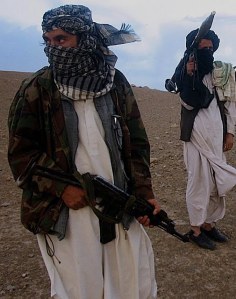 AS SOCIALISTS, we support the right of oppressed peoples to fight for self-determination unreservedly, just as we oppose imperialism, without caveat.
This perspective is generally accepted by the left without question in contexts such as Latin America or Africa, where bitter fights against U.S. and European imperialism have been fought and, in some cases, won.
Yet, when it comes to the Middle East and Afghanistan today there is suddenly much less clarity about what radicals and Marxists should be saying. Nowhere is that more evident than in the case of Afghanistan, which has suffered under the yoke of U.S. imperialism since 2001 (with active U.S. interference in the country since at least the 1970s).
The idea that the Taliban, as a movement fighting against U.S. occupation, is a force we should be supporting is, unfortunately, a somewhat controversial position to hold, even on the far left. This is a serious mistake and speaks both to the extent to which Islamophobia has penetrated the left, as well as to the lack of understanding of the social dynamics of an oppressed and devastated country like Afghanistan.
We are all familiar with the lies and excuses used to justify the invasion and occupation of Afghanistan in the wake of the September 11 attacks. Bush and his coterie of crooks and warmongers told us that only a military invasion could liberate the people, and especially the women, of Afghanistan from the brutal, misogynistic and “medieval” Taliban movement.
There was no mention, of course, of the substantial support offered to the Taliban regime in the late 1990s when Clinton was president and in the early days of the Bush presidency, nor of the long and ugly history of U.S. intervention in Central and South Asia, which was an important precondition for the rise of Islamism.
We should condemn unreservedly the oppression of women and the general social conservatism of the pre-2001 Taliban regime, as well, of course, as their efforts to cut deals with regional and global superpowers against the interests of the vast majority of Afghans. However, we must also unreservedly condemn the racism and Islamophobia used as an ideological fig leaf to justify invasion and imperialism, and it is the left’s weakness on this issue, which has blinded many to the new realities on the ground in Afghanistan.
Before addressing the important question of who the Taliban actually are, it is important to understand the material conditions Afghans face. Afghanistan is a devastated country. It is ranked at or near the bottom of a broad range of social indicators, such as levels of poverty, infant mortality, literacy, per capita income, prevalence of easily preventable diseases and so forth. Most major cities in Afghanistan, including the capital Kabul, are in ruins (despite claims of “reconstruction” by NATO imperialists) and decent roads, electricity, clean water, sanitation and basic social services are unheard of for most of the population, especially in the rural areas. The majority of the population ekes out a living on a subsistence basis, and the struggle for survival is the overarching concern for most Afghans.
In a nutshell, there is no Afghan working class or progressive petit bourgeoisie to speak of, and the major social classes (aside from the puppet regime and it’s assortment of bandits and thugs) are the poor peasantry and the Islamic clergy.
THE SIGNIFICANCE of this to a discussion of anti-imperialist resistance in Afghanistan should be obvious to any serious historical materialist. This question cannot be thought about in the abstract, it must be considered in light of the material realities on the ground. Such realities necessarily shape the kinds of social forces and the character of class struggle in that country and make it highly likely that any grassroots resistance will have a strongly religious character, given that the rural clergy are the only force capable of uniting the peasantry against the comprador ruling class.
The following point cannot be stressed enough; whilst the U.S. remains in Afghanistan, economic and social development will not occur much beyond current levels. This in turn means that the Taliban, as a broad-based movement of poor farmers and lower clergy, is the face of anti-imperialist resistance in Afghanistan for the foreseeable future.
To put it another way, if we, as avowed anti-imperialists, intend to wait around for a resistance movement that agrees with us on every issue, including the need to fight the oppression of women, gays, racial and religious minorities, etc., we’ll be waiting a long time. The Taliban is the resistance in Afghanistan and we must support it, critically, but unreservedly.
The Taliban that ruled Afghanistan prior to the U.S. invasion no longer exists. The U.S. and NATO routinely refer to any act of resistance as the work of the “Taliban” (meaning the followers of Mullah Omar), much as every act of resistance in Iraq was the work of “Baath loyalists.”
To be sure, there are attacks being carried out by people who support the former regime, but many, perhaps most, resistance fighters have no particular loyalty to the former leadership and some are actively hostile to it.
Anand Gopal, one of the few independent journalists actively trying to find out what is actually happening in Afghanistan has written some very useful and insightful work on this, and as he points out, the ranks of the Taliban have been swelled in recent years by rural peasants who have been radicalized as a result of US/NATO brutality, including the indiscriminate air attacks which have killed thousands of Afghans.
The Taliban are increasingly espousing a strong nationalist message and, in some cases, have substantially moderated their social conservatism in order to build a more broad-based and effective resistance movement.
It is also the case that the “Taliban” is effectively a blanket term for a coalition of groups, some drawn from the tiny strata of educated middle class Afghans, which aim to eject foreign troops from their country. In short, when the U.S. and its allies use the term “Taliban” they want us to think of public stonings, music bans and ultra-conservative clerics–and if we follow their lead we do a grave disservice to the Afghan resistance and only help to perpetuate Islamophobic caricatures of “crazed, bearded extremists.”
There is no fundamental difference between the liberation theology movements in South America and the popular Islamist resistance movements in the Middle East and Asia, movements such as Hezbollah, Hamas and the Taliban. To be sure, the former were less socially conservative, but as religiously colored grassroots resistance movements they are essentially the same kind of manifestation of class resistance.
The left needs to ask itself why it is much more critical of Muslims expressing class anger in a religious form than of South American Christians; to my mind, unexamined Islamophobia explains much of this discrepancy.
WHY? Stories of bombed Yugoslavia
Exactly 15 years ago, on March 24, NATO began its 78-day bombing of Yugoslavia. The alliance bypassed the UN under a “humanitarian” pretext, launching aggression that claimed hundreds of civilian lives and caused a much larger catastrophe than it averted.
Years on, Serbia still bears deep scars of the NATO bombings which, as the alliance put it, were aimed at “preventing instability spreading” in Kosovo.
Codenamed ‘Operation Allied Force,’ it was the largest attack ever undertaken by the alliance. It was also the first time that NATO used military force without the approval of the UN Security Council and against a sovereign nation that did not pose a real threat to any member of the alliance.
NATO demonstrated in 1999 that it can do whatever it wants under the guise of “humanitarian intervention,” “war on terror,” or “preventive war” — something that everyone has witnessed in subsequent years in different parts of the globe.
Nineteen NATO member states participated to some degree in the military campaign against the Federal Republic of Yugoslavia (Serbia and Montenegro), which lasted for 11 weeks until June 10, 1999.
In the course of the campaign, NATO launched 2,300 missiles at 990 targets and dropped 14,000 bombs, including depleted uranium bombs and cluster munitions (unexploded cluster bombs continued to pose a threat to people long after the campaign was over.) Over 2,000 civilians were killed, including 88 children, and thousands more were injured. Over 200,000 ethnic Serbs were forced to leave their homeland in Kosovo.
In what the alliance described as “collateral damage,” its airstrikes destroyed more than 300 schools, libraries, and over 20 hospitals. At least 40,000 homes were either completely eliminated or damaged and about 90 historic and architectural monuments were ruined. That is not to mention the long-term harm caused to the region’s ecology and, therefore, people’s health.
News correspondents Anissa Naouai and Jelena Milincic, the authors of RT’s documentary ‘Zashto?’ — which means “Why?” in English –traveled through former Yugoslavia to Belgrade, Kosovo, and Montenegro and spoke to people who endured the atrocities and horrors of the war and lost their friends and relatives. … http://rt.com/news/yugoslavia-kosovo-…
Violence and Terror: The Ukrainian and Colombian Road to Empire Building
By James Petras | The People’s Voice | March 19, 2014
Introduction
The two paths to 21st century empire-building-via-proxies are illustrated through the violent seizure of power in the Ukraine by a US-backed junta and the electoral gains of the US-backed Colombian war lord, Alvaro Uribe. We will describe the ‘mechanics’ of US intervention in the domestic politics of these two countries and their profound external effects – that is how they enhance imperial power on a continent-wide basis.
Political Intervention and Proxy Regimes: Ukraine
The conversion of the Ukraine into a US-EU vassal state has been a prolonged process which involved large scale, long term financing, indoctrination and recruitment of cadres, organization and training of politicos and street fighters and, above all, a capacity to combine direct action with electoral politics.
Seizing power is a high stakes game for empire: (1) Ukraine, in the hands of clients, provides a NATO with a military springboard into the heart of the Russian Federation; (2) Ukraine’s industrial and agricultural resources provide a source of enormous wealth for Western investors and (3) Ukraine is a strategic region for penetrating the Caucuses and beyond.
Washington invested over $5 billion dollars in client-building, mostly in ‘Western Ukraine’, especially in and around Kiev, focusing on ‘civil society groups’ and malleable political parties and leaders. By 2004, the initial US political ‘investment’ in regime change culminated in the so-called ‘Orange Revolution’ which installed a short-lived pro-US-EU regime. This, however, quickly degenerated amidst major corruption scandals, mismanagement and oligarchical pillage of the national treasury and public resources leading to the conviction of the former-Vice President and the demise of the regime. New elections produced a new regime, which attempted to secure ties with both the EU and Russia via economic agreements, while retaining many of the odious features (gross endemic corruption) of the previous regime. The US and EU, having lost thru democratic elections, relaunched their ‘direct action organizations’ with a new radical agenda. Neo-fascists seized power and established a dictatorial junta through violent demonstrations, vandalism, armed assaults and mob action. The composition of the new post-coup junta reflected two sides of the US-backed political organizations: (1) neo-liberal politicos for managing economic policy and forging closer ties with NATO, (2) and neo-fascists/violent nationalists to impose order by force and fist, and crush pro-Russian Crimean ‘autonomists’ and ethnic Russians and other minorities, especially in the industrialized south and east.
Whatever else may ensue, the coup and the resultant junta is fully subordinated to and dependent on the will of Washington: claims of Ukrainian ‘independence’ notwithstanding. The junta proceeded to purge the elected and appointed government officials affiliated with the political parties of the previous democratic regime and to persecute its supporters. Their purpose is to ensure that subsequent managed elections will provide a pretense of legitimacy, and elections will be limited to two sets of imperial clients: the neo-liberals, (self-styled “moderates”) and the neo-fascists dubbed as “nationalists”.
Ukraine’s road to imperialist power via a collaborator regime illustrates the various instruments of empire building: (1) the use of imperial state funds, channeled through NGOs, to political front groups and the build-up of a ‘mass base’ in civil society; (2) the financing of mass direct action leading to a coup (‘regime change’); (3) the imposition of neo-liberal policies by the client regime; (4) imperial financing of the re-organization and regroupment of mass direct action groups after the demise of the first client regime; (5) the transition from protest to violent direct action as the major backdrop to the extremist sectors (neo-fascists) organizing the seizure of power and purge of the opposition; (6) organizing an ‘international media campaign’ to prop up the new junta while demonizing domestic and international opposition (Russia) and (7) political power centralized in the hands of the junta, convoking “managed elections” limited to the victory of one or the other pro-imperial pro-junta candidates.
In summary, empire-builders operate on several/levels: violent and electoral; social and political; and with selected incumbents and rivals committed to one strategic aim: the seizure of state power and the conversion of the ruling elite into willing vassals of empire.
Columbia’s Deathsquad Democracy: Centerpiece of the Imperial Advance in Latin America
In the face of a continent-wide decline of US influence in Latin America, Colombia stands out as a constant bulwark of US imperial interests: (1) Colombia signed a free trade agreement with the US; (2) provided seven military bases and invited thousands of US counter-insurgency operatives; and (3) collaborated in building large-scale paramilitary death squads prepared for cross border raids against Washington’s arch enemy Venezuela.
Colombia’s ruling oligarchy and military have been able to resist the wave of massive democratic, national and popular social upheavals and electoral victories that gave rise to the post-neo-liberal states in Brazil, Argentina, Venezuela, Ecuador, Bolivia, Paraguay and Uruguay.
While Latin America has moved toward ‘regional organizations’ excluding the US, Colombia strengthened its ties to the US through bilateral agreements. While Latin America reduced its dependence on US markets, Colombia expanded its commercial ties. While Latin America reduced their military ties to the Pentagon, Colombia tightened them. While Latin America moved toward greater social inclusion by increasing taxes on foreign multinational corporations, Colombia lowered corporate taxes. While Latin America expanded land settlements for its landless rural populations, Colombia displaced over 4 million peasants as part of the US-designed ‘scorched earth’ counter-insurgency policy.
Colombia’s “exceptional” unwavering submission to US imperial interests is rooted in several large-scale, long-term programs developed in Washington. In 2000, President ‘Bill’ Clinton committed the US to a $6 billion dollar counter-insurgency program (Plan Colombia) which greatly increased the brutal repressive capacity of the Colombian elite to confront the popular grass roots movements of peasants and workers. Along with arms and training, US Special Forces and ideologues entered Colombia to develop military and paramilitary terror operations – aimed primarily at penetrating and decimating political opposition and civil society social movements and assassinating activists and leaders. The US-backed Alvaro Uribe, notorious narco-trafficker and the very personification of a ruthless imperial vassal, became president over a ‘Death-Squad Democracy’.
President Uribe further militarized Colombian society, savaged civil society movements and crushed any possibility of a popular democratic revival, such as were occurring throughout the rest of Latin America. Thousands of activists, trade unionists, human rights workers and peasants were murdered, tortured and jailed.
The ‘Colombian System’ combined the systematic use of para-militarism (death squads) to smash local and regional trade union and peasant opposition and the technification and massification of the military (over 300,000 soldiers) in fighting the popular insurgency and ‘emptying the countryside’ of rebel sympathizers. Large-scale multi-billion dollar drug trafficking and money laundering formed the ‘financial glue’ to cement a tight relationship among oligarchs, politicos, bankers and US counter-insurgency advisers – creating a terrifying high-tech police state bordering Venezuela, Ecuador and Brazil – countries with substantial popular mass movements.
The same state terror machinery, which decimated the pro-democracy social movements, has protected, promoted and participated in ‘stage-managed elections’, the hallmark of Colombia as a “death squad democracy”.
Elections are held under a vast overlapping network of military bases, where death squads and drug traffickers occupied towns and villages intimidating, terrorizing and ‘corrupting’ the electorate. The only ‘safe’ protest in this repressive atmosphere has been voter abstention. Electoral outcomes are pre-ordained: oligarchs never lose in death squad democracies, they are the empire’s most trusted vassals.
The cumulative effects of the decade and a half-long bloody purge of Colombian civil society by Presidents Uribe and his successor, Santos, have been to eliminate any consequential electoral opposition. Washington has achieved its ideal: a stable vassal state; a large-scale and obedient military; an oligarchy tied to US corporate elites; and a tightly-controlled ‘electoral’ system that never permits the election of a genuine opponent.
The March 2014 Colombian elections brilliantly illustrate the success of US strategic intervention in collaboration with the oligarchy: The vast majority of the electorate, over two-thirds, abstained, demonstrating the absence of any real legitimacy among the eligible voters. Among those who ‘voted’, ten percent submitted ‘spoiled’ or blank ballots. Voter abstention and ballot-spoilage was especially high in the rural regions and working class areas which had been subject to state terror.
Given the intense state repression, the mass of voters decided that no authentic pro-democracy party would have any chance and so refused to legitimize the process. The 30% who actually voted were largely urban middle and upper class Colombians and residents in some rural areas completely controlled by narco-terrorists and the military where ‘voting’ may have been ‘compulsory’. Of a total of 32 million eligible voters in Colombia, 18 million abstained and another 2.3 million submitted spoiled ballots. The two dominant oligarchical coalitions led by President Santos and ex-President Uribe received only 2.2 million and 2.05 million votes respectively, a fraction of the number who abstained (14 million). In this widely scorned electoral farce, the center-left and left parties made a miserable showing. Colombia’s electoral system puts a propaganda veneer on a dangerous, highly-militarized vassal state primed to play a strategic role in US plans to “reconquer” Latin America.
Two decades of systematic terror, financed by a six-billion dollar militarization program, has guaranteed that Washington will not encounter any substantial opposition in the legislature or presidential palace in Bogota. This is the ‘acrid, gunpowder-tinged smell of success’ for US policymakers: violence is the midwife of the vassal state. Colombia has been turned into the springboard for developing a US-centered trade bloc and a military alliance to undermine Venezuela’s Bolivarian regional alliances, such as ALBA and Petro Caribe as well as Venezuela’s national security. Bogota will try to influence neighboring right and center-left regimes pushing them to embrace of the US Empire against Venezuela.
Conclusion
Large-scale, long-term subversion and organization in Ukraine and Colombia, as well as the funding of paramilitary and civil society organizations (NGO) has enabled Washington to: (1) construct strategic allies, (2) build ties to oligarchs, malleable politicians and paramilitary thugs and (3) apply political terrorism for their seizure of state power. The imperial planners have thus created “model states” – devoid of consequential opponents and ‘open’ to sham elections among rival vassal politicians.
Coups and juntas, orchestrated by longstanding political proxies, and highly militarized states run by ‘Death Squad Executives’ are all legitimized by electoral systems designed to expand and strengthen imperial power.
By rendering democratic processes and peaceful popular reforms impossible and by overthrowing independent, democratically elected governments, Washington is making wars and violent upheavals inevitable.
-###-
James Petras is a Bartle Professor (Emeritus) of Sociology at Binghamton University, New York. He is the author of 64 books published in 29 languages, and over 560 articles in professional journals, including the American Sociological Review, British Journal of Sociology, Social Research, Journal of Contemporary Asia, and Journal of Peasant Studies.
Where the Money Isn’t Going
By JAMES G. ABOUREZK | June 29, 2009
Wherever I heard that hackneyed phrase, “If you find yourself in a hole, stop digging,” it applies more today than anytime I can remember. What I don’t understand is, when our government has spent billions on bank bailouts (not a good idea) on bailing out the stupidity of the automobile executives (a better idea because it saves jobs for working people), why are members of Congress and the drug and insurance lobbies feeding this fairy tale that we cannot afford single payer health care.
Virtually every industrialized country in the world has a health care system that is paid for by tax revenues, making sure that it is available to everyone. Even Syria, which is not a rich country, sends medical students to medical school, then requires them, upon graduation, to serve in a village clinic at a very low salary. Medical care is provided for every Syrian citizen, although there is a private medical system for those who want to pay.
Neither, we are told, can we afford a national passenger rail system that would do a great deal to decrease pollution, cut down on the use of oil, and that would move people to every part of our country, just like it’s done in Europe and in Japan.
But we can’t afford either of these common sense projects, even though we are digging our financial hole deeper and deeper with other projects that we should bring to a close.
Israel. We are still shoveling money out of the door of our national treasury giving Israel all the money they need to finance their brutal occupation of the Palestinians, plus giving them one of the highest living standards in the world. The last time I checked with the Library of Congress, Israel had drained our treasury (money from American taxpayers) to well over 100 billion dollars.
And what have we received in return? Well, I am currently reading Attack on the Liberty, written by James Scott, a journalist whose father was an ensign on board the Liberty when Israel tried to destroy the U.S. Navy ship during the 1967 Middle East War. Whenever I feel like having my blood boil, I pick up the book and read another chapter describing the deliberate attack on our ship, which killed over 30 American sailors and wounded another 170. As bad as the attack was, the continuing cover up both by Israel and the U.S. government is an ongoing outrage.
Add to that, the unknown number of Israeli spies who are burrowing into our government to learn our secrets. Jonathan Pollard, for example, was paid by Israel to unload what authorities have described as “a truckload of secret documents” to Israel’s agents in this country. The latest episode of Israeli spying is notable for the speed with which the U.S. Justice Department dismissed the charges against the two pro-Israeli spies, despite the finding of guilty and a 12 year sentence to the U.S. official–Larry Franklin–who handed over the documents to the spies.
Other things we can do without include the manned space program. The shuttle program, which costs American taxpayers several billion dollars a year, would look better viewing it from the rear view mirror. Several Nobel laureate scientists, as well as this writer, have advocated an unmanned program for space exploration instead of the much costlier manned program. First of all, the manned program cannot go as far into space as an unmanned program can, and secondly, it is vastly cheaper while being more rewarding. But it’s difficult to stop the bleeding of taxpayers’ money once it starts
We have the same trouble financing our NATO involvement. Now, NATO was designed during the Cold War to protect Europe from the nasty Soviets. Now that the Soviets are no longer around, who does NATO protect? Only the arms manufacturers who benefit from weapons sales both to the U.S. and to NATO members.
I don’t think a lot of explanation is needed for reasons to get the U.S. out of Iraq and Afghanistan. Yes, I include Afghanistan in my exit strategy, mostly for the reason that we shouldn’t need the second kick of a mule to learn to stay away from the mule. We all witnessed the Soviets who were almost destroyed by their adventure in Afghanistan, and we should have learned that American troops are a natural target in places like that country. The only logical conclusion is to get our troops out of there, leaving it to the Taliban and the warlords and the Pakistanis to deal with that quagmire.
Although the pro-Israeli Zionists do not like to hear it, but a lot of our Middle East woes derive from the brutality of the continuing occupation of Palestine by the Israelis. What is unfortunate is that the American press spends its time and its talents trying to avoid discussing what Israel is doing in the Middle East.
I saw NBC’s David Gregory interviewing Bibi Netanyahu on Meet the Press. Discussing Iran, Netanyahu said that true democracies such as Israel would never commit violence against protesters. Gregory let that one go right past him, going on to the next puffball question to Bibi, which again he knocked over the fence. If I recall, it was another bit of hypocrisy meted out by the slick talking Prime Minister.
But that’s the state of our media today. There is 40 times the coverage of Michael Jackson’s heart attack than there was of the slaughter of 1,200 Gazans during Israel’s invasion last year. At times I feel sad about the death of America’s newspapers, but after seeing how they behave, and how they fail in their job of watching the government for the rest of us, maybe it’s for the best to let them all go under. They contribute little more than crossword puzzles and sports scores (which are for the betting public anyway).
We’ve reached the place in the hole we’re digging which might make us think about stopping.
James G. Abourezk is a lawyer practicing in South Dakota. He is a former United States senator and the author of two books, Advise and Dissent, and a co-author of Through Different Eyes. This article also runs in the current issue of Washington Report For Middle East Affairs. Abourezk can be reached at georgepatton45@gmail.com
Source
US Policy of Isolating Russia and Expanding NATO Is a Dismal Failure
By Rodrigue Tremblay | The People’s Voice | March 5, 2014
[NATO’s goal is] to keep the Russians out, the Americans in, and the Germans down.
— Hastings Ismay, first NATO Secretary-General
Of all the enemies to public liberty, war is perhaps the most to be dreaded because it comprises and develops the germ of every other.
— James Madison (1751-1836), fourth American President
The hazards associated with American foreign policy since the collapse of the Soviet Union in 1991 should appear obvious to all, because it is precisely this policy that has caused the crisis in Ukraine with all its negative consequences for the coming months and years.
President Barack Obama was candid in admitting it on March 3, 2014: “we are indicating to the Russians [that] if in fact they continue on the current trajectory they’re on, then we are examining a whole series of steps — economic, diplomatic— that will isolate Russia.”
Well, it is precisely this desire to expand NATO and to isolate Russia by incorporating all the countries bordering Russia into NATO; i.e., a strategy of geopolitical and military encirclement of Russia, which has provoked that country when it felt threatened in its national security.
This is easy to understand.
For example, what would the United States do if a hypothetical Russian Empire were to incorporate Mexico or Canada into a military alliance? To ask the question is to answer it. Why is it so difficult to understand that the best way to start a war is to threaten a country’s vital interests?
The truth is that NATO should have been disbanded after the collapse of the Soviet empire in 1991, and especially after the Warsaw Pact was itself dismantled. Europe should have then moved to build an expanded Europe of nations, large, democratic and peaceful, within a framework of economic and political cooperation and peace. But no! The United States wanted to take advantage of the situation and demanded that everything fell into the military-financial U.S. empire.
That is the source of many problems.
In my book The New American Empire, originally published in 2003, just before the onset of the Iraq war, I pointed out the dangers of the American global imperial ambition and explained the reasons. The Middle East was the first to suffer under this global policy of interventionism. And now, Europe as a whole, most unfortunately, may have to pay the price for this unbridled American hubris, under both George W. Bush and Barack Obama, although that policy goes back to George H. Bush and Bill Clinton.
This is why President Obama and his neocon advisers do not think beyond their nose, as was the case for the not-too-bright George W. Bush, when they adopted such a global imperialist ideology.
In 2008, it just happened that I wrote an article in which I advanced the idea that Europe had a vital interest in disbanding that relic of another age: NATO. Indeed, we must blame European leaders not to have understood that the fundamental interest of Europe was not to blend into the American Empire but rather to build an independent and united Europe. Because that reality has not been well understood, Europe is now running the risk of falling prey to a new Cold War with divisive and ruinous conflicts, while the United States will try to pull the chestnuts out of the fire, with the U.K. as its convenient ally from within Europe.
It may be not too late for European leaders to rectify the situation. This would, however, require wisdom and the courage to tell the American neo-cons who have designed American foreign policy for a quarter of a century that they are not masters of the world and that the European Union has no intention to pursue an aggressive policy of military encirclement of Russia. Point to the line.
Rather, on the contrary, Russia should be invited to join an expanded Europe of nations, large, democratic and peaceful within a framework of economic cooperation and peace.
What is needed of them is vision, insight, and a spirit of independence, which currently seems to be lacking badly in many current European governments.
Carelessness and the current European abdication in letting Washington decide European foreign policy may serve the interests of the American empire, but this could lead Europe to disaster.
The author can be reach at: rodrigue.tremblay1@gmail.com
Art of drills: 10 NATO war games that almost started armed conflicts
RT | February 28, 2014
The world’s largest military alliance seems annoyed about Russia’s “lack of transparency” over military drills at a very “delicate time.” NATO, however, has its own long history of war games all over the globe.
Western politicians have leveled criticism at Russia for planned drills on its own territory, seemingly glossing over the many joint military exercises Western powers, namely the US and NATO forces, have conducted on foreign soil over the years.
South Korea
This week, US and South Korean forces began their annual joint military drills, which will last until mid-April. The Foal Eagle exercise is conducted near Iksan and Damyan, South Korea.
The drills prompted a stern reaction from North Korea, which slammed the exercises as “a serious provocation” that could plunge the region into “a deadlock and unimaginable holocaust.”
Israel
The US joined Greece, Italy, and Israeli forces at Ovda air base in southern Israel for the ‘Blue Flag’ air-training drills in November 2013. The drills were called the “largest international aerial exercise in history,” by Israeli news outlet Haaretz.
According to Israel National News reports the exercises are geared towards “simulating realistic engagements in a variety of scenarios, based on Israel’s experience with air forces of Arab armies in previous engagements.”
Poland and Latvia
NATO’s ‘Steadfast Jazz’ training exercise was held in November 2013, in Latvia and Poland. The drills included air, land, naval, and special forces.
Over 6,000 military personnel from around 20 NATO countries and allies took part in the largest NATO-led drills of their kind since 2006.
Bulgaria
In October, NATO also held anti-aircraft drills in Bulgaria, along with the Greek and Norwegian air forces. The exercises were held to test responses in conditions of radio interference, according to the Bulgarian Ministry of Defense.
Persian Gulf
In May 2013, the US joined 40 other countries in the Persian Gulf for maritime war games. The US Navy said the mass exercises are aimed at “enhancing capability to preserve freedom of navigation in international waterways.”
The drills provoked a sharp response from the Iranian government who voiced concerns at how the maneuvers came in the run-up to the Iranian elections.
Japan
In August 2012, US Marines joined Japanese troops for military drills in the western Pacific. The drills were held in part in Guam, a US holding, just as an old territory dispute reemerged between Japan and China over islands in the East China Sea.
“China will not ignore hostile gestures from other nations and give up on its core interests or change its course of development,” the Chinese Communist Party stated in response to the drills, warning the US and Japan not to “underestimate China’s resolve to defend its sovereignty.”
Jordan
The US joined 16 other nations in May 2012 for military exercises in Jordan near the Syria border. The ‘Eager Lion’ drills included 12,000 soldiers from the participating countries, Turkey, France, and Saudi Arabia among them.
Denying accusations that the violence in Syria had nothing to do with the drills, the US claimed it was “designed to strengthen military-to-military relationships through a joint, entire-government, multinational approach, integrating all instruments of national power to meet current and future complex national security challenges.
Vietnam
In August 2010, the US Navy joined Vietnamese forces for drills in the South China Sea, to the dismay of China. Sovereignty claims in the South China Sea have long been a subject of debate and animosity among Taiwan, the Philippines, Brunei, Vietnam, and Malaysia, though China’s territorial declarations have been the most aggressive.
Ukraine
Ukraine welcomed a fleet of NATO warships for a two-week period of military drills in July 2010. Operation ‘Sea Breeze-2010’ focused on joint anti-terror exercises, despite Kiev’s decision not to enter the NATO alliance. Some 3,000 international military personnel were said to be a part of the drills.
Ukraine began hosting the Sea Breeze exercises in 1997, as part of its commitment to join the alliance. In 2009, the Ukrainian parliament voted against the drills, curtailing then-President Viktor Yuschenko’s efforts to seek NATO membership.
Georgia
In May 2009, 15 NATO countries held a series of controversial military exercises in Georgia less than a year after it launched an offense against its breakaway region of South Ossetia. Russia called the maneuvers “dubious provocation” saying it may encourage the country’s regime to carry out new attacks.
Georgia to join NATO Response Force in 2015
Xinhua News Agency | February 12, 2014
TBILISI: Georgian Defense Minister Irakli Alasania said Wednesday that the country has decided to join the NATO Response Force (NRF) in 2015 with financial support from the United States.
The decision was announced at a joint press conference with Knud Bartels, chairman of the NATO Military Committee, on the second day of the committee’s first ever visit to the South Caucasus country, during which talks with Georgian leaders were also held to discuss security, cooperation and Georgia’s involvement in NATO’s mission in Afghanistan.
“It has already been decided that Georgia will become part of the NATO Response Force in 2015 and a sponsor state has already been selected. The United States will ensure readiness along with the NATO military to provide rapid response in case of crisis,” said Alasania.
Bartels told the assembled press that Georgia has made “solid progress in its defense reforms that will allow cooperation between Georgia and NATO.”
The NRF, initiated in November 2002, has a joint force of around 13,000 high-readiness troops made up of land, air, maritime and special operations components that the Alliance can deploy quickly wherever needed, according to NATO information.
US deploys destroyer to Europe amid Russia concerns
Press TV – February 11, 2014
The first of four US missile destroyers has arrived in Europe, an apparent move by Washington to challenge Russia that voiced concerns over the deployment.
The USS Donald Cook arrived in the Spanish port of Rota on Tuesday.
“For the first time, a ship of the United States Navy equipped with the Aegis ballistic missile-defense system is permanently based in Europe,” NATO Secretary General Anders Fogh Rasmussen said.
“The arrival of the USS Donald Cook marks a step forward for NATO, for European security, and for transatlantic cooperation,” he added.
Three more American destroyers will also be joined the USS Donald Cook at the base in Rota over the coming two years. Other US destroyers are the USS Ross, the USS Porter, and the USS Carney.
The deployment of the four destroyers is part of Washington’s military policy in Europe that includes land-based Aegis interceptor batteries in Romania and Poland, radar in Turkey and a command center at the US Air Force base in Ramstein, Germany.
The Obama administration’s plans for increasing military presence in Europe have caused a major rift with Russia.
Moscow says the system is major threat to its own security and has threatened to beef up its own nuclear arsenal in response.
Russian President Vladimir Putin has already ordered the deployment of short-range missiles to the country’s western Kaliningrad enclave, which is situated between Poland and Lithuania.
In a speech to the country’s Federal Assembly in December, the Russian president said that his country will not allow any nation to dominate it in military terms.
“We realize clearly that the AMD system is only called defensive, while in fact it is a significant part of the strategic offensive potential,” Putin said.
Related article

Saudi journalist sentenced to 12 years in jail for ‘disobeying the ruler’
RT | February 5, 2014
A journalist was sentenced Tuesday to 12 years in prison by a Saudi criminal court for “disobeying the ruler” and claiming in televised remarks that the Saudi kingdom incites terrorism, state media reported.
Local media identified the convicted as Wajdi Al-Ghazzawi, who was also accused of contacting an unnamed “enemy of Saudi Arabia at the time (2009) and receiving a suspicious sum of money from it,” according to SPA news agency.
Reports suggested that Ghazzawi was accused of taking money from former Libyan leader Muammar Gaddafi in 2009, a time of tension between Tripoli and Riyadh.
Ghazzawi, the court in Riyadh said, was guilty of “disobeying the ruler on a television programme, inciting sedition… discrediting the kingdom and claiming that terrorism and Al-Qaeda were created by Saudi Arabia.”
He was also charged with spreading excerpts of the televised remarks on the internet and of accusing the Saudis “of insulting residents and denying them their rights,” SPA reported.
The court also instituted a 20-year travel ban on Ghazzawi, in addition to barring him from appearing in any media.
Gaddafi, a long-time foe of Saudi Arabia during his four-decade rule in Libya, was killed by rebels in 2011 following the NATO-led ouster of his regime. In 2004, US and Saudi news outlets accused Gaddafi of allegedly plotting to assassinate Saudi King Abdullah, who was crown prince at the time, AFP pointed out.
On Sunday, Saudi Arabia passed a broad law that deems those that “disturb the public order” as terrorists.
It defines terrorism as “any act carried out by an offender… intended to disturb the public order… to shake the security of society…stability of the state… expose its national unity to danger… suspend the basic law of governance or some of its articles,” according to its text, as cited by Human Rights Watch.
Terrorists can also be considered those individuals who “insult the reputation of the state or its position… inflict damage upon one of its public utilities or its natural resources,” or those who attempt to force “governmental authority to carry out or prevent it from carrying out an action, or to threaten to carry out acts that lead to the named purposes or incite [these acts].”
The legislation, made up of 40 clauses, allows security forces to arrest and detain suspects for up to six months with the possibility to extend the confinement for another six months. Suspects are allowed to be held incommunicado for 90 days without the presence of their lawyer during the initial questioning.
Featured Video

Dan Dicks with James Corbett on Solutions Watch
or go to
Aletho News Archives – Video-Images
From the Archives
Secret document reveals plans for civil war in Lebanon, Israeli false flags, and invasion
By Randi Nord | Geopolitics Alert | April 5, 2019
Beirut – During his visit with US Secretary of State, Mike Pompeo, Lebanese President Michael Aoun reportedly received a US-Israeli document detailing plans for creating a civil war in Lebanon with covert false flag operations and possible Israeli invasion.
Although the source of the document is Israeli and created in partnership with Washington, no one knows who presented it to Aoun. The Lebanese TV station, Al-Jadeed, initially reported the document on Lebanese TV and a video on its website. Geopolitics Alert translated the report for this article. … continue
Blog Roll
 Aletho News
- Sheikh al-Asadi warns of Iraqi government compliance with US demands
- How to MAKE THE CONSPIRATORS PAY for their crimes! Dan Dicks with James Corbett on Solutions Watch
- There’s a drought in academia: A drought in honest research on the subject of drought and other weather extremes
- Department of War Awards $20.7 Billion Contract to Raytheon for Air-to-Air Missiles
- ‘Distance yourselves from Israel’: IRGC urges US population to question govt policies
- America’s Greenland deal has a radioactive backstory
- The RAF Fairford ‘terror plot’: Unpacking escalation in the UK echo-chamber
- EU Council Advances Chat Control 2.0 Scanning Proposal
- Ex-Greek MEP files complaint against Israeli spyware firm over alleged Pegasus surveillance
- Troubling ideas throughout the Torah, Talmud, Mishneh Torah and Tanya
- If Americans Knew
- New Report: “Scholasticide and Genocide in Gaza: Assessment, Testimonies and Legal Analysis”
- Ex-Biden officials are desperate for a Gaza scapegoat
- Israeli “settlers” Invade Al-Aqsa; Pour Boiling Water on 75-Year-Old
- Israel Has Kidnapped Another American Teenager
- US arms sales to Israel worth $21.6 billion in 20 months
- Three Palestinians Killed in Israeli Attacks on Gaza
- Revealed: German “Anti-Semitism Expert” Driving Crackdown on Palestine Solidarity is Former Israeli Spy
- Egypt’s Warning to Israel Before Oct 7
- Israel’s siege signals another cruel winter for 1.8 million Gazans – Daily Update
- Netanyahu Asked UAE Leader to Deny Report on Oct. 7 Warning in Secret Visit, Sources Say
- No Tricks Zone
- Two More Paleo Reconstructions Affirm Meters-Higher Sea Levels Across Ireland, Brazil 7000-6000 Years Ago
- New Study: Earth And Venus Surface Warmth Largely Explained By Convection And Lapse Rate, Not CO2 Or Radiation
- 2025 Nature Paper Claiming Worsening Global Drought Gets RETRACTED …Heavily Flawed
- New Study: ‘Global Drought Shows No Detectable Recent Acceleration Under Climate Warming’
- Economic Masterminds: German Socialists Suggest Taxing Productivity Gains Stemming From Using AI
- The South China Sea Has Not Been Cooperating With The Climate Change Narrative
- Energy Crisis: Germany Enters Heating Season With Historically Low Gas Reserve Fill Levels
- New Study: The Antarctic Ice Sheet Gained Mass From 2020-2024 Due To Staggering Snow And Ice Accumulation
- Study: Ocean Heating Rates From Thousands Of Years Ago ‘Dwarf’ Modern Ocean Heating Rates
- Climate Extremists Target, Attack Large-Scale Power Grid Infrastructure In Germany!

