The protests and violence in Egypt, Libya and Yemen have caused a notable uptick in media discussions about, as Newsweek’s cover puts it, “Muslim Rage.”
Part of the corporate media’s job is to make sure real political grievances are mostly kept out of the discussion. It’s a lot easier to talk about angry mobs and their peculiar religion than it is to acknowledge that maybe some of the anger has little to do with religion at all.
Take the news out of Afghanistan yesterday: A NATO airstrike killed eight women in the eastern province of Laghman who were out collecting firewood. This has happened before. And attacks that kill a lot of Afghans–whether accidental or not–tend to be covered the same way–quietly, and with a focus not on the killing but on the ramifications.
So yesterday if you logged into CommonDreams, you may have seen this headline:
NATO Airstrike in Afghanistan Kills 8 Women
Now look for the same news in the New York Times today (9/17/12). It’s there–but the headline is this:
Karzai Denounces Coalition Over Airstrikes
The Times gave a clear sense of what was important: “Mr. Karzai’s condemnation was likely to rankle some Western officials…” the paper’s Matthew Rosenberg explained, who went on to explain that
the confrontational tone of the statement was a sharp reminder of the acrimony that has often characterized relations between Mr. Karzai and his American benefactors.
In the Washington Post, the NATO airstrikes made the front page–sort of. Readers saw this headline at the website:
4 troops killed in southern Afghanistan insider attack
As you might have already guessed, the killings of Afghan women are a secondary news event:
Four U.S. troops were killed Sunday at a remote checkpoint in southern Afghanistan when a member of the Afghan security forces opened fire on them, military officials said. The attack brought to 51 the number of international troops shot dead by their Afghan partners this year. The insider attack came on the same day that NATO warplanes killed nine women gathering firewood in the mountains outside their village in an eastern province, according to local officials.
One has to wonder whether, absent the deaths of U.S. troops, the airstrike would have made the news at all.
September 17, 2012
Posted by aletho |
Deception, Ethnic Cleansing, Racism, Zionism, Mainstream Media, Warmongering, War Crimes | Afghanistan, NATO, New York Times, Newsweek, Peter Hart, Washington Post |
Leave a comment
The United States has stopped training Afghan forces due to rising incidents of the so-called insider attacks in Afghanistan.
The Washington Post reports that the commander of the US Special Forces has suspended training for all new Afghan recruits until Afghan soldiers are re-investigated for their possible ties to Taliban militants.
The US daily says the re-vetting process will affect more than 27,000 Afghan troops.
“We have a very good vetting process,” the paper quotes an unnamed senior special operations official as saying.
“What we learned is that you just can’t take it for granted. We probably should have had a mechanism to follow up with recruits from the beginning.”
Recently, the insider attacks by Afghan soldiers on US-led foreign troops in Afghanistan have increased.
Afghan forces have killed at least 45 foreign forces, mostly US soldiers, in such attacks so far in 2012.
On August 29, an Afghan soldier opened fire on a group of Australian troops in the southern district of Tarin Kowt, killing three of them.
Earlier in August, six US soldiers were killed in a series of such attacks in a single day.
US Defense Secretary Leon Panetta has expressed deep concern about the rise in the insider attacks.
September 2, 2012
Posted by aletho |
Illegal Occupation | Afghan National Army, Afghanistan, NATO, Taliban, Tarin Kowt, United States |
Leave a comment
On Sunday, as reported by Reuters, a senior US logistics commander in charge of transferring excess non-military equipment to Afghan forces Brigadier-General Steven Shapiro rejected accusations from front line combat troops that the complicated rollback from bases across Afghanistan was disrupting NATO-led operations against insurgents.
He said that around 400 bases had been already successfully closed or handed to Afghan security forces from a high of around 800 last October as part of a withdrawal of foreign troops from combat operations winding up in 2014.
The story goes on to say that the pullout of more than $60 billion worth of war-fighting equipment from Afghanistan is expected to be one of the most complicated logistical exercises in recent history, much more difficult than the pullout from Iraq.
By September the US administration is planning to cut the number of the US troops by 28,000 servicemen, which is regarded as a major PR action ahead of November presidential elections.
All this hardly makes the US servicemen remaining in Afghanistan too happy.
“It’s a nightmare. We barely have enough guys to cover our area, let alone get ready to pack up,” a US officer recently told Reuters in volatile eastern Kunar province.
Indeed, the whole situation poses too many questions, for most of which there are no ready answers.
First, the only visible result of the already started pullout process is the increasing number of defections among Afghan military and security force, and correspondingly – a growing number of insider (so called “green-on-blue”) attacks by people clad in Afghan uniform on NATO soldiers.
The diminishing number of Western troops is likely to encourage Afghans trained and equipped by their mentors to turn the arms, even more frequently, against their former patrons.
Second, all military – combat and non-combat – equipment has been accumulated in Afghanistan for more than two years. Now the task is to withdraw it in less than two years. The task itself seems unrealistic, especially with the strained relationship between the US and Pakistan – the only country capable of providing the shortest way for the pullout.
Despite the fact that recently Pakistan agreed to reopen the southern supply route for NATO forces in Afghanistan, even the present Pakistani leadership is under constant pressure from the society and political parties in order to reassess the relationship with the US. And taking into consideration that no later than 2013 the current leadership is more than likely to lose power, the prospects for a much more anti-American forces leadership to prevail is more than real. This will definitely pose additional difficulties for the NATO command.
This leaves few options open. One of them is using the northern route via Central Asia and Russia, which is much more expensive and not likely to make most of the transit countries happy. The other implies leaving most of the equipment at the Afghans’ disposal. But this variant is fraught with the risks that the equipment and arms will be used by those very forces the US is taking so much pain to fight.
Taking all these factors into consideration, one may easily come to a conclusion that whatever is explicitly said about the US plans concerning Afghanistan hardly reflects the truth.
And the truth is that the 400 bases allegedly “closed or handed to Afghan security forces” are small combat outposts and observation positions of minor importance. The big ones, like Shindand air base in Herat province (in close vicinity to Iran), or Kandahar and Bagram air bases remain basically untouched. And there is all reason to believe that the highly publicized pullout does not concern these major installations which play a crucial role in the US strategy of establishing its dominance in the “Greater Middle East” enabling American military to control a vast territory far beyond Afghanistan.
This also explains why both contenders in the US presidential race keep mum on the issue of Afghanistan. In reality, neither Barack Obama nor Mitt Romney is going to fulfill Obama’s imprudent promise to withdraw from Afghanistan. However unpopular the war might be, the role of the global gendarme is much more important than the public opinion.
August 28, 2012
Posted by aletho |
Deception, Illegal Occupation, Militarism, Progressive Hypocrite, Timeless or most popular | Afghan National Army, Afghan National Security Forces, Afghanistan, NATO, Obama, United States, Voice of Russia |
Leave a comment
What’s behind the Jason Puracal campaign?
World champions in arbitrary detention, the United States and the European Union, are now behind a campaign to free a person convicted for drug trafficking in Nicaragua. The US is notorious for its prisons at Guantanamo and Abu Ghraib and for its global network of secret detention centers. Its overseas accomplice, the EU, is also notorious, for having collaborated in setting up that network as well as for its own detention centers wherein tens of thousands of undocumented immigrants languish. Their support for the Puracal campaign is just one more political ploy, another clear example of the US-EU tandem at work to co-opt and corrupt the entire international human rights system.
“Midnight Express” in Central America
On August 2011, U.S. citizen Jason Puracal Zachary was convicted in a Nicaraguan Court of Justice to 22 years in prison for narcotics trafficking and money laundering along with 10 Nicaraguans, also sentenced to long prison terms.
Nine months earlier, Puracal’s home and office had been raided by Nicaraguan authorities without a warrant, an extraordinary procedure permitted in the country’s criminal code for serious cases in which there is suspicion that the investigation risks having evidence destroyed or concealed. Using the latest technology (provided, incidentally, by the United States) traces of narcotics were found in Puracal’s vehicle along with extensive documentation supporting the investigation, which the Nicaraguan judicial authorities argue justifies the charges against him and the other members of the network in which he participated.
As a U.S. national, Puracal has appealed the sentence and hearings begin this week in the district appeals court in Granada.
Jason Puracal is a former Peace Corps volunteer for the United States in Nicaragua. After having met and married a Nicaraguan, he decided to stay in the country, buying a real estate franchise after his volunteer service tour ended. His arrest has led to an unprecedented international campaign in the form of a petition organized in favour of his release which has gathered more than 90 thousand signatures on the internet.
The sentiment is understandable given the ease with which the situation can be turned into a parallel of the famous film Midnight Express (1978), by Alan Parker, from the screenplay by Oliver Stone. In the film, an American drugs trafficker is sentenced to 30 years in a Turkish prison. Over the decades the film, based on a true story, has become a classic of Islamophobia with all the clichés that portray countries of the non-Western “periphery” as lawless places where whites are exposed to all kinds of torture, including sexual abuse, at the hands of corrupt, ruthless and unpredictable locals. After years of enduring inhumane conditions and abandoning all hope of support from the U.S. government, Billy Hayes, the film’s protagonist, decides to escape from prison on his own.
Puracal’s case has been supported by groups in U.S. such as the Innocence Project and has received support from such influential persons as the former director of the U.S. Drug Enforcement Agency (DEA) Tom Cash (who helped prosecute Colombian narcotics kingpin Pablo Escobar) and Irwin Cotler, former Canadian justice minister and Attorney General. Cotler wrote an inflammatory letter to Nicaraguan President Daniel Ortega referring to the Puracal case as one of “arbitrary detention” and “a serious abuse of justice”, according to Nicaragua Dispatch. Even the supposedly prestigious UN Working Group on Arbitrary Detentions recommends the “immediate release” of Jason Puracal.
According to the version of events put forward by the defenders of Puracal, Puracal’s rights were violated by Nicaraguan authorities in their failure to produce a search warrant when entering his home and business office. They also argue that he was denied the right to a proper defense and that his prison sentence is longer than Nicaraguan law allows. Finally they allege that he has been forced to live with seven other prisoners in the same cell, and that at one point he suffered burns from a water kettle used in the prison.
All of these allegations have been rejected outright by the President of the Court of Appeal, Dr. Norman Miranda Castillo, who in turn accused the U.S. Embassy in Managua of interfering in the course of Nicaraguan justice.
“Responsibility to Protect” the Narcos
This past May 24, the Secretary for the UN’s Working Group on Arbitrary Detentions, Miguel De la Lama, sent a letter in response to a request by Jared Genser, on behalf of the “non-profit organization” Perseus Strategies LLC. In the letter, Lama informs Genser that the Working Group on Arbitrary Detention in its sixty-third session issued a “text of opinion”, number 10/2012 on Puracal.
The Working Group on Arbitrary Detention was established by Resolution 1991/42 of the now superseded UN Commission on Human Rights, among other things to investigate cases of arbitrary detention inconsistent with the Universal Declaration of Human Rights, a task that according to the United Nations should be carried out “with discretion, objectivity and independence.”
The “text of opinion“, sent by the UN Group to the Government of Nicaragua, clarifies that the human rights body cannot comment on the charges against Puracal, nor about the evidence presented against him by the State of Nicaragua. However, given that the Nicaraguan government did not respond to the allegations made by the group within the stipulated period of two months, the Council recommended Puracal’s immediate release, and for a new trial to be conducted if deemed necessary, along with with an indemnity to Puracal for alleged damage to his person. Clearly, this letter from the UN body immediately became a powerful media weapon.
The Working Group’s members are Malick El Hadji Sow from Senegal, Shaheen Sardar Ali from Pakistan, Roberto Garreton of Chile, Mads Andenas from Norway and Vladimir Tochilovsky, from the Ukraine. It is not difficult to discern the influence of the European Union and NATO prevalent in this UN Working Group.
The Working Group chairman Malick Sow, is a Supreme Court judge in Senegal, a strong regional ally of France and a country lauded as a “strong and stable democracy” by the European Union. Senegal ranks 155th of the 169 countries that make up the Human Development Index, and is heavily reliant on EU aid, which exceeds 10% of the national budget. Meanwhile, the Working Group’s Pakistani vice-president is actually a law professor at the University of Warwick in England and at the University of Oslo, in Norway. It is hardly possible to expect actions deviating from the official line by a Chilean representative who, although a recognized human rights defender during the Pinochet era, today represents a state that practices arbitrary detention of indigenous Mapuche of all ages, as if it were a sport. Nor can one expect independent action from a Ukrainian trial lawyer involved in the first stages of organizing the International Criminal Court, widely criticized for its bias against any head of State identified by Washington as an enemy, and for its reluctance to investigate the crimes by allies of the White House.
Lastly, the Norwegian, Andenas is, like the Pakistani Shaheen Ali, a professor at the University of Oslo’s Law Faculty, but he has also been a member of the board of a very exclusive organization, the Association of Human Rights Institutes (AHRI) of the European Union. This group, funded by the European Cooperation in Science and Technology (COST) organization, brings together some 41 universities in Europe to conduct research in the area of human rights. In December 2010, with funding from COST, AHRI conducted the seminar “International Criminal Court and the Responsibility to Protect – Synergies and Tensions.” One of the seminar themes was the suggestive name of “The Way Ahead”, a “discussion of the ways in which the “international community could coordinate their future actions” to implement the doctrine known as R2P.
The Responsibility to Protect, or R2P, is an idea that NATO countries have been promoting for several years within the United Nations. The basic concept of R2P is that when a state fails to protect its population, either deliberately or through being unable to, it is the responsibility of the “entire international community” to intervene, even when this is in contradiction with one of fundamental principles of the United Nations: non-interference in the internal affairs of other States. At the UN World Summit in September 2005, a majority of member states, under pressure from NATO countries accepted the idea of R2P in principle, but recommended a more extensive discussion of the topic. Little more than five years later, that doctrine would be put into practice by NATO forces through a war of aggression against the Libyan people.
Within the stretch of a few days in March 2011, Soliman Bouchuiguir of the Libyan League for Human Rights (LLHR) released a statement to an assembly of more than 70 NGOs for the 15th Special Session of the UN’s Human Rights Council beginning February 25, 2011. The session for the first time in its history decided to expel a member state, Libya, for alleged bombings against its civilian population. A few weeks later would mark the beginning of a NATO slaughter against the North African country.
“To be honest, it’s was not a very difficult undertaking because all these NGOs are known to each other (…) and finally, the session of the UN Human Rights Council made it all come together in Geneva, and so the statement was launched, signed by all members,” said Bouchuiguir interviewed for the documentary film “The Humanitarian War”, directed by Julien Teil.
The figures that Bouchuiguir convinced the other members of the Council of were shocking: March 17, 2011, reported 6,000 dead, 12,000 wounded, 500 missing, 700 rapes and 75,000 refugees. Just two weeks later, Bouchuiguir spoke of 18,000 dead, 46,000 wounded, 28,000 missing, 1600 sexual assaults. It was these figures that were used to justify the “no fly zone” and NATO bombing that resulted in a veritable slaughter. All these figures were invented.
Remember that on March 2, the Joint Chiefs of Staff of the U.S., Mike Mullen, testified before Congress: “we could not confirm that Libyan planes had opened fire on their own population.” Around the same time, the Russian Joint Chief of Staff reported that satellite monitoring over Libyan territory since the crisis’ beginning in mid-February, failed to detect any kind of bombing.
“There is no way to do it”, replied Bouchuiguir to Teil’s question about how to check whether the figures he had given the UN were true. “The Libyan government never, ever, gives information on human rights (…) so you have to do an estimate,” he said. “… his information (on the number of civilian casualties in Libya) I did not receive from just anyone. I received it from The Libyan Prime Minister – on the other side,” added Bouchuiguir referring to the National Transitional Council (NTC) sponsored by the so-called “rebels” in turn supported by NATO.
“It was Mr. Mahmoud… of the tribe Warfallah. It was he who gave me these figures. I used them, though with some caution,” he adds. Bouchuiguir was referring to Mahmoud Jibril, the “Prime Minister” of the “Libyan rebels” designated by NATO and the CIA.
Ali Zeidan, introduced in early March as the LLHR spokesman, would also become spokesman for the NTC. Later, when pressed by Teil, Bouchuiguir recognized that several members of the NTC were also members of the above mentioned “human rights” organization. “You know, these people in the government (the NTC), we are all part of the same group! They are members of the Libyan League for Human Rights! The Minister of Information, for example, the Education Minister, the Minister for Oil, the Finance Minister, all are members of our league! … None occupy positions of responsibility, but are members of our league,” he explains.
The true scale of the slaughter committed against the Libyan people may some day be known. For now, though, through some heavily embellished figures from NATO itself, detailing the use of 7,700 missiles and bombs on some more than 10,000 flights, one can get an idea, one that would very probably pale against the horror of the true facts. As long as those in charge of the task of counting the bodies on the ground continue to show the same unethical behaviour as individuals such as Bouchuiguir Soliman and the officials of the 70 “human rights” NGOs – who without even thinking voted so that others would execute their “responsibility to bomb” the Libyan people – the truth may never be known, simply because there are interests to ensure it never does.
All this begs the question: If these kinds of humanitarian bureaucrats have no qualms about inventing a genocide so as to sanction their own genocide in accordance with the interests of Western powers, why would they refrain from demanding the release of a convicted drug dealer like Jason Puracal?
Many other important cases await attention from the UN Working Group on Arbitrary Detentions, such as the recently passed law by U.S. President Barak Obama in late 2011, which allows for the indefinite detention of persons without charge, and imprisonment without trial, alongside the widely reported cases at Abu Ghraib, Guantanamo, and the many other secret CIA prisons around the world. Or there is the case of the 7,000 Palestinian children that Israel has had behind bars since 2000, or the case of more than 200 immigrant detention centers in which the European Union today detains tens of thousands of people who have not committed any crime, and so on.
What are the chances that the UN Working Group will deal seriously with these issues? None whatsoever, because its members are totally supportive of countries that are known human rights violators. Israel, arguably the closest ally of the United States, and it’s largest recipient of military aid, is also a de facto member of the European Union under generous trade and other agreements of cooperation and association.
Rising stars
Nothing happens spontaneously in the corrupt world of institutional “human rights”, controlled by NATO. As an example, one should ask, who is the person charged with requesting the UN Working Group to investigate the case of Jason Puracal?
Jared Genser, named by the National Law Journal as one of the “40 rising stars under 40 in Washington”, is the manager of Perseus Strategies, LLC and founder of Freedom Now, an “independent”, “non-profit ” organization devoted to defending alleged prisoners of conscience worldwide. Genser worked for the law firm DLA Piper LLP and the famous consulting firm McKinsey & Company, among whose clients are several multinational companies and governments along with their militaries. One detail in this bright star’s career: In 2006-2007 he was a visiting professor at the National Endowment for Democracy (NED), one of whose founders, Allen Weinstein, said back in 1991, “much of what we do today is what the CIA was doing covertly 25 years ago.” Another detail: amongst his official clients are former Czech president Vaclav Havel, Myanmar’s Aung San Suu Kyi, the Chinese Nobel prize winner Liu Xiaobo, South African Bishop Desmond Tutu, and the Hungarian-Jewish Nobel Prize winner Elie Wiesel. Genser is a graduate from prestigious universities such as Cornell, Harvard and Michigan. Nor should one omit from his curriculum a year spent as Raoul Wallenberg Scholar at the Hebrew University of Jerusalem.
Genser is also the author of “Review and Practical Guide” for the UN Working Group on Arbitrary Detention (to be published in 2013) and co-editor of another work on the R2P doctrine: “The Responsibility to Protect: The Promise of Stopping Mass Atrocities in Our Times “(Oxford University Press, 2012). Who was the editor of that book? None other than the former Canadian justice minister who sent the inflammatory letter to President Daniel Ortega demanding the immediate release of drug trafficker Jason Puracal in the first place: Irwin Cotler. With such a backdrop, it’s not surprising that the Nicaraguan Government has not paid much attention to the Puracal campaign, nor replied to the letter from the UN Working Group on Arbitrary Detention. When a group of influential allies with close contacts within the most powerful circles of the empire begin a campaign of letters and statements to the media, this is not a social movement, but a conspiracy.
One of Genser’s partners in Perseus Strategies, LLC, is Chris Fletcher, more a CIA agent than an idealistic lawyer. Fletcher is an expert on human rights and corporate social responsibility with office experience within the UN, he participated in the trials of the Khmer Rouge in Cambodia and worked for the NGO Oxfam in the United States among other organizations. Furthermore, Fletcher has been involved in “Tibet Forum, Governance and Practice”, at the University of Virginia. This university is a well-known CIA recruiting ground with professors active in national security and intelligence circles for decades, such as Frederick P . Hitz, at the university’s law school. Other temporary appointments of Chris Fletcher have been at the State Department and the World Bank.
Perseus Strategies, LLC, is a company dedicated to providing legal consulting services to large NGOs, multinational corporations and governments in the field of human rights, corporate social responsibility and the implementation of R2P. Their activities often include the promotion of U.S. interests in various countries, and the preparation of various documents to justify the application of imperialist aggression under the guise of R2P against target, as in the case of North Korea.
In parallel, or indeed as a special division within the organization, Genser and Fletcher operate a sui generis “social movement”, Freedom Now. This organization works to free “prisoners of conscience” from around the world by giving them “pro bono” legal assistance. It is no surprise that the list of Freedom Now defendants fails to include cases such as the Cuban-American citizens René González and his four Cuban comrades unjustly incarcerated in maximum security prisons for working to obtain information in order to prevent terrorist acts against Cuba from Miami. Incidentally, this August 13, within three days of Puracal initiating his appeal in Nicaragua, René González turned 56 years old somewhere in the U.S., unable to be with most of his family still living in Cuba.
These cases are of little or no interest or concern for the UN Working Group, for Genser, or for Fletcher and other individuals like them. They are only interested in cases that promote US government interests: for now, these include Chinese dissidents, Iranian “activists”, perhaps some journalists in some dark nether region of the Third World, or convicted U.S. drug traffickers in countries like Nicaragua, or some other nation being targeted by White House smear campaigns.
Genser is just one member of the Freedom Now board. Another, the president of Freedom Now, is the lawyer Jeremy Zucker, a former law clerk at the International Criminal Court and a member of the influential Council on Foreign Relations, where the elite of American power, both Democrats and Republicans, decide United States and allied foreign policy. In Norway, the Cuban-American Teresita Alvarez-Bjelland, works as a specialist “non-profit” consultant with the directors of the Norwegian-American Association, positioned to exert pressure on the UN Working Group through their strong Norwegian influence there. Peter Magyar, the attorney in charge of expanding the activity of Freedom Now in Europe, is an influential lawyer in the fields of privatization and international capital markets.
Freedom Now does not defend just anybody. Their work is designed “strategically” so as to promote political changes in the countries where they have selected defendants. Nor is their work limited to the courts, but is also devoted to developing public relations and propaganda campaigns with a broad range of agents and actors.
Freedom Now say they only defend prisoners of conscience. But in the case of Jason Puracal, convicted for drug trafficking, it is difficult if not impossible, to use that argument. In short, their activity is merely one more way, under the guise of human rights campaigns, to intervene with political motives in countries targeted by the United States.
Innocence? What innocence?
One of the most influential organizations sponsoring the campaign for Puracal is the group called the Innocence Project, whose mission is to protect the rights of American citizens unjustly imprisoned inside and outside the United States. In addition to media support, the organization has given Puracal legal support through its network of lawyers in the United States. This organization in 2011 received a grant of $ 400,000 for two years for overhead as part of US financial magnate George Soros’ “Open Society Foundations”, belonging to his Open Society Institute.
According to U.S. investigator Eva Golinger, the Open Society Institute has been involved in the destabilization of governments that have withstood the post-Soviet colour revolution offensive. The Open Society Institute was active in Yugoslavia, Ukraine and Georgia, working closely with both Freedom House and the Albert Einstein Institution (AEI) to overthrow governments by financing media and opposition groups. While the area of most interest for the Open Society Institute is Eastern Europe and the Caucasus, it is also very active in Africa and Latin America.
According to Barry C. Scheck in the New York Times late last year, the new director of Soros’ “philanthropic empire”, Christopher Stone, “has a passion to change things and a great vision and understanding of how to build institutions and re-engineer them to endure”. Scheck, co-director of the Innocence Project, is notorious as O. J. Simpson’s lawyer in the highly publicized 1995 case.
Scheck’s organization is just another in the dozens of NGOs and other groups that Soros has co-opted throughout the world to follow the empire’s agenda with his millions, last year alone, some 860 of them. An expert in breaking central banks around the world via speculative attacks on vulnerable national currencies, Soros criticizes the excesses of the financial system and advocates regulation, yet, he says, “not excessive regulation. Regulators are human beings who are fallible and are also bureaucrats who make decisions slowly and are subject to political influence.”
Soros’s speech about open societies, free markets and his criticisms of Bush have made him popular among Democrats, but he is by no means progressive. With respect to the strategy of empire, Soros is a leading player among the global power elite. He is a member of the Council on Foreign Relations, Bilderberg, the International Crisis Group and Human Rights Watch, all organizations working to achieve U.S. geopolitical goals, often using “human rights” as a pretext for US and NATO interventions.
The white rags of the DEA
The “recommendation” by the UN Working Group on Arbitrary Detention turned out to be political engineering at the highest levels of the U.S. government’s self-interested, politicized, corrupt “human rights” network. The former Canadian Justice Minister who so severely criticized Commandante Daniel Ortega, turns out to be an old friend of Jared Genser, the network’s orchestrator. Soros provides far-from-innocent funding to the international human rights “Innocence” organization
Likewise, there is more than meets the eye to former DEA chief Tom Cash as regards his support for Puracal. Thomas V. Cash is one of the men who helped prosecute Pablo Escobar. When he left the DEA, Cash went to work at the information and intelligence consulting company Kroll Inc., becoming head of it’s Miami office. Among its services Kroll offers advice to governments of various tax haven countries on how to improve their image and get themselves removed from the anti-money laundering lists of the Organization fro Economic Cooperation and Development.
Kroll hires former intelligence officers when they leave public office to go into the private sector. Kroll assigned Cash to whitewash the tax haven of Antigua by giving it a financial facelift and creating the loopholes through which contemporary Pablo Escobars can continue flushing drug revenues. What made Tom Cash fall from grace, however, was a different matter.
Last June, the fraudster R. Allen Stanford was sentenced to 110 years in prison. An investigation into his Ponzi scheme found that over a period of 20 years he stole $7 billion from 30,000 depositors, promising fabulous interest rates on their deposits at the Stanford International Bank in Antigua. The case first burst open three years ago, in 2009, when federal authorities raided the offices of the Stanford Group to investigate fraud.
In late July of that year, Cash left his position at Kroll. The reason? As a consultant working for Kroll, Cash gave investors the green light to invest in Stanford, but never bothered to report that his company had once been “hired and paid” as a consultant for Stanford. An electricians’ organization which lost more than $6 million in the Ponzi scheme then denounced Cash. Cash never told the electricians that Stanford had been penalized by the Financial Industry Regulatory Authority. Nor did he inform them that a former Stanford employee had sued the company charging that the scheme was all a scam.
Among Cash’s credentials, according to the New York Post, he has served as chairman of the Fraud Prevention International Bankers Association of Florida. The newspaper adds that the connections amongst the circles between Cash and state police were so large that a judge assigned to the electricians’ demand against Kroll, had to give up the case because he had been a personal friend of Cash for many years.
Blatant interference
On August 16th the appeal hearing begins in Nicaragua in the case of Jason Puracal. The Granada district appeal court will decide whether or not there are enough elements to declare a mistrial in the original trial that ended with his prison sentence of 22 years based on the procedures in Nicaragua’s Constitution and Penal Code. Even so, via their networks of political interference, false US human rights groups are using Puracal’s case for blatant anti-Nicaraguan propaganda. That in its turn does very little to help Puracal’s defense.
The campaign to free Jason Puracal, a convicted narcotics dealer, perfectly illustrates, yet again, the extent of the corrupt manipulation of human rights by the United States and its allies around the world.
* Translated by: Leandro E. Silva and toni solo
August 20, 2012
Posted by aletho |
Corruption, Deception, Mainstream Media, Warmongering, Timeless or most popular | Administrative detention, Central Intelligence Agency, Drug Enforcement Administration, European Union, Human rights, Libya, NATO, Nicaragua, Puracal, United States, Working Group on Arbitrary Detention |
Leave a comment

The campaign against Ken O’Keefe is not directed at his own person, as the abduction of the Aloha Palestine mission was not directed against him. What the Palestinians and other Arabs failed to understand is that this campaign that involved Palestinians as well was in the first place directed against Palestine and Palestinians and was not an internal dispute or a quarrel between peace activists over some project or mission. It is important to find out who benefits from this whole action and who are the people behind it and what are their affiliations since the people who abducted the mission are the same people who launched the anti O’Keefe campaign.
Could real activism attempt at a peace mission? For sure not; what attempted at the mission is a certain policy and agenda and a certain conduct dictated by that policy and agenda. the people who attacked the mission and then launched their miserable campaign were implementing an agenda that is a sectarian agenda by which they aimed at monopolizing the peace movement for Gaza and handing it over to people who will operate via Turkey for Turkey to reap politically on the ground the fruits of such peaceful and supportive endeavor. It is secular Turkey now claiming to represent the Sunni sect that was to take the Gaza peace movement in charge, any personal initiative not operating through Turkey became therefore threatened and exposed. All this is but a NATO/ Turkish / Israeli agenda that wants to infiltrate the Palestinian movement in all its aspects in order to lead the Palestinian struggle away from the Hizbullah/ Iran arena where Israel has been shamefully defeated. That is how the Turkish/ Israeli/ Palestinian/ sectarian rats were let loose to dismantle the Aloha mission the same way the Libyan fanatic thugs were let loose by NATO and Israel to dismantle the Libyan regime.
It might be surprising to say that brother O’Keefe was victim of an anti Iranian campaign but that is the real label under which falls the whole situation in our area, starting from the Iranian nuclear issue, passing by the Special Tribunal for Lebanon, not forgetting of course the Arab springs and, finally, the attack on Syria ; the abduction of the mission and the hatred campaign targeting brother Ken fall under the same label.
The sectarian agenda is a Turkish/Israeli agenda that has added many Palestinians to it to give it a Palestinian color and flavor and make it look true and genuine, but it is definitely an anti Palestinian agenda the same way the abduction of the mission is an anti Palestinian act. Unfortunately HAMAS was not able or not willing to hold back the sectarian rats who pirated the mission.
August 6, 2012
Posted by aletho |
Deception, Full Spectrum Dominance, Solidarity and Activism | Gaza, Hamas, Israel, NATO, Turkiye |
Leave a comment
Argentina has prohibited all ships sailing under the British flag from docking at any of the ports in the Buenos Aires province, Press TV reports.
The measure was adopted on Friday in a bill passed by the legislature of the province of Buenos Aires, the country’s largest province.
“We can’t have a colonial enclave affecting the region with NATO’s presence in our Malvinas Islands. We have to actively protest against those who explore and exploit our natural resources and violate our sovereignty,” said Remo Carlotto, an MP from the ruling party.
The bill prohibits vessels involved in “natural resources exploration and exploitation activities” in waters surrounding the Malvinas Islands, banning them from “mooring, loading or developing logistical operations” in the area”.
The move comes after months of political dialogue over the disputed archipelago between Argentina and Britain has failed to bear fruit.
“We have to keep moving forward using all the tools we have to defend our country’s sovereignty in the [Malvinas] islands. Argentina has taken significant steps. It has stood up and recovered its political and economic sovereignty,” said Martin Sabbatella, another lawmaker from the ruling party.
Earlier this year, Argentina took legal action against five British oil companies.
Argentina and Britain fought a 74-day war in 1982 over the islands.
August 4, 2012
Posted by aletho |
Economics, Illegal Occupation | Argentina, Buenos Aires, Buenos Aires Province, Falkland Islands, Malvinas Islands, NATO, South America |
Leave a comment
Progressive-left media persist in acting as propaganda outlets for the US-NATO destabilization of Syria, thus placating a politically conscious audience that might otherwise be mobilized against acts of imperialism and violence. The historical record suggests how this is not the first time “Progressive publicists” were used to sell a war.
A recent report in the UK Guardian by Charlie Skelton explains that Western news outlets remain willing victims (or accomplices) in a propaganda campaign for US -NATO led Syrian intervention being carried out by skilled and well-financed public relations practitioners. According to Skelton, “the spokespeople, the ‘experts on Syria’, the ‘democracy activists’ … The people who ‘urge’ and ‘warn’ and ‘call for action’” against the Assad regime are themselves part of a sophisticated and well-heeled public relations effort to allow NATO forces to give Syria the same medicine administered to Libya in 2011. “They’re selling the idea of military intervention and regime change,” Skelton reports,
“and the mainstream news is hungry to buy. Many of the “activists” and spokespeople representing the Syrian opposition are closely (and in many cases financially) interlinked with the US and London – the very people who would be doing the intervening. Which means information and statistics from these sources isn’t necessarily pure news – it’s a sales pitch, a PR campaign.”[1]
If one thinks that a revelation of this magnitude would be cause for other major Western news media to reassess their reportage of the Syrian situation they would be greatly mistaken. Amy Goodman’s Democracy Now is a case in point. Since the beginning of the “Arab Spring” color revolutions the foremost broadcast venue of “independent” progressive-Left journalism in the United States has used its reportage to obfuscate and thereby advance the campaign for regime change in Egypt, Libya, and now Syria. The tactics of disinformation and death squads employed in Libya and Syria should be easily recognizable since they were refined against popular Central American moves toward popular enfranchisement by the Reagan administration during the 1980s.
As Finian Cunningham recently observed [2] Democracy Now’s adherents look to Goodman on a regular basis because of her perceived credibility; she is the self-avowed “ exception to the rulers”—a tireless crusader against the restrictive corporate media where there remains a “deafening silence … around the issues—and people—that matter most.”[3] Today Goodman’s vaunted program is contributing to the very violence being committed by Western-backed mercenaries against the Syrian people.
Goodman and similar Left media are engaging and convincing precisely because of their posturing against corporate media control, economic exploitation and war mongering. Occupying the outer contours of National Public Radio’s milquetoast programming, Democracy Now’s self-described “independent” reportage takes on a certain aura of authenticity among its supporters—mainly progressives with concerns for social justice and human rights.
Such characteristics make Goodman and Democracy Now among the most effective sowers of disinformation. Further, their role in assuaging an educated and otherwise outspoken audience serves only to aid and abet the wanton military aggression Goodman and her cohorts claim to decry. In light of the program’s broader coverage of the “Arab Spring,” such reporting must be recognized and condemned as sheer public relations for NATO and the Obama administration’s campaign of perpetual terrorism and war on humanitarian grounds.[4]
On July 19, shortly after interviewing a mysterious “Syrian activist” who allegedly participated only with the assurance of anonymity, Democracy Now brought on McClatchy’s Beirut correspondent David Enders, who presented the US-NATO-backed mercenary army’s actions that resulted in the deaths of high-level Syrian government officials as part of a spontaneous popular revolution that was gaining momentum.
“We’ve seen the rebellion grow in numbers and as far as its organizational capability. And they’ve attempted to strike at Assad and his inner circle multiple times … I think what we’re seeing is just the government crumbling under the weight of a massive rebellion. It simply can’t put it down.”[5]
Goodman and Democracy Now are in fact upholding progressive journalism’s greatest perversion: consciously using the public’s faith in its performance and moral rectitude to promote the latest war—a tradition that dates back almost one hundred years. At that time journalists with public personae remarkably similar to Goodman’s were employed to persuade the American public on US entry into World War One. This was done with the government’s careful consideration of how ostensibly liberal crusaders were held in high regard by the broader public.
In April 1917, when Democratic President Woodrow Wilson led America into the war that he promised would “make the world safe for democracy,” he called on some of America’s foremost progressive journalists to “sell” the war to a reluctant American population through the greatest propaganda campaign ever put together. Wilson’s anxiety over securing liberal support for the war effort brought him to recognize how well known “Progressive publicists” exercised credibility in the public mind through their previous work in exposing government and corporate corruption. One such journalist was George Creel, who Wilson tapped to lead the newly formed Committee on Public Information (CPI). New Republic editor Walter Lippmann and “father of public relations” Edward Bernays were also brought on board the elaborate domestic and international campaign to “advertise America.”
Because of Creel’s wide-ranging connections to Progressive writers throughout the US, Wilson was confident that Creel would be successful in getting such intellectual workers on board the war effort, “to establish a visible link between liberal ideals and pursuit of the war,” Stuart Ewen observes. “On the whole, Wilson’s assumption was justified. When the war was declared, an impassioned generation of Progressive publicists fell into line, surrounding the war effort with a veil of much-needed liberal-democratic rhetoric.”
Well known for his derisive critiques of big business interests, such as the Rockefellers and their infamous role in the Ludlow massacre, Creel was the perfect candidate to lead a propaganda apparatus at a time when suspicion toward “a ‘capitalists’ war’” was prevalent. “When the moment to lead the public mind into war arrived, the disorder threatened by antiwar sentiments—particularly among the lower classes—was seen as an occasion that demanded what Lippmann would call the ‘manufacture of consent.’” [6]
The sales effort was unparalleled in its scale and sophistication. The CPI was not only able to officially censor news and information, but to manufacture it. Acting in the role of an advanced and multifaceted advertising agency, Creel’s operation “examined the different ways that information flowed to the population and flooded these channels with pro-war material.”
The Committee’s domestic organ was comprised of 19 subdivisions, each devoted to a specific type of propaganda, one of which was a Division of News that distributed over 6,000 press releases and acted as the chief avenue for war-related information. On an average week, more than 20,000 newspaper columns carried data provided through CPI propaganda. The Division of Syndicated Features enlisted the help of popular novelists, short story writers, and essayists. These mainstream American authors presented the official line in a readily accessible form reaching twelve million people every month. Similar endeavors existed for cinema, impromptu soapbox oratory (Four Minute Men), and outright advertising. [7]
Creel himself recalls the unparalleled efforts of the thought control apparatus he oversaw to sell the war to a skeptical American public
”It is a matter of pride to the Committee on Public Information, as it should be to America, that the directors of English, French, and Italian propaganda were a unit in agreeing that our literature was remarkable above all others for its brilliant and concentrated effectiveness.”[8]
Alongside Creel’s recollections, out of their experiences in the CPI the liberal-minded Lippmann and Bernays wrote of their overall contempt for what they understood as a malleable and hopelessly ill-informed public that could not be trusted with serious decision-making. In their view, public opinion had to be created by an “organized intelligence” of technocrats (Lippmann) or “engineered” by “an invisible government” (Bernays), with the average citizen relegated to the role of idle spectator.[9]
Given the backdrop of progressive-left journalists’ lengthy and ardent opposition to the Bush-Cheney policies of Nazi-like atrocities and plunder, venues such as Democracy Now are poised to serve as platforms for disseminating the necessary disinformation to make the Obama administration’s color revolutions and “humanitarian” policy of military interventions seem palatable to the very audiences whose sensibilities are most opposed to violence and imperialism.
The phenomenon attests to the sophistication and efficiency of modern publicity efforts that genuinely alternative news outlets have long pointed to, the gullibility of many on the Left, and the extent to which vintage propaganda techniques never truly die. Rather, they are consistently refined and expanded in anticipation of shifting public sentiment and rationales for deception.
Notes
[1] Charlie Skelton, “The Syrian Opposition: Who’s Doing the Talking?” Guardian, July 12, 2012, http://www.guardian.co.uk/commentisfree/2012/jul/12/syrian-opposition-doing-the-talking
[2] Finian Cunningham, “’Democracy Now’ and the ‘Progressive’ Alternative Media: Valued Cheerleaders for Imperialism and War,” July 13, 2012, GlobalResearch.ca, http://www.globalresearch.ca/index.php?context=va&aid=31874
[3] Amy Goodman with David Goodman, The Exception to the Rulers: Exposing Oily Politicians, War Profiteers, and the Media that Love Them, New York: Hyperion, 2004, 7.
[4] Fact Sheet: A Comprehensive Strategy and New Tools to Prevent and Respond to Atrocities, White House Press Release, August 4, 2011, http://www.whitehouse.gov/the-press-office/2012/04/23/fact-sheet-comprehensive-strategy-and-new-tools-prevent-and-respond-atro
[5] Democracy Now! “Back From Syria Reporter David Enders Says Assad Regime Crumbling to ‘Grassroots Rebellion,’” July 19, 2012, http://www.democracynow.org/2012/7/19/back_from_syria_reporter_david_enders. The observation, emblematic of Democracy Now’s overall Libyan and Syrian coverage, stands in stark contrast to the stories from genuine alternative news outlets providing important reports and analyses explaining the root causes of the Syrian unrest. For example, see Thierry Meyssan, “How Al Qaeda Men Came to Power in Libya,” Voltairenet.org, 7 September 2011; Tony Cartalucci, A Timeline & History: One Year Into the Engineered ‘Arab Spring,’ One Step Closer to Global Hegemony,” December 24, 2011, Land Destroyer Report, http://landdestroyer.blogspot.co.uk/2011/12/2011-year-of-dupe.html; Webster Tarpley, “NATO-Backed Death Squads Basic Cause of Syria Unrest,” PressTV, May 10, 2012; Stephen Lendman, “Syria at the Crossroads: Is US-NATO Contemplating a Plan B? GlobalResearch.ca, April 2, 2012,
[6] Stuart Ewen, PR! A Social History of Spin, New York: Basic Books, 1996, 109-110.
[7] Aaron Delwiche, Propaganda: Wartime Propaganda: World War I, The Committee on Public Information, Accessed July 20, 2012 at http://www.propagandacritic.com/articles/ww1.cpi.html; George Creel, “How We Advertised America, New York: Harper and Brothers, 1920. Available at http://archive.org/details/howweadvertameri00creerich
[8] Creel, 113.
[9] Walter Lippmann, Public Opinion, New York: Free Press, 1997 (1922); Edward L. Bernays, Propaganda, New York: Ig Publishing, 2005 (1928); See also Lippmann, The Phantom Public, New York: Transaction Publishers, 1927, and Crystallizing Public Opinion, New York: Bonni and Liveright, 1929.
James Tracy is Associate Professor of Media Studies at Florida Atlantic University. He is an associate of Project Censored and blogs at memorygap.org.
July 31, 2012
Posted by aletho |
Deception, Mainstream Media, Warmongering, Timeless or most popular, Wars for Israel | Amy Goodman, Committee on Public Information, George Creel, NATO, Syria, United States, Woodrow Wilson |
Leave a comment
The Myth
There has been a ridiculous notion amongst numerous left groups and those opposed to the Syrian government, that the Israeli regime does not want to see Assad fall. As self-professed “anti-zionists”, many in these groups are content to delude themselves into believing that both their enemies are on the same side. In the case of several socialist groups, they believe that this forcing of the Syrian crisis into their blanket “anti-authoritarian” narrative (regardless of the state in which they are applying that narrative to) enables them to maintain a façade of anti-imperialism.
London based socialist newspaper The Socialist Review writes: “Israel, although hostile to Syria, could depend on the Baathist regime to keep the frontier quiet. Thus criticism of Bashar is more muted in Tel Aviv.”
And Simon Assaf of the SocialistWorker writes:
The notion that ordinary Syrians struggling to change their country are the pawns of a ‘Western plot’ is absurd… In fact the Arab League is attempting to throw the regime a lifeline.
This view is also pervasive amongst the Islamic opposition to the Syrian government. Rafiq A. Tschannen of the The Muslims Times writes:
Israel believes that it would be safer under Assad regime than the new government whose credentials are unknown or the new Islamic extremist regime that would open a new war front with the Jewish state.
Israeli state media has actively fuelled this manipulation, as it has been beneficial to the Israeli state to both discredit the Syrian government in the eyes of Syrians and Arabs amongst whom cooperation with Israel has historically been a red line. Therefore the goal of these reports has been to create the false perception that Israel is uninvolved in the insurgency against the Syrian government. Similarly to how the NATO powers were keen to portray the Libyan insurgency as a “home-grown revolution”.
In this early 2011 Haaretz article entitled Israel’s favourite dictator, great lengths are taken to paint the Syrian president as a weak stooge of the Israeli state. The article regurgitates common Syrian criticisms and sources of frustration about the Syrian government’s failure to take back the Golan Heights. It even goes as far as to chastise Assad for not attacking Israel. The irony that an Israeli paper would be critical of a president’s failure to attack Israel is apparently lost on many. All the more incredible that these anti-Zionist groups have chosen to believe the spin of Israeli state media.
The Turkish based Syrian opposition, the Syrian National Council (SNC), also jumped on this bandwagon. The now deposed leader of the SNC, Burghan Ghallion told the Israeli paper Ynetnews “We are convinced that the Syrian regime’s strongest ally is Israel”.
Debunking the Myth
However the following facts expose all of the above as merely a part of the psychological warfare machinery directed from Qatar, Saudi Arabia, Israel and the NATO countries, which is an essential part of the overall aggression against Syria, and that such leftists have willingly become a part of:
Israel’s most important ally, the US, has been amongst its other allies repeatedly calling for regime change in Syria
Israel’s strongest ally the United States has been pushing for regime change in Syria since before the first signs of insurrection began. Most famously in 2007, General Wesley Clarke, who served as NATO’s Supreme Allied Commander between 1997 and 2000 said he had received a memo from the US Secretary of Defense’s Office which read that the Syrian Government would be one of the seven governments the US would destroy in the subsequent five years.
The Guardian’s recent headline “Saudi Arabia plans to fund Syria rebel army” is in the typical style of the liberal media based in the NATO countries, a malignant manipulation. The text of that article is specifically about plans by the US’ and by extension Israel’s most important regional allies, Qatar and Saudi Arabia, to pay the salaries of insurgents. But, buried further down, the very same article also reports that such support began months before. A less misleading headline therefore would replace “plans to fund” with “increases support for”, however a truthful headline would suggest external control over Syria’s insurgency has existed since its onset.
Indeed both Qatar and Saudi Arabia have a long history of hostility to the Syrian Ba’ath Party and Syrian foreign policy, a fact which is reflected in both of their leading medias (Al Jazeera and Al Arabiya respectively) severely distorted coverage of events in Syria from the outset.
But to highlight this context would give too much weight to the Syrian government’s consistent analysis that the crisis within its borders is externally created. A fact which leftist groups also fall over themselves trying to downplay or dismiss with the result of boosting the opposing narrative which imperialism has made dominant through its media machinery.
Why did that same Guardian article, and western leftists who claim that Assad is good for Israel, fail to mention that for example in early April, the US openly pledged to double its assistance to the insurgents to the tune of an additional $12 million, under the cover of “humanitarian aid”? Or the recent US admission that it is actively arming the insurgency using Qatar as a proxy? Or that in February, solid Israeli ally British Foreign Minister William Hague pledged more equipment to the insurgents, insisting there was “no limit on what resources” Britain would provide?
It shouldn’t have to be explained to anti-Zionists that US and Israeli foreign policy is one and the same.
Axis of Resistance
Syria is a member of the Axis of Resistance, which is the only effective military resistance to Israel left. It is made up of Syria, Iran and the resistance inside Lebanon with Hizbullah at the helm. Far from being a ‘safe’ option for Israel, as Al Akhbar writer Amal Saad-Ghorayeb sets out in her three part critique of the third-way position that has seized much of the western left, Syria has consistently put itself on the front line, risking its own survival, and has been involved in every Arab-Israeli conflict since they took power. Syria has been the strongest supporter of the Lebanese resistance movements against Israeli occupation; Hizbullah has repeatedly unequivocally attributed its ability to effectively win the 2006 war against Israeli invasion of Lebanon to its support from Syria and Iran.
A year since the beginning of the insurrection in Syria, the ridiculous notion that Israel was not pursuing regime change in Syria began to crumble. Israeli Intelligence Minister, Dan Meridor was quoted on Israeli radio, pointing out what was obvious all along: Regime change in Syria would break the Iran-Syria mutual defence pact thereby isolating Iran and cutting the supply of arms to Hezbollah. Finally, Israel’s greatest adversary, Syria, would be crippled.
This was not reported in Israeli mass media, which ensured that the lid was kept on the obvious, clearly in the knowledge that it would make the position of the insurgent’s self-professed anti-Zionist cheerleaders in the west and Arab world more untenable. Yet those cheerleaders who maintain that Assad is good for Israel have been unable to reconcile then why Israel relentlessly beats the war drums against one of Syria’s most important allies, Iran.
Aside from wanting to get rid of Assad to secure military hegemony of the region, Israel also has an economic interest in scuppering the Syria, Iran, Iraq oil pipeline which would rival both Israel’s BTC pipeline and the eternally fledgling plans for Europe’s Nabucco pipeline.
Pro-Israel Opposition
With increasing momentum, the already tenuous facade of being pro-Assad in the Israeli media began to crumble and increasingly, voices within the Syrian opposition have been crossing the red line of sounding friendly towards Israel.
MK Yitzhak Herzog, who has previously held ministerial posts in the Israeli parliament, said that Syrian opposition leaders have told him they want peace with Israel after Syrian President Bashar al Assad falls.
Indeed, SNC member Bassma Kodmani attended the 2012 Bilderberg conference where regime change in Syria was on the agenda. Kodmani has previously called for friendly relations between Syria and Israel on a French talk show, going as far as to say: ‘We need Israel in the region’.
Another SNC member, Ammar Abdulhamid declared his support for friendly relations between Israel and Syria in an interview with Israeli news paper Ynetnews.
Earlier this year a telephone conversation between the SNC’s Radwan Ziyade and Mouhammad Abdallah emerged where they begged Israeli Defense Minister Ehud Barack for more support.
Outside the SNC the children of former leadership figures now in opposition have joined the pro-Israel rat race. Ribal al-Assad, the son of Bashar Assad’s uncle and exiled former vice-president Rifaat al-Asaad welcomed the possibility of Syria making peace with Israel. And son of former Syrian prime minister Nofal Al-Dawalibi, said in an interview on Israeli radio that the Syrian people want peace with Israel. Dawalibi formed the “Free Syrian Transitional National Government”, another external opposition group rivaling the SNC for power in a situation where the Syrian government falls. The sectarian infighting and disunity, that is a mirror of post-Gaddafi Libya, is now threatening to plague Syria.
Lower down the opposition hierarchy, pro-Israel voices are still to be found.
Syrian Danny Abdul-Dayem, the almost one-hit-wonder unofficial spokesman for the FSA, appeared on CNN begging Israel to Attack Syria.
And in an interview with Israel’s Channel 2, Sheikh Abdullah Tamimi, an exiled Imam from the Syrian city of Homs, said that the Syrian Opposition does not have any enmity towards Israel. Tamimi proceeded to request monetary and military support for Sunnis in Syria and Lebanon.
Anti-Assad Zionists and Israeli Leaders
Socialists have chosen to be blind to the fact that prominent Zionists have been backing the Syrian insurgency since its inception.
US Senator John McCain and Joe Lieberman, both well known to be close friends of the Zionist entity, met with the SNC and Syrian insurgents on the Turkish border, then called for the US to arm them. In fact Joe Lieberman has been calling for war against Syria since 2011.
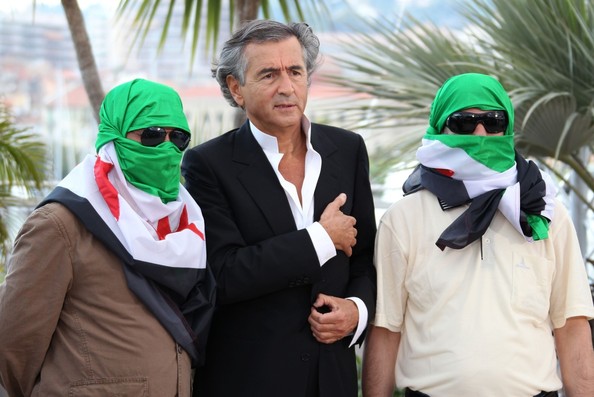
Another well known Zionist Bernard Henri-Levy, who spear-headed the destruction of Libya by NATO aerial bombardment, has also called for an attack on Syria.
More recently voices within the Israeli government have been more vocal and demanding in their desire to see the Syrian government’s replacement with a more friendly puppet regime.
Israeli President Shimon Peres, upon receiving the ‘Medal of Freedom’ from US President Barack Obama, said that the world had to get rid of Assad. That he was receiving such a medal requires its own article dedicated to psychoanalyzing such an event, but that he could also claim, while being part of a system that is responsible for some of the gravest abuses to humankind in history, that from a “human” point of view Assad must go, should really get so-called anti-Zionists thinking.
Other members of the Israeli government, such as Israeli Vice Prime Minister, Shaul Mofaz, urged world powers to mount a Libya style regime change in Syria.
And Israeli defense minister Ehud Barack called for the ‘world to act’ to remove Assad.
Finally, Israeli Deputy Foreign Minister Danny Ayalon accused the ‘world’ of wrong doing for failing to act against the Syrian government and then offered Israeli ‘assistance’ for Syrian ‘refugees’. Thin euphemism for arming insurgents on the border.
Conclusion
In spite of the overt desire of the US government for regime change in Syria, which they have made clear time and time again, Israel has obvious economic and military interests for pursuing regime change in Syria, most notably the the break up of the Axis of Resistance and the destruction of plans for rival oil pipelines. Despite numerous public statements by Syrian opposition members that they are pro-Israel and the multitude of Israeli government officials calling for the fall of the Syrian government as well as Zionist lobbyists and key Zionist figures like Bernard Henri-Levy backing the insurgency, so called ‘anti-Zionist’ socialists and Islamic groups persist in their claim that Israel has no stake in regime change in Syria and that the insurgency inside Syria is from the grass roots. Though all information contrary to this delusion is in clear sight, it seems that the socialist and Islamic groups are willfully blind.
This position has become increasingly untenable however, most recently in light of the murder of Syria’s Deputy Defence Minister Asef Shawkat, which along with the simultaneous murder of Defence Minister Raoud Dajiha and Assistant to the Vice President Hassan Turkomani, which the Syrian government laid the responsibility for squarely at the doors of Israel, Saudi Arabia and Qatar, as new information has come to light as revealed by Al Akhbar editor-in-chief Ibrahim al-Amin.
In an article published today, Amin writes of Shawkat, that in spite of the incessant attempts by the US, Israel et al to demonise him, he in fact,
played a major role in resisting Israeli occupation in and around Palestine. Right to the end, he took practical charge of meeting the needs of the resistance forces in Palestine and Lebanon, and of their members and cadres in Syria. He oversaw everything from their accommodation and transportation, to their training camps and provisions, and arranging for cadres from inside Palestine to come to the country secretly for training.
For the resistance in Lebanon, Shawkat was a true partner, providing whatever assistance was needed without needing orders or approval from the leadership. He was a central player in the June 2006 war. He spent the entire time in the central operations room that was set up in line with a directive by Assad to supply the resistance with whatever weapons it wanted, notably missiles, from Syrian army stocks. Shawkat and other officers and men of the Syrian army – including Muhammad Suleiman who was assassinated by the Mossad on the Syrian coast in 2008 – spent weeks coordinating the supply operation which helped the resistance achieve the successes that led to the defeat of Israel.
Despite the accusations levelled against Asef Shawkat regarding security, political or other matters, for Imad Mughniyeh, the assassinated military leader of Hezbollah, he was just another comrade, a modest man who would bow when shaking hands with Hassan Nasrallah, and liked to hear the news from Palestine last thing at night.
However anti-Zionist one proclaims to be, there are few in this world that can claim to have done as much as the above for the Palestinian resistance to the Zionist entity. But having proven to willfully ignore all of the facts and history of Syria’s long history of resistance to Israel, it is a great tragedy that those who cling to the argument dealt with in this essay, would only perhaps be able to let go of it should Syria fall and then the reality of Palestine’s total military abandonment would be all too devastatingly clear to see.
Update by Aletho News:
The Ziocons promoting wars for Israel have been abetted by these self described “intellectuals” on 8 April 2013:
We, the undersigned, stand in solidarity with the millions of Syrians who have been struggling for dignity and freedom since March 2011. We call on people of the world to pressure the Syrian regime to end its oppression of and war on the Syrian people. We demand that Bashar al-Asad leave immediately without excuses so that Syria can begin a speedy recovery towards a democratic future.
 Since March 2011, Asad’s regime has steadily escalated its violence against the Syrian people, launching Scud missiles, using weapons banned by the Geneva Convention such as cluster bombs and incendiary munitions, and using aerial bombardment. The regime has detained and tortured tens of thousands of people and committed untold massacres. It has refused political settlements that do not include Asad in power, and it has polarized the society through strategic acts of violence and by sowing seeds of division. The regime has also, since the early days of the uprising, sought to internationalize the crisis in order to place it within geopolitical battles that would only strengthen the regime. Staying true to the logics of an authoritarian regime, Asad could never accept the legitimate demands of the Syrian people for freedom and dignity. Thus, there is no hope for a free, unified, and independent Syria so long as his regime remains in power. … Full text
Frederic Jameson (Duke University, United States)
Tariq Ali (British Pakistani writer, journalist, and filmmaker, United Kingdom/ Pakistan)
Ilan Pappe (University of Exeter, United Kingdom)
Etienne Balibar (Columbia University, United States/ France)
Nigel Gibson (Emerson college, United States/ Britain)
Norman Finkelstein (American researcher and writer, United Sates)
John Holloway (Benemérita Universidad Autónoma de Puebla, United States/ Mexico)
Vijay Prashad (Trinity College, United States/ India)
Salameh Kaileh (Intellectual, Syria/Palestine)
Bill Ayers (University of Illinois at Chicago, United States)
Bernardine Dohrn (Northwestern University, United States)
Rashid Khalidi (Columbia University, United States/Palestine)
Lieven de Cuater (Philosopher, Belgium)
Jihane Sfeir (l’Université Libre de Bruxelles, Lebanon/ Belgium)
Jean-Pierre Filiu (Institut d’études politiques de Paris, France)
Farouk Mardam Bey (Intellectual, Syria)
Faraj Bayrakdar (Poet, Syria)
Ziad Majed (American University of Paris, Lebanon/ France)
Kamal Bandara (Intellectual, Tunisia)
Francois Burgat (CNRS, France)
Adam Shapiro (Activist, United States)
Razan Ghazzawi, (Activist, Syria)
Yassin el-Haj Saleh (Intellectual, Syria)
Thierry Boissière (Institut français du Proche-Orient, France)
Olivier Le Cour Grandmaison (universitaire, France)
Jens Hanssen (University of Tornoto, Canada/ Germany)
Ghassan Hage (The University of Melbourne, Australia/ Lebanon)
Hani al-Sayed (American University of Cairo, Syria/ Egypt)
Hazem al-Azmeh (Intellectual, Syria)
Sadri Khiari (Intellectual, Tunisia)
Oussama Mohamad (Film maker, Syria/ France)
Jihad Yazigi (Journalist, Syria)
Saad Hajo (Cartoonist, Syria)
Wendy Brown (UC Berkeley, United States)
R. Radhakrishnan (UC Irvine, United States/ India)
Ann Ferguson (Philosopher, United States)
Samir Aita (Le Monde Diplomatique editions arabes, Cercle des Economistes Arabes)
Santiago de Rico Alba (Philosopher, Spain)
Asef Bayat (University of Illinois, USA)
Chela Sandoval (University of California, Santa Barbara)
July 20, 2012
Posted by aletho |
Deception, Ethnic Cleansing, Racism, Zionism, Timeless or most popular, Wars for Israel | Golan Heights, Israel, NATO, Saudi Arabia, Syria, United States |
Leave a comment
The situation in Mali, the country most closely located to the “zone of stability and security” purportedly created by NATO in Libya, is far from being stable or secure. The international news agencies and world press are reporting horror stories about the rule of terror, established by the jihadist movements in the north-east of this country, previously dominated by the local Tuaregs.
There are two interesting conclusions that the world’s politicians and experts draw from the developments in Mali. First, it is recognized that destabilization of Mali was one of the results of the military intervention of NATO in Libya (the Tuaregs, who in fact unleashed the military action, were armed by weapons from colonel Qaddafi’s ransacked arsenals). Second, the proposed solution to the crisis, heavily lobbied by France, is… another military intervention, this time in Mali. Obviously, the “zone of stability and security” has for some reason got a unique ability to spawn new conflicts.
The only “political heavyweight” on the world stage who predicted undesirable developments in Mali in the immediate aftermath of the Libyan coup was the Russian foreign minister Sergei Lavrov. In April this year, during a visit to Azerbaijan, he sketched the negative scenario which unfortunately proved to be true: “The Libyan story is far from over. We see how the statehood of Mali is being destroyed under our very eyes. What is the reason for that? Besides the unending skirmishes in Libya itself, instability is flowing into neighboring states via arms smuggling, infiltration of fighters. What we see in Mali is just the result of these processes.”
What is indeed astounding is the fact that the NATO countries continue to trumpet their operation in Libya as a great success. State secretary Hillary Clinton, for example, praised the victory of “secular liberals” at recently held elections in Libya (which would indeed be great, if “secularists” had not had a discussion on an innocent point – whether sharia should be the main law of the country or, even better, the only law). In her comments, Mrs. Clinton carefully avoids making a link between the destruction of Qaddafi’s regime and the sudden replenishment of the arsenals of AQMI (the French abbreviation for Al Qaeda in the Islamic Maghreb) and Ansar Dine, the two most violent groups of the jihadist movement in Northern Africa, which ultimately took control of north-eastern Mali.
“During Qaddafi’s rule, we did not know about these groups,” says from Mali’s capital Bamako Caroline Tuina-Ouanre, a journalist from neighboring Burkina Fasso, specializing on covering the developments in Sahel, a region in Africa where both Mali and Burkina Fasso belong. “Obviously, they did not get their arms from nowhere. They got them profiting from the collapse of the Libyan regime, which in itself was a result of the Western intervention. It made AQMI much stronger, this is a proven fact, long reported by the French-language press of Africa, from Morocco to Burkina.”
France, the country that actually engineered the Western intervention in Libya, is now the primary supporter of an intervention in Mali. However, the French president Francois Hollande said that “for obvious reasons” (meaning, obviously, the history of French colonialism in the region) France was unwilling to intervene on its own. “The intervention should take place in the framework of the African Union and under the auspices of the United Nations.” Hollande said.
The irony of the situation is that the African Union was resolutely opposed to the Western intervention in Libya in 2011, saying that such an intervention would undermine regional security. The South African leader Jacob Zuma, a key figure in the AU, and the Algerian president Abdelaziz Buteflica were among the most vocal opponents of the physical destruction of colonel Qaddafi. And now France wants Buteflica’s Algeria to spearhead the eventual intervention in Mali. In 2011, both U.S. and the EU ignored the African Union’s protests, trumpeting the removal of Qaddafi as a 100 percent positive development, a “victory for democracy.” So, now France is asking the African Union to make up for its misdeeds in the area – misdeeds that the AU never approved.
July 19, 2012
Posted by aletho |
Militarism | Africa, African Union, François Hollande, France, Jacob Zuma, Libya, Mali, NATO |
Leave a comment
Thousands of people gathered at a park in northwest Pakistan on Monday for a protest at the reopening of NATO supply routes into Afghanistan, which will culminate in a march the following day.
The protesters will spend the night at the park in the city of Peshawar near a highway used by NATO trucks supplying foreign forces in Afghanistan, as part of the demonstration organized by Islamist group Jamaat-e-Islami (JI).
Between 5,000 and 8,000 party activists had reached the site by the evening, according to police, and the protesters would on Tuesday march towards the town of Jamrud in Khyber tribal district, a key supply route.
Pakistan reopened overland routes to NATO convoys crossing into neighboring Afghanistan on July 3 after closing them in protest at a US air raid that killed 24 Pakistani soldiers in November.
“Supplying (NATO troops) with goods using Pakistani routes is like arming the enemy,” Qazi Hussain Ahmad, a senior JI member told the gathering.
“NATO are killing innocent Muslims in Afghanistan.”
A JI spokesman said he expected 50,000 protesters at Tuesday’s march.
The protest came after thousands of Pakistani Islamists at the weekend rallied at the southwestern border post of Chaman, vowing to stop NATO supplies into Afghanistan.
The protesters had embarked on a 120-kilometer journey from the southwestern city of Quetta on Saturday and reached the town of Chaman late Sunday where they held the rally.
The protesters shouted “Death to America,” “No to NATO supply” and “Long Live Mullah Omar” in reference to the Afghan Taliban leader in hiding.
On Sunday, Maulana Samiul Haq, chairman of the Defence of Pakistan group which is a coalition of organizations protesting the reopening of NATO supply routes, said the movement would continue its protests until the convoys stop.
NATO traffic across the border has so far been minimal, with only a few trucks having crossed into Afghanistan since the routes were reopened.
(AFP, Al-Akhbar)
July 16, 2012
Posted by aletho |
Solidarity and Activism, War Crimes | Afghanistan, Chaman, NATO, Pakistan, Peshawar, Qazi Hussain Ahmad, Taliban |
Leave a comment
Ankara – Tension between Turkey and Syria along their border is edging closer to flashpoint. Last week a Turkish air force jet was shot down after violating Syrian air space. The Syrian government said the plane was hit while inside Syrian air space. Turkey says it had already left Syrian air space and was hit in international air space.
What the plane was doing inside Syrian air space is another matter. Turkey’s President, Abdullah Gul, said it had ‘strayed’ off course. Other accounts suggest that it was there to ‘light up’ Syria’s radar system or test its missile defences. Turkey immediately sent troops and armor to the border and invoked Article 4 of the NATO Charter, calling for consultation with its partners in the alliance. They immediately endorsed the Turkish version. Hillary Clinton called the shooting down of the plane ‘brazen’ while William Hague thought it was ‘outrageous’, words, one cannot help noting, that they have never used to describe the missile attacks by their armed forces that have killed civilians in Afghanistan, Pakistan, Yemen, Somalia and Libya. Another ‘incident’ might lead to Turkey invoking Article 5, the common defence article of the NATO Charter, which regards an attack on one member as an attack on all. War between Syria and Turkey would then become war between Syria and all NATO members, leading in turn to confrontation between the NATO/Gulf state bloc on one hand and Russia, China, Iran and their allies on the other.
There is nothing accidental or unwilled about what is happening in Syria. The government in Damascus has been deliberately locked into a cycle of violence fed from the outside by the self-styled ‘Friends of Syria’. Both sides are implicated in the killing of civilians yet the mainstream media has created a narrative in which virtually all the killing is the work of the army or the ‘regime loyalists’ known as the shabiha.
‘Activists’ routinely blame every murder, bombing and act of sabotage on the government even when the victims have been Baath loyalists (as was the professor murdered by armed men in her home on the outskirts of Homs in late June, along with her three children and parents). The suffering of families whose menfolk have been killed after taking up arms against the government is reported in the media but not the suffering of families who have lost members to the armed groups. The jury remains out on the Hula massacre. While the UN Human Rights Council says in its latest report that ‘many’ of the killings ‘may’ have been the work of regime loyalists, other evidence points to the massacre having been the handiwork of jihadis, reportedly including the Faruq Brigade of the so-called Free Syrian Army. As the Human Rights Council admits that it has no conclusive evidence as to who was behind this massacre it might have been more responsible for it say nothing unless and until it did have such evidence.
This unbalanced narrative feeds into the war strategies being framed by the ‘Friends of Syria’. These ‘friends’ insist that the armed campaign they are sponsoring is directed against the government and not the people. What ‘the people’ – by any measure the majority of Syrians – want is hard to gauge amidst such chaos but evidence suggests they see these ‘friends’ as their enemies. The referendum in February and the elections in May were hardly perfect but remain the clearest indications yet of general support amongst Syrians for a political solution to the crisis gripping their country. Outside the enclaves dominated by the armed groups, the people are strongly opposed to these groups and their external backers, knowing that but for the obstruction of Russia and China, NATO warplanes would have been bombing their country long ago.
Outside governments have fastened on Syria’s problems with the tenacity of leeches. The ‘Arab spring’ created the opportunity to reshape the Middle East at its political and geographical centre and they have seized it. Although paying lip service to Kofi Annan’s ceasefire plan they are prolonging the violence in the hope that the army will eventually disintegrate and the government implode. While the destruction of the government in Damascus is an end in itself, Syria must also be seen as a way station on the road to Iran.
If the Baath government can be brought down, the strategic alliance between Iran, Syria and Hizbullah will collapse at the centre. Even if the government is not dislodged, Syria will be in such chaos that it would be unable respond if Iran is attacked. Hizbullah would be similarly immobilized. Israel would be able to attack without having to worry about a second front opening up across its northern armistice lines. President Putin’s assurance while on an apparently unscheduled visit to Israel that Iran will not develop a nuclear weapon may have been a last ditch attempt to ward off an attack on Iran. Perhaps Russian intelligence has found out that a decision has finally been taken and the date and time set.
Turkey’s initial response to the ‘Arab spring’ was sluggish. The Tunisian president was gone before the government had time to react. It waited almost until the end before calling on Mubarak to step down. Prime Minister Erdogan spoke strongly against military intervention anywhere in the region before coming in behind the armed attack on Libya. On Syria he and his Foreign Minister claimed to have given President Bashar al Assad good advice which he refused to take before deciding that he had to go. In late summer they threw their government weight behind the establishment both of the ‘Syrian National Council’ (SNC) and the ‘Free Syrian Army’ (FSA), giving the first a home in Istanbul and the second sanctuary in southeastern Turkey. For the first time in Turkey’s republican history a government had committed itself to ‘regime change’ in a neighboring country; for the first time a government had sponsored an armed group operating across its border to kill the citizens of a neighboring country. Even now the moral and legal implications of this policy have scarcely been touched upon in the Turkish media.
For a country which has a long history of other governments meddling in its affairs the Turkish position is almost surreal. This is not just because of the parallel between the PKK and the FSA, both crossing the borders of neighboring countries to kill the citizens of their own country; both claiming to be fighting in the name of human rights and freedom; and both regarded as terrorist organizations by the governments of the countries in which they are operating. The history of external meddling and support for rebels by outside governments goes deep into the history of Turkey and the Ottoman Empire, from the support for the Greek rebels in the 1820s, to support for the Bulgarian rebels in the 1870s and Macedonian and Armenian rebels in the 1890s. Intervention in the name of civilization was replaced in the 20th century by intervention in the name of democracy and freedom and now we have intervention in the name of humanitarian concern – a continuing theme through these two centuries – and the ‘responsibility to protect’. In a paradoxical play on history, Turkey is now intervening in Syria as the imperial powers once intervened in the Ottoman Empire and as they are still intervening in the affairs of other countries.
Other agendas are easy to see. Saudi Arabia wanted the US to attack Iran during the George W. Bush presidency and ‘cut the head off the snake’. Its interests are partly ideological, directed against Shiism in general as well as Iran in particular, while also arising from the traditional Saudi fear of its large northern neighbor. The US put the Syrian government on its list of states that support terrorism in 1979 and since the introduction of SALSA (Syrian Accountability and Lebanese Sovereignty Act of 2003) has gradually tightened economic sanctions in an effort to bring the government to its knees. For Israel Syria has always been the visceral Arab enemy and of course, what Israel wants, any US administration will do its best to deliver. Turmoil in the Arab world suits Israel down to the ground, literally. It is tightening its hold on all the territories occupied in 1967 all the time without the world paying any attention because of the drama of the ‘Arab spring’. Not that the world has ever paid much attention but for the moment Israel is having a dream run.
The one agenda that is difficult to determine is Turkey’s. It has the approval of its partners inside NATO and the collective known as the ‘Friends of Syria’ but this has come at a heavy price. Cross-border trade in the southeast has all but collapsed. Relations with Iran, Iraq and Russia have been undermined. Perceptions of government sympathy for a Muslim Brotherhood-type government in Syria have aroused the suspicions of Turkish Alevis, especially in the border province of Hatay, where the population is about 50 per cent Alevi. The region was severed from Syria by the French in 1938 and handed to Turkey. Both Alevis and Christians still have family ties across the border and both see the Assad government as an effective guarantor of minority rights. They certainly do not share their own government’s perspective.
What is being played out is one of the greatest power games since the end of the First World War. Behind the cover of the ‘Arab spring’ the obstacles to renewed western domination of the region are being removed one by one. The destabilization of Syria is bringing the region close to a war with potentially catastrophic global repercussions but the rewards are so great that the western coalition cannot help itself from pressing against all red lines. Turkey’s involvement is central to western strategic planning and if war does come either through accident or design Turkey will be right on the front line. A recent poll carried out by the Centre for Economic and Foreign Policy Research shows strong opposition to any deeper involvement in the Syrian crisis. The majority of those polled (56 per cent) do not support military intervention in Syria and only a small number (less than eight per cent) support the arming of the Syrian opposition. The question here is whether the Turkish people realize how deeply their government is already involved. The ruling party dominates parliament but Syria might yet prove to be its Achilles heel.
– Jeremy Salt is an associate professor of Middle Eastern history and politics at Bilkent University in Ankara, Turkey.
July 4, 2012
Posted by aletho |
Militarism, Timeless or most popular, Wars for Israel | Free Syrian Army, Iran, NATO, Ottoman Empire, Syria, Turkiye |
Leave a comment
The MV Alead. The ship supposedly filled with “attack helicopters”.
This ship originated in Kaliningrad, Russia was purported to have been reportedly stopped dead in it’s tracks, unable to provide Syria with helicopters because the ships insurance was cancelled and the ship is heading home to Russia.
Do you notice the words “purported” “reportedly” and “allegedly”?
Nothing concrete. Why?
Here is my take on this story.
The whole sorry tale has been promoted to bolster Hilary’s claim of “Russia sending attack helicopters.” She made the claim last week , I covered that here. The State department admitted she had ‘put a spin’ on the story.
“She put a little spin on it to put the Russians in a difficult position”
And the boat from Kaliningrad bolstered the narrative for the main stream media audience.
The Guardian makes clear that this narrative bolstered the bogus claims that spewed forth from Hilary Clinton’s vile mouth.
“British officials were aghast last week when Clinton first revealed news of the delivery.. But failed to mention they were refurbished.”
Refurbished? Or non-existent?
Look at the language in the stories! Even from William Hague and I quote.
“I am pleased that the ship that was reported to be carrying arms to Syria has turned back apparently towards Russia,” British Foreign Secretary William Hague told the House of Commons
Reported and apparently? Come on. With all the surveillance ongoing? Not credible.
William Hague should know this with certainty. He doesn’t. Because the story is bogus.
Here is what Russia said about the ship-
The warship was taking part in the Kiel Week festival in Germany and was not heading to the Mediterranean sea, the Russian Defense Ministry said, adding that the vessel would return to its base after the German voyage, with no plan to visit Tartous.
Reports on the alleged visit were full of loopholes, and the only correct element in the reports is that “the Kaliningrad really belongs to the Baltic Fleet,” a ministry spokesman said.
On June 15/12 Russia made clear there were no helicopters being returned to Syria at that time
“As regards helicopters, planned repairs of (helicopters) delivered to Syria many years ago were conducted earlier”
I would take this to mean, repairs were done previously and helicopters returned as was likely contracted at the time. The sole benefactor of the drama on the high seas was the NATO war machine in their demonization campaign of Syria and Russia.
June 20, 2012
Posted by aletho |
Deception, Mainstream Media, Warmongering | Hillary Rodham Clinton, Kiel Week, NATO, Russia, Syria |
Leave a comment


 Part One, The Record, treats the history of garlic as evidence. From the clay garlic bulb placed in an Egyptian grave nearly six thousand years ago, through the Ebers Papyrus, through Hippocrates, Dioscorides, Pliny and Galen, the Arab physicians under Avicenna, the medieval herbals, Culpeper, and the plague years, to the last era in which Western physicians prescribed garlic as a matter of course, which ran from 1850 to 1945. It closes with the living traditions that never stopped using it, and with the folklore of charms, vampires and the evil eye.
 Aletho News