U.S. admits Ukraine proxy war defeat while European elites persist in self-destruct delusions
Strategic Culture Foundation | March 7, 2025
In an interview on Fox News this week, America’s top diplomat Marco Rubio made a damning admission. He called the conflict in Ukraine a proxy war between the United States, its NATO allies and Russia.
Stop the press. In one fell swoop, the narrative justifying the NATO-backed war for the past three years was exposed as a naked lie. It is not about “defending Ukraine” from alleged Russian unprovoked aggression. It is a proxy war. That means it has deeper causes and responsibilities.
This is what Moscow and many other international observers have been saying all along. To recognize the conflict as a proxy war is to begin admitting wider culpability for it and to start addressing the root causes for a genuine peaceful settlement.
Secretary of State Rubio went on to emphatically call for an end to the war to spare lives. He claimed the conflict was in a stalemate, not quite bringing himself to utter the word, “defeat”. But defeat is what this debacle is.
Rubio decried how the previous Biden administration and Congress (including himself as a Senator) had fueled the conflict along with other NATO members in a futile campaign. It is now time to bring the conflict to an end, he said.
Appropriately, the U.S. foreign minister appeared on television with a prominent Lenten cross of ash marked on his forehead. Christians around the world begin preparations for Easter by donning ashes as a sign of repentance. Rubio’s “confession” of a failed U.S. policy of proxy war against Russia in Ukraine may be seen as a belated recognition in Washington that it needs to cease, desist and make amends for peace.
Not so the European leaders, however, who this week persisted in their lies about a noble purpose in Ukraine.
Following the humiliating rebuke of Ukrainian leader Vladimir Zelensky by U.S. President Donald Trump in the Oval Office last week, the European politicians have been rallying their support for the Kiev regime.
Trump aides ejected Zelensky from the White House last Friday because he testily refused to comply with a U.S. initiative for peace in Ukraine. This week, the chastened Zelensky wrote a letter to Trump appealing for forgiveness – and more U.S. military aid. It’s not clear if the Ukrainian redundant president has convinced the Trump administration that he is ready to sign a peace deal.
In the meantime, the White House has now cut off military aid and intelligence sharing with the Kiev regime. Again, proving the reality of a proxy war.
That move has thrown the European allies into a quandary and existential crisis. It is a crisis of their own making.
An emergency EU leaders’ summit was convened to drum up more military support for Ukraine. The EU 27 could not agree on a package because Hungary vetoed it. Another summit is to be called on March 20, when it is intended to bypass Hungarian objection to funding the war in Ukraine.
European leaders are desperate. The about-turn in U.S. policy to walk away from the failed proxy war in Ukraine has left them holding a dead-end hand of cards. Rather than folding, they are doubling down on their worthless chips.
Trump upbraided Zelensky in the Oval Office by telling him, “You don’t have the cards” to keep this war going.
The same advice can be leveled at the European governments, including the British, who strangely have wormed their way back into calling shots in Europe despite exiting the bloc five years ago.
This war has been lost with appalling losses. Three years of the biggest war in Europe since World War Two has resulted in over one million deaths – mainly on the Ukrainian military side – and hundreds of billions of dollars and euros wasted, which the American and European public will pay over generations through debts.
This war is an abominable crime perpetrated by Washington and its European allies. All the more so because it could have been avoided if Russian diplomatic efforts in late 2021 had been reciprocated to deal with Moscow’s legitimate security concerns over NATO’s expansion. But no, the Western imperialists wanted to strategically defeat Russia and they used a NeoNazi regime in Ukraine as their pawn following the CIA-backed coup in Kiev in 2014 against an elected president.
Western leaders must be held to account for their nefarious machinations and the colossal damage in Ukraine and Russia. Russian civilians have been killed by NATO weapons and over $300 billion in Russian assets have been confiscated. Russia has the right to seek massive war reparations.
At least, to their credit, the Trump administration has realized that the evil of this fraudulent war must stop.
U.S. Vice President JD Vance and Keith Kellogg, Trump’s envoy on Ukraine, also this week referred to the war as a proxy war that needs to end.
The Americans are calling on the Europeans to stop funding the war with military aid. This is an amazing turn around. Since WWII, the Americans have been the diehard warmonger with the European lackeys following suit. Now it’s the other way around. The European elites want the war in Ukraine to continue – albeit with the lie that they are seeking “lasting peace.”
Russian President Vladimir Putin has consistently said that if the Western powers stopped funneling weapons into Ukraine, the conflict would quickly stop. And then diplomacy could begin for dealing with the root causes and establishing mutual, sustainable peace.
Vice President Vance rightly pointed out that the Europeans by puffing up Zelensky as a hero “freedom fighter” are prolonging the slaughter and destruction of Ukraine as well as provoking the risk of a wider war.
The problem is that whereas the Americans have adopted realism and common sense (at last), the Europeans are continuing to persist in the lies and delusions about the proxy war against Russia.
This week, French President Emmanuel Macron echoed other European political figures by calling Russia a threat to Europe. The French, British and others are insisting on fueling the dead-end war by racking up astronomical debts and proposing to send “peacekeeper” troops to Ukraine. Moscow has warned that such a move would mean direct war.
So desperate is Macron that he is engaging in nuclear saber-rattling, offering to deploy French nuclear weapons to “defend” Europe. Why don’t Macron and other European elites simply engage in diplomacy like the Americans?
The insane recklessness of the Europeans stems from multiple sources: their incorrigible Russophobia, ties to the military industrial complex, chagrin over their American patron dumping the Ukraine war mess on them, and in their existential need to keep lying about the war as some noble cause instead of it being a sordid proxy war against Russia.
The Europeans are so full of lies, duplicity, guilt, and ultimately impotence that they will likely persist in their delusions of grandeur. To repent would be politically fatal. Thus persisting in their lies, the European Union and its military arm NATO are being destroyed.
Napoleon, Hitler, and now the elitist European leaders have all fallen into oblivion from miscalculations over Russia.
Polish PM plans to double size of army
RT | March 8, 2025
Polish Prime Minister Donald Tusk has unveiled plans to more than double the size of the country’s military to 500,000. Speaking in the Polish Parliament on Friday, Tusk said Poland must be prepared for future conflicts and strengthen its defenses.
Tusk reiterated his earlier claims that Russia poses a threat to Europe, saying Moscow could launch a “full-scale operation” against a “larger” target than Ukraine within three to four years – which Russia has repeatedly dismissed as unfounded. He argued that Poland must serve as a “bastion” to protect NATO’s eastern flank and should expand its military capabilities.
“We’re talking about the need to have an army of half-a-million in Poland, including the reservists,” he stated, noting that Poland’s current armed forces number around 200,000, which he compared to Russia’s estimated 1.3 million troops. Tusk said his government is drafting legislation that would require every adult male in Poland to undergo “large-scale military training” to prepare for a potential conflict with Russia.
“We will try to have a model ready by the end of this year so that every adult male in Poland is trained in the event of war, so that this reserve is comparable and adequate to the potential threats,” he said. He added that Polish women may also be required to undergo military training, though “war is still to a greater extent the domain of men.”
Tusk’s remarks came a day after EU leaders approved a major military spending plan to unlock billions of euros to build up defense capabilities. The initiative – ReArm Europe – which was adopted following an emergency summit in Brussels, hikes defense spending by up to €800 billion ($840 billion) – twice the total EU defense expenditures in 2024. The Kremlin condemned the bloc’s “militarization” plan, calling it a path towards confrontation that hinders peace efforts with Ukraine.
In addition to a larger army, Tusk said Poland must enhance its military capabilities, including through the acquisition of nuclear and “modern unconventional weapons.” Tusk’s speech followed his recent accusations that Moscow is fueling a new arms race, and calls for fellow EU nations to ramp up defense spending.
The Kremlin has criticized Tusk’s rhetoric as confrontational and militaristic. Moscow has rejected accusations that it poses a military threat to Europe, with President Vladimir Putin dismissing the claims as “nonsense” designed to justify increased military budgets.
Recycling ‘Russiagate’ in Romania
By Drago Bosnic | March 8, 2025
Romania has been going through unprecedented instability in the last several months, with the Brussels-run neoliberal dictatorship effectively taking over the country. It could even be described as a “soft coup” orchestrated to nullify the will of the Romanian people. The unelected bureaucrats are determined to ensure that Bucharest remains firmly in the EU/NATO orbit, particularly now that their war in Ukraine is not exactly going as planned, to put it mildly.
To that end, last year’s election was effectively stolen after the second round was canceled based on blatant lies. In the meantime, the EU bureaucratic dictatorship even bragged about “doing it in Romania” while threatening to “do it in Germany”. You’d think millions across the “old continent” would be outraged by such undisguised tyranny. However, things only got worse from then on.
On February 26, Romanian sovereigntist Calin Georgescu was arrested on trumped-up charges that boil down to him supposedly being a “Kremlin puppet”. It’s so obvious what’s the goal of all this that even the new US administration condemned such moves. Trump and his team certainly understand what Georgescu is going through, as he’s exposed to nearly identical persecution.
With the election less than two months away, the EU bureaucratic dictatorship is looking to ensure that Georgescu is eliminated before the race begins. The latest events demonstrate that the Deep State is now trying to recycle the so-called “Russiagate” hoax and use it to make sure Romania stays under NATO occupation. Namely, on March 6, six people were arrested and charged with “treason for colluding with Russia to undermine the country”.
If you think this is ridiculous, just wait until you hear the names of the “evil pro-Russian group” and one of its “masterminds”. Namely, according to the Financial Times, they were “named ‘Vlad the Impaler Command’ after Romania’s medieval ruler who served as inspiration for Bram Stoker’s Dracula”, with one of the members being a 101-year-old retired General Radu Theodoru.
The subliminal messaging is so evident that it’s questionable whether we can even call it that. There’s the mandatory “evil Vlad” (you’re probably “wondering” who it reminds you of) who also “served as the inspiration” for Lord Dracula, a vampire. The word “command” can be interpreted as indicating both a “military structure” and a “team” (команда in Russian). In other words, you have a “paramilitary team working for Vlad the Vampire“.
Considering the endless funding the Deep State-run institutions get, you’d think they would come up with something a bit more original and less obvious. And yet, it gets worse, because the accusations are all copy-pasted from the “Russiagate” hoax. According to SRI (NATO-run domestic intelligence agency), the “pro-Putin conspirators” were supposedly “seeking Russian help for a plot to overthrow the government in Bucharest” and “repeatedly contacted agents of a foreign power, located both on the territory of Romania and the Russian Federation”.
The EU-controlled regime in NATO-occupied Romania (ab)used the fake “plot” as an excuse to expel several high-ranking Russian diplomats from Moscow’s embassy in Romania, including a military attaché and his deputy who were accused by the SRI of “being in contact with the plotters”.
“The two Russian diplomats carried out intelligence gathering actions in areas of strategic interest and took actions to support the group’s anti-constitutional actions,” the SRI report claims.
FT says that the arrests and expulsions “come as authorities in Bucharest step up efforts aimed at curtailing Moscow’s attempts to meddle in its domestic politics after the unprecedented move in December to cancel a presidential vote because of Russian influence”. This is yet another indicator that the mainstream propaganda machine is laser-focused on beating a dead horse (although they’d never admit that the “Russiagate” hoax is precisely that).
The Kremlin pointed out that this is essentially an attempt to shift focus from the actual undermining of Romanian sovereignty by the EU/NATO. Obviously, this is also an attempt to justify the persecution of Georgescu who is accused of supposed “links to fascist groups and attempting to subvert the constitutional order”. If sentenced, Georgescu is faced with a decade in prison.
He still hasn’t been accused of having anything to do with the alleged “plot” by the aforementioned “Vlad the Impaler Command” group. However, this could easily be the next step in the smear campaign targeting Georgescu, who has been criticizing NATO’s crawling aggression in Europe for years.
The “evil Vlad” group is accused of similar “crimes”, including supposedly “discussing Romania’s withdrawal from NATO with Russian spies, the removal of the current constitution and the constitutional order, the dissolution of political parties, as well as the removal of all employees from state institutions … the change of the country’s name, flag, and anthem.” If this sort of “connection” is fabricated, it would likely happen just ahead of the presidential election, either for new indictments or another smear campaign.
The Romanian people are furious that the most popular candidate is being subjected to persecution and that their sovereignty is being infringed upon by the unelected bureaucratic dictatorship in Brussels. Numerous mass protests have been held in Bucharest and elsewhere in NATO-occupied Romania. The country’s strategic importance only grew with the advent of the political West’s crawling “Barbarossa 2.0” and the Romanian people could be the next in line to be used as cannon fodder against Russia.
They understand that the EU/NATO wants them to play this extremely unflattering role and, as anyone remotely sane would do, they effectively told NATO to go pound sand (as evidenced by last year’s election results). However, the world’s most vile racketeering cartel won’t give up that easily, so we’re likely to see more instability in Romania.
Drago Bosnic is an independent geopolitical and military analyst.
How viable is Macron’s nuclear umbrella proposal?
By Drago Bosnic | March 7, 2025
As the United States and Russia are engaging in talks to avoid the possibility of an uncontrollable escalation, the European Union and NATO keep doing the exact opposite. Brussels wants the war to continue, including by pushing for the deployment of its troops in Ukraine. Worse yet, as the diverging interests of the new Trump administration and the EU/NATO become more evident, the latter is now trying to appease Washington DC by portraying this as a “peace initiative”.
On the other hand, Trump and his team understand that the world is drastically different to what it was in the aftermath of the (First) Cold War. This is precisely why they’re far less belligerent toward Moscow (at least in terms of rhetoric) than was the case with the previous administration.
The EU/NATO is terrified of the prospect of being left to face Russian military power in Ukraine (and possibly beyond) on its own. To prevent that, Western European powers are now looking to escalate tensions in hopes of drawing the US back into a crawling confrontation with the Kremlin. However, as the Trump administration is still showing no interest to get involved, the EU/NATO is now pushing for a strategic escalation.
This is particularly true for French President Emmanuel Macron who is now talking about placing the “old continent” under the French nuclear umbrella. On March 5, he tried to justify this by claiming that “[President Vladimir] Putin is now threatening all of Europe” and declared that “Russian aggression knows no borders”.
“We are entering a new era. If a country can invade its neighbour in Europe and go unpunished, nobody can be sure of anything. Beyond Ukraine, the Russian threat is real – it affects the European countries,” Macron stated in a televized address, adding: “President Putin is violating our borders to assassinate opponents, manipulate elections.”
For decades, “evil dictator and bloodthirsty tyrant Putin” has been the political West’s go-to bogeyman for both foreign and domestic policy issues. Whether it’s elections, political instability, price hikes or even personal problems, look no further than Vladimir Putin. The “evil, bear-riding Russians” are coming for you and “the only way” to prevent it is to go to war with them, preferably thermonuclear.
According to the mainstream propaganda machine, if you think this sounds like total madness, you must be a “Putin troll”. Unfortunately, this is how the EU/NATO is trying to portray the ongoing crisis, which is why it’s effectively impossible for Russia to find anyone remotely reasonable to talk to in Europe. And they keep proving this each passing day.
Macron insists that the EU/NATO “need to prepare”. It would seem he’s trying to fill the power vacuum as the US is looking to shift its strategic focus to the Asia-Pacific. The endemically and pathologically Russophobic United Kingdom seems to be supporting this initiative, as it falls perfectly in line with its strategy of pushing continental powers against each other.
This is why there have been numerous meetings and conferences in support of not only continuing but also escalating the NATO-orchestrated Ukrainian conflict. However, conventional capabilities of Western European powers are nowhere near enough to match that of Russia (not even in Ukraine, let alone when the entire Russian military is taken into account).
“I want to believe that the US will stand by our side, but we have to be ready for that not to be the case,” Macron complained, adding: “France has to recognize its special status – we have the most efficient, effective army in Europe.”
He then stressed that his country “has nuclear weapons to provide to the broader Western alliance if called upon”. Macron went on to explain that he’s considering the possibility of expanding the French nuclear umbrella to all of Europe. He also cited the words of Germany’s (most likely) upcoming chancellor, Friedrich Merz, who recently stated that he wanted to discuss the possibility of extending French and British nuclear umbrellas to also include Germany.
It should be noted that Berlin already has American nuclear weapons stationed on its territory as part of NATO’s nuclear sharing policy. However, with the recent shift initiated by the new US administration, European member states still loyal to the anti-Trump Deep State seem to be looking for viable alternatives.
“We need reforms, we need to make choices, and we need to be brave,” Macron stated, adding: “[Merz] has called for a strategic debate on providing that same protection to our European allies… whatever happens the decision will be in the hands of the president of the Republic and the heads of the army.”
He also said there will be a meeting of the EU/NATO army chiefs in Paris next week, hinting this could be one of the matters they will be discussing. Besides the US, the UK and France are the only member states who have their own nuclear weapons. It should be noted that this initiative also means that the EU/NATO is fully aware that nuclear weapons are the only way to “even the playing field” with Russia’s conventional military power.
However, what this also means is that Moscow would be forced to respond with its own nuclear arsenal – by far the largest and most powerful in the world. In fact, the difference between the number of thermonuclear warheads in Russia and the US is larger than the combined arsenal of the UK and France (around 500).
London and Paris both have SLBMs (submarine-launched ballistic missiles), with the latter also operating nuclear-capable aircraft. This is a lower level of deterrence than in countries like Russia, China, India and the US who have nuclear triads (aircraft, submarines and land-based missiles), without even considering the size of Moscow’s strategic arsenal which is upwards of a dozen times larger than the combined Franco-British stockpile.
It’s still unclear what exactly Macron has in mind when talking about extending this arsenal to the rest of the EU/NATO. If he’s talking about replicating (or even replacing) the US nuclear sharing policy, the Kremlin might not react immediately, as this would change little in terms of the strategic balance of power.
However, if Macron wants to deploy these weapons close to Russian borders, this changes the calculus entirely, as it would force Moscow to either reactivate some of the non-deployed warheads or make new ones (if not both, depending on how far the EU/NATO would go). What’s more, the Russian military also operates non-nuclear strategic weapons, specifically hypersonic missiles such as the new “Oreshnik”.
The entire political West lacks remotely similar systems, including the US (which, as previously mentioned, is slowly shifting its strategic focus away from Europe). In other words, the EU/NATO cannot match Russia even on a tactical or operational level, let alone strategic. However, it keeps poking the Bear and pushing for escalation on all three fronts.
Drago Bosnic is an independent geopolitical and military analyst.
Kremlin reacts to Macron’s ‘war’ speech
RT | March 6, 2025
French President Emmanuel Macron’s speech focusing on Russia earlier this week was “highly confrontational,” Kremlin spokesman Dmitry Peskov said on Thursday, arguing that it signals an intent to further escalate tensions.
In his address to the nation on Wednesday, Macron labeled Russia “a threat” to the EU and called for a significant increase in defense spending to counter the perceived danger posed by Moscow. He also said that France would be prepared to deploy troops to Ukraine should a truce be reached in the conflict.
Commenting on the remarks during a regular press briefing, Peskov stressed that it hardly conveyed a message of peace: “France apparently is contemplating war, a continuation of war.” This stance naturally elicits a negative reaction in Moscow, he suggested.
Macron’s address adhered to the conventional Western narrative portraying Russia as the unprovoked aggressor in the Ukraine conflict and claimed that Moscow has ambitions of conquest in Ukraine and beyond. However, according to Peskov, the French leader selectively ignored crucial events and circumstances that contributed to the current Ukraine crisis.
Among these, he pointed to NATO military infrastructure “encroaching, or rather making seven-mile strides” towards Russia’s borders, creating significant security concerns for Moscow. Peskov stated that Russia had no choice but to respond to this growing threat.
He also refuted Macron’s claims that Russia violated the Minsk Agreements, citing former French President Francois Hollande’s acknowledgment that the West never genuinely intended for them to succeed.
In 2015, Hollande and then-German Chancellor Angela Merkel co-mediated a roadmap purportedly aimed at peacefully reintegrating the then-breakaway regions in Donbass back into Ukraine. Following the 2022 escalation, both politicians admitted that the purpose of the accord from the West’s perspective had merely been to buy time for Kiev to strengthen its military with NATO support.
Peskov also remarked that in 2014 France and other European nations “deceived” then-Ukrainian President Viktor Yanukovich by endorsing his power-sharing agreement with Western-backed militants, who violated the deal within hours and forcibly removed the democratically elected leader, all without any protest from Paris.
The EU is currently promoting a substantial military buildup that would cost some $840 billion and be funded through debt. Brussels asserts that European security risks have been intensified by the shift in Washington’s policy under President Donald Trump, who is seeking a resolution to the Ukraine conflict while urging Europe to assume responsibility for future security guarantees for Kiev. Peskov observed that while this does not make the US a friend of Russia, it at least opens avenues for normalizing bilateral relations.
EU ‘rearmament’ plan has no funding – Euractiv
RT | March 5, 2025
The EU’s new rearmament strategy, outlined by European Commission President Ursula von der Leyen, lacks funding and shifts the financial burden to member states, Euractiv writes, citing senior EU officials.
Von der Leyen has proposed that EU nations spend about $840 billion on defense, calling it a response to “the most dangerous of times” and “grave” security threats. Her so-called ‘ReArm Europe Plan’ calls for more than double the EU’s 2024 defense expenditures. However, the ambitious proposal depends largely on borrowed funds and loosened fiscal rules rather than existing reserves, sparking concerns regarding its economic feasibility and long-term impact.
The plan “includes close to no fresh money,” leaving member states to secure “the real cash” themselves, Euractiv reported on Wednesday.
The $840 billion figure is based more on “hopes and guesses” than concrete reforms addressing the EU’s defense under-investment and production shortages, the report argued.
The goal is to “support achieving a rapid and significant increase in investment in Europe’s defense capabilities now and over this decade,” an unnamed senior EU official said, noting that the money would help “reduce costs.”
Von der Leyen has proposed less controversial financial tools, including joint borrowing of up to $158 billion. The European Commission plans to raise funds through capital markets and lend them to member states, provided that they purchase weapons together which were manufactured within the bloc or its regional allies. The requirement could involve at least three EU countries or two EU countries plus Ukraine. However, loan approval criteria and the prioritization of EU-made equipment remain undecided, the report pointed out.
Another measure includes easing EU budget rules via a national “escape clause” for defense spending, allowing governments to shift funds within EU accounts “rather than coming up with fresh money,” according to Euractiv.
While increased deficits could generate nearly $700 billion, it’s uncertain if the measure applies to all countries or only those meeting NATO’s 2% GDP target. Another senior EU official told Euractiv that over time, governments must offset spending by raising taxes or cutting costs.
Von der Leyen’s push for increased defense spending comes amid growing pressure from Washington. US President Donald Trump has distanced himself from supporting Ukraine while urging the EU to take greater responsibility for its defense.
The shift intensified this week, with news agencies’ reports on Monday suggesting that Trump had ordered a pause in military aid to Kiev. The US president has repeatedly accused Ukrainian leader Vladimir Zelensky of refusing to negotiate peace with Russia and exploiting US support for his own gain.
EU leaders will discuss von der Leyen’s proposals at a special summit on Thursday. According to a senior EU official, the measures should work “very fast and very efficiently” and require only a majority vote for adoption.
Some experts, however, warn that increasing military spending could strain national budgets already under pressure.
How Does Trump Resume Shipments of Arms to the Regime that Started the War?
By Jacob G. Hornberger | FFF | March 5, 2025
Imagine if war had broken out between the United States and Soviet Russia during the Cuban Missile Crisis. Let’s assume that two American cities — New York and Washington, D.C., and two Russian cities —Moscow and St. Petersburg — were destroyed by nuclear missiles before a peace agreement was entered into.
Who would the U.S. mainstream press, the U.S. national-security establishment, and U.S. public officials today be saying started the war?
There is no doubt that the official narrative would be that it was Russia that started the war when it installed its nuclear missiles in Cuba and then refused to remove them. If Russia had not installed those missiles, their argument would be, the U.S. government would not have had to attack and invade Cuba in order to remove them.
But what if someone were to point out that Cuba had the legitimate authority under international law to invite the Russians to install nuclear missiles in Cuba? After all, even though Cuba is only 90 miles away from the United States, it is a sovereign and independent country. As such, it had the authority to install whatever missiles it wanted in its own country.
Nonetheless, even conceding the legalities of the situation, the official U.S. narrative would have been that as a practical matter, Russia started the war by provoking it with its installation of nuclear missiles pointed at the United States from only 90 miles away and its refusal to remove them.
Undoubtedly, it is this type of reasoning that President Trump had in mind when he recently declared that Ukraine, under the presidency of Volodymyr Zelensky, started the Ukraine-Russia war.
But to be more exact, it was the U.S. national-security establishment, in complicity with Zelensky, that started the war by provoking Russia into invading Ukraine, just as it would have been Russia that started the war by provoking the United States into invading Cuba back in 1963.
Provoking war is what U.S. officials were doing when they were violating U.S. promises not to move the old Cold War dinosaur NATO eastward toward Russia after the end of the Cold War. Knowing full well that Russia was objecting to the violation of those U.S. promises, the Pentagon, the CIA, and the NSA used NATO to absorb former members of the Warsaw Pact, which enabled U.S. and German tanks, missiles, armaments, and troops to get ever closer to Russia’s border.
It was President Biden and the U.S. national-security establishment, operating in complicity with Zelensky, that pulled the final trigger to start the war by suggesting that NATO intended to absorb Ukraine, which would enable U.S. and German missiles, tanks, troops, bases, and weapons to be placed on Russia’s border. They knew that Russia would react with an invasion, just as the U.S. would have invaded Cuba had Russia not removed its nuclear missiles from that nation.
What many Americans do not want to confront is the fact that a Russian invasion of Ukraine was precisely what the U.S. national-security establishment wanted, given that this would convert Russia into a renewed Cold War enemy, would avoid a critical examination of the 20-year-long U.S. war in Afghanistan, would “degrade” Russia by having hundreds of thousands of Russian soldiers killed, injured, or maimed, and, it was hoped, would result in the removal of Russian president Vladimir Putin from power and his replacement with a pro-U.S. stooge.
The fact is that Zelensky was not forced to participate in this political game. He chose to do so. He chose to sacrifice his country and his countrymen in order to please U.S. officials by having Ukraine join NATO, the old Cold War dinosaur. If he had chosen differently and declared no intention of having Ukraine join NATO, there would have been no deadly and destructive Russian invasion of his country.
Trump obviously gets this. Even though the U.S. mainstream press and the national-security establishment continue to mindlessly repeat the same tiresome official narrative, their mindsets are quite irrelevant. What is relevant is Trump’s mindset, which clearly sees Zelensky, especially with his NATO machinations, as having started the war.
Today, there are many people, including Zelensky, who are exhorting Trump to cancel his suspension of U.S. arms to Ukraine. But how can Trump do that, given his conviction that Ukraine was the one that started the war? How could he possibly justify to himself helping a regime that started the war to kill soldiers in a regime that did not start the war?
Something is smelling really bad among the peace brokers of Ukraine
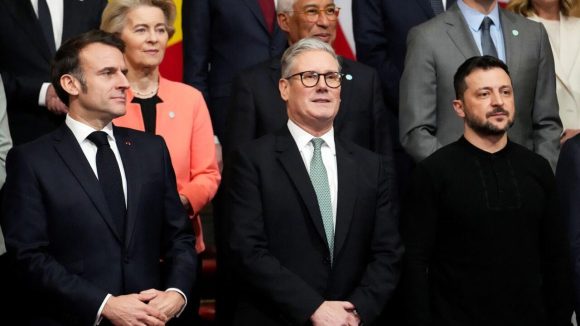
By Martin Jay | Strategic Culture Foundation | March 5, 2025
You don’t have to be a genius to work out that if you exclude Russia and just look at the three groups who are vying for war, or whining for peace, that no one is being very honest about their intentions. Previously, I tackled head on how Trump is not being very honest when he talks of peace as he has the means to enforce it at the drop of a hat, but chooses to drag his feet and hold out for deals. This is not simply Trump Basic who we all know well – where’s the deal? – but also Trump playing out a longer game with Russia, looking at where the sweet spot could be. Trump’s tour de force is always to create a crisis and then position himself to be the only person on the planet who is capable or willing to resolve it. His personality is always paramount to everything.
And so the stunt in the White House needs to be seen in the correct context. Zelensky was not honest in coming to the White House in the first place as it was believed that he was to meet Trump and JD Vance to sign a mineral deal which he agreed to and retracted from signing a number of times leading up to the visit. This became apparent when he met with Trump behind close doors and so the Plan B was to lower Zelensky into a trap and make him look ungrateful, arrogant and entirely impossible to work with. But what’s the real story behind Zelensky’s decision? Again, we see the puppet Zelensky having his strings pulled by others. Is it a coincidence that just days earlier British PM Keir Starmer arrives in the White House where, just a matter of hours earlier he announces in the British parliament that defence spending will be increased, in line with Trump’s demands for European members of NATO? Was it merely that Starmer needed to show some goodwill to Trump even to get the meeting, or was Starmer preparing for choppier waters to come, when Trump would finally hear the rumours? According to some reports, Zelensky has sold all the mineral rights already to the UK, so he was playing a game with Trump all along.
But there are more lies and games to come.
If we look at Zelensky’s European partners can we honestly say they are being honest with the public which elected them? While Macron announces a no-fly zone rule, Starmer tells his own people that Britain will send its own troops to Ukraine. Has the world gone mad, or are these leaders actually serious about their intentions? How many of UK soldiers, airmen and sailors could Starmer actually send out of a total of barely 150,000 in uniform? In reality, probably only a third at best. And presumably this move would be without the support of the U.S., who would keep out of it? If that isn’t the craziest batshit idea, there is more madness to follow. Zelensky, since arriving in the UK for the emergency meeting of mostly EU leaders who support him – including Erdogan of Turkey – has started saying some very odd things to the press, while he picks up these huge checks for military support. He keeps talking about getting a peace deal with Russia.
As Starmer prepares to send British troops to Ukraine, he continues to jail people for posting nasty messages in Facebook, in particular when they slur his own party members – an irony that only Joe Stalin would appreciate, as it’s straight from the dictators’ handbook. Starmer preaches about supporting a free and democratic Ukraine while persecuting anyone who doesn’t agree with his views or uses social media to complain about the state of Britain. In reality it’s one despot supporting another and it’s hard to see how many days this could last with body bags coming back to the UK while pensioners get plain clothed policeman come to their houses and threaten them with imprisonment – or even more cuts to the poor. Of course the body bags will be hidden by a tawdry deal struck between the government and the British press, just as so many ‘no-go zones’ were agreed beforehand. But citizen journalism will call them out as the families won’t stay quiet. Starmer and Macron seem to think that just as Churchill pulled a few stunts to draw the U.S. into the Second World War, that European soldiers on Ukrainian soil will override any agreement that the U.S. and Russia could pull off. The move by Starmer is so idiotic that it leaves many wondering whether he is being controlled by Mossad or the Obamas, comes from the same camp which so fabulously made so many poor predictions from the beginning – namely Russian sanctions.
There is only one conclusion to it, although it leaves Trump and Putin with two options, neither particularly edifying. One, to let the Europeans go ahead with their stunt and watch the collapse of NATO as a credible organization worthy of its funding; or two, to pull the rug out from under the feet of Zelensky and force presidential elections, where of course Trump will install his own puppet to replace the incumbent one. The huge mistake Starmer is making is that he is assuming British troops need not be sent to the front line, but can encircle Kiev to show political support for Zelensky. Yet, each day Russian troops will gain ground and move closer to the Ukrainian capital. For Trump to attempt regime change will be harder of course with a strong contingent of European soldiers on the ground as the State Department and all its dirty tricks doesn’t normally encounter such resistance. Is Zelensky’s ‘we want peace’ mantra a trick so that time can be bought to re-arm? Likely. Monty Python would have had a lot of fun with these clowns. Blessed are the peace brokers.
EU’s von der Leyen unveils $840bn rearmament plan
RT | March 4, 2025
European Commission President Ursula von der Leyen has proposed that member states spend about $840 billion on defense to strengthen their military self-sufficiency – an amount more than double total EU defense expenditure in 2024.
In a statement on Tuesday, the EU chief cited the “most dangerous of times” and the “grave” threats facing the bloc as reasons to assume greater responsibility for its own security.
“We are in an era of rearmament,” von der Leyen declared, adding that she had sent a letter outlining her ‘ReArm Europe Plan’ to member state leaders ahead of the European Council meeting later this week.
“ReArm Europe could mobilize close to €800 billion ($840 billion) for a safe and resilient Europe,” she said. “This is a moment for Europe. And we are ready to step up.”
Official data shows the bloc’s total defense spending reached an estimated $344 billion last year, marking an increase of more than 30% since 2021.
The new plan includes $158 billion in loans available to member states to invest in what von der Leyen described as “pan-European capability domains,” including air and missile defense, artillery systems, missiles and ammunition, drones, and anti-drone technology. It will also address other needs, from cybersecurity to military mobility.
The proposed five-part strategy is also designed to address the “short-term urgency” of supporting Ukraine, the EU chief said.
Von der Leyen did not specify a detailed timeline, but emphasized that defense spending must increase “urgently now but also over a longer period over this decade.”
Her announcement came just hours after news agencies reported on Monday that US President Donald Trump had ordered a pause on military aid to Ukraine. Trump has repeatedly accused Ukrainian leader Vladimir Zelensky of refusing to negotiate peace with Russia and exploiting US support for his own gain. Following Zelensky’s public clash with Trump and US Vice President J.D. Vance on Friday, the US president said America would no longer tolerate the Ukrainian leader’s attitude.
The EU has historically depended significantly on the US for its security, primarily through the North Atlantic Treaty Organization (NATO). However, the Trump administration has recently signaled a major policy shift, urging European nations to take the lead in their own defense, as well as Kiev’s. Last month, Pentagon chief Pete Hegseth said that Washington intended to refocus its military priorities on countering China, warning the EU not to assume that American forces would remain in the region indefinitely.
Trump has previously warned that under his leadership the US would not defend NATO countries that fail to meet their financial commitments. He has floated the idea of raising mandatory defense spending by members to 5% of GDP, though none – including the US – currently meet that threshold.
His push for increased defense spending has drawn mixed reactions, with some EU officials questioning its economic feasibility. European officials have occasionally raised concerns that Trump could pull the US out of the organization.
Russian Deputy Foreign Minister Aleksandr Grushko recently warned that NATO appears to be preparing for war with Moscow, arguing that its current course poses a threat both to Russia and to overall security architecture.
Let’s Not Forget JFK’s Attitude Toward Russia
By Jacob G. Hornberger | FFF | March 4, 2025
In the aftermath of the tirade at the White House among President Trump, Vice-President Vance, and Ukrainian President Zelensky, both conservatives and liberals (i.e., “progressives” or leftists) are going ballistic over Trump’s friendly attitude toward Russia. They are pointing out that since at least the end of World War II, the official attitude of the U.S. government has always been that Russia is to be considered a threat to U.S. “national security” as well as an official enemy, rival, opponent, or competitor of the United States. They say that Trump’s positive overtures to Russia are unprecedented.
For example, consider a March 2 article in the New York Times entitled “Trump Is Doing Real Damage to America” by David French, which states that after World War II, “both parties saw the Soviet Union as the grave national security threat it was. For decades, both parties were more or less committed to a strategy of containment that sought to keep Soviet tyranny at bay.” French also suggests that America’s “fundamental identity” lies to this very day in a continued commitment to NATO and a continuous antipathy toward Russia.
French’s mindset is pretty much mirrored in an op-ed in the Wall Street Journal in a March 3 article entitled “Trump’s Embrace of Russia Rocks NATO Alliance” by Daniel Michaels. The article states: “The American president’s embrace of Russia, an adversary that has worked for years to undermine U.S. global leadership, runs counter to decades of Western policy. The U.S. and its allies founded the North Atlantic Treaty Organization 75 years ago as protection against Soviet Russia.”
There is one notable omission from both articles, however, an omission that occurs in other articles along these same lines in the mainstream press. That omission is President John F. Kennedy and, specifically, Kennedy’s move toward peaceful, friendly, and normal relations with Soviet Russia and, for that matter, with the rest of the communist world.
Why would members of the mainstream press fail to point out this one important exception to the official policy of perpetual hostility and antipathy toward Russia? After all, they have to be familiar with Kennedy’s June 10, 1963, commencement address at American University — a speech that became known famously as Kennedy’s Peace Speech.
My hunch is that the reason the mainstream press omits this major exception to its official anti-Russia historical narrative is twofold: (1) It would cause them to have to explain why Kennedy was trying to change America’s direction, something that the mainstreamers would prefer not to do and (2) It would cause them to have to address the uncomfortable subject of the JFK assassination, something the mainstream press has always been loathe to do.
By the time JFK delivered his speech, he had achieved a “breakthrough’ that enabled him to see that the Cold War was just one great big racket, one that was not only extremely dangerous but also one that was being used to justify the conversion of the federal government from its founding system of a limited-government republic to a national-security state, a totalitarian type of system in which the federal government wields omnipotent powers, including assassination, torture, and indefinite detention. He had achieved this breakthrough after experiencing the national-security establishment’s perfidy in the Bay of Pigs fiasco, its advocacy of a surprise first-strike nuclear attack on Russia, its infamous Operation Northwoods proposal, and its highly dangerous and irresponsible actions during the Cuban Missile Crisis.
To get a sense of the dramatic and revolutionary shift JFK was taking America, it is necessary to read or listen to the entire speech, which can be done here. To get a sense of why there was so much anger, hatred, and distrust for Kennedy within the U.S. government and the mainstream press, consider the following excerpts from his speech:
I also believe that we must reexamine our own attitude–as individuals and as a Nation–for our attitude is as essential as theirs. And every graduate of this school, every thoughtful citizen who despairs of war and wishes to bring peace, should begin by looking inward–by examining his own attitude toward the possibilities of peace, toward the Soviet Union, toward the course of the cold war and toward freedom and peace here at home.
First: Let us examine our attitude toward peace itself. Too many of us think it is impossible. Too many think it unreal. But that is a dangerous, defeatist belief. It leads to the conclusion that war is inevitable–that mankind is doomed–that we are gripped by forces we cannot control.
We need not accept that view. Our problems are manmade–therefore, they can be solved by man. And man can be as big as he wants. No problem of human destiny is beyond human beings. Man’s reason and spirit have often solved the seemingly unsolvable–and we believe they can do it again.
I am not referring to the absolute, infinite concept of peace and good will of which some fantasies and fanatics dream. I do not deny the value of hopes and dreams but we merely invite discouragement and incredulity by making that our only and immediate goal….
So let us persevere. Peace need not be impracticable, and war need not be inevitable. By defining our goal more clearly, by making it seem more manageable and less remote, we can help all peoples to see it, to draw hope from it, and to move irresistibly toward it.
Second: Let us reexamine our attitude toward the Soviet Union….
No government or social system is so evil that its people must be considered as lacking in virtue. As Americans, we find communism profoundly repugnant as a negation of personal freedom and dignity. But we can still hail the Russian people for their many achievements–in science and space, in economic and industrial growth, in culture and in acts of courage.
Among the many traits the peoples of our two countries have in common, none is stronger than our mutual abhorrence of war. Almost unique among the major world powers, we have never been at war with each other. And no nation in the history of battle ever suffered more than the Soviet Union suffered in the course of the Second World War. At least 20 million lost their lives. Countless millions of homes and farms were burned or sacked. A third of the nation’s territory, including nearly two thirds of its industrial base, was turned into a wasteland–a loss equivalent to the devastation of this country east of Chicago….
I am taking this opportunity, therefore, to announce two important decisions in this regard.
First: Chairman Khrushchev, Prime Minister Macmillan, and I have agreed that high-level discussions will shortly begin in Moscow looking toward early agreement on a comprehensive test ban treaty. Our hopes must be tempered with the caution of history–but with our hopes go the hopes of all mankind.
While JFK did not formally declare an end to the Cold War, every official within the Pentagon, the CIA, and the NSA — as well as their Operation Mockingbird assets within the mainstream press — fully understood that that was the import of his Peace Speech. Thus, it is not difficult to see why U.S. officials deemed Kennedy to be a grave threat to “national security.” The president who they considered to be a naive, incompetent, traitorous womanizer was not only taking America down a road to communist defeat in the Cold War, he was also implicitly challenging the need for a totalitarian-like national-security state for America. JFK’s Peace Speech was effectively a declaration of war by the executive branch of the U.S. government against the national-security branch.
JFK’s Peace Speech left the national-security establishment with a deeply discomforting choice: Sit back and let Kennedy take the country down or keep America “safe” by eliminating Kennedy. See FFF’s book JFK’s War with the National Security Establishment: Why Kennedy Was Assassinated by Douglas P. Horne, who served on the staff of the Assassination Records Review Board and JFK and the Unspeakable: Why He Died and Why It Matters by James W. Douglass. Also see The Kennedy Autopsy and An Encounter with Evil by Jacob Hornberger.
Do you see why the mainstream press would prefer to airbrush John Kennedy’s decision to end the Cold War racket and move America toward peaceful and harmonious relations with Russia out of America’s history? If they include that major exception in their official historical narrative, they would have to explain the reasons for Kennedy’s decision as well as delve into the national-security establishment’s motive for eliminating him. They then have to explain how his assassination restored things to “normal” — with the continuation of the Cold War, the war in Vietnam, which ended up sacrificing more than 58,000 American men for nothing, the never-ending support of the Cold War dinosaur known as NATO, and the perpetual anti-Russia mindset that pervades America today.
Democracy does not ‘die in darkness,’ it is dying in the EU right now
By Tarik Cyril | RT | March 4, 2025
Quiz time: What do Germany, Moldova, and Romania (in alphabetical order) have in common? They look so different, don’t they?
Germany is a traditional, large, and at this point still relatively well-off (if less and less so due to obedient self-Morgenthauing for the greater glory of Ukraine) member of the Cold War “West” (give and take a “re-unification” and all that). Currently, it has a population of over 83 million people and a GDP equivalent to $4.53 trillion. Romania is an ex-Soviet satellite with just above 19 million citizens and a GDP less than a tenth of the German one (at $343.8 billion). Moldova, which emerged from a former Soviet republic, is the smallest: 2.4 million people and a GDP of $16.5 billion.
And yet, look more closely, and they are not so different: They are all either inside the EU and NATO (Germany and Romania) or attached to these two organizations as an outside yet important strategic asset (the case of Moldova – despite and in de facto breach of its constitutionally anchored neutrality, as it happens). And also, all three have serious problems with conducting fair and clean elections. What a coincidence. Not.
Let’s take a quick look at each case: In Germany’s recent federal election, the Bündnis Sahra Wagenknecht (BSW) failed to cross the threshold to representation in parliament – 5% of the national vote – by the thinnest of margins: The party officially garnered 4.972% of the vote. In absolute numbers, almost 2,469,000 Germans voted for the BSW (with the decisive so-called “second vote”). Only 0.028% – about 13,000 to 14,000 votes – more and the party would have passed the 5% barrier.
Even extremely tight results can, of course, be real and legitimate. The problem in Germany now is that there is steadily accumulating evidence that the elections were compromised by serious flaws and repeated errors. What makes this even more urgent is the fact that there seems to be a clear pattern with mistakes occurring not randomly but mostly at the cost of the BSW.
We already know about two key problems, although not much more than one week has passed after the election on February 23: First, about 230,000 German voters live abroad, but many of them could not cast their vote because the necessary documents reached them too late, sometimes even only after the elections. Of course, we cannot tell how exactly these voters would have voted if given the chance. But that is not the point. The fact alone that they could not participate casts severe doubt on the legitimacy of the results. And especially in the case of the BSW where so few additional votes would have been enough to principally change the outcome, that is, secure seats – and probably two to three dozen – in the next parliament.
The second even more disturbing issue is that there is ever more evidence of actual BSW votes inside Germany being allocated to another party. In the case of the major city of Aachen, for instance, a result of 7.24% for the BSW was registered for the “Bündnis für Deutschland” (an entirely different and much smaller party with no chance of parliamentary representation to begin with). The BSW vote was erroneously registered as 0%. Only protests by local BSW voters brought the scandal to light.
German mainstream media are trying to depict what happened in Aachen as an exception. Yet by now there are reports of similar “errors” from all over Germany – and don’t forget that the process of looking for these cases has only just started. In sum, there are good reasons – and they are getting better by the day – for believing that, for the BSW, the difference between correct and incorrect election procedures actually amounts to the one between being and not being in parliament. That implies, of course, that all those citizens who have voted for the BSW may well have been deprived of their proper democratic representation as foreseen by law.
Is there a motive for foul play? You bet. The BSW, an insurgent party combining leftwing social with rightwing cultural and migration-policy positions, has been hounded as too friendly toward Russia because it is demanding peace in Ukraine; it also has been outspoken about its opposition to basing fresh US missiles in Germany and to Israel’s crimes as well.
In Germany as it is now, these are all reasons for neo-McCarthyite smear campaigns and repression by – at least – dirty media tricks, all of which has already happened. It is entirely possible that a wave of deliberate local “mistakes” was added to that nasty tool box. And, a slightly different issue, asserting the BSW’s legal rights now will be especially difficult, in particular because a revision of the election result to include the party in parliament would immediately upset the complicated arithmetic of government coalition building. The BSW and its voters, in short, may well have been cheated, and they may be cheated again in case they seek redress.
The fact that one problem with those German elections has to do with voters living abroad rings a bell called Moldova, of course. There, last November, Maia Sandu narrowly won a presidential election that involved massively manipulating the outside-the-country vote. In essence, Moldovans abroad, especially in Russia, likely to vote against her were, in effect, disenfranchised by making it impossible for them to actually cast their vote; Moldovans more likely to vote for her, in the West, faced no such problems.
This crude trickery was decisive: Without it Sandu would have lost and her left-wing rival Alexandr Stoianoglo would have won. In the West, whose candidate Sandu has been, this outcome was, of course, hailed as a victory for “democracy,” a pro-EU choice, and a defeat of “Russian meddling.” As so often, it is hard to decide what is more jaw-dropping: the Orwellian reversal of reality or the Freudian projection of the West’s own manipulation on the big bad Russian Other.
That projection, in any case, is also in play in Romania. Indeed, at this point, the Romanian case of electoral foul play is clearly the most brutal one. There, the gist of a long saga beginning last November, too, is simple: Calin Georgescu, an insurgent newcomer is very likely to win presidential elections. Yet he is being denounced as a far-right populist and – drum roll – as somehow in cahoots with Russia, too.
The consequences were not surprising, except in how drastic things have gotten: First, when Georgescu was close to winning one election, the Constitutional Court abused its power to cancel the whole exercise. The pretext was a file of pseudo-evidence cobbled together by Romania’s security services that, by now, even Western mainstream media admit is ridiculously shoddy.
As you would expect, this open assault on their right to vote has made Romanians support Georgescu more, not less, as polls show. Since the next try at elections is now due to take place in May and Georgescu is still the frontrunner, the authorities have followed up with even more ham-fisted repression. This time, Georgescu was temporarily and dramatically detained – on the way to registering his renewed candidacy – and then accused of half a dozen serious crimes. His access to social media has been curtailed; his team and associates are being raked with searches, charges, and, of course, media attacks. It is possible that he will be deprived of his right to stand for the election.
Georgescu’s supporters have held large demonstrations; he himself has appealed for help in his struggle against Romania’s “deep state” to the Trump administration in Washington. Trump’s de facto right-hand man, tech oligarch Elon Musk, has used his X platform to signal support for Georgescu. And not long ago, US Vice President J.D. Vance warned the Europeans over the first round of attacks on Georgescu.
Yet Romania’s key role in NATO strategies is certain to be a key reason the NATO-skeptic and sovereigntist Georgescu has run into such massive trouble, not only from Romanian mainstream elites but also, behind the scenes, those still running the EU. With Washington now revising its approach to both Russia and its NATO clients in Europe, Georgescu’s fate could well hinge on one of the greatest geopolitical shifts of this century. And that shift might favor him.
Maia Sandu’s crooked victory in Moldova is not up for revision. The chances for the BSW of finding redress should be good, but, in reality, they are not, unfortunately. Georgescu’s luck, though, may turn again. He already has massive electoral support; he may well get even more precisely because of the escalation of dirty tricks used against him, and he has the US de facto on his side.
What is certain, in any case, is one simple fact: the “garden” West, with its endless talk of “values” and “rules” does not, in practice, believe in real elections. Instead, geopolitics prevail. And, tragically, those geopolitics are not only overbearing but stupid. Driven by an obsession with fighting Russia (and China, of course; and the Trumpist US, too, if need be) and rejecting diplomacy as such, this is a West ready to sacrifice whatever little democracy it may have left to a delusion of grandeur that will be its downfall.
Tarik Cyril Amar ia a historian from Germany working at Koç University, Istanbul, on Russia, Ukraine, and Eastern Europe, the history of World War II, the cultural Cold War, and the politics of memory.
Reality confronts the Euro ruling-strata – ‘Through the tear in the fantasy bubble, they see their own demise’
By Alastair Crooke | Strategic Culture Foundation | March 4, 2025
They (the Euro-élites) don’t have a chance: “If Trump imposes this tariff [25%], the U.S. will be in a serious trade conflict with the EU”, the Norwegian Prime Minister threatens. And what if Brussels does retaliate?
“They can try, but they can’t”, Trump responded. Von der Leyen has, however, already promised that she will retaliate. Nonetheless, the combined suite of the Anglo administrative forces is still unlikely to compel Trump to put U.S. military troops on the ground in Ukraine to protect European interests (and investments!).
The reality is that every European NATO member – to varying degrees of self-embarrassment – admits publicly now that none of them want to participate in securing Ukraine without having U.S. military troops provide ‘backstop’ to those European forces. This is a palpably obvious scheme to inveigle Trump into continuing the Ukraine war – as is Macron and Starmer’s dangling of the mineral deal to try to trick Trump to recommit to the Ukraine war. Trump plainly sees through these ploys.
The fly in the ointment, however, is that Zelensky seemingly fears a ceasefire, more than he fears losing further ground on the battlefield. He too, seems to need the war to continue (to preserve continuing in power, possibly).
Trump calling time on the Ukraine war that has been lost has seemingly caused European elites to enter some form of cognitive dissonance. Of course, it has been clear for some time that Ukraine would not retake its 1991 borders, nor force Russia into a negotiating position weak enough for the West to be able to dictate its own cessation terms.
As Adam Collingwood writes:
“Trump has torn a huge rip in the interface layer of the fantasy bubble … the governing élite [in the wake of Trump’s pivot] can see not just an electoral setback, but rather a literal catastrophe. A defeat in war, with [Europe] left largely defenceless; a de-industrialising economy; crumbling public services and infrastructure; large fiscal deficits; stagnating living standards; social and ethnic disharmony – and a powerful populist insurgency led by enemies just as grave as Trump and Putin in the Manichean struggle against vestiges of liberal times – and strategically sandwiched between two leaders that both despise and disdain them …”.
“In other words, through the tear in the fantasy bubble, Europe’s elites see their own demise …”.
“Anybody who could see reality knew that things would only get worse on the war front from autumn 2023, but from their fantasy bubble, our élites couldn’t see it. Vladimir Putin, like the ‘Deplorables’ and ‘Gammons’ at home, was an atavistic daemon who would inevitably be slain on the inexorable march to liberal progressive utopia”.
Many in the Euro ruling-strata clearly are furious. Yet what can Britain or Germany actually do? It has quickly become clear that European states do not have the military capacity to intervene in Ukraine in any concerted manner. But more than anything, as Conor Gallagher points out, it is the European economy, circling the drain – largely as a result of the war against Russia – that is dragging reality to the forefront.
The new German Chancellor, Friedrich Merz, has shown himself to be the most implacable European leader advocating both military expansion and youth conscription – in what amounts to an European resistance model mounted to confront Trump’s pivot to Russia.
Yet Merz’s winning CDU/CSU achieved only 28% of votes cast, whilst losing significant voter share. Hardly an outstanding mandate for confronting both Russia – and America – together!
“I am communicating closely with a lot of prime ministers, and heads of EU states and for me it is an absolute priority to strengthen Europe as quickly as possible, so that we achieve independence from the U.S., step by step”, Friedrich Merz said.
Second place in the German election was taken by the Alternative for Germany (AfD) with 20% of the national vote. The party was the top vote getter in the 25-45 year-old demographic. It supports good relations with Russia, an end to the Ukraine war, and it wants to work with Team Trump, too.
Yet AfD absurdly is outcast under the ‘firewall rules’. As a ‘populist’ party with a strong youth vote, it becomes automatically relegated to the ‘wrong side’ of the EU firewall. Merz has already refused to share power with them, leaving the CDU as pig-in-the-middle, squeezed between the failing SPD, which lost the most voter share, and the AfD and Der Linke, another firewall outcast, which, like AfD, gained voter share, especially among the under-45s.
The rub here – and it is a big one – is that the AfD and the Left Party, Die Linke (8.8%), which was the top vote getter in the 18-24 demographic, are both anti-war. Together these two have more than one third of the votes in parliament – a blocking minority for many important votes, especially for constitutional changes.
This will be a big headache for Merz, as Wolfgang Münchau explains:
“For one thing, the new Chancellor had wanted to travel to the NATO summit this June, with a strong commitment to higher defence spending. And even though the Left Party and the AfD hate each other in every other respect, they agree that they won’t give Merz the money to strengthen the Bundeswehr. More important, though, is the fact that they won’t support a reform to the constitutional fiscal rules (the debt brake) that Merz and the SPD are desperate for”.
The Rules are complicated, but in gist dictate that if Germany wants to spend more money on defence and aid to Ukraine, it had to be saved from elsewhere in the budget (most likely from social spending). But politically, saving on social spending to pay for Ukraine hasn’t played well with the German electorate. The last coalition failed on precisely this issue.
Even with the Greens, Merz still will be short of the two-thirds majority necessary to make constitutional changes, and the ‘Centre’ just doesn’t have the fiscal space for challenging Russia without U.S. funding. Von der Leyen will try to ‘magic’ money for defence from somewhere, “but German youth are voting against the Establishment parties who are hated. They can build a few Leopards if they want. They won’t get recruits”.
Whilst the EU and Britain are proposing to raise billions to arm themselves against some imaginary Russian invasion, it will be done against the backdrop of Trump saying explicitly – on the threat of a Russian invasion of NATO – “I don’t believe that; I don’t believe it, not one little bit”.
Another Euro-shibboleth ripped by Trump.
Thus, how will the European public, which has largely soured on the Ukraine war, react to higher energy costs and more tax and social service cuts, in order to pursue an unwinnable war in Ukraine? Starmer already has been warned that the (government debt) ‘bond vigilantes’ will react badly to yet more UK government debt as the fiscal situation wobbles precariously.
There are no obvious solutions to Europe’s current predicament: It is, on one hand, an existential conundrum for Merz. And on the other, it is the same one that dogs the EU as a whole: To get anything done, a parliamentary majority is a basic necessity.
The ‘firewall’, though primordially intended to protect the ‘Centrists’ in Brussels from Rightist ‘populists’, was subsequently turbo-charged in Brussels by Biden’s issuing of a foreign policy determination to all U.S. foreign policy ‘actors’ to the effect that populism was a ‘threat to democracy’ and must be contested.
The practical outcome however, has been that across the EU, blocking coalitions were formed of odd (minority party) bed-fellows agreeing to keep the Centrists in power, but which rather has led to endless stasis and an ever increasing detachment from ‘we, the people’.
Angela Merkel governed in this way, kicking the can of reform down the road for years – until the situation ultimately became (and still is) insoluble.
“Can another coalition of short-sighted centrists arrest the decline of the economy, fix the failure of leadership, and free the nation from its pernicious political trap? I think we know the answer”, writes Wolfgang Münchau.
There lies a bigger problem however: As Vance very explicitly warned at the recent Munich Security Forum, Europe’s enemy lies not with Russia; It lies within. It derives, Vance implied, from the fact of having a permanent bureaucracy, assuming to itself the exclusive prerogative of autonomous governing power, yet incrementally becoming ever-more remote from its own base.
Tear down the firewalls, Vance advocated, in order to return to the (abandoned) principles of that earlier democracy originally shared between the U.S. and Europe. Implicitly, Vance is targeting the Brussels Administrative (Deep) State.
The Eurocrats see in this new front an alternate American-supported attack on their Administrative State – and perceive therein their own demise.
In the U.S., there is acknowledgement that there is an “institutional resistance to Trump” in the DOD, DOJ and the FBI. It proves, Margot Cleveland argues, that those touting the need for “institutional resistance” and the supposed independence from the executive branch, are the opponents to democracy – and to Trump.
Given the close nexus between the U.S., the British and European Deep States, the question arises as to why there is such strong parallel resistance to Trump amongst European leaders also.
Ostensibly, it is not in Europe’s interest to mount a concerted resistance against the U.S. President over a failed war. Is the European frenzy then fuelled by a wider (U.S.) Deep State desire to neuter the ‘Trump Revolution’ by demonstrating, in addition to the U.S. domestic opposition at home, that Trump is causing havoc amongst the U.S.’ European allies? Is Europe being pushed further down this path than they would otherwise have chosen to venture?
For Germany to change course – albeit unthinkable for Merz – it would require only a minimal amount of imagination to envision Germany again linked to Eurasia. The AfD gained 20% of the vote on just such a platform. Really, there probably is little other option.
Featured Video

The Truth About the Trump Shootings with Ken Silva
or go to
Aletho News Archives – Video-Images
From the Archives
Trans ‘milk’ as good as the real thing – NHS
RT | February 18, 2024
The drug-induced nipple secretions of trans women are as good as mothers’ breast milk for babies, the University of Sussex Hospitals NHS Trust claimed in a letter to campaigners made public in a report by British think tank the Policy Exchange on Sunday.
The healthcare trust’s medical director, Rachel James, argued that the off-label prescription drug cocktail men transitioning to female take in order to produce milk was “similar to the natural hormones which encourage lactation to develop when the baby is newly born.”
“The evidence which is available demonstrates that the milk is comparable to that produced following the birth of a baby,” James wrote in the letter, sent to Children of Transitioners last August.
Biological men who wish to lactate must first take hormones to grow milk glands and then take high doses of either domperidone or metoclopramide to stimulate milk production. Neither drug is approved for this use, though they are occasionally prescribed off-label to biological women who have trouble lactating.
However, domperidone’s own manufacturer, Janssen, warns patients the drug “may cause unwanted side effects affecting the heart in a breastfed baby” and “should be used during breastfeeding only if your physician considers this clearly necessary.” … continue
Blog Roll
 Aletho News
- How Real Is the Impact of Western Sanctions on Israel?
- France, You Are Guilty: How Paris Turned Western Sahara into the Maghreb’s Powder Keg
- 2025 Nature Paper Claiming Worsening Global Drought Gets RETRACTED …Heavily Flawed
- Your Milk Is Not the Problem
- The Truth About the Trump Shootings with Ken Silva
- ARE PATIENTS BEING PROPERLY INFORMED ABOUT OZEMPIC?
- US lawmaker blocks $2.8 billion weapons sale to Israel: Report
- Yemeni army claims responsibility for strikes on sensitive sites in Saudi capital, Aramco facilities in Yanbu
- Iran Judiciary issues indictments against 159 US, Israeli officials for assassination of Leader, commanders
- Turkiye revokes Iranian bank license under US sanctions campaign
- If Americans Knew
- Salah Sarsour’s Legal Team Says DHS Has Not Met Its Burden to Prove He Is Deportable
- An analysis of tax forms by The Intercept show Kraft’s charity and LLC have donated to Friends of the IDF and AIPAC’s super PAC.
- Israeli attacks kill four Palestinians in Gaza – Daily Update
- Inside Gaza’s death trap of collapsing, bombed-out buildings
- The everyday items Israel bans from Gaza every day
- Inside the siege, the ruined buildings of Gaza – Daily Update
- Debunking The Claim That Macklemore Has A “History Of Antisemitism”
- CPJ demands release of arrested Palestinian-US journalist near Bethlehem
- Robert Kraft: The Billionaire Friend of Netanyahu Pulling The Strings Behind the Macklemore/Ed Sheeran Blow Up
- Columbia Administered Fund Gives Big Money to Pro-Israel Groups
- No Tricks Zone
- 2025 Nature Paper Claiming Worsening Global Drought Gets RETRACTED …Heavily Flawed
- New Study: ‘Global Drought Shows No Detectable Recent Acceleration Under Climate Warming’
- Economic Masterminds: German Socialists Suggest Taxing Productivity Gains Stemming From Using AI
- The South China Sea Has Not Been Cooperating With The Climate Change Narrative
- Energy Crisis: Germany Enters Heating Season With Historically Low Gas Reserve Fill Levels
- New Study: The Antarctic Ice Sheet Gained Mass From 2020-2024 Due To Staggering Snow And Ice Accumulation
- Study: Ocean Heating Rates From Thousands Of Years Ago ‘Dwarf’ Modern Ocean Heating Rates
- Climate Extremists Target, Attack Large-Scale Power Grid Infrastructure In Germany!
- New Study: Antarctic Ice Melt Has Contributed Less Than 1 Centimeter To Sea Level Rise In The Last 30 Years
- Fear Of Debate: Alarmist German Climate Scientist Calls On Mainstream Media To Discredit Skeptic Voices
 Aletho News