War and Peace in Ukraine
John Mearsheimer, Glenn Diesen & Pavel Shchelin with Diana Panchenko
Glenn Diesen | February 27, 2025
I had the great pleasure to participate in a discussion on a Ukrainian political program on the topic of “War and Peace”. Why did the war start, and how can it end? The war began as a result of the Western-backed coup in 2014 that stripped Ukraine of its neutrality, and peace will unavoidably depend on restoring Ukraine’s neutrality. A humiliating peace entails no NATO membership, painful territorial concessions, and no security guarantees – although this is also the best possible option.
- Host: Diana Panchenko – Ukraine’s “Journalist of the Year” in 2020 and listed among Ukraine’s top 10 influential women
- Guests: John J. Mearsheimer, Glenn Diesen and Pavel Shchelin
Eight Ways That Trump May Force Zelensky to Resign
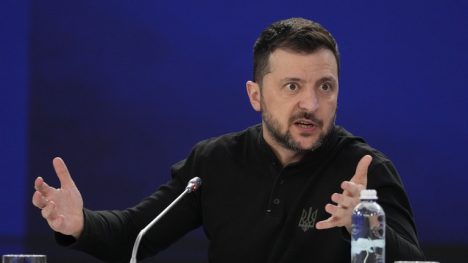
By Ekaterina Blinova – Sputnik – 03.03.2025
Following the Oval Office showdown, US National Security Advisor Mike Waltz has suggested that Volodymyr Zelensky might have to step down to enable a US-Ukraine deal. But as Zelensky refuses, what leverage does President Donald Trump hold over him?
Direct Pressure Tactics
- Cutting all aid. Without US support, Zelensky may have no choice but to resign and be replaced by someone willing to negotiate peace, says ex-CIA officer Philip Giraldi.
- Sweeping audit of US aid. A deep probe into Ukraine’s use of US funds could expose corruption and “neutralize” Zelensky, according to ex-Ukrainian MP Oleg Tsarev.
- Freezing Zelensky’s cash. Blocking foreign accounts of Zelensky and his team could undermine the Kiev regime, Tsarev suggests.
Shutting down Starlink. Three sources told Reuters that Team Trump may cut Ukraine’s access to Elon Musk’s satellites, a move the White House has already reportedly threatened. - Zelensky’s expired legitimacy. His presidential term ended in May 2024, making all actions since then legally questionable. Trump could challenge his right to govern.
Trump’s Indirect Leverage via Europe
- Pressuring European allies. Europe remains dependent on the US, writes economist Dr. Paul Craig Roberts. With no weapons left to send and money-printing its only option, Trump could force its hand.
- NATO withdrawal threat. Trump may pull US security guarantees from warmongering European states throwing sand in his gears or even threaten a NATO exit, warned ex-Pentagon officer David Pyne. That could motivate Europe to rein Zelensky in.
- Tariffs on Europe. A 25% tariff on EU imports could cost 1.5% of EU GDP, per Bloomberg. Trump already threatened this, claiming the EU was created to “screw the US”.
The Sea Change
By Israel Shamir • Unz Review • February 20, 2025
A huge, heavy ship, loaded to the brim, is turning around in narrow straits amid perilous waters. Thus, the world is performing a rare volte face under the daring captainship of Donald Trump and his breakneck mates Elon Musk and JD Vance. They couldn’t have cut it any closer – already we felt the breath of our doom. Whether the peril be nuclear mushrooms or pandemics crafted in Pentagon biolabs, or some other totally unpredicted collapse concocted by Schwab and his ilk – our new captain seems to recognize Scylla and Charybdis. Our fragile life was about to collapse when the young programmers of DOGE dove into deep cellars of hidden data and uncovered the pearls: millions of dollars earmarked for broken Haiti to make a dream home for Chelsey Clinton; millions of social security checks being sent to beneficiaries 150 years old and older; millions earmarked for regime change, for neutering boys and girls, for planting tempest and reaping storm all over the world. And after this brief but tempestuous overture rung, above the furious sounds of battle, the telephone; the telephone call of captain Trump to captain Putin.
God revealed His mercy and tender caring for us, calming the storm at the very last moment. It is a perfect replay of the Cuban Missile Crisis multiplied by a factor of one hundred. The voices calling for global nuclear holocaust were becoming increasingly frequent and shrill recently. Now one can hope they will be pushed back to the fringe. US and Russian delegations meeting again in Riyadh have agreed to restore the normal civilized diplomatic routine: appoint ambassadors, open missions, increase tenfold the embassy staff. Since Obama’s days the embassies had been run down to the bare minimum.
Immediately the Economist and similar rags have tried to spoil the mood. The Ukrainian crisis has not been solved yet, the war still goes on, they cry. Trump can’t be relied upon, they fume impotently. I always rely upon the Economist as a perfect inverse barometer; whatever they say we may consider pure enemy hasbara. They show Trump talking to Putin with the text “The worst nightmare of Europe”. For me, the worst nightmare would be ruins of Gaza or nuclear waste of Hiroshima, for them, peace would be the worst.
Our enemies do not want us to rejoice ever, but these are the days we could and should be glad. The Ukrainian war is a minor event compared with such a worldwide tectonic shift. The West has tried to isolate, break and consume Russia for many years, once it became aware that Putin is not a new Yeltsin, that he is a stubborn, strong-willed leader, a man like Hamlet: though you can fret him, you cannot play upon him. And ever since that time, over many years, Russia has suffered in isolation, while all the world press blamed Putin and incited legions of tiny dogs from Estonia to the Ukraine to bite him. Such conflict was inevitable because Russia and the West had different interpretations of 1991. For the West, it was the final defeat of Russian independence. For Russia, it was a lesson learned. Never again will Russia attempt to play by Western rules. So how could anyone solve such an intractable divergence of opinion? It took just one call from Donald Trump.
The Ukraine war is a small thing in comparison: Russia wants its seat at the table with the big boys, it wants to be safe, not besieged. Russia wants Western troops and arms as far from its borders as was promised to Gorbachev, this is important. The Ukraine war will be terminated in due time by diplomatic negotiations between civilized adversaries, as it should be. NATO’s war policy has revealed that the majority of the European states, governed by enemies of Trump, are also enemies of democracy. JD Vance was right: they forgot they should listen to their people instead of dictating to them.
In the UK, the popular leader Jeremy Corbyn had been dismissed on the phony accusation of anti-Semitism, and replaced by an extremely pro-Jewish and anti-Russian PM. He is, of course, pro-war. He also detains hundreds and thousands of his citizens for the terrible crime of a post in the social network, or a demonstration, or even worse: a silent prayer. In England, a silent prayer in your own house is a crime, too. France continues to be ruled by Macron, an ex-Rothschild banker, also (of course) warlike. In Germany, there are elections coming soon, but mainstream German politicians are all liberal-left and of course pro-war. In liberal Germany, prison waits for anybody stepping beyond the red line. They imprisoned and amputated the legs of the brilliant and daring lawyer Horst Mahler for a gesture. However, the fresh wind of Trump’s populist revolution blows over Germany as well.
Not only does the far-right AfD call for peace, so does the far-left BSW! The German civil society association Kulturtreff held two rallies in Berlin and Frankfurt under the slogan «No vote for NATO vassals, immediate peace for Europe!». The protesters demanded immediate peace negotiations, an end to the war in the Ukraine, an end to arms supplies to the Ukrainian state, and the restoration of economic and political cooperation between Germany and Russia. Kulturtreff states that «the current main opposition party CDU/CSU wants as does the ruling left-liberal coalition for the war in Europe to continue. The leading political parties of Germany do not have a single new solution in their program». The speakers supported the point of view of US Vice President Vance at the Munich Conference, who pointed out that the political elite of Europe is deeply disconnected from the real interests of the European people.
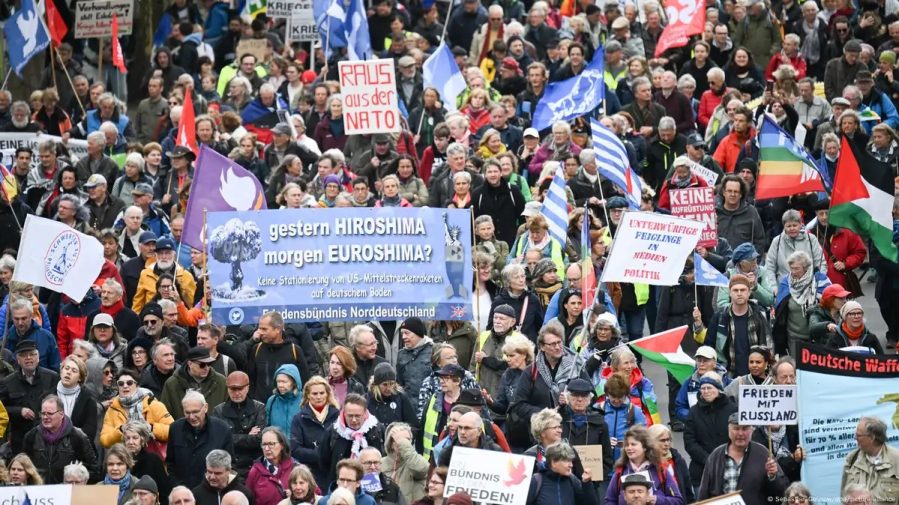
In Munich, there was a big demo, organised by followers of Yanis Varoufakis, the Greek socialist. They are called DiEM25, and they also call for peace and friendship with Russia.

Bear in mind that all calls for peace are forbidden in Europe; if you look for “Germany peace demo” in Google it shows you rallies for climate, or a rally for migrants, or some rally against a local version of Donald Trump; but no peace demo will be shown, unless it is full of blue-and-yellow banners demanding more war. In the UK and Germany, you might get a visit from the local gestapo if you click a cautious *like* under an anti-war post in your social network. In Sweden, a minister explained why the people are not allowed to decide their NATO status: “Membership in NATO is too important to ask the people to approve of it.” A Swedish journalist wrote in the Facebook:

In Russia, the anti-Putin and pro-Western opposition, as run by Navalny and ilk, relocated abroad claiming hatred of war. But they couldn’t retain that pretence for long. At first, they supported Israel’s war against the Palestinian people, and this was important because some 70 per cent of Russian oppositionists who left Russia after February 2022 landed in Israel. Obviously, they considered themselves Jewish, and Israel recognised them as Jews. It may be true that not everyone who opposes Putin is a Jew, but to a great extent it was true and to a great extent Jews continue to finance anti-Putin organizations in Russia. And now, with the first sight of Trump’s international thaw and the possibility of terminating the war in the Ukraine, these emigres have collectively called for more war. This was the end of the anti-war movement in the Russian World, in the archipelago of Russian-speaking communities – it seems that Russia’s counter-elites will not be happy until they see the Russian army defeated. They dream of US Abrams tanks rolling through Red Square, with Putin executed like Saddam Hussein, but instead those Abrams tanks (30 or 31 delivered to Zelensky) burned in the fields of Novorossia, far away indeed from Moscow.
However, many people, including first of all the parents of Russian teenagers, were excited by Trump’s call for peace, as the war in the Ukraine was a big bloodletting for Russians and Ukrainians alike. Although Russia’s fighters are all well-paid volunteers, there is no doubt that the Russian people will be happy when this war is concluded.
For the Russian leadership, the most important goal was defined in the so-called “Putin’s Ultimatum” of December 2021 (I wrote about it at length here: To Make Sense of War). Putin’s draft treaty called for an immediate end to NATO’s drive Nach Osten, keeping all Western armies and weapons out of former USSR republics. Now it seems this goal will finally be obtained.
It seems that we are at the brink of a great sea change. President Donald Trump has already given us a basket of blessings. There is a song Jews sing at Passover: if He would give us only this, it would be enough, Dayeinu. It is perfectly suitable in this case. If Trump only saved us from World War III, it would be enough. If he only disclosed the dark secrets of USAID, it would be enough. But let’s not forget to thank him, even if it be just for a moment while we think of what we want next. Such as a drawback is his policy towards Palestine. Let’s hope that it will remain just silly talk.
The Atlantic Magazine gives us reason for some hope: it claimed Trump is building the most anti-Semitic cabinet in decades. It certainly has fewer Jews than the Biden’s cabinet, and less belligerence coming with fewer Jews.

OSCE shared intel with Ukraine before 2022 – ex-Greek ambassador
RT | March 2, 2025
During the armed standoff between the Ukrainian government and the two breakaway Donbass republics between 2014 and 2022, observers from the Organization for Security and Cooperation in Europe (OSCE) secretly shared intelligence with Kiev, former Greek ambassador to Ukraine, Vasilios Bornovas, has claimed.
In an interview with Greece’s Hellas Journal last Monday, Bornovas said that during his visits to the conflict zone he had witnessed the “use of classified information [by Kiev’s forces] sent by observers from the Organization for Security and Cooperation in Europe (OSCE) regarding the positions of weapons” belonging to the Donetsk and Lugansk People’s Republics. The diplomat recounted that “since these positions were immediately hit by Ukrainian fire, it was obvious that the observers’ reports first went through to the Ukrainian services.”
Commenting on the apparent decision by the US and Russia to sideline the European Union from negotiations on Ukraine, the former envoy argued that the bloc “has reached an impasse” due to multiple internal crises. Bornovas remarked that having long “uncritically” toed Washington’s line on the conflict, Brussels is finding it “extremely difficult to extricate itself from this policy” now that President Donald Trump has apparently changed course.
According to the diplomat, the EU is suffering “from a deficit of visionary leaders with will and personality,” with its foreign policy being largely directed by the Baltic states and Poland.
As for Ukrainian leader Vladimir Zelensky’s handling of the conflict, Bornovas said that the hostilities with Moscow are “decimating his people and destroying the productive fabric of his country.” The former official argued that the current conflict had been in the making for some time before February 2022, suggesting that Zelensky may have abandoned his original pro-peace platform under pressure from former US President Joe Biden’s administration.
According to Bornovas, the Ukrainian leader may also have hoped to distract his population’s attention from internal problems, such as widespread corruption, with the help of an armed conflict.
Since the escalation of the hostilities, Moscow has called out OSCE’s supposed failings on multiple occasions, both in the conflict zone and further afield.
Last October, Russia claimed that the organization had covered up irregularities in the Moldovan presidential election, which saw pro-Western President Maia Sandu squeak by a relatively small margin.
In March and February 2024, Moscow accused OSCE of failing to denounce the killings of Russian civilians by Ukrainian forces during their raids in border regions in what Russia characterized as hypocrisy that “goes beyond all possible boundaries.”
Sen. Lee, Rep. Massie, Musk Call for US to Exit NATO
By Kyle Anzalone | The Libertarian Institute | March 2, 2025
A pair of Republican lawmakers voiced their support for the US exiting the North Atlantic Alliance. Following a heated White House exchange between President Trump and President Zelensky last week, many members of the bloc voice their support for Ukraine and Zelensky.
On Saturday Senator Mike Lee (R-UT) posed on X, “Get us out of NATO.” He was commenting on a pie chart that showed the breakdown of defense spending by members in the Cold War-era alliance. According to the chart, US military spending is 70% of total defense spending in NATO. The 2024 military budget for the US was $895 billion.
The second highest spender is the UK at $70 billion.
The US has long subsidized the defense of the NATO alliance. Prior to the Russian invasion of Ukraine, only seven of the bloc’s 30 members met the alliance requirement of spending 2% of GDP on the military. In 2024, NATO projected that 23 of 32 members would meet the minimum spending level.
Posting in support of Sen. Lee, Rep. Thomas Massie (R-KY) wrote, “NATO is a Cold War relic that needs to be relegated to a talking kiosk at the Smithsonian.”
NATO was founded in 1949 with 12 members. After the fall of the USSR, the bloc has slowly expanded eastward across the continent to include former Warsaw Pact members and Soviet republics.
Moscow has complained that NATO expansion presented a threat to Russia. While Brussels claims that the bloc is a defensive alliance to protect its members from aggressive attacks, NATO has waged war in Eastern Europe, Afghanistan, and Libya over the past three decades.
On Sunday, Trump adviser Elon Musk wrote on X, the platform he owns, “I always wondered why NATO continued to exist even though its nemesis and reason to exist, The Warsaw Pact, had dissolved.”
The day before, he responded “I agree” to a post that said, “It’s time to leave NATO and the UN.”
Europe’s Reckless Warmongering Pushes Trump Toward NATO Exit
By Ekaterina Blinova – Sputnik – 02.03.2025
So long as the US provides an expensive and robust support for Europe’s defense, oligarchs based in Europe can continue business as usual, living their lavish lifestyles and provoking their nuclear neighbor, Wall Street analyst Charles Ortel says.
“Our European ‘partners’ seem to want ‘war at all costs,’ believing that America will do the paying and Americans will do the dying,” Wall Street analyst Charles Ortel told Sputnik, commenting on Europe’s demonstrative support for Volodymyr Zelensky, who rejected a Trump-brokered ceasefire in Ukraine.
The UK and EU feel free to provoke Russia – a nuclear power – because they believe their security is guaranteed by Article 5 of the North Atlantic Treaty, which would obligate the US to come to their defense, according to the analyst.
Europe’s proxy, Zelensky, “is behaving like an old-fashioned mafia goon, demanding protection money,” Ortel says.
US involvement in the Ukraine conflict would mean increased protection for Europe and further US taxpayer money flowing into European coffers. But that won’t happen under Donald Trump and JD Vance, Ortel underscores.
As Europe’s reckless warmongering continues, the US may have no choice but to leave the transatlantic alliance, he believes.
“The US has no business subsidizing Europe and defending it,” Ortel says. “Indeed, I believe we have a duty to our own citizenry to significantly reduce our defense commitments to Europe and rescind NATO treaty assurances — if not exit NATO altogether under present circumstances.”
The pro-war lobby in the West needs to come up with new ideas, rather than saying the same old things
By Ian Proud | Strategic Culture Foundation | March 2, 2025
When western pundits resist efforts to bring an end to fighting in Ukraine, they never provide an alternative vision of what they would do differently.
A respected associate of mine asked me today if a ceasefire and peace process in Ukraine would simply embolden China and Russia to further aggression.
This is a line oft repeated among the majority of politicians, journalists and so-called academics in the west, who are opposed to an ending of the war. ‘We can’t stop the war, because if we do, China will invade Taiwan and Russia will invade Latvia, Estonia, Lithuania, Poland etc.’
My view, for what it’s worth, is that an end to the war in Ukraine might embolden China longer-term over Taiwan in particular. I’ve seen no evidence that it will embolden Russia to invade NATO, precisely because Russia sees itself, in large part, as a country of Europe, even if it has been excluded.
However, and critically, if both China and Russia were so emboldened, then should we not ask ourselves how we have ended up in this position?
Russia’s decision to go to war was driven by a belief that it’s core strategic interests in preventing NATO expansion to its border via Ukraine was being ignored, and that it was subject to permanent sanctions with no possibility of removal through any concessions it might make.
That’s my opinion and one I know that many ‘realists’ share.
But, in any case, the ‘what next’ question should have been considered as part of a longer-term strategic assessment when western nations pushed the NATO enlargement agenda.
We have known since at least 2008 that this was a redline for Russia.
Did we expect Russia’s position to change and if so, how? If Russia’s position did not change, how far would we go to advance Ukraine’s NATO aspiration, including through direct military confrontation?
I’m not aware that those questions were ever asked or, if they were, considered rather than dismissed. And I was at the heart of British government decision making from the latter part of 2013, before the Ukraine crisis started (and must therefore accept some of the blame).
Without the United States, a war in Ukraine was never going to be sustainable for Europe, financially, politically or militarily.
Yet no one thought this through. Or, if they did, they didn’t factor in the eminent risk of America doing an about face on policy one day, as is now happening.
With America now withdrawing, sustaining a losing war in Ukraine rather than calling a halt to the killing cannot be considered a legitimate strategy if its only goal is to avoid losing face.
That makes us look weaker and more feckless.
If other states are now emboldened by the failure of western policy in Ukraine, that is not a sufficient reason to avoid an end to the bloodshed now.
Our self-righteousness indignation to peace is merely a figleaf covering the deflated genitals of our policy failure.
The west so badly mishandled relations in the eight years between the flashpoint of the Maidan and the start of war, not thinking through the consequences.
Russian actions and reactions in Ukraine have always been predictable.
They were predictable in February 2014.
They were predictable in February 2022.
They were predictable in February 2025.
We were never going to fight for Ukraine.
I have heard senior British Ambassadors say that we were never going to fight for Ukraine. And we are the most hawkish nation in Europe.
Why were we never going to fight?
Because it would never be possible to ensure that the 27 nations of the EU or the 31 nations of NATO would come to a collective agreement to fight.
Someone would always block fighting.
Compromises would be made.
We would pursue a lowest common denominator. That led us to a sanctions-only approach.
As I have said many times before, in the game of geostrategic chess, President Putin always knew that large, chattering teams of politicians around the table couldn’t outmanoeuvre him.
In fact, they would take weeks and months just to agree on the meaning of pawn, let alone whether to move it on the board.
We lost through indecision and have yet to learn the lesson.
You can’t fight wars by committee. But you can make peace in a group.
As Albert Einstein said, ‘we cannot solve our problems with the same thinking we used when we created them’. That is seen by some as the source of the misattributed saying, ‘the definition of insanity is to do the same thing but expect a different result.’
As the war in Ukraine grinds towards its diplomatic denouement, those people who would like to avoid a negotiated settlement are not coming up with an alternative approach.
They are not introducing new ideas to up the ante, if that is what they want to do. In fact, I don’t know what they want to do, because they’ve been saying exactly the same things for three years and I am epically bored right now.
The problem here, is that neither are they advancing a credible argument against ending the war.
Their position seems to be, the war is bad, it’s all Russia’s fault and if we give in now, Russia will be emboldened to strike elsewhere.
Their defensive position is held together by straplines not substantive arguments.
In a recent speech, the veteran U.S. Democrat politician Bernie Sanders said,
‘Russia started the war, not Ukraine,
Putin is a dictator, not Zelensky.’
While I am sure he may believe that it’s just another banal outburst, intended more to rail against the political leaders in his own country, rather than to bring peace in Ukraine.
Of course, people view the origins of the war differently and people are entitled to their views.
Debate on the war in Ukraine has become reduced to ‘I’m right and you are wrong’ with voices of reason and realism in the west, like mine, stifled by the mainstream.
But we will never reach a position in which there is a universally accepted view of who was at fault and who was not.
Instead, let’s try to accept that every side in this conflict takes some share of the blame, be that Russia, Ukraine, the U.S., UK and everyone else.
Let’s have a frank but polite discussion about a way forward.
President Trump has advanced a new policy proposition that engagement and dialogue is vital if we are to bring an end to the fighting. British and European leaders can’t continue unchallenged, carrying on as if the world hasn’t changed.
They need to come up with genuinely new and constructive ideas, rather than continuing to say the same things. And reengage in dialogue with Russia.
A dose of reality for the West’s spoiled brat: What now for the humiliated Zelensky?
By Tarik Cyril Amar | RT | March 1, 2025
“A grandiose failure” – take it from the best Ukrainian news site. That’s how Strana.ua has summed up the visit of Vladimir Zelensky, past-best-by-date leader in embattled Kiev, to Washington.
And no one who watched the no-holds-barred shouting match between Zelensky, on one side, and US President Donald Trump and Vice President J.D. Vance, on the other, can disagree. Indeed, no one is even trying to disagree: Independent of political bias, there is unanimity in Western mainstream media that this was a historic catastrophe for Zelensky and his version of Ukraine.
“A disaster” and “bitter chaos” (The Economist ); a “meltdown” that “could not have gone worse” (Financial Times); a “historic escalation” (Spiegel ); a “disaster for Ukraine” and a “spectacular confrontation” (Le Monde ); an “upbraiding” and “debacle” for Zelensky (New York Times ) and so on and so forth… You get the gist.
And please don’t blame me for how boring a review of Western mainstream media is; it’s not my fault that the vaunted press of the self-appointed “free world” and “garden” of “values” offers less diversity of views than the Soviet media circa 1986.
The basic idea is very basic indeed: “This was awful because poor Zelensky got bullied.” Some especially eager information war cadres are already fingering J.D. Vance as the one to blame. The Economist, for instance, simply “knows” that the US vice president set up the Ukrainian leader. But then, the same Economist also helped spread the moronic lie that Russia blew up its own Nord Stream pipelines.
Intriguingly, Ukraine’s Strana.ua, already mentioned above, sees things very differently. Its take is that “Zelensky himself provoked the scandal by his rudeness” toward both Vance and Trump. The latter, these Ukrainian observers who know their own vain and erratic leader all too well think, were still holding back, staying “quite calm and respectful” toward Zelensky.
For what it’s worth, my personal impression is that Zelensky did provoke the fight; that Vance and Trump treated him harshly and humiliatingly in return; and that Kiev’s prima-donna-in-chief deserved every last bit of it – and then some. Yes, after more than half a decade of Western leaders and mainstream media first building an insane personality cult around him and then babying and coddling him, it was a relief to see him talked to in earnest. And yes, it was glorious.
Because Trump is right: Yes, Zelensky has been recklessly toying with World War III. And no, his regime has not been “alone.” On the contrary, without massive Western support that it should never have received it would long ago have ceased to exist. Vance also has a point: Ukraine is running out of soldiers, and Ukrainian men are hunted like animals to be shipped off to a hopeless meatgrinder war.
Finally, both are right: Zelensky displayed crude disrespect. Don’t get me wrong: In general, I am all for massively disrespecting the American empire. But once you’ve chosen to be its puppet and sold your own nation to it, you might as well cut out the grandstanding.
In short, at long last, a dose of reality for the West’s spoiled brat in Kiev.
And no more daft Churchill comparisons, please. In reality, like Stalin, Churchill was quite a monster – ask the miners or the Indians, for instance – who nonetheless played an important role in defeating Nazi Germany. But he was not a puffed-up provincial comedian.
Yet let’s not get distracted. Schadenfreude is not important. And neither are probably misguided speculations about Trump and the gang “setting traps,” staging “ambushes, or dishing out “payback.” Because even if they did, any leader worth his salt has to be able to deal with such baiting. One way or the other, this was yet another painful-to-watch display of Zelensky’s complete inadequacy.
The really interesting questions concern the consequences of this cluster-fiasco. No one knows the future. Currently, Zelensky is debasing himself even more – I know, hard to imagine, but leave it to the man who pretended to play piano with his genitals, in public – by trying to angle for mercy. Trump, as of now, seems in no mood to offer any. Not only was the Ukrainian satrap literally shown the door, but the irate American overlord also made a point of letting the media know that despite Zelensky’s begging it won’t be open again soon.
Hence, one consequence, let’s assume, is a long-term, deep falling out between Washington and the Zelensky regime that may well be irreparable. This is all the more remarkable as what led up to this turn of events was the almost-final-signing of an essentially colonial raw materials deal handing over Ukraine’s resources to America. And yet still not good enough.
The Trump administration is brutally frank about seeking material advantage; this, it seemed, was a done deal. What happened? We can only speculate, but one possibility is that Trump’s team is taking seriously the recent statements by Russia’s president Vladimir Putin.
In an important interview with journalist Pavel Zarubin – the real meaning of which has mostly escaped Western mainstream media, as is their wont – Putin explained that Moscow is open to business cooperation with the US regarding rare earth deposits everywhere in Russia. Including, as he stressed, territories recently conquered from Ukraine. You can extrapolate from here concerning other raw materials as well. Russia will, of course, not roll over Zelensky-style, but very much money can be made in fair deals, too.
Zelensky, hence, may have overestimated his negotiating position: although he is ready to sell out Ukraine’s raw materials to the US the way he has already sold its people, he has so little control that an offer of access with and through Moscow may have become attractive enough to neutralize his leverage. If that is so, then Washington has now even less interest than before in helping Kiev recover (impossible anyhow) or even keep territory.
Another possible consequence is obvious: Long before Trump, the US has had an impressive record of first using and then abandoning or even liquidating puppets, including, to name only a few, Ngo Dinh Diem of former South Vietnam, Manuel Noriega of Panama, Saddam Hussein of Iraq, and Osama Bin Laden, a badly backfiring Cold War terror puppet.
There can be no doubt that Zelensky should worry about a similar fate. Exile may be the best option available left for him in reality. He may also be cooped away in Ukraine. Or even be forced to obey the constitution and hold elections, which he is certain to lose, most likely against Valery Zaluzhny, former commander-in-chief and Zelensky’s arch-nemesis. Make no mistake: Zaluzhny is a bullheaded and narrowminded nationalist and militarist and, as of now, a Western puppet no less than Zelensky. Any scenarios involving Zelensky’s replacement remain hard to predict.
Especially because, and this brings us to a third possible consequence, Washington’s European vassals seem to be choosing the worst possible moment to finally rebel: Having helped drive the insane proxy war forward and Ukraine into an abyss with fanatic, self-destructive submissiveness to prior US rulers, it is the NATO-EU Europeans who are now trying to obstruct the search for peace. In that, they are even ready to diverge from Washington. That is the meaning, once again, behind the many messages of shlocky “solidarity” they are now demonstratively addressing to the Zelensky regime.
It is as perverse as you can imagine, but it is real: the hill that NATO-EU Europe has chosen to die on is to be even more warmongering and destructive than the US. Say what you will about these European “elites,” but they still manage to surprise: whenever you think they have done their very worst, they upstage themselves.
The war may well continue, even without the US. It would be insane. But the “elites” of NATO-EU Europe and Kiev are just that, of course, insane. We may even end up in a world where a Russian-US détente will unfold (as we should hope), while the Ukraine War becomes a fight between Russia and the US’ abandoned European vassals.
What will not change is the outcome: Ukraine and the West – in whatever rump shape – will lose. And the longer the war, the worse for both of them. Let’s hope that something will give. Ukrainians, another Maidan perhaps to finally stop the bloody clown who promised you peace and then betrayed you? Europeans, how much longer are you going to tolerate leaders obsessed with getting to World War III?
Tarik Cyril Amar is a historian from Germany working at Koç University, Istanbul, on Russia, Ukraine, and Eastern Europe, the history of World War II, the cultural Cold War, and the politics of memory
Trump gives Zelensky bum’s rush and flushes the European ploy to escalate war against Russia
By Finian Cunningham | Strategic Culture Foundation | March 1, 2025
After his mauling from President Trump live on TV and then being booted out of the White House, Ukraine’s Zelensky immediately phoned European leaders.
That reaction shows that the Ukrainian actor-turned-president had flown to Washington from Kiev not to merely sign a supposed minerals deal with the U.S., but to inveigle Trump into a trap to escalate the proxy war in Ukraine against Russia.
No doubt there is consternation and alarm among the Europeans that their agenda for prolonging the war against Russia is in disarray. Worst still, a furious Trump may now cut Ukraine loose and leave it completely at the mercy of Russia.
European leaders are huddling in London on Sunday for an emergency meeting convened by British Prime Minister Keir Starmer. Zelensky is to attend and be showered with European expressions of support and billions more of taxpayer money. Incredibly, they still champion the impudent conman as a “Churchillian hero”.
The fallout in the Oval Office on Friday was a sordid spectacle. Trump and his vice president, JD Vance, tore into Zelensky under the full glare of TV cameras for daring to make more demands for U.S. security guarantees as part of a deal giving American companies access to Ukraine’s alleged mineral wealth, including oil, gas and rare earth metals.
The meeting started cordially, but Trump refrained from giving specific “security guarantees” to Ukraine. Zelensky’s sniveling insistence on getting explicit U.S. commitments for military support following any peace deal with Russia triggered Trump and his officials to rebuke the Ukrainian leader for wrangling in public and not being respectful.
After their fireside fireworks, an incensed Trump gave Zelensky the bum’s rush. No minerals deal was signed and Zelensky left Washington empty handed. That’s not the end of it either. Trump later told reporters that Zelensky is not welcome back until he is ready to make the peace with Russia.
Trump was astute to the attempted rumble. He told reporters on the White House lawn following the slap-down of Zelensky: “We want peace. We’re not looking for somebody to sign up a strong power and then not make a peace deal because they feel emboldened. That’s what I saw happening. He wants to fight, fight, fight. I am not looking to get into anything protracted.”
Zelensky’s immediate phone calls to French President Emmanuel Macron and the NATO chief Mark Rutte after the White House fiasco is the big reveal here.
Days before Zelensky’s visit to the White House on Friday, European leaders had lobbied Trump for U.S. security guarantees as part of any peace deal with Russia.
Macron met Trump on Monday. On Thursday, it was Starmer’s turn to ingratiate with Trump. The EU’s top diplomat Kaja Kallas was also in Washington. Significantly, her meeting with U.S. Secretary of State Marco Rubio was abruptly called off “due to scheduling issues.”
The main objective for Macron and Starmer was to extract a commitment from Trump for a military “backstop” in Ukraine to beef up their proposal to deploy French and British troops under the guise of “peacekeepers”.
The British wanted American “air cover” for their troops, according to the BBC.
Both Macron and Starmer were palmed away with vague nothings despite the bonhomie and compliments, and a British sweetener from King Charles to invite Trump on a royal visit.
Trump’s diplomatic overture to Russian President Vladimir Putin, beginning with a phone call on February 12 followed by a high-level meeting of U.S. and Russian diplomats in Saudi Arabia on February 18, has sent shockwaves across the European NATO members.
They feel aggrieved that Trump is going to make a peace deal with Putin without them. The Europeans are still beholden to the propaganda narrative of the previous Biden administration about “defending democracy and sovereignty in Ukraine from Russian aggression.”
Trump wants out of the extravagant mess in Ukraine. He recognizes that the conflict was always a proxy war with an ulterior agenda to defeat Russia. Hundreds of billions of dollars and euros have been wasted fueling a futile proxy war that, as it turns out, Russia is decisively winning.
Marco Rubio, the U.S. top diplomat, disclosed in an interview to CNN after the Oval Office spat, that a European foreign minister had told him that “their plan” was to keep the war in Ukraine going for another year in the hope that it would eventually “weaken Russia” and make Moscow “beg for peace.”
The callousness of the Europeans and their Russophobic obsession are grotesque. The three-year conflict in Ukraine has cost up to one million military deaths, millions of refugees across Europe, and broken economies, not to mention the danger of it turning into World War Three.
Sneakily, the Europeans are covering their desire for continuing the proxy war with a belated apparent concern for making peace and backing Trump’s diplomacy.
Macron and Starmer ostensibly commend Trump (after initially being in a flap over this call with Putin) and they talk about “finding a path to a lasting peace.”
However, their seeming offer of deploying French and British soldiers as “peacekeepers” is a Trojan Horse that has nothing to do with keeping the peace. For its part, Moscow has categorically stated that any NATO troops in Ukraine will not be acceptable and will be attacked as combatants.
That is why Macron, Starmer and other European leaders were so insistent on trying to get Trump to give “security guarantees”. The so-called American military “backstop” would be a way to escalate the proxy war against Russia.
Zelensky was in Washington on a mission to beguile Trump into giving a security guarantee while dangling the bait of a lucrative minerals deal.
It was reported that the Trump White House wanted to cancel the meeting for Friday before Zelensky departed from Ukraine on Thursday. But Macron intervened and implored Trump to go ahead with the reception.
Zelensky, having got used to being indulged with endless blank checks, thought he could wheedle more out of Trump than just a mining deal. He was expected to extract the direct U.S. military involvement that the European Russophobic leaders want. In that way, the proxy war would escalate and those riding the war-racket gravy train would continue to extort the world’s biggest security crisis.
Fortunately, Trump gave Zelensky the bum’s rush and flushed out the European ploy.
The irony is that Trump had earlier in the week lavished praise on Macron and Starmer, exalting France for being America’s “oldest ally” and Britain for its “special relationship”. Trump might want to radically revise those cliched notions.
Trump takes on the ‘collective west’
By M. K. BHADRAKUMAR | Indian Punchline | March 1, 2025
The dramatic scene in the Oval Office on Friday evening signals that President Donald Trump is decoupling the US from the ‘forever war’ in Ukraine that his predecessor Joe Biden left behind. The war is poised to end with a whimper, but its ‘butterfly effect’ on our incredibly complex, deeply interconnected world will define European and international security for decades to come.
The western media which is hostile toward Trump, have seized the opportunity to caricature him as an impulsive figure in a role reversal with Zelenskyy. In reality, though, Trump has been literally driven to this point by the Biden administration.
The highly charged emotional reaction by the European Commission president Ursula von der Leyen commiserating with President Zelensky speaks for itself: “Your dignity honours the bravery of the Ukrainian people. Be strong, be brave, be fearless. You are never alone, dear President.” Trump’s refusal to give Von der Leyen an appointment may partly explain her fury as a woman scorned. Truly, the ‘Collective West’ find themselves at a crossroads and do not know which road to take. Without US air cover and satellite inputs, western troop deployment in Ukraine will be impossible. Even French Emmanuel Macron would agree that his troops will be put through a meat grinder.
Both Von der Leyen and Macron had a whale of a time as cheerleaders of Biden’s war but any further adventures in Ukraine will be suicidal, to put it mildly. Ukraine’s military will collapse if Trump freezes support. None of the European powers will risk a collision with Russia.
Trump knows by now that the western narrative of Biden’s war is a load of bullshit peppered with falsehoods and outright lies, and that the war erupted only out of the diabolic western plot to poke the bear, which got provoked finally and hit out.
The CIA’s coup in Kiev in February 2014 was a watershed event paving the way for a NATO presence on Ukrainian soil. Indeed, terrible things happened, which have been shoved under the carpet — for instance, then German foreign minister (current president) Frank-Walter Steinmeier’s dubious links with the neo-Nazi Ukrainian groups who acted as storm troopers in the 2014 coup. Just think of the grotesqueness of it — a German social democrat patronising neo-Nazi groups!
Most certainly, Trump knows that the US deep state had set in motion an agenda to destabilise the Russian Federation and dismember it as the unfinished business no sooner than the Soviet Union was dissolved. The Chechen War has no other explanation. In fact, Putin has accused US agents of directly aiding the insurgents.
Again, the Bill Clinton administration floated the idea of NATO expansion as early as in 1994. It came out of the blue but was obviously a work in progress since the disbandment of the Soviet Union. By the mid-nineties, even Boris Yeltsin understood that he was played nicely. The return of Evgeny Primakov to the Kremlin and Yeltsin’s overture to Beijing were the surest signs of a course correction.
Those familiar with Soviet history had known all along that Ukraine would be the theatre where the US would try to seal the fate of Russia. If further confirmation was needed, it came with the CIA’s colour revolution in Ukraine in 2003 where the election was rigged (as is happening in Romania today) and carried to a third round till the proxy emerged victorious and surely, Viktor Yushchenko brought the NATO membership issue to the table. At the 2008 NATO summit in Bucharest, George W. Bush insisted that the alliance formally offered membership to Ukraine!
Today, Britain’s MI6 calls the shots in Kiev. Zelenskyy admitted recently that much of the money given by Biden simply ‘disappeared’. Sordid tales of massive kickbacks and corruption are galore. Biden ignored them. The Biden family’s involvement in Ukraine’s cesspools is widely known. Contrary to his pledge earlier not to do so, Biden felt constrained finally to grant a presidential pardon to son Hunter Biden so that he wouldn’t end up in jail.
Suffice to say, Zelensky’s ‘strategic defiance’ stems out of his quiet confidence that western leaders — starting with Boris Johnson and Biden — who have been fellow travellers in the gravy train during the past three years of the war are beholden to him till eternity.
The axis between Zelensky and his European Union supporters is cajoling Trump, pressuring him and flattering him in turn to get him on board the bandwagon so that the war rolls on for another four years. Last week alone, the presidents of France and Poland and the British prime minister descended on the White House one after another seeking assurance that the war in Ukraine will continue. But Trump has refused to oblige.
Zelensky and his European backers want a ‘forever war’ in the western border lands of Eurasia, the traditional invasion route to Russia. And last week Trump again ruled out NATO membership for Ukraine. He also pointed to the ongoing talks on “major economic development transactions which will take place between the United States and Russia.”
Trump repeated last week that the war could be ended “within weeks” and warned of the risk of escalation into a “third world war.” Basically, he realises that this is an unwinnable war, and is apprehensive that a prolonged war may transform into a quagmire sinking his presidency and derailing the grand bargain he hopes to strike with the two other superpowers, Russia and China, to create synergy for his ambitious MAGA project.
Trump has chalked up 2026, the Quarter Millennial of the United States Declaration of Independence, for hosting the leaders of Russia and China on American soil to celebrate the high noon of his quest for world peace. The European political elites weaned on the liberal-globalist ‘rules-based order’ cannot understand Trump’s deep-rooted convictions and his abhorrence of war.
The big question now is wether the unprecedented fracas in the White House yesterday could backfire on Zelensky, since Washington has significant leverage vis-a-vis Kiev and given the latter’s heavy dependence on the US for some of the critical elements of its defence.
Following the Oval Office argument, Zelenskyy has issued a lengthy statement admitting that it is “crucial” for Ukraine to have Trump’s support. A patch-up cannot be ruled out but the transatlantic system has received a big jolt, as the overwhelming majority of European countries have voiced support for Zelensky. In fact, there hasn’t been a solitary voice censuring Zelensky. Britain kept mum. Keir Starmer, UK prime minister is hosting a meeting of European leaders on Sunday which Zelensky is due to attend. It is unlikely that Europeans will push the envelope further
In this dismal scenario, the best hope is that Zelensky’s ouster, which seems probable, will not be a violent bloody event, considering the power rivalries within the regime in Kiev. At any rate, his replacement may not be a terrible thing to happen since it would necessitate holding the long overdue election and lead to the emergence of a legitimate leadership in Kiev, which has now become a dire necessity for what Trump would call ‘common sense’ to prevail.
Trump and Zelensky Clash in the Oval Office
By Prof. Glenn Diesen | February 28, 2025
The disastrous meeting between Trump and Zelensky demonstrates why sensitive diplomacy should be done behind closed doors and not in front of the public. At such press conferences, one speaks to both the leader of the other country and the public. Both Zelensky and Trump escalated the rhetoric as they were in front of the cameras to win over the public and not appear weak. The need to prioritise the public as the main audience is a wider problem for diplomacy as, for example, the Europeans have for three years refused to engage in basic diplomacy with Russia (that could have reduced the risk of nuclear war) because it can “legitimise” Putin in the eyes of the public. The immense focus on narrative control in international politics makes it even more important to defend diplomacy.
The Trump-Zelensky meeting was predictably sensitive, as the issue of security guarantees had not been resolved before the press conference. Subsequently, the press conference became a battleground to win over the public. The purpose of the meeting was to sign an agreement that would give the US significant control over Ukraine’s natural resources, yet the document prepared in advance was deliberately vague. Trump was confident that Zelensky would fall in line as the US enjoys overwhelming leverage, while Zelensky had hoped to pressure Trump into offering security guarantees in return for the resources.
A security guarantee would pull the US into a direct war with Russia if a future peace agreement broke down. Such a security guarantee would deter Russia from breaking the ceasefire, yet it would also incentivise Ukraine to restart the fighting as the US would then be pulled into the war on the side of Ukraine to assist with reconquering lost territories. A likely outcome would be World War III with a possible nuclear exchange.
The visits by Macron and Starmer in the days before Zelensky’s arrival were also intended to prevent the US from decoupling itself from the conflict by obtaining US security guarantees. Europe cannot send troops into Ukraine without the promise of a US military “backstop”. Macron and Starmer probably also wanted to shower Trump with flattery to warm him up before Zelensky visited with economic incentives to get the US entangled in the war. The appeal to Trump’s vanity and greed did not work, as Trump seems to recognise that the war has been lost and that nuclear war is a growing possibility in the absence of peace negotiations.
The positive outcome of this very undiplomatic confrontation is that Zelensky may abandon his delusions. The Biden administration and the Europeans have been stringing along Ukraine for more than a decade on a path to its destruction. Trump and Vance seemed genuinely bewildered that Zelensky would not change course as his country is obliterated. The Europeans’ promises of NATO membership, return of territories and ironclad security guarantees are presented as expressions of support, but in reality they are fantasies to uphold dangerous delusions. NATO lost the proxy war in Ukraine, and there are no good solutions left. However, this should not have been done in public.
Three years on… Russia’s military intervention in Ukraine is vindicated
Strategic Culture Foundation | February 28, 2025
This week marks the third anniversary of Russia’s military intervention in Ukraine, launched on February 24, 2022.
Moscow has consistently explained the conflict in Ukraine to be a manifestation of a bigger geopolitical confrontation brought about by U.S. and NATO aggression using Ukraine as a proxy. That aggression was latent for decades going back to the end of the Second World War.
Russia’s emerging military victory against a NeoNazi regime armed to the teeth by an array of Western enemies has not just defeated a nefarious proxy war. It is demolishing the charade of supposed Western moral authority. This is an epoch-making watershed. It is significant that this event comes at a time when U.S. and Western global power is failing and flailing, and a new multipolar order is evolving, one where Russia’s international esteem and influence are increasing.
The United States, its European allies and the Western corporate-controlled news media have tried to depict Ukraine as an innocent victim of “unprovoked Russian aggression”.
Three years on, the Western narrative has collapsed in a pile of propaganda lies. The United States, under the new administration of President Donald Trump, has abandoned the erstwhile claims made against Russia. This week, the United States tabled a resolution at the United Nations Security Council which calls for peace in Ukraine and refrained from accusing Russia of aggression.
As many as one million Ukrainian soldiers have been killed over the past three years on the battlefield. Russia has not disclosed how many of its troops have died. Some estimates put the death toll at around 100,000.
The conflict in Ukraine is the biggest on the European continent since the end of World War II. It is a tragedy of epic proportion, especially given that the conflict could have been avoided by diplomacy.
The Trump administration is now pushing for peace negotiations with Russia. The American president has also acknowledged some of the “root causes” of the conflict, namely the provocative and unacceptable idea of Ukraine joining the NATO alliance advocated by his predecessor, and the longer-term threat posed by NATO’s expansion toward Russia’s borders since the end of the Cold War in the early 1990s.
In other words, the U.S. administration has now moved to a point for diplomacy that the previous Biden White House rejected.
It is important to recall that in the weeks before hostilities erupted at the end of February 2022, Moscow had presented a detailed and comprehensive proposal for a mutual security treaty between Russia and the U.S.-led NATO military alliance. That diplomatic initiative was dismissed by Washington and its European allies. The rejection of negotiations made the conflict and the ensuing death and destruction inevitable. That is a diabolical shame on the heads of the Western powers.
In our weekly editorial on February 25, 2022, it was stated: “Moscow had warned that if its reasonable security proposals were not reciprocated, then there would be ‘military-technical measures’. Having exhausted the initiative for dialogue and mutual respect, the next phase is the use of more ‘physical language’ to convey meaning to people who seem unresponsive to normal dialogue. It is the Western powers and their arrogant presumption of superiority that are responsible for the impasse and now the repercussions.”
Russia was fully justified in taking military action against NATO’s relentless threats. The conflict was never about merely Ukraine, it was about facing down the entire U.S.-led Western bloc and its incorrigible aggression towards Russia.
Again, in our editorial from three years ago we stated: “Russia has for years warned that U.S. and NATO aggression was posing a critical danger to international security and had to stop. The revoking of arms control treaties by the U.S. (the ABM, INF, Open Skies Treaty) and the expansion of missile threats near Russia’s borders were no longer tolerable. Ukraine is really just one element of the bigger picture. But this week, Russia has moved finally to stop the aggression. It is a historic watershed.”
This week, Russian President Vladimir Putin expressed hope that sanity and diplomacy may prevail under the Trump administration to negotiate a peace settlement in Ukraine. Putin also warned of the danger that diplomacy could be sabotaged by Western powers who would rather that their proxy war against Russia continues – no matter how many deaths it inflicts nor the risks of all-out nuclear war.
It is not clear if the Trump administration can be a reliable party. Trump this week extended economic sanctions on Russia for another year – which is not a good sign. Yes, he has expressed recognition of Russia’s deep concerns but this American president is fickle and mercurial. He seems prone to flip-flopping on his positions. Last week, he called Ukraine’s expired president, Vladimir Zelensky, a “dictator” (which is arguably correct). But this week, Trump denied the disparagement while inking a major mining deal with Zelensky in Washington.
Let’s not forget, too, that Trump during his first administration was complicit in instigating war when in 2019 he approved Javelin missiles to the Ukrainian regime – the first time the taboo of supplying lethal weapons was broken. Trump also ripped up the Intermediate-range Nuclear Forces Treaty and the Open Skies Treaty, gravely provoking tensions with Russia.
Fair enough, this time around, Trump has, in a good way, upended relations with European allies by snubbing their involvement in peace talks with Russia. The rupture in the transatlantic alliance has cast a huge shadow of doubt that the NATO bloc can hold together after 76 years of existence.
At the very least, Trump has created a space for dialogue and potential peace. However, it remains to be seen if his administration delivers on resolving the systematic causes of conflict.
It could turn out that Washington is merely moving to save face for the United States from an embarrassing defeat in Ukraine, aiming to dump the costs on its European lackeys, rather than forging a genuine security treaty as demanded by Moscow.
Washington’s belated dropping of the narrative about “Russian aggression” proves that the narrative was baseless. The Western-backed war in Ukraine with hundreds of billions of dollars and euros has been fueled on lies and deception. That is monstrously criminal.
Russia launched its special military operation to protect the ethnic Russian population that had come under relentless, murderous attacks by the NATO-backed Kiev regime that the CIA had installed in the 2014 coup.
Russia has regained historic territories through referenda in Donetsk, Lugansk, Zaporozhye and Kherson regions. Other historic territories are also up for reclaiming, including Kharkiv and Odessa, the port city founded by Russian empress Catherine the Great in the 18th century.
Russia will continue its military campaign to eradicate the Neo-Nazi regime in Kiev.
And Russia will ensure that the NATO bloc (if it continues to exist, which is doubtful at this time) never acquires a foothold in the rump Ukrainian territory. That includes rejecting any spurious notion by Britain and France of deploying “peacekeeping troops”.
The debacle among the U.S. and its European allies is proof of Russia’s vindication and why it was wholly justified in taking military action against NATO in Ukraine.
The enemies of Russia are in no position to trade. They have nothing to trade.
Russia’s vindication means there can be no shoddy deal – or compromises as Trump fancifully reckons. Russia is right to insist on all its demands for security and respect.
Featured Video

The Truth About the Trump Shootings with Ken Silva
or go to
Aletho News Archives – Video-Images
From the Archives
Trans ‘milk’ as good as the real thing – NHS
RT | February 18, 2024
The drug-induced nipple secretions of trans women are as good as mothers’ breast milk for babies, the University of Sussex Hospitals NHS Trust claimed in a letter to campaigners made public in a report by British think tank the Policy Exchange on Sunday.
The healthcare trust’s medical director, Rachel James, argued that the off-label prescription drug cocktail men transitioning to female take in order to produce milk was “similar to the natural hormones which encourage lactation to develop when the baby is newly born.”
“The evidence which is available demonstrates that the milk is comparable to that produced following the birth of a baby,” James wrote in the letter, sent to Children of Transitioners last August.
Biological men who wish to lactate must first take hormones to grow milk glands and then take high doses of either domperidone or metoclopramide to stimulate milk production. Neither drug is approved for this use, though they are occasionally prescribed off-label to biological women who have trouble lactating.
However, domperidone’s own manufacturer, Janssen, warns patients the drug “may cause unwanted side effects affecting the heart in a breastfed baby” and “should be used during breastfeeding only if your physician considers this clearly necessary.” … continue
Blog Roll
 Aletho News
- Anthrax Attacks Paved Way for COVID-Era ‘Junk Drugs and Vaccines’
- How Real Is the Impact of Western Sanctions on Israel?
- France, You Are Guilty: How Paris Turned Western Sahara into the Maghreb’s Powder Keg
- 2025 Nature Paper Claiming Worsening Global Drought Gets RETRACTED …Heavily Flawed
- Your Milk Is Not the Problem
- The Truth About the Trump Shootings with Ken Silva
- ARE PATIENTS BEING PROPERLY INFORMED ABOUT OZEMPIC?
- US lawmaker blocks $2.8 billion weapons sale to Israel: Report
- Yemeni army claims responsibility for strikes on sensitive sites in Saudi capital, Aramco facilities in Yanbu
- Iran Judiciary issues indictments against 159 US, Israeli officials for assassination of Leader, commanders
- If Americans Knew
- Salah Sarsour’s Legal Team Says DHS Has Not Met Its Burden to Prove He Is Deportable
- An analysis of tax forms by The Intercept show Kraft’s charity and LLC have donated to Friends of the IDF and AIPAC’s super PAC.
- Israeli attacks kill four Palestinians in Gaza – Daily Update
- Inside Gaza’s death trap of collapsing, bombed-out buildings
- The everyday items Israel bans from Gaza every day
- Inside the siege, the ruined buildings of Gaza – Daily Update
- Debunking The Claim That Macklemore Has A “History Of Antisemitism”
- CPJ demands release of arrested Palestinian-US journalist near Bethlehem
- Robert Kraft: The Billionaire Friend of Netanyahu Pulling The Strings Behind the Macklemore/Ed Sheeran Blow Up
- Columbia Administered Fund Gives Big Money to Pro-Israel Groups
- No Tricks Zone
- 2025 Nature Paper Claiming Worsening Global Drought Gets RETRACTED …Heavily Flawed
- New Study: ‘Global Drought Shows No Detectable Recent Acceleration Under Climate Warming’
- Economic Masterminds: German Socialists Suggest Taxing Productivity Gains Stemming From Using AI
- The South China Sea Has Not Been Cooperating With The Climate Change Narrative
- Energy Crisis: Germany Enters Heating Season With Historically Low Gas Reserve Fill Levels
- New Study: The Antarctic Ice Sheet Gained Mass From 2020-2024 Due To Staggering Snow And Ice Accumulation
- Study: Ocean Heating Rates From Thousands Of Years Ago ‘Dwarf’ Modern Ocean Heating Rates
- Climate Extremists Target, Attack Large-Scale Power Grid Infrastructure In Germany!
- New Study: Antarctic Ice Melt Has Contributed Less Than 1 Centimeter To Sea Level Rise In The Last 30 Years
- Fear Of Debate: Alarmist German Climate Scientist Calls On Mainstream Media To Discredit Skeptic Voices
 Aletho News