Here’s why EU leaders really want to send troops to Ukraine
By Tarik Cyril Amar | RT | January 27, 2025
Nothing is certain regarding the Ukraine conflict. Except two things: Russia is winning and, under new ownership, the US leadership is searching for a novel approach. As Russian foreign policy heavyweight Sergey Ryabkov has noted, there is now a window of opportunity for a compromise to, in essence, help end this senseless conflict and restore some normalcy to US-Russian relations and thus global politics as well. But that window is small and will not be open forever.
Beyond that, things remain murky. Is the end to this madness finally in sight? Will Washington now translate its declared intention to change course into negotiating positions that Moscow can take seriously? Those would have to include – as a minimum – territorial losses and genuine neutrality for Ukraine, as well as a robust sense that any peace is made to last.
Last but not least, will the West compel Kiev to accept such a realistic settlement? ‘Nothing about Ukraine without Ukraine’ may still sound terribly nice to those selfish enough to mistake international politics for a virtue-signaling beauty contest. Yet – like the daft, hypocritical cant of ‘agency’ – it was never true in the first place, has served to shield the Western abuse of Ukraine and Ukrainians, and must be abandoned if this meatgrinder of a conflict is to end.
Or could everything turn out the other way around? Could Western and especially US hardliners still prevail? Whispering into Trump’s ear that ‘winning’ will just take a bigger, Trumpier push, with even more money and arms for the Kiev regime and more economic warfare against Russia, and that making peace would actually cost more than continuing the proxy war? Yes, the first is pure wishful thinking, going against all recent experience; the second is an absurd non-argument sitting on top of a mountain of false premises; and yet, this nonsense is still all too popular in the West, which has a habit of building its foreign policy on illusions.
Washington’s recent signaling has been ambiguous enough, whether by design or clumsiness, to raise hopes among the many remaining diehards in the West. The British Telegraph, for instance, is fantasizing about “Trump’s playbook for bringing Putin to his knees”; the Washington Post interprets the new American president’s recent (online) speech at the Davos World Economic Forum as “putting the onus on Russia”; and the New York Times desperately sifts through Trump’s words for anything that is harsh about Russia or its president, Vladimir Putin.
In the end, all of the above will probably turn out to be nothing but clutching at straws. While any Washington-Moscow negotiations are bound to be complicated, a return to the demented mutism of the Biden administration is unlikely. Communication will become the default again, as it should be among sane adults. And as long as there is no foul play – an assassination of Donald Trump, for instance – the US will, in one way or the other, extricate itself from the Ukraine conflict. If only because Trump is, at heart, a businessman, and will not throw good money after bad. It’s a harsh, cold reasoning, but if it leads to the right results – an end to senseless fighting and unnecessary dying – then it will have to do.
That US extrication, it bears emphasis, need not wait for a settlement with Russia or even the start of serious negotiations. Indeed, the extrication isn’t one thing but a process, and it has already begun. First, immediately after Trump’s inauguration, support to Ukraine was reduced, but military aid was still upheld. Not for long though. Only days later, Politico reported that a second general order to suspend aid flows for 90 days also applied to military assistance for Kiev.
But there is a catch. If the US distances itself from its lost proxy war, that does not necessarily mean that its clients and vassals in the EU and NATO will follow, at least not immediately. That is counterintuitive, admittedly. If EU leaders were rational, acting in their countries’ best interest – and, in fact, that of Ukraine, too – they would not even consider going it alone. But then, if they were rational, they would have refused to join the US proxy war from the beginning and long have stopped listening sheepishly to bossy tirades by Ukraine past-best-by-date president Vladimir Zelensky. And yet they have just done it again at Davos.
So, instead of rationality, we now see unending affirmations that peace will not and must not come soon. Sorry Ukrainians, your European ‘friends’ believe you haven’t done enough dying yet.
French President Emmanuel Macron, for one, seems to be going through a manic phase, again. Clearly with reference to Trump’s very different ideas, the comically unpopular leader, whose ratings have just dived to a six-year low, has declared that the Ukraine conflict will not end soon, “neither today nor the day after today.” German Foreign Minister Annalena ‘360 degrees’ Baerbock is throwing tantrums when she can’t have as many billions for Ukraine as she wants. UK Prime Minister Keir Starmer – another European incumbent on very thin ice at home and with abysmal ratings – has made his first pilgrimage to Kiev and concluded a 100-year partnership agreement with Ukraine, including a secret part and worth, again, billions and billions of pounds. Because, you see, Britain is doing so incredibly well at home – except not really. Take just one data point: British factories have just registered their worst slump in orders since Covid.
Against this Euro-Conga-on-the-Titanic backdrop, another upshot of the persistent European refusal to get real is re-emerging talk about sending large numbers of Western ground forces to Ukraine, specifically from NATO-EU countries. True, Zelensky’s demands at Davos for 200,000 troops – that’s more than landed in Normandy on D-Day 1944, but why be modest when you are riding high in Kiev? – are ludicrous. Yet smaller but still substantial numbers – 40,000 or so – are still under consideration.
What exactly these troops would be doing in Ukraine remains hazy. They would not be a peacekeeping force because they would be siding with one party of the conflict, Ukraine. And yet, proponents of these schemes promise they would not be on the front lines fighting against Russia because they would either be introduced only after an end to the fighting, or they would somehow remain in the hinterland, thereby freeing up Ukrainian forces for the front.
None of the above makes sense. As long as the fighting continues, there is no hinterland in the sense that the troops would be spared real fighting and dying, because Russian airstrikes can reach them everywhere even now, and, depending on further developments, so may Russian land forces in the future. Moreover, once these troops enter the country, Kiev would, of course, do its best to get them embroiled in great bloodshed, including by provocations and false flag operations. The aim would be to drag these ‘allies’ so deep into the quagmire that they wouldn’t be able to get out again.
Introducing boots on the grounds from NATO-EU countries after the fighting, however, won’t work either. Russia is fighting to have a genuinely neutral Ukraine and will not agree; and as long as Russia does not agree, there won’t be any end to the fighting. If these troops were to turn up anyhow, the conflict would start again. Indeed, Kiev would have an incentive to restart it once they are in Ukraine (see above).
Of course, NATO-EU states already have black ops operators and mercenaries on the ground. But while Moscow has wisely decided not to take this degree of intervention as a reason for attacking beyond Ukraine, regular forces in large numbers would obviously be a different matter. The proponents of this type of deployment argue that the US contingent in South Korea and KFOR troops in Kosovo (of all places!) show that these deployments are possible without further escalation. This, too, is nonsense. KFOR’s presence is based on several 1999 agreements and, crucially, a UN Security Council resolution (1244). Its sad but very low fatalities (213 as of 2019), some caused by accidents, cannot remotely be compared with what would happen to NATO-EU troops clashing with the Russian Army; finally, those KFOR casualties that did not come from accidents, and were not inflicted by a state’s regular forces but by protesters and irregulars. A scenario in which thousands of EU troops die in a fight with the regular army of a nuclear-armed Russia is incomparable.
Regarding the US troops in South Korea, their presence is based on a mutual defense treaty concluded in 1953. Again, exactly the type of arrangement Moscow will not accept. And also one that the NATO-Europeans would be very wise to shy away from, because, once again, it would suck them deep into the next war. Finally, obvious but worth stating: Those US forces in South Korea have the backing of the US. They are a classical tripwire. Attack them, and face the whole US military. EU forces would not have US backing; and if Europeans want to underwrite such a tripwire with their own flimsy armies, they are suicidal.
If large-scale deployment of EU boots on the ground is such an obviously bad idea, why will it not finally go away? There are really only two possible answers: Either those dreaming such dreams are really so shortsighted and irresponsible (think Kaja Kallas and similar intellectual lightweights) or they are not quite honest about their motives. In reality, we are probably dealing with both.
Regarding the genuinely confused, let’s not waste time on them. But what about those who are really after something else? What could that be? Here is a plausible guess. The talk about sending major contingents to Ukraine has two real aims, one targeting the new American leadership and the other, Ukrainian domestic politics.
With regard to Washington, the real purpose of speculating about EU ground troops is a desperate attempt to secure Brussels a say in the coming negotiations between the US and Russia. And there, the Europeans are right about one thing: They may well be excluded, which will be an ironic outcome after their self-destructive obedience toward the Biden administration. But there’s a new sheriff in town now, and he might well cut them loose no less than Ukraine.
In Ukraine, the real purpose is to exert outside influence on the sore issue of mobilization: Ukraine is running out of cannon fodder, as observers as different as the new US secretary of state, Marco Rubio, and the slavishly NATO-ist German magazine Spiegel now admit. Mobilization of those who are still there is a creeping catastrophe; its violence and the mass evasion practiced by its victims demonstrating every day that many Ukrainians have had enough. The Zelensky regime’s proposed answer is to lower the mobilization age even further, to 18. Importantly, this is supposed to happen even if there is peace.
And would it not be convenient for this type of policy to point to troops from the West and tell unwilling draftees and their families: Look, if even those foreigners are coming to help, how can you stay at home? Yet they are unlikely to ever turn up. Once again, Ukrainians will be fed bloated rhetoric about and by false friends from the West – to, in the end, be left alone to keep dying and lose more territory. The way out of this is not more of the same. Even if it could work – which it cannot – NATO-EU mass deployment would only make everything worse. Because the real way out of this is a compromise with Russia – and the deployment of Western troops would prevent that compromise.
Tarik Cyril Amar is a historian from Germany working at Koç University, Istanbul, on Russia, Ukraine, and Eastern Europe, the history of World War II, the cultural Cold War, and the politics of memory.
There’s Nothing to Discuss with Brussels Vassals
By Mikhail Gamandiy-Egorov | New Eastern Outlook | January 25, 2025
As active discussions continue about potential negotiations between Russia and the new administration of the Washington regime, their vassals in the EU increasingly insist on the “necessity” of their participation in these talks. Naturally, there is no such necessity.
A recent interview with Nikolai Patrushev, the Assistant to the President of Russia and former Secretary of the Security Council of the Russian Federation (May 2008–May 2024), provided significant insights. The interview highlighted the theses and positions Patrushev believes should be implemented in potential negotiations between Moscow and the new Trump administration.
Potential Negotiations Without Unnecessary Participants
One of the key points in Patrushev’s interview is that any potential resolution of the Ukraine situation should be discussed exclusively between Russia and the United States, without the involvement of other Western representatives. This is a particularly crucial stance: “If we talk about the specific prospects for future developments considering the Trump factor, we respect his statements. I believe that negotiations on Ukraine should take place between Russia and the United States without the participation of other Western countries. There’s nothing to discuss with London or Brussels,” stated one of the Kremlin’s top representatives.
He further added that the EU leadership no longer has the authority to speak on behalf of many of its members, such as Hungary, Slovakia, and other European countries interested in stability in Europe and adopting a balanced approach toward Russia. The message is clear. However, this is not the only significant point in Patrushev’s remarks.
The Assistant to the President of Russia also suggested that the possibility of Ukraine ceasing to exist as a separate state in 2025 cannot be ruled out. As for Russia’s stance toward the Kyiv regime, it remains unchanged – namely, the objectives of the Special Military Operation must be achieved. These objectives have been repeatedly outlined by President Vladimir Putin.
This, of course, includes territorial matters. The territories once governed from Kyiv have joined Russia following the expression of the people’s will, in accordance with international law, Russian legislation, and the laws of those regions. Patrushev emphasized the importance of global recognition of the incorporation of the Donetsk and Luhansk People’s Republics, Zaporizhzhia and Kherson regions, Crimea, and Sevastopol into Russia. All these territories are integral parts of the Russian Federation under the Constitution.
Another vital point is that Russia harbors no illusions about any U.S. administration. As Patrushev aptly noted regarding the United States: priorities may shift, but redrawing the world map to serve their interests and interfering in the affairs of other nations across continents is an American tradition. This includes exacerbating conflicts with China, often artificially, as part of their strategic agenda. Patrushev reminded that our country maintains relations of uniquely privileged strategic cooperation with China. For us, China has been and remains our most important partner. Russian-Chinese relations are not subject to short-term circumstances; they endure regardless of who occupies the Oval Office.
A Multipolar World Ready to Emerge
Key conclusions can be drawn from Patrushev’s main theses. Firstly, the participation of open vassals in potential Russian-American negotiations is entirely unnecessary. Even during the Cold War negotiations between the USSR and the Washington regime, European vassals were never involved in the most critical talks.
If the goal of such a “format” is to give the collective West the appearance of greater influence, then Russia should insist on including its key allies and partners, such as China and countries of the Global South, in the negotiations. It is evident that such a format would be unacceptable to the West, as it would highlight their status as a global minority. Thus, the participation of vassals from London and Brussels in direct talks between Moscow and Washington is out of the question.
Secondly, discussing the Ukrainian issue with the Washington administration can only occur under the condition that all of Russia’s previously stated demands are met. After all, no one forced the West or the vassal Bandera Kyiv regime to violate the Minsk agreements. Likewise, no one compelled the West or NATO, particularly the London regime, to sabotage the Istanbul negotiations following the start of the Special Military Operation. Much has changed since then. Clearly, the new territorial realities will have to be accepted by Russia’s adversaries. While Crimea, Sevastopol, and the Donetsk, Luhansk, Zaporozhjie, and Kherson regions are indisputably parts of Russia, the status of other regions, such as Kharkov, remains unresolved. In the future, this could also include Dnepropetrovsk and other historically Russian territories.
Finally, and thirdly, it is clear that we are not destined to be friends. The fact that Washington may, at some point, display pure business pragmatism – realizing there is no further sense in financing what is already a formalized defeat for the entire NATO-Western bloc – could be a positive factor. However, we harbour no illusions, nor will we ever again. Russia knows its true allies and strategic partners among the countries of the global majority. These relationships will continue to grow and strengthen. Our country is fully prepared for further battles with the bloc of Western regimes in various parts of the world, including Africa and Latin America.
Russia will achieve all its objectives, one way or another. This is clearer today than ever before.
Mikhail Gamandiy-Egorov, entrepreneur, political observer, and expert on Africa and the Middle East
Ukraine in NATO would mean ruling out peace – Moscow
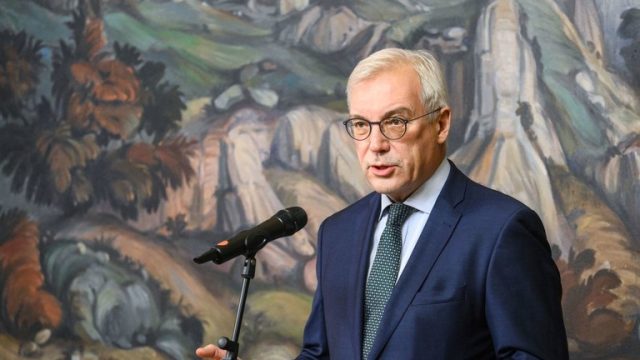
Russian Deputy Foreign Minister Alexander Grushko © Alexey Maishev; RIA Novosti
RT | January 24, 2025
Ukrainian accession to NATO would make achieving peace and establishing any kind of security architecture virtually impossible, Russian Deputy Foreign Minister Aleksandr Grushko has said in an interview published on Friday.
Speaking to the Russia 24 news channel, Grushko pointed out that the issue of Ukraine’s neutrality is one of the root causes of the ongoing conflict and is a key element of any potential deal with Kiev.
The diplomat emphasized that NATO membership for Kiev “precludes achieving peace in Ukraine and, in a broader sense, the creation of any kind of security architecture.”
He stressed that Moscow will not only seek “ironclad legal guarantees that would exclude Ukraine’s membership in NATO in any form,” but will also demand that this becomes an actual policy of the US-led military bloc.
NATO’s efforts to spread itself all over the world are increasing the possibility of a global military conflict, the diplomat said, specifically pointing to bloc chief Mark Rutte’s call to raise defense spending to 3% of members’ GDP.
“In fact, this has nothing to do with the real security situation,” Grushko explained. “This is over-armament, this is an attempt to achieve those geopolitical and military goals that they have recorded in their strategic documents, primarily American ones, to achieve military superiority in all operational environments, as they say, meaning land, air, space, cyberspace, and in all possible theaters of military operations, which now includes Asia.”
The diplomat accused NATO of pursuing a “very dangerous course that brings the threat of a global military clash closer,” while serving only to maintain the West’s hegemony that is “slipping out of their hands” amid the formation of a new multipolar world.
However, Grushko pointed out that Russia has “sufficient technical and other means to ensure” its security “in any scenario,” which includes the Oreshnik hypersonic missile system, as well as its nuclear forces and new technologies that continue to be added to the arsenal of Russia’s armed forces.
US Arms Ukraine, Europe Pays the Bill
Sputnik – 23.01.2025
NATO Secretary General Mark Rutte said on Thursday that European taxpayers would have to pay for US military supplies to Ukraine if the new US administration agreed to provide them.
“On Ukraine, we need US also to stay involved and to do as much as possible to get Ukraine in a position of strength, whenever peace talks start. But I can tell the Europeans, if this new Trump administration is willing to keep on supplying Ukraine from its defense industrial base, the bill will be paid by the Europeans,” he said at the World Economic Forum (WEF) in Davos.
The NATO chief said during the annual Ukrainian Breakfast event he was convinced that Europeans needed to be willing to pull their weight because, in his view, Americans were paying more despite being farther away from Ukraine than Europe.
Rutte also added that the alliance should increase its support for Ukraine in order to change the “wrong direction” in which the conflict is moving.
“We have to step up, not scale back, the support for Ukraine, we have to change the trajectory of the war which is ongoing, and so far we know the frontline is moving in the wrong direction,” Rutte said.
The annual WEF forum takes place from January 20-24 in the Swiss resort of Davos.
Russia believes arms supplies to Ukraine hinder the settlement process and directly involve NATO countries in the conflict. Russian Foreign Minister Sergey Lavrov has said the United States and NATO not only supply weapons to Kiev but also train personnel in the United Kingdom, Germany, Italy and elsewhere, which he argues is not conducive to peace.
Trump knows Ukraine conflict means nuclear WWIII, gives peace a chance with Russia’s Putin
By Finian Cunningham | Strategic Culture Foundation | January 23, 2025
The chances of a peace deal in Ukraine are suddenly a lot higher under President Donald Trump only because he has a realistic sense of a nuclear Third World War happening between the United States and Russia if that conflict is not ended promptly.
Peter Kuznick, an esteemed American professor of history, says that the Biden administration brought the world closer to a nuclear conflagration than at any time since the Cuban Missile Crisis in 1962. Biden did this by relentlessly arming Ukraine with weapons to strike deeper and deeper into Russia instead of trying to find a peaceful resolution to the conflict. Indeed, there was no diplomatic effort from Washington under Biden. It was ideologically and propaganda-driven for confrontation, as was the Democratic presidential candidate, Kamala Harris.
Kuznick points out that Trump is no John F Kennedy in terms of the latter’s depth of historical and philosophical knowledge. But in comparison with Joe Biden, Trump has shown more humanity and common sense by not insulting Putin and in reaching out for a peaceful end to the slaughter in Ukraine. Biden called Putin a thug and said he would back Ukraine as long as it takes to defeat Russia. The last Democrat administration spent $175 billion of U.S. taxpayers’ money propping up a NeoNazi regime in Kiev that has lost over one million military casualties since the war erupted in February 2022.
By contrast, newly inaugurated President Trump says that he wants to meet Russian leader Vladimir Putin as a priority to find a peaceful way out of the conflict and to avoid a catastrophic escalation between nuclear powers. Putin has welcomed a meeting with the new president and said he appreciates the urgent concern to avoid a nuclear disaster.
Kuznick is author of The Untold History of the United States, which was coauthored with acclaimed film director Oliver Stone. The book was turned into an award-winning television series aired on Showtime, Netflix and other channels. Kuznick deplores the way the U.S. and NATO partners undermined international security by expanding on Russia’s borders despite earlier promises to the Soviet leaders that would not happen.
If peace is to be found in Ukraine, it must be based on a bigger picture of lasting global security that considers all nations’ concerns.
That means the United States must treat Russia’s national security concerns over NATO’s expansion seriously and respectfully. Can the Trump administration deliver? It is packed with hawkish figures like Secretary of State Marco Rubio.
Donald Trump is better placed than the Biden adminstration to cut a deal with Russia for peace in Ukraine and thereby avoid nuclear disaster, says Kuznick.
Trump’s cabinet is filled with billionaires and his mercurial, superficial understanding of the world can be deprecated. Maybe his peaceful aspirations are muddled and not feasible given that Trump is surrounded by hawkish figures.
But at least he is willing to give peace a chance with Russia over Ukraine. That alone makes Trump a welcome change from the vile warmongering of Biden and his would-be successor Kamala Harris.
It’s Official: US Abandoning Ukraine

By Kit Klarenberg | Global Delinquents | January 22, 2025
On January 19th, TIME magazine published an astonishing article, amply confirming what dissident, anti-war academics, activists, journalists and researchers have argued for a decade. The US always intended to abandon Ukraine after setting up the country for proxy war with Russia, and never had any desire or intention to assist Kiev in defeating Moscow in the conflict, let alone achieving its maximalist aims of regaining Crimea and restoring the country’s 1991 borders. To have a major mainstream outlet finally corroborate this indubitable reality is a seismic development.
The TIME article’s brief first paragraph alone is rife with explosive revelations. It notes when the proxy war erupted in February 2022, then-President Joe Biden “set three objectives for the US response” – and “Ukraine’s victory was never among them.” Moreover, the phrase oft-repeated by White House apparatchiks, that Washington would support Kiev “for as long as it takes”, was never meant to be taken literally. Instead, it was just “intentionally vague” newspeak, with no implied timeframe or even desired outcome in mind.
Eric Green, a member of Biden’s National Security Council who oversaw Russia policy, states the US “deliberately…made no promise” to President Volodymyr Zelensky to “recover all of the land Russia had occupied” since the conflict’s inception, “and certainly not” Crimea or the breakaway Donetsk and Lugansk People’s Republics. He said the White House believed “doing so was beyond Ukraine’s ability, even with robust help from the West.” It was well-understood such efforts were “not going to be a success story ultimately” for Kiev, if tried.
According to TIME, the Biden administration’s three key objectives in Ukraine were all “achieved”. Nonetheless, “success” on these fronts “provides little satisfaction” to some of the former President’s “closest allies and advisers.” Green was quoted as saying Washington’s purported victory in Ukraine was “unfortunately the kind of success where you don’t feel great about it,” due to Kiev’s “suffering”, and “so much uncertainty about where it’s ultimately going to land.”
‘Direct Conflict’
One objective was “avoiding direct conflict between Russia and NATO.” Miraculously, despite the US and its allies consistently crossing Moscow’s clearly stated red lines on assistance to Kiev, providing Ukraine with weaponry and other support Biden himself explicitly and vehemently ruled out in March 2022, on the grounds it could cause World War III, and greenlighting hazardously escalatory strikes deep inside Russian territory, so far all-out hot war has failed to materialise. On this front perhaps, the former President can be said to have triumphed.
However, another “was for Ukraine to survive as a sovereign, democratic country free to pursue integration with the West.” This prospect dwindles daily, as the proxy war’s frontline teeters constantly on total collapse. Kiev is facing an eventual and seemingly inevitable rout of some magnitude, with the conflict likely settled solely on Russia’s terms, and Zelensky – or whoever replaces him – having no negotiating position to speak of. In December 2024, Empire house journal Foreign Policy even openly advocated cutting Kiev out of eventual peace talks.
Biden also “wanted the US and its allies to remain united.” It is this objective that most obviously failed, and quite spectacularly. As this journalist has repeatedly documented, British intelligence has consistently sought to escalate the proxy conflict into all-out war between the West and Russia, and encouraged Kiev in its maximalist aims, to the extent of covertly plotting grand operations for the purpose, and training Ukrainians to execute them. London’s overriding ambition, per leaked documents, is “to keep Ukraine fighting at all costs.”
The Western media has acknowledged Ukraine’s calamitous August 2024 invasion of Russia’s Kursk region was to all intents and purposes a British operation. London provided a vast welter of equipment to Kiev “central” to the effort, and “closely” advised their Ukrainian counterparts on strategy. The aim was to draw Russian forces away from Donbass and boost Kiev’s bargaining position, which has proven a staggering embarrassment on both fronts. But there was a wider, more insidious goal behind the incursion.
Britain openly and eagerly advertised its fundamental role in the Kursk misadventure to bolster public support at home for continuing the proxy war, and “persuade key allies to do more to help.” In other words, to normalise open Western involvement, and create the “direct conflict” the Biden administration was so keen to avoid. London was also at the forefront of pressuring NATO member states to permit Ukraine to use foreign-supplied weaponry and materiel inside Russia, which could likewise produce their long-sought hot war against Moscow.
Several Western countries – including the US – have offered such authorisation. Yet, Russia has consistently responded to strikes deep inside its territory with heavy duty counterattacks, which Kiev has been unable to repel. Meanwhile, London’s invitation to its allies to become more overtly involved in the proxy war was evidently rebuffed. In November 2024 too, pro-government outlet Ukrainska Pravda published a startling investigation, documenting in forensic detail how the October 2023 – June 2024 Krynky operation was, à la Kursk, essentially British.
Never spoken of by Ukrainian officials today, the nine-month effort saw wave after wave of British-trained and equipped marines attempt to secure a beachhead in a river-adjacent village in Russian-controlled Kherson. Poorly prepared, many died attempting to reach Krynky, due to relentless artillery, drone, flamethrower and mortar fire. Of those that survived the nightmarish journey, most were then killed under a constant and ever-intensifying blitz, in marsh conditions. Russia’s onslaught grew so inexorable, evacuating casualties or providing forces with even basic supplies became borderline impossible.
Survivors of the Krynky catastrophe – one of the absolute worst in military history – who spoke to Ukrainska Pravda revealed it was hoped the beachhead would be a “game-changer”, opening a second front in the conflict, allowing Kiev’s invading marines to march upon Crimea and all-out victory in the proxy war. They hoped to recreate the June 1944 Normandy landings – D-Day. It is all too easy to envisage British intelligence filling the heads of their Ukrainian trainees with such fantasies.
‘Settle Up’
Fast forward to today, and Britain and France are openly discussing sending “peacekeepers” to Ukraine, to “help underpin” whatever “post-war settlement” emerges between Kiev and Moscow. This is after in February 2024, French President Emmanuel Macron suggested formally deploying his country’s forces to Ukraine to halt Moscow’s advance. The proposal was summarily dropped and forgotten when Russian officials made abundantly clear each and every French soldier dispatched to the frontline would be killed without hesitation, and Paris could become a formal belligerent in the war.
It appears the “peacekeeping” plan is likely to suffer the same fate. On January 20th, coincidentally or not the day of Donald Trump’s inauguration, CIA-created Radio Free Europe published an explainer guide on why sending European troops to Ukraine is “a nonstarter”. Among other things, as the Russians are unambiguously winning, they are unlikely to offer many concessions, particularly allowing foreign soldiers to occupy Kiev’s territory. Furthermore, “as a permanent member of the UN Security Council, Moscow can block any peacekeeping mission.”
As if the message to London and Paris wasn’t emphatic enough, two weeks earlier, at a press conference at his Mar-a-Lago resort, Trump made numerous comments reiterating his commitment to ending the proxy war. “We’re going to have to settle up with Russia,” he declared. Notably, the President sympathised with Moscow’s “written in stone” determination Kiev not be enrolled into NATO, warned the situation “could escalate to be much worse,” and stated his hope the conflict could be wrapped up within six months.
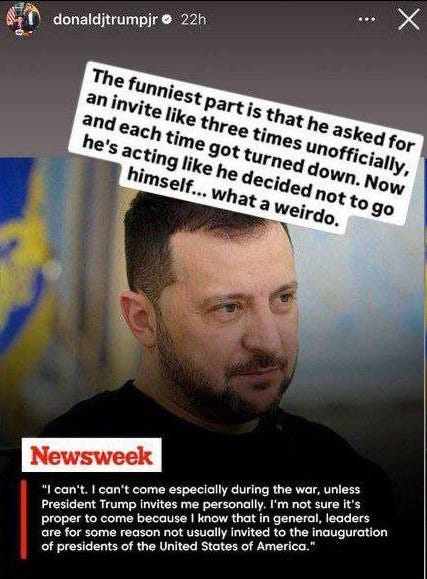
Markedly, Zelensky was not invited to Trump’s inauguration. In a January 6th interview with Newsweek, the Ukrainian President – typically never one to shy away from international jollies – said he was unable to attend, as it wasn’t “proper” to do so “during the war”. Amusingly, Trump’s son Donald Jr. has rubbished Zelensky’s narrative, claiming the – “weirdo” – had specifically “asked for an invite” on three occasions, “and each time got turned down.”
For Berlin, Kiev, London, Paris, and NATO more widely, the writing couldn’t be on the wall any more plainly. Whatever reveries they may have of maintaining the proxy war any longer – Britain recently signed a 100-year-long partnership with Ukraine, under which London will “explore” building military bases on Kiev’s soil – they all ultimately remain imperial vassals, wholly dependent on US financial and military support to exist. Save for a major false flag incident, Trump’s message can only be received among the military alliance.
The Budapest Memorandum: The Fake Narrative Supporting a Long War in Ukraine
By Professor Glenn Diesen | January 21, 2025
Narratives have been constructed to support a long war in Ukraine. For example, the narrative of an “unprovoked invasion” was important to criminalise diplomacy as the premise suggests negotiations would reward Russian military adventurism and embolden further Russian aggression. Meanwhile, NATO escalating the war creates costs that outweigh the benefits to Russia.
Russia’s violation of the Budapest Memorandum is a key narrative that supports a long war. It is constantly referenced as a reason why Russia cannot be trusted to abide by a peace agreement, and why the war must keep going. The argument is that Ukraine gave up its nuclear weapons in return for security guarantees for its territorial integrity. Russia’s breach of this agreement suggests it cannot be trusted and that the only reliable security guarantees must come from NATO membership. Furthermore, the West must continue to send weapons to Ukraine to honour the security guarantees of the Budapest Memorandum.
In February 2022, a few days before the Russian invasion, Zelensky referred to the Budapest Memorandum: “Ukraine has received security guarantees for abandoning the world’s third nuclear capability. We don’t have that weapon. We also have no security.” The Budapest Memorandum was again used by Zelensky in October 2024 to support the argument that Ukraine must either have NATO or nukes: “Either Ukraine will have nuclear weapons, and then it will be a defence for us, or Ukraine will be in NATO”.
This article presents facts and arguments that challenge the false narrative of the Budapest Memorandum, which aims to delegitimise diplomacy. Criticising the narrative of the Budapest Memorandum does not entail “legitimising” Russia’s invasion of Ukraine, which is a common tactic to smear and censor criticism against the narratives supporting a long war.
No Security Guarantees and No Ukrainian Nuclear Weapons
The Budapest Memorandum does not offer any security “guarantees”, rather it provides “assurances”. Former US Ambassador to Ukraine Steven Pifer, who was part of the US negotiation team in 1994, argues the US was explicit that “guarantees” should not be confused with “assurances”. Pifer also confirms this was understood by both the Ukrainians and the Russians:
“American officials decided the assurances would have to be packaged in a document that was not legally-binding. Neither the Bush nor Clinton administrations wanted a legal treaty that would have to be submitted to the Senate for advice and consent to ratification. State Department lawyers thus took careful interest in the actual language, in order to keep the commitments of a political nature. U.S. officials also continually used the term “assurances” instead of “guarantees,” as the latter implied a deeper, even legally-binding commitment of the kind that the United States extended to its NATO allies”.[1]
Ukraine also did not have any nuclear weapons. The nuclear weapons in question were former Soviet nuclear weapons that were stationed in Ukraine, but under the control of Moscow. Kiev did not and could not operate or maintain these weapons, which is usually left out of the narrative. Furthermore, in the Minsk agreement of 1991, Ukraine had already committed itself to the “destruction of nuclear weapons” on its territory.[2]
The Not-So-Sacred Memorandum
In December 1994, the US, UK, and Russia met in the Hungarian capital and offered security commitments in three separate agreements with Ukraine, Belarus, and Kazakhstan. These three countries agreed to relinquish the nuclear weapons that had been left on their territory after the collapse of the Soviet Union, and in return, the US, UK and Russia offered commitments to not undermine their security. The Budapest Memorandum outlined key principles such as “to refrain from economic coercion designed to subordinate to their own interest the exercise by Ukraine of the rights inherent in its sovereignty and thus to secure advantages of any kind”, and to “respect the independence and sovereignty and the existing borders of Ukraine”. In a display of cherry-picking, NATO countries constantly ignore the first commitment but constantly refer to the second commitment.
The US claims its use of economic coercion and violation of Ukrainian sovereignty was in support of democracy and human rights as opposed to advancing its own interests. Thus, the US freed itself from its commitments under the Budapest Memorandum. Under the so-called rules-based international order, the US and its allies claim the prerogative to exempt themselves from international law, norms and agreements under the guise of supporting humanitarian law and liberal democratic norms.[3]
When the US imposed sanctions on Belarus in 2013, Washington explicitly stated that the Budapest Memorandum was not legally binding and that US actions were exempted as the US was allegedly promoting human rights:
“Although the Memorandum is not legally binding, we take these political commitments seriously and do not believe any U.S. sanctions, whether imposed because of human rights or non-proliferation concerns, are inconsistent with our commitments to Belarus under the Memorandum or undermine them. Rather, sanctions are aimed at securing the human rights of Belarusians and combating the proliferation of weapons of mass destruction and other illicit activities, not at gaining any advantage for the United States”.[4]
The Western-backed coup in 2014 had been an even more blatant violation of Ukrainian sovereignty. The West interfered in the domestic affairs of Ukraine, imposed economic sanctions, and finally toppled the Ukrainian president to pull the country into NATO’s orbit. The commitments under the Budapest Memorandum were cast aside as the West claimed to support a “democratic revolution”, despite being an unconstitutional coup that did not even enjoy majority support from the Ukrainians and only a small minority of Ukrainians supported NATO membership.
International law imposes rules and mutual constraints that limit foreign policy flexibility, but in return deliver reciprocity and thus predictability. Once the West freed itself from mutual constraints in the Budapest Memorandum, Russia also abandoned it. US Ambassador Jack Matlock who participated in negotiating an end to the Cold War, questions the validity of the Budapest Memorandum after the coup in 2014. According to Matlock, the principle in international law of rebus sic stantibus means that agreements should be upheld “provided things remain the same”. Matlock argues that Russia “strictly observed its obligations in the Budapest Memorandum for 13 years” even as NATO expanded towards its borders, although the coup of 2014 created “a radically different international situation”. Matlock thus concludes that Russia was “entitled to ignore the earlier agreement”.[5]
Learning the right lessons
An honest assessment of why the Budapest Memorandum collapsed is important to assess how new agreements can be improved. NATO’s demand for hegemony in Europe and rejection of a common European security architecture inevitably led to the collapse of common agreements as the West would no longer accept the principle of mutual constraints and obligations. Liberal hegemony entailed that the West could exempt itself from international law and agreements, while Russia would still abide by them. The narrative of Ukrainian nuclear weapons, security guarantees, and ignoring the US and UK violation of the Budapest Memorandum serves the purpose of sowing distrust in any future security agreements with Russia. A mutually beneficial peace is possible if we first return to the truth.
[1] S. Pifer, 2011. The Trilater Proce The United States, Ukraine, Russia and Nuclear Weapons, Foreign Policy at Brookings, Arms Control Series, Paper 6, May 2011, p.17. https://www.brookings.edu/wp-content/uploads/2016/06/05_trilateral_process_pifer.pdf
[2] Agreement on Strategic Forces Concluded between the 11 members of the Commonwealth of Independent States on December 30, 1991. https://www.bits.de/NRANEU/START/documents/strategicforces91.htm
[3] G. Diesen, ‘The Case for Dismantling the Rules-Based International Order, Substack, 23 December 2024.
[4] US Embassy in Belarus, ‘Belarus: Budapest Memorandum’, U.S. Embassy in Minsk, 12 April 2013.
[5] J. Matlock, ‘Ambassador Jack Matlock on Ukraine, Russia, and the West’s Mistakes’, Nuova Rivista Storica
EU member pledges to veto future Ukraine aid
RT | January 19, 2025
Slovakia will veto any future Ukraine aid considered by the EU, Prime Minister Robert Fico has announced. Bratislava will now take a “reciprocal” approach to hostile moves by Kiev, he warned.
Fico issued the threat in a video address posted to social media late on Saturday. Ukraine’s Vladimir Zelensky believes everyone should be his “servant,” Fico asserted, warning such an approach would not work with him.
“In my case, the scythe hit a rock. Robert Fico is a Slovak prime minister and not a Ukrainian servant,” Fico stated.
Bratislava will take a “reciprocal” approach to Kiev in the row over the transit of Russian natural gas that Kiev ended at the beginning of the new year, Fico warned, pledging to veto any future aid packages from the EU. The packages require unanimous backing from all the members of the bloc to be passed.
The Slovak prime minister also reiterated other potential moves against Ukraine that he had articulated previously, namely halting the emergency electricity supply, stopping humanitarian aid deliveries, or cutting benefits received by Ukrainian refugees in Slovakia.
“I am increasingly convinced that President Zelensky is forcing us into reciprocity, and we will go for it,” Fico stated.
Once a major supporter of Ukraine, Slovakia changed its stance after Fico took office in late 2023, halting military aid to the country and pledging to veto its potential accession into the US-led NATO bloc.
The already strained relations between Bratislava and Kiev have further deteriorated owing to the row over the Russian gas, which Slovakia has been heavily dependent upon. Kiev opted not to renew the transit contract and halted the flow despite Moscow’s repeated signals that it was prepared to continue supplying its customers in the EU through Ukraine’s pipeline system.
Fico initially proposed negotiating with Zelensky on the border between the two countries, but the latter urged him through social media to come to Kiev instead. The response was deemed undiplomatic in Slovakia. Fico then proposed to meet Zelensky in Davos next week, where both leaders are expected to head. The proposal was openly mocked by Kiev, with Zelensky suggesting the Slovak leader could end up in Sochi, Russia, instead.
Russian Victory or Political Settlement in Ukraine?
Ambassador Chas Freeman, Alexander Mercouris & Glenn Diesen
Glenn Diesen | January 15, 2025
I had a conversation with Alexander Mercouris and Ambassador Chas Freeman, a former Assistant Secretary of Defense for International Security Affairs. Besides being a former ambassador to Saudi Arabia, Freeman’s career included opening China with Henry Kissinger and Richard Nixon in the 1970s and developing the post-Cold War security architecture in Europe.
We discussed the messy world that the Biden Administration is handing over to Trump. There is seemingly a genuine desire to end the proxy war in Ukraine, and Trump may also achieve a ceasefire in Palestine. However, NATO’s escalations in Ukraine to sabotage possible negotiations and the reckless support for HTS in Syria have reduced the possibilities available to Trump. Will the Ukraine War be resolved by a Russian victory or a political settlement?
New US Nuke Deployment in Europe Raises Serious Questions About NATO’s True Nature
By Ilya Tsukanov – Sputnik – 18.01.2025
The United States has begun the forward deployment of a new generation of its B61 nuclear gravity bomb at bases in Europe, a senior administrator has announced. What signal does the deployment send to Moscow? What impact will it have on strategic security in Europe? Sputnik turned to a senior former Pentagon insider for answers.
“The new B61-12 gravity bombs are fully forward deployed, and we have increased NATO’s visibility to our nuclear capabilities through visits to our enterprise and other regular engagements,” US National Nuclear Security Administration chief Jill Hruby revealed in a talk at the Hudson Institute this week.
“Our strategic partnership with the UK is very strong, as is their commitment to their nuclear deterrent. And we have advanced our thinking together about critical supply chain resilience. NATO is strong,” Hruby added, hinting at the prospects for ‘enhanced’ nuclear cooperation.
Reports have been swirling in recent years about US plans to redeploy tactical nuclear weapons in the UK at the RAF base at Lakenheath, although no official announcements have been made to date.
The B61-12, also known as the B61 Mod 12, is the latest upgrade to the US variable yield nuclear gravity bomb design first rolled out in the late 1960s. The Mod 12 is set to replace the older Mod 3, 4 and 7 variants of the weapon, and features a 0.3-50 kt yield.
Testing of the B61-12 was completed in 2020, with production starting in late 2021, and the Bulletin of the Atomic Scientists expecting 400-500 of the weapons to be produced, in part for deployments abroad.
Older variants of the munition are currently deployed in Belgium, Germany, Italy, the Netherlands, and Turkiye’s Incerlick Air Base. NATO has approved the weapons to be used in battle by select alliance members as part of the bloc’s “nuclear sharing” arrangements.
The announcement of the bombs’ deployment in Europe is meant to “signal to Moscow that NATO and particularly the UK… are prepared for any ‘attack’ on any NATO country,” says ex-DoD analyst Michael Maloof.
What it really signals is just how much of a US protectorate Western European countries and the UK have allowed themselves to become, Maloof, a former senior security policy analyst with the Office of the US Secretary of Defense, said.
“When I used to live there on a military base, we used to joke how the UK was nothing but a floating aircraft carrier because of all the US bases on the RAF facilities there,” the observer, who grew up in southern England during the Cold War, recalled.
The nukes’ deployment once again “underscores how NATO has evolved not into a defensive alliance, but an offensive alliance,” with the bases where the bombs are stored obvious targets for Russia in the event of a deadly escalation, Maloof said.
Can Trump Fix a Broken Alliance?
Maloof hopes that under Trump 2.0, “a total reevaluation of the deployment of US bases throughout NATO” will take place, especially in Germany but possibly also the UK.
NATO’s continued existence, the alliance’s “Cold War 2.0” against Russia and the bloc’s eastward expansion have been a disaster for European security, the observer said.
“I think it’s the beginning of the end of NATO as we know it. This perennial cycle has just got to cease. And given how we don’t even have a defense against hypersonics… it really shows that we’re reaching a very dangerous pinnacle here of escalation.”
The nuke deployment, the termination of the INF Treaty during Trump’s first term and other factors have “made Europe an all the more dangerous place to be,” Maloof emphasized, with reaction time in case of a nuclear escalation being “virtually nil.”
“I think that this posturing that we continually see to ‘show deterrence’ is actually making the West even more vulnerable to attack because it is an agitating factor,” the observer added.
The man who deserves but probably will not be allowed to lead Romania
By Stephen Karganovic | Strategic Culture Foundation | January 17, 2025
Calin Georgescu rightfully has a huge grievance against what passes for “Western democracy.” He is the clear first-round winner in the Presidential elections held in Romania late last year. Yet his projected even more resounding victory in the second round, scheduled for early December 2024, was scrapped (as the BBC indelicately put it) following a Romanian Supreme Court ruling that the electoral process was marred by alleged hybrid warfare interference conducted by Russia on Georgescu’s behalf.
How do you “scrap” elections in a vibrant democracy such as Romania, which also happens to be a member in good standing of NATO and the European Union, which are bastions of liberal freedoms and the rule of law? Well, you do it by making up a bogus dossier on the political candidate that you dislike and by ordering the local judiciary to act on it as if it were genuine evidence. The dossier purporting to document the alleged interference was so patently phony that at its first sitting to consider the matter the Romanian Supreme Court dismissed it out of hand. This show of integrity did not sit well at all with the paladins of the rules-based order. So they ordered the judges to reassemble forthwith in their chambers and to get it right this time. On 6 December the distinguished Romanian jurists did just that and obediently reversed their ruling issued just four days previously.
Citing Article 146 (f) of the Romanian Constitution concerning the legality and correctness of the presidential elections, the Court ordered that the “entire electoral process will be integrally redone.” So the result of the first round was duly “scrapped” and along with it the second round as well. The second round, which was in progress as the judges hurriedly improvised their new ruling, was stopped in its tracks. As even the Atlantic Council, no friend of elections which go the wrong way, was compelled to admit “the rollout of the decision was somewhat fumbled, as it became public while polling stations were already open for the [Romanian] diaspora in the second-round presidential election, and by the time the process was stopped, around 53,000 citizens abroad had already voted.” Scrapped just in time, because the Romanian diaspora was known to be a hotbed of Georgescu supporters.
The Presidential election was set by the judges for an unspecified date in the future. Some rumours suggest that it might be in May of this year, or whenever it is that the stage can be prepared to ensure the right outcome. In the meantime, Klaus Iohannis, who should have relinquished his post in December to his successor, is now as legally “expired” as his Ukrainian colleague Zelensky. But that does not seem to bother any of the vociferous champions of the democratic process. Iohannis after all is their man.
The Romanian public, however, do not seem to take kindly to electoral interference by the compliant judges and their string-pullers, who are widely suspected of being located abroad but not in Russia. Thousands have been marching in the streets of Bucharest and other major cities to oppose the cancellation of the elections. How much good it will do them in a country that has embraced the principles of Western democracy remains to be seen.
The protagonist of this political earthquake who was not permitted to democratically establish his credentials as the new President of Romania, Calin Georgescu, ever since his first-round triumph has been subjected to the full measure of calumny that is reserved for those whom the globalist system perceives as a non-team-player and a threat. The hope was evidently that he would be successfully discredited and simply fade away, allowing the charade of “democratic elections” with a prearranged outcome to be repeated whenever it is judged safe to do so.
Expectedly, the Georgescu affair with its scandalous implications has been largely ignored by the collective West media, except for a few derogatory observations here and there at the banned candidate’s expense. The Georgescu story might have died a quiet death but for the professionalism of American podcaster Shawn Ryan, who decided to perform a public service by travelling to Romania to find out first-hand what the electoral commotion was all about.
The result was a remarkable interview with the man who by all reasonable estimates should be sitting today in the Presidential office in Bucharest. It is worth viewing carefully and in its entirety for the insights it affords into the sombre times in which we happen to live.
Georgescu strenuously denies that he is “pro-Russian” and says that he has no personal acquaintance with Russian officials except for watching them on television. In any court of law or public opinion that declaration should suffice because the burden of proof is on his accusers and they have failed to meet it. But the accusation brings up a much deeper and more significant issue: even if he were, why should it be a problem? Most of the other candidates, including the election runner-up, advocated policies explicitly aligned with non-Romanian interests and entities, such as NATO and the EU. Why is it objectionable for another presidential candidate in a supposedly sovereign and democratic country to propose to the electorate a different policy for their consideration and approval?
And here comes the crux of the matter. Asked by Shawn Ryan whether he is pro-Russian, Georgescu let the cat out of the bag by responding that no, he is pro-Romanian, and that the policies he contemplates are shaped to best serve the needs and interests of the Romanian people. In the current political atmosphere there is hardly a more disqualifying admission than that. The few European leaders, such as Orban and Fico, who had made it through the cracks in the globalist system to ultimately disclose that their primary commitment is to their respective countries’ interests are shunned and reviled for their subversive patriotism. One was the target of an assassination attempt, the other is the target of a colour revolution as this is being written. The rise of another leader who espouses a similar philosophy would be intolerably disruptive to the globalist agenda. That is why Georgescu had to be thwarted by any means, fair or foul.
Georgescu clearly is a simple man, plain spoken and without guile, not practiced in the use of mendacious phrases which characterise the discourse of trained political mannequins, the chosen puppets of the power elites who are allowed inhabit the public universe of Western political systems. Asked by Shawn Ryan how he views Romania’s membership in NATO, he gave an answer that was somewhat awkward but still made fundamental sense. When Romania joined NATO, he said, it was understood to be a defensive alliance, but since then its mission was changed to include offensive operations in which Romania has no national interest. Romania, he implied, is no longer part of the same outfit that it had originally joined. It is a fair answer, not just from the standpoint of Romania but also of quite a few other countries that by hook and by crook were rushed into joining NATO for the geopolitical benefits their geographical location offered to the alliance and its belligerent agendas.
Hence, according to Georgescu, Romania (and by implication other countries which were similarly enticed into joining) is now fully entitled to reconsider its choice and pursue a policy that takes into account the alliance’s changed nature and Romania’s current interests.
As for the collective West’s favourite quagmire, Project Ukraine, speaking for his country and the Romanian nation, Georgescu was unforgivably frank. “That is not our war,” he said.
These are only some salient snippets of this highly illuminating interview which lays bare the corruption of the political system we have been told represents the pinnacle of liberal democracy. One wishes that Georgescu’s English were more fluent, but still it sufficed to convey the important points that he makes and it fully answered the question, if there was anyone who was still in doubt, why they are prepared to resort to the basest trickery to make sure this man of integrity does not become President of Romania. And to ensure by example that no like-minded patriot in any other country that they control will ever think of emulating Calin Georgescu.
Featured Video

The Truth About the Trump Shootings with Ken Silva
or go to
Aletho News Archives – Video-Images
From the Archives
Trans ‘milk’ as good as the real thing – NHS
RT | February 18, 2024
The drug-induced nipple secretions of trans women are as good as mothers’ breast milk for babies, the University of Sussex Hospitals NHS Trust claimed in a letter to campaigners made public in a report by British think tank the Policy Exchange on Sunday.
The healthcare trust’s medical director, Rachel James, argued that the off-label prescription drug cocktail men transitioning to female take in order to produce milk was “similar to the natural hormones which encourage lactation to develop when the baby is newly born.”
“The evidence which is available demonstrates that the milk is comparable to that produced following the birth of a baby,” James wrote in the letter, sent to Children of Transitioners last August.
Biological men who wish to lactate must first take hormones to grow milk glands and then take high doses of either domperidone or metoclopramide to stimulate milk production. Neither drug is approved for this use, though they are occasionally prescribed off-label to biological women who have trouble lactating.
However, domperidone’s own manufacturer, Janssen, warns patients the drug “may cause unwanted side effects affecting the heart in a breastfed baby” and “should be used during breastfeeding only if your physician considers this clearly necessary.” … continue
Blog Roll
 Aletho News
- Russia Voted Under Fire. Washington Is Loading the Tankers.
- 12 Things Your Oncologist Was Trained Not to Tell You
- Anthrax Attacks Paved Way for COVID-Era ‘Junk Drugs and Vaccines’
- How Real Is the Impact of Western Sanctions on Israel?
- France, You Are Guilty: How Paris Turned Western Sahara into the Maghreb’s Powder Keg
- 2025 Nature Paper Claiming Worsening Global Drought Gets RETRACTED …Heavily Flawed
- Your Milk Is Not the Problem
- The Truth About the Trump Shootings with Ken Silva
- ARE PATIENTS BEING PROPERLY INFORMED ABOUT OZEMPIC?
- US lawmaker blocks $2.8 billion weapons sale to Israel: Report
- If Americans Knew
- Salah Sarsour’s Legal Team Says DHS Has Not Met Its Burden to Prove He Is Deportable
- An analysis of tax forms by The Intercept show Kraft’s charity and LLC have donated to Friends of the IDF and AIPAC’s super PAC.
- Israeli attacks kill four Palestinians in Gaza – Daily Update
- Inside Gaza’s death trap of collapsing, bombed-out buildings
- The everyday items Israel bans from Gaza every day
- Inside the siege, the ruined buildings of Gaza – Daily Update
- Debunking The Claim That Macklemore Has A “History Of Antisemitism”
- CPJ demands release of arrested Palestinian-US journalist near Bethlehem
- Robert Kraft: The Billionaire Friend of Netanyahu Pulling The Strings Behind the Macklemore/Ed Sheeran Blow Up
- Columbia Administered Fund Gives Big Money to Pro-Israel Groups
- No Tricks Zone
- 2025 Nature Paper Claiming Worsening Global Drought Gets RETRACTED …Heavily Flawed
- New Study: ‘Global Drought Shows No Detectable Recent Acceleration Under Climate Warming’
- Economic Masterminds: German Socialists Suggest Taxing Productivity Gains Stemming From Using AI
- The South China Sea Has Not Been Cooperating With The Climate Change Narrative
- Energy Crisis: Germany Enters Heating Season With Historically Low Gas Reserve Fill Levels
- New Study: The Antarctic Ice Sheet Gained Mass From 2020-2024 Due To Staggering Snow And Ice Accumulation
- Study: Ocean Heating Rates From Thousands Of Years Ago ‘Dwarf’ Modern Ocean Heating Rates
- Climate Extremists Target, Attack Large-Scale Power Grid Infrastructure In Germany!
- New Study: Antarctic Ice Melt Has Contributed Less Than 1 Centimeter To Sea Level Rise In The Last 30 Years
- Fear Of Debate: Alarmist German Climate Scientist Calls On Mainstream Media To Discredit Skeptic Voices
 Aletho News