Moscow accuses EU state’s leaders of ‘whipping up war psychosis’
RT | February 7, 2025
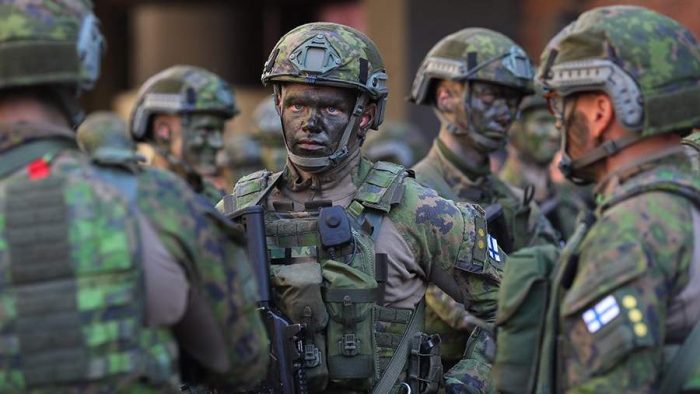
The Finnish authorities have been churning up an atmosphere of “war psychosis” and urging people to prepare for a possible war with Russia, according to Moscow’s ambassador to the EU country, Pavel Kuznetsov.
In an interview with RIA Novosti published on Thursday, Kuznetsov said that Finland’s leadership is instilling fear in the population using claims of “Russia’s aggressive plans.”
Helsinki is promoting various initiatives to strengthen military preparedness among civilians, the envoy said.
“There is increased media coverage of bomb shelter renovations, the expansion of shooting club networks, and the extension of the maximum age for reservists,” Kuznetsov observed, adding that such measures are being “widely promoted.”
According to the ambassador, such actions are part of the Finnish government’s attempt to justify the country’s “hasty” NATO accession and increased defense spending.
Finland, which shares an almost 1,300-kilometer-long border with Russia, officially joined the US-led military bloc in April 2023 following the escalation of the Ukraine conflict. The Finnish government has since strengthened its defense policies, including expanding military training and civil preparedness programs.
Multiple outlets have reported a sharp rise in interest among Finns in weapons training. Shooting ranges have seen membership soar, and the government has announced plans to open more than 300 new shooting facilities to encourage the trend.
In November 2024, Finland issued guidance on how to prepare for an armed conflict, emphasizing the importance of readiness in the face of potential threats.
Several other Nordic countries have also published information advising their populations on how to prepare for a possible war or other unexpected crises.
Sweden has sent out millions of updated booklets entitled “In case of crisis or war,” while Norway has issued pamphlets urging people to be prepared to survive on their own for a week in the event of extreme weather, war, or other threats.
Denmark’s emergency management agency has informed the public how much water, food, and medicine individuals need to get through a crisis lasting three days. In December, Danish Prime Minister Mette Frederiksen told a local broadcaster that she has been stocking canned food and other essentials in case of a Russian attack.
NATO has long declared Russia to be a direct threat, and Western officials have repeatedly claimed that if Moscow wins the Ukraine conflict, it could attack other European countries.
Russian President Vladimir Putin has dismissed any possibility of a military advance against NATO as “nonsense.”
Putin told US journalist Tucker Carlson last February that the bloc’s leaders are trying to scare their people with an imaginary threat from Moscow, but that “smart people understand perfectly well that this is a fake.”
At the same time, Russia has repeatedly warned against what it describes as NATO’s unprecedented military activity near its western borders in recent years.
Trump’s Foreign Policy – Strategy Behind the Noise?
Prof. Jeffrey Sachs with Prof. Glenn Diesen
Glenn Diesen | February 5, 2025
Trump’s actions in the international system are defined by the aims to remake US foreign policy, and the tendency to make noise that keeps him in the headlines. A key challenge for analysts is therefore to distinguish between the strategy and the noise. Some of Trump’s messaging has a deliberate purpose while at other times he is seemingly improvising.
US Secretary of State Marco Rubio dropped a bombshell by arguing that the unipolar world order is over and the natural condition is multipolarity. Does this represent Trump’s decision to retire the “hegemonic peace” in Europe through NATO expansion (that triggered a war in Ukraine), or was it simply an independent commentary by Rubio? Trump wants peace with Russia and recognises that NATO provoked the war, but he also attempts to threaten Russia to accept US terms. Trump wants to end the wars in the Middle East, but he also sends 2000-pound bombs to Israel and casually suggests ethnic cleansing of the Palestinians from Gaza. Trump wants to get along with China, but also to end China’s technological leadership. What is foreign policy and what is noise?
Did Trump’s Ukraine Peace Plan Just Leak?
By Ted Snider | The Libertarian Institute | February 4, 2025
A leaked document has given us a first glimpse at President Donald Trump’s peace plan for Ukraine. According to the Ukrainian online newspaper Strana, U.S. officials handed the plan to European diplomats who then passed it on to Ukraine.
The existence of the plan has not been verified, and Andriy Yermak, head of the Office of the President of Ukraine, has said “no ‘100-day peace plan’ as reported by the media exists in reality.”
If the plan is real, and if it is being put on the table by the Trump administration as a finished product that, if rejected, will lead to more sanctions on Russia and more weapons for Ukraine (as Trump has threatened), then the war will go on, and Trump’s promise to quickly end the war will vanish in a puff of delusion. But if the plan is real, and if it is put on the table as a starting point for negotiations, then there is hope. And there is suggestion that it is a starting point.
Here is an item by item analysis of what each side may consider acceptable in the supposed plan and what each side may insist on negotiating further.
The process begins with an immediate phone call between Donald Trump and Russian President Vladimir Putin followed by discussions between Washington and Kiev. That the plan may be intended as a starting point for negotiations is suggested by the fork in the schedule that negotiations will continue if common ground is found or pause if it is not. Further negotiations would lead to an Easter truce along the front line, an end of April peace conference, and a May 9 declaration of an agreement.
Russia has said that the Istanbul agreement could still be “the basis for starting negotiations.” In June 2024, Vladimir Putin set out a peace proposal based on the Istanbul agreement, but adjusted for current territorial realities. Putin’s proposal had four points: Ukraine must abandon plans to join NATO, they must withdraw from the four annexed territories, they must agree to limits on the size of their armed forces, and they must ensure the rights of ethnic Russians in Ukraine.
The alleged Trump plan can be evaluated by comparison to Putin’s proposal and to recent statements made by Ukrainian President Volodymyr Zelensky.
- Ukrainian troops must withdraw from Kursk at the time of the April Truce. This would be acceptable to Russia, who would insist on Ukrainian troops leaving its territory. But for Ukraine, this would be a difficult concession; not because of the withdrawal but because of the timing. Aside from the strategically catastrophic hope that the Kursk invasion would divert Russian troops away from the Donbas, the point of taking Russian territory was to use it to barter for the return of Ukrainian territory. Giving up the bargaining chip before the negotiations begin would nullify Ukraine’s hope of using it to force the return of more of its land.
- Ukraine must end martial law and hold presidential elections by the end of August and parliamentary elections by the end of October. This could be a bitter pill for Zelensky. Recent polling has shown that he could well lose that election. Elections would be welcomed by Russia, who see Zelensky’s government as intransigently hostile and anti-Russia. This would legally transfer hope for regime change to Ukrainians.
- Ukraine must declare neutrality and promise not to join NATO; NATO must promise not to expand into Ukraine. Ukraine was willing to abandon its NATO hopes in Istanbul. Though accepted by Kiev as inevitable, it would now be a painful concession. In the absence of NATO membership. It would be a hard sell to Ukrainians that the war after the Istanbul talks was worth the devastation. For Russia, this point is key, and there can be no negotiations without it. It would be the key accomplishment to get the two-sided promise that Ukraine will not ask for membership and NATO will not offer it.
- Ukraine will become a member of the European Union by 2030. This item is acceptable to both. EU membership will be necessary for Zelensky to present to Ukrainians as something that was worth fighting for. Ukraine is now free to pursue its ambitions to turn west and join Europe. Though Russia had concerns in 2014 with the EU’s Association Agreement with Ukraine because of its implied integration of Ukraine into the European security and military architecture, Putin has long left EU membership on the table for a postwar Ukraine, and that was specifically agreed to in the Istanbul agreement.
- Ukraine will not reduce the size of its armed forces and the United States will continue modernizing the Ukrainian military. While Ukraine will welcome this, it may not be enough. Russia will have a hard time with this one. This is like “the Israeli model” that then-Israeli Prime Minister Naftali Bennett says Putin and Zelensky were both open to in the early days of the war. But, in the absence of NATO, Zelensky has been adamant about American supported security guarantees. And, already by Istanbul, Russia was demanding limits on Ukraine’s armed forces. At the very least, modernized Ukrainian weaponry would have to be defensive and with a cap on firing into Russian territory.
- Ukraine refuses military and diplomatic attempts to return the occupied territories, but does not officially recognize Russian sovereignty. This item does not go far enough for Russia and too far for Ukraine. Zelensky has accepted that “De facto, these territories are now controlled by the Russians. We don’t have the strength to bring them back.” So, he will accept not attempting to return the occupied territories militarily. He has also insisted that Ukraine would never officially recognize Russian sovereignty over those lands. But the added clause, that he will not attempt to return them diplomatically, may be going further than Zelensky has been willing to go. In the case of Crimea, he has reserved the right to try to bring territory back diplomatically. For Russia, the de facto recognition of the territory it occupies will likely be enough. In his proposal, Putin insisted on the complete withdrawal from the territories while saying nothing about Ukraine officially recognizing Russian sovereignty over them. However, though Russia may be willing to negotiate over Kherson and Zaporizhzhia, they are less likely to accept only the lands east of the current front without it including all of the Donbas.
- Some sanctions on Russia will be lifted, including European Union bans on Russian oil. This item will likely be acceptable to Ukraine, especially since temporary duty on sales of oil will be used to restore Ukraine. It will likely be acceptable, at least as a starting point, for Russia.
- Parties that support Russian language and peaceful relations with Russia can participate in Ukraine’s elections. State actions against the Ukrainian Orthodox Church and Russian language must cease. Though difficult for Zelensky and some forces in Ukraine to accept, protection of language, religious and cultural rights is the second key Russian demand along with NATO.
- The idea of a European peacekeeping force is to be discussed separately. The recognition that security guarantees are both key and difficult for both parties is realistic. Neither side will agree to a European security force: Russia because it goes too far, Ukraine because it goes not far enough.
If this possible plan is a final draft whose rejection means negotiations end, then the war will not end. But if Donald Trump’s plan is intended as a starting point to negotiations—the most difficult of which may be the security guarantees — then there is hope.
Moscow welcomes Trump’s stance on Kiev’s NATO bid
RT | February 5, 2025
Russia welcomes the statements made by US President Donald Trump regarding Ukraine’s NATO membership ambitions, Foreign Minister Sergey Lavrov has said. Trump is the first Western leader to admit that it was wrong to support Kiev’s plans to join the military bloc, the diplomat said on Wednesday.
Trump stated last month that he understands the Russian stance that Ukraine should not be part of NATO. Speaking to reporters in Florida, the US president said Moscow’s position had long been “written in stone,” but that his predecessor, Joe Biden, had ignored it, which contributed to the current conflict.
“Somewhere along the line, Biden said, ‘[Ukraine], they should be able to join NATO.’ Well, then Russia has somebody right on their doorstep, and I can understand their feelings about that,” Trump added.
Speaking at an ambassadors’ roundtable on Ukraine, Lavrov said Trump’s comments suggest Washington may finally be ready to address issues linked to Ukraine’s NATO bid and the bloc’s eastward expansion.
“President Trump bluntly said that one of the main mistakes was drawing Ukraine into NATO, and that if he had been in power the past four years, the conflict would not have happened,” Lavrov noted.
“For the first time, a Western leader… the leader of the entire Western world, uttered these words, which we welcome because for the first time the problem of NATO was identified as something that the US is ready to discuss seriously,” he added. Lavrov reiterated Moscow’s stance that Ukraine’s NATO aspirations were a root cause of the current conflict, saying that warnings not to encourage these aspirations either fell on deaf ears or were met with “duplicity” and “hypocrisy” by Western politicians.
“The root cause is the conscious, long-term desire and… practical steps of the West to create direct military threats to Russia on our borders, on the territory of Ukraine, and drawing it into NATO. We have raised this issue repeatedly, demanding NATO honor its pledge not to expand eastward, but all was in vain,” Lavrov said. He suggested Trump’s remarks could signal a shift in US policy, which he called crucial as “Washington is the one who will ultimately make the decisions” regarding Ukraine’s NATO membership.
Moscow has long opposed Ukraine’s NATO aspirations, insisting any settlement of the ongoing conflict must include Kiev’s neutrality and demilitarization. Ukraine, however, considers its membership a strategic foreign and security policy objective, and has recently claimed that it sees its admission to the US-led military bloc as a security guarantee to agree to a ceasefire with Moscow. While NATO last year declared that Ukraine was on an “irreversible” path to joining the bloc, its members warned that Kiev would have to meet certain conditions first, such as resolving the conflict with Moscow.
Zelensky a ‘maniac’ to demand NATO nuclear weapons – Moscow
RT | February 5, 2025
Ukrainian leader Vladimir Zelensky’s statements on obtaining nuclear weapons are cause for serious concern, Russian Foreign Ministry spokeswoman Maria Zakharova has said. In a social media post on Wednesday, she branded Zelensky a “maniac [gripped by] sick delusions” who could seek a ‘dirty bomb’.
Zelensky reiterated his nuclear aspirations in an interview with British television host Piers Morgan on Tuesday, in which he lamented that Kiev traded Soviet-era deterrence “for nothing” in the 1990s.
“Will we be given nuclear weapons? Then let them give us nuclear weapons,” Zelensky told Morgan. “What missiles can stop Russia’s nuclear missiles? That is a rhetorical question.”
He called on NATO to deploy nuclear weapons in Ukraine as a stopgap measure while Kiev awaits accession to the US-led military bloc.
Responding on Wednesday, Zakharova wrote: “Zelensky’s latest statements that he wants to possess a nuclear capability expose him as a maniac, who considers the planet as an object for his sick delusions. They also prove that for him nuclear power stations are not a source of peaceful energy, but a dirty weapon that the Kiev regime needs for blackmail.”
Ukrainian nuclear rhetoric predates the outbreak of hostilities with Russia. Zelensky suggested that Kiev could build atomic weapons in a speech at the Munich Security Conference in February 2022, days before the escalation of the conflict.
Russian officials have expressed concern over Ukraine potentially developing a dirty bomb amid its battlefield setbacks. The International Atomic Energy Agency (IAEA), the UN’s nuclear watchdog, has reported no diversion of declared radioactive materials in the country.
Ukraine inherited a well-developed civilian nuclear industry from the USSR, and currently operates three nuclear power plants and two research reactors.
Contrary to Zelensky’s assertion, independent Ukraine lacked a true nuclear deterrent as it did not possess the unilateral capability to launch Soviet weapons deployed on its soil in response to an attack. The disarmament of Ukraine, along with Belarus and Kazakhstan, was part of a broader nuclear reduction initiative in the 1990s. Western nations incentivized the host nations with aid programs.
Kremlin comments on talks with ‘illegitimate’ Zelensky
RT | February 5, 2025
Moscow is ready for talks with Kiev even though Vladimir Zelensky currently has no legal right to lead Ukraine, Kremlin spokesman Dmitry Peskov has said.
On Tuesday, Zelensky told British journalist Piers Morgan that he could hold talks with Russian President Vladimir Putin. The comments marked a significant shift from Zelensky’s stance adopted in the autumn of 2022, when he signed a decree banning any negotiations with the Russian leadership.
“If that is the only setup in which we can bring peace to the citizens of Ukraine and not lose people, definitely we will go for this setup, for this meeting,” Zelensky told Morgan.
Asked to comment on Zelensky’s remarks on Wednesday, Peskov said there is “no place for emotions” when it comes to the settlement of the Ukraine conflict. “What is needed here is legal analysis and absolute pragmatism… Zelensky has significant de jure legitimacy issues within his own country,” the spokesman pointed out.
Peskov referred to the Ukrainian leader’s refusal to hold a presidential election and the fact that his term expired last May. Moscow maintains that the legitimate power in Ukraine now lies with the parliament and its speaker.
“Despite this, the Russian side remains open to negotiations,” Peskov stressed, arguing that Moscow’s successes on the battlefield “clearly suggest that Kiev should be the one to demonstrate openness and interest in such negotiations.”
Peskov also weighed in on Zelensky’s suggestion that the West could give Ukraine nuclear weapons as a substitute for NATO membership to guarantee its protection.
“In general, such statements are borderline madness. There is a nuclear non-proliferation regime,” the spokesman said. Peskov suggested that EU politicians, despite their flaws, should understand the “absurdity and potential danger of discussing such a topic.”
Ukraine agreed to relinquish its nuclear arsenal inherited from the Soviet Union in exchange for security guarantees from Russia, the US, and the UK as part of the 1994 Budapest Memorandum. Ukraine has repeatedly accused Moscow of violating the deal after Crimea voted to join Russia following the 2014 Western-backed coup in Kiev. Russia has argued that the deal was fundamentally undermined by NATO’s expansion towards its borders.
Putin has said that Russia would not allow Kiev to create or obtain nuclear weapons “under any circumstances.”
American Enforcement Actions in NATO – Part 25 of The Anglo-American War on Russia
Tales of the American Empire | January 30, 2025
NATO has lost its proxy war in Ukraine. Leaders remain in a state of denial as Russian forces advance daily. Economic sanctions on Russia and now China have caused an economic depression in most NATO states. Nations may try to leave NATO to avoid Anglo-American imperial adventures in Ukraine, Africa, and Asia and to trade freely with Russia and China.
As a result, the United States may take enforcement actions against some NATO members to force them to remain part of the alliance. Few Europeans are aware that the United Nations Charter allows this. The Enemy State clauses is a term used to refer to article 107 and parts of article 53 which are exceptions to the general prohibition on the use of force in relation to countries that were part of the Axis.
Under article 107, the original United Nations members from World War II are allowed to take enforcement action against any state that had been an enemy during World War II, while article 53 states that the renewal of aggressive action against a former enemy state does not require UN Security Council approval. These may be covert actions too, which occur in Germany.
_________________________________
Related Tale: “A Resurrection of the Austro-Hungarian Empire?”;  • A Resurrection of the Austro-Hungaria…
Related Tale: “NATO Contraction”; • NATO Contraction – Part 23 of the Ang…
“COL. Douglas Macgregor : Will Germany leave NATO?”; Judge Napolitano; YouTube; January 7, 2025; • COL. Douglas Macgregor : Will Germa…
UN Charter, former World War II enemies can be invaded by the USA or Britain. https://en.wikipedia.org/wiki/UN_Enem…
Related Tale: “The American Colony Called Germany”; • The American Colony Called Germany
“Ante Pavelić – Hitler’s Forgotten [Croatian] Ally”; Mark Felton; YouTube; June 25, 2021; • Ante Pavelić – Hitler’s Forgotten Ally
“Călin Georgescu to appeal ECHR regarding annulment of Romanian presidential elections”; Radu Dumitrescu; Romania-Insider; January 3, 2025; https://www.romania-insider.com/calin…
“Romania’s silent coup. EU/NATO tries to stop Georgescu”; The Duran; YouTube; January 17, 2025; • Romania’s silent coup. EU/NATO tries …
Related Tales: “The Anglo-American War on Russia”; • The Anglo-American War on Russia
Ukraine has lost – ex-Zelensky adviser
RT | February 3, 2025
Ukraine has lost the armed conflict with Russia, primarily due to the inability of the Ukrainian people to take personal responsibility for their failures, Aleksey Arestovich, a former aide to Vladimir Zelensky, has argued. He expects the US, Russia, and China to decide on a resolution without consulting Kiev.
Arestovich resigned from his government post in early 2023 after contradicting the official narrative around a missile incident. Now a sharp critic of the Zelensky administration, he argued in a Telegram post on Sunday that the changing tone of Western discourse about Ukraine has signaled a significant policy change.
US President Donald Trump will sort things out with Russian President Vladimir Putin and Chinese President Xi Jinping “without consulting us, because engaging with those who deny reality is futile,” he wrote.
“We have lost the war due to our own stupidity, pride and stubbornness. In truth, we have defeated ourselves,” Arestovich added. “We have created a society of mutual hatred and intolerance, in which every individual is right and everyone collectively is to blame.”
He cited several recent news stories, calling them a wakeup call for Ukrainians to acknowledge defeat and their role in it.
Keith Kellogg, Trump’s special envoy for the Ukraine conflict, has called on Kiev to resume presidential and parliamentary elections, which Zelensky suspended under martial law. Conservative US political commentator Tucker Carlson branded the Ukrainian leader “a dictator” during a debate with British television host Piers Morgan. Additionally, Washington’s decision last month to suspend foreign aid programs has forced many Ukrainian NGOs and media outlets to solicit for private donations to avoid shutdown.
Public statements and media reports suggest that the Trump administration seeks a freeze of the Ukraine conflict along existing frontlines. Moscow has said that it won’t accept an outcome that would allow Kiev to rebuild its military and renew hostilities in the future. The core causes of the conflict, including NATO’s expansion in Europe, need to be addressed in order for a sustainable peace agreement to be reached, Russian officials have asserted.
The Ukrainian military is reportedly plagued by large-scale desertion and poor morale, while Russia continues to advance. Zelensky, meanwhile, has called on Kiev’s Western backers to deploy at least 200,000 troops as “peacekeepers.” He has also urged Trump to adopt a “peace through strength” approach to pressure Moscow into accepting truce terms favorable to Kiev.
Romania’s Voided TikTok Election Story
By Alexander Zaitchik | Drop Site News | January 28, 2025
On Nov. 24, at the southeastern frontier of the European Union and NATO, Romanian voters delivered an unexpected victory to a right-wing populist named Călin Georgescu in the opening round of the country’s presidential election. Always considered a longshot, Georgescu had been polling in the single digits just weeks before surging to claim first place with 23 percent of the vote. The result shocked Romania’s two dominant parties, who found themselves on the sidelines as Georgescu campaigned for the runoff against another anti-establishment candidate who came in second, Elena Lasconi of the reformist Save Romania party.
Then, on Dec. 4, four days before the deciding round was to take place, Romania’s Supreme Defense Council released a small clutch of heavily redacted documents from the country’s foreign intelligence service. The documents outlined allegations of a Kremlin-backed social media campaign that supported Georgescu in violation of national election laws. “Data were obtained,” the accompanying government statement read, “revealing an aggressive promotion campaign that exploited the algorithms of some social media platforms to increase the popularity of Călin Georgescu at an accelerated pace.”
Within hours, the U.S. State Department expressed its “concern” over the allegations. Two days later, on Dec. 6, Romania’s Constitutional Court unanimously ruled the Nov. 24 vote invalid. “The entire electoral process for electing the President of Romania is annulled,” the court announced, citing government claims of irregularities on social media. Six weeks passed before a redo date of May 4 was announced on Jan. 16.
Thus did Romania become the first member state in the history of the European Union to cancel an election. The government had not called into question the legitimacy of the votes or vote-counting process. At issue is social media activity, primarily on TikTok, that boosted Georgescu’s profile and amplified his Euro-skeptical, far-right campaign in the final days before the tally. The cancellation of an election on these grounds marks a milestone in the development of Internet-age information war — one that underscores the fragility of the West’s collective commitment to democracy.
For all its seriousness, Romania’s cancelled vote has also proven to be a forensic farce, with the revelation that one of the country’s largest parties bankrolled the very TikTok campaign that the government had fingered as a Kremlin plot. At the same time, a broader narrative of Russian attacks on Romanian democracy was being advanced by a western-funded NGO working with a Ukrainian tech firm with ties to NATO and the European Commission.
“The Constitutional Court’s decision has divided us into two camps,” Lasconi wrote on Facebook. “Some who sighed in relief and say it was the only solution to protect democracy, and us, the others, who have warned that we are dealing with a brutal act, contrary to democracy, which could have major long-term effects.”
The declassified documents released on Dec. 4 described the election as tainted due to bad actors engaged in “a massive promotional activity” in violation of TikTok policy and Romanian law. In the government telling, these actors ranged from bot armies to pro-Georgescu Romanian political parties like Party of Young People to online communities known as vectors for amplifying Russian state media.
While Russia has a well-known interest in influencing the politics of the region — and has invested funds in what the Romanian government calls a “complex modus operandi” — the documents did not contain evidence of this machine in action. Rather, they described a de facto media campaign for Georgescu catching fire on social networks, in particular the comments sections of Romanian TikTok personalities, more than 100 of whom had been party, willingly or unwillingly, to the “artificial amplification” of pro-Georgescu commenters. Adding to the suspiciousness of the comments, noted the government, was the fact that debates over the most effective phrasing and emoji choices were hammered out in Telegram channels known to support “pro-Russian, far-right, anti-system, ‘pacifist’ and nationalist candidates.”
Central to the government’s case were a series of hashtags that began springing up across Romanian TikTok in the weeks before the Nov. 24 vote. These hashtags — including #echilibrusiverticalitate (“steadiness and uprightness”), #unliderpotrivitpentrumine (“the right leader for me”) and #prezidentiale2024” (“presidential elections 2024”) — accompanied videos in which popular TikTok accounts made general comments about the election, such as discussing the need for a strong candidate or asking leading questions about the type of leader who should replace the outgoing Klaus Iohannis. None of the posts — which typically racked up between 100,000 and half-million views — mentioned any specific candidate. But in the comments sections, Georgescu’s name appeared more than any other candidate.
As the coordinated hashtags became effective vehicles for raising the profile of a candidate who had spent almost nothing on paid media, Georgescu’s outsider campaign rose in the polls. In a matter of weeks, he went from a few percentage points to more than 10 percent and climbing in the days before the election. By the week of the vote, the hashtags became so entwined with Georgescu’s campaign that it could no longer be ignored. On Nov. 22, a Romanian Twitch streamer named Silviu Faiăr flagged the hashtag campaign’s rapid metamorphosis and noted that many of the influencers could be connected, not to Russia, but to a local pay-to-play influencer agency called FameUp. Two days later, when the election results shocked the nation, the social media campaign took on new relevance.
Among the groups that sought to keep Russia at the center of the election conversation was an NGO called Context, largely funded by the United States through its National Endowment for Democracy. On Nov. 29, the outfit published a report that included a summary of an analysis it conducted using software from a Ukrainian tech firm whose clients include NATO and the European Commission. In other words, five days after the election, a U.S.-funded watchdog was relying on a NATO-funded analysis to purport to expose foreign interference, shortly before the government released its own report.
When the government declassified its “top secret” documents on Dec. 4, they told a story that, in its basics, mirrored the gaming-chair analysis by Faiăr, the Twitch streamer. Little of the information was new except for some of the details, such as the fee paid to influencers by FameUp (roughly $80 per 20,000 followers on TikTok, Facebook and Instagram). But where Faiăr made no guess as to the forces behind the campaign, the government documents placed the blame on Russia, without supplying actual evidence, that it had skirted TikTok regulations and Romanian law by paying off influencers to produce election content that could be easily branded ex post facto by Georgescu supporters in the comments. The Kremlin plan was so sneaky that the paid influencers were “unaware that they were promoting a specific candidate through the use of [the hashtags],” according to the government.
Two days later, on Dec. 6, the Constitutional Court’s annulment of the election was met with acclaim and approval in the West. Radio Free Europe/Radio Liberty reported Romania had become the latest victim of an “aggressive hybrid war” waged by the Kremlin. Four U.S. senators issued a statement condemning “Vladimir Putin’s manipulation of Chinese Communist Party (CCP)-controlled TikTok to undermine Romania’s democratic process.” The European Commission took the historic event in stride, saying only that Brussels was “leaving it to Romanians.” Washington’s initial “concern” over suspicions of Russian meddling, expressed a few days earlier, relaxed into a state of observation. “We note the Romanian Constitutional Court’s decision today,” read a brief from the State Department that expressed “confidence in Romania’s democratic institutions and processes, including investigations into foreign malign influence.”
In Romania, the cancelled vote was more controversial. And the backstory, it turned out, was far from settled.
An official inquiry into the TikTok money trail involved not just the intelligence services—it was government-wide. Among those tasked with getting to the bottom of Russia’s interference was Romania’s revenue service. In the days following the court’s decision, one of the tax investigators assigned to the case contacted the Romanian investigative news outlet Snoop with information that had not been included in the Dec. 4 cache of declassified documents.
On Dec. 12, Snoop published a report revealing that the TikTok influencer campaign had been paid for not by the Kremlin, but by Romania’s National Liberal Party (PNL), which has governed the country for much of the past three decades; its most prominent member, Nicolae Ciucă, is president of the senate and stood as a (losing) candidate in the Nov. 24 election. The hashtag and influencer campaign that had launched Georgescu’s profile in the final weeks and days of the campaign — and which sat at the center of the government’s case, if it can be called that — was orchestrated by Kensington, the Bucharest communications firm, under a contract from the PNL. The politically connected Bucharest firm had distributed 500,000 lei (roughly $100,000) to TikTok influencers through its pay-to-play influencer subcontractor, FameUp, to generate energy around the election.
Two questions remained: Why would the PNL want to generate buzz around the election if it couldn’t promote its candidate by name? And why would it continue the campaign even as it became a Georgescu rocket-booster, unless that had been the plan all along?
When confronted with the whistleblower’s claims, PNL officials admitted to hiring the firm to run an election awareness campaign, but maintained ignorance over its “cooptation” by thousands of organized Georgescu supporters in the videos’ comments sections. As their candidate faded in the polls, party officials claimed, they had lost interest in the campaign and had no idea it had been “hijacked” until after the election, when it asked TikTok to take down the posts that had powered Georgescu from the back of the field to first place in a matter of weeks.
Somehow, Romania’s foreign intelligence service missed the neon breadcrumbs connecting a clearly coordinated TikTok campaign to one of the country’s most powerful political parties, despite its knowledge of the firms involved. The documents released on Dec. 4 contained no mention of the PNL; the word “Kensington” had been redacted.
“Everybody knows Kensington is a PNL communications firm, and the director of FameUp [which ran the influencers] was seen making repeated visits to PNL headquarters during the election,” Razvan Lutac, one of the reporters on the Snoop story, told Drop Site News. “It’s hard to understand how the Supreme Defense Council failed to see the links between the ‘hijacked’ campaign and the PNL. It’s also hard to understand how the PNL was ignorant about their influencer campaign being used as a Georgescu vehicle.”
Few in Romania buy the idea that the PNL was ignorant. Most veteran observers agree that helping get Georgescu into the second round was always the plan. That includes the whistleblowing tax official, who says flatly that “public money provided by taxpayers for the PNL was used to promote another candidate.”
“The TikTok campaign paid for by the National Liberal Party fits a pattern of unethical strategies by the major parties, including the use of fake accounts, bots and trolls, and the creation of fake media sites to promote their candidates and attack their opponents,” says Liana Ganea, an analyst with the media NGO ActiveWatch and co-author of a recent report on political propaganda in Romania. “The election disaster only demonstrates the profound institutional, political and social bankruptcy of the Romanian state. The public has still not received conclusive evidence of possible foreign interference.”
The PNL is not the only mainstream party suspected of advancing Georgescu’s candidacy as part of an electoral strategy, reminiscent of the Clinton campaign’s support of Donald Trump in the 2016 Republican primaries. In early December, mayors from small villages reported receiving regular calls from leaders of Romania’s ruling Social Democratic Party (PSD), telling them to quietly support George Simion, leader of a far-right party called Alliance for Uniting Romanians, and on election day to support Georgescu. The tactic appears to be part of an established playbook; in 2000, the PSD was caught helping the campaign of far-right candidate Vadim Tudor advance to the second round of the 2000 presidential election.
“Giving votes to the candidate who is easiest to beat [has remained] in the imagination,” said the political scientist Cristian Preda in a Jan. 19 interview with a Romanian news outlet. In the recent election, “the PNL wanted a controlled sharing of power. Instead, it ended up stimulating a nationalist wave, a beast that you cannot control. Beyond the lack of honesty, we are slipping into absurdity. You enter politics, you fight for your own camp, not for that of others.”
Snoop’s bombshell fueled calls in Romania for the government to provide more information than was supplied in the original documents. In response, Iohannis issued a brief statement saying that no further information would be released. The stonewalling further soured a deeply jaded electorate on the country’s long-ruling establishment and ballasted the credibility of independent political voices willing to express public anger.
“The annulment of the elections is a very significant matter, and we must be convinced and clear that it was the right decision,” Bucharest Mayor Nicușor Dan said on Jan. 5. “For now, we do not have that clarity.”
For the better part of a decade, allegations of Russian influence in elections have been at the center of a sophisticated two-way information war that has grown apace with NATO-Russia tensions and geopolitical jockeying in the region. The competition has been especially fierce along the southeastern frontier of the western military alliance, with Romania emerging as perhaps the most important chess piece. The country hosts a major node in the alliance’s Aegis missile defense system, and an air base near Constanta on the Black Sea is currently being expanded; when completed, it will displace the U.S. Air Force-NATO Ramstein base as the largest U.S. military outpost in Europe.
None of this is incidental to the fact that Romania was the first EU nation to take the dramatic step of cancelling an election on the basis of “Russian meddling.” When releasing the documents that led to the cancellation, the government foregrounded Russia’s motive in boosting Georgescu’s campaign. “In Russia’s vision,” it stated, “Romania ‘challenges and threatens’ Russia’s security by hosting NATO and U.S. military potential.” Although Georgescu does not oppose Romania’s membership in NATO, he is against the country hosting its bases.
Of course, the U.S. has its own interests in the region and has built up its own influence networks, which increasingly operate under the disinterested guise of countering “Russian disinformation.” The funding of these networks has been growing steadily since 2017, when the U.S. Congress created a $1.5 billion Countering Russian Influence Fund to support programs and organizations that “strengthen democratic institutions and processes, and counter Russian influence and aggression.” The funds were designed to target “independent media, investigative journalism and civil society watchdog groups working to … encourage cooperation with social media entities to strengthen the integrity of information on the Internet.” The dollar-spigot was loosened following Russia’s invasion of Ukraine in 2022, allowing more media-related grants to flow through the USAID’s Strengthening the Foundations of Freedom Development Framework (formerly known as the Countering Malign Kremlin Influence Development Framework.)
Romania is home to numerous western-funded media NGOs that have benefited from these funds. Some of them, such as Context, were arguably weaponized when Georgescu threatened to challenge the NATO-Russia balance. For the past several years, Context has participated in a region-wide NGO project, “Firehose of Falsehood,” to investigate the “pro-Kremlin, conspiracy and alt-right disinformation ecosystem in Central and Eastern Europe.” The participating groups often have similar funding streams and various western institutional connections. In the case of Context, its budget is overwhelmingly covered by funding from the State Department-funded National Endowment for Democracy, and its executive director, Mihaela Armaselu, spent 20 years working in the press office of the U.S. Embassy in Bucharest. (Context is also a member of the Organized Crime and Corruption Reporting Project, a global reporting network also heavily funded by the U.S. government.)
On Nov. 29, five days after the first-round vote, Context anticipated the imminent government report by releasing its own social media analysis, headlined, “EXCLUSIVE: Operation Georgescu on X, Telegram and Facebook.” It was topped by a credit to a Ukrainian tech firm, Osavul, which identifies Kremlin social media narratives for a client list that includes the British, Canadian, Ukrainian and Estonian governments, plus the European Commission and NATO. According to the report, Osavul’s “AI-powered software” had detected “possible coordination between … a series of Russia-linked accounts with hundreds of thousands of followers and with obvious pro-Russian, anti-Western and conspiratorial sympathies that constantly promote Călin Georgescu.” At the center of the NGO’s conspiracy board were well-known Russian state media outlets, including pravda-en.com and pravda-es.com.
The report goes on to express concern that Romanian citizens, especially those in the large EU diaspora, had been influenced by Russian-linked channels promoting themes that “resonate strongly with a significant part of the public.” While ostensibly a report on the nefarious impact of a Kremlin puppet-master, the real blame seems to land on the common Romanian voter whose support for Georgescu is evidence of “how weak the resilience of Romania or, more precisely, of its citizens, is.”
Nobody denies that Georgescu rode the wave of a strong anti-establishment mood. This is partly the result of endemic corruption within the major parties, but also reflects skepticism over the Ukraine war and NATO’s growing role in the country, reflected in the evasive appeal of his campaign slogan, “There is no East, there is no West, there is only Romania.” Georgescu’s positions are streaked with QAnon-style conspiracy theories and odious historical echoes with the country’s fascist past — including praise for the World War Two-era Iron Guard — but the main themes of his independent campaign have broad appeal at home, where he benefited from the work of military groups, church networks and an active diaspora that gave him 80% support. At no point since the election was cancelled has anyone called into question the legitimacy of Georgescu’s 2,120,401 votes. Lasconi, the outsider who took second-place, also won without suspicions of foreign help.
“Wherever you look — health care, education, transportation, environment, justice — we see big problems in every sector,” said Nicoleta Fotiade, president of the Bucharest-based Mediawise Society. “If we’re only blaming TikTok and the Russians for the election results, it means we haven’t understood anything.”
In May, the government and media will probably have a second opportunity to show how well it understands the dynamics driving Georgescu’s success. On Jan. 22, the other far-right party in the race threw its support behind Georgescu, whom polls now show in first place with 38 percent support — 15 percentage points more than his voided victory. Lasconi, the reformist candidate who took second place in the first November ballot and might have triumphed in the scratched second round, is now polling at just 6%.
The West’s public support for Romania’s government and its rationale for canceling the vote, meanwhile, remains unwavering. It was re-stated at the U.S. Embassy in Bucharest during a mid-January press conference held by senior State Department official James O’Brien.
“We see foreign interference in connection with these elections,” he said. “If I were Romanian, I would ask who is paying for what, and who will benefit from a certain outcome. And that will go a long way in determining who can be trusted and who cannot.”
Fair and important questions. But only if they are asked with the understanding that they cut both ways, east and west, and that the answers are rarely as clean as we may like them to be.
Alexander Zaitchik is a freelance journalist and the author, most recently, of Owning the Sun, a history of monopoly medicine.
Did the US Declare the End of the Unipolar World Order?
By Professor Glenn Diesen | January 31, 2025
Secretary of State Marco Rubio gave an interview with Megyn Kelly on 30 January 2025 which could signal the beginning of the end of America’s hegemonic security strategy. Rubio recognised that unipolarity, having one centre of power in the world, was a temporary phenomenon that has now passed:
“it’s not normal for the world to simply have a unipolar power. That was not – that was an anomaly. It was a product of the end of the Cold War, but eventually you were going to reach back to a point where you had a multipolar world, multi-great powers in different parts of the planet”.
Rubio suggested that the hegemonic position of the US resulted in a weakening of the Westphalian system based on sovereign states, and replaced it with a globalist system where the US claimed the role of a world policeman:
“And I think that was lost at the end of the Cold War, because we were the only power in the world, and so we assumed this responsibility of sort of becoming the global government in many cases, trying to solve every problem”.
Rubio is referring to the end of the unipolar world order that emerged after the Cold War, and the need for the US to adjust to multipolar realities.
What is multipolarity?
If unipolarity is over, what is the multipolar system that is returning? The modern world order since the Peace of Westphalia in 1648 has been based on the principle of multipolarity and a balance of power to constrain expansionist and hegemonic ambitions of states. A multipolar distribution of power dictates what produces security and the purpose of diplomacy.
Security when there are many centres of power entails managing the security competition between states. Conflicts derive from security competition as the efforts by one state to enhance its own security by for example expanding its military power, will reduce the security of other states. “Indivisible security” is therefore the key principle in a multipolar system, which suggests that security cannot be divided – either it is security for all or there will be security for none. Any effort by a state to become dominant will therefore trigger great power conflicts as it compels other powers to collectively balance the aspiring hegemon.
Diplomacy in a multipolar system aims to enhance mutual understanding about competing security interests and reach a compromise that elevates the security of all states. It is imperative to put oneself in the opponent’s shoes and recognise that if the opponent’s security concerns are resolved, then that also enhances one’s own security.
Unipolarity
Unipolarity was celebrated after the Cold War as it was premised on some good intentions. The idea was that great powers would not engage in rivalry and security competition if the benign hegemon of the US could not be contested. US security strategy was based on global primacy, and it was expected that there was no possibility and need to compete with the benign hegemony of the US. Furthermore, US global primacy would also ensure that liberal democratic values would be elevated. Yet, unipolarity would depend on keeping down rising powers that would therefore have an interest to collectively balance the US. Liberal democratic values would be corrupted as they would be used to legitimise the sovereign inequality required to interfere in every corner of the world. Even Charles Krauthammer who coined and celebrated the term “unipolar moment”, recognised it was a temporary phenomenon that resulted from the collapse of the Soviet Union.
Security under the unipolar system did not entail managing the security competition. On the contrary, security was dependent on dominating to such an extent that no rivals could even aspire to challenge the US. In 2002, the US Security Strategy explicitly outlined that global dominance would “dissuade future military competition” and that the US therefore had to perpetuate “the unparalleled strength of the United States armed forces, and their forward presence”. The hegemonic strategy is why the West abandoned all agreements for an inclusive pan-European security architecture with Russia, and instead returned to bloc politics by expanding NATO toward Russian borders. It would threaten Russian security, but there would be no security competition as Russia would be too weak. The sentiment was that Russia would have to adjust to new realities or be confronted by NATO that had encircled it.
Diplomacy under unipolarity also came to an end. Diplomacy no longer meant to recognise mutual security concerns to find solutions for indivisible security. Rather, diplomacy was replaced with the language of ultimatums and threats as other states would have to accept unilateral concessions. In the past, Western politicians and media would discuss the security concerns of adversaries to mitigate security competition. After the Cold War, Western politicians and media largely stopped discussing the security concerns of adversaries, as there was no desire to “legitimise” the notion that Western hegemony as a “force for good” could be considered a threat. When the West placed its military forces on the borders of other countries, it was claimed to bring democracy, stability and peace. Furthermore, conflicts could not be resolved by diplomacy if they challenged the dominance of the West. For example, taking into account Russian security concerns about NATO’s incursion into Ukraine would represent a rejection of the hegemonic system. While NATO rejected diplomacy for three years as hundreds of thousands of men died on the front line, Rubio now suggests that diplomacy and negotiations must start as “We just have to be realistic about the fact that Ukraine has lost”.
A reason for optimism
In the late 1920s, Antonio Gramsci wrote about the troubling times as a period of interregnum. Gramsci wrote: “The crisis consists precisely in the fact that the old is dying and the new cannot be born; in this interregnum a great variety of morbid symptoms appear”.
The great power conflicts in the world today are largely a result of the world being in a transition between unipolarity and multipolarity. The West attempts to defeat its rivals to restore the unipolarity of the 1990s, while the vast majority of the world seeks to complete the transition to multipolarity. As the US worries about unsustainable debt, the collective balancing by adversaries and the rising possibility of nuclear war – it appears that there is a growing willingness to retire the temporary project of unipolarity.
Russian media reach soars as NATO eyes countermeasures – report
RT | January 30, 2025
A fresh NATO report highlights a sharp increase in the reach of Russian state media outlets RT and Sputnik, particularly in Africa and the Middle East, where the news outlets have gained millions of new followers.
The report, published on Tuesday by the NATO Strategic Communications Centre of Excellence (StratCom COE), examines how Russian media operations have expanded their influence after the escalation of the Ukrainian conflict in early 2022. With Russian state-backed media subjected to blanket bans in the West, the outlets diverted their resources elsewhere.
According to the report, RT Arabic saw its audience grow by ten million users since the breakout of fighting between Ukraine and Russia. Sputnik Arabic also significantly increased its content output, posting 30–35% more frequently, while the news agency’s engagement on social media surged by 80%. Russian embassies in Africa also saw a 41% rise in social media followers, reflecting a broader trend of growing Russian media influence in non-Western regions, the report notes.
It also claims the outlets have been capitalizing on “anti-colonial narratives” and overall frustration with Western policies, particularly in Africa, and blames this on historical ties to the Soviet Union that still shape public perceptions there. In some cases, the narratives have resonated strongly with audiences already skeptical of Western institutions like the International Monetary Fund and the International Criminal Court, the report notes.
While StratCom COE projected its findings to the entirety of the Global South, the report actually examined the work of Russian media – as well as social media activities it had linked to Russia without any solid evidence – in Egypt, Mali, Kenya, South Africa and the UAE.
The authors of the report appeared to struggle with terminology, rejecting the ‘Global South’ over an “increasing pushback” against the name, and shot down the term ‘majority countries,’ claiming it has been promoted by assorted “malign actors” to push their agenda. Instead, the report uses the term ‘Multi-aligned Community,’ vaguely defining it as “states existing outside of the Western environment who have exhibited a preference for aligning or partnering with chosen states depending on specific spheres or issues.”
In response to the expanding reach of Russian media, the NATO report proposes new countermeasures aimed at reducing Moscow’s ever-growing influence. One recommendation is to establish a NATO-led initiative to engage with audiences in Africa and the Middle East, improving direct communication and addressing concerns about Western policies.
The report also suggests that NATO should work with local media outlets to “counter disinformation” and to bankroll local “independent journalism.” It also calls for stronger partnerships with civil society organizations to promote diverse viewpoints and counter what it describes as “one-sided narratives” from Russian state media.
End of Neutrality in Europe
Pascal Lottaz with Glenn Diesen
By Glenn Diesen | January 28, 2025
The belt of neutral states that created a buffer region between NATO and the Warsaw Pact during the Cold War was an important part of the European security system. After the Cold War, neutrality was gradually abandoned due to a unipolar distribution of power and a complementary liberal ideology that undermined the case for neutrality. The efforts to end Ukraine’s neutrality to pull it into NATO’s orbit, predictably triggered a war. Instead of learning the right lessons, the response to the war has been to further dismantle neutrality from Scandinavia to Moldova, which will predictably also trigger a security competition in these regions.
Substack: https://glenndiesen.substack.com/
X/Twitter: https://x.com/Glenn_Diesen
Support the channel: https://www.paypal.com/paypalme/glenn…
Featured Video
The Truth About the Trump Shootings with Ken Silva
or go to
Aletho News Archives – Video-Images
From the Archives
Trans ‘milk’ as good as the real thing – NHS
RT | February 18, 2024
The drug-induced nipple secretions of trans women are as good as mothers’ breast milk for babies, the University of Sussex Hospitals NHS Trust claimed in a letter to campaigners made public in a report by British think tank the Policy Exchange on Sunday.
The healthcare trust’s medical director, Rachel James, argued that the off-label prescription drug cocktail men transitioning to female take in order to produce milk was “similar to the natural hormones which encourage lactation to develop when the baby is newly born.”
“The evidence which is available demonstrates that the milk is comparable to that produced following the birth of a baby,” James wrote in the letter, sent to Children of Transitioners last August.
Biological men who wish to lactate must first take hormones to grow milk glands and then take high doses of either domperidone or metoclopramide to stimulate milk production. Neither drug is approved for this use, though they are occasionally prescribed off-label to biological women who have trouble lactating.
However, domperidone’s own manufacturer, Janssen, warns patients the drug “may cause unwanted side effects affecting the heart in a breastfed baby” and “should be used during breastfeeding only if your physician considers this clearly necessary.” … continue
Blog Roll
 Aletho News
- Russia Voted Under Fire. Washington Is Loading the Tankers.
- 12 Things Your Oncologist Was Trained Not to Tell You
- Anthrax Attacks Paved Way for COVID-Era ‘Junk Drugs and Vaccines’
- How Real Is the Impact of Western Sanctions on Israel?
- France, You Are Guilty: How Paris Turned Western Sahara into the Maghreb’s Powder Keg
- 2025 Nature Paper Claiming Worsening Global Drought Gets RETRACTED …Heavily Flawed
- Your Milk Is Not the Problem
- The Truth About the Trump Shootings with Ken Silva
- ARE PATIENTS BEING PROPERLY INFORMED ABOUT OZEMPIC?
- US lawmaker blocks $2.8 billion weapons sale to Israel: Report
- If Americans Knew
- Salah Sarsour’s Legal Team Says DHS Has Not Met Its Burden to Prove He Is Deportable
- An analysis of tax forms by The Intercept show Kraft’s charity and LLC have donated to Friends of the IDF and AIPAC’s super PAC.
- Israeli attacks kill four Palestinians in Gaza – Daily Update
- Inside Gaza’s death trap of collapsing, bombed-out buildings
- The everyday items Israel bans from Gaza every day
- Inside the siege, the ruined buildings of Gaza – Daily Update
- Debunking The Claim That Macklemore Has A “History Of Antisemitism”
- CPJ demands release of arrested Palestinian-US journalist near Bethlehem
- Robert Kraft: The Billionaire Friend of Netanyahu Pulling The Strings Behind the Macklemore/Ed Sheeran Blow Up
- Columbia Administered Fund Gives Big Money to Pro-Israel Groups
- No Tricks Zone
- 2025 Nature Paper Claiming Worsening Global Drought Gets RETRACTED …Heavily Flawed
- New Study: ‘Global Drought Shows No Detectable Recent Acceleration Under Climate Warming’
- Economic Masterminds: German Socialists Suggest Taxing Productivity Gains Stemming From Using AI
- The South China Sea Has Not Been Cooperating With The Climate Change Narrative
- Energy Crisis: Germany Enters Heating Season With Historically Low Gas Reserve Fill Levels
- New Study: The Antarctic Ice Sheet Gained Mass From 2020-2024 Due To Staggering Snow And Ice Accumulation
- Study: Ocean Heating Rates From Thousands Of Years Ago ‘Dwarf’ Modern Ocean Heating Rates
- Climate Extremists Target, Attack Large-Scale Power Grid Infrastructure In Germany!
- New Study: Antarctic Ice Melt Has Contributed Less Than 1 Centimeter To Sea Level Rise In The Last 30 Years
- Fear Of Debate: Alarmist German Climate Scientist Calls On Mainstream Media To Discredit Skeptic Voices
 Aletho News