NATO ‘one step away’ from sending troops to Ukraine – Orban
RT | April 19, 2024
The leaders of the EU and NATO are potentially ready to deploy forces to Ukraine, Hungarian Prime Minister Viktor Orban claimed on Friday. Brussels sees the conflict between Moscow and Kiev as its “own” and is failing to consider the risks arising from its ever-deeper involvement, he warned.
The mood of EU leaders is “one of war,” Orban told a gathering of his Fidesz Party ahead of the EU Parliament elections. “There is a pro-war majority in Brussels today,” he said, adding that the bloc’s politics “are dominated by the logic of war.” EU politicians are already so invested in the conflict that they fail to see the flaws in their strategy, the prime minister argued.
Despite all the “money and weapons, the situation is not improving [for Kiev], in fact, it is getting worse… We are one step away from the West sending troops to Ukraine,” Orban warned. “This is a vortex of war that can drag Europe into its depths. Brussels is playing with fire.”
Budapest will not let itself be dragged into the hostilities, and “will not enter… the war on either side,” the prime minister pledged, adding that his country “must stand for peace” everywhere, including in “Brussels, Washington, the UN and NATO.”
“We don’t want war, and we don’t want Hungary to become a toy of great powers again,” Orban stated.
The idea of sending NATO troops to Ukraine has been repeatedly floated by Western leaders. French President Emmanuel Macron first raised it in February, saying “all options are possible.”
Macron has since doubled down, stating that there are “no limits” to support for Kiev. His words initially alarmed some NATO allies, who quickly denied having such plans. However, the French leader did receive backing from certain members of the US-led military bloc.
In March, Polish Foreign Minister Radoslaw Sikorski said Russia’s military operation in Ukraine requires an “asymmetric escalation” on the part of the West. Warsaw’s top diplomat also called the idea of a NATO presence in Ukraine “not unthinkable.”
Estonian Defense Minister Hanno Pevkur said earlier in April that every NATO member already has military personnel in Ukraine operating as advisers or instructors. Last week, former British minister of state for the armed forces James Heappey told Sky News that sending NATO forces to Ukraine did “deserve consideration.”
Moscow has repeatedly warned that deploying NATO troops in Ukraine would bring the US-led bloc to the brink of a full-blown conflict with Russia. President Vladimir Putin stated in March that it would be “one step shy of a full-scale World War III.”
US to Allocate $40Mln in Defense Aid to Argentina Wishing to Be NATO’s Partner – Embassy
Sputnik – 19.04.2024
The United States will allocate $40 million to support defense modernization of Argentina, which has declared its intention to become NATO’s global partner, the US Embassy in Buenos Aires said.
On Thursday, Argentine Defense Minister Luis Alfonso Petri said that Buenos Aires wanted to become NATO’s global partner and had already submitted a corresponding request. NATO Deputy Secretary General Mircea Geoana welcomed the request, saying that closer political and practical cooperation could benefit both parties.
“The United States is proud to announce that it is providing $40 million in Foreign Military Financing (FMF) to support Argentina’s defense modernization,” the embassy said in a statement released on Thursday.
The diplomatic mission noted that such support is provided only to the US’s important partners.
Argentina will be able to purchase defense products, training services, and improve interaction thanks to US military aid. The funds will also contribute to Argentina’s purchase of F-16 fighter jets, the statement read.
In November 2023, Javier Milei won the runoff presidential election in Argentina. During the presidential campaign, Milei spoke against joining BRICS and cooperating with China, Brazil and Russia, and advocated a foreign policy oriented toward Israel and the United States.
Kiev regime promotes terror in liberated Donbass’ regions
By Lucas Leiroz | Strategic Culture Foundation | April 16, 2024
The Kiev regime continues to promote terror in peaceful regions of the Russian Federation to disguise its defeat on the front lines. On April 13, several Western missiles were launched by Ukraine against the capital of the Lugansk People’s Republic (LPR), destroying civilian structures. The absolute absence of any military objective makes the attack terrorist according to international law.
Although there are still hostilities in LPR, the oblast’s capital and surrounding cities are almost completely pacified. The city of Lugansk – capital of the LRP – is a region quite far from the front lines, which is why civilian life is gradually returning to normal, with ordinary people moving freely through the streets even under circumstances of martial law. In December I was in LPR as a correspondent and wrote important reports about the situation on the ground. At the time, I emphasized the advanced pacification process in Lugansk.
However, the Kiev regime does not seem willing to allow peace to prevail in the New Regions of Russia. Recently, neo-Nazi forces launched missile attacks against the capital of LPR, hitting a machinery factory that was about to be opened. As expected, this was another attack against civilian targets, without any military relevance. The reason for the incursion appears to be related to the Ukrainian objective of preventing life from returning to normal in Donbass, as this factory would employ dozens of people and accelerate the process of economic stabilization in Lugansk.
The attack injured at least three civilians, according to data published by the Coordination Council of Reintegration of New Regions. This was the first Ukrainian attack on Lugansk City in ten months. The region is one of the safest in Donbass, considering the distance from the “zero line” – where infantry troops fight. The people of Lugansk have long lived peacefully, but Kiev clearly wants to prevent security from prevailing.
It must be emphasized that it is not easy for Kiev to reach the capital of LPR, with most of the missiles launched being neutralized by Russian defense artillery. The attack on the 13th was successful because Kiev used long-range British missiles, the well-known Storm Shadow projectiles – capable of reaching more than 250km. At least two of these missiles were launched against LPR, which made the attack successful. The last successful attack against the city of Lugansk was in May 2023, also using Storm Shadow projectiles. At the time, neo-Nazi forces attacked a food factory and a home goods store, injuring dozens of people.
As we can see, Ukrainian attacks use lethal Western weapons to destroy civilian facilities and harm ordinary people, without any strategic purpose. The bombings in LPR come amid a recent wave of terrorist raids against civilian areas, including Zaparozhye, where, in addition to constant attacks on the nuclear power plant, three children were murdered in an artillery attack in the city of Tokmak on April 13. It is also necessary to remember that terror continues to spread on Russian borders, with Belgorod and Kursk being attacked by missiles and drones in terrorist operations that constantly generate civilian casualties.
Losing on the battlefield, the neo-Nazi regime uses terror to divert the attention of the global media and pretend that it still has some kind of chance to cause damage to the Russian Federation. The deliberate murder of civilians has become commonplace for Ukrainian troops, who frequently target non-military targets in peaceful regions to make it appear that they are having some strategic success – thus justifying the delivery of more weapons from NATO.
Moscow has already shown that it will not respond to terror with terror. While Russian civilians are killed, retaliations are only carried out against legitimate targets (military and critical infrastructure facilities). For Ukraine it would be very advantageous if Moscow attacked Ukrainian civilian targets, as this would generate arguments to boost the NATO war machine against Russia, but for its part Russia continues to understand this war as a conflict against the neo-Nazi regime and its sponsors, not against the Ukrainian people.
However, the constant use of Western weapons in these terrorist incursions tends to generate a serious escalation not only in the conflict, but also in the diplomatic sphere. Ties between Russia and the West will become increasingly unfriendly as Russian civilians are targeted by Western missiles.
NATO member explains why it will bar Ukraine from joining
RT | April 17, 2024
The risks of a global war will only increase if Ukraine becomes part of NATO, Slovakian Prime Minister Robert Fico said on Tuesday, promising to block Kiev’s accession.
Accepting new countries into the US-led military alliance requires unanimous consent from all of its 32 current members. If Ukraine gets invited to join NATO, Slovakia’s parliament will not ratify the accession treaty, Fico said.
“Slovakia needs a neutral Ukraine. Our interests will be threatened if it becomes a NATO member state because that is the basis of a large world conflict,” the prime minister explained, as quoted by the news website Noviny.sk.
Fico stressed that he will not bow down to any outside pressure. “Our partners abroad have been taught that whatever they ask and request from Slovakia, they will automatically get it. But we are a sovereign and self-confident country,” he said.
Slovakia, together with neighboring Hungary, has warned that the EU should not be dragged into the conflict between Russia and Ukraine and has insisted on a diplomatic resolution. After becoming prime minister in October 2023, Fico reversed the previous government’s decision to send weapons to Kiev. He also fiercely opposes sending NATO troops to Ukraine.
Ukraine formally applied to join NATO in September 2022. Although US Secretary of State Antony Blinken reiterated this month that Ukraine “will become a member of NATO” sometime in the future, the alliance has so far refused to commit to a specific timetable or provide a clear pathway for Kiev’s accession. US President Joe Biden and NATO Secretary General Jens Stoltenberg have ruled out Ukraine’s membership until the fighting ends.
Russia has repeatedly stressed that it views NATO’s continuing expansion eastward as a national security threat. Moscow cited the alliance’s military cooperation with Ukraine as one of the root causes of the current conflict and described Ukraine’s potential accession as a “red line.”
US-NATO: The Cost of War in Occupied Europe

By Manlio Dinucci | Global Research | April 15, 2024
NATO’s war against Russia in Ukraine involves increasing military spending. According to official data, Italy’s military spending has increased from 21 billion euros in 2019 to more than 30 billion euros in 2023, equivalent to an annual daily average of more than 80 million euros, in public money diverted from social spending. According to the NATO commitment, Italy will have to increase this spending to about 100 million euros per day. Since 2014, NATO-member Europe’s military spending has soared, exceeding the level of the last phase of the Cold War.
NATO Secretary General Stoltenberg emphasizes,
“The Allies are providing Ukraine with unprecedented military and financial aid. France will soon send more Caesar howitzers, and several Allies have joined the Czech Republic’s initiative to procure 800,000 additional artillery shells.”
Italy, which has already also supplied Kiev with heavy artillery pieces, is participating in the purchase of these additional 800,000 shells, with an additional outlay of public money paid by us citizens.
A further aggravation comes from the fact that Italy shares in the expenses of U.S.-NATO bases that, from Italian territory, play primary roles in supporting war operations, from Ukraine to the Middle East. Of particular importance is the role of Camp Darby, the largest U.S. arsenal outside U.S. territory. These days, new and more powerful armored vehicles are arriving from the United States at this base, located between Pisa and Livorno, which will be sent from Camp Darby, via the port of Livorno, to Ukraine.
The U.S. bases at Camp Darby, Sigonella and others on Italian soil also support war operations in the Middle East, where the United States continues to arm Israel under an agreement, entered into by President Obama and his deputy Biden, to supply Israel with $38 billion worth of weapons, including the bombs with which Israel is exterminating Palestinians in Gaza.
Red Sea rising: Exposing the West’s diminishing naval power
By Ali Halawi | Al Mayadeen | April 12, 2024
The Red Sea has witnessed several developments that brought to light the West’s fading power, as its enemies simultaneously and continuously develop precision weapons and naval capabilities.
Although ongoing escort, air defense, and aerial attack operations in the Red Sea are viewed as uncostly, in terms of human capital, and training routines that will raise the preparedness of NATO forces in the region, they have also unveiled a quite unpleasant reality for Western navies. On the flip side, the aerial attacks of Yemeni Armed Forces (YAF) on Israeli-affiliated ships, which were later expanded to include US-UK-affiliated ships in the Red Sea, add to an extended bill that NATO countries pay for securing the Israeli genocide of the Palestinian people.
The weapons used in these operations are similar to Iranian-designed drones, ballistic missiles, and cruise missiles and have been described as “cheap” yet effective weapons by US CENTCOM commanders. These precise guided munitions have been disseminated across factions in the Axis of Resistance, via direct armament or technology sharing. When put to the correct use the weapons have proven challenging for some of the world’s most well-trained and equipped forces.
West Asia casts a shadow over NATO military industrial complexes
Some weapons could have been transferred with the blueprints for the production of their main compartments and assembly at their final destination, bringing costs down and production levels up, further deepening the hole for Western counterparts. In the case of Ansar Allah in Yemen, the YAF owns and announces to locally produce a wide array of anti-ship weapons, as well as missiles, and drones that have been appropriated for attacking seaborne targets; currently being put to use to tighten a naval blockade on “Israel” through the Red Sea.
On the other hand, flailing Western military hegemony over the seas pushed the US and its allies to embark on a poorly planned campaign to protect Israeli shipping routes, forcing them to deal with these relatively low-cost weapons in the Red Sea and the Arabian Sea, where the YAF has dealt direct hits to multiple non-military vessels and threatened near hits some of the most advanced American military ships. This has been the case in Iraq, Syria, and Jordan, where US military bases have suffered from the horrors of cheap low-flying, and ballistic weapons in more than 100 operations on US assets, which dealt precise hits to their targets on multiple occasions.
When countering these attacks, Western forces have utilized some of the most sophisticated anti-air surface-to-air missiles, which are estimated to cost millions of dollars of taxpayer money. In the Red Sea, the US-led Western alliance has relied on NATO-standard interceptors, each of which was developed to counter specific inbound aerial objects.
According to The Responsible Statecraft and news circulating on Western media outlets regarding the mishaps of air defense units, the Western coalition has depended on the use of a layered anti-air model, consisting of RIM-116 (RAM), RIM-66 (SM-2), RIM-174 (SM-6), RIM-162 (ESSM), and RIM-161 (SM-3) interceptors. Each interceptor has been developed to counter specific weaponry, however, they all share in common extremely pricey tags.
Price list for NATO’s Israeli maritime protection campaign
Below is a list of the cost of a single interceptor, excluding operational and battery costs, as of 2022:
- RIM-116 (RAM): $905,000
- RIM-66 (SM-2): $2,100,000
- RIM-174 (SM-6): $3,901,818
- RIM-162 (ESSM): $2,031,875
- RIM 161 (SM-3) Block IB: $9,698,617
- RIM-161 (SM-3) Block IIA: $27,915,625
The price list is retrieved from the US Department of Defense and military-industrial complexes’ official documents.
Germany’s Navy ridicules itself
Keeping the aforementioned price ranges in mind, an outrageous fluke that came as a result of a failed surface-to-air missile interception attempt by the German Navy’s Hessen frigate exposed the deep-lying issues for the US-led Naval alliance in the Red Sea.
What should have been a strike on a low-cost Yemeni drone turned into a shabby affair in which the German Navy misidentified the drone, launched a dual attack on an allied asset, failed to hit the aircraft, and suffered malfunctions that led to the destruction of two interceptors midflight.
At first glance, the attack underlines several glaring issues including, the under-preparedness of the German air defense crew, inadequate storage or production of interceptors, and poor communication between NATO allied forces at Sea. Some military-concerned outlets have attempted to shift the blame on outdated German comms, however, further investigation of the incident reveals an issue of economic cost that could tip the scale towards NATO’s enemies.
Germany’s embarrassing mishap would cost the country around $4.2 million, as the Hessen launched two SM-2s at a US MQ-9 reaper drone that it failed to identify.
No SM-2 batches produced since 2018
The cost of the failed operation should not be the only consideration here, as the last time Ratheon sold a batch of its SM-2 Block IIIA interceptors was in a deal it signed with Denmark back in 2018. The deal was worth $152 million for 46 SM-2 Block IIIA interceptors and corresponding equipment for a couple of vertical launch systems. Now, the company has stopped producing the system, and the interceptors for lack of international orders and plans to resume production in 2035.
However, conflict in Ukraine, the war on Gaza, and tensions in East Asia may prompt reconsideration, especially as the genocide of Palestinian people drags on while their allies in Yemen, Lebanon, and Iraq tie their operations to the status of the aggression on Gaza itself.
Large-scale confrontation might see selective engagement
The fact that Raethon has not received any major orders since 2018 brings up the possibility of Western shortages in air defense systems and interceptors, in case of larger-scale engagement erupting in the region. The phenomenon cannot be limited to SM-2 interceptors but could affect a range of staple NATO-developed and produced SAMs, including the infamous Patriot systems, THAAD, Israeil Iron Dome, and other anti-ballistic and cruise missile systems.
Large-scale engagement will most likely see the Colletive West prioritize assets and selectively down often low-cost but deadly targets.
One Yemeni strike was capable of sinking a bulk carrier in the Red Sea, while an attack on a secret US outpost on the Jordanian-Syrian border injured and killed more than a hundred US servicepeople.
In a war of attrition, the Axis of Resistance’s factions will have the economic advantages of pumping out low-cost munitions that target multi-million dollar systems and vehicles, and the morale advantage of deep-rooted ideological motives related to religion and nativity to the lands they defend.
Another blunder: Denmark’s unreported defensive failure gets chief sacked
More recently, Denmark sacked its defense chief Flemming Lentfer after major faults were discovered in air defense systems on a frigate that it sent to the Red Sea earlier. Lentfer was axed on Wednesday night after failing to report to the Danish Defense Minister, Troels Lund Poulsen, that the Iver Huitfeldt vessel had experienced a 30 minutes-long malfunction in one of its missile and radar systems, during a drone attack in the Red Sea. The malfunction led Danish authorities to recall the frigate from its mission, marking the gravity of the faults.
“I have lost trust in the chief of defense,” said Poulsen. Shockingly, he found out about the incident from a specialist military outlet, rather than any of his subordinates.
“We are facing a historic and necessary strengthening of Denmark’s defense forces. This places great demands on our organization and on the military advice at a political level,” he asserted.
Danish news website Olfi was the one to break the news to the Minister of Defense, explaining that the frigate was commanded by Commander Sune Lund, who complained about a problem with the ship’s active radar and C-Flex combat management system.
Unexplained outages to the systems were severe enough to prevent the frigate from launching its ESSM interceptors. The Danish frigate’s 76 mm guns were also reported to be defective on several occasions during deployment to the Red Sea. Other reports revealed other aspects of the commander’s message, in which he stated that the equipment problems reportedly had been known about for “years”, but that little had been done to address them.
Germany’s “Embarrassment” vs Yemen’s Victory
Back to Germany’s flop in the Red Sea, which was described by German media outlet BILD as an “Embarrassment to our (the German) Navy in the Red Sea”, the YAF had just marked another milestone by downing a US-operated MQ-9 Reaper Drone over Hodeidah a few days prior to the blunder.
Although both forces attempted to target different MQ-9-type drones using their own SAMs, the Yemeni Armed Forces were able to destroy the highly prized American drone with a “locally produced” air defense system while the Germans harrowingly failed. The Germans said that they mistakenly targeted a drone on February 28, 2024. However, their failure to down the then-unidentified object was due to unnamed technical malfunctions that led to the detonation of the two SM-2 missiles midflight, rather than active efforts to avert the disaster.
Interestingly, Sanaa had only unveiled two air defense systems capable of achieving such a hit. One of which is seemingly a copy of the Iranian-developed compact air-defense missile, dubbed Saqer-2. The missile can be easily transported and launched to take down close-range targets, flying at relatively slow speeds. The Saqer-2, a copycat of the Iranian so-called 358 surface-to-air missile reportedly functions like a one-way attack drone, reaching the required via a liquid fuel-propelled engine, to later hover near an aerial target, approaching it and detonating its warhead after being manually locked on to it by a ground operator, or by working in an autonomous mode.
However, footage published by the YAF’s Military Media indicated that the air defense system utilized in the incident was similar to traditional supersonic SAMs due to the speed at which it reached its target and the sound produced during its flight in the video.
Notably, the missile impacted the drone in a near direct trajectory and did not pause to hover nearby or for directions by operators. Examining the publicly revealed arsenal of the YAF, this likely indicates that the missile in use was the Bareq-1 or Bareq-2 SAM.
The missiles resemble the Iranian Taer line of missiles, which are used on a multitude of staple air defense systems. Digging deeper into the origin of the technology, it is clear that the Taer or Bareq lines of missiles are actually reverse-engineered models of the Soviet-era 3M9, incorporating certain elements from NATO Standard Missiles.
Presuming that the Bareq-2 was used by the YAF for the operation reveals an even deeper hole dug by Western military complexes for their own armies. Moreover, NATO’s SMs are much more developed than the YAF’s interceptors, as they incorporate a wide range of technological and hardware additions, putting them in a class of their own.
These additions allow for 360° scope for air defense teams allowing Hessen and other vessels to fire at any surrounding target within its range at any time without having to adjust their position while boosters on the SM-6 allow for longer-range targeting.
Still, the single-stage and aimed single launch conducted by the YAF achieved a direct hit to the 20 m-long US drone obliterating it to pieces that were scavenged by fighters on al-Hodeidah’s shore.
Yemen’s support to Palestine uncovers deep crises in NATO’s Naval power
Putting this series of unfolding events into the context of the Yemeni Armed Forces’ support to Palestine, as the Western-backed Israeli regime continues its genocidal war on Gaza, is key to not only regional security but global security as a whole.
The equations drawn by the YAF have been unprecedented in the history of the nation’s struggle against Western imperialism, as for the first time, an Arab nation has taken the responsibility of launching an expansive naval campaign to support a moral and national cause, whose result will alter the course of human history. By setting this historical precedent, Yemen has not only altered regional security to the favor of natives, but it has also exposed essential faults in NATO’s military and naval structure which can and will be taken advantage of by adversaries.
These events have not been limited to uncovering the flaws of Danish and German forces, but they have laid bare essential challenges for the far superior American and British navies.
For the US, issues have concentrated around logistics and the high cost of operating multiple strike groups, in order to maintain feeble objectives. The UK on the other hand has witnessed multiple accidents and complications during the period of its operations.
The Yemeni Armed Forces’ strategic engagements in the Red Sea highlight a significant shift in naval dynamics, exposing vulnerabilities in Western military prowess and logistical strategies. Despite maintaining relatively low-scale engagements, the YAF’s precision attacks on military vessels have yielded valuable experience and expanded their target list, aided by direct repercussions from the US’s involvement in the genocidal war on Gaza. This evolving scenario underscores the importance of the Axis of Resistance’s strategic foresight and adaptive responses in navigating the complexities of Western provocations, in the context of modern naval warfare, signaling a paradigmatic challenge for maintaining Western military hegemony in the region.
EU state to give Ukraine fixed share of GDP annually
RT | April 11, 2024
Riga has resolved to supply Ukraine with military aid amounting to $120 million (€112 million) this year and will continue giving the equivalent of 0.25% of Latvia’s GDP in aid annually for the next three years, under a new agreement between the two nations.
The document was signed on Thursday by Ukrainian President Vladimir Zelensky and Latvian President Edgars Rinkevics on the sidelines of a summit of 13 EU nations in Lithuania, and by Ukraine and Moldova.
Under the agreement on “long-term support and security obligations,” Riga will allocate the same portion of its GDP for military assistance to Kiev in 2024, 2025 and 2026. The aid could come in the form of equipment, weapons or military training, according to the text of the document published by Kiev.
The Baltic nation also pledged to back Ukraine’s NATO and EU aspirations. Zelensky praised the development as a “concrete result” of his trip to Vilnius, host of the 15-nation summit. He also thanked Latvia for its “readiness to help” for as long as necessary. Riga has not commented on the agreement so far.
Earlier, another Baltic State, Estonia, vowed to spend the same share of its GDP on annual aid to Kiev. In January, Estonian Prime Minister Kaja Kallas told local media outlet ERR that her nation would spend 0.25% of its GDP on assistance for Ukraine for the next four years. She also called on other Western nations to follow suit.
However, Tallinn and Kiev have not yet signed any deals relating to the initiative. In early March, the Baltic nation said that the two states had begun developing a corresponding agreement. Later that same month, Ukrainian media reported that work on the treaty was “in its final stages.”
Estonia has been one of the most hawkish of Kiev’s backers amid its ongoing conflict with Russia. In March, Tallinn backed French President Emmanuel Macron after he raised the prospect of potentially sending NATO troops to Ukraine, with Kallas saying her country would not rule out deploying forces to Ukrainian territory.
Later in March, a poll showed that public trust in the Kallas-led government of Estonia stood at just 17%, down from 21% in February.
Latvia has taken a more moderate stance. In March, Prime Minister Evika Silina said that NATO was not ready for talks about sending troops to Ukraine and called for the focus to remain on military and financial assistance to Kiev instead.
Xi meets Lavrov, reaffirms China’s emphasis on partnership with Russia
By Yang Sheng | Global Times | April 9, 2024
Chinese President Xi Jinping met with Russian Foreign Minister Sergey Lavrov on Tuesday in Beijing. Chinese analysts said the meeting sends a strong signal that China will firmly develop its strategic partnership with Russia, despite pressure from the West. The China-Russia partnership continues to be key for the global strategic balance and the hope for promoting a multipolar world in which countries of the Global South will have greater roles to play.
Xi asked Lavrov to convey his sincere greetings to Russian President Vladimir Putin. Noting that this year marks the 75th anniversary of the establishment of diplomatic ties between the two countries, Xi said China and Russia have embarked on a new path of harmonious coexistence and win-win cooperation between major countries and neighbors, which has benefited the two countries and their peoples and contributed wisdom and strength to international fairness and justice, the Xinhua News Agency reported on Tuesday.
Earlier in the day, Chinese Foreign Minister Wang Yi held talks with Lavrov in Beijing, and both sides expressed hope for strengthening practical cooperation in various fields, Xinhua reported.
Wang, also a member of the Political Bureau of the Communist Party of China Central Committee, said that China is willing to work with Russia, in accordance with the consensus reached by the two heads of state, to strengthen the synergy of the two countries’ development plans and promote practical cooperation in various fields.
The top diplomats of the two countries held a joint press conference after their meeting. Wang mentioned “five always” at the press conference. For example, he said that the two countries should always follow the strategic guidance of head-of-state diplomacy, and should always adhere to the principle of no-alliance, no-confrontation and no-targeting at any third party.
China and Russia should always stay on the right course on major matters of principle. As permanent members of the UN Security Council and major emerging countries, China and Russia actively respond to the common aspirations and legitimate concerns of the people of all countries, advocate a new path of state-to-state relations featuring dialogue and partnership rather than confrontation and alliance, and actively promote the building of a community with a shared future for humanity, said Wang.
Yang Jin, an associate research fellow at the Institute of Russian, Eastern European and Central Asian Studies at the Chinese Academy of Social Sciences, told the Global Times on Tuesday that the remarks made by Xi and the “five always” raised by Wang provide a “framework and outline” for the future development of the China-Russia comprehensive strategic partnership of coordination.
Yet many voices from the West, mainly from the US as well as some senior NATO officials, insist on depicting the China-Russia relationship as akin to an “anti-West alliance,” which is completely wrong. By reaffirming the principles of “non-alignment, non-confrontation, and not targeting any third party,” China and Russia are refuting those voices with a clear stance, experts said.
Multipolar world
China always attaches great importance to the development of China-Russia relations, and stands ready to strengthen bilateral communication with Russia and enhance multilateral strategic coordination in BRICS and the Shanghai Cooperation Organisation (SCO), Xi said when meeting with the visiting Russian top diplomat.
Xi said that the two countries will show more responsibility, unite countries in the Global South in the spirit of equality, openness, transparency and inclusiveness, promote the reform of the global governance system, and vigorously lead the building of a community with a shared future for humanity.
China and Russia are trying to promote a multipolar world where developing countries and emerging economies of the Global South will play a greater role, which is the antithesis of the unipolar world dominated by the US, analysts said.
“China and Russia will not target any third party, but if hegemonic forces threaten China and Russia, or threaten world peace, China and Russia will stand together and fight to protect their own interests and safeguard world peace together,” said Li Haidong, a professor at the China Foreign Affairs University.
This is why China and Russia, as well as other members in the UN Security Council, are pushing an immediate cease-fire and the resumption of humanitarian aid to Gaza, even as the US vetoed these attempts time and again, before the Ramadan cease-fire resolution eventually passed on March 25, experts said.
Wang said at the joint press conference that Russia will hold the BRICS presidency this year, and China will take over the rotating presidency of SCO this year. The two sides will support each other’s chairmanship and light up the “moment of South” global governance.
Richard Sakwa, professor of Russian and European politics at the School of Politics and International Relations of the UK’s University of Kent, told the Global Times at a forum in Beijing on March 28 that China-Russia relations are “one of the key axes for international politics, and it’s not only very important but also necessary” to maintain the global strategic balance.
Lavrov said at the meeting with Wang that Russia supports the China-initiated Global Security Initiative, and is willing to deepen cooperation with China on multilateral platforms to promote the establishment of a more just and democratic international order.
The two sides also had in-depth exchanges on the Ukraine issue, the Palestinian-Israeli conflict, the situation in the Asia-Pacific region and other international and regional issues of common concern.
Ukraine crisis and counterterrorism
Wang said at the joint press conference with Lavrov that on the Ukraine issue, China hopes to see a “cease-fire and an end to the war as soon as possible.” China supports the timely convening of an international conference recognized by both Russia and Ukraine, with equal participation by all parties, and a fair discussion of all peace options, whether it is track one or track two, Wang noted.
Cui Heng, a scholar from the Shanghai-based China National Institute for SCO International Exchange and Judicial Cooperation, told the Global Times on Tuesday that “some Western countries have always blamed China for its ‘pro-Russia’ stance, but actually we are just asking for a mechanism that can be accepted by all parties and can treat everyone equally.”
“China’s stance is based on the desire to stop the bloodshed, but the US’ stance is to use the [Russia-Ukraine] conflict to weaken Russia as much as possible. The development of the crisis to some extent depends on the US presidential election later this year,” Cui noted “If Donald Trump is elected, there will be a chance to break the deadlock, but if Joe Biden gets reelected, we might also see some changes, as Washington and its allies might not be able to afford the war anymore.”
Xi stressed at the meeting with Lavrov that China supports the Russian people in following a development path that suits their national conditions, and supports Russia in combating terrorism and maintaining social security and stability.
At the joint press conference with Lavrov on Tuesday, Wang stressed that China must also pay attention to the resolution of other global and regional hot spot issues, including continuing to counter terrorism. “China once again reiterated its condemnation of the terrorist attack in Moscow and its condolences and support for Russia,” said Wang.
“The Chinese people are also victims of terrorism, and terrorism has always been a common threat facing mankind. The international community should resolutely combat all forms of terrorism with a ‘zero tolerance’ attitude, firmly support the efforts of all parties to maintain national security and stability, strengthen international anti-terrorism cooperation, coordinate development and security, and eliminate the breeding grounds for terrorism,” Wang remarked.
“I want to thank China for their condolences in connection with the terrorist attack in the Moscow Region on March 22, and for their support of Russia’s fight against terrorism,” Lavrov said during the meeting with Wang.
All those involved [in the terrorist attack] will be certainly punished, Russia’s top diplomat stated. “Our [Russia-China] cooperation on counter-terrorism will continue, including within the framework of multilateral institutions.”
China and Russia are two major powers in the SCO, and counter-terrorism cooperation between them and other SCO members is significant for regional peace and stability, especially when the threat of terrorism has reemerged in relevant regions, experts said. Apart from the discussion on the diplomatic level, the militaries, law-enforcement and intelligence agencies of the two countries will promote cooperation on combating terrorism, experts said.
UK and France Talk of Reviving WWI Alliance Over ‘Fear’ of Trump Return
Sputnik – 09.04.2024
In an op-ed penned on the 120th anniversary of the Entente Cordiale, a landmark agreement signed between the British Empire and France in 1904, British Foreign Secretary David Cameron and his French counterpart Stephane Sejourne penned an op-ed essentially calling for the revival of the alliance.
The two ministers argued that NATO must mobilize to deny Russia a victory in Ukraine, claiming that the UK and France, two of the military bloc’s founders and nuclear powers, “have a responsibility in driving the alliance to deal with the challenges before it.”
“We must do even more to ensure we defeat Russia. The world is watching – and will judge us if we fail,” they wrote in a piece published by The Telegraph.
Commenting on this development, Dr. John Laughland, a lecturer in politics and history at the Catholic Institute of the Vendée (ICES) in France and specialist in international affairs, observed that the UK and France are “two principal military powers in Europe” and do enjoy “quite a high level” of bilateral military cooperation.
He did point out, however, that though London and Paris “have indeed been strengthening that cooperation for some years now,” as Cameron and Sejourne wrote, he does not see “any substantial new initiatives” in the article, which he dismissed as “essentially just propaganda.”
Whereas the Entente managed to prevail in World War I in no small part due to the Russian Empire’s contribution to the cause, Dr. Laughland suggested that this new British-French axis would inevitably lean on the United States, “because everything that they say about the British-French Entente is in the context of NATO.”
“The current war is a NATO war. And so they are leaning on the Americans,” he remarked.
He suggested that France and the UK may be driven by the fear of Donald Trump’s reelection as the president of the United States.
“I think that the European powers, including France and Britain, are trying to pre-empt that outcome because whether rightly or wrongly, they fear that Trump would want to make peace in Ukraine, make peace with Russia,” the scholar mused. “But again, I regard this as just a piece of gesture politics, this article and this commemoration.”
Dr. Laughland also recalled a previous attempt by Cameron to partially revive the Entente in 2010 by signing military defense agreements with France during his premiership, with one of the outcomes of said deal being “the attack on Libya in 2011, which, as far as we understand, was a Franco-British initiative.”
“It was a French initiative which the British immediately supported. And the attack on Libya in 2011, which, of course, the Americans also supported, and then became a NATO attack, was an absolutely catastrophic war. It showed once again that NATO is an aggressive alliance,” he remarked. “I say once again, because, of course, NATO had attacked Yugoslavia in 1999. So unfortunately, it’s a very bad precedent, the 2010 agreement.”
Meanwhile, Mikael Valtersson, former officer of the Swedish Armed Forces and chief of staff of the Sweden Democrats political party, argued that the real reason for this talk about reviving the Entente Cordiale is the UK’s and France’s desire to “take a larger role in international politics” coupled with them realizing that they are not “big enough to do it on their own.”
“Both United Kingdom and France are also united in their nearly fanatical hard-line approach towards Russia. As they say in the article, Russia must lose and Ukraine must win,” he added.
According to Valtersson, this “hardline approach” towards Russia may be the reason why Germany was not included in this scheme as Berlin and Paris do not see eye to eye on how to deal with Moscow.
“The difference is that the French leader, President Macron in France, belongs to the belligerent anti-Russian camp, while the German leader Chancellor Scholz belongs to a more moderate grouping,” he explained. “These facts make a new Entante very fragile. Macron might be replaced as French president by a more nationalistic and pragmatic successor. Then the so-called alliance with the UK will be over and done with.”
Another reason for not including Germany might be the UK and France’s concerns that the German economic prowess would afford Berlin “too much influence” in such an alliance, not to mention London and Paris’ fears about Trump’s possible return to the White House, he noted.
“This talk about a revived Entente Cordiale might be an attempt from the UK and France to take over, or at least to prepare to take over, the leadership of the belligerent anti-Russian camp in the West. [It could be] Preparations in case the US abandons Ukraine,” Valtersson postulated. “But as I said earlier, it’s a weak alliance since a large part of the French population isn’t aboard.”
“But as long as the UK and France are united and work together with other belligerent states as the Netherlands, Poland, the Baltic and Nordic states, they probably can force Germany to slowly follow their lead in creating a prewar mentality in large part of Europe,” he added.
Russia launches terrorism probe into US and NATO officials
RT | April 9, 2024
Intelligence agencies and law enforcement are looking at certain Western government officials as part of an investigation into the funding of terrorist attacks such as the massacre at Crocus City Hall and the bombing of the Nord Stream pipelines, the Russian Investigative Committee announced on Tuesday.
The probe was launched after a referral by several Russian lawmakers, which accused the US and its allies of organizing the March 22 attack on the Moscow concert venue.
Investigators are currently looking at the potential involvement of “specific individuals from among government officials, people with civic and commercial organizations of Western countries,” said committee spokeswoman Svetlana Petrenko.
It has already been established that funding for terrorist attacks inside Russia has been funneled through Ukrainian companies, including the notorious Burisma Holdings – former employers of US President Joe Biden’s son Hunter – Petrenko added.
The Prosecutor General’s Office of Russia has also said it would follow the evidence leading to “persons and structures located in the US, Germany, France and Cyprus.”
In addition to last month’s Crocus City Hall attack, the investigation is looking at other terrorist acts, including the assassinations of prominent public figures and the bombing of the Nord Stream gas pipelines in international waters.
Investigators are establishing the connections between the direct perpetrators of terrorist acts and “foreign curators, organizers and sponsors,” Petrenko added.
Desperados… NATO cranks up false-flag mode
By Finian Cunningham | Strategic Culture Foundation | April 9, 2024
It’s open season for false-flag provocations in NATO’s proxy war against Russia in Ukraine.
Russia is winning the war – now in its third year – and the NATO weapons laundering scam with its NeoNazi regime in Ukraine is coming apart. So what to do?
Only two weeks after a terror attack near Moscow that killed 144 civilians, which the Western media roundly attributed to Islamist jihadists and Western governments categorically asserted had nothing to do with the Ukrainian regime it sponsors, there now follows a spate of other false flags.
Russia is being accused of dropping chemical weapons on Ukrainian soldiers while also trying to blow up Europe’s biggest civilian nuclear power plant.
Over the weekend, Western media reports bore the hallmark signs of disinformation campaigns by peddling lame claims that the Russian military was dropping gas grenades on Ukrainian troops.
It was reported that chemical weapons were being used daily to target Ukrainian positions near Lyman and Chasiv Yar in Donetsk Oblast. The source of this information was purportedly an “American combat medic” serving in the ranks of the Ukrainian armed forces. That detail alone raises suspicion of planted disinformation.
The second realm of cloying propaganda is the sudden reappearance of reports that the Zaporozyhe Nuclear Power Plant (ZNPP) is coming under constant artillery fire from drones. Those attacks had gone into a lull since last year. Now they are back, as if by clockwork.
Western media have repeated their earlier pattern of trying to make out that it is not clear whether it is the Ukrainian or the Russian side that is firing on the ZNPP – thereby risking a nuclear catastrophe that would engulf Europe from radioactive fallout.
Rafael Grossi, the director of the United Nations nuclear watchdog, the International Atomic Energy Agency, is again shamefully indulging the Western media disinformation. Grossi confirmed that the ZNPP was hit at least three times in recent days and he warned of “a significant risk of a major nuclear accident” adding that “this cannot happen”. But Grossi feigns to be agnostic about who is carrying out the attacks. He did not specifically call out the Ukrainian side as the perpetrator.
The Western media affects the ambiguous notion that it could not confirm Ukrainian or Russian claims, thereby giving the impression that it could have been Russian strikes on the ZNPP.
That is ludicrous. Russian forces control the nuclear plant having taken it in March 2022 soon after intervening in Ukraine to halt the aggression of the NATO-backed regime. Russia has provided documented evidence to the UN that the Ukrainian side has been targeting the ZNPP repeatedly with US-supplied artillery and NATO logistics.
Yet the Western media and the UN’s IAEA indulge in the risible charade that Russian forces might be shelling a nuclear plant that they are in possession and control of.
The Western media claims that Russia is resorting to chemical weapons are also absurdly illogical. Why would Russia need to use such a weapon when it is already gaining the strategic upper hand in the war? Besides, Russia has verifiably destroyed all of its chemical weapons years ago as mandated by the 1997 CW Convention.
The same illogical scenario was seen when the Syrian Arab Army was in full control of the battlefield against NATO-backed mercenaries. It was the Western-sponsored cut-throat jihadists of Al Nusra Front and so on that were the ones who contrived chemical weapons attacks and the Western media would reflexively and wrongly blame the Syrian state forces. The provocation succeeded in Syria in triggering the United States, Britain and France to launch air strikes against the Syrian army.
Russia has no need – even if it had chemical weapons – to use them when it is decimating NATO’s proxy army of the NeoNazi Ukrainian regime.
Likewise, Russia commandeered the Zaporozyhe Nuclear Power Plant at an early stage in the conflict knowing that the NATO regime would otherwise use it as a terror card. How right Russia was. The NATO forces are once again stepping up efforts to bomb the ZNPP in an attempt to create a crisis that would presumably justify an escalation by NATO.
Just like the atrocious mass murder at the Crocus City Hall near Moscow on March 22, the NATO proxy war is shifting to all-out hybrid terrorism. The NATO axis has lost conventional warfare on the battlefield due to Russia’s superior firepower and military tactics.
The NATO powers are becoming desperate from the historic defeat. They have invested an unprecedented huge amount of political and financial capital in winning a proxy war to defeat Russia – and they stand to now lose with devastating losses.
This is the feverish context for French leader Emmanuel Macron mouthing off about sending NATO troops into Ukraine and other NATO leaders issuing desperate pleas for more weapons supplies and compulsory military conscription. Their insane proxy war is a monumental debacle that spells calamity for the political establishments in the West, including the lying propaganda news media.
Amid this desperation on a sinking ship of Titanic proportions, the NATO powers are going into full false-flag mode to create some frenetic distraction.
The trouble for them is that we have been here many times before, and the whole world can see through their sordid playbook.
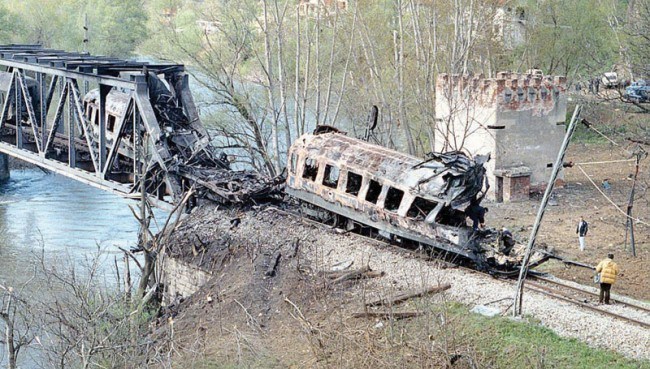
Why Did Washington Insist on the Kosovo War?
By James George Jatras | Ron Paul Institute | April 9, 2024
The following remarks were delivered at a conference marking the 25th anniversary of the NATO bombing of Serbia: “The 1999 Red-Green Bombing Terror against Serbia,” held on March 20, 2024, at the Bundestag in Berlin hosted by MdB Dr. Rainer Rothfuß and his Alternative for Germany parliamentary group.
In 2004, I appeared as the second defense witness called by Slobodan Milošević at his so-called “trial” before the so-called “International Criminal Tribunal for the former Yugoslavia” at The Hague My testimony was not as an expert witness but as a witness of fact concerning the formulation and implementation of US and western policy. I addressed one specific charge: that – beginning no later than October 1998 – Mr. Milošević was the initiator of a criminal conspiracy to drive the Albanians out of Kosovo and Metohija on the basis of their ethnicity.
There was one little problem with this accusation: there was absolutely zero direct evidence for it. No written order to this effect was ever produced. No person testified as to having received, transmitted, or even heard of such an instruction. Rather, the claim was based solely on circumstantial inferences of events starting from October 1998.
Thus, the heart of my testimony related to a paper I issued on August 12, 1998, as an analyst at the US Senate Republican Policy Committee, titled “Bosnia II: The Clinton Administration Sets Course for NATO Intervention in Kosovo.” In that paper, working solely from open sources, I detailed how, at that time – fully two months before the Milošević-led supposed “criminal conspiracy” came into effect —
“ … planning for a U.S.-led NATO intervention in Kosovo is now largely in place, …. The only missing element appears to be an event—with suitably vivid media coverage—that would make intervention politically salable, even imperative, in the same way that [the] Administration finally decided on intervention in Bosnia in 1995 after a series of ‘Serb mortar attacks’ took the lives of dozens of civilians—attacks, which, upon closer examination, may in fact have been the work of the Muslim regime in Sarajevo, the main beneficiary of the intervention. . . That the Administration is waiting for a similar ‘trigger’ in Kosovo is increasingly obvious: [As reported in the Washington Post, August 4, 1998], ‘A senior U.S. Defense Department official who briefed reporters on July 15 noted that “we’re not anywhere near making a decision for any kind of armed intervention in Kosovo right now, … [but] I think if some levels of atrocities were reached that would be intolerable, that would probably be a trigger”.’ ”
Now, if I was aware of this as early as August 1998, so were a lot of other people in Washington. I submitted to the “Tribunal” that in light of my paper, all interpretations of events would have to be drastically reevaluated. The issue wasn’t any longer whether Belgrade was planning an expulsion but that Washington was looking for a pretext for aggression.
(My cross-examination by prosecutor Geoffrey Nice (later Sir, based on his work at The Hague), asked me barely a word about my testimony. Rather, he interrogated me about my ethnic origins (Greek, from four Spartan grandparents), my religion (Orthodox Christian), and my opinions about the Islamic challenge to European, Christian civilization (negative).)
As we know, in due course the suitable “trigger” was found, with the so-called “Račak massacre” of January 1999. The key figure in “selling” Račak was William Walker. As described by Mark Ames and Matt Taibbi (now of Rolling Stone) in their article “Meet Mr. Massacre,” published in the now-defunct The Exile of February 10, 2000:
Years from now, when the war in Serbia is over and the dust has settled, historians will point to January 15, 1999 as the day the American Death Star became fully operational.
That was the date on which an American diplomat named William Walker brought his OSCE war crimes verification team to a tiny Kosovar village called Račak to investigate an alleged Serb massacre of ethnic Albanian peasants. After a brief review of the town’s 40-odd bullet-ridden corpses, Walker searched out the nearest television camera and essentially fired the starting gun for the war.
From what I saw, I do not hesitate to describe the crime as a massacre, a crime against humanity,’ he said. ‘Nor do I hesitate to accuse the government security forces of responsibility.’
We all know how Washington responded to Walker’s verdict; it quickly set its military machine in motion, and started sending out menacing invitations to its NATO friends to join the upcoming war party.
Focus on that phrase: “the American Death Star became fully operational.” Kosovo became the template that we then took on the road in one form or another in Afghanistan, Iraq, Libya, Syria, Yemen. Ukraine.
But the question still lingers: Why? Why was Washington so insistent that we and our NATO satelli– oops – “allies” needed to launch that war? Why did then-Secretary of State Madeleine Albright reveal in confidence, according to a reliable source, that at Rambouillet “We intentionally set the bar too high for the Serbs to comply. They need some bombing, and that’s what they are going to get”?
Some people will tell you it was about putting a NATO base, Camp Bondsteel, in a strategic location. Or that we wanted to clear the way for an East-West energy pipeline across the Balkans. Or that we coveted the mineral wealth of the Trepča mines. Or to secure the transit route for Afghan opium processed into heroin bound for Europe.
Certainly, all of our various interventions line a lot of a pockets, but in more than three decades of work in and around the Washington apparat, I never heard anyone point to such concrete and, frankly, normal if immoral imperial considerations.
Rather, answers must instead be sought within the larger perspective of American policy since the end of the first Cold War in 1991 and the development of the current one in the course of the 1990s: the American “unipolar moment,” as the bipartisan US policy nomenklatura sought to consolidate and perpetuate its hegemonic control over the entire planet, taking advantage of the vacuum left by the demise of the USSR. Perhaps the fullest expression of this was a 1996 Foreign Affairs article by neoconservative ideologists William Kristol and Robert Kagan (NOTE: Victoria Nuland’s husband), misleadingly titled “Toward a Neo-Reaganite Foreign Policy,” in which they called for the US to establish and maintain indefinitely “benevolent global hegemony” — in other words, perpetual American world domination.
Kristol and Kagan laid out virtually all of the elements that have guided US global policy during the ensuing years. It is no accident that Republican neoconservatives were enthusiastic supporters of Bill Clinton’s Balkan interventions of the 1990s, under the guidance of people like then-Secretary of State Madeleine Albright, who once opined regarding the sanctions-related deaths of a half million Iraqi children that “the price is worth it.” In the US establishment, there is little dissent on either side of the partisan aisle with Albright’s view that a militant United States has a special wisdom: “If we have to use force, it is because we are America; we are the indispensable nation. We stand tall and we see further than other countries into the future …”
The result is a kind of neo-Bolshevik ideology, where, as the vanguard of all progressive humanity, the US leadership class sees itself as the midwife of history. America took the path (as characterized by Russian Foreign Minister Sergey Lavrov) of the “replication of the experience of Bolshevism and Trotskyism”—morphing ourselves into a new Evil Empire in place of the old one. (Anyone familiar with the origins of America’s neoconservatives understands that the Trotskyite reference is not just rhetorical.)
Which brings us back to the “Why?” regarding Kosovo. When the dissolution of Yugoslavia kicked off in June 1991, largely at the initiative of Austria and Germany, official Washington was terrified that with the end of the Soviet bloc Europe might become “whole and free” – but without us. What then could be the future of Lord Hastings Lionel Ismay’s mission for NATO of keeping the Americans in Europe, the Russians out, and the Germans down? Europe, the crown jewel of the Global American Empire was slipping away.
Hence, as former Chairman of the Senate Foreign Relations Committee Richard Lugar (R-Indiana) indicated, NATO needed to go “out of area or out of business.” Starting in spring 1992, Washington moved swiftly to expand the conflict from Slovenia and Croatia (where it had been relatively contained) to Bosnia and Herzegovina. There the US became the vociferous champion of the Muslim faction, illegally shipping in al-Qaeda fighters and Iranian weapons via covert C-130 flights into Tuzla. We then engaged in a little demonstrative bombing of the Bosnian Serbs to set the stage for the Dayton Agreement. The arsonist sets the fire, so then he can be the hero rushing to the rescue: “See, you silly ‘dispensable’ European children? You just can’t get along without us …”
Following Dayton, Kosovo was the other shoe that needed to drop – with appropriate violence – to ensure that Europe was totally, abjectly, humiliatingly subservient to the United States through NATO, with the passive complicity of NATO’s concubine, the European Union. The corollary was that, just as the Serbs had no legitimate voice in determining post-Yugoslav structures, the Russians understood they had no legitimate voice in European security arrangements. These would be decided without them.
Now, of course, with defeat looming in Ukraine and with the broader Middle East on the edge of a regional conflagration, with many in Washington beating the drums for war with Iran or even China, the Global American Empire’s “unipolar” moment is coming to an end, one way or the other, either with a bang or with a whimper. Unfortunately, neither in Washington, nor in Berlin or other European capitals, with the exception of Budapest, are decisions made by people who can be regarded as mentally and morally healthy human beings, much less patriots.
The next few months and years promise to be a period of disorder and acute danger. The question is, can we – Americans and Europeans alike – find a path to governance that can secure a future for our peoples?
Featured Video

The Truth About the Trump Shootings with Ken Silva
or go to
Aletho News Archives – Video-Images
From the Archives
The Geopolitics behind the War in Yemen (I)
By Mahdi Darius NAZEMROAYA | Strategic Culture Foundation | 30.03.2015
The United States and the Kingdom of Saudi Arabia became very uneasy when the Yemenese or Yemenite movement of the Houthi or Ansarallah (meaning the supporters of God in Arabic) gained control of Yemen’s capital, Sanaa/Sana, in September 2014. The US-supported Yemenite President Abd-Rabbuh Manṣour Al-Hadi was humiliatingly forced to share power with the Houthis and the coalition of northern Yemenese tribes that had helped them enter Sana. Al-Hadi declared that negotiations for a Yemeni national unity government would take place and his allies the US and Saudi Arabia tried to use a new national dialogue and mediated talks to co-opt and pacify the Houthis.
The truth has been turned on its head about the war in Yemen. The war and ousting of President Abd-Rabbuh Manṣour Al-Hadi in Yemen are not the results of «Houthi coup» in Yemen. It is the opposite. Al-Hadi was ousted, because with Saudi and US support he tried to backtrack on the power sharing agreements he had made and return Yemen to authoritarian rule. The ousting of President Al-Hadi by the Houthis and their political allies was an unexpected reaction to the takeover Al-Hadi was planning with Washington and the House of Saudi. … continue
Blog Roll
 Aletho News
- IRGC air defenses destroy another US MQ-1 drone over Strait of Hormuz
- Imran Khan’s entire immediate family detained in Pakistan ahead of mass protest demanding his release
- EU nation detains former presidential frontrunner
- Leaked: Britain’s Sham Conviction Of Hashim Thaci
- Seyed M. Marandi: U.S. Strike Imminent – Toward Total War in the Middle East
- Russia Voted Under Fire. Washington Is Loading the Tankers.
- 12 Things Your Oncologist Was Trained Not to Tell You
- Anthrax Attacks Paved Way for COVID-Era ‘Junk Drugs and Vaccines’
- How Real Is the Impact of Western Sanctions on Israel?
- France, You Are Guilty: How Paris Turned Western Sahara into the Maghreb’s Powder Keg
- If Americans Knew
- Israeli president pardons soldier convicted for killing wounded Palestinian
- Singer Ed Sheeran says his ‘heart broken’ by Gaza devastation, addresses Macklemore controversy
- Israel Has Imprisoned Female Journalist Bushra Al-Tawil Without Trial Or Charge In Solitary Confinement For Past Month
- Israel poised to teach West Bank a lesson after one Israeli killed – Daily Update
- Salah Sarsour’s Legal Team Says DHS Has Not Met Its Burden to Prove He Is Deportable
- An analysis of tax forms by The Intercept show Kraft’s charity and LLC have donated to Friends of the IDF and AIPAC’s super PAC.
- Israeli attacks kill four Palestinians in Gaza – Daily Update
- Inside Gaza’s death trap of collapsing, bombed-out buildings
- The everyday items Israel bans from Gaza every day
- Inside the siege, the ruined buildings of Gaza – Daily Update
- No Tricks Zone
- 2025 Nature Paper Claiming Worsening Global Drought Gets RETRACTED …Heavily Flawed
- New Study: ‘Global Drought Shows No Detectable Recent Acceleration Under Climate Warming’
- Economic Masterminds: German Socialists Suggest Taxing Productivity Gains Stemming From Using AI
- The South China Sea Has Not Been Cooperating With The Climate Change Narrative
- Energy Crisis: Germany Enters Heating Season With Historically Low Gas Reserve Fill Levels
- New Study: The Antarctic Ice Sheet Gained Mass From 2020-2024 Due To Staggering Snow And Ice Accumulation
- Study: Ocean Heating Rates From Thousands Of Years Ago ‘Dwarf’ Modern Ocean Heating Rates
- Climate Extremists Target, Attack Large-Scale Power Grid Infrastructure In Germany!
- New Study: Antarctic Ice Melt Has Contributed Less Than 1 Centimeter To Sea Level Rise In The Last 30 Years
- Fear Of Debate: Alarmist German Climate Scientist Calls On Mainstream Media To Discredit Skeptic Voices
 Aletho News