Kremlin reacts to Macron’s remarks on NATO troops in Ukraine
RT | February 27, 2024
A direct conflict between Russia and NATO will likely become inevitable if member states of the US-led military bloc send troops to Ukraine, Kremlin spokesman Dmitry Peskov has said, after French President Emmanuel Macron raised the possibility.
Macron, whose government hosted a high-profile meeting of Ukraine backers on Monday, said EU members “will do everything necessary to prevent Russia from winning” – including deploying forces on the ground to support Kiev. Several governments have since ruled out sending troops to the front line.
Opponents of the proposal “have a sober assessment of the potential risks” of having NATO forces in Ukraine, Peskov told the media on Tuesday. That would be “absolutely against the interests of those nations” and their people, he warned.
Asked about the probability of a direct conflict with NATO if Western troops are sent to Ukraine, the Kremlin spokesman said, “in this case, we have to talk not about the probability, but rather the inevitability.”
German Chancellor Olaf Scholz has spoken out against the idea. Participants of the meeting in Paris came to an agreement against it, he told a news conference on Tuesday.
At a joint press conference in Prague on Tuesday, Czech Prime Minister Petr Fiala and his Polish counterpart, Donald Tusk, ruled out sending their citizens to fight in Ukraine. Senior officials in Hungary and Slovakia issued similar statements.
Macron said Western leaders could end up changing their minds in the future, similarly to how they did with military assistance – which in some cases initially involved items such as helmets to eventually donating lethal weaponry including tanks and fighter jets.
While there was no consensus over the proposal, the participants agreed to create a coalition to supply medium and long-range missiles to Kiev, the French president said.
Moscow considers the Ukraine conflict to be a US-orchestrated proxy war against Russia, and has repeatedly warned that by supplying increasingly sophisticated weapons to Kiev, NATO members are drawing closer to a direct confrontation.
NATO Countries Did Not Make Decision to Send Their Military to Ukraine – Polish President
Sputnik – 26.02.2024
WARSAW – NATO countries disagree on sending their military to Ukraine and have not made a decision to do so, Polish President Andrzej Duda said on Tuesday.
On Monday, Slovak Prime Minister Robert Fico said that several EU and NATO countries are considering the possibility of sending their military to Ukraine on the basis of bilateral agreements.
“If we are talking about providing specific assistance, then individual countries decide what kind of assistance they specifically provide to Ukraine. There was a heated discussion about sending soldiers to Ukraine, and there was no absolute mutual understanding on this issue. There are different opinions. But I want to emphasize that there are absolutely no such decisions,” Duda told reporters after the end of a conference on supporting Ukraine, held in Paris.
French President Emmanuel Macron added that “nothing can be ruled out,” commenting on the possibility of sending NATO troops to Ukraine.
Some EU, NATO States Ponder Possibility of Sending Military to Ukraine – Slovakia’s Fico
Sputnik – 26.02.2024
BRATISLAVA – Some EU and NATO countries are mulling over the possibility of sending their military to Ukraine on the basis of bilateral agreements, Slovak Prime Minister Robert Fico said on Monday.
Later in the day, Paris will host a meeting where members of the EU and NATO will discuss the situation in Ukraine.
“For me, today’s meeting [in Paris] is confirmation that the West’s strategy in Ukraine has failed, but I want to be constructively prepared for it … It follows from these arguments that a group of NATO and EU countries are considering [the option] to send their military to Ukraine on the basis of bilateral agreements,” Fico told reporters after a meeting of the government and the security council.
Possible deployment of the EU and NATO military to Ukraine will not allow them to achieve concessions from Russia, but will only lead to an escalation of the conflict, the prime minister said.
Slovakia is not planning to send its soldiers to Ukraine, Fico added.
Euromaidan Was Part of West’s Proxy War Against Russia – CIA Veteran
By Ekaterina Blinova – Sputnik – 21.02.2024
Exactly ten years ago, former President Viktor Yanukovych signed an agreement with the Euromaidan opposition to resolve the political crisis in Ukraine. The very next day, the opposition tore up the agreement and seized power by force.
Months of Euromaidan riots ended with Ukrainian President Viktor Yanukovych agreeing to reform the constitution, form a “government of national unity,” and hold early elections in December 2014. The then-Ukrainian president also agreed to pardon rioters and launch investigations into violent acts by law enforcement officials.
Although the agreement guaranteed by the EU powers appeared to be solid, it barely lasted 24 hours: on February 22, 2014, the buildings of the presidential administration, the Verkhovna Rada, and the Cabinet of Ministers were seized by violent protesters. The Maidan leaders appointed Oleksandr Turchynov as head of the Verkhovna Rada in violation of the country’s constitution, effectively ousting Yanukovych.
Speaking to US journalist Tucker Carlson on February 9, 2024, President Putin insisted that the coup was “unnecessary” because Yanukovych had agreed to meet the demands of the Maidan leaders.
Yanukovych went on the air from Kharkiv on February 22, 2014, and insisted that he would not resign: “I am a legally elected president. What is happening is fragrant vandalism and banditry and a coup d’etat,” he said.
Nonetheless, EU leaders openly signaled that they would work with the “new government” of Ukraine, thus destroying the agreements they had previously supported.
Real Puppeteers Were American Policy-Makers
“Officially the opposition was backed primarily by Europeans,” Russian President Vladimir Putin said in an interview for a documentary “Crimea: Way Back Home” in March 2015. “But we knew perfectly well that the real puppeteers pulling the strings were our American partners and friends.”
In early February 2014, a conversation between individuals believed to be then-US Assistant Secretary of State Victoria Nuland and then-US Ambassador to Ukraine Geoffrey Pyatt discussing the future composition of the Ukrainian government was leaked online. They talked about bringing opposition leader Arseniy Yatsenyuk to power, while keeping Tyahnybok and Klitchko “outside”. In a passage that caused embarrassment to Washington, Nuland was heard to dismiss European partners with the phrase “F**k the EU.”
The scenario described in the leaked conversation came to fruition the same month: on February 27, 2014, Yatsenyuk was appointed as the Ukrainian prime minister. Klitschko was sworn in as mayor of Kiev on June 5, 2014. Tyahnybok stayed out of the de facto Ukrainian government but nonetheless visited the White House and met with then Vice President Joe Biden.
Russia Was the Target
In the wake of the coup, the Ukrainian junta resorted to brutal persecution of their political opponents, promoting an openly Russophobic agenda, and launched nothing short of a war on Donbass civilians who did not accept the illegitimate ouster of Yanukovych.
However, the real target of the US-backed regime change in Kiev was Russia, according to Larry Johnson, a retired CIA intelligence officer and State Department official.
“What I think really, what it boils down to is that the West had simply decided that they wanted to take Russia,” Johnson told Sputnik. “At the core of it, they were looking for a long term strategy to isolate Russia. And the key to this was to get Ukraine into the western camp, to bring Ukraine into NATO, to bring Ukraine into the EU, and therefore to completely isolate, at least they thought they could isolate Russia. Because I think at least there was some recognition in some of the government circles that Russia has enormous wealth, natural resources. And it’s better for us to have it than for Russia to have it. I think it was the attitude.”
How Euromaidan Triggered Ukraine’s Nine-Year War on Donbass
The CIA veteran drew attention to the fact that the Euromaidan coup d’etat “ignited a civil war in Ukraine” and “ended up elevating Ukraine into a frontline priority” for the West.
“So prior to 2014, you didn’t get a lot of NATO exercises, featuring Ukraine. After 2014 Ukraine, even though it was not a formal member of NATO, was regularly featured in these joint annual exercises and that meant that Ukraine then became a proxy for a Cold War,” Johnson said.
“It became a proxy for the West to fight against Russia. And I think that’s why they were slowly building up Ukraine. The annual training was one thing, but also there was the desire, you know, persistent request to send more weapons to Ukraine. Again with nobody sitting back and saying, why? What are we trying to do? They tried to create the myth that it’s Russia that’s trying to attack Ukraine,” the former CIA veteran continued.
For its part, Russia made efforts to stop the bloodshed in Donbass through the 2014 and 2015 Minsk Agreements. The accords envisaged cessation of hostilities, withdrawal of heavy weapons from the front line, release of prisoners of war, and a constitutional reform in Ukraine to grant self-governance to breakaway Donetsk and Lugansk People’s Republics.
However, in 2022 former German Chancellor Angela Merkel and ex-French President Francois Hollande admitted that the Minsk Agreements were seen by the West as an opportunity to arm and train the Ukrainian Army.
For his part, Ukrainian President Volodymyr Zelensky acknowledged in an interview with Spiegel in February 2023 that he actually had not been intended to observe the Minsk accords and informed his European counterparts about that. So, the accords were thrown down the drain in the same manner the Ukrainian opposition and the West shredded agreements with Yanukovych on February 22, 2014.
Hostilities Could be Stopped Many Times, West Just Didn’t Want to Do It
There were plenty of opportunities to avoid armed conflicts in Ukraine, highlighted Johnson.
“I mean, all the United States had to do is to say look, we’re not going to expand NATO into Ukraine,” the CIA veteran said. “We will cease conducting annual military exercises with Ukraine. And let’s reopen talks about reigniting the Anti-Ballistic Missile Treaty and the Intermediate Nuclear Force Treaty, the INF. And let’s begin looking at ways that we can cooperate and work together. But no, it was you know, the threats about the Nord Stream pipeline, for example, that had evolved.”
Russia has always been open to negotiations, President Vladimir Putin told the press on February 20, during a meeting with Defense Minister Sergey Shoigu.
Moscow maintained dialogue with the governments of Poroshenko and Zelensky to implement the Minsk Agreements in order to respect the rights of Ukraine’s Russian-speakers while at the same time preserving the nation’s territorial integrity.
It remains neglected by the Western mainstream press that before launching the special military operation to demilitarize and de-Nazify Ukraine Moscow sought to conclude agreements with the US and NATO to ensure common European security. The draft agreements which envisaged NATO’s guarantees of eastward non-expansion and Ukraine’s neutral status were snubbed by Washington, Brussels and NATO leadership.
Just a month after the beginning of the special military operation, Russian and Ukrainian representatives inked preliminary peace agreements in Istanbul in March 2022. Davyd Arakhamia, who headed the Ukrainian delegation during the March 2022 Istanbul talks with Russia, told Ukrainian broadcaster 1+1 in November 2023 that Moscow was ready to end the conflict if Ukraine committed to neutrality and refused to join NATO. However, it was then-UK Prime Minister Boris Johnson who encouraged President Volodymyr Zelensky to pick the battle and fight to the bitter end, the Ukrainian politician said.
“When we returned from Istanbul, Boris Johnson came to Kiev and said: ‘We won’t sign anything with them at all, and let’s just fight’,” Arakhamia recalled.
However, ex-PM Johnson was not alone in derailing the deal. “This war will be won on the battlefield,” European Union top diplomat Josep Borrell tweeted in April 2022, pledging hundreds of millions of euros for Kiev.
The same month, US Secretary of Defense Lloyd Austin claimed that Washington wanted to see “Russia weakened to the degree that it can’t do the kinds of things that it has done” in launching the special military operation. The US has spent over $100 billion in support for Ukraine’s military effort since then.
“The Western governments don’t want anything good to happen to Russia. They’re not willing to do anything to improve the lives of the Russian people. In my view, it’s genuine evil. And I’m watching this horrific policy that’s implemented by my government and there’s going to be an accounting someday. This is wrong,” the CIA veteran said.
“You know, I could understand it if this had happened 40 years ago when the Soviet Union with the ideology of communism, of Marx and Lenin was dominant. And the attempt to, you know, destroy churches and exclude religion, if that was the case, so, okay, I can understand religious people wanting to rise up and throw that off, but that’s not the case. It’s just the opposite. What we’ve got going on in Ukraine is almost, it’s demonic. It’s satanic. They literally embrace anti-Christian views under the guise of being Christian,” Larry Johnson concluded.
An Opportune Death Hypocritically Mourned
By Stephen Karganovic | Strategic Culture Foundation | February 21, 2024
If Western media are to be believed, after the countless failures of their poisonous preparations clumsy Russian chemists seem now to have finally gotten it right. Alexey Navalny is reported to be dead and the Kremlin Borgias can now say: Gotcha!
However, unfortunately for the orchestrators of the new media stunt that after February 16 plunged the Western political class and MSM into a hysterical frenzy, the carefully crafted delusion began to unravel as soon as it was launched.
First off, it turned out that the politicians and media began to react as if on cue literally just a quarter hour after the obscure website of the Russian penitentiary system posted the news of Navalny’s death.
Observe the highly indicative chronological sequence of events and draw your own conclusions about the plausibility of their indignation.
Аt approximately 2:19 p.m. on February 18, 2024, the website operated by the Federal Penitentiary Service of Russia for the Yamal-Nenets Autonomous Area (surely not in the favourites section of most people’s computers) reported the death of convict Alexey Navalny in Prison Colony No. 3.
Literally, 15 minutes later, a flurry of cut and paste commentary and accusations from Western political hacks began to pour in:
– 2:35 pm, Tobias Billström (Sweden): ‘Terrible news about Navalny. If the information about his death in a Russian prison is confirmed, it will be another heinous crime by Putin’s regime.’
– 2:35 pm, Barth Eide (Norway): ‘I’m deeply saddened by the news of Navalny’s death. The Russian government bears a heavy burden of responsibility for this.’
– 2:41 pm, Edgars Rinkevics (Lithuania): ‘Whatever your thoughts about Alexei Navalny as a politician, he was just brutally murdered by the Kremlin. That’s a fact and that is something one should know about the true nature of Russia’s current regime.’
– 2:50 pm, Jan Lipavsky (Czech Republic): ‘Russia still treats foreign policy issues the same way it treats its citizens. It has turned into a violent state that kills people who dream of a beautiful, better future, such as Nemtsov and now Navalny, who was imprisoned and tortured to death.’
– 2:51 pm, Stéphane Séjourné (France): ‘Navalny paid with his life to fight against a system of oppression. His death in a penal colony reminds us of the realities of Vladimir Putin’s regime.’
– 3:02 pm, Charles Michel (EU): ‘The EU holds the Russian regime solely responsible for this tragic death.’
– 3:10 pm Kiev regime kingpin Zelensky: ‘Clearly, he was killed by Putin, like thousands of others who were tortured to death.’ (And just as clearly Gonzalo Lira was murdered by you, one would be inclined to respond to Zelensky in his face.)
– 3:16 pm (media), 4:50 pm (social media), Jens Stoltenberg (NATO): ‘We need to establish all the facts, and Russia needs to answer all the questions.’ (How about waiting for the facts to be established first and then asking questions?)
– 3:20 pm, Mark Rutte (Netherlands): ‘Navalny’s death once again bears witness to the immense brutality of the Russian regime’;
– 3:30 pm, Maia Sandu (Moldova): ‘Navalny’s death in a Russian prison is a reminder of the regime’s egregious suppression of dissent.’
– 3:35 pm, Annalena Baerbock (Germany): ‘Like no one else, Alexei Navalny was a symbol for a free and democratic Russia. That is precisely the reason he had to die.’
– 3:43 pm, Ursula von der Leyen (EU): ‘A grim reminder of what Putin and his regime are all about.’
– 3:49 pm, Ulf Kristersson (Sweden): ‘The Russian authorities, and President Putin personally, are responsible for Alexei Navalny no longer being alive.’
– 3:14 pm, Olaf Scholz (Germany): ‘He has now paid for this courage with his life. This terrible news demonstrates once again how Russia has changed and what kind of regime is in power in Moscow.’
– 3:25 pm, Antony Blinken (USA): ‘Beyond that, his death in a Russian prison and the fixation and fear of one man only underscores the weakness and rot at the heart of the system that Putin has built. Russia bears responsibility for this.’
– 5:28 pm, Emmanuel Macron (France): ‘In today’s Russia, free spirits are put in the Gulag and sentenced to death.’
Are we expected to believe that these ministers and officials have nothing better to do than to unceasingly monitor the website of the Russian Penitentiary service, in the hope of finding bits of information to which they might publicly react?
Note should be taken that within fifteen minutes to two hours following the 2:19 p.m. announcement of Navalny’s death no autopsy had or could have been performed. There was no forensic evidence whatsoever on which any conclusions about the causes and circumstances of Navalny’s demise could have been based. The only factual data that could have been known to these hacks at the time when they made their comments was that Navalny was exercising in the prison courtyard when he suddenly collapsed. A blood clot was suspected according to prison medical staff. What might that indicate?
It suggests, as Paul Craig Roberts has cogently argued, that outwardly at least Navalny’s observable manner of death was identical to that of numerous victims of the mRNA “vaccine.” Thousands of vaccinated young athletes and even airline pilots are dying in exactly the same way.
Where could Navalny possibly have received the fatal “vaccine,” which as former British Prime Minister Teresa May was fond of saying, “highly likely” was a shot manufactured by Pfizer, statistically the deadliest of them all? Not just by Teresa’s but in Navalny’s case more importantly by any reasonable person’s evidentiary standards, the answer is very simple. After his botched “Novichok poisoning” in Russia in 2020, Navalny was flown to Berlin where he received treatment at the top of the line Charité hospital. That was at the height of the Covid commotion. The hospital communique on his condition may have been redacted by Western intelligence agencies, but it is inconceivable that patient Navalny would have been hospitalised there without first being injected with the vaccine. In Germany, rigorous hospital protocol made that obligatory. We have no direct evidence that while in Germany Navalny did receive the jab, but under the circumstances that appears to be the logical and natural conclusion. The leading authority in such matters, Teresa May, would be simply obliged to agree that this would be a scenario that was “highly likely.” Unless she were prepared to contradict herself, of course.
So there you have it, as Andrey Martyanov would put it.
None of the West’s sock puppet politicians took that into consideration before issuing hackneyed carbon copy statements all of which appear to have been redacted by the same propaganda spin bureau.
Navalny’s death, whatever may have been its direct cause, could not have been better timed from the standpoint of his Western masters. For them, it came as a godsend, serving as a double distraction. Firstly, to turn attention away from the collapse of the Ukrainian front, not just in Avdeevka but along the entire line of contact. Secondly, to reframe perception and neutralise the impact of the truth bombs which exploded in the course of Tucker Carson’s interview.
It is – to reverse Teresa’s now famous dictum – highly unlikely that the reach of Western agencies extends to the remote prison camp in Magadan. The outcomes that from the standpoint of Navalny’s psychopathic controllers would be “good,” amongst which Navalny’s exploitable death would be a conspicuous benefit, easily could have happened fortuitously.
Even Freud was obliged to admit that “sometimes a cigar is just a cigar.”
The psychopaths that Navalny foolishly agreed to serve probably got lucky. By dropping dead when he did Navalny performed his last and perhaps most valuable service to at least partially offset the huge investment they had made in him.
The U.S. Is Planning for the Aftermath of Ukraine War
By Sonja van den Ende | Strategic Culture Foundation | February 20, 2024
The prominent think tank for U.S. policymaking recently published a long report on the so-called aftermath of the war in Ukraine.
Washington and its NATO allies have to admit that the U.S. is losing another proxy war together with its satellite states of Europe. Previously they lost in Afghanistan (after more than 20 years, a second Vietnam), also recently in Syria and Iraq, and now in Ukraine.
Even so-called “Russia experts” in Europe admit that Ukraine is losing.
“I do not rule out that Ukraine will lose the war this year. Europe has misjudged the Russian army,” says Belgian “Russia expert” Joris van Blade to De Standaard.
Russia has the initiative again and the Russian people are not going to stop the war, he thinks. “We have missed historic opportunities to make Europe safer.”
According to the Rand study, two scenarios are possible: a so-called “hardline” or a “softline” postwar. Of course, the U.S. prefers a softline postwar outcome, where they still have room for manipulation and possible coup d’état and Balkanization (partition) of Russia just like they did in former Yugoslavia. According to Rand, the U.S. military presence in Europe has increased to around 100,000 personnel since the start of Russia’s Special Military Operation in February 2022.
The United States deployed attack aviation from Germany to Lithuania; Patriot air defense systems from Germany to Slovakia and Poland; and F-15 tactical fighters from the United Kingdom to Poland. In addition, European countries are sending F-16s to Romania, as the Netherlands recently indicated. These F-16s are capable of attacking Russian cities. Washington characterized these deployments as part of a wartime surge to deter Russia from expanding its aggression beyond Ukraine to attack U.S. allies in Europe.
Leaders in Europe are almost hysterical. One after another, they proclaim that Russia is going to invade Europe, starting with Moldova, the Baltic States, and Poland. The Netherlands, Germany, and France are warning their people to expect an attack from Russia, as is Sweden, which recently joined NATO.
The population is being frightened by the unhinged rhetoric of their politicians. Conscription must be reactivated and Germany even has a concept ready to recruit migrants (about 1.5 million serviceable men) and entice them to get a passport.
European leaders are also concerned about the upcoming elections in the U.S. after Republican contender Donald Trump made comments suggesting he would quit NATO and let Europe fend for itself. They are worried that the U.S. might abandon them.
During a recent NATO conference in Brussels, a lot of war rhetoric was spoken. “We live in an era where we have to expect the unexpected,” said Dutch NATO Admiral Rob Bauer. Meanwhile, the Danish and German defense ministers have warned of a potential war with Russia within five years.
The U.S. and European leaders assume the “hardline” scenario is likely in the next few years. They proclaim through their mouthpieces in the corporate-controlled news media that Russia is becoming much more “risk-acceptant”. Therefore, it is calculated that a hardline approach may increase NATO’s ability to deter purported Russian aggression.
It’s that time of year again for the hawkish Munich Security Conference, in Bavaria, Germany. This is the forum where President Putin provoked alarm when he gave his famous speech in 2007, making it clear that the unipolar world was over and a multipolar world would emerge in the foreseeable future. Putin’s prognosis caused much chagrin for Western leaders.
This year’s theme at Munich is animated by Trump’s supposed undermining of NATO. The appeal for support from the U.S. has become more urgent among some European politicians. Ukraine lacks weapons and ammunition, they openly say. Russia is sometimes five times superior on the battlefield. In addition, a U.S. support package worth around $60 billion was approved by the Senate last week but the Republican-dominated House of Representatives could reject it – and so far it looks like it will.
Europe, in turn, would not be able to fill this gap and, therefore, Ukraine will lose the proxy war for the U.S. and the West.
In addition to the presence of Ukrainian President Vladimir Zelensky, the European leaders and lobbyists will also use the opportunity in Munich to lobby Republican Senators and Representatives to support Ukraine (with money). Nowhere outside the U.S. can you find as many American politicians in one place as at the Munich Security Conference this year.
Zelensky’s participation in the conference had been expected for some time but had not yet been officially confirmed.
Last year, he opened the most important meeting of Western politicians and experts on security policy via video address. Now he is taking part in person for the first time since the Russian Special Military Operation began almost two years ago. He is afraid for his position; he is losing the proxy war on behalf of the U.S. and EU/NATO.
The actor-President of Ukraine Zelensky desperately wants to secure future European support.
U.S. Vice President Kamala Harris is attending the Munich conference instead of Joe Biden. Rumors are circulating in the Western media that Biden’s cognitive condition has deteriorated even more and he is unable to come. If Biden wins the November presidential election, will Harris become the next president upon his inevitable retirement during a second term? That’s probably the intention.
As President Putin said, he would rather have Biden than Trump as the winner. In his diplomatic way, he said that Biden is an “old school” politician, meaning of course that a Democratic government with Biden/Harris is easier to understand and estimate than Trump, who is capricious and unpredictable.
These are the facts: the presumed hegemony of the Western states is falling to pieces. The “Collective West” is losing its wars. Their status and economies are in a downward spiral, even before the Special Military Operation.
The politicians and the elites who stand behind them, the World Economic Forum (WEF) and other semi-international organizations (usually Western-oriented) want to compensate for this historic loss of the unipolar world with a new system, away from fossil energy, ostensibly for the climate, but actually to try to weaken and isolate Russia by destroying its economy based on copious oil and gas resources.
European so-called leaders, in fact, “vassals” of the U.S., have slavishly followed the agenda of creating a new Cold War, which could turn into a hot war. Instead of betting on diplomacy, they have chosen the path of war, in contradiction to the (Western) UN Agenda 2030, where Western countries have forced this agenda on the Global South. This agenda also states that we must strive for peace and prosperity for everyone. So it is yet another lie from the Global West, or rather the empire of lies, which is now submerged in its own lies.
Hungary snubs US senators – ambassador
RT | February 19, 2024
Senior Hungarian officials have refused to meet four US senators who arrived in Budapest on Sunday, Washington’s envoy to the country has said. The American lawmakers are attempting to press Prime Minister Viktor Orban into speeding up approval of Sweden’s accession to NATO.
The delegation sought to meet a range of senior government officials and representatives from the ruling Fidesz party, US Ambassador David Pressman stated. The Hungarians declined, however, despite the group being “the most senior US bipartisan congressional delegation” to visit the country in recent years, the diplomat added.
The senators intend to submit a joint resolution to the US Congress that would condemn Hungary for alleged democratic backsliding, the Associated Press reported. Thom Tillis, one of the visiting lawmakers, urged Orban to speed up Sweden’s accession, claiming at a news conference that doing so would be “a great service to freedom-loving nations worldwide.”
Chris Murphy, another delegate, called the boycott “strange and concerning” and identified Orban as standing in the way of the ratification. Hungary is the only NATO country yet to approve Sweden’s membership of the US-led military bloc.
“We are wise enough about politics here to know that if Prime Minister Orban wants this to happen, then the parliament can move forward,” Murphy said.
Orban addressed the issue of NATO expansion during a rally on Saturday, saying Budapest and Stockholm were on a path to “rebuild trust.” A vote could happen during the parliamentary spring session, he suggested.
The prime minister previously cited Swedish criticism of his government and Hungary’s democratic credentials as the main reasons for skepticism among lawmakers in Budapest. NATO approved Sweden’s bid to join in June 2022.
The anti-Hungarian US resolution will criticize Orban for maintaining good relations with Russia and China, according to AP. Budapest has “resisted and diluted” the EU sanctions imposed on Moscow, the text reportedly states.
Orban is a vocal critic of the Western approach to the Ukraine crisis. He has argued that the arming of Kiev and the restrictions on Russia have failed to end the bloodshed and have caused major economic harm to the EU. He has also resisted Ukraine’s push to join NATO and the EU.
Hungarian Foreign Minister Peter Szijjarto said it was “not worth trying to exert pressure on us, because we are a sovereign country,” as he expressed general approval of the American visit on Friday.
Germany swims or sinks with NATO
BY M. K. BHADRAKUMAR | INDIAN PUNCHLINE | FEBRUARY 17, 2024
There couldn’t be a better metaphor than what a Chinese analyst used to characterise NATO while commenting on its secretary general Jens Stoltenberg’s recent remark that the West does not seek war with Russia but should still “prepare ourselves for a confrontation that could last decades.”
The Chinese commentator compared Stoltenberg to a firm of undertakers, “a store owner of coffin and casket, which makes no money in peacetime. As an undertaker, NATO needs conflict, bloodshed for earnings. So it spreads fear and panic in order to ensure its member countries continue to contribute military funding.”
Stoltenberg’s remark appeared in an interview with German newspaper Welt Am Sonntag on Feb. 10, soon after Russian President Vladimir Putin’s famous interview with Tucker Carlson where the Kremlin signalled that Russia did not refuse and is not refusing negotiations to end the war in Ukraine. Stoltenberg spoke for the Pentagon, no doubt.
Moscow, having reached an unassailable position in the war, is not interested in a full-scale war to realise its objectives, as eventually, the West will have to co-exist with Russia. Putin’s interview with Carlson was timed carefully — with hardly a fortnight left for the war to enter its third year.
Putin’s “message” that Russia is open to dialogue caught Washington off guard. For one thing, the bandwidth of the Biden Administration is dominated by the Israel-Palestine crisis. On the other hand, the two-year anniversary of the war is marked by a signal battlefield victory by Russian forces in the strategic eastern town of Avdiivka, a gateway to Donetsk city, and effectively on the front line ever since 2014 when the conflict in Donbass started.
All attempts by Russian troops to liquidate the big Ukrainian base in Avdiivka threatening Donetsk city had failed so far. Avdiivka is key to Russia’s aim of securing full control of the two eastern Donbass provinces — Donetsk and Luhansk. Its capture not only boosts the Russian morale but also consolidates Donetsk as a major Russian logistics hub for further westerly operations in the direction of the Dniepr river.
In political terms, it underscores that all along the almost 1000-km frontline, Russian forces are presently advancing. The Ukrainian military suffered a rout in Avdiivka.
Biden’s re-election bid will be bumpy if such distressing news keeps appearing from Ukraine highlighting the gravity of his foreign policy disaster, as NATO stares at another humiliating defeat after Afghanistan. Donald Trump is relentlessly challenging Biden on the issue of Russia-Ukraine and on NATO. Contrary to earlier prognosis, the US election has turned into one of the most influencing factors in the Ukraine conflict.
The path in the US Congress towards a military aid package for Ukraine is uncertain. The main obstacle all along was the House of Representatives, where Republicans have a majority. Apart from the Republican Speaker of the House being not in any hurry to table the bill passed by the Senate, the Congress is also about to shift back towards domestic fiscal policies, so that the foreign aid bill might simply fall down the list of priorities in the legislative agenda.
Meanwhile, the hearing in the Supreme Court on Trump’s candidacy signals that the talk that he might be debarred from running for the presidency is only wishful thinking. That means, if Trump maintains his lead in the South Carolina primaries on 24th February, the Republican race will be essentially over and he will be the party’s presumptive candidate. Trump has also widened his lead over Joe Biden in the polls.
The flow of finance to Ukraine is already ebbing and there is a pall of gloom among Ukraine’s cheerleaders in Europe after having discovered finally that Kiev is not winning the war. The West’s proxy war without a clearly set war goal means that there is no exit strategy, either.
A Trump victory would badly expose the European partners. Plugging the funding gap by Europe is going to be highly problematic. The US has so far committed €71.4 billion, more than half of it in the form of military aid. Number two is Germany with €21 billion, followed by the UK with €13.3 billion. Norway comes fourth. The paradox is, while the three largest European donors are all NATO members, it is only Germany who is a member of the European Union.
And Germany is not big enough to fill the gap left by the US on its own. But the biggest obstacle to a common European response is the lack of common ground between France and Germany. The special Franco-German relationship has largely become a historical artefact. The two EU giants are pursuing incompatible economic strategies — on fiscal policy and nuclear energy — and their economies are diverging, and so are their politics and defence strategies.
Chancellor Olaf Scholz has reoriented German defence co-operation away from France and towards the US. The power struggle between the EU’s two biggest powers that had its origins in the lack of chemistry between French president Emmanuel Macron and Scholz has turned into an antagonism manifesting as two different visions of the world.
Macron’s concept of “strategic autonomy”, which calls for Europe not to rely on outside powers in vital areas that could give them political leverage, is rubbing against Germany’s historical reliance on the American military umbrella (which France does not require.)
After a meeting with Biden at the White House in Washington on February 9, Scholz said, “Let’s not beat about the bush: support from the United States is indispensable if Ukraine is to be capable of defending itself.” Scholz strongly advocated stepping up military aid to Ukraine, emphasising an imperative need to send out a “very clear signal” to Putin.
As he put it, “We need to show that he (Putin) can’t count on our support waning.” Scholz added: “The support we provide will be on a big enough scale and it will last long enough.” By hyping up the war-like atmosphere, Germany seeks to maintain the relevance and financial stability of NATO through the conflict in Ukraine.
Biden responded to Scholz purring like a cat showing pleasure. Biden will next host Poland’s President Andrzej Duda and Prime Minister Donald Tusk for a meeting in Washington on March 12. The US is re-energising its coalition with Germany and Poland for the next phase of Ukraine war. France stands outside looking in, while Britain lies in coma.
Simply put, while Ukrainian president Volodymyr Zelensky’s delusion is that he can win this war, NATO’s delusion is that it will do whatever it takes. But the undertaker’s money is running out and further business depends on prolonging the war.
The veil has come off the western narrative — this war was never about Ukraine. The enemy image of Russia has become the cornerstone of NATO’s very existence and function.
Certainly, taking orders from an undertaker is not in Germany’s interests. The noted German editor Wolfgang Münchau wrote recently about “a general disorientation in Germany that accompanies the geopolitical and social change” manifesting in the faltering economy, the de-industrialisation that is happening and the absence of a post-industrial strategy for the country as such.
Clearly, European interests lie in shouldering their own defence and making peace with Russia so as to focus attention on the economy. Germans themselves are conflicted over this war. Scholz is not a man of charisma or of big ideas, Münchau noted, and the German public no longer trusts him. But then, there is also “the deeper problem: it is not really Scholz. It is that Germany has become a lot harder to run.”
No chance of diplomatic solution to Ukraine conflict – FM Lavrov
RT | February 14, 2024
The West will not offer a realistic diplomatic solution to the Ukraine conflict because the US and its allies are still intent on inflicting a strategic defeat on Moscow, Russian Foreign Minister Sergey Lavrov said on Wednesday.
Briefing Russian MPs on his ministry’s work and the current international situation, Lavrov stated that Moscow is “at the advance guard in the fight for a better future,” adding that the Western-dominated system is giving way to a multipolar world.
The US and its allies, however, remain committed to waging a hybrid war against anyone that prioritizes national interests, as evidenced by the continued Ukraine conflict, Lavrov claimed.
There has been a shift in Western rhetoric due to Moscow’s battlefield successes, according to the minister, with officials now focusing on preventing a Russian victory rather than ensuring its defeat. Nonetheless, their core policy of trying to damage Russia remains the same, Lavrov said, meaning the conflict is unlikely to be resolved diplomatically.
“Considering that those who declared a war on us offer no serious proposals and are unwilling to respect our interests and the reality on the ground, getting an agreement at the negotiating table will certainly be impossible. No such scenario is foreseen,” the diplomat stated.
Lavrov insisted that the West had initiated the conflict through its continued quest for “global domination and exceptionalism.” Russia, meanwhile, is working with its allies to dismantle the current system, which it perceives as colonialist in nature, he told the lawmakers.
US President Joe Biden reiterated his Ukraine policy on Tuesday, urging the House of Representatives to adopt a Senate-approved foreign aid package including roughly $60 billion for Kiev. The money will mostly fund arms production in the US and will help Ukraine oppose the “vicious onslaught” by Russia, Biden claimed.
“The United States pulled together a coalition of nearly 50 nations to support Ukraine. We unified NATO; we expanded it. We can’t walk away now,” the leader declared.
If approved, the bill would raise the amount of military assistance provided to Ukraine by the US since the outbreak of hostilities in February 2022 to some $170 billion.
The Vladimir Putin Interview – Part One
Part One: The Genealogy of a Civilizational Power
By William Schryver | imetatronink | February 13, 2024
On February 6, 2024, Tucker Carlson, a popular American conservative journalist and polemicist, was granted an interview with Russian Federation President Vladimir Putin. The interview — a two-hour-long marathon by American sound-bite / talking-point standards – was broadcast two days later.
It was initially published on Carlson’s website, and was then posted to the X social media platform. The X post alone has tallied ~200 million views. We may confidently assume that the interview video on Carlson’s website has been viewed by several million more.
It is reasonable to conclude that this interview of Vladimir Putin has been seen by a larger global audience than has ever previously watched an interview of a major national leader.
The reactions of the viewing audience have varied greatly. Western media and political leaders have almost universally condemned the interview as nothing more than what they characterize as typical Russian propaganda and mendacity. These same people have excoriated Tucker Carlson as a “Putin puppet” and a “useful idiot” who never should have afforded Putin the opportunity to speak from such a bully pulpit.
Some western political leaders and commentators even proposed to deny Carlson reentry to the United States, to deprive him of the privilege of traveling in the European Union, to sanction him in punitive ways, and even to charge him with espionage and treason.
Others who watched part or all of the interview considered it boring and tendentious.
Yet others — and my sense is that this category comprises the majority — found the interview surprisingly enlightening and came away from it with a favorable impression of President Putin.
I have now watched the video of the interview twice in its entirety, and have carefully read the transcript twice in full, and some parts additional times.
I have also, over the past two decades, viewed and/or read literally hundreds of Putin speeches, interviews, press-conferences, etc.
In my carefully considered opinion — given its context in this period of unprecedented global tensions and what is indisputably a major proxy war being waged by the United States and its NATO allies against Russia — I regard the interview as arguably the single most important such event of the post-Cold War era.
I submit further that, in my estimation, Vladimir Putin is, by a substantial margin, the single most intellectually potent and personally charismatic world leader of the past century. His knowledge and understanding of history, international relations, macroeconomics, and his manifest talent as an extemporaneous speaker are utterly unparalleled among all the national leaders of whom I have been aware over the course of my lifetime.
The interview commenced, much to my surprise and chagrin, with a mendaciously framed and deliberately disingenuous query by Carlson:
Tucker Carlson: On February 24, 2022, you addressed your country in your nationwide address when the conflict in Ukraine started and you said that you were acting because you had come to the conclusion that the United States through NATO might initiate a quote, “surprise attack on our country”. And to American ears that sounds paranoid. Tell us why you believe the United States might strike Russia out of the blue. How did you conclude that?
The premise of this question is patently false. Putin’s speech of February 24, 2022 makes no mention whatsoever of the threat of a “surprise attack on our country” from the United States or its NATO allies. Carlson claimed it to be a direct quote. No such statement is present in the speech, nor anything like unto it.
At no point in the speech does President Putin attempt to justify the coming “Special Military Operation” on the threat of an imminent attack from the western powers.
Simply put, Carlson invented this quote ex nihilo, and apparently sought to bait Putin into a response which, presumably, Carlson then intended to take advantage of in some fashion.
I was frankly shocked that he had done this. I was immediately aware that the question was built upon a falsehood, for I am extremely familiar with both the major speeches Putin gave in the days preceding the launch of the Russian “Special Military Operation”.
Why did Tucker Carlson do this? Hard to say. But it evoked from Putin a brilliant reply which immediately turned the tables on whatever Carlson’s motivations were for posing a question built upon a lie.
Vladimir Putin: It’s not that the United States was going to launch a surprise strike on Russia. I didn’t say so.
Are we having a talk show or a serious conversation?
This pointed response disarmed Carlson’s ill-intentions for the time being, and knocked him back on his heels.
Putin then started a “serious conversation” on his terms, and according to his agenda. And what he did first — although it no doubt befuddled a large proportion of his audience — was not only an exhibition of erudition, but more importantly, it was a type of thing one simply does not see in our day and age, although in ancient times it would have been considered entirely normal, and even de rigueur for a great national leader to do precisely what Putin did: present, as it were, the Russian nation’s Letters Patent; its genealogy dating back over a thousand years; its historical bona fides.
Vladimir Putin is the current leader of a great “civilizational power” — a nation whose history stretches back over a millennium, and whose voluminous archives document that history. And, given the fundamental importance of that fact in the context of what is in many respects a civil war taking place in Ukraine, it was imperative that certain elements of evidence be presented as a preface to the eventual discussion of the illegitimacy and demonstrable falsehoods of Ukraine’s presumptuous claims upon portions of the longstanding “Russian nation”.
“Ukraine” is a sovereign polity created in 1991. Its geographic footprint is an artificial construction effected by exogenous powers over the course of the twentieth century. Its origins are a relatively limited and historically ill-defined cultural area previously known as “The Ukraine” — a region “on the outskirts” of its mother nation: Russia.
One needn’t search hard to discover that nineteenth century maps and encyclopedias are perfectly consonant with this reality. In the Chambers Encyclopedia my great-grandfather purchased in 1888, the following map of European Russia appears:
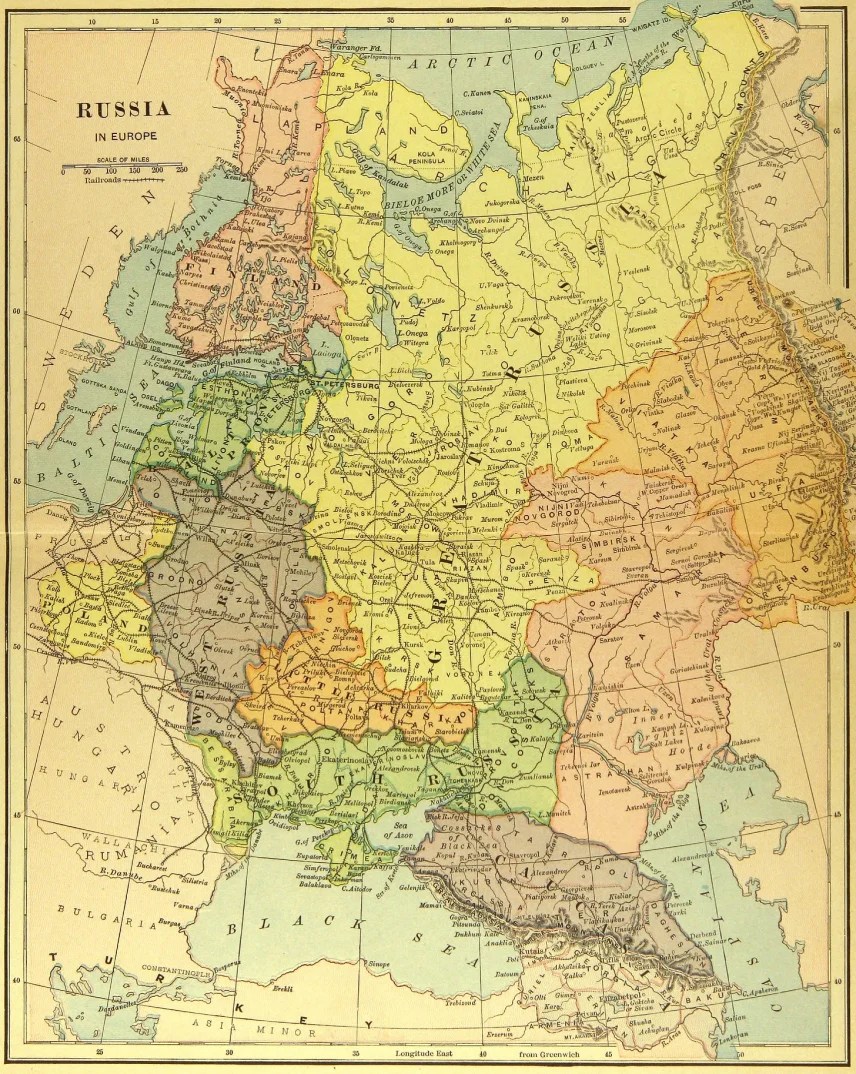
A smaller crop of that map which includes the area crafted into “Ukraine” in 1991 appears below:

And the encyclopedia entry for “Ukraine” reads as follows:
UKRAINE (Slavic, a frontier country or March), the name given in Poland first to the frontiers towards the Tatars and other nomads, and then to the fertile regions lying on both sides of the middle Dnieper, without any very definite limits. The Ukraine was long a bone of contention between Poland and Russia. About 1686 the part on the east side of Dnieper was ceded to Russia (Russian Ukraine); and at the second partition of Poland, the western portion (Polish Ukraine) also fell to Russia, and is mostly comprised of the government of Kiev. The historic Ukraine forms the greater part of what is called Little Russia (a name which first appears about 1654), which is made up of the governments of Kiev, Tchernigov, Poltava, and Kharkov.
– Chambers Encyclopedia, Volume VII, 1888 (abbreviations expanded)
But, as it has done in many other regions of the world, the Anglo-American empire, beginning as early as the immediate post-WW2 period, and accelerating in the post-Cold War period, sought to methodically cultivate violent national aspirations among portions of the populace of this region in order to effect a stratagem to weaken its long-time nemesis in Russia.
The western powers focused their nefarious project upon those portions of Ukraine wherein resided the heirs to the German-collaborating Ukrainian nationalists who, in direct affiliation with the Nazi SS formations, had proven to be reliable and particularly ruthless executioners of Jews, Poles, and Russians during the Second World War.
These historical facts are beyond dispute — at least in the realms of the informed. But the highly propagandized people of the so-called “western democracies” are not well-informed, and it is precisely for this reason that Vladimir Putin no doubt felt compelled to expound upon these questions in his lengthy but essential opening remarks in the interview with Tucker Carlson.
Carlson attempted multiple times to interrupt and redirect Putin’s train of thought, but to no avail. He even had the temerity to once again make reference to his initial deceptively constructed question:
Tucker Carlson: … many nations feel frustrated by their re-drawn borders after the wars of the 20th century, and wars going back a thousand years, the ones that you mention, but the fact is that you didn’t make this case in public until two years ago in February, and in the case that you made, which I read today, you explain at great length that you thought [there was] a physical threat from the West and NATO, including potentially a nuclear threat, and that’s what got you to move. Is that a fair characterization of what you said?
It is NOT a “fair characterization” of what Putin said. In fact, it is emphatically a FALSE characterization of what he said.
And yet Carlson was determined to extract an answer to this tortured misrepresentation of Putin’s own words.
Nevertheless, Putin refused to take the bait, and once again parried Carlson’s disingenuous query:
Vladimir Putin: I understand that my long speeches probably fall outside of the genre of an interview. That is why I asked you at the beginning: “Are we going to have a serious talk or a show?” You said — a serious talk. So bear with me please.
And then he proceeded to conclude his exposition of the essential historical facts.
I will, in subsequent installments of my commentary on this important interview, highlight multiple additional instances of Tucker Carlson posing ill-formed and disingenuous questions to President Putin, and then examine how Putin skillfully countered these curious attempts to “put words in his mouth”.

Coming up in Part 2: Tucker Carlson himself, along with many other western commentators and state-controlled propaganda organizations (such as Reuters, as seen above), have attempted in the aftermath of the interview to advance the demonstrably false narrative that Putin expressed a desire to negotiate a ceasefire and a mutually acceptable end to the ongoing war. Of course, that is a highly deceptive misinterpretation and misrepresentation of what really happened.
Blood on BoJo’s Hands
Putin’s claim that Boris Johnson scuttled peace deal confirmed by witnesses
BY JOHN LEAKE | COURAGEOUS DISCOURSE | FEBRUARY 13, 2024
Former British Prime Minister, Boris Johnson, and the mainstream media are hotly denying Vladimir Putin’s claim (in his recent Tucker Carlson interview) that Johnson derailed a peace deal between Russia and Ukraine just a couple of months after the war commenced.
And yet, Putin was merely confirming the statement of David Arahamiya, leader of Ukraine’s ruling party, that was reported in Newsweek on November 27, 2023: Russia Offered to End War if Ukraine Dropped NATO Bid: Kyiv Official.

The German analyst and Former United Nations Assistant Secretary General, Michael von der Schulenberg, also published a reconstruction of these events on November 14, 2023, titled How The Chance Was Lost For A Peace Settlement Of The Ukraine War.
The totality of circumstances and the statements of Arahamiya and von der Schulenberg indicate that an Austrian-style neutrality deal could have prevented this war to begin with, and then—had it been embraced by the the USA and Britain—ended it just two months later.
Since Churchill delivered his June 4, 1940, “We shall fight on the beaches” speech, many postwar heads of state have apparently fantasized that their opponents on the international stage are “just like Hitler” and that there can be no negotiated settlement with them.
In BoJo’s case, this shallow, sophomoric notion has apparently resulted in the needless deaths of hundreds of thousands of young Ukrainian and Russian soldiers.
Featured Video
The Truth About the Trump Shootings with Ken Silva
or go to
Aletho News Archives – Video-Images
From the Archives
The Geopolitics behind the War in Yemen (I)
By Mahdi Darius NAZEMROAYA | Strategic Culture Foundation | 30.03.2015
The United States and the Kingdom of Saudi Arabia became very uneasy when the Yemenese or Yemenite movement of the Houthi or Ansarallah (meaning the supporters of God in Arabic) gained control of Yemen’s capital, Sanaa/Sana, in September 2014. The US-supported Yemenite President Abd-Rabbuh Manṣour Al-Hadi was humiliatingly forced to share power with the Houthis and the coalition of northern Yemenese tribes that had helped them enter Sana. Al-Hadi declared that negotiations for a Yemeni national unity government would take place and his allies the US and Saudi Arabia tried to use a new national dialogue and mediated talks to co-opt and pacify the Houthis.
The truth has been turned on its head about the war in Yemen. The war and ousting of President Abd-Rabbuh Manṣour Al-Hadi in Yemen are not the results of «Houthi coup» in Yemen. It is the opposite. Al-Hadi was ousted, because with Saudi and US support he tried to backtrack on the power sharing agreements he had made and return Yemen to authoritarian rule. The ousting of President Al-Hadi by the Houthis and their political allies was an unexpected reaction to the takeover Al-Hadi was planning with Washington and the House of Saudi. … continue
Blog Roll
 Aletho News
- Pakistan-Iran talks secure LNG shipment to Islamabad through Hormuz
- Black Sea grain crisis puts global wheat supplies under pressure
- IRGC air defenses destroy another US MQ-1 drone over Strait of Hormuz
- Imran Khan’s entire immediate family detained in Pakistan ahead of mass protest demanding his release
- EU nation detains former presidential frontrunner
- Leaked: Britain’s Sham Conviction Of Hashim Thaci
- Seyed M. Marandi: U.S. Strike Imminent – Toward Total War in the Middle East
- Russia Voted Under Fire. Washington Is Loading the Tankers.
- 12 Things Your Oncologist Was Trained Not to Tell You
- Anthrax Attacks Paved Way for COVID-Era ‘Junk Drugs and Vaccines’
- If Americans Knew
- Trump’s militarization of Washington DC as he pursues Israel’s war against Iran
- Why Israel Fears This Searing New Documentary
- Huckabee aide solicited cash gifts from Israelis
- This isn’t sci-fi, AI is already killing people
- ‘The Most Brutal Thing’: Investigation Reveals Execution of Elderly Woman in Rafah
- Inside Israel’s ‘soft’ ethnic cleansing plan for Gaza through the eyes of its victims
- New online database tracks pro-Israel political donations in the United States
- Israeli president pardons soldier convicted for killing wounded Palestinian
- Singer Ed Sheeran says his ‘heart broken’ by Gaza devastation, addresses Macklemore controversy
- Israel Has Imprisoned Female Journalist Bushra Al-Tawil Without Trial Or Charge In Solitary Confinement For Past Month
- No Tricks Zone
- 2025 Nature Paper Claiming Worsening Global Drought Gets RETRACTED …Heavily Flawed
- New Study: ‘Global Drought Shows No Detectable Recent Acceleration Under Climate Warming’
- Economic Masterminds: German Socialists Suggest Taxing Productivity Gains Stemming From Using AI
- The South China Sea Has Not Been Cooperating With The Climate Change Narrative
- Energy Crisis: Germany Enters Heating Season With Historically Low Gas Reserve Fill Levels
- New Study: The Antarctic Ice Sheet Gained Mass From 2020-2024 Due To Staggering Snow And Ice Accumulation
- Study: Ocean Heating Rates From Thousands Of Years Ago ‘Dwarf’ Modern Ocean Heating Rates
- Climate Extremists Target, Attack Large-Scale Power Grid Infrastructure In Germany!
- New Study: Antarctic Ice Melt Has Contributed Less Than 1 Centimeter To Sea Level Rise In The Last 30 Years
- Fear Of Debate: Alarmist German Climate Scientist Calls On Mainstream Media To Discredit Skeptic Voices
 Aletho News