Democrats Put Partisanship Before Prospects for Peace
By Joe Lauria | Consortium News | June 13, 2018
When Richard Nixon returned to Washington after his historic 1972 trip to China, he was welcomed with strong support from Democrats.
“From the initial Congressional reaction, it was apparent that the President, home from his China trip, would find broad bipartisan support for his move toward closer relations with Peking,” The New York Times reported on Feb. 29, 1972.
Even Democratic Senate leaders Edward Kennedy and Mike Mansfield praised Nixon’s diplomatic gamble.
Forty-six years later President Donald Trump took a similar political risk in agreeing to the first ever summit with a North Korean leader. Cautious optimism emerged from the summit that peace on the Korean peninsula may finally be within reach 65 years after a truce silenced the guns of the Korean War.
But instead of the support Nixon received from the opposition party, Trump has been blasted by Democrats, who’ve put any prospect for peace behind their partisan quest to regain power.
“It sure looks as if President Trump was hoodwinked in Singapore,” wrote liberal New York Times columnist Nicholas Kristoff on Tuesday. “Trump seemed to believe he had achieved some remarkable agreement, but the concessions were all his own.”
“Kim seems to have completely out-negotiated Trump, and it’s scary that Trump doesn’t seem to realize this,” Kristoff wrote.
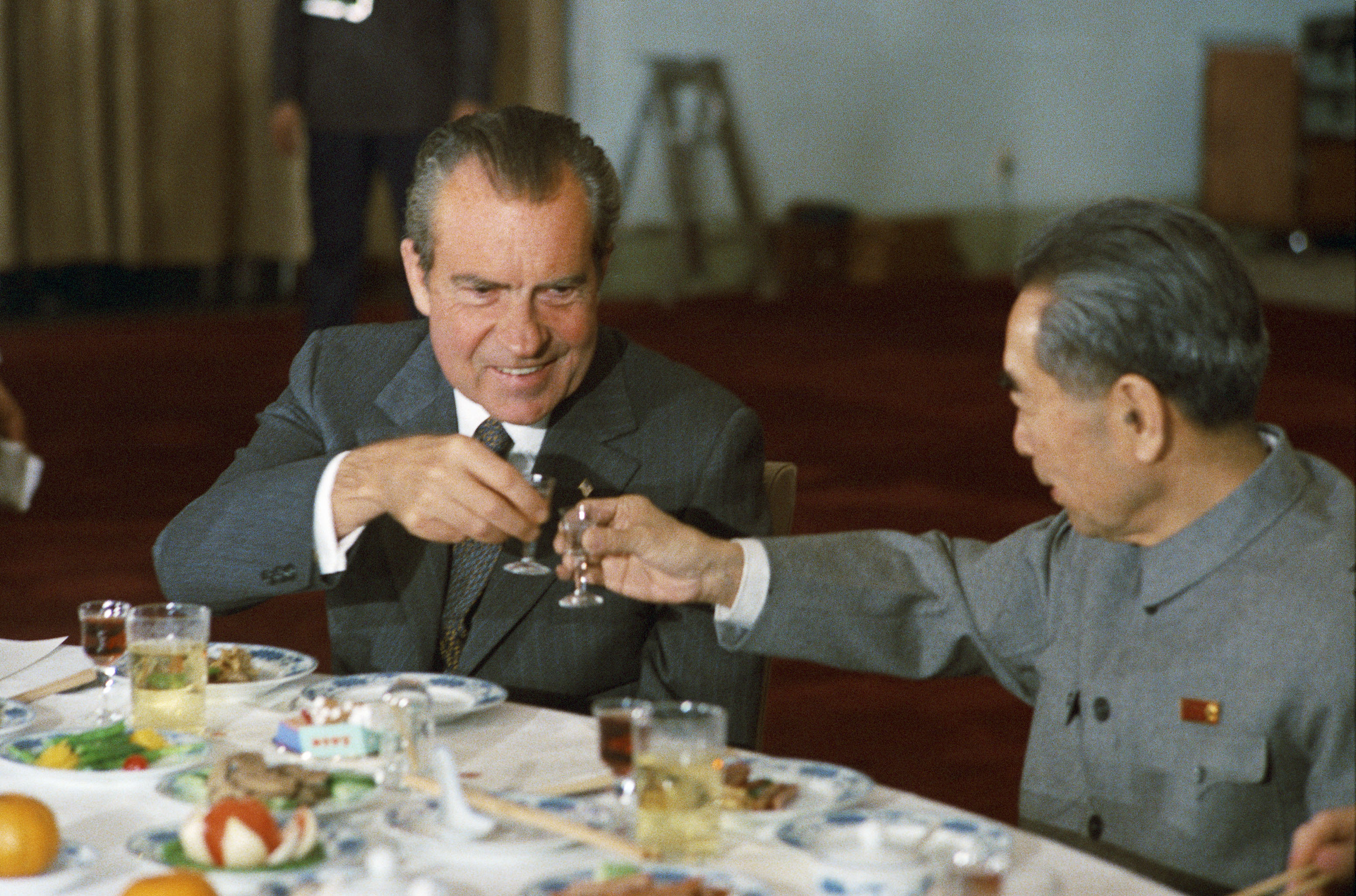
Nixon toasting Zhou
The Times editorial board was even harsher. “President Trump was on his best behavior, as is so often the case when he is dealing with dictators,” it wrote. “Mr. Trump was even more effusive about Mr. Kim after their session, sounding more like he was deconstructing a blind date than analyzing a diplomatic meeting.”
In case the reader didn’t get the message the editorial went on: “Whatever he does or does not understand about history or policy or statecraft, Mr. Trump has a keen sense of how to engage authoritarian thugs who crave respect and legitimacy. It’s how he’s wired.”
And then it piled on: “Mr. Trump has a deep and abiding fondness for strongmen … The more ruthlessly they have had to act to hold on to power, the more he respects them.”
“Dealing with men like Mr. Kim is, on some level, comfortable ground for Mr. Trump,” the Times editorial said. “Such negotiations are a higher-stakes, global version of the world he came up in, one of cutthroat real estate developers and shady businessmen and mobsters. … The world sneers at strongmen like Mr. Kim, Mr. Putin and Rodrigo Duterte, the president of the Philippines, regarding them as uncivilized thugs, and Mr. Trump feels similarly disrespected. Dispositionally speaking, these are Mr. Trump’s people.”
A Beginning, Not an End
There wasn’t a word about what the two leaders agreed to in Singapore, namely the start—not the end—of what Trump called “an arduous process” that could lead to peace on the Korean peninsula. Trump could not have been clearer. He even said he could be wrong if the agreement is not realized.
The Times editorial never mentioned the agreement. In essence both sides agreed to work towards a peace treaty to end the Korean War, and the U.S. agreed to provide security guarantees to North Korea in exchange for the denuclearization of the peninsula. This was always meant to be a broad agreement on principles at the summit to kick start the indeed arduous negotiations to follow.
That the Times editorial board purposely ignored this fact to score cheap partisan points could not be clearer. The risks inherent in war on the peninsula, which should be of bi-partisan concern, were apparently of no concern to the editors on Eighth Avenue who decidedly took the low road.
Senate Democrats were no less uncharitable, seizing what they thought was an opportunity to score partisan points, while ignoring the promise the summit holds. “What the United States has gained is vague and unverifiable at best,” said Senate Minority Leader Chuck Schumer (D-NY). “What North Korea has gained, however, is tangible and lasting. By granting a meeting with Chairman Kim, President Trump has granted a brutal and repressive dictatorship, the international legitimacy it has long craved.”
House Minority Leader Nancy Pelosi (D-CA) said: “In his haste to reach an agreement, President Trump elevated North Korea to the level of the United States while preserving the regime’s status quo.”
The questions asked at Trump’s post-summit press conference is illustrative of the partisan nature of today’s press. He was repeatedly asked about giving away the store without getting anything in return. But Trump made clear he had already gotten the return of three American prisoners, had gotten a commitment for the remains of Americans killed in the Korean War to be returned, and most crucially, a promise to begin the task of denuclearization.

US devastation of N. Korea (Keystone/Getty Images)
Yes it’s a promise. But the process has to begin somewhere. The very hard work to make that happen will begin now, and no peace-loving person would not want to give it a chance instead of seeking to gain short-sighted partisan advantage.
Trump said sanctions would remain and that war games with South Korea could resume if the deal does not materialize. After the devastation wrought by the United Sates on North Korea 65 years ago Trump incredibly agreed that those war games were seen as provocations by the North. He is being roasted for putting himself in the position of his adversary and seeing things as they do—a fundamental principle of diplomacy, and presumably journalism too.
The press also badgered Trump about North Korean human rights. They wanted to know how he could make a deal with such a repressive country. Would the alternative be war to enforce human rights? Trump said human rights were raised with Kim but were separate from the imperative of denuclearization. He felt that if peace were achieved and the North Korean economy improved (with the likely participation of U.S. corporations) that human rights would improve.
Turning the Tables
“I’m disappointed Kim Jong-un did not take the opportunity to raise with Trump the utterly dismal US human rights record, from mass incarceration of millions to rampant police murder of Black citizens,” tweeted Ali Abunimah, co-founder of the website The Electronic Intifada. “Any credible deal must be predicated on US respecting its own people.”
Journalist Max Blumenthal tweeted: “The US committed genocide during the Korean War, killing 20% of North Korea’s population, burning literally all of its cities to the ground w/ napalm, & nearly nuking it. Today it threatens w extermination. Reporters must ask Kim how he can make peace with such a brutal country.”
“Democrats attacking Trump from the Right on Korean Summit,” added writer and filmmaker Tariq Ali in a tweet. “Pity Obama didn’t have the guts to visit Teheran.”
What we are witnessing is an inability, or unwillingness, to break down Trump’s positions and examine each one individually, something that Democrats like Ted Kennedy were able to do with Nixon. But we are in a totally different era. A non-partisan approach to Trump would be able to decry his positions on climate, torture, health insurance, taxes, Iran and Palestine, and yet welcome his stated desire to lessen tensions with Russia and North Korea.
Instead we get tweets like this from former Republican Congressman Joe Walsh: “America is the brightest, most benevolent nation on earth. North Korea is the darkest, most horrific regime on Earth. We just gave them equal billing. We just sat at a table with them. There had better be something really, really good coming in return.”
Clearly some criticism of Trump for meeting Kim is bipartisan, but none of the praise is. Such an attitude of Walsh’s, and The New York Times, rests on a misunderstanding of America that is intended to reflect well on those who conveniently leave out the darkest chapters of America’s history, of which there have been far too many. The napalming and destruction of North Korea is among them, but hardly alone.
Deleting the context of decades of election meddling, coup plotting, assassinations and invasions of sovereign lands in the reporting and editorials of august organs like the Times, indeed in the entire corporate media, leaves Americans with a comic book understanding of their history, cast adrift in a bubble from the reality of the rest of the world.
Attacking other nations’ human rights record while ignoring one’s own, or one’s allies, such as Saudi Arabia and Israel, is classic projection designed to wash one’s conscience clean. It helps to hold a position in the post-War Western-dominated international system making it easy to convince oneself of one’s righteousness, though self-reflection would reveal that that system has become a grotesque image of its former self.
Joe Lauria is editor-in-chief of Consortium News and a former correspondent for The Wall Street Journal, Boston Globe, Sunday Times of London and numerous other newspapers. He can be reached at joelauria@consortiumnews.com and followed on Twitter @unjoe.
Still Waiting for Evidence of a Russian Hack
By Ray McGovern | Consortium News | June 7, 2018
If you are wondering why so little is heard these days of accusations that Russia hacked into the U.S. election in 2016, it could be because those charges could not withstand close scrutiny. It could also be because special counsel Robert Mueller appears to have never bothered to investigate what was once the central alleged crime in Russia-gate as no one associated with WikiLeaks has ever been questioned by his team.
Veteran Intelligence Professionals for Sanity — including two “alumni” who were former National Security Agency technical directors — have long since concluded that Julian Assange did not acquire what he called the “emails related to Hillary Clinton” via a “hack” by the Russians or anyone else. They found, rather, that he got them from someone with physical access to Democratic National Committee computers who copied the material onto an external storage device — probably a thumb drive. In December 2016 VIPS explained this in some detail in an open Memorandum to President Barack Obama.
On January 18, 2017 President Obama admitted that the “conclusions” of U.S. intelligence regarding how the alleged Russian hacking got to WikiLeaks were “inconclusive.” Even the vapid FBI/CIA/NSA “Intelligence Community Assessment of Russian Activities and Intentions in Recent U.S. Elections” of January 6, 2017, which tried to blame Russian President Vladimir Putin for election interference, contained no direct evidence of Russian involvement. That did not prevent the “handpicked” authors of that poor excuse for intelligence analysis from expressing “high confidence” that Russian intelligence “relayed material it acquired from the Democratic National Committee … to WikiLeaks.” Handpicked analysts, of course, say what they are handpicked to say.
Never mind. The FBI/CIA/NSA “assessment” became bible truth for partisans like Rep. Adam Schiff (D-CA), ranking member of the House Intelligence Committee, who was among the first off the blocks to blame Russia for interfering to help Trump. It simply could not have been that Hillary Clinton was quite capable of snatching defeat out of victory all by herself. No, it had to have been the Russians.
Five days into the Trump presidency, I had a chance to challenge Schiff personally on the gaping disconnect between the Russians and WikiLeaks. Schiff still “can’t share the evidence” with me … or with anyone else, because it does not exist.
WikiLeaks
Schiff: Can’t share evidence
It was on June 12, 2016, just six weeks before the Democratic National Convention, that Assange announced the pending publication of “emails related to Hillary Clinton,” throwing the Clinton campaign into panic mode, since the emails would document strong bias in favor of Clinton and successful attempts to sabotage the campaign of Bernie Sanders. When the emails were published on July 22, just three days before the convention began, the campaign decided to create what I call a Magnificent Diversion, drawing attention away from the substance of the emails by blaming Russia for their release.
Clinton’s PR chief Jennifer Palmieri later admitted that she golf-carted around to various media outlets at the convention with instructions “to get the press to focus on something even we found difficult to process: the prospect that Russia had not only hacked and stolen emails from the DNC, but that it had done so to help Donald Trump and hurt Hillary Clinton.” The diversion worked like a charm. Mainstream media kept shouting “The Russians did it,” and gave little, if any, play to the DNC skullduggery revealed in the emails themselves. And like Brer’ Fox, Bernie didn’t say nothin’.
Meanwhile, highly sophisticated technical experts, were hard at work fabricating “forensic facts” to “prove” the Russians did it. Here’s how it played out:
June 12, 2016: Assange announces that WikiLeaks is about to publish “emails related to Hillary Clinton.”
June 14, 2016: DNC contractor CrowdStrike, (with a dubious professional record and multiple conflicts of interest) announces that malware has been found on the DNC server and claims there is evidence it was injected by Russians.
June 15, 2016: “Guccifer 2.0” affirms the DNC statement; claims responsibility for the “hack;” claims to be a WikiLeaks source; and posts a document that the forensics show was synthetically tainted with “Russian fingerprints.”
The June 12, 14, & 15 timing was hardly coincidence. Rather, it was the start of a pre-emptive move to associate Russia with anything WikiLeaks might have been about to publish and to “show” that it came from a Russian hack.
Enter Independent Investigators
A year ago independent cyber-investigators completed the kind of forensic work that, for reasons best known to then-FBI Director James Comey, neither he nor the “handpicked analysts” who wrote the Jan. 6, 2017 assessment bothered to do. The independent investigators found verifiable evidence from metadata found in the record of an alleged Russian hack of July 5, 2016 showing that the “hack” that day of the DNC by Guccifer 2.0 was not a hack, by Russia or anyone else.
Rather it originated with a copy (onto an external storage device – a thumb drive, for example) by an insider — the same process used by the DNC insider/leaker before June 12, 2016 for an altogether different purpose. (Once the metadata was found and the “fluid dynamics” principle of physics applied, this was not difficult to disprove the validity of the claim that Russia was responsible.)
One of these independent investigators publishing under the name of The Forensicator on May 31 published new evidence that the Guccifer 2.0 persona uploaded a document from the West Coast of the United States, and not from Russia.
In our July 24, 2017 Memorandum to President Donald Trump we stated, “We do not know who or what the murky Guccifer 2.0 is. You may wish to ask the FBI.”
Our July 24 Memorandum continued: “Mr. President, the disclosure described below may be related. Even if it is not, it is something we think you should be made aware of in this general connection. On March 7, 2017, WikiLeaks began to publish a trove of original CIA documents that WikiLeaks labeled ‘Vault 7.’ WikiLeaks said it got the trove from a current or former CIA contractor and described it as comparable in scale and significance to the information Edward Snowden gave to reporters in 2013.
“No one has challenged the authenticity of the original documents of Vault 7, which disclosed a vast array of cyber warfare tools developed, probably with help from NSA, by CIA’s Engineering Development Group. That Group was part of the sprawling CIA Directorate of Digital Innovation – a growth industry established by John Brennan in 2015. [ (VIPS warned President Obama of some of the dangers of that basic CIA reorganization at the time.]
Marbled
“Scarcely imaginable digital tools – that can take control of your car and make it race over 100 mph, for example, or can enable remote spying through a TV – were described and duly reported in the New York Times and other media throughout March. But the Vault 7, part 3 release on March 31 that exposed the “Marble Framework” program apparently was judged too delicate to qualify as ‘news fit to print’ and was kept out of the Times at the time, and has never been mentioned since.
“The Washington Post’s Ellen Nakashima, it seems, ‘did not get the memo’ in time. Her March 31 article bore the catching (and accurate) headline: ‘WikiLeaks’ latest release of CIA cyber-tools could blow the cover on agency hacking operations.’
“The WikiLeaks release indicated that Marble was designed for flexible and easy-to-use ‘obfuscation,’ and that Marble source code includes a “de-obfuscator” to reverse CIA text obfuscation.
“More important, the CIA reportedly used Marble during 2016. In her Washington Post report, Nakashima left that out, but did include another significant point made by WikiLeaks; namely, that the obfuscation tool could be used to conduct a ‘forensic attribution double game’ or false-flag operation because it included test samples in Chinese, Russian, Korean, Arabic and Farsi.”
A few weeks later William Binney, a former NSA technical director, and I commented on Vault 7 Marble, and were able to get a shortened op-ed version published in The Baltimore Sun.
The CIA’s reaction to the WikiLeaks disclosure of the Marble Framework tool was neuralgic. Then Director Mike Pompeo lashed out two weeks later, calling Assange and his associates “demons,” and insisting; “It’s time to call out WikiLeaks for what it really is, a non-state hostile intelligence service, often abetted by state actors like Russia.”
Our July 24 Memorandum continued: “Mr. President, we do not know if CIA’s Marble Framework, or tools like it, played some kind of role in the campaign to blame Russia for hacking the DNC. Nor do we know how candid the denizens of CIA’s Digital Innovation Directorate have been with you and with Director Pompeo. These are areas that might profit from early White House review. [ President Trump then directed Pompeo to invite Binney, one of the authors of the July 24, 2017 VIPS Memorandum to the President, to discuss all this. Binney and Pompeo spent an hour together at CIA Headquarters on October 24, 2017, during which Binney briefed Pompeo with his customary straightforwardness. ]
“We also do not know if you have discussed cyber issues in any detail with President Putin. In his interview with NBC’s Megyn Kelly he seemed quite willing – perhaps even eager – to address issues related to the kind of cyber tools revealed in the Vault 7 disclosures, if only to indicate he has been briefed on them. Putin pointed out that today’s technology enables hacking to be ‘masked and camouflaged to an extent that no one can understand the origin’ [of the hack] … And, vice versa, it is possible to set up any entity or any individual that everyone will think that they are the exact source of that attack.
“‘Hackers may be anywhere,’ he said. ‘There may be hackers, by the way, in the United States who very craftily and professionally passed the buck to Russia. Can’t you imagine such a scenario? … I can.’
New attention has been drawn to these issues after I discussed them in a widely published 16-minute interview last Friday.
In view of the highly politicized environment surrounding these issues, I believe I must append here the same notice that VIPS felt compelled to add to our key Memorandum of July 24, 2017:
“Full Disclosure: Over recent decades the ethos of our intelligence profession has eroded in the public mind to the point that agenda-free analysis is deemed well nigh impossible. Thus, we add this disclaimer, which applies to everything we in VIPS say and do: We have no political agenda; our sole purpose is to spread truth around and, when necessary, hold to account our former intelligence colleagues.
“We speak and write without fear or favor. Consequently, any resemblance between what we say and what presidents, politicians and pundits say is purely coincidental.” The fact we find it is necessary to include that reminder speaks volumes about these highly politicized times.
Did Israel Kill the Kennedys?
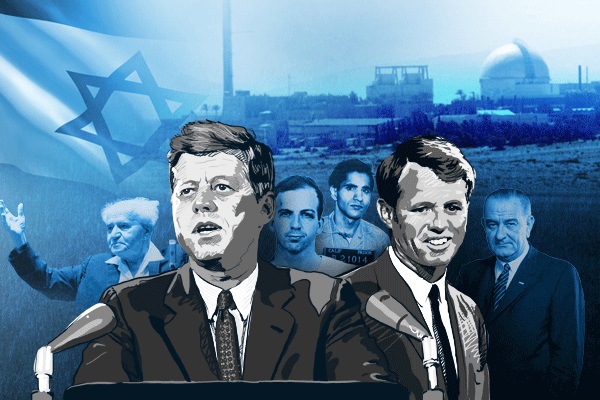
By Laurent Guyénot • Unz Review • June 3, 2018
Introduction
Just after midnight of June 6, 1968, Senator Robert Kennedy was assassinated in a backroom of the Ambassador Hotel in Los Angeles. He had just been celebrating his victory at the California primaries, which made him the most likely Democratic nominee for the presidential election. His popularity was so great that Richard Nixon, on the Republican side, stood little chance. At the age of 43, Robert would have become the youngest American president ever, after being the youngest Attorney General in his brother’s government. His death opened the way for Nixon, who could finally become president eight years after having been defeated by John F. Kennedy in 1960.
John had been assassinated four and a half years before Robert. Had he survived, he would certainly have been president until 1968. Instead, his vice-president Lyndon Johnson took over the White House in 1963, and became so unpopular that he retired in 1968. Interestingly, Johnson became president the very day of John’s death, and ended his term a few months after Robert’s death. He was in power at the time of both investigations.
And both investigations are widely regarded as cover-ups. In both cases, the official conclusion is rife with contradictions. We are going to sum them up here. But we will do more: we will show that the key to solving both cases resides in the link between them. And we will solve them beyond a reasonable doubt.
As Lance deHaven-Smith has remarked in Conspiracy Theory in America:
“It is seldom considered that the Kennedy assassinations might have been serial murders. In fact, in speaking about the murders, Americans rarely use the plural, ‘Kennedy assassinations’. […] Clearly, this quirk in the Kennedy assassination(s) lexicon reflects an unconscious effort by journalists, politicians, and millions of ordinary Americans to avoid thinking about the two assassinations together, despite the fact that the victims are connected in countless ways.”[1]
John and Robert were bound by an unshakable loyalty. Kennedy biographers have stressed the absolute dedication of Robert to his elder brother. Robert had successfully managed John’s campaign for the Senate in 1952, then his presidential campaign in 1960. John made him not only his Attorney General, but also his most trusted adviser, even on matters of Foreign or Military affairs. What John appreciated most in Robert was his sense of justice and the rectitude of his moral judgment. It is Robert, for example, who encouraged John to fully endorse the cause of the Blacks’ civil rights movement.[2]
Given this exceptional bond between the Kennedy brothers, what is the probability that the two Kennedy assassinations were unrelated? Rather, we should start with the assumption that they are related. Basic common sense suggests that the Kennedy brothers have been killed by the same force, and for the same motives. It is, at least, a logical working hypothesis that Robert was eliminated from the presidential race because he had to be prevented from reaching a position where he could reopen the case of his brother’s death. Both his loyalty to his brother’s memory, and his obsession with justice, made it predictable that, if he reached the White House, he would do just that. But was there, in 1968, any clear indication that he would?
Did Bobby plan to reopen the investigation on his brother’s assassination?
The question has been positively answered by David Talbot in his book Brothers: The Hidden History of the Kennedy Years, published in 2007 by Simon & Schuster. Robert had never believed in the Warren Report’s conclusion that Lee Harvey Oswald was the sole assassin of his brother. Knowing too well what to expect from Johnson, he had refused to testify before the Warren Commission. When its report came out, he had no choice but to publicly endorse it, but “privately he was dismissive of it,” as his son Robert Kennedy, Jr. remembers.[3] To close friends who wondered why he wouldn’t voice his doubt, he said: “there’s nothing I can do about it. Not now.” [4]
From 22 November 1963, Robert was alienated and monitored by Johnson and Hoover. Although still Attorney General, he knew he was powerless against the forces that had killed his brother. Yet he lost no time beginning his own investigation; he first asked CIA director John McCone, a Kennedy friend, to find out if the Agency had anything to do with the plot, and came out convinced that it hadn’t. In March 1964, he had a face-to-face conversation with mobster Jimmy Hoffa, his sworn enemy, whom he had battled for ten years, and whom he suspected of having taken revenge on his brother. Robert also asked his friend Daniel Moynihan to search for any complicity in the Secret Service, responsible for the President’s security[5]. And of course, Robert suspected Johnson, whom he had always mistrusted, as Jeff Shesol documents in Mutual Contempt: Lyndon Johnson, Robert Kennedy, and the Feud that Defined a Decade (1997).
In fact, a mere week after JFK’s death, November 29, 1963, Bill Walton, a friend of the Kennedys, travelled to Moscow and passed to Nikita Khrushchev, via a trusted agent who had already carried secret communications between Khrushchev and John Kennedy, a message from Robert and Jacqueline Kennedy; according to the memo found in the Soviet archives in the 90s by Alexandr Fursenko and Timothy Naftali (One Hell of a Gamble, 1998), Robert and Jackie wanted to inform the Soviet Premier that they believed John Kennedy had been “the victim of a right-wing conspiracy,” and that “the cooling that might occur in U.S.-Soviet relations because of Johnson would not last forever.” [6]
Robert also contacted a former MI6 officer who had been a friend of his family when his father was Ambassador in London. This British retired officer in turn contacted some trusted friends in France, and arrangments were made for two French Intelligence operatives to conduct, over a three-year period, a quiet investigation that involved hundreds of interviews in the United States. Their report, replete with innuendo about Lyndon Johnson and right-wing Texas oil barons, was delivered to Bobby Kennedy only months before his own assassination in June of 1968. After Bobby’s death, the last surviving brother, Senator Ted Kennedy, showed no interest in the material. The investigators then hired a French writer by the name of Hervé Lamarr to fashion the material into a book, under the pseudonym of James Hepburn. The book was first published in French under the title L’Amérique brûle, and was translated under the title Farewell America: The Plot to Kill JFK. Its conclusion is worth quoting:
“President Kennedy’s assassination was the work of magicians. It was a stage trick, complete with accessories and fake mirrors, and when the curtain fell, the actors, and even the scenery disappeared. […] the plotters were correct when they guessed that their crime would be concealed by shadows and silences, that it would be blamed on a ‘madman’ and negligence.”[7]
Robert had planned to run for the American Presidency in 1972, but the escalation of the Vietnam War precipitated his decision to run in 1968. Another factor may have been the opening of the investigation by New Orleans District Attorney Jim Garrison in 1967. Garrison was allowed to view Abraham Zapruder’s amateur film, confiscated by the FBI on the day of the assassination. This film, despite evident tampering, shows that the fatal shot came from the “grassy knoll” well in front of the President, not from the School Book Depository located behind him, where Oswald was supposed to be shooting from.
When talk of the investigation began, Kennedy asked one of his closest advisors, Frank Mankievitch, to follow its developments, “so if it gets to a point where I can do something about this, you can tell me what I need to know.” He confided to his friend William Attwood, then editor of Look magazine, that he, like Garrison, suspected a conspiracy, “but I can’t do anything until we get control of the White House.” [8] He refrained from openly supporting Garrison, believing that since the outcome of the investigation was uncertain, it could jeopardize his plans to reopen the case later, and even weaken his chances of election by construing his motivation as a family feud.
In conclusion, there can be little doubt that, had he been elected president, Robert Kennedy would have done everything possible to reopen the case of his brother’s assassination, in one way or another. This fact certainly did not escape John’s murderers. They had no other option but to stop him. This first conclusion is a sufficient reason to conduct a comparative analysis of both Kennedy assassinations, in search of some converging clues that might lead us to the trail of a common mastermind.We begin with Robert’s assassination.
Sirhan Sirhan, a Palestinian motivated by hatred of Israel?
Just hours after Robert’s assassination, the press was able to inform the American people, not only of the identity of the assassin, but also of his motive, and even of his detailed biography.[9] Twenty-four-year-old Sirhan Bishara Sirhan was born in Jordania, and had moved to the United States when his family was expelled from West Jerusalem in 1948. After the shooting, a newspaper clipping was found in Sirhan’s pocket, quoting favorable comments made by Robert regarding Israel and, in particular, what sounded like an electoral commitment: “The United States should without delay sell Israel the 50 Phantom jets she has so long been promised.” Handwritten notes by Sirhan found in a notebook at his home confirmed that his act had been premeditated and motivated by his hatred of Israel.
That became the story line of the mainstream media from day one. Jerry Cohen of the Los Angeles Times wrote a front page article, saying that Sirhan is “described by acquaintances as a ‘virulent’ anti-Israeli,” (Cohen changed that into “virulent anti-semite” in an article for the The Salt Lake Tribune), and that: “Investigation and disclosures from persons who knew him best revealed [him] as a young man with a supreme hatred for the state of Israel.” Cohen infers that “Senator Kennedy […] became a personification of that hatred because of his recent pro-Israeli statements.” Cohen further revealed that:
“About three weeks ago the young Jordanian refugee accused of shooting Sen. Robert Kennedy wrote a memo to himself, […] The memo said: ‘Kennedy must be assassinated before June 5, 1968’—the first anniversary of the six-day war in which Israel humiliated three Arab neighbors, Egypt, Syria and Jordan.”[10]
After September 11, 2001, the tragedy of Robert’s assassination was installed into the Neocon mythology of the Clash of Civilizations and the War on Terror the story. Sirhan became a precursor of Islamic terrorism on the American soil. In a book entitled The Forgotten Terrorist, Mel Ayton, who specializes in debunking conspiracy theories, claims to present “a wealth of evidence about [Sirhan’s] fanatical Palestinian nationalism,” and to demonstrate that “Sirhan was the lone assassin whose politically motivated act was a forerunner of present-day terrorism” (as written on the back cover).
In 2008, on the 40th anniversary of Robert’s death, Sasha Issenberg of the Boston Globe recalled that the death of Robert Kennedy was “a first taste of Mideast terror.” He quotes Harvard professor Alan Dershowitz (best known as Jonathan Pollard’s lawyer), as saying:
“I thought of it as an act of violence motivated by hatred of Israel and of anybody who supported Israel. […] It was in some ways the beginning of Islamic terrorism in America. It was the first shot. A lot of us didn’t recognize it at the time.”[11]
The fact that Sirhan was from a Christian family was lost on Dershowitz. The Jewish Forward took care to mention it on the same occasion, only to add that Islamic fanaticism ran in his veins anyway:
“But what he shared with his Muslim cousins — the perpetrators of September 11 — was a visceral, irrational hatred of Israel. It drove him to murder a man whom some still believe might have been the greatest hope of an earlier generation.”
“Robert Kennedy was the first American victim of modern Arab terrorism,” the Forward journalist hammered; “Sirhan hated Kennedy because he had supported Israel.” [12]
This leitmotiv of the public discourse begs the question: Was Bobby really a supporter of Israel? But before we answer that question, there is on more pressing one: Did Sirhan really kill Bobby?
Did Sirhan Bishara Sirhan really kill Robert Kennedy?
If we trust official statements and mainstream news, the assassination of Robert Kennedy is an open-and-shut case. The identity of the killer suffers no discussion, since he was arrested on the spot, with the smoking gun in his hand. In reality, ballistic and forensic evidence show that none of Sirhan’s bullets hit Kennedy.
According to the autopsy report of Chief Medical Examiner-Coroner Thomas Noguchi, Robert Kennedy died of a gunshot wound to the brain, fired from behind the right ear at point blank range, following an upward angle. Nogushi restated his conclusion in his 1983 memoirs, Coroner. Yet the sworn testimony of twelve shooting witnesses established that Robert had never turned his back on Sirhan and that Sirhan was five to six feet away from his target when he fired.
Tallying all the bullet impacts in the pantry, and those that wounded five people around Kennedy, it has been estimated that at least twelve bullets were fired, while Sirhan’s gun carried only eight. On April 23, 2011, attorneys William Pepper and his associate, Laurie Dusek, gathered all this evidence and more in a 58-page file submitted to the Court of California, asking that Sirhan’s case be reopened. They documented major irregularities in the 1968 trial, including the fact that the bullet tested in laboratory to be compared to the the one extracted from Robert’s brain had not been shot by Sirhan’s revolver, but by another gun, with a different serial number; thus, instead of incriminating Sirhan, the ballistic test in fact proved him innocent. Pepper has also provided a computer analysis of audio recordings during the shooting, made by engineer Philip Van Praag in 2008, which confirms that two guns are heard.[13]
The presence of a second shooter was signaled by several witnesses and reported on the same day by a few news media. There are strong suspicions that the second shooter was Thane Eugene Cesar, a security guard hired for the evening, who was stuck behind Kennedy at the moment of the shooting, and seen with his pistol drawn by several witnesses. One of them, Don Schulman, positively saw him fire. Cesar was never investigated, even though he did not conceal his hatred for the Kennedys, who according to his recorded statement, had “sold the country down the road to the commies.” [14]
Even if we assume that Sirhan did kill Robert Kennedy, a second aspect of the case raises question: according to several witnesses, Sirhan seemed to be in a state of trance during the shooting. More importantly, Sirhan has always claimed, and continues to claim, that he has never had any recollection of his act:
“I was told by my attorney that I shot and killed Senator Robert F. Kennedy and that to deny this would be completely futile, [but] I had and continue to have no memory of the shooting of Senator Kennedy.”
He also claims to have no memory of “many things and incidents which took place in the weeks leading up to the shooting.” [15] Some repetitive lines written of a notebook found in Sirhan’s bedroom, which Sirhan recognizes as his own handwriting but does not remember writing, are reminiscent of automatic writing.[16]
Psychiatric expertise, including lie-detector tests, have confirmed that Sirhan’s amnesia is not faked. In 2008, Harvard University professor Daniel Brown, a noted expert in hypnosis and trauma memory loss, interviewed Sirhan for a total of 60 hours, and concluded that Sirhan, whom he classifies in the category of “high hypnotizables,” acted unvoluntarily under the effect of hypnotic suggestion: “His firing of the gun was neither under his voluntary control, nor done with conscious knowledge, but is likely a product of automatic hypnotic behavior and coercive control.” [17]
We know that in the 1960s, American military agencies were experimenting on mental control. Dr Sidney Gottlieb, son of Hungarian Jews, directed the infamous CIA MKUltra project, which, among other things, were to answer questions such as: “Can a person under hypnosis be forced to commit murder?” according to a declassified document dated May 1951.[18] According to Israeli journalist Ronen Bergman, author of Rise and Kill First: The Secret History of Israel’s Targeted Assassinations (Random House, 2018), in 1968, an Israeli military psychologist by the name of Benjamin Shalit had concocted a plan to take a Palestinian prisoner and “brainwash and hypnotize him into becoming a programmed killer” aimed at Yasser Arafat.[19]
If Sirhan was hypnotically programmed, the question is: Who had some interest in having a visceral anti-Zionist Palestinian blamed for the killing of Robert Kennedy? Israel, of course. But then, we are faced with a dilemma, for why would Israel want to kill Robert Kennedy if Robert Kennedy was supportive of Israel, as the mainstream narrative goes?
Was Robert Kennedy really a friend of Israel?
The dilemma rests on a misleading assumption, which is part of the deception. In fact, Robert Kennedy was definitely not pro-Israel. He was simply campaigning in 1968. As everyone knows, a few good wishes and empty promises to Israel are an inescapable ritual in such circumstances. And Robert’s statement in an Oregon synagogue, mentioned in the May 27 Pasadena Independent Star-News article found in Sirhan’s pocket, didn’t exceed the minimal requirements. Its author David Lawrence had, in an earlier article entitled “Paradoxical Bob,” underlined how little credit should be given to such electoral promises: “Presidential candidates are out to get votes and some of them do not realize their own inconsistencies.”
All things considered, there is no ground for believing that Robert Kennedy would have been, as president of the US, particularly Israel-friendly. The Kennedy family, proudly Irish and Catholic, was known for its hostility to Jewish influence in politics, a classic theme of anti-Kennedy literature, best represented by the 1996 book by Ronald Kessler with the highly suggestive title, The Sins of the Father: Joseph P. Kennedy and the Dynasty He Founded.[20]
Robert had not been, in his brother’s government, a particularly pro-Israel Attorney General: He had infuriated Zionist leaders by supporting an investigation led by Senator William Fulbright of the Senate Committee on Foreign Relations aimed at registering the American Zionist Council as a “foreign agent” subject to the obligations defined by the Foreign Agents Registration Act of 1938, which would had considerably hindered its efficiency (after 1963, the AZD escaped this procedure by changing its status and renaming itself AIPAC)[21].
In conclusion, it is only with outstanding hypocrisy that The Jewish Daily Forward could write, on the 40th anniversary of Bobby’s death:
“In remembering Bobby Kennedy, let us remember not just what he lived for, but also what he died for—namely, the precious nature of the American-Israeli relationship.”[22]
Robert Kennedy’s death had not been a bad thing for the precious “American-Israeli relationship.” Rather, it was a great loss for the Arab world, where Bobby was mourned just as had his brother John before him.
Of course, the fact that the Zionist media lied when granting Robert Kennedy some posthumous certificate of good will toward Israel, and thereby provided Israel with a fake alibi, is not a sufficient reason for concluding that Israel murdered Robert. Even the fact that the masterminds of the plot chose as their programmed instrument an anti-Zionist Palestinian, and thereby stirred a strong anti-Palestinian feeling among Americans at the same time as getting rid of Robert, does not prove that Israel was involved. What is still lacking for a serious presumption is a plausible motive.
The motive of Robert’s assassination must be found, not in what Robert publicly declared in an Oregon synagogue during his presidential campaign, but rather in what he confided only to his most close friends: his intention to reopen the investigation on his brother’s death. Our next question, therefore, is: What would an unbiased investigation, conducted under the supervision of Robert in the White House, have revealed?
Did the CIA assassinate Kennedy?
It is obvious to anybody just vaguely informed that a genuine investigation would first establish that Oswald was a mere “patsy”, as he said himself, a scapegoat prepared in advance to be blamed for the crime and then be slaughtered without a trial. We will not here review the evidence that contradicts the official thesis of the lone gunman. It can be found in numerous books and documentary films.
Just as notorious is the theory that the plot to kill Kennedy originated from a secret network within the CIA, in collusion with extremist elements in the Pentagon. That conspiracy theory looms the largest in books, articles and films that have been produced since John Kennedy died.
That CIA-Pentagon theory, as I will call it (add the military-industrial complex if you wish) has a major flaw in the motive ascribed to the killers: besides getting rid of Kennedy, the theory goes, the aim was to create a pretext for invading Cuba, something the CIA had always pushed for and Kennedy had refused to do (the Bay of Pigs fiasco). With Oswald groomed as a pro-Castro communist, the Dallas shooting was staged as a false flag attack to be blamed on Cuba. But then, why did no invasion of Cuba follow Kennedy’s assassination? Why was the pro-Castro Oswald abandoned by the Warren Commission in favor of the lone nut Oswald? Those who address the question, like James Douglass in his JFK and the Unspeakable, credit Johnson with preventing the invasion. Johnson, we are led to understand, had nothing to do with the assassination plot, and thwarted the plotters’ ultimate aim to start World War III. This is to ignore the tremendous amount of evidence accumulated against Johnson for fifty years, and documented in such groundbreaking books as Phillip Nelson’s LBJ: The Mastermind of JFK’s Assassination (2010) or Roger Stone’s The Man Who Killed Kennedy: The Case Against LBJ (2013).
Another weakness in the CIA-Pentagon theory is the lack of agreement about the mastermind of the plot. In fact, one of the names that comes up most often is James Jesus Angleton, the head of Counter-Intelligence within the CIA, about whom Professor John Newman writes in Oswald and the CIA :
“In my view, whoever Oswald’s direct handler or handlers were, we must now seriously consider the possibility that Angleton was probably their general manager. No one else in the Agency had the access, the authority, and the diabolically ingenious mind to manage this sophisticated plot.”[23]
But there is plenty of evidence that Angleton, who was also the head of the CIA “Israel Office,” was a Mossad mole. According to his biographer Tom Mangold, “Angleton’s closest professional friends overseas […] came from the Mossad and […] he was held in immense esteem by his Israeli colleagues and by the state of Israel, which was to award him profound honors after his death.” [24] No less that two monuments were dedicated to him at memorial services in Israel during ceremonies attended by chiefs of Israeli Intelligence and even a future Prime Minister.[25]
Another aspect must be taken into account: if the trail of the CIA is such a well-trodden path among Kennedy researchers, it is because it has been cut and marked by the mainstream media themselves, as well as by Hollywood. And that began even before the assassination, on October 3, 1963, with an article by the New York Times’ chief Washington correspondent Arthur Krock. The article denounced the CIA’s “unrestrained thirst for power” and quotidian unnamed “very high official” who claimed that the White House could not control the CIA, and that:
“If the United States ever experiences an attempt at a coup to overthrow the Government, it will come from the CIA and not the Pentagon. The agency represents a tremendous power and total unaccountability to anyone.”[26]
In such a way, The New York Times was planting a sign, a month and a half before the Dallas killing, pointing to the CIA as the most likely instigator of the upcoming coup. The sign said: “The President is going to fall victim of a coup, and it will come from the CIA.”
One month after Kennedy’s assassination, it was the turn of the Washington Post to use a very similar trick, by publishing an op-ed signed by Harry Truman, in which the former president said he was “disturbed by the way CIA has been diverted from its original assignment.” “I never had any thought when I set up the CIA that it would be injected into peacetime cloak and dagger operations,” at the point of becoming across the globe “a symbol of sinister and mysterious foreign intrigue […] there are now some searching questions that need to be answered.” [27] Truman was hinting at the CIA’s role in toppling foreign governments and assassinating elected leaders abroad. But given the timing of his article, one month to the day after Dallas, it could only be understood by anyone with ears to hear, and at least subliminally by the rest, as an indictment of the CIA in the Kennedy assassination. This article, widely reprinted in the 1970s after the creation of the Church Committee and the House Select Committee on Assassinations, is regarded as Truman’s whistleblowing. Yet its mea culpa style is quite unlike Truman; that is because it was not written by Truman, but by his longtime assistant and ghostwriter, a Russian born Jew named David Noyes, whom Sidney Krasnoff calls “Truman’s alter ego” in his book, Truman and Noyes: Story of a President’s Alter Ego (1997). Truman probably never saw the article prior to its publication in the Washington Post morning edition, but he may be responsible for its deletion from the afternoon print runs.[28]
So the two most influential American newspapers, while ostensibly defending the official theory of the lone gunman, have planted directional signs pointing to the CIA. Most Kennedy truthers have followed the signs with enthusiasm.
In the 70s, the mainstream media and publishing industry played again a major role in steering conspiracy theorists toward the CIA, while avoiding any hint of Israeli involvement. One major contributor to that effort was A. J. Weberman, with his 1975 book Coup d’État in America: The CIA and the Assassination of John F. Kennedy, co-authored by Michael Canfield. According to the New York Jewish Daily Forward (December 28, 2012), Weberman had “immigrated to Israel in 1959 and has dual American-Israeli citizenship,” and is “a close associate of Jewish Defense Organization founder Mordechai Levy, whose fringe group is a spin-off of the late Rabbi Meir Kahane’s militant right-wing Jewish Defense League.” Weberman acknowledged Neocon Richard Perle’s assistance in his investigation.[29] The Weberman-Canfield book contributed to the momentum that led the House Select Committee on Assassinations (HSCA) to reinvestigate in 1976 the murders of JFK and Dr. Martin Luther King.
It is also in this context that Newsweek journalist Edward Jay Epstein published an interview of George De Mohrenschildt, a Russian geologist and consultant for Texan oilmen who had befriended Oswald and his Russian wife in Dallas in 1962. In this interview, De Mohrenschildt admitted that Oswald had been introduced to him at the instigation of Dallas CIA agent J. Walton Moore.[30] That piece of information is dubious for several reasons: First, Moore was officially FBI rather than CIA. Second, De Mohrenschildt was in no position to confirm or deny the words that Epstein ascribed to him: he was found dead a few hours after giving the interview. In fact, De Mohrenschildt’s interview published by Epstein contradicts De Mohrenschildt’s own manuscript account of his relationship to Oswald, revealed after his death.[31] De Mohrenschildt’s death was ruled a suicide. The Sheriff’s report mentions that in his last months he complained that “the Jews” and “the Jewish mafia” were out to get him.[32] Needless to say, Epstein didn’t mention anything about this. More suspicions arise from the fact that Epstein’s main source for his 1978 book, Legend: the Secret World of Lee Harvey Oswald, was James Jesus Angleton, who was actively spreading disinformation at the time of the HSCA, defending the theory that Oswald was a KGB agent with CIA connections.
That Israeli agents have been instrumental in spreading conspiracy theories targeting the CIA is also evidenced by Oliver Stone’s film JFK released in 1991, starring Kevin Costner in the role of New Orleans District Attorney Jim Garrison. This film, which shook public opinion to the point of motivating the President John F. Kennedy Assassination Records Collection Act of 1992, was produced by Arnon Milchan, described in a 2011 biography as being from his youth “one of the most important covert agents that Israeli intelligence has ever fielded,” involved in arms smuggling from the US to Israel.[33] In 2013 Milchan publicly revealed his extended activity as a secret agent of Israel, working in particular to boost Israel’s nuclear program.[34] It is therefore no wonder that Stone’s film gives no hint of the Mossad connection that Garrison stumbled upon.
Who killed JFK?
By a strange paradox, the authors who stand for the consensual conspiracy theory of a CIA plot against Kennedy build their case on the biography of Oswald, while at the same time claiming that Oswald had almost nothing to do with the killing. If Oswald was “just a patsy,” as he publicly claimed, the quest for the real culprits must logically begin by investigating the man who silenced Oswald.
Oswald’s assassin is known as Jack Ruby, but few people know that his real name was Jacob Leon Rubenstein, and that he was the son of Jewish Polish immigrants. Ruby was a member of the Jewish underworld. He was a friend of Los Angeles gangster Mickey Cohen, whom he had known and admired since 1946. Cohen was the successor of the famed Benjamin Siegelbaum, aka Bugsy Siegel, one of the bosses of Murder Incorporated. Cohen was infatuated with the Zionist cause, as he explained in his memoirs: “Now I got so engrossed with Israel that I actually pushed aside a lot of my activities and done nothing but what was involved with this Irgun war”.[35] Mickey Cohen was in contact with Menachem Begin, the former Irgun chief, with whom he even “spent a lot of time,” according to Gary Wean, former detective sergeant for the Los Angeles Police Department. So there is a direct line connecting Jack Ruby, via Mickey Cohen, to the Israeli terrorist ring, and in particular to Menachem Begin, a specialist in false flag terror. We also know that Ruby phoned Al Gruber, a Mickey Cohen associate, just after Oswald’s arrest; no doubt he received then “an offer he couldn’t refuse,” as they say in the underworld.[36] Ruby’s defense lawyer William Kunstler wrote in his memoirs that Ruby told him he had killed Oswald “for the Jews,” and Ruby’s rabbi Hillel Silverman received the same confession when visiting Ruby in jail.[37]
That is not all. At every level of the conspiracy to kill Kennedy, we also find the fingerprints of the Israeli deep state. JFK’s trip to Dallas, being officially “non political,” was sponsored by a powerful business group known as the Dallas Citizens Council, dominated by Julius Schepps, “a wholesale liquor distributor, member of every synagogue in town, and de facto leader of the Jewish community,” as described by Bryan Edward Stone in The Chosen Folks: Jews on the Frontiers of Texas.[38] Kennedy was on his way to the reception organized in his honor when he was shot.
The “host committee” inviting Kennedy was chaired by another influential figure of the wealthy Jewish community in Dallas: advertising executive and PR man Sam Bloom. According to former British Intelligence Officer Colonel John Hughes-Wilson, it was Bloom who suggested to the Police “that they move the alleged assassin [Oswald] from the Dallas police station to the Dallas County Jail in order to give the newsmen a good story and pictures. ”Oswald was shot by Ruby during this transfert. Hughes-Wilson adds that,“when the police later searched Ruby’s home, they found a slip of paper with Bloom’s name, address and telephone number on it.” [39]
After the Dallas tragedy, Israel’s sayanim were also busy fabricating the official lie. Apart from its chairman Earl Warren, chosen for his figurative role as Chief Justice, all key people in the investigative Commission were either personal enemies of Kennedy—like Allen Dulles, the CIA director fired by Kennedy in 1961—or ardent Zionists. The man who played the key role in fabricating the government lie purveyed by the Warren Commission was Arlen Specter, the inventor of what came to be called the “magic bullet” theory: a single bullet supposed to have caused seven wounds to Kennedy and John Connally sitting before him in the limousine, and later found in pristine condition on a gurney in Parkland Memorial Hospital in Dallas. Specter, who with an ironic touch of chutzpah titled his autobiography Passion for Truth, was the son of Russian Jewish immigrants, and, at his death in 2012, was mourned by the Israeli government as “an unswerving defender of the Jewish State,” and by AIPAC, as “a leading architect of the congressional bond between our country and Israel.” [40]
So, at all stages of the plot, we find a Zionist cabal including business men, politicians and Irgun-connected gangsters, not forgetting media executives, all devoted to Israel.
The most plausible motive for Israel to kill Kennedy has been revealed by two books: Seymour Hersh’s The Samson Option in 1991, then Avner Cohen’s Israel and the Bomb in 1998, and the lead has been followed up in 2007 by Michael Karpin in The Bomb in the Basement. What these investigators reveal is that Kennedy, informed by the CIA in 1960 of the military aim pursued at the Dimona complex in the Negev desert, was firmly determined to force Israel to renounce it. With that purpose in mind, he replaced CIA Director Allen Dulles by John McCone, who had, as Eisenhower’s chairman of the Atomic Energy Commission (AEC), leaked to The New York Times the truth about Israel’s Dimona project; the story was printed on December 19, 1960, weeks before Kennedy was to take office. As Alan Hart writes, “there can be no doubt that Kennedy’s determination to stop Israel developing its own nuclear bomb was the prime factor in his decision to appoint McCone.”[41] Then Kennedy urged Ben-Gurion to allow regular inspections of Dimona, first verbally in New York in 1961, and later through more and more insistent letters. In the last one, cabled June 15, 1963 to the Israeli ambassador with instruction to hand it personally to Ben-Gurion, Kennedy demanded Ben-Gurion’s agreement for an immediate visit followed by regular visits every six months, otherwise “this Government’s commitment to and support of Israel could be seriously jeopardized.” [42] The result was unexpected: Ben-Gurion avoided official reception of the letter by announcing his resignation on June 16. As soon as the new Prime Minister Levi Eshkol took office, Kennedy sent him a similar letter, dated July 5, 1963, to no avail. Did Ben-Gurion resign in order to deal with Kennedy from another level?
Five months later, Kennedy’s death relieved Israel of all pressure (diplomatic or otherwise) to stop its nuclear program. Faced with Johnson’s complete lack of interest in that issue, John McCone resigned from the CIA in 1965, declaring: “When I cannot get the President to read my reports, then it’s time to go.”
Kennedy’s determination to stop Israel’s Dimona project was only part of the “Kennedy problem”. During his first months in the White House, Kennedy committed himself by letters to Nasser and other Arab heads of State to support UN Resolution 194 for the right of return of Palestinian refugees. Ben-Gurion reacted with a letter to the Israeli ambassador in Washington, intended to be circulated among Jewish American leaders, in which he stated:
“Israel will regard this plan as a more serious danger to her existence than all the threats of the Arab dictators and Kings, than all the Arab armies, than all of Nasser’s missiles and his Soviet MIGs. […] Israel will fight against this implementation down to the last man.’”[43]
Kennedy behaved warmly toward Nasser, Israel’s worst enemy. Historian Philip Muehlenbeck writes:
“While the Eisenhower administration had sought to isolate Nasser and reduce his influence through building up Saudi Arabia’s King Saud as a conservative rival to the Egyptian president, the Kennedy administration pursued the exact opposite strategy.”[44]
After Kennedy’s death, American foreign policy was reversed again, without the American public being aware of it. Johnson cut the economic aid to Egypt, and increased the military aid to Israel, which reached 92 million dollars in 1966, more than the total of all previous years combined.
For 50 years, the Israeli trail in the Kennedy assassination has been smothered, and anyone who mentioned it was immediately ostracized. American congressman Paul Findley nevertheless dared write in March 1992 in the Washington Report on Middle East Affairs: “It is interesting to note that in all the words written and uttered about the Kennedy assassination, Israel’s intelligence agency, the Mossad, has never been mentioned.” One single author has seriously investigated that trail: Michael Collins Piper, in his 1995 book Final Judgment: The Missing Link in the JFK Assassination Conspiracy. Piper was largely ignored by the mainstream of the Kennedy truth movement. But his work has made its way nevertheless. In 2013, Martin Sandler wrote about Piper’s work in his edition of letters by Kennedy, which included those addressed to Ben-Gurion about Dimona: “Of all the conspiracy theories, it remains one of the most intriguing.” It is, in fact, a theory widespread in Arab countries.[45]
The case against Lyndon Johnson
Several investigators have identified Lyndon Johnson, Kennedy’s vice-president, as the mastermind of the Kennedy assassination. It is, at least, beyond doubt that the plotters acted with the foreknowledge that Johnson, who automatically stepped in as head of State after Kennedy’s death, would cover them. The context of national crisis enabled him to bully both Justice and the press while achieving his life’s ambition. Johnson not only benefitted from the plot; he participated in its elaboration. As a former senator from Texas, he could mobilize high-ranked accomplices in Dallas to prepare the ambush. Johnson also had his men in the Navy. In 1961, Texan senator John Connally had been appointed as Navy Secretary at the request of Johnson. When Connally resigned eleven months later to run for governor of Texas, Johnson convinced Kennedy to name another of his Texan friends, Fred Korth.
Johnson’s privileged control over the Navy is an important aspect of the case because the Navy was critical in the setting up and in the cover-up of the plot. First, contrary to a widespread but erroneous belief, Lee Harvey Oswald had been recruited by the Navy and not by the CIA. He was a Marine, and as a Marine he had worked for the Office of Naval Intelligence (ONI). Secondly, it is at the Naval Hospital in Washington, under the control of Navy officers, that Kennedy’s autopsy was performed, after his body had been literally stolen at gunpoint from Parkland Hospital in Dallas. The report of this autopsy stated that the fatal bullet had entered the back of Kennedy’s skull, which contradicted the testimonies of twenty-one members of the Dallas hospital staff who saw two entry bullet-wounds on the front of Kennedy’s body. This was critical because Oswald was presumably shooting from behind Kennedy, and could not possibly have caused these bullet wounds.
It is noteworthy that Johnson had actually taken advantage of his connections in the Navy to participate in the greatest corruption case ever recorded at that time. His accomplice Fred Korth was forced to resign as Navy Secretary in November 1963, only weeks before the Dallas coup, after the Justice Department headed by Robert Kennedy had implicated him in a fraud involving a $7 billion contract for the construction of 1,700 TFX military aircraft by General Dynamics, a Texas company. Johnson’s personal secretary, Bobby Baker, was charged in the same case.
Because of this mounting scandal and other suspicions of corruption, Kennedy was determined to change Vice-President for his upcoming reelection campaign.[46] While in Dallas the day before the President’s visit, Nixon publicized the rumor of Johnson’s removal, and the Dallas Morning News was reporting on November 22nd: “Nixon Predicts JFK May Drop Johnson.” Instead, Johnson became president that very day.
Many Americans immediately suspected Johnson’s involvement in the Dallas coup, especially after the publication in 1964 of a book by James Evetts Haley, A Texan Looks at Lyndon, which portrayed Johnson as deeply corrupt. According to his biographer Robert Caro, Johnson was a man thirsting “for power in its most naked form, for power not to improve the lives of others, but to manipulate and dominate them, to bend them to his will.” [47]
The evidence incriminating Johnson does not conflict with the evidence against Israel, quite the contrary. First, both trails converge in the person of Jack Ruby, whom Nixon identified a one of “Johnson’s boys,” according to former Nixon operative Roger Stone.[48] The hypothesis that Ruby acted on Johnson’s orders is a likely explanation for some of his odd statements to the Warren Commission:
“If you don’t take me back to Washington tonight to give me a chance to prove to the President that I am not guilty, then you will see the most tragic thing that will ever happen.” “There will be a certain tragic occurrence happening if you don’t take my testimony and somehow vindicate me so my people don’t suffer because of what I have done.”
He said that he feared that his act would be used “to create some falsehood about some of the Jewish faith,” but added that “maybe something can be saved […], if our President, Lyndon Johnson, knew the truth from me.” [49] With such words, Ruby seems to be trying to send a message to Johnson through the Commission, or rather a warning that he might spill the beans about Israel’s involvement if Johnson did not intervene in his favor. We get the impression that Ruby expected Johnson to pardon him.
Yet Johnson did nothing to get Ruby out of jail. Ruby’s sense of betrayal would explain why in 1965, after having been sentenced to life imprisonment, Ruby implicitly accused Johnson of Kennedy’s murder in a press conference: “If [Adlai Stevenson] was Vice-President there would never have been an assassination of our beloved President Kennedy.” [50]
Ruby died from a mysterious disease in his prison in 1967.
A Crypto-Zionist president?
Ruby is not the only link between Johnson and Israel, far from it. In truth, Johnson had always been Israel’s man. His electoral campaigns had been funded since 1948 by Zionist financier Abraham Feinberg, who happened to be president of the Americans for Haganah Incorporated, which raised money for the Jewish militia. It is the same Feinberg who, after the Democratic primaries in 1960, made the following proposal to Kennedy, as Kennedy himself later reported to his friend Charles Bartlett: “We know your campaign is in trouble. We’re willing to pay your bills if you’ll let us have control of your Middle East policy.” Bartlett recalls that Kennedy was deeply upset and swore that, “if he ever did get to be President, he was going to do something about it.” [51]
It is on record, thanks to Kennedy insider Arthur Schlesinger (A Thousand Days: John Kennedy in the White House, 1965), that the two men who convinced Kennedy to take Johnson as his running mate, were Philip Graham and Joseph Alsop, respectively publisher and columnist of the Washington Post, and strong supporters of Israel.[52] Schlesinger doesn’t reveal Graham and Alsop’s arguments, and states that Kennedy’s final decision “defies historical reconstruction”—a curious statement for a historian so well informed on the topic. But Evelyn Lincoln, Kennedy’s personal secretary for twelve years, had her own idea about it. She believed that Kennedy was blackmailed with proofs of his many infidelities to his wife: “Jack knew that Hoover and LBJ would just fill the air with womanizing.” Whatever the details of the blackmail, Kennedy once confided to his assistant Hyman Raskin, as an apology for taking Johnson, “I was left with no choice […] those bastards were trying to frame me. They threatened me with problems and I don’t need more problems.” [53]
In 2013, Associated Press reported about newly released tapes from Johnson’s White House office showing LBJ’s “personal and often emotional connection to Israel,” and pointed out that under Johnson, “the United States became Israel’s chief diplomatic ally and primary arms supplier.” An article from the 5 Towns Jewish Times “Our First Jewish President Lyndon Johnson?” recalls Johnson’s continuous support of Jews and Israel in the 1940s and 50s, and concludes: “President Johnson firmly pointed American policy in a pro-Israel direction.” The article also mentions that, “research into Johnson’s personal history indicates that he inherited his concern for the Jewish people from his family. His aunt Jessie Johnson Hatcher, a major influence on LBJ, was a member of the Zionist Organization of America.” And, in an additional note: “The line of Jewish mothers can be traced back three generations in Lyndon Johnson’s family tree. There is little doubt that he was Jewish.” [54]
Whatever was the reason of Johnson’s loyalty to Israel, it is a fact that, thanks to Johnson, Israel could continue its military nuclear program undisturbed, and acquire its first atomic bomb around 1965. Historian Stephen Green writes: “Lyndon Johnson’s White House saw no Dimona, heard no Dimona, and spoke no Dimona when the reactor went critical in early 1964.” [55]
Thanks to JFK’s death, Israel was also able to carry out its plan to annex Palestinian territories beyond the boundaries imposed by the United Nations Partition plan. By leaning on Pentagon and CIA hawks, Johnson intensified the Cold War and created the climate of tension which Israel needed in order to demonize Egyptian president Nasser and reinforce its own stature as indispensable ally in the Middle East.
During the Six Day War of 1967, Israel managed to triple its territory, while creating the illusion of acting in legitimate defense. The lie could not deceive American Intelligence agencies, but Johnson had given a green light to Israel’s attack, and even authorized James Angleton of the CIA to give Israel the precise positions of the Egyptian air bases, which enabled Israel to destroy them in just a few hours.
Four days after the start of the Israeli attack, Nasser accepted the ceasefire request from the UN Security Council. It was too soon for Israel, which had not yet achieved all its territorial objectives. On June 8, 1967, the USS Liberty, a NSA spy ship stationed in international waters off Sinai, was bombed, strafed and torpedoed during 75 minutes by Israeli Mirage jets and three torpedo boats, with the obvious intention of sinking it without leaving any survivors. (Even the rescue channels were machine-gunned.) Meanwhile, Johnson, from the White House, intervened personally to prohibit the nearby Sixth Fleet from rescuing the USS Liberty after the crew, despite the initial destruction of its transmitters, had managed to send off an SOS.
The attack would have been blamed on Egypt if it had succeeded, that is, if the ship had sunk and its crew had all died. The operation would then have given Johnson a pretext for intervening on the side of Israel against Egypt.
But it failed. The USS Liberty affair was suppressed by a commission of inquiry headed by Admiral John Sidney McCain II, Commander-in-Chief of US Naval Forces in Europe (and Father of Arizona Senator John McCain III). Johnson accepted Israel’s spurious “targeting error” explanation. In January 1968 he invited the Israeli Prime Minister, Levi Eshkol, to Washington, and warmly welcomed him to his Texas ranch. What’s more, Johnson rewarded Israel by lifting the embargo on offensive military equipment: US-made tanks and aircraft immediately flowed to Tel Aviv.
This failed false flag attack is evidence of the secret complicity of Johnson and Israel, implying high treason on the part of Johnson.
Conclusion
Let’s now conclude our overview of the evidence: beside the fact that John and Robert were brothers, their assassinations have at least two things in common: Lyndon Johnson and Israel.
First, their deaths are precisely framed by Johnson’s presidency, which was also the context for other political assassinations, such as Martin-Luther King’s. Johnson was in control of the State during the two investigations on John and Robert’s murders.
Secondly, in both cases, we find the fingerprints of Israel’s deep state. In the case of Robert, it is the choice of the manipulated patsy, which was obviously meant to disguise Robert’s assassination as an act of hatred against Israel. In the case of John, it it is the identity of the man asked to kill the patsy, a Jewish gangster linked to the Irgun.
Johnson and Israel, the two common elements in the Kennedy assassinations, are themselves closely linked, since Johnson can be considered as a high-level sayan, a man secretly devoted to Israel, or owned by Israel, to the point of committing high treason against the nation he had been elected to lead and protect.
The causal link between the two assassinations then becomes clear: even if Robert had been pro-Israel, which he was not, Israel and Johnson would still have had a compelling reason to eliminate him before he got to the White House, where he could—and would—reopen the investigation on his brother’s death.
What should have been obvious from the start now appears brightly clear: in order to solve the mystery of the assassination of John Kennedy, one has simply to look into the two other assassinations which are connected to it: the assassination of Lee Harvey Oswald, the man whose trial could have exposed the hoax and possibly put the plotters into the light, and the assassination of Robert Kennedy, the man who would have reopened the case if he had lived. And both these assassinations bear the signature of Israel.
At his death in 1968, Robert Kennedy left eleven orphans, not counting John’s two children, whom he had somewhat adopted. John’s son, John F. Kennedy Jr., aka John John, who had turned three the day of his father’s funeral, embodied the Kennedy myth in the heart of all Americans. The route seemed traced for him to become president one day. He died on July 16, 1999, with his pregnant wife and his sister-in-law, when his private plane suddenly and mysteriously nose-dived into the ocean a few seconds after he had announced his landing on the Kennedy property in Massachusetts.
John John had long been portrayed as a superficial, spoiled and harmless young man. But that image was as misleading as young Hamlet’s in Shakespeare’s play. John had serious interests in mind, and, at age 39, he was just entering politics. In 1995 he founded George magazine, which seemed harmless until it began to take an interest in political assassinations. In March 1997, George published a 13-page article by the mother of Yigal Amir, the convicted assassin of Israeli Prime Minister Yitzhak Rabin. The article was supporting the thesis of a conspiracy by the Israeli far-right. So JFK Jr. was eliminated while following in the footsteps of his father, entering politics through the door of journalism and taking an interest in the crimes of the Israeli deep state. Canadian-Israeli journalist Barry Chamish believes John Kennedy Jr. was assassinated precisely for that.[56]
The nonsensical notion of a mysterious curse on the Kennedy family is an obvious smoke screen. The unsolved murders of JFK and his two legitimate heirs—his younger brother and his only son—require a more rational explanation. The sense that the official stories about their deaths amount to a huge cover-up is obsessing the American psyche, a bit like a repressed family secret affecting the whole personality from a subconscious level.
President John Kennedy and his brother are heroic, almost Christ-like figures, in the heart of a growing community of citizens who have become aware of the disastrous longtime effect of their assassinations. Only when the American public at large come to grips with the truth of their deaths and honor their legacy and sacrifice will America have a chance to be redeemed and be great again.

Laurent Guyénot is the author of JFK-9/11: 50 years of Deep State, Progressive Press, 2014, and From Yahweh to Zion: Jealous God, Chosen People, Promised Land … Clash of Civilizations, 2018. ($30 shipping included from Sifting and Winnowing, POB 221, Lone Rock, WI 53556).
Footnotes
[1] Lance deHaven-Smith, Conspiracy Theory in America, University of Texas Press, 2013,kindle 284-292.
[2] John Lewis’ testimony is in the PBS documentary American Experience Robert F. Kennedy.
[3] Associated Press, “RFK children speak about JFK assassination,” January 12, 2013, on http://www.usatoday.com
[4] David Talbot, Brothers: The Hidden History of the Kennedy Years, Simon & Schuster, 2007, p. 278-280, 305.
[5] David Talbot, Brothers, op. cit., 2007, p. 21-22.
[6] David Talbot, Brothers, op. cit., p. 25-7.
[7] James Hepburn, Farewell America: The Plot to Kill JFK, Penmarin Books, 2002, p. 269.
[8] David Talbot, Brothers, op. cit., p. 312-314.
[9] Extract of TV news in the documentary film Evidence of Revision: Part 4: The RFK assassination as never seen before, 01:11:42
[10] Jerry Cohen, “Yorty Reveals That Suspect’s Memo Set Deadline for Death,” Los Angeles Times, June 6, 1968, pages 1 and 12, on latimesblogs.latimes.com/thedailymirror/2008/06/june-6-1968.html. Jerry Cohen, “Jerusalem-Born Suspect Called An Anti-Semite,” The Salt Lake Tribune, June 6, 1968, on http://www.newspapers.com. See also Harry Rosenthal, “Senator Kennedy’s support for Israel promoted decision declares Sirhan,” The Telegraph, March 5, 1969, on news.google.com
[11] Sasha Issenberg, “Slaying gave US a first taste of Mideast terror,”Boston Globe, June 5, 2008, on http://www.boston.com
[12] Jeffrey Salkin, “Remember What Bobby Kennedy Died For,” Forward.com, June 5, 2008. Also Michael Fischbach, “First Shot in Terror War Killed RFK,” Los Angeles Times, June 02, 2003, on articles.latimes.com
[13] Frank Morales, “The Assassination of RFK: A Time for Justice!” June 16, 2012, on http://www.globalresearch.ca; watch on YouTube, “RFK Assassination 40th Anniversary (2008) Paul Schrade on CNN.”
[14] Philip Melanson, The Robert F. Kennedy Assassination: New Revelations On the Conspiracy And Cover-Up, S.P.I. Books, 1994, p. 25. For a full overview, watch Shane O’Sullivan’s 2007 investigative documentary RFK Must Die: The Assassination of Bobby Kennedy. For more detail, read his book Who Killed Bobby? The Unsolved Murder of Robert F. Kennedy, Union Square Press, 2008. See also Don Schulman’s testimony in The Second Gun (1973), from 42 min 40.
[15] In a parole hearing in 2011, failing to convince the judges for the fourteenth time. Watch on YouTube, “Sirhan Sirhan Denied Parole”: http://www.youtube.com/watch?v=nsm1hKPI9EU
[16] Shane O’Sullivan, Who Killed Bobby? The Unsolved Murder of Robert F. Kennedy, Union Square Press, 2008, p. 5, 44, 103.
[17] Jacqui Goddard, “Sirhan Sirhan, assassin of Robert F.Kennedy, launches new campaign for freedom 42 years later,” The Telegraph, December 3, 2011, on http://www.telegraph.co.uk/search/
[18] Colin Ross, Bluebird: Deliberate Creation of Multiple Personality by Psychiatrists, Manitou Communications, 2000,summary on http://www.wanttoknow.info/bluebird10pg
[19] David B. Green, “Brainwashing and Cross-dressing: Israel’s Assassination Program Laid Bare in Shocking Detail,” Haaretz, February 5, 2018.
[20] Ronald Kessler, The Sins of the Father: Joseph P. Kennedy and the Dynasty He Founded, Hodder & Stoughton, 1996.
[21] The Israel Lobby Archive, http://www.irmep.org/ila/forrel/
[22] Jeffrey Salkin, “Remember What Bobby Kennedy Died For,” op. cit..
[23] Michael Collins Piper, False Flag, op. cit., p. 78.
[24] Tom Mangold, Cold Warrior: James Jesus Angleton: the CIA’s Master Spy Hunter, Simon & Schuster, 1991, p. 318.
[25] Michael Howard Holzman, James Jesus Angleton, the CIA, and the Craft of COunterintelligence, University of Massachusetts Press, 2008, p. 153.
[26] “Assassination studies Kennedy knew a coup was coming,” on Youtube. Image of Arthur Krock’s article is shown on http://www.youtube.com/watch?v=snE161QnL1U at 1:36.
[27] “Harry Truman Writes: Limit CIA Role to Intelligence,” Washington Post, December 22, 1963, quoted in Mark Lane, Last Word: My Indictment of the CIA in the Murder of JFK, Skyhorse Publishing, 2011, p. 246.
[28] Thomas Troy, “Truman on CIA,” September 22, 1993, on http://www.cia.gov ; Sidney Krasnoff, Truman and Noyes: Story of a President’s Alter Ego, Jonathan Stuart Press, 1997.
[29] Michael Collins Piper, False Flags: Template for Terror, American Free Press, 2013, p. 67.
[30] James Douglass, JFK and the Unspeakable: Why He Died and Why It Matters, Touchstone, 2008, p. 46.
[31] George de Mohrenschilldt, I am a Patsy! on jfkassassination.net/russ/jfkinfo4/jfk12/hscapatsy.htm
[32] Read the Sheriff’s Office report on mcadams.posc.mu.edu/death2.txt
[33] Meir Doron, Confidential: The Life of Secret Agent Turned Hollywood Tycoon – Arnon Milchan, Gefen Books, 2011, p. xi.
[34] Stuart Winer, “Hollywood producer Arnon Milchan reveals past as secret agent,” The Times of Israel, November 25, 2013, on http://www.timesofisrael.com ; Meir Doron, Confidential: The Life of Secret Agent Turned Hollywood Tycoon – Arnon Milchan, Gefen Books, 2011, p. xi
[35] Mickey Cohen, In My Own Words, Prentice-Hall, 1975, p. 91-92.
[36] Michael Collins Piper, Final Judgment: The Missing Link in the JFK Assassination Conspiracy, American Free Press, 6th ed., ebook 2005, p. 133-155, 226.
[37] William Kunstler, My Life as a Radical Lawyer, Carol Publishing, 1994, p. 158; Steve North, “Lee Harvey Oswald’s Killer ‘Jack Ruby’ Came From Strong Jewish Background,” The Forward, November 17, 2013, on forward.com
[38] Bryan Edward Stone, The Chosen Folks: Jews on the Frontiers of Texas, University of Texas Press, 2010, p. 200.
[39] John Hughes-Wilson, JFK-An American Coup d’État: The Truth Behind the Kennedy Assassination, John Blake, 2014.
[40] Natasha Mozgovaya, “Prominent Jewish-American politician Arlan Specter dies at 82,” Haaretz, October 14, 2012, on http://www.haaretz.com.
[41] Alan Hart,Zionism: The Real Enemy of the Jews, vol. 2: David Becomes Goliath, Clarity Press, 2009, p. 273.
[42] Warren Bass, Support any Friend: Kennedy’s Middle East and the Making of the U.S.-Israel Alliance, 2003, p. 219.
[43] Quoted in George and Douglas Ball, The Passionate Attachment: America’s Involvement With Israel, 1947 to the Present, W.W. Norton & Co., 1992, p. 51.
[44] Philip Muehlenbeck, Betting on the Africans: John F. Kennedy’s Courting of African Nationalist Leaders, Oxford UP, 2012.
[45] Listen to Libyan leader Muammar Gaddafi on the topic on http://www.youtube.com/watch?v=PV4kvhs8I8E
[46] Phillip Nelson, LBJ: The Mastermind of JFK’s Assassination, XLibris, 2010, p. 372.
[47] Quoted in Phillip Nelson, LBJ: The Mastermind, op. cit., p. 17.
[48] Patrick Howley, “Why Jack Ruby was probably part of the Kennedy conspiracy,” The Daily Caller, March 14, 2014, on dailycaller.com
[49] Read Ruby’s deposition on jfkmurdersolved.com/ruby.htm
[50] See on YouTube, “Jack Ruby Talks.”
[51] Seymour Hersh, The Samson Option: Israel’s Nuclear Arsenal and American Foreign Policy, Random House, 1991, p. 94-97.
[52] Arthur Schlesinger, A Thousand Days: John Kennedy in the White House (1965), Mariner Books, 2002, p. 56; Alan Hart, Zionism, vol. 2, op. cit., p. 257.
[53] Phillip Nelson, LBJ: The Mastermind, op; cit., p. 320.
[54] Morris Smith, “Our First Jewish President Lyndon Johnson? – an update!!,” 5 Towns Jewish Times, April 11, 2013, on 5tjt.com.
[55] Stephen Green, Taking Sides: America’s Secret Relations With a Militant Israel, William Morrow & Co., 1984, p. 166.
[56] Barry Chamish, “The Murder of JFK Jr – Ten Years Later,” www.barrychamish.com (also on: www.rense.com/general87/tenyrs.htm).
Mainstream media gets it wrong on Gaza AGAIN

The New York Times, the Washington Post, and CNN are 3 examples of the selective amnesia from which nearly every mainstream media news source seems to suffer when it comes to the subject of Israel. It doesn’t take much digging to discover the actual truth – the context that completely changes the story.
By Kathryn Shihadah | If Americans Knew | June 1, 2018
Palestinians of Gaza have been peacefully protesting for 2 months, unarmed, demanding only their human rights. They have been met with Israeli sniper fire week after week, killing at least 118.
And the United States hasn’t done anything.
Grant Smith points out on antiwar.com that “a stunning 81.5% of Americans say they never heard about the massacre through any channel,” which perhaps explains our apparent apathy.

Source: IRmep poll of 1,506 US adults through Google Surveys May 25-27, RMSE 4.1%. Raw data and demographic filters at Google
Mainstream media reports on incidents in Palestine-Israel, but its effectiveness as a source of accurate information is questionable. For example, most Americans don’t even know who is occupying whom.
On May 29, 2 weeks after the bloodiest day of protesting – in which at least 60 Palestinians were killed and thousands were injured – several factions in Gaza had enough and began shooting rockets toward Israel. Israel naturally responded with airstrikes from warplanes.
Mainstream media, with its short-term memory loss in all matters Israeli, forgot about the context of unarmed Palestinian protest and sniper fire, describing the Gazan rockets almost as though they represented an unprovoked attack on a peaceful state.
It is not hard to see that, when there is coverage, MSM tends to come down firmly on the side of Israel. In the interest of accurate education of American readers, we provide the following corrections of recent articles.
The New York Times published on May 29:
Gaza Militants Barrage Israel With Mortars and Rockets
NYT: Islamic militants in Gaza attacked southern Israel with rockets and mortars on Tuesday and Israel responded instantly with a wave of airstrikes across the Palestinian territory, a sharp escalation of violence after weeks of deadly protests, arson attacks and armed clashes along the border.
Everything about this paragraph is problematic.
Let’s talk chronology first: since March 30th there have been 9 weekends of nonviolent protests by Gazans, which were met by Israeli sniper fire, killing at least 118 and injuring 13,000. The number of Israeli casualties: three. The “deadly protests” were only deadly for Palestinians, who were unarmed. During this time, no rockets or mortars were fired out of Gaza. When “militants” responded after 2 months of Israeli violence, the NYT called it “an attack,” and Israel’s action “a response.”
NYT: The exchanges were the most intense cross-border hostilities in Gaza since the two sides fought a 50-day war in the summer of 2014.
“Cross-border hostilities” refers again to an unarmed population, protesting for their rights, vs. snipers. Palestinians never crossed any borders, but Israelis did. Likewise, Palestinians were not hostile, but Israelis were.
Similarly, the “two sides” that fought in 2014 included 34,000 unguided shells shot into Gaza by Israel (including 19,000 high-explosive artillery shells, which form a crater 50 feet wide and 36 feet deep, penetrate up to 15 inches of metal or 11 feet of concrete), and 4,500 rockets shot into Israel by Gaza. No wonder 72 Israelis (mostly military) vs. 2,200 Palestinians (mostly civilians, including 500 children), died in that “war.”
The “cross border hostilities” in 2014 and this week were similarly lopsided.

Israeli Air Force MK-84 crater from 2014 incursion on Gaza, “Operation Protective Edge.”
NYT: By 10 p.m. on Tuesday, Israel said there had been 70 rockets or mortars fired from Gaza throughout the day.
This may sound frightening, and it would indeed be unnerving to endure. But context matters: in 14 years of rockets from Gaza, only 17 Israelis have been killed during peacetime, and 44 total.
NYT: Tensions have been spiraling along the border in recent weeks during a series of Palestinian protests against the 11-year blockade of the Gaza Strip and to press Palestinian claims to lands in what is now Israel. Israel insisted that it was not seeking to escalate, and that it was up to Hamas to decide whether to ratchet things up or stand down.
We applaud NYT for mentioning the 11-year blockade and Palestinian claims to land in what is now Israel. Don’t be in such a rush, though, NYT. Linger over the blockade for a moment – at least long enough to help your readers understand the truth. The blockade is against international humanitarian law.The blockade is keeping food and medicine out of Gaza, and has done so for over a decade.
NYT: Early Wednesday, Israel announced a new wave of airstrikes against 25 more Hamas targets in Gaza, saying it was holding Hamas responsible for conducting and allowing a “wide-scale attack against Israeli citizens.”

U.S. Ambassador to the United Nations Nikki Haley (Drew Angerer/Getty Images)
The United States called for an emergency meeting of the United Nations Security Council to discuss the latest attacks on Israel from Gaza and said it expected the session to be held on Wednesday afternoon… [US ambassador to the UN Nikki Haley said], “The Security Council should be outraged and respond to this latest bout of violence directed at innocent Israeli civilians.”
It’s puzzling that the US sees Gaza’s nonlethal rockets as worthy of outrage, but Israel’s snipers killing over 100 as unworthy of comment.
NYT: As many as 120 Palestinians have been killed by Israeli fire since March 30, according to the Gaza Health Ministry, mostly by snipers during the protests and half of them in a single day, May 14, the peak of the campaign.
Israel said it was defending its border and the nearby communities against a mass breach by the protesters, adding that Gaza militants intended to use unarmed civilian protesters as cover to infiltrate Israeli territory and attack Israeli soldiers and civilians.
Oh, NYT, you started strong there, acknowledging the Palestinian deaths and the snipers. But then you gave your readers only Israel’s explanation (“Gaza militants intended to use unarmed civilian protesters as cover”) as though this was an indisputable fact instead of an opinion. A comment from a Palestinian spokesperson would have been in order at this juncture.
The Washington Post was similarly one-sided in its May 29 coverage:
Tensions rise as Gaza militants fire more than 70 mortars, rockets into Israel
WaPo: “This is something we cannot tolerate,” said [Israeli army spokesman Lt. Col. Jonathan] Conricus. “Hamas is turning the fence into an active combat zone, and we cannot tolerate attacks on Israeli civilians and military targets.”
Interestingly, even Ha’aretz has conceded that the Great March of Return is not a “Hamas project,” but a grassroots movement by people who are deeply invested in resistance and return. But WaPo prefers the official Israeli spin, that “Hamas is turning the fence into an active combat zone,” in spite of the obvious fact that one side of the fence has no combat weapons. There is also, apparently, nothing noteworthy in the statement, “we can not tolerate attacks on Israeli civilians and military targets” (as if Palestinians do not have the same right to be intolerant of violence being perpetrated on their people).
WaPo: Tensions have been soaring between Israel and Gaza for the past few months. Residents of the coastal enclave, which has been under land and sea blockade by Israel and Egypt since Hamas wrested power over the strip more than a decade ago, have been holding weekly demonstrations at the Israeli border fence. They are demanding a right to return to land that now sits inside Israel and expressing frustration over a growing humanitarian crisis in what they describe as an open-air prison.
WaPo came so close to getting the paragraph right. Fact is, Hamas did not “wrest power over the strip.” Rather, Hamas won a free and open election – which the US encouraged.
CNN likewise managed, on May 29, to miss the point:
Gaza militants launch mortars, rockets at Israel, which responds with airstrikes
CNN: In a statement, the IDF said the [launching of mortars and rockets by Gazans] was a “severe, dangerous, and orchestrated act of terror, aimed at Israeli civilians and children.”
The degree of self-deception required for the IDF to make such a statement is staggering. The “severity” and “danger” of Gaza rockets is minor in comparison to Israel’s snipers; the label “act of terror” belongs with the side that has been killing unarmed protesters; likewise, the targeted “civilians and children” were the ones killed (at least 12 children out of 118 dead) and injured (about 1,000 children out of over 13,000 injured).
CNN: UN chief Middle East envoy Nickolay Mladenov expressed his deep concern at what he called “indiscriminate firing” by Gaza militants toward communities in southern Israel.
“Such attacks are unacceptable and undermine the serious efforts by the international community to improve the situation in Gaza.”
Of course, “indiscriminate firing” is problematic (especially if it actually hits something, as Gazan rockets rarely do); how about “discriminate firing that hits people who are praying, or running from the border, or helping injured protesters, or children, or journalists, or medical personnel? Does discriminate firing help the “serious efforts by the international community”? And where in the international community is work actually being done to “improve the situation in Gaza”?

Israeli soldiers take aim as they lie prone over an earth barrier along the border with Gaza
Bottom line, these mainstream media articles were not aberrations, but business as usual. Every day in Gaza has yielded either similarly inaccurate news, or radio silence – the one exception perhaps being May 14, 2018. On that day there was opportunity for a dazzling visual display on every news channel: a split-screen exhibition contrasting the high-class, clueless crowd at the opening ceremony of the US embassy in Jerusalem, with the Israeli violence and Palestinian carnage at the Gaza border. For that brief moment, many commentators pointed out Israeli aggression against a besieged people group.
Shortly after that day, reporters’ memories were erased, and Gazans are once again aggressors and followers of Hamas. Avigdor Lieberman is correct again: there are “no innocent civilians in Gaza.”
Life is back to normal.
NYT Edit Board Are Last Humans on Earth Who Believe US Neutral in Israel/Palestine Conflict
By Adam Johnson | FAIR | May 16, 2018
The fact that the United States favors Israel in its decades-long “conflict” with the Palestinians is not a subjective or abstract question; it’s a well-established empirical fact. The US gives over $3 billion a year in military aid to Israel (more than the US spends on aid for the last seven countries it’s bombed combined ), and defends it from sanction almost uniformly at the UN Security Council. Israel’s support from the US Congress borders on sycophantic. The US, on the other hand, gives no military aid to Palestine, and opposes resolutions that even acknowledge Palestine exists—much less support its resistance to Israeli occupation. The US gives some aid to the Israeli-approved and corrupt Palestinian Authority, but this largely serves to buy off the docile and unpopular PA.
None of these simple, clear-as-day facts however, seem to be known—or at least acknowledged—by those who make up the New York Times editorial board.

New York Times editorial (5/14/18): “For generations the Americans, the honest brokers in seeking peace, withheld recognition of either side’s claims.”
In an otherwise decent scolding of President Donald Trump for moving the US embassy, the Times (5/14/18) fired off this cartoonishly naive and ahistorical gem:
Mr. Trump’s announcement that he was recognizing Jerusalem as Israel’s capital, and moving the embassy from Tel Aviv, swept aside 70 years of American neutrality.
It’s difficult to imagine any of the seemingly knowledgeable and healthy adults at the Times editorial board actually thinking the US has been “neutral” in its dealings with Israel and Palestine. Perhaps not 100 percent lockstep. Perhaps sometimes pushing back against the most right-wing elements in Israel. But “neutral”? It flies in the face of decades of evidence to the contrary.
This isn’t the first time the New York Times has played the part of a kindergartener finding out Santa Claus isn’t real. As FAIR noted last December (12/30/17), Times reporter Mark Landler used the specter of Trump to totally whitewash America’s aggressive and violent past, in a manner that crosses from jingoistic to outright goofy:
Above all, Mr. Trump has transformed the world’s view of the United States from a reliable anchor of the liberal, rules-based international order into something more inward-looking and unpredictable. That is a seminal change from the role the country has played for 70 years, under presidents from both parties, and it has lasting implications for how other countries chart their futures.
How they know this wasn’t made clear. Perhaps Landler and his editors at the Times did a secret poll and found out the United States has been viewed by “the world” as a “reliable anchor of the liberal, rules-based international order,” rather than a superpower bully that defends rogue apartheid states and launches wars of aggression without UN sanction. But in the article, this “view” was simply asserted, all the ideological lifting being done by the reporter’s back-of-the-napkin editorializing.
In a similar bout of amnesia (FAIR.org, 2/9/17), the Times editorial board argued earlier that year that America’s wars over the past decades were started for purely noble intentions:
At least in recent decades, American presidents who took military action have been driven by the desire to promote freedom and democracy, sometimes with extraordinary results, as when Germany and Japan evolved after World War II from vanquished enemies into trusted, prosperous allies.
Again, one is compelled to ask, how do Times editors know what’s in the hearts of our beloved leaders? What’s the evidence that their motives were benevolent, their empire an earnest, aw shucks effort to help out the little guy?
It’s understandable wanting to impress upon readers how dangerous and flagrant President Trump’s actions are and have been. But in doing so, there’s no reason to rewrite history and whitewash America’s crimes, or its prior bad-faith actions with regard to Palestine—if not for the sake of history, at least for the sake of their paper’s credibility.
Promoters of Saudi Prince as Feminist Reformer Are Silent on His Crackdown on Women
By Adam Johnson | FAIR | May 23, 2018
During his US PR tour in March, Saudi prince and de facto ruler of the absolute monarchy Mohammed bin Salman (often referred to as “MBS”) touted the progress the kingdom was making in the area of “women’s rights”—namely letting women drive and combatting nebulous reactionary forces that were somehow separate from the regime.
Since then, at least seven major women’s rights advocates—Eman al-Nafjan, Loujain al-Hathloul, Aziz al-Yousef, Aisha al-Manea, Madiha Al-Ajroush, Walaa Al-Shubbar and Hasah Al-Sheikh—have been detained by Saudi authorities and, according to at least one report (Middle East Eye, 5/22/18), may face the death penalty.
Two of the biggest media corners that helped sell bin Salman as a feminist reformer during the trip and the months leading up to it—the New York Times opinion pages and CBS News’ 60 Minutes—have not published any follow-up commentary on bin Salman’s recent crackdown on women’s rights campaigners (Independent, 5/22/18). Let’s review their past coverage:
- “In some ways, Prince Mohammed bin Salman, who serves as defense minister, is just what his country needs…. He would allow concerts, and would consider reforming laws tightly controlling the lives of women.” —New York Times editorial board (“The Young and Brash Saudi Crown Prince,” 6/23/17)
- “I never thought I’d live long enough to write this sentence: The most significant reform process underway anywhere in the Middle East today is in Saudi Arabia….There was something a 30-year-old Saudi woman social entrepreneur said to me that stuck in my ear. ‘We are privileged to be the generation that has seen the before and the after.’ The previous generation of Saudi women, she explained, could never imagine a day when a woman could drive and the coming generation will never be able to imagine a day when a woman couldn’t.” —Thomas Friedman (New York Times, 11/23/17)
- “He is emancipating women…. He has curbed the powers of the country’s so-called ‘religious police,’ who until recently were able to arrest women for not covering up.”—Norah O’Donnell (60 Minutes, 3/19/18)
The 60 Minutes interview was panned by many commentators at the time. “A crime against journalism,” The Intercept’s Mehdi Hasan (3/19/18) called it. “Embarrassing to watch,” insisted Omar H. Noureldin, VP of the the Muslim Public Affairs Council (Twitter, 3/20/18). “It was more of an Entertainment Tonight puff piece than a serious interview with journalistic standards.”
The New York Times editorial, while not quite as overtly sycophantic as Friedman and O’Donnell, still broadly painted the ruler as a “bold” and “brash” “reformer.”
Since the mass arrests of women’s group’s on Saturday, the Times news section has run several AP stories (5/18/18, 5/22/18) on the crackdown and one original report (5/18/18), but the typically scoldy editorial board hasn’t issued a condemnation of the arrests. They did, however, take time to condemn in maximalist terms the “violent regime” of Venezuela (5/21/18), insisting on “getting rid” of recently re-elected president Nicolas Maduro, and ran a separate editorial cartoon (5/22/18) showing Maduro declaring victory over the corpses of suffering Venezuelans.
Nor did MBS’s biggest court stenographer, Thomas Friedman, find room in his latest column in his latest column (5/22/18) to note the crackdown. Given Times opinion page editor James Bennet was clear his paper was axiomatically “pro-capitalism” (3/1/18), one wonders whether he views Latin American socialists as uniquely worthy of condemnation, whereas Middle East petrol dictatorships that invest in American corporations and hosts glossy tech conferences deserve nuance and mild “reform” childing. We have to “get rid of” the former, and the latter simply need “guidance” from the US—their respective human rights records a total non-factor.
CBS ran a 50-second story on the “emancipating” MBS’s crackdown on its web-only news network, CBSN (5/21/18), and an AP story on its website (5/19/18), but CBS News has thus far aired nothing on the flagrant human rights violation on any of the news programs on its actual network, and certainly nothing in the ballpark of its most-watched prime time program, 60 Minutes.
If influential outlets like the Times opinion section and CBS News are going to help build up bin Salman’s image as a “reformer” and a champion of women’s rights, don’t they have a unique obligation to inform their readers and viewers when the image they built up is so severely undermined? Shouldn’t Bennet’s editorial board and Friedman—who did so much to lend legitimacy to the Saudi ruler’s PR strategy—be particularly outraged when he does a 180 and starts arresting prominent women’s rights advocates? Will 60 Minutes do a comparable 27-minute segment detailing these arrests and their chilling effect on activism?
This is all unlikely, since US allies’ crackdown on dissent is never in urgent need of clear moral condemnation; it’s simply a hiccup on the never-ending road to “reform.”
Blaming the Victims of Israel’s Gaza Massacre
By Gregory Shupak | FAIR | May 17, 2018
Israel massacred 60 Palestinians on Monday, including seven children, bringing to 101 the total number of Palestinians Israel has killed since Palestinians began the Great March on March 30. In that period, Israel has killed 11 Palestinian children, two journalists, one person on crutches and three persons with disabilities.
Monday’s casualties included 1,861 wounded, bringing total injuries inflicted by Israel to 6,938 people, including 3,615 with live fire. Israel is using bullets designed to expand inside the body, causing maximum, often permanent damage: “The injuries sustained by patients will leave most with serious, long-term physical disabilities,” says Médecins Sans Frontières (Ha’aretz, 4/22/18).
On the 70th anniversary of Israel’s so-called “declaration of independence,” the United States opened its new embassy in Jerusalem—a city Israel claims as its own, despite what international law says on the matter—and Palestinians undertook unarmed protests in reaction to the move and as part of the Great Return March. Although to this point, the only Israeli casualty during the entire cycle of demonstrations has been one “lightly wounded” soldier, considerable space in coverage of the massacres is devoted to blaming Palestinians for their own slaughter.

NBC (5/14/18) mentions “what Palestinians refer to as their ‘right of return’”; actually, it’s what international law calls it, based on the Universal Declaration of Human Rights
Two of the first three paragraphs in an NBC report (5/14/18) provided Israel’s rationalizations for its killing spree. The second sentence in the article says that the Israeli military
accused Hamas of “leading a terrorist operation under the cover of masses of people,” adding that “firebombs and explosive devices” as well as rocks were being thrown towards the barrier.
A Washington Post article (5/14/18) devoted two of its first four sentences to telling readers that Palestinians are responsible for being murdered by Israel. Palestinian “organizers urged demonstrators to burst through the fence, telling them Israeli soldiers were fleeing their positions, even as they were reinforcing them,” read one sentence. “At the barrier, young men threw stones and tried to launch kites carrying flames in hopes of burning crops on the other side,” stated the next one, as though stones and burning kites released by a besieged people is violence remotely equivalent to subjecting people to a military siege and mowing them down.
The New York Times (5/14/18) said that “a mass attempt by Palestinians to cross the border fence separating Israel from Gaza turned violent, as Israeli soldiers responded with rifle fire,” painting Israel’s rampage as a reaction to a Palestinian provocation. Like FAIR (2/21/18) has previously said of the word “retaliation,” “response” functions as a justification of Israeli butchery: To characterize Israeli violence as a “response” is to wrongly imply that Palestinian actions warranted Israel unleashing its firing squads.
A Yahoo headline (5/14/18) described “Violent Protests in Gaza Ahead of US Embassy Inauguration in Jerusalem,” a flatly incorrect description in that it attributes the violence to Palestinian demonstrators rather than to Israel. The BBC (5/15/18) did the same with a segment called “Gaza Braced for Further Violent Protests.”

In Bloomberg‘s account (5/14/18), the fence seemed to be the real victim.
One Bloomberg article (5/14/18) by Saud Abu Ramadan and Amy Teibel had the same problem, referring to “a protest marred by violence,” while another one (5/14/18) attributed only to Ramadan is headlined “Hamas Targets Fence as Gaza Bloodshed Clouds Embassy Move,” as though the fence were Monday’s most tragic casualty. Ascribing this phantom violence to Palestinians provides Israel an alibi: Many readers will likely conclude that Israel’s lethal violence is reasonable if it is cast as a way of coping with “violent protests.”
The second paragraph of the Bloomberg article solely written by Ramadan says that
Gaza protesters, egged on by loudspeakers and transported in buses, streamed to the border, where some threw rocks, burned tires, and flew kites and balloons outfitted with firebombs into Israeli territory.
This author—like the rest in the “Palestinians were asking for it” chorus—failed to note that Israel’s fence runs deep into Palestinian territory and creates a 300-meter “buffer zone” between Palestinians and Israeli forces, which makes it highly unlikely that the kites and balloons of the colonized will have an effect on their drone-operating, rifle-wielding colonizers, let alone on people further afield in Israeli-held territory.
The New York Times editorial board (5/14/18) wrote as though Palestinians are barbarians against whom Israel has no choice but to unleash terror:
Led too long by men who were corrupt or violent or both, the Palestinians have failed and failed again to make their own best efforts toward peace. Even now, Gazans are undermining their own cause by resorting to violence, rather than keeping their protests strictly peaceful.
The board claimed that “Israel has every right to defend its borders, including the boundary with Gaza,” incorrectly suggesting that Palestinians were aggressors rather than on the receiving end of 100 years of settler-colonialism.
Moreover, like the Times and Bloomberg articles discussed above, the editorial attempts to legitimize Israel’s deadly violence by saying that it is defending a border that Palestinians are attempting to breach, but there is no border between Gaza and Israel. There is, as Maureen Murphy of Electronic Intifada (4/6/18) pointed out, “an armistice line between an occupying power and the population living under its military rule” that Palestinians are trying to cross in order to exercise their right to return to their land.

The Washington Post (5/15/18) condemned the “cruel, cynical tactic” of trying to exercise the internationally guaranteed right of return.
A Washington Post editorial (5/15/18) called the Palestinians hunted by Israel “nominal civilians.” Apart from being a logical impossibility (one either is or isn’t a civilian), the phrase illuminates how too much of media think about Palestinians: They are inherently threatening, intrinsically killable, always suspect, never innocent, permanently guilty of existing.
A Business Insider piece (5/14/18) by columnist Daniella Greenbaum described “Palestinian protesters who ramped up their activities along the Gaza strip and, as a result, were targeted by the Israeli army with increasing intensity.” Greenbaum’s use of the phrase “as a result” implies that it was inevitable and perhaps just that Palestinians’ “ramped up activities” led to Israel mowing down a population it occupies, 70 percent of whom are refugees Israel refuses to allow to return to their homes.
Greenbaum then climbs into the intellectual and moral gutter, claiming that
absent from the commentary that children have unfortunately been among the injured and dead are questions about how they ended up at the border. On that question, it is important to recognize and acknowledge the extent to which Palestinians have glorified violence and martyrdom — and the extent to which the terrorist organization Hamas has organized the “protests.”
In her view, dozens of Palestinians died because they are primitive savages who take pleasure in sacrificing their own children, not because Israel maintains the right to gun down refugees in the name of maintaining an ethnostate.
In a rare instance of a resident of Gaza allowed to participate directly in the media conversation, Fadi Abu Shammalah wrote an op-ed for the New York Times (4/27/18) that offered an explanation of why Palestinians are putting their lives on the line to march. Life for the people of Gaza, including for his three young sons, has been “one tragedy after another: waves of mass displacement, life in squalid refugee camps, a captured economy, restricted access to fishing waters, a strangling siege and three wars in the past nine years. ” Recalling the concern for his safety expressed by his seven-year-old child, Shammalah concludes:
If Ali asks me why I’m returning to the Great Return March despite the danger, I will tell him this: I love my life. But more than that, I love you, Karam and Adam. If risking my life means you and your brothers will have a chance to thrive, to have a future with dignity, to live in peace with all your neighbors, in your free country, then this is a risk I must take.
Palestinians have a right to liberate themselves that extends to the right to the use of armed struggle, yet as Shammalah wrote, the Great Return March signifies a “nearly unanimous acceptance of peaceful methods to call for our rights and insist on our humanity.” Nevertheless, based on media coverage, readers could be forgiven for concluding that it was Palestinians, not Israel, who carried out what Doctors Without Borders called “unacceptable and inhuman” violence.
Making Excuses for Russiagate
By Daniel Lazare | Consortium News | May 18, 2018
The best evidence that Russia-gate is sinking beneath the waves is the way those pushing the pseudo-scandal are now busily covering their tracks. The Guardian complains that “as the inquiry has expanded and dominated the news agenda over the last year, the real issues of people’s lives are in danger of being drowned out by obsessive cable television coverage of the Russia investigation” – as if the Guardian’s own coverage hasn’t been every bit as obsessive as anything CNN has come up with.
The Washington Post, second to none when it comes to painting Putin as a real-life Lord Voldemort, now says that Special counsel Robert Mueller “faces a particular challenge maintaining the confidence of the citizenry” as his investigation enters its second year – although it’s sticking to its guns that the problem is not the inquiry itself, but “the regular attacks he faces from President Trump, who has decried the probe as a ‘witch hunt.’”
And then there’s the New York Times, which this week devoted a 3,600-word front-page article to explain why the FBI had no choice but to launch an investigation into Trump’s alleged Russian links and how, if anything, the inquiry wasn’t aggressive enough. As the article puts it, “Interviews with a dozen current and former government officials and a review of documents show that the FBI was even more circumspect in that case than has been previously known.”
It’s Nobody’s Fault
The result is a late-breaking media chorus to the effect that it’s not the fault of the FBI that the investigation has dragged on with so little to show for it; it’s not the fault of Mueller either, and, most of all, it’s not the fault of the corporate press, even though it’s done little over the last two years than scream about Russia. It’s not anyone’s fault, evidently, but simply how the system works.
This is nonsense, and the gaping holes in the Times article show why.
The piece, written by Matt Apuzzo, Adam Goldman, and Nicholas Fandos and entitled “Code Name Crossfire Hurricane: The Secret Origins of the Trump Investigation,” is pretty much like everything else the Times has written on the subject, i.e. biased, misleading, and incomplete. Its main argument is that the FBI had no option but to step in because four Trump campaign aides had “obvious or suspected Russian ties.”
‘At Putin’s Arm’
One was Michael Flynn, who would briefly serve as Donald Trump’s national security adviser and who, according to the Times, “was paid $45,000 by the Russian government’s media arm for a 2015 speech and dined at the arm of the Russian president, Vladimir V. Putin.” Another was Paul Manafort, who briefly served as Trump’s campaign chairman and was a source of concern because he had “lobbied for pro-Russia interests in Ukraine and worked with an associate who has been identified as having connections to Russian intelligence.” A third was Carter Page, a Trump foreign-policy adviser who “was well known to the FBI” because “[h]e had previously been recruited by Russian spies and was suspected of meeting one in Moscow during the campaign.” The fourth was George Papadopoulos, a “young and inexperienced campaign aide whose wine-fueled conversation with the Australian ambassador set off the investigation. Before hacked Democratic emails appeared online, he had seemed to know that Russia had political dirt on Mrs. Clinton.”
Seems incriminating, eh? But in each case the connection was more tenuous than the Times lets on. Flynn, for example, didn’t dine “at the arm of the Russian president” at a now-famous December 2015 Moscow banquet honoring the Russian media outlet RT. He was merely at a table at which Putin happened to sit down for “maybe five minutes, maybe twenty, tops,” according to Green Party presidential candidate Jill Stein who was just a few chairs away. No words were exchanged, Stein says, and “[n]obody introduced anybody to anybody. There was no translator. The Russians spoke Russian. The four people who spoke English spoke English.”
The Manafort associate with the supposed Russian intelligence links turns out to be a Russian-Ukrainian translator named Konstantin Kilimnik who studied English at a Soviet military school and who vehemently denies any such connection. It seems that the Ukrainian authorities did investigate the allegations at one point but declined to press charges. So the connection is unproven.
Page Was No Spy
The same goes for Carter Page, who was not “recruited” by Russian intelligence, but, rather, approached by what he thought were Russian trade representatives at a January 2013 energy symposium in New York. When the FBI informed him five or six months later that it believed the men were intelligence agents, Page appears to have cooperated fully based on a federal indictment filed with the Southern District of New York. Thus, Page was not a spy but a government informant as ex-federal prosecutor Andrew C. McCarthy has pointed out – in other words, a good guy, as the Times would undoubtedly see it, helping the catch a couple of baddies.
As for Papadopoulos, who the Times suggests somehow got advance word that WikiLeaks was about to dump a treasure trove of Hillary Clinton emails, the article fails to mention that at the time the conversation with the Australian ambassador took place, the Clinton communications in the news were the 30,000 State Department emails that she had improperly stored on her private computer. These were the emails that “the American people are sick and tired of hearing about,” as Bernie Sanders put it. Instead of spilling the beans about a data breach yet to come, it’s more likely that Papadopoulos was referring to emails that were already in the news – a possibility the Times fails to discuss.
FBI ‘Perplexed’
One could go on. But not only does the Times article get the details wrong, it paints the big picture in misleading tones as well. It says that the FBI was “perplexed” by such Trump antics as calling on Russia to release still more Clinton emails after WikiLeaks went public with its disclosure. The word suggests a disinterested observer who can’t figure out what’s going on. But it ignores how poisonous the atmosphere had become by that point and how everyone’s mind was seemingly made up.
By July 2016, Clinton was striking out at Trump at every opportunity about his Russian ties – not because they were true, but because a candidate who had struggled to come up with a winning slogan had at last come across an issue that seemed to resonate with her fan base. Consequently, an intelligence report that Russia was responsible for hacking the Democratic National Committee “was a godsend,” wrote Jonathan Allen and Amie Parnes in Shattered, their best-selling account of the Clinton campaign, because it was “hard evidence upon which Hillary could start to really build the case that Trump was actually in league with Moscow.”
Not only did Clinton believe this, but her followers did as well, as did the corporate media and, evidently, the FBI. This is the takeaway from text messages that FBI counterintelligence chief Peter Strzok exchanged with FBI staff attorney Lisa Page.
Andrew McCarthy, who has done a masterful job of reconstructing the sequence, notes that in late July 2016, Page mentioned an article she had come across on a liberal web site discussing Trump’s alleged Russia ties. Strzok texted back that he’s “partial to any women sending articles about nasty the Russians are.” Page replied that the Russians “are probably the worst. Very little I finding redeeming about this. Even in history. Couple of good writers and artists I guess.” Strzok heartily agreed: “f***ing conniving cheating savages. At statecraft, athletics, you name it. I’m glad I’m on Team USA.”
The F’ing Russian ‘Savages’
This is the institutional bias that the Times doesn’t dare mention. An agency whose top officials believe that “f***ing conniving cheating savages” are breaking down the door is one that is fairly guaranteed to construe evidence in the most negative, anti-Russian way possible while ignoring anything to the contrary. So what if Carter Page had cooperated with the FBI? What’s important is that he had had contact with Russian intelligence at all, which was enough to render him suspicious in the bureau’s eyes. Ditto Konstantin Kilimnik. So what if the Ukrainian authorities had declined to press charges? The fact that they had even looked was damning enough.
The FBI thus made the classic methodological error of allowing its investigation to be contaminated by its preconceived beliefs. Objectivity fell by the wayside. The Times says that Christopher Steele, the ex-MI6 agent whose infamous, DNC and Clinton camp paid-for opposition research dossier turned “golden showers” into a household term, struck the FBI as “highly credible” because he had “helped agents unravel complicated cases” in the past. Perhaps. But the real reason is that he told agents what they wanted to hear, which is that the “Russian regime has been cultivating, supporting and assisting TRUMP for at least 5 years” with the “[a]im, endorsed by PUTIN, … [of] encourage[ing] splits and divisions in [the] western alliance.” (which can be construed as a shrewd defensive move against a Western alliance massing troops on Russian borders.)
What else would one expect of people as “nasty” as these? In fact, the Steele dossier should have caused alarm bells to go off. How could Putin have possibly known five years before that Trump would be a viable presidential candidate? Why would high-level Kremlin officials share inside information with an ex-intelligence official thousands of miles away? Why would the dossier declare on one page that the Kremlin has offered Trump “various lucrative real estate development business deals” but then say on another that Trump’s efforts to drum up business had gone nowhere and that he therefore “had had to settle for the use of extensive sexual services there from local prostitutes rather than business success”? Given that the dossier was little more than “oppo research” commissioned and funded by the Democratic National Committee and the Clinton campaign, why was it worthy of consideration at all?
The Rush to Believe
But all such questions disappeared amid the general rush to believe. The Times is right that the FBI slow-walked the investigation until Election Day. This is because agents assumed that Trump would lose and that therefore there was no need to rush. But when he didn’t, the mood turned to one of panic and fury.
Without offering a shred of evidence, the FBI, CIA, NSA, and Director of National Intelligence James Clapper issued a formal assessment on Jan. 6, 2017, that “Putin ordered an influence campaign in 2016 aimed at the US presidential election … [in order] to undermine public faith in the US democratic process, denigrate Secretary Clinton, and harm her electability and potential presidency.”
The New Yorker reports that an ex-aide to John McCain hoped to persuade the senator to use the Steele dossier to force Trump to resign even before taking office. (The ex-aide denies that this was the case.)
When FBI Director James Comey personally confronted Trump with news of the dossier two weeks prior to inauguration, the Times says he “feared making this conversation a ‘J. Edgar Hoover-type situation,’ with the FBI presenting embarrassing information “to lord over a president-elect.”
But that is precisely what happened. When someone – most likely CIA Director John Brennan, now a commentator with NBC News – leaked word of the meeting and Buzzfeed published the dossier four days later, the corporate media went wild. Trump was gravely wounded, while Adam Schiff, Democratic point man on the House Intelligence Committee, would subsequently trumpet the Steele dossier as the unvarnished truth. According to the Times account, Trump was unpersuaded by Comey’s assurances that he was there to help. “Hours earlier,” the paper says, “… he debuted what would quickly become a favorite phrase: ‘This is a political witch hunt.’”
The Times clearly regards the idea as preposterous on its face. But while Trump is wrong about many things, on this one subject he happens to be right. The press, the intelligence community, and the Democrats have all gone off the deep end in search of a Russia connection that doesn’t exist. They misled their readers, they made fools of themselves, and they committed a crime against journalism. And now they’re trying to dodge the blame.
Daniel Lazare is the author of The Frozen Republic: How the Constitution Is Paralyzing Democracy (Harcourt Brace, 1996) and other books about American politics.
A Bucketful of Novichok
By Rob Slane | The Blog Mire | May 5, 2018
In my last piece, I wrote that one of the downsides of the probable D-Notice slapped on the Skripal Case was that we may well be deprived of our daily dose of farcical nonsense, such as whether the poison was administered in the restaurant, the car, the cemetery, the flowers, the luggage, the bench, the porridge, the door handle or – and I’m surprised nobody has thought of it yet – perhaps the cat. There is no doubt an FSB manual waiting to be found which explains how cats can be safely used as conduits for “Novichok”, and it has almost certainly been put together by the dashingly handsome, astonishingly intelligent, but inexplicably bitmapped ruthless ex-KGB assassin, “Gordon”, who was apparently a suspect a couple of weeks ago, but is no longer deemed a person of interest.
But despite the D-Notice, on the morning of 5th May it seemed that the torrent of patent absurdities was actually not about to cease anytime soon. In an interview with the New York Times, the Director General of the Organisation for the Prohibition of Chemical Weapons (OPCW), Ahmet Uzumcu, said the following:
“For research activities or protection you would need, for instance, five to 10 grams or so, but even in Salisbury it looks like they may have used more than that, without knowing the exact quantity, I am told it may be 50, 100 grams or so, which goes beyond research activities for protection.”
My immediate reaction was to ask why only 50-100 grams (which the New York Times helpfully tells its readers is between about a quarter-cup to a half-cup of liquid)? Why not a whole bucketful of Novichok, splashed indiscriminately over the front door of Mr Skripal’s house?
It is testimony to the truly uninquisitive minds of the dutiful stenographers at the New York Times and the rest of the media which ran with the same story, that none of them appear to have wondered to themselves something along these lines:
“Huh? 100 grams of military-grade nerve agent? Of a type said to be 5-8 times more lethal than VX, which itself has a median lethal dose of 10 milligrams. And we’re now apparently talking about 100,000 milligrams! And yet not only are the Skripals alive (well at least they were when last Yulia got hold of a phone) but the population of Salisbury seems to be doing okay as well. In fact no-one died (apart from the cat and the guinea pigs). Does Mr Uzumcu know what he’s talking about?”
My next reaction was to wonder whether actually he knows exactly what he’s talking about. But I’ll come back to that in a moment.
Anyway, later in the day, the OPCW issued a Statement on Amount of Nerve Agent Used in Salisbury, which read as follows:
“In response to questions from the media, the OPCW Spokesperson stated that the OPCW would not be able to estimate or determine the amount of the nerve agent that was used in Salisbury on 4 March 2018. The quantity should probably be characterised in milligrams. However, the analysis of samples collected by the OPCW Technical Assistance Visit team concluded that the chemical substance found was of high purity, persistent and resistant to weather conditions.”
As an aside, I’d love to know which media asked the questions. My guess is that it wasn’t any of those organisations who had repeated the claims made in the New York Times.
But what of the statement itself? Taken at face value, along with Mr Uzumcu’s original statement, it is very odd for a number of reasons:
1. Firstly, it says that the OPCW would not be able to estimate or determine the amount of the substance used. But of course this is exactly what Mr Uzumcu did appear to say, when he mentioned the quantities 50 and 100 grams.
2. Secondly, the statement says that the quantity should probably be characterised in milligrams. Not bucketfuls then? But of course the problem with this is that it does appear to leave Mr Uzumcu looking rather stupid, as if he:
a) Doesn’t know his grams from his milligrams and
b) Doesn’t realise that a cupful of military grade nerve agent 5-8 times more toxic than VX would kill people – like, lots and lots and lots of people
3. And thirdly, the milligrams for grams exchange completely undercuts the whole point Mr Uzumcu was making. He was saying that it appeared from the amount used that it could not have been produced in any old laboratory, as he had admitted a week before when he had said it could be produced “in any country where there would be some chemical expertise.” Rather, the point he was making was that quantities like 50-100 grams could only point to military production of the agent, rather than simply for research purposes.
This is all very bizarre. That’s hardly surprising, though, since there is almost nothing about this case that has not been extremely odd. From what I can tell, there are only really two possible explanations for this latest bout of strangeness.
One possible explanation is that Mr Uzumcu is simply incompetent, and so lacking in knowledge that he doesn’t know his grams from his milligrams, nor that half a cup of deadly nerve agent would wipe out hundreds, if not thousands, of people (not to mention being impossible to put on a door handle in the first place, at least not without the kind of protection that might just draw attention). However, this seems to me fairly unlikely. I assume that you don’t become Director General of the OPCW and remain in the position for eight years if you really are that inept.
But is there another more revealing explanation?
If you go back and read Mr Uzumcu’s statement, it is very noticeable that he does not actually state that he personally believes the quantity of the poison used in Salisbury was 50 or 100 grams. What he actually said is:
“For research activities or protection you would need, for instance, five to 10 grams or so, but even in Salisbury it looks like they may have used more than that, without knowing the exact quantity, I am told it may be 50, 100 grams or so, which goes beyond research activities for protection” [my emphasis].
It looks like they may have used more than that? From what does it look like that? From the months long, multi-million pound clean up job being undertaken, by any chance?
And of the quantity, he says he was told this. But the question is, who told him?
I can’t be sure, but my hunch is that he does know his grams from his milligrams; that he is well aware that 50-100 grams of the stuff would be enough to have killed the Skripals outright, along with hundreds or possibly thousands of others in the surrounding area; and also that he understands full well that the current multi-million pound clean up operation in Salisbury, which is precisely intended to give the impression that there was so much of the stuff that it might make up half a cupful, or perhaps even a whole bucketful, is something of a farce.
And so even though his original statement at first seems absurd, I’m fairly convinced that it was not a display of incompetence on his part. Rather, together with the subsequent clarification, it was very likely a signal that he believes his source for the claim to be either incompetent or – shall we say – economical with the actualité. And it may be that his real aim was – as diplomatically as possible – to let certain folks in Britain know that he’s not as convinced by some of their claims as they might like him to be.
Nonsense about Syria gas attacks reveals US ideology of tyranny
By Stephen Gowans | what’s left | April 11, 2018
Ideologues of US power, notably those ensconced in the editorial offices of the New York Times and Wall Street Journal, believe that the United States has an imprescriptible right to exercise an absolutist tyranny over the world, to define the boundary between civilization and barbarism, and that Washington is unbound by international law, but free to wield it as a tool against the barbarians. In the ideology of US despotism, the compass of civilization includes states that submit to “US leadership”, a euphemized version of “US tyranny,” while states which favor an international order based on the UN Charter’s ideal of the sovereignty and equality of states (Syria, North Korea, Cuba, Iran and Venezuela are among the supporters of this alternative, democratic, order) are relegated to the category of barbarism. Once a state has been located outside of civilization, Western legal traditions—testing accusations against evidence and the assumption of innocence until culpability is credibly demonstrated— no longer apply. The “barbaric” state becomes guilty of all acts of which it is accused, regardless of whether there exists credible evidence to corroborate the accusation.
In a 9 April editorial “In Syria, Trump faces the limits of bluster” The New York Times attributes a global leadership role to the United States, which it urges the Trump administration to exercise by creating “an independent investigation that could lead to prosecution” of the Syrian leadership “in a tribunal like the International Criminal Court,” a court the United States itself rejects and refuses to be bound by.
The New York Times’ editors lay out steps Washington ought to take if “the Syrian regime’s guilt is determined,” but conclude all the same that the Syrian government is guilty on all charges, contrary to the reality that the US State Department, British Foreign Office, and its own reporters, have acknowledged that the chemical attack allegations against the Syrian government are unverified and unconfirmed. What’s more, the sources of the allegations are the White Helmets and Syrian American Medical Society, partisan outfits, funded by Western governments, and allied with anti-government insurgents, who have an interest in fabricating atrocities to defame their enemy and to justify continued and even elevated Western intervention in Syria.
Additionally, US Defense Secretary Jim Mattis, at a 2 February news conference, admitted that the Pentagon has no evidence that the Syrian military has ever used chemical weapons. This, however, didn’t stop the New York Times’ editors from declaring that Syria has failed to honor its agreement to destroy its chemical weapons under a 2013 pact or that it is responsible “for most of the 85 chemical attacks in the country over the past five years.” A newspaper which proclaims itself to live up to the highest standards of journalism, indeed, to set the gold standard, appears to have no trouble creating facts out of thin air.
The editors lay out steps the Trump administration should take once a legal imprimatur is conferred upon a pre-judgement of guilt. Inevitably, military action is called for. “If a Russian veto prevents Security Council action, then Mr. Trump needs to work with our allies, through NATO or otherwise,” the editors counsel—a call for the US administration to violate international law (again.)
“The use of poison gas,” the newspaper of record observes one paragraph later, “is a war crime under international law,” a curious observation given the editors’ dim view of international law as evidenced by their urging Washington to act without Security Council authorization in order to exercise “America’s traditional leadership role.” It should be recalled that the Third Reich, Fascist Italy, and Imperial Japan also claimed leadership roles, to say nothing of imperial Britain and imperial France, the latter of which is eager to rehabilitate its colonial tyranny over its former Syrian mandate under the guise of punishing the “barbarian” Assad for outrages against civilization.
The Pentagon has the world’s largest stockpile of weaponized poison gas. The point of having it is to possibly use it, despite its prohibition under the very same international law the New York Times condemns Syria (without evidence) of violating. Thus, the ideologues of US tyranny reveal that international law is a matter of significance only to countries the United States defines as its enemies (the barbarians), and not to the United States itself, which is free to act as it pleases against the barbarians, according to its own laws, as the guarantor of a global moral order. Needless to say, the idea that the United States, the principle source of disorder, suffering and decay in the world, has even a soupcon of moral authority, is risible, if not a sick joke—a truth of which most of the world’s population is only too aware.
In 1970, the United Nations General Assembly passed Resolution 2625, which, inter alia, declared that “States have the duty to refrain from propaganda for wars of aggression,” a resolution of apparently no significance to the New York Times, which is only too happy to spread propaganda for wars of aggression in the service of a US tyranny which, far from exercising moral authority, continues to spread its dark wings over the whole world, led by a madman at the top of a system of global oppression and exploitation, from which has sprung a program of neo-colonial warfare and escalating confrontation with China and Russia.
Featured Video

Chinese jet fuel and the myth of energy independence
or go to
Aletho News Archives – Video-Images
Book Review
Former Insiders Criticize Iran Policy as U.S. Hegemony
By GARETH PORTER | CounterPunch | February 27, 2013
“Going to Tehran” arguably represents the most important work on the subject of U.S.-Iran relations to be published thus far.
Flynt Leverett and Hillary Mann Leverett tackle not only U.S. policy toward Iran but the broader context of Middle East policy with a systematic analytical perspective informed by personal experience, as well as very extensive documentation.
More importantly, however, their exposé required a degree of courage that may be unparalleled in the writing of former U.S. national security officials about issues on which they worked. They have chosen not just to criticise U.S. policy toward Iran but to analyse that policy as a problem of U.S. hegemony. … continue
Blog Roll
 Aletho News
- What is fueling unrest across the EU?
- Why no power can undermine Iran’s eternal dominance over the Strait of Hormuz
- Is The War Against Iran Over?
- Iran war will leave long-term ‘scar’ on Wall Street, investors warn
- How Iran decimated US power projection in West Asia: Military lessons of 40-day war
- Iran’s report details US-Israeli war crimes in targeting schools, hospitals, livelihoods
- NATO’s Slow Fracture: How Trump’s Iran War Exposed the Instrument of Hegemony
- Chinese jet fuel and the myth of energy independence
- Ukraine Sea Drone Fired From Libya Hit Russian Tanker in Mediterranean
- IRGC: Iranian forces launched no attacks during ceasefire hours
- If Americans Knew
- Military aid to Israel emerges as the latest political litmus test for Democrats
- The only Palestinian children’s rights organization closes following years-long Israeli campaign against it
- ‘I Can’t Forget the Smell’: Lebanese Reel After Israel Kills Over 300 in Single Day
- DNC Shoots Down Resolutions Calling Out AIPAC and Limiting Arms to Israel
- TCN: Is Israel Blackmailing President Trump?
- Israel killed at least 303 Lebanese yesterday – who were they? Daily Update
- Amnesty: Urgent – Protect Lebanese civilians from brutal escalation in Israeli attacks
- Is The War Against Iran Over?
- Inside the Israeli army’s propaganda wing
- Hundreds of Gaza Amputees Stranded in Legal Limbo
- No Tricks Zone
- An Inconvenient Tree: Uncovered In Alps… Europe Much Warmer Than Today 6000 Years Ago
- New Study Reports A 60% Slowdown In Greenland’s Ice Loss Rate In The Last Decade
- Low Intensity Tornado Wrecks Major Solar Farm, Creating A Potential Toxic Dump
- New Study Finds Warming Saves Lives…Cold Temperatures 12 Times More Deadly Than Excess Heat
- German Science Blog Accuses PIK Climate Institute Of Hallucinating Climate Tipping Points
- Devastating Assessment Of Comirnaty Vaccine By Former Senior Pfizer Europe Toxicologist
- New Study: CO2 Is ‘Effectively Negligible’ As An Explanatory Climate Change Factor Since 2000
- Former Pfizer Toxicologist Dr. Helmut Sterz Tells Bundestag Hearing Pfizer Vaccine Should Have Never Been Approved
- Energy Expert: Germany’s Nuclear Phaseout Was A “500 Billion Euro Mistake”
- New Research: South Australia’s Mid-Holocene Sea Surface Temperatures Were 4°C Warmer Than Today
 Aletho News
