America’s Worldwide Impunity
By Robert Parry | Consortium News | September 19, 2016
After several years of arming and supporting Syrian rebel groups that often collaborated with Al Qaeda’s Nusra terror affiliate, the United States launched an illegal invasion of Syria two years ago with airstrikes supposedly aimed at Al Qaeda’s Islamic State spin-off, but on Saturday that air war killed scores of Syrian soldiers and aided an Islamic State victory.
Yet, the major American news outlets treat this extraordinary set of circumstances as barely newsworthy, operating with an imperial hubris that holds any U.S. invasion or subversion of another country as simply, ho-hum, the way things are supposed to work.
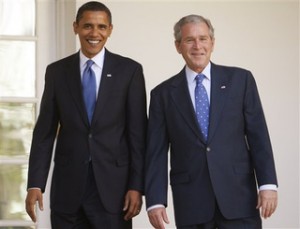
Barack Obama and George W. Bush at the White House
On Monday, The Washington Post dismissed the devastating airstrike at Deir al-Zour killing at least 62 Syrian soldiers as one of several “mishaps” that had occurred over the past week and jeopardized a limited ceasefire, arranged between Russia and the Obama administration.
But the fact that the U.S. and several allies have been routinely violating Syrian sovereign airspace to carry out attacks was not even an issue, nor is it a scandal that the U.S. military and CIA have been arming and training Syrian rebels. In the world of Official Washington, the United States has the right to intervene anywhere, anytime, for whatever reason it chooses.
President Barack Obama has even publicly talked about authorizing military strikes in seven different countries, including Syria, and yet he is deemed “weak” for not invading more countries, at least more decisively.
Democratic presidential nominee Hillary Clinton has vowed to engage in a larger invasion of Syria, albeit wrapping the aggression in pretty words like “safe zone” and “no-fly zone,” but it would mean bombing and killing more Syrian soldiers.
As Secretary of State, Clinton used similar language to justify invading Libya and implementing a “regime change” that killed the nation’s leader, Muammar Gaddafi, and unleashed five years of violent political chaos.
If you were living in a truly democratic country with a truly professional news media, you would think that this evolution of the United States into a rogue superpower violating pretty much every international law and treaty of the post-World War II era would be a regular topic of debate and criticism.
Those crimes include horrendous acts against people, such as torture and other violations of the Geneva Conventions, as well as acts of aggression, which the Nuremberg Tribunals deemed “the supreme international crime differing only from other war crimes in that it contains within itself the accumulated evil of the whole.”
Justifying ‘Regime Change’
Yet, instead of insisting on accountability for American leaders who have committed these crimes, the mainstream U.S. news media spreads pro-war propaganda against any nation or leader that refuses to bend to America’s imperial demands. In other words, the U.S. news media creates the rationalizations and arranges the public acquiescence for U.S. invasions and subversions of other countries.
In particular, The New York Times now reeks of propaganda, especially aimed at two of the current targets, Syrian President Bashar al-Assad and Russian President Vladimir Putin. With all pretenses of professionalism cast aside, the Times has descended into the status of a crude propaganda organ.
On Sunday, the Times described Assad’s visit to a town recently regained from the rebels this way: “Assad Smiles as Syria Burns, His Grip and Impunity Secure.” That was the headline. The article began:
“On the day after his 51st birthday, Bashar al-Assad, the president of Syria, took a victory lap through the dusty streets of a destroyed and empty rebel town that his forces had starved into submission.
“Smiling, with his shirt open at the collar, he led officials in dark suits past deserted shops and bombed-out buildings before telling a reporter that — despite a cease-fire announced by the United States and Russia — he was committed ‘to taking back all areas from the terrorists.’ When he says terrorists, he means all who oppose him.”
The story by Ben Hubbard continues in that vein, although oddly the accompanying photograph doesn’t show Assad smiling but rather assessing the scene with a rather grim visage.
But let’s unpack the propaganda elements of this front-page story, which is clearly intended to paint Assad as a sadistic monster, rather than a leader fighting a foreign-funded-and-armed rebel movement that includes radical jihadists, including powerful groups linked to Al Qaeda and others forces operating under the banner of the brutal Islamic State.
The reader is supposed to recoil at Assad who “smiles as Syria burns” and who is rejoicing over his “impunity.” Then, there’s the apparent suggestion that his trip to Daraya was part of his birthday celebration so he could take “a victory lap” while “smiling, with his shirt open at the collar,” although why his collar is relevant is hard to understand. Next, there is the argumentative claim that when Assad refers to “terrorists” that “he means all who oppose him.”
As much as the U.S. news media likes to pride itself on its “objectivity,” it is hard to see how this article meets any such standard, especially when the Times takes a far different posture when explaining, excusing or ignoring U.S. forces slaughtering countless civilians in multiple countries for decades and at a rapid clip over the past 15 years. If anyone operates with “impunity,” it has been the leadership of the U.S. government.
Dubious Charge
On Sunday, the Times also asserted as flat fact the dubious charge against Assad that he has “hit civilians with gas attacks” when the most notorious case – the sarin attack outside Damascus on Aug. 21, 2013 – appears now to have been carried out by rebels trying to trick the United States into intervening more directly on their side.
A recent United Nations report blaming Syrian forces for two later attacks involving chlorine was based on slim evidence and produced under great political pressure to reach that conclusion – while ignoring the absence of any logical reason for the Syrian forces to have used such an ineffective weapon and brushing aside testimony about rebels staging other gas attacks.
More often than not, U.N. officials bend to the will of the American superpower, failing to challenge any of the U.S.-sponsored invasions over recent decades, including something as blatantly illegal as the Iraq War. After all, for an aspiring U.N. bureaucrat, it’s clear which side his career bread is buttered.
We find ourselves in a world in which propaganda has come to dominate the foreign policy debates and – despite the belated admissions of lies used to justify the invasions of Iraq and Libya – the U.S. media insists on labeling anyone who questions the latest round of propaganda as a “fill-in-the-blank apologist.”
So, Americans who want to maintain their mainstream status shy away from contesting what the U.S. government and its complicit media assert, despite their proven track record of deceit. This is not just a case of being fooled once; it is being fooled over and over with a seemingly endless willingness to accept dubious assertion after dubious assertion.
In the same Sunday edition which carried the creepy portrayal about Assad, the Times’ Neil MacFarquhar pre-disparaged Russia’s parliamentary elections because the Russian people were showing little support for the Times’ beloved “liberals,” the political descendants of the Russians who collaborated with the U.S.-driven “shock therapy” of the 1990s, a policy that impoverished a vast number of Russians and drastically reduced life expectancy.
Why those Russian “liberals” have such limited support from the populace is a dark mystery to the mainstream U.S. news media, which also can’t figure out why Putin is popular for significantly reversing the “shock therapy” policies and restoring Russian life expectancy to its previous levels. No, it can’t be that Putin delivered for the Russian people; the only answer must be Putin’s “totalitarianism.”
The New York Times and Washington Post have been particularly outraged over Russia’s crackdown on “grassroots” organizations that are funded by the U.S. government or by billionaire financial speculator George Soros, who has publicly urged the overthrow of Putin. So has Carl Gershman, president of the National Endowment for Democracy (NED), which funnels U.S. government cash to political and media operations abroad.
The Post has decried a Russian legal requirement that political entities taking money from foreign sources must register as “foreign agents” and complains that such a designation discredits these organizations. What the Post doesn’t tell its readers is that the Russian law is modeled after the American “Foreign Agent Registration Act,” which likewise requires people trying to influence policy in favor of a foreign sponsor to register with the Justice Department.
Nor do the Times and Post acknowledge the long history of the U.S. government funding foreign groups, either overtly or covertly, to destabilize targeted regimes. These U.S.-financed groups often do act as “fifth columnists” spreading propaganda designed to undermine the credibility of the leaders, whether that’s Iranian Prime Minister Mohammad Mosaddegh in 1953 or Ukrainian President Viktor Yanukovych in 2014.
Imperfect Leaders
That’s not to say that these targeted leaders were or are perfect. They are often far from it. But the essence of propaganda is to apply selective outrage and exaggeration to the leader that is marked for removal. Similar treatment does not apply to U.S.-favored leaders.
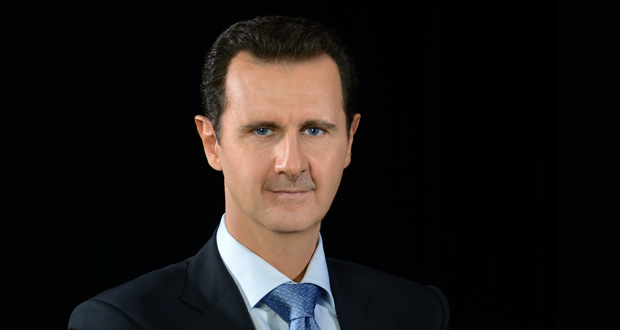
Syrian President Bashar al-Assad
The pattern of the Times and Post is also to engage in ridicule when someone in a targeted country actually perceives what is going on. The correct perception is then dismissed as some sort of paranoid conspiracy theory.
Take, for example, the Times’ MacFarquhar describing a pamphlet and speeches from Nikolai Merkushkin, the governor of Russian region of Samara, that MacFarquhar says “cast the blame for Russia’s economic woes not on economic mismanagement or Western sanctions after the annexation of Crimea but on a plot by President Obama and the C.I.A. to undermine Russia.”
The Times article continues: “Opposition candidates are a fifth column on the payroll of the State Department and part of the scheme, the pamphlet said, along with the collapse in oil prices and the emergence of the Islamic State. Mr. Putin is on the case, not least by rebuilding the military, the pamphlet said, noting that ‘our country forces others to take it seriously and this is something that American politicians don’t like very much.’”
Yet, despite the Times’ mocking tone, the pamphlet’s perceptions are largely accurate. There can be little doubt that the U.S. government through funding of anti-Putin groups inside Russia and organizing punishing sanctions against Russia, is trying to make the Russian economy scream, destabilize the Russian government and encourage a “regime change” in Moscow.
Further, President Obama has personally bristled at Russia’s attempts to reassert itself as an important world player, demeaning the former Cold War superpower as only a “regional power.” The U.S. government has even tread on that “regional” status by helping to orchestrate the 2014 putsch that overthrew Ukraine’s elected President Yanukovych on Russia’s border.
After quickly calling the coup regime “legitimate,” the U.S. government supported attempts to crush resistance in the south and east which were Yanukovych’s political strongholds. Crimea’s overwhelming decision to secede from Ukraine and rejoin Russia was deemed by The New York Times a Russian “invasion” although the Russian troops that helped protect Crimea’s referendum were already inside Crimea as part of the Sevastopol basing agreement.
The U.S.-backed Kiev regime’s attempt to annihilate resistance from ethnic Russians in the east – through what was called an “Anti-Terrorism Operation” that has slaughtered thousands of eastern Ukrainians – also had American backing. Russian assistance to these rebels is described in the mainstream U.S. media as Russian “aggression.”
Oddly, U.S. news outlets find nothing objectionable about the U.S. government launching military strikes in countries halfway around the world, including the recent massacre of scores of Syrian soldiers, but are outraged that Russia provided military help to ethnic Russians being faced with annihilation on Russia’s border.
Because of the Ukraine crisis, Hillary Clinton likened Vladimir Putin to Adolf Hitler.
Seeing No Coup
For its part, The New York Times concluded that there had been no coup in Ukraine – by ignoring the evidence that there was one, including an intercepted pre-coup telephone call between U.S. Assistant Secretary of State Victoria Nuland and U.S. Ambassador Geoffrey Pyatt discussing who should be made the new leaders of Ukraine.
The evidence of a coup was so clear that George Friedman, founder of the global intelligence firm Stratfor, said in an interview that the overthrow of Yanukovych “really was the most blatant coup in history.” But the Times put protecting the legitimacy of the post-coup regime ahead of its journalistic responsibilities to its readers, as it has done repeatedly regarding Ukraine.
Another stunning case of double standards has been the mainstream U.S. media’s apoplexy about alleged Russian hacking into emails of prominent Americans and then making them public. These blame-Russia articles have failed to present any solid evidence that the Russians were responsible and also fail to note that the United States leads the world in using electronic means to vacuum up personal secrets about foreign leaders as well as average citizens.
In a number of cases, these secrets appear to have been used to blackmail foreign leaders to get them to comply with U.S. demands, such as the case in 2002-03 of the George W. Bush administration spying on diplomats on the U.N. Security Council to coerce their votes on authorizing the U.S. invasion of Iraq, a ploy that failed.
U.S. intelligence also tapped the cell phone of German Chancellor Angela Merkel, whose cooperation on Ukraine and other issues of the New Cold War is important to Washington. And then there’s the massive collection of data about virtually everybody on the planet, including U.S. citizens, over the past 15 years during the “war on terror.”
Earlier this year, the mainstream U.S. news media congratulated itself over its use of hacked private business data from a Panama-based law firm, material that was said to implicate Putin in some shady business dealings even though his name never showed up in the documents. No one in the mainstream media protested that leak or questioned who did the hacking.
Such mainstream media bias is pervasive. In the case of Sunday’s Russian elections, the Times seems determined to maintain the fiction that the Russian people don’t really support Putin, despite consistent opinion polls showing him with some 80 percent approval.
In the Times’ version of reality, Putin’s popularity must be some kind of trick, a case of totalitarian repression of the Russian people, which would be fixed if only the U.S.-backed “liberals” were allowed to keep getting money from NED and Soros without having to divulge where the funds were coming from.
The fact that Russians, like Americans, will rally around their national leader when they perceive the country to be under assault – think, George W. Bush after the 9/11 attacks – is another reality that the Times can’t tolerate. No, the explanation must be mind control.
The troubling reality is that the Times, Post and other leading American news outlets have glibly applied one set of standards on “enemies” and another on the U.S. government. The Times may charge that Bashar al-Assad has “impunity” for his abuses, but what about the multitude of U.S. leaders – and, yes, journalists – who have their hands covered in the blood of Iraqis, Libyans, Afghans, Yemenis, Syrians, Somalis and other nationalities. Where is their accountability?
Investigative reporter Robert Parry broke many of the Iran-Contra stories for The Associated Press and Newsweek in the 1980s. You can buy his latest book, America’s Stolen Narrative, either in print here or as an e-book (from Amazon and barnesandnoble.com).
Billions in Taxpayer Money to Israel: How the NYT Hides Unsavory Facts from View
By Barbara Erickson | TimesWarp | September 15, 2016
Thanks to American taxpayers, Israel has been receiving $3.1 billion in direct military aid each year, and under a new agreement signed this week that amount is set to rise to $3.8 annually. This is a hefty package and major news, but The New York Times has been oddly reticent about it, running a story on page 6 of the print edition and without fanfare online.
This is not a new phenomenon at the Times. Over the past year, as the United States and Israel have negotiated a new 10-year memorandum of understanding concerning military aid, readers have seen few references to the topic, and even with the signing of a new agreement this week, the newspaper maintains its minimalist approach.
The article by Peter Baker and Julie Hirschfeld Davis gives few details of the deal, instead proving a great deal of space to the state of U.S.-Israeli relations. The story reports that the present aid package (signed in 2007 and due to expire next year) amounts to “about $3 billion a year” with additional funds of up to $500 million a year authorized by Congress for missile defense.
We also learn that Israel made some concessions in negotiations, that this week’s deal is “the largest of its kind” and that Israel receives more U.S. money than any other country. But much is missing.
In fact, Israel gets more than half of all U.S. military aid ($3.1 billion out of a total of $5.9 billion), and Israel together with Egypt receives 75 percent of American foreign military assistance. Since the large allotment for Egypt is aimed at maintaining a non-threatening neighbor on Israel’s border, this could also be counted as indirect aid to Israel.
In fact Israel has been receiving well over $3.1 billion. By a conservative estimate, the United States has been giving the country $3.7 billion in direct aid annually with funds for immigrants to Israel, grants for American hospitals and schools, “joint defense projects” with the Department of Defense, and an early disbursement of aid.
The last item on that list refers to a special arrangement: In contrast to other recipients, Israel receives all its funds from the United States in one lump sum within the first month of the fiscal year. The money is then transferred to a Federal Reserve Bank interest-bearing account, allowing Israel to accrue some $15 million annually in interest.
Then there are other perks, such as loan guarantees, “cash flow financing,” and the right to purchase arms directly from companies rather than going through a Department of Defense review.
In addition, donations sent by Jewish and Christian groups to support settlements are tax-exempt. So every dollar donated to support the colonization of Palestinian land means the loss of at least 20 cents that should go into the U.S. treasury. This is an indirect subsidy to Israel that has cost American taxpayers an incalculable amount, at least some tens of millions of dollars.
The Times, however, has shown no interest in revealing the full extent of aid or of pursuing the arguments against pouring so much money into Israel. This week’s story mentions criticism of the aid agreement not until about three quarters into the text, and then it is reduced to three bland paragraphs with quotes from the representative of an anti-occupation organization.
In fact, the opposition goes well beyond such groups. A member of Congress, Rep. Betty McCollum (D-MN), has asked the State Department to investigate Israeli military units for possible violations of the Leahy Act, which prohibits the dispersal of U.S. funds to groups that violate human rights with impunity.
In 2012, 15 leaders of major religious organizations wrote to Congress asking that military aid be made contingent on compliance with American law. Other groups have sponsored billboards in various areas of the country highlighting the incredible largesse the United States provides for Israel.
Moreover, a poll of Americans taken in 2014 revealed that 60 percent believed the United States gives too much aid to Israel, and of that group 34 percent said it received “much too much.” The percentage claiming that our aid package was excessive was even higher (65 percent) among Americans under 34.
Other commentators have noted that Israel is a wealthy country, with universal health care, and is less in need of help than American citizens who struggle to fund their schools, pay for prescription drugs and meet medical fees.
None of this debate appears in the Times, which seems determined to keep the subject well below the radar. Thus we find a lightweight story on the inside pages of the print edition, well behind a more prominent one about Syrian and Israeli skirmishes in the Golan Heights, and an uninformative one-minute video of the signing ceremony on the Middle East page.
Times readers are to remain ignorant of the full, unsavory story about U.S. aid to Israel. If the facts were fully reported, this might inspire unwelcome questions and pushback. Better to say as little as possible and allow Israel to keep collecting its yearly billions from American taxpayers.
Follow @TimesWarp on Twitter.
A History of Violence
What mainstream accounts of Venezuela’s “peaceful” opposition leave out
By Gabriel Hetland | Jacobin | September 11, 2016
The media narrative is clear: peaceful demonstrators upset about a collapsing economy and political repression are fighting an oppressive state in Venezuela. The actual history, however, is more murky.
For more than a decade the Venezuelan opposition has used a variety of violent tactics to try to topple the country’s democratically elected government. An April 2002 coup deposed Hugo Chávez for forty-seven hours and led to multiple civilian deaths.
Violent protests in April 2013 targeted government-run health clinics and other public institutions, resulting in at least seven civilian casualties; this occurred following the 2013 presidential election, which the opposition lost but refused to concede to the government. The early 2014 wave of protests resulted in forty-three deaths, half at the hands of the opposition.
During the 2014 protests, opposition activists deliberately targeted state security forces and even strung galvanized wire across intersections, leading to the brutal decapitation of a motorcyclist. Nor can we omit mention of the approximately two hundred peasant leaders killed by ranchers opposed to the 2001 land reform law pushed by Chávez.
This brutal history is almost totally absent from mainstream media depictions of the opposition. The same is true of leading opposition figures’ present-day celebrations of this violence. In mainstream accounts of last week’s protests in Caracas, the opposition is depicted as an essentially peaceful force, seeking to use constitutional means — a recall referendum — to legally put an end to an incompetent, repressive government.
An article on the protests in the Wall Street Journal quotes an opposition supporter saying, “[D]on’t tell me that we didn’t try to demand change peacefully through the constitution.” The article briefly mentions the 2002 coup, but fails to note that leading members of today’s opposition played key roles in that episode. Nor does it make any mention of more recent instances of opposition violence.
A New York Times article on the protests details the deteriorating conditions in Venezuela leading people to protest against the government, and provides ample coverage of claims that the government has repressed dissident politicians and foreign journalists. No mention is made of opposition violence.
A BBC article on the September 1 protests states that “A small group of protesters clashed with riot police as the peaceful rally ended.” The article mentions the 2014 protests and states that, “Forty-three people on both sides of the political divide were killed during those protests.” Like other mainstream articles, however, this piece focuses disproportionately on opposition allegations of instances of government repression.
A piece in Bloomberg on the September 1 protests briefly discusses the 2014 protests, but misleadingly gives readers the impression that “over 40 people were killed” because of a government “crackdown on anti-government protests,” eliding the opposition’s responsibility for many of those deaths.
The takeaway from these and other mainstream media stories about the protests is clear: the opposition is peaceful, and there is no reason to believe the government’s delusional and self-serving claims that it faces a real threat of a violent coup.
Indeed, opposition leaders have repeatedly denied seeking a coup. But statements from these figures, not to mention recent history, indicate that the government may have more reason to worry than mainstream sources allow for.
In May, Henrique Capriles, the opposition presidential candidate in the 2012 and 2013 elections, exhorted the Venezuelan military to “decide whether you are with the constitution or with Maduro.”
Other opposition leaders, such as Jesús Torrealba, have also made public statements that steer clear of explicitly calling on the military to overthrow the government, but still suggest that the military should actively support the opposition against President Maduro. One wonders how government officials in other countries would react if leading opposition figures made similar statements there?
A good test of whether the opposition is as “peaceful” as media accounts suggest is to examine how opposition leaders speak about past episodes of violence. It’s telling that key opposition figures not only fail to express remorse or contrition when events such as the 2002 coup are discussed, but openly celebrate such acts.
During a speech given on August 27, just days before the September 1 protests, Venezuelan National Assembly head and leading opposition figure Henry Ramos Allup repeatedly refers to the coup in an approving matter. In the speech Ramos Allup makes it clear that his only regret is that it did not succeed in ousting Chávez.
No doubt, there is plenty to criticize about the Venezuelan government these days. The government deserves ample blame for mismanaging its currency and failing to confront corruption. State violence that does occur should be condemned and there’s a need for an independent left to grow in the country. But the narratives we’re being sold by the media are giving the opposition a free pass.
Gabriel Hetland teaches at University at Albany and has written about Venezuelan politics for the Nation, NACLA, Qualitative Sociology, and Latin American Perspectives.
The New York Times is looking for a climate change editor
Drone footage that shows Greenland melting away. Long narratives about the plight of climate refugees, from Louisiana to Bolivia and beyond. A series on the California drought. Color-coded maps that show how hot it could be in 2060.
The New York Times is a leader in covering climate change. Now The Times is ramping up its coverage to make the most important story in the world even more relevant, urgent and accessible to a huge audience around the globe.
We are looking for an editor to lead this dynamic new group. We want someone with an entrepreneurial streak who is obsessed with finding new ways to connect with readers and new ways to tell this vital story.
The coverage should encompass: the science of climate change; the politics of climate debates; the technological race to find solutions; the economic consequences of climate change; and profiles of fascinating characters enmeshed in the issues.
The coverage should include journalism in a variety of formats: video, photography, newsletters, features, podcasts, conferences and more. The unit should make strategic decisions about which forms are top priorities and which are not.
The climate editor will collaborate with many others throughout the newsroom, but will operate apart from the current department structure, with no print obligations. —
To Apply
Applicants should submit a resume, examples of previous work, and a memo outlining their vision for coverage to Dean Baquet and Sam Dolnick by Sept. 19. This vision is the most important part of the application. It should be specific and set clear priorities. Some important questions to wrestle with:
What audiences should we be focusing on?
How will our coverage fit into their lives, and how will they experience it?
How will we distinguish our coverage from other journalism in this space?
What will be the main vehicles for the coverage? Features? News? Videos?
Should there be a signature voice attached to our climate coverage? Who?
How will you make a difficult subject interesting and accessible?
What stories are we willing not to do?
What should the team look like to get it done?
This non-Guild position is open to internal and external candidates. Applications should be sent to nytrecruit@nytimes.com.
North Korea’s Understandable Fears
By James Bradley | Consortium News | September 10, 2016
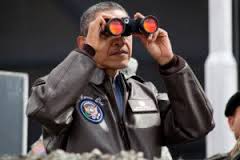
‘Near the ceasefire line’ (Photo by Pete Souza)
North Korea carried out its fifth nuclear test on Friday, drawing condemnation from President Obama and a charge from the Pentagon that the test was a “serious provocation.” Ho-hum, here we go again.
Every year, America pays its vassal-state South Korea huge sums of U.S. taxpayer money to mount 300,000-man-strong military “games” that threaten North Korea. North Koreans view images that never seem to make it to U.S. kitchen tables: hundreds of millions of dollars’ worth of U.S. armaments swarming in from the sea, hundreds of tanks and thousands of troops – their turrets and rifles pointed north – and nuclear-capable U.S. warplanes screaming overhead.
But when a young dictator straight out of central casting responds to U.S. threats with an underground test on North Korea’s founding day, it’s the number-one story on the front page of the New York Times.
Let’s connect some dots. Washington and their note takers in the American press constantly tell us that crazies in Pyongyang and Tehran are nuclear threats. The misplaced, but easily sold, fears of the “North Korean missile threat” and the “Iran missile threat” allows the Pentagon to install “defensive” missile systems in South Korea and Eastern Europe which actually amount to offensive systems targeting Beijing and Moscow (by making first strikes against China and Russia more feasible).
We need to look beyond the simplistic, race-based cartoon-like scaremongering to see that far more reality-based and frightening is the nuclear threat posed by the United States.
President Obama — the Nobel Prize winner who pledged to lead a nuclear-free world — has committed over $1 trillion dollars to modernize America’s nuclear arsenal. Almost unreported by the press, we have been spending a bundle to make nukes “usable,” by miniaturizing them. And to top it off, Obama has maintained a “first use” option for the U.S. nuclear arsenal.
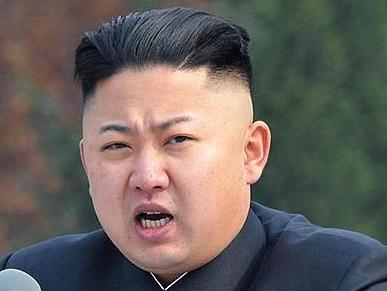
North Korean leader Kim Jong Un
Forget the tin-pot dictator with a bad crew-cut who leads an impoverished country. Here’s for some really scary reading:
Obama’s Trillion-Dollar Nuclear-Arms Train Wreck
Obama plans to retain first-use nuclear option
New U.S. Nuclear Bomb Moves Closer to Full-Scale Production
THAAD: A Major Security Risk for the ROK
James Bradley is author of several bestsellers including Flyboys and Flags of Our Fathers. His most recent book is The China Mirage: The Hidden History of American Disaster in Asia.
Conspiracy Theory in America
By Lance deHaven-Smith | OffGuardian | September 4, 2016

As an opener to our “9/11 – 15 years on” we’re sharing this extract from the book Conspiracy Theory in America by Lance deHaven Smith. Regardless of where we stand on the events of 9/11 we need to be aware of the intelligence-backed media campaign that lies behind the current social context of the phrase “conspiracy theory”.
A Curious History
The term “conspiracy theory” did not exist as a phrase in everyday American conversation before 1964. The conspiracy-theory label entered the American lexicon of political speech as a catchall for criticisms of the Warren Commission’s conclusion that President Kennedy was assassinated by a lone gunman with no assistance from, or foreknowledge by, any element of the United States government. Since then, the term’s prevalence and range of application have exploded. In 1964, the year the Warren Commission issued its report, the New York Times published five stories in which “conspiracy theory” appeared. In recent years, the phrase has occurred in over 140 New York Times stories annually. A Google search for the phrase (in 2012) yielded more than 21 million hits—triple the numbers for such common expressions as “abuse of power” and “war crime.” On Amazon.com, the term is a book category that includes in excess of 1,300 titles. In addition to books on conspiracy theories of particular events, there are conspiracy-theory encyclopedias, photographic compendiums, website directories, and guides for researchers, skeptics, and debunkers.
Initially, conspiracy theories were not an object of ridicule and hostility. Today, however, the conspiracy-theory label is employed routinely to dismiss a wide range of anti-government suspicions as symptoms of impaired thinking akin to superstition or mental illness. For example, in a massive book published in 2007 on the assassination of President Kennedy, former prosecutor Vincent Bugliosi says people who doubt the Warren Commission report are “as kooky as a three dollar bill in their beliefs and paranoia.” Similarly, in his recently published book Among the Truthers (Harper’s, 2011), Canadian journalist Jonathan Kay refers to 9/11 conspiracy theorists as “political paranoiacs” who have “lost their grip on the real world.” Making a similar point, if more colorfully, in his popular book Wingnuts, journalist John Avlon refers to conspiracy believers as “moonbats,” “Hatriots,” “wingnuts,” and the “Fright Wing.”
The same judgment is expressed in more measured terms by Cass Sunstein and Adrian Vermeule in a 2009 journal article on the “causes and cures” of conspiracy theories. Sunstein is a Harvard law professor appointed by President Obama to head the Office of Information and Regulatory Affairs. He and Vermeule claim that once a person buys into them, conspiracy theories are resistant to debunking because they are “self-sealing.” That is, because conspiracy theories attribute extraordinary powers to elites to orchestrate events, keep secrets, and avoid detection, the theories encourage their adherents to dismiss countervailing evidence as fabricated or planted.
In a book on technology and public opinion, Sunstein argues further that conspiracy-theory groups and networks are proliferating because the highly decentralized form of mass communication made possible by the Internet is altering the character of public discourse. Whereas television and radio provide platforms for debating competing viewpoints on matters of widely shared interest, the Internet tends to segment discussion into a multitude of small groups, each focusing on a separate and distinct topic. Sunstein argues that this splintering of discourse encourages extremism because it allows proponents of false or one-sided beliefs to locate others with similar views while at the same time avoiding interaction with competing perspectives. In Sunstein’s words, “The Internet produces a process of spontaneous creation of groups of like-minded types, fueling group polarization. People who would otherwise be loners, or isolated in their objections and concerns, congregate into social networks.” Sunstein acknowledges that this consequence of the Internet is unavoidable, but he says polarization can and should be mitigated by a combination of government action and voluntarily adopted norms. The objective, he says, should be to ensure that those who hold conspiracy theories “are exposed to credible counterarguments and are not living in an echo chamber of their own design”.
In their law review article, Sunstein and Vermeule expand this idea and propose covert government action reminiscent of the FBI’s efforts against the civil rights and antiwar movements in the 1960s. They consider a number of options for countering the influence of conspiracy theories, including public information campaigns, censorship, and fines for Internet service providers hosting conspiracy-theory websites. Ultimately rejecting those options as impractical because they would attract attention and reinforce anti-government suspicions, they call for a program of “cognitive infiltration” in which groups and networks popularizing conspiracy theories would be infiltrated and “disrupted.”
A Flawed and Un-American Label
As these examples illustrate, conspiracy deniers assume that what qualifies as a conspiracy theory is self-evident. In their view, the phrase “conspiracy theory” as it is conventionally understood simply names this objectively identifiable phenomenon. Conspiracy theories are easy to spot because they posit secret plots that are too wacky to be taken seriously. Indeed, the theories are deemed so far-fetched they require no reply or rejoinder; they are objects of derision, not ideas for discussion. In short, while analyzing the psychological appeal of conspiracy beliefs and bemoaning their corrosive effects on public trust, conspiracy deniers have taken the conspiracy-theory concept itself for granted.
This is remarkable, not to say shocking, because the concept is both fundamentally flawed and in direct conflict with American legal and political traditions. As a label for irrational political suspicions about secret plots by powerful people, the concept is obviously defective because political conspiracies in high office do, in fact, happen. Officials in the Nixon administration did conspire to steal the 1972 presidential election. Officials in the Reagan White House did participate in a criminal scheme to sell arms to Iran and channel profits to the Contras, a rebel army in Nicaragua. The Bush-Cheney administration did collude to mislead Congress and the public about the strength of its evidence for Iraqi weapons of mass destruction. If some conspiracy theories are true, then it is nonsensical to dismiss all unsubstantiated suspicions of elite intrigue as false by definition.
This fatal defect in the conspiracy-theory concept makes it all the more surprising that most scholars and journalists have failed to notice that their use of the term to ridicule suspicions of elite political criminality betrays the civic ethos inherited from the nation’s Founders. From the nation’s beginning, Americans were fearful of secret plots by political insiders to subvert constitutional governance. Those who now dismiss conspiracy theories as groundless paranoia have apparently forgotten that the United States was founded on a conspiracy theory. The Declaration of Independence claimed that “a history of repeated injuries and usurpations” by King George proved the king was plotting to establish “an absolute tyranny over these states.” Today, most Americans are familiar only with the Declaration’s opening paragraphs about self-evident truths and inalienable rights, but if they were to read the rest of the document, they would see that it is devoted to detailing the abuses evincing the king’s tyrannical design. Among the complaints listed are onerous taxation, fomenting slave rebellions and Indian uprisings, taxation without representation, and indifference to the colonies’ complaints. The document’s signers claimed it was this “design to reduce them under absolute despotism,” not any or all of the abuses themselves, that gave them the right and the duty “to throw off such government, and to provide new guards for their future security.”
The Founders considered political power a corrupting influence that makes political conspiracies against the people’s interests and liberties almost inevitable. They repeatedly and explicitly called for popular vigilance against antidemocratic schemes in high office. Educated in classical political philosophy, they understood that one of the most important questions in Western political thought is how to prevent top leaders from abusing their powers to impose arbitrary rule, which the Founders referred to, appropriately, as “tyranny.” Whereas Great Britain relied on common law to define the powers and procedures of its government, the generation that established the American republic developed a written constitution to set clear limits on public officials. Nevertheless, they understood that all constitutions are vulnerable to subversion because ultimately they are interpreted and administered by public officials themselves. The Founders would view today’s norms against conspiratorial suspicion as not only arrogant, but also dangerous and un-American.
The Founders would also be shocked that conspiracy deniers attack and ridicule individuals who voice conspiracy beliefs and yet ignore institutional purveyors of conspiratorial ideas even though the latter are the ideas that have proven truly dangerous in modern American history. Since at least the end of World War II, the citadel of theories alleging nefarious political conspiracies has been, not amateur investigators of the Kennedy assassination and other political crimes and tragedies, but the United States government. In the first three decades of the post–World War II era, U.S. officials asserted that communists were conspiring to take over the world, that the U.S. bureaucracy was riddled with Soviet spies, and that the civil rights and antiwar movements of the 1960s were creatures of Soviet influence. More recently, they have claimed that Iraq was complicit in 9/11, failed to dispose of its biological weapons, and attempted to purchase uranium in Niger so it could construct nuclear bombs. Although these ideas were untrue, they influenced millions of Americans, fomented social panic, fueled wars, and resulted in massive loss of life and destruction of property. If conspiracy deniers are so concerned about the dangers of conspiratorial suspicions in American politics and civic culture, why have they ignored the conspiracism of U.S. politicians?
Finally, there is something very hypocritical about those who want to fix people who do not share their opinions. Sunstein and Vermeule say conspiracy believers need to have their discussions disrupted, because they are dangerous. But what could be more dangerous than thinking it is acceptable to mess with someone else’s thoughts? Sunstein and Vermeule’s hypocrisy is breathtaking. They would have government conspiring against citizens who voice suspicions about government conspiracies, which is to say they would have government do precisely what they want citizens to stop saying the government does. How do Harvard law professors become snared in such Orwellian logic? One can only assume that there must be something bedeviling about the idea of conspiracy theory.
Naming the Taboo Topic
In what follows, I shall attempt to reorient analysis of the phenomenon that has been assigned the derisive label of “conspiracy theory.” In a 2006 peer-reviewed journal article, I introduced the concept of State Crime against Democracy (SCAD) to displace the term “conspiracy theory.” I say displace rather than replace because SCAD is not another name for conspiracy theory; it is a name for the type of wrongdoing about which the conspiracy-theory label discourages us from speaking. Basically, the term “conspiracy theory” is applied pejoratively to allegations of official wrongdoing that have not been substantiated by public officials themselves.
Deployed as a pejorative putdown, the label is a verbal defense mechanism used by political elites to suppress mass suspicions that inevitably arise when shocking political crimes benefit top leaders or play into their agendas, especially when those same officials are in control of agencies responsible for preventing the events in question or for investigating them after they have occurred. It is only natural to wonder about possible chicanery when a president and vice president bent on war in the Middle East are warned of impending terrorist attacks and yet fail to alert the American public or increase the readiness of the nation’s armed forces. Why would Americans not expect answers when Arabs with poor piloting skills manage to hijack four planes, fly them across the eastern United States, somehow evade America’s multilayered system of air defense, and then crash two of the planes into the Twin Towers in New York City and one into the Pentagon in Washington, DC? By the same token, it is only natural to question the motives of the president and vice president when they drag their feet on investigating this seemingly inexplicable defense failure and then, when the investigation is finally conducted, they insist on testifying together, in secret, and not under oath. Certainly, citizen distrust can be unwarranted and overwrought, but often citizen doubts make sense. Americans are not crazy to want answers when a president is assassinated by a lone gunman with mediocre shooting skills who manages to get off several lucky shots with an old bolt-action carbine that has a misaligned scope. Why would there not be doubts when an alleged assassin is apprehended, publicly claims he is just a patsy, is interrogated for two days but no one makes a recording or even takes notes, and he is then shot to death at point-blank range while in police custody at police headquarters?
Of course, some suspicions go too far. The idea that lizard-like aliens from space are secretly infiltrating top positions in government and business is ludicrous. However, the conspiracy-theory label makes fun of conspiratorial suspicions in general. Consequently, the label discourages Americans from registering doubts about their leaders’ motives and actions regardless of the circumstances. Any suspicions that public officials conspired to cause a tragedy or allowed it to happen are dismissed without further discussion because, supposedly, public officials simply do not engage in conspiracies.
Communication scientists Ginna Husting and Martin Orr, both of whom are professors at Boise State University, have studied the use of the conspiracy-theory label as a putdown. At the beginning of a peer-reviewed 2007 article on the subject, they point out how the label works rhetorically:
If I call you a conspiracy theorist, it matters little whether you have actually claimed that a conspiracy exists or whether you have simply raised an issue that I would rather avoid . . . I twist the machinery of interaction so that you, not I, are now called to account. In fact, I have done even more. By labeling you, I strategically exclude you from the sphere where public speech, debate, and conflict occur.
Husting and Orr go on to explain that the accusation of conspiracy theory discredits any explanations offered for specific social or historical events “regardless of the quality or quantity of evidence.” The label has this discrediting, end-of-argument effect because conspiracy theories have come to be seen as mere suspicions with no basis in fact, not as reasonable inferences from circumstances and evidence about matters of great importance.
In contrast, the SCAD construct does not refer to a type of allegation or suspicion; it refers to a special type of transgression: an attack from within on the political system’s organizing principles. For these extremely grave crimes, America’s Founders used the term “high crime” and included in this category treason and “conspiracies against the people’s liberties.” SCADs, high crimes, and antidemocratic conspiracies can also be called “elite political crimes” and “elite political criminality.” The SCAD construct is intended, not to supersede traditional terminology or monopolize conceptualization of this phenomenon, but rather to add a descriptive term that captures, with some specificity, the long-recognized potential for representative democracy to be subverted by people on the inside—the very people who have been entrusted to uphold the constitutional order.
SCADs are defined as concerted actions or inaction by government insiders intended to manipulate democratic processes and undermine popular sovereignty. Examples of SCADs that have been officially proven include the Watergate break-in and cover-up; the illegal arms sales and covert operations in Iran-Contra; and the effort to discredit Joseph Wilson by revealing his wife’s status as an intelligence agent.
Many other political crimes in which involvement by high officials is reasonably suspected have gone uninvestigated or have been investigated only superficially. They are included in SCAD studies even when the evidence of state complicity is contested, because excluding them would mean accepting the judgment of individuals and institutions whose rectitude and culpability are at issue. The nature of the subject matter is such that official inquiries, if they are conducted at all, are usually compromised by conflicts of interest. Hence the evidence must be evaluated independently on its merits, and decisions must be made on a case-by-case basis about which events are most likely elite political crimes. Of course, as Husting and Orr point out, engaging the evidence is precisely what the pejorative conspiracy-theory putdown is deployed rhetorically to avoid.
SCADs constitute a special type of political criminality. Unlike bribery, kickbacks, bid-rigging, and other, more mundane forms of political corruption, which tend to be isolated and to affect only pockets of government activity, SCADs have the potential to subvert political institutions and entire governments or branches of government. Committed at the highest levels of public office, they are crimes that threaten democracy itself. Clearly, such crimes and the circumstances that allow or encourage them warrant scientific study, both to better understand elite politics and to identify institutional vulnerabilities that can be corrected to make antidemocratic conspiracies less likely and less likely to succeed. Hence, one would have expected elite political crime, like white-collar crime, hate crime, and racketeering, to have been singled out for research and theorizing by social scientists long ago.
However, because powerful norms discourage Americans from questioning the integrity of their top leaders, and because anyone who raises such questions is likely to be seen as a “conspiracy theorist” who may be mentally unbalanced, the topic has been almost completely ignored by scholars. Social scientists have studied various forms of state crime, but in almost every case the potential for public officials in liberal democracies to subvert democratic institutions has been disregarded. Political science research on Watergate, Iran-Contra, and other U.S. political scandals has sidestepped questions about state criminality by studying the use of congressional investigations and independent prosecutors as political tactics in partisan competition.
Of course, a vast popular literature exists that presents a wide range of conspiracy theories of domestic assassinations and other high crimes, but the form of analysis employed, while careful and in many ways insightful, is not really scientific. Amateur investigators have uncovered important evidence overlooked by official inquiries, but, with only one or two exceptions, they have failed to investigate the general phenomenon of high criminality and instead have speculated about one suspicious incident at a time. There is a body of work on the assassination of President Kennedy, another on the events of 9/11, and still others on the 1980 October Surprise, the disputed 2000 presidential election, and the anthrax letter attacks. To be sure, we do learn a lot about each case; we learn a great deal, for example, about the assassination of President Kennedy and the assassination of Martin Luther King, but we learn next to nothing about assassinations in general, such as their typical targets, tactics, and timing, nor do we learn much about differences and similarities between assassinations and false-flag terrorism as political tactics. By the same token, since we learn little about the nature of elite political criminality in general, we gain little insight into the extent, nature, and role of elite crime and intrigue in American politics.
Perceptual Silos
The tendency to consider suspicious political events individually and in isolation rather than collectively and comparatively is not limited to the conspiracy-theory literature; it is built into the conspiracy-theory label and has become a pervasive predisposition in U.S. civic culture. For Americans, each assassination, each election breakdown, each defense failure, each war justified by “mistaken” claims is perceived as a unique event arising from its own special circumstances. While Americans in the present generation have personally witnessed many political crimes and tragedies, we see them as if through a fly’s eye, situating each event in a separate compartment of memories and context.
Even when obvious factors connect political crimes, the crimes are thought of as disparate and unrelated. For example, John Kennedy and Robert Kennedy were brothers; both were rivals of Richard Nixon and were hated by Lyndon Johnson; their murders occurred less than five years apart; both were killed while campaigning for the office of president; and both appeared likely to win the upcoming presidential election. Without their murders, neither Nixon nor Johnson would probably have ever become president. Nevertheless, the assassinations of John and Robert Kennedy are seen as entirely unrelated; parallels, if they are recognized at all, are dismissed as coincidences. It is seldom considered that the Kennedy assassinations might have been serial murders.
In fact, in speaking about the murders, Americans rarely use the plural, Kennedy assassinations. In the lexicon, there is the Kennedy assassination (singular), which refers to the murder of President Kennedy, and there is the assassination of Robert Kennedy. Clearly, this quirk in the Kennedy assassination(s) lexicon reflects an unconscious effort by journalists, politicians, and millions of ordinary Americans to avoid thinking about the two assassinations together, despite the fact that the victims are connected in countless ways and that they also deserve better—they deserve to be remembered as brothers who stood for the same values and who were somehow struck down by forces still beyond our grasp. This clever feat of keeping the Kennedy assassinations singular and separate might be called linguistic “compartmentalization,” for, by avoiding the plural of “assassination,” we have unconsciously split and compartmentalized in our awareness significantly related events.
For another example, consider how we compartmentalize our perceptions of the disputed 2000 and 2004 presidential elections. The election breakdowns are not widely suspected of being repeat offenses by the same network of political operatives employing the same tactics and resources, even though both elections were plagued by very similar problems, including inadequately equipped and staffed polling places in heavily Democratic areas, computer anomalies in the tabulation of county and state totals, highly partisan Republicans in charge of election administration, aggregate vote tabulations benefiting George W. Bush, and exit polls indicating that the other candidate had won rather than Bush. The two elections are seen as separate and without any forensically important parallels. No one called for statisticians to review both elections for similar problems or signs of election tampering. No one speaks of “the disputed Bush-Cheney elections,” or of “the back-to-back election disputes,” or even simply of the plural, “election breakdowns.”
A slightly different example of this phenomenon of compartmentalization is offered by contemporary perceptions of, on the one hand, the hijacked-airplane attacks on September 11, 2001, and on the other hand, the anthrax letter attacks that began a few weeks later. Today, 9/11 and the anthrax mailings are cognitively dissociated even though initially they were thought to be closely connected. It made sense to think they were connected because they shared many characteristics: they occurred closely together in time; both were acts of terrorism; both targeted private individuals as well as government officials; and both exploited essential services (commercial air travel and the postal service). In fact, for the first few months, the anthrax letter attacks were blamed on the terrorist group that was assumed to have carried out the hijacked-airplane attacks on the Twin Towers and the Pentagon.
Soon, however, the FBI investigation reached the conclusion that the anthrax came from a strain developed by the U.S. military at the Army Medical Research Institute of Infectious Diseases at Fort Detrick, Maryland. This discovery should have caused investigators and the public to wonder if the events of 9/11 might likewise have been connected in some way to the U.S. military. Alarm bells should also have sounded when, shortly after the anthrax letter attacks were discovered, the FBI authorized the destruction of a rare collection of anthrax samples at Iowa State University. According to scientists, this made it much more difficult to trace the anthrax in the letters to domestic laboratories. However, rather than look for connections between the anthrax case, the 9/11 hijackings, and what appears to have been an effort to prevent the domestic origins of the anthrax from being discovered, everyone just dropped the anthrax attacks from consideration as a terrorist threat. Talk of duct tape ended. In effect, the anthrax letter attacks were quickly sealed off cognitively, and awareness of their domestic origins did not have to be reconciled with what Americans later learned about 9/11—about the warnings President Bush received in his daily briefing in August 2001; about the war games that were scheduled on 9/11, some of which included hijacked airplanes and interfered with the response to the real hijackings; about the expedited flights of Osama bin Laden’s relatives . . . The list could go on. The point is that the domestic origins of the anthrax became a side story, and yet, at the time the anthrax letters were being received and people were being infected, the anthrax attacks appeared to be an integral part of a war on America.
But once the anthrax was traced to Fort Detrick, the fear was relieved and the crime was mentally cordoned off. There were no calls for investigators to look for U.S. military personnel with multiple connections to air defense, war games, and germ warfare. There was never any effort to identify government officials who were involved in national defense policy and who owned or had recently purchased stock in pharmaceutical companies that manufactured medicines for preventing or treating anthrax infections. To the contrary, rather than look for people linking anthrax, 9/11, air defense, and biological weapons, the investigation was narrowed to lone microbiologists who were considered to be disgruntled, emotionally troubled, or opportunistic.
Causes and Consequences
It should be stressed that this way of thinking about elite political crimes—this very common tendency to view parallel crimes separately and to see them as disparate and unrelated—is exactly opposite the way crimes committed by regular people are treated. If a man marries a wealthy woman and she dies in a freak accident at home, people would be suspicious simply because she was wealthy and the accident was improbable. If this same man then marries another wealthy woman who dies in a freak accident at home, foul play would naturally be suspected, and the husband would be the leading suspect in the wives’ demise. If the husband had taken out a life insurance policy on either wife a few weeks or months prior to the accidents, it would be considered circumstantial evidence of foreknowledge. If police failed to recognize the obvious similarities in the wives’ deaths, they would be considered incompetent, negligent, or bought off.
It is routine police protocol to look for patterns in burglaries, bank robberies, car thefts, and other crimes, and to use any patterns that are discovered as clues to the perpetrators’ identity and the vulnerabilities to crime that are being exploited. This method of crime analysis is shown repeatedly in crime shows on TV. It is Criminology 101. There is no excuse for most Americans, much less criminal investigators, journalists, and other professionals, to fail to apply this method to assassinations, election fiascos, defense failures, and other suspicious events that shape national political priorities.
Why do we compartmentalize crimes involving political elites while doing just the opposite with the crimes of ordinary people? At least two factors discourage us from connecting the dots in elite political criminality. One is the term “conspiracy theory,” which is applied to crimes that have major political consequences but not to other crimes. The conspiracy-theory phrase encourages cognitive compartmentalization because the phrase is not meant to apply to interconnected crimes. In American public discourse, multiple crimes planned and committed by a single group are generally called “organized crime,” not conspiracies. The term “conspiracy” is reserved for plots surrounding one major criminal objective and for the networks that come together for that purpose. The Mafia is not a conspiracy; it is an organization. A conspiracy theory about the assassination of President Kennedy is implicitly a theory about a temporary combination of plotters, not an enduring assassination squad or lethal criminal organization. Therefore, even if we think the assassination of John Kennedy was a conspiracy, and we think the assassination of Robert Kennedy was a conspiracy, we are nevertheless unlikely to see the two as connected, because the conspiracy concept envisions them as isolated, self-contained schemes.
The second factor impeding us from drawing connections between political crimes involving political elites is that looking for connections requires being suspicious to begin with, and yet being suspicious of political elites violates norms that are embodied in the pejorative connotations of the conspiracy-theory label. As shown by our speech habits and observation tendencies about assassinations, disputed elections, and terrorist attacks, we are averse to talking about such events as connected in any way.
This aversion is learned. Americans know that voicing suspicions about political elites will make them objects of hostility and derision. The verbal slaps vary, but they are difficult to counter because they usually abuse reason. For example, in using the conspiracy-theory label as a putdown, conspiracy deniers imply that official accounts of troubling events are something altogether much more solid than conspiratorial suspicions—as if official accounts are in some sense without speculation or presuppositions. In fact, however, conspiracy deniers and debunkers are relying on an unstated theory of their own—a very questionable theory. In the post-WWII era, official investigations have attributed assassinations, election fiascos, defense failures, and other suspicious events to such unpredictable, idiosyncratic forces as lone gunmen, antiquated voting equipment, bureaucratic bumbling, innocent mistakes, and, in the case of 9/11 (to quote the 9/11 Commission, p. 339), a “failure of imagination.” In effect, official accounts of suspicious events have answered conspiracy theories with coincidence theories.
Far from being more factual and plausible than theories positing political crimes and intrigues, coincidence theories become less and less plausible as coincidences pile up, which they have been doing for decades in the U.S. It is like flipping a coin ten times and it always falls on heads. In general, as SCADs and suspected SCADs pile up, the odds of coincidence drop rapidly. The Bush-Cheney ticket winning in one or two states despite exit polls indicating they had lost could have been the result of random variations in exit poll samples. When the same thing happens in state after state; when the difference between exit polls and election returns almost always favors the same candidates, the odds of this being by chance alone are astronomically low. This does not necessarily mean the elections were stolen, but it does mean something caused the election returns to differ from how voters said they voted.
The CIA’s Conspiracy-Theory Conspiracy
If political conspiracies in high office do, in fact, happen; if it is therefore unreasonable to assume conspiracy theories are, by definition, harebrained and paranoid; if the Declaration of Independence is a conspiracy theory; if the United States was founded on a conspiracy theory that alleged King George was plotting to take away the colonists’ rights; if the conspiracy-theory label makes it difficult to see connections between political crimes that, in fact, may be connected; if, because it ridicules suspicion, the conspiracy-theory label is inconsistent with the traditional American ethos of vigilance against conspiracies in high office; if, in summary, the conspiracy-theory label blinkers perceptions, silos thinking, and is un-American and unreasonable, how did the label come to be used so widely to begin with?
Most Americans will be shocked to learn that the conspiracy-theory label was popularized as a pejorative term by the Central Intelligence Agency (CIA) in a propaganda program initiated in 1967. This program was directed at criticisms of the Warren Commission’s report. The propaganda campaign called on media corporations and journalists to criticize “conspiracy theorists” and raise questions about their motives and judgments. The CIA told its contacts that “parts of the conspiracy talk appear to be deliberately generated by Communist propagandists.” In the shadows of McCarthyism and the Cold War, this warning about communist influence was delivered simultaneously to hundreds of well-positioned members of the press in a global CIA propaganda network, infusing the conspiracy-theory label with powerfully negative associations.
Western media propaganda threatens peace and prolongs the deadly conflict in eastern Ukraine
By Roger Annis | New Cold War | Sept 2, 2016
Western media is becoming unhinged as its anti-Russia propaganda struggles to keep a hold on its consumers. Two recent examples provide evidence.
Pro-peace conspiracy emanating from Moscow
On August 28, the New York Times published an article by its Moscow bureau chief about the troubling news (from the Times‘ viewpoint) that the people of Sweden are not happy with their government’s wish to join up with the NATO military alliance.
The ruling elites in Sweden and Finland have been quietly pushing for NATO membership for years. In May, the Swedish government pushed through the Riksdag a proposal for a ‘cooperation agreement’ with NATO, allowing it freer access to Swedish territory for transit and training. Finland already has such an agreement in place. In July, government leaders of the two countries proudly joined the NATO summit dinner in Warsaw.
But as a Reuters report at the time of the Warsaw summit explained, “An SvD/SIFO opinion poll showed 49 per cent of Swedes opposed joining NATO, with 33 in favor. Most Finns are against entering, and a government report said in April any such move would trigger a crisis with Russia.”
A Swedish news outlet reported on the same poll results:
In the survey of 1000 Swedes carried out by pollsters SIFO for newspaper Svenska Dagbladet in June, 49 per cent said they did not want Sweden to join NATO, 33 per cent said yes, and 18 said they were undecided.
The results suggest public opinion has changed since the last SIFO survey on the topic in September of 2015. In that poll, 41 per cent said they were in favour of Sweden seeking NATO membership, 39 per cent said they were against, and 20 per cent were undecided.
At the time, the 2015 figures appeared to demonstrate a significant shift in public opinion in the traditionally non-aligned Nordic country, but SIFO’s most-recent round of results indicates that shift was short-lived.
The Times article by Neil MacFarquharaug began, “With a vigorous national debate underway on whether Sweden should enter a military partnership with NATO, officials in Stockholm suddenly encountered an unsettling problem: a flood of distorted and outright false information on social media, confusing public perceptions of the issue.”
The source of the “confusion”? The Times headline reads, ‘A powerful Russian weapon: The spread of false stories’. The article says there is “a flood of distorted and outright false information on social media, confusing public perceptions of the issue.”
The Times writer declares a case of Russian dezinformatsiya in action. So powerful is the dezinformatsiya that it can seemingly bamboozle two of the wealthiest and most-educated populations in the world and make them act against their best interests, or at least the best advice of the New York Times, that being to join NATO.
As to the exact source of the public tripwire that Swedish government leaders have encountered, the dezinformatsiya conspiracy fades into the mists of the northern boreal forest. The Times explains, “As often happens in such cases, Swedish officials were never able to pin down the source of the false reports. But they, numerous analysts, and experts in American and European intelligence point to Russia as the prime suspect…”
Could public attitudes in Finland and Sweden towards NATO have anything to do with the historic ambivalence of Swedes and Finns to imperialist war alliances and their preference for peace over war? Apparently, the New York Times can’t climb out of its Russia conspiracy rut long enough to investigate.
According to the Global Peace Index as well as the Global Peace Index (produced annually by the Institute for Economics and Peace), Finland and Sweden score in the top 15 countries of the world in various measures of being peaceful, non-violent places to live. Could it be that the people in Sweden and Finland would like to keep things that way?
Meanwhile, here is the New York Times article’s own dezinformatsiya, in the form of a long list of alleged Russian propaganda initiatives that prove what a dastardly enemy it is:
- “Disinformation most famously succeeded in early 2014 with the initial obfuscation about deploying Russian forces to seize Crimea.”
- “… the simple truth that poorly trained insurgents had accidentally downed the [Malaysian Airlines Flight 17] plane with a missile supplied by Russia.”
- “… the Kremlin’s English-language news outlets heavily favored the campaign for [Britain] to leave the European Union, despite their claims of objectivity.”
- “Moscow’s targeting of the West with disinformation dates to a Cold War program the Soviets called ‘active measures’.”
- “[The Russian state-owned television channel] RT often seems obsessed with the United States, portraying life there as hellish.”
- “The weaponization of information is not some project devised by a Kremlin policy expert but is an integral part of Russian military doctrine…”
Reuters can’t write a truthful article
Meanwhile, the Reuters news agency published a report, also on August 28, purporting to look at the prospects for peace in Ukraine. The article is headlined, ‘Germany, Poland and France call for more efforts to end Ukraine crisis‘. Only ten brief paragraphs long, hardly a one in the article is untouched by distortions aimed at casting the best possible light on the right-wing, ultranationalist government in Kyiv and its civil war in the east of the country. Let’s read the ten paragraphs from start to finish:
The foreign ministers of Germany, France and Poland agreed on Sunday there should be greater international efforts to end the fighting in eastern Ukraine, German Foreign Minister Frank-Walter Steinmeier told reporters.
He said there had not been sufficient progress in implementing the Minsk ceasefire agreement. “Western officials were talking with Russia and Ukraine to encourage them to implement measures already agreed in the Minsk process, including communal elections,” he said.
“Fighting in eastern Ukraine” is Western news-speak for “We don’t’ wish to name the protagonist in the conflict in eastern Ukraine because it happens to be our friend and ally. And what’s more, we are hoping that you don’t notice that it is the army of Ukraine that has invaded and occupied parts of Donbass in eastern Ukraine, not the other way around.”
Reuters cites Germany’s foreign minister in saying “Russia and Ukraine” should implement the Minsk-2 ceasefire agreement (signed on February 12, 2015 in the Belarus capital of Minsk). But Minsk-2 is an agreement to end a conflict between two parties in Ukraine–the governing regime in Kyiv, and the people’s republics in Donbass (Donetsk and Lugansk). The agreement spells out the precise measures to be taken on both sides, including a cessation of military hostilities, comprehensive prisoner exchanges, recognition by Kyiv of autonomy for Donetsk and Lugansk, to be followed by the holding of elections there, and so on. What does all this have to do with Russia, apart from the obvious facilitation role which Russia (and other regional powers) could fulfill? Is Russia supposed to take over Ukraine so that Minsk-2 may be implemented? How well would that go over in Berlin and Washington?
Why not “Germany and Ukraine” or “France and Ukraine” to be encouraged to implement Minsk? After all, Germany and France are among the four members of the ‘Normandy Four’ group constituted to facilitate a resolution of the crisis in Ukraine and under whose facilitation Minsk-2 was arrived at in the first place.
“We have to work for a de-escalation of the situation,” [Steinmeier] told reporters after a meeting with his counterparts aimed at reinvigorating the Weimar Triangle [Germany-France-Poland] trilateral group.
Steinmeier said the group also wanted to reassure Europeans about the continued importance and relevance of the European Union after the June 23 vote by Britain to exit the bloc.
“The Weimar Triangle can plan an important role … It is a format where we can discuss progress or the lack of progress on issues such as the Normandy format aimed at ending the Ukraine conflict,” Steinmeier said.
The Normandy group comprises Russia, Ukraine, France and Germany.
So what, exactly, have Germany and France been doing to “de-escalate” the conflict in Ukraine? Have they called on Ukraine to pull its heavy weaponry out of the ceasefire zone and cease its criminal, daily shelling of towns and cities in Donbass, in total violation of Minsk-2? No. Have they called out Ukraine for refusing to recognize the Donetsk and Lugansk republics and thereby blocking the holding of elections as required by Minsk-2? No. How about Ukraine’s failure to conduct prisoner exchanges; have Germany and France scolded Ukraine for that? No. So why is Reuters misleading its readers about Germany and France’s failure to work to “de-escalate” the conflict?
The misleading is even worse, because not only have Germany and France failed to aid in de-escalating the conflict, they are constantly adding fuel to the fire. Recently, they led the European Union in extending EU economic sanctions against Russia, including Crimea. They are silent about the provocative action of the United States, Britain and Canada in providing military training and equipping of the Ukrainian army and paramilitary irregulars, which is then applied to the illegal and criminal war against the citizens of Donbass.
Germany and France are members of the NATO alliance whose lead member, the United States, recently constructed provocative and dangerous missile bases in Romania and Poland. These bases have been built as the U.S. undertakes a massive, trillion dollars-plus upgrade of its nuclear weapons. This includes designing new delivery systems that undo the current status quo of nuclear stand-off and greatly increase the possibility of accidental unleashing of nuclear weapons.
Why can’t Reuters provide its readers with important background information of the conflict in Ukraine instead of printing bland phrases that convey exactly the opposite impression of what is really taking place?
The leaders of Russia, Germany and France have agreed to meet to discuss the situation in Ukraine on Sept. 4-5 in China on the sidelines of the G20 summit, the Kremlin said last week.
A recent surge in fighting in eastern Ukraine, where Kiev is fighting pro-Russian separatists, and fresh tension in Crimea have raised concern that a fragile ceasefire agreed in Minsk in February 2015 could collapse.
“Recent surge in fighting in eastern Ukraine” is Reuters-speak for that which not must be spoken: in recent months, Ukraine has greatly increased its criminal shelling of the people of Donbass. What’s more, Ukraine conducts an ongoing military occupation of Donetsk and Lugansk territory and it calls the self-defense forces of Donbass “terrorists”, thus showing it has absolutely no intention of reaching a political settlement.
Ukrainian President Petro Poroshenko said last week he did not rule out introducing martial law and a new wave of military mobilization if the separatist conflict worsened.
“Separatist conflict” is Kyiv-speak/Reuters-speak for obscuring and confusing the source of the conflict in eastern Ukraine, which is the refusal of Kyiv to grant the slightest decentralization of power in the highly-centralized Ukrainian constitutional setup whereby regions of Donbass could achieve a desired autonomy.
Of course, as a result of Ukraine’s prolonged and cruel war against the people of Donbass, it is highly likely that if given the chance, they would vote to secede from Ukraine to either join Russia or constitute their own independent republics. But that hardly makes them criminals or “terrorists”. As a matter of fact, that would be an entirely lawful act, consistent with international law, such as it is, and consistent with recent political experience in such countries as Canada (Quebec) and the United Kingdom (Scotland).
Propaganda disguised as news or policy is the modus operandi of Western media outlets in reporting on Ukraine. It’s a major contributor to making the conflict there so intractable because it lessens the pressure that would otherwise operate on the ultra-nationalist regime in Kyiv that it cease its civil war course.
Postscript:
On September 1, the Globe and Mail national daily in Canada published a propaganda opinion piece by Aurel Braun, a professor of international relations and political science at the University of Toronto and a centre associate of the Davis Center, Harvard University. The commentary is titled ‘The West can’t let Putin decide Ukraine’s future‘ and the text begins:
Last week’s celebrations of 25 years of independence in Ukraine were bittersweet. Domestic problems aside, fighting escalated in eastern Ukraine with Moscow-controlled separatist rebels, Crimea remained firmly in Russia’s grip as the Kremlin increased its military presence there, Russian forces massed on Ukraine’s border and the Putin government provocatively accusing the Kiev government of seeking to invade Crimea. A worried President Petro Poroshenko warned just days before that he could not exclude the possibility of a full-scale Russian invasion of Ukraine.
There are two things of note in the commentary. One, the author says Ukraine would be “impossible to govern” if it were to adopt a federal system, ie a devolution of powers from Ukraine’s extremely centralized governing system to its 25 oblasts (regions). This will come as news to the people of many (most?) countries of the world that have a form of federal division of powers, including Canada, The United States… and Russia!
Two, the author describes present-day Ukraine as suffering “decades of failure to institute fundamental economic reforms, it needs to address endemic and damaging corruption, and Ukrainian political parties must learn the art of political compromise and be vigilant against various forms of extremism.” So how can these apparently intractable problems be cured? Why, ‘blame Russia!’
With such uninformed but university-level discourse, it is no wonder that most of the comments by readers posted to the Globe article absolutely mock its ludicrous assertions (and thereby mock the Globe editors for choosing to publish it). Here are a few examples of the withering comments directed at the editors of the Globe:
* Russia is this and Russia is that… The author of this piece of shameless propaganda thinks that we all have a very short memory span and cannot think by ourselves…
* Yet another wretched screed in the endless stream of Russia-baiting, Putin-bashing media commentaries in western media. Cannot the Globe and Mail find some knowledgeable persons from time to time to write something more or less objective and sensible about these and other troublesome international issues?…
* Ridiculous article and the University of Toronto should be ashamed that they have hired someone who is more of a government propagandist than a ‘student’ of foreign events…
* Is this guy really a professor? …
* … The author would do well to stop citing people who’ve lied through their teeth since the [2014] coup – the criminal act which sparked the avoidable crisis. We should all stop listening to people like [Aurel] Braun, who are well-known for doing the same.
* Ah yes, Aurel Braun, the man who destroyed Rights & Democracy (and whose actions possibly contributed to the death of its former director) in order to protect Israeli policy from criticism, is well-known for his anti-Russian bias and willingness to lie to enable conflict…
Final word in yet another chapter of Globe and Mail pro-Kyiv propaganda to another Globe commenter: “… If Western people and governments truly want to see the Ukrainian people begin to prosper, they will stop using that country as a chess piece in the Big Game. Work to ease tensions with Russia in this area, not exacerbate them.”
Whitewashing Israeli War Crimes, the NYT Turns its Back on Survivors and Critics
By Barbara Erickson | TimesWarp | August 26, 2016
So it’s settled, according to The New York Times: Israel was not at fault in a strike that killed 10 civilians near a United Nations school in the 2014 assault on Gaza, nor was it guilty of breaking the law in other instances that left innocent victims dead during that conflict.
This, at least, is what the Israeli military claims, and in a one-sided story in the Times this week, Isabel Kershner takes the Israeli military findings at face value, never questioning its conclusions or seeking commentary from outside sources.
She opens her piece with a summary of the military’s own account of the strike on the school, recounting it as established fact without attribution. Kershner goes on to say that the army also declared itself innocent of deliberately causing civilian deaths in two other attacks during the 51-day offensive: a strike on the Bureij refugee camp and the death of 12 members of one family in Rafah. The three cases were among seven closed without charges this week.
The school was hit, according to the army account, because militants targeted by an air-to-ground missile happened to pass by the site too late for the Israeli army to correct its aim; the Bureij bombing was “justified and legal” because the building hit was being used by Hamas as a control center; and the Rafah deaths were caused by “errant mortar fire” from Gaza militants.
Her story makes no mention of other instances that raised international outrage, such as the mortar attack that killed four boys playing soccer on a beach, the massacre in the Shujaiya neighborhood of Gaza City and the excessive and deadly bombardment of eastern Rafah after Palestinians captured an Israeli soldier.
The article likewise fails to include any comments by outsiders on the military decision to close seven cases. Kershner did not seek responses from Gaza residents or from human rights groups that have also investigated and documented the Israeli attacks.
Other media outlets, however, included these outside perspectives: The Guardian, for instance, sought reactions from Gaza residents affected by the strikes, and the International Business Times quoted extensively from an Amnesty International staff person.
But the Times finds no reason to look for sources beyond the Israeli military, which happens to be the entity under investigation. At the same time, it shows little concern for what the people of Gaza experience.
This week’s story, for example, concludes with two paragraphs about Israeli air and tank strikes on the beleaguered strip this week. A total of 50 bombardments hit the enclave after militants fired a single rocket toward the town of Sderot.
Kershner’s story tells us only what “Israeli analysts” have to say about the strikes. The targeted sites were “empty,” she reports, and “no deaths were reported.” Other news sources, however, state that four people were injured.
The Times insists that it provides full and fair accounts, that it is neutral and balanced, but its editors and reporters fail to follow even minimal journalistic standards in reporting on Israel. Those accused of war crimes are allowed to speak for themselves without the annoyance of outside observers to challenge any aspect of their claims. Those who bear the brunt of these alleged crimes have no voice at all.
Follow @TimesWarp on Twitter
CNN Strikes Again: Blames NYT Hack on Russians, Provides Zero Evidence
Sputnik – August 24, 2015
The major American news network claims that the FBI is looking toward Russia for hacking into the New York Times and other news organizations. Where CNN got this information is unknown.
Citing only anonymous sources, CNN released a report on Tuesday claiming that the FBI and other US security agencies are investigating a series of cyber breaches at various US media outlets, including the New York Times.
“Investigators so far believe that Russian intelligence is likely behind the attacks and that Russian hackers are targeting news organizations as part of a broader series of hacks that also have focused on Democratic Party organizations,” the report reads, citing, “US officials briefed on the matter.”
The identity of these officials remains unknown, as CNN notes that none of the principals involved have commented. While the FBI declined to comment, the New York Times released a vaguely-worded statement.
“Like most news organizations we are vigilant about guarding against attempts to hack into our systems,” said New York Times Co. spokeswoman Eileen Murphy.
“There are a variety of approaches we take, up to and including working with outside investigators and law enforcement. We won’t comment on any specific attempt to gain unauthorized access to The Times.”
The Russian government has become the scapegoat for a series of cyberattacks in recent months, including hacks into the computer networks of both major US political parties. Most recently, Moscow has been blamed for hacking into the US National Security Agency and stealing cyberweapons.
The accusations are never backed by evidence, and are often contradicted by shreds of inference. In the recent NSA hack, US government hacking tools acquired through the breach were put up for auction, suggesting that the perpetrators were not sponsored by a foreign government.
“A more logical explanation could also be insider theft,” James Bamford writes for Reuters, adding that it appeared the culprits were “more like hacktivists than Russian high command.”
“Rather than the NSA hacking tools being snatched as a result of a sophisticated cyber operation by Russia or some other nation, it seems more likely that an employee stole them.”
There is little evidence that Russia is responsible for the DNC hack that led to the release of internal emails by Wikileaks.
“Intelligence agencies have again pointed the finger at Russia for hacking into these emails,” Bamford says.
“Yet there has been no explanation as to how [Wikileaks founder Julian] Assange obtained them. He told NBC News, ‘There is no proof whatsoever’ that he obtained the emails from Russian intelligence. Moscow has also denied involvement.”
Russian, Chinese, Iranian or other foreign hackers are constantly blamed for online breaches of major US government or private corporation servers. However, despite making bold headlines, these accusations are rarely confirmed by facts and often are later quietly dismissed by intelligence officials and cyberexperts. Which doesn’t stop mainstream media from running with stories attributed to anonymous sources again and again.
The network has a history of jumping to conclusions on hacking stories. In the wake of the hack into Sony Pictures, CNN was quick to pin the blame on the North Korean government, but subsequent investigations have cast doubt on Pyongyang’s role. Similarly, CNN was one of the first to blame Russia for the breach of systems at the White House without any evidence.
Featured Video

Racist Seinfeld Dances for Joy as Bibi Unveils His New Map
or go to
Aletho News Archives – Video-Images
TV Drama Review
Japanese drama projects Japan’s wartime atrocities onto Chinese characters

Global Times | October 25, 2026
By portraying Chinese characters as perpetrators of ruthless violence while casting Japanese Self-Defense Forces (SDF) intelligence operatives as defenders, the season 2 of the Japanese drama Vivant has recently drawn criticism from Chinese netizens, who argue that its depiction turns historical reality on its head while ignoring Japan’s wartime atrocities.
The TBS drama series – a spy suspense story in which an alleged unofficial intelligence unit of the SDF operates across the globe — has attracted a passionate fanbase. Its currently airing season 2 opened with a household rating of 18.8 percent, the highest for a TV drama this year, according toa commentary article by Japanese media Toyo Keizai.
What draws attention is the portrayal of the enemies in the series, the article noted. Scenes in which the Chinese organization subjects kidnapped members of the SDF unit to brutal torture are repeated with unrelenting intensity.
It is rare for Japanese TV dramas to explicitly portray a real-life country as the enemy, the article noted.
Japanese Prime Minister Sanae Takaichi also made a reference to the drama, saying that she has been recording Vivant and hopes to binge-watch it over the year-end and New Year holidays, according to Japanese media outlets.
China’s CCTV News report on Sunday revealed that the drama features scenes in which Chinese personnel cut off the fingers of and stab Japanese intelligence operatives in the abdomen. Such acts bear striking similarities to the torture inflicted on Chinese nationals by invading Japanese troops during the World War II.
The drama distorts the truth by attributing these atrocities to modern Chinese characters. Beneath the surface, it subtly glorifies Japan’s cross-border overseas operations, blurs the functional boundaries of the SDF and implicitly promotes an expansionist narrative, per CCTV News. … continue
Blog Roll
 Aletho News
- Up in arms… Koreans reject U.S. empire’s plan to make South Korea the next Ukraine
- Iran, Turkey, Pakistan, Saudi Arabia could advance region-led security framework in Tehran: FM spox
- Netizens condemn Japanese drama for projecting Japan’s wartime atrocities onto Chinese characters
- Racist Seinfeld Dances for Joy as Bibi Unveils His New Map
- A West Bank War for Netanyahu’s Election Campaign, Could It Backfire?
- Yemen denounces European Parliament’s ‘hypocritical’ push to blacklist Ansarullah
- Qalibaf: UAE’s UN bid aims to ‘clear the runway’ for ‘Greater Israel’, whitewash genocide
- Pakistan reopens Iran border after boosting security: Report
- Why are so many Brazilians voting for Flávio Bolsonaro?
- Democrats Put Anti-Russia Agenda Ahead of American Workers
- If Americans Knew
- An error has occurred; the feed is probably down. Try again later.
- No Tricks Zone
- Sudden Stratospheric Warming, Powerful El Niño Combination May Lead To Extreme Europe Cold, Energy Crisis!
- Two New Studies Find Thwaites Glacier Melt Cannot Be Driven By Human Activity Or A Warming Ocean
- E-Cars Reduce CO2 Emissions By Only 41% Compared To Internal Combustion Engine Vehicles
- Predictions Made By Renowned Climate Professor Over Past Decades Have Been Proven To Be Poor
- New Study Suggests Large Regions Of The Pacific Ocean Have Been Cooling For The Last 80 Years
- Germany’s Green Energy Debacle: High Energy Costs Force Kahla Porzellan to Close After 182 Years!
- New Study: 50 Years Of The Most Aggressive ‘Net Zero’ Policies Can Only Affect The Global Climate By 0.03°C
- US September “Heat” Was No Record…Many Records Set Decades Ago
- Latest European Green Energy Debacle; Portugal’s Largest Flagship Solar Park Insolvent!
- Green Energy Debacle: German Expert Professor Fritz Vahrenholt Warns Of Severe Economic And Social Consequences

