NYT Still Pretends No Coup in Ukraine
By Robert Parry | Consortium News | January 6, 2015
During my years at Newsweek in the late 1980s, when I would propose correcting some misguided conventional wisdom, I’d often be told, “let’s leave that one for the historians,” with the magazine not wanting to challenge an erroneous storyline that all the important people “knew” to be true. And if false narratives only affected the past, one might argue my editors had a point. There’s always a lot of current news to cover.
But most false narratives are not really about the past; they are about how the public perceives the present and addresses the future. And it should fall to journalists to do their best to explain this background information even if it embarrasses powerful people and institutions, including the news organizations themselves.
Yet, rather than take on that difficult task, most major news outlets prefer to embroider onto their existing tapestry of misinformation, fitting today’s reporting onto the misshapen fabric of yesterday’s. They rarely start from scratch and admit the earlier work was wrong.
So, how does the mainstream U.S. news media explain the Ukraine crisis after essentially falsifying the historical record for the past year? Well, if you’re the New York Times, you keep on spinning the old storyline, albeit with a few adjustments.
For instance, on Sunday, the Times published a lengthy article that sought to sustain the West’s insistence that the coup overthrowing elected President Viktor Yanukovych wasn’t really a coup – just the crumbling of his government in the face of paramilitary violence from the street with rumors of worse violence to come – though that may sound to you pretty much like a coup. Still, the Times does make some modifications to Yanukovych’s image.
In the article, Yanukovych is recast from a brutal autocrat willfully having his police slaughter peaceful protesters into a frightened loser whose hand was “shaking” as he signed a Feb. 21 agreement with European diplomats, agreeing to reduce his powers and hold early elections, a deal that was cast aside on Feb. 22 when armed neo-Nazi militias overran presidential and parliamentary offices.
Defining a Coup
One might wonder what the New York Times thinks a coup looks like. Indeed, the Ukrainian coup had many of the same earmarks as such classics as the CIA-engineered regime changes in Iran in 1953 and in Guatemala in 1954.
The way those coups played out is now historically well known. Secret U.S. government operatives planted nasty propaganda about the targeted leader, stirred up political and economic chaos, conspired with rival political leaders, spread rumors of worse violence to come and then – as political institutions collapsed – chased away the duly elected leader before welcoming the new “legitimate” order.
In Iran, that meant reinstalling the autocratic Shah who then ruled with a heavy hand for the next quarter century; in Guatemala, the coup led to more than three decades of brutal military regimes and the killing of some 200,000 Guatemalans.
Coups don’t have to involve army tanks occupying the public squares, although that is an alternative model which follows many of the same initial steps except that the military is brought in at the end. The military coup was a common approach especially in Latin America in the 1960s and 1970s.
But the preferred method in more recent years has been the “color revolution,” which operates behind the façade of a “peaceful” popular uprising and international pressure on the targeted leader to show restraint until it’s too late to stop the coup. Despite the restraint, the leader is still accused of gross human rights violations, all the better to justify his removal.
Later, the ousted leader may get an image makeover; instead of a cruel bully, he is ridiculed for not showing sufficient resolve and letting his base of support melt away, as happened with Mohammad Mossadegh in Iran and Jacobo Arbenz in Guatemala.
The Ukraine Reality
The reality of what happened in Ukraine was never hard to figure out. George Friedman, the founder of the global intelligence firm Stratfor, called the overthrow of Yanukovych “the most blatant coup in history.” It’s just that the major U.S. news organizations were either complicit in the events or incompetent in describing them to the American people.
The first step in this process was to obscure that the motive for the coup – pulling Ukraine out of Russia’s economic orbit and capturing it in the European Union’s gravity field – was actually announced by influential American neocons in 2013.
On Sept. 26, 2013, National Endowment for Democracy President Carl Gershman, who has become a major neocon paymaster, took to the op-ed page of the neocon Washington Post and called Ukraine “the biggest prize” and an important interim step toward toppling Russian President Vladimir Putin.
At the time, Gershman, whose NED is funded by the U.S. Congress to the tune of about $100 million a year, was financing scores of projects inside Ukraine – training activists, paying for journalists and organizing business groups.
As for that even bigger prize – Putin – Gershman wrote: “Ukraine’s choice to join Europe will accelerate the demise of the ideology of Russian imperialism that Putin represents. … Russians, too, face a choice, and Putin may find himself on the losing end not just in the near abroad but within Russia itself.”
At that time, in early fall 2013, Ukraine’s President Yanukovych was exploring the idea of reaching out to Europe with an association agreement. But he got cold feet in November 2013 when economic experts in Kiev advised him that the Ukrainian economy would suffer a $160 billion hit if it separated from Russia, its eastern neighbor and major trading partner. There was also the West’s demand that Ukraine accept a harsh austerity plan from the International Monetary Fund.
Yanukovych wanted more time for the EU negotiations, but his decision angered many western Ukrainians who saw their future more attached to Europe than Russia. Tens of thousands of protesters began camping out at Maidan Square in Kiev, with Yanukovych ordering the police to show restraint.
Meanwhile, with Yanukovych shifting back toward Russia, which was offering a more generous $15 billion loan and discounted natural gas, he soon became the target of American neocons and the U.S. media, which portrayed Ukraine’s political unrest as a black-and-white case of a brutal and corrupt Yanukovych opposed by a saintly “pro-democracy” movement.
The Maidan uprising was urged on by American neocons, including Assistant Secretary of State for European Affairs Victoria Nuland, who passed out cookies at the Maidan and told Ukrainian business leaders that the United States had invested $5 billion in their “European aspirations.”
In the weeks before the coup, according to an intercepted phone call, Nuland discussed with U.S. Ambassador Geoffrey Pyatt who should lead the future regime. Nuland said her choice was Arseniy Yatsenyuk. “Yats is the guy,” she told Pyatt as he pondered how to “midwife this thing.”
Sen. John McCain, R-Arizona, also showed up, standing on stage with right-wing extremists from the Svoboda Party and telling the crowd that the United States was with them in their challenge to the Ukrainian government.
As the winter progressed, the protests grew more violent. Neo-Nazi and other extremist elements from Lviv and western Ukrainian cities began arriving in well-organized brigades or “sotins” of 100 trained street fighters. Police were attacked with firebombs and other weapons as the violent protesters began seizing government buildings and unfurling Nazi banners and even a Confederate flag.
Though Yanukovych continued to order his police to show restraint, he was still depicted in the major U.S. news media as a brutal thug who was callously murdering his own people. The chaos reached a climax on Feb. 20 when mysterious snipers opened fire on police and some protesters, killing scores. As police retreated, the militants advanced brandishing firearms and other weapons. The confrontation led to significant loss of life, pushing the death toll to around 80 including more than a dozen police.
U.S. diplomats and the mainstream U.S. press immediately blamed Yanukovych for the sniper attack, though the circumstances remain murky to this day and some investigations have suggested that the lethal sniper fire came from buildings controlled by Right Sektor extremists.
To tamp down the worsening violence, a shaken Yanukovych signed a European-brokered deal on Feb. 21, in which he accepted reduced powers and an early election so he could be voted out of office. He also agreed to requests from Vice President Joe Biden to pull back the police.
The precipitous police withdrawal then opened the path for the neo-Nazis and other street fighters to seize presidential offices and force Yanukovych’s people to flee for their lives. Yanukovych traveled to eastern Ukraine and the new coup regime that took power – and was immediately declared “legitimate” by the U.S. State Department – sought Yanukovych’s arrest for murder. Nuland’s favorite, Yatsenyuk, became the new prime minister.
Media Bias
Throughout the crisis, the mainstream U.S. press hammered home the theme of white-hatted protesters versus a black-hatted president. The police were portrayed as brutal killers who fired on unarmed supporters of “democracy.” The good-guy/bad-guy narrative was all the American people heard from the major media.
The New York Times went so far as to delete the slain policemen from the narrative and simply report that the police had killed all those who died in the Maidan. A typical Times report on March 5, 2014, summed up the storyline: “More than 80 protesters were shot to death by the police as an uprising spiraled out of control in mid-February.”
The mainstream U.S. media also sought to discredit anyone who observed the obvious fact that an unconstitutional coup had just occurred. A new theme emerged that portrayed Yanukovych as simply deciding to abandon his government because of the moral pressure from the noble and peaceful Maidan protests.
Any reference to a “coup” was dismissed as “Russian propaganda.” There was a parallel determination in the U.S. media to discredit or ignore evidence that neo-Nazi militias had played an important role in ousting Yanukovych and in the subsequent suppression of anti-coup resistance in eastern and southern Ukraine. That opposition among ethnic-Russian Ukrainians simply became “Russian aggression.”
This refusal to notice what was actually a remarkable story – the willful unleashing of Nazi storm troopers on a European population for the first time since World War II – reached absurd levels as the New York Times and the Washington Post buried references to the neo-Nazis at the end of stories, almost as afterthoughts.
The Washington Post went to the extreme of rationalizing Swastikas and other Nazi symbols by quoting one militia commander as calling them “romantic” gestures by impressionable young men. [See Consortiumnews.com’s “Ukraine’s ‘Romantic’ Neo-Nazi Storm Troopers.”]
Yet, despite the best efforts of the Times, the Post and other mainstream outlets to conceal this ugly reality from the American people, alternative news sources – presenting a more realistic account of what was happening in Ukraine – began to chip away at the preferred narrative.
Instead of buying the big media’s storyline, many Americans were coming to realize that the reality was much more complicated and that they were again being sold a bill of propaganda goods.
Denying a Coup
To the rescue rode the New York Times on Sunday, presenting what was portrayed as a detailed, granular “investigation” of how there was no coup in Ukraine and reaffirming the insistence that only Moscow stooges would think such a thing.
“Russia has attributed Mr. Yanukovych’s ouster to what it portrays as a violent, ‘neo-fascist’ coup supported and even choreographed by the West and dressed up as a popular uprising,” wrote Andrew Higgins and Andrew E. Kramer. “Few outside the Russian propaganda bubble ever seriously entertained the Kremlin’s line. But almost a year after the fall of Mr. Yanukovych’s government, questions remain about how and why it collapsed so quickly and completely.”
The Times’ article concluded that Yanukovych “was not so much overthrown as cast adrift by his own allies, and that Western officials were just as surprised by the meltdown as anyone else. The allies’ desertion, fueled in large part by fear, was accelerated by the seizing by protesters of a large stock of weapons in the west of the country. But just as important, the review of the final hours shows, was the panic in government ranks created by Mr. Yanukovych’s own efforts to make peace.”
Yet, what is particularly curious about this article is that it ignores the substantial body of evidence that the U.S. officials were instrumental in priming the crisis and fueling the ultimate ouster of Yanukovych. For instance, the Times makes no reference to the multitude of U.S.-financed political projects in Ukraine including scores by Gershman’s NED, nor the extraordinary intervention by Assistant Secretary of State Nuland.
Nuland’s encouragement to those challenging the elected government of Ukraine would surely merit mentioning, one would think. But it disappears from the Times’ version of history. Perhaps even more amazing there is no reference to the Nuland-Pyatt phone call, though Pyatt was interviewed for the article.
Even if the Times wanted to make excuses for the Nuland-Pyatt scheming – claiming perhaps it didn’t prove that they were coup-plotting – you would think the infamous phone call would deserve at least a mention. But Nuland isn’t referenced anywhere. Nor is Gershman. Nor is McCain.
The most useful part of the Times’ article is its description of the impact from a raid by anti-Yanukovych militias in the western city of Lviv on a military arsenal and the belief that the guns were headed to Kiev to give the uprising greater firepower.
The Times reports that “European envoys met at the German Embassy with Andriy Parubiy, the chief of the protesters’ security forces, and told him to keep the Lviv guns away from Kiev. ‘We told him: “Don’t let these guns come to Kiev. If they come, that will change the whole situation,”’ Mr. Pyatt recalled telling Mr. Parubiy, who turned up for the meeting wearing a black balaclava.
“In a recent interview in Kiev, Mr. Parubiy denied that the guns taken in Lviv ever got to Kiev, but added that the prospect that they might have provided a powerful lever to pressure both Mr. Yanukovych’s camp and Western governments. ‘I warned them that if Western governments did not take firmer action against Yanukovych, the whole process could gain a very threatening dimension,’ he said.
“Andriy Tereschenko, a Berkut [police] commander from Donetsk who was holed up with his men in the Cabinet Ministry, the government headquarters in Kiev, said that 16 of his men had already been shot on Feb. 18 and that he was terrified by the rumors of an armory of automatic weapons on its way from Lviv. ‘It was already an armed uprising, and it was going to get worse,’ he said. ‘We understood why the weapons were taken, to bring them to Kiev.’”
The Times leaves out a fuller identification of Parubiy. Beyond serving as the chief of the Maidan “self-defense forces,” Parubiy was a notorious neo-Nazi, the founder of the Social-National Party of Ukraine (and the national security chief for the post-coup regime). But “seeing no neo-Nazis” in Ukraine had become a pattern for the New York Times.
Still, the journalistic question remains: what does the New York Times think a coup looks like? You have foreign money, including from the U.S. government, pouring into Ukraine to finance political and propaganda operations. You have open encouragement to the coup-makers from senior American officials.
You have hundreds of trained and armed paramilitary fighters dispatched to Kiev from Lviv and other western cities. You have the seizure of an arsenal amid rumors that these more powerful weapons are being distributed to these paramilitaries. You have international pressure on the elected president to pull back his security forces, even as Western propaganda portrays him as a mass murderer.
Anyone who knows about the 1954 Guatemala coup would remember that a major element of that CIA operation was a disinformation campaign, broadcast over CIA-financed radio stations, about a sizeable anti-government force marching on Guatemala City, thus spooking the Arbenz government to collapse and Arbenz to flee.
But the Times article is not a serious attempt to study the Ukraine coup. If it had been, it would have looked seriously at the substantial evidence of Western interference and into other key facts, such as the identity of the Feb. 20 snipers. Instead, the article was just the latest attempt to pretend that the coup really wasn’t a coup.
~
Investigative reporter Robert Parry broke many of the Iran-Contra stories for The Associated Press and Newsweek in the 1980s. You can buy his latest book, America’s Stolen Narrative, either in print here or as an e-book (from Amazon and barnesandnoble.com).
The Fantasy of an Iran-US Partnership
By Seyed Mohammad Marandi | Tehran Times | January 6, 2015
Western pundits who blithely assert that the Islamic Republic of Iran can or will cooperate with the United States in Iraq against ISIL ignore a basic problem; how can the US be a serious partner in fighting a terrorist movement that Washington may have played a critical role in creating?
When US Vice-President Joe Biden told an American university audience in October that Turkey, the UAE and Saudi Arabia are responsible for arming al-Nusra, ISIL, and other al-Qaeda-rooted extremists in Syria and that there is no “moderate middle” in the country, there was (as most non-Americans expected) little coverage of this stunning admission in the US mainstream media.
Indeed, what little coverage there was focused on Biden’s subsequent apologies to Turkish, Emirati, and Saudi leaders for having made such comments in the first place.
Predictably, there was no follow-up reporting in The New York Times reminding Americans that the US is itself complicit in funding and arming extremists in Syria.
CIA producing weapons
In early 2013, the newspaper reported what many in the region already knew; that since the beginning of 2012, the CIA had been deeply involved in procuring weapons for anti-Assad forces, airlifting arms to Jordanian and Turkish airports, and “vetting” rebel commanders – all to help US allies “support the lethal side of the civil war”. Other reports pointed out that these shipments were actually paid for by US allies, at the bidding of the Obama administration.
But, after the Biden revelation, the so-called “newspaper of record” made no reference to how the US, in violation of international law, helped to facilitate the Syrian civil war – and, in the process, to enable the rise of ISIL.
Western-backed extremism is neither a new nor regionally-bound concept. Whether it is the “Contra” rebels in Nicaragua or al-Qaeda-like groups in Afghanistan, the objective has always been to achieve strategic objectives through the infliction of mass suffering – for, in the “free and civilised world” of the US and its allies, the utopian end too often justifies the Mephistophelean means.
More recently, an important footnote to the Libyan civil war was the involvement of Abdul Hakim Belhaj, previously the leader of the Libyan Islamic Fighting Group as well as an al-Qaeda member.
He was one of many Libyan militants influenced by a takfiri (apostate) ideology; the groups with which he was affiliated were designated as terrorist organisations by the US State Department.
Nevertheless, he, along with other like-minded militants, became central components in the efforts of western and Arab-backed anti-Gaddafi forces to capture Tripoli, the Libyan capital.
Western willingness to cooperate with al-Qaeda (or “former” al-Qaeda) militants in Libya was a major turning point. Even the subsequent death of the US ambassador to Libya did not change US policy in this regard. Belhaj became the representative of Libya’s interim president after Gaddafi’s overthrow (before the complete ruin of the country).
More importantly, the willingness of the US and European and “Middle Eastern” allies to embrace al-Qaeda-like militants took US and western foreign policy in the region back to what it had been before the September 11, 2001 attacks – a policy of cooperation with violent extremists to undermine regional actors the West considers problematic.
Monster they created
This policy quickly expanded from Libya to Syria and the repercussions are being felt today in countries like Pakistan, Nigeria, Australia, and China.
After Gaddafi’s overthrow, Turkey – a NATO member – allegedly helped Belhaj to meet with leaders of the so-called “Free Syrian Army” in Istanbul and along the Syrian-Turkish border. In the meetings the former al-Qaeda leader discussed supporting the FSA with money, weapons, and fighters, at a time when the CIA was a major conduit for the transfer of weapons from Libya to Syria.
While Belhaj was just one of many al-Qaeda affiliates involved in violent anti-government campaigns in both Libya and Syria, his openly acknowledged role underscores how the supposedly “moderate” FSA was, from early on in the Syrian civil war, as Iran repeatedly warned, deeply associated with and infiltrated by extremists.
US arms sales hit record levels
Over time, the problem grew so large with ISIL’s rise that it became impossible to hide the monster that the US and its allies had created. And so, Washington launched yet another chapter in its never-ending post-9/11 “war on terror”.
Notwithstanding Washington’s professed determination to degrade and, ultimately, to destroy ISIL, Iran remains profoundly skeptical of US intentions.
Even after dramatic gains by ISIL in Iraq and the formation of a US-led coalition of the guilty to fight it, this coalition has, on average, carried out just nine airstrikes per day in both Iraq and Syria.
In comparison, western reports indicate that, in the same period, the Syrian air force alone has at times carried out up to 200 strikes in 36 hours. Even as these largely inconsequential US-led airstrikes are carried out in Iraq and Syria, some regional players continue to provide extensive logistical support to ISIL; along Syria’s borders with Jordan and the Israeli regime, the Nusra Front continues to collaborate with other extremist militias backed by foreign (including western) powers.
In light of these realities, Iranians – who have been indispensable in preventing the fall of Damascus, Baghdad, Aleppo, and Erbil – simply do not buy the argument that a repentant US is now waging a real war against ISIL, the Nusra Front, and other extremist organisations in Iraq and Syria.
Rather, Iranians see the evidence as pointing to a complex (yet foolish) policy undertaken by Washington and its allies for the purpose of “containing” the Islamic Republic.
What, then, would be the justification – under such circumstances and as Iranian allies are successfully pushing back extremists in Iraq and Syria – for the Islamic Republic to cooperate with the US in Iraq?
No matter how much some may try to tempt it, Iran will not play Faust to America’s Mephistopheles.
Seyed Mohammad Marandi is professor of North American Studies and dean of the Faculty of World Studies at the University of Tehran. He can be reached at mmarandi@ut.ac.ir.
The Liberal Idiocy on Russia/Ukraine
By Robert Parry | Consortium News | December 22, 2014
Among honest and knowledgeable people, there really isn’t much doubt about what happened in Ukraine last winter. There was a U.S.-backed coup which ousted a constitutionally elected president and replaced him with a regime more in line with U.S. interests. Even some smart people who agree with the policy of going on the offensive against Russia recognize this reality.
For instance, George Friedman, the founder of the global intelligence firm Stratfor, was quoted in an interview with the Russian liberal business publication Kommersant as saying what happened on Feb. 22 in Kiev – the overthrow of President Viktor Yanukovych – “really was the most blatant coup in history.”
Brushing aside the righteous indignation and self-serving propaganda, Stratfor’s Friedman recognized that both Russia and the United States were operating in what they perceived to be their own interests. “The bottom line is that the strategic interests of the United States are to prevent Russia from becoming a hegemon,” he said. “And the strategic interests of Russia are not to allow the U.S. close to its borders.”
Another relative voice of reason, at least on this topic, has been former Secretary of State Henry Kissinger who – in an interview with Der Spiegel – dismissed Official Washington’s conventional wisdom that Russian President Vladimir Putin provoked the crisis and then annexed Crimea as part of some diabolical scheme to reclaim territory lost when the Soviet Union collapsed in 1991.
“The annexation of Crimea was not a move toward global conquest,” the 91-year-old Kissinger said. “It was not Hitler moving into Czechoslovakia” – as former Secretary of State Hillary Clinton had suggested.
Kissinger noted that Putin had no intention of instigating a crisis in Ukraine: “Putin spent tens of billions of dollars on the Winter Olympics in Sochi. The theme of the Olympics was that Russia is a progressive state tied to the West through its culture and, therefore, it presumably wants to be part of it. So it doesn’t make any sense that a week after the close of the Olympics, Putin would take Crimea and start a war over Ukraine.”
Instead Kissinger argued that the West – with its strategy of pulling Ukraine into the orbit of the European Union – was responsible for the crisis by failing to understand Russian sensitivity over Ukraine and making the grave mistake of quickly pushing the confrontation beyond dialogue.
While the comments by Henry Kissinger and Stratfor’s Friedman reflect the reality of what demonstrably happened in Ukraine, an entirely different “reality” exists in Official Washington. (Note that both interviews were carried in foreign, not U.S. publications.) In the United States, across the ideological spectrum, the only permitted viewpoint is that a crazed Putin launched a war of aggression against his neighbors and must be stopped.
Facts, such as the declaration in September 2013 from a leading neocon, National Endowment for Democracy President Carl Gershman, that Ukraine was “the biggest prize” and an important step toward ousting Putin in Russia, do not fit into this story frame. [See Consortiumnews.com’s “A Shadow U.S. Foreign Policy.”]
Nor do the comments of neocon Assistant Secretary of State for European Affairs Victoria Nuland, who was caught in a pre-coup phone call, handpicking Ukraine’s future leaders and discussing how to “glue this thing.” Nor her public statements about the United States investing $5 billion in Ukraine’s “European aspirations.”
White Hats, Black Hats
Instead of dealing with what actually happened in Ukraine, U.S. pundits and politicians – from conservative to liberal – have bought into a fantasy version of events in which the coup-makers all wore white hats and the elected president and his eastern Ukrainian supporters – along with Putin – all wore black hats.
But there are, as always, rhetorical differences across the U.S. partisan liberal-conservative divide. On Ukraine, the American Right urges an escalation of military tensions against Russia while chiding President Barack Obama for weakness (when compared with Putin’s toughness) – and liberals cheer on Obama’s supposed success in driving the Russian economy into a painful recession while accusing the Right of having a man-crush on Putin.
This liberal “theme” of jabbing the Right for its alleged love of Putin takes the Right’s comments about his forcefulness out of context, simply to score a political point. But the Right-loves-Putin charge has become all the rage with the likes of Paul Krugman, Thomas L. Friedman and other liberals who are bubbling with joy over the economic suffering being inflicted on the people of Russia and presumably eastern Ukraine.
Krugman, who is quickly jettisoning his reputation for thoughtfulness, published a second column on this topic in a row, showing that he has fully bought into all the propaganda “themes” emanating from the U.S. State Department and the compliant U.S. mainstream news media.
In Krugman’s mind, it was Putin who instigated the crisis with the goal of plundering Ukraine. Operating from that false hypothesis, Krugman then spins off this question:
“why did Mr. Putin do something so stupid? … The answer … is obvious if you think about Mr. Putin’s background. Remember, he’s an ex-K.G.B. man — which is to say, he spent his formative years as a professional thug. Violence and threats of violence, supplemented with bribery and corruption, are what he knows.
“And for years he had no incentive to learn anything else: High oil prices made Russia rich, and like everyone who presides over a bubble, he surely convinced himself that he was responsible for his own success. At a guess, he didn’t realize until a few days ago that he has no idea how to function in the 21st century.”
But Krugman is not only operating from a false hypothesis – the reality was that the Ukraine crisis was forced on Putin, not that he went seeking it – Krugman also has a simplistic view of the KGB, which, like the American CIA, certainly had its share of thugs but also had a significant number of smart analysts. Some of those KGB analysts were in the forefront of recognizing the need for the Soviet Union to reform its economy and to reach out to the West.
Putin was generally allied with the KGB faction which favored “convergence” with the West, a Russian attitude that dates back to Peter the Great, seeking Russia’s acceptance as part of Europe rather than being shunned by Europe as part of Asia.
Putin himself pined for the day when Russia would be accepted as a part of the First World with G-8 status and other big-power accoutrements. I’m told he took great pride in his success helping President Obama in 2013 resolve crises with Syria over the mysterious sarin-gas attack and with Iran over its nuclear program.
As Kissinger noted, Putin’s hunger for Western acceptance was the reason he obsessed so much over the Sochi Olympics – and even neglected the festering political crisis in neighboring Ukraine.
In other words, Paul Krugman doesn’t know what he’s talking about regarding Ukraine. His stab at offering a geopolitical analysis suffers from what an economist should recognize as “garbage in, garbage out.” [See also Consortiumnews.com’s “Krugman Joins the Anti-Putin Pack.”]
A Spreading Idiocy
Still, this liberal mindlessness appears to be catching. On Sunday, the New York Times’ star columnist Thomas L. Friedman weighed in with his own upside-down analysis, smirking about the economic suffering now being felt by average Russians because of the U.S.-led sanctions and the Saudi-spurred collapse of oil prices.
Friedman wrote:
“In March, the House Intelligence Committee chairman, Mike Rogers, was asked on ‘Fox News Sunday’ how he thought President Obama was handling relations with Russia versus how President Vladimir Putin had been handling relations with the United States. Rogers responded: ‘Well, I think Putin is playing chess, and I think we’re playing marbles. And I don’t think it’s even close.’
“Hmmm. Marbles. That’s an interesting metaphor. Actually, it turns out that Obama was the one playing chess and Putin was the one playing marbles, and it wouldn’t be wrong to say today that Putin’s lost most of his — in both senses of the word.”
Ha-ha-ha. Putin has lost his marbles! So clever! Perhaps it also wouldn’t be wrong to say that Tom Friedman has lost any credibility that he ever had by getting pretty much every international crisis wrong, most notably the U.S. invasion of Iraq in 2003 when he was just as smarmy in paving the way for that bloody catastrophe.
Washington Post liberal columnist E.J. Dionne Jr. also joined in the “group think” on Monday, writing:
“even … some of [Obama’s] older bets were paying off. The Russian economy is reeling from sanctions imposed in response to its invasion of Ukraine (and from low oil prices). An approach seen by its critics as not tough enough is beginning to show its teeth.”
Beyond the propagandistic quality of these columns – refusing to recognize the complex reality of what actually happened in Ukraine, including the overwhelming referendum by the voters of Crimea to secede from Ukraine and rejoin Russia – there is this disturbingly smug pleasure at how the U.S. actions are hurting the people of Russia.
Whatever you think of Putin, a key reason why he has remained so popular is that he brought some stability to the Russian economy after the “shock therapy” days of plunder under Boris Yeltsin when many Russians were pushed to the brink of starvation. Putin pushed back against some of the corrupt oligarchs who had amassed vast power under Yeltsin (while also striking alliances with others).
But the cumulative effect of a more stable Russian economy was that a fragile middle class was taking shape in a country that has notoriously failed to generate one over the centuries. Because of the U.S.-backed coup in Ukraine, which essentially forced Putin’s response and then led to Obama’s sanctions, the Russian middle class is losing its modest savings as the ruble’s value collapses.
In other words, the part of Russia’s population that could best propel Russia toward a more democratic and progressive future is being dismantled, in part, by punitive U.S. policies – while liberals Krugman, Friedman and Dionne celebrate.
Insider Rivalries
What really seems to matter to these pundits is getting a shot in at their conservative rivals, not the fate of average Russians. This attitude reminded me of an earlier phase of these mindless liberal-conservative food fights – in 1990 when conservative Robert Novak looked for ways to resolve Iraq’s invasion of Kuwait by accepting Saddam Hussein’s private offers to withdraw rather than resorting to war.
Yet, when Novak appeared on CNN’s “Capital Gang,” Al Hunt, a centrist who played the role of liberal pundit on the show, ridiculed the old “Prince of Darkness” for his uncharacteristic peaceful bent. Hunt hung the nickname “Neville Novak” around Novak’s neck, comparing him to British Prime Minister Neville Chamberlain who sought to appease Adolf Hitler before World War II.
When I later asked Hunt why he had derided Novak for looking at more peaceful solutions to an international crisis, Hunt defended the “Neville Novak” line by noting all the times that Novak had baited opponents for their softness against communism. “After years of battling Novak from the left, to have gotten to his right, I enjoyed that,” Hunt said.
Yet, the human consequences from the failure to resolve the Kuwait crisis peacefully have been almost incalculable. Beyond the hundreds of U.S. and coalition deaths and the tens of thousands of Iraqi soldiers and civilians killed, the Persian Gulf War set the stage for a decade of harsh economic sanctions against Iraq and marked a turning point for Saudi Osama bin Laden to begin targeting the United States.
Arguably, if Novak had been listened to – if Hussein’s peace feelers had been taken seriously – history might have taken a very different and less violent course. However, among Washington’s insiders, it seems that nothing is more important than their sparring with each other, in television and in print.
Now, these liberal columnists are enjoying bashing conservatives over their supposed love of Putin and their tolerance for Putin’s “invasion” of Ukraine. Not only are the likes of Paul Krugman, Thomas L. Friedman and E.J. Dionne Jr. spreading dangerous propaganda, they are setting the stage for a new Cold War and possibly even a nuclear confrontation.
~
Investigative reporter Robert Parry broke many of the Iran-Contra stories for The Associated Press and Newsweek in the 1980s. You can buy his latest book, America’s Stolen Narrative, either in print here or as an e-book (from Amazon and barnesandnoble.com).
Krugman Joins the Anti-Putin Pack
By Robert Parry | Consortium News | December 19, 2014
When America’s opinion-making herd gets running, it’s hard for anyone to get in the way regardless of how erroneous or unfair the reason for the stampede. It’s much easier – and career-wise safer – to join the pack, which is what New York Times columnist Paul Krugman has done regarding Russia, Ukraine and Vladimir Putin.
In the latest example of the New York Times’ endless Putin-bashing, Krugman begins his Friday column with what you might call a “negative endorsement” of the Russian president by claiming that ex-New York Mayor Rudy Giuliani has “an embarrassing crush on the swaggering statesman.”
But Krugman misleads his readers. Giuliani wasn’t really praising Putin when he said “that is what you call a leader” in commenting on Putin’s decisiveness. Some liberal defenders of President Barack Obama simply cherry-picked the quote to counter Giuliani’s attempt to disparage Obama by comparing Obama’s chronic indecisiveness to Putin’s forcefulness.
In the fuller context, Giuliani was not expressing a fondness for Putin at all. Indeed, he disparaged the Russian leader as “a bully” and urged a tough-guy response to Putin over Ukraine. “Instead of him pushing us around, we push him around,” Giuliani said in the Fox News interview. “That’s the only thing a bully understands.”
So, why did Krugman begin his Putin-bashing column by misrepresenting what Giuliani was saying? It may have been a form of “negative endorsement.” Since many American liberals hate Giuliani, Giuliani’s praise is supposed to translate into liberal hatred for Putin.
But “negative endorsements” are inherently unfair. Just because Josef Stalin might have liked Franklin Roosevelt and because we may hate Stalin, that doesn’t mean we should hate Roosevelt, too. The use of “negative endorsement” is akin to guilt by association. And, in this case, Krugman was playing fast and loose with the facts as well.
Krugman also opts for some of the most hyperbolic language that has been used in the U.S. mainstream media to distort events in Ukraine. For instance, Krugman claims that “Mr. Putin invaded Ukraine without debate or deliberation.” But that really isn’t true either.
The Ukraine crisis is far more complicated and nuanced than that, as Krugman must know. If he doesn’t, he should consult with fellow Princeton professor Stephen F. Cohen, who has bravely challenged the prevailing “group think” on both Ukraine and Russia.
Cohen, one of America’s premier Russia experts, has even warned that “American media coverage of Vladimir Putin … has so demonized him that the result may be to endanger U.S. national security. …
“[M]ainstream press reporting, editorials and op-ed articles have increasingly portrayed Putin as a czar-like ‘autocrat,’ or alternatively a ‘KGB thug,’ who imposed a ‘rollback of democratic reforms’ under way in Russia when he succeeded Boris Yeltsin as president in 2000. He installed instead a ‘venal regime’ that has permitted ‘corruptionism,’ encouraged the assassination of a ‘growing number’ of journalists and carried out the ‘killing of political opponents.’ Not infrequently, Putin is compared to Saddam Hussein and even Stalin.”
Yet, Cohen said, “there is no evidence that any of these allegations against him are true, or at least entirely true. Most seem to have originated with Putin’s personal enemies, particularly Yeltsin-era oligarchs who found themselves in foreign exile as a result of his policies – or, in the case of Mikhail Khodorkovsky, in prison. Nonetheless, U.S. media, with little investigation of their own, have woven the allegations into a near-consensus narrative of ‘Putin’s Russia.’” [For details from Cohen’s article, click here.]
‘Shock Therapy’
Indeed, much of what Krugman finds so offensive about Putin’s Russia actually stemmed from the Yeltsin era following the collapse of the Soviet Union in 1991 when the so-called Harvard Boys flew to Moscow to apply free-market “shock therapy” which translated into a small number of well-connected thieves plundering Russia’s industry and resources, making themselves billionaires while leaving average Russians near starvation.
When Putin succeeded Boris Yeltsin in 2000, Putin challenged some of the oligarchs and pushed others out of the political arena, while also moderating some of the extreme policies and thus making life somewhat better for the average Russian, thus explaining Putin’s broad popularity. Putin could be fairly criticized for not going further, but economist Krugman must surely know this history regarding how the Russian “kleptocracy” got started.
Yet, Krugman slides into the now common demonization of Putin. “Mr. Putin never had the resources to back his swagger,” Krugman smugly writes.
“It’s quite a comedown for Mr. Putin. And his swaggering strongman act helped set the stage for the disaster. A more open, accountable regime — one that wouldn’t have impressed Mr. Giuliani so much — would have been less corrupt, would probably have run up less debt, and would have been better placed to ride out falling oil prices. Macho posturing, it turns out, makes for bad economies.”
In other words, Krugman buys into the “group think” that blames Putin’s “macho posturing” over Ukraine for the current financial crisis in Russia, which has resulted from falling oil prices as well as the U.S.-led sanctions punishing Russia for its alleged “aggression” in Ukraine.
That puts Krugman in the same camp as the neocons who have pushed the bogus narrative that the megalomaniacal Putin is trying to reconstitute the Russian Empire. The actual facts, however, disprove that narrative. [See Consortiumnews.com’s “The Crazy US ‘Group Think’ on Russia.”]
Putin himself has a much better understanding of recent Russian history – and what Official Washington’s goals are regarding him and Russia – as he explained in an end-of-year news conference on Thursday.
Asked if the economic pain was the price for accepting Crimea back into Russia, Putin responded:
“No. This is not the price we have to pay for Crimea. … This is actually the price we have to pay for our natural aspiration to preserve ourselves as a nation, as a civilization, as a state. …
“I gave an example of our most recognizable symbol. It is a bear protecting his taiga. … [M]aybe it would be best if our bear just sat still. Maybe he should stop chasing pigs and boars around the taiga but start picking berries and eating honey. Maybe then he will be left alone.
“But no, he won’t be! Because someone will always try to chain him up. As soon as he’s chained they will tear out his teeth and claws. In this analogy, I am referring to the power of nuclear deterrence. As soon as – God forbid – it happens and they no longer need the bear, the taiga will be taken over. … And then, when all the teeth and claws are torn out, the bear will be of no use at all. Perhaps they’ll stuff it and that’s all.
“So, it is not about Crimea but about us protecting our independence, our sovereignty and our right to exist. That is what we should all realize.”
The Neo-Nazi Reality
There is another unpleasant reality about Ukraine that Krugman ignores — its neo-Nazi element — apparently not wanting to be out of step with his New York Times colleagues who have studiously looked the other way. Again, Krugman could learn something from his fellow Princeton professor Cohen, who has recounted the grim facts about neo-Nazism in Ukraine, facts that would put Putin’s supposed “invasion” in defense of Ukraine’s ethnic Russians in a different light.
In an article for The Nation magazine, Cohen wrote:
“Independent Western scholars have documented the fascist origins, contemporary ideology and declarative symbols of Svoboda and its fellow-traveling Right Sector. Both movements glorify Ukraine’s murderous Nazi collaborators in World War II as inspirational ancestors. Both, to quote Svoboda’s leader Oleh Tyahnybok, call for an ethnically pure nation purged of the ‘Moscow-Jewish mafia’ and ‘other scum,’ including homosexuals, feminists and political leftists.
“And both hailed the Odessa massacre [on May 2 when ethnic Russian protesters were trapped in the Trade Union building and burned alive]. According to the website of Right Sector leader Dmytro Yarosh, it was ‘another bright day in our national history.’ A Svoboda parliamentary deputy added, ‘Bravo, Odessa…. Let the Devils burn in hell.’
“If more evidence is needed, in December 2012, the European Parliament decried Svoboda’s ‘racist, anti-Semitic and xenophobic views [that] go against the EU’s fundamental values and principles.’ In 2013, the World Jewish Congress denounced Svoboda as ‘neo-Nazi.’ Still worse, observers agree that Right Sector is even more extremist. …
“In December 2012, a Svoboda parliamentary leader anathematized the Ukrainian-born American actress Mila Kunis as ‘a dirty kike.’ Since 2013, pro-Kiev mobs and militias have routinely denigrated ethnic Russians as insects (‘Colorado beetles,’ whose colors resemble a sacred Russia ornament). More recently, the US-picked prime minister, Arseniy Yatsenyuk, referred to resisters in the Southeast as ‘subhumans.’ His defense minister proposed putting them in ‘filtration camps,’ pending deportation, and raising fears of ethnic cleansing.
“Yulia Tymoshenko — a former prime minister, titular head of Yatsenyuk’s party and runner-up in the May presidential election — was overheard wishing she could ‘exterminate them all [Ukrainian Russians] with atomic weapons.’ ‘Sterilization’ is among the less apocalyptic official musings on the pursuit of a purified Ukraine.”
By leaving out this troubling context, it’s much easier to mislead Americans about what is actually happening in Ukraine. Instead of understanding Russia’s interest in protecting ethnic Russians in eastern Ukraine from these brutal neo-Nazis, the crisis can simply be presented as Putin’s “aggression” or – as Krugman says – how “Mr. Putin invaded Ukraine.” [For an earlier case of Krugman’s distortions on Ukraine, click here.]
More fitting Krugman’s expertise about the dangers of free-market extremism, he might do better looking at the consequences of those strategies on both Russia and Ukraine, where corrupt oligarchs also took power and have now moved to the center of Ukraine’s U.S.-backed regime.
And, if Krugman wants some current example of cronyism, he might look at the curious case of Natalie Jaresko, a former U.S. diplomat who parlayed $150 million in U.S. AID funds designed to help Ukraine develop an investment-based economy into a personal fortune and now into the post of Ukraine’s new Finance Minister.
According to corporate records, the U.S. government-funded investment project for Ukraine involved substantial insider dealings by Jaresko, including $1 million-plus fees to a management company that she also controlled. Meanwhile, the $150 million stake provided by the U.S. taxpayers appears to have dwindled to less than $100 million. [See Consortiumnews.com’s “Ukraine’s Made-in-the-USA Finance Minister.”]
But critical reporting about the U.S.-backed Ukrainian regime would violate Official Washington’s narrative that prefers the Kiev authorities to be dressed in white hats while Vladimir Putin wears the black hat.
~
Investigative reporter Robert Parry broke many of the Iran-Contra stories for The Associated Press and Newsweek in the 1980s. You can buy his latest book, America’s Stolen Narrative, either in print here or as an e-book (from Amazon and barnesandnoble.com).
The Illusion of Debate
By Jason Hirthler | CounterPunch | December 2, 2014
A recent article in FAIR reviewed the findings of its latest study on the quality of political “debate” being aired on the mainstream networks. It studied the run-up to the military interventions in both Iraq and Syria. Perhaps the arbiters of the study intended to illustrate what we’ve learned since the fraudulent Iraq War of 2003. Well, it appears we’ve learned nothing.
FAIR spent hours painfully absorbing the misinformation peddled by such soporific Sunday shows as CNN’s State of the Union, CBS’s Face the Nation, NBC’s Meet the Press, and ABC’s This Week, plus some of the more popular weekly political programming including ADHD-inducing CNN’s Situation Room, Fox News Channel’s Special Report, the venerable sedative PBS NewsHour, and MSNBC’s Hardball. You know the cast of characters: glib George Stephanopoulos, forthright Candy Crowly, harrowing Wolf Blitzer, and stentorian Chris Matthews. Images of their barking maws are seared into the national hippocampus.
Overall, 205 mostly government mouthpieces were invited to air their cleverly crafted talking points for public edification. Of them, a staggering sum of three voiced opposition to military action in Syria and Iraq. A mere 125 stated their support for aggressive action.
Confining its data to the Sunday shows, 89 guests were handsomely paid to educate our benighted couch-potato populace. One suggested not going to war. It stands to reason that considered legal arguments against these interventions got the short shrift, too.
The media consensus on Syria and Iraq isn’t an isolated instance of groupthink. Far from it. It conforms to a consistent pattern, one that has at its core a deliberate disregard for international law and efforts to strengthen transnational treaties and norms regarding military action. (Although transnational law regulating trade is highly favored, for obvious reasons.)
Here the New York Times uncritically repeats Israel casualty figures from the recent attack on Gaza. The journalist, Jodi Rudoren, gives equal legitimacy to sparsely defended claims from Tel Aviv and “painstakingly compiled research by the United Nations, and independent Palestinian human rights organizations in Gaza.” She adopts a baseless Israeli definition of “combatant”, ignoring broad international consensus that contradicts it. She dubiously conflates minors with adults, and under-reports the number of children killed. And so on. All in the service of the pro-Israel position of the paper.
In 2010 Israel assaulted an aid flotilla trying to relieve Palestinians under the Gaza blockade. Author and political analyst Anthony DiMaggio conducted Lexis Nexus searches that demonstrate how U.S. media and the NYT in particular scrupulously avoid the topic of international law when discussing Israeli actions. In one analysis of Times and Washington Post articles on Israel between May 31st and June 2nd, just five out of 48 articles referenced international law relating to either the flotilla raid or the blockade. DiMaggio dissects several of the methods by which Israel flaunts the United Nations Charter. He adds that Israel has violated more than 90 Security Council resolutions relating to its occupation. You don’t get this story in the American mainstream. But this is typical. U.S. media reflexively privileges the Israeli narrative over Arab points of view, and barely acknowledges the existence of dozens of United Nations resolutions condemning criminal actions by Israel.
It’s the same with Iran. For years now, Washington has been theatrically warning the world that Iran wants to build a bomb and menace the Middle East with it. That would be suicidal. It is common knowledge among American intelligence agencies, and any others that have been paying attention, that Iran’s foreign policy is deterrence. But this doesn’t stop the MSM from portraying Tehran as a hornet’s nest of frothing Islamists.
Kevin Young has done a telling survey of articles on nuclear negotiations between the U.S. and Iran. Some 40 editorials written by the Times and the Post were vetted. Precisely zero editorials acknowledged international legal implications of U.S. public threats and various subversions led by Israel, such as assassinating scientists and conducting cyber-attacks, both innovations on standard violations of sovereignty. However, 34 of the pieces “said or implied” that Iran was seeking a nuclear weapon. Forget that 16 American intelligence agencies stated that Iran had no active nuclear weapons program. These papers of record prefer to trade in innuendo and hearsay, despite assessments to the contrary. More than 80% of the articles supported the crippling U.S. sanctions that are justified by the supposed merit of the bomb-building claim.
Prior to Young’s work, Edward Hermann and David Peterson looked at 276 articles on Iran’s nuclear program between 2003 and 2009. The number itself is staggering, more so when stacked against the number of articles written over the same period about Israel’s nuclear program: a mighty three.
This is interesting considering the posture of both countries in relation to international treaties. Israel freely stockpiles nuclear weapons and maintains a “policy of deliberate ambiguity” about its nuclear weapons capacities, despite frequent efforts by Arab states to persuade it to declare its arsenal (which is estimated by some to be in the hundreds). Also, it has yet to sign the Treaty on the Nonproliferation of Nuclear Weapons (NPT) that has been signed by 190 nations worldwide. This intransigent stance has marooned the broadly embraced idea of working to establish a nuclear weapons free zone in the region.
Contrast Israel’s behavior with that of Iran itself, which has permitted extensive inspections of its nuclear facilities. The Times recently noted the country’s main nuclear facilities were “crawling with inspectors.” Iran is also a party to the NPT and is a full member of the IAEA. It continues to try to work toward a reasonable solution with the West despite debilitating sanctions levied on it by the United States. America has unduly pressured the IAEA to adopt additional protocols that would require prohibitively stringent demands on Iran, rendering the possibility of a negotiated solution comfortably remote from an American standpoint. (These additional demands reportedly include drone surveillance, tracking the origin and destination of every centrifuge produced anywhere in the country, and searches of the presidential palace. All of this passes without comment from our deeply objective journalist class.)
Coverage of Iraq is no different, particularly in advance of periodic illegal war of aggression against it. Former U.N. Special Rapporteur on Palestine Richard Falk and author Howard Friel conducted a survey in 2004 assessing the New York Times’ pre-war coverage of Iraq in 2003. In more than 70 articles on Iraq, the Times never mentioned “UN Charter” or “international law.” The study also found “No space was accorded to the broad array of international law and world-order arguments opposing the war.” But such arguments only exist outside of Western corridors of power in Washington, London, Paris, and Tel Aviv.
This isn’t debate. Real debate is pre-empted by internal bi-partisan consensus on some basic issues: maintain a giant garrison state, shrink the state everywhere else, preference corporations over populations, restrict civil liberties to secure status quo power structures. So when it comes to Iran, Iraq, Syria and the like, the question isn’t whether to go to war, but what kind of war to fight. Hawks want bombs. Doves want sanctions. Publicans want Marines. Dems want a proxy army of jihadis. They both want Academi mercenaries. (Obama hired out the gang formerly known as Blackwater to the CIA for a cool $250 million.) And when we’ve finished off ISIS, the question won’t be about an exit strategy, but whether to head west to Damascus or east to Tehran.
The question isn’t whether to cut aid to Israel given its serial criminality in Gaza and the West Bank, but how fast settlements can annex the Jordan Valley without attracting more international opprobrium. (International law, again, set aside.)
On the domestic front, the question isn’t whether to have single payer or private healthcare, but whether citizens should be forced to purchase private schemes or simply admonished to do so. The question isn’t whether or not to keep or strengthen New Deal entitlements, but how swiftly they can be eviscerated. The question isn’t whether or not to surveil the body politic, but where to store the data, and whether or not to harvest two-hop or three-hop metadata. The question isn’t whether or not to hold authors of torture programs accountable, but how much of the damning torture report to redact so as to leave them unprosecutable. The question isn’t whether or not to regulate Wall Street but, as slimy oil industry lawyer Bennett Holiday put it in Syriana, to create “the illusion of due diligence.”
All this is not to say the MSM isn’t aware of alternative viewpoints. It is, but it only acknowledges them when they can be used to justify a foregone conclusion. In the past year, the MSM has nearly become infatuated with international law. Friel has tracked the paper of record’s response to the Ukrainian fiasco. What did he find? When Russia annexed Crimea, the Times inveighed against the bloodless “invasion” as a gross violation of international law. Eight different editorials over the next few months hyperventilated about global security, castigating Russian President Vladimir Putin for his “illegal” violation and his “contempt for,” “flouting,” “blatant transgression,” and “breach” of international law. Calls were sounded to “protect” against such cynical disregard of global consensus. Western allies needed to busy themselves “reasserting international law” and exacting heavy penalties on Russia for “riding roughshod” over such sacred precepts as “Ukrainian sovereignty.”
Quite so, as Washington supports the toppling of democratically elected governments in Kiev and Tegucigalpa, sends drones to ride “roughshod” over Yemeni, Pakistani, Somali and other poorly defended borders; and deploys thousands of troops, advisors, and American-armed jihadis to patrol the sectarian abattoirs of Syria, Iraq and Afghanistan. But better to exonerate ourselves on those counts and chalk it up to the fog of war. After all, we follow the law of exceptionalism, clearly defined by Richard Falk as, “Accountability for the weak and vulnerable, discretion for the strong and mighty.”
Jason Hirthler is a veteran of the communications industry. He lives in New York City and can be reached at jasonhirthler@gmail.com.
A ‘Child’ Is Missing–From a New York Times Headline
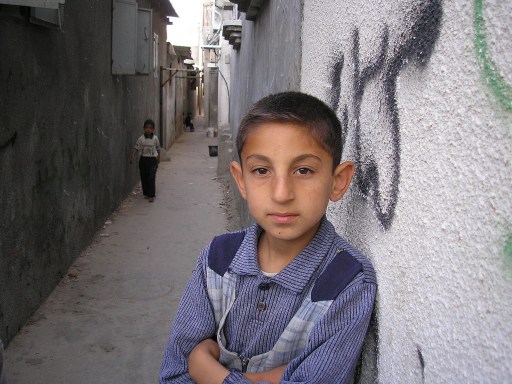
This is what a Palestinian boy looks like. (cc photo: Giles)
By Jim Naureckas | FAIR | November 18, 2014
Read this headline from the New York Times (11/16/14):
Palestinian Shot by Israeli Troops at Gaza Border
Think for a second about what kind of image that calls up. How much does that image change when you read the story’s second sentence?
A spokeswoman for the hospital said the Palestinian was a 10-year-old boy.
Now, very few people read the full text of every story in any newspaper, so as an editor you have to ask yourself what a headline conveys on its own. I expect that most people who only read that headline assumed that the Palestinian referenced was an adult–and likely had a different reaction to the story as a result.
They were probably also less likely to read the story–the opposite of the effect that you usually want to have with a headline–which makes you wonder why the Times would leave this key fact out. Space, maybe? But “Gazan Boy Shot by Israeli Troops at Border” would have fit just as easily.
Or “Child Shot by Israeli Troops at Gaza Border,” for that matter, since the shooting victim’s likely nationality would be clear from context; there aren’t too many Israeli children near the border with Gaza. In any case, the victim’s age is arguably a more important fact than his ethnicity.
So–did the editors leave out of the headline the fact that it was a child who had been shot because they didn’t want readers to get too upset about Israel doing the shooting?
Surely they would say no–but recall that New York Times story (7/16/14; FAIR Blog, 7/17/14), accurately headlined “Four Young Boys Killed Playing on Gaza Beach,” that was rewritten for the print edition as “Boys Drawn to Gaza Beach, and Into Center of Mideast Strife.” Here the boys remained boys, but their deaths disappeared.
When Times public editor Margaret Sullivan (7/22/14) asked why the headline had been changed, executive editor Dean Baquet claimed that print headlines tend to be “a little poetic.” Keats it ain’t.
To take a quantitative look at this phenomenon, let’s move from the New York Times to an outlet that fancies itself to be the New York Times of the airwaves–NPR. FAIR’s Seth Ackerman (Extra!, 11/01) did a study of which deaths it reported in the Israeli/Palestinian conflict over a six-month period. He found that NPR reported 81 percent of the Israeli deaths during that time, and 89 percent of the deaths of Israeli children–but only 34 percent of the Palestinian deaths, and 26 percent of the deaths of Palestinian children.
So while NPR–understandably–thought that being a child made an Israeli victim’s death more newsworthy, if Palestinian victims were children that made NPR less likely to report their deaths.
That’s an odd sort of news judgment–unless what’s being aimed at is not maximizing human interest, but keeping it to a minimum.
When Henry Kissinger Makes Sense
By Robert Parry | Consortium News | November 12, 2014
The American public is faced with an information crisis as the New York Times and other mainstream U.S. media outlets have become little more than propaganda organs on behalf of the neoconservative agenda and particularly the rush into a new Cold War with Russia – so much so that even ex-Secretary of State Henry Kissinger has broken ranks.
MSM articles consistently reek of bias – and in some cases make little sense. For instance, Times correspondent David M. Herszenhorn, one of the leading propagandists, wrote an alarmist story on Wednesday about a new Russian “invasion” of Ukraine but curiously he had the alleged Russian tank column heading east toward the Ukrainian city of Donetsk which would be back toward Russia, not westward into Ukraine.
According to Herszenhorn’s article, “The full scope of the Russian incursion is not clear, [NATO Supreme Commander Gen. Philip M. Breedlove] said, though the convoys seemed to be heading east toward Donetsk, an O.S.C.E. spokesman, Michael Bociurkiw, said Wednesday.”
Typical of his anti-Russian bias, Herszenhorn also cited Ukrainian government complaints that the Russians had been using a shaky cease-fire to bolster the ethnic Russian rebels in the east, but the reality is that both sides have been accusing the other of such maneuvering. Herszenhorn surely knows this but he wrote only:
“Ukrainian officials have complained all along that Russia was taking advantage of the so-called truce to reinforce the rebels in eastern Ukraine with more fighters and equipment.”
The reality is that there has been widespread alarm among eastern Ukrainians that the Kiev regime was using the relative lull in the fighting to resupply and reposition its forces for a new offensive like the one that killed thousands over the summer. Though human rights organizations have criticized Kiev for indiscriminate shelling of cities and unleashing brutal militia forces on the population, the Times and other mainstream U.S. newspapers have either ignored or downplayed such facts.
On Wednesday, Herszenhorn also compared the alleged new Russian incursion with the “invasion” of Crimea, although there really was no “invasion” of Crimea since the Russian troops that were involved in supporting Crimea’s popular referendum to secede from Ukraine and rejoin Russia were already in Crimea under an agreement with the Ukrainian government regarding the Russian naval base at Sebastopol.
Herszenhorn’s use of the word “invasion” is just an exaggeration like the rest of the imbalanced reporting that has made a rational U.S. public response to the crisis in Ukraine nearly impossible.
Since the start of the crisis in February, the New York Times’ coverage has been remarkable in its refusal to present the Ukraine story in anything like an objective fashion. For example, the Times has largely ignored the substantial public evidence that U.S. government officials and agents helped orchestrate the Feb. 22 coup which overthrew the elected President Viktor Yanukovych. [See Consortiumnews.com’s “The Whys Behind the Ukraine Crisis.”]
The Times also has buried evidence that extreme right-wing and neo-Nazi elements played key roles in firebombing police, forcing Yanukovych and other government officials to flee for their lives, and spearheading later attacks on ethnic Russians. When this reality is referenced, it is usually presented with little meaningful context or tacked on in the last few paragraphs of long articles on other topics.
Mocking Medvedev
Herszenhorn himself has been a leading violator of journalistic standards. For instance, in mid-April, early on in the crisis, he penned a mocking story from Moscow ridiculing Russian Prime Minister Dmitri Medvedev for predicting a possible civil war.
In the article entitled “Russia Is Quick To Bend Truth About Ukraine,” Herszenhorn accused Medvedev of posting an item on Facebook that “was bleak and full of dread,” including noting that “blood has been spilled in Ukraine again” and adding that “the threat of civil war looms.”
Herszenhorn continued, “He [Medvedev] pleaded with Ukrainians to decide their own future ‘without usurpers, nationalists and bandits, without tanks or armored vehicles – and without secret visits by the C.I.A. director.’ And so began another day of bluster and hyperbole, of the misinformation, exaggerations, conspiracy theories, overheated rhetoric and, occasionally, outright lies about the political crisis in Ukraine that have emanated from the highest echelons of the Kremlin and reverberated on state-controlled Russian television, hour after hour, day after day, week after week.”
This argumentative “news” story spilled from the front page to the top half of an inside page, but Herszenhorn never managed to mention that there was nothing false in what Medvedev wrote. Indeed, as the bloodshed soon grew worse and escalated into a civil war, you might say Medvedev was tragically prescient.
It was also the much-maligned Russian press that first reported the secret visit of CIA Director John Brennan to Kiev. Though the White House later confirmed that report, Herszenhorn still cited Medvedev’s reference to it in the context of “misinformation” and “conspiracy theories.” Nowhere in the long article did the Times inform its readers that, yes, the CIA director did make a secret visit to Ukraine.
In this upside-down world of MSM disinformation, there has been very little criticism of the glaring biases of the mainstream Western media but instead continued attacks on the professionalism of the Russian media, including an adverse finding this week by an official British agency that monitors alleged bias in news outlets operating in the UK. The agency, known as Ofcom, accused Russia’s RT network of failing to meet standards for “due impartiality” in early Ukraine coverage.
Interestingly, Ofcom did not judge any of the RT reports false in their description of neo-Nazi thugs participating in the Feb. 22 coup, a possible role of coup-related snipers in the slaughter of scores of people at the Maidan, and the unconstitutionality of the new government.
But Ofcom faulted RT for not meeting the fuzzy concept of “due impartiality” and threatened regulatory sanctions against RT if it didn’t shape up. Ofcom defined “due impartiality” as “impartiality adequate or appropriate to the subject and nature of the programme.”
The image of a British regulatory body threatening RT with sanctions for not toeing the pro-Western propaganda line that nearly all UK and U.S. news outlets do has an Orwellian feel to it, singling out one of the few sources of news that doesn’t accept the prevailing “group think.”
It would be one thing if the same standards were applied to Western media outlets for their one-sided reporting on Ukraine, but that apparently would ruffle too many important feathers.
Kissinger’s Dissent
Curiously, one of the few prominent Westerners who has dared question the prevailing wisdom on Ukraine is former Secretary of State Henry Kissinger who said, in an interview with the German newsmagazine Der Spiegel, that the West was exaggerating the significance of the Crimean annexation given the peninsula’s long historic ties to Russia.
“The annexation of the Crimea was no bid for world domination,” the 91-year-old Kissinger said. “It is not to be compared with Hitler’s invasion in Czechoslovakia” – as former Secretary of State Hillary Clinton and others have done.
Kissinger noted that Russian President Vladimir Putin had no intention of instigating a crisis in Ukraine: “Putin had [spent] tens of billions of dollars for the Olympic Winter Games … in Sochi. Russia wanted to present [itself] as a progressive nation. … It does not make sense that Putin, a week later, [launches] the Crimea attacks and a war for Ukraine begins.”
Instead Kissinger argued that the West – with its strategy of pulling Ukraine into the orbit of the European Union – was responsible for the crisis by failing to understand Russian sensitivity over Ukraine and making the “fatal” mistake of quickly pushing the confrontation beyond dialogue.
But Kissinger also faulted Putin for his reaction to the crisis. “I do not want to say that Russia’s response was appropriate,” Kissinger said.
Still, Kissinger told Der Spiegel that “a new edition of the Cold War would be a tragedy. … We must keep in view, that we need Russia to solve other crises, such as the nuclear conflict with Iran or Syria’s civil war.”
When Henry Kissinger starts to sound like the voice of reason, it says a lot about how crazy the New York Times and the rest of the MSM have become.
~
Investigative reporter Robert Parry broke many of the Iran-Contra stories for The Associated Press and Newsweek in the 1980s. You can buy his new book, America’s Stolen Narrative, either in print here or as an e-book (from Amazon and barnesandnoble.com).
Treating Putin Like a Lunatic
By Robert Parry | Consortium News | October 25, 2014
When reading the New York Times on many foreign policy issues, it doesn’t take a savant to figure out what the newspaper’s bias is. Anything, for instance, relating to Russian President Vladimir Putin drips of contempt and hostility.
Rather than offer the Times’ readers an objective or even slightly fair-minded account of Putin’s remarks, we are fed a steady diet of highly prejudicial language, such as we find in Saturday’s article about Putin’s comments at a conference in which he noted U.S. contributions to chaos in countries, such as Afghanistan, Iraq, Libya, Syria and Ukraine.
That Putin is correct appears almost irrelevant to the Times, which simply writes that Putin “unleashed perhaps his strongest diatribe against the United States yet” with his goal “to sell Moscow’s view that American meddling has sparked most of the world’s recent crises.”
Rather than address the merits of Putin’s critique, the Times’ article by Neil MacFarquhar uncritically cites the “group think” of Official Washington: “Russia is often accused of provoking the crisis in Ukraine by annexing Crimea, and of prolonging the agony in Syria by helping to crush a popular uprising against President Bashar al-Assad, Moscow’s last major Arab ally. Some analysts have suggested that Mr. Putin seeks to restore the lost power and influence of the Soviet Union, or even the Russian Empire, in a bid to prolong his own rule.”
Yes, “some analysts” can be cited to support nearly any claim no matter how wrongheaded, or you can use the passive tense – “is often accused” – to present any charge no matter how unfair. But a more realistic summary of the various crises afflicting the world would note that Putin is correct when he describes past U.S. backing for various extremists, from Islamic fundamentalists in the Middle East and Central Asia to neo-Nazis in Ukraine.
For example, during the 1980s, the Reagan administration consciously encouraged Islamic fundamentalism as a strategy to cause trouble for “atheistic communism” in Afghanistan and in the Muslim provinces of the Soviet Union.
To overthrow a Soviet-backed government in Afghanistan, the CIA and its Saudi collaborators financed the mujahedeen “holy warriors” who counted among their supporters Saudi extremist Osama bin Laden. Some of those Islamists later blended into the Taliban and al-Qaeda with dire consequences for the United States on Sept. 11, 2001.
By invading Iraq in 2003, President George W. Bush toppled a secular dictator, Saddam Hussein, but saw him replaced by what amounted to a Shiite theocracy which pushed Iraq’s Sunni minority into the arms of “Al-Qaeda in Iraq,” which has since rebranded itself as the Islamic State of Iraq and Syria or simply the Islamic State. Those extremists now control large swaths of Iraq and Syria and have massacred religious minorities and Western hostages, prompting another U.S. military intervention.
Obama’s Interventions
In Libya in 2011, President Barack Obama acquiesced to demands from “liberal interventionists” in his administration and authorized an air war to overthrow another secular autocrat, Muammar Gaddafi, whose ouster and murder have sent Libya spiraling into political chaos amid warring Islamist militias. It turns out Gaddafi was not wrong when he warned of Islamist terrorists operating around Benghazi.
Similarly, Official Washington’s embrace of protests and violence aimed at removing another secular Arab leader, Syria’s Bashar al-Assad, contributed to the bloody civil war that has devastated that country and created fertile ground for the Islamic State and the Nusra Front, the official al-Qaeda affiliate.
Though Obama balked at demands from neocons and “liberal interventionists” that he launch an air war against the Syrian military in 2013, he did authorize secret shipments of weapons and training for the supposedly “moderate” Syrian rebels who have generally sided with Islamist fighters affiliated with al-Qaeda and the Islamic State.
Many of these same neocons and “liberal interventionists” have been eager to ratchet up the confrontation with Iran over its nuclear program, including neocon dreams to “bomb, bomb, bomb Iran,” also a desire of hardliners in Israel.
In some of these crises, one of the few international leaders who has cooperated with Obama to tamp down tensions has been Putin, who helped negotiate conflict-avoiding agreements with Syria and Iran. But those peaceful interventions made Putin an inviting target for the neocons who began in fall 2013 arranging a coup d’etat in Ukraine on Russia’s border.
As Obama and Putin each paid too little attention to these maneuvers, neocons such as National Endowment for Democracy president Carl Gershman, Sen. John McCain, R-Arizona, and Assistant Secretary of State for European Affairs Victoria Nuland went to work on the Ukrainian coup.
However to actually overthrow Ukraine’s elected President Viktor Yanukovych, the coup makers had to collaborate with neo-Nazi militias which were organized in western Ukraine and dispatched to Kiev where they provided the muscle for the Maidan uprising. Neo-Nazi leaders were given several ministries in the new government, and neo-Nazi militants were incorporated into the National Guard and “volunteer” militias dispatched to crush the ethnic Russian resistance in the east.
Putin for the Status Quo
The underlying reality of the Ukraine crisis was that Putin actually supported the country’s status quo, i.e. maintaining the elected president and the constitutional process. It was the United States along with the European Union that sought to topple the existing system and pull Ukraine from Russia’s orbit into the West’s.
Whatever one thinks about the merits of that change, it is factually wrong to accuse Putin of initiating the Ukraine crisis or to extrapolate from Official Washington’s false conventional wisdom and conclude that Putin is a new Hitler, an aggressor seeking to reestablish the Soviet Union or the Russian Empire.
But the Times and other major U.S. news outlets have wedded themselves to that propaganda theme and now cannot deviate from it. So, when Putin states the obvious – that the U.S. has meddled in the affairs of other nations and that Russia did not pick the fight over Ukraine – his comments must be treated like the ravings of a lunatic unleashing some “diatribe.”
Among Putin’s ranting was his observation, according to the Times article, that “the United States supports ‘dubious’ groups ranging from ‘open neo-fascists to Islamic radicals.’
“‘Why do they support such people,’ he asked the annual gathering known as the Valdai Club, which met this year in the southern resort town of Sochi. ‘They do this because they decide to use them as instruments along the way in achieving their goals, but then burn their fingers and recoil.’
“The goal of the United States, he said, was to try to create a unipolar world in which American interests went unchallenged. …
“Mr. Putin … specifically denied trying to restore the Russian Empire. He argued Russia was compelled to intervene in Ukraine because that country was in the midst of a ‘civilized dialogue’ over its political future when the West staged a coup to oust the president last February, pushing the country into chaos and civil war.
“‘We did not start this,’ he said. ‘Statements that Russia is trying to reinstate some sort of empire, that it is encroaching on the sovereignty of its neighbors, are groundless.’”
Of course, all the “smart people” of Official Washington know how to react to such statements from Putin, with a snicker and a roll of the eyes. After all, they’ve been reading the narratives of these crises as fictionalized by the New York Times, the Washington Post, etc.
Rationality and realism seem to have lost any place in the workings of the mainstream U.S. news media.
~
Investigative reporter Robert Parry broke many of the Iran-Contra stories for The Associated Press and Newsweek in the 1980s. You can buy his new book, America’s Stolen Narrative, either in print here or as an e-book (from Amazon and barnesandnoble.com).
Is the CIA Running a Defamation Campaign Against Putin?
The latest hot topic in the Russian media. Russian politicians are talking about it. Historical precedent and behavior of Western media suggests that they are.
RI Interview | October 24, 2014

A major topic in the Russian media is mystification with how Putin is portrayed in the Western media.
Wildly popular at home, and seen as a decent, modest, an admirable person, and Russians don’t understand how there can be such a disconnect with Western impressions.
Recently, leading Russian commentators and politicians have been suggesting that this can only be explained by a deliberate campaign to defame Putin, by governments or other groups.
Yesterday, at a briefing to foreign journalists, Sergey Ivanov, Putin’s chief of staff, arguably the 2nd most powerful man in Russia, spoke of an “information war” consisting of “personal attacks” on Putin.

The western media hit a new low…
The day before another member of Putin’s inner circle, Vyasheslav Volodin, made similar remarks, telling foreign journalists “an attack on Putin is an attack on Russia.”
The logic, they argue, is that by defaming the leader of a country, you weaken his power domestically by undermining popular support for him, and internationally, by rallying popular opinion to support policies against that country. The ultimate goal, they argue, is to weaken the country itself. They also talk about regime change.
They argue that if one looks at the facts, that there is evidence of ongoing character assassination which cannot be explained by a vague popular zeitgeist in the West, but is more likely the result of a dedicated effort to introduce this defamation into the news flow.

Newsweek has been one of the most virulent Putin-bashers for years
The issue of manipulation of news by intelligence services has been in the news recently with revelations that the CIA and German Secret Service (GSS) have long-running programs to influence how media executives and top journalists convey and interpret the news, including direct cash payments.
Here are some examples they point to:
- Portraying him as a scheming dictator trying to rebuild a repressive empire.
- Claiming he personally ordered the murder of a number of journalists, and personally ordered a KGB defector to be murdered with radiation poisoning.
- Frequently citing unsubstantiated rumors he is having an affair with a famous gymnast.
- Allegations that he has stashed away billions for his personal benefit, without providing evidence.
- Recent article in newsweek claiming he leads a luxurious and lazy lifestyle, sleeping late.
- Recent article in NYT focusing on a supposed personal arrogance.
- Hillary Clinton mentioning in speech after speech that he is a bad guy, a bully, that one must confront him forcefully.
- Frequently using pejoratives to describe his person – “a jerk and a thug” (Thomas Friedman this week in the NYT)
- Mis-quoting him on his regret about the collapse of the Soviet Union.
- Articles about a supposed super-luxury villa built for him in southern Russia.
- The over-the top headlines in the western media (they were worst of all in Germany) portraying him personally responsible for murdering the victims of MH17.
- And soft stuff – magazine covers making him look sinister, monstrous, etc.
RI sat down with The Saker, a leading analyst of Russia in international affairs, and asked him what he thinks:
———————————–
So, is there any credence to this line of thinking, or is this conspiracy theorists running wild?
There is no doubt in my mind whatsoever that the US is waging a major psyop war against Russia, although not a shooting war, for now, and that what we are seeing is a targeted campaign to discredit Putin and achieve “regime change” in Russia or, should that fail, at the very least “regime weakening” and “Russia weakening”.

So this is a US government program?
Yes, Putin is absolutely hated by certain factions in the US government two main reasons:
1. He partially, but not fully, restored Russia’s sovereignty which under Gorbachev and Yeltsin had been totally lost … Russia then was a US colony like Ukraine is today … and,
2. He dared to openly defy the USA and its civilizational model.
… a free and sovereign Russia is perceived by the US “deep state” as an existential threat which has to be crushed. … this is a full-scale political assault on Russia and Putin personally.
So what the Russians are saying, that the constant personal attacks against Putin in the global media are partly the result of deliberate efforts by US intelligence services, … basically, planted stories…
Yes, absolutely
It seems like “Operation Mockingbird” all over again… Are you aware of other instances aimed at Putin?
(Editors Note: Operation Mockingbird was a CIA program started in the 1950s to influence the US media, which was gradually exposed by investigative journalists starting in the late 60s, culminating in sensational televised congressional hearings in 1975 which shocked the nation, forcing the program’s termination. Critics maintain that the same tactics have continued since, under different programs. Wikipedia)
Yes, of course. Since this defamation has very little traction with the Russian public … Putin’s popularity is higher than ever before .., there is an organized campaign to convince them that Putin is “selling out” Novorussia, that he is a puppet of oligarchs who are making deals with Ukrainian oligarchs to back-stab the Novorussian resistance…
… So far, Putin’s policies in the Ukraine have enjoyed very strong support from the Russian people who still oppose an overt military intervention…
… but if Kiev attacks Novorussia again – which appears very likely – and if such an attack is successful – which is less likely but always possible – then Putin will be blamed for having given the Ukrainians the time to regroup and reorganize.

Warm and fuzzy…
So you are saying that if the Ukrainian military strengthens its position enough to deliver a serious blow to the East Ukrainians, the US can use this as a method to strike at Putin’s support base…
Yes, that’s right … there are a lot of “fake patriots” in Russia and abroad who will reject any negotiated solution and who will present any compromise as a “betrayal”. They are the “useful idiots” used by western special services to smear and undermine Putin.
Is it limited to government special ops, or are there other groups who might have an interest in doing this?
Yes, well here is something that most people in the west don’t appreciate… there is a major behind-the scenes struggle among Russian elites between what I call the “Eurasian Sovereignists” (basically, those who support Putin) and what I call the “Atlantic Integrationists” (those whom Putin refers to as the “5th column).
The western media talks about this as the struggle between Russian liberals and conservatives, reformers and reactionaries, right?
Well its sort of like that, but not exactly…
The former see Russia’s future in the Russian North and East and want to turn Russia towards Asia, Latin America and the rest of the world, while the latter want Russia to become part of the “North Atlantic” power configuration.
The Atlantic Integrationists are now too weak to openly challenge Putin – whose real power base is his immense popular support – but they are quietly sabotaging his efforts to reform Russia while supporting anti-Putin campaigns.
Regarding the revelations of CIA activities in Germany, do you think this is going on in other countries, in the US?
I am sure that this is happening in most countries worldwide. The very nature of the modern corporate media is such that it makes journalists corrupt.
As the French philosopher Alain Soral says “nowadays a reporter is either unemployed or a prostitute”. There are, of course, a few exceptions, but by and large this is true.
This is not to say that most journalists are on the take. In the West this is mostly done in a more subtle way – by making it clear which ideas do or do not pass the editorial control, by lavishly rewarding those journalists who ‘get it’ and by quietly turning away those who don’t.
If a journalist or reporter commits the crime of “crimethink” he or she will be sidelined and soon out of work.
There is no real pluralism in the West where the boundaries of what can be said or not are very strictly fixed.
Ok, but is it like what has been revealed in Germany, …similar specific operational programs in France, the UK, Italy, Latin America, etc.
Yes, one has to assume so – it is in their interests to have them and there is no reason for them not to.
As for the CIA, it de-facto controls enough of the corporate media to “set the tone”. As somebody who in the past used to read the Soviet press for a living, I can sincerely say that it was far more honest and more pluralistic than the press in the USA or EU today.
Joseph Goebbels or Edward Bernays could not have imagined the degree of sophistication of modern propaganda machines.
If the US is doing it, can’t one assume other governments are too? Are the Russians doing it against western leaders?
I think that all governments try to do that kind of stuff. However, what makes the US so unique it a combination of truly phenomenal arrogance and multi-billion dollar budgets.
The US “deep state” owns the western corporate media which is by far the most powerful media on the planet. Most governments can only do that inside their own country … to smear a political opponent or discredit a public figure, but they simply do not have the resources to mount an international strategic psyop campaign. This is something only the US can do.
So foreign governments are at a great disadvantage in this arena vis-a-vis the US?
Absolutely.
Featured Video
Seyed M. Marandi: Negotiations Collapsed – Return to War
or go to
Aletho News Archives – Video-Images
From the Archives
Wartime internment camps in Australia
National Archives of Australia
World War I
During World War I, for security reasons the Australian Government pursued a comprehensive internment policy against enemy aliens living in Australia.
Initially only those born in countries at war with Australia were classed as enemy aliens, but later this was expanded to include people of enemy nations who were naturalised British subjects, Australian-born descendants of migrants born in enemy nations and others who were thought to pose a threat to Australia’s security.
Australia interned almost 7,000 people during World War I, of whom about 4,500 were enemy aliens and British nationals of German ancestry already resident in Australia.
Records of World War I internment camps
World War II
During World War II, Australian authorities established internment camps for three reasons – to prevent residents from assisting Australia’s enemies, to appease public opinion and to house overseas internees sent to Australia for the duration of the war.
Unlike World War I, the initial aim of internment during the later conflict was to identify and intern those who posed a particular threat to the safety or defence of the country. As the war progressed, however, this policy changed and Japanese residents were interned en masse. In the later years of the war, Germans and Italians were also interned on the basis of nationality, particularly those living in the north of Australia. In all, just over 20 per cent of all Italians resident in Australia were interned. … continue
Blog Roll
 Aletho News
- Seyed M. Marandi: Negotiations Collapsed – Return to War
- Tomorrow’s naval blockade showdown
- ‘Israel’ attacks civilians to hide its embarrassing military failures & out of pure sadism
- Any Foreign Military Vessel Approaching Hormuz Under Any Pretext ‘Will Be Dealt With Severely’: IRGC
- Diplomats slam US negotiators’ performance in Iran talks
- Trump Refuses Exit Ramp, War with Iran will Continue
- Trump Says US Naval Blockade in Strait of Hormuz Will Begin Shortly
- US, Iran end 21-hour talks without agreement
- US IRAN TALKS: Who Are the Crazy Ones Here? /Lt Col Daniel Davis
- Talks with the US end without a deal over excessive US demands: Iran
- If Americans Knew
- US-Iran ceasefire negotiations make zero progress – Daily Update
- Pro-Israel ‘Thinktanks’ and Individuals who Influence U.S. Foreign Policy
- Mearsheimer reveals how Israel dictates US policies on Iran, Gaza – video
- After killing 350+, Israel still has a “score to settle” with Lebanon before ceasefire – Daily Update
- Military aid to Israel emerges as the latest political litmus test for Democrats
- The only Palestinian children’s rights organization closes following years-long Israeli campaign against it
- ‘I Can’t Forget the Smell’: Lebanese Reel After Israel Kills Over 300 in Single Day
- DNC Shoots Down Resolutions Calling Out AIPAC and Limiting Arms to Israel
- TCN: Is Israel Blackmailing President Trump?
- Israel killed at least 303 Lebanese yesterday – who were they? Daily Update
- No Tricks Zone
- Cave Discovery Reveals Today’s Desert Climates Were Recently Far Warmer, Wetter, Teeming With Life
- German Expert: Heat Dome Led To Record Temps In Western USA…Warmer In 1934, 1936
- New Study: No Linear Warming Or Glacier Retreat Along Northern Antarctic Peninsula Since 1980s
- An Inconvenient Tree: Uncovered In Alps… Europe Much Warmer Than Today 6000 Years Ago
- New Study Reports A 60% Slowdown In Greenland’s Ice Loss Rate In The Last Decade
- Low Intensity Tornado Wrecks Major Solar Farm, Creating A Potential Toxic Dump
- New Study Finds Warming Saves Lives…Cold Temperatures 12 Times More Deadly Than Excess Heat
- German Science Blog Accuses PIK Climate Institute Of Hallucinating Climate Tipping Points
- Devastating Assessment Of Comirnaty Vaccine By Former Senior Pfizer Europe Toxicologist
- New Study: CO2 Is ‘Effectively Negligible’ As An Explanatory Climate Change Factor Since 2000
 Aletho News