‘Sanctions guru’ involved in creating Russiagate saga to return as CIA’s deputy director under Biden
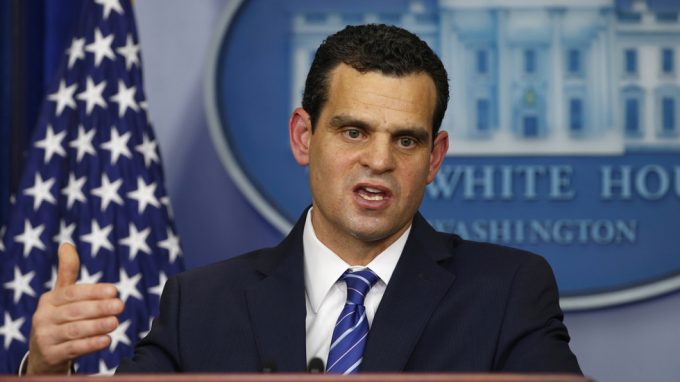
David Cohen in 2014. ©REUTERS / Kevin Lamarque
RT | January 15, 2021
Joe Biden’s transition team has picked David Cohen, the former deputy director of the CIA, to reprise his role and help smooth things out for his future boss, career diplomat and intelligence outsider William Burns.
Cohen was considered a frontrunner to become CIA director himself, but Biden chose Burns instead. Cohen’s return to the office he held between 2015 and 2017 was announced on Friday, and since his candidacy does not require a Senate confirmation, he will be able to start on inauguration day.
As deputy for then-CIA Director John Brennan, Cohen was involved in creating the infamous US intelligence assessment of alleged Russian interference in the 2016 election. The document was widely touted as a consensus opinion of 17 agencies, but later turned out to be a product of officials from only three of them – the CIA, FBI, and NSA – “hand-picked” for the task by then-Director of National Intelligence James Clapper (technically, his office is an agency of its own and could be counted as the fourth one vouching for the document).
The assessment, which was released in the final days of the Obama administration, claimed that Russia ran a sophisticated interference and influence campaign to help Donald Trump beat Hillary Clinton in the 2016 presidential election. It primed the US public for the sequel theory that accused the Trump campaign of “colluding” with the Kremlin, setting the tone for the entire presidency of the Republican winner. Russia denied any involvement in the election and said it was used as a scapegoat in US partisan fights.
In 2017, Cohen famously rebuked then-CIA Director Mike Pompeo, when he claimed the US intelligence community believed the outcome of the election was not affected by the purported Russian campaign. In fact, the scope of the report was not wide enough to make such an assessment.
Interestingly, after going private, Cohen worked at WilmerHale, a law firm that also employs Robert Mueller, the former FBI director and special counsel who investigated the Russiagate allegations and found no evidence of collusion. He also spent time as a national security contributor at NBC News, rubbing shoulders then with his ex-boss, Brennan.
Cohen is said to be respected and loved in the intelligence community. Brennan called him “a great listener” and “an ardent supporter and defender of the agency.”
Before becoming the second most senior official in the CIA, Cohen worked in the US Treasury, specializing in tracing financial streams and enforcing US economic sanctions, which won him the nickname “sanctions guru.” Early in his government career under George W. Bush, he was credited for his contribution to writing the section of the Patriot Act that deals with money laundering and financing of terrorism.
With Biden’s New Threats, the Russia Discourse is More Reckless and Dangerous Than Ever
The U.S. media demands inflammatory claims be accepted with no evidence, while hacking behavior routinely engaged in by the U.S. is depicted as aberrational.
By Glenn Greenwald | December 23, 2020
To justify Hillary Clinton’s 2016 loss to Donald Trump, leading Democrats and their key media allies for years competed with one another to depict what they called “Russia’s interference in our elections” in the most apocalyptic terms possible. They fanatically rejected the view of the Russian Federation repeatedly expressed by President Obama — that it is a weak regional power with an economy smaller than Italy’s capable of only threatening its neighbors but not the U.S. — and instead cast Moscow as a grave, even existential, threat to U.S. democracy, with its actions tantamount to the worst security breaches in U.S. history.
This post-2016 mania culminated with prominent liberal politicians and journalists (as well as John McCain) declaring Russia’s activities surrounding the 2016 [election] to be an “act of war” which, many of them insisted, was comparable to Pearl Harbor and the 9/11 attack — the two most traumatic attacks in modern U.S. history which both spawned years of savage and destructive war, among other things.
Sen. Jeanne Shaheen (D-NH) repeatedly demanded that Russia’s 2016 “interference” be treated as “an act of war.” Hillary Clinton described Russian hacking as “a cyber 9/11.” And Rep. Jerry Nadler (D-NY) on MSNBC in early February, 2018, pronounced Russia “a hostile foreign power” whose 2016 meddling was the “equivalent” of Pearl Harbor, “very much on par” with the “seriousness” of the 1941 attack in Hawaii that helped prompt four years of U.S. involvement in a world war.
With the Democrats, under Joe Biden, [presumably] just weeks away from assuming control of the White House and the U.S. military and foreign policy that goes along with it, the discourse from them and their media allies about Russia is becoming even more unhinged and dangerous. Moscow’s alleged responsibility for the recently revealed, multi-pronged hack of U.S. Government agencies and various corporate servers is asserted — despite not a shred of evidence, literally, having yet been presented — as not merely proven fact, but as so obviously true that it is off-limits from doubt or questioning.
Any questioning of this claim will be instantly vilified by the Democrats’ extremely militaristic media spokespeople as virtual treason. “Now the president is not just silent on Russia and the hack. He is deliberately running defense for the Kremlin by contradicting his own Secretary of State on Russian responsibility,” pronounced CNN’s national security reporter Jim Sciutto, who last week depicted Trump’s attempted troop withdrawal from Syria and Germany as “ceding territory” and furnishing “gifts” to Putin. More alarmingly, both the rhetoric to describe the hack and the retaliation being threatened are rapidly spiraling out of control.
Democrats (along with some Republicans long obsessed with The Russian Threat, such as Mitt Romney) are casting the latest alleged hack by Moscow in the most melodramatic terms possible, ensuring that Biden will enter the White House with tensions sky-high with Russia and facing heavy pressure to retaliate aggressively. Biden’s top national security advisers and now Biden himself have, with no evidence shown to the public, repeatedly threatened aggressive retaliation against the country with the world’s second-largest nuclear stockpile.
Congressman Jason Crow (D-CO) — one of the pro-war Democrats on the House Armed Services Committee who earlier this year joined with Rep. Liz Cheney (R-WY) to block Trump’s plan to withdraw troops from Afghanistan — announced: “this could be our modern day, cyber equivalent of Pearl Harbor,” adding: “Our nation is under assault.” The second-ranking Senate Democrat, Dick Durbin (D-IL), pronounced: “This is virtually a declaration of war by Russia.”
Meanwhile, Sen. Mitt Romney (R-UT), who has for years been casting Russia as a grave threat to the U.S. while Democrats mocked him as a relic of the Cold War (before they copied and then surpassed him), described the latest hack as “the equivalent of Russian bombers flying undetected over the entire country.” The GOP’s 2012 presidential nominee also blasted Trump for his failure to be “aggressively speaking out and protesting and taking punitive action,” though — like virtually every prominent figure demanding tough “retaliation” — Romney failed to specify what he had in mind that would be sufficient retaliation for “the equivalent of Russian bombers flying undetected over the entire country.”
For those keeping track at home: that’s two separate “Pearl Harbors” in less than four years from Moscow (or, if you prefer, one Pearl Harbor and one 9/11). If Democrats actually believe that, it stands to reason that they will be eager to embrace a policy of belligerence and aggression toward Russia. Many of them are demanding this outright, mocking Trump for failing to attack Russia — despite no evidence that they were responsible — while their well-trained liberal flock is suggesting that the non-response constitutes some form of “high treason.”
Indeed, the Biden team has been signalling that they intend to quickly fulfill demands for aggressive retaliation. The New York Times reported on Tuesday that Biden “accused President Trump [] of ‘irrational downplaying’” of the hack while “warning Russia that he would not allow the intrusion to ‘go unanswered’ after he takes office.” Biden emphasized that once the intelligence assessment is complete, “we will respond, and probably respond in kind.”
Threats and retaliation between the U.S. and Russia are always dangerous, but particularly so now. One of the key nuclear arms agreements between the two nuclear-armed nations, the New START treaty, will expire in February unless Putin and Biden can successfully negotiate a renewal: sixteen days after Biden is [tentatively] scheduled to take office. “That will force Mr. Biden to strike a deal to prevent one threat — a nuclear arms race — while simultaneously threatening retaliation on another,” observed the Times.
This escalating rhetoric from Washington about Russia, and the resulting climate of heightened tensions, are dangerous in the extreme. They are also based in numerous myths, deceits and falsehoods:
First, absolutely no evidence of any kind has been presented to suggest, let alone prove, that Russia is responsible for these hacks. It goes without saying that it is perfectly plausible that Russia could have done this: it’s the sort of thing that every large power from China and Iran to the U.S. and Russia have the capability to do and wield against virtually every other country including one another.
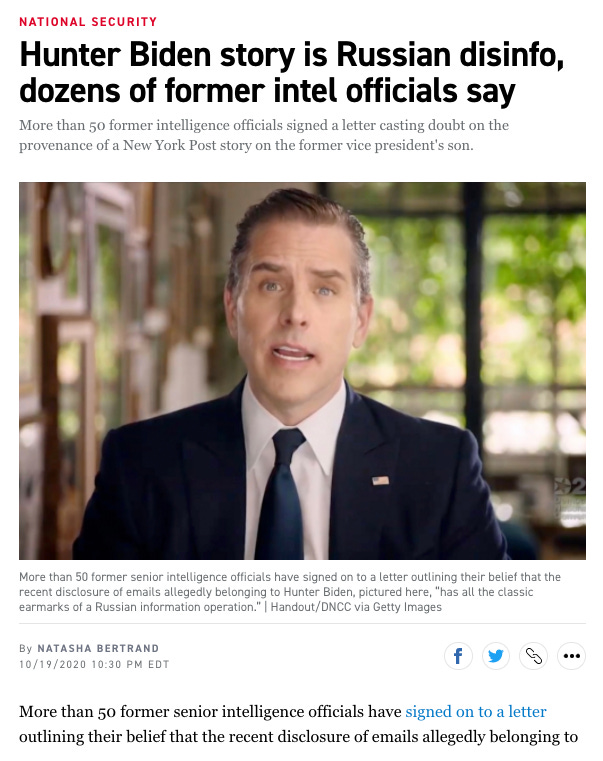
But if we learned nothing else over the last several decades, we should know that accepting claims that emanate from the U.S. intelligence community about adversaries without a shred of evidence is madness of the highest order. We just had a glaring reminder of the importance of this rule: just weeks before the election, countless mainstream media outlets laundered and endorsed the utterly false claim that the documents from Hunter Biden’s laptop were “Russian disinformation,” only for officials to acknowledge once the harm was done that there was no evidence — zero — of Russian involvement.
Yet that is exactly what the overwhelming bulk of media outlets are doing again: asserting that Russia is behind these hacks despite having no evidence of its truth. The New York Times’ Michael Barbaro, host of the paper’s popular The Daily podcast, asked his colleague, national security reporter David Sanger, what evidence exists to assert that Russia did this. As Barbaro put it, even Sanger is “allowing that early conclusions could all be wrong, but that it’s doubtful.” Indeed, Sanger acknowledged to Barbaro that they have no proof, asserting instead that the basis on which he is relying is that Russia possesses the sophistication to carry out such a hack (as do several other nation-states), along with claiming that the hack has what he calls the “markings” of Russian hackers.
But this tactic was exactly the same one used by former intelligence officials, echoed by these same media outlets, to circulate the false pre-election claim that the documents from Hunter Biden’s laptop were “Russian disinformation”: namely, they pronounced in lockstep, the material from Hunter’s laptop “has all the classic earmarks of a Russian information.” This was also exactly the same tactic used by the U.S. intelligence community in 2001 to falsely blame Iraq for the anthrax attacks, claiming that their chemical analysis revealed a substance that was “a trademark of the Iraqi biological weapons program.”
These media outlets will, if pressed, acknowledge their lack of proof that Russia did this. Despite this admitted lack of proof, media outlets are repeatedly stating Russian responsibility as proven fact.
“Scope of Russian Hacking Becomes Clear: Multiple U.S. Agencies Were Hit,” one New York Times headline proclaimed, and the first line of that article, co-written by Sanger, stated definitively: “The scope of a hacking engineered by one of Russia’s premier intelligence agencies became clearer on Monday.” The Washington Post deluged the public with identically certain headlines.
Nobody in the government has been as definitive in asserting Russian responsibility as corporate media outlets. Even Trump’s hawkish Secretary of State, Mike Pompeo, crafted his accusation against Moscow with caveats and uncertainty: “I think it’s the case that now we can say pretty clearly that it was the Russians that engaged in this activity.”
If actual evidence ultimately emerges demonstrating Russian responsibility, it would not alter how dangerous it is that — less than twenty years after the Iraq WMD debacle and less than a couple of years after media endorsement of endless Russiagate falsehoods — the most influential media outlets continue to mindlessly peddle as Truth whatever the intelligence community feeds them, without the need to see any evidence that what they’re claiming is actually true. Even more alarmingly, large sectors of the public that venerate these outlets continue to believe that what they hear from them must be true, no matter how many times they betray that trust. The ease with which the CIA can disseminate whatever messaging it wants through friendly media outlets is stunning.
Second, the very idea that this hack could be compared to rogue and wildly aberrational events such as Pearl Harbor or the 9/11 attack is utterly laughable on its face. One has to be drowning in endless amounts of jingoistic self-delusion to believe that this hack — or, for that matter, the 2016 “election interference” — is a radical departure from international norms as opposed to a perfect reflection of them.
Just as was true of 2016 fake Facebook pages and Twitter bots, it is not an exaggeration to say that the U.S. Government engages in hacking attacks of this sort, and ones far more invasive, against virtually every country on the planet, including Russia, on a weekly basis. That does not mean that this kind of hacking is either justified or unjustified. It does mean, however, that depicting it as some particularly dastardly and incomparably immoral act that requires massive retaliation requires a degree of irrationality and gullibility that is bewildering to behold.
The NSA reporting enabled by Edward Snowden by itself proved that the NSA spies on virtually anyone it can. Indeed, after reviewing the archive back in 2013, I made the decision that I would not report on U.S. hacks of large adversary countries such as China and Russia because it was so commonplace for all of these countries to hack one another as aggressively and intrusively as they could that it was hardly newsworthy to report on this (the only exception was when there was a substantial reason to view such spying as independently newsworthy, such as Sweden’s partnering with NSA to spy on Russia in direct violation of the denials Swedish officials voiced to their public).
Other news outlets who had access to Snowden documents, particularly The New York Times, were not nearly as circumspect in exposing U.S. spying on large nation-state adversaries. As a result, there is ample proof published by those outlets (sometimes provoking Snowden’s strong objections) that the U.S. does exactly what Russia is alleged to have done here — and far worse.
“Even as the United States made a public case about the dangers of buying from [China’s] Huawei, classified documents show that the National Security Agency was creating its own back doors — directly into Huawei’s networks,” reported The New York Times’ David Sanger and Nicole Perlroth in 2013, adding that “the agency pried its way into the servers in Huawei’s sealed headquarters in Shenzhen, China’s industrial heart.”
In 2013, the Guardian revealed “an NSA attempt to eavesdrop on the Russian leader, Dmitry Medvedev, as his phone calls passed through satellite links to Moscow,” and added: “foreign politicians and officials who took part in two G20 summit meetings in London in 2009 had their computers monitored and their phone calls intercepted on the instructions of their British government hosts.” Meanwhile, “Sweden has been a key partner for the United States in spying on Russia and its leadership, Swedish television said on Thursday,” noted Reuters, citing what one NSA document described as “a unique collection on high-priority Russian targets, such as leadership, internal politics.”

Other reports revealed that the U.S. had hacked into the Brazilian telecommunications system to collect data on the whole population, and was spying on Brazil’s key leaders (including then-President Dilma Rousseff) as well as its most important companies such as its oil giant Petrobras and its Ministry of Mines and Energy. The Washington Post reported: “The National Security Agency is gathering nearly 5 billion records a day on the whereabouts of cellphones around the world, according to top-secret documents and interviews with U.S. intelligence officials, enabling the agency to track the movements of individuals — and map their relationships — in ways that would have been previously unimaginable.” And on and on.
[One amazing though under-appreciated episode related to all this: the same New York Times reporter who revealed the details about massive NSA hacking of Chinese government and industry, Nicole Perlroth, subsequently urged (in tweets she has now deleted) that Snowden not be pardoned on the ground that, according to her, he revealed legitimate NSA spying on U.S. adversaries. In reality, it was actually she, Perlorth, not Snowden, who chose to expose NSA spying on China, provoking Snowden’s angry objections when she did so based on his view this was a violation of the framework he created for what should and should not be revealed; in other words, not only did Perlroth urge the criminal prosecution of a source on which she herself relied, an absolutely astonishing thing for any reporter to do, but so much worse, she did so by falsely accusing that source of doing something that she, Perlroth, had done herself: namely, reveal extensive U.S. hacking of China].
What all of this makes demonstrably clear is that only the most deluded and uninformed person could believe that Russian hacking of U.S. agencies and corporations — if it happened — is anything other than totally normal and common behavior between these countries. Harvard Law Professor and former Bush DOJ official Jack Goldsmith, reviewing growing demands for retaliation, wrote in an excellent article last week entitled “Self-Delusion on the Russia Hack: The U.S. regularly hacks foreign governmental computer systems on a massive scale”:
The lack of self-awareness in these and similar reactions to the Russia breach is astounding. The U.S. government has no principled basis to complain about the Russia hack, much less retaliate for it with military means, since the U.S. government hacks foreign government networks on a huge scale every day. Indeed, a military response to the Russian hack would violate international law . . . .
As the revelations from leaks of information from Edward Snowden made plain, the United States regularly penetrates foreign governmental computer systems on a massive scale, often (as in the Russia hack) with the unwitting assistance of the private sector, for purposes of spying. It is almost certainly the world’s leader in this practice, probably by a lot. The Snowden documents suggested as much, as does the NSA’s probable budget. In 2016, after noting “problems with cyber intrusions from Russia,” Obama boasted that the United States has “more capacity than anybody … offensively” . . . .
Because of its own practices, the U.S. government has traditionally accepted the legitimacy of foreign governmental electronic spying in U.S. government networks. After the notorious Chinese hack of the Office of Personnel Management database, then-Director of National Intelligence James Clapper said: “You have to kind of salute the Chinese for what they did. If we had the opportunity to do that, I don’t think we’d hesitate for a minute.” The same Russian agency that appears to have carried out the hack revealed this week also hacked into unclassified emails in the White House and Defense and State Departments in 2014-2015. The Obama administration deemed it traditional espionage and did not retaliate. “It was information collection, which is what nation states—including the United States—do,” said Obama administration cybersecurity coordinator Michael Daniel this week.
But over the last four years, Americans, particularly those who feed on liberal media outlets, have been drowned in so much mythology about the U.S. and Russia that they have no capacity to critically assess the claims being made, and — just as they were led to believe about “Russia’s 2016 interference in Our Sacred Elections” — are easily convinced that what Russia did is some shocking and extreme crime the likes of which are rarely seen in international relations. In reality, their own government is the undisputed world champion in perpetrating these acts, and has been for years if not decades.
Third, these demands for “retaliation” are so reckless because they are almost always unaccompanied by any specifics. Even if Moscow’s responsibility is demonstrated, what is the U.S. supposed to do in response? If your answer is that they should hack Russia back, rest assured the NSA and CIA are always trying to hack Russia as much as it possibly can, long before this event.
If the answer is more sanctions, that would be just performative and pointless, aside from wildly hypocritical. Any reprisals more severe than that would be beyond reckless, particularly with the need to renew nuclear arms control agreements looming. And if you are someone demanding retaliation, do you believe that Russia, China, Brazil and all the other countries invaded by NSA hackers have the same right of retaliation against the U.S., or does the U.S. occupy a special place with special entitlements that all other countries lack?
What we have here, yet again, is the classic operation of the intelligence community feeding serious accusations about a nuclear-armed power to an eagerly gullible corporate media, with the media mindlessly disseminating it without evidence, all toward ratcheting up tensions between these two nuclear-armed powers and fortifying a mythology of the U.S. as grand victim but never perpetrator.
If you ever find yourself wondering how massive military budgets and a posture of Endless War are seemingly invulnerable to challenge, this pathological behavior — from a now-enduring union of the intelligence community, corporate media outlets, and the Democratic Party — provides one key piece of the puzzle.
Patriot Act Used By The FBI To Collect Internet Browsing Data, Contradicting Claims Made To Oversight
By Tim Cushing | TechDirt | December 8, 2020
The NSA shut down its bulk phone records collection — authorized under Section 215 — after it became apparent it wasn’t worth the effort. Reforms put in place by the USA Freedom Act prevented the agency from collecting it all and sorting it out later. Instead, it had to approach telcos with actual targeted requests and only haul away responsive records. The NSA somehow still managed to overcollect records, putting it in violation of the law. The NSA hinted the program had outlived its usefulness anyway, suggesting it had far better collections available under other authorities that it would rather not subject to greater scrutiny.
But this didn’t end the government’s bulk records collections. It just ended the phone metadata program. The NSA still collects other records in bulk, including banking records and, oddly, books checked out by library patrons. The broad authority of Section 215 could be read to allow the government collect other records, like email metadata and internet activity. Reasoning that people voluntarily create records of their internet use by using third-party services to surf the web, the government hinted it could sweep these up just as easily as it had swept up call records.
The government’s attempt to collect internet history under this authority ran into some friction earlier this year when the Senate voted to block this collection. Senator Ron Wyden directly asked the director of national intelligence (DNI) to inform the Senate whether or not agencies under its purview had gathered internet use records under this authority. He received this answer.
In a Nov. 6 letter to Mr. Wyden, John Ratcliffe, the intelligence director, wrote that Section 215 was not used to gather internet search terms, and that none of the 61 orders issued last year under that law by the Foreign Intelligence Surveillance Court involved collection of “web browsing” records.
Wyden took this response to mean that implementing a ban on collection of internet history records could be put into place without negatively affecting any intelligence gathering activities. But when the New York Times pressed DNI John Ratcliffe on specifics, a new party inserted itself into the conversation: the DOJ. According to its response, the FBI had already done the thing the DNI had just told Sen. Wyden it hadn’t.
In fact, “one of those 61 orders resulted in the production of information that could be characterized as information regarding browsing,” Mr. Ratcliffe wrote in the second letter. Specifically, one order had approved collection of logs revealing which computers “in a specified foreign country” had visited “a single, identified U.S. web page.”
So, the FBI was collecting internet browsing records, albeit with an order that only targeted foreign users visiting one US web page. Still, this wasn’t what the DNI originally said to Sen. Wyden. This set Wyden off. Again. The supposedly honest answer he received in response to his questions wasn’t actually all that honest. As he pointed out in his statement, the belated admission raised questions about domestic surveillance and potential abuse of Section 215 authority to collect something the DNI said no one was collecting. And, if nothing changed, there was no guarantee the Intelligence Community wouldn’t talk itself into believing a collection of internet browsing data would be cool and legal.
“More generally,” Mr. Wyden continued, “the D.N.I. has provided no guarantee that the government wouldn’t use the Patriot Act to intentionally collect Americans’ web browsing information in the future, which is why Congress must pass the warrant requirement that has already received support from a bipartisan majority in the Senate.”
Previous attempts to erect a warrant requirement for the collection of internet data or search histories have failed to reach the president’s desk. This latest admission has refueled the fire to protect Americans (or visitors to American websites) from government overreach. Even if such a collection targets only foreign internet users, there’s no guarantee it won’t sweep up US citizens — like pretty much every other bulk collection has.
At this point, everything is up in the air. There’s a new president headed into office who might be more receptive to reform efforts, but he’s also the man who served the Obama Administration — one that wasn’t all that concerned about domestic surveillance until it became impossible to ignore the documents leaked by Ed Snowden. Even then, its response was tepid at best and it still allowed IC surveillance business to continue pretty much uninterrupted — something it used to justify extrajudicial killings based on little more than metadata. This needs to be fixed, but surveillance reform advocates still lack majority support. And the guy [potentially] headed to the White House has never seemed all that concerned about surveillance abuses.
Palantir’s Tiberius, Race, and the Public Health Panopticon
By Jeremy Loffredo and Whitney Webb |
Unlimited Hangout| December 7, 2020
Operation Warp Speed, the “public-private partnership” created to produce and allocate COVID-19 vaccines to the American populace, is set to begin rolling out a mass-vaccination campaign in the coming weeks. With the expected approval of its first vaccine candidate just days away, the allocation and distribution aspects of Operation Warp Speed deserve scrutiny, particularly given the critical role one of the most controversial companies in the country will play in that endeavor.
Palantir Technologies, the company founded by Alex Karp, Peter Thiel, and a handful of their associates, has courted controversy for its supporting role in the US military occupation of Iraq and Afghanistan as well as its participation in the detention of “illegal” immigrants through their contracts with the Department of Homeland Security and in “predictive policing” law enforcement programs that disproportionately affect minority neighborhoods. Equally controversial, but perhaps lesser known, is Palantir’s long-standing and enduring ties to the CIA and intelligence community at large, which was intimately involved in the development of Palantir’s products that now run on the databases of governments and corporations around the world.
The same national-security state that Palantir has long aided in oppressing countries abroad and minorities domestically is now running Operation Warp Speed. While Palantir’s selection to manage the allocation of the vaccine to “priority groups” may just seem like the national-security state wanting to award the contract to a familiar and trusted company, the allocation strategy’s heavy focus on vaccinating minorities first, with questionable justification for doing so, suggests something else may have been behind Palantir’s selection to play a prominent role in Warp Speed.
Part 1 of this series on Operation Warp Speed and Race, “The Johns Hopkins, CDC Plan to Mask Medical Experimentation on Minorities as ‘Racial Justice,’” explored Warp Speed’s vaccine allocation plan in depth. That plan utilizes a phased approach aimed at “populations of focus” that had been identified in advance by various government organizations, including the CDC’s Advisory Committee on Immunization Practices.
The main focus of this allocation strategy is to deliver vaccines first to racial minorities and in such a way as to make them feel “at ease” and not like “guinea pigs.” This is particularly glaring given that these minorities will be receiving an experimental vaccine that allocation-strategy documents admit is likely to cause “certain adverse effects . . . more frequently in certain population subgroups,” with research showing that those “subgroups” most at risk of experiencing adverse effects are these same racial minorities.
Part 1 also showed that the government believes information warfare and economic coercion will likely be necessary to combat “vaccine hesitancy” among these minority groups, rather than directly targeting the actual causes of this “hesitancy,” namely, by addressing past instances of illegal medical experimentation on minorities by the US government.
This report, the second part of this trilogy covering the racist underpinnings of key aspects of Operation Warp Speed, reveals the real factors behind Palantir’s rise to prominence as a national-security state contractor and the real reason why this company was chosen to identify the same “critical population” minority groups that it has been helping the US government oppress and surveil since the company’s inception.
Tiberius Rising
On November 24, 2020, Secretary Alex Azar of the Department of Health and Human Services (HHS), a former Eli Lilly executive, announced that the department would begin conducting “practice runs” for Operation Warp Speed’s distribution networks in anticipation of HHS’s national roll out of a COVID-19 vaccine, which is set to begin in mid-December.
CNBC, reporting on Azar’s comments, noted that Tiberius, a software program developed and managed by Palantir, “will help the federal government allocate the amount of vaccines each state will receive,” and local officials will use Tiberius to “decide where every allocated dose will go—from local doctors’ offices to large medical centers.” According to that report and others, Tiberius would collect data from US government agencies, as well as from local and state governments, pharmaceutical firms, vaccine manufacturers, and companies like McKesson that have been contracted for the coming vaccine distribution.
Palantir’s role in Operation Warp Speed was only announced in late October, with mainstream news outlets such as the Wall Street Journal reporting that the company was creating a new software product that would manage the production and allocation of COVID-19 vaccines in the operation’s campaign. That mass of data will include “a wide range of demographic, employment and public health data sets” that will be used “to identify the location of priority populations” and make related decisions regarding the allocation of vaccine doses. Tiberius will also allow officials to “proactively identify distribution bottlenecks, inventory constraints, and gaps in administration across key populations.”
AFP confirmed the Wall Street Journal’s reporting and noted that Tiberius would provide Palantir with access to sensitive health information so that it could “help identify high-priority populations at highest risk of infection.” The Business Insider website noted that Tiberius would be capable of showing “areas with high proportions of healthcare workers, clinically vulnerable people . . . elderly people” or any other demographic deemed to be a “target population” by Operation Warp Speed. A separate report at Military.com quoted HHS’s deputy chief of staff for policy, Paul Mango, as stating that delivery timetables and vaccine-delivery locations were “being mapped out” by Tiberius, which enables officials to see how many people in a given “target population” are in any US zip code.
Palantir’s Tiberius uses the software that manages HHS Protect, a secretive database that hoards information related to the spread of COVID-19 gathered from “more than 225 data sets, including demographic statistics, community-based tests, and a wide range of state-provided data.” HHS Protect has been criticized by several public health experts and epidemiologists, among others, because of the sudden decision by HHS to force US hospitals to provide all data on COVID-19 cases and patient information directly to HHS Protect. Hospitals have been threatened with the loss of Medicare or Medicaid funding if they decline to regularly feed all of their COVID-19 patient data and test results into the HHS Protect database.
HHS Protect, notably, contains protected health information, which several US senators warned in July raises “serious privacy concerns.” According to a group of Democratic senators and representatives, “neither HHS nor Palantir has publicly detailed what it plans to do with this PHI [protected health information], or what privacy safeguards have been put in place, if any.” They added that they were “concerned that, without any safeguards, data in HHS Protect could be used by other federal agencies in unexpected, unregulated, and potentially harmful ways, such as in the law and immigration enforcement context.” Palantir is well-known for its controversial contract work with Immigration and Customs Enforcement (ICE), part of the Department of Homeland Security that uses Palantir software in immigration raids.
HHS Protect is also controversial for its newly added artificial intelligence–driven “predictive” component, which “uses prewritten algorithms to simulate behaviors and forecast possible outcomes.” HHS has asserted that this AI component, called HHS Vision, was not built with software components purchased from Palantir, but with software from a smaller government contractor with close ties to IBM, another intelligence-linked tech giant.
In addition to the mass of information Palantir has access to through HHS Protect, the company is also a member of the COVID-19 Healthcare Coalition, a “collaborative private-industry response” involving Big Tech, NGOs, and health-care corporations that “share and leverage real-time data, best practices, and clinical expertise” for the official purpose of “preserving healthcare delivery” and “protecting people” during the coronavirus crisis. Other members, aside from Palantir, include Amazon, Microsoft, Google, Salesforce, and IBM as well as the CIA’s In-Q-Tel and the murky US intelligence contractor, the MITRE corporation. The massive amount of data shared by the coalition’s members, which also includes most major electronic health-record companies in the US, is aimed at “unlocking large-scale analytics for COVID-19.”
Tiberius, like HHS Protect, utilizes Palantir’s Gotham software, which has been “honed over a decade of partnership with military, civil, and intelligence communities,” according to Palantir’s product manager for Gotham, Ryan Beiermeister. In recent years, it has incorporated more aspects related to machine learning and artificial intelligence. According to Forbes, Gotham accumulates vast amounts of personal data that allow it to “map a person’s family members and business associates, as well as email addresses, phone numbers, current and previous addresses, bank accounts, social security numbers, and height, weight, and eye color.” It is usually favored by law enforcement and intelligence agencies and has been used (controversially) by several police departments, including in Los Angeles and New Orleans, as the cornerstone of “predictive policing” or precrime initiatives. A HHS spokeswoman stated that Tiberius will not use personally identifiable information.
Other reports have noted that Tiberius is involved to some extent in the clinical trials for COVID-19 vaccine candidates, which would also provide Tiberius with access to the data from those trials, including how various “population subgroups” react to a given vaccine candidate. As reported in Part 1 of this series, the Johns Hopkins guidance, on which the vaccine-allocation strategy was based, notes that it is likely that “certain adverse effects may occur more frequently in certain population subgroups.”
Those very subgroups with the greatest risk of experiencing adverse effects—ethnic minorities—are also the same subgroups set to be prioritized by the US government and identified by Tiberius to be vaccinated first during the official roll-out of Operation Warp Speed. Tellingly, those same ethnic minorities flagged by Johns Hopkins as priority groups are the same minorities that Palantir is best known for targeting through their controversial contracts with Department of Homeland Security’s Immigration and Customs Enforcement and law enforcement agencies.
Palantir and the Militarization of Health Care

New York Army National Guard Spc. Cody Roche records vehicle and personnel that enter through the Entry Control Point of the Bronx-Lehman COVID-19 Testing Site, April 4, 2020. US National Guard photo by 1st Lt. Kyle Kilner.
Tiberius is the most recent addition to—and perhaps the most emblematic—of Palantir’s moves into the growing field of “public health” surveillance. In addition to Palantir’s contracts related to HHS Protect, the company has also scored other COVID-19–related contracts with subdivisions of the HHS. As one example, it was Palantir that built the CDC web app for monitoring the spread of COVID-19, which has been actively collecting data since March 2020. The technology for this project was built on Palantir’s Foundry software and “takes in a range of anonymized data from US hospitals and healthcare agencies, including lab test results, emergency department statuses, bed capacity and ventilator supply.”
In early October, the National Institutes of Health Center for Advancing Translational Sciences awarded Palantir a $36 million contract for “enterprise data integration and data management,” giving the NIH the Foundry-based public health software as well. In addition, according to federal procurement records, the US Coast Guard contracted with Palantir in April to help with its COVID-19 Readiness System. Palantir’s contracting with the NIH preceded the COVID-19 crisis by a matter of months, with the company winning a NIH contract in January to provide “comprehensive data capabilities” for the President’s Emergency Plan for AIDS Relief, according to Forbes.
Palantir is also gaining comparable data access to the UK population. In March, the UK’s National Health Service awarded the company a $1.3 million contract to help develop its COVID-19 data store, with a similar mandate to help UK officials understand how to allocate resources appropriately. According to CNBC, “the NHS health records, which Palantir has gained access to, includes patient names, ages, addresses, health conditions, treatments and medicines, allergies, tests, scans, X-ray results, whether a patient smokes or drinks, and hospital admission and discharge information.” More recently, the NHS has been in talks for a little over a month with Palantir to see about the company playing a role in “sensitive” contact tracing. Aside from the UK, Palantir has claimed to be involved in the COVID-19 response efforts of at least ten other governments in addition to the US and UK.
These lucrative public health contracts are set to be a long-term boon for the company, which recently went public. As InvestorPlace explained in late November, “the re-emergence of the pandemic this fall and winter in the US and Europe will lift Palantir’s revenue.”
Meanwhile, just as Palantir has been acquiring “contact tracing” contracts throughout the Western world during 2020, the company has also been dramatically expanding its contracting work with the US military, which has also been playing an outsized role in the COVID-19 response, especially with Operation Warp Speed. Though the military has contracted with Palantir for years, the company has recently acquired more contracts than ever with the Department of Defense, and it has recently supplanted long-favored defense contractors, like Raytheon, winning several key bids.
In February 2020, Palantir was awarded a massive $823 million contract with BAE Systems for the US Army’s Distributed Common Ground System, and a month later the company was awarded a $80 million contract with the US Navy to create and manage a new logistics system. Then, in April, Palantir won a contract with the newly created US Space Force to build “a common operating picture of space.” At the end of November, Palantir was awarded a contract of an undisclosed sum by the Army’s Futures Command, a command focused on Army modernization with a heavy emphasis on AI and machine learning.
Palantir’s increasingly successful acquisition of top military contracts began in earnest last year. In March 2019, Palantir won an $800 million contract to build the Army’s new AI-driven “battlefield intelligence system.” Then, in October 2019, Palantir scored a two-year $91 million contract to develop AI and machine learning capabilities for the US Army Research Laboratory. The deal includes both their Foundry and Gotham products, with Foundry spotting and flagging “risks” and Gotham integrating multiple data sets into one. By the end of last year, Palantir had scored yet another multimillion-dollar contract with the military for the Army’s Project Vantage. Also, in December 2019, it was revealed that Palantir had taken over the Pentagon’s AI drone-assassination program, known as Project Maven, which had proved too controversial even for Google, the company that had originally won the Maven contract.
While it may seem odd that Palantir would simultaneously win massive contracts from health-care agencies and the military, the military has, in fact, been heavily driving the takeover of US health care by the national-security state during 2020. Through partnerships with other leading Silicon Valley firms, the Pentagon is playing a major role in the COVID-19 response through Warp Speed, but it also is involved in other public health efforts that are technically unrelated, including predictive cancer diagnoses and “fitness” wearables. In addition, HHS—under the leadership of the HHS assistant secretary for preparedness and response, Robert Kadlec—dramatically deepened its partnerships with the Pentagon’s Defense Advanced Research Projects Agency (DARPA) over the same period. Palantir not only fits right in with this larger Pentagon-led initiative to militarize health care nationwide but the company is at its core.
As the previously cited reports have detailed, Operation Warp Speed is being almost completely managed by the US military, along with the Department of Homeland Security and the National Security Agency (NSA), as opposed to civilian health agencies, which, as noted in Part 1 of this series, are significantly less involved than in previous national-vaccination efforts and have even been barred from attending some Warp Speed meetings. The DHS, NSA, and the military all have multimillion-dollar contracts with Palantir.
In July, a government chart was obtained by STAT that showed “that roughly sixty military officials—including at least four generals—involved in the leadership of Operation Warp Speed have never worked in health care or vaccine development.” One senior federal health official told STAT he was surprised by the number of soldiers in military uniform walking around the health department’s headquarters in Washington, D.C. and said that recently he’d seen more than one hundred officials in the Warp Speed corridors wearing “Desert Storm fatigues.”
Given Palantir’s emerging role as the public health police, it’s worth taking a step back to examine its record of enabling the racism and the militarism of US state violence. As noted by the Guardian earlier this year, “Palantir is well known in the defense and policing worlds.”
Palantir has come under fire as a result of the company’s contracts with Immigration and Customs Enforcement, including its creation an intelligence system used by ICE that is known as Investigative Case Management (ICM). The IB Times described ICM as “a vast ‘ecosystem’ of data to help immigration officials in identifying targets and creating cases against them” that also “provides ICE agents with access to databases managed by other federal agencies.” ICM further gives ICE access to “targets’ personal and sensitive information, such as background on schooling, employment, family relationships, phone records, immigration history, biometrics data, criminal records as well as home and work addresses.”
This $92 million relationship between ICE and Palantir should cause concern, considering Palantir will be in charge of allocating “tailored” COVID-19 vaccines to the same minorities they’re helping a militarized law enforcement agency target, “build cases against,” and deport. In addition, as noted in Part 1 of this series, Warp Speed is set to explicitly prioritize both incarcerated individuals and undocumented immigrants of color, meaning that those incarcerated in ICE detention facilities, many of whom were placed there as a result of Palantir’s other software, will also be flagged by Palantir’s Tiberius software.
Palantir’s work with ICE is hardly the sole reason controversies surround the company. It also has a close relationship with local law enforcement agencies and police departments across the country whom they supply with policing tools that overwhelmingly target minority groups. Some of those tools are “predictive,” meaning that they flag individuals who have not committed a crime but, according to Palantir’s data mining and algorithms, are “likely” to do so in the future. As noted by the Guardian in 2017, US law enforcement, in various parts of the country, have been using “Palantir to predict who will commit a crime by swooping Minority Report–style on suspects.”
Police departments that have used Palantir’s policing tools include but are not limited to the NYPD, LAPD, Chicago PD, Virginia State Police, and the New Orleans PD. Per its proponents, Palantir’s policing tools harness the technology of big data to help police departments “streamline” law enforcement, thereby enhancing efficiency. Critics, however, say Palantir’s tech creates “racist feedback loops” in which a “disproportionate amount of police resources are allocated to historically hyper-policed communities.”
Notably, Palantir’s predictive-policing methods were developed during the war in Iraq, a conflict where many legal red lines were crossed by the occupying forces. These aggressive policing techniques, forged during the fires of the so-called Global War on Terrorism, in which Iraqi citizens were almost completely denied their civil and human rights, are now being implemented in the US and elsewhere.
Palantir’s law enforcement tools crunch data and identify certain areas of cities or neighborhoods that should receive an uptick in police presence. The Palantir police technology can create “chronic-offender bulletins,” which attempt to predict and identify potential “repeat offenders” and problem areas.
After someone is deemed a possible or probable repeat offender, extra attention and enhanced surveillance techniques are deployed against that individual. Similarly, once an entire neighborhood is flagged by Palantir’s algorithms as densely populated with repeat offenders, the neighborhood is considered a “hotspot zone” and is then more heavily policed, increasing the chance that residents will be stopped for minor infractions.
The Stop LAPD Spying Coalition criticizes the technological assumptions that underlie Palantir’s algorithm-based policing as “pathologizing” individuals and entire neighborhoods. It says that the programs “enable the continuation of decades of discriminatory and racist policing under the apparent neutrality of objective data.”
Palantir’s policing tools also allow jurisdictions that normally would never communicate or share information to do so, resulting in a greater concentration of police power. As Wired noted, “When enough jurisdictions join Palantir’s interconnected web of police departments, government agencies, and databases, the resulting data trove resembles a pay-to-access social network—a Facebook of crime that’s both invisible and largely unaccountable to the citizens whose behavior it tracks.”
Of all Palantir’s predictive-policing efforts, arguably the most notorious took place in New Orleans. As revealed by The Verge in February 2018, Palantir had been secretly running a “predictive policing” pilot program for the New Orleans Police Department for six years and had been hiding it from the population of New Orleans and its city council. Key city council members were quoted as stating that they “had no idea that the city had any sort of relationship with Palantir, nor were they aware that Palantir used its program in New Orleans to market its services to another law enforcement agency for a multimillion-dollar contract.” Two weeks later, the press office of the outgoing New Orleans mayor, Mitch Landrieu, told the Times-Picayune that his office would not renew its “pro bono contract” with Palantir.
As Palantir’s role in “predictive policing” began to grow into a national controversy, another shady intelligence-linked company, Carbyne911—also funded by Peter Thiel— began contracting with police departments and emergency-service providers. Carbyne911, which received early investments from intelligence-linked figures such as Nicole Junkermann and the infamous Jeffrey Epstein, has stepped forward to take over what was once Palantir’s predictive-policing portfolio for counties throughout the country. As explored in this article, Carbyne911 has a predictive-policing component that is eerily similar Palantir’s.
In one recent example of Palantir-Carbyne baton passing, Carbyne911 entered into an agreement with the City of New Orleans this March, a deal that gave the company access to all emergency 911 call data and complete surveillance of those who call or interact with the city’s emergency-services system, without any accountability or limitations. Just a month later, the New Orleans Police Department installed police checkpoints across the city.
Yet, Carbyne911’s takeover of New Orleans in 2020 is not simply limited to 911 call-data collection. The company has also been involved in New Orleans official COVID-19 response from the very beginning. In March, Carbyne911 also claimed to be helping to “flatten the curve” in New Orleans.
Carbyne’s recent pivot into public health followed the tarnishing of the company’s public image over the past year, which was initially spurred by the Jeffrey Epstein scandal. After it was revealed that Epstein had invested a sizable sum in the company and that two of his close associates, Nicole Junkermann and former Israeli prime minister Ehud Barak, where Carbyne directors, the company became heavily scrutinized for its connections with Israeli intelligence.
Carbyne911 has since removed most of its original board of directors from public view in an effort to distance itself from Epstein-connected characters such as Junkermann and Barak and has also been using a company called Wowza to promote its services in an apparent effort to avoid further unwanted scrutiny.
Wowza Media Systems, which was founded in 2005 by David Stubenvoll and Charlie Good, partnered with Carbyne911 in 2015 to build what Wowza refer to as a “reliable, secure streaming ecosystem.” In June 2020, the CEO of Wowza admitted that “New Orleans uses Carbyne’s COVID-19 service to manage emergency calls and help individuals who have contracted the virus contact telehealth professionals instead of flooding emergency rooms. . . . Carbyne has been fielding 70 percent of the city’s emergency calls, a majority of which were related to COVID-19 symptoms.”
While the vast majority of Palantir’s original predictive-policing programs have been discontinued over the past two years, its services are being replaced by Carbyne911. From New York to New Orleans, it seems that when one Thiel company relinquishes its control over public data, another Thiel-backed company emerges to take the reins.
The Mentality behind Palantir
Aside from the company’s role in aiding the US national-security state target minorities, it is also worth exploring the views on race espoused by Alex Karp, Palantir’s CEO, and Peter Thiel, Palantir’s cofounder, board member, and person most often associated with the company in the media. In late October, the New York Times published a lengthy profile of Palantir with a particular focus on its CEO, Alex Karp. In that article, Karp expressed his life-long obsessive fear of being murdered due to his “amorphous” racial background and that this fear “propels a lot of the decisions” that are made at Palantir.
New York Times writer Michael Steinberger described Karp’s fear:
“I still can’t believe I haven’t been shot and pushed out the window,” Karp told me. We were in Palantir’s New York office, located in the Meatpacking district. He wasn’t being literal, despite the office’s bulletproof windows and the bodyguards hovering nearby. Rather, he meant the feeling of inevitable doom that has plagued him since childhood. . . .
He intuited from a young age that his background made him vulnerable, he said. “You’re a racially amorphous, far-left Jewish kid who’s also dyslexic—would you not come up with the idea that you’re [expletive]?” Although he was now the head of a major corporation, neither time nor success had diminished the anxiety. If the far right came to power, he said, he would certainly be among its victims. “Who’s the first person who is going to get hung? You make a list, and I will show you who they get first. It’s me. There’s not a box I don’t check.” His fear, he said, “propels a lot of the decisions for this company.”
A 2013 report published by Forbes noted that Karp has a 24/7 security detail that is explicitly there “to protect him from extremists.”
It is certainly telling that Karp’s longstanding and deep-seated fears of being targeted because of his ethnicity is a driving force behind many decisions that Palantir makes. Yet, while Karp professed to the New York Times that his fear is linked to a potential rise of “the far right,” this claim becomes doubtful when examining the politics and views of Karp’s close friend and Palantir cofounder, Peter Thiel.
A classmate of Thiel’s at Stanford and now best-selling author, Julie Lythcott-Haims, wrote in 2016 that Thiel had told her back when they were at university together that “apartheid was a sound economic system working efficiently, and moral issues were irrelevant.” Lythcott-Haims went on to say that Thiel’s statements gave her the impression that he was “indifferent to human suffering or felt that oppressing whole swaths of humans was a rational, justifiable element of a system of governance.”
Though this is just one anecdote, Thiel’s own subsequent statements and actions support this portrayal of his views. For instance, as the New York Times recently noted, “Thiel has argued that democracy and economic freedom are incompatible and suggested that giving women the vote had undermined the latter.”
In regard to the claim about democracy and economic freedom, an August article from Reason on Thiel’s political views provides more insight. For instance, Thiel wrote in 2009 that “I no longer believe that freedom and democracy are compatible,” while a major ally of Thiel’s, blogger Curtis Yarvin, claimed that same year that democracy was “a precancerous growth always pregnant with some malignancy.”
Another influence on Thiel is German philosopher Carl Schmitt, a man infamous for his promotion of dictatorship as an inherently superior form of government. In a 2004 essay, Thiel used Schmitt’s statement that “the high point of politics are the moments in which the enemy is, in concrete clarity, recognized as the enemy” in reference to the direction “the West” should take in the aftermath of September 11, 2001. At the time, Thiel had lamented that “a direct path forward” to face down the post-9/11 enemy “is prevented by America’s constitutional machinery.” It goes without saying that, at the time of the September 11 attacks, “the enemy” was perceived largely along ethnoreligious lines.
Thiel has also been linked to “white nationalists” and the “far right fringe,” the very groups that fuel Karp’s deepest fears, while individuals closely connected to Thiel, such as Jeff Giesea, are prominent supporters of “alt-right” personalities such as Mike Cernovich and Andrew “weev” Auernheimer.
Thiel’s enduring close association with Palantir and his long-standing, close relationship with Karp discredits Karp’s claim that his fear of being murdered for his ethnicity is solely based on fear of the “far right,” given that Thiel is essentially the “far right” personified. Regardless of Karp’s real reasons for feeling so afraid, what is clear is that race is at the forefront of his thinking and, thus, at the forefront of much of Palantir’s company decisions.
Privatizing Total Information Awareness
In order to fully understand the incredible power Palantir wields and why it was chosen to serve such an integral role in launching Operation Warp Speed, it is important to understand who was really behind the rise of Palantir and why.
In general terms, Palantir was created to be the privatized panopticon of the national-security state, the newest rebranding of the big data approach of intelligence agencies to quash dissent and instill obedience in the population. This has long been a key objective of US intelligence, having been pioneered by the CIA as far back as the Vietnam War. It was covertly turned against the bulk of the US population by both US and Israel intelligence during the Iran-Contra and PROMIS software scandals of the 1980s, though efforts to use these big data approaches to target domestic protests and specific social movements had been ongoing for years.
The panopticon was originally an English philosopher’s concept for a new, revolutionary prison design, but the idea was more fully developed by the French philosopher Michel Foucault. As independent journalist Johnny Vedmore reported in October, Foucault “would use the concept of Bentham’s original Panopticon as a way to describe and explore ‘disciplinary power.’ . . . According to Foucault’s work, disciplinary power had been successful due to its utilization of three technologies: hierarchical observation, normalizing judgment, and examinations.”
Vedmore then notes:
Among the most notable of Foucault’s analyses of the utility of the Panopticon is the following quote from his book Discipline and Punish: “The major effect of the panopticon is to induce in the inmate a state of consciousness and permanent visibility that assures the automatic functioning of power.” In other words, the uncertainty of whether or not an individual is being constantly watched induces obedience in that individual, allowing only a few to control the many.
It is perhaps unsurprising that for the recent profile on Palantir in the New York Times Karp chose to pose with three Palantir employees under a large portrait of Foucault.
During the Reagan administration, the individuals at the heart of the Iran-Contra scandal began to develop a database called Main Core, which firmly placed the US national-security state on its current, tech-fueled Foucauldian path. A senior government official with a high-ranking security clearance and service in five presidential administrations told Radar in 2008 that Main Core was “a database of Americans, who, often for the slightest and most trivial reason, are considered unfriendly, and who, in a time of panic might be incarcerated. The database can identify and locate perceived ‘enemies of the state’ almost instantaneously.” It was expressly developed for use in “continuity of government” (COG) protocols by the key Iran-Contra figure Oliver North and was used to compile a list of US dissidents and “potential troublemakers” to be dealt with if the continuity of government protocol was ever invoked.
Main Core utilized PROMIS software, which was stolen from its owners at Inslaw Inc. by top Reagan and US intelligence officials as well as Israeli spymaster Rafi Eitan. Also intimately involved in the PROMIS scandal was media baron and Israeli “super spy” Robert Maxwell, the father of Ghislaine Maxwell and reportedly the man who brought the intelligence-linked child trafficker and pedophile Jeffrey Epstein into the Israeli intelligence fold. Like PROMIS, Main Core involved both US and Israeli intelligence and was a big data approach to the surveillance of perceived domestic dissidents.
The Iran-Contra and PROMIS scandals were exposed, but they were subsequently covered up, largely by the then and current US attorney general William Barr. Main Core persisted and continued to amass data. That data could not be fully tapped into and utilized by the intelligence community until after the events of September 11, 2001, which offered a golden opportunity for the use of such tools against the domestic US population, all under the guise of combating “terrorism.” For example, in the immediate aftermath of 9/11 government officials reportedly saw Main Core being accessed by White House computers.
September 11 was also used as an excuse to remove information “firewalls” within the national-security state, expanding “information sharing” among agency databases and, by extension, also expanding the amount of data that could be accessed and analyzed by Main Core and its analogues. As Alan Wade, then serving as the CIA’s chief information officer, pointed out soon after 9/11: “One of the post-September 11 themes is collaboration and information sharing. We’re looking at tools that facilitate communication in ways that we don’t have today.”
In an attempt to build on these two post-9/11 objectives simultaneously, the US national-security state attempted to institute a “public-private” surveillance program so invasive that Congress defunded it just months after its creation due to concerns it would completely eliminate the right to privacy in the US. Called Total Information Awareness (TIA), the program sought to develop an “all-seeing” surveillance apparatus managed by the Pentagon’s DARPA. The official agreement was that invasive surveillance of the entire US population was necessary to prevent terrorist attacks, bioterrorism events, and even naturally occurring disease outbreaks before they could take place.
The architect of TIA, and the man who led it during its relatively brief existence, was John Poindexter, best known for being Reagan’s National Security Advisor during Iran-Contra and being convicted of five felonies in relation to that scandal. Poindexter, during the Iran-Contra hearings, had famously claimed that it was his duty to withhold information from Congress.
In regard to TIA, one of Poindexter’s key allies was at the time the chief information officer of the CIA, Alan Wade. Wade met with Poindexter in relation to TIA numerous times and managed the participation of not just the CIA but all US intelligence agencies that had signed on to add their data as “nodes” to TIA and, in exchange, gained access to its tools.
The TIA program, despite the best efforts of Poindexter and his allies such as Wade, was eventually forced to shut down after considerable criticism and public outrage. For instance, the American Civil Liberties Union claimed that the surveillance effort would “kill privacy in America” because “every aspect of our lives would be catalogued,” while several mainstream media outlets warned that TIA was “fighting terror by terrifying US citizens.”
Though the program was defunded, it later emerged that TIA was never actually shut down, with its various programs having been covertly divided among the web of military and intelligence agencies that make up the US national-security state. While some of those TIA programs went underground, the core panopticon software that TIA had hoped to wield began to be developed by the very company now known as Palantir, with considerable help from the CIA and Alan Wade, as well as Poindexter.
At the time it was formally launched in February 2003, the TIA program was immediately controversial, leading it to change its name in May 2003 to Terrorism Information Awareness in an apparent attempt to sound less like an all-encompassing domestic surveillance system and more like a tool specifically aimed at “terrorists.” The TIA program was shuttered by the end of 2003.
The same month as the TIA name change and with a growing backlash against the program, Peter Thiel incorporated Palantir. Thiel, however, had begun creating the software behind Palantir months in advance, though he claims he can’t recall exactly when. Thiel, Karp, and other Palantir cofounders claimed for years that the company had been founded in 2004, despite the paperwork of Palantir’s incorporation by Thiel directly contradicting this claim.
Also, in 2003, apparently soon after Thiel formally created Palantir, arch neocon Richard Perle called Poindexter, saying that he wanted to introduce the architect of TIA to two Silicon Valley entrepreneurs, Peter Thiel and Alex Karp. According to a report in New York Magazine, Poindexter “was precisely the person” whom Thiel and Karp wanted to meet, mainly because “their new company was similar in ambition to what Poindexter had tried to create at the Pentagon,” that is, TIA. During that meeting, Thiel and Karp sought “to pick the brain of the man now widely viewed as the godfather of modern surveillance.”
Soon after Palantir’s incorporation, though the exact timing and details of the investment remain hidden from the public, the CIA’s In-Q-Tel became the company’s first backer, aside from Thiel himself, giving it an estimated $2 million. In-Q-Tel’s stake in Palantir would not be publicly reported until mid-2006.
The money was certainly useful. In addition, Alex Karp recently told the New York Times that “the real value of the In-Q-Tel investment was that it gave Palantir access to the CIA analysts who were its intended clients.” A key figure in the making of In-Q-Tel investments during this period, including Palantir, was the CIA’s chief information officer at the time, Alan Wade.
After the In-Q-Tel investment, the CIA would be Palantir’s only client until 2008. During that period, Palantir’s two top engineers—Aki Jain and Stephen Cohen—traveled to CIA headquarters at Langley, Virginia every two weeks. Jain recalls making at least two hundred trips to CIA headquarters between 2005 and 2009. During those regular visits, CIA analysts “would test [Palantir’s software] out and offer feedback, and then Cohen and Jain would fly back to California to tweak it.” As with In-Q-Tel’s decision to invest in Palantir, the CIA’s chief information officer at the time, Alan Wade, played a key role in many of these meetings and subsequently in the “tweaking” of Palantir’s products.
It should come as no surprise, then, that there is an overlap between Palantir’s products and the vision that Wade and Poindexter had held for the failed TIA program. One can see the obvious parallels between Palantir and TIA by examining how the masterminds behind each describe their key functions.
Take, for instance, the following excerpt from Shane Harris’s book The Watchers: The Rise of America’s Surveillance State regarding Wade’s and Poindexter’s views of TIA’s “built-in privacy protections”:
Wade liked the idea, but he heard something even more intriguing in Poindexter’s pitch, a concept that he hadn’t heard in any of the tech briefings he’d sat through since 9/11: the words “protect privacy.” Wade thought that Poindexter’s was the first ambitious information architecture that included privacy from the ground up.
He described his privacy appliance concept, in which a physical device would set between the use and the data, shielding the names and other identifying information of the millions of innocent people in the noise. The TIA system would employ “selective revelation,” Poindexter explained. The farther into the data a user wished to probe, the more outside authority he had to obtain.
Compare TIA’s “selective revelation” sales pitch with that recently offered by Karp and Thiel to the New York Times about Palantir’s own supposed privacy safeguards:
Karp and Thiel say they had two overarching ambitions for Palantir early on. The first was to make software that could help keep the country safe from terrorism. The second was to prove that there was a technological solution to the challenge of balancing public safety and civil liberties—a “Hegelian” aspiration, as Karp puts it. Although political opposites, they both feared that personal privacy would be a casualty of the war on terrorism. . .
To that end, Palantir’s software was created with two primary security features: Users are able to access only information they are authorized to view, and the software generates an audit trail that, among other things, indicates if someone has tried to obtain material off-limits to them.
The explanation offered by Poindexter and Wade for TIA and that presented by Karp and Thiel for Palantir are essentially analogous. Similarly, Palantir’s “immutable log” concept, whereby “everything a user does in Palantir creates a trail that can be audited,” was also a hallmark of the TIA system envisioned by Poindexter and Wade.
As noted in The Watchers:
Poindexter also proposed “an immutable audit trail,” a master record of every analyst who had used the TIA system, what data they’d touched, what they’d done with it. The system would be trained to spot suspicious patterns of use. . . . Poindexter wanted to use TIA to watch the watchers. The CIA team [including Alan Wade] liked what they heard.
The benefits in repurposing the “public-private” TIA into a completely private entity after TIA was publicly dismantled are obvious. For instance, given that Palantir is a private company as opposed to a government program, the way its software is used by its government and corporate clients benefits from “plausible deniability” and frees Palantir and its software from constraints that would be present if it engaged in a public project.
As this same late October New York Times profile on Palantir notes:
The data, which is stored in various cloud services or on clients’ premises, is controlled by the customer, and Palantir says it does not police the use of its products. Nor are the privacy controls foolproof; it is up to the customers to decide who gets to see what and how vigilant they wish to be.
From PROMIS to Palantir: Building the Public Health Panopticon
While Wade was involved in operating the information technology infrastructure of US intelligence and in guiding the rise of Palantir, he was also intimately involved in another company known as Chiliad. Chiliad was a data analytics company founded in the late 1990s by Paul McOwen, Christine Maxwell, and an unnamed third individual. However, Bloomberg lists Alan Wade as a cofounder of Chiliad, meaning that Wade, as the third cofounder, was involved in creating Chiliad while also serving in a top post at the CIA.
This is significant for two main reasons. First, Chiliad was developed into the very tool that became in demand by US intelligence in the immediate aftermath of September 11. It had been conveniently set up well in advance, however, allowing it to score key contracts thanks to the advanced stage of its product and its founders’ intelligence connections. This, along with a glowing recommendation from the heavily compromised 9/11 Commission, benefited Chiliad’s software, which was remarkably similar to early versions of Palantir and PROMIS software. Due to ongoing litigation in the PROMIS case, efforts were made by the US national-security state to retool and tweak the PROMIS software sufficiently so that it could argue that the software in use was dissimilar to the original stolen product, according to the original PROMIS developer, Bill Hamilton of Inslaw Inc.
Second, Wade, employed by the CIA at the time of founding Chiliad, created the company with Christine Maxwell, sister of Ghislaine Maxwell and daughter of Robert Maxwell. Before her father’s death, Christine was intimately involved in and ended up leading the US-based front company that Robert Maxwell had used to sell versions of PROMIS, which had a backdoor to US national laboratories for Israeli intelligence, seriously compromising US national security. The CIA, alongside Israeli intelligence, was intimately involved in the PROMIS software scandal. Thus, the involvement of both Wade and Maxwell in creating Chiliad and the clear overlap in the PROMIS and Chiliad software, suggests Chiliad was the US-Israeli successor to PROMIS. In addition, Wade’s role in the rise of Palantir suggests that Palantir is yet another successor to PROMIS, a possibility also explored to some extent in this article.
Notably, Palantir began its rise to prominence as the go-to counterterrorism software of the West, just when Chiliad pivoted away from that sector, eventually folding a few years later. Notably, in the years prior to its shutdown, Chiliad had begun moving into health-care data, a pivot that became very obvious by 2012, when it began adding prominent health-care industry executives to its company board and getting involved in aiding “medical research.”
Not long after Chiliad was shut down, Wade, who had also been the chairman of its board for many years, was added to the board of a UK cybersecurity firm called Darktrace. Darktrace, as noted in this article by Johnny Vedmore, is the result of the joining of UK intelligence with a team of AI researchers at Cambridge who were seeking to develop the AI “singularity.” This attempt at “self-aware” AI was subsequently developed into “cybersecurity” software under the watchful eye and direction of UK intelligence. Darktrace’s intelligence-linked software now runs not only a large swath of the UK power grid and the computers of major corporations around the world but also cybersecurity for the UK’s NHS, giving it access to patient-health data.
Not long after Darktrace’s foray into health care began, Palantir made its own pivot into health care, both for the NHS in the UK and HHS in the US. The latter partnership has expanded considerably over this past year, from HHS Protect to contact tracing and now to Operation Warp Speed. Meanwhile, Palantir’s contracts with the US military, which is managing Operation Warp Speed, have also expanded considerably over the course of the past year. Palantir’s expansion into nearly every sector of government is set to continue, particularly with president-elect Biden’s pick to lead the US intelligence community—Avril Haines, who was a consultant to Palantir right up until she joined the Biden campaign as an adviser earlier this year.
Like the planned all-seeing TIA apparatus, even mainstream outlets such as the New York Times have taken to describing Palantir as the “all-seeing eye,” the center of a panopticon that has grown exponentially under the guise of a “private sector–led” response to a public health emergency. This “public health” panopticon, as clearly seen with Palantir and its role in Warp Speed, is all about advancing the long-standing goals of the national-security state and targeting the same populations targeted by state violence under the guise of “protecting” them and the collective. Palantir’s objective is, and always has been, control of information and of knowledge and becoming the centerpiece of a vast surveillance enterprise that now extends far beyond the US borders.
The minority groups that Palantir has long targeted on behalf of the national-security state, and whom they will now identify and prioritize for Warp Speed vaccination, have long been the groups that the Western power structure has been most worried about rising up against the structural inequality and state violence that disproportionately affects them. It is thus no coincidence that the next leap of the surveillance state, through “pharmacovigiliance” and militarized aspects of Warp Speed, will target these same groups.
With military-led Operation Warp Speed and ICE-partnered Palantir gearing up to “tailor” certain COVID-19 vaccines to minority “target populations,” we will next explore, in the third and final part of this series, the individuals surrounding one particular Operation Warp Speed vaccine. This vaccine has not only had a host of safety issues but was also developed by researchers with deep ties to the British Eugenics Society, which changed its name in 1989 to the Galton Institute.
Jeremy Loffredo is a journalist and researcher based in Washington, DC. He is formerly a segment producer for RT AMERICA and is currently an investigative reporter for Children’s Health Defense.
Whitney Webb has been a professional writer, researcher and journalist since 2016. She has written for several websites and, from 2017 to 2020, was a staff writer and senior investigative reporter for Mint Press News. She currently writes for The Last American Vagabond.
Swedish Opposition Demands Answers About Alleged US Espionage Against Country
By Igor Kuznetsov – Sputnik – 26.11.2020
According to a whistleblower report, the US intelligence service NSA, with the help of its Danish counterpart, spied on targets in several countries, including Norway, Finland, and Sweden.
In an unexpected alliance, the Left and the Sweden Democrats, representing the opposite ends of the Swedish political spectrum, have teamed up in demanding an answer from the government about alleged US espionage.
Danish Radio earlier published a whistleblower report from the country’s Defence Intelligence Service (FE) about the US National Security Agency (NSA) spying against the Danish, Norwegian, and Swedish defence industries via access to the data centre on the island of Amager off Copenhagen. From there, the NSA reportedly targeted traffic from ministries and defence companies such as Denmark’s Terma and Sweden’s Saab.
According to Danish sources, the espionage took place at the same time as the Danish state moved to the final round of fighter aircraft procurement, in which Saab’s Gripen was a contender. The Danish state eventually bought 27 US-made F-35 fighter jets.
Left MP Håkan Svenneling asked Social Democrat Foreign Minister Ann Linde what measures the minister and the government in general have taken in connection with the reported espionage, while Sweden Democrat MP Björn Söder demanded an answer from Defence Minister Peter Hultqvist.
“This may have affected the Swedish defence industry in a very negative way and it must be clarified”, Söder explained to national broadcaster SVT, emphasising that the government has been “very slow to act.”
In response, Social Democrat Interior Minister Mikael Damberg stressed that the government is waiting for Denmark’s investigation and that he cannot comment on the “accuracy” of the information that has appeared in the media.
“On the other hand, of course, I and the relevant Swedish authorities follow the Danish investigation with great interest”, Damberg said, assuring that the government “takes very seriously all forms of espionage against Sweden”.
Norway previously launched talks with Denmark about the espionage allegations at defence minister level, involving Norway’s Frank Bakke-Jensen and Denmark’s Trine Bramsen.
According to Danish Radio, the NSA used the Amager data centre with its XKeyscore system, which was revealed in 2013 by whistleblower Edward Snowden and which is a key feature of the NSA’s entire interception apparatus. The programme allows for a large amount of data in fibre cables to sifted through with the help of “selectors”, which are keywords such as the names of people in top positions in target organisations.
Founded in 1937, Saab AB is one of Sweden’s leading defence companies. Between 1947 and 1990 it served as the parent company of renowned car manufacturer Saab Automobile. Its main focus, however, is and has been fighter aircraft, combat weapons, missile systems, torpedoes, sensor systems, and unmanned underwater vehicles, as well as airborne surveillance solutions, radars, and means of electronic warfare. With some 17,000 employees, Saab is seen as the backbone of Sweden’s military-industrial complex.
US security agency accused of spying on European private companies
By Lucas Leiroz | November 18, 2020
A new cyber espionage scandal involving American intelligence agencies is being revealed – this time in Europe. Government ministries and Danish private companies were targets of US espionage, according to a recent report by an anonymous informer. The US National Security Agency (NSA) appears to have used top-secret schemes to allegedly spy Danish and other Scandinavian ministries and private companies. Details of such activities were revealed in a recent Danish Radio’s article, in which the alleged anonymous informer is referred to as an agent of the Danish Defense Intelligence Service (Forsvarets Efterretningstjeneste, FE). Operations would have started around 2015.
Among many points, the report denounced illegal activities promoted by American intelligence in collaboration with various sectors of Danish intelligence itself, which were conspiring against the interests of their own country by extracting information from Danish internet cables and passing it on to external agents. Among several other illegal operations, the report also revealed the espionage against the Ministries of Foreign Affairs and Economy of Denmark, as well as neighboring and allied countries, such as Norway and Sweden, indicating that the limit of such activities is much higher than mere surveillance over Denmark, expanding across a major part of the European continent. According to information contained in the report, the NSA obtained access to fiber optic cables and a data center on the island of Amager, south of Copenhagen. From then on, data traffic from the Netherlands, Norway, France and Germany, and political institutions in Denmark were constantly monitored, remaining under full surveillance by US agents.
In addition, it was mentioned that the NSA wanted to obtain more information about the activities of private companies in the defense and military industry, especially Terma, a major Danish company based in Aarhus that stands out internationally in the aerospace industry. According to information in the report, the US interest would have arisen from the moment that the Danish State decided to buy multibillion-dollar fighters to replace its F-16 fleet. At the beginning of the negotiations, Terma and the Swedish company Saab were competing for a prominent position before the Danish government, but after many debates and long controversies the government’s choice was to purchase a new fleet of dozens of American F-35 fighters. Apparently, constant surveillance and data stealing were key points for Washington to take advantage of European companies during the negotiations.
The anonymous informant said he had tried to warn of the dangers of espionage on several previous occasions, but was only successful when he turned to the Danish Defense Intelligence Service supervisor, whom he accused of having failed to follow or investigate the various espionage reports. On a later occasion, the current Danish defense minister, Trine Bramsen, announced the resignation of five high-ranking agents of the national secret service. So far, the information is not clear due to all the precautions that encompass such issues, but everything indicates that the dismissals occurred due to the spying allegations – however, these were carried out at a late time, indicating a long delay in acting against the internal sabotage.
In fact, espionage against European private companies is absolutely harmful to the interests of these nations, being an activity as dangerous as the espionage of official government agencies – which has also been occurring frequently. The authorities that were supposed to guarantee the security of Danish companies helped to undermine the country’s interests as they were ineffective in combating data theft schemes and enabled, among other things, commercial advantages for Washington in negotiations that prioritized the Danish private market. Still, it is necessary to take into account that during the leak of confidential information by anonymous informants it is very common that only a portion of the real information is revealed, exposing an “outer layer” of the content, but preserving the silence about more compromising data. This leads us to speculate to what extent American espionage is actually at work in Europe – certainly, the information contained in the anonymous informant’s report is only a small part of what is actually known on the subject.
The case has already begun to generate outrage in neighboring countries. Norwegian lawmaker Freddy Ovstegard said he believes Norway is also being spied on by the US, considering that this is a common practice of Washington with its own allied countries. The tendency is for these reactions to spread more and more and for a wave of aversion to Washington and its surveillance and espionage policies to grow across the European continent. A possible scenario is the gradual separation between the US and the EU, considering that the issue directly affects the interests of multibillionaire private companies, going far beyond the relations between states. If such companies fail to cooperate with the governments of their own countries and start selling military equipment to enemy nations, the result will be absolutely catastrophic – Europeans will certainly try to avoid this.
Lucas Leiroz is a research fellow in international law at the Federal University of Rio de Janeiro.
US – UK Intel Agencies Declare Cyber War on Independent Media
By Whitney Webb |
Unlimited Hangout| November 11, 2020
In just the past week, the national-security states of the United States and United Kingdom have discreetly let it be known that the cyber tools and online tactics previously designed for use in the post-9/11 “war on terror” are now being repurposed for use against information sources promoting “vaccine hesitancy” and information related to Covid-19 that runs counter to their state narratives.
A new cyber offensive was launched on Monday by the UK’s signal intelligence agency, Government Communications Headquarters (GCHQ), which seeks to target websites that publish content deemed to be “propaganda” that raises concerns regarding state-sponsored Covid-19 vaccine development and the multi-national pharmaceutical corporations involved.
Similar efforts are underway in the United States, with the US military recently funding a CIA-backed firm—stuffed with former counterterrorism officials who were behind the occupation of Iraq and the rise of the so-called Islamic State—to develop an AI algorithm aimed specifically at new websites promoting “suspected” disinformation related to the Covid-19 crisis and the US military–led Covid-19 vaccination effort known as Operation Warp Speed.
Both countries are preparing to silence independent journalists who raise legitimate concerns over pharmaceutical industry corruption or the extreme secrecy surrounding state-sponsored Covid-19 vaccination efforts, now that Pfizer’s vaccine candidate is slated to be approved by the US Food and Drug Administration (FDA) by month’s end.
Pfizer’s history of being fined billions for illegal marketing and for bribing government officials to help them cover up an illegal drug trial that killed eleven children (among other crimes) has gone unmentioned by most mass media outlets, which instead have celebrated the apparently imminent approval of the company’s Covid-19 vaccine without questioning the company’s history or that the mRNA technology used in the vaccine has sped through normal safety trial protocols and has never been approved for human use. Also unmentioned is that the head of the FDA’s Center for Drug Evaluation and Research, Patrizia Cavazzoni, is the former Pfizer vice president for product safety who covered up the connection of one of its products to birth defects.
Essentially, the power of the state is being wielded like never before to police online speech and to deplatform news websites to protect the interests of powerful corporations like Pfizer and other scandal-ridden pharmaceutical giants as well as the interests of the US and UK national-security states, which themselves are intimately involved in the Covid-19 vaccination endeavor.
UK Intelligence’s New Cyberwar Targeting “Anti-Vaccine Propaganda”
On Monday, the UK newspaper The Times reported that the UK’s GCHQ “has begun an offensive cyber-operation to disrupt anti-vaccine propaganda being spread by hostile states” and “is using a toolkit developed to tackle disinformation and recruitment material peddled by Islamic State” to do so. In addition, the UK government has ordered the British military’s 77th Brigade, which specializes in “information warfare,” to launch an online campaign to counter “deceptive narratives” about Covid-19 vaccine candidates.
The newly announced GCHQ “cyber war” will not only take down “anti-vaccine propaganda” but will also seek to “disrupt the operations of the cyberactors responsible for it, including encrypting their data so they cannot access it and blocking their communications with each other.” The effort will also involve GCHQ reaching out to other countries in the “Five Eyes” alliance (US, Australia, New Zealand and Canada) to alert their partner agencies in those countries to target such “propaganda” sites hosted within their borders.
The Times stated that “the government regards tackling false information about inoculation as a rising priority as the prospect of a reliable vaccine against the coronavirus draws closer,” suggesting that efforts will continue to ramp up as a vaccine candidate gets closer to approval.
It seems that, from the perspective of the UK national-security state, those who question corruption in the pharmaceutical industry and its possible impact on the leading experimental Covid-19 vaccine candidates (all of which use experimental vaccine technologies that have never before been approved for human use) should be targeted with tools originally designed to combat terrorist propaganda.
While The Times asserted that the effort would target content “that originated only from state adversaries” and would not target the sites of “ordinary citizens,” the newspaper suggested that the effort would rely on the US government for determining whether or not a site is part of a “foreign disinformation” operation.
This is highly troubling given that the US recently seized the domains of many sites, including the American Herald Tribune, which it erroneously labeled as “Iranian propaganda,” despite its editor in chief, Anthony Hall, being based in Canada. The US government made this claim about the American Herald Tribune after the cybersecurity firm FireEye, a US government contractor, stated that it had “moderate confidence” that the site had been “founded in Iran.”
In addition, the fact that GCHQ has alleged that most of the sites it plans to target are “linked to Moscow” gives further cause for concern given that the UK government was caught funding the Institute for Statecraft’s Integrity Initiative, which falsely labeled critics of the UK government’s actions as well as its narratives with respect to the Syria conflict as being related to “Russian disinformation” campaigns.
Given this precedent, it is certainly plausible that GCHQ could take the word of either an allied government, a government contractor, or perhaps even an allied media organization such as Bellingcat or the Atlantic Council’s DFRLab that a given site is “foreign propaganda” in order to launch a cyber offensive against it. Such concerns are only amplified when one of the main government sources for The Times article bluntly stated that “GCHQ has been told to take out antivaxers [sic] online and on social media. There are ways they have used to monitor and disrupt terrorist propaganda,” which suggests that the targets of GCHQ’s new cyber war will, in fact, be determined by the content itself rather than their suspected “foreign” origin. The “foreign” aspect instead appears to be a means of evading the prohibition in GCHQ’s operational mandate on targeting the speech or websites of ordinary citizens.
This larger pivot toward treating alleged “anti-vaxxers” as “national security threats” has been ongoing for much of this year, spearheaded in part by Imran Ahmed, the CEO of the UK-based Center for Countering Digital Hate, a member of the UK government’s Steering Committee on Countering Extremism Pilot Task Force, which is part of the UK government’s Commission for Countering Extremism.
Ahmed told the UK newspaper The Independent in July that “I would go beyond calling anti-vaxxers conspiracy theorists to say they are an extremist group that pose a national security risk.” He then stated that “once someone has been exposed to one type of conspiracy it’s easy to lead them down a path where they embrace more radical world views that can lead to violent extremism,” thereby implying that “anti-vaxxers” might engage in acts of violent extremism. Among the websites cited by Ahmed’s organization as promoting such “extremism” that poses a “national security risk” were Children’s Health Defense, the National Vaccine Information Center, Informed Consent Action Network, and Mercola.com, among others.
Similarly, a think tank tied to US intelligence—whose GCHQ equivalent, the National Security Agency, will take part in the newly announced “cyber war”—argued in a research paper published just months before the onset of the Covid-19 crisis that “the US ‘anti-vaxxer’ movement would pose a threat to national security in the event of a ‘pandemic with a novel organism.’”
InfraGard, “a partnership between the Federal Bureau of Investigation (FBI) and members of the private sector,” warned in the paper published last June that “the US anti-vaccine movement would also be connected with ‘social media misinformation and propaganda campaigns’ orchestrated by the Russian government,” as cited by The Guardian. The InfraGard paper further claimed that prominent “anti-vaxxers” are aligned “with other conspiracy movements including the far right . . . and social media misinformation and propaganda campaigns by many foreign and domestic actors. Included among these actors is the Internet Research Agency, the Russian government–aligned organization.”
An article published just last month by the Washington Post argued that “vaccine hesitancy is mixing with coronavirus denial and merging with far-right American conspiracy theories, including Qanon,” which the FBI named a potential domestic terror threat last year. The article quoted Peter Hotez, dean of the School of Tropical Medicine at Baylor College of Medicine in Houston, as saying “The US anti-vaccination movement is globalizing and it’s going toward more-extremist tendencies.”

Simone Warstat attends a rally against a legislative bill to make it more difficult for parents to opt out for non-medical reasons to immunize their children, June 7, 2020, in Denver Colorado.
It is worth pointing out that many so-called “anti-vaxxers” are actually critics of the pharmaceutical industry and are not necessarily opposed to vaccines in and of themselves, making the labels “anti-vaxxer” and “anti-vaccine” misleading. Given that many pharmaceutical giants involved in making Covid-19 vaccines donate heavily to politicians in both countries and have been involved in numerous safety scandals, using state intelligence agencies to wage cyber war against sites that investigate such concerns is not only troubling for the future of journalism but it suggests that the UK is taking a dangerous leap toward becoming a country that uses its state powers to treat the enemies of corporations as enemies of the state.
The CIA-Backed Firm “Weaponizing Truth” with AI
In early October, the US Air Force and US Special Operations Command announced that they had awarded a multimillion-dollar contract to the US-based “machine intelligence” company Primer. Per the press release, “Primer will develop the first-ever machine learning platform to automatically identify and assess suspected disinformation [emphasis added]. Primer will also enhance its natural language processing platform to automatically analyze tactical events to provide commanders with unprecedented insight as events unfold in near real-time.”
According to Primer, the company “builds software machines that read and write in English, Russian, and Chinese to automatically unearth trends and patterns across large volumes of data,” and their work “supports the mission of the intelligence community and broader DOD by automating reading and research tasks to enhance the speed and quality of decision-making.” In other words, Primer is developing an algorithm that would allow the national-security state to outsource many military and intelligence analyst positions to AI. In fact, the company openly admits this, stating that their current effort “will automate the work typically done by dozens of analysts in a security operations center to ingest all of the data relevant to an event as it happens and funnel it into a unified user interface.”
Primer’s ultimate goal is to use their AI to entirely automate the shaping of public perceptions and become the arbiter of “truth,” as defined by the state. Primer’s founder, Sean Gourley, who previously created AI programs for the military to track “insurgency” in post-invasion Iraq, asserted in an April blog post that “computational warfare and disinformation campaigns will, in 2020, become a more serious threat than physical war, and we will have to rethink the weapons we deploy to fight them.”
In that same post, Gourley argued for the creation of a “Manhattan Project for truth” that would create a publicly available Wikipedia-style database built off of “knowledge bases [that] already exist inside many countries’ intelligence agencies for national security purposes.” Gourley then wrote that “this effort would be ultimately about building and enhancing our collective intelligence and establishing a baseline for what’s true or not” as established by intelligence agencies. He concludes his blog post by stating that “in 2020, we will begin to weaponize truth.”
Notably, on November 9, the same day that GCHQ announced its plans to target “anti-vaccine propaganda,” the US website NextGov reported that Primer’s Pentagon-funded effort had turned its attention specifically to “Covid-19 related disinformation.” According to Primer’s director of science, John Bohannon, “Primer will be integrating bot detection, synthetic text detection and unstructured textual claims analysis capabilities into our existing artificial intelligence platform currently in use with DOD. . . . This will create the first unified mission-ready platform to effectively counter Covid-19-related disinformation in near-real time.”
Bohannon, who previously worked as a mainstream journalist embedded with NATO forces in Afghanistan, also told NextGov that Primer’s new Covid-19–focused effort “automatically classifies documents into one of 10 categories to enable the detection of the impact of COVID” on areas such as “business, science and technology, employment, the global economy, and elections.” The final product is expected to be delivered to the Pentagon in the second quarter of next year.
Though a so-called private company, Primer is deeply linked to the national-security state it is designed to protect by “weaponizing truth.” Primer proudly promotes itself as having more than 15 percent of its staff hailing from the US intelligence community or military. The director of the company’s National Security Group is Brian Raymond, a former CIA intelligence officer who served as the Director for Iraq on the US National Security Council after leaving the agency.
The company also recently added several prominent national-security officials to its board including:
- Gen. Raymond Thomas (ret.), who led the command of all US and NATO Special Operations Forces in Afghanistan and is the former commander of both US Special Operations Command and Joint Special Operations Command (JSOC).
- Lt. Gen. VeraLinn Jamieson (ret.), the former deputy chief of staff for Air Force Intelligence, Surveillance and Reconnaissance who led the Air Force’s intelligence and cyber forces. She also personally developed “strategic partnerships” between the Air Force and Microsoft, Amazon, Google, and IBM in order “to accelerate the Air Force’s digital transformation.”
- Brett McGurk, one of the “chief architects” of the Iraq War “surge,” alongside the notorious Kagan family, as NSC Director for Iraq, and then as special assistant to the president and senior Director for Iraq and Afghanistan during the Bush administration. Under Obama and during part of the Trump administration, McGurk was the special presidential envoy for the Global Coalition to Defeat ISIS at the State Department, helping to manage the “dirty war” waged by the US, the UK, and other allies against Syria.
In addition to those recent board hires, Primer brought on Sue Gordon, the former principal deputy director of National Intelligence, as a strategic adviser. Gordon previously “drove partnerships within the US Intelligence Community and provided advice to the National Security Council in her role as deputy director of national intelligence” and had a twenty-seven-year career at the CIA. The deep links are unsurprising, given that Primer is financially backed by the CIA’s venture-capital arm In-Q-Tel and the venture-capital arm of billionaire Mike Bloomberg, Bloomberg Beta.
Operation Warp Speed’s Disinformation Blitzkrieg
The rapid increase in interest by the US and UK national-security states toward Covid-19 “disinformation,” particularly as it relates to upcoming Covid-19 vaccination campaigns, is intimately related to the media-engagement strategy of the US government’s Operation Warp Speed.
Officially a “public-private partnership,” Operation Warp Speed, which has the goal of vaccinating 300 million Americans by next January, is dominated by the US military and also involves several US intelligence agencies, including the National Security Agency (NSA) and the Department of Homeland Security (DHS), as well as intelligence-linked tech giants Google, Oracle, and Palantir. Several reports published in The Last American Vagabond by this author and journalist Derrick Broze have revealed the extreme secrecy of the operation, its numerous conflicts of interest, and its deep ties to Silicon Valley and Orwellian technocratic initiatives.
Warp Speed’s official guidance discusses at length its phased plan for engaging the public and addressing issues of “vaccine hesitancy.” According to the Warp Speed document entitled “From the Factory to the Frontlines,” “strategic communications and public messaging are critical to ensure maximum acceptance of vaccines, requiring a saturation of messaging across the national media.” It also states that “working with established partners—especially those that are trusted sources for target audiences—is critical to advancing public understanding of, access to, and acceptance of eventual vaccines” and that “identifying the right messages to promote vaccine confidence, countering misinformation, and targeting outreach to vulnerable and at-risk populations will be necessary to achieve high coverage.”
The document also notes that Warp Speed will employ the CDC’s three-pronged strategic framework for its communications effort. The third pillar of that strategy is entitled “Stop Myths” and has as a main focus “establish[ing] partnerships to contain the spread of misinformation” as well as “work[ing] with local partners and trusted messengers to improve confidence in vaccines.”
Though that particular Warp Speed document is short on specifics, the CDC’s Covid-19 Vaccination Program Interim Playbook contains additional information. It states that Operation Warp Speed will “engage and use a wide range of partners, collaborations, and communication and news media channels to achieve communication goals, understanding that channel preferences and credible sources vary among audiences and people at higher risk for severe illness and critical populations, and channels vary in their capacity to achieve different communication objectives.” It states that it will focus its efforts in this regard on “traditional media channels” (print, radio, and TV) as well as “digital media” (internet, social media, and text messaging).
The CDC document further reveals that the “public messaging” campaign to “promote vaccine uptake” and address “vaccine hesitancy” is divided into four phases and adds that the overall communication strategy of Warp Speed “should be timely and applicable for the current phase of the Covid-19 Vaccination program.”
Those phases are:
- Before a vaccine is available
- The vaccine is available in limited supply for certain populations of early focus
- The vaccine is increasingly available for other critical populations and the general public
- The vaccine is widely available
Given that the Covid-19 vaccine candidate produced by Pfizer is expected to be approved by the end of November, it appears that the US national-security state, which is essentially running Operation Warp Speed, along with “trusted messengers” in mass media, is preparing to enter the second phase of its communications strategy, one in which news organizations and journalists who raise legitimate concerns about Warp Speed will be de-platformed to make way for the “required” saturation of pro-vaccine messaging across the English-speaking media landscape.
Why Canada Must Release Meng Wan Zhou
By K.J. Noh | Dissident Voice | October 30, 2020
 Few things are as dangerous as a poorly thought-out kidnapping. Kidnappings are serious business, often with unintended consequences. History is replete with dim-witted criminals who engaged in them on a whim, only to discover adverse outcomes far beyond their imagining. One dramatic example happened 90 years ago this week:
On October 24th, a mother with young children is kidnapped. She is the cherished wife of an important man whom the kidnapper’s group is in competition with. The plan of the kidnapper is that by kidnapping her, this will create unbearable psychological pressure on her husband, force him to capitulate, or at least damage his resolve.
The woman is first humiliated, then tortured, then killed. But the leader does not capitulate, break, or weaken. Instead, over the next nineteen years, he wages war without quarter on his enemies and eventually drives them into the sea. Decades later, he will write this poem for her:
The lonely goddess in the moon spreads her ample sleeves
To dance for these faithful souls in the endless sky.
Of a sudden comes word of the tiger’s defeat on earth,
And they break into tears of torrential rain
The poet, is of course, Mao Zedong. The kidnapped woman was the beloved wife of Chairman Mao, Yang Kai Hui, the mother of his three children. In the winter of 1930, the Kuomintang Fascists kidnapped her and her son, in order to demoralize Mao and put pressure on him to capitulate. She was executed in Changsha, on November 14th, in front of her children, at the ripe age of 29.
Though utterly helpless at the moment she was hostage, Mao never forgave the kidnappers for their depravity, cowardice, and misogyny—victimizing women and children as weapons in a war—and he ground his enemies into the dust, and then built a state where such atrocities could never occur or go unpunished again.
The State-directed, extraterritorial kidnapping of Huawei CFO Meng Wan Zhou is widely seen as a similar act of infamy, misogyny, and thuggery, by a similar class of disreputable individuals. “Lawless, reasonless, ruthless,… vicious” is the extraordinary official pronouncement of the Chinese government. It is certainly a violation of international law. How this will play out ultimately, and what retribution will be meted out remains to be seen, but retribution there will surely be for this “extremely vicious” act.
George Koo has pointed out the “rotten underpinnings of the case” in this article. Most people understand that Meng is not guilty of anything other than being the daughter of Ren Zeng Fei, the founder of Huawei. Huawei, as a global technological powerhouse, represents Chinese power and Chinese technical prowess, which the United States is hell-bent on destroying. Meng has been kidnapped as a pawn, as a hostage to exert pressure on Huawei and the Chinese government, and to curb China’s development. In a maneuver reminiscent of medieval or colonial warfare, the US has explicitly offered to release her if China capitulates on a trade deal—making clear that she is being held hostage. This constitutes a violation of the UN Convention on Hostages.
The outcome of this judicial kidnapping will determine US and Canada-Chinese policy for decades to come: whether a rapprochement is possible in the future, or whether relations will spiral into a cycle of acrimony, vengeance, and ultimately catastrophe.
What is on trial, of course, is not Meng, or Huawei, but the judicial system of Canada and the conscience, good sense, and ethics of its ruling class: whether it will uphold or undermine international notions of justice.
If the Canadian judiciary and its ruling classes fail this test, Canada risks being driven, metaphorically, into the sea by a determined Chinese leadership. The global community that upholds international justice could only concur.
Key Facts about the Meng Wan Zhou Case
The Canadian government arrested Meng Wan Zhou, the CFO of Huawei, on December 1st of 2018, as she was transiting Vancouver on a flight to Mexico. The arrest was made on the demand of the US government’s US District Court’s Eastern District of NY. The initial charge was “fraud and conspiracy to commit fraud to circumvent US sanctions on Iran”.
Of course, the US government knew rapidly that these allegations could not constitute an extraditable charge. The Canadians do not subscribe to US sanctions against Iran—they actively encourage trade with Iran–and therefore business dealings with Iran could hardly be a crime in Canada. In fact, the unilateral US sanction are actually a violation of international law. Furthermore, like most jurisdictions in the world, Canada also has a requirement of “double criminality”: unless the alleged crime is a crime in both jurisdictions, you cannot extradite.
So an alternate case had to be constructed. The case was that was concocted alleged that because Meng had lied to a bank, she must be extradited for fraud. Of course, the bank was British (HSBC), the “crime” happened in Hong Kong, the accused was a Chinese national, and the arrest was in Canada. Hence, she must be extradited to the US for “fraud”. As a set up for a lame joke this would not pass, and as legal argument it is beyond farce. The US court claimed standing to charge her because transactions with HSBC had, or would have transited US servers in New York for a few milliseconds.
Here are some key things to remember about this case:
1) Even if the allegations of so-called “fraud” were true, without the political pressures, such an issue would largely be a private matter between HSBC and Meng.
2) None of the transactions between HSBC and Meng occurred in the US. The funds only transited through the US system because of the way of the global banking system is set up for dollar clearance—this was the pretextual technicality used for jurisdiction and charging. (The funds could equally have been set up to transit through an alternate system, bypassing US servers and risk).
3) No non-US person has ever been charged for “causing” a non-US bank to violate US sanctions in the past. In similar cases, it’s usually a small fine to a corporation.
4) It’s been shown that the US attempted the abduction of Meng in 6 European and Latin American countries—all of which rejected US demands. The US decided on Meng’s momentary transit through Canada, because they considered the Trudeau government to be the most pliable and sycophantic to their cause.
5) Trump has made statements that Meng could be used as a bargaining chip in the US-China trade deal, showing the clearly political nature of the arrest. Confidential RCMP documents also note that the arrest was “highly political”. It’s widely suspected that the law-breaking John Bolton was the instigator behind the action.
6) HSBC was already under prosecution by the US government for prior unrelated violations; rather than doing due diligence in their loan or clearance processes or the law, it decided to collaborate with the US government to entrap Huawei and Meng.
7) The arrest itself involved massive abuses of process: irregularities in detention, notification, search, seizure, constituting themselves violations of international law and bilateral agreements.
8) The court case has been also full of abuses, including the hiding of key exculpatory documents (slides 6 & 16) by the prosecution; and denial of access to key documents to the defense (on the basis of national security and “damage to China-Canada relations”). Given the damage that has already happened to China-Canada relations by the abduction of Meng, one can only imagine what additional “damage” Canada’s Intelligence service is trying to prevent with a claim of National Secrets exemption.
9) The Trudeau government is going on with charade that it is a hapless damsel obliged to follow US strong-arm demands. But Section 23 of the Canadian Extradition Act gives the government the authority to terminate this case at any time. Extradition is made on the discretion of the government, and by refusing to act, the Trudeau administration is abdicating its responsibilities to the Canadian people and the cause of justice.
The Fraudulent Charge of Fraud
Meng Wan Zhou’s lawyer has argued, “It is a fiction, that the US has any interest in policing interactions between a private bank and a private citizen halfway around the world…It’s all about sanctions.”
The jurisprudence upholds this: for a fraud charge against Meng to stick, it would have to show 1) deliberate misrepresentation/deception to HSBC as well as 2) harm or risk of harm to HSBC. In other words, Meng’s lies would have put HSBC at risk for fines and penalities for sanctions busting.
Note, however, that the bank could not have been held liable, if it could be shown that they had been “deceived” into breaching US sanctions by Meng as alleged. If Meng had “lied” to the bank, no harm could have occurred to the bank. The bank would have needed to act deliberately to face any risk of liability.
On the other hand, documents, slides, and emails released later actually show that HSBC had been informed of the relationship between Skycom and Huawei before Meng’s testimony as well as during the meeting, so the allegation of deception doesn’t hold up. (Slides 6 & 16 used in Meng’s presentation to HSBC were omitted to make it seem as if Meng had deceived them, but in full context, show there was no deception).
The conclusion is simple: there was either no lie, or no harm. Regardless, there was no fraud.
In other words, the Canadian government had no case.
The Double Criminality of Heather Holmes
Canadian Justice Heather Holmes, presided over the interrogation. Like the fascist KMT warlord who had kidnapped and tortured Yang Kai Hui, she interrogated Meng Wan Zhou and her lawyer in sibilant tones. Tell me, about “double criminality”, she entreated gently, as if their arguments would be weighed in her judgement.
Meng’s lawyer, Richard Peck, answered with common sense: Because Canada doesn’t have sanctions against Iran, there would be no liability to the bank, hence, no risk to the bank, hence, no criminal “fraud”.
It also couldn’t constitute fraud in the US, since if what the government argued was true–that Meng had misrepresented facts to the bank–HSBC would not be liable because the bank would be an “innocent victim,” hence not liable for any sanctions.
“All risk is driven by sanctions risk in the US,” Peck stated.
Astonishingly, Justice Holmes ruled against Meng, claiming that one should not look for correspondence or equivalence between the statutes to determine “double criminality” in fraud. Instead, she claimed that one had to transpose the context and the coherence of the statues of the demanding country to render a decision. Even though Canada didn’t have sanctions against Iran (thus no illegality or risk of harm, and hence no fraud), she stated that she still had to interpret the demand for extradition by “transposing the environment” that led the US to make the demand. In other words, Canada had no sanctions on Iran, but she had to imagine “the environment”–i.e., “as if Canada had sanctions on Iran”–to render the decision. In so doing, she was able to smuggle in illegal US sanctions by installing a legal backdoor–into a country that had lifted sanctions.
In other words, the dubious, illegal “environment” of US sanctions overruled the clear, plain letter of Canadian law. At the same time, no consideration was given to the odious political “environment” driving the abduction.
Why did the good justice see fit to make a mockery of Canada’s own laws and sovereignty, and subjugate Canada to US extraterritoriality? Why did she contort herself to support the blatant illegality of US sanctions? Does she realize she has set the country barreling down the wrong lane of history?
It’s not known if Justice Holmes asked for the clerk to bring her a basin of Maple syrup to wash her hands after she passed judgement. But it would have been understandable for such a corrupt, consequential, and deeply catastrophic judgement.
Rogue State Canada
Canadian politicians and press like to intone robotically, that Meng’s kidnapping is strictly a by-the-books, “rule-of-law” procedure with Meng’s detention. They like to repeat the catechism, in that tiresome, hypocritical, Maple-washing fashion, that they are “a nation of laws” (insinuating the others are not). But the fact is, Canadians have an atrocious history of kidnapping innocents in general, and assisting the US with kidnappings in particular. There are many examples, but the best known is the story of Maher Arar, the Canadian engineer who was kidnapped and rendered as terrorist, and tortured unspeakably in Syria, where”the pain was so great, it makes you forget the taste of your mother’s milk” Of course, he was innocent of all charges.
It’s also well established that Canadian Police have an ugly habit of kidnapping Indigenous people who are drunk or homeless, and driving them far away from city and abandoning them where they are sure to die of hypothermia and exposure in the winter. These are called Saskatoon “Starlight tours”.
It’s equally well known that the Canadian government also kidnapped tens of thousands of Indigenous children, sometimes at gun point, and forced them into concentration camps (“residential schools”) where they were abused, tortured, raped, enslaved, and killed. Children kidnapped in these schools had a greater chance of dying than soldiers doing battle in WWII–some studies show a mortality rate of 40-60%. In other words, it committed genocide, through rule of law, of course.
In 2018, the UN Committee on Human Rights published a long series of incriminating findings on Canada, related to the torture, mistreatment, imprisonment, death and refoulement of immigrants, refugees, indigenous peoples, and other political prisoners.
On the other hand, the Canadian government has been known to fight tooth and nail to harbor war criminals and torturers–people who legitimately should be extradited. For example, it harbored several El Salvadoran death squad leaders in the 1980’s. These people were so toxic that the Salvadoran government could no longer have them in their country–so they gave them diplomatic postings to Canada. The Canadians, instead of doing the reasonable thing and extraditing them–as was demanded by human rights community around the world, bent over backwards to give them safe harbor and immunity.
Any hope that the settler-colonial Canadian justice system can play an even hand or follow basic human ethics in this case is belied by this atrocious history.
But Why is the US going after Huawei?
China has been designated the official enemy (“revisionist power”) of the US, because it poses a threat to US dominance. As such, the US is engaged in “multi-domain” hybrid warfare against China to attack and bring China down. The domains of warfare that involve the US assaults against Huawei are the domains of: tech war, trade war, economic war, lawfare, and cyber war. Huawei is one of the key pillars of China’s technological and economic strength. It is the world’s largest and most advanced telecom corporation, and in 5G it owns 1/5 of the base patents in the field.
Huawei is also building the digital infrastructure to accompany the Belt and Road Initiative (the “digital silk road”). This not only allows China’s economy to grow, but also prevents the effects of military blockade at the South China Sea. Its hardware makes it harder for US surveillance to tap.
These are the key reasons why it is being attacked and taken down. Aside from kidnappings, the US has been waging this warfare by trying to prevent other countries from signing deals for Huawei 5G infrastructure. It is alleging that Huawei would render these networks insecure: Huawei would spy on them for the Chinese government, or even open them for Chinese cyberwarfare.
Actually, the truth is exactly the inverse. A world-wide Huawei system could create problems for the US global panopticon upon which US “unipolar” dominance relies on: its ability to eavesdrop on individuals, corporations, the leaders of countries, as well as military communications. With non-Huawei routers, due to the subservience and mandated cooperation of US companies, cyberspace as a domain of warfare is always guaranteed to be permeable and amenable to US surveillance and attack.
In other words, the US taps routers globally to spy on individuals, companies, governments, and nations: “Routers, switches, and servers made by Cisco are booby-trapped with surveillance equipment that intercepts traffic handled by those devices and copies it to the NSA’s network”
Regarding specific allegations of Huawei’s “spying”, Huawei has been completely transparent and has handed over its source code to relevant Intelligence agencies for detailed analysis, year upon year. No spying or intentional backdoors have been found: For example, German Intelligence found no spying, and no potential for spying, and British Intelligence also found none.
On the other hand, the US NSA, in a program called Shotgiant, spied extensively on Huawei to look for links between Huawei and the PLA, evidence of backdoors and spying, and vulnerabilities that they could exploit. This extraordinary spying (revealed by Wikileaks) showed no evidence of backdoors, spying or connections with the PLA. The Shotgiant disclosures showed that US allegations were projection: NSA actions “actually mirror what the US has been accusing Huawei of potentially doing”. The NSA did, however, steal Huawei’s proprietary source code at the time, and had plans to spy on other countries by using this information and had sought to compromise security in general. Of course, these kinds of unethical exploits create dangers for everyone.
Theft and exploits notwithstanding, using Huawei hardware could still make it harder for the US to surveil networks–Huawei has declared it refuses to plant backdoors.
Guo Ping, the chairman of Huawei, was quoted in The Verge: “If the NSA wants to modify routers or switches in order to eavesdrop, a Chinese company will be unlikely to cooperate,”…Guo argues that his company “hampers US efforts to spy on whomever it wants,” reiterating its position that “Huawei has not and will never plant backdoors.”
Wired Magazine has also confirmed that Huawei is an obstacle to NSA surveillance: Telecom-equipment makers who sell products to carriers in the US “are required by law to build into their hardware ways for authorities to access the networks for lawful purposes”.
The only allegation of “Huawei vulnerabilities” with any backing evidence shown to date have been Bloomberg‘s “gotcha” article that alleged that in 2009, 2011 some telnet connections in Huawei equipment for Vodaphone in Italy were insecure. Vodaphone, however, refuted these allegations. Further technical analysis showed these allegations were completely implausible. The hardware (Baseboard Management Controller) that Bloomberg alleges is “insecure” cannot access any data in any normal configuration Furthermore, built-in Telnet access CLI connections are unexceptional, and did not pose meaningful risk.
Since then further allegations have been made by the US government (leaked to the WSJ ), but always without proof. These allegations may be recycled and refuted old allegations, or they may just be pure invention, which why they cannot issue the proof.
Of course, Huawei refutes these allegations and always demands proof. The proof is never forthcoming, because there is none.
Here is a solution that allows everyone to step back from the brink. Back off on the unsubstantiated, unverifiable “backdoor spying” canards. Stop the spying and harassment of Huawei, and stop the projection. Stop the interference with its global contracts: let each country evaluate them on their own merits. Stop the fraudulent prosecutions that recycle settled matters.
Above all, stop taking hostages: this is a violation of international law. Canada must release Meng Wan Zhou, immediately. And it must find ways to repair relations and find ways cooperate anew with China. The benefits of success will be tangible and immense. The consequences of failure, immeasurable.
K.J. Noh is a long time activist, writer, and teacher. He is a member of Veterans for Peace and works on global justice issues. He can be reached at: k.j.noh48@gmail.com.
‘Nothing nefarious at all’: Backlash as ex-NSA chief, involved in mass surveillance revealed by Snowden, joins Amazon board
RT | September 10, 2020
General Keith Alexander, ex-director of the National Security Agency, who oversaw illegal mass spying on Americans, has been appointed to Amazon’s board of directors, drawing the ire of privacy advocates, including Edward Snowden.
Amazon announced that Alexander, who served as NSA director from 2005 up to his retirement in March 2014, will join the company’s board on Wednesday.
“We’re thrilled to elect a new member to our Board of Directors this month. Welcome, General Keith Alexander!” the tech giant said in a statement on Twitter.
However, some, including the ex-CIA contractor Edward Snowden, were less than “thrilled” about the appointment.
Snowden – who in 2013 blew the whistle on a secret NSA surveillance program, leaking a massive trove of documents proving the bulk and warrantless collection of Americans’ telephone records by the government – was one of the first to call out Amazon for hiring Alexander.
“It turns out ‘Hey Alexa’ is short for ‘Hey Keith Alexander.’ Yes, the Keith Alexander personally responsible for the unlawful mass surveillance programs that caused a global scandal,” tweeted the whistleblower, who remains in exile in Russia.
Snowden noted that while Amazon Web Services (AWS) hosts nearly 6 percent of all websites, the figure looks even more damning “if you measure it by traffic instead of number of sites.”
Journalist Glenn Greenwald, a Snowden ally who was awarded a Pulitzer Prize for his reporting on the US intelligence machine’s global mass surveillance program, tweeted that Alexander’s appointment only revealed Amazon’s true colors.
“Gen. Keith Alexander was head of NSA when it secretly built a massive domestic surveillance system aimed at Americans – the one an appellate court just ruled likely illegal. Amazon just appointed him to its Board of Directors, again showing who they are,” Greenwald said.
Last week, a federal appeals court ruled that the “bulk collection” of data used by the NSA was illegal, with Snowden hailing the decision as a milestone in the fight against government-sanctioned snooping.
Even without an ex-spy chief with a less-than-stellar reputation in terms of privacy protection on its board, Amazon has faced growing pushback over its intrusive high-tech devices. Its virtual assistant Alexa was caught red-handed passively recording intimate conversations of unsuspecting family members, while its new fitness tracker ‘Halo’ promises to scan users’ bodies and track emotions in their voice.
It has been suggested that Alexander’s addition to the board may raise Amazon’s chances to win government contracts, as it is still reeling after losing out on the $10 billion JEDI ‘war cloud’ contract with the Pentagon, which was awarded to Microsoft last October. Amazon has attempted to stall the deal, filing a lawsuit alleging that US President Trump’s bias against the company robbed it of the lucrative deal.
Featured Video

Pax Judaica Explained | Prof. David Miller
or go to
Aletho News Archives – Video-Images
From the Archives
History and Biblical Scholarship: Al-Quds Is Not Jerusalem
By Dr. Elias Akleh | Global Research | July 3, 2018
The Zionist Israeli state calls on the Old Testament/Torah as a historical document to prove its legality to “re-claim” Palestine; their god’s promised land. To assert this legality and the myth of the promised land Zionist Organization, since its establishment, had recruited the science of archaeology, employing western Christian biblical archaeologists, to provide the required “historic” proof of the right of the Jews; alleged modern Israelites, to Palestine. This became very critical after Julius Wellhausen; the biblical scholar and Professor Ordinarius of Theology and head of the German School of Biblical Criticism, published his 1883 book “Geschichte Israels”, later titled as “Prolegomena zur Geschichte Israels” claiming that the Old Testament/Torah stories were invented during the Babylonian exile to serve certain theological and political purposes.
American biblical scholars and archaeologists, such as William Fox Albright, were recruited to refute Wellhausen’s claims. Albright was endorsed by covertly Zionist financed Biblical Colloquium; a scholarly society devoted to the analysis and discussions of biblical matters, and the preparations, publication, and distribution of biblical literature to brainwash readers and students with a specific theological ideology. Albright, as well as other biblical archaeologists like him, was also honored (bribed) by the American Friends of the Israel Exploration Society. His writings; such as “Why the Near East Needs the Jews”, are flagrant racist Zionist propaganda ignoring the vast archaeological history of the indigenous Palestinians while emphasizing the fake unproven Israelites’ narrative in Palestine. … continue
Blog Roll
 Aletho News
- Your Enslavement Begins in Gaza: The ‘Board of Peace’
- Israeli FOIA Data Reveals Massive Heart Injury Spike in Children Immediately After mRNA Shot Rollout
- What is Zionism? And what is anti-Zionism?
- Hungary’s Blocking of EU Loan to Ukraine May Jeopardize IMF Funding – Reports
- Pax Judaica Explained | Prof. David Miller
- Was MAHA Too Good to Last in the Trump Administration?
- Vermont advances bill letting unelected Health Commissioner decide which vaccines ctizens should receive
- Why the US-Israeli alliance will lose against Iran
- US envoy Huckabee claims Israel has ‘biblical right’ to conquer all West Asia
- Testing the Alliance: Netanyahu’s Washington Visit
- If Americans Knew
- Palestinian church leaders admonish Christian Zionist Mike Huckabee – Not a ceasefire Day 135
- Ominous messaging from Trump’s “Board of Peace” – Not a ceasefire Day 134
- ‘Christians Out’: Jerusalem Church Tagged With Hate Graffiti, Police Investigating
- Israeli Settlers Kill American Teen
- ‘We returned from hell’: Palestinian journalists recount torture in Israeli prisons
- No mercy for Gaza in Ramadan – Not a ceasefire Day 133
- The Israeli Government Installed and Maintained Security System at Epstein Apartment
- Tucker Carlson interrogated in Israel, has passport seized after interviewing US ambassador
- 6,000 Amputees in Gaza Face Impossible Recovery amid Israeli War Ultimatum
- The Lancet: Gaza death toll far higher than reported – Not a ceasefire Day 132
- No Tricks Zone
- Germany: Electric Car Catches Fire At Charging Station, Sets Off Local “Inferno”, Widespread Damage
- New Study: Canada’s New Brunswick Was 1°C Warmer Than Today During The Medieval Warm Period
- Coal Power Back In Trend As Globe Tries To Keep Pace With Growing Demand For Power
- New Study: A 4°C Warmer Beaufort Sea Had ‘No Sea Ice’ 11,700 – 8200 Years Ago
- Unfudging The Data: Dutch Meteorological Institute Reinstates Early 20th Centruy Heat Waves It Had Erased Earlier
- German Gas Crisis…Chancellor Merz Allegedly Bans Gas Debate Ahead of Elections!
- Pollen Reconstructions Show The Last Glacial’s Warming Events Were Global, 10x Greater Than Modern
- Germany’s Natural Gas Storage Level Dwindles To Just 28%… Increasingly Critical
- New Study Rebuts The Assumption That Anthropogenic CO2 Molecules Have ‘Special’ Properties
- Climate Scientist Who Predicted End Of “Heavy Frost And Snow” Now Refuses Media Inquiries
 Aletho News
