THE ARRESTS MORE OR LESS REAL OF KHAN, TRUMP AND PUTIN: THE PANIC OF THE DEEP STATE
By Cesare Sacchetti | The Eye Of The Needle | March 26, 2023
The end of the last week was shaken by an unreal announcement. The ICC tribunal, which has its headquarters in The Hague, announced that it issued a warrant arrest against the President of Russia, Vladimir Putin.
For those who have not any familiarity with this court, it does not have any jurisdiction in Russia due to the simple fact that Russia never signed the treaty that instituted the ICC.
Moreover, the ICC does not have a good reputation at all. We are talking about the court that was illegally prosecuting, according to several jurists, former Serbian president, Slobodan Milosevic with the charge of genocide.
Milosevic was very close to getting an acquittal because he was demolishing the case against him in court. Unfortunately, he could not get one because he died in never clarified circumstances before the end of his trial.
Some observers hold The Hague accountable for his death because Milosevic could have unmasked years of lies spread by NATO against him.
Nevertheless, the ICC prosecutor, Kharim Khan, showed himself before the world press and claimed that Putin was “guilty” of having trafficked Ukrainian children to Russia.
For those who don’t know much about Ukraine before the current war, the truth is quite simple. Ukraine was a world children supermarket. People from every part of the world ordered organs that were harvested from the bodies of innocent Ukrainian children.
Certainly, we are not talking about ordinary people. We are talking about people who travel in private jets. People who attend the WEF and who preach about pseudo-environmentalism while they’re the first to breach the rules of the insane and dystopian world that they imagine.
Therefore, if there is someone here who is guilty of child trafficking that would be the Ukrainian establishment, which is completely corrupt and handled by the foreign puppeteers who installed it in power.
The Euromaidan coup that was defined by Stratfor (a think tank quite close to the US deep state) as the “most blatant coup in history” is the “best” example of how the Ukrainian establishment is fully dependent upon the Anglosphere.
And the ICC has been silent for years about this horrendous traffic. It has not been saying a word about it. So if the ICC is really seeking who is responsible for the abuses suffered by the Ukrainian children, it should look at itself in the mirror. This trafficking has been taking place on the ICC’s watch, which has never lifted a finger to put an end to it.
However, this grotesque and provocative move has nothing to do with juridical issues. As we will see later, this is a political move that is deeply connected with two other announced arrests: that of Donald Trump and the one of the former Pakistani PM, Imran Khan.
The bogus case against Trump
On Friday 17th, Trump announced on Truth Social that the NY’s DA office was planning to arrest him for the Stormy Daniels case.
Basically, the case is founded upon the quite shaky legal grounds that Trump allegedly paid hush money to a pornstar, Stormy Daniels, in order to keep her quiet about his alleged affair with her.
Firstly, we should give a brief introduction about the US legal system and its developments in the latest years.
As many readers probably already know, the DAs in the US are elective assignments. They usually run for the Democratic or the Republican Party and they receive funds for their campaigns. And in recent years, a magnate who has spent a lot of money for getting elected DAs is George Soros. Soros has a very particular type of DA in mind to fulfill his “open society”.
Soros’ idea of a DA is an official who does not prosecute crimes and who allows the streets of his city to be ruled by criminals. The Open Society is literally allowing the dregs of society to have a free hand in harassing, raping, stealing and killing honest citizens.
The globalist world is where everything is upside down and where good is bad and right is wrong.
Therefore, if you happen to live in one of the cities where Soros DAs were elected and you’re a good citizen, you could be in trouble.
As a law abiding citizen, you’re not part of the open society. And you’re even more in trouble if you have political ideas keen to the principles of loving your country and defending it from foreign and domestic enemies.
And this is certainly the case of Donald Trump, who’s the target of never-ending political witch hunts.
In this case, the Soros DA who’s persecuting Trump is Alvin Bragg. Bragg would like to indict Trump for the 130,000 $ of hush money allegedly paid to Daniels. Money that was allegedly transferred to former Trump attorney, Michael Cohen, who, in turn, gave it to Stormy Daniels.
This round of transactions would constitute a falsification of Trump’s business records, according to the NY’s DA. But there’s a problem with all this theory. It is crumbling under the proofs to the contrary that are emerging in these days.
We are talking about crucial exculpatory evidence here like the letter signed by Cohen in which he clearly states that Trump never paid or reimbursed him for the money that he had given to Stormy Daniels in the first place.
In a normal world, the case would have been closed but in Soros’ world, it is not. Bragg’s probe seems to be falling under the blows of this evidence and the Grand Jury that should decide to proceed or not with Trump’s indictment keeps being postponed.
And this is happening because everyone in the legal arena, including Trump’s enemies, knows that Bragg does not have a case, and if he keeps overplaying his hand, he could be the one ending up indicted for abuse of power and for hiding crucial evidence who would immediately exonerate Trump from this bogus probe.
Therefore, Trump’s arrest seems to be less likely as the days go by. Never in the history of the United States, have we seen a President persecuted like Donald Trump.
From the very first moment when he went down the escalator of Trump Tower, he became enemy number one for the deep state.
Immediately, those powers who ruled Washington for decades tried to bar his way to the White House.
They started with the Russiagate hoax, also known as Spygate, which is an international plot that sees involved also British and Italian secret services in order to frame Trump by falsely accusing him of being a “Russian agent”.
They did not stop there. They even tried to physically remove him from the White House with at least two assassination attempts in August 2020 and with another at Mar-a-Lago in January 2021.
They even tried to oust him with the 2020 election fraud, which could be defined as the most blatant electoral fraud in history. Not to mention two attempted and failed impeachments against him, which were both based on preposterous and false accusations.
A war machine was clearly put in motion. It is the machine of those secret powers that have ruled the United States for far too long. Powers that hijacked the history of this country in order to subvert foreign leaders who were not obeying the orders of NATO and of the Israeli lobby. Powers that harmed and killed so many Americans and many other people all around the world.
The American people elected Trump to halt the exploitation of the United States. American people were fed up with seeing their country used to fulfill a global agenda whose only purpose is to establish a world totalitarian government.
And Trump is the political leader who has incarnated that spirit – the spirit of making America great again and of freeing this nation from the chains of her enemies.
The Bragg probe is just the latest attempt of this war against Trump and the American people. Trump is just inches away from officially returning to the White House and, as a result, the deep state launched this bogus investigation. It is an investigation that remains unclear if it will lead to an indictment and an eventual arrest.
The system has a very weak hand and Trump knows it. Most likely, his announcement aimed to expose this plot even if its probabilities of success are very low.
Imran Khan: the man who the deep state wants dead
Someone who is also running the risk of being arrested is former Pakistani PM, Imran Khan. Khan denounced last year a plot that was hatched by NATO’s circles to oust him from power.
Khan was and still is a very dangerous threat for the US deep state powers. The Pakistani leader aimed to establish relations with BRICS and, by doing so, Pakistan would have left the Anglosphere.
If this would come to fruition, NATO would lose another key strategic country in Asia.
That’s why he was removed with a confidence vote that was heavily swayed by foreign influences. But Khan didn’t throw in the towel.
He kept fighting for Pakistan. He keeps gathering massive crowds at his rallies. For the deep state, the risk was too high. They tried to kill him and if Khan is alive today, it is only for the result of miraculous circumstances.
On Saturday 18th, the police stormed his residence. Khan is facing a trial in Islamabad where the charge is of having sold watches that he received as gifts when he was still in charge. It’s not known what is the evidence of this “crime” but this case seems to be quite weak as the one against President Trump.
Therefore, the Pakistani leader could have the opportunity to run at the next election scheduled for this coming October. It’s a nightmarish scenario for the Anglozionist powers because Pakistan would definitely shift towards the multipolar world.
However, there are still some traps set on the way and Khan knows it. This is why he urged his supporters not to engage in any kind of violence because he knows that Sharif, the current PM, is seeking a way to frame him.
So we can see how all these three attempted arrests are connected to each other. Trump, Putin and Khan belong to the international patriotic alliance that is fighting against the globalist side.
On the one hand, we have a side of leaders who are fighting to preserve the sovereignity of their countries. On the other, we have unelected powerful banking families like the Rothschilds who have been trying to destroy the independence and prosperity of every country in the world.
What we saw in the last 14 days is just the latest chapter of this current war between these two sides.
And the globalist side is being inflicted tremendous blows.
Only in this week, Putin received more than 40 African leaders in a conference about the multipolar world. And why he was attending this event, he also received the Chinese president, Xi Jinping.
The BRICS are changing the lines of international politics. The world is shifting from the rule of the Anglosphere empire towards the restoration of the national States.
When Xi Jinping states that the changes that Russia and China are driving are unprecedented in the last 100 years, he’s quite right.
Even Saudi Arabia, a country forged by British and Zionist powers, understood that things went south and restored diplomatic relationships with Iran.
The world is changing at a tremendous speed. We are moving from the old globalized and centralized world towards one when there are no ruling powers. The age of the empires has died. The age of the nations has begun again.
After the defeat of NATO in Ukraine, which is running out of ammunitions, we will have passed the point of no return. NATO’s crisis will be so deep to the point that it could dissolve itself.
At that point, the EU, the last frail bulwark of globalism will be encircled. The crisis of the European establishment will aggravate and people in the EU countries will demand the end of neoliberal austerity and the normalization of relations with Russia.
Italy still seems to be the ideal candidate to run this process considering the fact that she has the most euro skeptical and most pro-Russia people in Europe.
And this is a perspective that scares a lot of members of both the Italian and EU deep state.
The old world of despotism is dying. The new world of free nations is being created.
We are certainly living in one of the most exciting and important times in history.
Will Pakistan Support A US Mercenary’s Plot To Recruit Afghan Refugees As Fighters For Kiev?
By Andrew Korybko | March 26, 2023
The New York Times’ (NYT) damning report about “Stolen Valor: The U.S. Volunteers in Ukraine Who Lie, Waste and Bicker” contained an intriguing detail that most readers might have missed regarding a US mercenary’s plot to recruit Pakistani-based Afghan refugees as fighters for Kiev. Former construction worker-turned-mercenary Ryan Routh brazenly told them about his plan to purchase passports from that country in order to facilitate this. Here’s the relevant excerpt from their report:
“With Legion growth stalling, Ryan Routh, a former construction worker from Greensboro, N.C., is seeking recruits from among Afghan soldiers who fled the Taliban. Mr. Routh, who spent several months in Ukraine last year, said he planned to move them, in some cases illegally, from Pakistan and Iran to Ukraine. He said dozens had expressed interest. ‘We can probably purchase some passports through Pakistan, since it’s such a corrupt country,’ he said in an interview from Washington.”
The reason why he’s resorting to illegal means for getting those refugees to Kiev is because that former Soviet Republic’s authorities have thus far refused to grant visas to any Afghan fighters. Routh said in a separate interview earlier this month that “Most of the Ukrainian authorities do not want these soldiers. I have had partners meeting with [Ukraine’s Ministry of Defense] every week and still have not been able to get them to agree to issue one single visa.”
Pakistan is already suspected of indirectly arming Kiev against Russia at the behest of its American overlord so the precedent is established for suspecting that it could support Routh’s plot. The fascist post-modern coup regime might therefore very well end up doing this despite Ukraine literally being against it if their shared US patron signals its approval, which is why it’s incumbent on Islamabad to issue a statement in response to the NYT’s latest report so as to urgently clarify this scandalous matter.
Remaining silent after one of the world’s leading Mainstream Media (MSM) outlets informed millions of people about this plan comes off as extremely suspicious. While it’s possible that Pakistan can still end up supporting Routh’s proposal even if it publicly denies any interest in doing so, its leadership should at least understand the soft power importance of reacting to this. The very fact that they haven’t suggests that they’re either not monitoring the media or could care less what the rest of the world thinks.
Either way, Pakistan’s silence is worthy of suspicion. Russia should consider raising the issue, whether directly via its diplomats or indirectly through the media, in order to prompt its non-traditional partner to say something about this scenario. If Islamabad goes along with Routh’s plot to let him purchase passports for those Afghan refugees who are interested in fighting for Kiev as mercenaries, then it would represent the latest instance of Pakistan’s “mission creep” in the NATO-Russian proxy war.
My would-be assassins are still in office – former Pakistani PM
RT | March 25, 2023
Death threats will remain a constant part of former Pakistani Prime Minister Imran Khan’s life until he can return to power and hold his would-be killers accountable, he told Going Underground host Afshin Rattansi on Saturday.
Khan told Rattansi that he has survived two attempts on his life in the last week – one which involved him being led into a “deathtrap” outside a court in Islamabad on Saturday, and another in which agents of the state would provoke police into opening fire on a crowd of Khan’s supporters before “coming after” him to finish the job.
“The threat is real because these people are sitting in power,” Khan said. “They are petrified that if I win the elections they will be in trouble, or held accountable.”
Khan blames Prime Minister Shehbaz Sharif, Interior Minister Rana Sanaullah, and Major General Faisal Naseer, a senior intelligence official, of plotting his assassination at a rally last November. Khan, who was removed from office through a no-confidence motion seven months earlier, was hit in the leg and hospitalized.
Sharif denies any involvement in the murder attempt, and has accused Khan of spreading “false and cheap conspiracies.” Sharif has also denied colluding with the US to have Khan removed from power.
Khan has since been charged with 143 criminal offenses, with the government most recently accusing him of terrorism after his supporters rioted outside the Islamabad courthouse last Saturday. He views these charges as politically-motivated, and aimed at preventing him from contesting this year’s general election.
While he has been barred from participating in the election, he insists Pakistan’s election commission had no legal grounds to ban him.
“They are petrified that their elections, my party will sweep them,” Khan told Rattansi. “In all opinion polls, my party is poised to win a two-thirds majority in Pakistan, hence them wanting to get rid of me.”
“The threat is real until the elections,” he added. “They’re worried that if the elections take place and I come back into power, they will be held accountable.”
Khan’s PTI party has won 29 out of 37 by-elections since he was removed from power, and a Gallup poll put his approval rating at 61% earlier this month, compared to Sharif’s 32%. Provincial elections in the PTI strongholds of Punjab and Khyber Pakhtunkhwa were set to be held on April 30, but were pushed back until October this week, after Sharif’s government withheld election-related funding from the provinces.
Amid the apparent threat to his life, Khan said that he is “taking precautions,” and now gives speeches from behind bulletproof glass. Referring to the Pakistani authorities, he said that “those who were supposed to protect me are the ones I’m in the greatest danger from.” – Video link
Chaos in Pakistan: Imran Khan Takes on America and Its “Comprador Elites”
By Junaid S. Ahmad | Global Research | March 19, 2023
With staunch US support, Pakistan’s unelected “imported government” is trying to arrest former Prime Minister Imran Khan, the most popular politician in the country, to prevent him from running in elections. But protesters are protecting him.
If 2022 was the year of popular uprisings in Pakistan, raising hope for protesters fed up with a thoroughly corrupt and repressive civil-military regime, 2023 seems to be the year when the government is trying every dirty trick in the book to kill that hope.
After a US-backed regime change operation removed elected Prime Minister Imran Khan from power in April 2022, Pakistan witnessed an unprecedented phenomenon in the nation’s history: For the first time, a civilian politician who was ousted from power didn’t simply end up in the dustbin of history, alongside interchangeable corrupt politicians who for decades played musical chairs, competing to plunder the country.
On the contrary, what occurred were massive outpourings of support for Khan and widespread opposition to the ancien régime put in power by Washington’s mercenaries in the military high command.
The enormous popular rejection of the current “imported government”, as Khan calls it, has made Pakistan’s elites increasingly desperate. They want him eliminated.
Assassination was their first method of choice – but they fumbled. At a rally in November, a gunman shot Khan in the leg, injuring but failing to kill him.
In the meantime, Plan B is being implemented: Arrest Khan on bogus charges and disqualify him from politics forever.
The former prime minister has been relentlessly holding peaceful demonstrations, demanding elections. The government knows that Khan would easily win, so it wants to prevent him from running.
A Gallup poll in March found that Khan is by far the most popular politician in Pakistan, with a 61% approval rating, compared to 37% disapproval.
The current, unelected Prime Minister Shehbaz Sharif has the complete opposite: a 32% approval rating, compared to 65% disapproval.
The figures are clear: Nearly two-thirds of Pakistanis support Khan and oppose the unelected government.
Pakistan’s “imported government” orders the arrest of Imran Khan
Faced with its deep unpopularity, on March 8, Pakistan’s regime initiated Plan B.
Khan was leading a peaceful protest – one of the countless rallies he has organized since the April 2022 regime-change operation.
This time, massive state security forces went on a rampage and tried to arrest Khan. But they could not do it. Standing between them and Khan were tens of thousands of his supporters.
The only way to get to Khan would have been a bloodbath. This was avoided – although one Khan supporter was killed.
Then again, on March 13, Khan called for a rally in the city considered to be the heart of Pakistan: Lahore.
Despite the entire state security machinery targeting him and his supporters, the rally in Lahore was one of the biggest the city has seen.
Khan and the protesters marched confidently and peacefully in every corner of the city, where they seemed unstoppable, greeted with joy by ordinary Pakistanis of all walks of life.
The former prime minister was undeterred, committed to holding demonstrations in the provinces of the Punjab and Khyber Pakhtunkhwa (KPK), in the lead-up to what he hopes will be national elections.
On March 14, the regime escalated its crackdown. Police surrounded Khan’s house in Lahore and tried to arrest him.
In response, thousands of supporters gathered at Khan’s home, protecting him.
The police responded with extreme violence, wounding dozens of protesters.
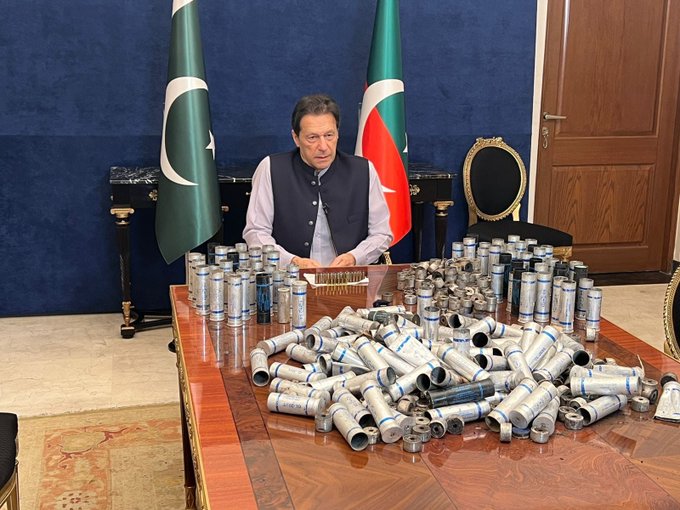
From his house, Khan symbolically delivered a speech via video stream, sitting with the tear gas canisters that had been fired outside.
The regime tries to ban Khan from public life
Khan’s determination to relentlessly participate in mass mobilizations has led the regime to try to ban him from public life.
Even Western organizations that are often biased, such as Amnesty International, have condemned the unelected Pakistani government’s authoritarian tactics, which have included prohibiting all speeches and rallies by Khan, as well arresting people who criticize the military on Twitter.
There are two main factors preventing an all-out assault to arrest Khan: the wrath of the population that would ensue, and fear that significant ranks within the armed forces would revolt and turn their guns on their superiors, à la Vietnam.
Indeed, it has been because of Khan’s popularity not just among ordinary Pakistani civilians but within the military ranks as well that the former prime minister has survived so far.
Khan’s popularity among some parts of the army is easy to explain. Rank-and-file soldiers and the majority of the junior and mid-rank officer corps are not keen on Washington dictating a War on Terror 2.0. They have always appreciated Khan’s principled opposition, since day one, to any military solution to the militancy in Afghanistan and the northwest of Pakistan.
Throughout 2022, Khan’s political party, the Pakistan Tehreek-e-Insaf (PTI, the “Movement for Justice”), exponentially rose in popularity, in contrast to the all-too-visible political shenanigans of the coalition of feudal family dynasties and other corrupt forces in power.
If it is true that Khan mismanaged both political and economic governance while in power, then the current lot has engendered a virtual implosion and collapse in the country.
Khan challenges Pakistan’s pro-Western elites
It is difficult to overstate how incensed ordinary Pakistanis are with the political mafias, significant sections of the military top brass, and the chief mafia don: Washington.
One of the most disturbing aspects of what has been happening is the virtual connivance of liberal-left forces and the Pakistani deep state in attempting to eliminate Khan from the Pakistani political scene.
The visceral hatred of Khan by Pakistan’s comprador elites cannot be explained by simply having differences with Khan on various policies – something that Khan’s own critical supporters have as well.
No, for this elite class of the liberal, pro-Western Pakistani intelligentsia, Khan has committed the ultimate crime: socio-cultural class betrayal.
Khan lived abroad for so long during his impressive cricket career. He studied at Oxford, and speaks perfect English. Thus, Pakistan’s ‘Westoxicated’ elites thought that Khan would behave just like them.
Instead, Khan has rejected the condescending attitude that the country’s Western-educated elites show toward ordinary Pakistanis.
Khan has mobilized tens of millions because of his sincerity to reimagine a new Pakistan, prioritizing social justice and an independent foreign policy.
The fact that one small, sectarian leftist party or the other is not being given the credit of leading the revolt against the unpopular regime has made them neurotically envious of Khan.
It is clear for all to see: Khan and the critical supporters both in and outside of his political party have become the most dangerous threat to Pakistan’s status quo.
That is why we have seen very unusual and fast-paced meetings between US officials and Pakistan’s generals and regime officials: Washington’s “friends again”.
Elimination of Khan is absolutely necessary for the troika of these power centers: local comprador political elites, the military high command, and Washington.
Why? Because they know that Khan and his party will sweep any elections that are held.
US encourages Pakistan to “continue working with the IMF”
In the meantime, Pakistan is enduring a deep economic crisis. The country has nearly exhausted its foreign exchange reserves.
The regime is in talks with the US-dominated International Monetary Fund (IMF) to save itself from bankruptcy. All of the corresponding policies of austerity and taxing the poor – “structural adjustment” – are to be expected.
CIA officer turned US State Department spokesman Ned Price said in a press briefing on March 8 that Washington wants Pakistan to “continue working with the IMF” to impose “reforms that will improve Pakistan’s business environment”, in order to “make Pakistani businesses more attractive and competitive”.
In other words, the US State Department wants Pakistan to double down on neoliberal economic policies, such as lowering wages and cutting social spending.
If hated before, the current “imported government” is now despised more than ever.
Imran Khan’s independent foreign policy angers the mafia don in Washington
Khan’s foreign policy was anathema to Washington.
He refused to recognize apartheid Israel as a legitimate state.
He improved ties with Russia for straightforward reasons of economic necessity (as well as promoting the geostrategic stability in the broader Central Asian region).
Khan mended ties and cooperated with Iran, even praising its revolutionary “dignity.”
He strengthened ties with China.
At the same time, Khan repeatedly said he desired friendly relations with Washington, proposing that they work together in peacebuilding in Afghanistan and the wider region.
But these other foreign policy aims were utterly unacceptable to the mafia don, which seems to be set on a war path with Beijing (and others).
Pakistan has been a close ally of China since the 1960s. But Islamabad’s intense obsession with pleasing Washington is a flagrant slap in the face of Beijing.
The meetings that top Pakistani military officials, including the powerful Chief of Army Staff, General Qamar Javed Bajwa, have held with officials in Washington and London are not being missed upon by Beijing or Moscow.
Though Pakistan is suffering through some of the worst economic woes in its history – thanks to the robber barons in power – the US still knows that the South Asian nation has one of the most formidable militaries in the world, and is a nuclear-powered country of 230 million.
Washington also knows that it can easily woo the military top brass by reminding them of how only the US and its weapons and fighter jets can allow Pakistan to stay apace with arch-rival India, trying to match its military supremacy in the region.
This is why the US is so keen on Pakistan participating in Joe Biden’s second “Summit for Democracy” in March 2023. (Despite the fact that Pakistan’s current government was not elected, and repeatedly resisted calls for holding a vote.)
As prime minister, Khan respectfully declined the invitation to the first summit in 2021, because he knew exactly what the intention was: A declining empire seeking to muster as many nations as it can to be a part of its “coalition of the willing” against official enemies like China, Russia, Iran, Venezuela, Cuba, etc.
According to leaks by Pakistan’s own ambassador to the US (who has a soft spot for Khan), Washington wants to reestablish its old military base in Pakistan, which was closed down in 2011.
The US is also reportedly dictating to Pakistan which militant groups to go after and which ones should be left alone – such as the anti-China East Turkestan independence movement or the ISIS elements giving trouble to Beijing and the Taliban government in Kabul.
Most importantly, Washington wants to compel Islamabad to do everything possible to significantly reduce or halt any progress on the China-Pakistan Economic Corridor (CPEC) and Beijing’s Belt and Road Initiative.
Moreover, Washington and the Persian Gulf monarchies are having a splendid time in convincing the new favorable military-civilian regime in Islamabad to undertake a political 180 that Khan would never agree to: gradually normalizing relations with Tel Aviv.
Nevertheless, what all of these power centers conspiring against Khan overlook is that they are dealing with a different Pakistani population now. The people’s political consciousness has exponentially risen with the ouster of Khan from power.
Hence, whether Khan is assassinated or somehow arrested or disqualified from politics, the powers-that-be might get a rude awakening, and be surprised that they are dealing with a new Pakistan, with or without Khan – one that will have zero tolerance for their venality, corruption, and subordination to Washington.
Prof. Junaid S Ahmad teaches Religion and Global Politics and is the Director of the Center for the Study of Islam and Decoloniality, Islamabad, Pakistan.
Pakistan’s Fascist Post-Modern Coup Regime Risks Replicating The East Pakistan Tragedy
By Andrew Korybko | March 15, 2023
The fascist authorities who were installed in Pakistan following last April’s US-orchestrated but superficially “democratic” post-modern coup against former Prime Minister Imran Khan risk replicating the East Pakistan tragedy if they don’t immediately stop shooting at their own people. The ousted leader’s supporters are rallying around his residence to prevent the local police from serving him an arrest warrant on a trumped-up graft charge that was concocted against him as “lawfare”.
Instead of reconsidering the wisdom of clashing with unarmed and purely peaceful civilians, the fascist authorities ordered their goons to assault them all with tear gas, rubber bullets, and reportedly even live ammunition that was shot into the air according to some accounts. This de facto declaration of war by the fascist post-modern coup regime on its own people could dangerously place the country’s political-security trajectory on the irreversible path towards civil war.
Former Prime Minister Khan warned as much in a tweet on Wednesday that he shared alongside a photo of himself sitting down in front of a pile of tear gas canisters that were shot at his home the other day. He wrote that “My house has been under heavy attack since yesterday afternoon. Latest attack by Rangers, pitting the largest pol party against the army. This is what PDM and the enemies of Pakistan want. No lessons learnt from the East Pakistan tragedy.”
The military-intelligence establishment must urgently rescind their de facto declaration of war on the Pakistani people, do whatever’s required behind the scenes to have the fascist post-modern coup’s leading figures resign as the first step towards national reconciliation, and then hold early elections. It’s only through this three-step process that the worst-case scenario of replicating the East Pakistan tragedy can potentially be avoided since anything less than that makes this more likely by the hour.
One of the most populous countries in the world is being pushed towards civil conflict by those conspirators who illegally usurped power with the US’ help last April and subsequently crashed the economy. This factual framing of Pakistan’s latest political-security dynamics proves that the increasingly violent clashes provoked by the fascist post-modern coup regime against its own people could lead to a global crisis in the event that they soon spiral even further out of control.
If the military-intelligence establishment continues waging war on the Pakistani people, then their victims should consider publicly calling on their iron brothers in China to urgently rein them in as a last resort to avert the worst-case scenario that former Prime Minister Khan just warned about. China’s diplomatic miracle in brokering the Iranian–Saudi rapprochement last week proves that it has the political capabilities to peacefully resolve the Pakistani Crisis if the people request for it to do so.
After all, the People’s Republic also stands to geostrategically lose if that neighboring nation descends into civil war. The China-Pakistan Economic Corridor (CPEC), which is the flagship project of Beijing’s Belt & Road Initiative (BRI) that’s aimed at creating a Community of Common Destiny for Mankind, would practically become inoperable should that happen. Not only could that block off China’s shortcut to the Indian Ocean, but it would deal an immense blow to its soft power and BRI’s reputation as well.
Without intending to come off as “conspiratorial”, observers can’t preclude the possibility that the fascist post-modern coup regime’s US backers encouraged them to provoke a civil war partially for the purpose of advancing America’s anti-Chinese “containment” strategy via unconventional means. At the very least, its military-intelligence establishment wouldn’t so publicly violate its people’s human rights and possibly even countenance war crimes against them without the US’ advance approval.
This means that the latest escalation of the nearly year-long Pakistani Crisis is connected to the US just like its origin is, thus extending credence to the preceding concerns that the events which Washington set into motion last April are actually part of its larger Hybrid War on China. This South Asian state was knocked out of the geostrategic game at the most sensitive moment in the global systemic transition shortly after this process accelerated following the start of Russia’s special operation.
That outcome hasn’t just proven disastrous for the Pakistani people who’ve suffered as a result of the crippling economic crisis that followed, but it also unexpectedly offset a key pillar of China’s grand strategy related to its reliance on CPEC as a non-US-controlled shortcut to the Indian Ocean. Furthermore, both the political and especially economic dimensions of the US-provoked Pakistani Crisis also raised serious doubts about CPEC’s future as well as that of BRI more broadly.
Nobody can therefore deny that the US’ regime change in Pakistan last year had very serious consequences for China that are becoming worse by the hour as that country’s fascist post-modern regime risks pushing it into civil war after de facto declaring war on its own people. China might already be working behind the scenes to try and de-escalate the latest and thus far most dangerous phase of this nearly year-long crisis on its borders, but it would still help a lot if Pakistanis publicly requested this.
That’s because this could compel China into taking urgent action behind close doors if it hasn’t already done so, not to mention creating the optics of Pakistan’s US-backed fascist post-modern coup regime literally shooting at Chinese-friendly peaceful protesters, which would force China to get involved. No other party apart from the US has the influence to peacefully resolve this crisis, and seeing as how Washington’s interests are perversely advanced by exacerbating it, the onus thus falls on Beijing.
Practically speaking, China has a credible chance of brokering peace and thus averting another Pakistani Civil War, but this best-case scenario can only happen if the fascist post-modern coup regime has the political will to save their country from this US-engineered collapse. If they do, then China can simply propose the previously suggested three-step peace plan related to immediately ceasing fire against unarmed peaceful protesters, creating a caretake government, and holding early elections.
The coup regime might agree to this in exchange for a Chinese bailout that could replace the IMF’s continually delayed one that’s full of strings and has thus far been withheld by that body’s US leader for the purpose of keeping its proxies in check in case they consider “defecting”. That last-mentioned observation is precisely what China would be tempting them to do, basically “defect” from the US in exchange for much-needed aid and thus averting the seemingly impending civil war.
The latest and thus far most dangerous phase of the nearly year-long Pakistani Crisis is rife with unpredictability since everything is moving so rapidly right now so it’s difficult to predict what might come next. In any case, it would greatly help the cause of peace and preventing a replication of the East Pakistani tragedy that former Prime Minister Khan just warned about if his unarmed peaceful protesters publicly called on China to diplomatically intervene and prevent this from becoming a global crisis.
Will Pakistan defy US sanctions to complete ‘Peace Pipeline’ with Iran?
By F.M. Shakil | The Cradle | March 7, 2023
Islamabad has formed a diplomatic channel to convince Washington to ease sanctions on Iran, which would finally allow for the completion of a crucial pipeline project to bring cheap Iranian natural gas to Pakistan.
Iran has vowed to take the matter to arbitration if Pakistan does not complete its portion of the pipeline by March 2024, as stipulated in an agreement between the two West Asian countries.
Discussions on constructing the massive pipeline project began almost 29 years ago, in 1994 – then called the Iran-India-Pakistan pipeline – which originally envisioned moving Iranian gas to Pakistan, Bangladesh, and China. The focus later shifted to constructing a pipeline between Pakistan and Iran only, but the project has never been completed.

According to the terms of the IP-GSPA (Gas Sales Purchase Agreement) signed between Iran and Pakistan, each country was obligated to construct the portion of the pipeline on its own territory, and the first flow of Iranian gas to Pakistan was to start January 1, 2015. The agreement stipulated Pakistan would pay Iran $1 million per day in exchange for 750 million cubic feet of gas daily, with a contract lasting 25 years.
Iran completed its portion of the pipeline in 2011, however, Pakistan has failed to construct its portion, largely due to difficulties caused by US economic sanctions imposed on Iran for the country’s alleged nuclear weapons program. US sanctions block Pakistan from purchasing Iranian gas, and this geopolitical risk has made Pakistani banks unwilling to finance the project.
Because of US foreign policy pritiorites, therefore, Pakistan continues to rely on more expensive liquified natural gas (LNG) to meet its burgeoning energy needs, which has greatly limited Pakistani economic growth and exposed the country to crises during periods of volatile LNG price spikes.
Due to these difficulties, Pakistan’s Inter-State Gas Systems (ISGS) and the National Iranian Gas Company (NIGC) signed a revised agreement in 2019 to allow Pakistan more time to complete its segment of the pipeline. The agreement stipulated that neither Iran nor Pakistan will take the other to court for delays or impose fines until 2024.
But US sanctions have continued to make Pakistan’s completion of the project difficult, and Iran is now threatening to sue Islamabad for $18 billion in fines if it breaks the agreement and fails to complete construction by the 2024 cutoff date.
Financial straits or US pressure
As Asif Durrani, a former Pakistan ambassador to Iran, tells The Cradle:
“Pakistan needs roughly $3 billion to lay a pipeline stretching over a radius of 781 kilometers inside the country. The question is who will finance this project, and secondly, the US sanctions on Iran, which took the air out of this project as far as Pakistan is concerned, need a revisit by the US authorities to protect the faltering economies of the region.”
The sanctions, he adds, were primarily focused on the energy sector of Iran and set a cap of $10 million on investments in the Iranian oil and gas sector.
Durrani is not convinced that US sanctions make completion of the pipeline impossible, however.
“These are lousy arguments because, despite these restrictions, Iran supplies Turkiye with almost $10 billion annually in natural gas,” he argues, adding that India and China have also resisted US sanctions.
Durrani contends that Pakistan and Iran are neighboring nations and that neighbors must always conduct business with one another. He urges private sector participation in the IP gas project to accelerate the development phase of this huge project.
Now a senior fellow at the Islamabad Policy Research Institute (IPRI), the former Pakistani envoy to Tehran had in 2021 criticized the US for sabotaging the Iranian nuclear deal, claiming that Iran, as a Non-Proliferation Treaty (NPT) member, had the legal right to use nuclear energy for peaceful purposes.
Dr. Muhammad Abdul Muqtedar Khan, an Indian-American academic and a professor in the Department of Political Science and International Relations at the University of Delaware concurs with Durrani’s logic, telling The Cradle that too many countries in this region tend to yield to US pressure unnecessarily.
India, he says, disregarded US outrage over the Russian oil issue and refused to capitulate, unlike Pakistan which is still in a state of vacillation. In the same way, Pakistan could proceed with the Iran gas pipeline project, citing its energy and resource constraints in the face of pressure from Washington.
“In 1990, India, China, and even Bangladesh showed interest in the peace pipeline – but, in 2008, as a result of the Indian nuclear accord with the US, New Delhi decided to withdraw. As the thing unfolded, Iran has already installed the pipeline on their side of the border, but Pakistan is still dilly-dallying about it because of the US pressure and lack of the financial means to begin construction,” Khan adds.
He says Iran has spent a considerable amount of money constructing its section of the pipeline and would want compensation for the resulting commercial loss. “Iran has granted sufficient time for the pipeline’s development, and if Pakistan begins building its gas infrastructure, it could gain some cushion to reduce its import bill.
Pakistan is hedging its bets
Pakistan’s Secretary of Petroleum, Ali Raza Bhutta, disclosed in a meeting of the country’s Public Accounts Committee (PAC) that Pakistan has spoken to the US about the gas project, seeking relief in sanctions on Iran to press ahead with the construction of the pipeline.
Islamabad’s top energy official went on to add that since there was a ban on importing gas from Iran, the government has conveyed to the US ambassador to either grant Islamabad permission to go ahead with the project, or compensate Iran for the penalty imposed for opting out of the project.
As Noor Alam Khan, Chairman of the Public Accounts Committee, tells The Cradle:
“I did not convene this meeting specifically for the IP gas project, the focus was only on the audit paras of the petroleum ministry, and I suggested during the meeting – not the secretary – that the Ministry of Foreign Affairs should approach the US to let them know how serious the situation is.”
When informed that the secretary of petroleum had briefed the committee on the IP gas project and that media had quoted him saying that either the US should pay the damages or permit the country to continue with the IP gas project under the terms of the Iran agreement, Khan, a member of a breakaway faction of former president Imran Khan’s Pakistan Tehrik-e-Insaf party, became irritated, said it was nonsense, and hung up the phone.
The Pakistan National Assembly’s Foreign Affairs Committee also discussed this matter last week. The committee’s chairman, Mohsin Dawar, raised fears about the fact that several nations in the region have received waivers for importing Iranian oil even though Iran is under sanctions.
Pakistan, however, was unable to secure such a waiver to conduct such lucrative oil and gas business with Iran. He pressed the appropriate ministries to examine opportunities for receiving exemptions for the IP gas pipeline with Iran, much as India and China had done for Iranian oil imports.
IP Gas Pipeline in perspective
The plan for the IP Gas Pipeline, which is also called the “Peace Pipeline,” dates back to 1994, when India was also part of the project.
The 1,700-mile (2,735 km), $7.5 billion project planned to move gas from the South Pars Gas Fields to India through the western part of Pakistan, Balochistan. Since its inception, the project has encountered numerous obstacles that have caused repeated delays in the execution of a natural gas project that was badly needed by energy-starved Pakistan.
In 2008, the three nations were close to reaching an agreement before India opted to pursue an alternative project, the Turkmenistan-Afghanistan-Pakistan-India pipeline (TAPI). The US pressure and sanctions on Iran appear to have impacted India’s decision to withdraw from the IP gas pipeline agreement and pursue an alternative that excluded Iran.
Then, in 2010, a 25-year-long Gas Sale and Purchase Agreement (GSPA) was signed, to construct a pipeline stretching across Pakistani territory from the Iranian border to Nawabshah, a distance of 781 kilometers.
Approximately 665 kilometers will travel through Balochistan while 115 kilometers will run through Pakistan’s Sindh province. The length of the Iranian portion of the pipeline is 1,100 kilometers. It begins in the energy economic zone of Pars and goes to Iranshahr and Bushehr. The route then continues through Fars, Kerman, Hormozghan, and Sistan-Baluchistan.
From the Pakistani border to Nawabshah, the pipeline will stretch around 781 kilometers. After completion, the IP gas pipeline was projected to supply 750 million cubic feet of gas per day to Islamabad from Iran. According to the deal, gas supplies from Iran would start in 2014. But, this assumption turned out to be a pipe dream and has not been realized during the past nine years.
A panacea for Pakistan’s economic woes
“Pakistan’s issue with foreign reserves would progressively get worse if it were unable to achieve a deal with Iran because years were spent in negotiations between Pakistan, Iran, and Turkey to create a close economic relationship for significant infrastructure projects, but the US sanctions and pressure shattered all these dreams,” Muqtedar Khan maintains.
He believes that Pakistan is currently dealing with a protracted foreign exchange problem that cannot be remedied by borrowing money from China, Saudi Arabia, or the International Monetary Fund (IMF) because Pakistan would still have to pay back the initial debt.
“Strangely, Pakistan and Iran have failed to create a mutual understanding despite their common Islamic background. As an alternative to US dollars, they may conduct business in their own currencies. Even though they are neighbors, it would be a diplomatic failure if they did not restore a reciprocal trade relationship,” Muqtedar Khan concludes.
Russia and Pakistan agree major energy deal
RT | January 21, 2023
Moscow and Islamabad have reached “conceptual” agreements on supplies of Russian oil and petroleum products to Pakistan, Russian Deputy Energy Minister Sergey Mochalnikov said at an intergovernmental commission meeting in the Pakistani capital on Friday.
Earlier in December, the minister of petroleum, Musaddiq Malik, visited Moscow to negotiate energy supplies to Islamabad and announced that Russia would provide oil, gasoline, and diesel to the country at discounts. He did not specify the price but noted that the talks were “more productive than expected.”
During the meeting in Islamabad, the sides also discussed “remaining questions” on the construction of the Pakistan Stream gas pipeline and the prospects for wider cooperation in energy and power engineering.
Mochalnikov said Russia presented a concept of future gas supplies to Pakistan, adding that “we must evaluate the position of the Pakistan Stream in this concept as soon as possible.”
The day before, Russian Energy Minister Nikolay Shulginov stated that Moscow is “ready to sign required corporate documents” to kickstart the construction of the pipeline.
Russia and Pakistan signed an intergovernmental agreement on the construction of the North-South gas pipeline (Pakistan Stream) from Karachi to Lahore in 2015. The launch of the project was postponed several times. The 1,100km pipeline with a capacity of 12.3 billion cubic meters of gas per year will link liquefied natural gas (LNG) terminals in the ports of Karachi and Gwadar in southern Pakistan with power plants and industrial gas consumers in Lahore in the north of the country.
The pipeline will transport both regasified gas and pipeline gas from various sources, including Iran and Turkmenistan, according to Shulginov.
“The approach to the implementation of such projects has to be comprehensive. It means not only a pipeline but also a source of gas for it. And we are currently discussing the project both from the point of view of transporting regasified gas and pipeline gas,” the minister said.
Islamabad is also seeking to negotiate long-term deals with Russia on imports of LNG, as there is currently no stable supplier for the country. Pakistan has been struggling with an acute energy shortage, and the surge in global oil and gas prices has worsened the situation. Imports of the fuel have become five to ten times more expensive due to increased demand in the EU.
Supreme Court Orders Police to File Case Against PM Sharif After Imran Khan Assassination Attempt
By Rishikesh Kumar – Samizdat – 07.11.2022
Pakistan’s Supreme Court on Monday ordered the police chief of Punjab to lodge a First Information Report (FIR) in the Imran Khan assassination case within 24 hours.
The police said that the provincial government was preventing Khan’s Pakistan Tehreek-i-Insaf (PTI) from registering the case despite several attempts.
Issuing a warning to Punjab police, the court said that suo-motu action will follow in case the complaint is not registered against Pakistan’s Prime Minister Shehbaz Sharif, Interior Minister Rana Sanaullah, and Maj. Gen. Faisal Naseer, all of whom, as Khan believes, were allegedly involved in the attack against him.
Khan’s “Absolute Freedom March” was halted on Thursday following the assassination attempt against Khan, whose convoy reached Wazirabad at that time. Khan openly accused Prime Minister Shehbaz Sharif and an army official of being behind the attack, in which one person died and at least nine people suffered bullet injuries, including the PTI chief.
“Under the criminal justice system, police can register the FIR itself. It’s been more than 90 hours but the FIR has yet to be registered,” the Supreme Court observed.
Local media also reported that the Punjab government was not in favor of adding Maj. Gen. Naseer, an official of the Inter-Services Intelligence (ISI) agency, in the complaint, but the request was rejected by the PTI.
Meanwhile, PTI’s Fawad Chaudhry has deemed the order the “first step towards justice.”
Khan, 70, sustained a bullet injury when two gunmen opened fire, shooting several rounds at him and his political aide on a container-mounted truck in the Wazirabad area of Punjab province on November 3.
After being discharged from the hospital, Khan announced he would resume the march to Pakistan’s capital on Tuesday. The Islamabad police warned the PTI of strict action if they carried out protests in the capital without the permission of the administration.
Former Pakistan PM barred from elections
Samizdat | October 21, 2022
Imran Khan, the former prime minister of Pakistan, has been banned from running in elections and becoming a member of parliament for the next five years. The decision by the election commission was rejected by his party, which has called for street protests in response to what they say is an act of political bias.
The Election Commission of Pakistan (ECP) accused Khan of failing to properly report how his government handled gifts that he had received while in office. It constituted “corrupt practices” that warranted his disqualification from holding public office, the body announced on Friday.
Senior officials in Khan’s Pakistan Tehreek-e-Insaf (PTI) party rejected the ruling and said they would challenge it in court.
Fawad Chaudhry, who was the minister of law under Khan, called the ruling a “slap on the face of 220 million” party supporters and claimed that the verdict was “written by Nawaz Sharif and signed by his servants,” according to local news website Dawn.
He was referring to the former Pakistani prime minister, who is also the brother of the incumbent head of the government, Shehbaz Sharif. Chaudhry declared the “beginning of the revolution.”
Reports of protests and some street clashes between PTI supporters and police have been coming from several cities, including the capital Islamabad, Lahore, Peshawar, and Karachi. On the Lahore–Islamabad motorway, people burned tires, according to videos shared on social media.
In the capital itself, police appeared to deploy tear gas to disperse demonstrators. Footage from the scene showed thick white clouds billowing in the streets, with people running away.
The Pakistani government called the verdict a proper execution of justice and said Khan may face prosecution for corruption. Law Minister Azam Nazeer Tarar also accused the PTI leadership of inciting “mobs” to attack Pakistani cities.
Khan was removed as prime minister in August in a no-confidence vote in parliament. He claimed that it was a soft coup orchestrated by Washington to place a more pliable politician at the helm of the country. Both Shehbaz Sharif and the US government denied the allegations.
The case reviewed by the ECP was related to four gifts from foreign countries, which Khan admitted to selling. In his formal reply to the commission last month, he insisted that he paid their value to the treasury when he received them.
Certain top government officials in Pakistan are legally obliged to declare all gifts but are allowed to keep those below a certain value. More expensive items must go to a special office called Toshakhana, but in some cases, the recipient can buy them back at around half their value.
Pakistan’s Energy Crisis Worsens as Gov’t Fails to Finds Bidder to Supply Natural Gas Before 2028
Samizdat – 04.10.2022
Pakistan Prime Minister Shehbaz Sharif has said that the European countries are purchasing most of the gas supplies available on the market, leaving Pakistan with no source of energy. Similar concerns about difficulties experienced by the ‘Global South’ in meeting their energy demands have been voiced by Indian Foreign Minister S. Jaishankar.
Islamabad has failed to find even a single bidder in response to a tender floated by Pakistan LNG Limited (PLL) for supplying liquefied natural gas (LNG) between 2023 and 2028, as per an official document.
As per tender documents, the PLL had in August invited bids for the supply of 72 units of LNG cargo starting in January next year. Under the terms of the tender, the government agency said it wanted to import 140,000 cubic meters of LNG every month for six years. The results of the bid were published on Monday.
A tender for procuring 10 cargoes of LNG floated by the Pakistani government in July had also failed to attract even a single bidder.
The latest development comes against the backdrop of an ongoing energy and economic crisis in the South Asian country, which is grappling with power shortages owing to a shortfall in energy supplies spurred by high prices and a surge in demand in the European countries.
Pakistan has also been facing the problem of depleting forex reserves and is awaiting the disbursement of $1.17 billion from the International Monetary Fund (IMF) after reaching a staff level agreement (SLA) in July.
Billions of dollars in aid are also awaited from other countries such as Qatar, Saudi Arabia and the UAE, the authorities have said.
S&P Global said last month that power shortages have been exacerbated by unprecedented flooding, as major grid stations have been endangered due to the climate disaster and connectivity options have been disrupted.
Before the floods struck in June-July, Pakistan was already reeling under high energy import bills, which had surged 91 percent to $4.98 billion on a year-on-year basis as of the end of the financial year in June, as per the Pakistan Bureau of Statistics.
A report by Institute of Energy Economics and Financial Analysis (IEEFA) has said that energy import bills could increase to more than $32 billion by 2030.
The global surge in energy prices has largely been blamed on Western sanctions against Russia in the wake of the eruption of Ukraine crisis, with many European countries looking for alternatives to Russian energy.
As the EU seeks to draw down its reliance on Russia, which has been EU’s primary supplier of gas, many EU countries have ramped up their imports from other countries such as Qatar, another major producer of natural gas.
In many cases, the richer EU nations have been offering better rates for sourcing energy than the developing countries.
Soaring Energy Prices Force Pakistani Industrialists to Close Businesses
By Aneela Rashid – Samizdat – 20.09.2022
Pakistan has a young and growing entrepreneurial population, with English as the main language for business, but inflation, as well as the recent political turmoil and devastating floods, are making it difficult for industries to flourish.
Tension among Pakistan’s business community is on the rise following unprecedented inflation caused by multiple factors, including COVID-19, monsoon floods and political instability.
Despite recent improvements in the business environment, many problems remain an issue for companies operating in Pakistan. Pakistan had previously climbed 28 places to 108 out of 190 countries ranked on the ease of doing business by the World Bank’s 2020 Doing Business report.
Considering that the country has a young population, with English as the main language for business, there are plenty of opportunities due to the expanding middle class which has a keen eye for imported goods and services.
Foreign retail and franchise outlets are also spreading rapidly in urbanized cities and the country has a natural endowment in agriculture and minerals.
The country’s most developed industries – cotton textile production and apparel manufacturing – account for about 66% of exports and almost 40% of the employed labor force, as stated in the report Pakistan Market Insights 2021.
Other major industries include cement, fertilizer, edible oil, sugar, steel, tobacco, chemicals, machinery, and food processing.
As such, the economic outlook of Pakistan presents many opportunities, but also many challenges, particularly in the long-term, which are harming the country’s industries and business opportunities.
Annual inflation in the country increased to 27.3% in August, the highest since May 1975, according to a report by Trading Economics. Inflation is causing panic amongst both urban and rural dwellers.
Transport prices recorded the biggest increase of nearly 65%, due to high fuel prices that have seen a 94.4% increase in urban areas and almost 100% in rural areas. Meanwhile, housing and utilities have seen a 27.6% rise, with electricity charges rising a whopping 123.4%. Food and non-alcoholic beverages also jumped in price by a record level of 29.5%.
The Pakistan rupee is expected to trade at 242.06 to the US$ by the end of this quarter, according to Trading Economics global macro models and analysts’ expectations. As Pakistan experiences economic disorder with fast-depleting foreign reserves, historic depreciation of the rupee against the US dollar and soaring inflation, the country’s industries and business community are taking a big hit.
Some 40,000 industries in the port city of Karachi alone are unable to continue production, according to a report by Bloomberg. Karachi’s power utility, K-Electric Ltd., warned that it may start widespread power cuts in the city of 20 million, which could include prolonged rationing to industrial zones for the first time in 11 years.
“These current conditions are severely hindering KE’s ability to procure fuel, causing a permanent curtailment of power generation that translates to as much as 10 hours of planned blackouts for some parts of the city,” Sadia Dada, a spokesperson for K-Electric was reported as saying by Bloomberg.
Speaking at a press conference on Monday, Lahore Chamber of Commerce and Industry (LCCI) President Mian Nauman Kabir said that the National Electric Power Regulatory Authority (Nepra) is doing great harm to the economy of Pakistan. “I am receiving messages from the industrialists every day, who say they are shutting their industrial units due to high electricity bills,” he said.
However, many of the country’s leading industrialists refrain from expressing their frustrations to the media, anxious not to land on the wrong side of current or future political leaders. However, there are some who are not afraid to voice their concerns.
An unnamed businessman told the Dawn newspaper, “If politicians fail to resist the temptation to take their conflict out of parliament it can make the country drift towards anarchy. Yes, we are worried for our businesses, but we are more concerned about the safety and security of our family and the future of this country.”
Similarly, businessman Musadaq Zulqarnain said that Pakistan needs a sustained growth of 7-8 per cent for several years. According to him, this continued growth needs to be powered by an increase in exports, if the country is to come out of its economic troubles.
A few other business leaders also expressed their frustration with the lack of clarity in politics and were critical of “mismatched priorities of successive governments.”
Meanwhile, a prominent member of Pakistan’s business community, Mian Muhammad Mansha, believes that the country needs to tell the untold story of its rich, untapped business opportunities, and change the world’s perception about itself. In an interview with Dawn, the billionaire industrialist said that it is vital to convince foreign investors to attract foreign direct investment (FDI) to shore up foreign currency reserves and boost economic growth.
“Our problems will be solved only when foreign investors start to invest here. You can’t build foreign reserves with exports alone. India has accumulated reserves of $650 billion mainly by attracting FDI,” stated Mansha.
His advice to the government was to borrow the needed money to stabilize the economy and then move towards rapid growth. “Once the economy starts growing, it will yield a lot bigger tax revenue than you can hope to collect by boosting the tax rates. The deficit will not matter any longer. We mustn’t just look at the budgets; these are just a small part of the economy. The bigger economy exists outside the budget and the public sector; we should grow that and tap the hitherto untapped potential of the country and opportunities it offers,” he further said.
On August 29, the IMF’s executive board approved almost $1.2 billion for Pakistan. Antoinette Sayeh, IMF deputy managing director and acting chair, criticized Pakistan’s government policies that caused “uneven and unbalanced growth,” saying that the country must implement “corrective policies and reforms” to regain economic stability, and sustainable growth.
In a recent interview with Reuters, Pakistan’s Finance Minister Miftah Ismail noted that the country was awaiting $4 billion for budgetary and other financial support from the Asian Development Bank (ADB), Asian Infrastructure Investment Bank, and the World Bank. He said that around $1.5 billion was expected to be disbursed to Islamabad next month from the ADB as a “countercyclical support facility”.
However, some reports suggest that this funding may not be enough to pull Pakistan out of its deep economic crisis. The floods alone are estimated to have caused more than $10 billion in damages, and these are just preliminary estimates. With Pakistan’s agricultural output brought to a standstill and 80% of the country’s crops destroyed, the food shortages will only exacerbate.
The concerns voiced by the business community echo the pleas of common Pakistanis, who are desperately waiting for the debilitating economic stress to ease off in the nearest future.
Iran given roadmap for joining Russia and China in major bloc
Samizdat | September 15, 2022
Iran has signed a memorandum paving the way to transition from its current observer status to full membership of the Shanghai Cooperation Organization (SCO).
The Middle-Eastern nation, which the US has long sought to undermine with diplomatic isolation and economic sanctions, made a formal step on Thursday to become the ninth member of the organization. Among the SCO’s heavyweights are Russia and China, two major powers that are on Washington’s list of geopolitical opponents.
The SCO was created in 2001 as an intragovernmental forum aimed at fostering trust and developing economic and humanitarian ties in Asia.
It currently has eight permanent members: China, India, Kazakhstan, Kyrgyzstan, Russia, Pakistan, Tajikistan, and Uzbekistan. The last is currently hosting the annual summit of the leaders of the member states in the city of Samarkand.
Iran has been an SCO observer since 2005. Its delegation to the summit is headed by President Ebrahim Raisi, who met with senior Uzbek officials on Wednesday.
The memorandum, which spells the commitments that Tehran will undertake to become an SCO member, was signed by Iranian Foreign Minister Hossein Amir-Abdollahian and SCO Secretary-General Zhang Ming, the host country’s foreign ministry reported.
Yury Ushakov, a foreign affairs advisor to Russian President Vladimir Putin, said earlier this week that Iran could qualify for being upgraded to full membership before next year’s SCO summit in India.
Uzbek President Shavkat Mirziyoyev touted this year’s event as a turning point for the organization. He cited the rapidly growing interest of nations in closer involvement with the SCO and said that it served as an example of how a “deep crisis of trust at the global level” can be overcome by parties willing to do so. He also stressed the scale of the group, which accounts for roughly half of the world’s population and a quarter of global GDP.
Belarus, also an SCO observer, is set to start the formal process for full membership this year. Egypt and Qatar formally joined the organization as dialogue partners on Wednesday. Saudi Arabia is scheduled to do the same, while Bahrain, Kuwait, the UAE, Myanmar, and the Maldives are expected to begin their respective paths to receiving the same status.
Featured Video

Iran FM Araghchi: “Hormuz Will No Longer Be the Same”
or go to
Aletho News Archives – Video-Images
From the Archives
Sam Husseini: The entire US establishment helped lie their way into the Iraq war
By Slava Zilber | American Herald Tribune | October 14, 2019
Sam Husseini is a senior analyst with the Institute for Public Accuracy, independent journalist and contributor to The Nation and FAIR.
Slava Zilber: Sam, three years ago, you appeared on Talk Nation Radio with David Swanson and spoke about the case of the GCHQ whistleblower Katharine Gun. You pointed out that the people involved in the spying on the UN and the people authorizing the Iraq War were not held accountable:
“Virtually everybody who went along with the war, whether it is Kerry or Clinton, of course, the Bush administration themselves has falsified their own records in terms of why, what they did, when they did, why they did it, to the extent that they’ve been scrutinised at all.”
You also address it in a recent article. And recently, Joe Biden has been lying about his position on the Iraq War. How can such an important issue escape meaningful scrutiny? … continue
Blog Roll
 Aletho News
- Barghouti: ‘Netanyahu has fallen,’ era of Smotrich, Ben-Gvir over
- China slams US policy on Iran as Russia rejects legality of nuclear meeting at UN
- The Mecca Pact Courts Iran: Containment Comes Full Circle
- Oman FM: Persian Gulf states, Iran, Iraq should form security pact excluding US
- Trump peddles fresh falsehoods, claims Iran ‘started the war’ as US aggression drags on
- Ukraine quagmire? Yes, but it’s for NATO, not Russia
- US intelligence hypes Chinese, Russian space threats while accelerating its own military buildup in orbit
- Iran FM Araghchi: “Hormuz Will No Longer Be the Same”
- EU facing trillion-euro debt hole while seeking more cash for Kiev
- How US, Europe, Persian Gulf states exhausted missile stockpiles, splurged billions to defend Israel
- If Americans Knew
- An error has occurred; the feed is probably down. Try again later.
- No Tricks Zone
- Sudden Stratospheric Warming, Powerful El Niño Combination May Lead To Extreme Europe Cold, Energy Crisis!
- Two New Studies Find Thwaites Glacier Melt Cannot Be Driven By Human Activity Or A Warming Ocean
- E-Cars Reduce CO2 Emissions By Only 41% Compared To Internal Combustion Engine Vehicles
- Predictions Made By Renowned Climate Professor Over Past Decades Have Been Proven To Be Poor
- New Study Suggests Large Regions Of The Pacific Ocean Have Been Cooling For The Last 80 Years
- Germany’s Green Energy Debacle: High Energy Costs Force Kahla Porzellan to Close After 182 Years!
- New Study: 50 Years Of The Most Aggressive ‘Net Zero’ Policies Can Only Affect The Global Climate By 0.03°C
- US September “Heat” Was No Record…Many Records Set Decades Ago
- Latest European Green Energy Debacle; Portugal’s Largest Flagship Solar Park Insolvent!
- Green Energy Debacle: German Expert Professor Fritz Vahrenholt Warns Of Severe Economic And Social Consequences

