The other mass displacement: while eyes are on Gaza, settlers advance on West Bank herders
United Nations Office for the Coordination of Humanitarian Affairs | November 1, 2023
Shortly after armed Israeli settlers threatened to kill them if they did not leave, 24 Palestinian households totaling 141 people, half of whom are children, were displaced from Khirbat Zanuta in the southern West Bank.
On 28 October 2023, the families dismantled about 50 residential and animal structures and vacated the area with their 5,000 livestock. The Office for the Coordination of Humanitarian Affairs has previously documented settler attacks in this community, most recently on 12, 21 and 26 October. About two thirds of the families that comprised this community are now displaced.
“On 26 October, settlers attacked us, destroying our homes, water tanks, solar panels, and cars,” said 43-year-old Abu Khaled from Khirbet Zanuta. “I felt the presence of death so tangibly as if I saw it with my own eyes. I was torn between staying in or leaving the place I love, where I belong, where I may die. On 28 October, I made the hardest decision in my life: to leave Zanuta and leave everything behind, as memories. I did this to protect my children.”
These experiences are not unique to Khirbat Zanuta. In 15 herding communities across the West Bank, at least 98 households comprising 828 people, including 313 children, have been displaced amid settler violence or increased movement restrictions since 7 October. Since then, Israeli settler violence has increased significantly, from an already high average of three incidents per day thus far in 2023 to a current average of seven per day.

In this period, OCHA has recorded 171 settler attacks against Palestinians, resulting in Palestinian casualties (26 incidents), damage to Palestinian properties (115 incidents), or both (30 incidents). Cases of harassment, trespass, and intimidation are not included in these statistics when they do not result in damage or casualties, although they too increase the pressure on Palestinians to leave.
On 9 October, 40 people were displaced from the herding community of Al Ganoub. Armed Israeli settlers had raided the community, threatening residents at gunpoint, saying they would kill them if they did not leave within an hour. Abu Jamal, 75, is one of those who were displaced. “Settlers set fire to our tent and stole my goats,” he told us. “They destroyed everything that had kept me here.” Another residential structure was also set on fire during this incident.Since 7 October, access restrictions, typically imposed by the Israeli occupation authorities, have intensified throughout the West Bank, including East Jerusalem. These are particularly severe in areas near illegal Israeli settlements and in the ‘Seam Zone,’ the Palestinian area isolated by Israel’s 712-kilometre-long illegal Separation Wall in the West Bank. Settlers too have imposed movement restrictions, blocking access roads to Palestinian communities. Such measures have limited Palestinians’ access to essential services and livelihoods. In some cases, settlers have also damaged water resources relied upon by herding communities, depriving them of a fundamental human necessity. Palestinian herding communities are often highly dependent on humanitarian assistance, including health and education services. However, since restrictions intensified, many of the services have had to stop.
On 12 October, eight households, comprising 51 people, were displaced from Shihda WaHamlan herding community in Nablus, after settlers threatened them at gunpoint, saying they would kill them and set their tents on fire during the night. One of the family members, 52-year-old Abu Ismail, stated: “I had no choice but to leave everything behind to protect my children.” More than one in every three settler-related incidents since 7 October has involved settlers using firearms to threaten Palestinians, including by opening fire. In almost half the cases, Israeli forces accompanied or actively supported the attackers. Many of the latter incidents were followed by confrontations between Israeli forces and Palestinians, where three Palestinians were killed, and dozens injured. Eight Palestinians were killed by settlers directly, as of the end of October. Damage or destruction was caused to 24 residential structures, 40 structures used for farming, 67 vehicles and more than 400 trees and saplings. Settlements are illegal under international humanitarian law and, compounded by settler violence, they have for many years resulted in increased risks and heightened humanitarian needs among Palestinians.
At the same time, concerns are high over families who have remained and continue to endure attacks by settlers. Mohamad Abu Seif (Abu Khalid), 90, has been living with his family in the herding community of Ein Shibli for over 40 years. While they have remained, they are exposed to repetitive threats and harassment by settlers. “They prevent us from grazing our sheep,” he told us.
He and his family are among five Palestinian households, comprising 33 people, who remain in this community. All of them are at risk of displacement as grazing areas diminish by the actions of Israeli settlers. Eight families, comprising 51 people, have already left this area since 7 October. While Abu Khalid is still there, he and his family have no assurances that they would be able to remain for much longer.
Why a global anti-Hamas coalition pushed by Macron is a bad idea
By Rachel Marsden | RT | November 2, 2023
Last week, standing beside Israeli Prime Minister Benjamin Netanyahu during a visit to Jerusalem, French President Emmanuel Macron suggested recycling the global coalition of 86 nations against Islamic State (IS, formerly ISIS) to focus on Hamas.
“Hamas is a terrorist group, whose objective is the destruction of the state of Israel. This is also the case of ISIS, of Al-Qaeda, of all those associated with them, either by actions or by intentions,” Macron said, betraying a short and selective memory. The stated goal of IS wasn’t to eradicate Israel – it was to establish a caliphate in Syria and Iraq, then broaden it into Arab countries. IS was first and foremost a threat to the stability of Syria – the same country whose government the US and its Western allies actively hindered in its fight against terrorism by making a failed attempt at overthrowing President Bashar Assad through Pentagon and CIA-backed training and equipping of “Syrian rebel” jihadists. As for Al-Qaeda, Israel was even reportedly at one point helping treat wounded militants from the group who were fighting their common enemy, the Iranian-backed Hezbollah, in Syria – in turn effectively hindering the fight against IS, as Syria and Hezbollah worked to destroy it.
The Global Coalition against Daesh (another name for IS), founded in 2014, explicitly excluded Russia, whose invitation by Damascus to help it eradicate the terrorist threat can be largely credited for Syria’s stabilization, and the fact that it’s rare to even hear any talk of IS anymore. Russia’s involvement in neutralizing the terrorist group, coupled with former US President Donald Trump’s refusal to continue funding Washington’s incursion into Syria, beyond hunkering down in the oil-rich Kurdish part, was the ultimate key to IS’ defeat. So with apparently little left for it to do now, Macron recommends that the coalition that mostly sat and watched – while Russia, Iran, and Syria did the heavy lifting – take on Hamas. Who does he think is going to do the work this time? Russia, which is still excluded from the coalition? Syria, which has recently taken incoming missile fire from Israel? Iran’s Hezbollah allies, who lost 1,000 men fighting IS in Syria – and whom Netanyahu has placed in the same basket as Hamas as an enemy of Israel? Good luck with that.
So with the most effective anti-IS fighters excluded from fighting Hamas, who’s left in Macron’s proposed coalition? There’s the Global South, including some African countries that just kicked out French troops for their own failed counterterrorism missions which had led to multiple coups and the flourishing of jihadism. It’s doubtful these nations will now be keen to embark on yet another counterterrorism mission alongside the same forces that they just expelled.
Then there are all those members of the international community who are quietly thinking what United Nations Secretary General Antonio Guterres dared to say aloud last week – that Hamas’ brutal attack on October 7, which left close to a thousand civilians and hundreds of military and security personnel dead, “did not happen in a vacuum.” He was, of course, hinting at Israel’s longstanding, UN-recognized oppression of civilians in Gaza. His statement begs yet another question: Is Hamas really a global threat? Or is it just Israel’s problem?
Anti-Israel unrest has reverberated outside of the immediate conflict zone, including in Western Europe and the US, but these protests have nothing to do with Hamas. Instead, citizens elsewhere in the world are merely reacting to perceived injustices, particularly in light of what they consider to be an overwhelmingly pro-Israel bias on the part of the Western establishment, which initially and drastically minimized concerns over the protection of Palestinian civilians. So any global action against Hamas seems futile.
The anti-IS coalition targeted the terror group’s propaganda, with its website stating that IS’ “use of social media tied to acts of terrorism is well-documented. In response, Coalition partners are working together to expose the falsehoods that lie at the heart” of its ideology. They’re free to do that, but why bother when there’s already open debate among those who have the opportunity to see reports from the ground and assess the situation for themselves? Governments can’t be trusted not to promote their own propaganda under the guise of combating it – all to secure an advantage for their preferred narrative.
Just consider the recent example of propaganda emitted by one of the self-styled gatekeepers of truth: European Commission President Ursula von der Leyen. “Russia and Hamas are alike… their essence is the same,” she said. Nah, actually they aren’t the same at all. And not even Israel has been saying that, but still, “Vladimir Putin wants to wipe Ukraine from the map. Hamas, supported by Iran, wants to wipe Israel from the map,” von der Leyen explained. Besides the hot take on Putin’s intentions regarding Ukraine, that’s like saying that since Warren Buffet has a bank account, and I have a bank account, then I’m also a billionaire. This is exactly the kind of nonsense that Western anti-propaganda campaigns end up spewing.
The anti-IS coalition was made to tackle IS. If that’s no longer an issue, then just toss it in the trash. How many interventionist entities does the West need to spearhead, anyway? There are already more than enough vehicles and coordination mechanisms for intelligence sharing, propagandizing, and security operations. Besides, there’s no proof that better intelligence could have helped Israel when Egyptian and American officials have claimed that Netanyahu had warning of the impending Hamas attack. About the only thing that more useless Western-led bureaucracy would help is the West’s own hunger for more of it.
Rachel Marsden is a columnist, political strategist, and host of independently produced talk-shows in French and English.
Hamas holds strong in Gaza despite army’s best efforts: Israeli media
The Cradle | November 2, 2023
Hebrew newspaper Maariv reported on 2 November that the Israeli army is facing a difficult and complex situation the more it deepens its ground assault on the Gaza Strip.
“The fighting in the coming days is expected to be much more difficult … The officers describe how it is evident that Hamas prepared itself to fight against IDF forces,” Maariv reports.
At the current stage, Hamas “is very far from a breaking point or crisis,” it says, adding that it has managed to maintain an organized method of fighting that relies mainly on tunnel warfare,” in which the fighters regularly ascend from out of tunnels and ambush Israeli soldiers with anti-tank weaponry.
The Panther APC armored vehicle, which Hamas ambushed on 28 October, proved to be the “most difficult event for the IDF so far,” Maariv wrote.
Fighters emerged out of a tunnel and struck the armored vehicle with anti-tank missiles, killing at least 11 soldiers and wounding several more. Israel has announced an investigation to determine the military failures that led to the incident.
Since then, several more Israeli soldiers have been killed as a result of intense clashes and anti-tank missile ambushes carried out by the resistance.
Eighteen Israeli soldiers have been killed inside the Gaza Strip since Tuesday, among them a senior officer. Intense fighting continues to rage on.
The Qassam Brigades announced on 2 November that its forces destroyed an Israeli tank and an armored personnel carrier with Al-Yassin 105 rockets.
Israel’s army also announced the killing of dozens of Hamas militants and breaching the group’s first defensive line.
The military has also allegedly begun an operation to destroy Hamas’ tunnels, Walla news outlet reported.
“Under no circumstances” should Israeli forces attempt to enter the tunnels; an ex-military chief was quoted as saying.
According to an Israeli officer cited by Walla, the Israeli army aims “to collapse the entrances and the tunnels” on Hamas and turn the underground network into a “death zone.”
However, as Maariv notes, Hamas has continued to use tunnels that the army had claimed to have destroyed in previous wars.
After Operation Guardian of the Walls in 2021, the army “greatly exaggerated and arrogantly overestimated the intensity of the damage to the tunnels” and the “psychological effect” that was meant to scare Hamas into fighting above ground out of fear that the tunnels would become “death traps.”
This assessment was “disconnected from reality on the ground,” Maariv said, adding that Hamas “will fight hard … and will not surrender easily.”
Israel has vowed to completely eradicate Hamas and dismantle its vast underground network of tunnels.
Between Iraq and a hard place: Sudani’s US dilemma over Gaza
By Khalil Harb | The Cradle | November 1, 2023
The Yamamah Palace, the epicenter of Saudi Arabia’s royal authority in Riyadh, is known for its deliberate and measured decision-making, particularly in the face of significant regional events.
But Israel’s genocidal war against Gaza proved an exception, warranting a rapid dispatch of Foreign Minister Prince Faisal bin Farhan to Baghdad within a mere 48 hours after the Hamas-led resistance operation Al-Aqsa Flood was launched. This is far from a coincidence; a large subset of Iraqis belong to the regional Axis of Resistance.
Likewise, it is noteworthy that Iraqi Prime Minister Mohammed Shia al-Sudani revealed a discussion point that was visibly absent from the White House statement on his 16 October phone call with US President Joe Biden. Specifically, the part where the Iraqi leader expresses that “the continued aggression in Gaza stirs outrage among people in the region and globally.”
These two incidents lay bare Iraq’s state of confusion. The Persian Gulf state’s inner turmoil became even more evident in the way it voted on the Arab draft resolution presented by Jordan at the UN General Assembly.
War in West Asia
Although Baghdad had a hand in sponsoring the draft calling for a “sustained humanitarian truce,” the electronic vote initially showed that it had abstained. The Iraqi delegation in New York later scrambled to amend its vote in support of the resolution, blaming the mishap on “technical issues.”
Geographically, Baghdad may seem distant from occupied Palestine, but for many Iraqis and Palestinians, the legacy of Iraqi soldiers who helped prevent the Zionist occupation of Jenin in 1948 remains a powerful memory, with the cemetery of Iraqi martyrs standing as a solemn tribute.
However, Prime Minister Sudani faces challenges far more treacherous than reviving the heroic legacy of the Palestinian cause. Over the past week, at the Trebil border crossing with Jordan, large crowds of Iraqi protesters have camped out, and Iraqi oil shipments offered to Jordan at favorable prices are being hindered.
Chants of “Give me the fatwa, and see with your eyes” reflect the Iraqi street’s desire for a fatwa from the supreme Shia authority in Najaf, calling for defensive “jihad” against Israel. Sudani is also dealing with almost daily attacks on US military bases since 17 October.
While there are no “official” military fronts opened against Israel by the Arab states, the intensity of the political scene in Baghdad makes it almost impossible for Iraq to remain immune from the ripple effects of the “Unity of Fronts” that brings together the forces of the Axis of Resistance in Palestine, Lebanon, Syria, and Yemen.
The Resistance’s ‘red lines’
If Israel has shown little concern – at least so far – about the extent to which its brutal assault on Palestinians in the besieged Gaza Strip and the occupied West Bank affects the passive Arab governments near and far, it is the US that should actually be most anxious.
The relentless Israeli onslaught on Gaza, which has so far claimed over 8,000 civilian lives and left more than 20,000 people injured, poses a significant threat to one of the few accomplishments the US could still claim from its illegal 2003 invasion of Iraq. Back then, Washington boasted it was establishing a democratic system to replace an authoritarian Iraqi regime.
However, even the staunchest American ideologues who defended and justified the invasion are lost for words today, as the Gaza war undermines any noble goals attributed to their intervention. This genocide being committed in Gaza before the eyes of the world is eroding the last remnants of respect and prestige associated with the US.
Indeed, the urgent visit of Prince Faisal bin Farhan to Baghdad underscores Saudi awareness, traditionally aligned with US interests, of the sensitivity of the situation in Iraq. It signals a growing conviction that Iraq may not stay neutral in the ongoing conflict, especially now that Iranian President Ebrahim Raisi has announced that Israel has crossed certain “red lines” set by the Axis of Resistance.
These red lines include the much-delayed ground invasion of Gaza, an attempt to completely uproot Hamas and other Palestinian resistance factions, and the Israeli government stepping up its acts of aggression against other fronts.
Checking US moves
For Sudani, being Iraq’s prime minister without a solid party, parliamentary support, or political base to weather the looming regional war is a daunting challenge. Diplomatically, Baghdad is also in an uneasy position.
Incidents such as the one at the UN, where Iraq supported a ceasefire resolution but balked over references to the defunct “two-state solution” – given Iraqi legal stances against normalization with Israel – and concerns about placing Palestinian civilians on the same footing as their occupying overlords.
Sudani’s biggest fear is being pulled into Iraq’s messy domestic politics over this issue. Observers believe that the “Coordination Framework” forces, which played a pivotal role in bringing him to power, won’t stand idle if the US allows Israeli President Benjamin Netanyahu to bring about another nakba.
Among these Framework forces, there are Iraqi factions that align themselves with the Resistance Axis, maintain close ties with Iran and Lebanese Hezbollah, and consider the Palestinian cause a central issue in their political discourse.
Hadi al-Amiri, leader of the Badr Organization, was among the first to escalate the rhetoric a day after Washington announced it would ramp up arms supplies to Israel, warning that: “If they intervene, we would intervene… if the Americans intervened openly in this conflict… we will consider all American targets legitimate … and we will not hesitate to target it.”
Three weeks into the current conflict, the extent of US involvement becomes clearer, including implicit and overt threats to prevent any regional party from intervening against US and Israeli interests. Calls and letters from western leaders to Baghdad have also been on the rise.
Jaafar al-Husseini, spokesman for the prominent Iraqi resistance faction Kataib Hezbollah, said that “the resistance in Iraq achieved its first attacks … and will continue at a higher pace,” adding that “The Americans are essential partners in killing the people of Gaza and therefore they must bear the consequences.”
US Proxy or Protector of Palestine?
The west, particularly the US, is employing intimidation tactics through messages conveyed to Baghdad. They are trying to push the Sudani government to act as their proxy within the “containment front,” which will potentially spark internal conflict.
This would jeopardize the relative calm that marked the first year of Sudani’s premiership. It will further undermine efforts to promote Iraq’s regional integration and distance it from Iran in exchange for closer ties with Arab states like Egypt, Jordan, Saudi Arabia, and the UAE.
Iraqi sources say that the status-of-forces agreement known as “SOFA” between Baghdad and Washington may be one of the first “victims” of the Israeli escalation in Gaza and the destabilizing US military involvement in the war.
If Iraqis cancel the agreement regulating US military presence in their country, it would render the US mission and presence illegitimate, effectively pushing Iraq out of the Atlanticist orbit two decades after the invasion.
Another potential casualty of Al-Aqsa Flood is the third Baghdad Conference backed by Paris – Its convening is now in doubt, especially if the region becomes further inflamed. This would be a setback for France’s influence and its role in Iraq, including a lucrative deal worth over $27 billion with French conglomerate Total Energy.
The “hands on the trigger,” as the Iranians have stressed repeatedly, are not just a threat but also a form of pressure to compel the US to rein in the Israeli government’s genocidal actions. Baghdad has conveyed a message from Washington to Tehran that calm is needed, and the Iraqis have also relayed to the Americans the importance of not provoking Lebanese Hezbollah if the US truly wants to contain the situation regionally.
The real question here isn’t whether Iraqi factions will engage in a major war, but whether Washington is so beholden to Israel that it will overlook the potential repercussions of the growing outrage within Iraq and the rest of West Asia, which will eventually engulf the US’s remaining overt colonial outpost in the region.
At General Assembly, Russia calls for immediate halt to bloodshed in Gaza Strip
Press TV – November 2, 2023
Russia’s Ambassador to the United Nations Vasily Nebenzya has called for an immediate end to the bloodshed in the Gaza Strip, as the Israeli regime continues its deadly bombing campaign in the besieged enclave.
Nebenzya made the appeal during the General Assembly special session on Palestine on Thursday, stressing that the bloodshed must be stopped in order to prevent the ongoing crisis from spreading to the entire.
“First of all, it is necessary to stop the bloodshed and to prevent the crisis from engulfing the entire region. Otherwise, the conflict will never be stopped,” he said.
Nebenzya also demanded that the mediators be allowed to work on a diplomatic solution, including the release of hostages.
“One will have to walk down this path sooner or later; the only question is how many innocent people will die in the meantime,” he said.
The Russian envoy said Israel is an occupying regime and therefore it does not have the right to defend itself in the current conflict as it claims.
On Tuesday, Nebenzya blamed the United States for the ongoing atrocities committed by Israel against Palestinians, after Washington opposed a UN Security Council resolution calling for an urgent ceasefire in the Gaza Strip.
The envoy also slammed Western countries that abstained at the vote on Russia-proposed draft resolutions that called for a ceasefire.
A week earlier, Nebenzya said Moscow has for years been warning about the soaring tensions in West Asia and that the ongoing crisis in the region results from longstanding “destructive” policies of the United States.
Israel has been heavily bombing Gaza since October 7 when the Palestinian resistance movement Hamas launched a surprise operation in the occupied territories in response to the Israeli regime’s intensified crimes against Palestinians in the occupied West Bank.
The aggression has so far killed 8,800 Palestinians and left more than 23,000 wounded.
Tel Aviv has also blocked water, food, and electricity to Gaza, plunging the coastal strip into a humanitarian crisis.
Canadian special forces in Israel are not helping Palestinians
By Yves Engler | November 2, 2023
Canada’s most elite soldiers have been dispatched to Israel. While it’s unclear if they are assisting the onslaught on Gaza, their deployment highlights close Canadian ties to the genocidal apartheid regime.
Global News has reported that JTF2 were in Israel. The stated reason for the deployment of Canada’s most specialized soldiers is to assist the embassy with security and evacuations. That may be true. But the deployment also reflects Canada-Israel military co-operation and may entail a more direct role in Gaza.
Would Israel accept special forces from South Africa or Chile? How about Russia? Or Syria?
Extremely unlikely. At minimum the JTF2 deployment reveals close military, as well as diplomatic and political, ties between the two countries.
After Hamas’ October 7 attack the Canadian Air Force flew 30 Israeli reservists back into the country. With flights evacuating Canadians from Tel Aviv to Athens, military aircraft transported Israeli reservists in the other direction.
Ten days ago, Canadian Forces Intelligence Command endorsed Israel’s highly suspect claim the IDF wasn’t responsible for killing hundreds at the al-Ahli Anglican Hospital in Gaza. Echoing US and Israeli claims, Canada’s military intelligence suggested an errant Palestinian rocket was the cause of the destruction. But a subsequent New York Times investigation rejected an important part of that claim while previous Al Jazeera and Britain’s channel 4 reports have questioned Israel’s denial.
Through the Five Eyes, Canadian military intelligence has close ties to its Israeli counterparts. The Department of National Defence run Communications Security Establishment (CSE) has long gathered intelligence on Palestinians for Israel. According to files released by Edward Snowden, CSE spied on Israel’s enemies and shared the intelligence with that country’s SIGINT National Unit. “Palestinians” was a “specific intelligence topic” of a CSE, US NSA and British GCH project shared with their Israeli counterpart.
Alongside relations with the Five Eyes intelligence apparatus, Israel has a Strategic Partnership with NATO. Canada and Israel both have military attachés in each other’s countries and top military officials regularly visit each other. The Israeli Air Force trains in Canada and Canada has a “border management and security” agreement with Israel, even though the two countries do not share a border. Additionally, the Canada-Israel Industrial Research and Development Fund has pumped tens of millions of dollars into joint research ventures between the countries’ military companies.
Through Operation Proteus Canadian troops in the West Bank have been regularly coordinating with their Israeli counterparts for over a decade. Since 2007 about 20 Canadian troops have been training Palestinian Authority security forces to act as the subcontractor of Israel’s occupation as part of a mission led by the Office of the United States Security Coordinator.
A bevy of Canadian groups, including some registered charities, assist the IDF in different ways. Israel and affiliated groups have long recruited Canadians in possible violation of the Foreign Enlistment Act. In 1947/48 hundreds of Canadians fought to establish Israel and ethnically cleanse Palestine. Israel’s initial Air Force was led by a Canadian and dominated by former World War II Canadian pilots.
Back to the present day, the JTF2 deployment to Israel may go beyond assisting evacuation efforts and embassy security. Since the fighting erupted three weeks ago the US has dispatched an aircraft carrier and about a dozen vessels with 15,000 soldiers to the region. US forces, including a three-star general, are advising the IDF on its fighting strategy. According to the New York Times, US special forces are helping locate Hamas hostages. Assistant secretary of defense for special operations, Christopher P. Maier, said their main task is to “identify hostages” but he also noted that “we’re actively helping the Israelis to do a number of things.”
JTF2 works closely with their US counterparts so they may be assisting its special forces with regards to hostages or other military planning. As part of their longer term plan, Israeli and US officials have discussed “granting temporary oversight to Gaza to countries from the region, backed by troops from the US, UK, Germany and France”, reported Bloomberg. JTF2 could be preparing for that possibility.
From Afghanistan to Iraq, Libya to Haiti Canadian special forces have deployed on many politically controversial missions. What the secretive forces are doing in Israel remains unclear, but they certainly aren’t assisting the Palestinians being slaughtered in Gaza.
Gaza: Where is Hezbollah?

lecridespeuples | Resistance News | November 2, 2023
Following the spectacular “Al-Aqsa Flood” operation launched by the Palestinian resistance in Gaza, the army of occupation has inflicted an unprecedented level of massacre and destruction on its defenseless civilian population, trapped in the world’s largest concentration camp. While Israel’s official stated aim is the annihilation of the Palestinian resistance, its unofficial objective seems to be the ethnic cleansing of the entire Gaza Strip, where everything is being done to make life impossible, paving the way for the definitive liquidation of the Palestinian cause.
Since the beginning of this crucial phase in the Arab-Israeli struggle, where the stakes seem existential on both sides, all eyes have been turned towards the northern border of occupied Palestine, with concern, hope and/or frustration: while NATO provides Israel with all its political and military support, will the Lebanese Hezbollah, which has always vowed to stand firmly by the Palestinians and fight the occupier relentlessly until the total Liberation of Palestine, intervene at the hour of truth?
Why are all eyes on Hezbollah?
“France is ready for the international coalition against ISIS, to which we are committed for our operation in Iraq and Syria, to also fight against Hamas. […] We must also conduct this fight in such a way as to avoid setting the whole region ablaze. I warn Hezbollah, the Iranian regime, the Houthis in Yemen and all the factions in the region that threaten Israel not to take the ill-considered risk of opening up new fronts. To do so would be to open the door to a regional conflagration from which everyone would lose. This is a necessity for all the peoples of the region: let’s do everything we can to avoid adding tears to tears and blood to blood.“
These were the words spoken by French President Emmanuel Macron in Tel Aviv on October 24, 2023, at a press conference with Israeli Prime Minister Benyamin Netanyahu, whom he had come to assure of his unconditional support, going so far as to make the ignoble and grotesque proposal of involving French and NATO armed forces in the fight against Palestinian resistance. If he was the first (and only) to suggest this idea, he was not the first to threaten the Lebanese Hezbollah not to open a new front against Israel. The arrival of a large American war fleet in the Mediterranean has been widely interpreted as an attempt to intimidate the entire “Resistance Axis” in general (an informal alliance comprising, in addition to Palestinian Resistance factions, the Lebanese Hezbollah, Iran, Iraq, Syria and Yemen) and Hezbollah in particular. When he announced the deployment of aircraft carriers in a speech on October 10, US President Joe Biden made it clear what he was talking about:
The United States has also enhanced our military force posture in the region to strengthen our deterrence. The Department of Defense has moved the USS Gerald R. Ford Carrier Strike Group to the Eastern Mediterranean and bolstered our fighter aircraft presence. And we stand ready to move in additional assets as needed.
Let me say again — to any country, any organization, anyone thinking of taking advantage of this situation, I have one word: Don’t. Don’t. Our hearts may be broken, but our resolve is clear.
Yesterday, I also spoke with the leaders of France, Germany, Italy, and the UK to discuss the latest developments with our European allies and coordinate our united response.
This macabre ballet of Western leaders renewing their unconditional allegiance and support to the State of Israel clearly indicates, in addition to their abject and irreversible moral decay, the seriousness of the threat hanging over the occupier, and underlines Israel’s fragility far more than its strength: if Hamas, the weakest link in the Resistance Axis, can break all the defensive lines around Gaza in the space of a few hours, shattering forever any illusions about the superiority of the Israeli army, the devastating consequences of a regional war against Israel suddenly appeared in people’s minds more forcefully than ever. Israel would face total annihilation. Hezbollah alone, with more than 100,000 men and an even greater number of rockets and precision missiles, would be capable of inflicting casualties on Israel considerably greater than those of October 7, seizing and holding to vast territories in occupied northern Palestine and destroying the country’s vital infrastructure. And what if States like Syria and Iran intervened? The Supreme Leader of the Islamic Republic, Ali Khamenei, was in no way exaggerating when he declared that, by visiting Israel, Joe Biden, Ursula von der Leyen, Olaf Scholz, Rishi Sunak, Emmanuel Macron and others had come to the bedside of a dying friend:
The evil powers in the world can see that the Zionist regime is falling apart and on the verge of destruction due to the very strong, decisive blow of the Palestinian fighters. Thus, by making these trips, by expressing solidarity with the Zionist regime and providing it with criminal tools such as bombs and other weaponry, they are struggling to keep the wounded, crippled entity on its feet.
Russian President Vladimir Putin was even more explicit about the presence of US naval air forces off the coast of Israel, saying that they were specifically directed against Hezbollah:
“I do not understand why the United States is sending aircraft carriers to the Mediterranean. It has sent one group and has announced the intention of sending another one. I do not see any sense in it. What are they planning to bomb there? Lebanon? What are they planning to do there? Or are they doing this for intimidation? But there are people there who are no longer afraid of anything. The problem should not be addressed in this way. Instead, we should look for compromise solutions. This is what we should do. These actions are certainly whipping up tension. If the conflict spreads beyond the Palestinian territories, things will get out of control.”
Indeed, neither Hezbollah nor its allies are afraid, on the contrary: in fact, it’s fair to say that both in occupied Palestine and on the international scene, fear has changed sides. Moreover, if Joe Biden began by threatening Hezbollah and then the Axis of Resistance not to intervene in the conflict between Israel and Gaza, he quickly denied the allegation (spread by the Netanyahu government) that the United States would intervene alongside Israel if Hezbollah attacked (“It’s not true. I never said that”, Biden replied curtly), and his administration is now quietly advising Israel not to do anything that might bring Hezbollah into the picture.
Finally, let’s not forget that the Resistance Axis itself has issued the most explicit warnings to US forces: any open intervention alongside Israel will result in massive intervention by Palestine’s allies, with direct strikes not only against the Zionist entity (Yemen has already struck it four times with drones and missiles), but also against US forces in the Mediterranean and throughout the Middle East. And these are not empty threats: US bases in Iraq and Syria have been struck daily by Resistance factions since October 8 (so far, 23 attacks were acknowledged by the US command, and only two “retaliations” from the occupying US forces have taken place, which clearly demonstrates who is emboldened and who is intimidated). It’s clear that it’s not just Gaza that’s on the offensive, but all the forces of the Resistance Axis, whose enthusiasm and morale are at an all-time high since the spectacular success of the “Al-Aqsa Flood”, which was certainly no surprise for Hezbollah and its allies.
How does Hezbollah view the situation?
Far from adopting the defeatist and catastrophist view prevalent in the West due to the pervasiveness of racism, imperialism and Hollywood mythology, promoted by the most formidable media propaganda machine in history and extolling the invincibility of White armies — be they those of NATO or Israel, largely assimilated to the dominant civilization— the Resistance Axis does not consider Gaza to be on the brink of annihilation, but on the threshold of its greatest victory. Gaza is not in a defensive position, but one of initiative and conquest. Gaza is not fighting for survival, but leading the greatest liberation battle in the history of the Arab-Israeli conflict. And the Palestinian Resistance has launched its most audacious attack to date at a time of its choosing, when its forces and those of its allies are at their peak, and those of the enemy are more fragile than ever.
The immediate objectives of the Resistance in Gaza are the release of thousands of Palestinian prisoners held by Israel, an end to the desecration of the Al-Aqsa mosque and to ethnic cleansing in the West Bank and especially in East Jerusalem, and the lifting of the blockade. These three goals will most certainly be achieved, even if it takes several years. Experience showed this in 2006: whether it’s the capture of Gilad Shalit by Hamas in June 25 or the capture of Ehud Goldwasser and Eldad Regev by Hezbollah in July 12, Israel always starts out in a rage, launching campaigns of destruction in the hope of achieving military success or turning the civilian population against the Resistance, then realizes that none of these objectives can be achieved and that its army is heading for a debacle, and saves face by asking its US sponsor to stop vetoing ceasefire resolutions at the UN Security Council. The occupying power finally resolves to engage in negotiations and yields to the demands of the Resistance: Hezbollah freed all its prisoners in 2008, and Hamas freed over 1,000 in 2011. This is a recurring pattern, and there’s every chance of it happening again this time.
Admittedly, the destruction inflicted by Israel on Gaza, the scale of the massacres and the humanitarian stranglehold are unprecedented. But they are by no means a military achievement. The command, strength and capabilities of Hamas and the other Resistance factions in Gaza remain intact, as demonstrated by their ability to maintain rocket and missile fire against Israel on a daily basis, to prevent his groud invasion by daily attacks and to strike the Israeli territory more and more deeply. The 2006 war in Lebanon definitively proved that a simple air campaign, however violent, was incapable of liquidating, or even significantly weakening, a popular Resistance that has adopted guerrilla tactics. And the prospect of a ground offensive, whether in Lebanon or Gaza, has always remained wishful thinking on the Israeli side, as the fighters of Hezbollah, Hamas and Islamic Jihad only dream of this opportunity to inflict considerable losses on Israeli forces. Decades of low-cost occupation against civilians in the West Bank have rendered the IDF absolutely incapable of carrying out a real offensive against armed forces worthy of the name, and this prospect literally terrorizes all echelons of command, who even fear mass mutinies and desertion on the part of their soldiers, the most cowardly in the world. The proof is that for 25 days, Israel has been promising an imminent ground offensive, but has only made timid incursions on the edge of Gaza, in largely deserted areas, still suffering heavy losses that only strict military censorship and the black-out imposed on Gaza allows hiding for the moment: is such an army ready to confront an urban guerrilla, or will it be decimated? All the massacres of civilians only reflect the impotent rage of the occupying army and unmask its cowardice, barbarity and insatiable thirst for innocent blood. The atrocious images that are broadcast every day constitute an unfathomable disgrace and arouse the indignation of the entire world, which has clearly understood that the IDF is not an army of fighters, but of murderers of women and children. And the prestige of the Israeli army is not only shattered internationally, but in the eyes of the Israeli government, military command and population, which are more divided than ever.
Hezbollah, like the other forces of the Resistance Axis, is certainly not indifferent to the humanitarian aspect of the situation in Gaza, and will most certainly intervene in force if a red line is crossed. But the Islamic Resistance in Lebanon remains focused on the military aspect, in which, however difficult it may be to accept amid the daily scenes of carnage and plight of Gaza’s civilian population, the Palestinian Resistance holds the upper hand, just as the Lebanese Resistance never lost the upper hand throughout the 33 days of massacre and destruction in 2006. Destroying civilian infrastructure, massacring and starving populations and imposing a medieval siege on them, depriving more than two million people of water, electricity, fuel and medicine can only win a war against a weak political leadership, and a people incapable of enduring such suffering: but the Palestinians have long demonstrated that their resilience is, quite literally, unrivalled and foolproof. They would be slaughtered to the last man, woman, child and baby rather than give in to Israeli mass terrorism or become refugees for the third time, after the forced exoduses of 1948 (Nakba) and 1967 (Naksa), of which they are the direct descendants. But there is no doubt that if the Resistance in Gaza is seriously threatened in its integrity or even its existence, or if the entire Palestinian population is threatened with imminent forced displacement or humanitarian catastrophe, then Hezbollah and all the forces of the Resistance Axis will intervene with all their firepower, and this will be the end of the temporary usurping entity, even if the price to pay is enormous. If Hezbollah was ready for all-out war against Israel over Lebanon’s maritime borders, how could it hesitate when the Palestinian cause faced an existential threat? It is even possible that certain forces of the Resistance Axis have already taken the decision to intervene massively against Israel, but they will do so at the opportune moment, probably when the Israeli occupant is bogged down in Gaza and has suffered another military disaster, which the Resistance might even have an interest in “encouraging” as much as possible, by letting Israel believe that it has no intention of intervening massively. Leaving the enemy in doubt and uncertainty, exerting the necessary pressure to dissuade it from crossing certain limits, and reserving surprises for it, is an art in which Hezbollah and its allies excel, and they must wish for a major Israeli ground incursion into Gaza as ardently as Hamas and Islamic Jihad, who have promised to make it the invaders’ graveyard.
The speeches of Abu Obeida, spokesman for Hamas’ Al-Qassam Brigades, are by no means empty, bombastic language, but reveal the shared vision of the entire Resistance Axis with regard to the military situation in Gaza, and the unshakeable certainty of an upcoming triumphant victory, which will be multiplied tenfold in the event of a large-scale ground operation. Here are extracts from his speeches on October 30 and 31:
“In the continuity of the heroic battle of the Al-Aqsa Flood that the Palestinian Resistance, led by the Al-Qassam Brigades and the Al-Quds Brigades, launched, we stand firm against the aggression, and continue to write chapters of honor and pride and achieve success after success on the road to the inevitable victory, God willing.
Before your very eyes, the Resistance stands proud, its fighters still have their fingers on the trigger and are facing up to the situation on the ground, and the blessed rocket barrages have not stopped, continuing to hit Tel Aviv, Ashdod, Asqelon, Beersheva and the whole area around Gaza, in retaliation for the continuing perpetuation of massacres and the deliberate targeting of our innocent civilians.
Our forces, alongside other Resistance factions, continue their heroic deeds on the battlefield, confronting the futile ground incursion maneuvers carried out by the enemy army under a deluge of fire, in a vain effort to give an illusion of achievement and restore confidence in the Gaza Brigade, which was the main target of the Al-Aqsa Flood.
The enemy is doing its utmost to paint a deceptive image of success, and to boast a mirage of progress and achievement on the ground, but we know full well what its real objectives are. We have maneuvered in the field time and again to deny the enemy opportunities to advance, in accordance with our understanding of the battle.
O army of successive defeats, O caravan of vile rats coming to sully the soil of our worthy and proud Gaza, inform Yoav Gallant [Israeli Defense Minister] and Herzi Halevi [Chief of Staff of the Israeli forces] of what happened to you West of Bayt Lahia, East of Khan Younis and Beit Hanoun, and today in the Zaitoun neighborhood. Tell them how you let yourselves be lured like fools into an ambush of death and into fields of horror. And once again, come forward, for I swear by God, we’re waiting for you with bated breath.
O our Palestinian people, O Arab and Islamic nations, O free men of the world, we continue our battle, the battle of the Al-Aqsa Flood. And at our side is our resilient people, ready for any sacrifice, who continue to chant, despite the bloodshed, his immutable attachment to his cause with the noblest marks of devotion and loyalty, as every Palestinian is ready to give everything on the path to freedom for our people.
With our stance and achievements, we reaffirm, with the support of our people, the value and dignity of our lives. Our people, in all their components and factions, pledge their loyalty to the call to Resistance and stand tall, rising from beneath the rubble, whether as martyrs, draped in the shroud of victory heralded by their sacrifice, or as survivors, shouting with all their might their support for the Resistance, in a scene that dismays the Zionist cowards, who have worked hard to turn the people against us but have failed to separate the Resistance from its popular base. […]
Recently, the Zionist enemy began ground maneuvers on several fronts. The first front is in the north-west of the Gaza Strip, while the second stretches from the eastern center of the Strip to its south-east. They are also present around the Beit Hanoun crossing and in the vicinity of Beit Hanoun.
The criminal enemy approached these fronts after more than 20 days of bombardment using all types of weapons, attempting to displace our population and causing extensive destruction, presumably to restore the image of their defeated army that we shattered on October 7. As soon as these Zionist ground forces reached our defense lines and contact zones, our forces began harassing them and continue to defend themselves against the enemy’s planned attacks on all frontlines.
Our fighters are and have been engaged in fierce confrontations and direct clashes. Despite the enemy’s advance, our fighters have succeeded in engaging enemy forces and destroying 22 Zionist vehicles so far, using the highly penetrating Al-Yassin 105 shells and our devastating explosive guerrilla bombs that have been deployed in this battle.
Our fighters attacked the Zionist forces using various types of explosives and missiles, and they carried out infiltration operations from behind enemy lines in gatherings and advance areas, managing to kill many soldiers of the occupation. We continue to bombard ground forces with mortar shells and short-range missile barrages, while continuing to strike deep into enemy territory with rockets of varying ranges. Our naval forces successfully carried out multiple attacks on several naval targets, using the Al-Asif torpedo which entered service during this battle.
Our defensive operations continue and are only just beginning. By God’s grace and strength, we still have much in store. As we promised the enemy, Gaza will be its graveyard and a nightmare for its soldiers. […]
We affirm that the strategic results of this battle will consist of transformation at all levels and in all directions for the benefit of the Resistance and the project of Liberation of Palestine, all of Palestine, with the grace of God.”
This is on this assessment of the ground that Hezbollah plans its actions. And as Abu Obeida says in conclusion, let us recall that the ultimate goal of the Palestinian Resistance, Hezbollah and the Resistance Axis is not simply to lift the blockade or release the prisoners, to end the ethnic cleansing in the West Bank and the desecration of Al-Aqsa, nor even to impose a resolution of the conflict with the establishment of two States, a solution dead and buried for a long time due to Israeli colonization, in no way. The strategic goal of the Resistance Axis is to completely wipe out the State of Israel from the map, to expel all settlers and to establish a single Palestinian state from the Mediterranean Sea to the Jordan River. Additionally, following the assassination of Qassem Soleimani, the head of the Quds Force of Iran’s Islamic Revolutionary Guard Corps, the Resistance Axis forces announced that their goal was to drive out all U.S. forces from the Middle East. This long-term objective must be accomplished with as little loss of life as possible. It would be the inevitable result of a total regional war (which could have been triggered when Iran struck the US base of Al-Assad in Iraq, a first since Pearl Harbor), but it could cost the lives of hundreds of thousands of Lebanese, Syrians, Iraqis, Iranians and Yemenis if it were carried out today, the US empire being in clear decline but not yet in its terminal phase of collapse (even if Covid, the debacle in Afghanistan then in Ukraine and the economic and energy crisis allow us to expect this moment more acutely than ever). Strategic patience requires waiting for the opportune moment, when a war may not even be necessary (or will at least be much less deadly and would not involve NATO forces), for example if the collapse of the United States follows the model of the Soviet Union. Hezbollah Secretary General Hassan Nasrallah himself raised the hypothesis during an interview dating from 2019:
“The power of Israel depends essentially on that of the United States. Therefore, if something happens to the United States – like what happened to the USSR, for example a collapse of its economy, internal problems and discord, natural disasters or any other incident that could cause the United States to unite in focusing on their internal problems and reducing their presence and influence in the region – I assure you that the Israelis will pack up on their own and evacuate as soon as possible. Therefore, the destruction of Israel does not necessarily require war.”
Nasrallah stressed it again after the assassination of Qassem Soleimani in January 2020:
“Within the Axis of Resistance, our will and our objective must be the following: the answer to the murder of Qassem Soleimani and Abu Mahdi is to expel American forces from our entire region! If we achieve this goal, and we will achieve it God willing, the Liberation of Al-Quds, of the Palestinian people, the full return of all Palestine and all the holy places of Palestine to the Arab-Muslim Nation will be very close, a stone’s throw away. When the United States leaves our region, these Zionists will pack up and leave (hastily). It may not even require a battle against Israel.”
As difficult as it may be to say and accept, it would not make sense for Hezbollah to start a war that would sacrifice Lebanese civilians by the thousands and destroy the country’s infrastructure in order to save 5,000 or even 10,000 Palestinians. Especially if Hamas can achieve this victory alone, albeit at the cost of enormous sacrifices, as neither Hezbollah nor its allies want to compete with it to take the laurels. If the Resistance in Gaza makes it out by itself, the humiliation will only be greater for the Zionist entity, and will accelerate its inevitable demise: it would be a much greater shock for Israel to be defeated by Gaza alone than by an international coalition of forces, and it would shatter any sense of security for the settlers around Gaza, who might never come back. But if, at any point, the Palestinian cause itself is at stake, if Gaza or the Resistance are on the verge of annihilation, if it is a question of saving Al-Quds (Jerusalem) and the Al-Aqsa mosque, Hezbollah and the Resistance Axis will enter the war in full force and will not shy away from any sacrifice, absolutely none, even if it had biblical proportions. Indeed, the ideal would be a Liberation of Al-Quds on the model of the Prophet’s entry into Mecca, that happened without any major combat (because then the superiority of the Muslim armies was so overwhelming that no one dared to oppose it), but if they have no other choice to save Palestine, Hezbollah and the entire Resistance Axis will not back down from Armageddon itself.
Is Hezbollah standing idle?
Last but not least, it should be remembered that since October 7, Hezbollah has not been sitting idle: it has continued to confront Israel on south Lebanon, and to inflict serious losses on its forces. Hezbollah’s policy is simple: initially, it lets the different factions of the Palestinian Resistance in Lebanon hit Israel with rocket attacks, or attempted incursions, which it unofficially covers and facilitates but without officially participating; secondly, when the occupier retaliates, Hezbollah declares that it cannot tolerate this aggression against Lebanon, and that it will respond (by the way, this is in no way impudent: according to international law, an occupied people has the right to use force to liberate their lands; an occupier only has the right to pack up, and cannot ever invoke self-defense): thus Hezbollah can support the Palestinian Resistance without departing from the defined rules of engagement against Israel, and carry out daily attacks against Israeli bases, troops and settlements along the whole border (all the videos of Hezbollah operations are displayed on this Telegram channel) without the situation escalating into a total war.
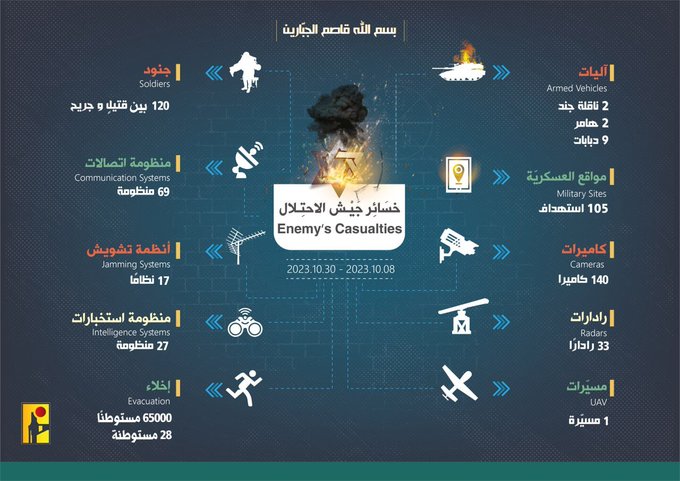
The Lebanese Resistance has just published this graph which indicates the losses inflicted on the occupier between October 8 and 30 “as part of operations on the road to the liberation of Al-Quds”: 120 Israeli soldiers were killed or injured, 65,000 settlers were evacuated from 28 settlements, 13 armed vehicles were destroyed (2 armored personnel carriers, 2 Humvees and 9 tanks) and 105 military sites were targeted. In addition, 69 communications systems, 17 jamming systems and 27 intelligence systems, 140 cameras, 33 radars and 1 drone were destroyed, so that Israel is almost completely blinded to what is happening on the Lebanese border, which would facilitate a major ground offensive from Lebanon. For its part, Hezbollah announced 49 martyrs so far: these are indeed low-intensity clashes, but on both sides, the losses in soldiers already represent almost a third of those of the entire July 2006 war, which is far from insignificant. Especially since this daily pressure on the occupier does not only represent moral support, but indeed military support. As Sheikh Naïm Qassem, Deputy Secretary General of Hezbollah, declared, Israel has amassed 5 brigades around Gaza, and 3 brigades on the Lebanese border: without the threat that Hezbollah poses to Israel, 8 brigades would be amassed around Gaza. It is therefore above all a matter of dividing the enemy’s forces, and of leaving its command in uncertainty, in order to paralyze its decisions and its willingness to massively commit its forces against the Palestinian Resistance. In this regard, the success is undeniable: to be convinced of this, one only needs to listen to the confused and contradictory declarations of Netanyahu, his ministers and the Israeli general staff on the launch of the ground operation, its timing, its scale, its objectives, etc.
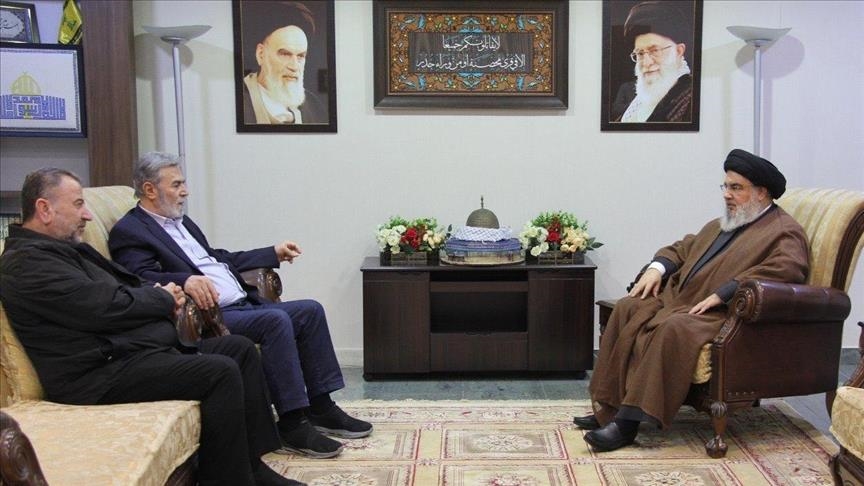
Lebanon: Hassan Nasrallah discusses developments with Ziyad Al-Nakhalah (Islamic Jihad) and Salah Al-Arouri (Hamas)
Additionally, Hezbollah is directly involved in the daily operations of the Resistance in Gaza, working closely with Hamas and Islamic Jihad cadres based in Lebanon in a common command room. Following Nasrallah’s high-profile meeting with Hamas and Islamic Jihad leaders on October 25, Hamas political leader Salah al-Arouri said:
“We are witnessing a heroic epic of Resistance in Lebanon against the occupier along the southern borders, where daily clashes break out and where martyrs fall daily among Hezbollah, the Al-Quds Brigades and the Al-Qassam Brigades. Hezbollah operates at all military and political levels, and our battle is also their battle. We share one goal and one destiny. Our struggle is united, our destiny is shared towards Al-Quds. We are in constant coordination in this battle.
Not all of our meetings with Hezbollah are public. We met Sayed Hassan Nasrallah on the first day of the battle. We are in constant meetings and maintain deep and precise communication with all the Resistance forces and our Hezbollah brothers, with Sayed Nasrallah on the front line.
If the enemy invades by land, it will mark a new and glorious chapter for our people and an unprecedented defeat for the occupation in the history of the Israeli-Arab struggle. Punishment for the crimes of the occupation is inevitable. We assure our people that the Resistance is doing well despite the crimes of the enemy and will ease your hearts regarding the extent of your suffering in the event of a brutal ground attack.
To the occupation, I declare this: be ready, because the battle has not yet begun.”
It is more than likely that Hezbollah was not surprised by the October 7 operation nor by its spectacular success, Nasrallah having constantly warned Israel not to underestimate the Palestinian Resistance, and to fear a massive reaction if they did not stop their ethnic cleansing in the West Bank and their provocations at the Al-Aqsa mosque: “Don’t miscalculate”, he kept warning the Israeli occupier and his new fascist government. We can even say that the Lebanese Resistance, which, thanks to its experience of liberating territories occupied by ISIS and Al-Nusra in Syria, has been planning an operation to invade Israel and liberate the Galilee for years, has transmitted its expertise to the Palestinian Resistance in Gaza, which took the Israeli army completely by surprise by launching an operation it expected on its northern border. Hezbollah is therefore directly linked to all aspects of the terrain and the situation, and assists the Resistance factions in all possible ways, similar to what the United States is doing for Israel.
What now?
Hezbollah’s decisions are influenced neither by the threats of enemies, nor by the reproaches (or even bitter insults) of friends who allow themselves to be carried away by emotion and see in Hezbollah’s attitude cowardice or a betrayal of the Palestinian cause. Hezbollah has never cared about “saving face” and is only driven by its long-term strategic vision, which is entirely focused on the total liberation of Palestine and the ways to achieve this strategic objective while minimizing sacrifices, if possible. Those who consider the eradication of Israel an unrealizable illusion are the same people who, in 1982, would have considered the desire of the nascent Hezbollah to expel by force the Israeli army which occupied half of Lebanon, or who, before October 7, would have found it inconceivable that the Resistance in Gaza could break the siege and inflict such losses and humiliation on the enemy. The red lines which, if crossed, would bring in Hezbollah and the Resistance Axis with all its firepower are probably clearly drawn, but it would not be wise to divulge them: it would be telling Israel that he can go this far without risking an all-out war. Leaving the enemy in confusion and exerting controlled pressure on the Lebanese border is the best strategy for this phase of the battle: Hezbollah demonstrates that he is present, that he is not afraid of confrontation or of escalation, and that he is ready for open war.
Whatever happens, October 7 will go down in history as a resounding victory for the Palestinian Resistance, and an earthquake for Israel. No massacre, no destruction, no genocide can ever erase it. As Sheikh Naïm Qassem pointed out, Israel has little choice today but between being content with the crushing defeat it has already suffered, or persisting in blind revenge and suffering discredit and defeat on a much bigger scale. Each of these two scenarios is satisfactory for the Palestinian Resistance and its allies, who will not abandon it, whatever the price to pay. And already, the confidence of Israeli society in its army and in itself, which has only become more fragile over the last two decades, is irremediably broken, and the process of remigration of Israeli settlers to Europe and America will only accelerate.
Hassan Nasrallah’s speech announced for November 3, in tribute to the martyrs of the Lebanese Islamic Resistance who fell in recent days, will finally break the silence of the Hezbollah Secretary General, an expert in psychological warfare, whose silence as well as his speeches are feared and deciphered by Israel. He will not necessarily make thunderous announcements, though many people expect him to do so, but he will clarify the very tense situation on the Lebanese border, which is getting worse every day, and could degenerate into open conflict at any time. Of all the speeches Nasrallah has given, this is probably the one that will be the most eagerly awaited and followed by both friends and enemies of the Party of God and Palestine.
Review: Against Our Better Judgment, by Alison Weir
The Hidden History of How the U.S. Was Used to Create Israel
BY RICHARD C. COOK • UNZ REVIEW • NOVEMBER 1, 2023
As the crisis involving the Israelis and Palestinians deepens after the October 7 Hamas attack, we might pause to examine how the state of Israel was created in the first place. At the current juncture, as World War III looms on the horizon, as massacres are currently being perpetrated by Israel against the civilian population of Gaza, with a death toll exceeding 9,000, of which over 4,000 are children, and as a Western armada is gathering in the eastern Mediterranean, it is befitting to review journalist Alison Weir’s book Against Our Better Judgment: The Hidden History of How the U.S. Was Used to Create Israel. The book was published in 2014, is packed with often hard-to-access details, and is masterfully documented. Alison Weir is also head of a group she has founded: If Americans Knew.
Alison Weir’s book is crucially important in considering ways to gain a broader perspective in order to defuse the situation. It is also of keen interest with respect to the larger potential conflict, where U.S. political leaders are again trotting out the phrase, “Axis of Evil,” this time to describe the nations of Russia, China, and Iran. (Sometimes North Korea is tossed in for good measure.) It’s Iran, of course, that U.S. leaders are identifying as an alleged sponsor of the resistance groups in and around Palestine, including Hamas.
Following are what I view as the main points from Alison Weir’s book. My own interspersed editorial comments are in italics. Page numbers are given in parentheses only for quotations from the book.
Origin of Zionism in the U.S. Against Our Better Judgment: The Hidden History of How the U.S. Was Used to Create Israel begins by explaining that support for Zionism, defined as the desire for creation of a Jewish national state somewhere in the world, goes back in U.S. history to the late 1880s, around the time that the Zionist Movement was becoming prominent in Europe. By the 1910s, there were thousands of U.S. adherents, though many Jews opposed Zionism as not in the interests of the Jewish people and certain to result in antagonism toward them. Probably a majority of Jews in the U.S. had never even heard of Zionism and/or were happy to have assimilated into American society. In fact, there was nothing that could even be viewed remotely as an “anti-Semitism problem” in the U.S. at this time.
Role of U.S. Supreme Court Associate Justice Louis Brandeis and Creation of the Parushim. Still, some very powerful people became Zionists, including U.S. Supreme Court Justice Louis Brandeis, whose main disciple was future Supreme Court Justice Felix Frankfurter. Brandeis formed a secret organization called the Parushim, whose sole purpose was to bring about the creation of a Jewish state in Palestine. This Zionist organization required an oath that appeared to give life and death power over its sworn members.
“Parushim,” also spelled “Purushim,” is the Hebrew word from which the name “Pharisees” is derived, meaning “separatists.” From the Pharisees came Rabbinical Judaism and the idea that, “We should not assimilate or acculturate at all.” (prezi.com) I would note that Alison Weir’s book did not aim at giving an account of the deeper motivations of the Zionist movement, other than its claim to be a reaction to European “anti-Semitism.” For more depth, I would recommend a careful reading of the classic The Controversy of Zion by British journalist Douglas Reed (1895-1976).
Justice Louis Brandeis was close to Wall Street banker Jacob Schiff. Brandeis was also closely involved with the creation of the Federal Reserve System, as was Schiff, though Brandeis’s involvement in political issues was largely behind the scenes.
The Federal Reserve, I would add, was largely a project of the U.S. Money Trust and the British/European Rothschilds. The Rothschilds were also heavily involved in Zionism and in the creation and support of the Zionist state. The fact that Zionism was sponsored by some incredibly rich people might cause us to ask to what extent financial rewards played a role in the rapid conversion of many Jews and non-Jews to Zionism during this period. For information on creation of the Federal Reserve, see my own book, Our Country, Then and Now (Clarity Press, 2023).
Collaboration Between the Parushim and Great Britain. Justice Louis Brandeis’s Parushim worked closely with Zionists in Great Britain, including travel back and forth, to persuade the British government to designate Palestine as a future Jewish homeland. This was after Zionist leaders had rejected such locations as Kenya. Thus was created a “contract” between Britain and the Parushim that if the British would generate what became the Balfour Declaration, the U.S. Zionists would endeavor to assure U.S. entrance into World War I against Germany on the side of Britain. This contract was fulfilled by both parties, though, as in the U.S., many British Jews opposed Zionism for similar reasons—as a threat to Jewish assimilation.
The Balfour Declaration specified that it should be “clearly understood that nothing shall be done which may prejudice the civil and religious rights of existing non-Jewish communities in Palestine.” (p.97) At the time, non-Jewish communities made up 92 percent of the population of Palestine.
Zionism and the Failure to Make Peace with the Ottoman Empire. World War I begin in 1914. By 1915-1916, the Ottoman Empire, which was allied with Germany but not at war against the U.S., offered to make a separate peace with the U.S. The Ottomans had also offered to allow the Jews of Europe to live at peace anywhere in their empire. The U.S. sent a delegation to negotiate this separate peace, but Brandeis informed the British Zionists that the delegation was on its way. The British Zionists then send their leader, Chaim Weizmann, to intercept the U.S. delegation at Gibraltar, where he prevailed on it to call off the negotiations. The reason was that the British were going to lay claim to Palestine after the war as a homeland for the Jews, so they wanted to assure that Palestine was going to be available for British control. The British design was to break up the Ottoman Empire, not leave it intact through a separate U.S.-instigated peace.
Warnings Against the Zionist Project. Diplomats within the U.S. State Department both in Washington, D.C., and in the Middle East were aware of and warned against the Zionist project, arguing that a million Palestinians would be displaced or made virtual servants/slaves of the invaders.
World War I. In 1917 the U.S. entered the war on the side of Britain, per the Zionist agreement, and Germany was defeated, along with the Ottomans. Britain also signed a secret agreement with France by which it would get control of Palestine after the war. Control was implemented through the vehicle of a British Mandate approved by the League of Nations.
During this period, antagonism against Jews had begun to grow within U.S. society, partly in reaction to perceptions that Jews controlled the banks and other financial institutions. “The Protocols of the Elders of Zion” had also appeared. While claimed to be a forgery from Czarist Russia, the Protocols received credence and publicity from Henry Ford and others.
Germany was aware that the Zionists had contributed to the defeat of Germany in WWI. This contributed to the anti-Jewish attitudes of Germans after the war and was a factor in the later Nazi anti-Jewish policies.
During WWI, the Parushim gave the FBI a list of Americans who were opponents to Zionism or the war. Many of these people were arrested and sent to prison. Through all of this, Brandeis was directing matters from behind the scenes. He was arguably the most powerful person in the U.S., but his political activities were secret or carried out through proxies.
At the end of WWI, President Woodrow Wilson sent a commission to Palestine to investigate the situation. Known as the King-Crane Commission, its report “recommended against the Zionist position of unlimited immigration of Jews to make Palestine a distinctly Jewish state.” The report stated that “the Zionists looked forward to a practically complete dispossession of the present non-Jewish inhabitants of Palestine,” that “armed force would be required to accomplish this,” and that “the project for making Palestine distinctly a Jewish commonwealth should be given up.” The report of the King-Crane Commission “was suppressed.” (p.25)
Zionism After World War I. Between the two world wars, a growing number of U.S. Zionists worked to further the project for the creation of Israel. In Germany, the Zionists supported the rise of the Nazis, as this would lead to German Jews wanting to emigrate to Palestine. In Iraq, where the Jewish leaders did not support Zionism, Iraqi Jews were attacked, even murdered, to force them to emigrate to Palestine. Without arousing the anxiety of Jews around the world that they were unsafe in their homelands, Zionist planners believed there would not be enough Jewish settlers to create a Zionist state and force the Palestinians out.
Opponents of Zionism in the U.S. diplomatic service were threatened with having their careers destroyed if they did not support the claims that Jews in foreign countries were suffering discrimination so should want to move to Palestine. The Zionists worked to limit immigration opportunities for Jews elsewhere than Palestine, including the U.S. The Zionists opposed measures by the British government to limit the number of Jews who could enter Palestine.
Collaboration Between the Zionists and Nazis. Building on work by author Hannah Arendt, Edwin Black wrote The Transfer Agreement: The Dramatic Story of the Pact Between the Third Reich and Jewish Palestine. Click Here According to author Tom Segev, “Arendt stated that many Jews would have survived ‘had their leaders not helped the Nazis organize the concentration of Jews in the ghettos, their deportation to the east, and their transport to the death camps.’” (p.146) This was called the “Haavara Agreement.”
The famous 1930s Jewish boycott of German products may have been instigated by Zionists to promote anti-Jewish sentiment leading to more desire among Jews to emigrate to Palestine. Other Zionists made claims that persecuted Jews were prone to becoming revolutionary communists for the same purpose.
Zionist Activities Between the World Wars. In the U.S. during the 1920s and 1930s, Zionist leaders muffled talk of a Jewish state in Palestine and focused on creating new institutions there as altruistic enterprises. An example was Hebrew University, opening in Jerusalem in 1925. Zionist leaders complained that most U.S. Jews saw themselves first and foremost as American citizens. Organizations like the American Zionist Emergency Council and the United Jewish Appeal were founded to generate funding and support. Donations to the United Jewish Appeal in 1948 was four times that of the American Red Cross. Pro-Zionist publicity and lobbying efforts were unleashed across the U.S. Some Jews, like the American Council for Judaism, still opposed Zionism as inimical to real Jewish interests. The ACJ opposed the Zionists’ “anti-Semitic racialist lie that Jews the world over were a separate, national body.” (p.152)
Zionist advocacy in the U.S. had powerful political adherents. New York Congressman Emanuel Celler told President Harry Truman, “We’ll run you out of town,” if he did not support the program. Senator Jacob Javits said, “We’ll fight to the death and make a Jewish state in Palestine if it’s the last thing that we do.” (p.38) Zionist propaganda included funding of best-selling pro-Zionist books by non-Jews. Zionists such as wealthy Wall Street lawyer Samuel Untermyer began to interject “dispensationalist” ideas of “Christian Zionism” into the discourse through sponsorship of the “Scofield Reference Bible.” (Untermyer was also a leading backer of the Federal Reserve and advocate of the worldwide Jewish boycott of Germany.)
Today, as we all know, “Christian Zionism” among “evangelicals” is part of the bedrock support of the Israel Lobby. Leading evangelical ministers like Jerry Falwell received large donations from Zionist supporters. An entire “dispensationalist” mythology involving the “Rapture,” etc., has been constructed and promoted to justify the political union between this group of American religionists and the most extreme factions of Israeli politics led today by such figures as Prime Minister Benjamin Netanyahu. Though Netanyahu has surfaced this mad mythology to cover Israeli genocide in Gaza, the topic is not covered in detail in Alison Weir’s book, so will not be dealt with further here.
Protestant Support of Zionism. By the 1930s, U.S. Zionists were trying to organize American Protestants in their support. By the end of WWII the Christian Council on Palestine had grown to 3,000 members and the American Palestine Committee to 6,500. The appeal to Protestants was based on generating sympathy for refugees, though no mention was made of the hundreds of thousands of Palestinians becoming refugees due to the Zionist takeover. During the Israeli war of independence in 1947-1949, Christian churches and institutions in Palestine were assaulted by the Zionists along with the Palestinians.
Beginnings of Terrorism and U.N. Partition of Palestine. In Palestine in the 1930s and 1940s, the Zionists tried to buy Palestinian land but few inhabitants wished to sell. The Zionists then began to organize terrorist forces to drive them out. These terrorist groups also targeted British government officials, as Palestine was still a British Mandate. Author Alison Weir cites a statement by David ben Gurion, Israel’s first prime minister, that suggests this was at least part of what started today’s worldwide phenomenon of terrorism.
By the start of the 1947-1949 war, Jews made up 30 percent of the Palestinian population but owned only 6-7 percent of the land. In 1947, Britain turned its Palestine Mandate over to the U.N. A General Assembly resolution to partition gave the Zionists 55 percent of the land of Palestine. The U.S. State Department opposed the partition plan as against the wishes of local people and in violation of U.S. interests and of democratic principles. Officials warned that partition “would guarantee that the Palestine problem would be permanent and still more complicated in the future.” (p.45) Officials said the proposal was for “a theocratic racial state” that discriminated “on grounds of religion and race.” (p.45) The leading anti-Zionist Department of State official, Loy Henderson, was exiled by his superiors to a post as ambassador to Nepal.
U.S. Government Opposition to Zionism. Nevertheless, virtually the entire U.S. executive branch was opposed to a Jewish state in Palestine. Statements and reports were made by a 1946 commission headed by Ambassador Henry F. Grady, the CIA, the Joint Chiefs of Staff, and Undersecretary of State Dean Acheson. A 1948 report of the Joint Chiefs of Staff stated that, “The Zionist strategy will seek to involve [the U.S.] in a continuously widening and deepening series of operations intended to secure maximum Jewish objectives.” (p.47)
Jewish leaders were well aware that U.N. partitioning of Palestine was temporary and that over time, the Jewish state would expand to absorb the entire region. The concept of “Eretz Israel” was formulated, whereby the Zionist state would encompass Transjordan, as well as parts of Lebanon and Syria. Zionists also had begun using U.S. antagonism toward the Soviet Union as an argument for creation of a pro-Western Jewish state. This hearkened back to the early days of Zionism, when Zionist leaders characterized their proposed state as a bulwark of British influence in the Middle East; i.e., as an extension of British colonialism and geopolitics.
Today, pro-Zionists make the argument that Israel is an outpost of benign “Judeo-Christian” influence in the Middle East, as they try to arouse antagonism toward the one billion Muslims in the world in a purported “clash of civilizations.” Such attitudes became prominent in U.S. politics during the “War on Terror” of the Bush/Cheney administration that continues today through U.S. labeling of anti-Zionist groups like Hamas and Hezbollah as “terrorist” organizations. This is despite the historical fact cited above that it was the Zionists who introduced terrorism into the Middle East.
U.S. Recognition of Israel and the Role of President Truman. The U.S. was the first country to recognize Israel as an independent state when on May 14, 1948, President Harry Truman issued a statement of recognition following Israel’s proclamation of independence on the same date. Truman’s main motivation was believed at the time, and still is today, the winning of Jewish support in the presidential election that year. His decision was strongly opposed by Secretary of State George Marshall, Secretary of Defense James Forrestal, the CIA and National Security Council, and top State Department official George Kennan. Intelligence agent Kermit Roosevelt wrote: “The present course of world crisis will increasingly force upon Americans the realization that their national interests and those of the proposed Jewish state in Palestine are going to conflict.” (p.51) Contrary to the belief that U.S. oil interests promoted the Zionist project, officials argued that U.S. ability to access Middle Eastern resources would be adversely affected. Truman also had pro-Zionist insiders at high levels of his administration.
Author Alison Weir points out that bribery also played a part. “Gore Vidal wrote: ‘Sometime in the late 1950s, that world-class gossip and occasional historian, John F. Kennedy, told me how, in 1948, Harry S. Truman had been pretty much abandoned by everyone when he came to run for president. Then an American Zionist brought him two million dollars in cash, in a suitcase, aboard his whistle-stop campaign train. ‘That’s why our recognition of Israel was rushed through so fast.’” (p.167) Jewish businessman Abraham Feinberg explained his raising of cash for Truman in an oral history interview published by the Truman Library in 1973. The CIA also discovered Feinberg’s illegal gun-running to Zionist groups.
I may be the first writer to point out that Truman’s action in accepting bribes, if discovered, could have been seen and treated as an impeachable offense.
Zionist Takeover of Palestine. At the time of Israel’s proclamation of independence and immediate U.S. recognition, the U.N. resolution of partition had been passed, with war ensuing between Zionist and Arab forces. The U.N. General Assembly adopted the partition plan by 33 votes to 13 with 10 abstentions, with many nations subjected to intense Zionist lobbying and threats. For instance, “Financier and longtime presidential adviser Bernard Baruch told France it would lose U.S. aid if it voted against partition.” (p.55) A Swedish U.N. mediator, Count Folke Bernadotte, was killed by Zionist assassins. To this day, no accepted legal authority for the U.N. in its partitioning of Palestine has ever been demonstrated. In other words, it was likely an extra-legal action in response to Zionist lobbying.
Though sporadic violence between Jews and Palestinian Arabs had taken place over the previous two decades, the Zionists committed wholesale massacres of Palestinians after the U.N. resolution for partition. By the end of Israel’s war of independence in 1948, over 750,000 Palestinians had been expelled from Zionist-controlled territory. Israeli historian Tom Segev wrote: “Israel was born of terror, war, and revolution, and its creation required a measure of fanaticism and cruelty.” (p.58) Today this is called in Arabic the “Nakba”—“catastrophe.”
The most well-known massacre took place at the village of Deir Yessin in April 1948, before any Arab armies had joined the fight. There, 254 villagers were murdered in cold blood. The heads of two militias present at Deir Yessin, Irgun and the Stern Gang, were Menachem Begin and Yitzhak Shamir, both of whom later became prime ministers of Israel. The Irgun bombed the King David Hotel in Jerusalem on July 22, 1947, killing 86. The Stern Gang also solicited aid from the Axis powers during WWII.
Zionist Front Organizations in the U.S. During the 1930s and 1940s, the Zionists created a number of front organizations to raise money used to finance militant activities in Palestine. After WWII, the U.S. maintained an arms embargo against Israel and the Middle East. Foremost among the sponsors of the front organizations intended to skirt the embargo was Irgun. One group, the Jewish Army of Stateless and Palestinians Jews, claimed it was formed to fight the Nazis in Europe, but was intended instead to fight the British and Arabs in Palestine. These groups espoused such radical ideologies as the idea that “non-Jews are the embodiment of Satan, and that the world was created solely for Jews.” (p.67) Another group, headed by Orthodox Rabbi Baruch Korff, hatched a plot to blow up the British foreign office in London that was exposed in the New York Herald Tribune. Through political influence, U.S. charges against Korff were dropped. Later he “became a close friend and fervent supporter of President Richard Nixon, who called him ‘my rabbi.’” (p.71) Nixon’s support for Israel manifested in the gigantic airlift of military supplies that helped save Israel from defeat in the 1973 Yom Kippur War. Another major organization raising money for sending arms to the Zionists in Palestine was the Sonneborn Institute. Between 1939 and May 1948, the Jewish Agency for Israel was also active, raising the equivalent today of $3.5 billion.
Zionism and Organized Crime. Financial backers of Israeli independence included members of organized crime, including Meyer Lansky, head of the Jewish Mafia in the U.S. In an April 19, 2018 article in Tablet (tabletmag.com) entitled “Gangsters for Zion: Yom Ha’atzmaut: How Jewish mobsters helped Israel gain its independence. Robert Rockaway wrote: “In 1945, the Jewish Agency, the pre-state Israeli government headed by David Ben-Gurion, created a vast clandestine arms-purchasing-and-smuggling network throughout the United States. The operation was placed under the aegis of the Haganah, the underground forerunner of the Israel Defense Forces, and involved hundreds of Americans from every walk of life. They included millionaires, rabbinical students, scrap-metal merchants, ex-GIs, college students, longshoremen, industrialists, chemists, engineers, Protestants and Catholics, as well as Jews. One group, who remained anonymous and rarely talked about, were men who were tough, streetwise, unafraid, and had access to ready cash: Jewish gangsters.” Rockaway, a professor emeritus at Tel Aviv University, also wrote that through their control of U.S. ports, the Jewish mob arranged for arms deliveries to Israel aboard vessels flying the flag of Panama.
Recruiting Jews to Relocate to Palestine. “Zionist cadres infiltrated displaced persons’ camps that had been set up to house refugees displaced during WWII. These infiltrators tried secretly to funnel people to Palestine. When it turned out that most didn’t want to go to Palestine, they worked to convince them—sometimes by force.” (p.74) Another recruiting source was Jewish foster children in Christian homes. The Zionists claimed to be the sole representative of all the world’s Jews in order to legitimize efforts to divert war survivors to Israel, not to countries like the U.S. to which many preferred to go. “After a voluntary recruitment drive netted less than 0.3 percent of the DP [displaced persons] population, a compulsory draft was implemented.” (p.79) Some draftees were required to fight in Palestine in the Zionist war of independence. Meanwhile, the secretive Sieff group was formed in Washington, D.C., to carry out back channel lobbying for the Zionist project. The group was protected by such powerful individuals as Supreme Court Justice Felix Frankfurter, Secretary of the Treasury Henry Morgenthau, Jr., and the aforementioned financier and presidential adviser Bernard Baruch.
Fate of the Palestinian Refugees. Three-quarters of a million Palestinian refugees fled to neighboring regions in a gigantic humanitarian disaster. A 1948 State Department report stated “The total direct relief offered…by the Israeli government to date consists of 500 cases of oranges.” (p.83) The value of land confiscated by the Zionists amounted to $5.2 trillion in today’s dollars. Christians also suffered as “numerous convents, hospices, seminaries, and churches were either destroyed or cleared of their Christian owners and custodians.” (p.83) Efforts by U.S. government officials to withhold aid to the Israeli government due to the refugee crisis were overruled by President Truman.
Zionism and the media. Even as early as WWI, the Zionists exerted almost complete control over the U.S. press. This included placing pro-Zionist articles in prestigious newspapers like The New York Times. In 1953, author Alfred Lilienthal wrote: “The capture of the American press by Jewish nationalism was, in fact, incredibly complete. Magazines as well as newspapers, in news stories as well as editorial columns, gave primarily the Zionist views of events before, during, and after partition.” (p.86) Zionist coercion extended to withdrawal of advertising, cancellation of subscriptions, and blacklisting of journalists and authors, even those offering a mere trace of sympathy toward the displaced Palestinians. Particularly emotional in their support of Zionism were the journals the Nation and the New Republic. An example of how the Zionists could destroy an author’s career was the attack on then-famous journalist Dorothy Thompson after “she began to speak about Palestinian refugees, narrated a documentary about their plight, and condemned Jewish terrorism. (p.92)
We all know that the complete slanting of U.S. media coverage toward Zionism and Israel dominates news reporting at all levels and across the ideological spectrum, from the top newspapers and networks to what is left of small town journalism. This includes so-called “independent” outlets like Breitbart. The start of this bias began, perhaps not coincidentally, during the time before WWI when the newsrooms of U.S. newspapers were taken over by propagandists sympathetic to the Federal Reserve System and the Money Trust. Today, of course, we have the internet, which has begun to make inroads into the control of the news by pro-establishment media corporations and Deep State censors. Internet outlets also must be cautious, however, so are often reduced to the role of “limited hangouts,” reporting only selected stories that protest particularly egregious Israeli offenses, but never the “big picture.”
In conclusion we can say that, as Alison Weir’s book makes clear, it was largely American Zionists who financed and enabled the violent takeover of Palestine and who thereby share responsibility over the past three-quarters of a century for the atrocities committed against a diverse population whose forebears had been living in peace and rooted in the region for millenniums. This population also inhabited the holy city of Jerusalem, sacred to the Jewish, Christian, and Islamic religions.
The book also makes it clear that people can oppose Zionism—the forceful establishment of a Jewish national state in Palestine—without being anti-Jewish or “anti-Semitic.” Of course, most of the indigenous people of Palestine are “Semites” in ethnicity and language. Also, the most forceful opponents of the original Zionist movement in Great Britain, the U.S., and possibly other nations, have been, and still are, Jews themselves who had successfully assimilated into their host cultures. Examples are the Hassidic Jews of Brooklyn, N.Y., and Jews in Iran who refuse to support Israel.
Many more volumes could or should be written about U.S. enabling of Israel and Zionism and about Israel’s and Zionism’s interference in internal U.S. affairs. I would include an examination of Israel’s possible participation in the JFK/RFK assassinations and the 9/11 attacks, U.S. acquiescence in Israel’s nuclear weapons program, Israel’s links with the Neocons who control today’s U.S. foreign policy, and today’s courting of World War III against more than half the world’s countries, starting with Israel’s nemesis, Iran. Will the U.S. stumble into WWIII because of its pro-Zionist captivity?
 Copyright 2023 by Richard C. Cook. Comments are welcome and will be read at monetaryreform@gmail.com.
Richard C. Cook is a retired U.S. federal analyst who served with the U.S. Civil Service Commission, FDA, the Carter White House, NASA, and the U.S. Treasury. As a whistleblower at the time of the Challenger disaster, he broke the story of the flawed O-ring joints that destroyed the Shuttle. After serving at Treasury, he exposed the disastrous flaws of a monetary system controlled by private finance in his book We Hold These Truths: The Hope of Monetary Reform. As an adviser to the American Monetary Institute and while working with Congressman Dennis Kucinich, he advocated the replacement of the Federal Reserve System with a genuine national currency. His latest book is Our Country, Then and Now (Clarity Press, 2023).
“Every human enterprise must serve life, must seek to enrich existence on earth, lest man become enslaved where he seeks to establish his dominion!” Bô Yin Râ (Joseph Anton Schneiderfranken, 1876-1943), Translation by Posthumus Projects Amsterdam, 2014.
Countries Begin Downgrading Ties with Israel Over Relentless Bombing of Gaza
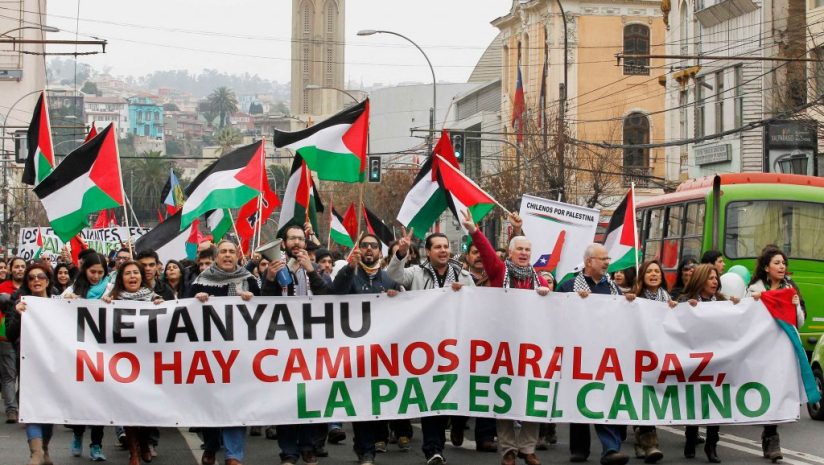
By Kyle Anzalone | The Libertarian Institute | November 1, 2023
A trio of South American countries, along with Jordan, have cut ties with Israel over the onslaught in Gaza. According to Palestinian sources, the Israeli military operations in Gaza have killed nearly 9,000 people, half of which are women and children.
On Tuesday, Bolivia took the most extreme step and cut all ties with Israel. Deputy Foreign Minister Freddy Mamani explained that Bolivia “decided to break diplomatic relations with the Israeli state in repudiation and condemnation of the aggressive and disproportionate Israeli military offensive taking place in the Gaza Strip.”
The next day, Tel Aviv responded by saying Sucre’s move was “capitulation to terrorism and to the ayatollah regime in Iran.”
Colombia and Chile announced they would recall their ambassadors to Israel. Colombian President Gustavo Petro posted on X, “I have decided to call our ambassador in Israel for consultation. If Israel does not stop the massacre of the Palestinian people we cannot be there.”
Chile posted a press release saying Santiago would also recall its diplomat.
“Given the unacceptable violations of International Humanitarian Law that Israel has incurred in the Gaza Strip, the Government of Chile has decided to recall the Chilean ambassador to Israel, Jorge Carvajal, to Santiago for consultations. …”
“Chile strongly condemns and observes with great concern that these military operations – which at this point in their development entail collective punishment of the Palestinian civilian population in Gaza – do not respect fundamental norms of International Law, as demonstrated by the more than eight thousand civilian victims, mostly women and children.”
Jordan joined the South American nations in downgrading ties with Israel. The Foreign Ministry announced it was recalling its ambassador. “Foreign Minister Ayman Safadi decided to immediately recall Jordan’s ambassador to Israel,” a statement said. The move is to reflect Amman’s condemnation of the “Israeli war that is killing innocent people in Gaza.”
While Tel Aviv receives near unconditional backing from Washington, Israel lacks the international community’s support for its war. On Monday, the UN General Assembly voted 120-14 for a ceasefire in Gaza.
After a Hamas attack in southern Israel on October 7, Tel Aviv launched a military operation. The bombing campaign and ground invasion have killed thousands of Palestinian civilians, including over 3,600 children.
Real Names of Stolen Villages, Illegal Settlements of the Gaza Perimeter
By Perla Issa | Institute For Palestine Studies | October 25, 2023
If you are to read Western news reports coming from Israel, you would likely believe that Kfar Azza, Be’eri, Erez, Nahal Oz, and the other settlements that surround Gaza are “idyllic spots,” “little pieces of paradise, little pieces of heaven;” and “small farming communities.”
What is missing from this picture, what is missing from the vast majority of Western news reports on the genocide unfolding in Gaza is that these “pieces of paradise” are built on stolen land — stolen by Zionists from the Palestinian people through violence. And that the Palestinian population have been huddled and caged in one small corner of their original lands for over 75 years. That is what is currently called the Gaza Strip. About 80 percent of Gaza’s population are refugees, refugees from what today is called the Gaza perimeter. As Palestinian resistance increased over the years, as Palestinians, generation after generation, have tried to break the cage and return home, that cage has become tighter and tighter.
That is how the Israeli residents of these “farming communities” — around 50,000 people living on 1,038 squared kilometers of stolen lands (the Sha’ar HaNegev, Eshkol, and Sdot Negev regional councils)— have been able for years to live, prosper, raise families, have dinners, swim in pools, dance, sing and celebrate “unity and love” in large concerts just a few kilometers away from where over 2.1 million people live on 365 squared kilometers, usurped from their lands, subjugated to daily humiliation, purposely impoverished and caged in, unable to move, live, fish in the sea, and certainly unable to celebrate “unity and love.”
A simple glance at Google maps puts this reality in plain sight. How can such an urban reality exist? A people density of 5,753 people per squared kilometer next to a people density of 48 people per squared kilometer. Can there be any doubt that in order to keep such a reality for decades a vast amount of daily violence needs to be applied in order to prevent any spill over?
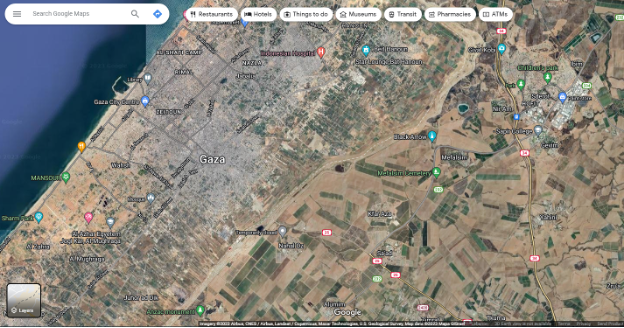 Google Maps screenshot of the Gaza Strip and surrounding area, showing the wide disparity in urban density between Palestinian and Israeli-controlled areas. Taken on Oct 16, 2023. The image used as the header of this article, however, is a historic map from 1948 from Palestine Open Maps.
Palestinians live this reality on a daily basis, while Israelis, living in “idyllic spots,” thought that they could afford to forget it. They thought they could afford to forget how they came to live on that very land.
Let us here, remind ourselves of this reality.
In an oral history project of interviews with Zionist fighters, the truth is spoken plainly and simply. Michael Cohen from the Negev Brigade of the Israeli Occupation Forces (Formed from the Palmach, the elite fighting force of the Haganah) explains in a recorded video how the brigade expelled Palestinians in October 1948 from what “today you would call the Gaza Perimeter. It’s the entire Western sector bordering on today’s Gaza Strip.” He explains how “expelling was easy.” That the majority of the Palestinians “had no plans to hurt us” but that “we couldn’t allow ourselves, we, as an army and the [Jewish] settlements around us, to leave Arab settlements in our underbelly. We kicked them out.”
He explains how in many places, Palestinians left without a fight: “On one or two occasions, there was some sort of resistance, even using firearms. But that was rare … The Negev was cleared of all villages!” But with time the soldiers realized that the people they had expelled were coming back and that “it was difficult to finish the job with them.” He explains that they had to block them, “block means shoot to kill!” In his own words: “So in that case I saw it with my own eyes, I didn’t just see it with my own eyes, I also did it. Expulsion was one thing that needed to be done and it was done.”
Indeed, violent expulsion was done, but violence breeds violence. Through Cohen’s testimony we can see how Palestinian resistance was changing and adapting in response to Israeli violence. The villagers and Bedouins went from friendly coexistence, to acquiescence, to non-violent resistance by quietly returning to their lands, but once faced with deadly force, they resorted to armed resistance, they started attacking roads and planting mines. The Israeli response was more violence, they demolished Palestinian homes and burned fields forcing the population to flee again. Cohen explains how they planted explosives and “would topple down the houses in one full swoop.” He further explains: “The demolition [of the houses] and/or the burning of the fields, it wasn’t a one-time thing during the deportation, it was a process.”
Avri Ya’ari of the Haganah explains in another recorded video how they expelled the people of Huj (هوج), a Palestinian village lying 2.5 kilometers from the current Israeli settlement of Sderot and 6.5 kilometers from the Gaza Strip; where Ariel Sharon built a ranch. Through Ya’ari’s testimony we get a sense of the large disproportionate of force between the Israeli armed forces and the Palestinians and again we see how the Palestinian population was peaceful.
Ya’ari: There was Huj … but the relations with them were very good …
Interviewer: The Arab population, when did they leave the area?
Ya’ari: When they were told to. [Laughter]
Interviewer: What do you mean?
Ya’ari: They were told to take a hike.
Interviewer: Who told them?
Ya’ari: The army, the Israeli Defense Forces. In certain stages … how should I say it? They cleared the area of Arabs. The people of Huj, who had been very friendly and later suffered terribly in the refugee camps, they told them, they’d be back in two or three weeks.
Palestinians indeed have been attempting to return ever since by any and all means at their disposal. Therefore, if you wish to help end the violence, to usher in peace and security for Palestinians and Israelis, then recognize what lands Israeli settlements have been built on and call them by their names, their real names. In the table below is a list of some of the settlements that surround Gaza and the corresponding Palestinian lands that they have been built on, whether it be city, village, or tribal lands.
|
Israeli settlement |
Name of depopulated Palestinian city that corresponding Israeli settlement is built on | Name of depopulated Palestinian village that corresponding Israeli settlement is built on | Name of depopulated Tribal land that corresponding Israeli settlement is built on | Additional notes from author |
| Ashkelon | Al-Majdal (المجدل)
Al-Jura (الجورة), Al-Khisas (الخصاص), Ni’ilya (نعليا) |
Built on the village lands and orchards | ||
| Zikim | Hirbiya (هربيا) | Built on the citrus groves of the village | ||
| Karmiya | Hirbiya (هربيا) | Built on the orchards of the village | ||
| Mavqiim | Barbara (بربرة) | Built on the village and its orchards | ||
| Erez | Dimra (دمرة) | |||
| Sderot | Najd (نجد) | |||
| Mefalsim | Wadi ez Zeit of Gaza city | |||
| Kfar Aza | Turkman quarter of Gaza city | |||
| Nahal Oz | Waqf Esh Sheikh Zarif in Gaza city (وقف الشيخ ظريف) | |||
| Sa’ad | Jdeide quarter of Gaza city | |||
| Alumin | Turkman quarter of Gaza city | |||
| Be’eri | Wuhaitat al Tarabin (الوحيدات ترابين) clan of the Tarabin (ترابين) tribe lands | |||
| Re’im | Ghawali al-Zari’i (غوالي الزريعي) clan of the Tarabin (ترابين) tribe lands | Built next to the ancient ruins of Tell Jamma (تل جمة) in the Gaza valley | ||
| Kisufim | Abu Khammash (ابو خماش) clan of the Tarabin (ترابين) tribe lands | |||
| En HaShlosha | Ma’in Abu Sitta village (معين ابو ستة), Umm Tina hamlet (ام تينة) | part of the Arab al Ghawali (عرب الغوالي) clan of the Tarabin (ترابين) tribe | Umm Tina is described in an oral history project by a former villager as “fertile land extending as far as the eye can see, wide and spacious, with almond orchards and fields of wheat, barley, lentils, watermelons, and cantaloupes … a wonderful country.” | |
| Nirim | Ma’in Abu Sitta village (معين ابو ستة), | part of the Arab al Ghawali (عرب الغوالي) clan of the Tarabin (ترابين) tribe | Built on the ruins of the village’s former school | |
| Nir Oz | Ma’in Abu Sitta village (معين ابو ستة), | part of the Arab al Ghawali (عرب الغوالي) clan of the Tarabin (ترابين) tribe | Built on the village orchards | |
| Magen | Ma’in Abu Sitta village (معين ابو ستة), Abu Tailakh (أبو تيلخ) and Abu Nuqeira (ابو نقيرة) hamlets | Part of Arab al Ghawali (عرب الغوالي) clan of the Tarabin (ترابين) tribe | Built on the village orchards, engulfing the shrine of Sheikh Nuran (مقام الشيخ نوران ) and the Abu Qurayda spring (بئر أبو قريدة) | |
| Ami’Oz,
Zohar, Ohad, Mivtahim, Yesha |
Umm ‘Ajwe (أم عجوة) and Tell Rabiya (تل رابية) hamlets | Part of the Najmat clan (نجمات ) of the Tarabin (ترابين) tribe | ||
| Sde Nitsan,
Talmei Eliyahu |
Karm ‘Aqel (كرم عقل) | Part of the Najmat clan (نجمات ) of the Tarabin (ترابين) tribe | ||
| Holit | El-Buhdari hamlet (كرم البهداري) | Part of the Najmat al-Kassar (نجمات القصار) clan of the Tarabin tribe (ترابين) | Built on the village orchards | |
| Peri-Gan,
Sede-Avraham, Deqel, Talme-Yosef, Avshalom, Yated, Yevul |
El-Ahmar (كرم الاحمر) and El-Khilawi (كرم الخلاوي) hamlet | Part of the Najmat al-Kassar (نجمات القصار) clan of the Tarabin tribe (ترابين) | Built on the village orchards |
Editor’s Note: This is not an exhaustive list. Feel free to contact the author directly at perla@palestine-studies.org. You may also seek additional resources such as All That Remains: The Palestinian Villages Occupied and Depopulated by Israel in 1948, the Interactive Encyclopedia of the Palestine Question (Places section), Palestine Open Maps, Palestine Remembered, and The Return Journey (Atlas) for further reading on the history of destroyed and depopulated villages across all of Palestine.
Russia warns Israel about attacks on Syria
RT | October 31, 2023
Spreading conflict to other countries in the Middle East is “unacceptable,” Russian Foreign Minister Sergey Lavrov said on Tuesday, while discussing a spate of recent Israeli airstrikes with his Syrian counterpart.
Lavrov brought up the issue of Israeli airstrikes, “which have become more frequent against the backdrop of events around the Gaza Strip,” during a phone call with Syrian Foreign Minister Faisal Mekdad, the Russian Foreign Ministry said in a readout of the call.
Both ministers “emphasized the danger of attempts by external forces to turn the Middle East, in its current explosive situation, into an arena for settling geopolitical scores,” the readout added.
Mekdad phoned Lavrov to discuss the situation in Gaza, as well as a number of bilateral issues and the progress in ending the war in Syria. While the 2011 attempt at armed “regime change” backed by the West and some regional powers ended in failure, the north and northeast of Syria remain outside the control of the government in Damascus.
Since the Hamas incursion from Gaza on October 7, Israel has bombed Syria at least three times, repeatedly shutting down the airports in Aleppo and Damascus. One of these attacks was acknowledged by the Israeli ambassador to Germany, who said it was intended to disrupt “weapons deliveries from Iran.”
Israeli Prime Minister Benjamin Netanyahu once said there had been “hundreds” of strikes on Syria over the past decade. On the rare occasions when the Israel Defense Forces (IDF) comments on the attacks, it claims to have acted in pre-emptive self-defense against Iran, accusing Tehran of supplying Hezbollah militants. Damascus has repeatedly insisted that the raids constitute a violation of Syrian sovereignty, but to no avail.
Lavrov and Mekdad agreed on the need for an “immediate end to the bloodshed” in Gaza and a solution to all the humanitarian problems created by the fighting.
Russia has condemned the Hamas attack but called Israel’s response against Gaza an unacceptable form of “collective punishment” against innocent civilians. Moscow has called for a peace settlement between Israel and the Palestinians through the creation and recognition of an independent Palestinian state.
Featured Video
Seyed M. Marandi: Negotiations Collapsed – Return to War
or go to
Aletho News Archives – Video-Images
From the Archives
Wartime internment camps in Australia
National Archives of Australia
World War I
During World War I, for security reasons the Australian Government pursued a comprehensive internment policy against enemy aliens living in Australia.
Initially only those born in countries at war with Australia were classed as enemy aliens, but later this was expanded to include people of enemy nations who were naturalised British subjects, Australian-born descendants of migrants born in enemy nations and others who were thought to pose a threat to Australia’s security.
Australia interned almost 7,000 people during World War I, of whom about 4,500 were enemy aliens and British nationals of German ancestry already resident in Australia.
Records of World War I internment camps
World War II
During World War II, Australian authorities established internment camps for three reasons – to prevent residents from assisting Australia’s enemies, to appease public opinion and to house overseas internees sent to Australia for the duration of the war.
Unlike World War I, the initial aim of internment during the later conflict was to identify and intern those who posed a particular threat to the safety or defence of the country. As the war progressed, however, this policy changed and Japanese residents were interned en masse. In the later years of the war, Germans and Italians were also interned on the basis of nationality, particularly those living in the north of Australia. In all, just over 20 per cent of all Italians resident in Australia were interned. … continue
Blog Roll
 Aletho News
- Seyed M. Marandi: Negotiations Collapsed – Return to War
- Tomorrow’s naval blockade showdown
- ‘Israel’ attacks civilians to hide its embarrassing military failures & out of pure sadism
- Any Foreign Military Vessel Approaching Hormuz Under Any Pretext ‘Will Be Dealt With Severely’: IRGC
- Diplomats slam US negotiators’ performance in Iran talks
- Trump Refuses Exit Ramp, War with Iran will Continue
- Trump Says US Naval Blockade in Strait of Hormuz Will Begin Shortly
- US, Iran end 21-hour talks without agreement
- US IRAN TALKS: Who Are the Crazy Ones Here? /Lt Col Daniel Davis
- Talks with the US end without a deal over excessive US demands: Iran
- If Americans Knew
- US-Iran ceasefire negotiations make zero progress – Daily Update
- Pro-Israel ‘Thinktanks’ and Individuals who Influence U.S. Foreign Policy
- Mearsheimer reveals how Israel dictates US policies on Iran, Gaza – video
- After killing 350+, Israel still has a “score to settle” with Lebanon before ceasefire – Daily Update
- Military aid to Israel emerges as the latest political litmus test for Democrats
- The only Palestinian children’s rights organization closes following years-long Israeli campaign against it
- ‘I Can’t Forget the Smell’: Lebanese Reel After Israel Kills Over 300 in Single Day
- DNC Shoots Down Resolutions Calling Out AIPAC and Limiting Arms to Israel
- TCN: Is Israel Blackmailing President Trump?
- Israel killed at least 303 Lebanese yesterday – who were they? Daily Update
- No Tricks Zone
- Cave Discovery Reveals Today’s Desert Climates Were Recently Far Warmer, Wetter, Teeming With Life
- German Expert: Heat Dome Led To Record Temps In Western USA…Warmer In 1934, 1936
- New Study: No Linear Warming Or Glacier Retreat Along Northern Antarctic Peninsula Since 1980s
- An Inconvenient Tree: Uncovered In Alps… Europe Much Warmer Than Today 6000 Years Ago
- New Study Reports A 60% Slowdown In Greenland’s Ice Loss Rate In The Last Decade
- Low Intensity Tornado Wrecks Major Solar Farm, Creating A Potential Toxic Dump
- New Study Finds Warming Saves Lives…Cold Temperatures 12 Times More Deadly Than Excess Heat
- German Science Blog Accuses PIK Climate Institute Of Hallucinating Climate Tipping Points
- Devastating Assessment Of Comirnaty Vaccine By Former Senior Pfizer Europe Toxicologist
- New Study: CO2 Is ‘Effectively Negligible’ As An Explanatory Climate Change Factor Since 2000
 Aletho News