Russia: Israel’s bombardment of Gaza unlawful
Press TV – October 28, 2023
Russia has shown its strongest reaction to the Israeli regime’s nonstop bombardment of the besieged Gaza Strip by labeling the three-week campaign targeting the civilians in the Palestinian territory “unlawful.”
Foreign Minister Sergei Lavrov said in remarks published by the Belarusian state news agency Belta on Saturday that the carnage is against international law and could create a decades-long catastrophe in the region.
Lavrov said Israel has been “indiscriminately using force against targets where civilians are known to be present.”
He warned that Israel’s stated goal of seeking to eradicate the Palestinian resistance movement Hamas would require a total destruction of Gaza, an enclave of over 2.3 million people located on the Mediterranean.
“If Gaza is destroyed and 2 million inhabitants are expelled, as some politicians in Israel and abroad propose, this will create a catastrophe for many decades, if not centuries,” said the Russian foreign minister.
“It is necessary to stop, and to announce humanitarian programs to save the population under blockade.”
Israel’s savagery began on October 7 in response to a Hamas operation in the occupied territories which led to over 1,400 deaths among settlers and regime troops.
Israelis were already angered by Moscow’s decision to host a Hamas delegation in the midst of the conflict in Palestine.
Russian authorities have defended the move while Hamas leaders say they have received a request from Moscow to look for eight people identified by Russia as possibly being among hostages taken by the group’s fighters during the blitz into the occupied territories.
Figures released by Gaza’s health officials on Saturday showed the Israeli bombardment has killed more than 7,700 Palestinians, including over 5,000 women and children.
Hamas resists Israeli offensive in Gaza after violent night of airstrikes
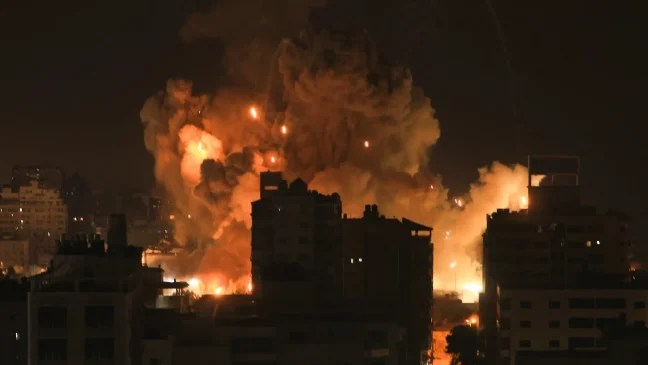
Gaza City during an Israeli airstrike on 8 October, 2023. (Photo Credit: MAHMUD HAMS / AFP)
The Cradle | October 28, 2023
Gaza-based Palestinian resistance faction Hamas announced on 28 October that its forces successfully held back invading Israeli troops who overnight launched large-scale ground operations into the coastal enclave under the cover of intense air raids.
Hamas says its forces dealt “heavy losses to the enemy’s ranks” as they repelled the ground incursion. Nonetheless, heavy clashes continue in several points of the northern Gaza Strip.
“The enemy fell into ambushes set up by the Palestinian resistance on several fronts. Kornet missiles and Yasin shells were used to repel the attack, and we expect the enemy to try again. The Israeli regime used helicopters to evacuate the wounded and the dead from the battlefield,” the Hamas statement reads.
For their part, Israeli media claims there are “no reports of Israeli casualties” and that “ground forces, including infantry, combat engineering forces, and tanks, remained inside Gaza […] operating deeper into the Hamas-run territory than previous limited incursions.”
On Friday night, the Israeli army began what officials described as an “expansion” of their ground operations into Gaza after several nights of “limited incursions” that were also repelled by the Palestinian resistance.
According to local reports, the elite US Delta Force has been accompanying Israeli troops into the besieged territory. However, Washington maintains that its forces only provide logistical advice to Tel Aviv.
The Israeli ground offensive was launched under the cover of a violent campaign of airstrikes by the Israeli air force, which decimated the northern Gaza Strip with hundreds of bombs, including internationally banned white phosphorous and cluster munitions.
Despite the intensity of the Israeli offensive, the Gaza resistance continued to launch rocket attacks toward the occupied territories, setting off alarms in several settlements.
As the clashes continue, Gaza remains unreachable to the outside world after Israel cut off all phone and internet services to provide cover for the genocide being committed against Palestinian civilians.
“This communications blackout means that it will be even more difficult to obtain critical information and evidence about human rights violations and war crimes being committed against Palestinian civilians in Gaza and to hear directly from those experiencing the violations,” Erika Guevara Rosas, senior director of research, advocacy, policy and campaigns at Amnesty International, said in a statement on Friday.
UN agencies and human rights organizations say they can still not reach their staff and health facilities inside Gaza.
Gaza suffers near-total information blackout
RT | October 27, 2023
Internet and cell phone services stopped working in Gaza on Friday night, after Israel “expanded” its military operation against Hamas militants in the Palestinian enclave.
The largest telecommunications provider in Gaza, Paltel, has announced “a complete severance of all communications and Internet services” due to intensified Israeli strikes.
“The intense bombing in the last hour caused the destruction of all remaining international routes linking Gaza to the outside world,” the company said.
Netblocks, a company that tracks internet connectivity globally, confirmed the information blackout, calling it “the largest single disruption to internet connectivity in Gaza since the beginning of the conflict and will be perceived by many as a total or near-total internet blackout.”
International media outlets, including RT, have partially lost contact with their crews and stringers on the ground. The Israel Defense Forces (IDF) told news organizations that Israel “cannot guarantee your employees’ safety, and strongly urge you to take all necessary measures for their safety,” according to a letter sent to Reuters and AFP.
The head of RT Arabic, Maya Manna, said there was no contact with correspondents and photographers operating in the Palestinian enclave as of Friday evening. The sole message came from an RT stringer in the area, describing a “very violent bombing.”
“I don’t know what to do with my children and my family. Everyone is afraid, everyone is terrified, and there is screaming everywhere in the Gaza Strip,” Masoud Abu Jarash, a local reporter, told RT.
According to an NBC News crew member, who was also able to message colleagues, “all internet, electricity and everything” has been cut off. “The situation we’re in is difficult, so difficult and very dangerous. We’re being extensively shelled by artillery and by air,” the unnamed staffer said.
The UN children’s agency also lost contact with their colleagues in Gaza, with UNICEF chief Catherine Russel saying she was “extremely concerned about their safety and another night of unspeakable horror for 1 million children in Gaza.”
The international healthcare charity Doctors Without Borders (MSF) said there was no contact with some of their Palestinian colleagues.
“We are particularly worried for the patients, medical staff and thousands of families taking shelter at Al Shifa hospital and other health facilities,” MSF said, expressing deep concern over the situation regarding one of Gaza’s biggest medical centers.
Israel has accused Hamas of turning hospitals into “headquarters for their terror,” referring specifically to Al Shifa, and even published an “illustrative video” which supposedly points out the “different locations in and under the hospital which are being used to plan and implement terrorist activities.”
Hamas claims that by cutting off communications from Gaza, Israel is attempting to “cover up the crimes of the occupation without any oversight or accountability,” and tries to “create an image of victory,” a senior official, Osama Hamdan, told Al Jazeera.
The Gods Are Going Against the Chosen People – Mammon Against Israel, Mars Against the Pentagon
By John Helmer | Dances with Bears | October 27, 2023
The Palestinian strategy against Israel is aimed at destroying Israel’s capacity to survive in its present state in a long war.
This means attacking the invincibility of the Israel Defense Forces (IDF) and their so-called Iron Dome defence; this began with the cross-border offensive on October 7, and continues with daily drone and artillery attacks on targets inside Israel, as well as resistance to IDF incursions in Gaza.
The plan also means exposing the weakness of the state’s infrastructure and economy; extending the battlefield across all of Israel’s territory – the ports, power plants and electricity grid, communications, and financial markets — making the cost of occupation of the Arab territories unendurable. In a long war, two of Israel’s leading exports earning more than 40% of the state’s trade — diamonds and tourism — face ruin.*
“The Israelis cannot withstand one year of fighting in a war,” Iraq’s President Saddam Hussein told his general staff in 1983 during a discussion of planning for a regional war of the Arabs against Israel.** In the forty years since then, the evolution of military technology and tactics has expanded the power of small national liberation armies like Hamas, Hezbollah, and the Houthis, of proxy principals like Iran, and of the strategic balancing role of Russia and China. Their combination now has shortened the Zionist state’s endurance in a long war, and that of its proxy principal, the US.
The Israelis and the Jewish diaspora comprehend this reluctantly. For them, the short war must be correspondingly shorter. This means the genocide of at least a million Palestinians in lives and displacement.
The war to do that has now become an international war – and this is a war the US cannot sustain. As a Pentagon insider said publicly this week, “because there are so many draws on the logistics and support infrastructure of the Pentagon, we’re not prepared to go in in a concerted way. What we are seeing right now is death by a thousand cuts. Our adversaries know we are stretched so they are going to make us stretch even more, so we can respond even less.”
The Russian Foreign Ministry spokesman, Maria Zakharova, acknowledged the point in Moscow on Thursday: US naval, air force, and marine reinforcements deployed around Israel and Gaza are “American tactics to strengthen their own security (this is how it should be interpreted) at someone else’s expense.” They are backfiring on Washington’s capacity to defend US forces in the Mediterranean, the Red Sea, the Persian Gulf, and in land bases in Syria, Iraq and Jordan. “On the contrary,” Zakharova added, the US military deployment “will further rock the situation in the Middle East, create additional tension that can spill out beyond the region.”
Zakharova’s warning came in the Moscow afternoon. By then Russian Foreign Ministry officials had held meetings with a Hamas delegation, and officials from Iran, Egypt, and Kuwait. Across the city at the same time, President Vladimir Putin held telephone talks with Turkey’s President Recep Tayyip Erdogan. The Kremlin communiqué reported: “Russia and Turkiye have practically overlapping positions.”
Israeli and US-led media censorship and propaganda are concealing the breadth of impact of the Palestine warfighting plan, and the deepening military and economic weaknesses of the Israeli state.
The longer the war continues, the plainer the evidence is on the battlefield that the single-state scheme of Israel and the US is no longer possible. Whether Israel and the US can be compelled to withdraw to the 1967 borders and a new Palestinian state created with partition, demilitarisation, and international security guarantees – the basis of the Russian position announced again on Thursday in Moscow — remains to be fought over.
In this long war, the gods do not favour the Chosen People.
Following with precision the battlefield action is impossible in the Israeli and Anglo-American press. Reporting of operations, and of Israeli and US casualties, is being suppressed entirely or delayed for days, if not weeks.

According to this NBC television report, broadcast on October 24, there were at least 24 US combat casualties following drone attacks on or about October 18 at the Al-Tanf base in Syria and the Al-Asad base in Iraq. Reporting of naval action in the Red Sea, when the USS Carney reportedly engaged Houthi missiles over several hours, has been changing since the initial news flashes of October 19. Read more here. In a new report of October 24, Israeli and US casualties in a joint raid inside Gaza were revealed: “in the last 24 hours or so, some of our Special Ops forces and Israeli Special Ops forces went into Gaza to reconnoiter, to plan for where they might want to go to free hostages and make an impact, and they were shot to pieces and took heavy losses, as I understand it. I think that is where we are headed and I don’t see that as a win for Israel in any way, shape, or form. And I certainly think it is very dangerous for us”. In current reporting by Al Mayadeen, daily strikes against US bases in Iraq and northeastern Syria are documented.
Tracking the electric war and infrastructure strikes by Hamas and Hezbollah is also difficult. They commenced with cyber attacks on Israel’s electricity generation plants and power grids; these have been followed by missile and drone strikes. “The ground has been laid for attacks on the Israeli grid,” a US military source claims. “I believe drones will come first, then missiles. We may even see commando raids.”
Israel’s seaports are also under constant attack. Ashkelon, which is closest in range to Gaza, has been closed. Eilat may have been the target of the Houthi missile strike which was engaged last week by the USS Carney. Ashdod, which accounts for about 40% of incoming and outgoing Israeli seaborne trade, and Tel Aviv port have been targeted. The result is a tenfold surge in war risk insurance for vessels and cargoes, and the curtailment of international vessel movement in and out of the Israeli ports; there are reports that shipping is down 30% in Ashdod compared to the pre-war volume. Evergreen, the Taiwanese container shipping company, declared force majeure for Ashdod on October 17, diverted one vessel to Haifa, and halted future shipping into both ports. “We advise evaluating each port visit in Israel on a case by case basis and implementing appropriate precautions in ship contingency plans,” recommends a maritime industry alert bulletin.
Chevron’s offshore Tamar gas field has been shut down. The source produces 70% of the gas required to fuel Israel’s electricity generation needs. Not a single Anglo-American media source has noticed that Israel is at risk of losing its principal energy source to drone or missile attack. “After what the Americans and Germans did to blow up the Nordstream pipelines,” comments a Moscow industry source, “what is holding Hamas back from hitting Tamar, or Hezbollah from the other Israeli gas fields?”
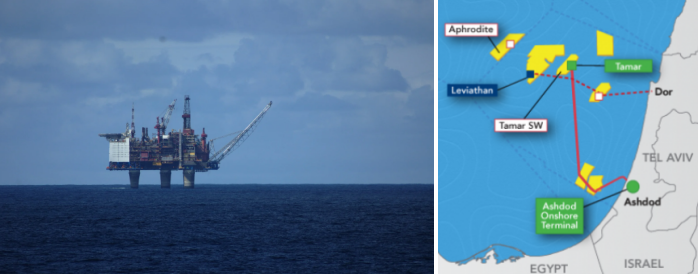
Left: Chevron’s Tamar gas production platform is located at sea 24 kilometres west of Ashkelon. Right: click to enlarge map of Israel’s offshore gas sources.
A Moscow source comments that “in Israel, the US and the UK will be able to bring in supplies without a very big risk of US ships being attacked. The risk is to the ports and bases, not to supplies from the Med[iterranean]. The Greek and Cyprus bases will come in very useful. Israel will not face severe logistical issues as long as it is on the offensive. If its settlements start getting cut off, encircled or penetrated then it is a different matter.”
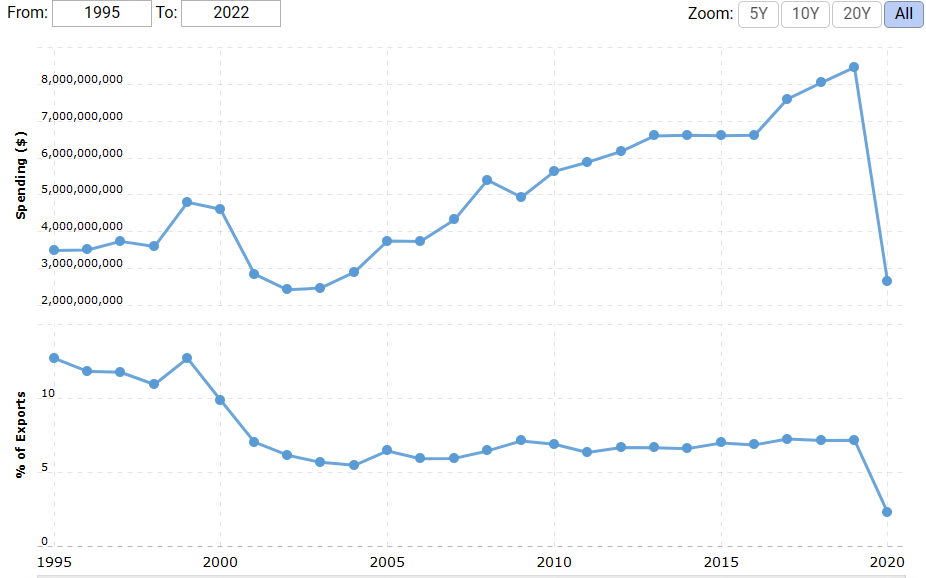
The indirect economic impacts of the war have also not been calculated or discussed in the mainstream media or international business newspapers. The leading export revenue earners are diamonds at above $9 billion per annum, and tourism which had been peaking at $8.5 billion in 2019. Counted together, diamonds and tourism amount to more than 40% of the state’s export earnings.
The Covid-19 pandemic and worldwide travel restrictions cut Israel’s tourism revenue fourfold, and this had been recovering over 2022 and the tourist season this year. This has now stopped, although for the time being Hamas rocket launches on Ben Gurion airport near Tel Aviv have been intercepted.

October 12, 2023 — source: https://www.youtube.com/.
ISRAEL TOURISM REVENUE TRAJECTORY, 1999-2022
Source: https://www.macrotrends.net/
Israel’s high-tech machine exports and pharmaceuticals may also be affected if electricity supply, internet networks, and transportation are damaged.
The cumulative effect will be the outcome which the international ratings agencies have been warning the international banks and financial markets to prepare for. “In our view,” Fitch reported to clients on October 17, “the combination of Israel’s dynamic, high-value added economy, the record of resilience to regional conflict, [and] preparedness for military confrontations… make it unlikely a relatively short conflict largely confined to Gaza will affect Israel’s rating…. the risk that other actors hostile to Israel, such as Iran and Hezbollah, could join the conflict at scale has risen significantly… a major escalation could result in negative rating action. This could take the form of a wider and longer conflict, resulting in a sustained fiscal drain, both from higher spending and lower tax collection, as well as loss of human and material capital and severe economic disruption.”
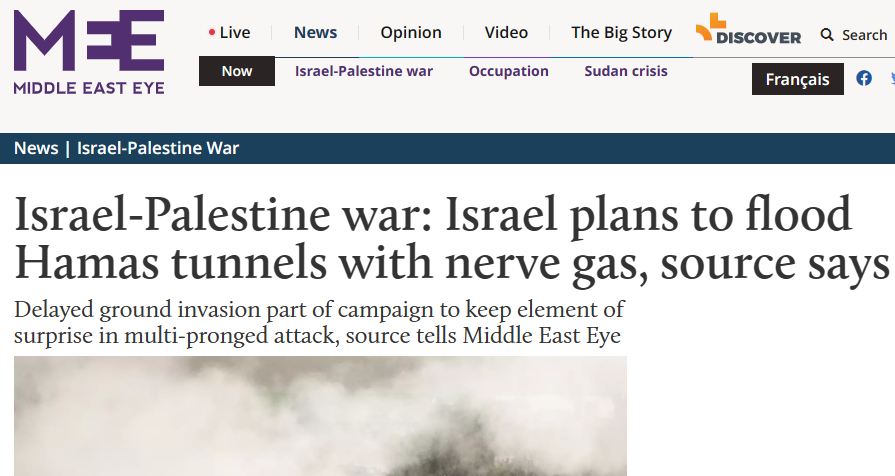
How short, and also how long, Israel’s warfighting plan will take depends on American and international acceptance, not only of the genocide intended for the Palestinians of Gaza, but of the Novichok-type chemical warfare planned by the IDF and the Pentagon for the Hamas tunnel system in Gaza City. After several years in which the US and UK have fabricated claims that Syria and Russia were using prohibited gas warfare weapons, the Israelis have reportedly persuaded the US to participate in the tunnel attack operation. The Pentagon is denying the reports.
Source: https://www.middleeasteye.net
Russian and US military sources are already confirming the logistical supply problems facing Israeli and US forces at present, when the war is just three weeks long. Greek sources are reporting the Souda Bay, Crete, base has already reached its capacity for incoming US navy and air force supply and support operations; the spillover is facing growing Greek protest at the Elefsina air base near Athens.
A Cyprus source says the movement of US and British aircraft into and out of the Dekhelia and Akrotiri airbases is accelerating, and there is an air and seaborne shuttle between the Cypriot ports of Larnaca and Limassol and the USS Gerald Ford carrier group at sea to the southwest of the island.
The lengthening of the supply lines required to support the USS Eisenhower carrier group in the Red Sea and Persian Gulf and the shore bases needed to support it are politically sensitive already; and the risks of Houthi and other attacks, along with domestic Arab crowd protests, will intensify for these bases in the Arab sheikhdoms the longer the war against Israel reveals Arab and Iranian warfighting skill and resistance.
Converting these gains into a negotiating framework for Israeli-American retreat is the task Russian officials are attempting in silent coordination with the Chinese, and in semi-open negotiations in Moscow this week. In its first move outside the region since the war began, Hamas has visited Moscow for negotiations, led by US-educated Moussa Mohammed Abu Marzouq.
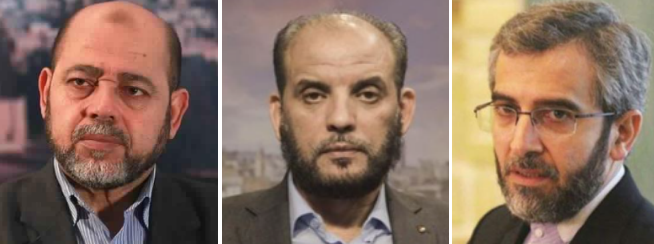
Left: Moussa Mohammed Abu Marzouq; centre: Husam Badran; right, Ali Bagheri Kyani.
Zakharova confirmed the start of the talks with Hamas on Thursday. She said: “I can also say and confirm that representatives of the relevant Palestinian movement are in Moscow. As for contacts, we will inform you additionally.” She has also disclosed that since the war began, nine thousand Russian passport holders have returned to Russia from Israel; and that at least fifteen Russian passport holders among the Hamas hostages have been killed in the IDF airstrikes.
At the same time as Marzouq’s meetings, Husam Badran issued a statement to the Russian state news medium, Sputnik. “Russia,” Badran said, “is able to play an important role in ending the war between Israel and the Gaza Strip, and delivering aid to the Palestinian exclave. Hamas values Russia’s role on the international stage, especially use of veto in the UN Security Council against the United States. But Russia can play a greater role in ending the aggression against our people in the Gaza Strip and applying international pressure to deliver urgent aid to our people in the Gaza Strip.”
What Hamas means by “greater role” for Russia has not been disclosed publicly yet. It is known that Hamas is willing to negotiate the release of “non-military” hostages, including Israelis holding Russian passports, through Iran. This is conditional on the IDF lifting its siege on Gaza and allowing sufficient supplies into all parts of the territory.
The “military hostages” are being held in exchange for the release of Palestinian prisoners in Israeli jails. There are more than 6,000 of the latter; there may be fewer than 200 hostages in Gaza, as up to 50 have been killed by Israeli bombing.
The Russian Foreign Ministry statement on the talks with Hamas is less revealing. According to the Sputnik release, “Russia has discussed release of hostages and evacuation of Russians from the Gaza Strip during a meeting with a delegation of Hamas in Moscow on Thursday.” A member of the political office of the Islamic resistance movement Hamas, Abu Marzouq, is in Moscow. Contacts took place with him in continuation of the Russian line for the immediate release of foreign hostages located in the Gaza Strip, and issues related to ensuring the evacuation of Russian and other foreign citizens from the territory of the Palestinian enclave were also discussed.”
At the same time on Thursday – unnoticed and unreported by the western media – Russian officials held several negotiating sessions with an Iranian emissary, Deputy Foreign Minister Ali Bagheri Kyani. In three separate Foreign Ministry releases, meeting communiqués were issued for Kyani’s meetings with deputy ministers Mikhail Bogdanov, Sergei Ryabkov, and Mikhail Galuzin. “The need for the cessation of hostilities in and around the Gaza Strip and the prompt provision of humanitarian assistance to the affected Palestinian population was confirmed,” Bogdanov’s communiqué said. “It was stated that Moscow and Tehran are determined to continue close coordination of efforts in the interests of stabilizing the situation in the Middle East.”
It is unclear if the talks also included the Hamas officials in a three-party format. During the day there were also Foreign Ministry negotiations in Moscow with Kuwaiti and Egyptian officials.
At the Kremlin it has been announced that President Putin spoke with Turkish President Erdogan to discuss the war. According to the Kremlin release, “the presidents reviewed the active efforts undertaken by Russia at the UN Security Council, as well as the corresponding political and diplomatic steps taken by Turkiye to stop the bloodshed and ensure the unimpeded delivery of humanitarian aid to those in need. It was emphasised that Russia and Turkiye have practically overlapping positions, focused on implementing the well-known two-state solution, which provides for the creation of an independent Palestine coexisting with Israel in peace and security.”
In her briefing for the press, Zakharova dismissed the US moves so far. “We do not consider the US presence in the Middle East as contributing to the stability of the situation in the region. Exactly the opposite. Washington’s earlier attempts to monopolise the Middle East settlement process, ignoring the true causes of the protracted conflict, have largely led to the current catastrophic consequences… This situation has an absolutely clear and understandable road, a ‘road map’ for settlement. It is not simple, but complex, painful, but leading to the solution of the issue, not its aggravation.”
“Of course, no air defence systems, arms supplies, materiel injections into some ‘security complexes’ will help resolve this situation. Today’s lesson must be learned. How many Americans have deployed there (their bases, experts, satellites), nothing has worked to prevent a bloody scenario, of which both Palestinians and Israelis are victims.”
[*] With support from Israel and influential Jewish diamantaires in New York and Tel Aviv, a scheme of sanctions is being prepared by the US Government to stop Russian raw diamonds, produced by Alrosa, from being sold into the Belgian, Israeli, and US markets. The Russian goods are to be tagged “blood diamonds” because of the war in the Ukraine. However, now that Israel is destroying the Palestinian population of Gaza, the “blood” tag can be applied to the Israeli diamond cutting industry and to the Jewish diamond trade abroad. Support for the anti-Russian sanction, and also for the IDF operations against the Palestinians can be found in Rapaport.com news reports. “Rapaport stands with Israel”, the publication and its owner Martin Rapaport declared on October 26, “and has undertaken all the necessary effort and costs for the October Single Stone Auction to help the Israeli market continue to conduct business as best as possible during this difficult time. Rapaport believes that continuing to do business in Israel during the war is a victory over the brutal Hamas terrorists, and will help Israel win the war.” In another editorial for the diamond trade, Rapaport proposes “to boycott Iran and all other supporters of the Hamas terrorist organization.” Rapaport also cites religious authority for liquidation. “In the words of G-d (Exodus 17:14): ‘I will utterly blot out the memory of Amalek from under heaven.’May the words of G-d be done, here and now.” Quietly, Russia’s state diamond interests dictate a strategy for protecting against this double-edged Israeli policy.
[**] Saddam Hussein is quoted in the chapter on US plots against him in Iraq – see The Jackals’ Wedding: American Power, Arab Revolt, Ch. 6.
Why are the Israelis massacring civilians in Gaza? Because they can get away with it
By Michael Hoffman | Revelation of the Method | October 23, 2023
Israeli forces terror-bombed Beirut throughout the summer of 1982. In the West in English there is exactly one book about it: God Cried by Catherine Leroy and Tony Clifton. The Lebanese have almost no memorial and certainly no museum devoted to the bombing of hospitals, schools and apartment blocks, just like now, in Gaza. The Israeli government is well aware of this forgetfulness and they calculate their atrocities and war crimes accordingly.
If the Palestinians were bombing Tel Aviv to the extent the Israelis have bombed Gaza (5,000 deaths thus far), in the aftermath there would be books, movies, diaries, poems, plays, museums, and annual, solemn commemorations throughout the West.
Gaza was heavily bombed in 2009 and 2014. The Arab and Muslim world do not engage in the same level of memory and commemoration, other than personal recollection. There are a few exceptions, but they are comparatively minuscule.
Furthermore, if, as in Gaza, day-in and day-out Tel Aviv’s civilian centers were being blown to bits, and its food, fuel and even its water (!) were shut down, the International Court in The Hague and the European Union would be charging the Palestinian leadership responsible, with war crimes. The US would be heavily sanctioning those leaders and humanitarian supplies would be dropped by parachute if necessary to sustain the Israeli civilians.
Instead, the Court and the EU are frozen in mute assent to crimes against Arab children committed as I write these words, by the Israelis who suffered a holocaust in Europe and have been granted by Europe and Britain a license to perpetrate atrocities in Palestine. Hamas terrorists copied this perverse victims-have-the-right-to-be executioners “logic” on Oct. 7.
As for the casual, business-as-usual aspect of the atrocities against Palestinian civilians, it is rooted in the Zionist weaponization of the Talmudic halacha which few in the West, on the Left or the Right, care to learn about – http://talmudical.blogspot.com – and without which they will have no key to comprehending the depth of contempt for Palestinian life.
There are hundreds of books in English harshly critiquing the Quran. Meanwhile this writer’s two banned books [Judaism Discovered and Judaism’s Strange Gods] containing a sustained critique of Talmudism, which in English are among the only credible and charitable texts compassionately documenting Talmudic hate speech, which causes real world harm to Palestinian children, women, elderly and non-combatant men, in the form of their relentless mass murder.
The hate speech is real: on Oct. 9 Israeli Defense Minister Yoav Gallant referred to the Palestinian people as “human animals.”
Israeli Prime Minister Meachem Begin termed them “two-legged animals.”
Israeli Army Chief of Staff Rafael Eitan called the Palestinians: “cockroaches in a bottle.”
The Allied incineration by more than 800 bombers leveled the German city and burned alive tens of thousands of civilians.
The murder of civilians, including by Hamas, is always wrong. Murder is murder. Dressing it up with alibis and platitudes does not make the heinous war crimes any less criminal.
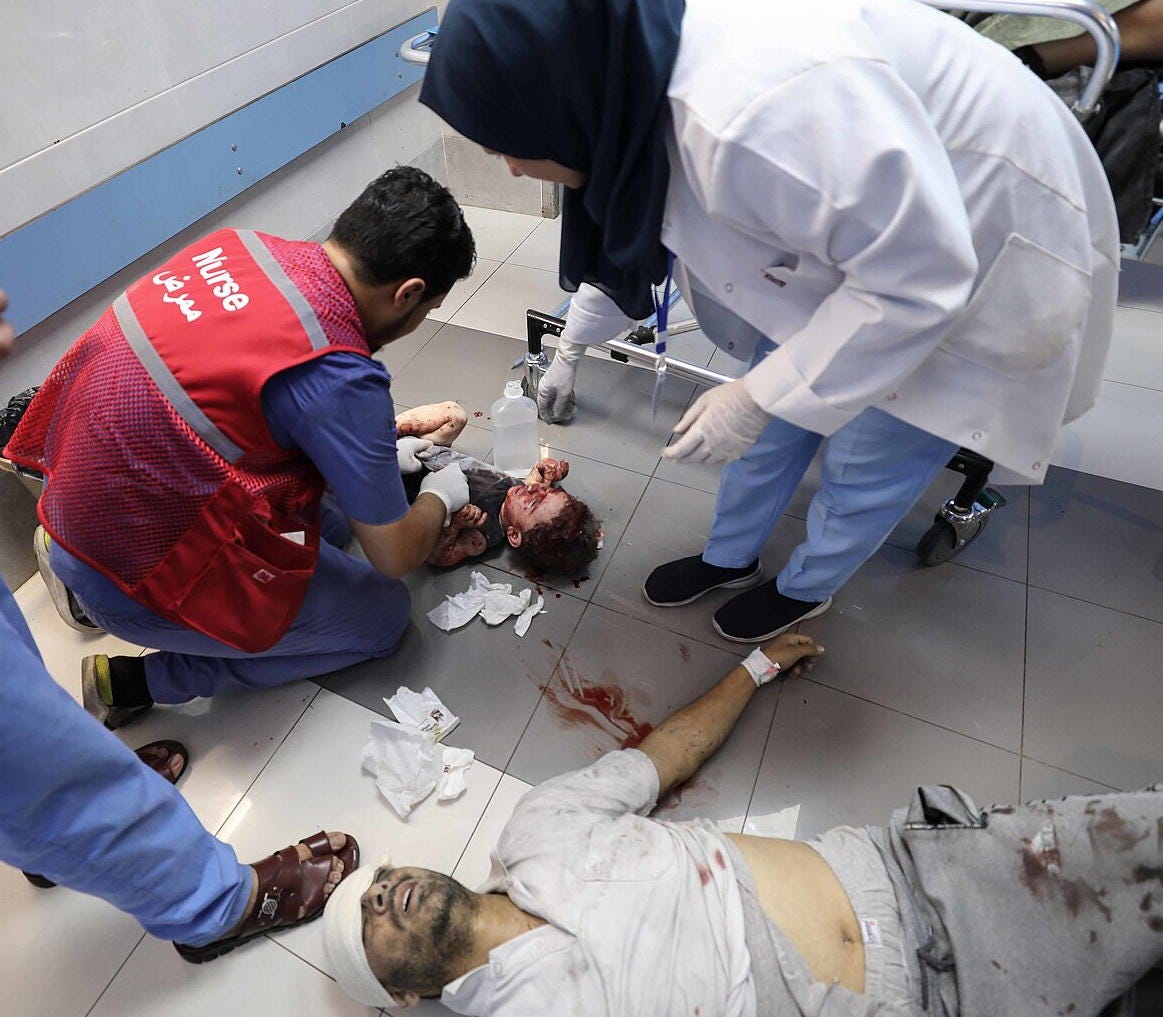
Wounded Palestinian child and man receiving medical treatment at Al-Shifa Hospital in Gaza City following an Israeli bombing, Oct. 11, 2023
How can the daily Israeli massacre of kids and their mothers be parsed, justified or mitigated? It is right, but abortion is wrong? The bipolar nature of such thinking is depraved.
(Israeli victims of Hamas terrorism are no less innocent. They are extensively mourned in the West however, and rightly so; that’s not the case for the Palestinian civilian dead, not in any sustained memorial).
How can the Israeli mass murder of kids and their mothers be justified? I will answer my own question:
The record shows that bombing civilians in cities is the default method of Allied warfare: Tokyo, Nagasaki, Hiroshima, Dresden, Hamburg, Hanoi, Baghdad.
As noted previously, Israelis terror-bombed Beirut throughout the summer of 1982 and Gaza in 2009 and 2014. These war crimes are justified by media ghouls in America, ensuring more of the same, as in Gaza now.
The bombing of Afghan villages and weddings contributed to the defeat of US forces, after the people became fed-up with the transparently lame excuses for the massacres by the likes of David Petraeus, who is now being touted by the media ghouls as a master of statecraft and generalship.
President Biden’s last act in Afghanistan was to approve a missile attack on an SUV that was transporting a large family. Seven children and three adults were incinerated; that’s how the US will be remembered in that nation.
Adolf Hitler was responsible for the brutal, mass expulsion of hundreds of thousands of Judaic people from Germany. For the past 20 years conservative wunderkind Ben Shapiro has advocated the forced extrusion (“transfer”) of the Palestinian people from Palestine. In his own words: “Here is the bottom line: If you believe that the Jewish state has a right to exist, then you must allow Israel to transfer the Palestinians and the Israeli-Arabs from Judea, Samaria, Gaza and Israel proper.”
Each of us must bear witness and do what we can to document, teach and remember.
FOR FURTHER RESEARCH
On the Palestine issue, Amy Goodwin’s podcast today, Oct. 23, is recommended. It can be accessed here at her Democracy Now! website.
A righteous Jew and an extraordinary human being, the brilliant Israeli journalist Amira Hass, is interviewed in two parts.
Take the time to listen to Amira:
If you’re in haste, at least listen to the interview in part two.
All of these broadcasts should be saved and conserved by citizen-journalists (like you), for posterity, and compiled into a permanent data base. I propose the following title for the proposed repository: Witness of War Crimes in Gaza.
History Lesson: Leftist Daniel Denvir conducts a “Palestine Teach-In“ on his podcast, which is accessible at The Dig website: the first hour contains a generally excellent history of the rise of Zionism in Palestine. Too many people don’t know how it all started. The historical context has been missing. Caveat : Mr. Denvir’s guests are mostly of the Left and their analysis of Britain’s role in the ascendance of Zionism in Palestine is limited to a perspective of British colonialism as the root cause. The influence of Freemasonry on the British government, and the masonic objective of rebuilding the Temple of Solomon in Jerusalem, is missing from their analysis. However, don’t let that omission keep you from accessing the history offered.
Michael Hoffman is a former reporter for the New York bureau of the Associated Press and the author of ten books of history and literature, including Secret Societies and Psychological Warfare (2001), The Occult Renaissance Church of Rome (2017) , Twilight Language (2021), as well as a textbook (Judaism Discovered), and five other books published in the United States, as well as overseas in Japanese and French translation; and 122 issues of Revisionist History® newsletter, 1997-2022. His truth mission is made possible by donations, paid Substack subscriptions, and the sale of his books, newsletters and recordings. Podcast: here. X (Twitter): here. Rumble here.
October 7 testimonies reveal Israel’s military ‘shelling’ Israeli citizens with tanks, missiles
BY MAX BLUMENTHAL · THE GRAYZONE · OCTOBER 27, 2023
Israel’s military received orders to shell Israeli homes and even their own bases as they were overwhelmed by Hamas militants on October 7. How many Israeli citizens said to have been “burned alive” were actually killed by friendly fire?
Several new testimonies by Israeli witnesses to the October 7 Hamas surprise attack on southern Israel adds to growing evidence that the Israeli military killed its own citizens as they fought to neutralize Palestinian gunmen.
Tuval Escapa, a member of the security team for Kibbutz Be’eri, set up a hotline to coordinate between kibbutz residents and the Israeli army. He told the Israeli newspaper Haaretz that as desperation began to set in, “the commanders in the field made difficult decisions – including shelling houses on their occupants in order to eliminate the terrorists along with the hostages.”
A separate report published in Haaretz noted that the Israeli military was “compelled to request an aerial strike” against its own facility inside the Erez Crossing to Gaza “in order to repulse the terrorists” who had seized control. That base was filled with Israeli Civil Administration officers and soldiers at the time.
These reports indicate that orders came down from the military’s high command to attack homes and and other areas inside Israel, even at the cost of many Israeli lives.
An Israeli woman named Yasmin Porat confirmed in an interview with Israel Radio that the military “undoubtedly” killed numerous Israeli noncombatants during gun battles with Hamas militants on October 7. “They eliminated everyone, including the hostages,” she stated, referring to Israeli special forces.
As David Sheen and Ali Abunimah reported in Electronic Intifada, Porat described “very, very heavy crossfire” and Israeli tank shelling, which led to many casualties among Israelis.
While being held by the Hamas gunmen, Porat recalled, “They did not abuse us. We were treated very humanely… No one treated us violently.”
She added, “The objective was to kidnap us to Gaza, not to murder us.”
According to Haaretz, the army was only able to restore control over Be’eri after admittedly “shelling” the homes of Israelis who had been taken captive. “The price was terrible: at least 112 Be’eri residents were killed,” the paper chronicled. “Others were kidnapped. Yesterday, 11 days after the massacre, the bodies of a mother and her son were discovered in one of the destroyed houses. It is believed that more bodies are still lying in the rubble.”
Much of the shelling in Be’eri was carried out by Israeli tank crews. As a reporter for the Israeli Foreign Ministry-sponsored outlet i24 noted during a visit to Be’eri, “small and quaint homes [were] bombarded or destroyed,” and “well-maintained lawns [were] ripped up by the tracks of an armored vehicle, perhaps a tank.”
Apache attack helicopters also figured heavily in the Israeli military’s response on October 7. Pilots have told Israeli media they scrambled to the battlefield without any intelligence, unable to differentiate between Hamas fighters and Israeli noncombatants, and yet determined to “empty the belly” of their war machines. “I find myself in a dilemma as to what to shoot at, because there are so many of them,” one Apache pilot commented.
Video filmed by uniformed Hamas gunmen makes it clear they intentionally shot many Israelis with Kalashnikov rifles on October 7. However, the Israeli government has not been content to rely on verified video evidence. Instead, it continues to push discredited claims of “beheaded babies” while distributing photographs of “bodies burned beyond recognition” to insist that militants sadistically immolated their captives, and even raped some before torching them alive.
The objective behind Tel Aviv’s atrocity exhibition is clear: to paint Hamas as “worse than ISIS” while cultivating support for the Israeli army’s ongoing bombardment of the Gaza Strip, which has left over 7000 dead, including at least 2500 children at the time of publication. While hundreds of wounded children in Gaza have been treated for what a surgeon described as “fourth degree burns” caused by novel weapons, the Western media’s focus remains trained on Israeli citizens supposedly “burned alive” on October 7.
Yet the mounting evidence of friendly fire orders handed down by Israeli army commanders strongly suggests that at least some of the most jarring images of charred Israeli corpses, Israeli homes reduced to rubble and burned out hulks of vehicles presented to Western media were, in fact, the handiwork of tank crews and helicopter pilots blanketing Israeli territory with shells, cannon fire and Hellfire missiles.
Indeed, it appears that on October 7, Israel’s military resorted to the same tactics it has employed against civilians in Gaza, driving up the death toll of its own citizens with the indiscriminate use of heavy weapons.
Israel bombs its own base, nerve center of the Gaza siege
Hamas and Palestinian Islamic Jihad (PIJ) launched Operation Al-Aqsa Flood at 6 AM on October 7, quickly overwhelming the military bases from which Israel maintains its siege of the Gaza Strip. Chief among the objectives outlined by Hamas and PIJ was the release of Palestinians imprisoned by Israel, including as many as 700 children and 1117 Palestinians held without charges.
The 2011 swap for Gilad Shalit, an Israeli soldier captured five years prior and released in exchange for 1027 prisoners, provided clear inspiration for Al-Aqsa Flood. By storming military bases and kibbutzes, the Palestinian militants aimed to capture as many Israeli soldiers and civilians as possible, and bring them back to Gaza alive.
The lighting assault immediately overwhelmed Israel’s Gaza Division. Video recorded from GoPro cameras mounted on the helmets of Palestinian fighters shows Israeli soldiers cut down in rapid succession, many still dressed in underwear and caught off guard. At least 340 active soldiers and intelligence officers were killed on October 7, accounting for close to 50% of confirmed Israeli deaths. The casualties included high ranking officers like Col. Jonathan Steinberg, the commander of Israel’s Nahal Brigade. (Many first responders and armed Israeli civilians were also killed).
The Erez Crossing is the home of a massive military and Coordination of Government Activities in the [Occupied] Territories (COGAT) facility which functions as the nerve center of Israel’s siege on Gaza. When it was overrun by Palestinian fighters on October 7 with droves of army bureaucrats inside, the Israeli military flew into a panic.
According to Haaretz, the commander of the Gaza Division, Brig. Gen. Avi Rosenfeld, “entrenched himself in the division’s subterranean war room together with a handful of male and female soldiers, trying desperately to rescue and organize the sector under attack. Many of the soldiers, most of them not combat personnel, were killed or wounded outside. The division was compelled to request an aerial strike against the [Erez Crossing] base itself in order to repulse the terrorists.”
Video released by Israel’s COGAT ten days after the battle – and the Israeli airstrike – shows severe structural damage to the roof of the Erez Crossing facility.
Israeli Apache helicopters attack inside Israel: “I find myself in a dilemma as to what to shoot at”
By 10:30 AM, according to an account the military gave to the Israeli news outlet Mako, “most of the [Palestinian] forces from the original invasion wave had already left the area for Gaza.” But with the rapid collapse of the Israeli military’s Gaza Division, looters, common onlookers and low-level guerrillas not necessarily under the command of Hamas flowed freely into Israel.
By this point, Israel’s two Apache helicopter squadrons had 8 choppers in the air, “and there was almost no intelligence to help make fateful decisions,” Mako reported. The squadrons did not reach full strength until noon.
As the wave of infiltrations from Gaza drove chaos on the ground, discombobulated Israeli pilots unleashed a frenzy of missile and machine gun salvos: “The Apache pilots testify that they fired a huge amount of munitions, emptied the ‘belly of the helicopter’ in minutes, flew to re-arm and returned to the air, again and again. But it didn’t help and they understand it,” Mako reported.
The Apache helicopters appear to have focused on vehicles streaming back into Gaza from the Nova electronic music festival and nearby kibbutzes, attacked cars with apparent knowledge that Israeli captives could be inside. They also fired on unarmed people exiting cars or walking on foot through the fields on the periphery of Gaza.
In an interview with Israel’s Mako news outlet, one Apache pilot reflected on the tortuous dilemma of whether to shoot at people and cars returning to Gaza. He knew that many of those vehicles may have contained Israeli captives. But he chose to open fire anyway. “I choose targets like that,” the pilot reflected, “where I tell myself that the chance that I am shooting here on hostages as well is low.” However, he admitted that his judgment “was not 100%.”
“I understand that we have to shoot here and quickly,” the commander of the Apache unit, Lt. Col. E., told Mako in a separate report. “Shooting at people in our territory – this is something I never thought I would do.”
Lt. Col. A., a reserve pilot in the same unit, described a fog of confusion: “I find myself in a dilemma as to what to shoot at, because there are so many of them.”
A report on the Apache squadrons by the Israeli outlet Yedioth Aharanoth noted that “the pilots realized that there was tremendous difficulty in distinguishing within the occupied outposts and settlements who was a terrorist and who was a soldier or civilian… The rate of fire against the thousands of terrorists was tremendous at first, and only at a certain point did the pilots begin to slow down the attacks and carefully select the targets.”
A squadron commander explained to Mako how he nearly attacked the home of an Israeli family occupied by Hamas militants, and wound up firing next to it with cannon rounds. “Our forces hadn’t had time to reach this settlement yet,” the pilot recalled, “and I’ve already run out of missiles there, which is the more accurate weaponry.”
With the family inside a fortified bomb shelter, the pilot “decided to shoot a cannon 30 meters from this house, a very difficult decision. I shoot so that if they are currently there, they will hear the bombs inside the house, that they understand that it is known they are there, and with the hope that they will leave that house. I am also telling you the truth, it crossed my mind that I was shooting at the house.”
Ultimately, the Israeli helicopter pilots blamed clever Hamas tactics for their inability to distinguish between the armed militants and Israeli non-combatants. “The Hamas army, it turns out, deliberately made it difficult for the helicopter pilots and the operators of the UAVs,” Yedioth Aharanoth claimed.
According to the Israeli paper, “it became clear that the invading forces were asked in the last briefings to walk slowly into the settlements and outposts or within them, and under no circumstances to run, in order to make the pilots think they were Israelis. This deception worked for a considerable time , until the Apache pilots realized that they had to skip all the restrictions. It was only around 9:00 a.m. that some of them began to spray the terrorists with the cannons on their own, without authorization from superiors.”
And so, without any intelligence or ability to distinguish between Palestinian and Israeli, the pilots let loose a fury of cannon and missile fire onto Israeli areas below.

One of many homes in Kibbutz Be’eri which appears to have been shelled with heavy weapons
Israel’s military “eliminated everyone, including the hostages,” firing tank shells into kibbutz homes
Photos of the aftermath of the fighting inside kibbutzes like Be’eri – and of the Israeli bombardment of these communities – show rubble and charred homes that resemble the aftermath of Israeli tank and artillery attacks inside Gaza. As Tuval Escapa, the security coordinator at Kibbutz Be’eri, told Haaretz, Israeli army commanders had ordered the “shelling [of] houses on their occupants in order to eliminate the terrorists along with the hostages.”
Yasmin Porat, an attendee of the Nova music festival who fled into Kibbutz Be’eri, told Israeli Radio that when Israeli special forces arrived during a hostage standoff, “They eliminated everyone, including the hostages because there was very, very heavy crossfire.”
“After insane crossfire,” Porat continued, “two tank shells were shot into the house. It’s a small kibbutz house, nothing big.”

Destroyed homes in Kibbutz Be’eri following the fighting on October 7, which included Israeli tank shelling of residences
A video posted by the Telegram account of Israel’s South Responders shows the bodies of Israelis discovered below the rubble of a home destroyed by a powerful explosive blast – likely a tank shell. The right-wing New York Post ran a report on a similar incident about a boy’s body found scorched beneath the ruins of his home in Be’eri.
The phenomenon of charred corpses whose hands and ankles had been tied, and who were found in groups beneath the rubble of destroyed homes, also raises questions about “friendly” tank fire.
Yasmin Porat, the hostage who survived a standoff at Be’eri, described how Hamas militants tied her partner’s hands behind his back. After one militant commander surrendered, using her as a human shield to ensure his safety, she saw her partner lying on the ground, still alive. She stated that Israeli security forces “undoubtedly” killed him and the other hostages as they opened fire on the remaining militants inside, including with tank shells.
Israeli security forces also opened fire on fleeing Israelis whom they mistook for Hamas gunmen. A resident of Ashkelon named Danielle Rachiel described nearly being killed after escaping from the Nova music festival when it was attacked by militants from Gaza. “As we reached the roundabout [at a kibbutz], we saw Israeli security forces!” Rachiel recalled. “We held our heads down [because] we automatically knew they’d be suspicious of us, in a small beat-up car… from the same direction the terrorists were coming from. Our forces began shooting at us!”
“When our forces fired at us, our windows shattered,” she continued. It was only when they shouted in Hebrew, “We’re Israelis!” that the shooting stopped, and they were taken to safety.

From Danielle Rachiel’s video testimony on October 7
Among the most gruesome videos of the aftermath of October 7, also published on the Telegram account of South Responders, shows a car full of charred corpses (below) at the entrance of Kibbutz Be’eri. The Israeli government has portrayed these casualties as Israeli victims of sadistic Hamas violence. However, the melted steel body and collapsed roof of the car, and the comprehensively scorched corpses inside, evidence a direct hit from a Hellfire missile.
It is also possible that the male occupants of the car were Hamas activists who had streamed in after the fences were breached. They may have also been returning to Gaza with Israeli captives inside their car.

Did Israel’s now-disappeared “Hamas atrocity” photos depict dead Hamas fighters?
During an angry tirade on October 26 at the United Nations, Israeli UN ambassador Gilad Erdan whipped out a paper displaying a QR code beside the caption, “Scan to see Hamas’ atrocities.”
When I scanned the code that day at noon, I found around 8 grisly images of burned bodies and blackened body parts. One showed a pile of completely charred male corpses piled into a dumpster. Would Israeli rescuers and medics have disposed of dead Jewish Israelis in such a fashion?
All Israelis killed on October 7 appear to have been collected in individual body bags and transported to morgues. Meanwhile, numerous videos recorded by Israelis showed them defiling the corpses of Hamas gunmen killed by security forces – stripping them naked, urinating on them, and mutilating their bodies. Throwing their bodies in a dumpster would seem to be a part of the de facto policy of corpse abuse.
Just over twelve hours after Ambassador Erdan promoted the supposed Hamas atrocity photos at the UN, the Google Drive file contained only one brief video. Among the mysteriously disappeared photos was the image of the dumpster filled with burned bodies. Had it been deleted because it showed Hamas fighters torched by a Hellfire missile, and not Israelis “burned to death” by Hamas?

Israeli ambassador Gilad Erdan at the UN, October 26. The QR code he displayed currently leads to a 404 notice.
Destruction reminiscent of Israeli attacks on Gaza
Some rescuers who arrived at sites of carnage in southern Israel after October 7 said they had never seen such destruction. For those who have borne witness to Israel’s bombardment of the Gaza Strip, however, the images of bombed-out homes and burned cars should have been familiar.
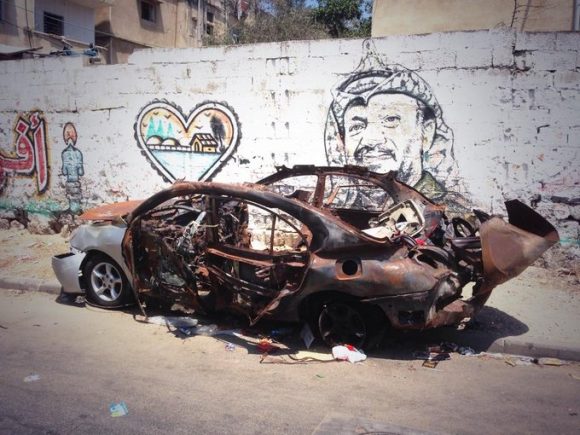
While reporting on Israel’s 51 day-long assault on Gaza in 2014, I came across a destroyed vehicle in central Gaza City belonging to a young taxi driver named Fadel Alawan who had been assassinated by an Israeli drone after he unwittingly dropped a wounded Hamas fighter off at a nearby hospital. Inside the car, the remains of Alawan’s sandal could still be seen melted into the gas pedal.
By the afternoon of October 7, placid settlements and desert roads across southern Israel were charred and lined with bombed-out cars that looked much like Alawan’s. Were the lightly-armed Hamas fighters actually capable of exacting destruction on such a comprehensive scale?
Is the Israeli government distributing photos of friendly fire casualties?
This October 23, Israel’s government gathered members of the international press for an off-the-record propaganda session. Inside a closed military base, officials bombarded the press with snuff films and a collection of lurid allegations of “harrowing scenes of murder, torture and decapitation from Hamas’s October 7 onslaught,” according to the Times of Israel.
In perhaps the most unsettling document presented by the Israeli government, reporters were treated to video showing “a partially burned woman’s corpse, with a mutilated head… The dead woman’s dress is pulled up to her waist and her underpants have been removed,” according to the Times of Israel.
Daniel Amram, the most popular private news blogger in Israel, tweeted the video of the woman’s burned corpse, claiming that “she was raped and burned alive.”
In fact, the young woman appeared to have been killed instantly by a powerful blast. And she seemed to have been removed from the car in which she was seated – and which may have belonged to a captor from Gaza. The vehicle was comprehensively destroyed and situated on a dirt field, as many others attacked by Apache helicopters were. She was scantily clad with her legs spread apart.
Though she had attended the Nova electronic music festival, where many female attendees dressed in skimpy attire, and her parted limbs were typical of bodies with rigor mortis, Israeli pundits and officials ran with the claim she had been raped.
But the allegations of sexual assault have so far proven baseless. Israeli army spokesman Mickey Edelstein insisted to reporters at the October 23 press briefing that “we have evidence” of rape, but when asked for proof, he told the Times of Israel, “we cannot share it.”
Was this young woman yet another casualty of the Israeli military’s friendly fire orders? Only an independent investigation can determine the truth.
Israel’s military kills Israeli captives inside Gaza, grumbles about their release
Inside Gaza, where some 200 Israeli citizens are held hostage, there is little doubt about who is killing the captives. On October 26, the Hamas armed wing known as the Al-Qassam Brigades announced that Israel had killed “almost 50 captives” in missile strikes.
If Israel’s military had intentionally targeted areas where it knew the captives were held, its actions would have been consistent with Israel’s Hannibal Directive. The military procedure was established in 1986 following the Jibril Agreement, a deal in which Israel traded 1150 Palestinian prisoners for three Israeli soldiers. Following heavy political backlash, the Israeli military drafted a secret field order to prevent future kidnappings. The proposed operation drew its name from the Carthaginian general who chose to poison himself rather than be held captive by the enemy.
The last confirmed application of the Hannibal Directive took place on August 1, 2014 in Rafah, Gaza, when Hamas fighters captured an Israeli officer, Col. Hadar Goldin, prompting the military to unleash more than 2000 bombs, missiles and shells on the area, killing the soldier along with over 100 Palestinian civilians.
Whether or not Israel is intentionally killing its captive citizens in Gaza, it has proven strangely allergic to their immediate release. On October 22, after refusing an offer from Hamas to release 50 hostages in exchange for fuel, Israel rejected an offer from Hamas to free Yocheved Lifshitz, an 85-year-old Israeli peace activist, and her 79-year-old friend, Nurit Cooper.
When Israel agreed to their release a day later, video showed Liftshitz clasping hands with a Hamas militant and intoning “Shalom” to him as he escorted her out of Gaza. During a press conference that day, she recounted the humane treatment she received from her captors.
The spectacle of Lifshitz’s release was treated as a propaganda disaster by the Israeli government’s spinmeisters, with officials grumbling that allowing her to speak publicly was a grave “mistake.”
The Israeli military was no less displeased by her sudden freedom. As the Times of Israel reported, “The army is concerned that further hostage releases by Hamas could lead the political leadership to delay a ground incursion or even halt it midway.”
Israeli troops launch new ‘limited incursion’ into Gaza
The Cradle | October 27, 2023
Israeli forces launched another limited ground incursion into the Gaza Strip overnight on Thursday, the second in a row following an incursion the night before.
The small-scale incursions carried out so far are meant to test the waters for the upcoming ground invasion Israel has announced.
“The IDF conducted strikes on Hamas terrorist targets over the last 24 hours. IDF ground troops, fighter jets, and UAVs struck: Anti-tank missile launch sites, Command and control centers, Hamas terrorist operatives,” the Israeli army said in a statement.
“The troops exited the area and no injuries were reported,” it added.
Israeli troops also carried out a limited incursion into Gaza the night before, on 25 October.
The incursion aimed to help prepare forces for the “next stages” of the war and the anticipated large-scale offensive on the besieged enclave.
“IDF tanks and infantry struck numerous terrorist cells, infrastructure, and anti-tank missile launch posts. The soldiers have since exited the area and returned to Israeli territory,” a military statement said on 26 October.
A previous Israeli attempt to enter the strip last weekend was met with fierce resistance by Hamas’ Al-Qassam Brigades.
Israeli troops crossed the border fence by several meters for a preparatory incursion into the Gaza Strip. The Al-Qassam Brigades ambushed the troops, destroying two army bulldozers and a tank, leaving several soldiers seriously wounded, and forcing them to withdraw.
Retired US Army colonel Douglas Macgregor said this week that US special forces went into Gaza with the Israeli army to “reconnoiter” and plan for the release of prisoners.
“They were shot to pieces and took heavy losses, as I understand,” Macgregor added.
Israel announced plans to launch a full ground invasion of the Gaza Strip following the launch of Operation Al-Aqsa Flood on 7 October.
The stated goal is to “eradicate” Hamas. Israel says it intends to find and destroy the group’s extensive network of tunnels and wipe out its infrastructure while its army attacks from the air and sea.
However, Tel Aviv has continued to delay the operation, coinciding with reports that Washington is unconvinced of Israel’s readiness for a ground invasion. Nonetheless, US special forces have been advising and coordinating with the Israeli army to prepare.
“The military leadership has already finalized an invasion plan, but [Benjamin] Netanyahu has angered senior officers by refusing to sign off on it — in part because he wants unanimous approval from members of the war cabinet he formed after the Oct. 7 attack,” the New York Times (NYT) reported on 26 October, citing two anonymous sources who have been present at Israeli cabinet meetings.
“Analysts believe that Mr. Netanyahu is wary about unilaterally giving the go-ahead because, with public confidence in his leadership already decreasing, he fears being blamed if the operation fails,” NYT added.
According to a recent poll, a majority of Israelis believe that Netanyahu must bear the responsibility for the massive security and intelligence failure which led the success of Operation Al-Aqsa Flood.
Israel announced on 25 October that it is waiting for further equipment deliveries from the US, but continues to maintain that the full ground invasion is imminent.
Analysts have said Israel’s goal of “eradicating” Hamas is overambitious.
According to The Cradle’s Hasan Illaik, such an operation will drag Israel into a massive multi-front war which it would not be able to bear the cost of.
Hamas’ Al-Qassam Brigades have heavily prepared themselves to face Israel on the ground.
Israel reportedly planning to use banned chemical weapons in Gaza
By Lucas Leiroz | October 27, 2023
There seems to be no ethical limits to the IDF’s anti-humanitarian practices against the Palestinian people in the Gaza Strip. According to local sources, the Israeli military is planning a chemical attack against Hamas’ underground tunnels. In addition to being illegal, the practice seems anti-strategic because with this maneuver the IDF could also kill Israeli citizens kept as prisoners of war by Hamas in the bunkers.
Rumors began to spread by local Palestinian correspondents, citing intelligence sources. According to the report, Israeli and American forces were working together to flood the bunkers with chemical weapons, mainly nerve gases. The objective would be to cause severe symptoms in Palestinian soldiers, facilitating an IDF invasion.
“The plan hinges on the element of surprise so as to decisively win the battle, using internationally forbidden gases, particularly nerve gas, and chemical weapons. Large quantities of nerve gas would be pumped into the tunnels (…) Inhaled or absorbed through the skin, most nerve gases can kill in anywhere between one to 10 minutes by crippling the respiratory centre of the central nervous system and paralysing the muscles around the lungs”, source said.
The sources also claim that Israel is postponing its incursion into the field to try to provoke an element of surprise when the invasion finally takes place. The objective is to deceive the enemy, in accordance with the elementary principles of military science, inducing the Palestinians to believe that the invasion will not occur at any time. So, when it happens, it will be something unexpected and capable of causing severe damage to the enemy.
Obviously, Israel and the US deny the accusations and claim that they are nothing more than unsubstantiated rumors. However, no solid argument is given to actually deny the “rumors”. On the contrary, Israeli military even used racist rhetoric to delegitimize the reports, stating that believing in an Arab official would be a sign of “ignorance.”
“It is utmost ignorance and naivety to rely on a chatter by some Arab official with regard to this matter and to take it seriously (…) Usually there should be logic [behind any military action]. What’s the point of releasing gas into these underground tunnels?”, Yaakov Kedmi, an Israeli military expert said. In the same sense, Sabrina Singh, a spokesperson for the US Department of Defense commented on the case stating: “This is not true and this reporting is inaccurate.”
However, it is important to emphasize that this is not the first time that journalistic reports citing sources familiar with Israeli military have suggested that Israel will use anti-humanitarian methods to attack Hamas’ tunnels. For example, a few days ago, US investigative journalist Seymour Hersh stated that occupation forces plan to use seawater to flood bunkers in order to kill Hamas members. In this type of operation, as well as in the use of gas, there would be many risks to hostages and prisoners of war, but, according to Hersh and his sources, Israel’s only real objective is to kill Hamas soldiers, with little concern for hostages.
“A well-informed American official told me that the Israeli leadership is known to be considering flooding Hamas’s vast tunnel system before sending in its troops, many of whom have had only a few weeks of training in the maneuvers and coordination required for the invasion (…) Where the estimated 200-plus hostages are is an open question. Israel is only talking about the end of the Hamas regime”, Hersh said.
In fact, these rumors and reports suggest that something serious is probably actually being planned by the IDF. There does not yet appear to be a consensus among Israeli officials on what techniques should be used against Hamas, but they are evidently thinking about different strategies to overcome the challenge of confronting Hamas’ complex system of tunnels. Israel wants to prevent Gaza from becoming its “Vietnam” but cannot find an efficient combat strategy to achieve this goal.
It is necessary to remember that Israel has been spreading accusations against Hamas recently, alleging that the Palestinian organization plans to use chemical weapons. It is unlikely that Hamas has this type of weapon, as the group’s capabilities do not allow for the manufacture of sophisticated equipment. Furthermore, the only country that publicly has stocks of chemical weapons is precisely the US, which is Israel’s biggest ally. It is possible then that Tel Aviv will use these illegal weapons in Gaza, not only to launch them in the tunnels, but also to carry out a false flag operation against Hamas and legitimize further escalations.
The only thing that seems clear so far is that the Zionist government remains convinced in its objective of carrying out a process of ethnic cleansing, collective punishment and actual massacre in Gaza. The possible use of chemical weapons will only worsen the international image of the Israeli regime, as this type of equipment is banned by international law.
Lucas Leiroz, journalist, researcher at the Center for Geostrategic Studies, geopolitical consultant.
Spanish minister calls on Europe to sever ties with Israel
MEMO | October 26, 2023
Spain’s acting Minister of Social Rights, Ione Belarra, called on European countries to sever diplomatic relations with Israel and impose an arms embargo and economic sanctions.
Belarra said in a post on X yesterday, that it is still possible to stop the “genocide” and also called for Israeli Prime Minister Benjamin Netanyahu and all other political leaders, who bombed civilians in the Gaza Strip, to be brought before the International Criminal Court.
In a previous statement, Belarra confirmed that “Israel has left hundreds of thousands of people without electricity, food, or water, and is bombing civilians, which constitutes collective punishment, serious violation of international humanitarian law and can be considered a war crime.”
She also accused the EU and US of encouraging Israel to practice a policy of discrimination, racism and aggression that – according to the Spanish minister – seriously violates human rights.
For the 19th consecutive day, the Israeli occupation army continues to target the Gaza Strip with intense air strikes that destroyed entire neighbourhoods and left thousands of Palestinian civilians martyred and wounded.
Featured Video
No Vote, No Representation, No State: Democracy, Israeli Style
or go to
Aletho News Archives – Video-Images
From the Archives
Sanctions, War and the Policy of Dual Containment
By SASAN FAYAZMANESH | March 17, 2008
It is now nearly three decades since the Unites States adopted the policy of dual containment of Iran and Iraq. While much has been written about the containment of Iraq, there has been very little in-depth analysis of this policy when it comes to Iran. In a book that is going to be released on March 31, 2008, entitled The United States and Iran: Sanctions, Wars and the Policy of Dual Containment (Routledge), I attempt to address this shortcoming by investigating when and why the US policy of containment of Iran came about, how it evolved, and where it stands today.[1] To the extent that Israel has been involved in US policy making, the study will also include the role that Israel has played in the containment of Iran. Also, since the fate of Iran has been inextricably linked to that of Iraq, occasionally the investigation will overlap with the containment of Iraq.
The policy of dual containment of Iran and Iraq originated during the Carter Administration, but it was not until the Clinton Administration that the expression “dual containment” became popular. … continue
Blog Roll
 Aletho News
- No Vote, No Representation, No State: Democracy, Israeli Style
- Zionist Bought Senate Blocks Information About American Citizens Killed By Israel
- While Gaza dominates the UN, these are the people keeping it alive
- New Report: “Scholasticide and Genocide in Gaza: Assessment, Testimonies and Legal Analysis”
- ‘THAAD Delusion’: Iran war exposes US missile shield limits – The Atlantic
- Moscow issues warning to NATO over Russian exclave
- Yes, the Iran war has destroyed Trump’s presidency
- The fallacy of US delusions about Iran’s economic collapse
- Hezbollah denies Syria cell link, warns of Israeli plan to sow discord
- The legacy of US sanctions, war, and occupation in Iraq
- If Americans Knew
- Mamdani releases plan to combat antisemitism and hate crimes in New York City
- Iran’s Revolutionary Guards Publish Letter to the American People
- DMFI launches $1 million ad campaign supporting Virginia’s Elaine Luria
- US Senate blocks resolution seeking report on Americans killed by Israel
- Israeli Attacks Kill Ten Palestinians in Gaza
- Massacre at Minab: The School That Became a Grave
- Israeli media: The IDF Shows It Doesn’t Turn a Blind Eye; It Actively Emboldens Settler Havoc
- As settlers ravage West Bank, Israeli forces kill 10 in Gaza – Daily Update
- New Report: “Scholasticide and Genocide in Gaza: Assessment, Testimonies and Legal Analysis”
- Ex-Biden officials are desperate for a Gaza scapegoat
- No Tricks Zone
- Green Energy Debacle: German Expert Professor Fritz Vahrenholt Warns Of Severe Economic And Social Consequences
- Two More Paleo Reconstructions Affirm Meters-Higher Sea Levels Across Ireland, Brazil 7000-6000 Years Ago
- New Study: Earth And Venus Surface Warmth Largely Explained By Convection And Lapse Rate, Not CO2 Or Radiation
- 2025 Nature Paper Claiming Worsening Global Drought Gets RETRACTED …Heavily Flawed
- New Study: ‘Global Drought Shows No Detectable Recent Acceleration Under Climate Warming’
- Economic Masterminds: German Socialists Suggest Taxing Productivity Gains Stemming From Using AI
- The South China Sea Has Not Been Cooperating With The Climate Change Narrative
- Energy Crisis: Germany Enters Heating Season With Historically Low Gas Reserve Fill Levels
- New Study: The Antarctic Ice Sheet Gained Mass From 2020-2024 Due To Staggering Snow And Ice Accumulation
- Study: Ocean Heating Rates From Thousands Of Years Ago ‘Dwarf’ Modern Ocean Heating Rates