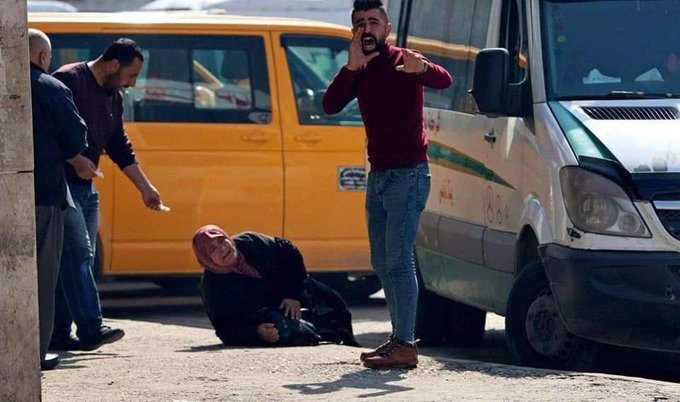
16-year-old Anas Al-Khalili was used as a human shield by Israeli forces in the northern occupied West Bank town of Nablus earlier this year. In this video, he describes his terrifying experience.
13-year-old Abdul-Rahman was shot in the head by Israeli forces while collecting grapes near his home in the village of Kafr Qaddoum in the occupied West Bank. An expanding bullet struck him in the forehead and doctors were unable to remove all the bullet shards, leaving Abdul-Rahman with lifelong injuries.
These bullets used by Israeli forces are designed to expand inside the body upon impact, causing massive internal injuries. Customary international law prohibits the use of expanding bullets, or any bullets that expand or flatten easily in the human body, though DCIP regularly documents fatalities and injuries seemingly as a result of expanding bullets, also known as dumdum bullets.
Hate crimes including vandalism and assaults carried out by Israeli Jews against Arab Christians in occupied Jerusalem have been rising sharply since the start of this year, Haaretz revealed on Sunday. Church leaders attribute the rise of anti-Christian hate crimes to the rhetoric of the most extreme far-right government that Israel has ever had.
According to Haaretz, the Israeli police do not take the issue seriously enough and refuse to recognise the growing number of hate crimes. Christians now feel that it is futile to report such incidents.
An Armenian priest quoted by the Jerusalem Inter-Church Centre said that he has been spat on more than ninety times this year already, mostly in Jerusalem’s Old City.
“It is no coincidence that the legitimisation of discrimination and violence within the current Israeli political environment also translates into acts of hatred and violence against the Christian community,” said Father Francesco Patton, the custodian of the Franciscan order in the Holy Land. “We expect and demand that the Israeli government and law enforcement agencies act decisively to guarantee security for all communities, to guarantee the protection of religious minorities and to eradicate religious fanaticism. We refer specifically to these serious incidents of intolerance, crimes of hatred and vandalism directed against Christians in Israel.”
Israel police denied the Christian narrative and claimed that all reported incidents are dealt with quickly and decisively, and that suspects had been arrested in most cases, and charged in some of them.
RT pointed out that Christians made up 25 per cent of Jerusalem residents 100 years ago, but are just one per cent today. The number of Arab Christians in Jerusalem started to decline following the 1967 occupation, as Israel has since confiscated 30 per cent of their land and stolen many properties through questionable land deals.
The ‘Butcher of Tantura’, who often bragged about murdering unarmed Palestinians after invading their small hamlet on the Mediterranean coast in the summer of 1948, is dead. He was 96.
Amitzur Cohen was groomed as part of the Zionist terrorist group Lehi and went on to carry out some of the most horrendous crimes against humanity, including the Tantura massacre.
After the illegitimate Zionist entity came into existence in May 1948 as part of the British project to colonize Palestine, hundreds of Palestinian villages and cities were ethnically cleansed and destroyed.
On the intervening night of May 22-23, the Palestinian coastal village of Tantura with a population of around 1,500 was among the last to be ambushed and occupied by the Israeli army’s Alexandroni Brigade, leaving behind a trail of death and destruction.
In his book ‘The birth of the Palestinian refugee problem’, historian Benny Morris writes that the occupying regime forces took the decision to “expel or subdue” native Palestinians in Tantura.
A communique issued by the Israeli military a day after the Tantura massacre brazenly boasted that “hundreds of Arabs and a large quantity of booty fell into our hands”.
As per activists and researchers, more than 200 Palestinians were killed and buried in a mass grave measuring 115 x 13 feet following the carnage carried out by the Zionist terrorist group.
Last year, Israeli media reported the discovery of a mass grave in the village, which prompted calls from Palestinian groups for an international commission to probe the series of massacres that followed the forcible expulsion of at least 750,000 Palestinians from their homeland, known popularly as the Nakba, or catastrophe.
An explosive documentary film by Alon Schwarz titled ‘Tantura’, which premiered late last year at the Sundance festival in the US, documented in detail the horrifying details of the colossal tragedy.
One of the vilest testimonies in Schwarz’s film was that of Cohen, the Zionist mass murderer who boastfully spoke about his first months as the Israeli regime soldier and how he killed for sport.
“I do not remember the number of Arabs I killed in 1948. I never counted the number, because I was a murderer, and I did not take any prisoners,” Cohen admitted, bursting into peals of laughter.
“I didn’t count. I had a machine gun with 250 bullets. I can’t say how many,” he said on being asked how many Arab Palestinians he remembered murdering in the events of May 1948.
Cohen eerily and unapologetically acknowledged that if a group of Arabs was standing in front of him, with their hands raised in a show of surrender, he would still shoot them dead.
The testimonies in the documentary film, including that of Cohen, were collected by Teddy Katz, who interviewed 135 people and collected 140 hours as part of his thesis at the University of Haifa in the late 1990s. Katz was later harassed by the Israeli regime for letting skeletons out of the closet.
Cohen, who was a member of the Zionist terrorist group Lehi that eventually took the shape of Israeli military force, had earned notoriety for carrying out complex terrorist operations, including derailing passenger trains and planting landmines on the tracks, as mentioned on the Lehi website.
“Amitzur took part in Lehi operations, such as derailing trains by laying mines on the tracks and blowing up the large railway bridge by Hotel HaCarmel,” the website states, referring to the railway line that linked the coastal Palestinian city of Haifa and Cairo at the time.
According to a report, Cohen joined the Lehi group “to resist and exterminate the Arabs in 1946” although his father and brother were members of the armed Zionist “Haganah” gangs.
“I was looking for work when I was captured by the Zionist underground ideology,” he was quoted as saying in the report. “I was ready for that, to kill without worrying (for consequences).”
On Saturday, the “butcher of Tantura” died at the age of 96 in the Binyamina settlement that he founded in 1922, named after French banker and supporter of Zionism, Benjamin de Rothschild.
Syed Zafar Mehdi is a Tehran-based journalist, political commentator and author. He has reported for more than 13 years from India, Afghanistan, Kashmir and West Asia for leading publications worldwide.
Israeli police and firefighters outside the Gethsemane Church in Jerusalem after settlers attempted to set fire to the holy site [AHMAD GHARABLI/AFP/Getty Images]
The Russian Ministry of Foreign Affairs has called for the trial of those responsible for the attack on the Church of Gethsemane in occupied Jerusalem.
On Friday, Russian Foreign Ministry spokesperson Maria Zakharova shared an official statement: “We are convinced that there is no justification, and that there can never be any justification, for such criminal acts, and hope that the Israeli authorities will provide an unequivocal assessment of what happened and to take comprehensive measures to bring perpetrators to justice and prevent the recurrence of such attacks in the future.”
Zakharova expressed Moscow’s “profound concern” about such abusive behaviour, noting: “The number of anti-Christian incidents has grown at an alarming pace recently, as churches, cemeteries of various Christian denominations, clergy and monks have become targets for these attacks.”
On 19 March, two settlers stormed the church and tried to destroy its contents, inflicting physical harm on clergy members and intimidating visitors and pilgrims.
This is the fifth attack of its kind against Christian places of worship in occupied Jerusalem by Jewish extremists since the beginning of the year. Prior to this, settlers stormed the Church of the Flagellation in the Old City of Jerusalem, broke and destroyed some of its contents, and tried to set it on fire. The cemetery of the Episcopal Church was also attacked, in addition to attempts to break into the Armenian Patriarchate, while racist phrases were written on its walls.
Samidoun Palestinian Prisoner Solidarity Network expresses its solidarity with Dr. Ahmed Shehadeh after Panamanian immigration authorities at Tocumen International Airport detained and deported Shehadeh, the head of the Brazilian-Palestinian Institute (Ibraspal), on Thursday, March 16. The Panamanian officials confiscated and held his Brazilian passport while he was transiting at the airport on his way to the second conference of the Palestinian Federation of Latin America, taking place between 17 and 19 March in Barranquilla, Colombia, Ibraspal’s vice president, Sayid Marcos Tenório, said.
“Shehadeh was interrogated by Panamanian intelligence agents, possibly with the participation and support of U.S. and Israeli intelligence,” Tenório said. “The state of Panama is under American occupation. American and Israeli intelligence are targeting anyone working against imperialist Zionist policies.”
Palestinian community sources in Brazil reported that extensive contacts took place with the Brazilian authorities, as Alexandre Padilha (Minister of Institutional Relations), Paulo Pimenta (Federal Deputy) and the Ministry of Foreign Affairs intervened, as did the representative of the Brazilian Embassy in Panama, communicating with the Panamanian authorities until Shehadeh returned to Brazil after his deportation, where his passport was returned to him at Brasilia airport.
Shehadeh was detained and interrogated for many hours before he was told that Panamanian immigration authorities were deporting him back to Brazil rather than allowing him to continue his journey to Colombia and the Palestinian conference taking place there.
Rawa Alsagheer, Palestinian activist and member of Samidoun Network in Brazil, denounced the action of the Panamanian authorities. “This reflects a Zionist and U.S. attempt to target and disrupt the organizing of Palestinians in exile in diaspora, especially in Latin America,” she said.
Brazilian media and social media widely reported on the news of Shehadeh’s detention and deportation, and many Brazilian and Palestinian organizations denounced the Panamanian action. The Panamanian Committee in Solidarity with the Palestinian People also condemned the immigration authorities’ actions.
Brazilian organizations and parties are planning to visit Shehadeh to express their solidarity with the Palestinian people and their rejection of the Panamanian authorities’ decision to prevent him from participating in the Palestinian Federation of Latin America’s conference.
A key goal of both the Israeli and American governments is to foster the normalization of ties between Israel and Saudi Arabia, and part of the strategy to make this happen was to unite the two against what has been depicted as a common enemy, Iran. The Saudi-Iranian rapprochement now appears to have thrown a spanner in the works of such efforts, and hence enraged the Israelis.
After five rounds of talks throughout the span of two years, Iran and Saudi Arabia were unable to reach a compromise for the re-establishment of diplomatic ties, something China has now managed to broker in a shocking turn of events. Based upon the long rivalry between Tehran and Riyadh, US and Israeli policy towards Saudi Arabia has been based on combating a common enemy shared between all sides. Although the US government itself has not reacted with open animosity to the sudden change in regional dynamics, the Israelis are publicly interpreting this as a negative development.
In June 2022, the Wall Street Journalreported that a previously undisclosed meeting had taken place in Sharm el-Sheikh, Egypt, whereby a number of Arab nations, including Saudi Arabia, had met with the Israeli military chief of staff at the time, Aviv Kochavi. Part of the discussions that took place was allegedly geared towards forming an Israeli-Arab defense alliance. Although no such alliance was formed, it was largely speculated at the time that US President Joe Biden’s visit to both Israel and Saudi Arabia the following month would include discussions on this topic. Despite the failure of the US and Israel so far to put together such an alliance, it is clear that part of the strategy for achieving normalization has been to secure defense interests.
Across the Israeli political spectrum, from both the coalition government and opposition, finger pointing has been taking place, in attempts to pin the blame for the perceived failure of Israel to prevent Saudi-Iranian normalization. Israeli Prime Minister Benjamin Netanyahu has attempted to shift the blame onto the former government, an idea refuted by former Israeli Mossad head Efraim Halevy as “factually incorrect.” On the other hand, former Israeli PM Naftali Bennett has called the agreement “a serious and dangerous development for Israel.” Yair Lapid, another former PM and current leader of the opposition, also said it is an “utter and dangerous failure of the Israeli government’s foreign policy.”
The big question now is whether the Chinese-brokered normalization agreement will negatively impact potential normalization between Israel and Saudi Arabia. Reuters reported that, according to an unnamed senior Israeli official, the Saudi-Iranian deal will have no significant impact on Israeli-Saudi relations. It is also not clear whether the agreement has any clauses to do with Israeli normalization. According to Carmiel Arbit from the Washington-based Atlantic Council, the Saudis could be attempting to conduct a balancing act the way the United Arab Emirates has. The UAE, which signed its own normalization deal with Israel in 2020, has since 2019 managed to de-escalate tensions with Iran and is currently maintaining cordial ties with both sides.
It is not clear, however, whether the model of Abu Dhabi will be applicable for the Saudis. Riyadh, simply put, has a lot more to lose than the Emiratis, due to its wide regional entanglements and domestic constraints, and hence it has chosen to maintain a distance from the Israelis at this time. The internal political crisis in Tel Aviv may also play a crucial role in the Saudi decision to push forward with the normalization of ties with Iran, as instability within Israel, coupled with a potential escalation in the conflict with the Palestinian people, could severely hinder a formal diplomatic breakthrough.
One crucial result of Saudi-Iranian normalization, however, is not necessarily to do with Israel’s own relations with the Saudis. Combating Iran, specifically its nuclear program through coercive measures, is an active policy position on both sides of the political divide in Israel. Netanyahu placed the issue of combating Iran, even through direct force, at the forefront of his campaign to win the election late last year. Throughout the past unity coalition of Bennett and Lapid, the anti-Iran position also proved a cornerstone of Israeli regional policy.
Performing aggressive actions, such as a direct attack against Iranian nuclear facilities, could now be much more difficult for the Israelis to pull off, with Saudi Arabia taking a non-combative approach to Iran. Although the nuclear issue is perhaps the most pervasive issue for the Israeli public, Iran’s regional alliances and defense programs are the true threats posed to Israel. If Saudi-Iranian ties are able to flourish and the Chinese-brokered deal holds, this could mean that Riyadh’s efforts in Lebanon against Hezbollah could be curtailed, and this surely represents a concern for Israel.
Iran, through its relationships with regional political parties, governments, and localized militia forces, also possesses the ability to pull strings that could benefit Saudi Arabia if it reciprocates by doing the same. This is especially the case when it comes to the conflict in Yemen. One thing that Ansarallah, also known as the Houthis, have been able to prove in their efforts against the Saudi-led coalition since 2015 when the war began, is that they are capable of overcoming US-made defense equipment. Iran, as a close ally of Ansarallah, could aid in setting up a long-term truce or even lasting peace, which the likes of the US simply cannot offer. To end this war would be in the security interests of the Saudis, who will undoubtedly suffer if the violence resumes, especially if missiles and drones begin striking their vital infrastructure again.
Just as Beijing proved capable of fostering Saudi-Iranian normalization, Tehran could offer the ability to properly negotiate a peaceful solution in Yemen. However, it is simply too early to tell whether such a development will take place. What the deal undoubtedly does is prove the weakness in Israel’s regional capabilities, along with the waning influence of the US. Israel’s security concerns regarding Syria and Lebanon may be heightened if the Chinese-brokered agreement delivers a more peaceful approach inside both of these nations. Saudi Arabia could also re-establish ties with the Syrian government, as the UAE has already done, which could help Damascus on the road to recovery from its brutal war and current state of economic ruin. A strong and united Syria could in the future also pose a strategic threat to Israel. While Saudi-Israeli normalization is by no means off the table, the Saudi-Iranian agreement could pose a serious challenge regionally for Israel’s current policy approach.
Robert Inlakesh is a political analyst, journalist and documentary filmmaker currently based in London, UK. He has reported from and lived in the Palestinian territories and currently works with Quds News.
Saudi Arabia’s former intelligence chief has said that the Kingdom is sticking to the terms of the 2002 Arab Peace Initiative in its drive to normalise relations with Israel.
“The terms are well-known,” Prince Turki Al-Faisal told France 24. “The creation of a sovereign Palestinian state with recognised borders and Jerusalem is its capital, and the return of Palestine refugees.” He pointed out that these were the conditions that Saudi Arabia added to the initiative before it was adopted by the Arab League 21 years ago.
The Arab Peace Initiative has been rejected by every Israeli government since then. Moreover, several Arab states have bypassed it and forged ties with the occupation state.
Replying to a question about the potential normalisation of ties with Israel without fulfilling these conditions, Al-Faisal confirmed: “What I have said was not my opinion, but it was declared by officials. I trust the officials when they say anything, and anything made by media is nonsense.”
According to the New Khalij news website, reports in America claim that Riyadh has proposed to Washington that it will make diplomatic ties with Israel in return for a US pledge to protect the Gulf region, support a peaceful nuclear programme in the Kingdom and approve major arms sales to the Royal Saudi Armed Forces.
On Thursday the New York Times ran yet another report about Saudi Arabia’s entry into an “Abraham Accord,” but if only certain conditions could be met. It quoted longtime Israel lobby heavyweight Martin Indyk and reported on the American Israel Public Affairs Committee’s think tank the Washington Institute for Near East Policy “expert” delegation’s visit to Riyadh to finalize a deal. Then on Friday explosive news broke that China had successfully concluded a secret peace agreement between Iran and Saudi Arabia.
The plan aims to restore diplomatic relations by reopening embassies within two months. They also agree to restart their April 2001 Security Cooperation. Also back on the front burner is a 1998 General Agreement covering economic, trade, investment, technology, science, culture, sports and youth ties. It is well worth reading the entire statement.
As it often does, the New York Times quickly updated its March 9 story in an attempt not to look foolish having given too much credence to Israel lobby guidance.
Too late.
Israel and its lobby have for decades attempted to steer the United States into attacking Iran. The neocon policy coup of 2001 was not only a plan to get the U.S. to attack Israel’s arch enemy Iraq, it was also designed to steer the U.S. into attacking seven countries in seven years, most prominently Iran.
When the U.S. invasion of Iraq quickly turned into a quagmire, two American Israel Public Affairs Committee executives tried to place stolen classified Department of Defense information incriminating to Iran into circulation at the Washington Post. The operation failed, the Pentagon colonel leaking classified information was prosecuted, while the longtime AIPAC officials were dismissed.
Israel’s foreign influence operation AIPAC has steadily lobbied against Iran on behalf of Israel including punishing economic warfare from the U.S. Treasury’s OTFI unit, which AIPAC lobbied to set up for just this purpose in the aftermath of 9/11.
The Trump era “Abraham Accords” were yet another attempt to isolate Iran while harnessing Arab countries to Israel’s undue foreign influence and war on Iran machine. Under the scheme, the U.S. sacrifices its remaining international reputation to compel Arab governments to sign diplomatic and commercial accords with Israel their populations overwhelmingly reject. Target governments get access to advanced U.S. weapons, or recognition of illegal land grabs in exchange for normalization.
Saudi Arabia was always the toughest prospect for sticking its head into the yoke of an Abraham Accord. The Saudi Initiative, or Arab Peace Initiative endorsed by the Arab League in 2002, re-endorsed in 2007 and 2017 was a legitimate path toward a somewhat just settlement through the creation of a Palestinian state with East Jerusalem as its capital in exchange for Arab normalization.
Under constant Israel lobby pressure, there was never any serious U.S. consideration of the Saudi led plan. Instead, Israel surrogates Jared Kushner and former real estate lawyer turned ambassador to Israel David M. Friedman among others pushed the so-called “Deal of the Century” that offered tenuous promises of economic development to Palestinians in exchange for relinquishing their rights under international law. A 2019 IRmep poll revealed that 68 percent of Americans would have rejected a similar deal if they were in Palestinians’ shoes, and the deal collapsed.
The Abraham Accords then attempted to “transcend” the Palestine question by making Palestinian claims under international law and the Arab Peace Plan irrelevant.
The new Joint Trilateral Statement signals a rejection of the Abraham Accords and yoking Saudi Arabia to Israel and its lobby’s foreign policy intrigues and domestic meddling. Saudi Arabia may not want to become as subject to Israeli prerogatives as America and has obviously been learning how to avoid it. Saudi Arabia skillfully cushioned the bad news by end-running AIPAC and placated the American military industrial congressional complex by simultaneously agreeing to purchase $35 billion in Boeing passenger jets. That is nearly the same amount as military aid the US agreed to give to Israel gratis over ten years under the Obama administration.
Israel and its lobby will not take this bad news lying down and still have many levers to pull in the region, establishment U.S. media, Congress, the State Department, and the White House. But for now, the Saudi rejection of the Abraham Accords could signal the way out for UAE, squeezed by Israel and AIPAC to invest in sketchy Israeli schemes such as “Project Jonah,” and get into a war footing with Iran. UAE may be inspired and try to disentangle themselves from the Israeli undue influence and Palestine justice minimization machine.
“Israel’s right to exist” has been challenged in expert testimonies by leading scholars Professor John Dugard and Professor Avi Shlaim. Dugard is an advocate of the High Court of South Africa. He has served intermittently as Judge of the International Court of Justice. His other high-profile appointment was at the United Nations where he served as Special Rapporteur on the Situation of Human Rights in the Occupied Palestinian Territories from 2001 to 2008. Shlaim, who is an author of several books on Israel and Palestine, is an Emeritus Fellow of St Antony’s College and an Emeritus Professor in International Relations at the University of Oxford.
Dugard and Shlaim issued their testimonies in response to the UK government’s prohibition on schools and universities from engaging with organisations that question Israel’s “right to exist”. The testimonies are part of a legal action against the former Education Secretary, Gavin Williamson, by UK human rights group, CAGE. In a 2021 letter to schools and universities, Williamson applied pressure to adopt the discredited International Holocaust Remembrance Alliance (IHRA) definition of anti-Semitism. The letter also told schools that they were prohibited from engaging with organisations that reject Israel’s “right to exist”.
A judicial review of the government’s guideline was lodged by CAGE, it argued that no such right exists in international law that prohibits people and groups from questioning a state’s legitimacy. “For too long, the political phrase ‘Israel’s right to exist’ has been used as a weapon to silence any debate about the legitimacy of its creation, the right of return of Palestinian refugees displaced by its creation and the apartheid nature of the Israeli state,” CAGE said at the time. In July a British High Court ruled against a judicial review.
This week CAGE published the expert testimonies of Dugard and Shlaim. Both challenged the prevailing narrative pushed by the UK government on Israel’s “right to exist”. Their testimony gave a brief history of the creation of the State of Israel and explained why the claim of a “right to exist” in law and morality is debatable.
Shlaim described Williamson as someone who habitually conflates anti-Zionism and anti-Semitism. He also claimed that the former education secretary had used his ministerial position to restrict freedom of speech on Israel. Commenting on the IHRA and possible financial sanctions that may be imposed if schools refused to adopt it, Shlaim said: “This is a highly controversial and, in my opinion, discredited definition which was promoted by Israel’s friends. The two-sentence definition is vacuous, but it is followed by 11 ‘illustrative examples’ of what might constitute antisemitism. Seven of the 11 examples relate to Israel. The real purpose of the definition is not to protect Jews against antisemitism but to protect Israel against legitimate criticism.”
Shlaim was one of 77 Israeli academics in Britain who united in response to Williamson’s infamous intervention. In January 2021, they sent a letter to vice chancellors and academic senates in England urging universities not to adopt the IHRA document, which they viewed as being “detrimental not only to academic freedom and to the struggle for human rights, but also to the fight against antisemitism.”
Challenging Israel’s right to exist, the expert testimonies argued that such a claim has no basis in international law. The idea that states have rights is rejected outright. The point is often made in the following way: Human beings have a right to exist, and to live flourishing lives. The moral and legal justification for the existence of any nation-state is based on their ability to protect and defend the rights of human beings and through serving the interest and well-being of peoples cultures and communities living within the territory they control. When a state fails in this regard for enough of those people for a long enough time, its control comes under challenge and loses its legitimacy. The shelf-life of any state is to the degree it can guarantee the human rights of people in territory controlled by that state.
Though there are many examples, a classic case often cited to highlight that point is Apartheid South Africa. Arguments were raised that Apartheid South Africa should not be recognised as a state and should be expelled from the UN. Although South Africa was not expelled from membership of the world body, the credentials of the South African government were not accepted, and it was denied the right to participate in the work of the General Assembly. In effect, this meant that many countries believed that South Africa no longer had the right to exist as a state because of its policy of apartheid. South Africa lost its legitimacy because of its refusal to guarantee and protect the rights of black South Africans in the same territory.
The arrangement in Apartheid South Africa has many similarities with Israel, which is why every major human rights group has concluded that Israel is committing the crime of apartheid. Within the territory controlled by the occupation state – known also as historic Palestine – seven million of Israel’s Jewish population enjoy full rights and privileges, while seven million of the territories’ non-Jewish population experience some form of discrimination depending on where they live. Twenty per cent of Israel’s Palestinian citizens for example suffer less discrimination than the five million Palestinians in occupied West Bank, Jerusalem and Gaza. Not forgetting also, the six million Palestinian refugees who are refused their right to return while every Jew in the world is granted their “right to return”.
Returning to the expert testimonies, Dugard and Shlaim rejected Israel’s “right to exist”, explaining that such a right cannot be exercised because there is no basis for it in international law. According to Dugard, the rights of a state that are enshrined in international law are the right to territorial integrity; political independence and not to be forcibly attacked by another state. It’s not obvious therefore why Israel should be allowed to enjoy these rights given that it has no defined borders, and furthermore not only has it forcibly attacked and occupied the State of Palestine, it continues to annex territory beyond the internationally recognised borders of the apartheid state.
Further arguments rejecting Israel’s “right to exist” are demonstrated by the fact that a state may be recognised as a state by some states but not by others. Consequently, it is a state for those countries that recognise it but not for states that do not recognise it. Palestine, for instance, is recognized as a state by 138 countries, which is more than Kosovo, recognised by 100 states.
Perhaps the most powerful objection against Israel’s demand on others to recognise its “right to exist” are claims it had made about itself during the country’s founding. Israel’s declaration of independence was based on the Balfour Declaration, the Mandate of the League of Nations and the General Assembly’s Partition Resolution. Every one of those claims have been challenged on legal grounds since 1948. The Balfour Declaration of 1917 for example did not recognise the right of the Jewish people to a state in Palestine. It simply stated that the British government viewed “with favour the establishment in Palestine of a home for the Jewish people” but that this was to be without prejudice to the “civil and religious rights of existing non-Jewish communities in Palestine.” The clear and obvious goal of the declaration was to create a “home” for the Jewish people “InPalestine,” not erase Palestine as Israel has done to supplant a new state on top of it.
Similar contentions exist with the British Mandate for Palestine and UN Partition Plan. Although the Mandate incorporated the provisions of the Balfour Declaration it made no provision for a Jewish State. As for the partition plan, Palestinians rejected Resolution 181 on account of its unfairness: it gave the Jewish community comprising 33 per cent of the population of Palestine 57 per cent of the land and 84 per cent of the agricultural land.
The message in the expert testimonies can be boiled down to the fact that not only is the British government’s suppression of a discussion on Israel’s “right to exists” preposterous, ahistorical and an attack on freedom of thought, there can be no discussion about Israel’s “right to exist” without a similar discussion about Palestine’s right to exist.
Rarely does the Palestinian Ambassador to the UN make an official comment expressing happiness over any official proceedings concerning the Israeli occupation of Palestine. Ambassador Riyad Mansour, though, is “very happy that there was a very strong united message from the Security Council against the illegal, unilateral measure” undertaken by the Israeli government.
The “measure” in question is a decision, on 12 February, by the far-right government of Israeli Prime Minister Benjamin Netanyahu to construct 10,000 new housing units in nine illegal Jewish settlements in the Occupied Palestinian West Bank. Predictably, Netanyahu was angered by the supposedly “very strong united message” from an institution that is hardly known for its meaningful action regarding international conflicts, especially in occupied Palestine.
Mansour’s happiness may be justified from some perspectives, especially as we seldom witness a strongly-worded position by the Security Council that is both critical of Israel and embraced by the US. The latter has used its veto in the council 53 times since 1972 — according to the UN itself — to block draft Security Council resolutions that are critical of the occupation state.
However, a close examination of the context of the latest UN statement on Israel and Palestine shows that there is little reason for Mansour’s excitement. The statement in question is just that; a statement, with no tangible value and no legal repercussions. It could have been meaningful if the language had been unchanged from its original draft. Not of the statement itself, but of a binding UN resolution that was introduced on 15 February by the UAE ambassador.
Reutersrevealed that the draft resolution would have demanded that Israel “immediately and completely cease all settlement activities in the Occupied Palestinian Territory.” That resolution — and its strong language — was scrapped under pressure from the US and was replaced by a mere statement that “reiterates” the Security Council’s position that “continuing Israeli settlement activities are dangerously imperilling the viability of the two-state solution based on the 1967 lines.” It also expressed “deep concern”, actually, “dismay” with Israel’s 12 February announcement.
Netanyahu’s angry response was mostly intended for public consumption in Israel, and to keep his far-right government allies in check; after all, the conversion of the resolution into a statement, and the watering down of the language were all carried out with the prior agreement of the US, Israel and the PA. The Aqaba conference held two days ago is confirmation that such an agreement is indeed in place. Hence, the statement could not have come as a surprise to the Israeli prime minister.
Moreover, US media spoke openly about a deal, which was mediated by US Secretary of State Antony Blinken. The reason behind it, initially, was to avert a “potential crisis” which would have resulted if the US had vetoed the resolution. According to the Associated Press, such a veto “would have angered Palestinian supporters at a time that the US and its western allies are trying to gain international support against Russia.”
However, there is another reason behind Washington’s apparent sense of urgency. In December 2016, the then US Ambassador to the UN Susan Rice refrained from vetoing a similar UN Security Council resolution that strongly condemned Israel’s illegal settlement activities. This happened less than a month before the end of Barack Obama’s second term in the White House. For Palestinians, the resolution was too little, too late. For Israel, it was an unforgivable betrayal. To appease Tel Aviv, the Trump Administration gave the UN post to Nikki Haley, an ardent supporter of Israel.
Although another US veto would have raised a few eyebrows, it would have presented a major opportunity for the strong pro-Palestine camp at the UN to challenge US hegemony over the matter of the Israeli occupation of Palestine. It would also have deferred the issue to the UN General Assembly and other UN-related organisations.
Even more interesting, according to the Blinken-mediated agreement — reported by AP, Reuters, Axios and others — Palestinians and Israelis would have to refrain from unilateral actions. Israel would freeze all settlement activities until August, and Palestinians would not “pursue action against Israel at the UN and other international bodies such as the World Court, the International Criminal Court and the UN Human Rights Council.” This was the gist of the agreement at the US-sponsored Aqaba meeting as well. While the PA is likely to abide by this understanding — since it continues to seek US financial handouts and political validation — Israel will most likely refuse; in fact, practically-speaking, it already has.
Although the agreement reportedly stipulated that Israel would not stage major attacks on Palestinian cities, only two days later, on 22 February, Israel raided the West Bank city of Nablus. It killed 11 Palestinians and wounded 102 others, including two elderly men and a child.
Moreover, a settlement freeze is almost impossible. Netanyahu’s extremist coalition government is held together in large part by the common understanding that settlements must expand constantly. Any change to this understanding would almost certainly mean the collapse of one of Israel’s most stable governments in years.
Why, then, is Mansour “very happy”? The answer stems from the fact that the PA’s credibility among Palestinians is at an all-time low. Mistrust, if not outright disdain, of Mahmoud Abbas and his authority is one of the main reasons behind the brewing armed rebellion against the Israeli occupation. Decades of promises that justice will eventually arrive through US-mediated talks have culminated in nothing, so Palestinians are developing their own alternative resistance strategies.
The UN statement was marketed by PA-controlled media in Palestine as a victory for Palestinian diplomacy. Hence, Mansour’s happiness. But this euphoria was short lived.
The Israeli massacre in Nablus left no doubt that Netanyahu will not even respect a promise he made to his own benefactors in Washington. This takes us back to square one: back to where Israel refuses to respect international law, the US refuses to allow the international community to hold Israel to account, and the PA claims another false victory in its supposed quest for the liberation of Palestine. Practically, this means that Palestinians are left with no other option but to carry on with their resistance, indifferent — justifiably so — to the UN and its “watered-down” statements.
Scores of Israeli settlers rampaged for several hours in the West Bank town of Huwara late on 26 February, leaving one Palestinian dead, at least 390 injured, and setting fire to at least 75 Palestinian homes and 100 cars.
The Palestinian Health Ministry said 37-year-old Sameh Aqtash was shot and killed by Israeli fire. The Palestinian Red Crescent medical service said two other people were shot and wounded, a third person was stabbed, and a fourth was beaten with an iron bar.
The settlers descended on the Palestinian village brandishing firearms, knives, sticks, and stones under the protection of the Israeli army.
Images posted on social media show settlers killing an entire herd of sheep and uprooting olive trees and other crops from Palestinian farmers.
According to WAFA news agency, early on Monday, an Israeli settler tried to run over a group of journalists covering the raid in Huwara.
The attack on the Palestinian village came in response to the killing of two Israeli settlers on highway 60 near Huwara by a Palestinian gunman. Israeli Channel 12 reported that the man intercepted the settlers’ vehicle by ramming into it, got out and shot both of them, then escaped by foot.
Sunday’s violence occurred just as senior officials from Egypt, Israel, Jordan, Palestine, and the US met in the Red Sea resort of Aqaba, where they announced that Tel Aviv and the Palestinian Authority (PA) reached an agreement to “de-escalate tensions” for a period of three to six months.
“They reaffirmed the necessity of committing to de-escalation on the ground and to prevent further violence,” the Jordanian Foreign Ministry announced in a statement.
The statement also claimed Israel agreed to “stop discussion of any new settlement units for four months and to stop authorization of any outposts for six months.”
However, Prime Minister Benjamin Netanyahu swiftly denied this claim, tweeting that “the building and authorization in [the West Bank] will continue according to the original planning and building schedule, with no change.”
Tel Aviv has also tightened its siege on the occupied West Bank city of Nablus, imposing a closure on the checkpoints of Huwara, Awarta, Al-Murabaa, Zatara, and entrances to Beita.
Over the past year, the occupied West Bank has witnessed a severe uptick in violence, both from settler assaults and Palestinian retaliatory attacks, in addition to the intense, often violent raids the Israeli army carries out on a near-daily basis.
Ten Palestinians have been killed and over a hundred wounded this morning following an Israeli military raid in the occupied West Bank city of Nablus.
The Israeli occupation’s military stormed the city with armoured vehicles and blocked off all entrances before surrounding a home with two wanted Palestinians inside. Hossam Isleem and Mohammad Abdulghani, who were both killed.
The Israeli forces demolished the building while the two were inside; their bodies were later identified by the occuption’s forces. Israeli military sources claim the two Palestinians were involved in numerous resistance attacks against illegal Israeli settlements and in the death of a soldier last October.
The Palestinian Health Ministry reported that ten people were killed and 102 others were wounded as a result of gunfire by Israeli occupation soldiers.
Palestinian victims among the dead include 72-year-old Adnan Saabe Baara, 61-year-old Abdul Hadi Abdul Aziz Ashqar, 16-year-old Mohammad Farid Shaaban, 25-year-old Mohammad Khaled Anbousi and 33-year-old Tamer Nimr Minawi.
It is now nearly three decades since the Unites States adopted the policy of dual containment of Iran and Iraq. While much has been written about the containment of Iraq, there has been very little in-depth analysis of this policy when it comes to Iran. In a book that is going to be released on March 31, 2008, entitled The United States and Iran: Sanctions, Wars and the Policy of Dual Containment (Routledge), I attempt to address this shortcoming by investigating when and why the US policy of containment of Iran came about, how it evolved, and where it stands today.[1] To the extent that Israel has been involved in US policy making, the study will also include the role that Israel has played in the containment of Iran. Also, since the fate of Iran has been inextricably linked to that of Iraq, occasionally the investigation will overlap with the containment of Iraq.
The policy of dual containment of Iran and Iraq originated during the Carter Administration, but it was not until the Clinton Administration that the expression “dual containment” became popular. … continue
This site is provided as a research and reference tool. Although we make every reasonable effort to ensure that the information and data provided at this site are useful, accurate, and current, we cannot guarantee that the information and data provided here will be error-free. By using this site, you assume all responsibility for and risk arising from your use of and reliance upon the contents of this site.
This site and the information available through it do not, and are not intended to constitute legal advice. Should you require legal advice, you should consult your own attorney.
Nothing within this site or linked to by this site constitutes investment advice or medical advice.
Materials accessible from or added to this site by third parties, such as comments posted, are strictly the responsibility of the third party who added such materials or made them accessible and we neither endorse nor undertake to control, monitor, edit or assume responsibility for any such third-party material.
The posting of stories, commentaries, reports, documents and links (embedded or otherwise) on this site does not in any way, shape or form, implied or otherwise, necessarily express or suggest endorsement or support of any of such posted material or parts therein.
The word “alleged” is deemed to occur before the word “fraud.” Since the rule of law still applies. To peasants, at least.
Fair Use
This site contains copyrighted material the use of which has not always been specifically authorized by the copyright owner. We are making such material available in our efforts to advance understanding of environmental, political, human rights, economic, democracy, scientific, and social justice issues, etc. We believe this constitutes a ‘fair use’ of any such copyrighted material as provided for in section 107 of the US Copyright Law. In accordance with Title 17 U.S.C. Section 107, the material on this site is distributed without profit to those who have expressed a prior interest in receiving the included information for research and educational purposes. For more info go to: http://www.law.cornell.edu/uscode/17/107.shtml. If you wish to use copyrighted material from this site for purposes of your own that go beyond ‘fair use’, you must obtain permission from the copyright owner.
DMCA Contact
This is information for anyone that wishes to challenge our “fair use” of copyrighted material.
If you are a legal copyright holder or a designated agent for such and you believe that content residing on or accessible through our website infringes a copyright and falls outside the boundaries of “Fair Use”, please send a notice of infringement by contacting atheonews@gmail.com.
We will respond and take necessary action immediately.
If notice is given of an alleged copyright violation we will act expeditiously to remove or disable access to the material(s) in question.
All 3rd party material posted on this website is copyright the respective owners / authors. Aletho News makes no claim of copyright on such material.