Russia holds Israel responsible for latest offensive against Gaza

MEMO | August 9, 2022
Russia blames Israel for the latest three-day military offensive against the Palestinians in the Gaza Strip, the Foreign Ministry in Moscow has announced.
“The new escalation was caused by the Israeli army firing into the Gaza Strip on 5 August,” said ministry spokesperson Maria Zakharova. She pointed out that the Palestinian factions responded to this escalation by firing rockets indiscriminately towards Israeli territory.
“We are observing with profound worry how events are evolving,” added Zakharova. “The resumption of a full-scale military confrontation [would see the] already deplorable humanitarian situation in Gaza deteriorate further.”
The ministry official reaffirmed Russia’s “principled and consistent position, reflected in the relevant resolutions of the UN General Assembly and the Security Council, in support of a comprehensive and long-term settlement of the Palestinian-Israeli conflict in accordance with the two-state principle.
“It is possible to put an end to cyclical violence only within the framework of the negotiation process, the result of which should be the realisation of the legitimate national rights of the Palestinian people to establish an independent state within the 1967 borders.”
Zakharova’s statements come at a time when relations between Israel and Russia are tense.
Meanwhile, the Ukrainian Ambassador to Israel, Yevgeny Kornichuk, declared his solidarity with the occupation state: “As a Ukrainian whose country is under brutal attack by its neighbour, I feel great sympathy for the Israeli public. An attack against children and women is an abominable thing. Terror and a malicious attack against civilians are the daily reality of Israelis and Ukrainians and this appalling threat must be stopped immediately.”
Kornichuk made his comments before the Egyptian-brokered ceasefire between Gaza and Israel came into effect.
Although the occupation state declared that it was targeting the Palestinian Islamic Jihad movement, the Palestinian Ministry of Health has confirmed that 44 citizens were killed as a result of the Israeli offensive, including 15 children and four women. Another 360 Palestinian civilians were wounded. Moreover, many homes and residential buildings were destroyed.
The hidden goal behind Gaza’s assault
By Batool Subeiti | Press TV | August 7, 2022
The Zionist regime’s unprovoked blitz on Gaza since Friday afternoon was, firstly, a direct message to Lebanon, that it is not interested in going into war over the maritime boarders, thereby conceding to line 23 and the Qana fields that Lebanon has demanded full sovereignty over. Secondly, the regime seeks to test the waters through this limited confrontation.
The limited scope of the confrontation between Palestinian Islamic Jihad (PIJ) and the Zionist regime implies the objective is not aimed at weakening the resistance, rather it is to measure the reactions of this confrontation on many levels and to send underlying messages in the process.
The Zionist regime considers the Palestinian resistance to be the easiest target within the resistance axis and has therefore sought calculated confrontation with this entity. Through its assaults on Gaza, the regime is interested in testing the extent of unification of the regional resistance factions in decision making, logistical support, the readiness of factions to get involved if the battle escalates, how willing they are to expand the war in addition to their stock of weapons, their capabilities, and capacities.
This is also happening at a time when the Zionist regime will hold its fifth election in four years this November, thereby seeking to rally the settler population over a point of unity – that is usually attacks on Gaza. The regime seeks to paint the image that it is unafraid to attack in any circumstance to ensure their ‘security’, with Israeli Prime Minister Yair Lapid stating on Friday that, “the country has ‘zero tolerance’ for attacks from Gaza”. However, he also made it clear in the same press conference that there is no interest in a ‘broader battle’.
More importantly, the Zionist regime is approaching a due position and that is drawing the maritime boarders with Lebanon, which if it does not end up playing in the interests of Lebanon, poses an imminent danger, and calls for an imminent war, as made clear by the Secretary General of the Islamic resistance party in Lebanon. The Zionist regime wishes to prevent a war at all costs and that means it has no choice but to compromise, which appears as a point of weakness for the settler population in the context of the elections, as they wish for a candidate that takes a strong stance on such issues. This smaller scale attack was therefore launched in order to avoid a larger war, and for the regime to grant itself some credit as well.
It is also important for the Zionist regime to reinforce the phobia of war within the minds of the settler population, such that the mass general opinion formed is one that aligns with the Zionist government’s decision to compromise on the maritime boarders, in order to prevent a wider scale war where the battle front is opened beyond one Palestinian resistance faction, the PIJ, and in the worst case extends to the Lebanese resistance that has over 100,000 rockets.
The reason that the Zionist regime seeks to compromise on the boarders are because it knows the resistance capabilities are very strong, such as when they sent three unmanned aircraft (UAV) targeting the gas rigs in July. The regime however also seeks to paint the image that they are strong through launching an offensive attack on the resistance, however the reality is that they don’t wish for a war and in fact know that other Palestinian resistance organizations such as Hamas, the Popular Front do not intend to get involved and the operation is of a limited nature. The head of Shin Bet reportedly told cabinet ministers overnight on Saturday that Tel Aviv, “met most of the objectives it set at the outset of the operation in Gaza.”
In this process, the Zionist regime has sought to send a message to the internal resistance in Palestine that the head of PIJ, Ziad Nakhala is in Tehran whilst key commanders of the group are being assassinated, thereby seeking a show of display for their supposed lack of fear and strength. However, the unmasked reality is that since the regime are seeking compromise, they want to grant themselves false credit regarding their strategic strength and seek to gain publicity without it affecting their elections. The reality is that the regime is deceiving its own population through putting forth titles that sound big but are empty, as they know the resistance won’t be dragged into the square they want, and their aim is to appeal to the public opinion of the Zionist settlers through deception.
Batool Subeiti is an Energy Engineer and political analyst based in London, UK.
Israeli airstrike kills 5-year-old Palestinian girl in Gaza
Defense for Children International – Palestine | August 5, 2022
An Israeli airstrike killed a 5-year-old Palestinian girl in Gaza City today as the Israeli military announced a new military offensive on the Gaza Strip.
Alaa Abdullah Riyad Qaddoum, 5, was killed around 4:30 p.m. on August 5 by an Israeli airstrike in the Shuja’iyya neighborhood of Gaza City, according to documentation collected by Defense for Children International – Palestine. The Israeli airstrike hit a group of people gathered outside Abu Samra mosque in the Wadi Al-Arayes area of Shuja’iyya neighborhood. Alaa’s six-year-old brother, Riyad, and father, Abdullah, were injured in the same attack.
“Israeli forces routinely use explosive weapons in densely populated civilian areas with complete disregard for the indiscriminate effects,” said Ayed Abu Eqtaish, accountability program director at DCIP. “There is no safe space in the Gaza Strip for Palestinian children and their families and they increasingly bear the brunt of Israel’s repeated military offensives.”

5-year-old Alaa with her kindergarten diploma. (Photo: Courtesy of the Qaddoum family)
Alaa was killed instantly and sustained injuries to her forehead, chest, and right leg from shrapnel, according to a doctor at Al-Shifa hospital.
At least two other Palestinians were killed in the same attack, including Alaa’s 24-year-old cousin Yousef Salman Mohammad Qaddoum, according to information collected by DCIP.
Alaa is the 19th Palestinian child killed by Israeli forces in 2022, according to documentation collected by DCIP.
The Israeli military launched airstrikes across the Gaza Strip on Friday, killing at least ten people and injuring at least 55, according to the Palestinian Ministry of Health in Gaza. The Israeli military offensive comes days after Israeli forces arrested a senior Islamic Jihad leader in Jenin and killed 16-year-old Dirar Riyad Lufti Al-Haj Saleh, also in Jenin, who was protesting the Israeli military’s incursion into Jenin refugee camp.
International humanitarian law prohibits indiscriminate and disproportionate attacks and requires all parties to an armed conflict to distinguish between military targets, civilians, and civilian objects. Israel as the occupying power in the Occupied Palestinian Territory, including the Gaza Strip, is required to protect the Palestinian civilian population from violence.
Israeli authorities have imposed a closure policy against the Gaza Strip since 2007 by strictly controlling and limiting the entry and exit of individuals; maintaining harsh restrictions on imports including food, construction materials, fuel, and other essential items; as well as prohibiting exports. Israel continues to maintain complete control over the Gaza Strip’s borders, airspace, and territorial waters.
Eight Palestinians killed in Israeli air strikes on Gaza
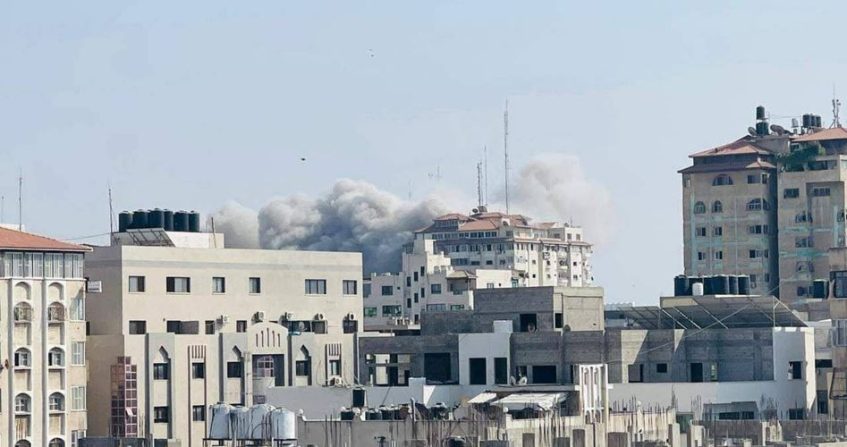
Palestine Information Center – August 5, 2022
GAZA – At least eight people were killed – including an Islamic Jihad commander and a five-year-old child – and 44 were wounded in a series of Israeli aerial strikes on various areas of the Gaza Strip on Friday evening.
The Palestinian health ministry in Gaza said at least eight people were killed, including the Islamic Jihad commander Taysir al-Jabari and a five-year-old girl.
At least 44 people were wounded and are being treated at hospitals as a result of the Israeli raids, the ministry added.
Jabari, a commander of the Al-Quds Brigades, the armed wing of the Islamic Jihad, was killed in an air strike on an apartment in the Palestine Tower in the center of Gaza City, the Islamic Jihad group said in a statement.
Multiple blasts were heard and seen throughout Gaza, while Israeli reconnaissance drones were heard hovering over the besieged territory.
The Israeli attack follows days of tension after the arrest of a senior Jihad leader in the occupied West Bank.
“The IDF is currently striking in the Gaza Strip. A special situation has been declared on the Israeli home front,” the Israeli military said in a statement. It said further details would follow.
Israel has been imposing tight restrictions on the Gaza Strip for the fourth consecutive day, deepening the humanitarian crisis in the besieged enclave.
Earlier on Wednesday, Israeli prime minister Yair Lapid held a security consultation with Israeli officials to discuss the security situation in the south, Lapid’s office said.
Israel demands disbanding of UN committee investigating attacks on Gaza
MEMO | August 1, 2022
Israel demanded on Sunday the disbanding of the UN committee investigating crimes committed during the occupation state’s military offensive against Gaza in May last year. It is alleged that remarks made by one member of the committee were “anti-Semitic”.
Israeli Prime Minister Yair Lapid made the demand in a letter to UN Secretary-General Antonio Guterres, in which he referred to the statements by Miloon Kothari, a member of the UN Human Rights Council’s Commission of Inquiry, in a media interview.
“We are very disheartened by the social media that is controlled largely by, whether it is the Jewish lobby or specific NGOs,” Kothari said on a Mondoweiss podcast on 25 July. “A lot of money is being thrown into trying to discredit us.”
Israel boycotted the investigation and prevented the commission’s investigators from entering the apartheid state. It claimed that the commission’s partial findings in June were “the latest in a series of biased reports.”
In his letter to Guterres, Lapid claimed that, “The fight against anti-Semitism cannot be waged with words alone, it requires action. This is the time for action; it is time to disband the Commission. This Commission does not just endorse antisemitism — it fuels it.”
The UN spokesman did not respond immediately to requests for comment, but Mondoweiss published a message from the committee’s chair, Navi Pillay, in which she said that Kothari’s comments were intentionally taken out of context.
The US and other Western countries, including Germany, Britain and Austria, denounced — very predictably — Kothari’s comments as “anti-Semitic”.
The US representative to the UN Human Rights Council, Ambassador Michele Taylor, tweeted, “We are outraged by recent anti-Semitic, anti-Israel comments made by a member of the Israel COI. These unacceptable remarks sadly exacerbate our deep concerns about the open-ended nature & overly broad scope of the COI and the HRC’s disproportionate & biased treatment of Israel.”
Although the commission was set up to investigate the Israeli attack on Gaza, which lasted 11 days in May last year, its mandate includes human rights violations before and after that, in addition to investigating the root causes of the tension.
At least 250 Palestinians as well as 13 people in Israel were killed during the Israeli aggression, which saw severe Israeli attacks and raids that exacerbated the destruction caused by the 2014 military offensive. Palestinian factions in the Gaza Strip fired several thousand rockets in response to Israel’s ongoing brutal military occupation and siege.
UK schools push Ukraine propaganda, gag Palestine solidarity
By Robert Carter | Press TV | July 30, 2022
London – A new study has revealed a shocking disparity by British schools which have gone to great lengths to promote Ukraine solidarity among their students, in stark contrast to how Palestinian solidarity is suppressed in the classroom.
Human rights group CAGE carried out the survey, which received 532 responses from parents, students and teachers. The group said the survey revealed a ‘cavalier attitude to due diligence’, including collaboration with organizations with far-right links and the soft penetration of security think tanks and those linked to the UK’s so-called prevent counter-extremism program.
Some of the survey’s findings include 96% of respondents confirmed proactive engagement on the Ukraine issue by their school, including holding non-uniform days, activities or donation appeals. 62% indicated their schools had fundraised or hosted donation drives for Ukraine.
While 17% also mentioned schools promoted the Ukraine flag, such as encouraging children to wear blue and yellow for non-uniform days, or hoisting the Ukrainian flag on school grounds. And perhaps most shockingly, alleged funding from some schools was intended to provide military gear for the war.
In 2021, Israel’s bombing of Gaza drew huge international backlash as millions took to the streets worldwide.
British students also joined the outpouring of support for Palestine. However, British schools responded negatively. With students being punished for waving a Palestinian flag or branded “racist” for expressing solidarity.
In early July, London’s High Court dismissed a legal challenge by CAGE against the Department for Education for issuing “discriminatory” guidance that led to the censure of dozens of schoolchildren showing support for Palestine during the Israeli bombing last year. The whole saga appears to have proven beyond reasonable doubt that the UK is indeed biased when it takes a stand on Human Rights.
US judge throws out malicious anti-Semitism claim against university professor
MEMO | July 29, 2022
In a victory for the Boycott, Divestment and Sanctions (BDS) campaign against Israel, a US judge has thrown out bogus anti-Semitism claims against a professor at Pittsburgh university in a lawsuit based on the highly controversial International Holocaust Remembrance Alliance (IHRA) definition of anti-Jewish racism.
Pro-Israel groups have been advocating IHRA’s adoption for several years saying that the non-binding definition will not stifle free speech on Israel. Critics, however, have consistently warned that not only will the IHRA have a chilling effect on free speech, but it will also give ammunition to radicalised Zionist groups to pursue malicious lawsuits against critics of the Apartheid State.
Robert Ross, who teaches literary arts and social justice studies at Point Park University appears to have been the victim of such spurious and malicious lawsuits which are designed to intimidate critics of Israel as much as to instil fear in anyone advocating for Palestinian rights.
The lawsuit against Ross was filed in 2019 by Channa Newman, a professor at the university. Newman claimed that she was a target of anti-Semitism due to her Zionist beliefs. According to the Electronic Intifada, Newman’s lawsuit alleged Ross used his position to foster “a militant version” of the BDS movement and “hateful views against Israel” that “are anti-Semitic.”
Newman, who made her case using the US State Department’s definition of anti-Semitism which has very similar wording to the IHRA, further alleged that the political views of Ross, and those of his students, led to a hostile work environment for her. As is the case with the IHRA, the State Department definition includes claims that it is anti-Semitic to say Israel’s foundation was a “racist endeavour” or to apply “double standards” to Israel by requiring from it “behavior not expected or demanded of any other democratic nation.”
In his ruling, the judge asserted that if the court accepted Newman’s allegations, it would “invalidate” on its face and on civil rights grounds “an entire academic and public debate” and that it would give Newman “a veto over others engaging in that same debate.” The judge further added that Newman was effectively seeking to “compel” the speech and views of others to be consistent with hers.
“I am relieved and thrilled,” Ross told the Electronic Intifada. “The judge took the time to articulate why he’s not granting this work environment claim and that there’s nothing inherently hostile with [advocating for] BDS. In these times, we’ll take what we can get. I think it’s a victory,” he explained.
“The judge, to me, made it clear that there’s nothing legally wrong with teaching BDS, participating in BDS, or advocating for it,” Ross added. The dismissal of the hostile work environment claims, Ross added, “should be empowering, it should be a green light for other folks to engage in this movement.”
Time for Palestine to claim its stolen gas
Hezbollah threatened Israel with war if Lebanon is not allowed to exploit its share in the Karish gas field. Palestinian resistance may do the same over the “stolen gas” off Gaza.
By Yousef Fares | The Cradle | July 22 2022
The maritime border dispute between Lebanon and Israel over the Karish gas field is reminiscent of the stolen gas fields in Palestine’s Gaza Strip. With the naked eye, Gazans can only stand by and watch the Occupation’s gas drilling platforms a few kilometers off their own coast.
This situation could change though, and may depend on the way in which the resistance in Lebanon handles the conflict over Karish.
That scenario may encourage the Palestinian resistance to follow their northern neighbor’s example in threatening to target Israeli platforms if Palestinians are denied their rights to the “Gaza Marine” field.
So long as Palestinians are deprived of basic living condition rights (electricity, fuel, food and medicine shortages) by their Israeli occupiers, they would be foolhardy to ignore the game-changing potential of gas extraction off their own coastline.
However, Lebanon’s current dispute is not the only issue that has led to the Palestinian claim resurfacing. Indeed, there are other factors related to the energy crisis, and it involves the Europeans.
Not Israel’s gas to export
On 15 June, it was announced in Cairo that a memorandum of understanding (MoU) had been signed to export Israeli (stolen Palestinian) gas to the European Union (EU) through Egypt.
The MoU, which Israel and the EU described as a “historic agreement,” extends over three years and is automatically renewable for two further years. It includes transporting gas from Israel to liquefaction stations in Egypt (Idku and Damietta in the north), then shipping it to Europe, which imported 155 billion cubic meters (bcm) of gas from Russia last year.
In light of the EU’s faltering standoff with Moscow over Ukraine, Europe is seeking – among other sources – “Israeli gas” to compensate for about 10 percent of this amount, while Israel for its part is eager to increase its production of natural gas to 40 bcm (billion cubic meters) annually.
Experts estimate that most of this quantity will come from Palestinian gas extracted from “Gaza Marine 1” which is adjacent to the Strip, and “Marine 2” which is located within the maritime border area between Gaza and Israel.

Not the PA’s right
Understandably, news of the MoU angered the Palestinian resistance, especially since the Palestinian Authority (PA) in Ramallah did not take any practical steps to demand Palestinian rights in this matter.
Informed, anonymous sources have told The Cradle that the EU has bought the silence of the PA by giving it a 4 percent share of the value of the extracted gas, while most of the agreements signed between Ramallah and the extraction companies, in the past two decades, stipulated a ratio ranging from 10 percent to 27.5 percent.
There are also accusations that the PA will only collect some taxes on monthly production, in addition to accelerating EU aid to the Palestinians.
On 12 June, the European Commission approved a new aid package for the Palestinians worth 224.8 million euros, as a ‘bribe’ for the PA, with a verbal pledge to support Palestinian rights and confront Israeli policies that undermine the two-state solution, particularly in Jerusalem.
The EU also pledged to press for the allocation of part of the extracted gas for Palestinians at preferential prices in order to operate the power plants in Gaza and Jenin.
In return for these gestures, the PA committed to the charter of the “Eastern Mediterranean Gas Countries,” and will not object to any steps in the region’s energy file, specifically with regard to the start of exploration and extraction of natural gas from the Gaza Marine field and the Rantis field west of Ramallah. The PA further agreed not to raise the issue of Palestinian rights to energy in the areas under its “control.”
In this context, Israel tried to indirectly buy the restraint of the resistance in the Gaza Strip by increasing work permits for Palestinians in the occupied territories to 20,000.
Gaza’s gas
Located in Palestinian territorial waters 36 km west of the Strip in the eastern Mediterranean Sea, the Gaza Marine gas field was first discovered around 1999 by British Gas who were contracted to develop it.
Despite its discovery, gas has not been extracted from the area despite the PA’s conclusion of several agreements with foreign companies, which were aborted because Israel refused to allow the operations to proceed.
Significantly, the Gaza Marine includes approximately 8 adjacent fields and is estimated to contain 12 trillion cubic meters of gas, at an attractive depth that makes the cost of extraction low.
Pirates of the Mediterranean
Israel controls the gas fields in Palestinian waters in the north of the Gaza Strip and in the eastern Mediterranean, including the so-called Yam Tethys fields, which were proven to be Palestinian property according to maps submitted by the state of Palestine to the United Nations.
In 2019, an investigation conducted by Al-Jazeera showed that Israel drained the “Mari B” gas field in the Gaza Sea (it contained enough gas for the Strip for 15 years). An investigation by Middle East Eye concluded that the Palestinians could claim 6,600 square kilometers of marine area, five times the area they now own.
Lebanon and the Gaza Strip face similar economic difficulties brought about through different foreign tools of economic besiegement. In the case of Gaza, the blockade is direct, as Israel controls the factors impacting their standard of living and welfare. As for Lebanon, it faces US sanctions and diktats that have contributed to the country’s economic meltdown.
The way in which Lebanon’s resistance movement Hezbollah manages the Karish field file will be interesting as it is likely to influence how the Palestinian resistance choose to go about protecting and reclaiming their rights.
With gas revenues estimated at $4.5 billion annually, Ramallah’s budget – which in 2021 was set at $5.6 billion, of which $3.9 billion was provided by internal revenues – could achieve self-sufficiency. Additionally, these resources could provide a radical solution to the fuel and electricity crises in the Strip.
A meeting of minds in Beirut
Informed sources have told The Cradle they have credible reason to believe the Palestinian resistance factions will take advantage of the battle that Hezbollah Secretary General Hassan Nasrallah has threatened to ignite if Israel continues to ignore Lebanon’s right to its gas fields. Nasrallah has set a deadline – the start of September – for this access to be provided.
The sources also say that Hamas’ Political Bureau Chief Ismail Haniyeh discussed the gas file with Nasrallah during their meeting in Beirut on 23 June, and suggested that the resistance in Gaza would likely participate in any future war, especially in the face of Israel’s continued theft and deprivation of natural resources.
Haniyeh spoke of “Lebanon’s right to extract gas from its maritime borders, and to stop Israeli piracy.”
However, there are calculations which must be taken into account before the Palestinian resistance gets involved in any war. This is related to the scale of the hypothetical war and the Israeli reaction to it, as well as to the logistical capabilities of the resistance at the naval level.
Yet it is the Palestinian silence on both the official and resistance level which has angered Lebanese authorities. The Director General of Lebanon’s General Security, Major General Abbas Ibrahim, demanded that Palestinians take a coherent political stance towards what “Lebanon is negotiating regarding the gas that is in the Palestinian waters occupied by Israel.”
A military response
However, well-informed sources in the Palestinian resistance tell The Cradle that their factions have now placed the military option relating to Gaza Marine on the table, triggered by the signing of the tripartite gas agreement (between Egypt, Israel and the EU) in June.
Political analyst Ismail Muhammad believes that the Haniyeh-Nasrallah meeting resulted in a preliminary agreement, which could be implemented at the military level if necessary.
Speaking to The Cradle, Muhammad explained that “the resistance cannot miss such regional circumstances to remind of its right to Palestinian gas which has been stolen before its eyes. Just as Lebanon’s economic future depends on the extraction and sale of gas, Palestine in general, and Gaza in particular, needs such income to end the economic dependence on occupation and to liberate its political decision-making.”
Muhammad refers to the expected strategic results of any victory in the battle over the Karish and Gaza Marine fields, not just the potential economic outcomes. Extracting the right to one’s energy resources, whether by military force or by an agreement, effectively ends the Israeli-US economic blockade in both Gaza and Lebanon.
This presents “a victory for the resistance, which increases its political influence and reduces the influence of external dictates,” he added.
“This is a major battle. Winning it against the Israeli-American-Arab alliance will change the future of the region.”
Expected scenarios
There is near unanimity that there is as much a chance of a gradual military escalation as there is of reaching a fair solution to the Karish field dilemma. There are three scenarios for the role of the Palestinian resistance in the event that Hezbollah is forced to resort to force:
First, that Hezbollah initiate a gradual escalation using a qualitative weapon to strike the British/Greek drilling ship in Karish. This will deprive all parties of benefiting from the field, and return the gas file to square one.
On the other hand, Israel absorbs the blow and responds in a limited manner that does not lead to an all-out war. In this case, it is expected that the resistance in Gaza will maintain its readiness without providing guarantees of non-interference, which means that Israel will have to occupy thousands of its soldiers, along with a few squadrons of its aircraft and at least a tank battalion, to contain any reaction in Gaza.
Second, that Israel ignore Nasrallah’s threats to strike the gas platforms in “Karish and beyond Karish,” which effectively means to paralyze the entire Israeli energy sector by expanding the range of targets to include the fields of Athens, Tanin, Dolphin, Leviathan, Dalit and Aphrodite.
These fields represent the cornerstone of the energy sector, on which Israel relies to secure its gas and oil needs and provide it with financial revenues. The fields located off the shores of occupied Ashkelon and Gaza, such as Kirin, Nawa and Marin Bay – about 190 km from Gaza – also fall within the scope of Nasrallah’s “beyond Karish” equation.
Sources in the Palestinian resistance who spoke to The Cradle suggest that this scenario means a comprehensive regional war. In this case, their decision would be to “directly participate” in such a war. Although their logistical capabilities do not allow for “accurate point” hits to the gas rigs, the fire intensity provided by the suicide drones and missiles will put these fields out of action.
One source points to the Palestinian resistance’s success in targeting the Tamar natural gas field off the shores of Ashkelon and the Eilat-Ashkelon gas pipeline, which was hit by about twenty missiles, during Operation Sayf Al-Quds (Sword of Jerusalem) in May 2021.
“Israel will not be able to launch a large-scale operation against the Strip. It will not venture into an irregular war on two fronts at the same time, especially since the priority is for the Lebanese front, where there is a huge stockpile of weapons and advanced capabilities. Most probably, it will be satisfied with conventional air strikes against civilian and military targets in Gaza,” he says.
Third, the resistance also takes into account the scenario of a comprehensive war in which all the components of the Resistance Axis can participate; in Lebanon, Syria, Iraq and Yemen.
In such a conflict, the Palestinian resistance will spare no effort in igniting all the fronts, in Gaza, the West Bank and Jerusalem, and even in the 1948 occupied territories, as it will be an opportunity to change the “map of the region” and hit a “historic blow to the entire Zionist project,” even though the current international circumstances make such scenario unlikely to happen.
Palestinian pragmatism
It is evident that the resistance in Gaza views the gas crisis between Lebanon and Israel as an opportunity that must be exploited to demand legitimate Palestinian rights. The continuation of difficult living conditions in the Gaza Strip in particular, hostage to conditional Israeli facilities, is something worth sacrificing to change.
Therefore, Gaza’s participation in a war between Lebanon’s Hezbollah and Israel stems from the existence of a common interest, and not just a mutual foe.
Washington is the problem, not the solution, so why is Abbas seeking new ‘powerful’ sponsors?
By Ramzy Baroud | MEMO | July 25, 2022
To describe US President Joe Biden’s recent visit to Israel and Palestine as a “failure” in terms of activating the dormant “peace process” is to use a misnomer. For this statement to be accurate, Washington would have had to indicate that it had even a nominal desire to push for negotiations between the Israeli government and the Palestinian leadership.
Political and diplomatic platitudes aside, the current US administration has done the exact opposite, as indicated by Biden’s words and actions. Alleging that the US commitment to a two-state solution “has not changed”, Biden dismissed his administration’s interest in trying to achieve such a goal by declaring that the “ground is not ripe” for negotiations.
Given that the Palestinian Authority led by Mahmoud Abbas has repeatedly announced its readiness to return to negotiations, one can only assume that the process is being stalled due to Israel’s intransigence. Indeed, none of Israel’s top leaders or major parties champion negotiations — the so-called peace process — as a strategic objective.
However, Israel is not the only one to blame. The Americans have also made it clear that they have moved on from that political sham altogether, one which they invented and then sustained for decades. In fact, the final nail in the “negotiated solution” coffin was hammered in by the Donald Trump administration, which has simply backed every Israeli claim and shunned all legitimate Palestinian demands.
The Biden administration has been blamed habitually by Palestinians, Arabs and progressive voices within the Democratic Party for failing to reverse Trump’s prejudiced moves in favour of Israel: moving the US Embassy from Tel Aviv to Jerusalem, for example; shutting down the US Consulate in East Jerusalem; and accepting the unfounded Israeli claims regarding its jurisdiction over illegal Jewish settlements built on occupied Palestinian land. The list goes on.
Even if one assumes that the Biden administration is capable of reversing some or all of Trump’s unlawful actions, what good would that be in the greater scheme of things? Washington was, and remains, Israel’s greatest benefactor, funding its military occupation of Palestine with an annual gift of $4 billion, in addition to many other schemes, including a massive and growing budget allocated just for Israel’s Iron Dome missile defence system.
As horrific as Trump’s years were in terms of undermining a just resolution to the Israeli occupation of Palestine, Biden’s policies are but a continuation of an existing pro-Israel American legacy that surpasses that of Trump by decades.
For Israel, the “peace process” has served its purpose, which explains the infamous declaration by the CEO of the Jewish settlement council, Yesha, in the occupied West Bank in 2018: “I don’t want to brag that we’ve won… Others would say it appears that we’re winning.”
However, Israel’s supposed “victory” following three decades of a fraudulent “peace process” cannot be credited to Trump alone. Biden and other top US officials have also been quite useful. While it is understood widely that US politicians support Israel out of self-interest — they need, for example, to appease the influential pro-Israel lobby in Washington — Biden’s support for Israel has an ideological foundation. The US president was less than bashful when he repeated his famous statement at Israel’s Ben Gurion airport on 13 July: “You need not be a Jew to be Zionist.”
Consequently, it may appear puzzling to hear Palestinian officials call on the US — and Biden specifically — to put pressure on Tel Aviv to end its 55-year occupation of East Jerusalem, the West Bank and Gaza Strip.
Mohannad Al-Aklouk, the Palestinian representative at the Arab League, is just one who has repeated the same clichéd and unrealistic language of expecting the US to “exert practical pressure on Israel”, “set the stage for a fair political process based on international law”, and “meet its role as a fair sponsor of the peace process”. Strangely, Al-Aklouk truly believes that Washington, with its dismal track record of pro-Israel bias, can be the saviour of the Palestinians.
Another Palestinian official told the New Arab that PA President Abbas was “disappointed with the results of Biden’s visit” as, apparently, the Palestinian leader “expected that the US president would make progress in the peace process.” The same source added that Abbas’s authority is holding meetings with representatives from “powerful countries” to replace the US as sponsors of the negotiations.
Abbas’s political stance is confusing. The “peace process” is, after all, an American invention. It was a unique, self-serving style of diplomacy that was formulated to ensure Israel’s priorities remain centre stage of US foreign policy in the Middle East. In the Palestinian case, the “peace process” served only to entrench Israel’s colonisation of Palestine, while degrading, or completely sidelining, legitimate Palestinian demands. This “process” was also constructed with the aim of marginalising international law as a political and legal frame of reference for the Israeli occupation of Palestine.
Instead of questioning the entire “peace process” apparatus and apologising for the strategic blunder of pursuing American mirages at the expense of Palestinian rights, the Palestinian Authority is still clutching desperately to the same old fantasy, even when the US and Israel have long abandoned the political farce that they created.
Even if China, Russia or India, for example, would agree to be the new sponsors of the “peace process”, there is no reason for Tel Aviv to engage in future negotiations when it is able to achieve its colonial objectives with full support from the US. Moreover, none of these countries have, for now, much leverage over Israel, and so are unable to sustain any kind of meaningful pressure on Tel Aviv to respect international law.
Yet, the PA is still holding on, simply because the “peace process” has proved to be greatly beneficial in terms of funds, power and prestige enjoyed by a small but powerful class of Palestinians that was formulated largely after the Oslo Accords in 1993.
It is time for Palestinians to stop investing their political capital in the Biden or any other administration. What they need is not a new “powerful” sponsor of the “peace process”, but a grassroots-based struggle for freedom and liberation starting at home, one that galvanises the energies of the Palestinian people themselves. Alas, this new paradigm cannot be achieved when the priorities of the Palestinian leadership remain fixated on the financial handouts and political validation of Washington and its Western allies.
Israeli Soldiers Kill Two Palestinians, Injure Nineteen, In Nablus
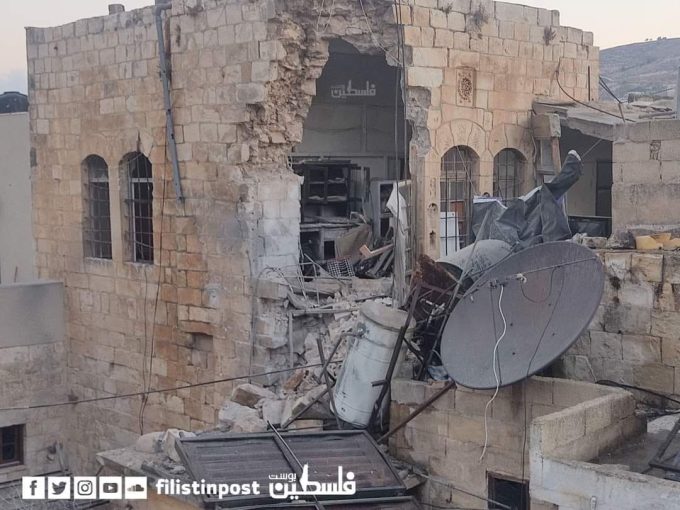
IMEMC | JULY 24, 2022
Israeli soldiers killed two Palestinians and injured nineteen, including one who suffered a serious gunshot wound to the head, in the Old City of Nablus, in the northern part of the occupied West Bank on Sunday at dawn.
The Palestinian Red Crescent Society (PRCS) has confirmed that the soldiers killed Abboud Sobeh, 29, and Mohammad al-Azizi, 22, in the al-Yasmina neighborhood in Nablus’s Old City.
The PRCS added that the soldiers shot nineteen other Palestinians, including ten who were shot with live fire, among them one who was shot in the head and is in critical condition.
The incidents took place after undercover Israeli soldiers infiltrated Nablus before many armored military vehicles invaded it from several directions, resulting in exchanges of fire between the invading soldiers and Palestinian resistance fighters.
The soldiers surrounded a home where several Palestinian resistance fighters were located and exchanged fire with them for several hours before the army fired a few missiles at the property, killing the two young men, while the five others managed to escape unharmed.
The missiles caused excessive damage to the home and several surrounding homes, buildings, and mangled cars parked on the sides of the street.
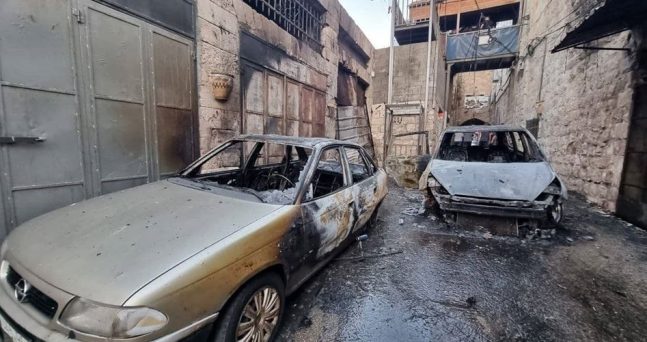
The soldiers withdrew from Nablus a few hours after killing the two Palestinians and wounding twelve, leaving massive destruction to homes and buildings.
Nablus Abu Rudeina, the spokesperson of the Palestinian President, denounced the invasion, the killing of the two Palestinians, and the injuring of the twelve and said that Israel is only interested in escalation and more violence.
‘Disloyal’ Palestinians can be stripped of citizenship and made stateless, rules Israel Supreme Court
MEMO | July 22, 2022
Palestinians can be stripped of their citizenship and made stateless; the Israeli Supreme Court ruled yesterday in a judgement that further reinforces the apartheid status of the occupation state.
Israeli citizens that are found to be in “breach of loyalty” can have their citizenship revoked, but rights groups insist that the policy will only be applied to non-Jews even if it makes them stateless.
Many countries have laws that allow revocation of citizenship, a trend that has grown over the past two decades following the start of the so called “war on terror.” Though such a policy is highly controversial because it is primarily directed at non-white populations, no government has exercised such draconian powers if it makes individuals stateless.
Under international law no government is allowed to strip citizens of their citizenship if it leads to statelessness.
Yesterday’s ruling addressed a 2008 Citizenship Law in Israel that gives the state authority the ability to revoke citizenship based on actions that constitute a “breach of loyalty”. It came following separate appeals in the cases of two Palestinian citizens of Israel who were convicted of carrying out attacks that killed Israeli citizens. The two were handed long sentences but the state sought to strip them of citizenship.
The Supreme Court denied the removal of citizenship in these two cases based on what has been described as “serious procedural flaws” but ruled that the practice itself was constitutional, even if a person became stateless as a result.
A joint statement in response to the ruling by the Association for Civil Rights in Israel (ACRI) and Adalah, an Arab rights group, reported in Reuters, called the law discriminatory and said it “will likely be used exclusively against Palestinian citizens of Israel”. Some 20 per cent of Israeli citizens are Palestinians. Nearly all are descendants of Israel’s ethnic cleansing in 1947/48 which drove the indigenous non-Jewish population out.
“There are many cases of Jews in Israel who took part in terror and not even once has the interior ministry thought to appeal to revoke their citizenship,” the ACRI’s Oded Feller told Reuters. “The only cases that were submitted to the court were of Arab citizens.”
Featured Video
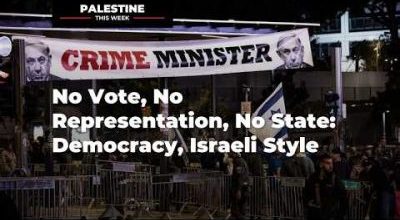
No Vote, No Representation, No State: Democracy, Israeli Style
or go to
Aletho News Archives – Video-Images
From the Archives
Sanctions, War and the Policy of Dual Containment
By SASAN FAYAZMANESH | March 17, 2008
It is now nearly three decades since the Unites States adopted the policy of dual containment of Iran and Iraq. While much has been written about the containment of Iraq, there has been very little in-depth analysis of this policy when it comes to Iran. In a book that is going to be released on March 31, 2008, entitled The United States and Iran: Sanctions, Wars and the Policy of Dual Containment (Routledge), I attempt to address this shortcoming by investigating when and why the US policy of containment of Iran came about, how it evolved, and where it stands today.[1] To the extent that Israel has been involved in US policy making, the study will also include the role that Israel has played in the containment of Iran. Also, since the fate of Iran has been inextricably linked to that of Iraq, occasionally the investigation will overlap with the containment of Iraq.
The policy of dual containment of Iran and Iraq originated during the Carter Administration, but it was not until the Clinton Administration that the expression “dual containment” became popular. … continue
Blog Roll
 Aletho News
- Elmo Sold mRNA Jabs to Your Toddler. Now They Are “Off-Label.”
- British state targets Palestine Action with yet another crooked trial
- Americans are paying the price to preserve Israel’s nuclear hegemony
- Resistance factions are necessary to ensure a permanent US Iraq withdrawal
- How Israel destabilizes the Middle East: Denying sovereignty and the right to exist
- Europe’s Establishment Is Embracing War – and Losing Voters
- NATO chief advocates war of aggression
- No Vote, No Representation, No State: Democracy, Israeli Style
- Zionist Bought Senate Blocks Information About American Citizens Killed By Israel
- While Gaza dominates the UN, these are the people keeping it alive
- If Americans Knew
- Israeli Soldiers Abduct At Least 22 Across Occupied West Bank
- Eight Palestinians Killed in Israeli Attacks on Gaza
- Israeli former leaders and security chiefs threaten legal action over ‘Jewish terrorism’
- Israel map in LA Times ad includes all land from the river to the sea
- Inside Lebanon’s 200-page dossier on Israeli war crimes
- Flydubai, genocide, settler violence, Trump abuse of power to deport – Daily Update
- Counting Antisemitic Incidents: What the ADL Audit Reveals — and Obscures
- Mamdani releases plan to combat antisemitism and hate crimes in New York City
- Iran’s Revolutionary Guards Publish Letter to the American People
- DMFI launches $1 million ad campaign supporting Virginia’s Elaine Luria
- No Tricks Zone
- Green Energy Debacle: German Expert Professor Fritz Vahrenholt Warns Of Severe Economic And Social Consequences
- Two More Paleo Reconstructions Affirm Meters-Higher Sea Levels Across Ireland, Brazil 7000-6000 Years Ago
- New Study: Earth And Venus Surface Warmth Largely Explained By Convection And Lapse Rate, Not CO2 Or Radiation
- 2025 Nature Paper Claiming Worsening Global Drought Gets RETRACTED …Heavily Flawed
- New Study: ‘Global Drought Shows No Detectable Recent Acceleration Under Climate Warming’
- Economic Masterminds: German Socialists Suggest Taxing Productivity Gains Stemming From Using AI
- The South China Sea Has Not Been Cooperating With The Climate Change Narrative
- Energy Crisis: Germany Enters Heating Season With Historically Low Gas Reserve Fill Levels
- New Study: The Antarctic Ice Sheet Gained Mass From 2020-2024 Due To Staggering Snow And Ice Accumulation
- Study: Ocean Heating Rates From Thousands Of Years Ago ‘Dwarf’ Modern Ocean Heating Rates

