How the Third Temple Movement in Israel Rebranded Theocracy as “Civil Rights”
By Whitney Webb | MintPress News | July 3, 2019
JERUSALEM — In a troubling trend that continues to be overlooked by international media, the Temple Activist movement that seeks to destroy the Al-Aqsa mosque and the Dome of the Rock in Jerusalem and replace it with a Third Temple continues to advance its agenda. The movement’s forward progress is largely thanks to its successful efforts in recent years to rebrand as a “civil rights” movement — securing support from secular and religious Zionists alike — as well as to growing levels of support in Israel’s executive and legislative branches of government.
As was detailed in Part I of this series, the Temple Activist movement is now more mainstream than ever before and its effort to destroy the Al-Aqsa mosque compound, the third holiest site in Islam, has advanced with great rapidity since the year began and has picked up precipitously in recent weeks. Yet this new face of the Temple Activist movement — one that claims that its quest is to wrest control of the holy site from Jordanian and Palestinian custody in the name of “equal rights” for Israeli Jews — obfuscates the troubling origins of this once-fringe yet now normalized campaign.
Beginning in earnest after the Six Day War in 1967, the Temple Activist movement within Israel was largely formed by two groups of people: 1) a small, then-fringe group of messianic religious Zionists led by Rabbi Shlomo Goren that supported the complete annexation of Palestine, particularly Jerusalem with the Al-Aqsa mosque; and 2) former members of the secular Zionist paramilitary groups Irgun and Lehi, known for their penchant for massacring Palestinian civilians for political gain, who either became religious messianists following Israel’s 1967 victory or remained secular and felt that salvation for Israeli Jews necessitated the miltiary conquest of Palestine and the destruction of its mosques and churches — particularly the site of Al-Aqsa mosque, often referred to as either the Temple Mount or Haram El-Sharif (Arabic for “the Noble Sanctuary”).
The modern “friendly” face of the Temple Activist movement — embodied by figures like Yehuda Glick, former executive director of the Temple Institute and a member of Israel’s Knesset — hides the extremist and largely secular origins of this quasi-religious movement that — as Rabbi Yisroel Dovid Weiss of Neturei Karta, an international organization of ultra-Orthodox Jews opposed to Zionism, told MintPress in Part I — is ultimately colonial (i.e., Zionist) in nature and uses religious imagery and appeals “to excuse their occupation and to try to portray this [the occupation of Palestine] as a religious conflict.”
As this installment of this multi-part series on the current threats facing the historic Al-Aqsa Mosque compound will show, the Temple Activist movement’s extremist origins and increasing normalization in Israeli society parallels the rise of Israel’s political far-right, particularly of the Likud Party — whose roots, much like those of the Temple Activist movment, trace back to secular Zionist paramilitaries like Irgun.
Miko Peled, Israeli author and human-rights activist, described this trend to MintPress as “the resurgence of the ‘good old days’ when young zealots were the forefront of the Zionist project.” Peled pointed out that these zealots set up the foundations for actions that are later pursued and consolidated by the Israeli state, such as in the context of the settler movement where, as Peled noted:
The [Israeli political] establishment comes in and takes over and turns an ‘outpost’ [established by a small group of extremists] into a settlement and then a city. The Haram El-Sharif or Temple Mount compound will be the same. These zealots, young and old are the cutting edge of Zionist ideologues and they do the ‘dirty work.’ Now they do not seem so radical any more and soon the state will come in full force.”
For that reason, and as this report will show, there is a significant degree of overlap between the dominant parties of Israeli politics today and the Temple Activist movement, with a majority of current Israeli government ministers, including Prime Minister Benjamin Netanyahu himself, and a large and influential lobby of lawmakers in Israel’s Knesset openly supporting the Israeli government takeover of Al-Aqsa mosque and its destruction and replacement with a Third Temple. Subsequent installments of this series will show how such an outcome is a grave threat to peace — not just in Israel/Palestine, but the entire Middle East — and a major yet widely overlooked motivation behind the foreign policy objectives of not only Israel’s current government but the Trump administration.
Shlomo Goren: The man who lit the match
The Israeli military’s conquest of the Old City of Jerusalem in 1967 was seen by some of its soldiers as a sign from the divine that end-times prophecies were being fulfilled. Among those who were the first to arrive at the newly conquered historic district of Jerusalem were three men who — in distinct ways — would go on to lead a movement aimed at remaking this area of Jerusalem in the image of their specific, and then-fringe, interpretation of Biblical prophecy. They were Shlomo Goren, then-Rabbi of the IDF and later Chief Ashkenazi Rabbi of Israel; Geroshon Salomon, then-soldier and later founder of the Temple Mount Faithful; and Yisrael Ariel, Rabbi and founder of the Temple Institute.

Goren, center, carries a Torah and submachine gun during a 1956 Israeli assault on Gaza. Photo | AP
Shlomo Goren, euphoric after the Israeli military’s takeover of the Temple Mount, led the celebration, where both Ariel and Salomon were present. Per Ariel’s recollection, Goren’s words about the prophetic significance of the Israeli takeover of the Temple Mount gave meaning to the occasion and would go on to inspire Ariel, as well as Salomon, to found organizations devoted to Goren’s vision of a Third Temple in the place of Al-Aqsa mosque, which currently sits on the Temple Mount of Haram El-Sharif.
Soon after the celebratory mood had faded that fateful day in 1967, Goren — according to several accounts — pushed the IDF’s Chief of Central Command Uzi Narkiss to seize the opportunity to bring down the historic mosque with explosives, something Goren felt was best done under the cover of war. Narkiss’ rejection of Goren’s plea would subsequently be remembered bitterly by Goren and his allies, Ariel and Salomon among them, as a missed opportunity and, for some, an act of “treason.” Such bitter feelings were reserved, not just for Narkiss or then-Defense Minister Moshe Dayan, both secular Zionists, but also for the State’s rabbinical authorities who, following the 1967 capture and subsequent occupation of Jerusalem, maintained the centuries-old opinion that it was against Jewish religious law for Jews to ascend the Temple Mount.
While the 1967 war did not result in the destruction of the Al-Aqsa mosque or the Dome of the Rock as Goren and others had hoped, Goren dedicated much of his future career to advancing what is now often referred to as the Temple Activist movement, which aims to replace the Al-Aqsa mosque compound with a Third Temple. Goren specifically believed that the Third Temple must be built before the Messiah could be revealed, as opposed to after he is revealed, and that the conquest of the site in the 1967 war meant that the time had come to build a new temple where Al-Aqsa sits.
It is worth pointing out that Goren’s beliefs were, and remain, at odds with the rabbinical authorities both within Israel and abroad. As Motti Inbari, scholar of Jewish fundamentalism and messianism and associate professor of religion at UNC Pembroke, wrote for The Times of Israel in 2015:
According to halakha (Jewish religious law), anyone who enters the mount will be punished by karet — death sentence carried out by God. This decision has been reinforced in innumerable rulings. One was handed down by the chief rabbinate after the capture of the Mount during the Six-Day War in 1967… And this custom is followed by the vast majority of ultra-Orthodox rabbis.”
Goren’s rise to further prominence was meteoric after the 1967 war, and he became Chief Ashkenazi Rabbi of Israel, Israel’s most important state rabbinical position, just a year after retiring as the IDF’s first chief rabbi in 1972. Miko Peled, Israeli author and human rights activist, told MintPress that Goren’s role as chief Rabbi made him “a strong influence on the ‘Religious Zionist’ movement that sought to settle all of the ‘Land of Israel’” — meaning “Biblical Israel,” which includes all of occupied Palestine and large parts of territory of several neighboring countries.
Goren’s quick ascension to the most prominent position in Israel’s Rabbinate was dogged by accusations that he had cut a secret deal with the then-Prime Minister of Israel, Golda Meir, and that Goren had promised to assist Meir in finding solutions to pressing conflicts that had arisen between Israel’s actions as a state and Jewish law. As chief rabbi, Goren would adapt Jewish religious law to scientific advances and military conflicts, solving many of the problems that had concerned Meir in the early 1970s.
As chief rabbi of Israel, Goren later developed a close relationship with Menachim Begin — former leader of the Irgun paramilitary and terrorist group, and Israel’s prime minister from 1977 to 1983 — who was denounced as a fascist and a terrorist by numerous Jewish American intellectuals and public figures – including Albert Einstein. Goren became an important liaison between Begin and U.S. President Ronald Reagan at a time when Begin was actively courting the American evangelical right, specifically Christian Zionists. Begin and Goren had both long advocated for complete Israeli control over the Temple Mount and both shared a vision of a “Greater Israel,” where the state of Israel would expand through all of the occupied Palestinian territories and into several surrounding countries.
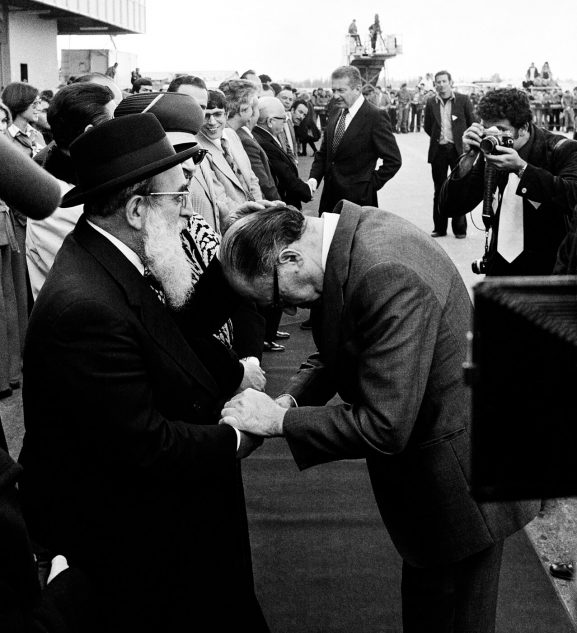
Begin, right, bows his head to receive a blessing from Shlomo Goren in 1977 at Ben-Gurion Airport. Max Nash | AP
In one example, Goren claimed that he had been sent by Begin to the White House to personally deliver Reagan a message regarding the withdrawal of Israel from the Sinai Peninsula and “to provide Reagan with a sense of the moral and spritual feeling in Israel,” which included warning against the formation of a Palestinian state, keeping Jerusalem “united,” and recognizing the city as exclusively Israeli.
As chief rabbi of Israel, Goren’s “activism” regarding the Temple Mount continued unabated and arguably grew with his growing political influence, both within Israel and abroad. Having led extremists in ascending the Temple Mount since the Old City’s conquest in 1967, Goren’s stature as chief rabbi allowed him to continue and expand his efforts to push for an increased presence of extremist religious Zionists on the Temple Mount. Following the 1967 war, Goren also created detailed maps of the Temple Mount with the intention of delineating where the Third Temple should be built and where he believed the long-lost treasures of the Ark of the Covenant were hidden beneath the Temple. Those maps are still used by Temple Activists today.
Yet Goren’s “activism” on behalf of a Third Temple was much more far-reaching during his time as chief rabbi. In 1981, Goren along with Rabbi of the Western Wall Yehuda Getz, began excavating a series of tunnels under the Temple Mount, without archaeological approval, in an alleged search for the Ark of the Covenant artifact. They believed that finding the Ark of the Covenant would signal that the time to build a Third Temple had arrived. One of the volunteers aiding Getz and Goren was Gersh Salomon, who had founded the Temple Mount Faithful a few years prior.
The tunnels — conducted without archeological supervision, as is required by Israeli law — were dug with the support of Israel’s Religious Affairs Ministry. There was also another government connection to the illegal project, owing to the intimate involvement of Rafi Eitan in the project. Eitan was an influential counterterrorism and security adviser to three Israeli prime ministers (Menachem Begin, Yitzhak Shamir and Shimon Peres), a former officer for the Mossad and Shin Bet, and a “personal and close family friend” of current Israeli Prime Minister Benjamin Netanyahu. He later gained notoriety for recruiting Jonathan Pollard, a former United States Navy intelligence analyst convicted of spying for Israel, and serving as his handler.
Goren, Getz and their group of volunteers managed to reach Warren’s Gate, an ancient subterranean passage leading to the Temple Mount. Accordig to Salomon, “We needed just two days more to come to the place where the Ark of the Covenant is located.” However, their ambitions were cut short when Palestinians guarding Al-Aqsa heard strange noises coming from below Al-Aqsa Mosque and quickly discovered the group’s excavations. A riot nearly broke out and Israeli authorities subsequently sealed the tunnel.
A few years later, in 1986, three years after leaving his position as chief rabbi, Goren, together with other prominent rabbis, issued a religious edict that called for the immediate construction of a Third Temple on the Temple Mount and for public Jewish prayers on the site, an act historically forbidden by Jewish law. Prior to the end of his life in 1994, Goren issued several other controversial religious edicts, such as one that ruled that IDF soldiers could disobey government orders in order to remove extremist settlers from the West Bank, and another stating that Jewish law compelled Jews to murder Palestinian leader Yasser Arafat.
The Temple Mount Faithful
Goren’s impact on the Temple Activist movement is unique, as his actions following the Israeli conquest of Jerusalem’s Old City were the spark that inspired the two other most notable forces in laying the ground for the Temple Activist movement of today: Gershon Salomon and Yisrael Ariel.
Salomon was one of the paratroopers who helped “liberate” the Temple Mount and the Western Wall in 1967 and he went on to found the Temple Mount Faithful soon after. Following the war, he “dedicated himself to the vision of consecrating the Temple Mount to the Name of G‑d, to removing the Muslim shrines placed there as a symbol of Muslim conquest, to the rebuilding of the Third Temple on the Temple Mount, and the godly redemption of the People and the Land of Israel,” according to the Temple Mount Faithful website. He worked directly with Goren for a number of years, and others who were greatly influenced by Goren, such as Ariel, later joined Salomon’s group.
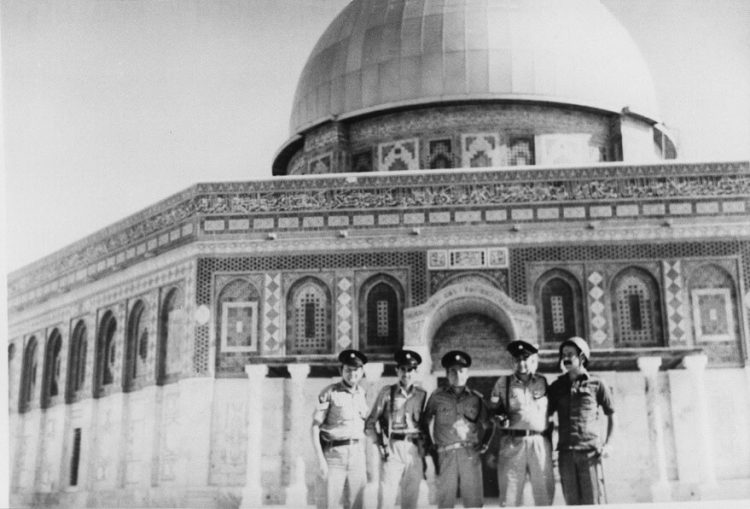
Gershon Salomon, right, poses in front of al-Aqsa Mosque in 1967.
Goren participated directly with the Temple Mount Faithful on some occasions, such as in hosting a “conference” in front of the Temple Mount where Goren, Salomon and other attendees called on Israel’s government “to purify the Temple Mount from its Arab and Islamic presence and desecration,” as it was later described by Salomon.
The group attracted members from the messianic fringes of religious Zionism, as well as more secular, fascist elements that were associated with the precursors to the modern-day Likud Party. Indeed, Motti Inbari has noted that most of the Temple Mount Faithful’s membership during its “golden years” (from the late 1960s to 1987) were former members of the Irgun and Lehi Zionist paramilitary groups, both of which have deep ties to Israel’s Likud Party.
For decades, the Temple Mount Faithful’s main activities were demonstrations that Inbari, who attended several of the group’s demonstrations, states were intended to “cause provocations and riots bordering on hysteria among the [Palestinian] Muslim public.” These provocations center around the group attempting to physically place cornerstones they commissioned for a future Third Temple on the Temple Mount. One of the group’s cornerstone demonstrations led to what became known as the Al-Aqsa massacre of 1990, which resulted in rioting among Palestinian worshippers who were then at the mosque. Israeli police shot and killed over 20 Palestinians and wounded an estimated 150 more.
Yet, beginning in the mid-1980s, a rift started to emerge in the Temple Mount Faithful between the religious and secular Zionists within the group. The rift was initiated by Rabbi Yosef Elboim and saw religious Zionists, like Rabbi Yisrael Ariel, leave the Temple Mount Faithful en masse, as they felt the movement could only grow in influence if it focused more strongly on the Third Temple’s religious and ritual importance, as opposed to its importance as a nationalist and Zionist symbol, a view espoused by Salomon.
Though Salomon frequently uses religious and biblical imagery when discussing the Temple and sees the construction of the Temple as his divine mission, he ultimately viewed the Temple as a symbol of Israeli nationalism. This view of the Temple as a nationalist symbol was first articulated by members of the Zionist and fascist paramilitary group Lehi, also known as the Stern Gang. The view helped Salomon win over some influential secular Zionists to the Temple Activist movement, though it caused him to lose influence with religious Zionists. Yet this loss of support from religious Zionists led Salomon to reach out and forge ties with another group, the Christian Zionists of the West.
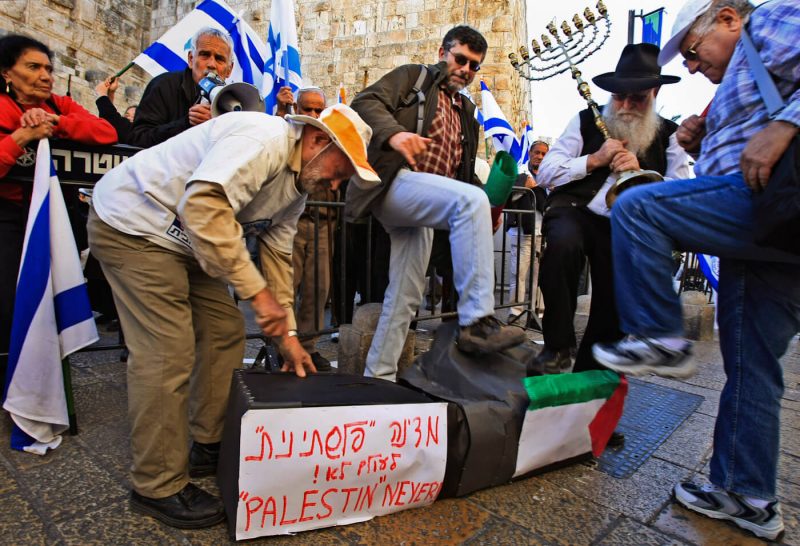
Temple Mount Faithful members step on a mock coffin symbolizing Palestine during a 2007 parade in Jerusalem. Alex Kolomoisky | AP
The 1987 rift with the Temple Mount Faithful resulted in the official creation of the Temple Institute, which was founded by Rabbi Ariel and has since become the most prominent organization of its type within Israel. Soon after its creation, the Institute joined an alliance of other Temple Mount Faithful splinter groups and associated groups, known collectively as the Movement for the Establishment of the Temple, but did not include the Temple Mount Faithful itself.
The Jewish Underground
While many former members of Irgun and Lehi joined the Temple Activist movement following its formation in the late 1960s, others chose an even more extreme approach than that offered by the Temple Mount Faithful. Shabtai Ben-Dov, a former member of Lehi who believed that the Third Temple and Jewish Messiah could only be achieved through violence and blood-soaked conquest, was one of the “guiding lights” of a group known as the Jewish Underground.
Ben-Dov is an obscure figure to most Israelis, but his impact on Jewish messianic groups in Israel was profound. He was an enthusiastic member of Lehi — or, as noted above, “the Stern Gang” — a Zionist paramilitary group known for its use of terrorism as well as its role in comitting several civilian massacres; the assassination of UN and British officials; its attempts to formally ally with the Nazis; and desire to create a Jewish state in Palestine based on “nationalist and totalitarian principles.”
Ben-Dov, who became increasingly more religious following the founding of the state of Israel and the dissolution of Lehi, turned to writing and argued that Lehi’s totalitarian vision for the state of Israel should be realized through the establishment of a theocracy, led by a king and the Sanhedrin, a council that served as the main political, judicial and religious force for Jews during the Roman period and was guided by the values of “conquest and holy war.” Furthermore, he believed — like Avraham Stern, who founded Lehi — that the Third Temple must be built as soon as possible and that doing so would solve all of the problems then facing the Jewish people.
Though his beliefs didn’t catch on — then, at least — Ben-Dov’s writings were dramatically inspirational to Yehuda Etzion, a settler activist who became profoundly disillusioned with the efforts to broker peace between Israel and Egypt that eventually resulted in the Camp David Accords in 1979. Shortly prior to Ben-Dov’s death and soon after the accords were formalized, Etzion sought out the former Lehi member, who successfully convinced the young Etzion to actively participate in the “messianic process.” When Etzion asked Ben-Dov if destroying the Dome of the Rock and Al-Aqsa mosque would catalyze the “redemption” process and usher in the coming of the messiah, Ben-Dov responded, “If you want to do something that will solve all the Jew’s problems, do that.”
With that, the planning of the now infamous plot of the Jewish Underground to destroy Al-Aqsa began, a plot that was narrowly foiled just a few years later in 1984. Indeed, Etzion and his co-conspirators, all of whom were later convicted of terrorism, had raided an Israeli military outpost in the occupied Golan Heights and had managed to steal over 2,000 pounds of explosives, which were used to build at least 27 bombs with which to commit the deed. For reasons that will become more relevant in a future article in this series, Etzion and his co-conspirators also believed that destroying Al-Aqsa mosque would first lead to a war with rival Middle Eastern nations, a war from which Israel would emerge victorious — and only then could the Third Temple and a theocratic Israel take shape.
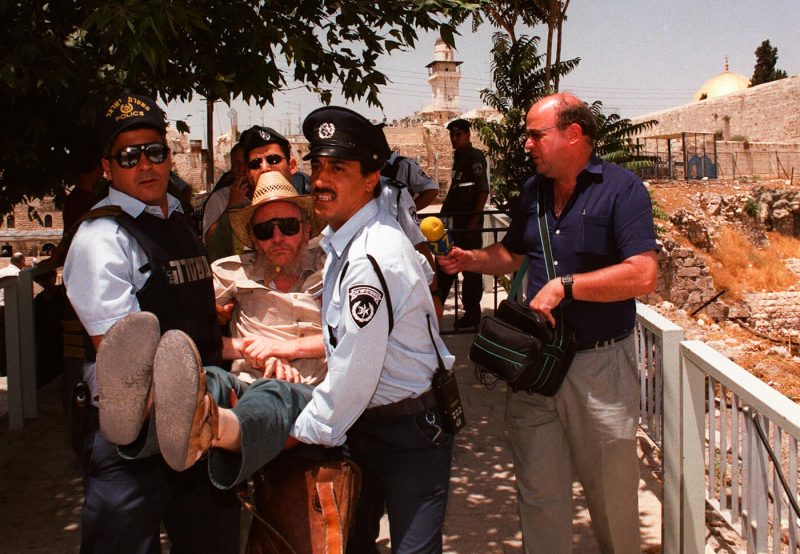
Israeli police carry Yehuda Etzion after he breached the Temple Mount in 1997. Zoom 77 | AP
After his arrest, Etzion had lamented that the plot had failed only because “the generation was not ready.” As noted in Part I, he called for the building of “a new force that grows very slowly, moving its educational and social activity into a new leadership,” a force that — as this article and Part I of this series clearly show — has been spectacularly successful.
Though a convicted terrorist and a proponent of theocracy and “holy war,” Etzion today is considered “the most revered figure among patrons of the Temple Mount,” according to Israeli newspaper Haaretz. Etzion was even the subject of a rather sympathetic New York Times article in 2015, as the rebranding of the Temple Activist movement (discussed shortly) was in full swing. That article asserted that Etzion “laments violence now used against Palestinians,” despite noting that Etzion “does not regret, exactly, helping plant bombs in the cars of Palestinian mayors and plotting to blow up the Dome of the Rock in the 1980s, nor does he express remorse.”
Though Etzion’s ideology may once have been fringe and his embrace of violence odious, it has gone increasingly mainstream, much like the Temple Activist movement itself, and there is considerable overlap. A fitting example of such overlap was seen just a few months ago when Bezalel Smotrich — now Israel’s Transportation Minister, who has openly called for the construction of a Third Temple and incited settlers to violently attack Palestinains in the occupied West Bank — called for Israel to be ruled by Jewish law and to become a theocracy at a time when he was under consideration for the position of Justice Minister.
Smotrich is but one example of how the ideas promoted by figures like Etzion have found their way into Israel’s halls of power. Indeed, Israel’s current Minister of Strategic Affairs, Internal Security, and Information Gilad Erdan, former Minister of Education Naftali Bennett, and Speaker of the Knesset Yuli Edelstein are all close associates and supporters of Etzion and his Chai Vekayam (Alive and Existing) movement.
Carmi Gillon, former head of Israel’s internal security service Shin Bet, stated last year that the former members of Jewish Underground have become so influential that they have won the battle for Israel’s future. Gillon told Haaretz:
They are more devoted to their idea. It’s exactly what you see with Hamas or Hezbollah. A religious person who believes he is commanded from on high can’t compromise on that command. A secular person is more pragmatic to begin with. But they have one goal: to turn Israel into a Jewish state governed by religious Jewish law, to perpetuate the occupation and to rescind liberal laws.”
The “Moderate” facade of the Temple Institute
Today, the Temple Institute, founded by Yisrael Ariel, is treated by many media sources as the “moderate face” of the Temple Activist movement. Yet, Ariel — much like Salomon, Etzion and other prominent figures in the Temple Activist movement — has long been an extremist, making his institute hardly “moderate.” As the saying goes, the apple doesn’t fall far from the tree.
After following Shlomo Goren to the Western Wall the day of its conquest in 1967, Ariel became deeply involved in the settler movement and became the “unofficial” rabbi of an Israeli settlement in the Sinai Peninsula. After that settlement was dismantled as part of the Camp David Accords, which saw the Sinai returned to Egypt, Ariel returned to Jerusalem and joined one of the most radical, racist political parties in Israel’s history, Kach.

Yisrael Ariel oversees a Temple Mount Faithful enactment of rituals for a rebuilt Third Temple. Tomer Appelbaum | Haaretz
The Kach Party was founded in 1971 by American-born Rabbi Meir Kahane, a convicted terrorist known for his racist, extremist positions that advocated Jewish supremacy, the expulsion of Palestinians from the occupied territories, and prison sentences for Palestinian men accused of having intimate relations with Jewish women. In addition, an often overlooked aspect of his radical platform was complete Jewish sovereignty over the Temple Mount.
In the 1981 elections, Ariel ran as Kahane’s number two right-hand man as a member of Kach, later served as Kahane’s deputy in the Knesset, and continued to be active in the party until it was banned from participating in Israeli elections in 1988. A few years after Kahane was assassinated in 1990, Baruch Goldstein, a Kahane follower and Kach member who murdered scores of praying Palestinians in a Hebron mosque, was praised by Ariel as a “martyr” and “our advocate in Heaven,” even as Goldstein’s actions led the Kach Party and its spinoffs to be labeled terrorist organizations by Israel, the United States and several other countries.
During his lengthy association with the Kach Party and Meir Kahane, Ariel founded the Temple Institute, registering it first as an association in 1984 and then creating a more formal organization in 1987 soon after other religious Zionist elements of the Temple Mount Faithful left that group en masse.
Ariel’s reason for doing so was based on his view that the Third Temple must be pursued at all costs. Ariel’s “Holy Temple Prayerbook” as cited on the Temple Institute’s website, summarizes his beliefs in his own words:
Through the years, the more I studied the more I began to understand that we had only ourselves and our own inaction to hold accountable: God does not intend for us to wait for a day of miracles. We are expected to act. We must accomplish that with which we have been charged: to do all in our power to prepare for the rebuilding of the Holy Temple, and the renewal of the divine service.”
Furthermore, Ariel feels that the Temple lies at the heart of Israel’s future as a state and as a panacea for all of its problems. He stated the following in 2005:
The State of Israel can be only one thing — a state with a Temple at its center. Otherwise it is no different from any other state. All of today’s troubles originate in the sin of abandoning the Temple Mount and the site of the Holy Temple… The Holy Temple is the solution to all of our problems.”
This same view that held that the Temple would solve all of Israel’s problems was also voiced by Shabtai Ben-Dov, the former Lehi member who advised members of the radical Jewish Underground terrorist group to blow up Al-Aqsa mosque in the early 1980s.
While the worldview of Ariel and his ideological allies can easily be dismissed as that of an extremist, the issue is that — over the past few decades — the Temple Institute he founded has taken a central role in the Temple Activist movement and has found growing levels of support from Israel’s government, including financial support.
Since its formation, the Temple Institute has created detailed blueprints of its vision for a Third Temple, based partially on the maps first made by Shlomo Goren in 1967, as well as 3-D computer animations and physical models of that Temple. In addition, it has created several artifacts for use in a future temple, including a golden menorah, incense altars, priestly garments and a variety of ritual vessels, among others. The menorah alone is estimated to have cost 5 million NIS (about $1.3 million USD).
These artifacts and models have allowed the Temple Institute to obfuscate its extremist origins by opening a museum dedicated to the Third Temple, a museum that enjoys Israeli government sponsorship. That museum, dubbed the “Disney Land for Temple fundamentalism” by the Times of Israel, receives hundreds of thousands of visitors every year.education
Beyond its creation of artifacts and structures to be used in a future temple, the Institute has also dedicated itself to training a new generation of Levite priests with the intention that they perform ritual sacrifices in the future temple, and has also attempted to recreate a “Red Heifer” for use in a purification ritual.
Rabbi Yisroel Dovid Weiss of Neturei Karta — an ultra-Orthodox group of Haredi Jews founded in Palestine in 1938, who believe Jews are forbidden from having their own state until the Jewish Messiah is revealed — told MintPress that these rituals cannot be performed because the red heifer, among other objects, is no longer available as these objects were when these rituals were practiced nearly two thousand years ago. Yet, the Temple Institute has made efforts to recreate a red heifer using advanced techniques in animal husbandry and artificial insemination and claimed to have produced a suitable red heifer in 2018.
Over the years, the Institute has received increasing levels of support from Israel’s government, even though the Institute’s activities run counter to official Israeli government policy in relation to the Temple Mount and also violate a 1994 peace treaty between Israel and Jordan that explicitly forbids non-Muslims from praying on Haram el-Sharif (the Temple Mount), in keeping with Islamic theological doctrine regarding its most holy sites. According to Israeli non-profit Ir Amim, the Temple Institute has been receiving direct funding from Israel’s government since at least 2008 — receiving an estimated 412,000 NIS (~$114,775) annually from Israel’s Ministry of Culture, Science and Sports, headed by Miri Regev, as well as Israel’s Ministry of Education from 2008 to 2012. In 2012 alone, the educational arm of the Temple Institute, the Midrasha, received 189,000 NIS (~$52,650) from the Ministry of Education.
Prior to obtaining direct government funding, the Temple Institute received funding from “persons in different government ministries,” according to statements made by Ariel in 1992 when thanking members of the government for helping finance the Institute and offset its debts. Notably, government funding of the Temple Institute is a small portion of its estimated $1 million annual operating budget. However, direct government funding of the organization suggests that the current Likud government led by Netanyahu is relatively supportive, at least covertly, of its mission.
This is corroborated by the fact that recent years have seen overt support for the Institute and its objectives by prominent Israeli politicians. For instance, in 2013, Nir Barkat — then-mayor of Jerusalem and member of the ruling Likud Party — presented Ariel with an award for his work at the Temple Institute. It was subsequently revealed that the Temple Institute had received a government contract from Israel’s Ministry of Education. That contract paid the Temple Institute to develop a mandatory social studies curriculum that would instill a “longing for the Temple” in children at the kindergarten level and above. Critics argued that the curriculum “could drive students to take violent actions to advance the building of the Third Temple,” according to Haaretz. The Institute’s relationship with Israel’s government is further revealed by Israel’s allowing of women to perform their mandatory national service in lieu of mandatory military service by working as tour guides in the Institute’s Museum.

A schoolbook created jointly with Israel’s Ministry of Education depicts rebuilding of the Third Temple. Credit | Ir Amim
The combination of government support for the Temple Institute and the Institute working as a government contractor in developing a national educational curriculum has resulted in growing support for the Third Temple among religious and secular Israelis alike.
Miko Peled told MintPress that the type of material being taught and normalized in schools throughout the country had been a key factor in the Temple Activist movement’s goals becoming mainstream:
The mainstreaming of these fringe [Temple Activist] groups is possible only because within the mainstream in Israel there is a desire to see the Temple ‘restored.’ The mythical narrative of King David and King Solomon and his magnificent temple are taught as history, and so even secular Israelis see this as a symbol of their identity and a right. This is taught in schools, through Israeli folk songs, etc. Furthermore, among the ‘tour’ organizers and the Temple activists there have always been non-religious Israelis.”
As the Temple Institute’s influence has grown and as it has perfected the capacity to speak to more moderate as well as extremist factions within religious Zionism, Ariel has notably felt emboldened to articulate the controversial, extremist beliefs he has long held. In a video recorded in 2015, he made overt calls for genocide and murder based on his interpretation of the works of 12th-century Jewish sage Maimonides.
In that video, publicized by Canadian journalist David Sheen, Ariel makes several outrageous statements, including claims that Jewish law compelled religious Jews to assassinate then-President of the United States Barack Obama, and calling for a Jewish army to conquer the entire Middle East, specifically Iran, and to destroy all mosques and churches.
Ariel also called for the murder of all Muslims and Christians who do not renounce their religions in order to follow the “Noahide laws,” which Ariel and other extremists believe must be imposed on all of humanity, aside from practitioners of Judaism, as a condition of their existence. A year later, Ariel again garnered attention from Israeli media for claiming that the Temple Mount must be “flattened and cleaned” of the Al-Aqsa mosque so a Third Temple could be rebuilt.
From extremist to “civil rights” movement
Though Rabbi Yisrael Ariel is often considered the face of the Institute, the Institute’s increasing prominence has been aided by a somewhat younger generation of Temple Activists who have become influential in Israeli politics.
There is no better example of such a figure than Yehuda Glick, who was the Temple Institute’s executive director for five years and became a member of Israel’s Knesset for the ruling Likud Party in 2016. Largely thanks to the “affable” face Glick and some of his contemporaries have lent to the Temple Activist movement, it has been able to rebrand from an extremist colonialist project to a “civil rights movement” promoting “equal rights” for Jewish Israelis when it comes to praying on the Temple Mount. Yet Glick differs little, in terms of ideology, from the old guard, as evidenced by his personal beliefs and his close relationships with figures such as Etzion and Ariel.
Glick, through his prominent role in the Temple Institute and the Temple Mount Heritage Foundation, had become a well-known figure in the Temple Activist movement by the time he was attacked and shot in early February 2014, almost losing his life to his assailant, who was alleged to have been a young Palestinian. Glick’s serious injuries, which he survived, became the basis for a subsequent and successful media campaign within Israel that helped paint the Temple Activist movement as a “civil rights” movement aimed merely at securing “equal rights” to pray on the Temple Mount, for both Jews and Muslims alike.
This narrative soon went beyond Israel, with prominent media outlets like the New York Times euphemistically describing Glick as an “agitator who has pushed for more Jewish access and rights at a hotly contested religious site in Jerusalem.” Left unmentioned was Glick’s history of arrests for participating in provocations at the Temple Mount, his assault of a Palestinian woman at the contested site, and the fact that he lives in an illegal West Bank settlement.
Yet, there is much to doubt about the narrative surrounding Glick’s attempted murder, leading some critics to suggest that the attempt on his life may have been a “false flag” aimed at creating enough public outrage so as to force Israel’s government to alter the current status quo on the Temple Mount. Indeed, just a week before he was nearly killed, Glick had told Haaretz that the situation on the Temple Mount would only change after a Jew was violently attacked by an Arab.

Yehuda Glick arrives to cast his vote during Likud party elections in Jerusalem, still healing from an alleged attack, Dec. 31, 2014. Oded Balilty | AP
“When will the change take place?” Glick told the Israeli newspaper, answering:
As soon as the Arabs harm someone on the Temple Mount, the prime minister will wake up and it will be too late… Violence is escalating every day, and the police are simply helpless. Police impotence leads to violence… Bibi is tying their hands and the Jordanians are tying their hands.” (emphasis added)
Soon after the murder attempt, Ali Abunimah detailed at Electronic Intifada many of the other discrepancies regarding the events that led to Glick’s injuries, including the swift extrajudicial execution of his alleged attacker before an investigation or trial could take place and some of the dubious claims made by witnesses at the scene, particularly witnesses known to be greatly involved in the Temple Activist cause. Two of the witnesses were none other than Rabbi Yisrael Ariel, founder of the Temple Institute, and Moshe Feiglin, then-Likud member of the Knesset and outspoken Temple Activist, each of whom later called the attack on Glick “inevitable” and “expected,” respectively.
A year and a half after the attack that threatened his life, Glick became a member of Israel’s Knesset for the Likud Party, occupying the post left by former Defense Minister Mosha Ya’alon, who had resigned. Though Glick had previously served a minor role in government, his ascent to the Knesset as a Likud lawmaker gave him a platform to continue to promote Temple Activism as an issue of “civil rights,” one that was received by outlets like Forward with great sympathy.
“The discrimination on the Temple Mount is obvious,” Forward quoted Glick as saying soon after he became a member of the Knesset. “[Under Jordanian control] the Temple Mount became a center of incitement and hate instead of a center of peace.”
Miko Peled described the effort to rebrand what was once a radical, fringe movement as a “civil rights” struggle that has been “very successful” and played a role in the increasingly mainstream status that the Temple Activist movement now enjoys. Peled told MintPress:
Their [the Temple Activists] entire discourse is now about their rights, and the denial of the rights of Jewish [people] to freedom of worship, etc. This works well in promoting them as more moderate and friendly and as victims of a reality that once again discriminates against Jews. They realize that what is working for the Palestinians is the fact that their narrative is framed as an injustice and they now do the same. You hear them complaining that while the world, and even the Israeli “Left,” stand for Palestinian rights, they — once again — don’t stand for the rights of Jews.”
Powerful mainstream proponents
Since the attack on Glick and the subsequent rebranding of Temple Activism as a “civil rights” movement, the decades-long effort to manufacture consensus among both secular and religious Israelis has grown dramatically. The growth of this movement, much of which is detailed in Part I of this series, has been most noticeable within Israel’s halls of power, with a large number of Israel’s most powerful politicians, and a majority of Israel’s current cabinet, now openly pushing for Israeli sovereignty over the Temple Mount and for the reconstruction of a Third Temple.
In the interest of brevity, MintPress has compiled the following list of current Israeli government ministers who have shown or expressed varying degrees of public support for the construction of a Third Temple, the destruction of Al-Aqsa, and/or complete Israeli sovereignty over the Temple Mount. Some of the individuals listed below hold multiple ministerial positions.
Current Israeli Government Ministers Supportive of Temple Activism
-
- Miri Regev, Minister of Culture and Sport
- Rafi Peretz, Minister of Education
- Bezalel Smotrich, Minister of Transportation
- Uri Ariel, Minister of Agriculture and Rural Development
- Gilad Erdan, Minister of Strategic Affairs, Minister of Internal Security, Minister of Information
- Yisrael Katz, Minister of Foreign Affairs, Minister of Intelligence and Atomic Energy
- Yoav Galant, Minister of Construction
- Amir Ohana, Minister of Justice
- Ze’ev Elkin, Minister of Jerusalem, Minister of Environmental Protection
- Ofir Akunis, Minister of Science, Technology and Space
- Tzachi Hanegbi, Minister of Communications, Minister of Regional Communications
Those listed above account for more than half of all Israeli government ministers (11 out of 20) and nearly 60 percent of all ministerial positions (16 out of 27) that are not currently held by Israeli Prime Minister Netanyahu, who is currently serving as the Minister of Health, Defense, and Diaspora Affairs in addition to being Prime Minister.
While it may come as a shock that more than half of all current Israeli government ministers are supportive of key aspects of Temple Activism, numerous other prominent Israeli politicians in the Knesset and other positions of political power are also strong advocates for altering the current Temple Mount status quo.
The strong presence of Temple Activist supporters in Israel’s halls of power has not been lost on leaders within the movement. Rabbi Chaim Richman, head of the Temple Institute’s International Department, told Christian Headlines in 2017 that:
Today there’s a lobby in the Knesset … many members of the Knesset that are constantly speaking about Jewish rights to pray on the Temple Mount. There are members of the Knesset that actually talk about rebuilding the Holy Temple. Do you realize that 20 years ago these people wouldn’t have been given a moment on prime time television to say these things. They would have been laughed out.”
Netanyahu’s dance
In addition to its increasingly strong hold on Israeli legislatures, the Temple Activist movement’s reach stretches all the way to Israeli Prime Minister Benjamin Netanyahu. Netanyahu, given his role as prime minister, has long avoided any explicit endorsements of Temple Activism, though his actions over his decades-long political career offer enough insight to conclude that he is, at the very least, supportive of the movement and some of its objectives.
Netanyahu, from his prominent political position, has publicly maintained that his government seeks to maintain the current status quo on the Temple Mount, likely to avoid stoking unrest and protests. Yet, such claims are at odds with the fact that a majority of his ministers have publicly stated that they wish to wrest control of the holy site from its current custodians.
Furthermore, Netanyahu himself in 2017 told the Knesset the following: “To you, the members of the Knesset, the citizens of Israel, and to the entire world, I want to make it clear: The Temple Mount and the Western Wall will stay under Israeli sovereignty forever.” In that same speech, Netanyahu referred to Palestinian sovereignty over Jerusalem prior to 1967 as a “black cloud” that had hung over the city.
Though Netanyahu has been relatively mum on the subject of the Third Temple specifically, his practice of remaining silent after prominent members of his government and political party promote Temple Activism has not escaped the notice of Israeli media, which has repeatedly pointed out that the claims of government officials close to Netanyahu qualify as incitement under Israeli law, a punishable offense. Such silence has been taken by some Netanyahu critics as tacit support for Temple Activists, as has Netanyahu’s recent appearances at events where Al-Aqsa and the Dome of the Rock have been edited out of the Jerusalem skyline, despite the compound’s iconic status.
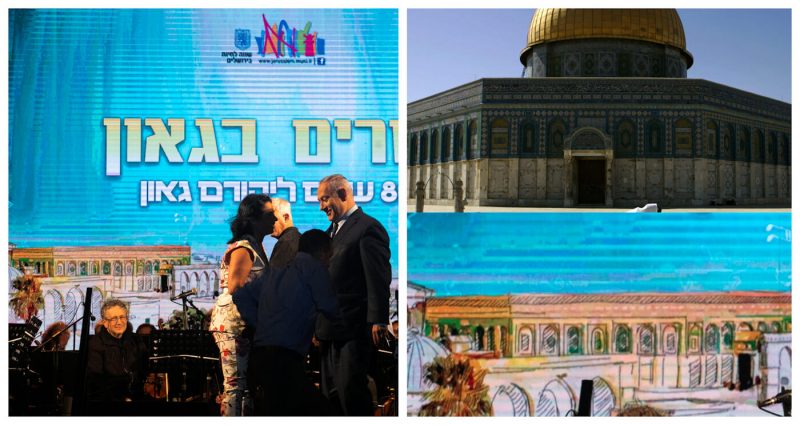
Netanyahu attends an event back-dropped by an image of the Temple Mount with a dome-less mosque, June 13, 2019. Olivier Fitoussi | AP
Yet Netanyahu is silent not only about many of his closest political associates embracing Temple Activism, but about the considerable support that some of his most important political donors have given to Temple Activist groups. A 2015 Haaretz investigation found that top Netanyahu donor Kenneth Abramowitz — an American billionaire who also heads American Friends of Likud — had given more than $1.3 million to the Israel-based institution that funds all of Yehuda Glick’s Temple Activist organizations.
In addition to funding Netanyahu, Abramowitz has also donated to Yisrael Katz and Gilad Erdan — current Minister of Foreign Affairs and current MInister of Strategic Affairs, Internal Security and Information, respectively — both of whom support upending the current status quo on the Temple Mount. Palestinian academic and journalist Ramzy Baroud told MintPress that Gilad Erdan is “the main person advocating for this [Temple Activist] movement within Israel’s government and within Israeli politics.”
Another key financier of Netanyahu — U.S. casino magnate Sheldon Adelson — also appears to be supportive of Temple Activism. For instance, Israel Hayom — the Israeli newspaper that Adelson funds — has published numerous articles supportive of Temple Activism, including front-page stories that call for the destruction of Al-Aqsa mosque. Furthermore, Adelson has grown increasingly close to Israeli politician Naftali Bennett, who has increasingly pushed for increased Israeli control over the Temple Mount in recent years. Adelson even allegedly favored Bennett over Netanyahu for the position of prime minister at one point.
Bennett, who until recently was Education Minister, spent his tenure at that ministry inserting Temple Activist educational material into mandatory school curriculums, some of which were developed by the Temple Institute as part of a contract with the Bennett-led Education Ministry. In addition, Bennett — after failing to secure enough seats in Israel’s elections this past April — is mulling joining forces with Moshe Feiglin, one of the most pro-Third Temple Israeli politicians of all.
Beyond his close association with donors and politicians who support Temple Activism, Netanyahu’s relationship with prominent religious leaders have led to speculation that he supports the construction of a Third Temple on the Temple Mount. During a meeting in 1990 with Rabbi Mencahem Schneerson — then leader of the Chabad Lubavitch movement, an international Orthodox Jewish organization that has gained global prominence and also invited controversy — Netanyahu asked Schneerson, often referred to simply as “the Rebbe,” for advice on both personal and political matters.
Schneerson, who up until his death was a strong advocate for the religious messianic belief that physical actions could speed up the fulfillment of end-times prophecy and the coming of the Messiah, advised Netanyahu that he “do something to hasten his [the Messiah’s] coming.” Netanyahu responded, “We’re doing, We’re doing…,” at which the Rebbe interrupted him, saying “Apparently, it’s not enough,” urging him to do more still, and eventually garnering a “Yes” from Netanyahu. After that meeting, Schneerson stated that Netanyahu would later “hand his keys over to Moshiach [the Messiah],” suggesting that Netanyahu’s political career would culminate in the building of a Third Temple, a prerequisite for the appearance of the Messiah per Schneerson’s teachings.
Given that Schneerson heavily promoted the construction of a Third Temple during his lifetime and frequently received Third Temple models from devotees as offerings and gifts, this exchange has contributed to speculation that Netanyahu supports the same vein of religious messianism and vision propounded by Temple Activists.
However, leaked audio of a private meeting between Netanyahu and other Likud Party members provided evidence that Netanyahu does not personally approve of constructing a Third Temple, but turns a blind eye to those that do within his ruling coalition and among his donors purely out of political expediency. In that leaked audio, recorded in 2015, the prime minister stated that if Israel wanted to destroy Al-Aqsa “it would not require a great effort… but it goes against everything we stand for.”
Yet, in the years since that meeting took place, the prime minister has made some moves that have suggested that he may no longer think that destroying Al-Aqsa is “against everything we stand for,” especially given that Temple Activism is much more mainstream now than it was in 2015. Such claims of possession and right have increased following the beginning of the Trump administration in the United States, which — as the next installment of this series will show — also contains numerous figures who are committed to building a Third Temple on the Temple Mount, albeit for different reasons.
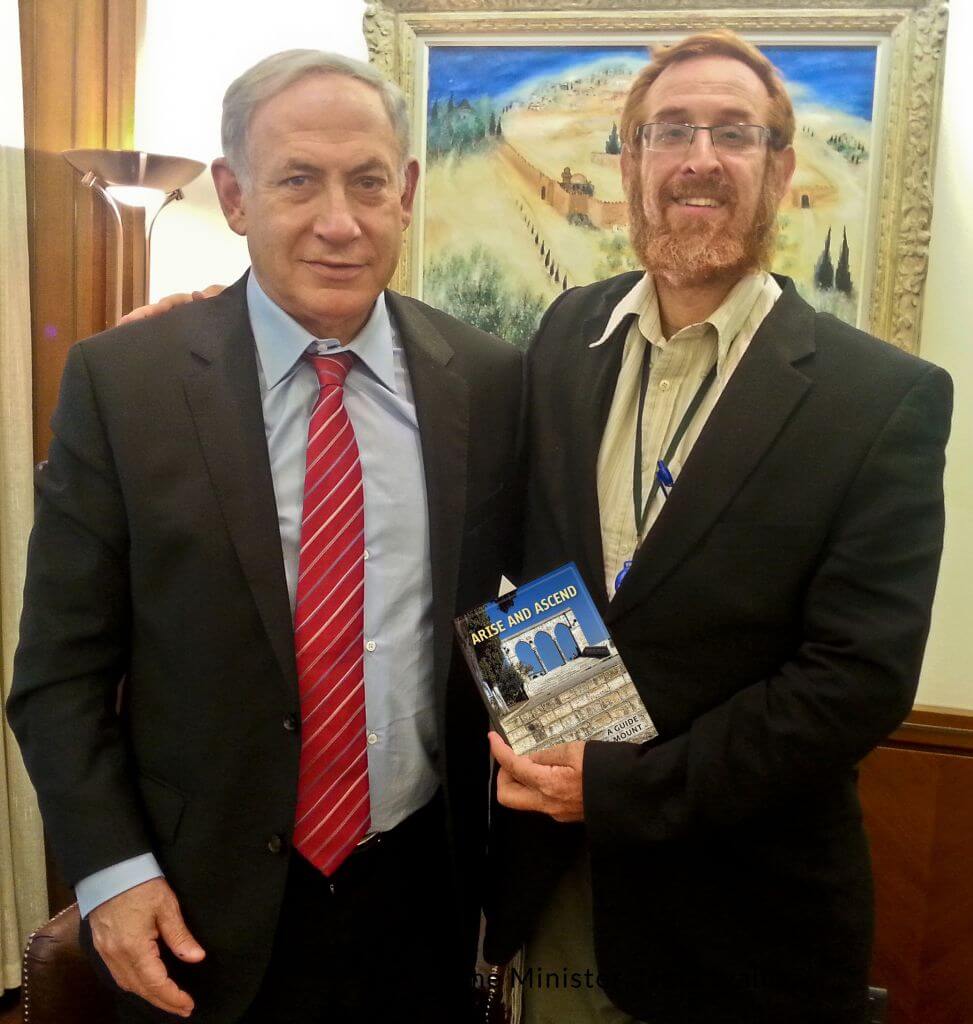
Netanyahu poses with Yehuda Glick, who is holding his Temple Activist “guide book” to the Temple Mount
During his speech last May at the dedication of the U.S. Embassy in Jerusalem — a political move heralded by numerous Temple Activists and Netanyahu himself as having “fulfilled prophecies” related to the Third Temple — Netanyahu made numerous references to the Temple and the Temple Mount and linked Israeli sovereignty over the Temple Mount to the presence of a physical temple.
According to Miko Peled, Netanyahu’s recent ministerial appointments following Israel’s recent elections in April reveal his private support for Temple Activism. Peled told MintPress:
Recently, Netanyahu brought two new members into his cabinet — Bezalel Smotrich and Rafi Peretz. They are from the heart of the settler, religious Zionist, messianic, Temple movement. They are clear about their political goals and are not shy about stating their goals.
They talk about giving the “Arabs of Israel,” as they call the Palestinians, three options: surrender and live without rights in a Jewish state, leave, or die. They make no secret of their desire to build a temple in place of Al-Aqsa. Netanyahu brought them in only because he agrees with them, shares their vision, but cannot express it as they do for fear of losing his international standing as a ‘statesman.’”
While Netanyahu may share their vision, as Peled asserted, other political moves he has made since the April elections suggest that he is likely not ready to enact such a vision, at least in regard to the Temple Mount. For instance, while he did include Smotrich in his cabinet, Netanyahu denied the controversial politician the ministerial positions he had desired, either Defense Minister or Justice Minister, precisely because of Smotrich’s comments about and stances regarding the Temple Mount.
Mainstreaming the apocalypse
As Yehuda Etzion had hoped back in 1985, writing from his prison cell after his failed effort to destroy Al-Aqsa, the “new force that grows very slowly, moving its educational and social activity into a new leadership” in the Israeli political establishment has now clearly manifested. Thanks to the efforts of Etzion and other Temple Activists like Yisrael Ariel and Yehuda Glick, the Temple Activist movement has become more mainstream within Israeli culture and politics than ever before, largely owing to the movement’s huge success since 2014 in rebranding itself as a “civil rights” movement, despite its origins steeped in religious extremism and terrorism.
In Part I of this series, the urgency with which the Israeli political establishment and Temple Activists are pursuing their agenda targeting Al-Aqsa and the Temple Mount was detailed, revealing – as Ramzy Baroud described it – that support for the Third Temple within Israeli society is now “greater than at any time in the past.”
Yet, as the next installment of this series will show, none of this would be possible without strong support from the United States government, where powerful politicians and individuals – particularly within the Trump administration – share the vision of the Temple Activists, although many of them, being Christian Zionists, do so for radically different reasons. The combination of strong support for using political force as a driver of eschatology — among certain groups, whether of Christians or Jews — has increasingly become a common denominator between U.S. and Israeli politics in recent years, one that has colored the foreign policy of both countries.
However, far from a benign influence, the end-times prophecies that are motivating these influential individuals are stocked with future events that portend untold suffering, mass loss of life and cataclysmic wars. Given that both Christians and Jews that favor this interpretation of the end-times believe that active steps must be taken to usher in these apocalyptic scenarios by those with the capacity to do so — e.g., politicians, political donors and so on — it makes understanding this often overlooked aspect lurking behind current Israeli and U.S. foreign policy both a critical and urgent task.
Whitney Webb is a MintPress News journalist based in Chile. She has contributed to several independent media outlets including Global Research, EcoWatch, the Ron Paul Institute and 21st Century Wire, among others. She has made several radio and television appearances and is the 2019 winner of the Serena Shim Award for Uncompromised Integrity in Journalism.
Trump Admin Dangles $50Bn Bribe for Palestinian Surrender
By Finian Cunningham | Strategic Culture Foundation | July 3, 2019
President Trump’s senior aide on Mideast affairs Jared Kushner tried last week to sell his much-vaunted “deal of the century” for a Palestinian-Israeli peace settlement. The core of it was a purported foreign investment plan worth $50 billion.
The sales pitch made at a conference in Bahrain amounted to a $50Bn bribe dangled at the Palestinians to accept permanent illegal occupation of their ancestral lands in exchange for foreign investment. Kushner rebranded it as the “opportunity of the century”.
He claimed that political peace depends on a viable economic plan. Others would see that formulation as back-to-front: economic development and prosperity depends on a political solution to decades of injustice against Palestinians.
American diplomacy has been an utter failure for decades with regard to settling this bitter dispute. It would therefore be impossibly naive to expect the Trump administration to succeed. More likely, its blundering and bias will only make this historic problem a whole lot worse.
That’s no doubt why so many regional players decided to give the Bahrain event this week a clunking big miss.
Like his father-in-law in the White House, Kushner comes from a real estate background before Trump appointed him as his top aide on the Palestinian-Israeli issue. For the past two years, Kushner has been working on a “master plan” to end the eight-decade-old conflict. That conflict has been at the center of most other disputes and tensions in the region. Trump has billed his son-in-law’s peace plan as the “deal of the century”.
In Bahrain, the Trump administration gave the first-ever preview of its peace plans. Skeptics of Kushner’s ability to deliver a realistic, workable framework were not to be surprised. The boyish-looking Kushner looked way out of his depth as he presented his vision of business and investment as the supposed key to peace. He invited the audience to “imagine” Palestinian territories in the West Bank and Gaza bustling with enterprise and trade. That entrepreneurial “promised land” would arrive if the Palestinians accepted Kushner’s vision of a $50Bn foreign investor fund.
What that boils down to is Palestinians accepting the present status quo of illegal occupation by Israel and in effect surrendering their historic claims for sovereign statehood. Moreover, the $5oBn in investments that Kushner was swooning about are not existing funds. They are only promises of potential investment, which may never actually be delivered.
Nowhere in the Trump administration’s “deal of the century” is there any attempt to redress historical violations of Palestinian national rights. There is no mention of the right of return of millions of Palestinians displaced by the 1948 war that established the sate of Israel. Nor of returning land annexed during the 1967 war. Illegal occupation is merely a fact on the ground that needs to be officially recognized as Israeli territory, according to the Trump administration. In the same way that Trump earlier this year officially recognized the occupied Syrian Golan Heights as part of Israel.
Kushner’s bias in a supposedly peace mediator role is flagrant. He is Jewish and a family friend of Israeli Prime Minister Benjamin Netanyahu. Kushner’s wife, Ivanka, Trump’s daughter, is a convert to Judaism. Last year, she personally unveiled the controversial new American embassy in Jerusalem, which Trump had promised to Netanyahu on his election in 2016 in recognition of the city as the capital of Israel. That move was seen by Palestinians as a betrayal of their historic claim to East Jerusalem as the capital of their future state.
During the past two years, the Trump administration has cut off development aid and diplomatic links with Palestinian authorities. Respected Palestinian negotiators like veteran envoy Hanan Ashrawi have been denied travel visas to the US. The consultation conducted by Kushner with the Palestinian side in formulating his peace plan has been minimal.
During a recent interview in the US, Kushner revealed his colonial-type mindset when he asserted that the “Palestinians were not ready yet for self-government”. In other words, in this supposed mediator’s view, he is saying that there will be no foreseeable state of Palestine. That is, the Palestinians must accept their inferior status as an occupied people while the state of Israel is permitted to continue annexing more and more of their ancestral land. Indeed, Kushner is believed to have personal business investments in the construction of new Israeli settlements in the occupied territories.
It’s no wonder then than his so-called “deal of the century” amounts to a shallow business plan bereft of any deep historical, political issues. Palestinians are expected to shut up and surrender their historic rights for statehood by accepting a quixotic vision of economic wonders descending on them while living under permanent marginalization and deprivation. A UN report last year found that Gaza will no longer be habitable in a few years due to water and power shortages.
The Trump-Kushner proposal is the sort of con job that real estate agents excel at. Everything is reduced to the value of money while prospects are talked up with the most ludicrous glamor. Unscrupulous real estate agents would have the temerity to sell a cardboard box as if it were a penthouse suite. Trump and his son-in-law would seem to be of that same wheeler-dealer ilk.
After two years of bragging about its big Middle East “vision”, what people saw this week was little more than a glossy brochure of hype over historical realities. Indeed, it would seem that the purpose of the hype is to bury the hard historical problems that underly the Palestinian-Israeli conflict. The excessive emphasis on billions of dollars of investment by Kushner is an attempt to seduce Palestinians into relinquishing their political and moral rights.
This week, however, while the Trump administration was making its sales pitch in Bahrain, it was notable that there was no Palestinian delegation present. All across the West Bank and Gaza, Palestinians shut their businesses in protest and took to the streets to burn effigies of the “deal of the century”.
Israeli government representatives were also not in attendance. That was only after the White House belatedly pulled their invitations in the weeks before the Bahrain conference took place. No doubt that hasty move by the White House was meant to minimize the embarrassing spectacle of a Palestinian boycott by also not having an official Israeli delegation.
Russia and China also gave the Kushner presentation a miss. Some Arab countries, such as Iraq and Lebanon, did not attend either. Iran, a major regional player and supporter of the Palestinian cause, was not represented. The European Union sent only technical-level officials; EU foreign policy chief Federica Mogherini was not present.
The glaring absences reflect the lack of international credibility of this White House’s peace efforts for the Middle East. The “deal of the century” is more seen as the “con of the century”.
Oman rejects claims it’s establishing diplomatic relations with Israel
Press TV – July 2, 2019
Oman has dismissed as “baseless” Israel’s claims that the Persian Gulf sultanate is establishing diplomatic ties with the Tel Aviv regime.
In a statement published on its official Twitter page on Tuesday, the Omani Foreign Ministry reacted to comments by the head of the Mossad intelligence service, who had said a day earlier Israel was renewing ties with Oman.
“The Sultanate is keen to exert all efforts to create favorable diplomatic conditions to restore contacts between all international and regional parties to work towards achieving peace between the Palestinian Authority and … Israel, leading to the establishment of an independent Palestinian state,” the Omani Foreign Ministry said in the statement.
The Mossad chief, Yossi Cohen, had claimed at the Herzliya Conference on Monday that, “Just recently, renewal of formal relations with Oman was declared and the establishment of a representative office of the foreign ministry in that country.”
“That is only the visible tip of a much broader secret effort,” he added. “We do not yet have with them (Arab states) official peace treaties but there is already a communality of interests, broad cooperation and open channels of communication.”
Jordan and Egypt are the only two Arab states that have diplomatic ties with Israel. However, reports have indicated that several of them, including Saudi Arabia, the United Arab Emirates and Bahrain, have had secret relations with Tel Aviv.
Israeli Prime Minister Benjamin Netanyahu in late November last year visited Oman, where he met Sultan Sayyid Qaboos bin Said Al Said at the Bait al-Barakah Royal Palace in the coastal city of Seeb near the capital Muscat.
The Jerusalem Post daily newspaper reported that the two men had discussed ways to advance the so-called Middle East peace process as well as other matters of mutual interest.
The Omani Foreign Ministry announced on June 26 that it will open an embassy in the occupied West Bank city of Ramallah.
The decision was made “in continuation of the sultanate’s support for the Palestinian people,” it said.
“A delegation from the Ministry of Foreign Affairs will travel to Ramallah to initiate the opening of the embassy,” the foreign ministry noted, without providing further details.
Activists scale Israel arms manufacturer building, demand end to UK complicity in rights violations
MEMO | July 1, 2019
Activists from the Manchester Palestine Action network have scaled the roof of the Israeli owned Elbit/Ferranti arms manufacturer in Oldham in protest of UK complicity in Israel’s human rights violations.
To commemorate the five-year anniversary of “Operation Protective Edge” in 2014, which killed over 2,000 Palestinians, activists draped large banners in front of the building which read “UK Stop Arming Israel”.
The group say that over the last five years the UK has raised their arms sales to Israel and are calling for an arms embargo and the closure of all Elbit factories in the UK.
A group of activists also entered the new, hi-tech, Discovery Industrial Park in Kent and headed towards Elbit’s, purpose-built Instro Precision factory. They blockaded both of the gates to the factory and scaled a shipping container forcing the factory to close.
In 2017 the Campaign Against Arms Trade reported that the UK issued £221 million worth of arms licenses to defence companies exporting to Israel which makes Israel the eighth largest UK arms market.
In the past half-decade Israel has brought over £350 million worth of UK military hardware.
During the Great March of Return Israeli snipers have killed over 180 Palestinian protesters including 57 children, yet the UK has approved some £14 million worth of arms sales during this period, according to the group.
Adie from Manchester Palestine Action said: “We think that arms companies like Elbit Ferranti should stop operating when it is clear their weapons are being developed through the mass murder of Palestinians in Gaza and the rest of Palestine. The crimes must stop and so must UK-based companies that are profiting from them.”
US Ambassador to Israel Participates in Israeli Underground Settlement Expansion

IMEMC | July 1, 2019
The US Ambassador to Israel, and longtime Israeli settlement financier, David Friedman, participated on Sunday in an underground excavation under the Palestinian neighborhood of Silwan, in East Jerusalem, actively participating in the illegal settlement action by bashing with a hammer a section of ancient underground wall located beneath Palestinian homes.
In addition to Ambassador David Friedman, the US “Peace Envoy” Jason Greenblatt also participated in the controversial and illegal excavation, along with Sara Netanyahu, the wife of Israeli Prime Minister Binyamin Netanyahu, who recently narrowly avoided prison time by negotiating a plea agreement in which she pleaded guilty to corruption charge.
The presence of US officials at the incident marks the first time that the US, or any country, has decided to recognize Israeli sovereignty over the Old City of Jerusalem. The Old City was declared an international space open to all during the declaration recognizing the state of Israel in 1948. But since 1967, Israeli forces have occupied the mainly Palestinian city and have used many measures, legal and illegal, to push out the Palestinian residents of the city.
This archaeological dig is to excavate a tunnel that Israeli state archaeologists claim was used by Jewish pilgrims thousands of years ago.
According to a statement by the Israeli non-profit Emek Shaveh, the group believes that this incident with the U.S. officials is “a further step in American support for the pro-settlement policy in Jerusalem, and particularly the touristic-settlement projects…. It is inexcusable to ignore the Palestinian residents of Silwan, carrying out extensive excavations of an underground city and to use such excavations as part of an effort to tell a historical story that is exclusively Jewish in a 4,000 year-old city with a rich and diverse cultural and religious past”.
In an editorial in the leading Israeli newspaper Ha’aretz, the paper’s editors write, “The participation of American diplomats at an event sponsored by a right-wing group in East Jerusalem constitutes de facto recognition of Israeli sovereignty in Jerusalem’s historic basin. If anyone had any doubts about that, Friedman made clear in an interview with the Jerusalem Post that, ‘The City of David is an essential component of the national heritage of the State of Israel.” Giving it up, even in the context of a peace agreement, he said, “would be akin to America returning the Statue of Liberty.’”
The problem with this argument, according to the editors of Ha’aretz, is that, “This recognition doesn’t just put the American administration on the extreme right of the Israeli political map – thus undercutting the claim that American can be an unbiased broker between Israel and the Palestinians – but it also ignores the complicated reality in Silwan, East Jerusalem and the entire region. The tunnel, which was excavated using controversial methods from a scientific standpoint, harnesses archaeology to politics while ignoring the nuances of Jerusalem’s ancient past…. Anyone having even a passing familiarity with the Palestinian people knows that there’s no chance of arriving at any kind of agreement that will end the occupation so long as Israel continues to control East Jerusalem and the Temple Mount. Thus, by mere words and an event dripping with sweetness and smiles, the administration of U.S. President Donald Trump has sentenced Israelis to a life of constant conflict, or to an apartheid state in which there are two types of residents, those with rights and those without them.”
Over 300,000 Palestinians live in the city of Jerusalem, at least 20,000 of whom live in Silwan. These Palestinians have no citizenship rights and are not granted freedom of movement by the Israeli authorities. They are frequently displaced from their ancestral homes by Israeli settlers, particularly in Silwan neighborhood, which has been targeted by Israeli right-wing settlers for colonization.
Israeli ‘solution’ for Gaza includes massive military offensive and move to Sinai
MEMO | July 1, 2019
Two Israeli officials have proposed a “solution” for the Gaza Strip which includes another massive military offensive against the enclave and moving the Palestinians to Egypt’s Sinai Peninsula, Arabi21.com reported on Sunday. The end of the government led by Mahmoud Abbas is also suggested in a report published by the Jerusalem Institute for Public and State Affairs.
The purpose of the proposal is to make the humanitarian crisis in Gaza even worse, prompting a military confrontation. Its authors are Shimon Shapira, a former military secretary to Israel’s Prime Minister, and Shlomi Fogel, an official who has proposed numerous initiatives related to the Arab world. The phase which would follow the offensive would be based on economic and commercial development for Sinai backed by Egypt.
According to Shapira and Fogel, Gaza is still a crisis issue for Israel and the international community. They refer to a report issued by the International Bank in 2018 which said that Gaza’s economy is failing.
Saving Gaza will not be easy, the report claims, because Hamas, which controls Gaza, is seen by the US, EU and Israel as a “terrorist group”, while its ideological parent, the Muslim Brotherhood, is also regarded as a “terrorist” movement by a number of Arab states. Furthermore, the Gaza Strip and its residents have faced three massive Israeli military offensives against the largely civilian population since Hamas won the last Palestinian elections in 2006 and took full control of the coastal territory a year later.
The report describes the failure to deal with Gaza as a “ticking bomb”, not only for Israel, but also for the other countries in the region, including Egypt. It suggests an international aid package for Egypt coming mainly from the US and Gulf States to develop the infrastructure in Sinai. This, it is proposed, will help Egyptian workers by giving them work and improving their life, and will, it is believed, deter them from joining Daesh or attacking the Egyptian army. Workers from Gaza will also benefit.
As well as developing the port at El-Arish, Shapira and Fogel suggest the building of an airport for goods and passenger transport, as well as a new power plant run on Egyptian natural gas, a desalination plant and a railway from Gaza to the North Sinai coastal city.
Erdogan Says ‘Out of Question’ to Support US Plan on Palestine
Al-Manar | July 1, 2019
President Recep Tayyip Erdogan said it was “out of the question” for Turkey to support the US economic plan of President Donald Trump’s so-called “deal of the century” on Palestine and the Zionist entity.
The White House plan revealed last week calls for $50 billion in investment over 10 years in the Palestinian territories and their Arab neighbors.
“It is out of the question for us to approach this issue positively,” Erdogan told journalists on Monday aboard his plane returning from the G-20 summit in Japan, according to pro-government daily Yeni Safak.
Trump’s administration has hinted that its political plan, which will follow the economic one and is due later in the year, will not mention a Palestinian state.
The Palestinian Authority and its rival Hamas have both denounced the economic initiative, saying it amounts to a bid by the unabashedly pro-‘Israel’ Trump to buy off their demands for an independent state.
Erdogan has presented himself in the last years is a vocal advocate of the Palestinian cause, and strongly opposed the US decision to move its Israeli embassy to Al-Quds (Jerusalem) last year.
The Lie Of The Century
By Jafar M. Ramini | Counter Currents | June 29, 2019
Well, it’s happened. It’s real. Mr. Jared Kushner, the son-in-law and Senior Advisor of President Trump has delivered 136 pages of lies, suppositions and conjuring tricks to seduce or compel us Palestinians to accept our fate and surrender our rights. What rights? As far as this document is concerned, Palestinians have no rights whatsoever, and, as for a Palestinian perspective, what is that?
The Palestinians were not even invited to Manama, let alone considered. What about the Israelis? Were they there? Were they invited? On the face of it, no. But, in reality, they were amply represented. What is Jared Kushner if not the team captain for the Greater Israel Project? After all, he is Jewish, an ardent Zionist, an investor in the illegal settlements in Palestine and an advocate, par excellence, for Israeli survival and supremacy.
The Lie Of The Century, as I call it, is just that. A lie. From beginning to end, every word, every supposition of this long-winded deception is to ensure that the Greater Israel Project will advance unhindered, and we, the Palestinians, are to accept the crumbs off the table of our land-lords. Or perish.
But, hang on a minute. How could an occupier who seized our land by brute force be made a legitimate land-lord over us? The answer is simple. In the Trumpian universe, all that matters are power and Mammon. Isn’t this what the ‘Deal of The Century’ is all about? American/Israeli power exercised over us Palestinians without mercy? And, what about the money? Oh, yes. There is money, but it is not American nor Israeli money. It’s Arab money — to be extorted from despotic, Arabic regimes in the Gulf, as per usual. Trump demands and the Arab Regimes of the Gulf and Saudi Arabia oblige. If they don’t, as Mr. Trump intimated, their shaky thrones wouldn’t last a week without US protection.
Mr. Kushner promised $50 billion in Arab money to be divided between Palestine, Jordan and Egypt. Nowhere in the document was there any mention of Palestinian political rights, the right of return of the Palestinian refugees or even the Israeli occupation of Palestine. All was conveniently kicked into touch because it doesn’t matter, you see. What matters is Israeli survival and supremacy and the continued, rapid march of the Greater Israel Project.
I say ‘rapid march’ because who is to stop it? The Palestinians do not have an army, an air force, a navy or even a coalition to stop this march. Jordan has already succumbed to American threats and promises of prosperity. The same goes for Egypt, especially under the hand-picked President Abdul Fatah Alsisi, whose sole purpose is to neuter Egypt and serve as a facilitator for American and Israeli hegemony in our area.
Syria? Western powers, Israel and despotic Arab/Muslim states have made sure that Syria is taken out of the equation by embroiling it in a 7-year long devastating war.
The Gulf States? Saudi Arabia? Instead of stopping this advance of Greater Israel they are facilitating it by making a frantic rush towards normalization with Israel and to form a coalition of the willing to combat a perceived threat from another Muslim country, Iran. The honorable exception is the State of Kuwait, who refused to attend this farce and reaffirmed their total support of Palestinian rights and aspirations.
Let’s look closely at the word, ‘surrender’. Many of you might remember an article I wrote recently, entitled, ‘Surrender Or Die’. It didn’t take too long for the Israelis to prove me right. There it is. From the Grand weasel’s mouth, none other than Danny Danon, the Israeli Ambassador to the UN. In an article entitled, ‘What’s Wrong With Palestinian Surrender”, published in the New York Times on June 24th, one day before the Manama ‘Workshop’. “Surrender”, he wrote,” is the recognition that in a contest, staying the course will prove costlier than submission.”
There you have it. To the victor the spoils.
And, then, comes the other Grand Weasel, Mr. Jared Kushner, to deliver the message of surrender to a room full of weasels. All of these aforementioned weasels, who have been gnawing at our heels for over a century, omitted to consider one vital point: The Palestinian character and pride.
Surrender is not in our character. We’d rather die standing up, defending our rights than exist, kneeling at the feet of our self-appointed land-lords and benefactors.
Just in case any of those weasels calling for our surrender might have any interest in what we Palestinians want, here is how Executive Member of the PLO, Dr. Hanan Ashrawi, put it:
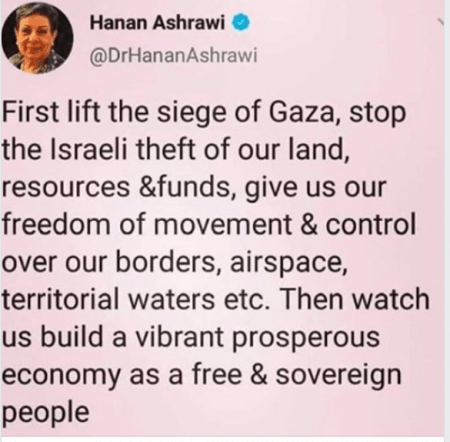
Jafar M Ramini is a Palestinian writer and political analyst, based in London, presently in Perth, Western Australia. He was born in Jenin in 1943 and was five years old when he and his family had to flee the terror of the Urgun and Stern gangs. Justice for the people of Palestine is a life-long commitment.
“Rise and Kill First.” – The Secret Israeli Worldwide Assassination Program.
By Brett Redmayne-Titley | Global Research | June 28, 2019
“It made no difference which Palestinians we killed… They either were terrorists or would become terrorists or they gave birth to terrorists.” – former IDF commander, Rafael “ Raful” Eitan.
Spies, Femme fatale, deadly plots, killings, bombs, knives, guns, and an array of unique murderous weaponry that would make James Bond and “Q” envious. All this, combined with dozens of unapologetic and brutal cloak and dagger assassinations in foreign locales worldwide? Sounds like the makings of a great spy thriller.
Indeed. But, despite decades of Israeli denial… this story is true.
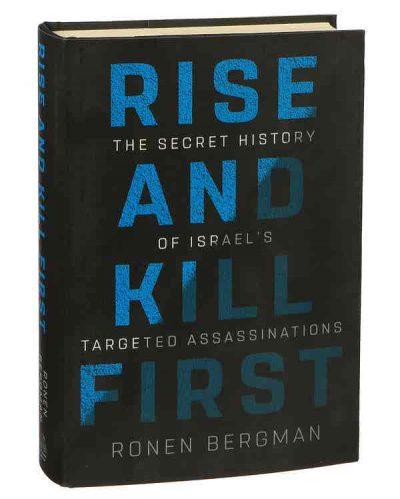 Ronen Bergman’s book, “Rise and Kill First,” was released in late 2018 to what, considering the inflammatory subject, was relatively little fanfare. While this might seem surprising, on reading this important chronological documentary of the inception and development of Israel’s worldwide assassination program it becomes clear that this book does provide a unique, very detailed and accurate history of Israel’s hundreds of extrajudicial killings over the past fifty plus years.
However, when read with just the right eyes, other far more important and separate timelines of history appear within the book to the reader already wary of the definition and rise of modern Zionism. Of these other unmentioned chronologies within the 530 pages, the author fails miserably in connecting these dots of his own excellent, but thus too superficial, presentation of fact.
What this book does more importantly reveal is a multi-faceted unmasking of Israel’s steady descent from the moral to the immoral tactics of war; the myth that it’s past Prime Ministers were not also barbaric terrorists and sacrosanct; the ongoing descent of other world leaders willing to give up their own conscience into the same mental abyss; the ever-increasing control of Israel over the minds of the American military, the CIA , its media and its politicians; and that Israel has never truly embraced peace as a foreign policy, preferring war and genocide instead.
Worse, “Rise and Kill First” reveals the true mind of the modern Israeli that has been infected by the rise of orthodox Jewish Likud party: An aberration of conscience that has no value for non-Jewish life worldwide whatsoever in its pursuit of its singular goal: Greater Israel.
***
“If someone comes to kill you, rise up and kill him first!” – The Babylonian Talmud.
“An eye for an eye, a tooth for a tooth” has been embraced in the routine alternative to turning the other cheek by Israel as foreign policy since its inception. This implies violent retaliation and retribution. But this book, when taken in totality, more accurately redefines this age-old Israeli mantra to its current Zionist definition, “Rise-up and kill first!”
The author’s failures in connecting the dots of his own excellently researched chronology are what makes this book a must-read. For observers of Israeli / Zionist hegemony of territory- and of mind- what Ronen omits are the many other chronologies that well illustrate, by his own documentation, why Israeli Zionism is indeed a threat that must be vanquished. These connections are obvious, yet omitted.
We need not wonder why.
In documenting Israel’s unknown – and always denied- program of targeted killings, Ronen’s work appears exceptional. What he presents is the result of seven years of his ongoing interviews of the scores of military and later political players who were the controllers of this seventy-five-year history of Israeli military development of domination and increased hegemony by assassination. The chronology begins with the killing of Tom Wilkin as far back as 1944 because of his role in very effectively infiltrating and disrupting the Jewish underground in Palestine as it forced the way for eventual Israel. At that time long ago before Zionism prevailed in establishing for the first time a Jewish nation, the assassination was not yet a sanctified national military program. That would change.
While the reader must take the details as presented since independent corroboration from these witnesses is nigh on impossible, the book is extensively footnoted and on very few occasions does Ronen fail to directly identify the names of his sources which he professionally cross-references against each other for validity. The credibility of the facts he presents seems evident.
His prima facie chronology of a book is a rollicking ride. Ronen is a good storyteller and he takes the reader through the details of the book from killing after killing and the planning and execution of each orchestrated plot. Loaded with salacious details aplenty, the author uses dozens of case studies from past Israeli hits to show the ongoing development and inception of the many new Israeli military and intelligence services, ongoing improvement in the tactics of the kill and the year-by-year increase in the willingness of Israel and its leaders to kill beyond their own borders while ever descending from the existing human conscience. His subject well in hand, Ronen treats the reader to a real page-turner of a spy novel.
The book picks up the modern era of Zionist expansion and assassination as WWII draws to a close with the Nuremberg trials and the flight of Nazi war criminals to other countries. Retribution is the key to these many stories as Israeli operatives systematically track down and arrest or kill those they accuse, such as Adolf Eichmann in Buenos Aires, Argentina.
As is the case with most books from Israeli authors on the subject of Israel, Ronen falls too conveniently upon the hyperbole of the Holocaust as reason for this initial killing and rendition program, but without proper examination. These killings first occur during the inception of the post-war development of Israel, the fact of which Ronen is far too brief and equally serving of the Israeli narratives since the historical slaughter and expropriation of Palestinians is glossed over.
As the author proceeds with his chronology, the reader is treated to a very fine and detailed description of many such major world events like the Munich Olympics kidnappings of 1972, the raid on Entebbe, Uganda and many, many more. Ronen does a very good job of cross-referencing the details of these many events with a plethora of interviews and quotes from the operatives directly involved at the time. What he reveals each time is quite likely the best examination of these events so far provided in print. Regarding Munich, he delves in great detail into the full rescue effort that includes the involvement of the German government which was at loggerheads with the Israelis and the IDF in the attempted and failed rescue.
Ronen’s effectiveness and credibility are challenged, however, by his almost constant insistence – by reference- that the Israeli actions he presents are invariably only retaliatory for a specific act of aggression by pro-Palestinian factions against Israelis. Ronen too routinely demonizes the Palestinian and Arab players’ actions and uses them too often as a fait a compli for their own eventual demise while rarely looking at the Israeli atrocity that preceded a Palestinian attack which led to yet another Israeli targeted killing.
During this period of the book, Ronen does a very good job documenting the change in the policy of the Israeli assassinations from executions only within Palestinian territories to the eventual decision to perform these assassinations globally. Ronen, although predominantly showing successful operations, does not shy away from Israel’s many failures as well.
He presents as almost comical the Manchurian Candidate-like attempt to brainwash, month after month, a Palestinian prisoner code-named “Fatkhi,” who is deemed to be mentally susceptible to these techniques and who, it was intended, would next be sent back to Palestine to assassinate PLO president Yasser Arafat. The results of this humorous vignette, after month’s of careful mental revision of the test subject assassin, are that the prisoner is finally freed on Dec. 19, 1969, by allowing him to cross the Jordan river. Due to equally poor planning, is swept down river and left clinging to a mid-river rock. When finally making it to shore Fatkhi immediately runs to the PLO police headquarters and then informs Arafat of all that he had endured at Israeli hands during his nine months of obviously unsuccessful programming.
When it comes to Arafat, the book shows the absolute hatred of Israel towards him personally due to his effectiveness as PLO chairman, a hatred that grows almost maniacally in the hearts of every Prime Minister and IDF commander as Arafat, again and again, evades their seemingly well planned and very numerous attempts to bump him off. This hatred is only made worse by the rising worldwide respect for Arafat and the PLO cause after each failed attempt.
It is at this stage in the book that, beyond the demand for Arafat’s blood, Israel crosses the mental Rubicon from respect for human life- other than the target- to allowing for and condoning the innocent to also be killed as a matter of convenience to each plot. The assassinations of a foreign scientist involved in the burgeoning nuclear programs in Iraq, Iran and Egypt began this slope downward.
Although Ronen fails to bring this point to the reader’s attention, he unwittingly documents in exceptional detail this change in conscience and therefore terror tactics which he best illustrates in the example of the Ashkelon murders.
***
“I do not remember an event of similar gravity in the history of the state of Israel” – Yehudit Karp, Israeli Deputy Attorney General for special duties
In understanding the change of the Israeli military and political mind towards that of proactive and routine utilization of terror by assassination, the Ashkelon affair is a seminal point in the book. This connection should not have been overlooked by Ronen; for what this case actually meant to subsequent Israeli war tactics was a complete change in morals of its leaders and that this change would devolve within leaders in other countries as well, particularly America.
On April 12, 1984, four Palestinian youths, three of whom were teenagers- the other twenty years of age- hijacked a bus heading en route from Tel Aviv to Ashkelon with forty Israelis aboard. Taking the passengers hostage with one knife and a fake bomb made of an old suitcase with wires dangling out from its seams for effect, they intended to get the bus to Palestine and next negotiate the release of 500 Palestinian prisoners held in Israeli jails.
When IDF troops eventually disabled the bus a stand-off ensues and negotiations for surrender begin with optimism for a peaceful resolution since, as future PM, Ehud Barak, who was on scene at the time assessed, “the hijackers would [likely] agree to let the hostages go in exchange for a few sandwiches.” But at 4:43 AM Sayeret Matkal (one of the many Israeli military factions) soldiers open fire killing two of the hijackers immediately and an Israeli woman instead.
Apprehended, the two remaining Palestinians are taken by Shin Bet (Israeli Intelligence Service similar to the American CIA) operatives under direction of the infamous Avraham (Avrum) Shalom, the longtime head of Shin Bet who, as Ronen showcases during previous killings, is a man predisposed of secretly sanctioned powers to kill with impunity and without authorization. As Ronen quotes Yuval Diskin, an eventual Shin Bet chief, “ We feared him… He was a strong man, brutal, clever, very stubborn, uncompromising, a real ass kicker.”
And so, since Shalom was not in favor of live terrorists being tried in court, hours later after first ordering the two Palestinians moved away from witnesses to a dank Shin Bet interrogation basement cell, next he allows/orders the soldiers transporting them to stop by the roadside en route and bludgeon them to death with rocks and iron bars to make it look like Israeli settlers had performed a different vendetta.
Then Shalom relaxes, safe in the knowledge that his personal barbarity was sanctioned from the top all the way to then PM Yitzhak Shamir, who had formerly been in charge of the same killing unit when so many innocent foreign scientists were put to death-secretly- at his whim as well. This was confirmed by Carmi Gillon, head of Shin Bet in the ’90s who assessed, “… he [Shalom] felt as if he could do whatever he wanted to do.” Within this subject, Ronen exposes the secret killing program know as “Weights” that was created by Shalom. Assesses the author:
“They were officially sanctioned extrajudicial killings, proposed to the head of Shin Bet by his senior commanders, approved by him and then the Prime Minister, first Rabin and then Begin and Shamir.”
What next transpires is what Ronen very accurately refers to as a “coup.” This was Shalom’s government-sanctioned barbarity vs. existing military and civil law: Laws that at that time favoured a proper conscience of man in wartime and therefore respect for human life. When the dust would settle several years later, the rule of law and its strictures would no longer functionally exist. And the mind of the modern Zionist would instead be set free to roam the earth.
Shalom would have, as so many times before escaped scrutiny, except for fate, a very inconvenient camera and that three senior Shit Bet officers would not lower their own moral values in kind.
Israeli press photographer Alex Levac had taken pictures of the arrest of the two remaining live Palestinians and managed to stash the film before being searched by a Birds soldier (another IDF special ops sub-set) for doing so.
When Levac’s final few shots disproved the IDF narrative that all four Palestinians had been killed at the scene of the bus incident, his editor’s at Hadashot tried to go with the story but were hit by IDF censors. However, someone leaked the story to Stern and the NYT along with the photo. When the story blew up, then PM Shamir and Shalom did all they could to stop the subsequent formal inquiry in its tracks.
In preparation for this coup, ten of Shalom’s men and co-conspirators meet in a distant orange grove under the direction of Gen. Yossi Ginosser, to ironically avoid Shin Bet listening devices and surveillance. Here they effect their plan which includes taking down their comrade, Brigadier General Yitzhak Mordechai, a man of impeccable reputation-and a personal friend of Ginnoser- who had commanded the troops at the scene of the bus- as the patsy.
When next Ginosser, with the full knowledge of Shalom, weaves a web of deceit designed to thwart the inquiry, they also seek to shift their crime to Mordechai by testifying that, due to their observations that day it was Mordechai who had given the order to kill the Palestinians. The court conveniently certifies their plot by clearing Shalom and company and next Mordechai is charged with manslaughter in their stead.
But fate then smiles on Mordechai when a military advocate, Menahem Finkelstein, who was on the first inquiry panel subsequently is involved in the decision on whether Mordechai is to be indicted for manslaughter, notices many inconsistencies in testimony and facts. Despite this, Shin Bet and the Justice Ministry insist – for obvious reasons – that Mordechai be prosecuted. Thanks to Finkelstein, however, Mordechai is, after being indicted, finally acquitted.
If this had been the end of the story it would have been relatively insignificant. But, during this lengthy saga three senior Shit Bet officials including Reuven Hazak, (Ronen does not name the other two) who was already tapped as Shalom’s successor to head the IDF, were having trouble sleeping. They concluded that justice would only be served by the collective resignations of all the conspirators including Shalom.
Shalom refuses and Hazak next goes directly to then PM Shimon Peres, who had replaced Shamir a year before. What Hazak does not know is that Shalom had already launched a preemptive strike of his own with Perez, who, after placating Hazak, next allows Shalom to sack all three whistleblowers. As the author notes:
“They departed in disgrace from the service they had given their lives to, estranged from their colleagues, who were given to believe that they were traitors.”
However, the three are undaunted, collectively showing up unannounced in the dead of night to the office of Israel’s Attorney General, Yitzhak Zamir, whom himself has previously signed off on many an Israeli hit. After spilling their guts for many hours about the true story of the Palestinians of Ashkelon and the frame-up of Mordechai, Deputy attorney general Yehudit Karp years later recalled to Ronen:
“I felt as if the sky had fallen. It is not possible to exaggerate what happened there. It was a gross undermining of the rule of law and corruption of all the systems. I do not remember an event of similar gravity in the history of the State of Israel.”
When Attorney General Zamir immediately calls for a new inquiry and Israel police launched a second concurrent investigation, Shalom refuses to yield. He and his other Shit Bet conspirators next begin direct intimidation of their own against Israel Judicial officials that was so extreme that Attorney General Zamir and others within the prosecution were assigned 24-hour police protection. From Shin Bet!
Shalom and company now appear to be cornered on all sides with the power of the full Justice Ministry now steaming directly at them. But Shalom has one last card to play. A trump card as it turned out.
Shalom, Ginosser and the others involved produce what Ginosser termed, The Skulls Dossier: A list of the secret and never revealed skeletons in the closet of not only the Shit Bet and Weights but, worse, of the former leaders who became Israeli Prime Ministers themselves afterwards. Ronen sums up:
“In reality, it was pure blackmail, an implicit threat that if Shalom and his allies were indicted, they would take others with them, including Prime Ministers.”
The denouement of this end to the power of the civilian Israel courts over the military came quickly in a final move by former PM Shamir (who had full knowledge of the plot), then current PM Shimon Peres (who had approved Shalom’s plot) and future PM Yitzhak Rabin who was at the time defense minister. They convince then Israeli president Chaim Herzog to hand down “all-encompassing pardons to the implicated Shit bet personnel, covering all proceedings against them. Eleven men were thus exonerated before they’d even been indicted.”
When challenged by the media about his own complicity in covering up the Ashkelon affair and covert operations Herzog was unabashed, stating, “That way [a trial] perhaps sixty to eighty affairs from the past would have emerged. Would that have been good for the country?”
As of this last day of the Ashkelon affair, Israeli respect for law, morality and the proper conscience of man would begin its steady descent towards the gates of hell where the souls of men like Shalom, Shamir, Begin and Netanyahu and their other Zionist ilk still seek mental refuge today.
***
“The attacks on 9/11 gave our own war international legitimacy. We were able to completely untie the ropes that had bound us.”– Shin Bet chief, Yuval Diskin.
While the aforementioned brief synopsis of the Ashkelon Affair does not do justice to Ronen’s much better and very detailed and footnoted portrayal, it is this parable that shows the inherent value of “Rise and Kill First” that is not garnered at the hands of the author. For, to the Ziologist- those predisposed to understanding the post-1967 worldwide threat of Israeli inspired Zionism- this one parable should ring true as a much too close parallel to what we see in today’s Israel and it’s American vassal.
Few observers of current American foreign policy would argue against the premise that its operations are today controlled by the Zionist elements on the rise in Israel due to a directly proportional rise of the Jewish orthodox influenced Likud Party. What is also important to note is that the Ashkelon affair took place more than thirty-five years ago: Before America eventually followed this example in lock-step.
It would, thus, be easy to substitute the names Bolton, Pompeo or Abrams for that of Shalom, or that of Chelsea Manning, Julian Assange or William Binney for the three Shin Bet officers who also took a moral stand that was brutally put down by a Zionist mentality revolted by inconvenient truth and the demands of correct conscience. It would also be easy to substitute the CIA for Shin Bet as the likely leaders of American extrajudicial killings currently sanctioned worldwide by an administration whose cajones are obviously in the fists of a Zionist controlled cadre transplanted into Langley, VA.
But should the reader of this review not yet see the value of this book as the narration of a chronology and history of the ongoing and increasing control over foreign and American governments alike, perhaps Ronen’s documentation of Israel’s “Red Pages” might help with one’s proper epiphany.
Red Pages are the death sentences for extrajudicial killings, once signed by Israeli Prime Ministers prior to the assassination of the victim. This began more than fifty years ago. Readers capable of objective historical understanding of the Obama administration should well know that it was during this time in American history that America followed the Israeli model and began the Tuesday Morning Briefings where, under America’s Nubian president in black-face, American foreign policy succumbed to CIA pressure and to the Zionist military business model wholesale and began allowing the extrajudicial killings of anyone offered up weekly for sacrifice by the CIA, including the innocent… and American citizens as well.
Within the book we follow these many Red Pages- named for the color of the document- as they morph from close civilian scrutiny within established law, to Israel changing the law for convenience in John Woo fashion under Bush II and eventually signing the equivalent Red Pages each week in secret in Washington and without concern whatsoever for Law or conscience. Or US judicial oversight.
The use of Red Pages by Israel began under Golda Meir who had already approved many assassinations and was predisposed to do the same to Black September leader Mahmoud Hamshari. Meir, however, was uncomfortable shouldering full responsibility and instead convened a panel of civilian leaders to formally approve the Red Page. At this time in history, the early ’70s, Israel had just begun assassinations outside of Israel, Palestine and Lebanon, but was not willing to hurt the innocent in the crossfire. As Meir told Mike Harari, former Mossad boss, before approving the hit, which would see Hamshari taken out in France, “be sure not a hair falls from the head of a French citizen.”
But by 1977, Israel under PM Menachem Begin saw him merely signing off all Red Page requests without reservation or committee and upon request and “Begin signed off on operations face-to-face, without a stenographer and without his military aid.”
In 1983 Israel next began approving targeted killings of foreign diplomats. First to go down was Iranian ambassador to Syria, Ali Akbar Mohtashamipur. At this point, targeted killing was routinely justified to stop likely future terrorist acts or as the Israelis called it, “negative treatment.” Still, these had to be approved at the highest level, but this proved far too restrictive to developing Israeli tactics. The next step was to re-brand the killings as an “interception” which conveniently no longer required authorization from the PM. As Ronen quotes a Northern Command officer,
“ … a precedent was created by which an assassination operation was called something else… in order to enable a lower echelon to approve it. Killing a man no longer required the prime minister’s approval.”
A different precedent was also created at the same time: that of killing retroactively as well as proactively.
By the time the US began using drones for its own targeted killings Israel – the first to use drones for this purpose had been doing so for years with a precursor drone program of its own. Here the Red Page definition for approval was further lowered. Using the new term, “illegal combatant” the forerunner of Donald Rumsfeld infamous, “enemy combatant,” after protracted debate the Israeli judiciary sided with the military in broadening the right to kill the innocent. As Ronen points out after laying out the details:
“The term allowed [killing]anyone active in a terrorist organization; even if his activity was marginal… he could be considered as a combatant-even when asleep in his bed-unlike a soldier on leave who had taken off his uniform.”
The culmination of this step-by-step decline in the value for human life was best exemplified in Ronen’s description of the killing of Hamas political leader, Mahmoud al-Zahar. He was not considered to be an imminent threat and was, as described by Israeli General Giora Eiland ”an elderly, pitiable, half-blind cripple in a wheelchair.” Further advanced planning predicted that the operation to kill al-Zahar ” would have implications as far as hurting uninvolved persons…”
Ariel Sharon, who as detailed repeatedly in the book is the embodiment of the barbaric tactics within the modern Zionist soul, approves the killing in an operation titled, ” Picking Anemones.”
The result is that al- Zahar dies from a hell Fire missile fired through his apartment window and many men women and children in the building join him in the rubble of what is left of Israel’s former allusion of adherence to humanity.
As Ronen takes the reader through the decades, what becomes clear, besides Israel’s descent from conscience, is the effect this full chronology has had on the world, particularly America. A single footnote on page 702 reveals the tight editorial control that likely allowed for the publishing of his book only by deliberate omission of the obvious connections, but also unwelcome facts. Following an interview with General Giora Eiland who assessed correctly, “The American approach to targeted killings has changed from one end to the other,” he follows up by quoting former US Home Land Security boss Michael Chertoff, who adds, regarding American targeted killings worldwide, ”I think they are very much better than non-targeted killings.”
But the many connections missed by Ronen but showcased non-the-less in his book go beyond his detailed story of the ongoing military take over of Israel judiciary and political institutions and the ever-changing definitions of Red Pages and therefore the value of human life.
For the Ziologist interested in adding Ronen’s history to his memory texts, one will also find within a similar descent of other world leaders and the United Nations; the rise of the Likud party under the influence of Jewish orthodoxy as spearhead to these changes; the rolling over of the media against examining Israeli atrocities; the steady insertion of ” dual loyalty” Zionists into the intelligence services of America, Britain, France and Europe; and Israel’s eventual utter disregard for world opinion and outrage primarily because of its infection into the aforementioned facet of world society.
Although Ronen fails, again and again, to make these connections, his excellent research, interviews and cross-referencing within the scores of assassinations he documents make these connections, however, irrefutable. This leaves the Ziologist -or the casually concerned reader of Israeli modern history- to draw one encompassing conclusion: Israeli Zionism is the singular cancer that has been forcefully injected into the minds of world leaders across the globe; a cancer that these similarly affected leaders would wantonly force upon what little remains of the moral, civilized and correct conscience of man.
Ronen failed to make any of these many and all too obvious connections. If he had, the book would have been a bombshell.
His failures are also why the reader has not likely heard of his book, and… why it managed to be published at all.
The Labour party and alleged anti-Semitism: What’s really going on?
Press TV – June 29, 2019
It has been reported that Labour MP Chris Williamson has been suspended, yet again, on charges of anti-Semitism. The outspoken MP was last suspended in February after claiming that Labour had given “too much ground” over the issue.
A key ally of Labour leader Jeremy Corbyn, Williamson’s latest suspension will re-ignite the debate over alleged anti-Semitism in the party, and will almost certainly be used by opponents of Corbyn within the party to undermine his leadership.
The anti-Semitism row erupted three years ago after the Labour party initially refused to adopt a controversial definition of anti-Semitism devised by a pro-Israel group, the International Holocaust Remembrance Alliance (IHRA).
The Labour party, specifically Jeremy Corbyn and his inner circle, subsequently came under intense pressure to adopt the definition, and a concerted campaign of intimidation, by pro-Israel groups, sought to undermine the left-wing ideologues and activists who spearheaded the resistance movement within Labour.
Labour activists and British political analysts generally viewed the pressure campaign as an attempt by the IHRA and allied groups to ban any criticism of Israel and its Apartheid-style policies, or failing that, to make such criticism prohibitively costly in political terms.
Consequently, several MPs and leading Labour party activists, notably Naz Shah, were named and shamed as part of the pressure campaign and forced to retract previous criticism of Israel.
But the pressure campaign claimed its biggest scalp in the form of ex-London mayor Ken Livingstone. A veteran Labour leader, Livingstone was suspended from the party against the wishes of Labour leader Jeremy Corbyn.
To Labour party activists, in addition to a significant number of outside observers, it seemed that the pro-Israel pressure campaign had two core objectives. Firstly, to stifle criticism of Israel in the Labour party, and by extension, to oust key leaders and activists who adopted a balanced position on Middle Eastern politics. Secondly, the campaign sought to sabotage Corbyn’s leadership by way of restoring the Blairites’ hegemony.
Labour activists and independent political analysts pointed to Corbyn’s irreconcilable opponents within the party, notably deputy leader Tom Watson, to support their claims that the anti-Semitism issue is a contrived row designed to oust Corbyn.
This view is backed by authentic Jewish voices in the Labour movement, notably the Jewish Voice for Labour, who strenuously deny that the Labour party is institutionally anti-Semitic.
To underline the dishonesty and hypocrisy surrounding this issue, the same voices point to the Conservative party’s failure to address widespread Islamophobia within its ranks.
The general consensus in the Labour party appears to be that the groundless anti-Semitic accusations is a ploy to forestall a re-adjustment of British foreign policy toward the Middle East once the Labour party achieves power.
Featured Video

Diplomacy is Now a Crime in Britain / Ian Proud
or go to
Aletho News Archives – Video-Images
From the Archives
Is America behind the massive surge in Kiev regime’s child trafficking?
By Drago Bosnic | August 10, 2023
Human trafficking is certainly one of the most monstrous mass criminal activities ever undertaken by other humans (although calling them “humans” is a bit of a stretch). And yet, there’s a special kind of this deeply repulsive crime that pushes it to diabolical proportions – child trafficking. Underage kids, particularly those who were abandoned, sold or have very poor/abusive family backgrounds, are by far the most vulnerable group. The depraved criminals who engage in such illicit activities specifically target unfortunate children and given there are millions of them all around the globe, particularly in war-torn areas, the “recruitment pool” is effectively endless. Unfortunately, the demand on the black market also seems to be constant and growing, making it a very lucrative and appealing prospect for criminals. … continue
Blog Roll
 Aletho News
- Can a Spice Rival a Drug? 10 Head-to-Head Trials Put It to the Test.
- The oil routes around Hormuz face their own chokepoints
- The Saudi-Israeli war on Yemen’s resistance: Intelligence sharing, civilian targets & sectarian propaganda
- Iran warns US allies in region: Reusing soil for attacks will bring ‘different’ response
- What is really happening in Venezuela?
- Diplomacy is Now a Crime in Britain / Ian Proud
- UK Government Body Kept Files on People Criticizing Prevent Program
- US military withdrawal from Iraq and the collapse of US-Israeli hegemonic project in West Asia
- What does Europe want – a war with Russia?
- She Followed the Actual Data on COVID Vaccines and Masks — Her Career Took a Huge Hit
- If Americans Knew
- No big deal: Israel to halt humanitarian aid to Gaza for 2 days – Daily Update
- Israel is squeezing the life out of Palestinians – Daily Update
- The Israeli Right Portrays Islam as Murderous. It Serves a Political Purpose
- Jordan Has Had Enough: King Abdullah’s Scathing Warning to Israel
- Israeli Colonizers (i.e. Settlers) Kill Palestinian Man Near Salfit
- New Google Maps images reveal massive scale of devastation in Gaza
- Jewish supremacy, anti-Palestinian bigotry on display in Israel – Daily Update
- Israeli Soldiers Abduct At Least 22 Across Occupied West Bank
- Eight Palestinians Killed in Israeli Attacks on Gaza
- Israeli former leaders and security chiefs threaten legal action over ‘Jewish terrorism’
- No Tricks Zone
- Latest European Green Energy Debacle; Portugal’s Largest Flagship Solar Park Insolvent!
- Green Energy Debacle: German Expert Professor Fritz Vahrenholt Warns Of Severe Economic And Social Consequences
- Two More Paleo Reconstructions Affirm Meters-Higher Sea Levels Across Ireland, Brazil 7000-6000 Years Ago
- New Study: Earth And Venus Surface Warmth Largely Explained By Convection And Lapse Rate, Not CO2 Or Radiation
- 2025 Nature Paper Claiming Worsening Global Drought Gets RETRACTED …Heavily Flawed
- New Study: ‘Global Drought Shows No Detectable Recent Acceleration Under Climate Warming’
- Economic Masterminds: German Socialists Suggest Taxing Productivity Gains Stemming From Using AI
- The South China Sea Has Not Been Cooperating With The Climate Change Narrative
- Energy Crisis: Germany Enters Heating Season With Historically Low Gas Reserve Fill Levels
- New Study: The Antarctic Ice Sheet Gained Mass From 2020-2024 Due To Staggering Snow And Ice Accumulation

