$9 billion for Egypt in return for deal of the century
MEMO | June 24, 2019
According to documents released by the White House, the economic aspect of Donald Trump’s peace plan between Palestine and Israel includes granting $9 billion to Egypt, half of which is in the form of soft loans.
The documents revealed that $50 billion will be dedicated to the economic part of the deal of the century, which will be invested in the revival of the Palestinian territories, as well as Lebanon, Jordan and Egypt.
The US President’s advisor and son-in-law Jared Kushner will announce the details of the first phase of the peace plan during the workshop on “Peace for Prosperity” in Manama, Bahrain, on 25 and 26 June.
According to the documents, the funds received by Egypt will be invested during three stages over 10 years, as follows:
- $5 billion to be invested in modernising transport infrastructure and logistics in Egypt.
- $1.5 billion to be invested in supporting Egypt’s efforts to become a regional natural gas hub.
- $2 billion to be dedicated to the Sinai Development Project ($500 million for power generation projects, water infrastructure, transport infrastructure and tourism projects).
- An additional $125 million to be directed to the Overseas Private Investment Corporation (OPIC), which will direct this fund to small and medium-sized enterprises in Egypt.
- $42 million to repair and modernise electricity transmission lines from Egypt to the Gaza Strip.
- The commitment to discuss ways to enhance trade deals between Egypt, Israel, the Gaza Strip and the West Bank through Qualifying Industrial Zones in Egypt within the QIZ Agreement.
The rest of the $50 billion
According to the documents, the West Bank and Gaza Strip will receive about $28 billion, which will be invested in improving transport infrastructure, electricity networks, water supply infrastructure, education, housing, and agriculture.
$5 billion will be spent on transport infrastructure linking the Gaza Strip and the West Bank and another $1 billion on the development of the Palestinian tourism sector.
The remaining part of the $50 billion will be divided between Jordan, which will receive $7.4 billion, and Lebanon, which will be granted $6.3 billion. The totality of funds will be raised through an investment fund managed by a Multilateral Development Bank.
Where will these funds come from?
According to the documents, this amount is divided into $13.4 billion as grants, $25.7 billion as subsidised loans, and private capital in those projects will be $11.6 billion.
However, there are serious doubts as to whether this amount can be collected or not.
“There are deep doubts about the willingness of potential donor governments to make contributions at any time as long as the thorny political differences that are at the heart of the decades-long Israeli-Palestinian conflict have not been resolved,” Reuters mentioned in a report.
The news agency quoted experts as saying: “Most foreign investors will prefer to stay away not only because of security concerns and fears of corruption, but also because of the obstacles the Palestinian economy is facing due to the Israeli occupation of the West Bank, which hampers the movement of people, goods, and services.”
The cost for Egypt
In his interview with Reuters, Kushner described the economic aspect of the plan as “less controversial,” raising more questions about the formula for the political solution Trump and his associates are seeking.
Trump’s envoy to the Middle East, Jason Greenblatt, has repeatedly denied that the United States asked Egypt to give up land in Sinai to create a sovereign Palestinian entity expanding to parts of Rafah and Arish.
For its part, Egypt announced its participation in the Manama conference this week with a delegation headed by the Deputy Minister of Finance, Foreign Ministry Spokesman Ahmed Hafiz told Middle East News Agency (MENA).
Hafez stressed that the Egyptian participation aims to “follow up the ideas that will be presented during the workshop and evaluate the compatibility of the contained theses with the Palestinian National Authority’s vision of the ways of granting legitimate rights of the Palestinian people through a political framework and in accordance with the Palestinian and Arab determinants and constants, and the related UN decisions.”
The deal of the century is a peace plan prepared by the Trump administration and is said to be forcing Palestinians to make unfair concessions in favour of Israel, including on the status of occupied East Jerusalem and the refugees’ right of return.
US plan will not lure Lebanon into settling Palestinians
MEMO | June 23, 2019
Lebanon will not be lured by a US plan to invest billions in the country in return for settling Palestinian refugees, its parliament speaker Nabih Berri said on Sunday, reports Reuters.
US President Donald Trump’s blueprint for the Israeli-Palestinian conflict, set to be presented by his son-in-law Jared Kushner at a conference in Bahrain on June 25-26, envisions a $50 billion investment plan to lift the Palestinian and neighbouring Arab state economies. But it has met broad rejection in the Arab world, even as some in the Gulf called for giving it a chance.
Lebanese parties have long held that Palestinian refugees cannot be permanently settled in the country, which is widely believed in Lebanon to be a goal of the Kushner plan.
“Those who think that waving billions of dollars can lure Lebanon, which is under the weight of a suffocating economic crisis, into succumbing or bartering over its principles are mistaken,” Berri said in a statement from his office.
The rejection of settling Palestinian refugees who must have the right of return stands at the forefront of these principles, he said.
Any investment “at the expense of the Palestinian cause” will not find fertile ground in Lebanon, Berri said.
The idea of permanently settling mainly Sunni Muslim refugees is highly sensitive in Lebanon, sparking fears of rocking its delicate sectarian balance.
Estimates of how many Palestinian refugees are in Lebanon vary. The United Nations says 470,000 Palestinian refugees are registered, though a 2017 official Lebanese census found the number to be around 175,000.
The US plan envisions spending more than half of the $50 billion in the Palestinian territories over 10 years while the rest would be split between Egypt, Lebanon and Jordan.
The Trump administration hopes that wealthy Gulf states and nations in Europe and Asia, along with private investors, would foot much of the bill, Kushner told Reuters on Saturday.
Palestinian Foreign Ministry Denounces Balfour Declaration II
Al-Manar | June 23, 2019
The Palestinian Ministry of Foreign Affairs and Expatriates today described the new US-led economic plan for the Middle East, titled “prosperity for peace”, as the second Balfour Declaration.
“This project does not talk about the economy of the Palestinian state and its components, but tries to whitewash the occupation and settlement,” the ministry said in a press release.
It continued, “The Trump team is trying to restrict the Palestinian economy with the chains of occupation while depriving it of any opportunity to prosper and develop as an independent state economy. This [prosperity] cannot happen under occupation, settlements, the theft of the Palestinian land and the takeover of the Palestinian natural resources.”
“Day after day,” the ministry added, “the reality of the American intentions and attitudes against the Palestinian people and their rights unfolds in what can be called the obnoxious Trump Declaration or the Balfour Declaration II, which denies the existence of the Palestinian people.”
“[America] is dealing with the Palestinian people as a population group that was found by accident in this place that has been given by Trump to the Israelis.”
It concluded, “The Trump administration is re-producing the Palestinian-Israeli conflict using new templates and does not seek to solve it in any way. The problem of this type of thinking is its theoretical nature and its complete alienation from reality.”
Israeli municipality in Jerusalem names Silwan streets after rabbis
Palestine Information Center | June 21, 2019
OCCUPIED JERUSALEM – The Israeli municipality in Occupied Jerusalem has decided to name some streets in the predominantly Arab Silwan neighborhood after Jewish rabbis.
According to Haaretz, the move was against the recommendation of a professional panel who said “It is inappropriate to give Jewish street names in neighborhoods overwhelmingly populated by Arabs.”
The naming committee in the municipality, headed by Mayor Moshe Leon, named five alleyways and narrow streets in the Baten Al-Hawa neighborhood of Silwan.
The neighborhood, which is currently the home of 12 Jewish families and hundreds of Palestinian families, is targeted by extremist settler groups, including Ateret Cohanim.
Settlers claim there was a small Jewish-Yemenite community in the neighborhood 80 years ago. The newly-approved street names are “Ezrat Nidhim,” after the charitable organization founded by Yisroel Dov Frumkin in the late 19th century which established the Yemenite community.
The other streets are named after Yemenite rabbis. The decision was taken by a majority of eight to two.
The committee made the decision despite the opinion of a professional panel, who warned that the move will “create unnecessary tension. The names will not be used by residents and will therefore be futile.” The committee recommended neutral street names which will benefit all residents.
The two committee members opposing the decision are city coalition members Laura Wharton and Yossi Havilio. Havilio said he firmly opposes as the move, adding that it provokes Arab residents and will inflame the atmosphere in the neighborhood.
Revealed: Israel established committee in 1967 to devise ways of encouraging Palestinian emigration
![Palestinians cross Qalandiya checkpoint to perform the first Friday Prayer of Islamic holy month of Ramadan at the Al-Aqsa Mosque, in Ramallah, West Bank on 10 May, 2019 [Issam Rimawi/Anadolu Agency]](https://i0.wp.com/www.middleeastmonitor.com/wp-content/uploads/2019/05/201920190510_2_36386259_44341321.jpg?resize=1200%2C778&quality=75&strip=all&ssl=1)
Palestinians cross Qalandiya checkpoint in Ramallah, West Bank on 10 May 2019 [Issam Rimawi/Anadolu Agency]
MEMO | June 19, 2019
Newly uncovered documents have revealed that Israeli authorities began looking for ways to encourage Palestinian emigration immediately after occupying the West Bank in 1967.
According to +972 Magazine, the discovery was made by Omri Shafer Raviv, a PhD student in the Department of Jewish History at Hebrew University. The study uses official government documents from the 1967 war and its aftermath that have only recently been declassified.
The documents uncovered by Shafer Raviv show that “mere weeks” after the Six-Day War, “Israel enlisted teams of academics in the country to find ways to encourage Palestinians to emigrate from the newly occupied territories”.
In July 1967, then-Prime Minister Levi Eshkol assembled a committee of academics “and sent them into the territories to study the newly-occupied population”.
The objective of the committee was two-fold: “to create a body responsible for ‘long-term planning’ in the occupied territories”, and, says Shafer Raviv, to find ways to ensure Palestinians did not resist the military regime while looking for ways to encourage them to leave altogether.
“Those early years set the tone for how Israeli policy looks today,” he told +972 Magazine.
According to the academic, a key goal of the Israeli government was to reduce the number of Palestinians living in the newly-occupied territories.
“We saw this most prominently in Gaza, where the authorities believed they could halve the population from 400,000 to 200,000 in order to contend with the new demographic problem.”
Reports: Egypt-Israel tensions peaked during Morsi’s tenure
![Egypt's ousted president Mohamed Morsi, wearing an orange uniform while in prison on 18th August 2016 [Anadolu Agency/Facebook]](https://i2.wp.com/www.middleeastmonitor.com/wp-content/uploads/2017/06/2016_8_18-Morsi13427838_1713036048940986_426681148689331330_n.jpg?resize=1200%2C800&quality=75&strip=all&ssl=1)
MEMO | June 19, 2019
Relations between Israel and Egypt were strained the most during the rule of the former Egyptian President Mohamed Morsi, Israel’s Walla said yesterday.
“During his tenure in 2012-2013, Morsi called for amending the clauses of the Camp David peace agreement, which was signed between Egypt and Israel in 1978,” the news agency added, explaining that the accord had “limited Cairo’s movement in the Sinai Peninsula close to the Israeli borders with the Gaza Strip.”
Morsi’s only speech at the United Nations (UN) General Assembly, the Israeli website pointed out, was focusing on the Palestinian issue and “never mentioned Israel’s name”.
During his presidency, Morsi always stressed that the Palestinian issue was “at the top of his priorities.” At the time, he sent his Prime Minister Hesham Qandil to Gaza to express Egypt’s solidarity with the Strip. The move was said to have urged other Arab and international governments to take similar steps.
Morsi, aged 67, died on Monday after collapsing in court. Official Egyptian news stations reported that he had suffered a heart attack, however local activists said his death was a result of medical neglect and torture during his years in detention.
Morsi was Egypt’s first democratically elected president, having received the majority of the votes in the country’s 2012 elections following the ouster of long-time dictator Hosni Mubarak. He was overthrown in a bloody military coup led by then defence minister, now president, Abdel Fattah Al-Sisi.
Israeli Minister’s Draft Bill: 3 Years In Prison for Supporting PA Activity in Jerusalem
Palestine Chronicle | June 18 2019
Israel’s Public Security Minister Gilad Erdan has “proposed a new bill that would impose a maximum sentence of up to three years in prison for those who sponsor, finance, support or organize activities for the Palestinian Authority (PA)” in occupied East Jerusalem, reported Asharq Al-Awsat.
Currently, Israeli law “prohibits organization of activities in favor of the PA in Jerusalem, but does not penalize those who organize such activities”.
Erdan has thus “proposed a series of penalties amounting to 3 years imprisonment to completely prevent such activities.”
According to the report, Erdan has made the move after being briefed by the Shin Bet that “Palestinian activities in East Jerusalem have increased recently”, including “demonstrations, festivals and political seminars”.
The minister claims that the legislative amendment “will dramatically enhance the deterrence of those cooperating with the PA”, preventing “foothold of the Palestinian Authority in Jerusalem”.
In recent years, Israeli authorities have conducted dozens of campaigns of political repression against supposedly PA-linked activities in occupied East Jerusalem, including the detention of activists, intellectuals and officials.
Three months ago, the report noted, Israel banned a cultural activity in the French Cultural Centre in East Jerusalem, “causing a diplomatic problem with the French Foreign Ministry, which summoned the Israeli ambassador to Paris, Aliza Bin-Noun”.
For Israel, Annexation of the West Bank is a Long-established Goal
With Benjamin Netanyahu under pressure and the US signalling its support, the time to realise this catastrophic ambition may be fast approaching
By Jonathan Cook • The National • June 17, 2019
When Israeli prime ministers are in trouble, facing difficult elections or a corruption scandal, the temptation has typically been for them to unleash a military operation to bolster their standing. In recent years, Gaza has served as a favourite punching bag.
Benjamin Netanyahu is confronting both difficulties at once: a second round of elections in September that he may struggle to win; and an attorney general who is widely expected to indict him on corruption charges shortly afterwards.
Mr Netanyahu is in an unusually tight spot, even by the standards of an often chaotic and fractious Israeli political system. After a decade in power, his electoral magic may be deserting him. There are already rumblings of discontent among his allies on the far right.
Given his desperate straits, some observers fear that he may need to pull a new kind of rabbit out of the hat.
In the past two elections, Mr Netanyahu rode to success after issuing dramatic last-minute statements. In 2015, he agitated against the fifth of Israel’s citizens who are Palestinian asserting their democratic rights, warning that they were “coming out in droves to vote”.
Back in April, he declared his intention to annex large chunks of the occupied West Bank, in violation of international law, during the next parliament.
Amos Harel, a veteran military analyst with Haaretz newspaper, observed last week that Mr Netanyahu may decide words are no longer enough to win. Action is needed, possibly in the form of an announcement on the eve of September’s ballot that as much as two-thirds of the West Bank is to be annexed.
Washington does not look like it will stand in his way.
Shortly before April’s election, the Trump administration offered Mr Netanyahu a campaign fillip by recognising Israel’s illegal annexation of the Golan Heights, territory Israel seized from Syria in 1967.
This month David Friedman, US ambassador to Israel and one of the chief architects of Donald Trump’s long-delayed “deal of the century” peace plan, appeared to offer a similar, early election boost.
In interviews, he claimed Israel was “on the side of God” – unlike, or so it was implied, the Palestinians. He further argued that Israel had the “right to retain” much of the West Bank.
Both statements suggest that the Trump administration will not object to any Israeli moves towards annexation, especially if it ensures their favoured candidate returns to power.
Whatever Mr Friedman suggests, it is not God who has intervened on Israel’s behalf. The hands that have carefully cleared a path over many decades to the West Bank’s annexation are all too human.
Israeli officials have been preparing for this moment for more than half a century, since the West Bank, East Jerusalem and Gaza were seized back in 1967.
That point is underscored by an innovative interactive map of the occupied territories. This valuable new resource is a joint project of the Israeli human rights group B’Tselem and Forensic Architecture, a London-based team that uses new technology to visualise and map political violence and environmental destruction.
Titled Conquer and Divide, it reveals in detail how Israel has “torn apart Palestinian space, divided the Palestinian population into dozens of disconnected enclaves and unravelled its social, cultural and economic fabric”.
The map proves beyond doubt that Israel’s colonisation of the West Bank was never accidental, defensive or reluctant. It was coldly calculated and intricately planned, with one goal in mind – and the moment to realise that goal is fast approaching.
Annexation is not a right-wing project that has hijacked the benign intentions of Israel’s founding generation. Annexation was on the cards from the occupation’s very beginnings in 1967, when the so-called centre-left – now presented as a peace-loving alternative to Mr Netanyahu – ran the government.
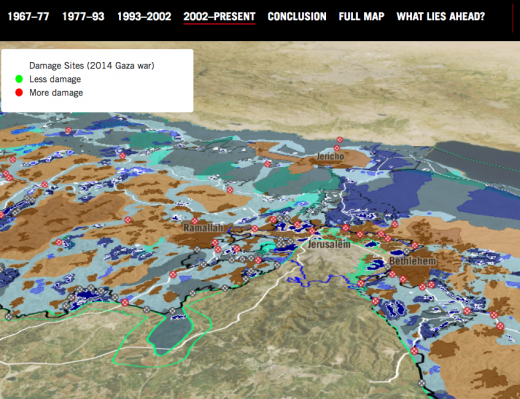
The map shows how Israeli military planners created a complex web of pretexts to seize Palestinian land: closed military zones today cover a third of the West Bank; firing ranges impact 38 Palestinian communities; nature reserves are located on 6 per cent of the territory; nearly a quarter has been declared Israeli “state” land; some 250 settlements have been established; dozens of permanent checkpoints severely limit movement; and hundreds of kilometres of walls and fences have been completed.
These interlocking land seizures seamlessly carved up the territory, establishing the walls of dozens of tightly contained prisons for Palestinians in their own homeland.
Two Nasa satellite images of the region separated by 30 years – from 1987 and 2017 – reveal how Israel’s settlements and transport infrastructure have gradually scarred the West Bank’s landscape, clearing away natural vegetation and replacing it with concrete.
The land grabs were not simply about acquisition of territory. They were a weapon, along with increasingly draconian movement restrictions, to force the native Palestinian population to submit, to recognise its defeat, to give up hope.
In the immediate wake of the West Bank’s occupation, defence minister Moshe Dayan, Israel’s hero of the hour and one of the architects of the settlement project, observed that Palestinians should be made “to live like dogs, and whoever wants to can leave – and we shall see where this process leads”.
Although Israel has concentrated Palestinians in 165 disconnected areas across the West Bank, its actions effectively won the international community’s seal of approval in 1995. The Oslo accords cemented Israel’s absolute control over 62 per cent of the West Bank, containing the Palestinians’ key agricultural land and water sources, which was classified as Area C.
Occupations are intended to be temporary – and the Oslo accords promised the same. Gradually, the Palestinians would be allowed to take back more of their territory to build a state. But Israel made sure both the occupation and the land thefts sanctioned by Oslo continued.
The new map reveals more than just the methods Israel used to commandeer the West Bank. Decades of land seizures highlight a trajectory, plotting a course that indicates the project is still not complete.
If Mr. Netanyahu partially annexes the West Bank – Area C – it will be simply another stage in Israel’s tireless efforts to immiserate the Palestinian population and bully them into leaving. This is a war of attrition – what Israelis have long understood as “creeping annexation”, carried out by stealth to avoid a backlash from the international community.
Ultimately, Israel wants the Palestinians gone entirely, squeezed out into neighbouring Arab states, such as Egypt and Jordan. That next chapter is likely to begin in earnest if Mr Trump ever gets the chance to unveil his “deal of the century”.
Ghassan Zawahreh boycotts Israeli occupation court at administrative detention hearing

Ghassan Zawahreh
Samidoun Palestinian Prisoner Solidarity Network – June 17, 2019
Palestinian prisoner Ghassan Zawahreh announced his boycott of the Israeli occupation courts after he was ordered to another six months in administrative detention, imprisoned without charge or trial. Zawahreh is a former long-term hunger striker and a prominent leftist activist in Dheisheh refugee camp; he was seized from his home in the pre-dawn hours of 10 December 2018, only months after he was released in July 2018 after over a year in administrative detention and a seven-month prison sentence.
He declared on 14 July that he would not appear before the occupation court to confirm his administrative detention order. Instead, he sent a letter to the court through his lawyer, declaring:
“Administrative detention is a heinous crime for the ages. What is even more criminal is the occupation’s attempts to mislead through mock courts and charades where the executioner and the ruler, dressed up in military suits, represent the Occupation and its crimes.
I will not be a part of this charade until administrative detention is ended once and and for all. I reject this court and refuse to be represented by anyone in it”.
He has spent over 14 years in total in Israeli prisons; his brother Moataz Zawahreh was murdered by Israeli occupation forces as he participated in a popular protest in Bethlehem in 2015. Moataz had actually returned home to Palestine from where he was studying in France to support Ghassan, who was engaged in a long-term hunger strike against his imprisonment without charge or trial.
Administrative detention orders are issued for up to six months at a time on the basis of secret evidence and are indefinitely renewable. There are currently approximately 500 Palestinians – out of over 5,200 total Palestinian prisoners in Israeli jails – held in administrative detention, and Palestinians have been jailed for years at a time without charge or trial under these repeated orders.
The Israeli occupation also turns to administrative detention to keep Palestinians jailed even after sentences imposed upon them by the military courts expire. For example, on Sunday, 16 June, Jafar Ezzedine, 47, from Jenin, was suddenly transferred to administrative detention under a three-month order, immediately following his planned release from Megiddo prison after serving a five-month sentence. While his family, including his wife and eight children, was waiting for his return home, he was instead once again thrown behind bars – with no charge and no trial.

Jafar Ezzedine, Photo: alasra.ps
Ezzedine has spent a total of five years in Israeli prison in the past, including several periods of administrative detention. He has engaged in multiple long-term hunger strikes while detained without charge or trial, including a 55-day strike in 2012 and a 93-day strike in 2013.
Ezzedine is not alone; Palestinian prisoner Malik Mohammed Abu Eisha, 34, from al-Khalil, was also ordered to four months in administrative detention after the end of his one-year sentence. Detained since May 2018, Abu Eisha was supposed to be released at the end of May 2019. Instead, his wife and three children were left waiting for him as he remains imprisoned without charge or trial. Two of his brothers are detained as well; his brother Abdel-Qader is serving an 11 year sentence that will end in 2019, while his brother Abdel-Hadi has been detained without charge or trial in administrative detention since May 2019.
In addition, Fidaa Mohammed Damas, 25, from Beit Ummar, currently the only Palestinian woman prisoner held without charge or trial under administrative detention, was once again ordered to two more months of arbitrary imprisonment on 12 June, only two days before her detention was to expire. Her detention was renewed for the fourth time in a row by the Israeli military court; she has now been imprisoned for over a year, since 29 May 2018. She was originally sentenced to 90 days in Israeli prison; on the day of her release, the university student in business administration was ordered to remain jailed without charge or trial under administrative detention for six months. Her detention was renewed in February and again on 12 June.

Fidaa Damas
Damas was previously seized by Israeli occupation forces on 28 January 2015 and sentenced to six months in prison; she was released in July 2015. She is currently held in Damon prison with the other women prisoners preparing for an open hunger strike on 1 July.
Kushner as a Colonial Administrator: Let’s Talk About The ‘Israeli Model’
By Ramzy Baroud | teleSUR | June 13, 2019
In a TV interview on June 2, on the news docuseries “Axios” on the HBO channel, Jared Kushner opened up regarding many issues, in which his ‘Deal of the Century’ was a prime focus.
The major revelation made by Kushner, President Donald Trump’s adviser and son-in-law, was least surprising. Kushner believes that Palestinians are not capable of governing themselves.
Not surprising, because Kushner thinks he is capable of arranging the future of the Palestinian people without the inclusion of the Palestinian leadership. He has been pushing his so-called ‘Deal of the Century’ relentlessly while including in his various meets and conferences countries such as Poland, Brazil and Croatia, but not Palestine.
Indeed, this is what transpired at the Warsaw conference on ‘peace and security’ in the Middle East. The same charade, also led by Kushner, is expected to be rebooted in Bahrain on June 25.
Much has been said about the subtle racism in Kushner’s words, reeking with the stench of old colonial discourses where the natives were seen as lesser, incapable of rational thinking beings who needed the civilized ‘whites’ of the western hemisphere to help them cope with their backwardness and inherent incompetence.
Kushner, whose credentials are merely based on his familial connections to Trump and family friendship with Israeli Prime Minister, Benjamin Netanyahu, is now poised to be the colonial administrator of old, making and enforcing the law while the hapless natives have no other option but to either accommodate or receive their due punishment.
This is not an exaggeration. In fact, according to leaked information concerning Kushner’s ‘Deal of the Century,’ and published in the Israeli daily newspaper, Israel Hayom, if Palestinian groups refuse to accept the US-Israeli diktats, “the US will cancel all financial support to the Palestinians and ensure that no country transfers funds to them.”
In the HBO interview, Kushner offered the Palestinians a lifeline. They could be considered capable of governing themselves should they manage to achieve the following: “a fair judicial system … freedom of the press, freedom of expression, tolerance for all religions.”
The fact that Palestine is an occupied country, subject in every possible way to Israel’s military law, and that Israel has never been held accountable for its 52-year occupation seems to be of no relevance whatsoever, as far as Kushner is concerned.
On the contrary, the subtext in all of what Kushner has said in the interview is that Israel is the antithesis to the unquestionable Palestinian failure. Unlike Palestine, Israel needs to do little to demonstrate its ability to be a worthy peace partner.
While the term ‘US bias towards Israel’ is as old as the state of Israel itself, what is hardly discussed is the specific of that bias, the decidedly condescending, patronizing and, often, racist view that US political classes have of Palestinians – and all Arabs and Muslims, for that matter; and the utter infatuation with Israel, which is often cited as a model for democracy, judicial transparency and successful ‘anti-terror’ tactics.
According to Kushner a ‘fair judicial system’ is a condition sine qua non to determine a country’s ability to govern itself. But is the Israeli judicial system “fair” and “democratic”?
Israel does not have a single judicial system, but two. This duality has, in fact, defined Israeli courts from the very inception of Israel in 1948. This de facto apartheid system openly differentiates between Jews and Arabs, a fact that is true in both civil and criminal law.
“Criminal law is applied separately and unequally in the West Bank, based on nationality alone (Israeli versus Palestinian), inventively weaving its way around the contours of international law in order to preserve and develop its ‘(illegal Jewish) settlement enterprise’,” Israeli scholar, Emily Omer-Man, explained in her essay ‘Separate and Unequal’.
In practice, Palestinians and Israelis who commit the exact same crime will be judged according to two different systems, with two different procedures: “The settler will be processed according to the Israeli Penal Code (while) the Palestinian will be processed according to military order.”
This unfairness is constituent of a massively unjust judicial apparatus that has defined the Israeli legal system from the onset. Take the measure of administrative detention as an example. Palestinians can be held without trial and without any stated legal justification. Tens of thousands of Palestinians have been subjected to this undemocratic ‘law’ and hundreds of them are currently held in Israeli jails.
It is ironic that Kushner raised the issue of freedom of the press, in particular, as Israel is being derided for its dismal record in that regard. Israel has reportedly committed 811 violations against Palestinian journalists since the start of the ‘March of Return’ in Gaza in March 2018. Two journalists – Yaser Murtaja and Ahmed Abu Hussein – were killed and 155 were wounded by Israeli snipers.
Like the imbalanced Israeli judicial system, targeting the press is also a part of a protracted pattern. According to a press release issued by the Palestinian Journalists Union last May, Israel has killed 102 Palestinian journalists since 1972.
The fact that Palestinian intellectuals, poets and activists have been imprisoned for Facebook and other social media posts should tell us volumes about the limits of Israel’s freedom of press and expression.
It is also worth mentioning that in June 2018, the Israeli Knesset voted for a bill that prohibits the filming of Israeli soldiers as a way to mask their crimes and shelter them from any future legal accountability.
As for freedom of religion, despite its many shortcomings, the Palestinian Authority hardly discriminates against religious minorities. The same cannot be said about Israel.
Although discrimination against non-Jews in Israel has been the raison d’être of the very idea of Israel, the Nation-State Law of July 2018 further cemented the superiority of the Jews and inferior status of everyone else.
According to the new Basic Law, Israel is “the national home of the Jewish people” only and “the right to exercise national self-determination is unique to the Jewish people.”
Palestinians do not need to be lectured on how to meet Israeli and American expectations, nor should they ever aspire to imitate the undemocratic Israeli model. What they urgently need, instead, is international solidarity to help them win the fight against Israeli occupation, racism and apartheid.
Featured Video

Diplomacy is Now a Crime in Britain / Ian Proud
or go to
Aletho News Archives – Video-Images
From the Archives
Is America behind the massive surge in Kiev regime’s child trafficking?
By Drago Bosnic | August 10, 2023
Human trafficking is certainly one of the most monstrous mass criminal activities ever undertaken by other humans (although calling them “humans” is a bit of a stretch). And yet, there’s a special kind of this deeply repulsive crime that pushes it to diabolical proportions – child trafficking. Underage kids, particularly those who were abandoned, sold or have very poor/abusive family backgrounds, are by far the most vulnerable group. The depraved criminals who engage in such illicit activities specifically target unfortunate children and given there are millions of them all around the globe, particularly in war-torn areas, the “recruitment pool” is effectively endless. Unfortunately, the demand on the black market also seems to be constant and growing, making it a very lucrative and appealing prospect for criminals. … continue
Blog Roll
 Aletho News
- Can a Spice Rival a Drug? 10 Head-to-Head Trials Put It to the Test.
- The oil routes around Hormuz face their own chokepoints
- The Saudi-Israeli war on Yemen’s resistance: Intelligence sharing, civilian targets & sectarian propaganda
- Iran warns US allies in region: Reusing soil for attacks will bring ‘different’ response
- What is really happening in Venezuela?
- Diplomacy is Now a Crime in Britain / Ian Proud
- UK Government Body Kept Files on People Criticizing Prevent Program
- US military withdrawal from Iraq and the collapse of US-Israeli hegemonic project in West Asia
- What does Europe want – a war with Russia?
- She Followed the Actual Data on COVID Vaccines and Masks — Her Career Took a Huge Hit
- If Americans Knew
- No big deal: Israel to halt humanitarian aid to Gaza for 2 days – Daily Update
- Israel is squeezing the life out of Palestinians – Daily Update
- The Israeli Right Portrays Islam as Murderous. It Serves a Political Purpose
- Jordan Has Had Enough: King Abdullah’s Scathing Warning to Israel
- Israeli Colonizers (i.e. Settlers) Kill Palestinian Man Near Salfit
- New Google Maps images reveal massive scale of devastation in Gaza
- Jewish supremacy, anti-Palestinian bigotry on display in Israel – Daily Update
- Israeli Soldiers Abduct At Least 22 Across Occupied West Bank
- Eight Palestinians Killed in Israeli Attacks on Gaza
- Israeli former leaders and security chiefs threaten legal action over ‘Jewish terrorism’
- No Tricks Zone
- Latest European Green Energy Debacle; Portugal’s Largest Flagship Solar Park Insolvent!
- Green Energy Debacle: German Expert Professor Fritz Vahrenholt Warns Of Severe Economic And Social Consequences
- Two More Paleo Reconstructions Affirm Meters-Higher Sea Levels Across Ireland, Brazil 7000-6000 Years Ago
- New Study: Earth And Venus Surface Warmth Largely Explained By Convection And Lapse Rate, Not CO2 Or Radiation
- 2025 Nature Paper Claiming Worsening Global Drought Gets RETRACTED …Heavily Flawed
- New Study: ‘Global Drought Shows No Detectable Recent Acceleration Under Climate Warming’
- Economic Masterminds: German Socialists Suggest Taxing Productivity Gains Stemming From Using AI
- The South China Sea Has Not Been Cooperating With The Climate Change Narrative
- Energy Crisis: Germany Enters Heating Season With Historically Low Gas Reserve Fill Levels
- New Study: The Antarctic Ice Sheet Gained Mass From 2020-2024 Due To Staggering Snow And Ice Accumulation

