Lebanese President Aoun Receives Swiss Counterpart, Calls for Return of Palestinian, Syrian Refugees

Lebanese President Michel Aoun receiving Swiss counterpart Alain Berset, at Baabda presidential Palace (Monday, August 27, 2018).
Al-Manar | August 27, 2018
Lebanese President Michel Aoun received his Swiss counterpart on Monday, reiterating Beirut’s stance on several issues including the return of Palestinian and Syrian refugees.
In a joint press conference with visiting President of the Swiss Confederation, Alain Berset, at Baabda presidential Palace, President Aoun confirmed Lebanon’s commitment to the Arab peace initiative and the need to respect the rights of the Palestinian people, including their right of return to their homeland.
The President also affirmed Lebanon’s condemnation of the “National Religious Law” which had been endorsed by the Israeli Knesset, noting that the bill contradicted with the “historical path”.
“Lebanon refuses any attempt that tampers with the sanctity of Al-Quds and its unique humanitarian and religious entity,” Aoun said.
Aoun meanwhile, stressed Lebanon’s unwavering position vis-a-vis the return of Syrian refugees to the safe areas of their country. In this context, he voiced Lebanon’s support for the Russian initiatives to help facilitate the return of refugees to their homeland.
“I asked of the Swiss president to have his country side with Lebanon on this issue and not to link the refugees’ return to a political solution — which might take a long time to be reached,” Aoun concluded.
On the other hand, President Aoun expressed heartfelt pleasure welcoming the Swiss President and his wife, Aoun seizing the opportunity to thank Switzerland for its unyielding support for Lebanon.
“Switzerland has always sided with Lebanon and its just causes; it hosted two national dialogue conferences in support of Lebanon in Geneva in 1983 and in Lausanne in 1984,” Aoun said.
The President went on to say that he had briefed the Swiss President on Lebanon’s demand to become an international center for dialogue of religions and civilizations, National News Agency (NNA) reported.
“We discussed the importance of parliamentary elections, especially that they had been held for the first time on the basis of proportionality, and with the participation of immigrants of Lebanese origin, including the Lebanese people in Switzerland,” Aoun added.
Moreover, the President informed his Swiss guest about the most important “workshop” that awaited Lebanon, which is “the development of the national economic plan, the implementation of Cedre Conference, and the fight against corruption.
France demands that Israel releases French citizen

French-Palestinian activist Salah Hamouri [salah_hamouri/Twitter]
MEMO | August 25, 2018
The Ministry of Europe and Foreign Affairs in Paris has pointed out that a year has elapsed since the arrest of French citizen Salah Hamouri by Israel. France is still concerned about his administrative detention, which has been extended until 30 September, said a spokeswoman.
Speaking during a press conference, she revealed that President Emmanuel Macron has discussed this issue with Israeli Prime Minister Benjamin Netanyahu on several occasions and called for an end to Hamouri’s detention. He is held with neither charge nor trial, and administrative detention also denies him the right to know the charges brought against him, does not respect his normal legal rights and does not allow his family to visit him, not even his wife and son. The French official noted that these demands have always been discussed with the Israeli authorities in order to have them met.
“Hamouri will continue to enjoy the consular protection granted by the Vienna Convention,” she explained. “This has allowed French officials to visit him regularly since his arrest, which will also continue until he is released.” The unnamed spokeswoman stressed France’s demand for Israel to respect all of its citizen’s rights.
From Chaim Weitzman to Jeremy Corbyn
By Gilad Atzmon | August 25, 2018
Every day, a few hours before dawn, the British Jewish leadership unleashes its daily smear against the Labour Party and its leader. Although this relentless operation tells us little about Corbyn and the Labour Party it is very revealing of the Jewish leadership and the Israeli propaganda project.
Jewish Labour MP Luciana Berger declared yesterday that she feels “unwelcome” in her party after a video emerged of Jeremy Corbyn remarking that British Zionists have, “no sense of English irony.” In the clip, Mr Corbyn says, “British Zionists clearly have two problems. One is they don’t want to study history, and secondly, having lived in this country for a very long time, probably all their lives, they don’t understand English irony either.”
On Twitter, MP Berger responded: “The video released today of the leader of @UKLabour making inexcusable comments – defended by a party spokesman – makes me as a proud British Jew feel unwelcome in my own party. I’ve lived in Britain all my life and I don’t need any lessons in history/irony.”
Either knowingly or not, Mrs. Berger managed to validate Chaim Weizmann’s* essential observation: ‘there are no English, French, German or American Jews, but only Jews living in England, France, Germany or America.”** In Weizmann’s view, it doesn’t matter where Jews dwell, because wherever they are they remain primarily Jewish, and it is Jewishness that determines who they are: their politics, culture and national aspiration. If MP Berger knew something about irony she wouldn’t have fallen so easily into this trap. She would have noticed that while Corbyn is pointing at “Zionists” in a polite sarcastic manner, she takes offense as a “British Jew.”
But surely, this is a welcome development. It shows once again that the good old ‘dichotomy’ between Jews and Zionists may not hold water. Like Weizmann, in Berger’s eyes, so it seems, Jews and Zionists are somehow the same. You may hold it against me, but I tend to believe that both Berger and Weizmann have a point. It is pretty much impossible to determine where exactly Zionism ends and ‘the Jew’ starts. Impossible because such a demarcation line doesn’t exist. As we know, even the Jewish so-called ‘anti’ Zionists follow Weizmann’s mantra, they operate in racially exclusive Jewish political cells that are even more segregated than the Jewish state. Rather than acting as Palestinian supporters who happen to be of Jewish origin, members of JVP prefer to see themselves as Jewish voice for peace. And rather than being Labour Party members who happen to be of Jewish descent, members of the JVL adhere to Weizmann’s philosophy, they choose to operate within a Jews only political group.
The Jewish emancipation that began after the French Revolution promised to make Jews equal to their neighbours. With this, the emancipation had limited success. In France, America, Britain and other countries, Jewish political bodies act in defiance of the emancipation and its promise, they operate in the interests of the few and not the many. In Britain, the Jewish leadership is openly acting against a national party and its leader. It pushes its definition of racism that applies to just one people instead of fighting racism (universally) against any people. It promotes the interests of a foreign criminal state with an horrendous record of war crimes and human rights abuses.
Weizmann was a visionary character. Zionism, as he painted it, has, over time, won the minds and the hearts of the Jews. Luciana Berger confirmed this when she expressed her offense as a “British Jew” to a mild critique of ‘Zionists’ lack of irony’. The JVL website confirms Weizmann’s observation that they see themselves as Jews before anything else.
While many British Jews may be happy with their community leaders, some Jews might find these developments concerning, and for a good reason. Some Jews see themselves as British first. These Jews will never have a voice ‘as Jews’ because they grasp that it is this attitude that makes Jews into Weizmann’s Zionists. Their only option is to sneak out of the ghetto, alone. and in the wee small hours. They will have to depart from the tribe and the sooner the better.
Donate to support Gilad’s legal costs.
Time for media to tell Americans about the bills in Congress to give Israel $38 billion
If Americans Knew | August 24, 2018
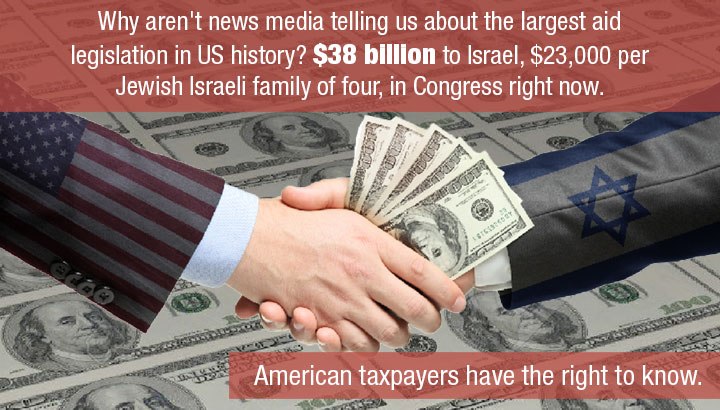
Congress is currently considering legislation to give Israel a total of $38 billion over 10 years, the largest such aid package in U.S. history. Yet, U.S. media are not telling Americans about the legislation, which is before Congress right now…
Legislation to give Israel $38 billion over the next ten years is currently working its way through Congress. This is the largest military aid package in U.S. history.
Yet, while Israeli media are covering the legislation, virtually no U.S. news reports have informed American taxpayers about this proposed disbursement of their tax money.
The proposed military aid amounts to $23,000 per every Jewish Israeli family of four. (Aid to Israel has been on average about 7,000 times greater per capita than U.S. aid to others around the world.)
The proposed aid is divided between two bills. One has already passed, but the main bill is still before Congress.
1. The 2019 military spending bill contains a provision giving Israel 550 million dollars (i.e. $5.5 billion over 10 years). This has already passed both houses of Congress and was signed into law on August 16.
2. A second bill, “United States-Israel Security Assistance Authorization Act of 2018,” is slated to give rest of the package, approximately $33 billion, to Israel. The number is H.R.5141.
This bill has already passed the Senate, and is now being considered in two House committees: Armed Services and Science, Space, and Technology.[1] (Click on each committee to see its members.)
The reason that the bill was referred to the committee on space is because the bill mandates that NASA work with the Israel Space Agency, despite accusations of Israeli espionage against the U.S.
In 2015 a Caltech scientist revealed that the Chair of Israel’s National Committee for Space Research had illegally acquired classified U.S. information. The alleged espionage and theft largely took place at Caltech’s Jet Propulsion Laboratory, a top NASA research and development center.
The $38 billion package was originally negotiated by the Obama administration in 2014,[2] but must now be codified into law.
While U.S. media are inexplicably ignoring this massive aid legislation, Israeli media are covering it regularly, and Israel lobbying organizations are calling on their members to support it. (AIPAC, the American Israel Public Affairs Committee, reportedly pioneered the legislation.)
For example, while U.S. media covered the military spending bill, none of the reports seem to have mentioned the millions of dollars to Israel. This is exemplified by an in depth PBS examination of the bill, which discussed aid to Ukraine – which gets a fraction of the amount promised to Israel – but failed to mention the far larger money to Israel.
We could not find any news reports that tell about the current aid to Israel bill.
In other words, Israelis know about the proposed $38 billion legislation, Israeli partisans in the U.S. know about it and are pressuring Congress to pass it, but the large majority of American taxpayers have no idea the legislation is before Congress.
Indications are that U.S. media are not going to report on these bills unless Americans demand that they do so.
Any Americans who believe the media should report on how American tax money is spent, will need to contact the media, both national and local, and tell them that.
The House will be back in session on September 4th. It’s probable that the bill will move forward quickly at that point. It’s unlikely that the process will involve any public debate whatsoever, unless voters contact their Congressional representatives and demand this.[3]
1. A third House committee, the committee on Foreign Affairs, passed the bill on May 9 and recommended that the full House now consider it “Under Suspension of the Rules, by Unanimous Consent.” (“The purpose of considering bills under suspension is to dispose of non-controversial measures expeditiously.” )
2. The Obama administration’s Memorandum of Understanding gave Israel even more money than it seems to have expected. The Forward reported at the time: “When Yaakov Nagel, Israel’s acting national security adviser, was tasked with heading the team negotiating a new 10-year military aid package with the United States, Prime Minister Netanyahu set forth the guidelines: ‘If you reach $3.5 billion a year, you’ll get a gold medal,’ Nagel recalled Wednesday, hours before signing the agreement in Washington. ‘If you get $3.3 billion you’ll get a silver medal; and if you get $3.1 billion you’ll get the bronze.’” Israel got an MOU for $3.8 billion per year, the largest pledge of military assistance in U.S. history.
A memorandum of understanding (MOU) is a non-binding agreement between two or more parties outlining the terms and details of an understanding. The legislation currently before Congress seeks to make the Obama administration’s 2014 MOU into law.
3. The disbursement is problematic on at least three grounds: (1) the majority of Americans feel we already give Israel too much money, (2) the aid would violate U.S. laws – see below, and (3) it would fund Israeli violations of international law and human rights abuses, causing tragedy in the region and hostility to the U.S. This has been documented in reports by the Red Cross, Human Rights Watch, Defense for Children, Christian Aid, Amnesty International, Israeli human rights organizations, etc, but these numerous reports, like the current $38 billion legislation, are largely ignored by U.S. media, which consistently provide Israel-centric reporting and fail to give Americans the full picture.
For a timeline of Israelis and Palestinians of all ages killed since 2000 go here.
The aid would violate several U.S. laws:
• It would violate two amendments to the 1961 Foreign Assistance Act, known as the the Symington and Glenn Amendments, that ban support for countries engaged in clandestine nuclear programs. (More information here.)
• It would violate the Leahy Law, which prohibits aid to countries guilty of human rights violations (more info here).
In the past Israel has used U.S. aid in ways that violated the Arms Export Control Act (AECA), which prohibits re-export of U.S.-origin defense and dual-use technology, which Israel has repeatedly done. Israel has also been charged with using U.S. weaponry illegally.
UNRWA head: ‘One cannot simply wish away 5m people’
MEMO | August 23, 2018
The head of the UN agency for Palestinian refugees has spoken out against efforts underway to see the organisation dismantled, stating: “One cannot simply wish away five million people”.
Pierre Krahenbuhl, Commissioner General for the United Nations Relief and Works Agency for Palestine Refugees in the Near East (UNRWA), made the remarks in an interview with Foreign Policy.
Krahenbuhl also spoke to the impact US funding cuts have already had on URNWA’s operations, noting that in the Gaza Strip, the agency “had to announce cuts to some of our emergency services like community mental health, job creation” and “there was even a risk for our food distribution”.
According to the Swiss diplomat, the protests in response to job cuts led to UNRWA losing control of its compound in Gaza for “about 20 days”.
Asked by Foreign Policy about the claim made by Israel and the Trump administration that “Palestinians are the only people in the world who are allowed to pass their refugee status down through generations,” Krahenbuhl said this was “clearly a misrepresentation”.
“UNRWA, in ways that are no different from the UNHCR [United Nations High Commissioner for Refugees], considers children and descendants of refugees as refugees,” he said, before citing Afghanistan, Angola, Burma, Burundi and Sudan as cases of protracted refugee situations where “the children and grandchildren of the original refugee[s]” are also considered refugees.
“It rests on the notion that family unity, the principle of family unity, is keeping families united and together as one of the key parameters of managing refugee crises,” he added.
Pressed as to what life would be like for refugees were UNRWA to be dismantled – a key demand of many Israeli and US politicians – Krahenbuhl replied:
“If UNRWA didn’t exist tomorrow, and even if UNHCR didn’t exist, the world would still have to tackle the reality of protracted, long-term refugee situations that are impacting the well-being of people, but also the security and stability of states in many parts of the world. One cannot simply wish away five million people”.
Read also:
The plan to end UNRWA will not take away Palestinians’ right of return
UK Labour self-destructs under ‘anti-Semitism’ onslaught

Einstein’s famous quote, which most have never heard of. Now you know why.
By Stuart Littlewood | Veterans Today | August 22, 2018
The ‘anti-Semitism’ rumpus engulfing Jeremy Corbyn and tearing the Labour Party apart comes at the very moment when the country needs an alert and dynamic Opposition to May’s shambolic administration. The campaign, so obviously orchestrated by powerful pro-Israel interest groups to bring down Corbyn, threatens to derail all prospect of worthwhile change at the next election, which could be called anytime given the chaos over Brexit. This would be a calamity not just for Labour but the whole country.
The distraction is such a blot on the political landscape and so disruptive that Corbyn must neutralise it without giving ground. The question is how.
Clarity please – who are the Semites?
What is the argument about? It’s the S-word, ‘Semitism’. At least, that’s the cover-story. The real issue, as many realise, is something deeper. But let’s stick with ‘anti-Semitism’, which is the weapon. It is stupid to go to war without asking questions. So who exactly are the Semites? They may not be who they seem, or who we’re told they are. So let us first deal with the cover story, anti-Semitism, by setting up a learned panel to review the research by Shlomo Sand, Arthur Koestler, Johns Hopkins University and others, turn the S-word inside out, shake it all about, and establish (if that’s possible) who is, and who is not Semitic enough to be offended by certain remarks.
For example, DNA research by Johns Hopkins University School of Medicine and published by the Oxford University Press in 2012 on behalf of the Society of Molecular Biology and Evolution, found that the Khazarian Hypothesis is scientifically correct, meaning that most Jews are Khazars.
The Khazarians were never in ancient Israel. They converted to Talmudic Judaism in the 8th Century. Even if you believe the myth that God gave the land to the Israelites, He certainly didn’t give it to the Khazarians. Russian and East European Jews like the thug Lieberman, Israel’s defence minister, and countless others who flooded into the Holy Land intending to kick the Palestinians out, have no biblical or ancestral claim to the land.
Probably no more than 2% of Jews in Israel are actually Israelites, according to the findings. So most of those living today who claim to be Jews are not descended from the ancient Israelites at all. Palestinians, who are indigenous to the Holy Land, are the real Semites.
Of course, there’s no rush by Israelis or their admirers to acknowledge this.
Has the Johns Hopkins study been refuted? If they and others who came to the same conclusion have got it right, the whole anti-Semitism thing becomes an upside-down nonsense – a hoax – in which the anti-Semites are actually the racist Israeli regime and its Zionist stooges who stalk the corridors of power and have been oppressing the Palestinians for decades with impunity.
Until the topic is thoroughly aired and we have clarity, all anti-Semitism allegations ought to be withdrawn. And no organisation, let alone the Labour Party, should import any definition of anti-Semitism onto its rulebook without looking into the basics.
In the meantime, yes, Jeremy Corbyn needs to dislodge the anti-Jew morons and racist crackpots, of which there are many in all parties. He should also disband Labour Friends of Israel, an aggressive mouthpiece for a foreign terror regime that has no place in British politics.
Job done – Israel’s stooges now in control and doing the dirty work
Meanwhile the concerted fear-mongering by the Zionist Inquisition and browbeating by Jewish community leaders seems to have worked. As I write, Jeremy Corbyn is touring Scotland talking about important things like his ‘Build it in Britain’ plan to regenerate Scottish industry. But the media are gloating over a story involving a former Scottish Labour MP being suspended by his local constituency party and publicly shamed for alleged anti-Semitic remarks – on the strength of just one complaint apparently.
Furthermore the local party executive, in a statement, have already found him guilty. iNews and other media outlets report Renfrewshire North and West Constituency Labour Party Executive Committee as saying: “We fully condemn the anti-Semitic comments expressed by Jim Sheridan, and it is right that he is subject to a full investigation by the Labour Party…. The views expressed by Jim Sheridan in no way reflect the views of the members of the Labour Party in the Renfrewshire North and West constituency…. [His] comments are in direct conflict with the Labour Party’s values of anti-racism, equality and solidarity.”
That’s before he’s had a chance to defend himself.
Cllr Sheridan had tweeted: “For almost all my adult life I have had the utmost respect and empathy for the Jewish community and their historic suffering. No longer, due to what they and their Blairite plotters are doing to my party and the long suffering people of Britain who need a radical Labour government.”
Bearing in mind that the Jewish Leadership Council and the Board of Deputies claim to represent the Jewish community in the UK and have been instrumental in the damaging anti-Semitism campaign against Labour and Corbyn, it is difficult to see anything objectionable in Cllr Sheridan’s remark. But it amounts to a flogging offence, it seems, in the minds of some Labour officials.
Cllr Sheridan said he was restricted from making comment at this stage but told me, as a matter of fact: “I haven’t had a hearing yet or a date for that to happen. You may wish to know that I visited Auschwitz along with a group of schoolchildren and fellow MPs and saw at first hand the horrors and felt the pain and anguish the Jewish prisoners must have felt. Also, in all the years as an MP I signed the annual Holocaust remembrance book in the House of Commons.”
Does that sound like an ‘anti-Semite’ speaking?
In Renfrewshire they seem hell-bent on destroying the Labour Party’s credibility without any further help from the Israel lobby. It is a vivid example of self-harm by brainwashed twits from within. If the press story is to be believed, somebody makes an allegation, the accused is immediately suspended, publicly shamed and possibly has his reputation damaged irreparably without being heard and before the allegation is substantiated. The accused is gagged from making public comment while the local party executive committee feel free to pass judgement and prejudice the whole matter by declaring to the world that the accused is guilty and stating that nobody else in the local party shares his views. ‘Due process’ is conspicuously absent from the proceedings and party officials in Renfrewshire seem to think it’s OK to issue a statement condemning the accused when he hasn’t been told when his side of the story will be heard and by whom.
It’s medieval.
And last month another Scottish Labour councillor, Mary Bain Lockhart of West Fife, was suspended voicing suspicion that Israeli spies might be plotting to get rid of Jeremy Corbyn as Labour leader after three Jewish newspapers published a joint front page warning that a Corbyn-led government would pose an “existential threat to Jewish life in this country”.
She wrote on social media: “If the purpose is to generate opposition to anti-semitism, it has backfired spectacularly. If it is to get rid of Jeremy Corbyn as Labour Leader, it is unlikely to succeed, and is a shameless piece of cynical opportunism. And if it is a Mossad assisted campaign to prevent the election of a Labour Government pledged to recognise Palestine as a State, it is unacceptable interference in the democracy of Britain.”
She added: “Israel is a racist State. And since the Palestinians are also Semites, it is an anti-Semitic State.”
Those paying attention will remember, back in January 2017, revelations that a senior political officer at the Israeli embassy in London, Shai Masot, had been plotting with stooges among British MPs and other maggots in the political woodwork to “take down” senior government figures including Boris Johnson’s deputy at the Foreign Office, Sir Alan Duncan. It should have resulted in the ambassador himself, Mark Regev, a vile propagandist, a master of disinformation and a former personal spokesman for the Zionist regime’s prime minister Netanyahu, also being kicked out. But he was let off the hook. Regev is still here exercising his shifty talents and oiling his links to Mossad.
Masot’s hostile scheming was captured and revealed by an Al Jazeera undercover investigation and not, as one would have wished, by Britain’s own security services and press. “The UK has a strong relationship with Israel and we consider the matter closed,” said the British government. The Speaker of the House of Commons John Bercow, who is Jewish, also declined to investigate.
So Cllr Lockhart is entitled to be suspicious. Nevertheless a complaint about her remarks was lodged by former Labour MP Thomas Docherty. It was Docherty who wrote to the Culture Secretary in 2015 urging a debate to ban Hitler’s Mein Kampf, a best seller on Amazon, arguing that it was “too offensive to be made available”.
And Paul Masterton, the Tory MP for East Renfrewshire, complained that, given how “offensive” Cllr Lockhart’s comments were, the Scottish Labour leader Richard Leonard had been too slow to act and should have spoken out against her behaviour immediately. “Instead we have continued silence from him and a failure to prove to the Jewish community that he and his party are taking this issue seriously. It’s clear to the vast majority of people that Mary Lockhart is no longer fit to hold office, and Scottish Labour must understand that a suspension doesn’t go far enough.”
What the media didn’t tell us is that Mr Masterton is chairman of the All-Party Parliamentary Group on British Jews which is funded, supported and administered by The Board of Deputies of British Jews which, along with the Jewish Leadership Council and others is heavily implicated in picking a fight with Corbyn and trying to ram the IHRA definition of anti-Semitism, unedited, down Labour’s throat.
The IHRA definition, which has been allowed to consume Labour when the Party has better things to do, seems to be having its intended effect. It is obvious that many members still haven’t read the two caveats proposed by the Home Office Select Committee and the legal criticism by Hugh Tomlinson QC and Sir Stephen Sedley. Had they done so, more would insist on it being drastically modified or rejected altogether.
Being Pro-Palestinian Doesn’t Make Jeremy Corbyn an Anti-Semite
By As’ad AbuKhalil | Consortium News | August 22, 2018
In the last few decades, public opinion in the West has shifted from the early, post- World War II period. Support for Israel has declined while support for the Palestinians has increased. This shift has been particularly pronounced among youth, especially those who are liberals or leftists.
The view was much different when Israel established its occupation of Palestine in 1948. But Israel has committed too many massacres and perpetrated too many invasions to maintain the status quo. Its war crimes have been televised too often for the world not to notice and popular opinion not to change. Mainstream print media no longer can control the narrative and mold the coverage of Israel and its offenses like it once did.
Still, while the base of the Socialist Party in France or the Labour Party in the United Kingdom has shifted in a more pro-Palestinian direction, much of the leadership of those parties continues to uphold Israeli dogmas. These are the same dogmas which all ruling parties of Europe and the U.S. and its establishment media have adhered to since the occupation began.
The U.S. is a prime example. Although the Democratic base has become more sympathetic to the Palestinians (and less supportive of Israel), the leadership of the Democratic Party has not wavered in its support for military and economic aid to Israel and for its unconditional support for Israeli wars and invasions with the mantra that “Israel has a right to defend itself.” This fact remains as true with Bernie Sanders as it is does with Nancy Pelosi and Hillary Clinton.
Defining Anti-Semitism

Corbyn: Accused
British Labour Party leader Jeremy Corbyn is the exception. Unlike Francois Hollande of France, Corbyn represents the progressive, youthful base of the his party on domestic and foreign policies.
His political rise poses a real problem for Israel. Therefore Tel Aviv’s latest target is Corbyn. Israel finds his stance worrisome because if he were to be elected prime minister, a real possibility, his views could influence a major shift in the foreign policies of other European ruling parties.
Various attempts therefore have been made to malign Corbyn and misconstrue his statements as racist. Corbyn obliged by giving a long interview to an Israeli publication in which he declared support for the occupation state.
But the more he gave in, the more the pressure increased. No matter what he had to say, it was not enough, and the accusation of anti-Semitism has been hurled in his face at an increasingly frenzied pace.
Corbyn’s repeated denunciations of anti-Semitism haven’t been sufficient because this is not really about anti-Semitism and its repugnance. The beef that British Zionists (and other Zionists especially in Israel) have with Corbyn is with his views on Palestine. He was asked to accept—without hesitation or equivocation—an Israeli definition of anti-Semitism, which was provided by the International Holocaust Remembrance Alliance (IHRA).
Insistence on accepting this definition is an attempt to force Corbyn to tailor his statements and beliefs on the Arab-Israeli question to the Israeli position. The Israeli establishment wants to prevent grass-roots views on Palestine among British progressives from being reflected in the stances of party leaders.
The “working” definition of the IHRA in many ways is quite accurate: “Antisemitism is a certain perception of Jews, which may be expressed as hatred toward Jews. Rhetorical and physical manifestations of antisemitism are directed toward Jewish or non-Jewish individuals and/or their property, toward Jewish community institutions and religious facilities.” This statement is indisputable and sums up the various forms of hatred of Jewish people.
Exaggerating Jewish power in society and believing in a global Jewish conspiracy (or promoting grotesque fakes, such as the Protocols of the Elders of Zion) are also manifestations of anti-Semitism. These ideas are not included in the IHRA definition (although some examples in the document later cover those forms).
Other examples the IHRA cites—such as “calling for, aiding, or justifying the killing or harming of Jews in the name of a radical ideology or an extremist religion”—cannot be debated. These vile sentiments are anti-Semitic and indeed represent a repugnant form of hatred. Of course anti-Semitism includes “accusing Jews as a people of being responsible for real or imagined wrongdoing committed by a single Jewish person or group.” (This same blanket denouncement of a group of people applies to Islamophobia today, incidentally.)
Prejudice vs. Propaganda
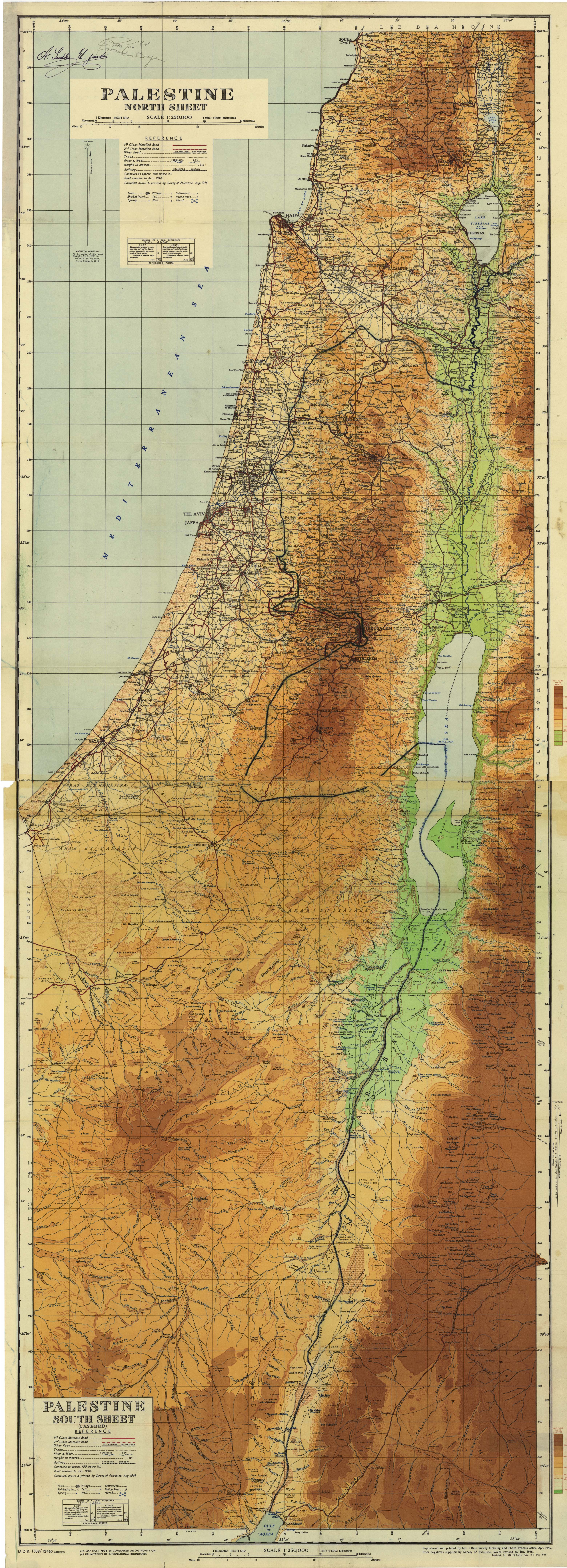 The IHRA’s definition of anti-Semitism falters in its “guiding” examples and “illustrations” of anti-Semitism. In this regard, political considerations have been inserted into the definition. Combatting anti-Semitism always is—or should be—a humanitarian concern that goes beyond any political consideration. However, the IHRA reveals a political agenda: “Denying the Jewish people their right to self-determination, e.g., by claiming that the existence of a State of Israel is a racist endeavor.”
This is where we enter into the realm of Israeli propaganda. If one is to declare support for the rights of all religious groups to self-determination except the Jewish people, that would be anti-Semitism. But not every denial of religious rights of self-determination is anti-Semitic. What if one is opposed to the rights of self-determination for all religious groups without exception because one believes that the right of self-determination should be a political, and not religious, right?
Self-determination is tied to nationalist attachment to a piece of land. One has to ensure that a right of self-determination of one people does not impede or obstruct the right of self-determination of another people on the same piece of land. Maxime Rodinson, the French historian and sociologist, once observed, sarcastically, that there is no reason for one to oppose the establishment of a Jewish state, say, on the moon.
To support the right of Jews to self-determination when this self-determination has become bound up with Palestine—and only Palestine, when it wasn’t before the First Zionist Congress in 1897—is to deprive the native population of Palestine from their own right to self-determination.
Opposing the right of self-determination to Jews is not anti-Semitic if one is a) concerned about the right of the native population who were the original inhabitants of the lands or b) opposed to religious rights of self-determination as a matter of secular principle. If I am opposed to Muslim right of self-determination in California, can that be considered Islamophobic, if we follow the same Israeli logic?
As far as declaring Israel a racist state, that is hardly anti-Semitic. Remember, a majority of nations (75 to 35) in the world voted in the General Assembly of the United Nations in November 1975 (long before the U.S. imposed its will on the U.N. after the demise of the Soviet bloc) for the “Zionism-is-racism” resolution (which then was repealed in 1991). That is not in itself anti-Semitic.
Similarly, to accuse the Iranian regime or the Saudi regime of sexism or of repression is not Islamophobic. To criticize a state, or even to work for the dismantlement of its political institution, is not an act of hostility against the people of the state, even if that state—be it Israel, Saudi Arabia or Iran—may speak on behalf of the entire members of a particular religion in the world. (Just last week, the Saudi regime adopted the Israeli playbook and declared that any criticism of the regime is an insult to Islam and to Muslims).
Laws and practices in Israel are racist. Labeling them as such does not malign all Jewish people because all Jewish people should not be held responsible for the actions and crimes of the state of Israel. just as criticizing the misogyny of the Saudi regime is not Islamophobic. (There are, of course, critics of Israel who are anti-Semitic just as there are critics of Saudi Arabia or Iran who are Islamophobic, but the criticism in itself is not necessarily a form of prejudice).
On the contrary, to blame all Jews around the world collectively for the crimes and racism of Israel is anti-Semitism. And the Alliance concedes this last point, although it does not fit with the last example provided above.
Weaponizing the Holocaust
In recent years, Israel has resorted to classic manipulation tactics, perfected over decades, that conflate legitimate criticism about Israel with anti-Semitism. From early on in the history of Israeli immigration to Palestine, Israel attributed Palestinian opposition to its virtual invasion of Palestine to anti-Semitism—as if Palestinians would have been less opposed if Christians, Buddhist, or even other Muslims, were the ones taking over their homeland.
That Israel’s establishment took place in the wake of the horrors of the Holocaust made it easier for the Israeli occupation state to present the takeover of Palestine as a tribute to Holocaust victims. Palestine was not the only place where a haven for Jewish refugees could be found. The takeover treated the native inhabitants of Palestine as though they didn’t exist.
Successive Palestinian and Arab leaders resisting this takeover have been compared to Adolf Hitler. Amos Oz and Elie Wiesel never hesitated to equate the Palestinian national movement with Nazism. Benjamin Netanyahu recently decided to absolve Hitler of responsibility for the Holocaust and to instead blame Haj Amin Husseini, the grand mufti of Jerusalem from 1921-1948, for the designs and execution of Nazi war crimes. The more Israel finds itself in an untenable position, given the changes in world public opinion in favor of Palestinians and their rights, the more Israel and Israelis worldwide invoke the memory of the Holocaust and anti-Semitism to silence critics.
The question of comparing Israeli policies and actions with those of the Nazis is not a simple one. There is indeed a uniqueness to the horrors of the Holocaust that require special respect for its victims. To throw around the word “rape” in situations where there is no rape, is offensive to victims of rape. Similarly, one should not use the word “holocaust” casually because it connotes one of the worst crimes of the last century.
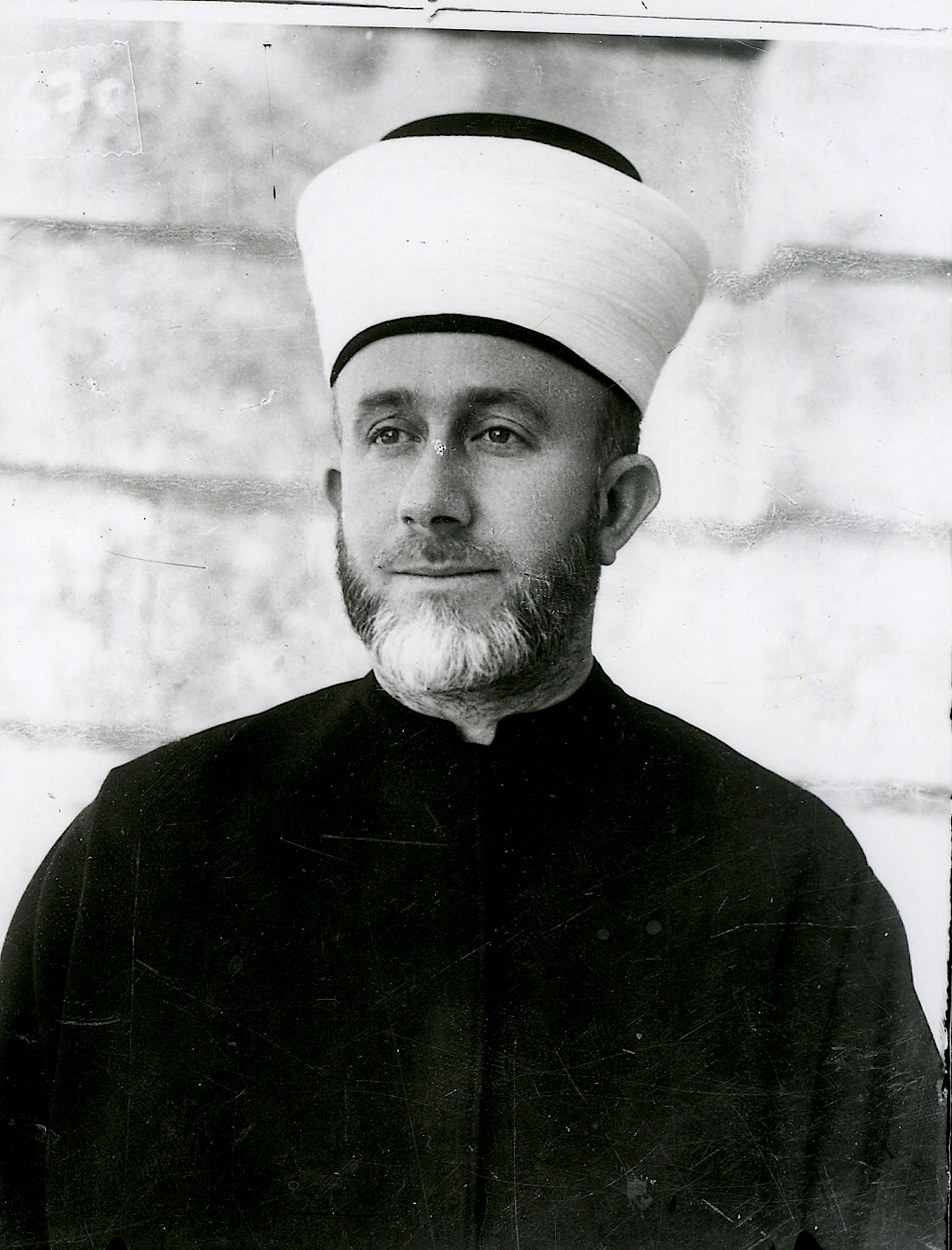
Husseini: Worst than Hitler, says Netanyahu
But Israelis can’t have it both ways. If the reason for their rejection of a comparison between Israel and the Nazi regime is out of respect for the victims of the Holocaust, then why did most—if not all—Israeli organizations (in the U.S. and elsewhere) popularize the comparison between the Syrian regime and the Nazi regime over the last few years of the Syrian war? Why do Israelis compare the Palestinian national movement to Nazism?
The Holocaust Museum in Washington, D.C. took a leading role in the propaganda production about Syria. Shouldn’t that be considered anti-Semitic, if a comparison between Israel and the Nazi regime is anti-Semitic? Either we reject any analogy between the Nazi regime and any other regime regardless of how criminal it is, or we accept it as part of the propaganda of war. Israelis can’t ban others from what they themselves permit themselves to do.
True Lies and False Virtue
Propaganda is how Israel still manages to find new and different ways to silence debate and ostracize dissent. Israel has campaigned to deny tenure to professors who are critical of its abuses (see Norman Finkelstein, Joseph Massad, Steven Salaita and others). Israelis say the Boycott, Divestment, Sanctions (BDS) movement should be legally banned and have lobbied state governments in the United States to ban boycotting Israel, which the ACLU among others see as a violation of the First Amendment. Israel has also launched an app that directs users to make negative social media comments. In general, Israel wants to impose a rigid uniformity of discourse and terms about the Arab-Israeli conflict.
Israelis fight—and kill—Arabs all over the world (Israel has not been shy about murdering Arab scientists, and U.S. media casually report on those assassinations without comments or repudiation). Arabs and non-Arabs cannot speak and write uncensored thoughts about the Arab-Israeli conflict without risking severe repression from the Israeli occupation state, including censorship on social media.
The war on Corbyn is a prominent part of Israel’s war on free speech in the U.K. and elsewhere.
Corbyn and other politicians should be expected to never resort to anti-Semitic expressions. But so far only evidence of his pro-Palestinian statements have been found and that should never be confused with the scourge of genuine anti-Semitism.
As’ad AbuKhalil is a Lebanese-American professor of political science at California State University, Stanislaus. He is the author of the Historical Dictionary of Lebanon (1998), Bin Laden, Islam and America’s New “War on Terrorism” (2002), and The Battle for Saudi Arabia (2004). He also runs the popular blog The Angry Arab News Service.
Detained Journalist Released Under Strict Conditions
IMEMC | August 22, 2018
 Israeli Authorities released a Palestinian journalist from the central West Bank city of Ramallah on Tuesday evening after forcing him to pay a fine, in addition to preventing him for working in his profession for two months.
The journalist, Ala’ Rimawi, was abducted, along with three other reporters, on July 30th, 2018, for working for the Palestinian Al-Quds Satellite News Agency, after the military and the Israeli political leadership, decided to classify it as a “terrorist agency.”
The three other journalists have been identified as Hosni Anjass, Mohammad Alwan and Qoteiba Hamdan.
It is worth mentioning that Rimawi launched a hunger strike on the first day of his imprisonment on July 30th, 2018.
The ruling to release Rimawi was made by the military court in Ofer prison, built on Palestinian lands in Betunia city, west of Ramallah; the Israeli prosecutor’s office filed three appeals demanding keeping the journalist in prison.
The court ordered the detainee to pay a 10.000 Israeli Shekels fine, in addition to preventing him from resuming his journalism profession, and forcing him under house arrest, for two months.
Elizabeth Warren’s Anti Corruption Specificity Evaporates When Foreign Policy is Raised
By Sam Husseini | August 22, 2018
On Tuesday, Sen. Elizabeth Warren addressed the National Press Club, outlining with great specificity a host of proposals on issues including eliminating financial conflicts, close the revolving door between business and government and, perhaps most notably, reforming corporate structures.
Warren gave a blistering attack on corporate power run amok, giving example after example, like Congressman Billy Tauzin doing the pharmaceutical lobby’s bidding by preventing a bill for expanded Medicare coverage from allowing the program to negotiate lower drug prices. Noted Warren: “In December of 2003, the very same month the bill was signed into law, PhRMA — the drug companies’ biggest lobbying group — dangled the possibility that Billy could be their next CEO.”In February of 2004, Congressman Tauzin announced that he wouldn’t seek re-election. Ten months later, he became CEO of PhRMA — at an annual salary of $2 million. Big Pharma certainly knows how to say ‘thank you for your service.'”
But I found that Warren’s tenacity when ripping things like corporate lobbyists’ “pre-bribes” suddenly evaporated when dealing with issues like the enormous military budget and Israeli assaults on Palestinian children.
The Press Club moderator, Angela Greiling Keane, early in the news conference asked about Alexandria Ocasio-Cortez’s keeping press out of town hall meetings, pairing that with Trump’s outright attacks on media.
Husseini: Sam Husseini with The Nation and the Institute for Public Accuracy. Cortez, who was mentioned earlier, and other likely incoming congressional members next year propose slashing the military budget to help pay for human and environmental needs. Do you agree? And if I could, a second question: would you consider introducing and sponsoring [a version of] Betty McCollum’s bill on Palestinians children’s rights in the Senate?
Warren: I now sit on Armed Services and I have been in the middle of the sausage making factory on that one. And that has pushed me even more strongly in the direction of systemic reforms. I want to be able to have those debates. I want to be able to get them out in the open and talk about these poor issues that affect our government, affect our people. I want to be able to debate them on the floor of the senate. I want to be able to do amendments on them. Right now the whole of big money over our government stops much of that. It chokes off much of the debate we should have. So I am going to give you a system-wide answer because I think that’s what matters here. This is not about one particular proposal, this is all the way across. How is it that we get the voices of the people heard in government instead of over and over the voices of the wealthy and the well connected. The voices of those with higher armies of lobbyists. So for me that’s what this is about.
But part of the power that the wealthy and well connected have is getting direct responses to their specific concerns. Political funders are unlikely impressed with broad “system-wide answers”.
In a sense, her non-response to very direct questions rather highlighted the problem she is presumably addressing.
And we’ve been here before.
Bernie Sanders, in his 2016 presidential run, was remarkably vague or even outright repressive regarding foreign policy, especially early on. This reached almost comical proportions when during a debate on CBS just after the November 2015 bombing in Paris, he tried to avoid substantially addressing the issue, wanting instead to fall back on income inequality. Certainly, Sanders was arguably treated very unfairly by the Democratic Party and media establishment, but he was greatly diminished by not having serious foreign policy answers.
Warren and other “progressive” candidates may be set to repeat that. Sanders did address foreign policy more at the end of the campaign and since, but his answers are still problematic at times and at best it was all too little too late.
One question is, realistically, what are Warren’s goals here? It could well be a good faith effort by someone committed to changing the world for the better. But then, why the selectivity?
If it was enactment of these policies, then the strongest way to do that might have been to find a rogue Republican to pair up with on at least some aspects of her proposals so as to avoid charges being purely politically motivated. When questioned by a New York Post reporter at the news conference, Warren couldn’t name a Republican whom she might work with. This would especially be the case since Trump — like Obama before him — ran against the establishment.
Is it to make her a leading contender for the Democratic nomination? If so, the hope would be that she’s not simply playing the role of what Bruce Dixon of Black Agenda Report calls “sheepdogging” — that is, the presidential run or promise of a run by a Sanders or Warren as simply a tool the Democratic Party establishment uses to keep enough of the public “on the reservation”.
Said Warren of her own financial reform proposals: “Inside Washington, some of these proposals will be very unpopular, even with some of my friends. Outside Washington, I expect that most people will see these ideas as no-brainers and be shocked they’re not already the law.”
Why doesn’t the same principle apply to funding perpetual wars and massive human rights abuses against children?
Featured Video

or go to
Aletho News Archives – Video-Images
Book Review
The Maidan Killings and the False-Flag Case
By Freddie Ponton | 21st Century Wire | September 5, 2026
Before the killings that helped bring down Ukraine’s president in February 2014, American diplomats were discussing who should enter its government. In a leaked telephone call, senior State Department official Victoria Nuland told US ambassador Geoffrey Pyatt, “I think Yats is the guy,” referring to opposition leader Arseniy Yatseniuk. Washington had clear preferences and was working to advance them. Later that month, Yatseniuk became prime minister.
Ivan Katchanovski’s The Maidan Massacre in Ukraine examines the violence that preceded that transfer of power. Drawing on television footage, witness testimony, forensic examinations and Ukrainian court proceedings, he argues that elements of the opposition shot protesters and police in a false-flag operation. His case centres on evidence of protesters being shot from opposition-controlled locations, including Hotel Ukraina, overlooking the killing ground. … continue
Blog Roll
 Aletho News
- Israel expands “incitement” charge to target Palestinian education and memory
- How Israel seeks to reshape Arab classrooms
- Paris bans pro-Palestinian demonstration planned for Oct. 7 over ‘risks of public disorder’
- In August Hanning Treason Case – All Signs Point To Tel Aviv.
- France cleared dozens of military sales to Israel between May and September: Report
- France projects nuclear power as Macron pushes arsenal expansion
- The fallacy of US delusions about Iran’s economic collapse
- What changes with Lula or Flávio?
- Britain leads Western media’s demise through ‘fear porn’ narrative
- The Maidan Killings and the False-Flag Case
- If Americans Knew
- Soldier testimony sheds light on how Israel wages information war
- CIA Report Warns Israel Could Head Toward Civil War, Total Collapse
- Banker Who Exposed Howard Lutnick’s Ties to Epstein Warned of ‘Retaliation’ and ‘Personal Consequences’ in Last Post Before Suicide
- Israeli Attacks Kill Two Palestinians in Gaza
- Gaza genocide at 3: Israeli-U.S. cruelty and the smart, deep resistance to it are changing the world
- As genocide is about to enter 3rd year, little of Gaza remains– Daily Update
- “We See Our Homes Now From A Satellite, Like Strangers”
- Watch “Gaza: Doctors Under Attack”, originally censored by BBC
- NAZA: Israeli embassies in UK and US promote rival documentary to challenge Gaza genocide allegations
- David Ellison appoints Israeli to lead merged Paramount-Warner studios
- No Tricks Zone
- Latest European Green Energy Debacle; Portugal’s Largest Flagship Solar Park Insolvent!
- Green Energy Debacle: German Expert Professor Fritz Vahrenholt Warns Of Severe Economic And Social Consequences
- Two More Paleo Reconstructions Affirm Meters-Higher Sea Levels Across Ireland, Brazil 7000-6000 Years Ago
- New Study: Earth And Venus Surface Warmth Largely Explained By Convection And Lapse Rate, Not CO2 Or Radiation
- 2025 Nature Paper Claiming Worsening Global Drought Gets RETRACTED …Heavily Flawed
- New Study: ‘Global Drought Shows No Detectable Recent Acceleration Under Climate Warming’
- Economic Masterminds: German Socialists Suggest Taxing Productivity Gains Stemming From Using AI
- The South China Sea Has Not Been Cooperating With The Climate Change Narrative
- Energy Crisis: Germany Enters Heating Season With Historically Low Gas Reserve Fill Levels
- New Study: The Antarctic Ice Sheet Gained Mass From 2020-2024 Due To Staggering Snow And Ice Accumulation

