Corbyn and the Jewish Question
By Gilad Atzmon | August 31, 2018
It doesn’t take a genius to detect the present volatile state of British Jewish institutions. To the outside observer, some of the actions of Britain’s so-called Jewish ‘leaders’ may seem to be a form of collective insanity. Yet, the Brits do not seem to be at all impressed. They are perplexed by the self-propelled collective hysteria. Naturally, many Brits do not agree with Corbyn on issues; some may not agree with his pacifist politics, others see him as a naïve delusional lefty, a few are upset by his association with controversial characters, but no one except a few Israel firsters sees Corbyn as a crazed ‘anti-Semite,’ let alone as a Hitler type who puts Jewish life under an “existential threat.” While it isn’t clear whether Corbyn can unite the Brits against their horrid government, it is increasingly likely that the Zionist lobby has the capacity to unite the Brits behind Corbyn. A comment on twitter the other day noted that “not supporting Corbyn at this point is an act of treason.”
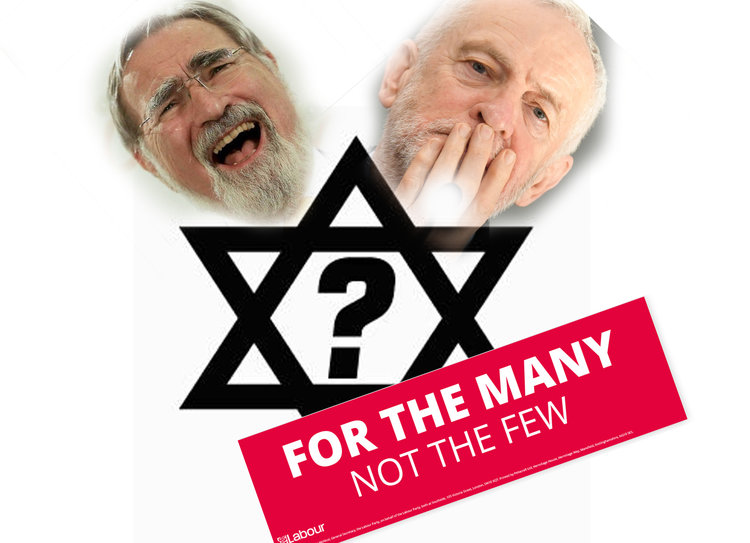
This week the ex-chief rabbi, Jonathan Sacks, became completely unhinged; comparing Corbyn to Enoch Powell’s “rivers of blood” speech. In an interview Rabbi Sacks maintained that Corbyn “undermines the existence of an entire group of British citizens by depicting them as essentially alien.” What had Corbyn said that provoked such an extreme reaction from the celebrity rabbi? Apparently, in 2013 Corbyn criticised British Zionists by suggesting that they have two problems. “One is they don’t want to study history and, secondly, having lived in this country for a very long time, probably all their lives, they don’t understand English irony.”
This raises some obvious questions: 1. What is it in Corbyn’s statement that sparked Rabbi Sacks’ outburst, and 2. How is it possible that when Corbyn speaks about Zionists, Rabbi Sacks hears ‘Jews’?
One possibility is that in Rabbi Sacks’ mind, Jews and Zionists are one and the same. After all, Rabbi Sacks believes that “anti Zionism is the new anti-Semitism.” The rabbi freely associates ‘Zionists,’ ‘Semites’ and ‘Jews.’ Someone should remind the rabbi that the suggestion that ‘Jews’ and Zionists are somehow the same might fall within the IHRA Working Definition of Antisemitsm. According to the definition, manifestations of anti-Semitism “might include the targeting of the state of Israel, conceived as a Jewish collectivity.” In his interpretation of Corbyn’s words, Rabbi Sacks seems to expand the term ‘Zionists’ into meaning ‘Jewish collectivity.’ I am afraid that our ex-chief rabbi may have fallen into the IHRA trap, something you might expect from a Talmudic Jewish scholar but not from an Oxford graduate.
The truth of the matter is that Corbyn has managed to touch the most sensitive Jewish collective nerve. In Corbyn’s universalist egalitarian offering there is no room for tribal exceptionalism. In Corbyn’s universe, Jews are just ordinary people and not God’s chosen people. Corbyn’s ‘for the many not the few’ doesn’t conform to chosenism, Jewish or identitarian. But we can see that this universalist perception of the ‘many’ is interpreted by British Jewish leadership as a casus belli – a call for a war.
Corbyn’s reference to Zionists’ ‘lack of British irony’ touched the rawest Jewish nerve. He stumbled upon the Jewish ‘assimilation complex.’
Since the emancipation of European Jewry, a 19th century political transition, Jews have been struggling to define their identity and role in the wider society. Emancipation invited assimilation, it offered Jews the ability to become an indistinguishable part of the ‘many,’ but this transformative shift would have entailed a loss of Jewish identity. This dilemma is known as the ‘Jewish Question.’ Zionism was initially an attempt to resolve the Jewish question and the assimilation dilemma. It offered Jews the ability to be ‘people like all other people’ but in a different place. Zionism promised to take the Jews away while allowing Jews to assimilate, although as a distinct nation amongst nations. Zionism gave Jews a way to resolve the tension between assimilation and preservation. The Jews were saved the danger of integrating into their host nations and allowed to preserve many if not most of their cultural traits, as Israel proves on a daily basis.
The Jewish fear of assimilation is not a secret. Golda Meir who served as Israel’s Prime Minister at the time of October War (1973), believed that Jews who assimilate are essentially partners to the Nazis, since through assimilation they are exterminating the continuation of the Jewish people. For Meir, mixed marriages, and not the Arabs, were the greatest danger to the Jewish people. With Meir’s anti assimilationist view in mind, it is clear why Corbyn’s traditional socialist view of ‘the many’ poses an existential danger to those who insist upon being ‘the few.’ Corbyn’s well meaning invitation to the Jews and everyone else to fully integrate into British society is interpreted by Zionist Jews as a threat of extermination (to use Golda Meir’s loaded terminology).
Rabbi Sacks’ reaction, however, takes us to a new level in our understanding of the Zionist mindset. The rabbi actually accused Corbyn of implying that “Jews are not fully British.” But that was not what Corbyn said or implied. He suggested that “Zionists” are not exactly British, a statement that poses no problem for most Zionists since they openly and voluntarily swear allegiance to another state, one that is nationalist, racist and expansionist and shares few, if any, values with Britain or the West.
In order to grasp Rabbi Sacks’ recent outburst we may have to appeal once again to the famous French psychoanalyst Jacques Lacan’s astute observation: “unconscious is the discourse of the Other.” The unconscious, according to Lacan, is the fear that the Other, in this case, the gentile, the humanist or shall we say Corbyn and the Brits see you truly. It is the tormenting thought that the Goy may be able to detect the lie. It is the unbearable anxiety that the Brits know that British Zionists aren’t exactly Brits, they are deeply devoted to another state and its foreign interests, they never assimilated and do not plan to assimilate in the near future. The Lacanian unconscious is the fear that a Goy may stand up one day and decide to call a spade a spade or, way more disturbing, refer to a celebrity ex-chief rabbi as a “far right extremist,” as Trade Union activist Eddie Dempsey suggests in the video below:
Crucifying Corbyn: Former Chief Rabbi Joins in The anti-Semitism smear-mongering gets more bizarre each day

(Rabbi Lord Jonathan Sacks speaks at TED2017. Image credit: Bret Hartman/ TED Conference/ Flickr)
By Stuart Littlewood | American Herald Tribune | August 30, 2018
The nasty slur campaign against Jeremy Corbyn has just plumbed new depths with a hark-back to 1968 and the “Rivers of Blood” speech by Enoch Powell. It seems to have been prompted by a remark Corbyn made in 2013 that British Zionists had two problems: “One is they don’t want to study history and, secondly, having lived in this country for a very long time, probably all their lives, they don’t understand English irony.”
In anti-Semitism terms that’s a flogging offence, even when it might be true. The former Chief Rabbi, Lord Jonathan Sacks, immediately took umbrage saying that Corbyn’s criticism of British Zionists was the most offensive statement made by a senior politician since Enoch Powell’s Rivers of Blood speech. Sacks told the New Statesman : “It was divisive, hateful and, like Powell’s speech, it undermines the existence of an entire group of British citizens by depicting them as essentially alien.”
He said Corbyn had implied “Jews are not fully British” and that he was “using the language of classic pre-war European anti-Semitism”, adding that Corbyn was an anti-Semite who “defiles our politics and demeans the country we love”. He had “given support to racists, terrorists and dealers of hate who want to kill Jews and remove Israel from the map”.
Sacks’ words could equally be taken to mean those who align themselves with Israeli hate and the wish to kill Palestinians and wipe Palestine from the map – which they have already done quite literally. And if Corbyn defiles our politics so does the Israel lobby. But the irony must have escaped him.
Just how righteous is the moralising Lord Sacks? In a House of Lords debate in 2014 on the Middle East in general and the question of formal recognition of Palestine by the UK in particular, the former Chief Rabbi got up and made a speech that was more like a pro-Israel rant. After a long winded spiel about the history of Israel and Jerusalem – from the Jewish angle of course – he went on to demonise Hamas and Hezbollah in the manner recommended by Israel’s ‘hasbara’ handbook and all the more absurd when Israel’s hands are so unclean. Everyone knows that Hamas has agreed to a long-term truce with Israel provided it ends the illegal occupation, gets back behind its 1967 borders and accepts the refugees’ right of return – all as per UN resolutions and subject to a Palestinian referendum. And Hezbollah, as Sacks knows perfectly well, was formed to resist the Israeli occupation of Lebanon after the 1982 war.
Israel, said Sacks, is the place where his people were born almost 4,000 years ago. As an ardent promoter of the Jewish religion, the Jewish state and the idea that God gave Jews exclusive title to Jerusalem, he seemed oblivious to the irony of his speech especially where he said: “When ancient theologies are used for modern political ends, they speak a very dangerous language indeed. So, for example, Hamas and Hezbollah, both self-defined as religious movements, refuse to recognise the legitimacy of the state of Israel within any boundaries whatever and seek only its complete destruction.”
Where does he get his information? Israel won’t define its boundaries, leaving them fluid for endless expansion, and does a first-class job of de-legitimising itself by its defiance of international law and utter contempt for norms of human decency and obligations under UN Charter and other agreements.
Zionists distort the scriptures to claim Jerusalem is theirs by Divine right, it was already 2000 years old and an established, fortified city when King David captured it. The Jews lost Jerusalem to the Babylonians, recaptured it, then lost it again to the Roman Empire in 63BC. When they rebelled Hadrian threw them out in 135. Until the present illegal occupation the Jews had only controlled Jerusalem for some 500 years, small beer compared to the 1,277 years it was subsequently ruled by Muslims and the 2000 years, or thereabouts, it originally belonged to the Canaanites.
Jerusalem was also a Christian city. The 4th century saw the building of the Church of the Holy Sepulchre. The Persians came and went. Then, after the Islamic conquest in 690, two major shrines were constructed over the ruins of the earlier temples — the Dome of the Rock from which Muhammed is said to have ascended to Heaven, and the Al-Aqsa Mosque. The Crusaders re-took Jerusalem in 1099 and The Temple Mount became the headquarters of the Knights Templar. In 1187 Saladin ended the Crusader Kingdom and restored the city to Islam while allowing Jews and Christians to remain if they wished.
As the saying goes, “None has claim. All have claim!”
Nowhere in his speech did Lord Sacks address the main question of British recognition of Palestinian statehood. Nowhere did he recommend the jackboot of oppression be immediately lifted and the Palestinians granted their human rights and their freedom. That would surely have been the Christian position and, I imagine [?], the true Jewish one.
It is what the Rabbi failed to say on this important occasion that makes me wonder whether he’s an instrument of God or just another preacher of Israeli ‘hasbara’. I read somewhere that Lord Sacks is of Polish/Lithuanian extraction. Most Palestinians can demonstrate ancestral ties to the ancient Holy Land. Can he?
“Jeremy Corbyn moved the rock and the antisemites crawled out”
Corbyn is also in trouble over a remark he made in 2010 at a meeting of the Palestine Solidarity Campaign suggesting that MPs who took part in a parliamentary debate on the Middle East had their comments prepared for them by the Israeli ambassador. I’d say that was fair comment although the scriptwriters were more likely to have been Mark Regev’s propaganda team in Tel Aviv. Regev, a propaganda expert from the dark side, is now Israel’s ambassador in London. Oh, the irony (again).
And a few days ago we heard that Jews are preparing to quit Britain because they fear Jeremy Corbyn taking power, according to the former chairman of the Conservative Party Lord Feldman. So says The Times.
Feldman wrote an open letter to Mr. Corbyn telling him that Jewish people were making contingency plans to emigrate because Labour had become a hotbed of anti-Jewish feeling. “Many Jewish people in the United Kingdom are seriously contemplating their future here in the event of you becoming prime minister. Quietly, discreetly and extremely reluctantly, they are making contingency plans.”
One of these is Mark Lewis, a prominent solicitor and a former director of lawfare firm UK Lawyers for Israel, who is emigrating to Israel with his partner, Mandy Blumenthal. It is believed she is the National Director of Likud-Herut UK, an affiliate of the Zionist Federation and whose website is full of preposterous ideas such as: “We believe that terms like ‘illegal occupation’ should never go unchallenged….” and “Such criticism as we may have [of Israel] should never be expressed publicly….”
Lewis, who describes himself as an ‘unapologetic Zionist’, said: “Jeremy Corbyn moved the rock and the antisemites crawled out from underneath.” And he told the Evening Standard: “I don’t feel welcome in this country anymore.” So he’s off to that hotbed of racism and apartheid, Israel.
Being unwelcome is not a happy feeling. I know this from my trips to Israel, what with their rudeness, threatening behavior, intrusive searches, hostile questioning and unforgivably vile treatment of our Palestinian friends. It’s not as if we want to be in Israel – we are forced to divert there on account of Israel’s illegal military occupation. And when we eventually reach Palestine we have to put up with the presence of arrogant Israeli gunslingers strutting the streets, setting up hundreds of roadblocks, using obstructive tactics with brutish behavior, creating endless queues and interfering with Palestinian life at every level.
And if we try traveling to Palestine direct, like the humanitarian aid boats Al-Awda, and Freedom last month, we get violently and unlawfully assaulted on the high seas, beaten up, thrown in a stinking Israeli jail and have our belongings and money stolen by the Israeli military desperate to maintain their illegal blockade of Gaza.
So, if Messrs Feldman, Lewis and Blumenthal feel more comfortable with those criminals they’d better join them.
In answer to the babble put out by Zio-propagandists, church leaders in the Holy Land issued their 2006 Jerusalem Declaration saying:
“We categorically reject Christian Zionist doctrines as false teaching that corrupts the biblical message of love, justice and reconciliation.
“We further reject the contemporary alliance of Christian Zionist leaders and organizations with elements in the governments of Israel and the United States that are presently imposing their unilateral pre-emptive borders and domination over Palestine… We reject the teachings of Christian Zionism that facilitate and support these policies as they advance racial exclusivity and perpetual war rather than the gospel of universal love, redemption and reconciliation.”
This still stands. And as the Declaration also points out, “discriminative actions [by the Occupation] are turning Palestine into impoverished ghettos surrounded by exclusive Israeli settlements. The establishment of the illegal settlements and the construction of the Separation Wall on confiscated Palestinian land undermines the viability of a Palestinian state as well as peace and security in the entire region”.
That comes from genuine churchmen working in the front line against armed Zio-thugs whose vicious day-to-day persecution of the Christian and Muslim communities in the Holy Land makes a nonsense of accusations of anti-semitism in the UK.
I think we can deduce from all this that Zionism is a menace. Nothing has changed for the better; it has got steadily worse.
‘We want our Jerusalem back, and our state’
In 2010 Fr Manuel Musallam, a gritty Catholic priest with long experience of Israel’s cruel and illegal occupation, told members of the Irish Government: “Christianity in the region has been destroyed not by Muslims but by Israel. Israel destroyed the church of Palestine and the church of Jerusalem beginning in 1948. It, not Muslims, has sent Christians in the region into a diaspora… We have spoken to Israel for more than 18 years and the result has been zero. We have signed agreements here and there at various times and then when there is a change in the Government of Israel we have to start again from the beginning. We ask for our life and to be given back our Jerusalem, to be given our state and for enough water to drink… I have not seen Jerusalem since 1990.”
Archbishop Theodosius Hanna (Greek Orthodox Church) told them: “Palestine is the place from where Christianity comes…. Everything that has happened to the Palestinians between 1948 and today has happened to all Palestinians, including Christian Palestinians.
“What we are after is freedom and dignity just as freedom and dignity have been bestowed on so many nations in the world. We want that too. When we speak about peace, we also speak about justice because it is impossible to have peace without justice. Peace is part of justice. Unfortunately, in the Holy Land there is no such thing as justice.”
Corbyn should remind his tormentors of all this and take no lectures from those who support Zionism and adore the racist state it spawned.
Israel controls UK politicians’ speech: Corbyn
Press TV – August 30, 2018
UK Labour leader Jeremy Corbyn, who is battling allegations of anti-Semitism in his party, has come under fire for a 2010 speech where he said speeches British lawmakers make are controlled by the Tel Aviv regime.
The videotaped remarks were made during Corbyn’s meeting with the Palestine Solidarity Campaign in London following Israel’s deadly raid on an aid flotilla that attempted to break the years-long blockade on the Gaza Strip, the Daily Mail reported Tuesday.
During the May 2010 attack, 10 Turkish activists onboard the Mavi Marmara were killed after Israeli naval commandos boarded the ship and opened fire.
Criticizing British lawmakers’ pro-Israeli reactions to the attack, Corbyn reportedly said during the meeting that the MPs “all turned up [to the debating chamber] with a pre-prepared script. I’m sure our friend Ron Prosor (the Israeli ambassador) wrote it. Because they all came up with the same key words. It was rather like reading a European document looking for buzz-words.”
“And the buzz-words were, ‘Israel’s need for security.’ And then ‘the extremism of the people on one ship.’ And ‘the existence of Turkish militants on the vessel.’ It came through in every single speech, this stuff came through,” he added.
The Israeli lobby has long complained about what it calls Corbyn’s tolerance for anti-Semitism in his party.
An open critic of Israel’s crimes against the people of Palestine, Corbyn has drawn fire from his opponents by allowing the members of his party to speak their mind about Israel and its occupation of Palestinian lands.
Earlier this week, the Campaign Against Anti-Semitism launched an online campaign to pressure Labour lawmakers into issuing a vote of no-confidence in Corbyn and force him to resign.
The Labour leader most recently came under fire for video footage of a speech from 2013, where he says “Zionists” can’t understand British ways of thinking despite growing up in the country. Corbyn defended his remarks, saying by Zionists did not mean Jews.
Meanwhile, Corbyn’s allies in and outside of the UK have rushed to his support in the face of the Israeli media upsurge that try to portray him as an anti-Semite.
Israeli lawmaker Haneen Zoabi said Wednesday that the attacks against Corbyn were “unjust, offensive and absurd.”
“Corbyn’s criticism is justified. And the state, which deals with theft, murder and racist acts under the law of nationality, is rightly justified by this criticism,” the Israeli Knesset member said.
Israeli project brings young scientists on free trip to “learn about Israel”
By Alison Weir | If Americans Knew | August 29, 2018
An Israeli institute recently brought 73 high school graduates from around the world on a month-long, all-expenses-paid trip to Israel. Much of this is funded by tax-deductible donations from the U.S.
For almost half a century, the program, which is run by a project of Israel’s Weizmann Institute, has been bringing students to Israel with two purposes: to learn about science and to “learn about life in Israel.”
It appears that what they learn about Israel is substantially filtered.
There is no indication that the students hear from Israeli groups such as B’Tselem or the Israeli Committee Against Home Demolitions that expose Israel’s long record of human rights violations, from Israeli soldiers who are breaking the silence on Israeli military violence, or from groups like Addameer that could tell them about the thousands of Palestinians imprisoned by Israel who were never given a trial or charged with a crime.
An article about the program in JTA reports: “Each year about 70-80 students from around the world, both Jews and non-Jews, are accepted. The largest delegation – about 20 students – comes from the United States, but participants also have come from South Korea, Japan, Turkey, Brazil, Mexico, Argentina, New Zealand, Australia, Canada, European countries — and Israel. The program has more than 3,000 alumni.”
In addition to spending time in labs, JTA reports that the students “participate in cultural and social events, and go on field trips to different parts of Israel.”
While one young participant is quoted as saying: “You need to be here to know the real situation,” it’s doubtful that they actually learn that. There do not appear to be any trips to the Occupied Territories or meetings with Israeli journalists like Gideon Levy or Amira Hass, who might fill them in on some of the less glowing aspects of Israeli policies, or of the systemic discrimination against non-Jews in Israel.
JTA reports that the program is conducted in English and is free for the students; all costs are covered by scholarships from Weizmann donors – in the U.S. via the American Committee for the Weizmann Institute of Science.
While there are numerous American scientific institutes that conduct life-saving scientific and medical research, Weizmann USA – which is based in the U.S with offices throughout the country – funnels money to an institute in Israel. Even though every dollar for the young scientists program goes to Israel, this money is tax-deductible in the US, removing money from the U.S. economy.
The Institute proudly announces that “the Weizmann Institute’s graduate school is unique in that every student receives financial support.” A slick advertising promo to raise money for the Institute’s scientific research nowhere mentions that the donations go to Israel, not to U.S. research.
According to its website, discoveries at the Institute are “moved from the lab to the marketplace via the Yeda Research and Development Company, Inc., the Institute’s technology transfer arm.”
Among Yeda’s Board Members is Martin Gerstel, who was born in Norwalk, Connecticut, received a BS degree from Yale, and an MBA from Stanford. Gerstel is a director of Israel’s Teva Pharmaceuticals, which has captured the world market in generic drugs.
Weizmann USA, with assets of close to $700 million, is just one of many such schemes that divert U.S. money to Israel via tax-deductible donations. Another raises millions of tax-deductible dollars for Israeli soldiers while many American military veterans are having trouble scraping by.
These programs are on top of massive U.S. governmental aid to Israel. The latest aid package, which is being pushed through Congress right now without public awareness or debate, is slated to give Israel $38 billion over the next 10 years. This works out to approximately $23,000 per Israeli family of four.
On average, Israelis have received 7,000 times more U.S. aid than other people around the world.
Alison Weir is executive director of If Americans Knew, president of the Council for the National Interest, and author of Against Our Better Judgment: The Hidden History of How the U.S. Was Used to Create Israel.
Seven detained Palestinian women activists from al-Khalil face Israeli persecution

Photo: Protest demands release of Palestinian women prisoners. Via Wattan TV
Samidoun Palestinian Prisoner Solidarity Network – August 29, 2018
Seven Palestinian women from al-Khalil have been jailed by the Israeli occupation, with many held in intense, torturous interrogation for many weeks. The Israeli Shin Bet intelligence agency is now attempting to market these arrests in the media as an attack on “Hamas infrastructure” in al-Khalil in an attempt to justify the ongoing large-scale arrests targeting active Palestinian women in the city.
In addition to the main arrests targeting seven women, a number of other women were summoned to hours of interrogation before being released. Riyad al-Ashqar of the Palestinian Prisoners’ Center for Studies said that all of the women work in social services, public activities, media work or at home with their families and that none are involved in Hamas’ political or military work. He said that the Shin Bet’s claims are an attempt to create a state of fear and terror to suppress Palestinian women’s participation in activities against the crimes of the occupation or supporting the Palestinian resistance.
The campaign against Palestinian women in al-Khalil began with the arrest of City Council member Suzan Abdel-Karim Owawi, 40, on 5 June. She was subjected to extensive, harsh interrogation that was extended repeatedly during that time. In addition to her public service as an elected official, she is a social activist who works to support Palestinian prisoners; she is married and the mother of four children.
Safa Abu Hussein, 36, was arrested next after Israeli occupation forces invaded her home and took her to interrogation. Her detention has been extended four times.
Rawda Mohammed Abu Aisha, 53, was next to be seized by occupation forces; she was seized when she drove to a checkpoint in Bethlehem and taken to interrogation.
The occupation forces also arrested Dima Said al-Karmi, 38, the widow of Nashat al-Karmi, a Hamas activist killed by Israeli occupation forces and the mother of an 8-year-old daughter. She was taken to Ashkelon detention center and interrogated harshly and extensively and deprived of sleep. During her interrogation, she fainted on multiple occasions. Her detention has also been repeatedly extended.
Lama Khater, 42, is a Palestinian writer who was seized on 24 July by Israeli occupation forces after they invaded her family home. She was deprived of sleep, insulted and threatened by Israeli interrogators at the Ashkelon detention center. The mother of five children – the youngest only 2 – she is a political analyst and writer whose work is widely published on newspapers and websites.
Saida Badr, 55, is the wife of Palestinian Legislative Council (PLC) member Mohammed Badr, 61, who has spent many years in Israeli prison including a recent sentence in administrative detention, imprisonment without charge or trial.
Finally, Sonia Hamouri, 40, a university lecturer, was seized from her family home in al-Khalil on 14 August. A number of other women were also detained for several hours and interrogated.
The Israeli occupation is accusing the women of communicating information from Palestinians in exile to those inside occupied Palestine, especially activists in Hamas. They were also accused of doing social and charitable work in support of the movement by providing aid to the prisoners’ families.
Palestinian political parties and movements are labeled “illegal organizations” by the Israeli occupation, and thousands of Palestinians are jailed for allegedly supporting or belonging to these liberation movements. One of the most common charges against Palestinian prisoners is “membership in an illegal organization,” as participation in most major Palestinian political movements is criminalized by the colonial occupation.
These seven women are among a total of approximately 63 Palestinian women prisoners, including several held without charge or trial under administrative detention, such as parliamentarian Khalida Jarrar and student Fidaa Akhalil.
Israeli occupation bans Palestinian student from his university campus
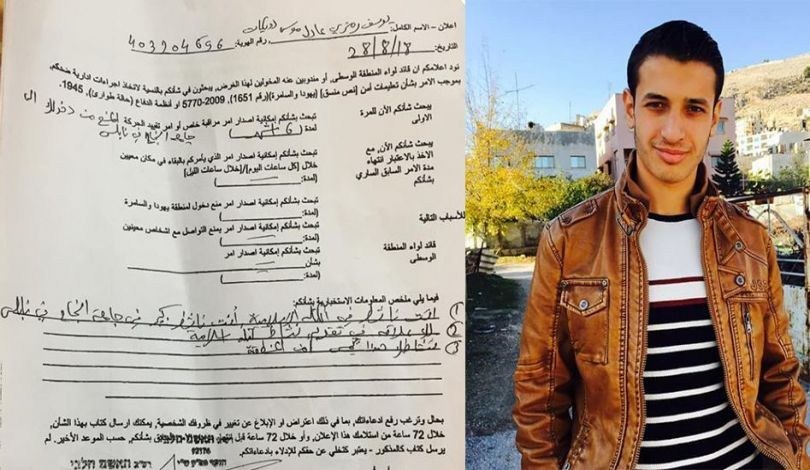
Photo: Yousef Dweikat and the order barring him from his university. Via Hadf News.
Samidoun Palestinian Prisoner Solidarity Network – August 29, 2018
Palestinian student Yousef Dweikat was banned from entering the campus of his university, An-Najah National University in occupied Nablus, on Tuesday, 28 August 2018. Dweikat, 20, a student at the Faculty of Engineering at the university and an activist with the Islamic Bloc student organization, was summoned to meet with Israeli occupation intelligence in the Salem military base.
When he presented himself, he was presented with an order barring him from his own university campus for the next six months. A Palestinian refugee who lives in Balata refugee camp, Dweikat, an electrical engineering student, is a former prisoner; he was arrested by Israeli occupation forces in March 2017 and jailed for six months for his involvement in student activities.
In an interview with Quds News, Dweikat called upon the university “to create solutions and alternatives so that this type of decision does not affect a larger number of university students.” He noted that the Israeli occupation had used a similar policy against university students in the 1980s and is now returning to those practices. Dweikat also said that his education was already delayed because of his previous detention and that he had already registered for the new year, paid his university fees and prepared to start the new semester. “My family and I are tense and frustrated. We do not know what we can do next to confront this unjust decision,” he said.
This is only the latest violation of the Palestinian right to education by the Israeli occupation. According to the Palestinian Ministry of Education, there are over 300 Palestinian university students imprisoned in Israeli jails. Each year, especially around the time of student council elections, universities face invasions and attacks on active students. Student leaders like Omar Kiswani, president of the Bir Zeit University student council, have been seized from campus in violent raids.
In addition, as the Palestinian Right to Enter campaign notes, international academics – including Palestinians born in exile with foreign passports – are routinely denied entry to Palestine by Israeli occupation forces at colonially controlled borders. By denying entry to scholars invited to teach, lecture or study at Palestinian universities, the Israeli occupation seeks to isolate Palestinian educators, scholars and students from their international peers.
These routine violations of Palestinian academic freedom – along with the racial exclusion of international students, particularly those identified as Arabs, Muslims or Palestinians – have added impetus to the ongoing call for academic boycott of Israeli institutions. The US Campaign for the Academic and Cultural Boycott of Israel is urging universities, students and faculty to take a pledge to boycott “study abroad” programs run by Israeli institutions, “We Will not Study in Israel Until Palestinians Can Return: Boycott Study Abroad in Israel!” Samidoun Palestinian Prisoner Solidarity Network is one of the endorsers of this call.
As many students head back to university around the world, solidarity with Palestinian students and scholars is particularly critical. These arrests and bans are an attempt to dismantle Palestinian students’ ability to learn, organize and uphold their identity, existence and struggle on campus. Samidoun Palestinian Prisoner Solidarity Network urges supporters of Palestine on campuses around the world to join the campaign to boycott Study Abroad, support the academic boycott of Israel and hold events and activities to highlight the violation of Palestinian rights to education, particularly the imprisonment of Palestinian students.
Israeli forces ransack Nablus print shop, confiscate equipment
Ma’an – August 27, 2018
NABLUS – Dozens of Israeli forces raided and ransacked a Palestinian print shop on predawn Monday near the Balata refugee camp in the northern occupied West Bank district of Nablus.
Locals said that Israeli forces raided the al-Manahil print shop and confiscated print equipment before closing down the shop on Monday.
Sources added that some 18 Israeli military vehicles entered the refugee camp and demolished the gates of and the interior content of the print shop.
The shop belonged to Palestinian resident, Ghassan Thuqan, who was previously detained by Israeli forces last year, along with his two sons.
Sources mentioned that Israeli forces closed down the shop under the pretext that the structure was allegedly being used for “terrorist operations.”
It is noteworthy that the print shop was fully licensed and legal; the owner had not received a prior notice that his business was suspected of wrongdoing by Israeli forces.
No detentions nor injuries were reported from the raid.
The video below shows Israeli forces raiding the area and confiscating print equipment:
Defining Anti-Semitism, Threatening Free Speech
By Sheldon Richman | The Libertarian Institute | August 24, 2018
In May the benign-sounding Anti-Semitism Awareness Act appeared before the U.S Congress “to provide for consideration a definition of anti-Semitism for the enforcement of Federal antidiscrimination laws concerning education programs or activities.”
No big deal? Let us see.
S. 2940 is sponsored by Republican Sen. Tim Scott and has four co-sponsors: Republican Lindsey Graham and Democrats Ron Wyden, Robert Casey, and Michael Bennet. The House sponsor of H.R. 5924 is Republican Rep. Peter Roskam, with 41 cosponsors, 30 Republicans and 11 Democrats. Both bills remain in committee. (The Senate passed a similar bill two years ago, but it never reached the House floor.)
Right off the bat, the legislation seems odd: under what Republican Party theory of limited government does Congress proposes definitions of words simply for consideration for educational purposes? And I thought Republicans don’t like federal involvement in education. We’ll see that the answer is steeped in irony: the stated purpose is to help education agencies to combat racial discrimination.
While the act is directed at education, the resulting law would reach beyond that realm because it would officially stigmatize as anti-Semitic any speech and activity, public and private, said to fall within the definition. Since this would at least chill the open marketplace of ideas, advocates of free speech should be concerned about the content of the definition and its revealing support material. We must not assume that merely because the definition is said to brand something anti-Semitic that it is actually anti-Semitic.
The act states that Title VI of the 1964 Civil Rights Act “prohibits discrimination on the basis of race, color, or national origin” (not, mind you, religion) but that “both the Department of Justice and the Department of Education have properly concluded that title VI prohibits discrimination against Jews, Muslims, Sikhs, and members of other religious groups when the discrimination is based on the group’s actual or perceived shared ancestry or ethnic characteristics or when the discrimination is based on actual or perceived citizenship or residence in a country whose residents share a dominant religion or a distinct religious identity” (emphasis added). Hence, those departments have managed to shoehorn religion into a statute that does not mention religion.
The proposed definition directly comes from a 2010 State Department Fact Sheet, which in turn comes, with some modification, from the International Holocaust Remembrance Alliance (IHRA) “working definition of Anti-Semitism.” The IHRA has 31 member countries, including the United States, and Israel.
Anti-Semitism, according to the IHRA “working definition,” is “a certain perception of Jews, which may be expressed as hatred toward Jews. Rhetorical and physical manifestations of antisemitism are directed toward Jewish or non-Jewish individuals and/or their property, toward Jewish community institutions and religious facilities.”
This may seem less than helpful — history professor David Feldman, director of the Pears Institute for the Study of Antisemitism at London’s Birkbeck, University, calls it “bewilderingly imprecise — so the IHRA furnished examples (couched in conditional terms such as could and might and to be interpreted by “taking into account the overall context”). And here the problems continue. Writing in the Guardian, Feldman, says of the 11 examples: “Seven deal with criticism of Israel. Some of the points are sensible, some are not. Crucially, there is a danger that the overall effect will place the onus on Israel’s critics to demonstrate they are not antisemitic” (emphasis added). That should be of concern.
Among the possible examples of anti-Semitism quoted from the IHRA document in the State Department Fact Sheet, but with some modification, are:
+ Accusing Jews as a people of being responsible for real or imagined wrongdoing committed by a single Jewish person or group, the state of Israel, or even for acts committed by non-Jews. [Emphasis added.]
+ Accusing Jewish citizens of being more loyal to Israel, or to the alleged priorities of Jews worldwide, than to the interest of their own nations.
+ Drawing comparisons of contemporary Israeli policy to that of the Nazis”
+ Applying double standards by requiring of it [Israel] a behavior not expected or demanded of any other democratic nation.
+ Denying the Jewish people their right to self-determination, and denying Israel the right to exist.
Two things are worth pointing out here. The phrase “the state of Israel” in first example above does not appear in the IHRA list; that version says only, “Accusing Jews as a people of being responsible for real or imagined wrongdoing committed by a single Jewish person or group, or even for acts committed by non-Jews.” The IHRA does go one to say later that “manifestations might [emphasis added] include the targeting of the state of Israel, conceived as a Jewish collectivity” but immediately cautions that criticism of Israel similar to that leveled against any other country cannot be regarded as antisemitic.” The Fact Sheet, which, again, the legislation incorporates, adds, almost as an afterthought, “However, criticism of Israel similar to that leveled against any other country cannot be regarded as anti-Semitic” (italics in original).
Second, the last example differs from the similar IHRA example, which reads, “Denying the Jewish people their right to self-determination, e.g., by claiming that the existence of a State of Israel is a racist endeavor” (emphasis added). I am unaware of criticism of the Fact Sheet or legislation for this key modification. A similar modification has landed the UK’s Labor Party leadership in hot water. (More below.)
As we’ll see, the inclusion of criticism of Israel in the examples is where much of the danger of this legislation lies. Indeed, Antony Lerman, former director of the Institute for Jewish Policy Research in Britain, who traces the origin and promotion of the IHRA document to the American Jewish Committee and the Simon Wiesenthal Center, both of which routinely conflate criticism of Israel with anti-Semitism, says it was designed to “equate criticisms of Israel with hatred of Jews.” Of course it was; today, being a good anti-anti-Semite, like being a good Jew, means little more than being unswervingly pro-Israel and pro-Israeli repression of Palestinians.
By way of additional background and contrast, the legislation cites a 2010 U.S. Department of Education “Dear Colleague” letter on religious bigotry to state and local educational agencies stating that they “must take prompt and effective steps reasonably calculated to end the harassment, eliminate any hostile environment, and its effects, and prevent the harassment from recurring.” However, the legislation states that letter “did not provide guidance on current manifestations of anti-Semitism, including discriminatory anti-Semitic conduct that is couched as anti-Israel or anti-Zionist” (emphasis added). That’s right: the Education Department did not mention Israel or Zionism in its letter about combating anti-Semitism. So the authors of the legislation seek to “correct” that “shortcoming.”
The legislation goes to state that “anti-Semitism, and harassment on the basis of actual or perceived shared ancestry or ethnic characteristics with a religious group, remains a persistent, disturbing problem in elementary and secondary schools and on college campuses.”
Is that so? It doesn’t ring true. The Pew Research Center “finds that when it comes to religion, Americans generally express more positive feelings toward various religious groups [including Jews] today than they did just a few years ago. Asked to rate a variety of groups on a ‘feeling thermometer’ ranging from 0 to 100, U.S. adults give nearly all groups warmer ratings than they did in a June 2014 Pew Research Center survey.” For all age groups, atheists and Muslims rank far below Jews. (In another survey, Muslims ranked below atheists.) For Americans 30 years and up, Jews rank at or near the top, and the score has risen since 2014. For Americans 18-29, Jews rank just below top-ranking Buddhists, Catholics, and Hindus. No religious group scored more than 69 “degrees” except for, among people 65 and older, Mainline Protestants, Jews, and Catholics, who scored in the 70s. Where’s the widespread anti-Semitism?
And where’s the evidence of growing anti-Semitism on college campuses? The legislation “finds” that “students from a range of diverse backgrounds, including Jewish, Arab Muslim, and Sikh students, are being threatened, harassed, or intimidated in their schools,” but it would be interesting to see the groups broken out. One suspects the atmosphere on campus is more hostile to Arab and Muslim professors and students than to Jews. (See examples here and here.) And we cannot discount the likelihood that criticism of Israel is simply interpreted as criticism of Jews qua Jews. Indeed, the lead author of the IHRA definition, Kenneth Stern, said last year in congressional testimony that it is untrue that “antisemitism on campus is an epidemic. Far from it. There are thousands of campuses in the United States, and in very few is antisemitism – or anti-Israel animus – an issue.”
Anti-Semitism exists, of course, but it’s clearly confined to the fringes of American society. It is so disreputable that people have shied away from criticizing Israel for fear of being accused of Jew-hatred, which can destroy careers and friendships. The legislation seems designed to reinforce that fear, which fortunately has been fading in recent years, especially among younger people, in light of Israel’s periodic military assaults on the essentially defenseless people of Gaza. Every so often the word goes out that anti-Semitism is on the rise, but it’s hard not to notice that those alarms follow the broad international criticism of Israeli systematic brutality against Palestinians resisting the 51-year occupation of their property. As Norman Finkelstein, who monitors this phenomenon closely, writes, “Whenever Israel commits another atrocity, its propagandists stage a revival of the ‘New Anti-Semitism’ extravaganza to deflect or squelch global condemnation.” (See Finkelstein’s book Beyond Chutzpah: On the Misuse of Anti-Semitism and the Abuse of History.)
I won’t try to define anti-Semitism; let’s just go with Stephen Sedley’s definition: “Shorn of philosophical and political refinements, anti-Semitism is hostility towards Jews as Jews.” I’ll only add that it has something to do with seeing all Jews as members of a malignant and world-controlling racial or ethnic entity, with each member being responsible for any wrongdoing, real or imagined, by any other Jew. This is rank collectivism that no liberal individualist will accept. We must note the irony, however, that many Jews themselves believe that all Jews without exception constitute a genetic entity, though this is patently absurd. Jews are of many races, ethnicities, nationalities, and cultures and until a couple of hundred years into the Common Era, Judaism was a proselytizing religion with many successes at converting whole kingdoms, nations, and tribes. In other words, many Jews today are descendants of people who converted to Judaism, sometimes unwillingly, and who never were in the Land of Israel.
Note further the irony of the legislation’s condemnation of those who conflate all Jews with the state of Israel. Israel’s recently passed Nation-State Law declares that the “land of Israel is the historical homeland of the Jewish people.” That includes all Jews no matter where they were born, where they live now, or whether they ever set foot in Israel. In other words, the government of Israel claims to speak for all Jews, which is an affront to any Jew who does not wish to be spoken for by a foreign government or who no longer regards himself as a Jew. (If the Jewish people are not a racial or ethnic entity but a diverse religious group, one can, like Spinoza, stop being a Jew.) It would be wrong for anyone to presume that Prime Minister Benjamin Netanyahu speaks for or acts on behalf of American, British, French, and other non-Israeli Jews, but that is what Israel’s Basic Law claims. (Former Meet the Press host David Gregory once addressed Netanyahu on the air as the “leader of the Jewish people.)
And this claim, which predates the Nation-State Law, is what has given rise to the (dual) loyalty suspicion. So we have yet another irony in The Anti-Semitism Awareness Act’s condemnation of statements “accusing Jewish citizens of being more loyal to Israel, or to the alleged priorities of Jews worldwide, than to the interest of their own nations.” A great way to dispose of the loyalty issue would be for Israel and its supporters to stop pretending it represents all Jews (and former Jews) everywhere.
As noted, the legislation says that “denying the Jewish people their right to self-determination, and denying Israel the right to exist” is anti-Semitic. But what about denying the Jewish people the right to self-determination on land taken from its rightful owners, as Jewish and non-Jewish anti-Zionists have long denied? And when will Congress get around to condemning those who deny the right of Palestinians to self-determination? The Nation-State law says that the “right to exercise national self-determination in the State of Israel is unique to the Jewish people.” So Palestinians are lesser people than Jews? What’s the word for that attitude?
The condemnation of people who “apply[] double standards by requiring of it [Israel] a behavior not expected or demanded of any other democratic nation” is also filled with problems. The first is that Israel’s unconditional defenders themselves are guilty of applying a double standard. If any national group treated another group the way the Zionists and Israelis have treated the Palestinians, they would have been condemned by liberal-minded Jewish Americans along with most other Americans. Second, where is the double standard in the criticism of Israel? Name another country that occupies other people’s land, recognizes no rights in the occupied population, systematically discriminates against 25 percent of its “citizens,” gets billion in military aid every year from American taxpayers, has a highly influential lobby ready to smear any critic, claims to be the most moral military in world, and insists it’s the only democracy in its region? When we have another country like that we’ll see if Israel’s critics apply a double standard.
The example of anti-Semitism allegedly found in “drawing comparisons of contemporary Israeli policy to that of the Nazis” is also worth examination. Is it really the case that Israel’s rulers are incapable of acting like Nazis, even when it seizes Palestinians, including children, in the dark of night, holds them indefinitely without charge; tortures them; shoots them or break their bones when they protest their oppression peacefully; requires internal travel permits; maintains military checkpoints; bars them from much of the land and Jewish-only roads; and destroys homes as collective punishment or to clear land for use by Jews only? What’s the theory underlying that claim? Do the oppressed never become oppressors?
And here’s another question: are Jews who make that comparison also anti-Semites? The fact is that Jews have repeatedly made that comparison, for example, the late Hajo Meyer, a Holocaust survivor, and Yair Golan, the former deputy chief of the general staff of the Israel Defense Force. Indeed, in 1948 Albert Einstein, Hannah Arendt, and other Jews sent a letter to the New York Times expressing concern over the emergence of the Israeli “‘Freedom Party’ (Tnuat Haherut), a political party closely akin in its organization, methods, political philosophy and social appeal to the Nazi and Fascist parties. It was formed out of the membership and following of the former Irgun Zvai Leumi, a terrorist, right-wing, chauvinist organization in Palestine.” That party and the Irgun were led by Menachem Begin, who became prime minister of Israel in the 1970s. The party merged with Netanyahu’s Likud party in 1988.
Yet one more question: if neither Jews nor non-Jews may liken Israeli policies against the Palestinians to some Nazi policies, why are Israelis and their supporters allowed to claim that any and all perceived adversaries (Nasser, Saddam Hussein, Qaddafi, and Ahmadinejad and the Iranian ayatollahs, for example) are reincarnations of Adolf Hitler?
Since Jews as well as non-Jews often commit the “offenses” specified by the IHRA, maybe the congressional legislation should have been called the Anti-Semitism and Jewish Self-Hatred Awareness Act. Or perhaps only men and women with Jewish mothers are to be permitted to do what is forbidden to others. That would be odd view indeed.
No, the Israeli regime does not operate death camps, but it does things that resemble what the Nazi and other totalitarian regimes did to Jews and other groups. Gaza, where the more-than-decade-old Israeli blockade causes two million Palestinians, half of them children, to be undernourished and forced to drink polluted water, has been called a concentration camp and a ghetto by Jews.
Real anti-Semitism is ugly and execrable. And that’s why diluting the concept with extraneous elements is what’s really dangerous. Sure, some of Israel’s critics could be anti-Semites, but some of Israel’s biggest fans are too. I would be suspicious of anyone who was eager to pack my bags and shuffle me off to Tel Aviv. There simply are no reasonable grounds for a presumption of anti-Semitism about opponents of Israel, certainly not in people of good faith. Conflating anti-Semitism even with foundational criticism of Israel makes anti-Semitism seem not so bad in some people’s eyes. As Antony Lerman wrote, “Rather than make it easier to identify antisemitism, the promotion of the ‘working definition’ and the entrenchment of the concept of the ‘new antisemitism’ have so extended the range of expressions of what can be regarded as antisemitic that the word antisemitism has come close to losing all meaning.”
Why would anyone want to encourage that outcome? Lerman also points out that “if … only ‘antisemities’ would dissociate themselves from the ‘working definition,’ this places a significant number of highly respected Jewish and non-Jewish academics working in the field of antisemitism research in the dock.”
Those who continue to lobby for this conflation are unwittingly pursuing an evil course even on their own terms — unless they intend such an outcome. (Real or imagined anti-Semitism can be useful in deterring Jewish assimilation and disillusionment with Israel.) Moreover, they are encouraging organizations that harass students and teachers sympathetic to the Palestinians’ plight. Free speech and inquiry must be protected. As the ACLU said about the legislation:
The overbroad definition of anti-Semitism in this bill risks incorrectly equating constitutionally protected criticism of Israel with anti-Semitism, making it likely that free speech will be chilled on campuses. The examples incorporated into the bill’s definition of anti-Semitism include actions and statements critical of Israel, including many constitutionally protected statements. As a result, the proposed legislation is likely to chill the speech of students, faculty, and other members campus communities around the country, and is unnecessary to enforce federal prohibitions on harassment in education as such protections already exist under federal law.
As the ACLU letter opposing the legislation notes, even the lead author of the definition, Kenneth Stern, a self-described Zionist, “has himself opposed application of this definition to campus speech.” In a 2016 op-ed opposing South Carolina’s adoption of the definition, Stern wrote,
It is really an attempt to create a speech code about Israel. It is an unnecessary law which will hurt Jewish students and the academy…. It was never intended as a vehicle to monitor or suppress speech on campus. But that’s what some right-wing Jewish groups and individuals behind this legislation seek…
[The legislation advocates’] intent is clear: to have the state define a line where political speech about Israel is classified as anti-Semitic, and chilled if not suppressed….
If the definition becomes law, campus administrators will fear lawsuits when outside groups complain about anti-Israel expression, and the leadership of the university doesn’t punish, stop or denounce it….
[I]f the anti-Semitism definition is enshrined into law, what professor will want to walk into this minefield, fearful that the selection of certain texts or the expression of certain opinions will put his or her university’s funding in jeopardy?
Indeed, if certain expressions about Israel are officially defined as anti-Semitic, pro-Israel Jewish students will be further marginalized, having gained the reputation for suppressing, rather than answering, speech they don’t like.
In 2017 testimony before the House Judiciary Committee, Stern elaborated:
The proponents of the legislation have made a business model of seeking out speech they believe transgresses the Department of State Definition. They will hunt for such instances and then press administrators to either suppress or condemn such statements, threatening Title VI cases if they don’t act, with the added weight of a Congressionally-endorsed, campus-focused definition behind them…. Armed with a congressional determination that effectively says campus anti-Zionism is antisemitism, … professors will correctly see themselves at risk when they ask their students to read and digest materials deemed anti-Zionist, whether the writings of leading 20th century Jewish thinkers who were skeptical of Zionism, such as Hannah Arendt and Martin Buber, or of contemporary Palestinians. Professors do not get combat pay. It will be safer and wiser for them to teach about Jews in the shtetl than Jews in modern Israel, and Zionism as a concept from the late 19th century, rather than how it plays out today…. My fear is, if we … enshrine this definition into law, outside groups will try and suppress – rather than answer – political speech they don’t like. The academy, Jewish students, and faculty teaching about Jewish issues, will all suffer.
The definition has also been faulted, as Lerman put it, for its “go-it-alone exceptionalism as the way of managing heightened fears of antisemitism, rather than pursuing open-hearted collaboration with other minority groups to fight the resurgent racism that blights society.”
If the Anti-Semitism Awareness Act passes and is signed into law, it would threaten free speech in the academy and beyond, notwithstanding it obligatory “Nothing in this Act shall be construed to diminish or infringe upon any right protected under the First Amendment to the Constitution of the United States.”
Moreover, it will make political campaigns even less meaningful than they are now. As it is, American politicians are afraid to defend the Palestinians against Israel or to question the huge annual military appropriation that enables the brutality; candidates have much to lose both in campaign contributions and reputation. Those who slip, like Bernie Sanders, Cory Booker, and Alexandria Ocasio-Cortez, will have hell to pay and will likely be more careful in the future. (Sanders has had his ups as well as downs.) The UK Labor Party and its leader, the life-long anti-racist Jeremy Corbyn, are learning the same lesson.
We must hope that things do not get as bad in the US as they are in the UK, where a hysterical smear campaign against Israel’s critics has conjured up the term “political anti-Semitism targeting Israel” (in contrast to “racial antisemitism targeting Jews”) and alarm in some quarters about the alleged “existential threat to Jewish life in this country [Great Britain] that would be posed by a Jeremy Corbyn-led government.” The Labor Party’s National Executive Committee has been accused of Jew-hatred because its new code of conduct on anti-Semitism allegedly failed to incorporate the entire IHRA definition of anti-Semitism — hence, its apparent cowardly retreat. Jonathan Freedland of the Guardian tweeted, “So Labour have rejected a definition of antisemitism accepted by UK, Scottish and Welsh govts, 124 local authorities, gov’ts around the world and most Jews.”
Note the authority Freedland, like others, vests in the now-holy IHRA definition — as though it were an amendment to the tablets allegedly handed down at Mount Sinai.
But Lerman shows that Freedland’s charge is utter rubbish; the executive committee’s code explicitly incorporates and quotes the definition, but the authors modified some of the IHRA’s examples and (like the State Department’s Fact Sheet) removed from another the phrase “claiming that the existence of a State of Israel is a racist endeavor.”
But can it be anti-Semitic to call Israel a racist endeavor when leading Israeli intellectuals such as historian Benny Morris acknowledge that ridding Palestine of the indigenous Palestinians — that is, ethnic cleansing — was intrinsic to Zionism?
Lerman also shows, as already noted, that by its own word choices, the IHRA suggests that its illustrations may or may not qualify as examples of anti-Semitism depending on the context. Lerman notes that defenders of the definition make opposing claims — that the examples both are and are not part of the definition — depending on which position is convenient at the time.
Clearly, the Labor Party leadership stands accused of anti-Semitism purely for adopting a code of conduct that distinguishes anti-Semitism from criticism of Israel.
Is this sort of smear campaign that is in store for members of Congress who vote against the Anti-Semitism Awareness Act?
Featured Video

or go to
Aletho News Archives – Video-Images
Book Review
The Maidan Killings and the False-Flag Case
By Freddie Ponton | 21st Century Wire | September 5, 2026
Before the killings that helped bring down Ukraine’s president in February 2014, American diplomats were discussing who should enter its government. In a leaked telephone call, senior State Department official Victoria Nuland told US ambassador Geoffrey Pyatt, “I think Yats is the guy,” referring to opposition leader Arseniy Yatseniuk. Washington had clear preferences and was working to advance them. Later that month, Yatseniuk became prime minister.
Ivan Katchanovski’s The Maidan Massacre in Ukraine examines the violence that preceded that transfer of power. Drawing on television footage, witness testimony, forensic examinations and Ukrainian court proceedings, he argues that elements of the opposition shot protesters and police in a false-flag operation. His case centres on evidence of protesters being shot from opposition-controlled locations, including Hotel Ukraina, overlooking the killing ground. … continue
Blog Roll
 Aletho News
- Israel expands “incitement” charge to target Palestinian education and memory
- How Israel seeks to reshape Arab classrooms
- Paris bans pro-Palestinian demonstration planned for Oct. 7 over ‘risks of public disorder’
- In August Hanning Treason Case – All Signs Point To Tel Aviv.
- France cleared dozens of military sales to Israel between May and September: Report
- France projects nuclear power as Macron pushes arsenal expansion
- The fallacy of US delusions about Iran’s economic collapse
- What changes with Lula or Flávio?
- Britain leads Western media’s demise through ‘fear porn’ narrative
- The Maidan Killings and the False-Flag Case
- If Americans Knew
- Soldier testimony sheds light on how Israel wages information war
- CIA Report Warns Israel Could Head Toward Civil War, Total Collapse
- Banker Who Exposed Howard Lutnick’s Ties to Epstein Warned of ‘Retaliation’ and ‘Personal Consequences’ in Last Post Before Suicide
- Israeli Attacks Kill Two Palestinians in Gaza
- Gaza genocide at 3: Israeli-U.S. cruelty and the smart, deep resistance to it are changing the world
- As genocide is about to enter 3rd year, little of Gaza remains– Daily Update
- “We See Our Homes Now From A Satellite, Like Strangers”
- Watch “Gaza: Doctors Under Attack”, originally censored by BBC
- NAZA: Israeli embassies in UK and US promote rival documentary to challenge Gaza genocide allegations
- David Ellison appoints Israeli to lead merged Paramount-Warner studios
- No Tricks Zone
- Latest European Green Energy Debacle; Portugal’s Largest Flagship Solar Park Insolvent!
- Green Energy Debacle: German Expert Professor Fritz Vahrenholt Warns Of Severe Economic And Social Consequences
- Two More Paleo Reconstructions Affirm Meters-Higher Sea Levels Across Ireland, Brazil 7000-6000 Years Ago
- New Study: Earth And Venus Surface Warmth Largely Explained By Convection And Lapse Rate, Not CO2 Or Radiation
- 2025 Nature Paper Claiming Worsening Global Drought Gets RETRACTED …Heavily Flawed
- New Study: ‘Global Drought Shows No Detectable Recent Acceleration Under Climate Warming’
- Economic Masterminds: German Socialists Suggest Taxing Productivity Gains Stemming From Using AI
- The South China Sea Has Not Been Cooperating With The Climate Change Narrative
- Energy Crisis: Germany Enters Heating Season With Historically Low Gas Reserve Fill Levels
- New Study: The Antarctic Ice Sheet Gained Mass From 2020-2024 Due To Staggering Snow And Ice Accumulation

