Israeli forces detain Dean of Student Affairs of Bethlehem University
Ma’an – April 24, 2018
 BETHLEHEM – Israeli army forces on Tuesday detained the Dean of Student Affairs at Bethlehem University, according to a statement from the Palestinian Prisoners’ Society (PPS).
PPS reported that the dean, Mahmoud Hammad, was detained. The circumstances surrounding his detention remain unknown.
The group added in a statement that Israeli forces also detained Muhammad Samer Sirhan, 14, from occupied East Jerusalem.
Israeli search and arrest operations are a near-nightly occurrence in the occupied West Bank and East Jerusalem.
According to UN documentation, between March 27th and April 9th, Israeli forces carried out 159 raids.
Palestinian prisoners rights group Addameer reported that as of March, there were 6,050 Palestinians being held as political prisoners in Israeli jails.
Israel, UK engaged in secret arms deals: Report
Press TV – April 24, 2018
A recent report has revealed that the United Kingdom has licensed the sale of arms to Israel worth $445 million since the 2014 war in occupied Palestinian territories.
The Middle East Eye online news service reported on Tuesday that figures compiled by the Campaign Against Arms Trade (CAAT) indicate that the arms included components for drones, combat aircraft and helicopters along with spare parts for sniper rifles.
The report has raised fresh concerns that the weapons made by Britain are being used by the Israeli military in the occupied West Bank, amid fears that components in sniper rifles used to kill scores of Palestinian civilians in recent weeks could have been made in the UK.
New Department for International Trade figures show that Arms export licenses to Israel increased to £216 million or $300 million at current exchange rates, last year from £20 million ($28 million) in the wake of the Gaza war.
They include a major £183 million ($255 million ) license covering “technology for military radars.” Ministers have also approved the sale for export of grenades, bombs, missiles, armored vehicles, assault rifles, small arms ammunition, sniper rifles and components for sniper rifles, arguing that Israel has a right to defend itself from military assault and “terrorist attacks.”
“The appalling scenes we have seen over recent weeks are yet another stark reminder of the repression and abuse that Palestinians are living under every day. The response to protests hasn’t just been heavy handed, it has been a massacre,” Andrew Smith, a spokesman for CAAT said.
“By continuing to arm Israeli forces the UK isn’t just making itself complicit in future attacks, it is sending a message of support for the collective punishment that has been inflicted,” Smith added.
In March another report revealed that the United Kingdom is using secretive licenses to hide the scale of its arms exports to countries with dire human rights records in the Middle East.
Saudi Arabia is by far the largest buyer of UK arms under the opaque open licensing system.
In February, the online news portal revealed an increase of 75 percent in the use of approvals for arms exports, including vital parts for warplanes used in the Saudi aggression on Yemen.
Palestinians file complaint to UN over Israel violation of anti-racism convention
MEMO | April 23, 2018
Palestinians have filed a complaint to the UN against Israel for numerous violations including breaches of its obligations under international anti-racism treaty.
The move, which is likely to trigger a lengthy and high-profile investigation by world bodies monitoring racism and discrimination, was handed to the UN by the Palestinian ambassador to the international organisation, Ibrahim Khraishi, to the body that monitors the implementation of the UN convention against racism.
In the 350 page document seen by the Guardian, which accuses Israel of establishing an apartheid regime, Palestinians say that Israel is implementing policies that have “the common aim of displacing and replacing the Palestinian people for the purpose of maintaining a colonial occupation”.
Palestinians list a number of Israeli violations in the occupied territories and accuse Israel of seeking to maintain “a Jewish demographic majority in the entirety of historic Palestine”.
“Not only is the purpose of the settlement regime discriminatory in itself, it is further maintained by a system of discriminatory measures, severely depriving Palestinians of their fundamental rights,” the report says.
The complaint sent to the UN is over violations of the 1979 UN Convention on the Elimination of All Forms of Racial Discrimination. Israel has ratified the convention and Palestinians, who were granted UN observer status in 2014, filed the complaint which is believed to be the first interstate complaint filed under the treaty.
The convention is monitored by the Committee on the Elimination of Racial Discrimination, a body of 18 independent experts that is now tasked with assessing the complaint. Israel will now be required to submit written explanations within three months, including any remedies it has taken. The committee could then move to investigate the claims.
According to Ammar Hijazi, from the Palestinian ministry of foreign affairs, the complaint “does not reach the level of a court order.” Hijazi added that the finding that Israel had breached the treaty would oblige other signatories to the convention, which include the US, to “ensure that such practices are not continued”, reported the Guardian.
In their list of complaints Palestinians say that they are severely limited in their freedom of movement compared to Israeli settlers and are subject to “confiscation and seizure” of their land, including home demolitions.
In addition to the violations relating to the right to equal treatment under the law, Palestinians claim that Israel is in breach of article 3 of the convention, which prohibits racial segregation and apartheid. “It is clear that Israel’s acts are part of a widespread and oppressive regime that is institutionalised and systematic; that accords separate and unequal treatment to Palestinians,” the summary says, calling for the dismantling of all existing Israeli settlements.
Israeli settlers attack Palestinian families, attempt to take over homes in Hebron

Ma’an – April 21, 2018
HEBRON – A group of Israeli settlers attacked a Palestinian family and attempted to take over two homes on Saturday in the southern occupied West Bank city of Hebron.
Local activist Aref Jaber told Ma’an that a group of Israeli settlers “attacked” two homes in the Old City and attempted to take them over, demanding that the families leave their homes.
The homes belonged to the Jaber and Kfeisheh families.
Jaber added that the same group of settlers had previously taken over a home belonging to the al-Zaatari family, near the Ibrahimi mosque in the Old City.
“These continuous threats by Israeli settlers are meant to terrify Palestinian families in order to force them to leave their homes.”
Located in the center of Hebron — one of the largest cities in the occupied West Bank — the Old City was divided into Palestinian and Israeli-controlled areas, known as H1 and H2, following the Ibrahimi Mosque massacre.
Some 6,500 Palestinians and 800 notoriously aggressive Israeli settlers live in the Old City of Hebron, according to a 2016 report by legal rights NGO BADIL.
Palestinian residents of the Old City face a large Israeli military presence on a daily basis, with at least 32 permanent and partial checkpoints set up at the entrances of many streets.
Additionally, Palestinians are not allowed to drive on al-Shuhada street, have had their homes and shops on the street welded shut, and in some areas of the Old City, are not permitted to walk on certain roads.
Meanwhile, Israeli settlers move freely on the street, drive cars, and carry machine guns.
A Brilliant Early Defender of Palestine – Book Review
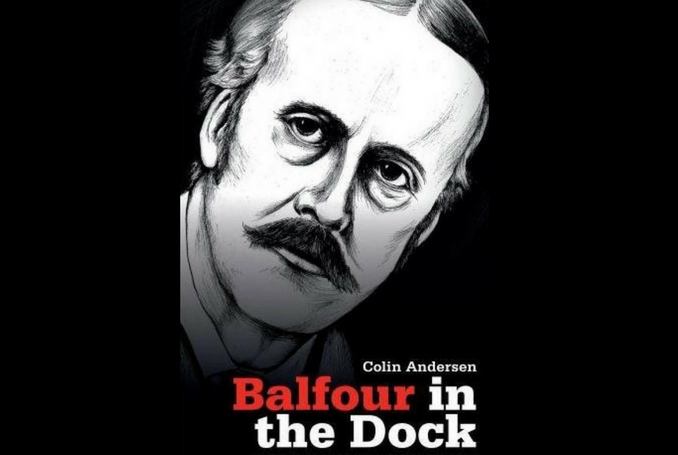
(Colin Andersen, Balfour in the Dock. J.M.N. Jeffries and the Case for the Prosecution. Bloxham, Oxon: Skyscraper Publications, 2017)
Reviewed by Jeremy Salt | Palestine Chronicle | April 18, 2018
J.M.N (Joseph) Jeffries was an outstanding British journalist whose book Palestine: The Reality (1939) is described by Colin Andersen as ‘a masterwork of history and a scathing indictment of British policy in Palestine from 1914 to 1938.’
George Antonius’ seminal work, The Arab Awakening, had been published only the year before but it is a more general account of British betrayal of the Arabs, whereas the value of the Jeffries book lies in his single-minded focus on Palestine and the force of his arguments. Few copies of the book were printed, and it is now almost impossible to find even in libraries. By Edward Said and many others, however, its value as an early exposure of British perfidy has long since been recognized.
Zionism itself was a wicked idea from the start. Herzl was not ignorant of the realities on the ground in Palestine. In the form of the people, he wanted to remove them and in the form of the land he wanted to turn Palestine into something else. Chaim Weizmann was no better. He lied, deceived and dissimulated as a matter of course. By 1914, with one exception, Zionism had no support anywhere. The Ottoman sultan, the Kaiser, and the Tsar’s government had all turned their backs on it. By Jews around the world, the Zionists were regarded as cranks, fanatics, and heretics but the one exception was critical. In Britain, the seed of imperial support for this mad idea had been sown by Joseph Chamberlain, the Colonial Secretary, when in 1903 he backed Zionist settlement in East Africa.
By 1917 Zionism had been absorbed into British imperialism. The motive was not gratitude for Weizmann’s chemical research in support of the war effort or anything as fanciful as sympathy for a persecuted people bent on returning to their ancient homeland but the recognition that Zionism was a tool Britain could use. The chief villains of the piece, in Jeffries’ reading, were the British Prime Minister, David Lloyd George, and his Foreign Secretary, Arthur James Balfour, both of whom, to use a term now current, ‘weaponised’ Zionism, first to bring the US into the war and then to turn Palestine over to their Zionist proxies, much as the US, Britain, France and their ‘allies’ have tried hard over the past seven years to put Syria in the hands of their takfiri proxies.
It was Jeffries, an outstanding correspondent for the London Daily Mail, who in 1923 exposed the deception deliberately built into Sir Henry McMahon’s correspondence with the Sharif Husayn of Mecca in 1915. The Sharif had outlined the area in which the Arabs were to be granted independence in return for supporting the British war effort. McMahon made specific exceptions for Mersin and Alexandretta (Iskanderun) and ‘portions of Syria lying to the west of the districts of Damascus, Homs, Hama and Aleppo, which cannot be said to be purely Arab.’ The excluded region had a substantial Christian percentage, but in line with its imperial tactics of divide and rule Britain chose to regard only Muslims as ‘Arab’ despite the role Christians played in the formulation of the Arab national idea.
This region ‘west of Damascus’ was the coastal littoral Britain intended to allocate to France in Sykes-Picot the following year but on no map, can Palestine be found west of Damascus. Homs and Hama are mentioned but not Jerusalem, for the obvious reason that the British knew that the Sharif Husayn would never agree to its exclusion from the area set aside for ‘Arab independence.’ Although Antonius is given the credit he deserves for exposing the depth of deceit in the McMahon letters to the Sharif Husayn, it was Jeffries, in articles written for the Daily Mail in 1923, based on a copy of the text he had been given by King Feisal, who first brought this deception to the attention of the British public.
The Husayn-McMahon correspondence was followed in 1916 by the treachery of Sykes-Picot and in 1917 by the further treachery of the Balfour declaration, a pledge not just made to the Zionists but largely written by them. Behind the caviling and declarations of nothing but good intentions, Jeffries knew exactly what they were up to the formula of a ‘national home’ was adopted for the time only because pressing for statehood would be regarded even by the British government as too provocative. The ‘country without a people for a people without a country’ was a brazen lie which the Zionists pretended to believe because they did not want the Palestinians to be there. They were being wished away psychologically long before they could be removed physically. As Jeffries was to write, they were nobodies who would eventually ‘vanish like mist before the sun of Zion.’
Behind his lofty, somewhat detached philosophical exterior, Balfour was as remorseless as the fanatics whose cause he was promoting, not in their interests, as they undoubtedly realized, but Britain’s. Zionism, he wrote in 1919, right or wrong, good or bad, was rooted in traditions, present needs and future hopes of ‘far profounder import than the desires and prejudices of the 700,000 Arabs who now inhabit that ancient land.’ Crucially, the words ‘now’ and ‘inhabit’ point to what Balfour, the British government, and the Zionists, colluding, had in mind: Palestine did not belong to the Palestinians, they were only ‘inhabiting’ it and only for ‘now.’ In the same statement Balfour, in a rare moment of truth, wrote that insofar as Palestine was concerned ‘the Powers have made no statement of fact which is not admittedly wrong and no declaration of policy which, at least in the letter, they have not always intended to violate.’
In Palestine: The Reality Jeffries traced Balfour’s declaration from inception through gestation to birth. As Colin Andersen writes, far from being a pure and lofty initiative of the British government, the declaration was in its drafting ‘very much an Anglo-Zionist-American affair.’ The process began ‘in earnest’ in June 1917, when Weizmann, Lord Rothschild, and Sir Ronald Graham, assistant undersecretary at the Foreign Office, visited Balfour, who had just returned from a five-week visit to the US, where he met the leading US Zionist, Supreme Court Justice Louis D. Brandeis. The question of a declaration on Palestine was discussed and after seeing Weizmann and Rothschild back in London, the drafting began, as Jeffries was to write, ‘on both sides of the Atlantic.’
It remains very worthwhile to consider how these drafts changed. As documented by Jeffries, in its first draft, prepared in July 1917, the British government spoke of Palestine being recognized as ‘the National Home of the Jewish people’, with the conditions of their ‘national life’ being determined with representatives of the ‘Zionist Organization.’ There is no mention of the theme dwelt upon by Balfour and others in the government of historical Jewish suffering and the need for a refuge and neither is there any mention of the majority of the population – Arab – actually living in Palestine.
On July 18 the Zionists produced their amended version in which Palestine would be ‘reconstituted’ as the national home of the Jewish people. In August Lord Milner, a senior figure in the government prepared a draft removing ‘reconstituted’ and referring to ‘a’ Jewish national home ‘in’ Palestine. This was approved by Balfour but opposed by Edwin Montagu, Secretary of State for India, both Jewish and anti-zionist, who described Zionism as a ‘mischievous political creed’, who said there was no Jewish nation and even argued that Zionism should be declared as illegal ‘and against the national interest.’ By longing for the day when he could ‘shake British soil from his shoes’ and go to Palestine, the British Jew would have acknowledged aims inconsistent with British citizenship and admitted that ‘he is unfit for a share in public life in Great Britain or to be treated as an Englishman.’ At a Cabinet meeting on October 4, Montagu again objected vigorously, with the support of Lord Curzon, who asked ‘How was it proposed to get rid of the existing majority of Mussulman inhabitants and to introduce the Jews in their place?’
In Washington on October 13, President Wilson approved to have the British draft, clearly without spending much time thinking about it. Back in London, a reworded draft referred to the British government viewing with favor the establishment in Palestine of a national home for the Jewish ‘race’, a phrase as bereft of any logic, historical or otherwise, as the Jewish ‘people’ or ‘nation.’ This time, however, the draft referred to the civil and religious rights of ‘existing’ non-Jewish communities in Palestine – the Palestinians, 90 percent of the population- as well as the rights of Jews elsewhere who were content with their existing nationality ‘and citizenship’, Balfour added.
This draft was also approved by Wilson. Alterations at the behest of Louis Brandeis led to further rewording, especially ‘people’ instead of ‘race.’ The reference to the rights of the ‘existing non-Jewish communities’ raised objections from the Zionists. How could anyone think that they could be damaged by the establishment of a national Jewish home? After all, did not Jewish religious tradition prescribe that the stranger must be looked after? In their inverted world, it was the stranger, themselves, who owned the land and the true owners, individually and collectively, the people of Palestine, who were the strangers, not that the Zionists had any intention of looking after them or even sharing the land. They wanted to get rid of them.
The final form of the declaration was approved by the War Cabinet on October 31 and issued on November 2. It ends with Balfour’s request to Lord Rothschild to bring the declaration to the notice of the Zionist Federation. Nothing more cynically humorous had ever been penned than these two lines, wrote Jeffries, seeing that the Zionists had collaborated in drafting the declaration: in its final form it would never have been issued without their approval. Jeffries describes the document as the most discreditable produced by a British government in living memory.
He follows a trail spotted with lies and deceit to where it led after the war, to a mandatory administration of Palestine top-heavy with Zionists and Palestine resistance to the Anglo-Zionist occupation of their land. By 1937 the Peel report was recommending partition and transfer of part of the Palestinian population, a solution which the Zionists wanted not in part but full but part would at least be a start. Wrote Jeffries: ‘How can anyone suggest that about a quarter of the Arab population should be removed by force from the land which they and theirs have occupied for centuries?’
Colin Andersen, blending original material from Palestine: The Reality and Jeffries’ other writings with his own analysis and interpretation, has produced a book that no student of Britain’s deceits from Husain-McMahon to the Balfour Declaration should leave unread. There is a broader context, of course. In 1917, as the Balfour Declaration was being prepared and the world was reacting to the Bolshevik revolution, Lloyd George was giving assurances to the British labor movement that territorial annexation was the last thing the government had on its own mind.
The British were sick of war and the government was alarmed at the effects of the Bolshevik revolution, at a time it needed to ‘comb out’ more working-class men of fighting age to send to the front. They had to be deceived. In December 1917, addressing trade union leaders, Lloyd George asserted that ‘our one object in the war was to defend the violated public law of Europe, to vindicate Treaty obligations and to secure the restoration of Belgium.’ The release by the Bolsheviks of the contents of Sykes-Picot on November 23 had been an embarrassment but the Labor Party could still issue a statement praising Lloyd George, whose speech had revealed ‘a government and a people seeking no selfish or predatory aims of any kind, pursuing with one unchanging mind, one unchanging purpose: to obtain justice for others so that we thereby secure for ourselves a lasting peace. We desire neither to destroy Germany or diminish her boundaries: we seek neither to exalt ourselves nor to enlarge our empire.’
The immense harm which has been done to the Palestinians also has to be set in a broader regional context. The partition of Arab lands was of a piece with the planned partition of Anatolia, where the powers planned to establish a Christian Armenian ‘protectorate’ in eastern provinces where the population was 80 percent Muslim. In 1919 Lloyd George was the principal architect of the Greek invasion of western Anatolia, which was not to end, after great loss of life and massive destruction, until 1922. In the same year the British government launched the ‘war of intervention’ against the Bolsheviks: in the 1930s it launched the war of non-intervention against the republican government of Spain as well as enabling the Italian invasion of Ethiopia and the Japanese invasion of China. Class and money interests of the British establishment took precedence over national interests (not that by this same establishment they were seen as being any different).
We can see continuity in the leading role Britain has played in the destruction of Iraq and Libya and the devastation of Syria by armed proxies over the past eight years, up to the missile attack of April 14. The record of lies, deception, intimidation, and aggression all the way since 1915 is practically seamless. We can only imagine what a journalist of the caliber of J.M.N Jeffries would have made of all this.
– Jeremy Salt taught at the University of Melbourne, at Bosporus University in Istanbul and Bilkent University in Ankara for many years, specializing in the modern history of the Middle East. Among his recent publications is his 2008 book, The Unmaking of the Middle East. A History of Western Disorder in Arab Lands (University of California Press).
Modi’s homage to Herzl comes to haunt him
By M K Bhadrakumar | Indian Punchline | April 20, 2018
The Israelis are in a bloody mess. They don’t know how to handle it – Palestinians in their thousands taking a leaf out of Gandhi and protesting non-violently against their colonial masters ignoring their fearsome reputation for brutality. And, to boot, women are at the barricades leading the Great Return March. Bravo!
So far, 37 Palestinians have been killed by the Israeli troops and more than 1,500 injured with live ammunition. Prime Minister Netanyahu’s government has given advance instructions to the army to shoot to kill. Today, the Israeli troopers shot down two more Palestinians. Today’s has been the fourth weekly protest. The escalating showdown with Israel is to culminate in a mass march on May 15.
The marches are pressing for the “right of return” of Palestinian refugees and their descendants to what is now Israel. Hundreds of thousands of Palestinians fled or were evicted from their homes and forced to leave their homeland in the 1948 atrocities by the Jewish extremists to pave the way for Israel’s creation. Palestinians mark May 15 (the anniversary Israel celebrates as its founding day) as their “nakba,” or catastrophe.
Ominously, that is also the date President Trump has chosen to shift the American embassy to Jerusalem. What crass insensitivity! But then, Trump needs Jewish money and Jewish media support in his campaign for re-election in 2020. Son-in-law Jared Kushner who is Trump’s point person on the Middle East also happens to be a Jew – some say, a closet rabbi.
Part of the reason for the protests is the crippling Israeli border blockade on Gaza since 2007. Evidently, the mass marches are also fueled by growing desperation among Gaza’s 2 million residents who are trapped in the tiny coastal territory amidst a gutted economy and deepened poverty. The Gaza residents typically get fewer than five hours of electricity per day, while unemployment has soared above 40 percent.
Despite Israel’s media manipulation to change the narrative and divert attention away from the Palestinian issue toward Iran, there is some uneasiness among American Jews as to where all this is heading and what damage all this is causing to Israel’s future in a medium term scenario. (Of course, America’s “exceptionalism” becomes a macabre joke.)
The White House envoy Jason Greenblatt, a member of President Donald Trump’s Mideast team, has admitted on social media that Palestinians in Gaza have a “right to protest their dire humanitarian circumstances.” He added that organizers “should focus on that message, not stoke the potential for more violence with firebombs and flaming kites, and must keep a safe distance from the border… the cost of these demonstrations is too high in loss of life and injuries.” Greenblatt is a devout and observant Jew himself – although he has opted not to wear a kippa while serving the Trump administration.
Another noted figure, actress Natalie Portman – also a Jewess – who is the recipient of an award, which is dubbed the “Jewish Nobel”, has pulled out of the June awards ceremony in Israel because of “extreme distress” over the brutal violence in that country. The Jerusalem-born Oscar winner intimated the Israeli organizers that she “does not feel comfortable participating in any public events in Israel.”
To my mind, the silence of the Indian government on Israel’s premeditated killings is deafening. How hypocrtical that our current leadership keeps chanting “Vasudhaiva Kutumbakam” (whole-world-is-one-single-family) as its foreign-policy motto! I can only hope that Prime Minister Modi gets to know about all this at some point – and sincerely repents.
Actress Natalie Portman puts him to shame. Indeed, Modi’s visit to the marble tomb of Theodor Herzl, the founder of Zionism, in Jerusalem last July stands out as a dark page in the chronicle of independent India’s current history.
I can understand Modi’s lack of erudition. But what I cannot understand why those fellows in his entourage who would have heard somewhere, sometime, someplace about the ideology of Zionism — and Gandhi’s visceral opposition to it — and didn’t alert their prime minister that he was making an appalling error of judgment. Probably, they chickened out.
Read a stirring dispatch from Gaza Strip by Al Jazeera, here, on Friday’s protests that have been labeled as the “Women’s March of Gaza.”
Hasbara memo: “When Israelis murder Palestinians, it’s a tragedy — for Israelis.”

© Ibraheem Abu Mustafa / Reuters
By Richard Hugus | April 19, 2018
Since the start of the latest massacre in Gaza — the killing with live fire of almost 40 and wounding of almost 3,000 unarmed Palestinian protestors during the March of Return — propaganda in service of Israel has been mobilized to cover up the blatant crime. Three days after the March began, the Jewish Community Relations Council of Greater Boston issued an unbelievably twisted statement on the attacks. What follows is their statement, with comments inserted in italics:
Jewish Community Relations Council Statement on Events Along Gaza Border
April 2, 2018
“We see the events along the Gaza-Israel border this weekend as the continuation of one of the great tragedies of our time.”
— This implies that Gaza is a sovereign country bordering Israel, not the prison for Palestinian refugees that Israel established decades ago in the south of Palestine.
“This is a situation where many are at fault, leaving individuals in impossible situations with impossible choices.”
— When someone is morally at fault, the situation is always “complicated.” As we shall see, the “many at fault” are always Palestinians, not Israelis.
“It is a tragedy for the people of Gaza that, 12 years after the complete withdrawal of Israel from the Gaza Strip, they live under such difficult conditions.”
— “Tragedy” in Greek theater held that events are written by our fate and could not have been otherwise. If Zionism had not chosen Palestine in the late 1800’s and then proceeded to steal land from Palestinians from then on, it could very much have been otherwise. There was an actor here; there was a cause, and an effect. The cause of the “tragedy” was Zionism. Ask the settlers to return to their own countries, and the “tragedy” would end.
The sentence also implies that Israel made a noble gesture when it withdrew from Gaza, and that it is the fault of the Palestinians that they did not make the best of this generous gift. In fact, Israel left Gaza because it was more expedient for Israel to administer Gaza as a prison than to occupy it. The “difficult conditions” faced by the people of Gaza are the result of Israeli control over everything and everyone that goes into and out of it. The “difficult conditions” are the result of repeated Israeli bombings of critical infrastructure, and Israel’s clear plan for the complete immiseration of Gaza’s two million people.
“It is a tragedy for the Palestinians that Gaza was taken over by Hamas, an internationally designated terrorist organization that rules in a brutal dictatorship.”
— Hamas was democratically elected by its people because it distinguished itself from the collaborationist leadership of the Palestinian Authority. Israel defines Hamas as terrorist because Hamas is determined to resist the Zionist entity. Israel’s minions in legislative bodies in other countries have been used to create the “designated terrorist” label.
“Brutal dictatorship” is a buzzword applied to all political movements asserting independence from imperialist control.
“It is a tragedy that Hamas has chosen to direct its resources to the building of tunnels and rockets, rather than building hospitals, schools, housing, and factories that would create prosperity and opportunity for the Palestinian people.”
— Are these the same hospitals, schools, housing and factories that Israel has been bombing since 2006? Are these the same tunnels that Gazans used to bring in vital humanitarian goods not allowed through Israeli checkpoints? Doesn’t Hamas have the right to its primitive rockets when Gazans are being periodically bombarded by Israel and its highly sophisticated fighter jets?
“It is a tragedy that, by squandering the opportunity to build a better future for the Palestinian people, Hamas has forced Israel and Egypt to secure their own borders with a blockade to prevent the further weaponization of Gaza.”
— For choosing resistance against the Zionist occupier, the Palestinian people were punished by the Zionist occupier and his servants in Egypt. The blockade is not just against weapons, it’s against any freedom of movement, and any importation of needed goods. Even people in need of urgent medical care are refused. The main purpose of the Israeli blockade is to starve Gaza, to “put them on a diet”, as one Israeli official said. To its everlasting shame, the West-installed political class in Egypt – not the Egyptian people – has chosen to collaborate.
“It is a tragedy that the Palestinian people of Gaza have no recourse against their leaders, living without elections or even the ability to protest those in power openly on pain of death.”
— Again, Hamas was democratically elected in 2006. One would think “the only democracy in the Middle East” would appreciate this. Stories of Hamas killing protesters have appeared only in the Israeli press – e.g., the Jerusalem Post, the Times of Israel. However, there are stories every day in the worldwide press of Israeli soldiers shooting Palestinian protestors all over the West Bank. Let’s also remember that the March of Return in Gaza is made up of protestors, and that Israel sent snipers there for the explicit purpose of killing and wounding them. This is not to mention the “recourse against” Hamas leaders employed over the years by Israel – namely, open assassination.
“It is a tragedy that they are deceived by their own leaders with the unrealistic promise of a destructive victory over the State of Israel – a victory that will never come. It is a tragedy that their own government chooses to use them as human shields, perpetuating their suffering for nefarious self-interest.”
— As the Borg said, “Resistance is futile.” Isn’t the promotion of the idea of an unconquerable Israel the worst kind of war propaganda? The “human shields” argument has been used by Israel as an excuse for intentionally killing hundreds of civilians during its repeated bombing campaigns. What is the “nefarious self-interest” of Gaza’s leadership? — liberation from Israeli torture.
“It is a tragedy that the Israeli people look at Gaza and see the end of a dream; to live in peace with their neighbors.”
— The “dream” of the majority of the Israeli people today is to remove Palestinians from all of historic Palestine, and completely erase Palestinian history. Israelis do not “live in peace with their neighbors.” They have repeatedly attacked Lebanon, Iraq, and Syria and they are the main instigators today of conflict and war with Iran.
“It is a tragedy that Israelis living near the border are terrorized by threats coming from tunnels under their homes and rockets over their schools.”
–The main tactic of this propaganda piece is to blame the victim. Thus, nothing was done through the agency of the Jewish state and its obvious goals; everything was done as a reaction to injustices committed by Palestinians. It also turns reality on its head. Homes and schools have indeed been destroyed, but by Israel.
“It is a tragedy that when Israelis do what any other nation in the world would do – protect their border from being overrun – that they endure a condemnation that no other nation would receive.”
— This is the “why pick on us?” argument. Why? Because Israel has the ugliest, most long-standing system of open colonization and oppression visible in the world today. The vast majority of the people of the world are disgusted. What Israel claims as its “borders” is stolen land.
“It is a tragedy that Israelis experience this singling out as a further example of an isolation, their status as “the Jew amongst the nations,” with only themselves to protect their inalienable rights to live in security.”
— This is the “Jew as victim” argument, made possible by unrelenting Holocaust instruction since World War II, which provides a guaranteed pass for any and all crimes committed by Jews. Since 2001, Israel, the poor victim nation, has gotten the United States to attack a long list of countries in the Middle East which Israel feels threatened by, now including Russia because Russia has thrown a wrench into Israeli plans to destroy Syria. Israel also receives massive direct funding and political cover from the United Sates.
If Israel resents its status as “the Jew amongst the nations” why does it call itself “the Jewish state”? Why does it display the Star of David on all its national symbols and armaments? This is an identity which Israelis promote – how can they now turn around and blame us for it?
“It is a tragedy because this weekend, young men and women of the Israel Defense Forces stared down the sights of their rifles and learned violence at a time when they should have been at home with their families celebrating freedom at the Passover table.”
— The idea that it is the Israeli Occupation Forces who have suffered because they have had to kill and maim defenseless Palestinians is a perfect example of what Zionist supremacy and racism is. It is a form of self-worship and psychopathy in which one is never responsible for committing any wrong — it is always the fault of the other. This sentence is reminiscent of Israeli Prime Minister Golda Meir saying: “We can forgive the Arabs for killing our children. We cannot forgive them for forcing us to kill their children.” In other words, the real crime has been committed against Jews, whose purity has been sullied by having to kill innocent people (as they were invading their land and homes).
This belief of Jewish superiority above others is at the bottom of everything Palestinians have suffered for the past 70 years.
“It is a tragedy because Palestinians need some way to express their frustrations – at Israel and at their own government after years of wasted opportunities to build a better life for the people of Gaza. Instead they experienced more manipulation, and more loss.”
–No, the ” frustration” Palestinians feel is from being consistently and sadistically blocked from life and liberty by the Israeli prison-keeper. The real manipulators are those who would have us believe the oppressive tactics of Israel are of the Palestinians’ own making, as this sentence implies.
“We see this weekend as the continuation of a tragedy that has not brought the people of Israel and Gaza any closer to a future of peace and hope for all of their children. As the Boston Jewish community continues to celebrate the Passover holiday this week, we are mindful of the lessons learned at our seders, that we do not rejoice over the tragedy of others and we are ever hopeful for peace and stability for all people.”
— Again, no recognition that this “tragedy” might be in any way the fault of Israel. Israel is supported, not by “the Boston Jewish community” but by a cynically propagandistic Washington-based lobby for Israel, the Jewish Council for Public Affairs, which provides the political line for 125 supposedly local Jewish Community Relations Councils in the US. In other words, a political lobby for a country 6,000 miles away says they speak for all Jews in Boston.
In 2016 the Jewish Community Relations Council of Boston sponsored a deceptive anti-boycott bill in the Massachusetts legislature. They were successfully opposed by a large number of Jewish activists in the state, and many others. The Council now claims to represent the Jewish community of Boston in mobilizing opposition to a motion in the Cambridge city council to boycott Hewlett-Packard. When was the vote in which “the Boston Jewish community” elected this Council? Who is the real manipulator in this scenario? Doesn’t the Jewish Community Relations Council actually represent a foreign political movement — not Cambridge, not Boston, not Massachusetts?
Israel, you can’t have it both ways. You can’t repeatedly murder people in Gaza in broad daylight and then piously claim you’re for “ peace and stability for all people.”
Lebanese Journalist Names Washington’s Goal Number One in Syria
Sputnik – April 19, 2018
Sputnik spoke to Lebanese journalist and commentator Sharmine Narwani to find out more about situation in Syria and Washington’s goals and actions there.
It has been revealed that US Secretary of Defence, James Mattis, tried to urge US President Donald Trump to obtain congressional approval before launching airstrikes on targets in Syria last weekend. According to reports, President Trump was however set on the use of military force, and overruled the Pentagon chief’s advice. In other developments, Saudi Arabia is reportedly holding talks with the United States and Egypt about sending an Arab coalition force into Syria.
Sputnik: We’re hearing news that the US is in talks with Saudi Arabia to build an Arab force and send it to Syria. Saudi Arabia’s foreign minister has said that he is in talks with US National Security Advisor John Bolton to plan building this force – what do you make of this, what do you think its purpose is?
Sharmine Narwani: Look Trump wants to clear exit the debacle in Syria and eliminate the need to spend billions of dollars a year in maintaining US forces there and participating in the war. The recent chemical weapons allegations came shortly after Trump vocalised this desire; but the likelihood of an Arab force to physically base themselves in Syria on the Syrian-Iraqi border is virtually nil. We must view this new tactic with some suspicion. The US has always trumpeted ISIS as its main goal in Syria or the elimination of ISIS. If ISIS is gone, then what’s the need to have foreign forces based on that border? It seemed clear all along that containing Iran’s access from Iran to the borders of Palestine has always been the goal. It’s not as though Saudi Arabia and Egypt have stellar or significant nation-building expertise anyway. And they have many differences – the Saudis and the UEA for instance are heavily involved militarily in Yemen and are overextended there. Egypt has shown reluctance to participate in that Arab conflict, let alone another one with a government that it has actually sort of ideologically supported in the Syrian conflict. So it’s not likely to become a reality.
Sputnik: Of course in the lead up to the Western bombing campaign on Syria the US was saying that President Bashar al-Assad had used sarin gas, but we’ve now found out that they did not have sufficient evidence of this at the time. Also, the New York Times has revealed that Defence Secretary Jim Mattis urged Trump to get congressional approval for the strikes, but the president overruled him on that – what does this all tell you about the lead up to the events of last weekend?
Sharmine Narwani: If we look at the recent events leading up to the alleged chemical weapons incident, it took place under cover of two important developments: one was Trump’s declaration of exiting Syria, and removing US troops from there soon. The second would be the Syrian army’s very rapid defeat of terrorists in Eastern Ghouta and the reclamation of that strategically vital territory around Damascus. I think the sort of bringing up Sarin, the nerve gas sarin, it’s always kind of utilised as an emotional trigger, as is the mention of chemical weapons by itself and the general assumption if we’re talking about sarin would be that only states would have access to that particular substance, and not terrorist groups and non-state actors, unlike say with a substance like chlorine that is readily available. So I think it was very deliberately invoked, meaning sarin, to create an emotional response globally.
But Sarin has been used in Iraq by insurgents since at least 2004, in the form of IEDs. Turkey for instance, in May 2013, way later during the Syrian conflict, captured 12 Nusra members, Nusra is the Al-Qaida arm in Syria, they captured 12 Nusra members with significant amounts of Sarin and that was believed to be heading toward Syria. And major US-UK risk analysis firm IHS Conflict Monitor, in 2016, told us in a report that ISIS has used chemical weapons more than 52 times in both Syria and Iraq.
Sputnik: We’ve heard today that US senators are increasingly becoming concerned at the absence of a coherent US strategy in Syria, where do you see things from here?
Sharmine Narwani: Even during Obama’s term, we talked about there being a lack of coherent strategy. I would say that there is maybe a lack of a coherent verbalised strategy, one that was disseminated to the American public and an international one. There was certainly a strategy behind the scenes, one that was not vocalised and actions speak louder than words, so when we look at the arming, training and financing of terrorists when it was clear that there wasn’t enough Syrian support to topple Assad in the way leaders had been toppled in Tunisia and Egypt. We had the arming, training & financing but there was a very clear strategy, and the goal was number one, regime change, and two, to weaken the most important Iranian Arab state ally. So that was the strategy. When people say there wasn’t a coherent one they probably mean there wasn’t a coherent vocalised one. US actions have certainly shown us that regime change and weakening Iran were in fact the strategy in Syria and this is apparent today because the escalation still continues.
Media Cover-up: Shielding Israel is a Matter of Policy
By Ramzy Baroud | MEMO | April 17, 2018
The term ‘media bias’ does not do justice to the western corporate media’s relationship with Israel and Palestine. The relationship is, indeed, far more profound than mere partiality. It is not ignorance, either. It is a calculated and long-term campaign, aimed at guarding Israel and demonizing Palestinians.
The current disgraceful coverage of Gaza’s popular protests indicates that the media’s position aims at suppressing the truth on Palestine, at any cost and by any means.
Political symbiosis, cultural affinity, Hollywood, the outreaching influence of pro-Israel and Zionist groups within the political and media circles, are some of the explanations many of us have offered as to why Israel is often viewed with sympathetic eyes and Palestinians and Arabs condemned.
But such explanations should hardly suffice. Nowadays, there are numerous media outlets that are trying to offset some of the imbalance, many of them emanating from the Middle East, but also other parts of the world. Palestinian and Arab journalists, intellectuals and cultural representatives are more present on a global stage than ever before and are more than capable of facing off, if not defeating, the pro-Israeli media discourse.
However, they are largely invisible to western media; it is the Israeli spokesperson who continues to occupy the center stage, speaking, shouting, theorizing and demonizing as he pleases.
It is, then, not a matter of media ignorance, but policy.
Even before March 30, when scores of Palestinians in Gaza were killed and thousands wounded, the US and British media, for example, should have, at least, questioned why hundreds of Israeli snipers and army tanks were ordered to deploy at the Gaza border to face-off Palestinian protesters.
Instead, they referred to ‘clashes’ between Gaza youth and the snipers, as if they are equal forces in an equivalent battle.
Western media is not blind. If ordinary people are increasingly able to see the truth regarding the situation in Palestine, experienced western journalists cannot possibly be blind to the truth. They know, but they choose to remain silent.
The maxim that official Israeli propaganda or ‘hasbara’ is too savvy no longer suffices. In fact, it is hardly true.
Where is the ingenuity in the way the Israeli army explained the killing of unarmed Palestinians in Gaza?
“Yesterday we saw 30,000 people,” the Israeli army tweeted on March 31. “We arrived prepared and with precise reinforcements. Nothing was carried out uncontrolled; everything was accurate and measured, and we know where every bullet landed.”
If that is not bad enough, Israel’s ultra-nationalist Minister of Defense, Avigdor Lieberman, followed that self-indictment by declaring there are “no innocent people in Gaza”; thus, legitimizing the targeting of any Gazan within the besieged Strip.
Unfair media coverage is not fueled by the simplistic notion of ‘clever Israel, imprudent Arabs’. Western media is actively involved in shielding Israel and enhancing its diminishing brand, while painstakingly demolishing the image of Israel’s enemies.
Take for example, Israel’s unfounded propaganda that Yasser Murtaja, the Gaza journalist who was killed in cold blood by an Israeli sniper while covering the Great March of Return protests at the Gaza border, was a member of Hamas.
First, ‘unnamed officials’ in Israel claimed that Yasser is ‘a member of the Hamas security apparatus.’ Then, Lieberman offered more (fabricated) details that Yasser was on Hamas’ payroll since 2011 and ‘held a rank similar to a captain.’ Many journalists took these statements and ran with them, constantly associating any news coverage of Yasser’s death with Hamas.
It turned out that, according to the US State Department, Yasser’s start-up media company in Gaza had actually received a small grant from USAID, which subjected Yasser’s company to a rigorous vetting process.
More still, a report by the International Federation of Journalists claimed that Yasser was actually detained and beaten by the Gaza police in 2015, and that Israel’s Defense Minister is engineering a cover-up.
Judging by this, Israel’s media apparatus is as erratic and self-defeating as North Korea; but this is hardly the image conveyed by western media, because it insists on placing Israel on a moral pedestal while misrepresenting Palestinians, regardless of the circumstances.
But there is more to western media’s approach to Palestine and Israel than shielding and elevating Israel, while demonizing Palestinians. Oftentimes, the media works to distract from the issues altogether, as is the case in Britain today, where Israel’s image is rapidly deteriorating.
To disrupt the conversation on Palestine, the Israeli Occupation and the British government’s unconditional support of Israel, British mainstream media has turned the heat on Jeremy Corbyn, the popular leader of the Labor Party.
Accusations of anti-Semitism have dogged the party since Corbyn’s election in 2015. Yet, Corbyn is not racist; on the contrary, he has stood against racism, for the working class and other disadvantaged groups. His strong pro-Palestine stance, in particular, is threatening to compel a paradigm shift on Palestine and Israel within the revived and energised Labor Party.
Sadly, Corbyn’s counter strategy is almost entirely absent. Instead of issuing a statement condemning all forms of racism and moving on to deal with the urgent issues at hand, including that of Palestine, he allows his detractors to determine the nature of the discussion, if not the whole discourse. He is now trapped in a perpetual conversation, while the Labor Party is regularly purging its own members for alleged anti-Semitism.
Considering that Israel and its allies in the media, and elsewhere, conflate between criticism of Israel and its Zionist ideology, on the one hand, and that of Jews and Judaism on the other, Corbyn cannot win this battle.
Nor are Israel’s friends keen on winning, either. They merely want to prolong a futile debate so that British society remains embroiled in distractions and spares Israel any accountability for its action.
If British media was, indeed, keen on calling out racism and isolating racists, why then is there little discussion on Israel’s racist policies targeting Palestinians?
Media spin will continue to provide Israel with the needed margins to carry out its violent policies against the Palestinian people, with no moral accountability. It will remain loyal to Israel, creating a buffer between the truth and its audiences.
It is incumbent on us to expose this sinister relationship and hold mainstream media to account for covering up Israel’s crimes, as well as Israel for committing these crimes in the first place.
MK proposes 10 years prison sentence for anyone filming Israeli soldiers

Palestine Information Center – April 13, 2018
OCCUPIED JERUSALEM – In a step aimed at covering up Israeli crimes, MK Robert Ilatov (Yisrael Beytenu) has called for introducing a new bill punishing anyone who photographs or video-records soldiers while performing their duties in order to undermine their morale.
He made his proposal after a video went viral on the internet showing an Israeli soldier shooting at a Palestinian on Gaza border as other follow soldiers were verbally attacking other protesters.
According to the Hebrew newspaper Israel Hayom, the proposed bill calls for imposing a five-year prison punishment on anyone exposing on-duty soldiers’ behavior.
It also calls for jailing for 10 years anyone who does so with the intention of harming Israel’s national security.
The proposed bill mentions NGOs such as B’Tselem, Machsom Watch and Breaking the Silence, calling them “anti-Israel and pro-Palestinian… and BDS organizations.”
It claims that “for many years, there has been a disturbing phenomenon in Israel of documenting soldiers through videos, stills and voice recordings,” and that some NGOs have people follow soldiers all day long to try to “document them in a biased and slanted way… while sometimes accusing and insulting them.”
Ilatov said the time came to put an end to what he called “anarchy.” “It cannot be that any left-wing activist or organization, supported by foreign entities, can get free access and document, undisturbed, soldiers on duty.”
“We have the responsibility to give soldiers the optimal conditions to do their jobs, without them having to be worried about a left-wing activist or organization sending out their photo and trying to shame them.”
Featured Video

Netanyahu Ordered the 2003 Invasion of Iraq
or go to
Aletho News Archives – Video-Images
From the Archives
A Lesser “Grade” of Human
By Michael Hoffman | Revelation of the Method | January 3, 2024
Will the more than 100 Iranians killed by terrorist bombs today be mourned in the West as victims of terrorism? Certainly not. Allied doctrine has it that the killing of Israeli or American civilians is a crime of cosmic proportions, while shedding the blood of “enemy” women and children is perfectly acceptable; indeed commendable.
The West does not memorialize the hundreds of thousands of civilians bombed by the U.S. in Serbia, Iraq, Afghanistan and every major German city 1943-1945. America’s fire-bombing of the city of Tokyo by General Curtis LeMay in March 1945 was followed by Harry Truman’s atomic incineration of Hiroshima and Nagasaki in August of that year. Truman never had a moment of doubt or regret over the murder of more than a 100,000 Asian children, mothers and non-combatant boys and men. It was business as usual for the “noble” Allies during the “Good War.”
In the West human rights signifies passionate concern only for civilians designated as truly human: Israelis first, then Americans and British, followed by their satraps.
This inhumanity is the legacy of Talmudic ideology, beginning with tractate Sanhedrin 57a from 400 A.D., concerning liability for capital punishment: “If a Jew murders a gentile, he is exempt.”
This teaching of contempt was reiterated in the dogma of Chabad Lubavitch founder Rabbi Shneur Zalman in the 18th century. … continue
Blog Roll
 Aletho News
- US Senator Murphy says Pentagon denied him entry to US base in Qatar
- Israel expands “incitement” charge to target Palestinian education and memory
- How Israel seeks to reshape Arab classrooms
- Paris bans pro-Palestinian demonstration planned for Oct. 7 over ‘risks of public disorder’
- In August Hanning Treason Case – All Signs Point To Tel Aviv.
- France cleared dozens of military sales to Israel between May and September: Report
- France projects nuclear power as Macron pushes arsenal expansion
- The fallacy of US delusions about Iran’s economic collapse
- What changes with Lula or Flávio?
- Britain leads Western media’s demise through ‘fear porn’ narrative
- If Americans Knew
- Soldier testimony sheds light on how Israel wages information war
- CIA Report Warns Israel Could Head Toward Civil War, Total Collapse
- Banker Who Exposed Howard Lutnick’s Ties to Epstein Warned of ‘Retaliation’ and ‘Personal Consequences’ in Last Post Before Suicide
- Israeli Attacks Kill Two Palestinians in Gaza
- Gaza genocide at 3: Israeli-U.S. cruelty and the smart, deep resistance to it are changing the world
- As genocide is about to enter 3rd year, little of Gaza remains– Daily Update
- “We See Our Homes Now From A Satellite, Like Strangers”
- Watch “Gaza: Doctors Under Attack”, originally censored by BBC
- NAZA: Israeli embassies in UK and US promote rival documentary to challenge Gaza genocide allegations
- David Ellison appoints Israeli to lead merged Paramount-Warner studios
- No Tricks Zone
- US September “Heat” Was No Record…Many Records Set Decades Ago
- Latest European Green Energy Debacle; Portugal’s Largest Flagship Solar Park Insolvent!
- Green Energy Debacle: German Expert Professor Fritz Vahrenholt Warns Of Severe Economic And Social Consequences
- Two More Paleo Reconstructions Affirm Meters-Higher Sea Levels Across Ireland, Brazil 7000-6000 Years Ago
- New Study: Earth And Venus Surface Warmth Largely Explained By Convection And Lapse Rate, Not CO2 Or Radiation
- 2025 Nature Paper Claiming Worsening Global Drought Gets RETRACTED …Heavily Flawed
- New Study: ‘Global Drought Shows No Detectable Recent Acceleration Under Climate Warming’
- Economic Masterminds: German Socialists Suggest Taxing Productivity Gains Stemming From Using AI
- The South China Sea Has Not Been Cooperating With The Climate Change Narrative
- Energy Crisis: Germany Enters Heating Season With Historically Low Gas Reserve Fill Levels

