Paraguay to move its embassy in Israel to Occupied Jerusalem
Palestine Information Center – April 29, 2018
OCCUPIED JERUSALEM – Israel Hayom newspaper on Sunday said that the Paraguayan president Horacio Cartes has pledged to transfer his country’s embassy from Tel Aviv to Jerusalem.
Cartes said that he would like the move to take place before he leaves office in June.
Cartes said during a ceremony held in the Paraguayan capital of Asunción to mark the 70th anniversary of the establishment of Israel that his decision stems from both political and personal commitment.
Paraguay is the fourth country to decide to move its embassy to Occupied Jerusalem joining the Czech Republic, Guatemala and Honduras who followed the lead of the US.
Both the US and Guatemala have decided to transfer their embassies to Jerusalem in mid-May, while Honduras and the Czech Republic have not set a date yet.
On 6th December 2017 the US president Donald Trump recognized Jerusalem as Israel’s capital and announced his intention to move the US embassy from Tel Aviv to the holy city stirring worldwide condemnation.
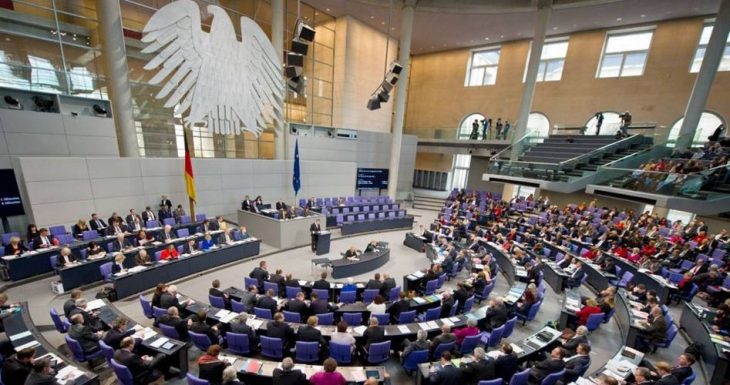
Hamas condemns Bundestag’s support for ‘Israel’ to be a Jewish state
Palestine Information Center – April 29, 2018
GAZA – Hamas strongly condemned the German Bundestag’s call for the German government to support recognizing the Israeli occupation as a Jewish state over the land of historic Palestine.
In a statement on Sunday, Hamas said “At the time the Palestinians expected a strong support from the Federal Republic of Germany on the 70th anniversary of the Nakba, the Bundestag did not mention the seven-decade long aggression of the Israeli occupation on our people, and it did not denounce the Israeli racist and fascist policies”.
Today, the Israeli occupation as an occupying power, continues usurping Palestinian land in favor of illegal settlements, arrests thousands without trial, many of them are children, women and patients, Judaizes Jerusalem and forcefully deports Jerusalemites from their homes and imposes an unjust siege on more than two million Palestinians in Gaza.
The siege on Gaza is considered by all international institutions and international laws as a collective punishment that amounts to a crime against humanity.
You, the Bundestag, described the Israeli occupation as a “state that embraces western European values.” Do these values accept, for example, the killing of dozens and wounding of thousands of peaceful demonstrators, most of them children, who demand their right to a decent life and return to their homes?
This decision destabilizes the region and the world, as well as it gives the occupation a green light to continue its aggression against our people, violation of international law and encourages the displacement of the rest of our people.
Hamas is wondering whether accepting a Jewish state is in line with the democratic values on which Germany was founded after WWII, which basically do not consider differences between citizens on the basis of race, color or religion.
Therefore, we demand that the Bundestag cancel this decision and take positions that achieve justice for our people after decades of suffering, which Europe, and foremost Germany, is a major cause of it.
Hamas: Haley’s remarks encourages Israel to commit more crimes
Palestine Information Center – April 27, 2018
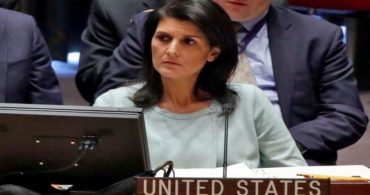 GAZA – Hamas Movement on Friday perceived the statements of Nikki Haley, the United States Ambassador to the United Nations, in which she claimed that Hamas uses civilians as human shields in Gaza Strip, as untrue offensive remarks.
The Hamas’s spokesman Sami Abu Zuhri said, on Twitter, that Haley’s statements encourage Israeli occupation authorities to commit more crimes against the Palestinian people including the killing of children.
Earlier on Thursday, Haley reiterated her allegations against Hamas Movement before the UN Security Council without even mentioning Israeli ceaseless violations against Palestinians including the killing of the participants of the march of return.
Some 41 Palestinians have been killed and over 5000 others have been injured by Israeli forces since March 30, 2018.
German parliament endorses draft bill recognizing Israel as Jewish State
MEMO | April 27, 2018
The German Bundestag endorsed a draft bill that recognizes the Jewish State of Israel, Thursday.
The bill states that the two- state solution is the only solution to end the Palestinian-Israeli conflict and stated that Israel’s security and sovereignty is key to Germany’s foreign and security policy.
Three parliamentary blocs; the Christian and Democratic Union led by Chancellor Angela Merkel, the Socialist Party and the Free Democratic Party submitted the draft bill on the 70th anniversary of Israel establishment.
The draft bill stipulates that the government and its partners in the international community should work towards a two-state solution, which it described as “the only solution to the conflict in the Middle East with emphasis on Israel Jewishness, democracy and independence as well as the establishment of a Palestinian viable and democratic state”.
Romanian President Demands Prime Minister’s Resignation Over Betrayal of Palestine
By Adam Garrie | Eurasia Future | 2018-04-27
When Romania’s Prime Minister Viorica Dancila announced that her country would move its “Israeli” Embassy from Tel Aviv to Jerusalem/Al-Quds in line with the United States, she did not consult her President as Romanian law demands. The move which is considered a grave insult to millions of Arabs, Muslims and Christians throughout the world was apparently taken in a unilateral move that Romania’s President has said violates both national and possibly international law.
President Klaus Iohannis has stated that the Premier’s decision “does not cope with her position of the prime minister of Romania and thus it turns the government into a vulnerability for Romania…. That is why I call publicly for her resignation.”
The rift comes after Prime Minister Dancila recently took a trip to “Israel” which the President said was not cleared with the head of state and therefore cannot be described as an official state visit even though Dancila acted as though it was.
The political turmoil within Romania is a clear sign that even among the few European nations that have been inching towards a US position of moving their embassies in “Israel” to Jerusalem/Al-Quds, such moves are highly domestically divisive.
Today in Palestine, demonstrators continue their Great March of Return protests which are set to continue through Nakba Day on the 15th of May. Thus far, “Israeli” aggression against peaceful demonstrators has resulted in over 40 deaths and the wounding over over 5,500 Palestinians.
Landmark bill restricting criticism of Israel sneaks through South Carolina Senate

South Carolina State Representative Alan Clemmons, a real estate attorney who has been called “Israel’s biggest supporter in a U.S. state legislature,” tells Representatives that his bill won’t interfere with free speech. Many experts disagree.
South Carolina is poised to be the first state to pass legislation to adopt an Israel-centric definition for “anti-Semitism.” This will then apply to the state’s campuses, potentially limiting discussion of Israel-Palestine to one-sided information that fosters U.S. policies that provide Israel $10 million per day. The bill has been heralded in Israel as a “a landmark bill” that will lead change across the U.S. and the world.
By Alison Weir | If Americans Knew | April 25, 2018
The South Carolina Senate has recently passed legislation that changes the definition of anti-Semitism to include criticism of Israel, and then applies this new definition to college campuses in a manner that experts say will impede free academic inquiry. The U.S. gives Israel over $10 million per day, and Congress frequently approves increases to that amount; restricting discussion on this issue could serve to bolster and increase these expenditures.
The legislation codifies a definition of anti-Semitism that significantly changes the meaning of the word, and it requires the state’s colleges to use this new definition when determining whether an action is “discriminatory” and therefore prohibited. This new definition declares statements that are critical of Israel—even when factual—“anti-Semitic” and therefore impermissible.
A bill on this passed in the state House of Representatives, but when promoters failed to pass it in the state Senate, they resorted to a parliamentary maneuver that may have broken their own rules. They inserted the text at the last minute in South Carolina’s 545-page General Appropriations bill, which is considered a “must-pass” bill because it is required for state government to function. The insertion is on page 348, sandwiched between a section on “Statewide Higher Education Repair and Renovation” and a section that specifies the amount of money appropriated to one of the state’s colleges.
Since the inserted text (section 11.22) does not appear germane to the bill in which it was inserted (and was ruled out of order on the first attempt to add it), the maneuver may have broken legislative rules.*
However, it appears unlikely that the sponsors will be held to account, for two reasons: 1. In Israel the bill is considered extremely important, and some powerful organizations both in the U.S. and internationally support it. 2. However, in South Carolina, legislators tend to consider it insignificant legislation that will have little, if any, impact and therefore see no reason to expend political capital in questioning it. (More on this below.)
Not Law Yet
While pro-Israel groups are celebrating the passage as a “monumental” victory, there are actually two more steps before it becomes state law.
First, the bill must be reconciled with a previous appropriations bill passed by the House. This bill also contains an amendment redefining anti-Semitism and applying it to colleges, but uses different wording. Representatives of the two chambers will meet in the next week or so to create a compromise bill. After that has been accomplished, the Governor must sign it into law.
It is safe to assume neither of these steps will constitute obstacles, however. The governor is in an 8-candidate gubernatorial race where campaign donations are critical, and examination of campaign finance records indicate that pro-Israel donors, often from out of state, frequently play an outsized role in such elections. If history is any predictor, neither he nor any challengers are likely to oppose the legislation.
The Law Will Have Major Impact
The inserted legislation does several things:
First, it vastly expands the traditional, very clear meaning of anti-Semitism—hostility to or prejudice against Jewish people on the basis of their being Jewish—to a new definition that includes certain types of information about Israel.
The Senate bill spells out a long, hazy definition that consists of an array of types of actions, “certain perceptions,” “rhetorical manifestation,” etc., that would now legally constitute “anti-Semitism.” Half a dozen of them are related to the modern state of Israel.
The House bill, rather than spelling out the definition itself, codifies a definition adopted by a State Department special envoy in 2010, which also changed the traditional meaning of anti-Semitism to include statements critical of Israel. (Full text of both are below.)
The Senate bill requires South Carolina’s Commission on Higher Education to print copies of this new, Israel-centric definition of anti-Semitism and distribute them to all South Carolina public colleges and universities.
Finally, both bills mandate that academic institutions use this definition in deciding whether someone has violated a school’s policy prohibiting discrimination.
If the legislation goes through and becomes law, as proponents appear certain it will, the consequences could be two-fold: a significant loss of academic freedom at South Carolina colleges, and, indirectly, continued one-sided U.S. Middle East policies and massive expenditures.
But first let’s look at the historic and geopolitical background of this new definition.
Origin of the New Definition
The basic outline of this new, Israel-centric definition of anti-Semitism was first created by an Israeli minister in 2004. Israel partisans have successfully pushed its adoption by numerous entities around the world ever since, building on even the smallest endorsements to create momentum and a snowballing effect. (See this for details.)
In the U.S., a two-step process has achieved partial success in getting the nation to legally adopt the new definition, but the effort is ongoing—South Carolina’s law would be a major step forward for proponents of the definition, and the accompanying censorship of certain types of information.
The first step that would enable the adoption of the definition in the U.S. also occurred in 2004: Pro-Israel groups successfully promoted federal legislation to create a “special envoy” and State Department office to monitor anti-Semitism. This was done over the objections of state department officials, who said it was unnecessary.
The second step was accomplished by one of these envoys, who unilaterally adopted the new, Israel-centric definition in 2009. (All three envoys have been demonstrably pro-Israel, two later working for the Israel lobbying organization AIPAC—the American Israel Political Action Committee. President Trump, as part of his general cost-cutting measures, has not yet appointed a new envoy, causing many pro-Israel groups to call him anti-Semitic for this failure.)
Anti-Semitism Special Envoy Hannah Rosenthal (above) adopted the Israel-centric definition in 2009.
Since that time, Israel partisans have introduced legislation in the federal government and state legislatures—and even on some college campuses—to adopt this definition, which they call the “state department definition.” South Carolina, if the bill becomes state law, will be their first success in this effort.
Curtailing Freedom of Speech and Academic Inquiry
These bills usually contain a final sentence that says they don’t violate the Constitutional guarantee of free speech, and their sponsors make this claim to the people voting for them.
However, the reality seems to be the opposite.
Legal experts say the legislation will do just that, and there is a history of university administrators around the country censoring protected speech on the basis of such definitions.
In fact, the author of the definition adopted by the State Department anti-Semitism envoy has vehemently opposed legislating the definition into law, specifically writing that applying it to colleges “is a direct affront to academic freedom.”

Kenneth Stern, who helped write the new definition, says legislation that imposes it on campuses is “unconstitutional and unwise.” Stern was employed by the American Jewish Committee as its expert on anti-Semitism for 25 years.
In a letter opposing federal legislation to codify the definition as law, author Kenneth Stern stated: “The definition was never intended to be used to limit speech on college campuses; it was written for European data collectors to have a guide for what to include and what to exclude in their reports.”
Stern, the American Jewish Committee’s expert on anti-Semitism for 25 years, opposed incorporating the definition into law in a way that he called “unconstitutional and unwise.” Stern warned that this would “actually harm Jewish students and have a toxic effect on the academy.”
Other legal experts agree with Stern.
An analysis by the Center for Constitutional Rights and other groups that examined the proposed federal bill (not yet passed) found that not only would it interfere with freedom of speech, but that such censorship was the motivation for the legislation: “The Act purports to address rising anti-Semitism on college campuses, but a close reading reveals that its true purpose is to silence campus advocacy for Palestinian rights and censor any criticism of Israeli government policies.”
The document continues: “This vague and overbroad re-definition conflates political criticism of Israel with anti-Semitism, infringing on constitutionally protected speech.”
Finally, the paper specifically emphasizes: “The re-definition is especially detrimental to universities, where freedom of speech, critical inquiry, and unfettered debate are integral.”
The American Civil Liberties Union (ACLU) also actively opposes such legislation, stating that the federal bill poses “a serious threat to the First Amendment free speech rights of those on campus who may hold certain political views.”
In its letter of opposition to the federal bill, the ACLU stated: “The First Amendment prevents the federal government from using its great weight to impose severe penalties on a person simply for sharing a political viewpoint critical of Israel.”
The chief of staff of the ACLU’s legislative office in Washington said that the legislation “opens the door to considering anti-Israel political statements and activities as possible grounds for civil rights investigations.”
How the Law Will Limit Free Speech in South Carolina

The legislation could mean that University of South Carolina students will only hear one side on the Israel-Palestine issue, helping Israel partisans continue the over $10 million per day that the U.S. gives Israel.
An examination of the South Carolina situation indicates how the new law could play out.
University of South Carolina guidelines contain the laudable statement that “all students should be able to learn and live” in an environment that is “free from discrimination … in all programs, activities, and services of the University.”
Since the new legislation defines many statements about Israel, no matter how factual, as “anti-Semitic” and therefore constituting discrimination, Israel partisans can be expected to invoke the law: to prevent public speakers from discussing information on Palestine, to prevent professors from educating students fully and accurately on the Middle East, and/or to punish professors or students who provide facts that Israel and its partisans don’t wish students to know. Anti-Palestinian activists have invoked the definition to accomplish all of these things elsewhere, in a number of instances.
In addition, the legislation could interfere with student groups’ ability to bring speakers to campus. While student groups are normally allowed to use student fees to bring outside speakers, under the new legislation this could change. While students could bring pro-Israel speakers without problems, groups wishing to bring speakers with different perspectives might not have an equal ability to do so. Ironically, a bill that many of its supporters intended to be against discrimination, might actually create discrimination against certain students, including those from ethnic or religious minorities.
By blocking such speakers and information, the “free marketplace of ideas” would be severely limited on South Carolina campuses when it comes to Israel-Palestine—one of the most significant issues in today’s world, a critical factor in Middle East wars, and the core issue of the Middle East.
For decades, the U.S. has given Israel far more of our tax money than to any other nation (on average, 7,000 times more per capita than to other people), as well as massive diplomatic cover. Most of the rest of the world therefore considers the U.S. as the sponsor responsible for Israel’s actions. Therefore, it is particularly crucial that Americans be fully informed on Israel and its actions. No one, including the most committed supporter of Israel, benefits from one-sided, incomplete information. Friends don’t let friends bury their heads in misinformation while supporting ethnic cleansing.
“Momentous” Breakthrough

Brandeis Center’s Kenneth Marcus commended Representative Alan Clemmons, Representative Beth Bernstein, Senator Larry Grooms, the Israel Allies Foundation, the Columbia Jewish Federation, the Charleston Jewish Federation, CUFI, StandWithUs, and the Israel Project for helping promote the bill.
Pro-Israel groups, both international and domestic, have been watching—and participating in—the South Carolina situation with great eagerness. Now that South Carolina seems poised to adopt the “anti-Semitism” legislation, many hope that “as goes South Carolina, so goes the nation”—and the world.
Israel’s Jerusalem Post newspaper called the South Carolina legislation “a landmark bill that is set to be the model for states across America and countries around the world.”
The pro-Israel Brandeis Center, which helped promote the legislation, declared: “Just as two dozen states followed South Carolina’s lead on legislation condemning the movement to boycott certain countries [Israel], we are hoping this momentous step will result in another national wave to, once and for all, begin defeating rising anti-Semitism.” Anti-Semitism, that is, defined to include many forms of criticism of Israel.
Supporters of these bills claim their efforts are necessary to battle rising anti-Semitism. Therefore, it is important to realize and scrutinize what they mean by “anti-Semitism.”
The much-cited Anti-Defamation League (ADL) and another group, AMCHA, classify many actions in support of international law and Palestinian human rights as supposedly “anti-Semitism.” Both organizations actively advocate for Israel. The ADL, which is often perceived as a civil rights organization, has been connected to some initiatives promoting Islamophobia, and it produced a campus guide describing how to block events about Palestine.
Despite what the legislation’s supporters would have us believe, a 2017 report found that Jewish students “reported feeling comfortable on their campuses, and, more specifically, comfortable as Jews on their campuses.” Fewer than 10 percent of the students articulated the belief that anti-Israel sentiment is anti-Semitism. Even some Israel partisans have said that reports of alleged anti-Semitism on campuses are inaccurate.
Barry Trachtenberg, who teaches in the Jewish Studies Department at Wake Forest University, said it was a “factual distortion” to call colleges “hotbeds” of anti-Semitism, and said that that criticism of Israel is part of healthy academic debate.
“Students who engage in speech critical of Israeli policy are largely motivated by their concern for Palestinian human rights,” Trachtenberg said. “They are not motivated by anti-Semitic hate, but its opposite — a desire to end racial and religious discrimination of all kinds.”
The reality is that students who support Israel are extraordinarily well supported on American campuses. There are over two dozen organizations that collectively contribute millions of dollars to campaigns to promote Israel on campuses. Casino magnate Sheldon Adelson reportedly has raised at least $20 million to quash student speech critical of Israeli policies. Sheldon, who has said he wished he had served in the Israeli military rather than in the U.S. army, has created a task force that funds pro-Israel students to organize events on campuses, with the funding per campus reportedly in the six figures per year on at least forty campuses.
Israel has long recognized the need to promote its interests on campuses. The Israeli minister who created the original formulation for the new anti-Semitism definition said that college campuses were “one of the most important battlefields” for Israel.
An Israel lobby leader announced some years ago, after student government at U.C. Berkeley considered taking some measures to boycott Israel: “We’re going to make certain that pro-Israel students take over the student government. That is how AIPAC operates in our nation’s capitol. This is how AIPAC must operate on our nation’s campuses.”
Organizations & individuals behind the bill
A number of pro-Israel organizations took credit for helping on South Carolina’s anti-Semitism legislation.
The Brandeis Center, named after former Supreme Court Justice Louis Brandeis (who for a period headed the world Zionist movement) announced that its representatives “testified at multiple South Carolina hearings on the bill and have been working closely with state legislators to ensure passage.”
Another group that helped promote the bill was the Israel Allies Foundation. Its U.S. executive director Joseph Sabag stated: “The IAF was honored to help lead the advocacy and surrounding educational efforts, as well as provided policy and legal resources to legislators for this effort.”

Israel Allies Director Joe Sabag speaks at Standing with Israel event in Texas, where he praises the South Carolina bill.
IAF is a multi-million dollar international organization that promotes Israel around the world. Sabag explained that the mission of IAF, “via its 37 pro-Israel Caucuses worldwide, and in the U.S. Congress and state legislatures, is to provide policymakers with the resources they need to craft sound public policy.” IAF particularly works to create support for Israel among Christians, putting on events at churches and other venues throughout the United States.
Sabag said that the Israel Allies Foundation “couldn’t be prouder of what’s been accomplished here in South Carolina.”
The Israel Project, with a budget of about $8 million, is another organization that helped on the legislation. Founded 16 years ago to support Israel, The Israel Project focuses on “informing the media and public conversation about Israel and the Middle East.” Its website proclaims that it “is the only organization dedicated to changing people’s minds about Israel through cutting-edge strategic communications. We don’t attack the media, we become a trusted partner and resource.”
Israel Project President Josh Block (annual salary half a million dollars) praised South Carolina: “South Carolina was the first state to pass anti-BDS legislation and now has become the first state in the nation to pass uniform definition of anti-Semitism legislation.” (BDS—boycott, divestment, sanctions—is an economic campaign to pressure Israel to end its violations of international law, U.S. law, and human rights.).
The Brandeis Center also credited CUFI (Christians United for Israel) and StandWithUs for their help on the legislation.

David Brog, the “powerhouse” behind CUFI, previously worked for Democrat Arlen Specter. His cousin is former Israeli Prime Minister Ehud Barak.
Founded in 2006, CUFI claims to have 3-4 million “members,” though this seems to actually be the number of emails the organization has gathered; the number of active supporters may be closer to 30,000 to 50,000. CUFI lobbies on behalf of Israel and disseminates pro-Israel spin on diverse issues to Americans and Canadians.
Charisma News reports: “It’s no secret that one of the most powerful lobbying groups in Washington, D.C., the American Israel Public Affairs Committee (AIPAC), has long wanted a ‘Gentile arm,’ and some believe they now have it in CUFI.”
While CUFI’s head is megachurch pastor and celebrity John Hagee, its executive director and co-founder David Brog may be the organization’s real mover and shaker. According to Charisma News, “Brog is the powerhouse behind the Christian organization, yet he’s also a conservative (non-Messianic) Jew.” The article reports: “Brog, who was chief of staff to liberal Sen. Arlen Specter of Pennsylvania for seven years, is said to run CUFI like a political campaign. He has talking points, stays focused and rallies his constituency.” Prime Minister Ehud Barak is his cousin.
Stand With Us is an international organization supporting Israel headquartered in Los Angeles that works in the U.S., Canada, Israel, England, South Africa, China, Europe, and Australia. CEO Roz Rothstein commended South Carolina’s legislation, saying: “Just as South Carolina took the lead in passing anti-BDS legislation, we hope that the passage of H3643 will be the first of many states to follow suit.”

Over 1,000 people helped StandWithUs celebrate its 16th anniversary at its 2017 gala at the Beverly Hilton Hotel in Beverly Hills. The event raised more than $3 million.
The Brandeis Center also credited the Jewish Federations of Columbia and Charleston, South Carolina with helping on the legislation.
Representative Alan Clemmons
The official author of the House bill was Representative Alan Clemmons, known for his Israel advocacy. South Carolina’s Post and Courier newspaper reports that Clemmons is “Israel’s biggest supporter in a U.S. state legislature.”

Alan Clemmons (right) with Israeli Prime Minister Netanyahu & wife; insert shows Clemmons with Israeli soldiers. [From Clemmons Twitter account.]
Clemmons, a Mormon, has traveled to Israel four times, met with Prime Minister Netanyahu, sometimes leads South Carolina delegations to Israel, and was a drafter of the 2016 national Republican Party platform on Israel, parts of which have been adopted by the Trump administration. In 2017 Clemmons joined U.S. Ambassador to the U.N. and former South Carolina Governor Nikki Haley at special U.N. event sponsored by the World Jewish Congress.
Clemmons sometimes meets with extremist Israeli settlers (Israeli settlements are illegal under international law), and calls them his “great tutors” on the issue of Israel-Palestine. (But Clemons ignores the statements of religious leaders such as Dead Sea scholar Millar Burrows, Naturei Karta rabbis, and the American Council on Judaism, who have long opposed Israeli confiscation of Palestinian land.)

Alan Clemmons’ delegation to Israel spent much of its time in Israeli settlements, where their “eyes were opened” by Israeli settlers (sometimes from the U.S.) who claim they have the right to confiscate land belonging to Christians, Muslims, and others.
There is no record of Clemmons and his delegations ever traveling to Gaza or the West Bank on independent, fact-finding trips or having unscripted meetings with Palestinian Muslims and Christians.
Opposition to the Legislation
A number of South Carolinians objected to the legislation for diverse reasons.

Children in Gaza after an invasion by Israeli forces. More information here.
Some argued it could “restrict thoughtful critiques of Israeli policy.” A Palestinian student activist wrote a letter to the editor in which she explained that her group, which included Jewish members, “fully acknowledge and sympathize with the Jewish history, but assert our right to criticize the actions of Israel.”
South Carolina’s State newspaper reported on opponents who testified against the House bill: “Speaking hurriedly to meet a two-minute time limit lawmakers had imposed, they said the bill would discourage college discussions on the Israeli-Palestinian conflict and gag pro-Palestine student groups.”
The paper reported that Caroline Nagel, an associate professor of geography at the University of South Carolina, said she feared that the bill would “silence professors and student groups who are trying to explain and to give voice to a diversity of opinions about the Israeli-Palestinian conflict.”
“I am frankly baffled,” Nagel said, “as to why any legislator would consider an idea to curtail our freedom of speech.”

Israel was created through the expulsion of hundreds of thousands of the original Muslim and Christian inhabitants. Under the new law such information might be considered “anti-Semitic” and prohibited.
Some opponents felt that the House members who signed onto it had been “hoodwinked.”
“They just think it’s something that’s nice for Israel,” said David Matos, president of Carolina Peace Resource Center. “They don’t realize it’s a pretty nasty attempt to suppress free speech on college campuses … to suppress debate on college campuses on Israel and Palestine.”
“It’s clearly unconstitutional,” Matos said. “The intent is to suppress political speech and smear it as anti-Semitism.”
Some State Legislators Raise Questions

SC Senator Brad Hutto considers anti-Semitism “horrible” but questioned the need for the bill. (photo from 2014)
South Carolina State Senator Brad Hutto held up the Senate bill, leading its sponsors to slip it into the appropriations bill instead. Hutto said: “I have heard not one university trustee that I know come up here and tell me that they were having any problems understanding how to read the dictionary or make up their own mind and needing our help on it.”
The Israel Allies Foundation, angered at Hutto’s action, blasted Hutto, a longtime liberal who calls anti-Semitism “horrible,” for allegedly working “to benefit the forces of bigotry and intolerance.”
In reality, however, Hutto had explained that he would support the legislation if it applied to “all races, ethnicities and gender identities.”
In an interview for this article, Hutto said that he was opposed to the bill for several reasons.
Hutto felt there was no need for the legislation. While he emphasized that “anti-Semitism is a horrible thing,” he pointed out that the universities have an elected board of trustees fully capable of managing any complaints or problems. He said there was no need for the State Assembly to “micromanage conduct on campuses.”
Hutto also disliked that the bill focused on only one type of bigotry, and in only one place. He emphasized that “all bigotry of every kind is bad,” and said “it’s bad everywhere, in housing, at work, everywhere.” Hutto said he might consider supporting a broader bill that made a general statement against all bigotries in all their various forms and locations.
Hutto also felt it was a mistake to inject foreign policy into the state legislature when there are numerous pressing issues in South Carolina that the legislature needs to address.
The bottom line, however, was that Hutto didn’t think the law would have any impact, “other than getting one or two members free trips to Israel.”
For that reason, he said, most Senators considered the legislation unimportant. While some other Senators also opposed the legislation, he said—mostly out of freedom of speech concerns—they didn’t see the need to expend “political capital” on a law that they felt would “do nothing.”
Hutto, focused on South Carolina and the needs of his constituents, seemed surprised that the bill is considered so significant elsewhere.
A few people in the state house also opposed the bill.
One of them, Josiah Magnuson, said in an interview for this article that he supports Israel, but thought that the bill was “probably not the right approach” and was concerned that it might limit free speech. Like Hutto, though, he didn’t think the legislation was important or would do much.

Representative Jonathan Hill took his name off the bill. “The First Amendment is a pretty big deal,” Hill said. “At the end of the day the government can’t start micromanaging the things that you say.”
Representative Jonathan Hill, a former sponsor who took his name off the bill, said that he thought it was wrong to apply to U.S. citizens a State Department definition of anti-Semitism intended for use abroad: “It does not necessarily account for the rights of American citizens to free speech. It’s designed for application in a geopolitical context.”
In an interview for this article, Hill noted that the State Department definition “was created for diplomatic purposes, not for use in the U.S.” and was concerned that applying it to colleges “could interfere with the Constitutional rights of Americans.”
Hill emphasized that he finds anti-Semitism “reprehensible,” but is focused on “the most appropriate way to handle the situation.” He said, “I’m not against what Senator Clemmons is trying to accomplish, but I feel that he is going about it the wrong way.”
“The First Amendment is a pretty big deal,” Hill said. “At the end of the day the government can’t start micromanaging the things that you say.”
Jewish Academics Oppose the Legislation

Alan Brownfeld of the American Council on Judaism, says: “Real problems must be addressed with real discussion and debate. Only those who have something to lose by open debate would use the tactics we have seen deployed by Israel and its most fervent American supporters.” (Photo is from 2014 talk)
Some Jewish groups and individuals also opposed the new definition and codifying it in federal law or state law.
The American Council on Judaism’s Allan Brownfeld recently wrote: “There is a campaign to redefine anti-Semitism to mean criticism of Israel and opposition to Zionism. This campaign has as its goal the silencing of those who are critical of Israel’s 50-year occupation of Palestinian territories and are engaged in activities such as support for the boycott, divestment and sanctions (BDS) movement.”
Brownfeld concluded: “Real problems must be addressed with real discussion and debate. Only those who have something to lose by open debate would use the tactics we have seen deployed by Israel and its most fervent American supporters.”
Over 60 Jewish scholars signed a letter calling the federal bill “misguided and dangerous.”
Another 300 Jewish students signed a letter objecting that the federal bill conflated “legitimate criticism of the policies of the Israeli government with anti-Semitism, using a problematic definition of anti-Semitism never intended for use on college campuses … At a time when freedom of expression is under threat across the country, we need to be protecting and expanding speech, not restricting it.”
The letter said that such legislation would “limit our freedom of expression around the vital issues of our time.”
Truly a Vital Issue
The issue of Israel-Palestine is particularly relevant right now.
In the last few weeks there has been a massive uprising by men, women, and children in Gaza against the theft of their homes, their virtual imprisonment by Israel, and the decade-long blockade against them that has caused malnutrition among their children and severe hardship for their whole population.
Israeli forces have injured approximately 5,000 of the demonstrators, including a child who was shot in the head. During Easter, Israeli forces blocked hundreds of Palestinian Christians in Gaza from praying at the Church of the Holy Sepulchre in Jerusalem.
These are not pleasant facts to disseminate or to know. Israel partisans may wish to dispute details, and have the right to do so. But the proper way to go about this is with civil, open, fair debate—not by suppressing information, breaking the rules, cheating students of their rights, and violating a Constitution that has served the United States well for over 200 years, as we have striven ever closer to the ideal of equal rights for all.
Allowing a special interest group to censor important information from our country’s students, even for the most benign of motivations, is unfair to our young people, damages our way of government, and causes profound harm to all of us.
Let us hope that South Carolina’s legislators rethink their support for this bill. If they don’t, let us hope that other states don’t follow in a direction that violates some of our nation’s most fundamental principles. Our students and our nation deserve better.
Alison Weir is executive director of If Americans Knew, president of the Council for the National Interest, and author of Against Our Better Judgment: The Hidden History of How the U.S. Was Used to Create Israel.
* The first attempt to insert the text into the Senate appropriations bill, Amendment No. 49, was ruled not germane and ruled out of order. Supporters of the text then came back with Amendment No. 74, which added the requirement that the new definition be printed and distributed. Because this required an expenditure, this time the amendment squeaked through. Both amendments were introduced by Senator Larry Grooms, who had shepherded the bill in the Senate.
House Appropriations bill – 4950
Below is the section about anti-Semitism:
117.149. (GP: Prohibition of Discriminatory Practices) (A) In the current fiscal year and from the funds appropriated to public colleges and universities, when reviewing, investigating, or deciding whether there has been a violation of a college or university policy prohibiting discriminatory practices on the basis of religion, South Carolina public colleges and universities shall take into consideration the definition of anti-Semitism for purposes of determining whether the alleged practice was motivated by anti-Semitic intent.
(B) Nothing in this proviso may be construed to diminish or infringe upon any right protected under the First Amendment to the Constitution of the United States or Section 2, Article I of the South Carolina Constitution, 1895.
(C) For purposes of this proviso, the term ‘definition of anti-Semitism’ includes:
(1) the definition of anti-Semitism set forth by the Special Envoy to Monitor and Combat Anti-Semitism of the Department of State in the fact sheet issued on June 8, 2010; and
(2) the examples set forth under the headings ‘Contemporary Examples of Anti-Semitism’ and ‘What is Anti-Semitism Relative to Israel?’ in the fact sheet.
Senate General Appropriations bill 4950
Below is the text on pages 348-9 of General Appropriations bill 4950 passed by the Senate on April 12, 2018:
11.23. (CHE: Prohibition of Discriminatory Practices) (A) In the current fiscal year and from the funds appropriated to the 16 Commission on Higher Education, the commission shall print and distribute to all South Carolina public colleges and universities 17 the definition of anti-Semitism. 18 (B) For purposes of this proviso, the term “definition of anti-Semitism” includes: 19 (1) a certain perception of Jews, which may be expressed as hatred toward Jews. Rhetorical and physical manifestations 20 of anti-Semitism are directed toward Jewish or non-Jewish individuals and/or their property, toward Jewish community institutions 21 and religious facilities; 22 (2) calling for, aiding, or justifying the killing or harming of Jews; 23 (3) making mendacious, dehumanizing, demonizing, or stereotypical allegations about Jews as such or the power of Jews 24 as a collective; 25 (4) accusing Jews as a people of being responsible for real or imagined wrongdoing committed by a single Jewish person 26 or group, the state of Israel, or even for acts committed by non-Jews; 27 (5) accusing the Jews as a people, or Israel as a state, of inventing or exaggerating the Holocaust; 28 (6) accusing Jewish citizens of being more loyal to Israel, or to the alleged priorities of Jews worldwide, than to the interest 29 of their own nations; 30 (7) using the symbols and images associated with classic anti-Semitism to characterize Israel or Israelis; 31 (8) drawing comparisons of contemporary Israeli policy to that of the Nazis; 32 (9) blaming Israel for all inter-religious or political tensions; 33 (10) applying double standards by requiring of it a behavior not expected or demanded of any other democratic nation; 34 (11) multilateral organizations focusing on Israel only for peace or human rights investigations; and 35 (12) denying the Jewish people their right to self-determination, and denying Israel the right to exist, provided, however, that 36 criticism of Israel similar to that leveled against any other country cannot be regarded as anti-Semitic. SECTION 11 – H030 – COMMISSION ON HIGHER EDUCATION PAGE 349 1 (C) South Carolina public colleges and universities shall take into consideration the definition of anti-Semitism for purposes of 2 determining whether the alleged practice was motivated by anti-Semitic intent when reviewing, investigating, or deciding whether 3 there has been a violation of a college or university policy prohibiting discriminatory practices on the basis of religion. 4 (D) Nothing in this proviso may be construed to diminish or infringe upon any right protected under the First Amendment to the 5 Constitution of the United States or Section 2, Article I of the South Carolina Constitution, 1895.
Below is the earlier bill, that had been held up in the Senate:
TO AMEND THE CODE OF LAWS OF SOUTH CAROLINA, 1976, BY ADDING SECTION 59-101-220 SO AS TO DEFINE CERTAIN TERMS CONCERNING ANTI-SEMITISM, TO PROVIDE INSTITUTIONS OF HIGHER LEARNING IN THIS STATE SHALL CONSIDER THIS DEFINITION WHEN REVIEWING, INVESTIGATING, OR DECIDING WHETHER THERE HAS BEEN A VIOLATION OF AN INSTITUTIONAL POLICY PROHIBITING DISCRIMINATORY PRACTICES ON THE BASIS OF RELIGION, AND TO PROVIDE NOTHING IN THIS ACT MAY BE CONSTRUED TO DIMINISH OR INFRINGE UPON ANY RIGHTS AFFORDED BY THE FIRST AMENDMENT TO THE UNITED STATES CONSTITUTION OR SECTION 2, ARTICLE I OF THE CONSTITUTION OF THIS STATE.
Be it enacted by the General Assembly of the State of South Carolina:
SECTION 1. Article 1, Chapter 101, Title 59 of the 1976 Code is amended by adding:
“Section 59-101-220. (A) For purposes of this section, the term ‘definition of anti-Semitism’ includes:
(1) the definition of anti-Semitism set forth by the Special Envoy to Monitor and Combat Anti-Semitism of the Department of State in the fact sheet issued on June 8, 2010; and
(2) the examples set forth under the headings ‘Contemporary Examples of Anti-Semitism’ and ‘What is Anti-Semitism Relative to Israel?’ in the fact sheet.
(B) In reviewing, investigating, or deciding whether there has been a violation of a college or university policy prohibiting discriminatory practices on the basis of religion, South Carolina public colleges and universities shall take into consideration the definition of anti-Semitism for purposes of determining whether the alleged practice was motivated by anti-Semitic intent.
(C) Nothing in this section may be construed to diminish or infringe upon any right protected under the First Amendment to the Constitution of the United States or Section 2, Article I of the South Carolina Constitution, 1895.”
SECTION 2. This act takes effect upon approval by the Governor.
Second Palestinian journalist dies covering Gaza marches

IMEMC | April 25, 2018
The Palestinian Health Ministry has reported that a journalist, who was shot and seriously injured by Israeli army fire near the eastern border of the Gaza Strip two weeks ago, has died from his wounds.
The Ministry stated that the Journalist, Ahmad Mohammad Abu Hussein, 25, from Jabalia refugee camp in northern Gaza, was shot on April 13, with an expanding bullet in the abdomen before he was rushed to the Indonesian Hospital, in Beit Lahia, also in northern Gaza.
On the same day, the soldiers also shot another journalist, identified as Mohammad al-Hajjar, with a live round in the soldiers.
Abu Hussein was transferred to Palestine Medical Complex in Ramallah, in central West Bank, on April 16, before he was moved to Tel HaShomer Israeli Hospital, on April 19, where he succumbed to his serious wounds.
 The slain journalist worked for the People’s Voice Radio (Sha’ab Radio), in Gaza.
The Palestinian Journalists’ Syndicate issued a statement strongly condemning the ongoing Israeli violations against the journalists in Palestine, and urging all international, legal and human rights organizations to perform their duties and provide the needed protection to the Palestinian people.
Mohammad is the second journalist to be killed since the beginning of the Great March of Return nonviolent protests on March 30, which also masks the Palestinian Land Day.
On April 6th, the soldiers killed a Journalist, identified as Yasser Mortaja, 31, with a live round in the abdomen, below his ‘PRESS’ jacket, in the same area where Ahmad was shot.
Activists expose UK university’s links to Israel weapons manufacturer
MEMO | April 25, 2018
Relations between the University of Manchester (UoM) and Israeli arms manufacturers have been exposed in a new report by student activists. Members of the Boycott, Divestment and Sanctions movement revealed the web of connections between the university’s commercial arm and several weapons companies including Israel Aerospace Industries (IAI) which produced drones that were used during the Gaza onslaught of 2014.
In the report “Entangled Graphene, Arms, Israel and The University of Manchester”, the activists document several cases of collaboration and commercial ventures between companies tied to UoM and Israel.
UoM is said to be a pioneer in the research and development of Nanene, which is a particular type of graphene, a material that is thought to be 200x stronger than steel making it the strongest material known. According to the report, in October 2017 a contract was signed between Versarien, which is a commercial partner of UoM and Israel Aerospace Industries, the state corporation that was deeply involved in the attacks on Gaza.
UoM is alleged to have jointly participated in EU funded projects with the main Israeli drone producers including IAI and taken part in ventures with Elbit and Rafael.
The discovery was made through a series of Freedom of Information requests by students who revealed that it had taken six months as well as intervention by the Information Commissioner before the university answered any questions related to their investigation.
UoM had come under fire for its controversial links with Israeli institutions last year when the university disciplined students for protesting against Israel. The university claimed that the students were punished for “trespassing on a roof during Israeli Apartheid Week” but the students said their protest was meant to put pressure on UoM to “divest from firms that abet the apartheid regime of Israel”.
![UoM BDS Campaign - Cartoon [Latuff]](https://i0.wp.com/www.middleeastmonitor.com/wp-content/uploads/2017/09/University-of-Manchester-BDS-Campaign-Caterpillar-Israel-Palestine.jpg?resize=265%2C333&quality=75&strip=all&ssl=1)
UoM BDS Campaign – Cartoon [Latuff]
Trust between UoM and students broke down even further after the university refused to share details concerning its relation with Israeli institutions. The body regulating data protection in the UK, the Information Commissioner’s Office (ICO), found the university to be in violation of the government act issued in 2000 by not disclosing information requested by a student activist over its controversial ties.
In the latest chapter of the feud between UoM and pro-Palestinian student activists, the university’s controversial ties are further exposed. The report mentions the CEO of Versarien, who is reported to have admitted to the connection between the commercial arm of the university and Israeli companies. “Dealing with any Israeli company is challenging,” confessed Neill Ricketts, “and this is a defence company so there’s a huge amount of confidentiality and even to get a quote is a real achievement. What we have here is the ability to be able to take our materials and work closely with the guys in not only in aircraft but in defence projects and space projects and so on.”
Ricketts, who praised UoM for its production of the various methods and techniques in the development of graphene exuded: “This is massive news for us as a company and for the industry in general. The Israeli Aerospace Industry do not put press releases out as a rule, and they’ve been very kind to us in allowing us to name them. They’re extremely enthusiastic to use these next generation materials in their products”.
In its statement to MEMO concerning details raised in the report UoM said: “The University of Manchester partners with many different academic and industrial organisations. We have a robust partnership process and all the University’s research is tested against our nationally recognised ethical criteria.”
READ ALSO: Calls for UK to ensure arms supplies to Israel are used lawfully
Manchester University must reveal its relations with Israeli institutions
Corbyn set for showdown with Jewish groups that led protests against him

© Stephen Chung / Global Look Press
RT | April 24, 2018
Jeremy Corbyn is set to face-off with Jewish leaders, weeks after they led protests against him, accusing him of failing to act against anti-Semitism and allowing pockets of anti-Semitism in the Labour Party.
The Jewish Leadership Council and Board of Deputies of British Jews, which will meet with Corbyn today, delivered a letter to the Labour leader in late March, condemning his “systematic failure to understand and deal with anti-Semitism.” The groups believe that Corbyn has been slow to act on the recommendations of the 2016 Shami Chakrabarti inquiry into anti-Semitism within the party.
The Jewish groups want disciplinary cases expedited and elected officials thrown out if they share a platform with anti-Semites. Labour has said there must be “zero tolerance” of anti-Semitism within the party.
Last month, Corbyn apologized for “pockets of anti-Semitism” in the party, and stated that he wanted to “rebuild” confidence among Jewish groups. He was also slammed by some in the Jewish community for spending Passover with members of left-wing group Jewdas in his Islington constituency.
He has condemned anti-Semitism on many occasions but his critics, including many of his own MPs, have called on him to back up his words with actions, including by expelling former London mayor Ken Livingstone. The ex-mayor was suspended from the party in 2016 for [correctly] claiming that Hitler supported a Jewish homeland in the 1930s.
Co-chair of Jewish Voice for Labour Jenny Manson said the report should be fully implemented but there should “not be a witch-hunt.” While Manson said it was a “misery and tragedy” that some MPs have “received nasty anti-Semitic comments,” she suspected that the majority of such comments had been made on social media. She told BBC Radio 4’s ‘Today’ program that “it has not been properly worked out” who made the remarks.
Referring to the “Enough is Enough” demonstration organized by their groups, leaders from the Jewish Leadership Council and Board of Deputies of British Jews wrote: “Last month’s protest was a necessary moment of catharsis, as painful for Labour as it was for our community, but we cannot now return to ‘business as usual.’
“We need this to be a genuine turning point and will do everything we can to make it so. We can achieve this together if Mr Corbyn can fulfil his pledge to be our ‘militant ally’ in the fight against anti-Semitism and demonstrate his understanding that what is now needed is firm action and not just words.”
The meeting will also be attended by Labour’s recently appointed General Secretary Jennie Formby.
Palestinian medic in Gaza recounts being shot by Israeli sniper
World Health Organization | April 2018
 Gaza –Imad is 34 and has been volunteering as a first responder with the Palestinian Red Crescent Society (PRCS) since 2006. On Monday 9 April 2018, Imad volunteered with PRCS east of al Bureij refugee camp in the Middle Area of the Gaza Strip. Imad was waiting as part of the PRCS team, sitting in the front passenger seat of an ambulance beyond the 300-metre zone.
“Just after 5 o’clock there was suddenly shooting from the barrier and I was hit in my right leg. We got out of the ambulance straight away and went to hide behind it [on the opposite side from the Gaza barrier]. At this point the paramedics who were with me put a bandage on my leg to stem the bleeding and then they got me into the ambulance and moved me to Al Aqsa Hospital in Deir Al-Balah. I was in Al Aqsa Hospital for about 30 minutes to receive first aid and then I was moved to Al-Quds Hospital in Gaza City. From there they transferred me to Shifa Hospital after the doctors diagnosed me with compartment syndrome [bleeding into the calf of the leg that then cuts off the blood supply to the leg]. In Shifa I had surgery. Doctors told me that if I hadn’t been able to have this surgery I would have lost my leg.”
Imad has been volunteering with PRCS for more than 10 years. He reports that the teams he works with are often exposed to tear gas and he himself has previously sustained some minor injuries. However, Imad remains committed to volunteering with the ambulances and first responders.
“We need humanitarian workers in this difficult situation. Gaza has been exposed to three wars in 6 years. Life here is a constant emergency. Working with PRCS to help the sick and injured, you feel at least that you are able to improve things in some small way.”
Imad graduated in English from Al-Azhar University in Gaza in 2008. He works intermittently as an emergency trainer for the PRCS and other organizations. He is married and has 2 young children.
Now Imad is recovering from this initial operation at Al Quds Hospital in Gaza City. He is due for a second operation to remove the bullet, which is still lodged in his right calf muscle, and to fix a fracture. “After I complete my treatment and get better, I’m aiming to go back to working with the ambulances. For me, it’s a duty that I feel to our patients and to Gaza.”
Featured Video

Netanyahu Ordered the 2003 Invasion of Iraq
or go to
Aletho News Archives – Video-Images
From the Archives
A Lesser “Grade” of Human
By Michael Hoffman | Revelation of the Method | January 3, 2024
Will the more than 100 Iranians killed by terrorist bombs today be mourned in the West as victims of terrorism? Certainly not. Allied doctrine has it that the killing of Israeli or American civilians is a crime of cosmic proportions, while shedding the blood of “enemy” women and children is perfectly acceptable; indeed commendable.
The West does not memorialize the hundreds of thousands of civilians bombed by the U.S. in Serbia, Iraq, Afghanistan and every major German city 1943-1945. America’s fire-bombing of the city of Tokyo by General Curtis LeMay in March 1945 was followed by Harry Truman’s atomic incineration of Hiroshima and Nagasaki in August of that year. Truman never had a moment of doubt or regret over the murder of more than a 100,000 Asian children, mothers and non-combatant boys and men. It was business as usual for the “noble” Allies during the “Good War.”
In the West human rights signifies passionate concern only for civilians designated as truly human: Israelis first, then Americans and British, followed by their satraps.
This inhumanity is the legacy of Talmudic ideology, beginning with tractate Sanhedrin 57a from 400 A.D., concerning liability for capital punishment: “If a Jew murders a gentile, he is exempt.”
This teaching of contempt was reiterated in the dogma of Chabad Lubavitch founder Rabbi Shneur Zalman in the 18th century. … continue
Blog Roll
 Aletho News
- US Senator Murphy says Pentagon denied him entry to US base in Qatar
- Israel expands “incitement” charge to target Palestinian education and memory
- How Israel seeks to reshape Arab classrooms
- Paris bans pro-Palestinian demonstration planned for Oct. 7 over ‘risks of public disorder’
- In August Hanning Treason Case – All Signs Point To Tel Aviv.
- France cleared dozens of military sales to Israel between May and September: Report
- France projects nuclear power as Macron pushes arsenal expansion
- The fallacy of US delusions about Iran’s economic collapse
- What changes with Lula or Flávio?
- Britain leads Western media’s demise through ‘fear porn’ narrative
- If Americans Knew
- Soldier testimony sheds light on how Israel wages information war
- CIA Report Warns Israel Could Head Toward Civil War, Total Collapse
- Banker Who Exposed Howard Lutnick’s Ties to Epstein Warned of ‘Retaliation’ and ‘Personal Consequences’ in Last Post Before Suicide
- Israeli Attacks Kill Two Palestinians in Gaza
- Gaza genocide at 3: Israeli-U.S. cruelty and the smart, deep resistance to it are changing the world
- As genocide is about to enter 3rd year, little of Gaza remains– Daily Update
- “We See Our Homes Now From A Satellite, Like Strangers”
- Watch “Gaza: Doctors Under Attack”, originally censored by BBC
- NAZA: Israeli embassies in UK and US promote rival documentary to challenge Gaza genocide allegations
- David Ellison appoints Israeli to lead merged Paramount-Warner studios
- No Tricks Zone
- US September “Heat” Was No Record…Many Records Set Decades Ago
- Latest European Green Energy Debacle; Portugal’s Largest Flagship Solar Park Insolvent!
- Green Energy Debacle: German Expert Professor Fritz Vahrenholt Warns Of Severe Economic And Social Consequences
- Two More Paleo Reconstructions Affirm Meters-Higher Sea Levels Across Ireland, Brazil 7000-6000 Years Ago
- New Study: Earth And Venus Surface Warmth Largely Explained By Convection And Lapse Rate, Not CO2 Or Radiation
- 2025 Nature Paper Claiming Worsening Global Drought Gets RETRACTED …Heavily Flawed
- New Study: ‘Global Drought Shows No Detectable Recent Acceleration Under Climate Warming’
- Economic Masterminds: German Socialists Suggest Taxing Productivity Gains Stemming From Using AI
- The South China Sea Has Not Been Cooperating With The Climate Change Narrative
- Energy Crisis: Germany Enters Heating Season With Historically Low Gas Reserve Fill Levels

