Rogue State Israel Withdraws Bid For UN Security Council Seat
RT | May 5, 2018
Seeing little support amid international criticism over its violent crackdown on Palestinian protesters, Israel has announced it will not be seeking a rotating two-year non-permanent seat at the United Nations Security Council.
“After consulting with our partners, including our good friends, the State of Israel has decided to postpone its candidacy for a seat on the Security Council,” the Israeli delegation to the UN said.
At the same time, the diplomatic mission stressed that the country will remain “active” in the United Nations to exercise the country’s rights in the decision-making processes of the world body. “This includes the Security Council as well as an emphasis on areas related to development and innovation,” the statement added.
The State of Israel, which has never been a member of the UNSC, decided to throw in the towel after realizing that it had little chance of beating Germany and Belgium in the upcoming United Nations General Assembly vote, which is set to choose the rotating members of the Council on June 8, a source at the UN told Reuters.
Earlier, the Palestinian Authority noted that the Arab states would prevent Tel Aviv from obtaining enough votes to assume a seat at the Council. “We are doing everything possible to convince as many countries as possible to block the vote on Israel’s bid for a seat at the Security Council,” Riyad al-Maliki, Foreign Affairs Minister of the Palestinian National Authority, noted earlier.
“A country that violates international laws and conventions, that violates UN resolutions and principles, cannot sit down to dictate the fate of security and peace around the world,” he added.
The Jewish state’s decision to withdraw its bid comes amid massive international criticism over its use of lethal force to suppress the so-called ‘Great March of Return’ protests along the Gaza border which have been ongoing weekly since March 30. According to the Palestinian Health Ministry, the Israeli crackdown has resulted in at least 45 deaths, inclusive of two journalists, who were shot despite wearing jackets marked ‘PRESS’. More than 6,700 others have been injured in the ongoing rallies, set to conclude on May 15.
Brussels and Berlin will now run uncontested in the Western European and Others group at next month’s vote in the UN General Assembly when the 193-member body will decide on five new members for a two-year term, starting on January 1, 2019. Belgium and Germany, however, still need to secure a two-thirds majority to be elected.
The UNSC, in which the five permanent members –the United States, Britain, France, China and Russia– hold veto powers, is the only UN body that can make legally binding decisions. In addition to permanent members, there are five seats for African and Asian states, two for the Latin American and Caribbean states, two for Western European and other states, and one for Eastern European states. The rotation system was devised to ensure geographical representation on the Council.
The Israel lobby: A List

Hollywood gala on November 2, 2017 to raise funds for “Friends of the IDF”, which supports Israeli soldiers. The event raised $54 million. Since FIDF has been made tax exempt in the U.S, donors were able to write their donations to soldiers for a foreign military off their U.S. taxes.
If Americans Knew | May 4, 2018
The pro-Israel special interest group is one of the most significant and pervasive special interest groups in the United States. It consists of numerous institutions and individuals that work to influence Congress, the president, academia, the media, religious institutions, and American public opinion on behalf of Israel. It has been active in the U.S. for many decades.
Below is a partial list, in no particular order, of groups and individuals that publicly support Israel. Some of these are official lobbying groups whose primary purpose is to lobby governmental officials for pro-Israel policies. Others are groups or individuals that work to influence the media, academia and/or others in a pro-Israel direction. Some do this full-time; others as one portion of a diverse array of activities. While they span the political spectrum and range from hardcore supporters of the Israeli right to liberal critics of some Israeli policies, all support Israel.
We will continue to update and add entities to this very incomplete list as staffing and time allow. (Also, we have been creating this roster for a number of years, so some links below may now be broken and some information may need to be updated; we will work to fix these as soon as possible.)
Below this list are some recommended books and additional resources on the Israel lobby.
• The American Israel Public Affairs Committee (AIPAC): AIPAC is the most prominent governmental lobbying organization on behalf of Israel. Fortune Magazine typically rates it as the second most powerful lobby in the U.S. AIPAC frequently writes legislation for members of Congress, which extraordinarily large majorities of both parties typically endorse. It has a $100 million endowmentand annual revenue of about $60 million and spends about $2-3 million each year in lobbying Congress. AIPAC’s annual conventions are typically a who’s who of high government office from both parties pledging their loyalty to Israel. Some years ago an AIPAC official announced that they planned to take over student governments.
• Pro-Israel Political Action Committees (PACs): AIPAC does not give campaign contributions itself but instead uses a campaign finance network consisting of around thirty Pro-Israel Political Action Committees (PACs), which AIPAC is constantly signaling. Only four of these PACs have names that indicate their true agenda, such as ‘Allies for Israel’ or ‘World Alliance for Israel.’ The rest have innocuous names like ‘National Action Committee’ or ‘Heartland PAC.’ Constituents usually don’t realize their candidates are receiving money from PACs that advance the interests of a foreign government. (More info below)
• Conference of Presidents of Major American Jewish Organizations (CoP): This group of 51 Zionist organizations also advocates on behalf of Israel, including a focus on Iran. It had revenues of over $2.2 million in 2011. All members of the CoP sit on AIPAC’s executive committee. The Conference of Presidents focuses on lobbying the Executive branch while AIPAC concentrates on Congress.
• The American Israel Education Foundation (AIEF): AIEF is a subsidiary of AIPAC that takes Congressional Representatives on all-expense-paid trips to Israel. In August 2011, 81 members of Congress from both parties took trips to Israel with the AIEF. Its annual budget is over $26 million, and its executive director, Richard Fishman, is officially “not compensated,” but he receives $395,000 annually from affiliates. Roll Call reports that in 2012 “The American Israel Education Foundation spent more than $650,000 last year — more than any other group — to send more than 60 lawmakers and staffers to Israel for tours of Jerusalem, seminars on Israeli politics and discussions of asymmetric warfare, according to congressional travel filings.”
• The Washington Institute for Near East Policy (WINEP): WINEP is a highly influential think tank that pushes Israel-centric Middle East policies. It was founded by a former AIPAC employee, and while it claims to promote a “balanced and realistic” understanding of the Middle East, it is “funded by individuals deeply committed to advancing Israel’s agenda.” It is frequently called upon by both the government and the media to provide “expert” analysis on Middle East issues. Its 2010 revenues were $9.4 million, and its net assets total $23.5 million. Former AIPAC member MJ Rosenberg stated: “I was working at AIPAC and it was Steve Rosen who cleverly came up with the idea for an AIPAC controlled think-tank that would put forth the AIPAC line but in a way that would disguise its connections.” More information is here.
• Anti-Defamation League (ADL): The ADL bills itself as a civil rights institution devoted to stamping out anti-Semitism. But in practice, it regularly works to promote Israeli interests and attacks virtually any prominent person who criticized Israel and labels them “anti-Semitic.” It has also been involved in a large spying operation against American citizens who opposed the policies of Israel and the Apartheid regime in South Africa. It is an architect of “hate crimes legislation” that may effectively criminalize criticism of Israeli policies. The ADL is a member of the CoP with revenues of around $68 million and as of 2008 had net assets of over $185 million. Abe Foxman, its former national director, made $688,280 per year. When he retired he took a position at an Israeli think tank. The current director is Jonathan Greenblatt.
• International Fellowship of Christians and Jews (aka Stand for Israel): Founded in 1983 by Rabbi Yechiel Eckstein “to promote understanding between Jews and Christians and build broad support for Israel,” it promotes advocacy for Israel among mostly right-wing Christians. It has annual revenues of nearly $100 million.
• Central Fund of Israel, based in Manhattan, says it funds “over 250 charitable causes in Israel.” A Ha’aretz investigation found it funneled much of its money to settlements; it has sent money to an extremist Israeli organization in which the “rabbis heading the yeshiva published a book that discussed the circumstances in which non-Jews can be killed.” It has received “tens of millions of dollars” in donations. In 2015 its revenue was $20 million.
It also sponsors Reservists on Duty, established in 2015 by Israeli soldiers to travel to US college campuses to advocate for Israel and to train American Jewish students to speak on behalf of Israel.
The Gideon Project was created by Reservists On Duty “to give students fluent in English a chance to represent and defend Israel internationally after their service.” Soldiers speak on campuses throughout the U.S. Video here.
• Christians United for Israel (CUFI): CUFI is a right-wing Evangelical Christian organization run by David Brog, a Jewish American attorney who previously practiced corporate law in Tel Aviv, Israel. He’s the author of Reclaiming Israel’s History. In 2007, the Forward newspaper listed Brog in its “Forward 50” most influential Jews in America. The titular founder of CUFI is John Hagee. CUFI, which distorts Biblical teachings, has high-level contacts with the Israeli government. Despite a budget of $7 million, it may be losing ground as more evangelicals learn the facts about Israel. It has a lobbying arm, called CUFI Action Fund, first reported in The Washington Post, run by Gary Bauer, one of the signers of the Statement of Principles of Project for the New American Century (PNAC) on June 3, 1997. Bauer also serves on the board of the Emergency Committee for Israel. In 2010 he received the Defender of Israel Award from the Zionist Organization of America. CUFI Action Fund’s Communications Director is Ari Morgenstern, an Israeli citizen who previously served at the Israeli Embassy in Washington. The fund, Bauer said, will have a multimillion-dollar budget and a dozen staffers who will focus on pro-Israel lobbying among members of Congress and presidential candidates. In 2017 it began a scorecard of legislators’ every vote and comment about Israel.
• Simon Wiesenthal Center: According to its website: “The Simon Wiesenthal Center is a global Jewish human rights organization that confronts anti-Semitism, hate and terrorism, promotes human rights and dignity, stands with Israel, defends the safety of Jews worldwide, and teaches the lessons of the Holocaust for future generations.” It has “a constituency of over 400,000 households” in the US. It is headquartered in Los Angeles, with offices in New York, Toronto, Miami, Chicago, Paris, Buenos Aires, and Jerusalem.” It gave its “Humanitarian Award” to Harvey Weinstein in 2015 despite the open secret of Weinstein’s assaults on women. In 2011 it had an annual budget of $24 millionand net assets of $67 million.
• The Israel Project: Founded in 2003, the Israel Project specializes in pro-Israel propaganda targeting the press and the American public. In 2009, a secret handbook commissioned by The Israel Project and written by Republican pollster and strategist Frank Luntz, “The Global Language Dictionary,” was exposed by two Newsweek reporters. The handbook crafts language and talking points for Israel advocates in simplistic, diversionary, and dishonest ways. The organization has 70 employees and an $11 million annual budget. In 2011 it opened additional bureaus in India and China and launched a website in Arabic.
• Friends of the Israeli Defense Forces (FIDF): This American organization supports the Israeli armed forces. It hosts lavish fundraisers and has fourteen regional offices in the U.S. and one in Latin America. FIDF also brings hundreds of Israeli soldiersto the U.S. every year to lecture at synagogues, universities, and schools in order to increase American support for Israeli policies. It has annual revenues of around $60 million and net assets of $80 million.
• Hadassah (Women’s Zionist Organization of America): Founded in 1912, Hadassah is “a volunteer organization that inspires a passion for and commitment to its partnership with the land and people of Israel.” It has chapters across the U.S. and “more than 330,000… Members, Associates and supporters.” It regularly advocates on behalf of Israel and is currently pushing anti-Iran legislation. It has annual revenues of nearly $100 million and $400 million in net assets.
• America’s Voices in Israel (AVI): A project of the Conference of Presidents, AVI works to “strengthen American understanding of and support for Israel by inviting U.S.-based radio talk show hosts to see Israel and broadcast their programs live from Jerusalem.” It also brings celebrities and other “opinion makers” on guided tours of Israel.
• The Jewish Agency for Israel: The name is often shortened to just “The Jewish Agency.” According to its website, founded in 1929, this links “Jews around the world with Israel as the focal point… ” Major activities include Jewish Zionist education and building a global Jewish community. “In addition to extensive programs in Israel, it operates in close to 80 countries on five continents through a network of over 450 emissaries, including hundreds of formal and informal educators. The world Jewish community participates in the Jewish Agency’s decision-making process through the Assembly, its supreme governing body, and its Board of Governors, which is responsible for policy making and oversight.” The Jewish Federations of North American are a fundraising partner, with individual Jewish Federations from numerous American cities listed.
- James S. Tisch: Chairperson of the Jewish Agency Board of Governors. According to its website, Tisch is President and Chief Executive Officer of Loews Corporation, chairman of the Board of Directors of Diamond Offshore Drilling, Inc., a member of the Board of Directors of CNA Financial Corporatio, a director on the board of the General Electric Company, Chairman of the Board of WNET, parent of WNET Channel 13 and WLIW Channel 21, a member of the Board of Directors of The New York Public Library, serves on the Executive Committee of the Partnership for New York City, a Trustee of the Mount Sinai Medical Center, a member of the Council on Foreign Relations, a fellow of the American Academy of Arts and Sciences, President and Chairman Emeritus of Federation Employment and Guidance Service (F.E.G.S.), past Chairman of the Board of the Conference of Presidents of Major American Jewish Organizations, past Chairman of the Board of United Jewish Communities, past President of UJA-Federation of New York, and a former director on the board of the Federal Reserve Bank of New York.
• Young Judaea: According to its website, the organization was founded in 1909 and is “the oldest Zionist youth movement in the United States.” It brings young people to Israel and also has numerous summer camps in the US that serve to “instill a lifelong love” of Israel. It’s annual budget is approximately $200,000.
• American Friends of Likud: According to its website, AFL “has developed unparalleled relationships with the Likud [a right-wing Israeli political party] Ministers and Members of Knesset as well as other Israeli dignitaries and policy and opinion makers. Our programs feature these individuals as guest speakers, lecturers and educators. Our special relationships with Israel’s leaders, dignitaries, journalists, etc. have been developed over the years and are based on a mutual belief in a right-leaning Likud philosophy.” Based in New York City, it is a has an annual budget of approximately $300,000. AFLis reported to be “one of hundreds of ‘Friends of’ Israel organizations in the US – all 501c3 tax-exempt charities raising funds to send to their parent organizations in Israel.”
• American-Israeli Cooperative Enterprise (AICE) [Jewish Virtual Library]: This nonprofit organization was established in 1993, according to its website, in order to “strengthen the U.S.-Israel relationship.” Its principal publication is Myths & Facts: A Guide to the Arab-Israeli Conflict. It also works to fight “the delegitimization of Israel,” producing materials to oppose the BCS campaign and publishing the StopBDS.com website. There seem to be a number of AICE branches. The one in Chevy Chase assets of almost $11 million as of 2013. Its leader is Mitchell Bard. The organization sometimes funds professorson US campuses.
• The Israel Allies Foundation: Its website states: “Pioneered by MK Rabbi Binyamin Elon, the Israel Allies Foundation (IAF) works with Congress and parliaments around the world to mobilize political support for Israel based on Judeo-Christian values.” Officially titled International Israel Allies Caucus Foundation, it coordinates similar caucuses in 35 countries and has approximately $2 million in resources.
• Americans United with Israel: The American branch of the international organization United with Israel, which states that it is “a global community comprised of individuals who are deeply committed to the success and prosperity of Israel. Our primary mission is to build a massive network of pro-Israel activists and to educate and promote unity with the People, Country and Land of Israel.” It is a tax-exempt organization. 2014 revenue was $590,000. It’s head is Kaylene Ladinsky, associate publisher of the Atlanta Jewish Times.
• The Jewish Policy Center: Its website says it provides timely perspectives and analysis of foreign and domestic policies by leading scholars, academics, and commentators” and “passionately supports … U.S.-Israel security cooperation, and missile defense. We support Israel in its quest for legitimacy and security.” The JPC also says: “We also support U.S. efforts to spread democracy in the Middle East. We believe it is critical to reduce America’s dependence on foreign oil. We support Washington’s efforts to deter dangerous states from acquiring nuclear weapons. Finally, we lend our full support to Israel in its long war for security in the Middle East.”
• The Haym Salomon Center: According to its website, The Haym Salomon Center is a news and public policy group that produces content that often appears in mainstream and new media outlets. Its articles have been published in USA Today, the New York Daily News, Fox News, The Hill, the Washington Times, the Wall Street Journal, etc. Many of its articles focus on Israel, the dangers of “political Islam,” and”antisemitism,” which frequently means opposition to Israeli human rights violations. It operates under Over the Horizon nonprofit organization, which in 2014 had approximately a quarter of a million dollars.
• The Foundation for Jewish Camp: This nonprofit foundation states on its website that in in Jewish camps “Israeli culture is celebrated through song, food, art, and dance,” and reports, “The magic of Jewish camp is rooted in its 24/7 atmosphere” and says that “connection to Israel” is “entwined with basketball, arts and crafts and swimming.” It notes that some camps are particularly “focused on Zionism and the role of Israel in Jewish life.” It reports that in one of these, CAMP INC., “Israel education will be embedded in the program as campers learn about Israel through the lens of their entrepreneurial sector. Campers will learn from high-level mentors, teachers, and business pioneers. Camp Inc., under the direction of Josh Pierce, will be operated by the Boulder JCC.” Another, URJ 6 POINTS SCIENCE ACADEMY “will immerse them in a vibrant Jewish community filled with Jewish music, Shabbat experiences, and living connections to Israel.” It states that the Academy, the 14th in the Union for Reform Judaism’s camp system, will be located in the Boston, MA area. Funding comes from a grant of $8.6 million jointly funded by The Jim Joseph Foundation and the AVI CHAI Foundation.
• The Jim Joseph Foundation: This is a DBA of the Shimon Ben Joseph Foundation, which faqs.org reports has assets of $837,220,914. Its website reports that among the activities its sponsors is “Israel Education,” which includes “twinning day schools with schools in Israel; integrating Israel education with learning taking place in general studies courses; and showcasing Israel’s arts and culture so students and teachers are in direct contact with what is happening in Israel today.”
• The Avi Chai Foundation: According to its 2010 form 990 report it had total assets of $614,997,808. One of its primary North American focuses, according to its website, is “Promoting Jewish Peoplehood and Israel.” It states: “Israel studies and Israel advocacy have become centerpieces of AVI CHAI’s peoplehood efforts in North America. All of the day schools receiving support from AVI CHAI have agreed to include in their materials, as an expression of their own philosophy, the following statement: “The creation of the State of Israel is one of the seminal events in Jewish history. Recognizing the significance of the State and its national institutions, we seek to instill in our students an attachment to the State of Israel and its people as well as a sense of responsibility for their welfare.”
JTA reports: “The Avi Chai Foundation, one of the leading supporters of Jewish day schools, includes on its website a section on Israel Education and Advocacy. It requires all schools receiving its support to abide by a statement saying that they ‘seek to instill in our students an attachment to the State of Israel and its people as well as a sense of responsibility for their welfare.’ It provides books on defending against anti-Israel campaigning on college campuses.”
• Stand with Us: Stand with Us has headquarters in Los Angeles and chapters in Israel, Europe, Britain, Australia, and South Africa. Its annual budget is at least $4 million, though this may only cover the U.S. section. It has a number of divisions, including StandWithUsCampus, StandWithUs International, United4Freedom, Stand4Facts, LearnIsrael, Librarians for Fairness, and Emerson Fellows. Student leaders are trained to advocate for Israel on campuses around the country. The organization has erected numerous pro-Israel, anti-Palestinian billboards around the U.S. “Israelis invested $57 billion in U.S. Companies” is one of them. For a deconstruction of this billboard go here.
• Emergency Committee for Israel (ECI): The Israeli newspaper Haaretz reports:
Washington observers may feel there is no obvious shortage of pro-Israel lobbyists in the city—but a group of leading American conservatives thinks otherwise and has set up a new campaign group to attack President Obama over his ‘anti-Israel’ stance. The Emergency Committee for Israel presents a potent combination of Republican Party neoconservatives and Evangelical Christians. The new group’s board includes Weekly Standard Editor William Kristol and Gary Bauer, a former Republican presidential candidate who leads the group American Values, as well as Rachel Abrams, a conservative writer and activist.
Its website says: “The Committee for Israel is committed to mounting an active defense of the US-Israel relationship by educating the public about the positions of political candidates on this important issue, and by keeping the public informed of the latest developments in both countries. Join us to help support Israel and her many friends here in the United States.” The group makes his videos, Its board is here.
The Committee produced an advertisement against Ron Paul that ran in South Carolina because of Paul’s opposition to U.S. aid to Israel and other countries, and another one against Rush Holt, who was defeated by Cory Booker, whose largest donor was a pro-Israel PAC. ECI funded tens of thousands of dollars worth of anti-Obama advertising.
• Leona M. and Harry B Helmsley Charitable Trust: The trust fund is valued at between $4 billion and $8 billion. Among the main areas its grants support are programs focused on “the security and development of Israel.” According to Jewish Week:
“[Leona Helmsley] left instructions for her charitable trust fund… to benefit dogs. But the courts ruled that the Leona and Harry Helmsley Trust Fund she had established after her husband’s death was not legally bound to fund animals only, and that its grants should be directed solely at the discretion of the trustees she had appointed. Fortunately for the State of Israel, Mrs. Helmsley chose Sandor (Sandy) Frankel, 69, a local Jewish attorney who worked closely with her the last 18 years of her life, to be one of the four trustees who now oversee that major trust. Frankel, who is married to an Israeli and has visited Israel frequently since he was a teenager, is proud to say that he has a passion for the Jewish state.
Among the projects receiving its multi-million grants was a new press center in Israel. At its opening Frankel announced: “Our hope is that with the opening of the club’s doors, the press will flock here, and will accurately report” on the country and its people.
• AMIT: According to its website: “Founded in 1925, AMIT is the world’s leading supporter of religious Zionist education and social services for Israel’s children and youth, nurturing and educating Israeli children to become productive, contributing members of society.” It has numerous chapters throughout the U.S. It sponsors lectures about Israel, holds screenings of Israeli films, participates in pro-Israel parades, etc. In 2011 its annual expenses were over $8 million and its net assets were $11,705,151. Its executive vice president was paid $120,292.
• Aaron and Marie Blackman Foundation, Inc: Net assets of about $7 million (see also here and here). Distributes grants to various Israeli organizations and other organizations with relationships with Israel.
• Jewish Day Schools: Many of these schools work to “instill in our students an attachment to the state of Israel.” (they sometimes use this version: “we seek to instill in our students an attachment to the State of Israel and its people as well as a sense of responsibility for their welfare.” They frequently have school trips to Israel (e.g. the Jewish Day school in Seattle), and include it in curricula, e.g. in Sacramento: “sixth-graders pursue a curriculum centered on Israel.” Their mission statements note that they teach “the centrality of the State of Israel” (see Contra Costa Jewish Day School). These are usually tax exempt institutions, which means they are subsidized by U.S. taxpayers. JTA reports: “In April 2002, day schools throughout the country — Block Yeshiva High School in St. Louis, the Ramaz School in New York and the Ida Crown Jewish Academy in Chicago, to name a few — sent students by bus or plane to a pro-Israel rally in Washington, D.C. “’They drove us to every single rally,” said Shira Galston, a 2004 graduate of Ramaz. “There was no question [of] do you want to go to the rally. We’re going to the rally. Whenever there was something that happened, there was never a question of what side the school was on.’” The Frisch school (Jared Kushner is an alum) hosts training sessions for a project in which teens carry out social media missions assigned from Israel. The Avi Chai Foundation, one of the leading supporters of Jewish day schools, includes on its website a section on Israel Education and Advocacy. It requires all schools receiving its support to abide by a statement saying that they “seek to instill in our students an attachment to the State of Israel and its people as well as a sense of responsibility for their welfare.” It provides books on defending against anti-Israel campaigning on college campuses. See this statement by Avi Chai. (It is important to note that such support for Israel came only after years of pro-Israel efforts to obtain this. The American Jewish population did not originally support Zionism, and there are many groups and individuals today who oppose this ideology, both in the U.S. and in Israel itself.)
• Jewish Council for Public Affairs (JCPA): The Jewish Council for Public Affairs acts as an umbrella for many smaller organizations. One of its three goals, as announced in its mission statement, is to work for “the safety and security of the State of Israel.” Its annual funding is $3,128,795 and comes primarily from private individuals.
• Jewish National Fund (JNF): The Jewish National Fund is an international organization founded at Basil Switzerland by Theodore Herzl in 1901. The fund was originally created with for the purpose of purchasing land in Palestine for a future Jewish state. Today the main focus for the JNF is land “reclamation” and forestry. However, the group also serves to fund IDF military installations. The organization is well funded by donors with total assets of $1.15 billion dollars.
• Zionist Organization of America (ZOA): The Zionist Organization of America was established in 1887, making it the oldest pro-Israel organization in the US. Their goal is to spread the Zionist message wherever in all aspects of American life. Their objectives include spreading Zionism on American campuses, work to advance the interests Israel and Jewish people within the American legal system. They also engage in pro-Israel lobbying, with expenditures totaling$299,900 in 2009. Their finances include over $8 Million in assets and $2.5 million from donors.
• American Jewish Committee (AJC): The American Jewish Committee, founded in 1906, is based is San Francisco. In its mission statement, the AJC espouses support for leftist values, such as “shared democratic values” and “energy independence of the US,” while also advocating the right of Israel to exist as an exclusionary Jewish state. Its annual income is about $49,525,000 and comes largely from private individuals, with its assets totaling$132,310,000. It played a major role in creating the new Israel-centric definition of antisemitismthat is being embedded around the world.
• World Jewish Congress: The World Jewish Congress is an international organization representing Jews in 100 countries. Supporting Israel is one of the key components of its mission. Although its global finances are unknown, its US offices have an annual revenue of $5,521,674.
• Friends of Aish Hatorah: Aish Hatora, Hebrew for “fire of the Torah,” is an Orthodox Jewish organization founded in 1974 and headquartered in Jerusalem. The group is known for a number of pro-Israel programs, including The Theodore Herzl Mission, which brings heads of state to Israel for one week each year. They also have a program called the Hasbara Fellowship, where people can come from around the world to learn how to effectively engage in pro-Israel propaganda. The group has also been linked to the distribution of an anti-Islamic propaganda film during the 2008 American presidential campaign. Because Aish Hatora is based in Jerusalem with various global branches, the details of their funding are unknown.
• Chabad: Chabad-Lubavitch, based on an 18th century Hasidic movement, is one of the the largest Jewish organizations in the world. It is a fervent supporter of Israel. One Chabad Rabbi has encouraged Jewish people to kill “Arab men, women, and children.” Chabad sometimes openly teaches that “the soul of the Jew is different than the soul of the non-Jew.” The group has a reported net worth of $1 billion dollars.
• Republican Jewish Coalition: The Republican Jewish Coalition Jewish is a lobbying group whose mission statement includes the “embrace of pro-Israel foreign policy.” The RJC maintains close links to the Likud party of Israel. They also control a Super Pac, which has upward of 2 million dollars in their war chest. Their Annual revenue is $10,067,507. The vast majority of their funding comes from various organizations.
• National Jewish Democratic Council: The National Jewish Democratic Council is a group dedicated to maximising Jewish support for the Democrat party, increasing support for “Jewish domestic and foreign policy priorities,” and “secur[ing] a democratic Jewish state in Israel.” NJDC supports Likud policies and pushes for a hawkish stance against Iran, urging the President of the United States to “stand with Israel.” Its annual income is $1,161,195 and is funded by private individuals.
• Foundation for Defense of Democracies: The Foundation for Defense of Democracies is an international organization whose claimed goal is “fighting terrorism and promoting freedom” and “defend[ing] free nations from their enemies.” It developed from the educational initiative Emet, which was created to “win American sympathy for Israel’s response to the Palestinian intifada.” While its mission may appear neutral, the organization is dedicated to promoting the security of Israel. Among its other projects is the Iran Project, which revolves around “supporting energy sanctions.” It is funded largely by private individuals’ donations. Its annual income is$7,267,839.
JINSA: JINSA is a non-profit organization whose mandate includes promoting a “a strong U.S. military, a robust national security policy, and a strong U.S. security relationship with Israel…” Their total revenue is $3,332,140 from contributions and program services.
• Saban Center at Brookings: The Saban Center for Middle East Policy is part of the Brookings Institute. Its mission statement includes a two-state solution for Israel/ Palestine. “Ardent Zionist” Haim Saban, a former AIPAC official, funds the institute.
• Center for Security Policy: Founded and led by neoconservative Frank Gaffney, a longtime Israel partisan, CSP works to promote a close US-Israelrelationship and to position Israel’s enemies as allegedly US adversaries. It’s annual budget is approximately $4 million and Gaffney himself earns over $288,000 yearly. The Institute for Policy Studies states: “…(CSP) is a prominent member of the neoconservative advocacy community that has promoted extravagant weapons programs, an Israel-centric view of Middle East peace, and a broad “war on terror” against ‘Islamofascists.’……A primary target of CSP’s work is Iran.”
• MEMRI: The Middle East Media Research Institute is an organization founded in the US in 1998. It’s stated objective is to “inform the debate over US foreign policy in the Middle East.” However, MEMRI is a shadowy organization that does not disclose names of staff members nor office locations. Analysts have commented that MEMRI appears to function as a propaganda organization that circulates biased translations in order to portray Arabs in the most negative possible light. One of the organization’s founders worked as an Israeli military intelligence officer. MEMRI has full non-profit status in the US and receives donations and grants amounting to $4,872,208 annually.
• Hillel: Hillel is a Jewish international student organization. According to its web page, Hillel “fosters an enduring commitment to Jewish life, learning and Israel.” Its president has stated: “We are a pro-Israel organization. It is part of our mission to encourage students to build an enduring commitment to Israel as a Jewish and democratic homeland.” Hillel sponsors and promotes free “birthright” trips to Israel. These trips position Israel as the “homeland” for European and American Jews. Hillel collects annual revenue of $25,920,017, primarily from gifts, grants, and contributions. Hillel has had a program to try to expand its reach by “paying students to attract other students” to Hillel.
In 2014 some students launched an Open Hillel to challenge the Hillel establishment and work to allow campus groups “to adopt policies that are more open and inclusive than Hillel International’s, and that allow for free discourse on all subjects within the Hillel community” and that represent “a Jewish community where the full diversity of Jewish views on Israel-Palestine is accepted and celebrated.”
• Birthright Israel: Birthright Israel is an organization that provides free ten-day holidays to Israel for young Jewish adults, age 18 to 26. Their objective is to, “strengthen Jewish identities, Jewish community, and solidarity with Israel…” Their web page strongly emphasizes support for Israel.Philanthropists, along with 14,000 individual donors, fund Birthright Israel. Their total revenue is $101,960,863.
• David Project: The David Project is a non-profit educational program for the dissemination of pro-Israel propaganda in schools. Their primary goal is justification for Israeli actions, which is often referred to in the Hebrew term, “hasbara” (explaining). Their objective is, “work[ing] directly with students and Israel groups to help them reach out to their peers and talk about Israel.” The David Project has annual income of $2,824,763. However, the source of this income is unclear.
• Amcha Initiative: The Amcha Initiative is a group whose stated objective is to protect Jewish students from anti-Semitism. Their definition of anti-Semitism is broad and encompasses virtually any criticism of Israel, including criticism of Israel’s human rights abuses. The group also lists the Boycott Divest and Sanction movement as an example anti-Semitism. Their annual income is $199,155. The source of this income is unclear.
• Young Israel: The National Council of Young Israel is a group of 146 Orthodox Jewish congregations. Starting in 1912, Young Israel’s web page claims that the group has always been “fiercely Zionist” and even boasts the acquisition of arms for the Jewish terror group Haganah. Young Israel currently offers material support to the Israeli Defense Force as it engages in attacks on Palestinians in Gaza. Because Young Israel is an umbrella for over 100 individual non-profit organizations, it is difficult to ascertain the amount and sources of the group’s income.
• Ateret Cohanim: American Friends of Ateret Cohanim is a non-profit organization based in Jerusalem. The purpose of the organization is the urban renewal of Jerusalem through Jewish gentrification. Their web site boasts of a new Jewish presence in the Christian and Muslim quarters of the Old City, and proclaims Jerusalem to be a city belonging to every single Jew, in spite of the fact that Israel’s annexation of East Jerusalem is still not recognized under international law. The group maintains an office in New York with annual revenue of $1,054,618.
• Elad: The Ir David foundation (Amutat EL-AD) is a non-profit organization established in 1986 by David Be’eri, a former elite military commander of the IDF. According to their web page, the group “is dedicated to the preservation and development of the Biblical City of David and its environs.” However, the Ir David foundation is best known for its policy of “Judaization of east Jerusalem” through forced evictions and housing purchases. In recent years, their activity in East Jerusalem has been linked to violent clashes between Palestinians and the new Jewish residents. Ir David has a US auxiliary in New York called Friends of Ir David with total annual revenue of $5,884,950.
• BBYO (formerly B’nai B’rith Youth Organization): Its website says: “BBYO is the leading pluralistic teen movement aspiring to involve more Jewish teens in more meaningful Jewish experiences. For 90 years, BBYO has provided identity enrichment and leadership development experiences for hundreds of thousands of Jewish teens.” It pridesitself on its “unwavering commitment to the State of Israel.” The site says: “BBYO’s history is closely tied to that of the State of Israel. As the future leaders of the global Jewish community, it is our responsibility to learn about, appreciate and advocate for Israel.” Its 2015 annual budget was $27 million.
• Israeli-American Council: According to the Jewish Daily Forward, the Israeli American Council (IAC) aims to establish the Israeli expatriate community living in the U.S. community “as a ‘strategic asset’ for Israel in the U.S.” The goal is to be a “a potent political force in the future.” IAC was established in Los Angeles in 2007, but expanded dramatically in 2013 when casino mogul Sheldon Adelson’s began to serve as its main funder. About 700 expatriate Israelis participated in the “first-ever national political conference exclusively devoted to the expat Israeli community” in Nov. 2014. It has an annual budget of $17.5 million.
According to a 2013 report, “Current IAC programs include: Tzav 8 (recruiting thousands for pro-Israel rallies); Financing the Israeli “Shlichim” at all major campuses in Southern California; Organizing and funding the Los Angeles Independence Day Festival – the largest Jewish festival in North America, as well as dozens of ceremonies, holidays and mass events for the community; Sifriyat Pijama B’America, through which 10,000 families nationwide enjoy Hebrew bedtime books sent to their kids by mail, free of charge on a monthly basis; IAC-BINA club, consisting of approximately 1,500 Israeli and American Jewish young adults who convene discussions and activities relating to Jewish identity and support for Israel; establishing and funding the IAC-Care project in which thousands of the community members volunteer and organize large scale drives; and Mishelanu (the leadership program for Israeli-Americans students). More information is available on its website.
• America-Israel Chamber of Commerce Chicago: An American 501(c)6 tax-exempt organization founded in 1958 that facilitates trade and investment between the US and Israel, promotes Israeli goods and services, trade delegations and business match-making events, and works closely with the Government of Israel to advance bilateral trade. It is a sponsor of the website BuyIsraelGoods.org. The organization, which is tax deductible in the U.S., urges people to buy goods from a foreign country.
This is just one of a dozen such tax-exempt America-Israel Chambers of Commerce in the U.S. listed by the The Association of America-Israel Chambers of Commerce.
Influential Pro-Israel Individuals
• Daniel Shapiro, past US Ambassador to Israel, gave a speech in which he detailed his extremely close, life-long ties to Israel, concluding: “[A]s a committed Jewish American, with deep roots in the American Jewish community and warm bonds of affection with Israel, I will have an opportunity to draw on those associations to help make the U.S.-Israel relationship, strong as it is, even stronger in the years ahead.” He stated that “ensuring Israel’s future” drives all US policies. See “US Ambassador: Support for Israel drives all US policies”
According to Wikipedia: Shapiro served as a professional staff member on the House Foreign Affairs Committee, he was a legislative assistant and senior foreign policy adviser to Senator Dianne Feinstein, he sat on the National Security Council under President Bill Clinton, he was deputy chief of staff (primarily on foreign policy issues) for U.S. Senator Bill Nelson, he was vice president of the Washington, D.C., lobbying firm Timmons & Company, served as an advisor to then-U.S. Sen. Barack Obama on Middle East and Jewish community also assisting as strategist and fundraiser, accompanied Obama on his July 2008 trip to Israel; In January 2009, Shapiro was appointed senior director for the Middle East and North Africa of the U.S. National Security Council. Focusing on Israel, he attended every Israel-related meeting, and met with every senior Israeli diplomat and military officer who visited Washington, D.C. Shapiro often accompanied U.S. Special Envoy for Middle East Peace George J. Mitchell on his trips to the region, and played a central role in talks regarding the Middle East Peace Process and the strengthening of military cooperation between the U.S. and Israel. He maintained close relations with Benyamin Netanyahu, in spite of tensions between the Israeli prime minister and President Obama.[14] Shapiro took leave of the President of Israel, Reuven Rivlin, on January 17, 2017 before holding his final meeting with Netanyahu two days later, which one newspaper described as a “terse farewell.”After concluding his service as ambassador to Israel, Shapiro became a Distinguished Visiting Fellow at the Institute for National Security Studies (Israel) at Tel Aviv University.
• Howard Berman, Democratic Congressman from California, acknowledged in a 2008 interview with the Forward, “Even before I was a Democrat, I was a Zionist.” He went on to explain that “an interest in the Jewish state” was one of the main reasons he first sought a seat on the House Committee on Foreign Affairs, where he is the top Democrat. Berman, who is known as “the Congressman from Hollywood,” also told the Forward, “He is particularly keen on getting the House more involved in Iran-related issues.”
• Martin Indyk, former U.S. Ambassador to Israel (he was naturalized as an American citizen before being nominated for this position); currently Special Envoy for Israeli Palestinian Negotiations. At one point he had his security clearance revoked, the only time this has happened to a U.S. ambassador. See video.
• Haim Saban, multimedia mogul whose net worth is over $3 billion dollars, has said, “I’m a one-issue guy and my issue is Israel.” In 2010, he told New Yorker magazine that his greatest concern is to protect Israel by strengthening the United States-Israel relationship. Saban has bluntly outlined his formula for gaining influence in American politics: make donations to political parties, establish think tanks, and control media outlets. He tried to buy Time and Newsweek magazines, and has made repeated bids for the Los Angeles Times because he considers the paper to be pro-Palestinian. He donated $9 million to Democrats in the 2002 election cycle alone.
• Sheldon Adelson, a businessman and casino magnate, is worth over $28 billion dollars. He owns a number of resorts as well as the Israeli newspaper Israel Hayom, the most largely circulated paper in Israel. Adelson set a new record in political donations by giving $70 million (to Republicans) in the 2012 elections, nearly triple the previous highest amount. He also funds pro-Israel organizations such as Birthright Israel, which takes thousands of young Jewish Americans on recruiting visits to Israel.
• Rahm Emanuel, powerful Democratic politician, was a Congressman, chair of the House Democratic caucus, mayor of Chicago (despite allegations that he had not been a Chicago resident), in Bill Clinton’s administration (had been Clinton’s main fundraiser), White House Chief of Staff under President Obama, etc. Volunteered with the Israeli military during the first Gulf War (his father had served in the pre-Israel terrorist group the Irgun), was Israeli citizen until age of 18. Jeffrey Goldberg says Emanuel “is deeply and emotionally committed to Israel and its safety. We’ve talked about the issue a dozen times; it’s something he thinks about constantly.” See video.
• Stuart Weitzman, shoe designer, donated $1 million to Maccabi USA. The Maccabiah is an Olympics-style competition held every four years in Israel.
• David Satterfield, U.S. diplomat who holds the rank of “Career Minister” who has worked on Middle East issues for over 40 years.. Among his positions have been second-highest diplomat at the US Embassy in Baghdad. In 2002 Satterfield discussed secret national security matters in two meetings with Steven J. Rosen, a top AIPAC official.
Other individuals include:
Journalists
NYT’s Ethan Bronner’s son was in the Israeli army; more info on NY Times)
Pundits like Jeffrey Goldberg Kenneth Pollack, Daniel Pipes, Bill Kristol, Irving Moskowitz (more)
The Islamophobia Industry: Institutions and individuals who promote Islamophobia, including Aubrey and Joyce Chernick, Frank Gaffney, Pamela Geller, David Horowitz, Stephen Emerson, David Yerushalmi, and others. (more)
Eric Weider, publisher of American History, Civil War Times, Military History, and eight other history magazines.
Hollywood tycoon Arnon Milchan, who produced Pretty Woman, Mr. & Mrs. Smith, and Fight Club, worked for the Mossad.
Politicians
(we have just begun compiling this category)
Charles “Chuck” Schumer, top Democraatic leder in the Senate
There’s no card to carry that says one is part of the Israel lobby. But taken as a whole, this sampling of powerful pro-Israel organizations demonstrates how information is systematically skewed before it reaches the American public. Politicians and journalists are systematically harassed, often losing jobs, if they step out of line.
There is no comparable pressure from the Arab-American side, much less from stateless Palestinians, who have no army, little money, and very little cultural influence or PR savvy. By contrast to the $3 million given by pro-Israel PACs in 2010, the two Arab-American PACs—Arab American Leadership Council PAC and Arab American Political Action Committee—gave a total of $36,500.
Many members of the lobby have promoted policies against Iran and Iraq.
* PACs: Usually a PAC can only donate $5,000 for a primary and $5,000 for general elections. But with thirty “unaffiliated” PACs marching in lockstep behind AIPAC, this can balloon up to $300,000 for any given candidate. The extent of this influence remains hidden from view. They also use “bundling,” which means taking various individual donations and handing them over en masse to a candidate, so that on the books it shows up as several individual donations, but everyone except the FEC understands who’s really controlling the money.
A 1996 book called Stealth PACs reports that “in 1988, Israel’s lobby had 78 PACs spending more than $5.5 million to bribe Congress to vote more aid for Israel. That was more than total contributions together of the two next largest special interests in the United States—the real estate lobby and the teamsters.”
During the 2010 elections, Israel-affiliated contributions were the third highest of any special interest at nearly $3 million (with almost equal amounts given to Democrats and Republicans). But because that number was broken into pieces and hidden behind unrelated names, pro-Israel contributions didn’t “officially” make the top twenty.
One example is Washington Pac, founded by Morris Amitay, former head of AIPAC. Its website states: “…over three million dollars has been carefully distributed on a bipartisan basis to Senators, Representatives, and candidates… Its Capitol Hill location enables the PAC to meet with Representatives and Senators on an almost daily basis. The Advisory Board holds regular luncheons with U.S. Senate candidates, and the PAC’s newsletter has earned an esteemed reputation for its analysis of the U.S. Senate races.”
• Teva: Not all PACs with connections to Israel are included in the pro-Israel list. For example, the parents company of the Teva PAC Teva Pharmaceuticals USA, is Teva Pharmaceutical Industries, an Israeli company, the world’s largest generic drug maker. It has achieved its astronomical sales by at times infringing on patents (although Judge Sidney Stein just rejected a similar claim – Stein also rejected a freedom of speech law suit related to the Palestinian issue ). Teva’s website states, “Teva Government & Public Affairs seeks to provide legislators and policy makers with both policy and political assistance on issues of importance to patients, the company, its customers, and the pharmaceutical industry as a whole.
The Washington Report on Middle East Affairs reports on PACs frequently. For example, see their list of pro-Israel PAC contributions to candidates in 2010..
Recommended books:
They Dare to Speak OutThey Dare to Speak Out: People and Institutions Confront Israel’s Lobby, by Paul Findley
The Lobby: Jewish Political Power and American Foreign Policy, by Edward Tivnan
The Israel Lobby and U.S. Foreign Policy, by John Mearsheimer and Stephen Walt
Against Our Better Judgment: The Hidden History of How the U.S. Was Used to Create Israel, by Alison Weir
Additional resources
Washington Report on Middle East Affairs
Council for the National Interest
Institute for Research: Middle Eastern Policy
We also recommend subscribing to the If Americans Knew news blog, where we post new items on this category frequently, as well as on Israel-Palestine in general.
As IDF Uses Gaza Protesters for Shoot-to-Maim Target Practice, Israel Argues Human Rights Don’t Apply to this “War”
By Eliot Gabriel | Mint Press News | May 4, 2018
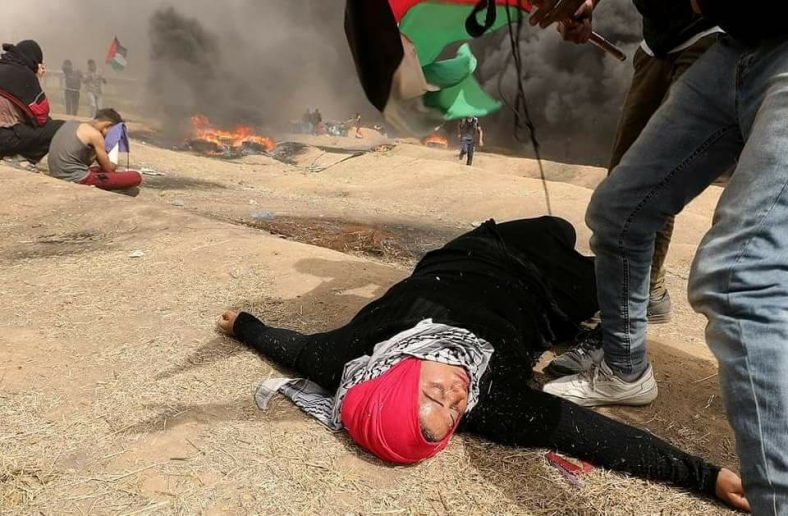
GAZA CITY, PALESTINE — Israeli officials have deemed peaceful protests by Palestinian refugees in the Gaza Strip to be tantamount to a “state of war,” arguing that soldiers were well within their rights firing live ammunition at unarmed protesters participating in ongoing mass mobilizations at the eastern fence enclosing the besieged territory.
In response to a High Court petition by human rights advocates, authorities in Tel Aviv noted that “the state opposes the applying of human rights law during an armed conflict,” arguing that even the Red Cross deemed human rights law inapplicable during wartime.
According to the Gaza Health Ministry, 50 Palestinians have been killed in the protests while over 6,200 protesters have sustained injuries at the hands of Israeli forces deploying live ammunition or rubber-coated steel rounds and other less-lethal munitions.
The state attorneys’ argument attempts to give international and domestic legal status to the military suppression of peaceful protest and the suspension of international human rights law enforcement, allowing occupation forces the right to use lethal force against unarmed demonstrators.
#Watch | Bizarre symptoms appeared on some protesters who suffered suffocation from gas bombs thrown by Israeli occupation forces on peaceful protesters in the #GreatReturnMarch. pic.twitter.com/v5BpB7DtTQ
— Quds News Network | #GreatReturnMarch (@QudsNen) April 21, 2018
Since March 30, residents of the captive region have held large-scale demonstrations to draw attention to the continuing dispossession of the people of Palestine and theft of their ancestral land by the Tel Aviv government, with the support of the U.S. government.
Organizers hope to continue the rallies until May 15, when Israelis will celebrate the 70th anniversary of the establishment of the State of Israel. The date is mourned by Palestinians as Nakba Day, or “The Day of Catastrophe,” when the ongoing process of ethnic cleansing and expansionism was commenced by the extremist Zionist militia, which later united as the “Israeli Defense Forces” or Israeli military. From 1947 to 1949, around 750,000 Palestinians out of a total population of nearly 1.9 million were expelled from the land of Palestine.
Around two-thirds of Gaza’s 2 million Palestinians are war refugees, or their descendants, who are confined to what is tantamount to a large-scale, open-air prison camp. Speaking to Reuters, 24-year-old protester Ahmed said:
If it wasn’t for the occupation we would have lived as free as people like in other countries … If they don’t allow us back, at least they should give us a state.”
Grim facts reveal intentional abuse
The manner in which protesters, including children, have been injured – live ammunition fired at the groin, neck, limbs, and abdomen – suggests that Israeli troops intentionally aim to inflict maximum harm that could result in life-altering disabilities, paralysis, amputation or the sterilization of civilian participants in the marches.
Many are struck by a new explosive type of ammunition known as the “butterfly” bullet, which causes massive deformities and creates exit wounds as large as a fist. The bullet expands upon hitting targets, decimating human flesh and bone or “pulverizing” internal organs, according to local health officials.
Butterfly bullet is a type of bullets that launched faster than sound and causes severe damage in flesh layers and bone when hitting the human body. It is used by the Israeli army snipers against the armless demonstrators on the borders of gaza. #BDSOurWeapon @basemn63 #Israel70 pic.twitter.com/tNc79jqe4Q
— Jamal Naim (@jnaim1) April 24, 2018
According to Marie-Elisabeth Ingres, the head of the Doctors Without Borders mission in the Occupied Palestinian Territories:
Half of the more than 500 patients we have admitted in our clinics have injuries where the bullet has literally destroyed tissue after having pulverized the bone … These patients will need to have very complex surgical operations, and most of them will have disabilities for life.”
The Israelis, however, cite the law when justifying their use of deadly force. In a statement to Al Jazeera, an Israeli military official said:
The IDF only employs means that are lawful under international law. No new bullets or gas have been employed during the recent events in the Gaza Strip.”
Cold-blooded mass murder and repression
While Israeli authorities claim that the peaceful protests in Gaza constitute a state of war, videos captured of Israeli soldiers show them casually discussing how best to inflict harm on unarmed Palestinians while facing little to no danger from protesters.
In a video released in April, a sniper can be seen expressing elation after shooting a protester who was allegedly throwing rocks, exclaiming “Yes!”
According to a new survey by the Israel Democracy Institute and Tel Aviv University, 83 percent of Israeli respondents “strongly support” the open-fire policy while around 71 percent of Israelis reject the easing of a crippling blockade imposed on Gaza for the past 11 years.
Israeli authorities consistently claim that the protests are organized by Islamist Palestinian resistance group Hamas, which has ruled the Strip since winning elections in 2007, and that the protest aims to provide cover for alleged “terrorist attacks” using stones and Molotov cocktails. Various factions and civil-society groups have endorsed the march, however, and deny that Hamas has a monopoly on leading the mass actions or that the protests have any ulterior motives beyond the stated demands for the right to return to their former homes in historic Palestine.
Palestinian academic Rashid Khalidi noted that the methods used by the Israeli army indicate a fear of peaceful protest as well as an inherently racist attitude toward the people of Palestine:
So, heavily armored Israeli soldiers with sniper rifles at hundreds of meters are picking off, systematically, Palestinian protesters or people who try to approach the fence or whatever. And that this is a policy that the government is proud of … I think it tells us a lot about Israel’s attitude towards Palestinians, that they are subhuman.
… [A]t the rate at which things are going, unfortunately, we’re probably likely to see even more savage, vicious, brutal, murderous repression.”
State Dept condemns journalist killings, except ones by Israeli soldiers
RT | May 4, 2018
Speaking on World Press Freedom Day, US State Department spokesperson Heather Nauert preached freedom from oppression for all journalists – unless they are Palestinian and the oppressor is Israel.
Nauert started her Thursday briefing by praising the State Department press pool and urging accountability for the “apparent assassination” of a BBC journalist in Afghanistan on Monday (one of the nine that were killed in that attack). She then profusely condemned the many violations of journalists’ rights across the world. Among the perpetrators, she listed Myanmar, Egypt, Turkey, Tanzania, Cambodia, the Philippines, Malta, Mexico and, of course, China and Russia. All of them were chastised as oppressive governments that repress, detain or outright murder unwanted journalists.
Once Nauert was done with her opening speech (which included congratulating one of the journalists present on her promotion and praising another’s dress choice), she moved on to other topics – but was pulled back on track by the first reporter to ask a question:
“Would you also condemn the recent deaths of journalists, Palestinian journalists in the Gaza Strip?”
Nauert answered that too many journalists die across the world, and the State Department can’t mention them all.
She said that the US, of course, is “always saddened by the loss of life,” but “Israel has a right to defend itself.”
Israel has been defending itself from Palestinian protesters across the border in Gaza for a month now. Within that time, the defensive action, which includes live gunfire, has claimed 45 lives – two of them journalists’ – and caused 6,000 injuries, according to the Gaza Health Ministry. The Israel Defense Force (IDF) says the Gazans were rioting, throwing improvised explosives and trying to break through the border fence.
When pressured further, Nauert claimed no detailed knowledge of any journalists killed or injured by the IDF, and ultimately told the pool reporters to go ask the Israeli government.
‘Partners in crime’: Israel settlers and soldiers attack Palestinians in West Bank village
MEMO | May 4, 2018
Israeli settlers attacked Palestinians in the West Bank village of ‘Einabus with the assistance of Israeli soldiers, according to a new report by human rights NGO B’Tselem.
On the morning of 6 March, two Palestinians – ‘Ahed Hamad and Yasser Hamad – went to the northern part of the village to pave a road intended to help residents access their farmland.
Shortly after they began work, some 30 Israeli settlers, “some of them masked”, arrived from the direction of the notorious Yitzhar settlement, located some four kilometres away.
“The settlers surrounded the bulldozer and began throwing stones at it, breaking the windshield,” stated B’Tselem. “The two men tried to escape, but some of the settlers pursued them, throwing stones and hitting them, until they managed to escape into the village.”
“The settlers who remained near the bulldozer threw stones and sticks at it and slashed its tyres.”
Some 50 village residents then went to protect their lands, after which “the settlers returned in larger numbers, accompanied by soldiers”.
Settlers and Palestinian residents “threw stones at each other”, while Israeli occupation forces “fired live bullets, rubber-coated metal bullets and teargas” at the Palestinians. Six Palestinians were injured, of whom four were taken to hospital.
According to B’Tselem: “This incident is not unusual: settlers have attacked Palestinians in the presence of soldiers hundreds of times, with the soldiers sometimes – as in the present case – joining in the assault.”
Israel effectively condones this conduct and reaps the benefits: the Palestinian residents, who know they face a possible attack with no protection at any given time, hold back from going to their farmland – to tend the land or graze flocks – and this makes it easier for the state to take over the land.
Israel convicts Palestinian poet of incitement

Press TV – May 4, 2018
An Israeli court has convicted a renowned Arab poet of using her poems to provoke violence against the Tel Aviv regime’s military forces.
Dareen Tatour, who has been under extended house arrest since January 2016, was charged on Thursday in connection with three posts that she made on social media during a wave of attacks on Israeli soldiers which began in 2015.
In the indictment, Israeli prosecutors said they made the decision based on one specific poem — “Resist My People, Resist” — which was posted on Facebook, and three other posts that Tatour made, calling on Palestinian people to rise up to protect the al-Aqsa Mosque in Jerusalem al-Quds.
The poem includes such lines as, “I will not succumb to the ‘peaceful solution,’ Never lower my flags, Until I evict them from my land.”
She also wrote in the poem, “Resist the settler’s robbery, And follow the caravan of martyrs.” This is a reference to Israel’s illegal settlement activities in the occupied Palestinian lands.
The indictment further claimed that the poem’s “content, its exposure and the circumstances of its publication created a real possibility that acts of violence or terrorism will be committed.”
Following her indictment, Israeli newspapers quoted Tatour as saying, “My trial ripped off the masks.”
“The court said I am convicted of terrorism. If that’s my terrorism, I give the world a terrorism of love,” she added.
The case has drawn international attention after Israel initially arrested Tatour in 2015 and then put the 36-year-old poet under house arrest.
Describing her arrest as a violation of freedom of expression for a poet, more than 150 literary figures, including authors Alice Walker and Naomi Klein, have so far called for her immediate release.
Member of Israeli Parliament, Ahmad Tibi, who is with the Joint (Arab) List at the Knesset, also condemned the court’s verdict, saying Tatour has received the conviction only because she was Arab.
“Dareen Tatour was found guilty solely because she is an Arab,” he tweeted. “[Israeli Prime Minister Benjamin] Netanyahu, rabbis, and right-wing politicians continue to incite freely solely because they are Jewish.”
Ex-Israel chief military prosecutor lives in home built on privately-owned Palestinian land
MEMO | May 3, 2018
A former chief Israeli military prosecutor lives in a house in the West Bank settlement of Efrat “which was illegally constructed on private Palestinian land”, it has been revealed.
According to anti-occupation NGO Kerem Navot, Lieutenant Colonel Morris Hirsch served as the chief military prosecutor in the West Bank until about a year and a half ago, “and was responsible for legal proceedings against thousands of Palestinians each year”.
In addition, “since his release, he has been employed as a ‘military consultant’ by the right-wing organisation NGO Monitor”.
Kerem Navot has now revealed that Hirsch not only lives in a West Bank settlement, but his house is located on privately-owned Palestinian land.
An Israeli company says it bought the land “from some Arabs”, but have no evidence to prove the claim. This did not prevent Israeli authorities “from allowing the company to advance a master plan on site and to authorise the two illegally constructed housing units, in one of which Hirsch resides”.
Kerem Navot said it is “ironic” that an individual “who was responsible for the rotten prosecution system that Israel runs in the West Bank for several years, currently lives in a house that was built solely due to the very same rottenness that pervades the law enforcement system in its entirety”.
South Carolina’s New Hate Speech Law Outlaws Criticism of the Israeli Occupation
Discussing the military occupation of the West Bank, a reality recognized even by Israel’s Supreme Court, would be considered anti-Semitic under the new South Carolina law.
By Whitney Webb | Mint Press News | May 1, 2018
COLUMBIA, SOUTH CAROLINA — The state of South Carolina will become the first state in the nation to legislate a definition of anti-Semitism that considers certain criticisms of the Israeli government to be hate speech. The language, which was inserted into the state’s recently passed $8 billion budget, offers a much more vague definition of anti-Semitism that some suggest specifically targets the presence of the global boycott, divestment and sanctions, or BDS, movement on state college campuses. The law requires that all state institutions, including state universities, apply the revised definition when deciding whether an act violates anti-discrimination policies.
Once it is reconciled with an appropriations bill previously passed by the state House, the measure will become law and take effect this July. However, the law will last only until the next budget is passed, meaning that the new legal definition of anti-Semitism must be renewed on a yearly basis unless new legislation making the language permanent is passed in the future.
The new definition uses the State Department’s current definition of anti-Semitism as its template — defining speech that “demonizes” or applies “double standards” to Israel “by requiring of it a behavior not expected or demanded of any other democratic nation” as anti-Semitic.
However, the State Department’s definition was never intended to be used as an enforcement tool, and concern has subsequently been raised that South Carolina colleges may now move to criminalize conventional and factual criticism of Israel under the new, vague definition of anti-Semitism.
Such concern is well-founded, in part because the bill’s sponsor, State Rep. Alan Clemmons (R-Myrtle Beach), previously called the pro-Israel lobby J-Street “anti-Semitic” for referring to Israel’s presence in Palestine’s West Bank as an “occupation.” Thus, in Clemmons’ view, discussing the military occupation of the West Bank, a reality recognized even by Israel’s Supreme Court, would be considered anti-Semitic under the new South Carolina law.
Clemmons, a Mormon who has previously hosted state delegations to Israel, also considers the non-violent Palestinian rights movement Boycott, Divest, Sanctions (BDS) to be motivated by anti-Semitism and has been called “Israel’s biggest supporter in a U.S. state legislature.”
Honored to have visited with @realDonaldTrump @FLOTUS @netanyahu & @sara_netanyahu. #USA & #Israel are partners of light in a dark world! pic.twitter.com/SbWKEnJVVB
— Alan Clemmons (@RepAlanClemmons) June 28, 2017
In addition to the views of the bill’s sponsor, Kenneth Stern, the author of the State Department’s definition of anti-Semitism upon which the new South Carolina law is based, has vehemently opposed codifying into law the definition he wrote, asserting that applying that definition to colleges “is a direct affront to academic freedom” as well as “unconstitutional and unwise.”
In regards to the South Carolina Law, Stern stated that it “is really an attempt to create a speech code about Israel,” adding that it is also “an unnecessary law that will hurt Jewish students and the academy.”
Other groups, such as the Center for Constitutional Rights, have raised similar concerns, stating that “this vague and overbroad re-definition conflates political criticism of Israel with anti-Semitism, infringing on constitutionally protected speech.”
Pro-Israel groups, in contrast, praised the law’s wording. The Brandeis Center, for instance, stated:
This bill gives South Carolina the tools to protect Jewish students’ and all South Carolina students’ right to a learning environment free of unlawful discrimination. We are hoping this momentous step will result in another national wave to, once and for all, begin defeating rising anti-Semitism.”
First clashes in a coming national battle?
The Brandeis Center’s allusion to a “national wave” aimed at legally conflating criticism of Israel with anti-Semitism may be closer to reality than previously thought. Indeed, if Kenneth Marcus, Trump’s nominee to serve as the next Assistant Secretary for Civil Rights at the Department of Education, is confirmed in the coming months, the newly passed South Carolina law is likely to be repeated across the country.
Marcus, who once boasted of instilling “fear” into BDS activists and considers any demonstration of solidarity with Palestine as anti-Semitic, has long desired the post, as he sees it as a way to shut down BDS at the national level. As Marcus himself has noted, changing the legal definition of anti-Semitism to include criticism of the Israeli state is a critical part of silencing BDS groups on U.S. college campuses.
Ultimately, the bill comes at a critical time for pro-Israel partisans seeking to curb the recent success of BDS at universities across the U.S. Indeed, just a week after the new South Carolina law was passed, the students at one of the country’s most Jewish colleges – Barnard College in New York – overwhelmingly supported a referendum asking its school’s administration to boycott, divest and sanction Israel for its violations of international law in Palestine. Such victories are apparently considered so dangerous by Israel’s right-wing and its U.S. equivalents that they have sought to restrict freedom of speech on college campuses nationwide in order to prevent them in the future.
In 2015, South Carolina became the first of at least 22 states to prohibit state agencies or institutions from contracting with any vendor participating in a boycott of Israel. A hub of the slaveholding South in the U.S., South Carolina is a deeply conservative state with strong ties to Christian evangelicals, but a relatively small Jewish population of roughly 20,000 — dwarfed by a state like Illinois with more than 300,000 Jews.
Whitney Webb is a staff writer for MintPress News and a contributor to Ben Swann’s Truth in Media. Her work has appeared on Global Research, the Ron Paul Institute and 21st Century Wire, among others. She has also made radio and TV appearances on RT and Sputnik. She currently lives with her family in southern Chile.
Gazan Gandhis: Gaza bleeds alone as ‘Liberals’ and ‘Progressives’ go mute

By Ramzy Baroud | MEMO | May 1, 2018
Three more Palestinians were killed and 611 wounded last Friday, when tens of thousands of Gazans continued their largely non-violent protests at the Gaza-Israel border.
Yet as the casualty count keeps climbing – nearly 45 dead and over 5,500 wounded – the deafening silence also continues. Tellingly, many of those who long chastised Palestinians for using armed resistance against the Israeli occupation are nowhere to be found, while children, journalists, women and men are all targeted by hundreds of Israeli snipers who dot the Gaza border.
Israeli officials are adamant. The likes of Defense Minister, Avigdor Lieberman, perceives his war against the unarmed protesters as a war on terrorists. He believes that “there are no innocents in Gaza.” While the Israeli mindset is not in the least surprising, it is emboldened by the lack of meaningful action, or outright international silence to the atrocities taking place at the border.
The International Criminal Court (ICC), aside from frequent statements laced with ambiguous legal jargon, has been quite useless thus far. Its Chief Prosecutor, Fatou Bensouda, derided Israel’s killings in a recent statement, but also distorted facts in her attempt at ‘even-handed language’, to the delight of Israeli media.
“Violence against civilians – in a situation such as the one prevailing in Gaza – could constitute crimes under the Rome Statute of the International Criminal Court … as could the use of civilian presence for the purpose of shielding military activities,” she said.
Encouraged by Bensouda’s statement, Israel is exploiting the opportunity to deflect from its own crimes. On April 25, an Israeli law group, Shurat Hadin, is seeking to indict three Hamas leaders at the ICC, accusing Hamas of using children as human shields at the border protests.
It is tragic that many still find it difficult to grasp the notion that the Palestinian people are capable of mobilizing, resisting and making decisions independent from Palestinian factions.
Indeed, for the nearly decade-long Hamas-Fatah feud, the Israeli siege on Gaza and throughout the various destructive wars, Gazans have been sidelined, often seen as hapless victims of war and factionalism, and lacking any human agency.
Shurat Hadin, like Bensouda, are all feeding into that dehumanizing discourse.
By insisting that Palestinians are not capable of operating outside the confines of political factions, few feel the sense of political responsibility or moral accountability to come to the aid of the Palestinians.
This is reminiscent of former US President Barack Obama’s unsolicited lecture to Palestinians during his Cairo speech to the Muslim world in 2009.
“Palestinians must abandon violence,” he said. “Resistance through violence and killing is wrong and does not succeed.”
He then offered his own questionable version of history of how all nations, including ‘black people in America’, the nations of South Africa, South East Asia, Eastern Europe and Indonesia fought and won their freedom by peaceful means only.
This demeaning approach – of comparing supposed Palestinian failures to others’ successes – is always meant to highlight that Palestinians are different, lesser beings who are incapable of being like the rest of humanity. Interestingly, this is very much the core of the Zionist narrative about the Palestinians.
That very notion is often presented in the question “where is the Palestinian Gandhi?” The inquiry, often asked by so-called liberals and progressives, is not an inquiry at all, but is a judgement – and an unfair one at that.
Addressing the question soon after the last Israeli war on Gaza in 2014, Jeff Stein wrote in Newsweek, “The answer has been blown away in the smoke and rubble of Gaza, where the idea of non-violent protest seems as quaint as Peter, Paul and Mary. The Palestinians who preached non-violence and led peaceful marches, boycotts, mass sit-downs and the like are mostly dead, in jail, marginalized or in exile.”
Yet, astonishingly, it is being resurrected again, despite the numerous odds, the unfathomable anger and unrelenting pain.
Tens of thousands of protesters, raising Palestinian flags continue to hold their massive rallies across the Gaza border. Despite the high death toll and the thousands maimed, they return everyday with the same commitment to popular resistance that is predicated on collective unity, beyond factionalism and politics.
But why are they still being largely ignored?
Why isn’t Obama tweeting in solidarity with Gazans? Why isn’t Hillary Clinton taking the podium to address the unremitting Israeli violence?
It is politically convenient to criticize Palestinians as a matter of course, and utterly inconvenient to credit them, even when they display such courage, prowess and commitment to peaceful change.
The likes of famed author, J.K. Rowling, had much to stay in criticism of the peaceful Palestinian boycott movement, which aims at holding Israel accountable for its military occupation and violations of human rights. But she became mute when Israeli snipers killed children in Gaza, while cheering whenever a child falls.
The singer Bono of the band U2 dedicated a song to the late Israeli President Shimon Peres, accused of numerous war crimes, but his voice seems to have grown hoarse as the Gaza boy, Mohammed Ibrahim Ayoub, 15 was shot by an Israeli sniper while protesting peacefully at the border.
However, there is a lesson in all of this. The Palestinian people should have no expectations of those who have constantly failed them. Chastising Palestinians for failing at this or that is an old habit, meant to simply hold Palestinians responsible for their own suffering, and to absolve Israel from any wrong doing. Not even Israel’s ‘incremental genocide‘ in Gaza will change that paradigm.
Instead, Palestinians must continue to count on themselves; to stay focused on formulating a proper strategy that will serve their own interests in the long run, the kind of strategy that transcends factionalism and offer all Palestinians a true roadmap to the coveted freedom.
The popular resistance in Gaza is just the beginning; it must serve as a foundation for a new outlook, a vision that will ensure that the blood of Mohammed Ibrahim Ayoub is not spilled in vain.
Israel revokes residency of 4 Jerusalemite officials
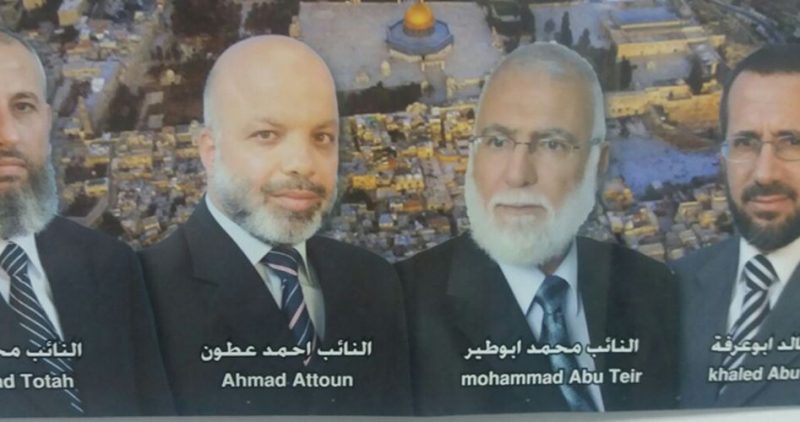
Palestine Information Center – April 30, 2018
OCCUPIED JERUSALEM – Palestinian human rights sources said that Israel decided on Sunday to strip four Jerusalemite officials of their permanent residency under the pretext of not being loyal to Israel.
Lawyer Fadi al-Qawasmi said that Israel’s Interior Minister Aryeh Deri decided to revoke the residency of MPs Mohammed Abu Tir, Ahmad Attoun, and Mohammed Toutah as well as former Minister of Jerusalem Affairs Khaled Abu Arafa.
Al-Qawasmi said in press statements that the decision came after the Knesset approved a new bill earlier in March that allows the Interior Minister to strip any Jerusalemite of his residency rights if he is involved in “terrorism” or “anti-Israel acts”.
According to al-Qawasmi, the Israeli Supreme Court in mid-September 2017 overturned a decision to revoke the residency of the Jerusalemite MPs. However, it decided to give the Israeli government a time limit to enact a law that gives the Interior Ministry the authority to strip any Jerusalemite of his residency.
The Palestinian lawyer described the bill as “unfair” and “illegal”, saying that it was applied retroactively. He affirmed that he will return to Israeli courts to oppose the decision.
The Palestinians in East Jerusalem and the Druze in the Syrian Golan Heights are considered residents not citizens by the Israeli authorities. Revoking their residency, according to the new bill, means expelling them permanently from these territories.
In 2006 the Israeli authorities confiscated the ID cards of the four Jerusalemite MPs after arresting them following their participation in a protest in Occupied Jerusalem. They spent several months in Israeli jails before they were deported to the West Bank.
Corbyn should learn his lesson: compromise with the devil is not an option
By Kit Knightly | OffGuardian | April 30, 2018
There are two kinds of compromise: the strong compromise, and the weak.
The former is where you cede an interest to uphold a principle, the latter when you ignore your principles to further your interests.
The first is an important tool in all aspects of life, the second should almost always be avoided. Jeremy Corbyn should learn that lesson.
Twice in recent weeks Corbyn’s leadership has faced an opportunity to cede a point of principle in order to further – as they apparently see it – the interests of their party. Both times they have done so, both times were a huge mistake.
Antisemitism
The first question is: What does “Antisemitism in the Labour party” actually mean?
Let’s start by acknowledging what it isn’t. Criticising the government of Israel is not antisemitic. Supporting Palestine in its struggle for emancipation and justice is not antisemitic. Opposing George Soros’s neoliberal crusade through his various NGOs is not antisemitic. Accusing a Blairite MP (who happens to be Jewish) of working hand in hand with the right-wing press to undermine Corbyn is not antisemitic. Claiming Hitler was a “Zionist” may or may not be accurate, but it is not antisemitic. Even supporting the freedom of expression for a painter who makes a mural about the 1% that some third parties allege might appear to represent unflattering images of Jewish people (even though the artist denies it completely) is not antisemitic, unless specific intents can be established.
When we remove all these non-antisemitic incidents from the list of alleged “antisemitism” in the Labour Party, how much real antisemitism remains?
Very little to none would seem to be the answer. You might even argue there is less antisemitism within the Labour party than within the general population. Certainly there’s little evidence of any more. Ken Livingstone shows no signs of being antisemitic. Nor does the latest victim of the latest purge – Marc Wadsworth.
Wadsworth – a veteran anti-racism campaigner – has been expelled from the party for notionally being racist (it was actually “bringing the party into disrepute”, the evidence of racism was so little they couldn’t even officially call it that). He has been effectively sacrificed to appease the state-sponsored and state-supporting media in the UK.
This is a terrible mistake. By conceding this point of principle in order to gain a perceived strategic advantage Corbyn’s team have in fact conceded both principle and strategy to a force that has no interest in compromising with them and simply wants them gone. The result is this:
1. Labour’s right-wing, (who DO, demonstrably, work “hand in hand” with the anti-Corbyn press), have been allowed to define what “antisemitism” means, and they are going to take full advantage of this. From now on, any Labour MP or even grassroots member who criticises Israel’s genocide against the Palestinians – or who simply disagrees with another Labour member who happens to be Jewish – can look forward to being shamed and expelled. How does Corbyn see this as furthering the cause of freedom and democracy?
2. They have accepted the lie as truth. A man has been expelled for antisemitism. Even though the grounds are spurious, it will in future be cited as evidence that the left does indeed have a problem with antisemitism.
Corbyn’s team decided to play soft and weak, in the hopes that letting a little blood would sate the thirst of the media. But you don’t abate a feeding frenzy by chumming the water. You don’t compromise with the devil by selling a piece of your soul. They have made it immeasurably worse. Livingstone and Walker will follow, and slowly Corbyn’s allies in the party will be chipped away.
Russia
The same exact process is playing out with the “Russian interference” situation. When the first accusations of being “soft on Putin” were thrown around, the strong principled position to take would be to dismiss the smears as racist and stupid. Argue the issues, ignore the white noise of smear and innuendo.
Corbyn’s principles, and those of the Labour party, dictate that they should stand against prejudice, abuse, censorship and summary justice.
They COULD have made statements that RT is just as valid a medium to be interviewed on as the BBC or CNN. They could have pointed out that Russian money in London is fleeing Putin’s crackdown on the oligarchs. They could have stood by the truth, and to hell with what the press say.
Instead Corbyn’s camp saw a chance to score some easy points in the media. McDonnell decided to publicly denounce RT, whilst the “leftwing” press tried to attack the Tories for their “dirty” Russian donors. Instead of saying “this campaign of demonising Russians is degraded & offensive”, they said effectively “Yes, Russians are demons, but they like the Tories more than us!”
This is potentially a more egregious mistake than the antisemitism issue. Firstly, it endorses the quasi-racist idea that all things Russian are inherently tainted with evil. Secondly, it undermines RT, an important voice for alternative politicians in the UK. And it opens the gates to this:

Headline in the Sunday Times, April 29 2018
This is the most predictable headline I have ever seen. It’s more predictable than sunrise or the tides or the waning moon. It was destined from the moment of his first leadership victory. And Corbyn has no one to blame but himself.
By allowing the “Russiagate” hysteria to blossom without challenge, by allowing the memes of “dirty Russian money” in London, and the “Russian influence” of the Brexit vote to go unchecked, Corbyn has encouraged the climate where people can be “denounced” in true McCarthyite fashion. And now he is paying the price.
Corbyn seems to think a few little compromises will get him accepted in the mainstream media. It pains me to say it, but this is fundamentally untrue. You can’t compromise with someone who wants nothing but your total destruction. Hopefully Corbyn has learned this lesson by now.
And truth in politics is important, it has power, not simply through its rarity. Corbyn’s power came from telling truths we all knew and no one else was saying, and he has undermined it by allowing convenient lies to stand.
You can’t build a greater truth on a foundation of small, convenient lies. When a person tells a lie, it is an act of weakness to allow it to stand. Responding “Yes, but”, does nothing but reinforce the initial dishonesty.
You cannot allow the deep state to use their tools in the media to set the narrative. You cannot try to meet them in the middle, because they’ll just use that leverage to pull you further over to their side. A half-truth is just a lie that lacks conviction, and by letting them slide you allow the media to set the width of the Overton window.
Jeremy Corbyn is a good man, his entire career – apparently his entire outlook on life – is built around principle. It’s those principles that got him elected leader and made him so popular. He should not compromise them now, in order to appease people who will never be appeased.
Featured Video

Netanyahu Ordered the 2003 Invasion of Iraq
or go to
Aletho News Archives – Video-Images
From the Archives
A Lesser “Grade” of Human
By Michael Hoffman | Revelation of the Method | January 3, 2024
Will the more than 100 Iranians killed by terrorist bombs today be mourned in the West as victims of terrorism? Certainly not. Allied doctrine has it that the killing of Israeli or American civilians is a crime of cosmic proportions, while shedding the blood of “enemy” women and children is perfectly acceptable; indeed commendable.
The West does not memorialize the hundreds of thousands of civilians bombed by the U.S. in Serbia, Iraq, Afghanistan and every major German city 1943-1945. America’s fire-bombing of the city of Tokyo by General Curtis LeMay in March 1945 was followed by Harry Truman’s atomic incineration of Hiroshima and Nagasaki in August of that year. Truman never had a moment of doubt or regret over the murder of more than a 100,000 Asian children, mothers and non-combatant boys and men. It was business as usual for the “noble” Allies during the “Good War.”
In the West human rights signifies passionate concern only for civilians designated as truly human: Israelis first, then Americans and British, followed by their satraps.
This inhumanity is the legacy of Talmudic ideology, beginning with tractate Sanhedrin 57a from 400 A.D., concerning liability for capital punishment: “If a Jew murders a gentile, he is exempt.”
This teaching of contempt was reiterated in the dogma of Chabad Lubavitch founder Rabbi Shneur Zalman in the 18th century. … continue
Blog Roll
 Aletho News
- US Senator Murphy says Pentagon denied him entry to US base in Qatar
- Israel expands “incitement” charge to target Palestinian education and memory
- How Israel seeks to reshape Arab classrooms
- Paris bans pro-Palestinian demonstration planned for Oct. 7 over ‘risks of public disorder’
- In August Hanning Treason Case – All Signs Point To Tel Aviv.
- France cleared dozens of military sales to Israel between May and September: Report
- France projects nuclear power as Macron pushes arsenal expansion
- The fallacy of US delusions about Iran’s economic collapse
- What changes with Lula or Flávio?
- Britain leads Western media’s demise through ‘fear porn’ narrative
- If Americans Knew
- Soldier testimony sheds light on how Israel wages information war
- CIA Report Warns Israel Could Head Toward Civil War, Total Collapse
- Banker Who Exposed Howard Lutnick’s Ties to Epstein Warned of ‘Retaliation’ and ‘Personal Consequences’ in Last Post Before Suicide
- Israeli Attacks Kill Two Palestinians in Gaza
- Gaza genocide at 3: Israeli-U.S. cruelty and the smart, deep resistance to it are changing the world
- As genocide is about to enter 3rd year, little of Gaza remains– Daily Update
- “We See Our Homes Now From A Satellite, Like Strangers”
- Watch “Gaza: Doctors Under Attack”, originally censored by BBC
- NAZA: Israeli embassies in UK and US promote rival documentary to challenge Gaza genocide allegations
- David Ellison appoints Israeli to lead merged Paramount-Warner studios
- No Tricks Zone
- US September “Heat” Was No Record…Many Records Set Decades Ago
- Latest European Green Energy Debacle; Portugal’s Largest Flagship Solar Park Insolvent!
- Green Energy Debacle: German Expert Professor Fritz Vahrenholt Warns Of Severe Economic And Social Consequences
- Two More Paleo Reconstructions Affirm Meters-Higher Sea Levels Across Ireland, Brazil 7000-6000 Years Ago
- New Study: Earth And Venus Surface Warmth Largely Explained By Convection And Lapse Rate, Not CO2 Or Radiation
- 2025 Nature Paper Claiming Worsening Global Drought Gets RETRACTED …Heavily Flawed
- New Study: ‘Global Drought Shows No Detectable Recent Acceleration Under Climate Warming’
- Economic Masterminds: German Socialists Suggest Taxing Productivity Gains Stemming From Using AI
- The South China Sea Has Not Been Cooperating With The Climate Change Narrative
- Energy Crisis: Germany Enters Heating Season With Historically Low Gas Reserve Fill Levels

