Return marches are humanitarian and a holy duty, insists senior Christian official
MEMO | March 31, 2018
The secretary of the Episcopal Commission for Islamic-Christian Dialogue in Lebanon insisted on Friday that the Palestinian return marches are humanitarian activities and a holy, ethical and national duty, Al-Resalah has reported.
“Any Palestinian resistance action aimed at protecting the country and human dignity is a religious duty guaranteed by all religions,” said Father Antoine Daou. He noted that the aim of the return marches is to achieve freedom and regain rights. “These are spiritual goals also guaranteed by all religions.”
Israel’s fear of such marches, suggested Daou, reflects the aggressive face of the state. “This was evident in its brutal treatment of the unarmed civilians.” Gaza’s residents, he added, are looking for salvation for all oppressed Palestinians. “They are taking the path of freedom which aims to end persecution and oppression.”
The senior Christian official said that such action corrects the moral compass of the Arab nations, which has been lost recently.
Hamas: No alternative to right of return

Ismail Haneyya
Palestine Information Center – March 30, 2018
GAZA – Head of Hamas’s Political Bureau Ismail Haneyya affirmed on Friday that Palestinians will continue to demand their right of return in all possible ways.
In a statement on Palestinian Land Day, Haneyya said that the Palestinians will no longer accept that the right of return remains a slogan chanted in every occasion here or there; rather, they will work to make it a tangible and achievable goal.
While taking part in the activities of the Great March of Return in Gaza, Haneyya hailed the Palestinian martyrs who fell while defending their lands on 30th March 1976.
He continued to say that the crowds taking part in the Great March of Return represent the real Palestinian unity.
Haneyya added that the Great March of Return came as the attack on the Palestinian cause has reached its peak following the US recognition of Jerusalem as Israel’s capital and in light of increasing talks about the deal of the century.
The marching Palestinians wanted to say that there is no alternative to Palestine and the right of return, he stressed.
AP’s slanted report on Gaza Return March, corrected and annotated
The Associated Press’s news story on the upcoming Great Return March echoes Israeli talking points…
By Kathryn Shihadah | If Americans Knew | March 30, 2018
The Associated Press, a (usually) trusted name in global news, has been unmasked for its pro-Israel bias, and the ruse continues.
Today’s exhibit is of particular significance, as the people of Gaza are about to embark on a large-scale nonviolent protest. True to form, AP has cranked out a Hamas-bashing, Israel-congratulating piece that fails to provide the accurate information its readers deserve. The report largely replicates Israel’s public relations strategy.
Below are excerpts from the AP article with commentary that will fill in some of the gaps and clear up some misrepresentations. Truth matters.
AP: Gaza’s embattled Hamas rulers are imploring people to march along the border with Israel in the coming weeks in a risky gambit meant to shore up their shaky rule, but with potentially deadly consequences.
Many Americans fail to recognize what is going on in Gaza for precisely this reason: nearly every word of this paragraph is problematic. Hamas has not imposed some kind of tyrannical regime over Gaza; their “rule” is shaky in that Israel has such a chokehold on the territory that the people are starving to death. There is little governing going on.
Grassroots movements have been in the making for years – decades, even – because Palestinians don’t need to be told they should resist the occupation. Many can see their original homes in what is now Israel or the location of their villages from the fence imprisoning them. They remember every day; they pray to God to bring them back home. Their people are being slowly, systematically eradicated.
The “gambit” is indeed “risky” – because Gazans will be nonviolently protesting while in the crosshairs of Israeli snipers, and the “potentially deadly consequences” of the initiative will almost certainly involve unarmed Palestinians dying.
Israel has essentially promised this outcome: Major General Yoav Mordechai vowed, “We intend to do everything to prevent violent demonstrations and terror demonstrations.” While Palestinians have made it clear that they will not so much as throw rocks, Israel has 100 sharpshooters at the ready, drones lined up to drop tear gas canisters, and thousands of troops armed to the teeth.
AP: But the first-of-its-kind protest also comes at a low point for the Islamic militant group and the 2 million residents of Gaza, where conditions have deteriorated since Hamas seized control of the territory from the internationally-backed Palestinian Authority in 2007.
Conditions have indeed deteriorated, but this statement is misleading: Hamas was voted into office by the people of Gaza, and Israel collectively punished them for this by imposing a blockade. Combine that with multiple “wars” against the essentially unarmed population with thousands killed and tens of thousands left homeless. “Conditions have deteriorated” is an understatement.
AP: Beginning Friday, Hamas hopes it can mobilize large crowds to set up tent camps near the border. It plans a series of demonstrations culminating with a march to the border fence on May 15, the anniversary of Israel’s establishment, known to Palestinians as “the Nakba,” or catastrophe.
Let’s take a minute to unpack the phrase that tried to sneak past. “The Nakba” is not just an Arabic name for the anniversary of Israel’s birth: it is the name for the forced exile of 75% of their population and the loss of 78% of their land. This catastrophe occurred in 1948, and tens of thousands of Palestinians who live in Gaza today are among those refugees.
AP: The group aims to mobilize hundreds of thousands of people for the effort, though it hasn’t been able to get such turnouts at past rallies. Nonetheless, a jittery Israel is closely watching and vowing a tough response if the border is breached.
Israel lives in a constant state of jitter, but why? Because the stones in Palestinians’ hands are so dangerous? Because the rockets are so deadly? (See here) Or because if Palestinian voices are heard, Israel will be exposed?
AP: An Israeli-Egyptian blockade, along with three wars with Israel and a series of sanctions by Palestinian President Mahmoud Abbas, have left Gaza’s economy in tatters. Unemployment is well over 40 percent, tap water is undrinkable and Gazans receive just a few hours of electricity a day.
Israel is the occupying power over Gaza. The occupation is now in its 6th decade, and the blockade in its 11th year. Israel has an obligation as occupier to maintain the lives and wellbeing of the occupied. Egypt and Abbas are minor players in this situation.
AP: “Hamas has realized it’s besieged from three sides; Israel, Egypt and the Palestinian Authority,” said Mkhaimar Abusada, political science professor at Gaza’s al-Azhar University. “It feels the crisis is suffocating.”
All Gazans are suffocating, not just Hamas. That is why this movement is happening right now. This is not some ploy by a terrorist organization to make trouble for Israel. It is the organic response of Palestinians who can endure no more, who must resist.
AP: [Mkhaimar Abusada] said that for Hamas, the protests can divert attention from their domestic woes while avoiding renewed war with Israel. “They think busying Israel with this issue may put it under pressure,” he said.
What the people actually think is that perhaps this time, the world will pay attention and finally realize that the level of cruelty and injustice being perpetrated on Palestinians is a huge, ongoing crime against humanity. The hope is not to “busy Israel” but to seek the rights that have been promised them by international law: the right to self-determination, the right to return to the land from which they were exiled, the right to be heard and to receive justice.
AP: A combination of social pressure and curiosity in a territory with few options for recreation could help attract people.
This statement shows an inexcusable level of ignorance: it assumes that Palestinians are content with a never-ending, illegal occupation and blockade; that they would not be inclined to march in resistance against their oppressor; and above all that people attending the protest would come for recreational purposes.
AP: Israel opposes any large-scale return of refugees, saying it would destroy the country’s Jewish character.
It’s hard to decide how to respond to this statement. Yes, having refugees pour into one’s country can be upsetting to one’s culture. The Palestinians were willing to take in Jews in the early 20th century, at a high social cost. The thanks they got for this gesture was to be themselves made refugees. Of course Israel opposes the return of non-Jews. But return they must, according to international law and consensus.
AP: Israeli Cabinet Minister Yoav Galant said, “Hamas is in distress. They are using in a cruel and cynical way their own population in order to hurt them and to hurt Israel.”
Israel has massive military might, and Israel and AP both know it. With one of the most advanced armies in the world, $10 million a day in military aid coming from the US, at least 100 nuclear weapons, and a military that is armed to the teeth, this march is not going to “hurt” Israel in any reasonable sense of the word. The only real pain the state can anticipate is the fear of being found out.
AP: “We will try to use the minimum force that is needed in order to avoid Palestinians wounded and casualties. But the red line is very clear. They stay on the Gazan side and we stay in Israel.”
Only time will tell what “minimum force” looks like, but in a nation where children can be imprisoned for years if they are suspected of throwing a stone, chances are Palestinians will die.
Most Western media, if they cover this event at all, will publish inaccurate, biased accounts that will make the Palestinians out to be the aggressors. They will completely fail to ground the story in the context of illegal occupation and blockade, not to mention dispossession and forced exile. Israel will come out looking like it acted in self-defense, and the injustice will continue unchecked as it has for lo these many years.
Kathryn Shihadah is a staff writer for If Americans Knew.
7 Palestinians killed, dozens injured as Israel suppresses massive protest in Gaza

Ma’an – March 30, 2018
GAZA CITY – Six Palestinians have been killed by Israeli forces and dozens more injured since early Friday morning, as thousands of Gazans took to the borders with Israel as part of “The Great March of Return” taking place across the besieged coastal enclave to mark the 42nd Land Day.
In 1976, Israeli police shot and killed six Palestinian citizens of Israel as they were protesting the Israeli government’s expropriation of thousands of dunums of Palestinian land. Since then, Palestinians have commemorated March 30 as Land Day with mass protests across the occupied West Bank and East Jerusalem, Gaza, and inside Israel.
A Palestinian farmer was killed around dawn and another was injured as Israeli forces targeted the southern Gazan district of Khan Younis with mortar shells.
Spokesperson of the Gaza Ministry of Health, Ashraf al-Qidra, identified the slain farmer as Omar Sammour, 31, adding that another Palestinian, whose identity remained unknown, was injured during the shelling.
Israeli media reported that Sammour and the other man with him were targeted for approaching the border fence with Israel in a “suspicious manner,” though local sources reported that Sammour was simply gathering crops from his land to sell later in the day.
On Friday afternoon, medical sources confirmed to Ma’an that two more Palestinians were killed during the protest along the border.
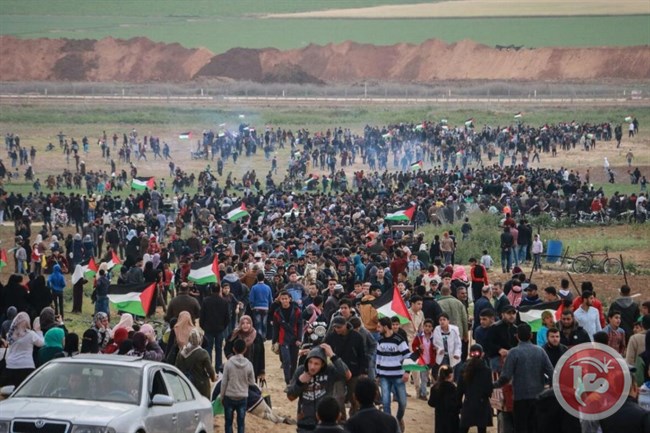
One of the slain Palestinians was identified as Amin Mahmoud Muhammar from Rafah in southern Gaza. His age remained unknown.
The other slain Palestinian was identified as Muhammad Kamal al-Najjar, 25, from eastern Jabaliya in northern Gaza.
Around 2:20 p.m. medical sources told Ma’an that a fourth Palestinian had been killed. He was identified as Muhammad Abu Omar, 19.
Fifteen minutes later, the Gaza Ministry of Health confirmed that a fifth Palestinian had been killed. He was identified as 16-year-old Ahmad Ibrahim Odeh from the northern Gaza Strip.
Around 3:15p.m. the ministry reported that Jihad Freineh, 33, from Gaza City was killed.
Minutes later, the ministry reported that the seventh Palestinian had been killed by Israeli forces. He was identified as Mahmoud Saadi Rahmi, from Gaza City.
Leading up to the march, the Israeli army released a statement saying it had declared the border area along Gaza a “closed military zone,” meaning that any Palestinian who got close to the border fence could risk getting shot.
The Israeli army released statements on Twitter describing the protests as “violent riots.”
“17,000 Palestinians are rioting in 5 locations along the Gaza Strip security fence. The rioters are rolling burning tires and hurling firebombs & rocks at the security fence & IDF troops, who are responding w riot dispersal means and firing towards main instigators,” the statement said.
Despite the Israeli army’s claims, Palestinian activists and leaders in the Gaza Strip have maintained that the “March of Return” was organized as a massive non-violent, weeks-long protest advocating for the return of Palestinian refugees to their original homelands in historic Palestine, now present day Israel.
Leading up to Friday, the first official day of the march — which will continue until the 70th anniversary of the Nakba, or catastrophe, in May — Palestinians set up tents along the border with Gaza, where protesters plan to stay until the Nakba anniversary.
Ismail Haniyeh, head of the Hamas politburo, gave a speech at the March of Return, saying it “demonstrates that there are no alternatives to Palestine and the right of return (for the Palestinian people),” praising the people who left their homes to attend the march.
When speaking about the goal of the march, Haniyeh said it constitutes “the beginning of a return (of the Palestinian people) to the entirety of the land of Palestine.”
“We will not give up and we will not bargain with the Zionist entity over even a small piece of the land of Palestine,” Haniyeh continued, stressing that the Palestinians will reject any deal proposed by the Trump administration.
“Our people went out today to make it clear that we will not give up Jerusalem and that there is no alternative to Palestine and the right of return. We will not accept the right of return staying only a slogan.”
On eve of rally, Israel threatens to kill Hamas leaders
MEMO | March 29, 2018
Israel on Thursday threatened to assassinate top Hamas leaders in the event of any major “escalations” during mass demonstrations planned for Friday in the blockaded Gaza Strip.
“We will not allow Hamas leaders to continue to hide in Gaza while women and children are sent to the border fence,” Israeli army spokesman Avichay Adaree tweeted.
Adaree’s warning comes only one day before planned demonstrations during which Palestinian protesters plan to converge en masse on the Gaza Strip’s roughly 45-kilometer eastern border with Israel.
“If necessary, we will respond — near the fence and inside the Gaza Strip — against those promoting violent demonstrations: the military wing of Hamas,” Adaree said.
All major Palestinian factions, including Hamas and Fatah, have endorsed the planned rally, in which thousands of Gazans are expected to participate.
According to organizers, the demonstration — dubbed the “Great Return March” — is to be entirely peaceful in nature.
Israeli Housing Minister Yoav Galant, however, said: “If the situation on the Gaza border escalates, the assassination of Hamas leaders is an option that remains on the table.”
Speaking to Israel’s Walla news website, he added: “In times of conflict, everything is allowed.”
The planned rallies are intended to pressure Israel to lift its decade-long siege of the Gaza Strip and reaffirm the Palestinians’ right to return to their ancestral homes in historical Palestine.
Since 2007, the Gaza Strip has suffered a crippling Israeli/Egyptian blockade that has gutted its economy and deprived its more than two million inhabitants of many basic commodities.
The UN disregard for Palestinians’ right of return colludes with Israeli violence
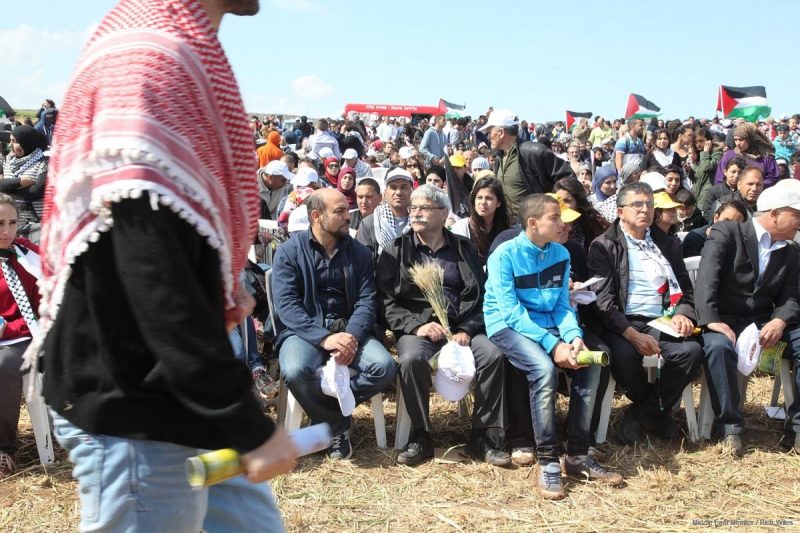
Thousands of internally displaced Palestinians take part in the March of Return [File photo]
By Ramona Wadi | MEMO | March 29, 2018
The Palestinian “Great March of Return” has exposed the frailty of Israel’s fabricated narratives, yet once again the international community prefers to speak about “sides” in the conflict. As the planned march draws nearer, the Jerusalem Post reported that UN Special Coordinator for the Middle East Peace Process, Nickolay Mladenov, has urged “all sides to exercise restraint and to take the necessary steps to avoid a violent escalation.”
Palestinians have already insisted repeatedly that the march is a form of non-violent protest stemming from a legitimate right to go back to the land from which the nascent Israeli state drove them out at gunpoint. Nevertheless, the Times of Israel reported yesterday that more than 100 snipers have been deployed along the border with the Gaza Strip “to deal with a Palestinian march expected to begin on Friday…” Officers will “authorise them to open fire if… Israeli lives are in danger.” Israel Defence Forces (IDF) Chief of Staff Gadi Eizenkot clarified this further: “The orders are to use a lot of force.”
Israeli media outlets have supported the state’s premeditated violence by framing the Palestinian protest as a violent act even before it has taken place, and thus justified in advance what they deem to be a necessarily violent response. However, they are not alone in promoting narratives of denial with regard to Israel’s colonial violence. The UN’s absence of any assertiveness when it comes to holding Israel accountable for its crimes is becoming a core component of the colonial entity’s ability to act with total impunity. Nowhere is this more evident than in its patronising attitude towards the Palestinian right of return.
Israel National News published an op-ed earlier this week which described the planned protest as the “latest innovation” with the immediate objective of Palestinians participating in the march “to get killed themselves”, simply in order to “delegitimise Israel”. The op-ed provides the most dissociated overviews of the Nakba, which the author describes as “the date in 1948 on which Ben Gurion declared the state of Israel and five Arab states invaded it.” Needless to say, the article also seeks to disavow the displacement, dispossession and ethnic cleansing which transformed Palestinians into perpetual refugees.
Israel’s widespread denial of the Palestinian right of return necessitates this manipulation of the indigenous population’s history. It also allows Eizenkot to justify targeting Palestinians with sniper fire for “marching into our territory.” Yet the international community’s refusal to support the perfectly legitimate right of return speaks volumes about the UN’s collusion with Israel. It is also proof that the UN never intended that the right should ever be implemented, even though it was made a condition of Israel’s membership of the international organisation. The only possibility lies in the hands of the Palestinian people, who have the power to move away, at least intellectually, from the impositions disguised as UN resolutions.
The Palestinian Great March of Return should thus prompt some thinking. Despite seeking to abide by UN resolutions, Palestinians have found themselves tethered to cycles of dispossession, which shows that the international agenda is deeply flawed and corrupted. The international response to this non-violent protest has not singled out Israeli plans to murder Palestinians at the border of their own land for condemnation; rather, the UN has chosen a discourse which insists on equivalence between the protagonists when it is clear to all and sundry that there is none. A colonial power with one of the best-equipped armed forces in the world — including nuclear weapons — is imposing its will on a colonised population which seeks to return to its own land and reverse the permanent refugee status which has become synonymous with the Palestinians.
Since Israel and the UN have already chosen their violent narratives, we are justified in asking why the latter’s intent is to maintain the political coercion that created the Palestinian refugee problem in the first place and face its own accountability for the transformation of the legitimate right to return into a dangerous game with limited options. The Palestinians, meanwhile, can either submit and stay permanently displaced, or stand up for their rights and be killed by acts of premeditated violence by Israel, with which the UN is colluding.
Israel army to use live ammo to disperse border rallies
MEMO | March 28, 2018
The Israeli army will use live ammunition to disperse planned Friday rallies in the Gaza Strip, according to Israel’s army chief-of-staff.
“We are reinforcing the barriers [along the Gaza-Israel border] while large numbers of [Israeli] soldiers will be stationed in the area to prevent infiltration attempts,” Israeli Army Chief-of-Staff Gadi Eizenkot said Wednesday.
Soldiers have received permission to open fire on protesters “if Israeli security infrastructure comes under threat,” Eizenkot told Israeli daily Maariv.
“Last year, hundreds were injured after they tried to destroy parts of the [border] fence,” he said. “We will not stand for this.”
Speaking to Israeli daily Yedioth Ahronoth, Eizenkot said the Israeli army had deployed more than 100 sharpshooters in advance of Friday’s planned rallies.
“If lives are in jeopardy, [soldiers will have] permission to open fire,” he said.
Eizenkot made the remarks only two days before planned demonstrations during which Gazan protesters hope to converge en masse on the Gaza Strip’s 45-kilometer eastern border with Israel.
Dubbed the “Great Return March”, the event is intended to pressure Israel to lift its decade-long siege of the Gaza Strip and reaffirm the Palestinians’ right to return to their homes in historical Palestine.
Since 2007, the Gaza Strip has groaned under a crippling Israeli/Egyptian blockade that has gutted its economy and deprived its more than two million inhabitants of many basic commodities.
Return March organizers: Israel’s terrorism will not intimidate us
Palestine Information Center – March 28, 2018
 GAZA – National committee for the March of Return, during a press conference held near the Great March of Return’s tent east of Gaza city which was targeted by Israeli gunfire on Wednesday morning, said that Israel will not succeed in terrorizing the Palestinian people.
The committee affirmed that preparations for the Great March of Return are ongoing, calling on the world nations to support this popular movement.
Head of the committee Khalid al-Batsh said that the Great March of Return is a purely peaceful event and that Palestinians are entitled to demand their right of return which is guaranteed by international law.
The PIC reporter said that the Israeli tanks stationed near Gaza’s eastern border fence fired two missiles on Wednesday morning at two sites east of al-Zaitoun neighborhood in Gaza city. No injuries were reported.
Member of the committee Ismail Ridwan warned the Israeli occupation against using violence against the protesters participating in the Great March of Return.
The Islamic Jihad leader Ahmad al-Modallal said that the Israeli occupation is in a state of confusion and trying to thwart this popular movement by various means. He continued to say that Israel will never be able to break the Palestinian will or kill the Palestinian dream of return.
The coordinating committee of the Great March of Return in February announced its intention to launch popular mass demonstrations toward the Palestinian territories occupied since 1948 in demand of the Palestinian refugees’ right of return.
Israel readies extra troops, snipers and drones, for Palestinian ‘March of Return’

Courtesy: defenseindustrydaily.com
MEMO | March 27, 2018
Israeli authorities are preparing extra troops, snipers and drones ahead of the Palestinians’ planned “March of Return”, a six-week long series of actions beginning this Friday with Land Day protests.
According to the Times of Israel, Israeli occupation forces are “gearing up” for protests expected to take place along the Gaza Strip’s perimeter fence, “putting additional units on alert out of concerns that large numbers of Palestinians might try to break through the barrier and rush into Israel”.
The majority of Palestinians in the occupied and blockaded Gaza Strip are from nearby communities ethnically cleansed by Israel in the 1948 Nakba.
Land Day, which takes place annually on 30 March, marks the Israeli government’s appropriation of land from Palestinian citizens in 1976, and the bloody repression of protests against the seizure. The March of Return initiative is intended to continue until 15 May, the 70th anniversary of the Nakba.
Citing a “military source”, the Times of Israel reported that in preparation for the expected protests, “additional army battalions, Border Police units, and dozens of snipers will be deployed along the Gaza border on Friday, in order to keep demonstrators from crossing”.
In addition, “police officers will be stationed a bit farther back, in order to keep back any Palestinians who breach the first line of defence”, while “additional teams of IDF soldiers will also patrol the Israeli communities closest to the border”.
Israeli forces are also likely to “deploy drones that can drop tear gas on protesters on the Gaza side of the border, a technique that the Border Police tested earlier this month.”
In regular protests since December, Israeli occupation forces have used lethal violence against Palestinian demonstrators, killing a number of unarmed protesters and injuring hundreds more.
Israeli forces pound Beit Lahia in Gaza Strip following false Iron Dome alert
Press TV – March 25, 2018
Israeli forces have pounded the Palestinian town of Beit Lahia after dozens of rocket sirens sounded in southern Israel following light artillery fire from a drill carried out by Hamas’ military arm in the northern Gaza Strip.
The Iron Dome missile system was activated several times late Sunday evening as a result of the artillery fire from the Hamas’ maneuver.
There were no immediate reports on the possible casualties from the attack.
Israeli media reported multiple interceptions launched from Ashkelon following a barrage of rockets fired from Gaza. But the Israeli army later confirmed no rockets had been fired into Israel. It said the Iron dome anti-missile system was activated after heavy machine gun shooting in the Gaza strip.
The Israeli military frequently bombs the Gaza Strip, with civilians being the main target of such attacks.
Israel has also launched several wars on the Palestinian coastal sliver, the last of which began in early July 2014. The military aggression, which ended on August 26, 2014, killed nearly 2,200 Palestinians. Over 11,100 others were also wounded in the war.
The Gaza Strip has been under an Israeli siege since June 2007. The blockade has caused a decline in the standards of living as well as unprecedented levels of unemployment and unrelenting poverty.
The Israeli regime denies about 1.8 million people in Gaza their basic rights, such as freedom of movement, jobs with proper wages as well as adequate healthcare and education.
Featured Video

or go to
Aletho News Archives – Video-Images
From the Archives
A Lesser “Grade” of Human
By Michael Hoffman | Revelation of the Method | January 3, 2024
Will the more than 100 Iranians killed by terrorist bombs today be mourned in the West as victims of terrorism? Certainly not. Allied doctrine has it that the killing of Israeli or American civilians is a crime of cosmic proportions, while shedding the blood of “enemy” women and children is perfectly acceptable; indeed commendable.
The West does not memorialize the hundreds of thousands of civilians bombed by the U.S. in Serbia, Iraq, Afghanistan and every major German city 1943-1945. America’s fire-bombing of the city of Tokyo by General Curtis LeMay in March 1945 was followed by Harry Truman’s atomic incineration of Hiroshima and Nagasaki in August of that year. Truman never had a moment of doubt or regret over the murder of more than a 100,000 Asian children, mothers and non-combatant boys and men. It was business as usual for the “noble” Allies during the “Good War.”
In the West human rights signifies passionate concern only for civilians designated as truly human: Israelis first, then Americans and British, followed by their satraps.
This inhumanity is the legacy of Talmudic ideology, beginning with tractate Sanhedrin 57a from 400 A.D., concerning liability for capital punishment: “If a Jew murders a gentile, he is exempt.”
This teaching of contempt was reiterated in the dogma of Chabad Lubavitch founder Rabbi Shneur Zalman in the 18th century. … continue
Blog Roll
 Aletho News
- NATO’s top generals gather in Kiev
- EU’s continuing expansion – greater threat to Russia
- US Senator Murphy says Pentagon denied him entry to US base in Qatar
- Israel expands “incitement” charge to target Palestinian education and memory
- How Israel seeks to reshape Arab classrooms
- Paris bans pro-Palestinian demonstration planned for Oct. 7 over ‘risks of public disorder’
- In August Hanning Treason Case – All Signs Point To Tel Aviv.
- France cleared dozens of military sales to Israel between May and September: Report
- France projects nuclear power as Macron pushes arsenal expansion
- The fallacy of US delusions about Iran’s economic collapse
- If Americans Knew
- Three years of genocide: Israel turned prisons into killing grounds and torture sites
- Three years of genocide. Words fail. Daily Update
- ‘I’d rather die than go back’: A Palestinian teen’s 10-month nightmare in Israeli jail
- How Jared Kushner’s firm’s investment in an Israeli company could be a major conflict of interest
- Soldier testimony sheds light on how Israel wages information war
- CIA Report Warns Israel Could Head Toward Civil War, Total Collapse
- Banker Who Exposed Howard Lutnick’s Ties to Epstein Warned of ‘Retaliation’ and ‘Personal Consequences’ in Last Post Before Suicide
- Israeli Attacks Kill Two Palestinians in Gaza
- Gaza genocide at 3: Israeli-U.S. cruelty and the smart, deep resistance to it are changing the world
- As genocide is about to enter 3rd year, little of Gaza remains– Daily Update
- No Tricks Zone
- US September “Heat” Was No Record…Many Records Set Decades Ago
- Latest European Green Energy Debacle; Portugal’s Largest Flagship Solar Park Insolvent!
- Green Energy Debacle: German Expert Professor Fritz Vahrenholt Warns Of Severe Economic And Social Consequences
- Two More Paleo Reconstructions Affirm Meters-Higher Sea Levels Across Ireland, Brazil 7000-6000 Years Ago
- New Study: Earth And Venus Surface Warmth Largely Explained By Convection And Lapse Rate, Not CO2 Or Radiation
- 2025 Nature Paper Claiming Worsening Global Drought Gets RETRACTED …Heavily Flawed
- New Study: ‘Global Drought Shows No Detectable Recent Acceleration Under Climate Warming’
- Economic Masterminds: German Socialists Suggest Taxing Productivity Gains Stemming From Using AI
- The South China Sea Has Not Been Cooperating With The Climate Change Narrative
- Energy Crisis: Germany Enters Heating Season With Historically Low Gas Reserve Fill Levels

