The Israeli navy has seized the Zaytouna-Oliva, a Gaza-bound aid ship, and is currently towing it towards the Israeli port city of Ashdod, according to the initiative’s organizers and reports in the Israeli media.
Sondos Ferwana, a media spokeswoman for the International Coalition for the Fourth Freedom Flotilla, told reporters on Wednesday evening that Israeli naval forces had “captured the ship”.
The Israeli military, for its part, confirmed the ship’s seizure in a statement.
“The Israeli Defense Forces managed to quickly seize the ship without causing any injuries among passengers,” the statement read.
According to the military, the crew of the Gaza-bound vessel had initially refused the navy’s orders to change course.
“This forced us to intervene and seize the ship before it violated the legal maritime closure imposed on the Gaza Strip,” the statement read.
According to reports on Israel’s Channel Two television station, the aid ship was intercepted — without resistance — some 80 kilometers off Gaza’s coast.
Ferwana, for her part, described the incident as “another act of Israeli piracy”, adding that all contact with the ship — which is carrying humanitarian aid and several female activists — had been lost.
“We don’t know the fate of the activists aboard,” she said.
Passengers on the Zaytouna-Oliva, which set sail from the Spanish city of Barcelona last month, include Irish Nobel Peace Prize laureate Mairead Maguire, Swedish and Algerian lawmakers, a South African Olympic athlete and a Malaysian doctor.
The all-female initiative seeks to break Israel’s decade-long blockade of the Gaza Strip and show solidarity with the women of Gaza.
Palestinian resistance movement Hamas, for its part, which has governed the Gaza Strip since 2007, condemned what it described “the Israeli occupation’s assault on the aid ship and its intimidation of the activists on board”.
In a statement, Hamas spokesman Fawzi Barhoum said the incident amounted to “an act of state terrorism” and another example of Israeli “aggression against the Palestinian people and those who show solidarity with the Palestinian cause”.
Barhoum went on to urge the international community to “put an end to Israel’s crimes”, stressing the need for immediate action “to lift the blockade and rescue the people of Gaza”.
In June of last year, Israeli forces intercepted the “Marianne” — which had been taking part in a similar initiative — and arrested all activists on board.
A similar Gaza-bound aid flotilla ended in tragedy in 2010 when the Mavi Marmara, a Turkish aid ship, was raided by Israeli commandos who killed 10 Turkish activists.
Since 2007, the Hamas-run Gaza Strip has groaned under a crippling Israeli/Egyptian blockade that has deprived its almost two million inhabitants of most basic commodities, including food, fuel, medicine and desperately-needed building materials.
In June, UN Secretary-General Ban Ki-moon described the blockade of Gaza as “collective punishment”, which, he asserted, “suffocates its people, stifles its economy and impedes reconstruction efforts”.
The Bank of Ireland has been criticised after shutting the account of the Ireland Palestine Solidarity Campaign (IPSC), the latest in a string of similar moves by European banks.
IPSC has formally complained, following the closure of its account which it uses to lodge donations, and intends to take a case to the Financial Services Ombudsman.
Earlier this year, the Bank of Ireland requested information from IPSC about its funding and how funds were spent, in response to which, IPSC submitted its audited accounts.
According to IPSC, the Bank of Ireland has “failed to give a specific explanation of why it was closing the accounts.”
Kevin Squires, IPSC coordinator told TheJournal.ie : “Bank of Ireland’s silence speaks volumes. Honestly it’s hard to not view this as part of a wider campaign which has seen banks close accounts in the UK, Austria and France.”
“In the last year or so we have had €1,200 go to Palestine to pay for Palestinian scarves, which is a tiny amount. That’s trade with Palestine. It’s not like we’re sending money to people there.”
Vice-President of Sinn Fein and a Teachta Dala for Dublin Central, Mary Lou McDonald, said the decision was “outrageous”.
“The Ireland Palestine Solidarity Campaign are an established advocacy group that have spent years protesting against the treatment of the Palestinian people. To close their account citing that they associate with a ‘high risk country’… this is not only outrageous; this is insulting to the Palestinian people.”
“Bank of Ireland cannot stay silent on this matter,” she added.
The following is from a statement by the IPSC:
This denial of banking rights, the ensuing loss of income and the potential reputational damage to the IPSC comes in the context of similar seemingly coordinated attacks on Palestine solidarity organisations across Europe and the United States. Numerous bank accounts belonging to such organisations have been closed in France, Germany, Austria and the UK. It is difficult to escape the conclusion that this attack on the IPSC’s ability to bank – which is, in effect, the ability to function at all – is political in nature and forms part of this wider attack on organisations that advocate for peaceful action to secure Palestinian rights enshrined in international law.
Israel has boasted of conducting a global campaign of ‘lawfare’ – using legal and other punitive threats to silence and attack supporters of Palestinian rights. This attack on the IPSC It appears to be part of this campaign, a politically motivated measure to silence a human rights organsiation that campaigns for Boycott, Divestment and Sanctions (BDS) against Israel until it fulfils its obligations under international law – a campaign the Irish government views as an entirely “legitimate” means of protest “intended to pressure Israel into ending the occupation.”
OCCUPIED JERUSALEM – The Israeli occupation authority (IOA) has finished all preparations, in cooperation with unnamed Jewish groups, to build a big synagogue called the Jewel of Israel in the heart of the Old City of Jerusalem.
It will be located about 200 meters away from the western side of the Aqsa Mosque.
According to the Palestinian news website Qpress, the new synagogue project will cost around 48 million shekels, mostly from the Israeli government and the rest from wealthy Jews.
The synagogue will be composed of six floors, two underground, and will be built on the ruins of an Islamic historical site dating back to the Ottoman and Mamluk eras.
The project is part of a large-scale Israeli plan aimed at planting religious Jewish structures in the heart of Old Jerusalem to change the Islamic and Arab identity of the holy city.
It will be the second massive Jewish edifice in the Old City after the Hurva synagogue, which was built in 2010.
There is a hypocritical disconnect in Western and especially U.S. foreign policy. When it comes to Israel, the U.S. is quick to claim “Israel has a right to defend itself.” For Syria, that same right does not seem to exist.
When Israel executed intense bombing campaigns against Gaza in 2008, 2012 and 2014 the U.S. justified the attacks. At the United Nations on July 18, 2014, U.S. Ambassador Samantha Power said, “President Obama spoke with Prime Minister Netanyahu this morning to reaffirm the United States’ strong support for Israel’s right to defend itself…. Hamas’ attacks are unacceptable and would be unacceptable to any member state of the United Nations. Israel has the right to defend its citizens and prevent these attacks.”
Israel claimed it was simply responding defensively. The human rights group BtSelem reports that over the decade between June 2004 and July 2015, Palestinians launched over 8,700 rockets and 5,000 mortars from Gaza into Israel. But the total number of civilians killed over 10 years was 28 for an average of fewer than three persons per year. Using this as a justification, Israel has attacked by air and invaded every few years inflicting far heavier casualty rates on the Palestinians in Gaza. For example, Israeli attacks on Gaza in Summer 2014 killed more than 2,000 Gazans, the vast majority of them civilians and many of them children.
With so few deaths and little damage caused by the rockets from Gaza, it seems Palestinians have launched these as almost symbolic protest against Israeli repression. The Gazan economy is hugely restricted, the borders are closed and even the sky and ocean are off limits. Many people would say that Israel is keeping the entire population of Gaza in prison-like circumstances. In addition, many residents of Gaza are descendants of refugees from nearby Israeli towns and cities. Under the Geneva Conventions and U.N. Resolution 194, they have the right to return but have been deprived of this in addition to most other rights.
In summary, Palestinians have launched rockets and mortars to protest Israeli occupation and apartheid policies. The Palestinians are not seeking the overthrow of the Israeli state so much as recognition of their rights and an end to the Occupation. Casualties from the rockets have been few. In response, the West has given Israel a virtual free pass to attack Palestinians in Gaza and unleash horrific bombing in densely populated urban areas where there are huge civilian casualties.
The disproportionate nature of these Israeli attacks suggests that the Israeli government is not defending itself; it is imposing punishment on a captive and defenseless population.
Syrian State Under Real Attack
The situation in Syria is dramatically different. The armed opposition in Syria has inflicted a huge number of deaths and damage in its five-year campaign to overthrow the government. Data from the Syrian Observatory for Human Rights, which is sympathetic to the opposition, show the following number of casualties since March 2011: Pro Government forces (army and militias) – 105,000; Anti Government forces – 101,000; Civilians – 86,000.
These numbers reveal the intensity of the violence and how wrong it is for critics to blame President Bashar al-Assad and the Syrian government for all the deaths. As shown, soldiers and militias defending the state make up the largest number of casualties.
The conflict in Aleppo is currently in the news. Aleppo was the largest city in Syria and the industrial and financial engine. The largest and most effective opposition force in Aleppo is Al Qaeda’s affiliate Nusra Front, which is recognized to be “terrorist” even by the U.S. and was never part of the “cessation of hostilities.” There are other factions and fighting groups in Aleppo also seeking to destroy the Syrian state. Most of the groups are explicitly Wahhabi sectarian and hostile to secularism, Christianity and moderate Islamic faiths.
The opposition in Syria is heavily armed with weapons, ammunition and explosives. Daily they launch hell cannon missiles into western Aleppo, killing randomly in this government-controlled part of the city. Car bombs have killed thousands of civilians and soldiers. Tunnel bombs have killed thousands more.
Aleppo was relatively quiet until summer of 2012 when thousands of armed fighters invaded and occupied neighborhoods in the eastern part of the city. The “rebels” were disliked by the majority of the population from the start. This was documented even by Western journalists such as James Foley and Stephen Sotloff, who went there inclined to be sympathetic to the opposition. (Foley and Sotloff were later captured and beheaded by Islamic State jihadists.)
Martin Chulov of the Guardiandescribed East Aleppo in 2015 and estimated its population at just 40,000. In sharp contrast, there is a large population of about 1.5 million Syrians living in the rest of the city. This is reflective of the reality: the vast majority of Syrians support the government and hate the terrorists. This includes many who are critical of the Baath Party and who want reforms but not violence and destruction. This important fact is generally ignored by Western media. (The current situation in western Aleppo is described here by journalist Eva Bartlett.)
In contrast with Israeli’s periodic wars on Gaza, the Syrian government is truly fighting to defend itself – and its civilian population – against an armed opposition that is violent, sectarian and unpopular with the large majority of Syrians.
Adding to the legitimacy of the Syrian government’s right to defend itself, the armed opposition in Syria has been heavily supported by foreign governments. Western states and their Gulf allies have supplied weapons, training, logistical support and salaries for many thousands of fighters. Qatar’s Al Jazeera has broadcast misinformation, fabricated stories and heavily biased reporting from the start.
The same governments have been complicit in the recruitment and travel to Syria by thousands of foreigners from all parts of the globe. European, North American and Australian governments “looked the other way” as their citizens were recruited and then traveled to Syria via Turkey to join ISIS or Nusra. According to one study, over 12,000 foreigners including 3,000 from Europe and North America traveled to Syria in the first three years of the conflict. That was before ISIS peaked. Only in the last year, following terrorist actions in the West, have Western governments started arresting or detaining recruits and recruiters.
Violating International Law
The situation in Syria is more extreme but has similarities to the situation in Nicaragua in the 1980s when the Reagan administration was covertly arming and financing the Contras, a rebel army that inflicted death and destruction across parts of Nicaragua. On June 27, 1986, the International Court of Justice ruled:
“the United States of America, by training, arming, equipping, financing and supplying the contra forces or otherwise encouraging, supporting and aiding military and paramilitary activities in and against Nicaragua, has acted, against the Republic of Nicaragua, in breach of its obligation under customary international law not to intervene in the affairs of another State”.
The court also decided that the U.S. should make reparations to Nicaragua for injury caused by the violations. The U.S. ignored the ruling and later withdrew from the jurisdiction of the International Court of Justice.
The former Nicaragua Foreign Minister and former President of the United Nations General Assembly, Father Miguel D’Escoto, has written “What the U.S. government is doing in Syria is tantamount to a war of aggression, which, according to the Nuremberg Tribunal, is the worst possible crime a State can commit against another State.” (Personal correspondence quoted with permission)
Some foreign governments seeking “regime change” in Damascus have poured huge amounts of money into what is called “smart” or “soft power” via the funding of an array of organizations with nice sounding names to control the narrative and influence public opinion.
There is the Syrian Justice and Accountability Centre, initiated by Secretary of State Hillary Clinton, to prepare for victor’s justice. There is the Syrian Network for Human Rights which largely ignores the deaths of Syrian soldiers and seeks U.S./NATO intervention. There is the Syrian Civil Defense also known as the White Helmets, a support group for Al Qaeda/Nusra but most importantly a political lobbying tool actively campaigning for U.S./NATO intervention.
All of these organizations, and many more, are said to be “Syrian” and “independent.” But they were all created after the conflict began and they are all funded by the foreign governments that seek to overthrow the Syrian government.
These and other organizations support the opposition in various ways, demonize the Syrian government and romanticize the opposition. They are part of the reason why many people around the world believe that the anti-government protests in 2011 only became violent after peaceful protests were brutally crushed, which is untrue. There were seven police killed in the first protests in Deraa. That was soon followed by dozens of soldiers being massacred in Deraa and Banyas at the end of March and in April 2011.
By justifying the continued “rebel” violence, this “soft power” acts in concert with “hard” or military power. For example the White Helmets was originally called the Syrian Civil Defense and began with a military contractor training some Syrians in Turkey. This group was then rebranded as the “White Helmets” by a New York marketing company called “The Syria Campaign.” Since then, the “feel good” White Helmets brand has been heavily promoted.
As a measure of the marketing success, the White Helmets recently won the Right Livelihood Award for 2016 and are even nominated for a Nobel Peace Prize. Ironically, there is a REAL Syrian Civil Defense working since 1953 and a REAL White Helmets/CascosBlancos from Argentina which have received little recognition alongside the slick new “White Helmets” created and promoted by the shadowy PR firm.
Soft power distorts the reality in the conflict. Thus we are not told that the Syrian government is defending against terrorists but that the “Assad regime” is ‘”targeting hospitals and civilian markets.” Are the claims true? My investigation of the claims regarding the Doctors Without Borders/MSF supported “Al Quds Hospital” in April 2016 revealed that the accusations were full of contradictions, inconsistencies and unverified accusations.
The “hospital” was an unmarked building; the damage was unclear; the number of deaths varied wildly and could not be verified. The photographic evidence, supplied by the ubiquitous White Helmets, was dubious. The investigation resulted in a open letter to MSF. So far they have failed to corroborate or document their accusations and claims.
Doctors Without Borders/MSF continues to issue politically biased messages. Their Oct 2 tweet about a “bloodbath in East Aleppo” led to false accusations that two teenagers were killed by Syrian government bombing when they were actually killed by terrorist bombing.
Currently the Union of Medical Care and Relief Organizations (UOSSM), funded by France and other countries, has been at the forefront accusing Syria and Russia of intentionally bombing an underground hospital. Is the story real or fabricated propaganda? The Russians and Syrians are trying to fight the terrorists; why would they waste resources and generate negative publicity by attacking a hospital? The reports seem to be based on phone or skype conversations with sources of unknown reliability.
The narrative promoted by “soft power” is that the Syrian government is an unpopular dictatorship dominated by the Alawi religious group. Is that true? On the contrary, key ministries including Defense and Foreign Affairs are held by Sunni leaders. The majority of the Syrian Arab Army are Sunni. Visitors to Syria readily meet mothers who are proud of their sons who died defending their country against foreign-backed terrorism.
The narrative promoted by “soft power” is that the Syrian uprising was largely progressive, secular, and seeking democracy. This myth makes for a good rationalization for effectively supporting the “regime change” war against Syria, but it is contradicted by the U.S. Defense Intelligence Agency. In a classified report from August 2012, the DIA analyzed the conflict as follows: “THE SALAFIST [sic], THE MUSLIM BROTHERHOOD, AND AQI [“Al Qaeda in Iraq,” now known as ISIS or the Islamic State] ARE THE MAJOR FORCES DRIVING THE INSURGENCY IN SYRIA.”
“Soft power” in Syria has involved the creation and funding of Syrian groups who convey a message supportive of the “regime change” goals. For example there is a group in the town of Kafranbel which produces an English language banner each week. The group is provided with the message by a foreign source and the group holds the banner to be photographed and displayed on social media in the West. Most of the locals probably have no clue what it says.
Then there is the Aleppo Media Center which creates videos for influencing Western audiences, and the White Helmets previously discussed. These Western-created groups are the examples of the “Syrian Revolution” by those who promote this narrative. What kind of “revolution” is on contract with the U.S. State Department?
Current Situation and Coming Crisis
The Syrian government, with the support of the majority of Syrian people, is doing its best to defend itself against an onslaught financed by some of the wealthiest and most powerful countries on earth. The Syrian Army and popular militias have suffered huge losses but are advancing. In the last year, Russia has provided crucial air support. Unlike the invasion of Syrian land and air space by the U.S., the Russian intervention is in compliance with international law because it followed a request for assistance from Syria’s internationally recognized government, whereas the U.S. government and its allies have no such permission.
Currently the Syrian government and allies are seeking to drive Nusra and other terrorist groups from eastern Aleppo. If that is successful, they could then focus on ISIS in Raqqa and the remaining terrorists in other parts of the country. Unlike densely populated Gaza, the opposition-held areas of Aleppo have very few civilians left. Although civilian casualties happen in all wars, it makes no sense that the Syrian military would target civilians. On the contrary, the government has opened corridors to facilitate civilians and fighters to leave Aleppo.
Largely unreported in the West, the Syrian government has an active reconciliation program which allows former gunmen to move to a different area or return to society. This has been successfully used to clear the last remnant of terrorists from Al Waer near Homs and Darraya near Damascus. Many thousands of Syrian fighters who were coerced or bribed into joining the opposition have laid down their arms, signed an agreement and rejoined society.
In contrast with the frenzy and alarm in Western media and political circles, there is a growing optimism and hope among the vast majority of people in Aleppo. Syrian journalist Edward Dark recently tweeted “Aleppo soon will be freed from the jihadis that invaded & destroyed it. After 4 years of hell its people will finally know peace.” They are looking forward to the final defeat or expulsion of the terrorists who invaded the city in 2012.
What will the foreign enemies of Syria do to prevent this? Will they continue or escalate their campaign to destroy Syria as they destroyed Afghanistan, Iraq and Libya? Are they prepared to risk potential World War III with Russia? In the last month Turkey sent troops into northern Syria and the U.S. attacked the Syrian Army in Deir Ezzor, killing at least 62 soldiers. The U.S. claims this was an accident, but many believe it was intentional.
Since the collapse of the cessation of hostilities, “soft power” propaganda has escalated. Accusations that the Syrians and Russians are targeting hospitals are linked to new social media campaigns to “Save Aleppo.” Two things are clear:
–The public should be wary of media stories based on the claims of biased actors and not supported by solid evidence
–The Syrian government has the right to defend itself against foreign-funded violent extremists seeking to destroy it.
Rick Sterling is an investigative journalist and member of Syrian Solidarity Movement.
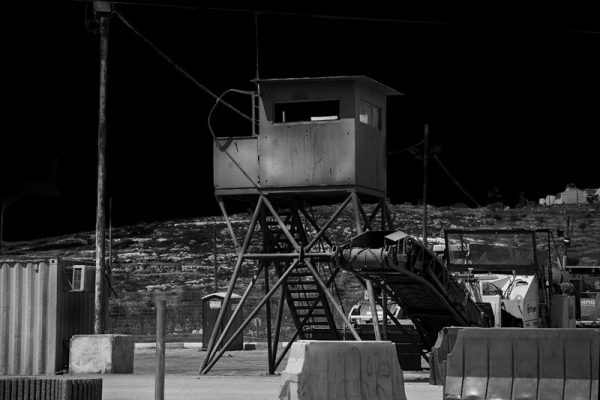
Hebron, Occupied Palestine – Israeli forces put up a CCTV observation tower in the Ibrahimi mosque area, further increasing not only their all-encompassing surveillance of Palestinians, but also their slow but steady illegal annexation of more and more Palestinian land in occupied al-Khalil (Hebron).
At the end of last week, Israeli forces in a ‘secret’ over-night action put up the observation tower, surrounded by dozens of cement blocks and barbed-wire. Located in a corner between Palestinian houses, the observation post with a container and all the surrounding paraphernalia is just another step in the illegal annexation of yet more land. In recent weeks, Israeli forces have increased their illegal annexations of the tiny strip of Shuhada Street still accessible to Palestinian pedestrians and stepped up the game of creating a coercive environment directly leading to forced displacement of Palestinians in the Tel Rumeida area.
CCTV surveillance tower newly put up in Palestinian neighborhood
This observation tower is fitted with a camera that reaches high above the houses in the neighborhood, thus watching Palestinians constantly. This feeling of permanently being watched for Palestinians is combined with the ever present controls and humiliations at the more-and-more militarized checkpoints. Palestinians are watched, humiliated, numbered, deprived of their most basic human rights – occupied not only physically by the Israeli occupation forces, but also mentally. They can never tell whether they’ll be allowed through a checkpoint (something that solely depends on the respective soldiers whim), whether their children will be tear-gassed on their way to school or arrested, or even whether they’ll be gunned down by Israeli forces at a checkpoint and left to bleed to death. Any and all of these forms of collective punishment are enforced by the Israeli occupying forces on the entire population of civilians in complete disregard of any care for international law or humane treatment of the occupied indigenous Palestinian population.
The Tel Rumeida neighborhood, Shuhada Street, and the area around the Ibrahimi Mosque are already linked by a settler-only street that has been ethnically cleansed of Palestinians in the aftermath of the Ibrahimi Mosque massacre. Restrictions in the Tel Rumeida neighborhood (declared a ‘closed military zone’ solely enforced on Palestinian residents for almost a year now) and around the Ibrahimi Mosque (where Palestinians are often prevented from passing checkpoints on a age-limit between 15-30) have escalated in a very short amount of time, making life for the Palstinians as hard – or rather impossible – as possible, leaving them with no choice than to leave. The only and clear aim is the forcible transfer of all Palestinians in this area, thus geographically linking the illegal settlements in an area ethnically cleansed of any Palestinian presence.
Israeli authorities have decided to close the Ibrahimi Mosque, in the heart of the occupied West Bank city of al-Khalil (Hebron), to Palestinians, Muslim worshipers and non-Jewish visitors for seven non-consecutive days.
Yousif Ideis, the Palestinian minister of endowment and religious affairs, said on Sunday that the sacred site will be closed to Palestinians and non-Jews on October 3, 4, 9, 12, 18, 19 and 26.
Israeli officials have said the shutdown is aimed at maintaining security in the wake of Rosh Hashanah (the Jewish New Year), Yom Kippur (The Day of Atonement), Sukkot (Feast of Booths) and Simchat Torah holidays.
Ideis added that dozens of illegal Israeli settlers broke into the mosque courtyard on Saturday night amid protection by Israeli troopers.
In the meantime, Israeli authorities are closing all passageways between the blockaded Gaza Strip and Israel, as well as between the occupied West Bank and Israel for Rosh Hashanah.
Israeli officials regularly impose stringent restrictions for Palestinians during Jewish holidays for alleged security purposes.
The constraints include denied access to the Ibrahimi Mosque, which is revered by Jews, Christians and Muslims and has been the site of violent tensions between Israelis and Palestinians for decades.
On February 25, 1994, at least 29 Palestinians were killed and 125 others wounded when American-Israeli Baruch Goldstein opened fire on a large number of Palestinian Muslims, who had gathered inside the Ibrahimi Mosque to say prayers during the holy fasting month of Ramadan.
The occupied territories have already been the scene of increased tensions ever since Israeli forces imposed restrictions on the entry of Palestinian worshipers into the al-Aqsa Mosque compound in East Jerusalem al-Quds in August 2015.
Nearly 250 Palestinians have lost their lives at the hands of Israeli forces since the beginning of last October.
The following is a translation of the report issued monthly by Palestinian organizations working on prisoners’ issues: Prisoners Affairs Committee; Palestinian Prisoners; Society; Al-Mezan Center for Human Rights and Addameer Prisoner Support and Human Rights Association. The report was issued on Monday, 3 October and translated by Samidoun Palestinian Prisoner Solidarity Network. Photo for illustration purposes.
Israeli occupation forces arrested 436 Palestinians in the West Bank and Gaza in September 2016, including 73 children and 11 women (including 3 minor girls.)
151 of those arrests took place in the Jerusalem Governorate, 81 in Al-Khalil, 40 in Bethlehem, 40 in Nablus, 35 in Jenin, 32 in Ramallah and El-Bireh, 23 in Tulkarem, eight in Qalqilya, six in Tubas, six in Salfit, five from Jericho and nine from the Gaza Strip.
There are approximately 7,000 Palestinian prisoners in Israeli jails, including 59 women, 12 of them minor girls. There are a total of approximately 350 children in Megiddo and Ofer prisons. There are 700 Palestinians held in administrative detention without charge or trial. 122 administrative detention orders were issued in September, including 44 new orders.
Battle of the empty stomachs in September
Palestinian prisoners Mohammed and Mahmoud al-Balboul and Malik al-Qadi carried out hunger strikes of 79, 76 and 68 days against the administrative detention orders against them. They ended their strikes on 22 September after reaching an agreement for their release without renewal of their administrative detention, with the immediate release of al-Qadi to a Palestinian hospital and the release of the Balboul brothers on 8 December 2016, which came after popular, legal and political efforts for their release.
Palestinian prisoners Ahmad Abu Fara and Anas Shadid launched their hunger strike on 25 September against administrative detention while Jawad Jawarish and Maher Abayat announced their strike against arbitrary transfer and isolation.
A year on the popular intifada: the issue of prisoners
The popular uprising which began on 1 October 2015 has had a clear impact on the issue of prisoners. The number of daily arrests has increased over the past year and has included the arrests of different ages and social groups, children, women and men. At least 7955 Palestinians were arrested, including 1963 children, 229 women and girls, 41 journalists and five members of the Palestinian Legislative Council.
The highest number of arrested Palestinians were from Jerusalem; 2355 Palestinians from Jerusalem have been detained since last October, including 842 children and 128 women, including 24 minor girls.
There has been an increase in the number of administrative detention orders throught the year. For the first time since 2008, occupation authorities have issued 1436 administrative detention orders in 2016, including 546 new orders issued without charge or trial under the so-called “secret file.” It is worth noting that many administrative detention orders were issued against young people and students who are not affiliated with the Palestinian political factions.
The Israeli occupation authorities have pursued since last October systematic and deliberate policies against Palestinian prisoners at all stages from arrest through transfer to imprisonment, to a dangerous extent that threatens Palestinian lives. Prominent among these grave violations are the use of excessive force and the execution and extrajudicial killing of Palestinians by Israeli soldiers, including the killing of dozens of Palestinians instantly, noting that these practices of shooting to kill Palestinians violate international law.
Human rights organizations also monitored the number of violations against Palestinian detainees, including an escalation on the use of torture and cruel and inhumane treatment, such as beating and assault during arrest and interrogation, as well as increased frequency and violence of raids and invasion of prison rooms and sections and the conduct of humiliating inspections. Prisoners have been arrested after being shot and did not receive necessary medical care and were subject to interrogation before and during medical treatment in hospitals, in addition to the abduction of wounded Palestinians from hospitals and ambulances.
The occupying power also enacted legislation and proposed draft laws against Palestinians, including laws that escalate prison sentences against “stone throwers,” often children and youth, and expansion of the scope of administrative detention, in an effort to impose collective punishment against Palestinians. In addition, new charges were used to arrest hundreds of Palestinians related to publishing on social media, with sentences up to one year in prison; the year also saw an expansion by occupation forces of the policy of deportation and forcible transfer from the Jerusalem.
Shimon Peres is being eulogized around the world as Israel’s philosopher-king, its elegant worldly face to the world, the last of the Founding Fathers. The NY Times has published a news story, an op-ed by Tzipi Livni, and a Roger Cohen column, all of which amount to little more than hagiography. But there is a sizablenumber of criticalappraisals like this one which have been published presenting Peres’ darker side and which are very important reading.
What follows is a newly published note which Peres sent to Israel’s leading nuclear historian, Avner Cohen. In 1999, Cohen had sent the Israeli leader a copy of his first book, Israel and the Bomb. In the book, Cohen offered an inscription portraying Peres’ unique role in the creation of Israel nuclear weapons arsenal. Because Cohen hadn’t used Peres as a source for this authoritative history of Israel’s first nuclear weapon (he hadn’t thought an individual who had so many nuclear secrets would be able or willing to speak candidly), he didn’t think Peres would respond. But he did and wrote the following:
To: Avner Cohen:
Thank you for your book, Israel and the Bomb, and for your fine dedication. I’ve gone through the first half of your book and find it interesting and absorbing. I believe you’ve done some fundamental research in which, as with other historical research–the narrative depends on the willingness of various individuals [sources] to reveal things. According to what was said to you, the proportions may not be quite exact. However, this is not your fault.
Essentially, I do not find fault with this because until now I have not felt able to reveal the full story.
But one thing I must say: we didn’t build Dimona [Israel’s nuclear weapons production facility] to make a Hiroshima, but rather to achieve Oslo [the note was written six years after the Oslo Accords were signed]: in Oslo I felt the full justification of this effort [to create The Bomb].
This represents yet another part of the Peres effort to project a civilized, liberal Israeli face to the world. We didn’t build the bomb for destruction. We built it to enable us to be strong enough to compromise for peace. Whatever Peres may’ve really believed about why he built the Bomb, the result wasn’t at all what he portrayed above. Israel’s 200 nuclear weapons have served as a bulwark against compromise. In a phone conversation, Cohen told me that they “promoted Occupation.” Instead of relying on peace or compromise, the nuclear arsenal has forced Israel to live (and die) “by the sword.” The whole enterprise, Cohen told me, is built on “arrogance.”
In parsing the original intent of Ben Gurion, who first set forth the race for nuclear weapons, Cohen believes Israelis needed a forceful tool to force the Arab states to admit that Israel could never be wiped off the map. A nuclear weapon would, so Israel’s founder believed, would persuade his enemies that his country was “here to stay.” It would be the ultimate “persuader.” But it turned out to be much more than that.
Cohen believes that Israel’s first nuclear weapon, hastily put together just before the 1967 War, directly led to that conflict. Having it, offered the Israelis a heady tonic that persuaded them they would be invincible; that regardless of what happened on the field of battle, they had a Doomsday weapon that would ultimately ensure victory.
Since no other regional power had or has WMD, Israel can never be forced to compromise against its will. Every front-line state, including Israel’s allies like the U.S., know that if its back was up against the wall it could reject any solution that didn’t accord with its perceived interests, because it possessed the ultimate weapon. This is a good deal of what lies behind the rejectionism of almost all previous Israeli prime ministers, all of whom have turned away from multiple opportunities to reach a final accord.
Dimona Succeeded, but Oslo Failed
Further, Oslo failed (though Peres couldn’t have known that in 1999, when he wrote that note). It failed because Israeli leaders, including those in his own Labor Party, refused to honor the terms of the deal. Later, they refused to offer enough to the Palestinians at the second Camp David. They refused to make the necessary compromises to satisfy their peace partner. They knew they could get away with this, because they had a card in their back pocket that no one else in the region had. They knew they could walk away from the table and that there would be no meaningful consequences for doing so.
Those who support Israel’s nuclear weapons may argue that the above claim is false because Israel never threatened or used nuclear weapons, as the U.S. did against Japan. But this argument rings hollow because in 1973, at the outset of the October War, Israeli forces were being overrun in the Golan and Sinai. Defense minister Moshe Dayan went to Golda Meir with a plan to detonate a nuclear weapon in the desert to warn the Arabs that if they overran Israel, it would use The Bomb. Thankfully, Meir and her other advisors rejected Dayan’s advice as that of a man under severe stress and a possible mental breakdown. But had Meir been a different person, Israel may very well have detonated at least one of its nukes.
There is absolutely no guarantee that in the future, should it face a similar threat, Israel would not use a nuclear weapon. After all, as distinguished an Israeli historian as Benny Morris advocated just such a prospect against Iran in the pages of none other than the New York Times.
After Peres’, recent stroke, which eventually led to his death, I published this appraisal, which reveals another little-known element of Peres’ pursuit of the Bomb with the connivance of the French during the run-up to the 1956 Suez War, of which Peres, Ben Gurion and Israel were eager partners.
Peres and the Theft of the Yemenite Children
An equally little-known darker side to the Peres legacy involved a scandal which has tainted Israel for decades. In the early 1950s, Israel airlifted 50,000 Yemenite Jews to the new state under the Orientalist rubric, Operation Magic Carpet. It did so in order to buttress its Jewish population, as Israel’s leadership sought to balance the large numbers of Palestinians who remained in Israel after the 1948 Nakba.
Though Israel heralded the airlift to the world as its heroic effort to save an ancient Jewish community, in truth it treated the new immigrants shabbily. It sent them to camps little better than the DP camps to which Holocaust survivors were consigned after WWII. Later, it sent them to development towns which consisted of little more than tents and basic services. Over time, the Yemenites became part of the Israeli Mizrahi minority which faced severe discrimination at the hands of the Ashkenazi (European) majority.
But Israeli authorities committed a far worse crime against these immigrants. It systematically stole Yemenite children from their families and offered them to Ashkenazi couples who were unable to conceive or sought to adopt babies. Some of these children (estimates range as high as 1,000 were stolen) were even sent abroad (one was tracked to Belgium). Authorities at the time believed the Yemenite were primitive people who would not integrate into a superior “western” society. Israel wanted them to assimilate quickly and believed if the newborn were given to Ashkenazi families they would have a proper, civilized upbringing that would bring them into the modern, advanced world.
The racism of this project is now clear. Projects with similar tragic consequences were played out in other countries in that era, including Native American and Aboriginal children taken from families to be raised in government schools. The difference is that Israel has consistently refused to make an accounting of what happened leaving an open, weeping sore where there should be healing, repentance and restitution.
Israel has investigated this scandal several times but has never fully exposed the reason for the kidnapping, who orchestrated the plan, or who were the victims. So historians do not know precisely how many children were stolen. This has left an indelible stain on the Israeli Yemenite community and a severe breach between it and the State. Mothers who were told lies that their babies died after childbirth, have never had a proper accounting of what happened. They know they have children in the world, but they don’t know who or where they are.
Shimon Peres, when he was prime minister, refused to appoint a commission with full powers to investigate the child theft. Instead, he hand-picked three mid-level bureaucrats in 1985, who were given extremely limited resources, to investigate. One of them was a senior police officer, Amon Navot. Sampson Giat, then president of the Yemenite Jewish Federation, wrote a 1993 book about the scandal in which he said:
In 1985, Arnon Navot, a high-ranking policeman, was the head of the country’s missing persons’ bureau. There was increased pressure on Prime Minister Shimon Peres to have another committee investigation after the lack of results of the former Bahalul Minkovsky Committee came up with only 342 missing children. Afterwards, 600 more children’s names were added.
Peres, rather than forming another government committee instructed Arnon Navot to head a task force with two others. Since Peres had no intention of creating a public committee, he did not give Navot the tools necessary to investigate.
Navot claims that his superiors put hurdles in front of him. He was not allowed to store information on his computer; his official car was taken from him so that he had to carry loads of documents on public transportation.
Navot found evidence that a child, whose parents were told he had died, had been illegally adopted by a family in Belgium. His superiors would not allow him to follow up on his findings.
Navot was convinced that Shimon Peres, like most politicians, was afraid of the political fallout resulting from any discoveries. The cover up started.
When you read glowing encomium’s like those in the NY Times, remember the darker side of Shimon Peres. Whatever good he may’ve done is more than outweighed by his profound lapses in judgment and morality.
Two Palestinian UN and international NGO workers in Gaza, Mohammed al-Halabi and Waheed Bursh, have been targeted by the Israeli occupation for arrest and military prosecution in high-profile cases that seemingly aim to imprison not only these individual Palestinians, but also to pressure international agencies into a further separation and deeper division from the Palestinian people under occupation with whom they work, and towards control and authorization by Israeli occupation forces.
Mohammed al-Halabi, the operations manager for World Vision in Gaza, was arrested by Israeli occupation forces on 15 June as he crossed at the Beit Hanoun/Erez crossing (to which he had already been given a permit by the Israeli occupation.) After being held incommunicado and under interrogation, facing torture and abuse for over a month and a half, Al-Halabi was accused in a showy statement of allegedly “diverting” up to $50 million USD to the Palestinian resistance organization and political party Hamas – based on a “confession.” Despite the allegations, World Vision noted that its “cumulative operating budget in Gaza for the past 10 years was approximately $22.5 million,” making the alleged amounts of money involved materially impossible. World Vision also noted that “Mohammad El Halabi was the manager of our Gaza operations only since October 2014; before that time he managed only portions of the Gaza budget. World Vision’s accountability processes cap the amount individuals in management positions at his level to a signing authority of US$15,000.”
Nevertheless, Israeli prime minister Benjamin Netanyahu issued a video message alleging that the Israeli occupation project “cared more” about Palestinians than Palestinian leadership organizations, particularly Hamas in Gaza. While the Israeli occupation state controls access to Gaza and entirely occupies its sea and skies, it claims to not have control or occupying power over Gaza. Nevertheless, the Israeli occupation state is imprisoning Al-Halabi for matters that – even taking their tortured “confessions” at face value – is seemingly entirely internal to Palestinians in Gaza and international organizations working with them.
It should be noted that the allegations against Halabi appear to be based entirely upon confessions obtained through torture and potentially the word of a collaborator or a “disgruntled employee” who disappeared from Gaza to Egypt after his firing from World Vision by Halabi; this is reflected in the clearly inaccurate financial amounts reported in coverage of this case. Perhaps because of the very weakness of the allegations themselves, Halabi will allegedly be tried in a “secret court,” reported his lawyer, Lea Tsemel. Despite the origins of the allegations (confessions obtained through torture) and their seeming physical impossibility, both the Australian and German governments suspended aid to World Vision. While World Vision has announced its trust in its staff, the cut in funds – and an Israeli freeze on its bank account in Jerusalem for the international Christian charity – has meant that over 120 local Palestinian staff have been laid off in Gaza and operations are suspended, where unemployment already ranges near 40% and poverty forces Palestinians to rely on international aid.
This is not the first run-in between the Israeli state and World Vision. Israel and its supporters in NGO Monitor attacked the Christian charity in 2004 for supporting Palestinian rights, thus “support for terror.” World Vision’s programs came under attack previously by Mossad-linked law firm “Shurat Ha-Din,” known for its pursuit of dubious yet fiscally draining lawsuits against opponents and critics of Israel around the world, Shurat Ha-Din attacked World Vision and other charities for their support for the work of the Union of Agricultural Work Committees, a land and water defense organization operating in the West Bank and Gaza that has been honored with the UN’s Equator Prize and is a member of the global peasant movement, Via Campesina. Shurat Ha-Din demanded an end to Australian support of World Vision, claiming that UAWC was a “front” for Palestinian leftist political party, the Popular Front for the Liberation of Palestine. Shurat Ha-Din’s efforts were rejected in Australia and refuted both by the Australian government and World Vision itself. Still, the continuing focus on World Vision and its engagement with local Palestinian organiztions in Gaza appears to be a continuing thread in Israeli surveillance and repression.
While Halabi was arrested on 15 June, Waheed Bursh, a Palestinian engineer contracted by the UN Development Program (UNDP) was arrested one month later, also as he crossed the Beit Hanoun/Erez crossing, for which he had previously received a permit. The case of Bursh is particularly striking: over two weeks after his arrest, and several days after the public announcement of the allegations against Halabi, he was accused by the Israeli occupation of allegedly “diverting” rubble in Gaza created by the massive Israeli bombing of Gaza in 2014 for Palestinian use to shore up a port and jetty on Gaza’s north shore. The Israeli occupation accuses the rubble of being “diverted to Hamas,” but it is distinctly unclear if that simply means to the Palestinian Authority in Gaza, which is run by Hamas officials – and in any case, the UNDP itself reaffirmed that the rubble in question was directed as agreed to a civilian area and there “was no diversion.”
This case is, essentially, about whether Palestinians have the right to decide in any small way what to do with the massive rubble created when hundreds of thousands of Palestinians’ homes in Gaza were destroyed by Israeli bombs and warplanes – and that any individual Palestinian following Palestinian direction in such a case is subject to torture and imprisonment. Not only does Israel declare the right to bomb and destroy Gaza at will; it also declares the right and ongoing authority to determine the usage of the rubble created by its bombing and destruction.
The Bursh case highlights the insufficiency and the injustice of the UN “reconstruction program” for Gaza, which has seen both an extremely high level of inefficiency as only a small portion of the buildings destroyed in Gaza have been rebuilt, but also an extremely high level of utter disregard for Palestinian sovereignty and internationally-recognized rights, instead creating a program in which all access to funds and building materials is dependent on the approval of the Israeli occupation that destroyed those places to begin with.
The UN has argued that Bursh is immune from prosecution given his UN role, and that he acted according to the request of the Palestinian Authority. This case is not only about the imprisonment of one Palestinian engineer, but about who has the right to build with the rubble created by Israel’s bombs, and who decides: Palestinians, including their political forces? Or international organizations with the consent and oversight of the Israeli occupation? Or, perhaps more precisely, the Israeli occupation, with the work carried out by international organizations and highly subjugated Palestinian staff?
Both the Gaza reconstruction mechanism and the Halabi and Borsh cases highlight the severity of the ongoing Israeli occupation of Gaza as well as an apparent political priority of disempowering Palestinian non-governmental organizations and even staff of international organizations in any context in which they operate outside of complete Israeli control. While the Israeli occupation has generally supported the “NGOization” of Palestinian society as an alternative to Palestinian resistance organizations, these recent cases appear to indicate an intention for Israel to outsource not only the costs but also the repressive mechanisms of its occupation of Gaza to international organizations, thus requiring the dismissal and complete control of any local Palestinian staff empowered to make independent decisions.
Conditional aid that requires all staff at an organization not to be members of any organization on the US list of “foreign terrorist organizations,” such as that distributed by USAID, has commonly been discussed as a long-running problem in Palestinian civil society. The US FTO list includes major Palestinian political forces such as Hamas, the PFLP, Palestinian Islamic Jihad and even Fateh’s armed wing; similar lists are to be found in the European Union, Canada, Australia, the UK and elsewhere – although Hamas is currently fighting a legal case for removal from the EU’s list. Further, the overall impact of international donor funds in directing the priorities of Palestinian organizations away from Palestinian national liberation and towards “projects” and state-building amid ongoing occupation and oppression, and demobilizing the Palestinian national movement into “civil society” or “interest groups” has been the subject of intense discussion among Palestinian organizations and activists.
In Gaza in particular, the filing and heavy publicity surrounding the Halabi and Bursh cases seems to indicate that the Israeli state is pursuing an even heavier hand on all forms of Palestinian organization and even Palestinian roles in directing the work of international organizations. Palestinian organizations in 1948 Palestine have come under attack through new laws designed to block “foreign funding,” while the Balad/National Democratic Assembly political party, represented in the Knesset by Jamal Zahalka, Haneen Zoabi and Basil Ghattas, has been subject to a series of raids and arrests accusing them of undisclosed “foreign funds.” Of course, Palestinian organizations like Addameer Prisoner Support and Human Rights Association, the Palestinian Prisoners’ Center for Studies and other organizations in the West Bank continue to be subject to arrests, raids and other attacks by occupation forces, while Israel continues to threaten escalation against Palestinian civil society organizations supporting the growing boycott, divestment and sanctions (BDS) movement. Ben White in Al-Jazeera noted that “Israeli minister Gilad Erdan has claimed that the accusations against Halabi prove the government’s claim that ‘there are extensive ideological and monetary ties between terrorist organisations and delegitimisation organisations that work against Israel.’”
Ali Abunimah of the Electronic Intifada wrote, “But by spreading sensational allegations that a group as well-known as World Vision is ‘funding terrorism,’ Israel may seek to put other organizations and the Israel-friendly Western governments that fund them on notice that all their operations, especially in Gaza, are at its mercy. It may also be an effort to break growing solidarity for Palestinians in churches, where there has been a strong push to hold Israel accountable through boycott, divestment and sanctions.”
These allegations perhaps bear the closest resemblance to early-to-mid-2000s calls from the Israeli occupation and Western states regarding “corruption” in the Palestinian Authority under Yasser Arafat. Viewing the PA’s role in outsourcing the costs of occupation and suppressing Palestinian resistance as apparently insufficient, Israeli and Western charges of corruption and demands for higher levels of international and Israeli control led in part to the imposition of Mahmoud Abbas as a prime minister and the “Daytonization” of PA security forces under US command, removing Fateh loyalists and turning them into even more of a direct mechanism for security cooperation with the Israeli occupation.
Circumstances differ in that corruption in the PA was – and remains – a legitimate concern of Palestinians (although higher levels of Israeli and international control in fact exacerbated the problem and were opposite to the solutions demanded by Palestinians), while in these cases the arrests reflect entirely Israeli interests at the expense of Palestinians. However, the projected outcomes are similar in the re-orienting of international organizations as opponents and monitors of Palestinians and the escalation of international and Israeli control at the expense of even the most individual and basic levels of Palestinian control or self-determination.
The roots of the prosecution of Halabi and Bursh, the shuttering of World Vision’s programs and the threat of further raids and prosecutions against Palestinian staff of international organizations can also be found in the use of “foreign terrorist lists” by international states and bodies to criminalize Palestinian political life and resistance. While the United States, European Union, Canada, UK, Australia and other states are clearly not opponents of either state-sponsored or non-state violence when carried out by allies and agents, and while Palestinians are internationally recognized as an occupied people with rights to sovereignty and self-determination, Palestinian resistance organizations are routinely labeled as “terrorist.” In the post-Oslo era, the drive to redefine the Palestinian struggle from an anti-colonial national liberation movement into a “state-building project” and a “mediated conflict” with the Palestinian Authority as its reference has been used to criminalize and prosecute Palestinian organizing not only inside but also outside Palestine, while obscuring the nature of Palestinian reality today.
That governments such as those of Australia and Germany chose to cut funding to World Vision in response to these allegations rather than defend an occupied people under colonization and denounce the actions of a belligerent occupier abducting and accusing people under occupation of using funds and, indeed, the rubble created by the occupier’s bombing, in their own interest, indicates the enmeshment of these states with the Israeli state in a common support for settler colonialism, Zionism and racism in Palestine and internationally.
From the siege on Gaza – against which the Women’s Boat to Gaza today sails with the support of people’s movements and against the will of Western states and the Israeli occupation – to the imprisonment of over 7,000 Palestinian prisoners, it is nearly impossible to support fundamental Palestinian rights while labeling Palestinian resistance as “terrorist.” Attempts to do so are then only more vulnerable to attacks of this type – while local Palestinian staff attempting to serve their people within the context of international organizations are targeted for secret trials and persecution on the basis of torture-borne “confessions,” even if the charges themselves are materially incoherent or manifestly absurd. Thus, the international reconstruction mechanism in Gaza has only allowed a greater level of Israeli occupation and control of the Strip, while years after Israel’s bombing, Palestinians in Gaza are still living in shelters while their homes remain rubble.
International mobilization in defense of Halabi and Bursh is necessary. It is not enough to demand a “fair trial” when the charges and structure of prosecution exist only as a mechanism of colonialism. It is urgent to stand not only against the persecution of these Palestinian staff but against the entire framework that seeks to undermine Palestinian sovereignty, redefine resistance as “terror” and legitimize ongoing colonization and occupation.
Charlotte Kates is the international coordinator of Samidoun Palestinian Prisoner Solidarity Network. She coordinates the National Lawyers Guild’s International Committee and works with a number of organizations advocating for Palestinian rights.
Not long ago I came across an image—don’t remember where or why—in which celebrated writer and feminist Lena Dunham was clad in a red, white and blue shirt emblazoned all over with the name “Hillary.” It struck me as curious that someone held up publicly as an example of enlightened 21st century thought (I’m not aware of whether Dunham considers herself as such; perhaps she doesn’t) would feel comfortable broadcasting so unabashedly her affinity for Mrs. Clinton, so I looked into it further.
“Nothing gets me angrier,” Dunham said in January to a crowd in Iowa prior to that state’s caucus, “than when someone implies I’m voting for Hillary Clinton simply because she’s female.”
Fair enough; it must be insulting to have strangers imply, or otherwise assert, that her endorsement of Clinton can be reduced to a sort of blind gender loyalty. And to Dunham’s credit, she has attempted to spell out exactly what is it about Clinton she finds so enchanting. The least we can do is consider her own words on the matter.
It shouldn’t come as any surprise that Clinton’s “commitment to fighting for women” is at the top of the list. After all, it’s an important issue, one about which Dunham is ostensibly serious and which Clinton allegedly “comes at … from every direction.” For example: She “fights for equal pay”; she says she will “fight for more funding” of Planned Parenthood; she “stays current on prenatal-nutrition research”; and she “flies to countries where women are routinely denied basic freedoms … and puts their leaders on blast.”
Summing it up: “In a million ways, for women and girls in every walk of life, Hillary does the damn thing.”
Dunham is also fetched by Clinton’s alleged opposition to racism. “I’ve been moved,” she writes, “by the stories of people across the country who attest to Hillary’s decades of working for social justice in their communities.”
Gun control, “a feminist issue,” factors into the equation as well: “Hillary has a plan specifically to keep guns out of the hands of domestic abusers.”
And lest her audience mistakenly perceive that she finds no fault in her favored candidate, Dunham would like us to know that she recognizes that Hillary has “made mistakes.” One such mistake, as Dunham sees it, is Hillary’s vote in favor of Bush’s invasion of Iraq. But while this was a “huge miscalculation,” Dunham is encouraged by her belief that Hillary “worked her heart out as secretary of state to make up for it.”
“Wouldn’t it be cool,” Dunham inquires rhetorically, “if everyone else who voted for that war did as much to promote peace and human rights around the world?”
One charitably assumes that Dunham either doesn’t know what she’s saying or doesn’t mean it. Otherwise she can and should be disregarded as yet another vulgar propagandist whose supposed empathy doesn’t extend beyond the margins of her own very narrow perspective.
Before continuing, I’ll make a distinction that shouldn’t have to be made because it’s self-evident: we are dealing with someone of a degree of cultural significance who has been enthusiastically campaigning for Clinton from the beginning; we are not dealing with someone prepared to cast a vote for Clinton because they are persuaded by the lesser-evil argument. These are two very different casts of mind and are not equally assailable.
There’s no question that Clinton professes to care about women, just as Barack Obama professes to oppose the proliferation of nuclear weapons, or Mrs. Clinton’s husband professed to believe that the Sudanese pharmaceutical plant he blew up was used by terrorists to produce chemical weapons. The question, of course, is whether we’re justified in taking them at their word. The historical record, as well as common sense, suggest that we’re not.
Dunham’s remark about Hillary flying around “to countries where women are routinely denied basic freedoms” to put “their leaders on blast” is interesting. There are two possibilities: either she fails to recognize the inanity of her own comment, or else she’s trusting that her audience will fail to recognize it. In the former case, she’s ignorant and irresponsible; in the latter she’s dishonest and hypocritical, and should be exposed as such.
Saudi Arabia, as all but the most uninformed of people fully understand, is world’s leading exporter of Wahhabism, the radical Islamic ideology that reduces women to chattel. According to this ideology—which, thanks to US foreign policy, can now be observed all over the Middle East and elsewhere—women are fit to be kept as sex slaves, fit to be genitally mutilated, fit to be punished for exposing their skin in public, fit to be punished (or killed) for resisting an arranged marriage, fit to be punished for being gang raped. With that said, the misogynistic thugs governing Saudi Arabia produce oil [and more importantly transfer global revenues from the sale of petroleum to Wall st.] and are hostile to Iran; ergo they are a crucial US ally.
As such, while serving as secretary of state, Clinton facilitated billions of dollars in munitions sales to Saudi Arabia; in fact, US arms exports to Saudi Arabia increased by 97 percent during this time. (Recall that, according to Dunham, Clinton is very concerned about keeping weapons out of the hands of those who are liable to use them against women.) These weapons are now being used to massacre civilians—including, of course, women and children—in Yemen and to bolster Saudi Arabia’s regional (and thus global) influence. When said influence increases, so too does Wahhabi-style persecution of women, a circumstance any feminist—indeed, any decent human—finds utterly despicable and ought to resist.
This, presumably, is one way in which Hillary “worked her heart out as secretary of state to make up for” her Iraq war vote.
Another way is perhaps her support for the 2009 military coup in Honduras, whereby, according to Greg Grandin of The Nation, “Clinton allied with the worst sectors of Honduran society.” Grandin’s article, a eulogy for a female activist in Honduras who was gunned down by political opponents, is of particular relevance considering Dunham’s assertion that Hillary is dedicated “to women’s reproductive health and rights” and moreover has a “holistic approach to protecting the vulnerable.”
Consider the following details regarding the rights of women following the military coup Mrs. Clinton helped to consolidate:
Despite the fact that he was a rural patriarch, [toppled president Manuel Zelaya] was remarkably supportive of “intersectionality” (that is, a left politics not reducible to class or political economy): He tried to make the morning-after pill legal. (After Zelaya’s ouster, Honduras’s coup congress—the one legitimated by Hillary Clinton—passed an absolute ban on emergency contraception, criminalizing “the sale, distribution, and use of the ‘morning-after pill’—imposing punishment for offenders equal to that of obtaining or performing an abortion, which in Honduras is completely restricted.”)
Elsewhere, Honduran feminists have spoken plainly about the devastating effects of the US-sponsored coup in their country. Believe it or not, many of them reject the idea that Clinton empathizes with their plight. Take for instance the words of Neesa Medina, of the Honduran Women’s Rights Center:
The 2009 coup had repercussions for sexual and reproductive rights for Honduran women…. As a member of a feminist organization severely affected by the support of the U.S. for militaristic policies of recent governments, I must say that it is important that voters take the time to do a critical structural analysis of all of the information in the campaign proposals and previous actions of those running for president. United States support for militarily invasive policies in other countries has a negative impact on the women in these countries.
The current dictatorship under [President Juan Orlando] Hernandez is part of [Hillary Clinton’s] creation. The misery doesn’t just affect women with more brutality, but also our bodies are exposed to the militarist ideology with which they uphold poverty and kill us; to the conservative fundamentalism with which they deny the exercise of our sexual autonomy; and to the possibility of being creative people and not just workers for their factories and way of life.
Clinton, to my knowledge, has yet to put the Hernandez regime, for which she and President Obama bear major responsibility, “on blast” for its abominable treatment of women.
There is also, of course, NATO’s military bombardment of Libya, a horrific and illegal policy decision—spearheaded by Clinton’s State Department—which effectively invited an assortment of misogynistic Islamic gangs to reap the benefits of the chaos sown by the removal of Muammar Gaddafi from power.
According to a March report by Human Rights Watch, Libyan women living in Sirte (now ISIS-controlled territory) endure extraordinary repression. The rule of the land is a hardline interpretation of Sharia Law, imposing unprecedented restrictions on Libyan women’s freedom. For instance, “all women and girls as young as 10 or 11” are required by law “to cover themselves from head to toe in a loose black abaya outside their homes, and to never leave without … a male relative such as a husband, brother or father.” If a woman is caught violating the dress code, her husband is either fined or flogged. Furthermore, “shop owners are whipped and fined and their shops are closed if they receive an unaccompanied woman.” And it perhaps goes without saying that men residing in Sirte are coerced into surrendering their daughters over to ISIS militants, who then force marriage and God knows what else upon the girl.
No doubt the women of Libya can appreciate Clinton’s image, in the eyes of the West, as a model feminist. Remember: she “does the damn thing” for “women and girls in every walk of life.”
In Gaza, where the Israeli government (with unilateral US support) has imposed an illegal siege for nearly a decade, 36 percent of pregnant women suffer from anemia, a direct result of the fact that a staggering 80 percent of Gaza’s Palestinian population is dependent on food-aid. Moreover, owing to regular IDF aggression against the besieged territory, as well as the Israeli government’s practice of administrative detention, women in Gaza are often left to support their families by themselves, all while being unable to find work.
“The siege affects us all, but it especially affects women,” said Tagreed Jummah, director of Gaza City’s Union of Palestinian Women Committees. “In recent years, more women have been forced to become heads of the family because their husbands have been killed, are in Israeli prisons, or are unemployed as a result of the siege. But the majority of these women have no means of earning money.”
In the summer of 2014, while Israeli missiles rained down on the people of Gaza (killing well over 1,000 civilians), Clinton gave an interview in which she dismissed international condemnation of Israel’s military aggression as “uncalled for and unfair”—just one of countless examples of her apologetics for Israeli terror. On that note, Hillary has promised that, should she win the election, she will invite Israeli Prime Minister Benjamin Netanyahu (described by Middle East scholar Norman Finkelstein as a “certifiable maniac”) to the White House in her first month in office. Such is her empathetic concern for the men, women and children writhing under the heel of Zionist brutality.
All of this is readily available to anyone mildly curious about Clinton’s humanitarian credentials. One wonders, then, how someone like Lena Dunham, whose primary concern (ostensibly) is the oppression of women, can laud Mrs. Clinton as a person genuinely troubled by and committed to eradicating that very oppression wherever it exists. How, for instance, could she seriously characterize Clinton as a politician who fights to “promote peace and human rights around the world”? Could Dunham be that confused? Or is she merely ignoring facts inconsistent with her argument? Does she understand that her comments could easily (and not illogically) be construed as evidence of a racist disdain for people who happen to have been born outside of the United States?
Dunham ought to clarify whether she believes Palestinians, Hondurans, Libyans, Yemenis, etc. to be somehow unworthy of the human rights she speaks and writes so passionately about. If this is indeed the case, then her arguments in favor of Hillary Clinton, while morally and intellectually bankrupt, make perfect sense.
If, however, she is appalled to learn of her chosen candidate’s (at best) callous indifference to the fate of women in other parts of the world, Dunham should revise her position accordingly. After all, she communicates not only to a broad audience, but a broad audience of young people who by and large represent the future of Western liberalism. By simply ignoring the reality of Hillary Clinton’s worldview (and all of this could just as easily have been said of Barack Obama), Dunham is assisting the corporate media in breeding a generation of “liberals” whose compassion is terribly shortsighted, and who are thus liable to stand back and observe their leaders’ crimes with equanimity—so long as progress is being made on other fronts. When this sort of truncated empathy reigns, as history has repeatedly shown, there’s virtually nothing a wayward government can’t do. And as Orwell demonstrated, there is perhaps nothing more terrifying than an omnipotent state.
I’ll say it again, since reading comprehension varies: this was not written as a rejoinder to the argument that Clinton is preferable to Donald Trump or any other opponent; it was written in response to a relatively influential celebrity who has repeatedly attempted to cast Hillary Clinton as a champion of human rights, which is manifestly preposterous and, in my view, ultimately dangerous. Any number of individuals (celebrities, journalists and pundits alike) could have been substituted for Dunham in this context. One can vote for Hillary Clinton without telling half-truths about her sordid record.
The Israeli state has launched a major campaign of arrests and political persecution against activists of the National Democratic Assembly or Balad, the political party of Palestinians in ’48 Palestine. The party is represented in the Knesset as part of the Joint List, where its representatives, including Jamal Zahalka, Haneen Zoabi and Basil Ghattas, have been repeatedly targeted for their statements recognizing their own Palestinian identity and their support for the Palestinian liberation struggle. Indeed, today, Israeli attorney general Avichai Mandelblit has approved the police to interrogate Zoabi and Zahalka on the ongoing arrests, regarding “campaign finance issues.”
In the past two weeks, dozens of activists and leaders in the party have been arrested in allegations that were initially trumpeted as related to “corruption,” but are in fact instead attempts to label the party as receiving “improper foreign funding.” Thus, rather than Balad/NDA leaders being accused of stealing money from the party or from the Palestinian people, they are being accused by the Israeli state of bringing money from international and Arab supporters to Palestine to support the Palestinian people. Exact allegations, however, have not been released and are “secret,” withheld from the public and the detainees, reported Al Jazeera. The party issued a statement in which it “unequivocally denies all allegations and calls for the immediate release of all activists.”
The party and other Palestinian activists in ’48 have warned of this as an ongoing attempt to criminalize Palestinian political activity among Palestinian citizens of Israel. Broad protests have taken place throughout Palestine ’48 and political forces throughout the Palestinian population, including Abnaa al-Balad, Hadash and the Higher Arab Follow-Up Committee have denounced the arrest campaign, calling for Palestinian unity against repression.
On 18 September, the homes of party leaders were raided by Israeli police and 20 members and leaders of the party were arrested. Dozens have been released, with some being ordered to house arrest, forbidden from leaving their homes and in some cases from internet usage. Party general secretary Awad Abdel Fattah was released from prison to house arrest Wednesday, 28 September, as were Kayed Attiyah Awni, Ezzedine Badran and Shadi Awad. Deputy General Secretary Yousef Tatour was also released after being detained one day before. Over 35 leaders and activists have been arrested in total in the past weeks, with the majority released. Murad Haddad, member of the municipal council of Shafa ‘Amr and the party’s central committee, saw his detention extended until Wednesday inn a Haifa magistrate’s court. Several lawyers have also been arrested and released, including Eyad Khalayleh, Haneen Ighbarieh, Mohammed Tarabeh and Alaa Mahajna.
Balad labeled the move to interrogate Zahalka and Zoabi as “an escalation in the rabid political persecution against the Assembly and a provocative attempt to smear the reputation of the party….[this] is retaliatory political action that cmes after police have failed to intimidate the members and cadres of the party over the last two weeks.”
The Abnaa al-Balad movement noted in its statement on the repression that “these despicable repressive campaigns have been a systematic practice against our struggling people throughout their history since the beginning of the occupation of Palestine in 1948. We have seen the prosecution of all of the movements and activist national political currents among our people since the Al-Ard movement.”
Indeed, political persecution of the political activity of Palestinians in ’48 is nothing new; for the first twenty years of Israeli occupation, Palestinians lived under martial law and were prohibited from forming political parties; the Al-Ard movement of Palestinian citizens of Israel was prohibited in 1964. The movement of Palestinians in ’48 produced a series of movements, including the protest movement against land confiscation that sparked national protests and general strikes in 1976; after the killing of six Palestinian protesters, 30 March became known as Land Day. Palestinians from ’48 have always been imprisoned alongside fellow Palestinians in Israeli jails; today, there are over 100 Palestinian political prisoners holding Israeli citizenship, including Lena Jarbouni, Raed Salah, Ameer Makhoul and Said Nafa.
In late 2015, the Northern Islamic Movement, a large Islamic political and social organization among Palestinians who hold Israeli citizenship, led by Sheikh Raed Salah, was banned by the Israeli state following its extensive campaigns against repression and limitation of access to Al-Aqsa Mosque. Zahalka labeled the move at the time a “declaration of war” against the Palestinian population. Dozens of social organizations were raided and served with orders for their closure, including kindergartens, clinics, mosques and a sports league.
Salah is currently serving a 9-month prison term for “incitement” for delivering speeches against Israeli action at Al-Aqsa Mosque. “Incitement” is the same charge currently being used against Palestinian poet Dareen Tatour, also holding Israeli citizenship; Tatour has spent 11 months in prison and then house arrest and is threatened with up to eight years in prison for posting her poetry on YouTube. Tatour’s case has received international support from literary organizations and prominent writers and poets.
Nafa, a former member of the Knesset, is imprisoned for visiting Syria, an “enemy state” and meeting there with exiled Palestinians and Palestinian political parties; interrogation and arrest of Palestinians for visiting Lebanon, Syria or meeting Palestinian political parties labeled “prohibited organizations” are not uncommon.
Palestinian citizens of Israel are subject to over 80 discriminatory laws, including a number of laws specifically targeting Knesset members. These include new laws allowing the expulsion of members if 3/4 of the existing members agree; as well the suspension of members based on majority vote, carried out against Balad MKs earlier in the year, for meeting with the families of Palestinians killed by Israeli soldiers.
Balad advocates for “a state for all its citizens” and participates in the Joint List, a coalition of mostly Palestinian parties in ’48 formed after a new threshhold law would see most of the Palestinian parties excluded from the Knesset. However, participating in the Knesset is itself highly controversial among Palestinians in ’48 Palestine, and numerous Palestinian citizens of Israel participate in a boycott of Knesset elections. Opponents of Knesset participation emphasize that the Knesset itself is an institution that is fundamentally racist and Zionist and based on the dispossession and expulsion of Palestinians. Organizations including the now-banned Islamic Movement in the North and Abnaa el-Balad emphasize that the participation of Palestinians in the parliament, where they are subject to racist laws and repression, is used to beautify the image of Israel internationally and claim that it is “democratic” for all of its citizens.
“De mortuis nil nisi bene” is commonly translated in English with “Speak no ill of the dead”. The headlines of German obituaries on Shimon Peres outbid themselves in adulation. President Obama, however, outbid even the Germans. He praised Peres without irony as “a champion of peace. […] As Americans, we are indebted to him”, he said. He even got metaphysical: “A light has gone out, but the hope he gave us will burn forever.” The US president should have really known better, that even “Peace Angel” Peres was only interested in peace with the Palestinians on Israeli conditions, namely, their subjugation under an Israeli peace diktat. Obama’s hypocrisy was topped off by Israel’s Prime Minister Benyamin Netanyahu, who had fought fiercely against the “peace policy” of Yitzhak Rabin and Shimon Peres.
Two Germans, former Germany’s President Christian Wulff and Charlotte Knobloch, former President of the Central Council of Jewry in Germany, outbid even the general adulation of Peres. Christian Wulff wrote: “[Peres] outshone his time, with his empathy, his great heart, his philanthropy and his courage, his apparently unshakeable belief that Good is possible. Shimon Peres has shown what the world so desperately needs and what it simultaneously so sorely lacks.” Ms. Knobloch said: “He was a symbol of the Zionist dream”, undoubtedly believing that she was thereby praising the deceased. This “dream” had however turned out to be a nightmare for the Palestinians. Peres’ entire political life was, according to her, a “struggle for peace”. Was he really a “smart bearer of hope, a tireless reconciler”? It seems that such delusions characterize the public image of a politician, the reality of which he had created on the ground had nothing, absolutely nothing, to do with such eulogies. I need not dwell here upon the assessments of the official political class, as they are drafted in the same vein.
Peres’ career is well known to everybody: He drew his nimbus as a confidant of David Ben-Gurion; he was the main initiator of the Israeli nuclear program, friend of German CSU leader Franz Josef Strauss; he spent two stints as Israel’s Prime Minister; he held almost every government post, crowning his long career as “President of the State of Israel”. He was not elected to this function by the population but by the Israeli parliament, the Knesset. In each election, Peres always came out second. He was nicknamed by the public the “eternal loser”. An important reason for that, is that Israelis deeply distrusted him.
Without much ado, it can be said that he has served the Zionist entity until the last breath. This is not to be equated with the cause of peace with the Palestinians. His image in the West has always been that of a “liberal” or a “good Israeli”. Less known is the fact that Peres was a Zionist hardliner who managed to garb his ideas in the rhetoric of the so-called “Zionist Left”. His vision was not different than that of Ariel Sharon or Netanyahu, but he knew how to present it in a less confrontational manner, designed for a Western audience. On this point, the contrived visions of Peres resemble political obituaries of political leaders in the US and Germany.
In Peres’ various political positions, he always supported the colonization of the occupied territories. After his “partner in peace”, Premier Minister Yitzhak Rabin, was assassinated in November 1995 by Yigal Amir, a Jewish right-wing extremist, Peres followed Rabin in the Premiership. Peres had never served in the Israeli military, hence, in the May’s election of 1996, opposing Netanyahu, he tried to make a showing of a “strong” leader by, inter alia, authorizing Operation “Grapes of Wrath” against the Hezbollah movement in Lebanon. In that operation Israel’s army bombed the UN base at Qana. In this attack, 106 Lebanese were killed and an equal number were injured. As usual, the Peres government “regretted” the massacre. Despite playing the strongman, Peres lost the elections for Netanyahu.
Ten years earlier, in 1985, Peres as the then serving Prime Minister of Israel, was responsible for an act of aggression against Tunisia that killed 75 Tunisians and Palestinians. According to international law, Israel’s aggression violated “the sovereignty, territorial integrity or political independence of another State, or (was) in any other manner inconsistent with the Charter of the United Nations”, wrote Elias Davidsson, a native of Palestine, as far back as 1993. As there existed no international enforcement mechanism at the time, which would allow “the arrest, trial and punishment of criminals such as Mr. Peres”, Davidsson urged “authorities of civilized nations to refuse any official dealings with persons for which there is prima facie evidence of implication in such crimes”, including Shimon Peres.
Shimon Peres received together with Yitzhak Rabin and Yasser Arafat the Nobel Peace Prize for the so-called Oslo peace process, which brought only havoc and desperation upon the Palestinian people. It’s not unusual in our world that former terrorists such as Menachem Begin or war criminals such as Henry Kissinger will be bestowed with this distinction. Immediately after taking office, Barack Obama was awarded the Nobel Peace Prize, i.e. before he reneged on his promise to close Guantánamo and started extra-judicial executions around the world.
In obituaries, only good and beautiful things are written about the deceased. May mine only serve to complete the picture of a man who authentically personified Zionism.
The ruthless businessman who financed coups in Central America and shaped Israeli statehood
José Niño Unfiltered | May 7, 2026
Leftist commentators consistently push a shallow and economically reductive narrative that frames American foreign policy as the sole domain of greedy White capitalists while choosing to ignore the obvious Jewish power structure directing these events. When the veneer of this supposed corporate imperialism is stripped away, it becomes clear that the United States has often served as a vehicle for the specific goals of organized Jewry. The life of Samuel Zemurray stands as prime evidence of this hidden mechanism.
Few figures in American business history wielded power as ruthlessly or as secretly as Zemurray. Born Schmiel Zmurri on January 18, 1877, to a poor Jewish family in Imperial Russia, this teenage immigrant would rise from peddling rotting bananas off railroad cars in Alabama to become the controlling force behind the United Fruit Company, the most powerful agricultural corporation on earth. Along the way he overthrew governments, bribed presidents, hired mercenaries, and played a pivotal behind-the-scenes role in the creation of the State of Israel. … continue
This site is provided as a research and reference tool. Although we make every reasonable effort to ensure that the information and data provided at this site are useful, accurate, and current, we cannot guarantee that the information and data provided here will be error-free. By using this site, you assume all responsibility for and risk arising from your use of and reliance upon the contents of this site.
This site and the information available through it do not, and are not intended to constitute legal advice. Should you require legal advice, you should consult your own attorney.
Nothing within this site or linked to by this site constitutes investment advice or medical advice.
Materials accessible from or added to this site by third parties, such as comments posted, are strictly the responsibility of the third party who added such materials or made them accessible and we neither endorse nor undertake to control, monitor, edit or assume responsibility for any such third-party material.
The posting of stories, commentaries, reports, documents and links (embedded or otherwise) on this site does not in any way, shape or form, implied or otherwise, necessarily express or suggest endorsement or support of any of such posted material or parts therein.
The word “alleged” is deemed to occur before the word “fraud.” Since the rule of law still applies. To peasants, at least.
Fair Use
This site contains copyrighted material the use of which has not always been specifically authorized by the copyright owner. We are making such material available in our efforts to advance understanding of environmental, political, human rights, economic, democracy, scientific, and social justice issues, etc. We believe this constitutes a ‘fair use’ of any such copyrighted material as provided for in section 107 of the US Copyright Law. In accordance with Title 17 U.S.C. Section 107, the material on this site is distributed without profit to those who have expressed a prior interest in receiving the included information for research and educational purposes. For more info go to: http://www.law.cornell.edu/uscode/17/107.shtml. If you wish to use copyrighted material from this site for purposes of your own that go beyond ‘fair use’, you must obtain permission from the copyright owner.
DMCA Contact
This is information for anyone that wishes to challenge our “fair use” of copyrighted material.
If you are a legal copyright holder or a designated agent for such and you believe that content residing on or accessible through our website infringes a copyright and falls outside the boundaries of “Fair Use”, please send a notice of infringement by contacting atheonews@gmail.com.
We will respond and take necessary action immediately.
If notice is given of an alleged copyright violation we will act expeditiously to remove or disable access to the material(s) in question.
All 3rd party material posted on this website is copyright the respective owners / authors. Aletho News makes no claim of copyright on such material.