Photo-Story: Mini walking tour of occupied Hebron
International Solidarity Movement | November 24, 2016
Hebron, Occupied Palestine – After our afternoon school run today, two of us took a walk around a small part of Al Khalil.
The photos are sort of a mini-walking tour of some of the stolen Palestinian land, streets, homes and shops, roadblocks and checkpoints.
Note the diagonal iron bars on the shops. These are welded in place to keep their Palestinian owners from re-entering their own shops and businesses. Above the shops are now illegal colonial Zionist settlers living in the once owned homes of Palestinians.
On some of the streets Palestinians are prohibited from walking. And no Palestinian vehicles allowed.
Al Khalil is unique in that the illegal colonial settlers live right in the city among the Palestinians (of course with colonial Zionist Israeli Occupation Forces and walls and fences to “protect” them and many of these Zionists carry their automatic weapons with them as well.
Most illegal colonial settlements are separated or outside of the Palestinian villages, town, and cities (and generally an army base within or next to it. Currently there are over 600,000 living in these settlements in the West Bank and construction of new and expansion of existing ones continues!

Gate locking access to the Abu Haykal family land, now deemed an ‘archaeological site’ by Israeli forces

A typical road-block

Ghost Street – in the process of ethnic cleansing of all Palestinian residents
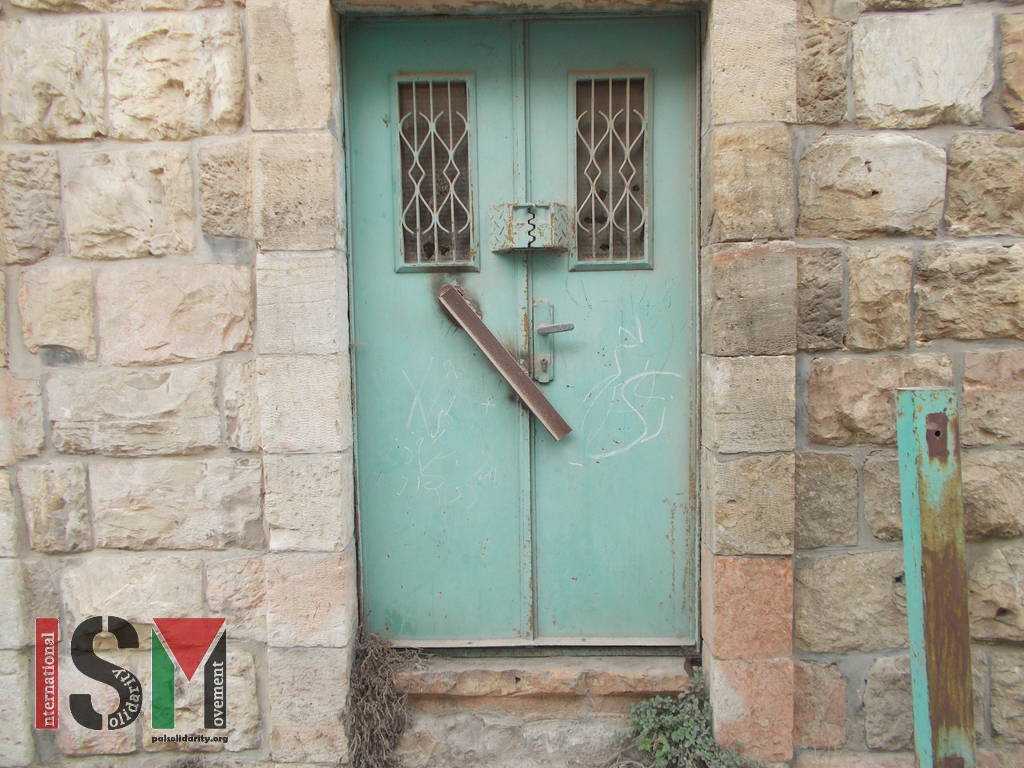
Diagonal metal bar is welded to doors in order to keep shops and homes permanently closed
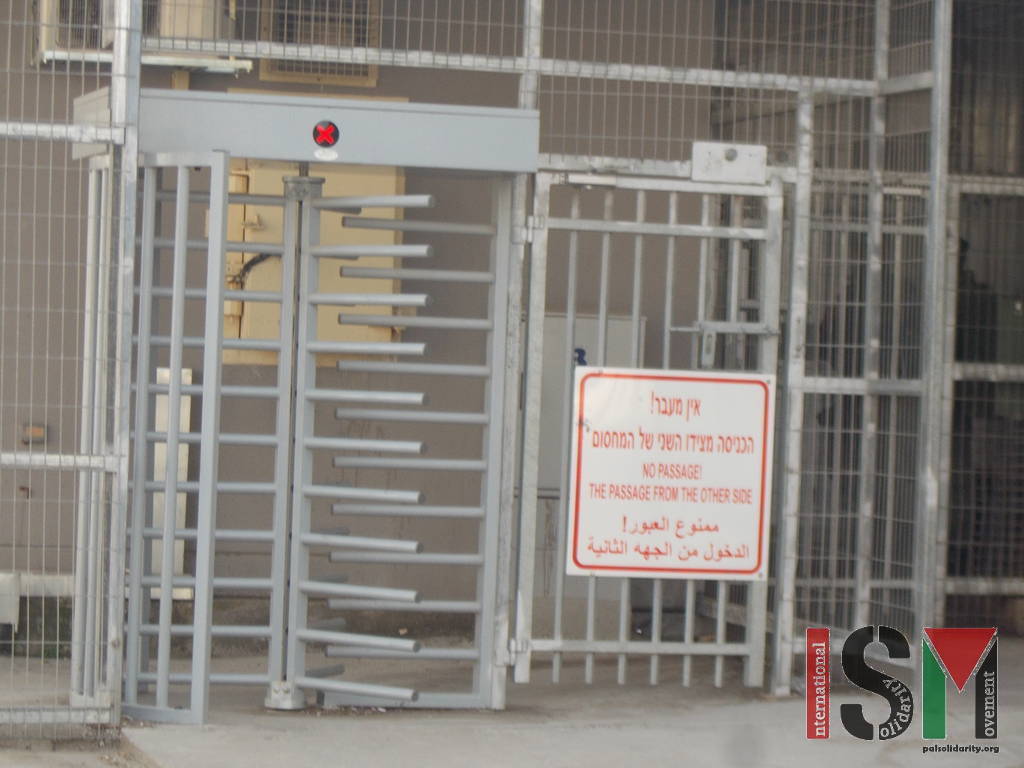
Entrance to a typical checkpoint

Left side of the fence for illegal colonial settlers, right side for Palestinians – often littered with trash by the settlers

Another road-block preventing Palestinian freedom of movement
Academic among 7 Palestinians from West Bank kidnapped by Israeli forces
Palestine Information Center – November 24, 2106
 WEST BANK – The Israeli occupation army (IOF) kidnapped seven Palestinians, including an academic, from West Bank provinces at dawn Thursday.
A PIC news correspondent said the IOF rolled into the An-Najah Campus dormitory in al-Maajin neighborhood, in western Nablus, and wreaked havoc on the apartment of lecturer Issam Rashed al-Ashqar, 57, before they kidnapped him and seized his car.
Al-Ashqar, an ex-prisoner, is a lecturer at the Physics Department at An-Najah University. He had previously been sentenced to several prison-terms, mostly in administrative detention, without charge or trial. He has also been diagnosed with health disorders.
The Israeli occupation army further kidnapped the two Palestinian citizens Amjad Abu Sbeih and Yazen al-Basiti from their own family homes in Jerusalem’s Old City.
The IOF stormed Jenin’s western towns of Anin and Zabouba and cracked down on Palestinian drivers in the eastern outskirts of the city.
A PIC reporter quoted eyewitnesses as stating that the IOF kidnapped the citizen Abdul Nasser Mohamed Yassin, 42, from Anin village after they ravaged his home and subjected the family to intensive questioning.
A military checkpoint was pitched by the IOF near the main entrance to Zabouba town.
The campaign culminated in the abduction of other Palestinians from Nablus, al-Khalil, and Bethlehem’s town of Beit Fajjar.
Canada’s Political Parties Enable Israel’s Oppression of Palestinians
“Canada is back” to isolating itself from world opinion on Palestinian rights
By Yves Engler | Dissident Voice | November 22, 2016
How can you identify a Canadian Liberal? They talk to the left, but walk to the right.
Under Justin Trudeau “Canada is back” to isolating itself from world opinion on Palestinian rights.
On Monday Canada joined the US, Israel, Marshall Islands, Nauru, Federated States of Micronesia and Palau in opposing a UN Social, Humanitarian and Cultural Committee resolution in support of Palestinian self determination.
Two weeks ago Ottawa joined Israel, the US, Marshall Islands, Federated States of Micronesia, and Palau in opposing motions titled “Israeli settlements in the Occupied Palestinian Territory, including East Jerusalem, and the occupied Syrian Golan” and “persons displaced as a result of the June 1967 and subsequent hostilities.” One hundred and fifty-six countries voted in favour of the motions while seven abstained on the first and six on the second.
Two among numerous resolutions upholding Palestinian rights Canada opposed. These votes follow on the heels of foreign minister Stéphane Dion attacking UNESCO for defending Palestinian rights. Last month the UN cultural body criticised Israel for restricting Muslim access to the Al Aqsa Mosque compound and recognised Israel as the occupying power. “Canada strongly rejects UNESCO World Heritage singling out Israel & denying Judaism’s link to the Old City + Western Wall,” Dion tweeted.
A few months earlier Trudeau’s minister criticized another arm of the UN. In March Dion denounced the UN Human Rights Council’s appointment of University of Western Ontario law professor Michael Lynk as “Special Rapporteur on Palestine”. Claiming the Canadian lawyer was hostile to Israel, Dion asked the UNHRC to review Lynk’s appointment.
In addition to isolating Canada internationally, the Trudeau government has pursued various pro-Israel moves. At the start of the month Governor General David Johnston visited a Jewish National Fund Forest. An owner of 13 per cent of Israel’s land, the JNF discriminates against Palestinian citizens of Israel (Arab Israelis) who make up a fifth of the population. According to a UN report, JNF lands are “chartered to benefit Jews exclusively,” which has led to an “institutionalized form of discrimination.”
While the GG recently visited a racist Israeli institution, the PM attended the “Butcher of Qana’s” funeral at the end of September. In 1996 Shimon Peres ordered the shelling of a UN compound in the village of Qana, Lebanon, which killed 106 civilians — half of whom were children. Through his long political career, reports Patrick Martin, Peres “was deeply implicated in many of the foulest historical crimes associated with the establishment, expansion and militarization of the state of Israel.”
Peres’ role in dispossessing Palestinians didn’t stop the Trudeau government from gushing with praise after he passed away. “The whole country of Canada is supporting the whole country of Israel and the prime minister wanted that to be very clear,” Dion told the press.
At the start of the year the Liberals condemned Canadians seeking to hold Israel accountable to international law. The Prime Minister and most Liberal MPs supported a Conservative Party call for the House of Commons to “reject the Boycott, Divestment and Sanctions (BDS) movement, which promotes the demonization and delegitimization of the State of Israel.” The February resolution also “condemned any and all attempts by Canadian organizations, groups or individuals to promote the BDS movement, both here at home and abroad.”
The Trudeau government’s efforts to undermine Palestinians’ liberation strengthens Canada’s multifaceted contribution to Israeli expansionism. Each year registered Canadian charities channel tens of millions of dollars to projects supporting Israel’s powerful military, racist institutions and illegal settlements. Over the past decade Ottawa has delivered over one hundred million dollars in aid to the Palestinian Authority in an explicit bid to advance Israel’s interests by building a security apparatus to protect the corrupt Palestinian Authority from popular disgust over its compliance in the face of ongoing Israeli settlement building. Further legitimating its illegal occupation, Canada’s two-decade old free trade agreement with Israel allows settlement products to enter Canada duty-free.
The truth is, it’s hard to tell Canada’s political parties apart when it comes to enabling Israeli oppression of Palestinians.
Without a growing popular movement campaigning for Palestinian rights this country’s political elites will continue to isolate Canada from world opinion.
Yves Engler is the author of Canada in Africa: 300 years of aid and exploitation.
Israeli Bid to Silence Mosque Prayer Calls Revived
Al-Manar | November 23, 2016
A controversial Israeli bill to silence the Muslim call to prayer is to go forward after it was amended so as not to affect the Jewish Shabbat siren, the speaker’s office said Wednesday.
Health Minister Yaakov Litzman, an ultra-Orthodox Jew, had blocked the draft law in its original form for fear it would also force the toning down of the sirens that announce the start of the Jewish day of rest at sundown each Friday.
But he lifted his objections after it was amended to apply only between 11 pm and 7 am.
The bill will “probably” now be put to a preliminary vote in parliament “next week,” a spokesman for speaker Yuli Edelstein told AFP.
It will then require three further parliamentary votes before it becomes law but it has already sparked outrage around the Arab and wider Muslim world.
Even Israeli government watchdogs have slammed the proposed legislation, describing it as a threat to religious freedom and an unnecessary provocation.
Arab Israeli lawmaker Ahmed Tibi has vowed to appeal to the High Court of Justice if the Shabbat siren is excluded from the scope of the bill on the grounds that it discriminates between Jews and Muslims.
The law would apply to mosques in annexed Arab east al-Quds (Jerusalem) as well as the occupied territories. But supersensitive Al-Aqsa mosque compound — Islam’s third holiest site — will be exempted.
“No changes will be made on” al-Aqsa Mosque an Israeli official told AFP.
Journalist Omar Nazzal, Shadi Jarrar among Palestinians ordered to additional imprisonment without charge
Samidoun Palestinian Prisoner Solidarity Network – November 21, 2016
 Omar Nazzal, prominent Palestinian journalist and member of the General Secretariat of the Palestinian Journalists’ Syndicate, was ordered on Monday, 21 November to three additional months in administrative detention by the Israeli occupation military. One of dozens of imprisoned journalists, Nazzal was seized by occupation forces on 23 April 2016 as he attempted to cross the al-Karameh/Allenby bridge to Jordan to participate in the General Meeting of the European Federation of Journalists in Sarajevo, Bosnia and Herzegovina. Since that time, he was ordered first to four months in administrative detention without charge or trial, then again to another three months of arbitrary imprisonment before his detention was again renewed today. Nazzal’s case has drawn international condemnation at the targeting of a prominent Palestinian journalist without charge or trial on the basis of so-called “secret evidence.”
 Nazzal was not the only Palestinian political prisoner ordered to additional imprisonment without charge or trial. Palestinian prisoner Shadi Jarrar, 36, from Wadi Burkin west of Jenin, was ordered to four months in administrative detention for the third time consecutively. He has spent eight months in administrative detention since his seizure by Israeli occupation forces on 12 March as he passed a military checkpoint between Ramallah and Nablus. Jarrar is held in the Negev desert prison. He previously spent 13 years in Israeli jails before his release in 2014 as a Palestinian political prisoner.
 Also ordered once more to administrative detention was Louay Daoud, 41, of Qalqilya, for the fourth time, for four months. Arrested by Israeli occupation forces when they invaded his home on 9 December 2015, he has now been ordered to administrative detention four times consecutively, without charge or trial. Daoud is also a former prisoner who spent 12 years in Israeli prisons until his release in 2003.
 Ashraf Jibril, 23, of Qalqilya, was also ordered imprisoned without charge or trial for an additional four months – the third consecutive administrative detention order against him. His home was raided on 10 November 2015 by Israeli occupation forces; he was twice ordered to six months in administrative detention and now an additional four months. The Israeli occupation authorities also renewed the administrative detention of Palestinian prisoner Qusai Hassan Khaliliya, 22, of Jaba village south of Jenin, for the second consecutive time for six months of imprisonment without charge or trial. Khaliliya was seized by occupation forces on 23 May in a pre-dawn raid on his Jaba home by occupation forces, who ransacked his belongings.
There are over 700 Palestinians held without charge or trial out of a total of 7,000 Palestinian political prisoners in Israeli jails. Administrative detention orders can be issued for one to six months at a time and are indefinitely renewable. Many Palestinian prisoners have spent years at a time imprisoned under repeatedly-extending administrative detention orders. Administrative detention has been used to target political leaders, influential community members, members of the Palestinian Legislative Council, and other prominent Palestinian figures. Ahmad Abu Fara and Anas Shadid are currently on hunger strike for the 57th day against their own imprisonment without charge or trial.
Netanyahu praises Sisi
MEMO | November 21, 2016
During yesterday’s Cabinet meeting, Israeli Prime Minister Benjamin Netanyahu praised Egyptian President Abdel Fattah Al-Sisi’s “courageous leadership”.
Netanyahu criticised PA President Mahmoud Abbas policies of inciting Palestinians through the idea of the right of return.
“Palestinian Authority President Mahmoud Abbas refuses to come to direct negotiations without preconditions, continues to incite his people regarding the idea of a right of return and erasing the State of Israel, and is not taking the right steps to start calming things and preparing public opinion for reconciliation with the State of Israel,” he added.
During the meeting, he referred to the visit of the former Egyptian President Anwar Sadat to Jerusalem and his speech to the Knesset that launched the Egyptian-Israeli peace deal 39 years ago, describing the visit as “historic”.
“A peace agreement was achieved between Israel and Egypt through direct negotiations; this agreement has stood for almost 40 years, currently under the courageous leadership of Egyptian President Abdel Fattah Al-Sisi. I note this because here one can see the contrast with what is occurring vis-à-vis the Palestinians,” he said.
Facebook blocks Palestine Network for Dialogue’s page
Palestinian Information Center – November 18, 2016
 GAZA – Facebook administration resumed its policy of targeting Palestinian media pages after blocking Palestine Network for Dialogue’s page for the third time Friday.
The Palestine Network for Dialogue, an online discussion board, was blocked without any prior notice although it has 70,000 followers.
Palestine Network for Dialogue specializes in publishing stories about the plight of Palestinians both in the occupied West Bank and Gaza Strip in addition to those living in 1948 occupied Palestine.
Last September, several pro-Palestinian Facebook pages and accounts were removed including accounts of seven editors of the Palestinian Information Center.
In a controversial move, the Israeli government and Facebook reportedly agreed to work together to determine how to tackle incitement on social media, aimed primarily at Palestinians.
Not long after Facebook’s agreement, several Palestinian pages with millions of readers found themselves closed and administrators locked out, in a move believed to be directly connected to the agreement between Facebook and the Israeli government.
Nothing is simple in Palestine
International Solidarity Movement | November 17, 2016
Umm al-Kheir, Occupied South Hebron Hills – Almost nothing in Palestine is what you expect for the most part. And, this is so true of the negative things you see. No matter how bad you think things are or expect them to be, you are almost always guaranteed that they will be worse (usually much worse) when you actually see them. And if you tell people the truth you may be thought to be making things up. But, this is Palestine and things are this unbelievable and this bad. This was true today for me (to put it mildly). Part of our team was invited by an “inspector” from the United Nations office based here in Al Khalil to go to a Bedouin village in the South Hebron Hills where a demolition took place yesterday.

The two demolished structures – with the illegal settlement in the background
Throughout my multiple trips here I’ve been to numerous house demolitions and even sat with families throughout the night waiting for the Israeli Occupation Forces to arrive to demolish a home. I was not ready for what I saw today. On our way to the village our U.N. inspector told us a bit of the history/story of the village. But, when we arrived I just wanted to vomit and I still have a knot in my stomach as I write this. The village of Umm Al Khair was established in 1952 on land the villagers purchased. They have the deed to prove ownership. The village is currently made up of approximately 140 Bedouin (registered) refugees, (approximately 28 families) who are mostly goat herders and farmers. They came here to the West Bank from “the 48” (Israel proper) after their home village was destroyed along with over 500 other Palestinian villages by Israeli Zionists, during the Nakba which created over 700,000 Palestinian refugees.
In 1982 the illegal colonial Zionist settlement of Carmel was established right next to them (less than 50 yards away) on land they stole from the village. Even though we couldn’t see inside the illegal settlement we were informed by the individual from the U.N. that the homes in the settlement were spacious, modern, had green grass lawns and gardens and even a small goldfish pond or two and all of the modern luxuries. In contrast, the village is made up of makeshift tents, crude metal and wood structures with dirt floors. There is no running water, no electricity, and a few crude toilet facilities.
Given that the villagers own the land, according to Israeli law, they cannot be legally evicted. However, the Zionists can make life so miserable that the villagers will give up and leave. This (in all probability) will never happen. They are strong, hopeful, and determined to stay here. This is their home. They will not leave. Even the children who have grown up here and gone off and got university degrees return here to their homes.

Rubble from the most recent demolition
Israel uses the excuse that the villagers don’t have building permits. But Israel doesn’t grant but a few building permits per year (if any) to Palestinians.
Drones routinely fly over the village photographing, looking for any sign of new construction or rebuilding and the soldiers will return and demolish again and again. And if a demolition order is given for a particular home or building, it is permanent and nothing can be built on that spot again.
There have been 5 demolitions in the past year: October 27, 2015; 1 in April 2016; 2 this past August; and the most recent one yesterday where two structures were demolished. Their Community Center which housed the kindergarten, a computer center, an after school program to help kids with homework, and a library has been demolished several times. There are some international aid programs such as the International Red Cross, several U.N. programs, and from the European Union that have helped with building materials and /or small structures for living. None of these programs, however, can help with the Community Center because it does not provide shelter for people or animals. So it is the children who suffer the brunt of these losses.

Rubble from the demolition, with the luxurious houses in the illegal settlement in the background
While one of our team members was conducting a video interview I went outside and was swarmed by young children. All smiling, laughing and excited by my presence and attention to them. All eager to show me around the village, show me their goat herds, their small playground and have me push them on the swings, take their photographs with their goats. They all appeared to be happy and none the worse for wear. But what I am describing is and has been their life. They know nothing else. It doesn’t make how these villagers are treated any less excusable. And this is only one observation from one person visiting one of the scores of similar villages throughout the West Bank. An older woman whose home was demolished in August of this year stated before we left, “We just need the demolitions to stop. We are getting sick and tired of it.” Our U.N. person then said, everyone including most of the aid programs are feeling the same way as this woman and little by little pay a bit less attention as time goes on. Even the government, The Palestinian Authority was called this morning about yesterday’s demolition and they stated they couldn’t come to look they had other things to do today.
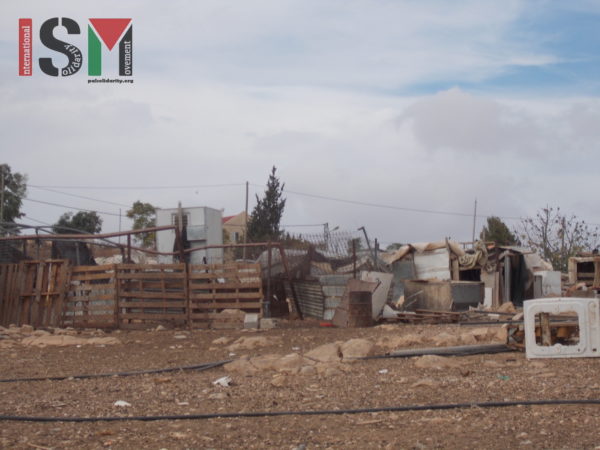
Residential dwelling of some of the families
I’ve always thought (and said) that somewhere inside the Israeli Zionist must still have some small bit of humanity left in them. After what I witnessed today I cannot believe that there is even a shred of humanity left in any of them. Today was by far the most overwhelming and depressing day I’ve had in all of my trips here to Palestine, and I’ve seen quite a few depressing and overwhelming things during these trips.
What can you do? Join the Boycott movement in your country. Write to your elected government officials to stop funding the various degrees of genocide that Israel is committing here in Palestine. Write letters to the editor of your newspapers. Talk to your families, friends, neighbors and let them know the truth. Speak up. As long as our country continues to support the behavior of Israel with our tax dollars we are all responsible!
Review: “Against Our Better Judgment”
The Hidden History of How the U.S. Was Used to Create Israel, by Alison Weir
Stephen J. Sniegoski • Unz Review • November 14, 2016
Alison Weir’s relatively short book covers the history of Zionism in the United States from the last decades of the 19th century until the creation of the state of Israel in 1948. (She is working on a second volume that will carry this history to the present.) Its brevity does not mean, however, that it is in any sense superficial, as it brings out key historical information, all well-documented, that sets the stage for the troubled world in which we now live. While histories of Zionism have usually focused on Europe, Weir shows that American adherents of this ideology have been far more important than generally has been recognized
 The basic theses of this book are encapsulated in the title and subtitle. The history of how American Zionists used America to create Israel was “hidden” in two respects. First, it was “hidden” in the sense that American Zionists often worked behind the scenes. More importantly, however, that history is known but has been kept hidden from the general public, who rely on the mainstream media, and exists almost exclusively in works produced by small publishers—often of a scholarly bent—read by only a few. As Weir points out, those who have tried to bring this information to the general public have suffered both venomous verbal attacks and economic threats that quickly silence the message and often destroy the messenger. This treatment obviously serves to prevent others from doing likewise—“Pour encourager les autres.”
America’s support for Israel ran “against our better judgment” in the sense that American foreign policy experts of the era covered by this work recognized that support for Zionist goals would damage American national interest and that this support only came about because of the political power of American Zionism.
While Weir is not a professional historian, she has intensively studied the literature on this subject for years, much of it rather arcane, as well as spending considerable time traveling in the region. Having a Ph.D. in history myself, I would like to point out that the writing of history does not require any specialized talents as are needed in such fields as theoretical physics or medicine, so that intelligent, hardworking laypersons can often produce works of great value. Weir does not purport to have pored over primary sources to discover new information, which is the hallmark of the professional historian’s craft, but rather synthesizes information from existing published studies that are largely unknown to the general public. Moreover, she brings to her work knowledge of the land and the peoples which she has picked up from her travels.
For those who still might find her background insufficient for her task, it should be further added that Israel apologist Alan Dershowitz, who lacks as far as I can tell any college degree in history, manages to produce works on Israel that are picked up by major publishers who would not think of publishing anything done by most academic historians. It might be added that academic historians, who specialize in monographs, would be loath to produce a comparable account of this subject from Weir’s perspective, since it would do little for their careers and might serve as their professional death knell.
While the book’s narrative is very readable and the key points can easily be digested by the average reader, it is nonetheless well-documented. To satisfy the more academic reader, the book has a section of extended endnotes longer than the narrative. I found the endnotes section valuable not only for confirming and expanding upon the content of the narrative but also in serving as a point of departure for additional research. I often switched from my Kindle book to a Web search, coming up with names of related books and articles that I would like to peruse, should I ever have the time to venture to a research library.
The work goes over a large number of little known but very important topics to demonstrate the powerful influence of Zionism over American foreign policy. Space, naturally, precludes me from discussing all the topics in detail so I have focused on those which seem to deal most directly with the major themes of the book.
The early political influence of Zionism is illustrated by the fact that in 1887 a Jewish American was made ambassador to the Ottoman Empire, which then controlled Palestine and was thus considered by Zionists as the key country with which to deal. This set the precedent of a Jewish ambassador to this country that was continued for the next 30 years, by which time the Zionist search for outside support had turned elsewhere.
The book brings up the central importance of Louis Brandeis and his disciple Felix Frankfurter in advancing the interests of Zionism. Brandeis was a noted social and economic reformer who was a Zionist and happened to be very close to President Wilson, who would put him on the Supreme Court in 1916, the first Jew to hold such a position. Even after joining the Supreme Court, Brandeis used this access to Wilson to promote Zionist interests, sometimes acting as a go-between for Wilson and British Zionists.
Brandeis would head the international Zionist Central Office during the teens but, perhaps even more significant, he would be a leading member of a secret society, the Parushim, the Hebrew word for “Pharisees” and “separate,” which covertly advanced the interests of Zionism in the United States and Europe. The Parushim was founded in 1913 by a University of Wisconsin philosophy professor, Horace M. Kallen, who ironically is considered to be the father of cultural pluralism in the United States. Obviously this idea conflicted completely with his support for the creation of a Jewish exclusivist state, but it is a contradiction that is rather commonplace among many Jews and liberal gentiles alike.
Kallen was regarded by some as first promoting the idea for what became the Balfour Declaration, which would set the stage for the modern state of Israel. He promoted this scheme in 1915 when the U.S. was still a neutral. He told a British friend that this would serve to bring the United States into World War I. It should be pointed out that at that time, despite serious diplomatic issues regarding German submarine warfare, the great majority of the American people wanted to avoid war and Wilson would be re-elected president in November 1916 on the slogan “He kept us out of war.” Kallen’s idea for advancing the Zionist goal, however, soon gained traction.
Frustrated in their efforts to achieve a Jewish homeland in Palestine from the Ottoman Empire, the American Zionists turned toward Britain to bring this about. In 1916 as World War I dragged on indecisively, Zionist leaders promised the British that in return for a Jewish homeland in Palestine—which the British could expect to gain from the Ottomans as one of the spoils of a victorious war—American Zionists would work to bring the United States into the war on behalf of Britain and its allies. Many British strategists at the time, such as Winston Churchill, believed that such an event would turn the tide for victory. Weir holds that it “appears” that the Zionists’ activity was one factor in bringing America into the war [1] and cites a number a number of reputable books and leading contemporary figures—such as then-British Prime Minister Lloyd George—that held that Zionists carried out their side of the bargain by pushing the United States into war.
The Balfour Declaration was a letter, dated November 2, 1917 (and coming out in the press one week later), from British Foreign Secretary Arthur Balfour to Walter Rothschild, a British Zionist leader, officially stating that Britain would use its “best endeavours to facilitate the achievement” of a Jewish Homeland in Palestine.
Now even to give attention to the Balfour Declaration in a history of World War I is somewhat outré; to claim that it caused the United States to enter war is one of those ultra-taboos. Although my Ph.D. was in American history with a focus on diplomacy (and a minor in 20th Century European history), never did I come into contact with anything about the Balfour Declaration in my college studies (which, granted, did not deal with the Middle East). I only knew about it from reading what the mainstream historical profession would regard as disreputable authors.
Reference to the Balfour Declaration and the Zionist role in it was considered one of the daring things done by the iconoclastic Israeli “New Historian” Tom Segev who discussed it in his book, One Palestine, Complete: Jews and Arabs Under the British Mandate (2000). In a lecture on his book that I heard at the University of Maryland in 2002, Segev, though acknowledging that the British goal was winning over Jews to their side [2], derided the idea of any real Jewish power, attributing that mode of thinking to “anti-Semitism.” In 2010, Segev expressed this view in a review of a new book on the Balfour Declaration: “Obviously there was no ‘Jewish power’ controlling world affairs, but Weizmann [3] successfully pretended that the Jews were in fact turning the wheels of history. For once, the anti-Semitic image of the Jews proved useful — they were believed to be so maliciously dangerous that one would do best to acquire them as allies rather than as enemies.”[4]
Although Segev is a daring historian who often rejects the Zionist myths on the creation of Israel, in this case he essentially relies on a classic Zionist-constructed strawman, which involves greatly exaggerating the view that the Zionists (and Jews in general) don’t like. It is highly doubtful that the British foreign office believed that Jews were so powerful as to be “turning the wheels of history.” (If that had been the case, one would think that the British would have offered Jews much more than Palestine from the very start of the war.) Furthermore, as noted earlier, Weir does not subscribe to anything like this Zionist strawman in regard to the Balfour Declaration, or anything else, I should add.
However, what is important is not only whether the American Zionists were able to bring the United States into a war, but that they made a solemn promise to a foreign country that they would try to do so. As a matter of fact, since Zionists such as Brandeis knew much about Wilson’s thinking and undoubtedly were kept abreast on what Germany was likely to do (it being well-known that Germany was suffering from the British “starvation” blockade and that politically powerful voices there wanted to retaliate by pursuing a harsher submarine policy toward neutrals such as the U.S.), they may have realistically thought in 1916 that there was a good chance that the United States would shortly go to war whether they interceded or not, which meant it would be a wise move to make such a deal and be able to get credit for a result that was not of their own making.[5]
It is also of significance that the American Zionists promised to push the U.S. into war not because they believed that it was in their own country’s national interest—as was the case for a number of prominent Americans such as former President Theodore Roosevelt—but solely for what they considered to be in the interests of world Jewry. Ascribing “dual loyalty” to any Jews is regarded as a classic anti-Semitic canard. In this case, however, the American Zionists’ position did not even rise to the level of “dual loyalty,” being purely singular in that it evinced no apparent concern whatsoever for American interests.
Linked to the Balfour Declaration, Weir points out that “American Zionists may also have played a role in preventing an early peace with the Ottoman Empire.”[6] In 1917, the U.S. State Department had heard that the Ottomans were becoming weary of the war, and it decided to send a secret mission to explore the possibility of detaching the Ottoman Empire from its alliance with the other Central Powers. Such a separate peace would likely leave the Ottoman Empire (or Turkey as it would become shortly)[7] in control of its Asian possessions, which would mean that since Britain would not gain Palestine, no home for Jews could emerge there.
This mission was headed by former Ambassador Henry Morgenthau, who, though Jewish, was not a Zionist. However, he was persuaded by Zionists such as Brandeis protégé Felix Frankfurter, who was a member of the mission’s delegation, to abandon the effort. In a meeting with Morgenthau, Chaim Weizmann, a leading British Zionist who was alerted by American Zionists as to the danger posed by Morgenthau’s mission, also played a major role in stopping the potentially-peacemaking mission, as is indicated in Weir’s endnotes.[8]
Other obstacles to the Zionists’ goal in Palestine would also arise soon after the end of the war in November 1918. Important Christian Americans who were intimately involved in the Near East and supported self-determination for the Arabs recognized that this could not take place if the Zionists were able to set up an ethnic Jewish enclave on Arab land. They went to the Paris Peace Conference which, among a number of issues stemming from World War I, would deal with the territorial settlement.
As a result of the divergent views on the future status of the territory to be given up by the Ottoman Empire, President Wilson decided to send an investigatory commission to the region, which became known as the King-Crane Commission.[9] In line with Wilson’s goal of national self-determination, the commission sought to discover how the region’s inhabitants wanted to be governed, and they overwhelmingly expressed opposition to a Jewish home in Palestine.
Weir points out that “Zionists through Brandeis dominated the situation, however, and the report was suppressed until after the Peace Accords were enacted.”[10] At the Paris Peace Conference, Weir writes, “[t]he U.S. delegation was forced to follow Zionist directives.”[11]
One minor criticism here is that the reader might incorrectly get the impression that the King-Crane Commission dealt solely with Palestine, while it actually involved all the territories severed from, or expected to be severed from, the Ottoman Empire (Turkey).[12] The issue of Palestine made up about half of the report on “Syria,” which also included present day Syria and Lebanon. The other two geographical sections of the report were “Mesopotamia” and “Non-Arabic speaking portions of the Former Ottoman Empire (Asia Minor).”[13] Thus the suppression of the commission’s report was likely due not only to opposition by Zionists, but also to other interested parties disturbed by its findings in areas other than Palestine. These parties would include the British, French and Greeks.
In regard to the report’s description of Palestine, however, Weir’s presentation was completely on the mark. The King-Crane report reflected extreme opposition to Zionism expressed by those Muslims and Christians who lived in Palestine as well as by those who lived in neighboring areas.
Weir points out that during the inter-war period, when Palestine was governed by Britain under a League of Nations mandate, which was intended to prepare the country for eventual independence, the American Zionists moved away from openly pushing for the establishment of an exclusivist Jewish state in Palestine since this ran counter to the temper of the times—which reflected American opposition to militant nationalism and dual loyalty, and respect for majority rule and national self-determination. Instead, Zionists focused on the development of Jewish institutions in Palestine, which would serve as a basis for a Jewish state. Zionist leaders, such as David Ben-Gurion, still viewed American support as key to their establishment of a Jewish state.
With World War II on the horizon, Zionists began to return directly to their goal of a Jewish state. A precursor of the current Israel lobby, the American Zionist Emergency Council (AZEC), began in 1939. In order to pressure the U.S. government to support a Zionist state, AZEC worked to establish more than 400 local committees under 76 state and regional branches to promote this goal. These committees distributed Zionist pamphlets, circulated petitions, and engaged in letter writing campaigns to promote the Zionist cause. AZEC also funded books, articles and academic studies for this same purpose.
By the end of World War II, Zionist efforts gave them considerable power in American politics. In order to appeal to the general American populace, they stressed the needs of the many Jewish European refugees, connecting the refugee problem to Palestine, the latter destination purportedly being the only solution to their existing homelessness. By this humanitarian argument, Zionists could thus appeal to many Americans who did not necessarily believe the Zionists’ contention that Jews had a historical right to control Palestine.
As Britain opted to turn over the troublesome issue of Palestine to the United Nations in 1947, Zionists pushed for a partitioning of Palestine between Jews and the indigenous Palestinian population. The partition plan discriminated in favor of the Zionists, since while the Jewish population comprised about 30 percent of Palestine’s population, the plan would award them with 55 percent of the land. And the Zionists’ real goal was not to be content with that amount but to also grab the remainder.
U.S. State Department officials strenuously opposed the partition plan, looking upon this approach as both contrary to America’s professed principle of national self-determination and its vital interests in the Middle East, where a vast majority of the governments and their people were vehemently opposed to Zionism. A leading State Department official in this opposition was Loy Henderson, Director of the Office of Near Eastern and African Affairs. Zionists viciously attacked him, demanding his removal and even threatening his family. The State Department chose to move him elsewhere and in 1948 President Truman named him Ambassador to Nepal, which kept him far away from anything to do with Palestine.
Removing Henderson, however, did not make the State Department favorable toward transforming any part of Palestine into a Jewish state. Among the higher level opponents were the head of the State Department‘s Division of Near Eastern Affairs, Gordon P. Merriam; Undersecretary of State Dean Acheson, who later became Secretary of State; and George F. Kennan, the State Department‘s Director of Policy Planning, noted as the architect of America’s containment policy against Soviet Communism.
The State Department was not the only part of the executive branch of the United States government that opposed the Zionist goal for Palestine. The newly-created CIA reported in 1947 that the Zionists were seeking goals that would be harmful to both Jews and “the strategic interests of the Western powers in the Near and Middle East.”[14] The Joint Chiefs of Staff opposed partition and expressed the prescient fear that the Zionist aim was to involve the U.S. in their conflict with their Middle East enemies.
Despite this opposition from a consensus of foreign policy and national security experts within his own government, Truman opted to support the Zionist partition plan for political reasons, relying heavily on the views of his domestic political advisor, Clark Clifford, who maintained that the Jewish vote and financial backing were necessary to win the presidential election in 1948. Truman‘s Secretary of State George Marshall, noted for the famed Marshall Plan that helped to rebuild devastated Western Europe, and Secretary of Defense James Forrestal remained staunchly opposed to what they regarded as Truman’s willingness to sacrifice vital national security interests on the altar of domestic politics.
Weir points out that a number of wealthy Zionist Jews provided financial support for Truman’s presidential campaign in 1948, which may put us in mind of Zionist mega-donors of today such as Sheldon Adelson. One of these backers was Abraham Feinberg who funded Truman’s epic whistle-stop train campaign. Truman would give Feinberg credit for his victory. As quid pro quo, the Truman administration remained inert when the CIA later reported that Feinberg was involved in illegal gun-running to Zionist groups in Palestine.
I should add that while Truman has become something of an idol for recent historians, he was looked upon during his time as being driven by what would benefit his own political interest. As the redoubtable journalist H. L. Mencken quipped about Truman’s 1948 campaign: “If there had been any formidable body of cannibals in the country he would have promised them with free missionaries, fattened at the taxpayer’s expense.” In Truman’s defense, however, it should be pointed out that two of his key opponents in the 1948 presidential election, Republican Thomas Dewey and the left-wing Progressive Party candidate Henry Wallace, Franklin Roosevelt’s former Vice-President, were both staunchly pro-Zionist.[15]
Weir describes a number of Zionists who maintained personal contact with Truman and likely played a role in shaping his policies. David K. Niles, Truman’s executive assistant, was regularly briefed by the head of the Washington Office of the Zionist Organization of America and was believed to be passing top-secret information to the Israeli government. Truman’s long-time friend and former business partner, Eddie Jacobson, was a staunch Zionist with close access to Truman who would describe his information to be of “decisive importance.”[16] Sam Rosenman, a political advisor to Truman, screened State Department memos to Truman.
Although the United States had announced its support for the partition of Palestine, it was apparent that the partition plan still lacked the necessary two-thirds vote to pass in the UN General Assembly. Consequently, the Zionists were able to get a delay in the vote and used that time to intimidate or bribe opponents to reverse their positions.
For example, Weir notes that Wall Street financier and perennial presidential adviser Bernard Baruch threatened war-torn France that it would be denied aid from the United States if it voted against partition. David Niles was able to get rubber baron Harvey Firestone to tell the Liberian president that he would terminate his planned expansion in his country if it did not vote in favor of partition. Haiti was promised economic aid if it would change its vote and support the measure. Costa Rica’s President Jose Figueres was said to have received a blank checkbook to get his country’s vote.
As a result of this behind the scenes skullduggery, the UN General Assembly on November 29, 1947, voted in favor of the adoption and implementation of the partition plan as UN General Assembly Resolution 181. Although this resolution is widely believed in the United States to have created Israel,[17] Weir correctly points out that it “was of limited (if any) legal impact” since General Assembly resolutions, as opposed to those of the Security Council, are not binding on member states. Although the resolution recommended that the UN Security Council implement the partition, it never did.[18]
The effect of the General Assembly’s resolution, however, was to increase the fighting in Palestine. While the Zionist myth would have it that the Jews in Palestine were simply a peaceful community set upon by violent Arabs intent on genocide, Weir points out that Zionist military forces had been covertly preparing for war for some time. They had amassed extensive armaments, some of it coming illicitly from the U.S., and their troop numbers exceeded those of their foes even after five Arab governments had joined the fray. The traditional Zionist portrayal of Israel’s war for independence (which, of course, prevented independence for the Palestinians) as a David versus Goliath conflict in which the Jews miraculously overcame overwhelming odds is pure fiction, but it is still believed in many quarters today and continues to generate sympathy for Israel. On May 15, 1948, Zionists announced the establishment of their new state of Israel, for which they did not establish any boundaries.
A quick aside here: somewhat ironically, in my view, Weir barely touches on the United States decision to recognize Israel. Moreover, what does exist is largely in the endnotes. Although there will be a second volume to Weir’s history, and the cut-off point for this volume has to be somewhere, still the fact that the book does make reference to events in 1948 would seem to have made it appropriate to discuss in some detail the issue of America’s quick recognition of Israel.
A number of interlocking organizations operated in the U.S. to raise money for Zionist paramilitary groups in Palestine, though this goal was kept secret. These organizations were under the direction of the leader of the Irgun Delegation, Hillel Kook, who operated under the name of Peter Bergson. During World War II, these organizations purported to be trying to alert people to the genocide of European Jews and trying to rescue those still alive. By promoting this purpose these organizations were able to attract substantial public support, including from those who would be repulsed by their funding of terrorist activities, which, Weir implies, was their real intent. The latter, she maintains, was made manifest by the organizations’ failure to actually rescue Jews from Europe.
The Irgun group engaged in numerous public activities to raise money, one of the most successful being a pageant entitled “We Will Never Die!” which, woven within the backdrop of the Nazi genocide, celebrated the Jewish contribution to Western civilization. Written by Ben Hecht, an Academy Award-winning screenwriter, the pageant included such Broadway and Hollywood celebrities of the era as Edward G. Robinson, Dean Martin, Frank Sinatra, and Leonard Bernstein. Forty thousand attended the extravaganza’s New York performances. It went on to play in a number of other large American cities. The group produced a number of other plays and rallies, one of which featured a young Marlon Brando, and raised $1 million.[19]
Some American Zionists, Weir observes, actually planned terrorist activities outside of Palestine in order to influence developments there. One such terrorist activity conceived by a group of American Zionists headed by an Orthodox Rabbi named Baruch Korff consisted of a plan to drop bombs along with threatening leaflets on the British foreign office in London, or anywhere in London if that were too difficult. The airplane pilot sought for this task, however, went to the Paris Police—he and Korff both being in France at the time—and Korff was arrested. Powerful people rushed to Korff’s defense and the charges were dropped. Korff thus was able return to his former activities in America as if nothing had happened. With this particular event thrown down the Orwellian “memory hole,” Korff resurfaced over two decades later as a public figure close to President Richard Nixon, influencing the latter’s Middle East policies.
The amount of money raised for Zionist groups in the United States during these years is impossible to calculate accurately, but it would be enormous. Weir writes that between 1939 and May 1948 the Jewish Agency for Israel alone raised the equivalent of $3.5 billion in today’s dollars.
David Ben-Gurion, then de facto leader of the Jewish community in Palestine, realized that the international concern for Jewish refugees could be used to advance the cause of a Jewish state by making it appear that no other safe refuges for Jews existed. Weir illustrates this deception by a discussion of the famous ship Exodus, which carried Holocaust survivors to Palestine when the British were not allowing illegal immigration there.
Weir points out that what is generally unknown to the public is that the French were willing to take in those Exodus refugees but Ben-Gurion rejected that solution, forcing those survivors to remain on board the ship for seven months. Weir quotes historian Baruch Kimmerling on the significance of the Exodus affair: “Ben-Gurion‘s strategy in the Exodus affair paid off. The fate of the refugee ship attracted considerable and sympathetic attention around the world, and served the Zionist cause well. Few observers at the time knew that many of the refugees from the Exodus had applied for immigration visas to the United States, and were hardly anxious to settle in Israel . . . . By dramatizing the fate of the survivors, in whom he had little interest except as future residents of the state he was building . . . Ben-Gurion helped to make Israel the world’s chief power broker over Jewish affairs.”[20]
Weir includes a brief reference to Leon Uris’s bestselling 1958 novel on the Exodus ship, and though it falls outside the chronological purview of this volume, I would add that the impact of the already mythologized Exodus event was greatly magnified by Uris’s book, which sold over 7 million copies and was turned into a blockbuster movie in 1960 by Otto Preminger, a leading film director of the era. The film has been identified by many commentators as having greatly enhanced support for Israel in the United States by Jews as well as gentiles and in the view of some scholars this movie has had a lasting effect on how Americans view the Israeli–Palestinian conflict. Weir even acknowledges that it had initially shaped her thinking on the subject.[21]
While the pro-Zionist propaganda that inundated the American media played up the existence of Jewish refugees who allegedly sought to come to Israel, there was little popular attention paid toward the hundreds of thousands of Palestinians who were being driven from their homeland as a result of Zionist massacres and other forcible expulsion measures. A State Department study in March 1949 found the American public was “unaware of the Palestine refugee problem, since it has not been hammered away at by the press or radio.”[22]
To underscore the importance of what Weir presents on this subject, it should be pointed out that until fairly recently, Israel’s denial of ever having expelled the Palestinians dominated the public discourse in the U.S. It was alleged that when Arab armies were about to invade the newly-declared state of Israel, Palestinians left their homes in the new Israel at the behest of their leaders, expecting to return with the victorious Arab armies. Beginning in the 1980s, however, Israel’s so-called “New Historians,” relying on newly released Israeli documents, exploded this myth. They concluded that the major cause of Palestinian flight was Israeli military action, which included terrorist massacres and the fear of them.
Even without the discovery of this Israeli documentary evidence, or any other documentary evidence for that matter, the use of the cui bono test would strongly point to Zionist culpability for the removal of the native Palestinians. For the Zionists planned to create a state that was both democratic and Jewish. This would be impossible if a large number of non-Jewish people, who were largely hostile to Zionism, resided within the country. From this fact, it would seem reasonable to conclude that the emptying of Palestine in 1948 was not a serendipitous development from the perspective of the Zionists, but one that was intentionally brought about by them.
Weir observes that U.S. State Department experts at the time were aware of Israel’s inhumane actions and sought to take action to at least moderate Israel’s effort to achieve a permanent removal of Palestinians. The State Department threatened to withhold $49 million of unallocated funds from an Export-Import Bank loan to Israel if it did not allow at least 200,000 refugees to return to their homes. Although Truman sympathized with the Palestinians’ plight, and in early 1948 even briefly considered backtracking from the partition and supporting a UN trusteeship for the entirety of Palestine, he ultimately prevented the State Department’s move from being implemented.
Weir points out that those in the mainstream media who attempted to alert the American people to the reality of the dispossession of the Palestinian people were effectively prevented from doing so by pro-Zionists. The latter relied on hurling the career-destroying charge of “anti-Semitism” and threatening economic measures to harm any media outlet that would dare to disseminate information they deemed to be too negative toward Israel.
The individual whom the Zionists caused to fall the farthest was Dorothy Thompson. Weir deserves much credit here for pulling this once well-known figure out of the Orwellian memory hole. Thompson happens to have been one of the principal figures in my doctoral dissertation titled, ”The Intellectual Wellsprings of American World War II Interventionism, 1939-1941.”[23] And I have added a few additional points to what Weir has in her book to illustrate the high reputation Thompson had at one time.
Thompson was an early and persistent critic of Nazism. She had an interview with Hitler in 1931 before he had become German Chancellor, which was made into a book. Thompson portrayed Hitler and Nazism in a negative light and in 1934, the now Nazi government of Germany expelled her when she attempted to visit the country. From 1934 onward, the bulk of her writing dealt with the danger posed by Nazism to the Western democracies. After the start of World War II in Europe in September 1939, Thompson was a staunch interventionist who initially advocated greater American aid to the allies but by the latter part of 1941 she was advocating American entrance into the war.
In 1939, Time Magazine named Thompson the second most popular and influential woman in America behind Eleanor Roosevelt.[24] She spoke out about anti-Semitism and the plight of the Jews in Europe, and urged a relaxation of immigration restrictions so the U.S. could be a safe haven for Jews under threat in Europe. She also was a strong supporter of Zionism.
In early 1945 she took a trip to Palestine where she saw firsthand Jews oppressing Palestinians. She came to realize that the Zionists sought to create a Jewish exclusivist state, not one that would include all of its current inhabitants. Her criticism of Zionism led to charges against her of “anti-Semitism” and even pro-Nazism, as absurd as that was given her background.[25] As a result of this all-out Zionist attack, newspapers began to drop her columns. Especially harmful was her loss of an outlet in New York City—where she had received a large proportion of her income—when the New York Post dropped her column with no other major New York City daily being willing to pick it up. Her radio program and speaking engagements also disappeared. Despite these problems, Thompson would not back away from her criticism of Zionism. And she continued to do so in the dwindling number of newspapers that still took her column, which did not end until 1958.
It is significant that the black-out of Dorothy Thompson has continued after her death, and perhaps even become worse. In the effort to make the subject of American history more inclusive, recent historians have often added women who were little known in their own eras, whereas Thompson who had been an important figure remains unmentioned. It seems likely that she has remained largely unmentioned both for what she had to say about Zionism and also by the fact that she was blacklisted by pro-Zionists, the power of whom one is not allowed to publicly acknowledge. (This contrasts with those Americans who were blacklisted for being pro-Communist, who are now often praised as martyrs because of this treatment.)
To conclude the review, it should be emphasized that this concise book should be of value to a wide audience. The general reader with little background knowledge should easily pick up a number of key points that serve to dispel the many myths that loom large today in the mainstream media, while even those individuals familiar with the subject are almost guaranteed to profit from little known facts, especially in the notes section, that should augment their knowledge. And it is essential that many more Americans become aware of this knowledge if America’s position is to change regarding Israel and the Middle East in general. Such a change is essential not only to bring about some degree of justice for the Palestinians but in order to extricate the United States from the debilitating regional conflicts that its close connection with Israel has entailed. It will be interesting to see how Weir, in her forthcoming volume, deals with the problems America has faced in more recent years that ineluctably derived from the events described in this work.
[1] Alison Weir, Against Our Better Judgment: The Hidden History of How the U.S. Was Used to Create Israel, (CreateSpace Independent Publishing Platform, 2014), Kindle Edition, Kindle Location 364. Weir contends that there were a number of factors that caused the United States to enter World War I in April 1917, some of which she lists, and that “Zionism appears to have been one of those factors.”
[2] Some historians have diluted this Jewish factor, attributing motivation to British foreign policy goals in the Near East. A Jewish homeland allegedly could serve as a buffer zone that would protect the Suez Canal.
[3] Chaim Weizmann was a leading figure in the Zionist movement who served as President of the Zionist Organization and later as the first President of Israel.
[4] Tom Segev, “‘View With Favor’, Review of The Balfour Declaration: The Origins of the Arab-Israeli Conflict by Jonathan Schneer, International New York Times, August 20, 2010, accessed December 13, 2015, http://www.nytimes.com/2010/08/22/books/review/Segev-t.html.
In other parts of his review, Segev’s analysis is impressive. For example he writes: “The Balfour declaration thus finds its place among a multitude of fruitless schemes and indulgent fantasies, except, of course, that in this case, surprisingly, the British by and large kept their word. For at least two decades they allowed the Zionist movement to bring hundreds of thousands of Jewish immigrants into Palestine, and these new arrivals set up hundreds of settlements including several towns, as well as the political, economic, military and cultural infrastructure of the future state of Israel. But if Israel’s existence originated with the British, so did the Palestinians’ tragedy.”
[5] The controversial House-Grey memorandum, developed with Britain in February 1916, stated that at an appropriate time Wilson would call for a peace conference. If the Allies accepted the offer and Germany rejected it or acted intransigently at the conference, the United States would go to war against Germany. And if Germany accepted the offer and a peace conference did take place, the settlement would not be unfavorable to the Allies. Wayne S. Cole, An Interpretive History of American Foreign Relations (Homewood, Ill.: Dorsey Press, 1968), 363
[6] Weir, Against Our Better Judgment, Kindle Location 449.
[7] The Wikipedia entry for “Ottoman Empire,” states that the “’Ottoman Empire’ and ‘Turkey’ were often used interchangeably, with ‘Turkey’ being increasingly favored both in formal and informal situations. This dichotomy was officially ended in 1920–23, when the newly established Ankara-based Turkish government chose Turkey as the sole official name,” accessed December 13, 2015, https://en.wikipedia.org/wiki/Ottoman_Empire .
[8] Weir, Against Our Better Judgment, Kindle Locations 2668-2669 .
[9] The King-Crane Commission was originally created as the American Section of the Inter-Allied Commission on Mandates in Turkey, which was also to include British and French members, and be like a number of other fact finding missions stemming from the Paris Peace Conference of 1919. These two countries failed to participate. Ken Grossi, Maren Milligan, and Ted Waddelow, Restoring Lost Voices of Self-Determination: Background to the Commission, August 2011, Part of the King-Crane Commission Digital Collection, Oberlin College Archives, accessed December 13, 2015, http://www.oberlin.edu/library/digital/king-crane/intro.html .
[10] Weir, Against Our Better Judgment, Kindle Locations 502-503.
[11] Weir, Against Our Better Judgment, Kindle Location 505.
[12] The King-Crane Commission Report, August 28, 1919, http://www.hri.org/docs/king-crane/. The report includes discussions of territory intended to have been taken from Turkey in the Treaty of Sevres, which Turkey never accepted and was not implemented.
[13] Ibid.
[14] Quoted in Weir, Against Our Better Judgment, Kindle Location 798.
[15] Wallace had no chance of winning the election but Truman’s backers feared that he could syphon off enough liberal votes in large Northern and Midwestern states to enable Dewey to win the election. The issue of Israel did not play a role in Strom Thurmond’s 1948 campaign in the South, which focused on states’ rights and racial issues.
[16] Quoted in Weir, Against Our Better Judgment, Kindle Location 894.
King-Crane Commission Report, August 28, 1919.
[17] Jeremy R. Hammond, “The Myth of the U.N. Creation of Israel,” Foreign Policy Journal, October 26, 2010, accessed December 13, 2015, http://www.foreignpolicyjournal.com/2010/10/26/the-myth-of-the-u-n-creation-of-israel/.
[18] More than this, the UN General Assembly, after the vote, created another committee that came to quite different conclusions. Jeremy Hammond writes: “The Ad Hoc Committee on the Palestinian Question was established by the General Assembly shortly after the issuance of the UNSCOP report in order to continue to study the problem and make recommendations. A sub-committee was established in turn that was tasked with examining the legal issues pertaining to the situation in Palestine, and it released the report of its findings on November 11. It observed that the UNSCOP report had accepted a basic premise ‘that the claims to Palestine of the Arabs and Jews both possess validity’, which was ‘not supported by any cogent reasons and is demonstrably against the weight of all available evidence.’ With an end to the Mandate and with British withdrawal, ‘there is no further obstacle to the conversion of Palestine into an independent state’, which ‘would be the logical culmination of the objectives of the Mandate’ and the Covenant of the League of Nations. It found that ‘the General Assembly is not competent to recommend, still less to enforce, any solution other than the recognition of the independence of Palestine, and that the settlement of the future government of Palestine is a matter solely for the people of Palestine.’’’ Hammond, “The Myth of the U.N. Creation of Israel.”
[19] Marlon Brando was very close to Jews before he became a movie star and later donated a considerable amount of money to Zionist causes. He expressed more negative views of Jews toward the end of his life. See: Allan M. Jalon, “How Marlon Brando Became Godfather to the Jews,” Forward, September 16, 2015, accessed December 13, 2015, http://forward.com/culture/320671/how-marlon-brando-became-godfather-to-the-jews/; Danielle Berrin, “Marlon Brando and the Jews,” Jewish Journal, July 30, 2014, accessed December 13, 2015, http://www.jewishjournal.com/hollywoodjew/item/marlon_brando_and_the_jews.
[20] Weir, Against Our Better Judgment, Kindle Locations 1249-1256.
[21] The movie had an all-star cast (and a very popular, award winning theme song), which included: Paul Newman, Eva Marie Saint, Peter Lawford, Sal Mineo, and Lee J. Cobb.
[22] Weir, Against Our Better Judgment, Kindle Locations 1370-1371.
[23] Stephen John Sniegoski, “The Intellectual Wellsprings of American World War II Interventionism, 1939-1941,” (PhD diss., University of Maryland-College Park, 1977).
My research on Thompson included a visit to the archival collection of her papers at the George Arents Research Library at Syracuse University in Syracuse, New York, in 1976, where I perused some material dealing with her break with American Jews, which was outside the scope of my dissertation.
[24] Thompson’s correspondence in her manuscript collection at Syracuse University illustrates her importance. The Overview of the Collection states: “Correspondents include authors (John Gunther, Wallace Irwin, Alfred M. Lilienthal, Edgar A. Mowrer, Vincent Sheehan, Johannes Urzidil), literary figures (Jean Cocteau, Rose Wilder Lane, Thomas Mann, Rebecca West), politicians and statesmen (Bernard M. Baruch, Winston Churchill, Ely Culbertson, Ralph E. Flanders, Felix Frankfurter, Charles de Gaulle, Cordell Hull, Clare Boothe Luce, Jan Masaryk, Gamal Abdel Nasser, Franklin D. and Eleanor Roosevelt, Harry S. Truman).” Overview of the Collection, Dorothy Thompson Papers, Syracuse University Libraries, accessed December 13, 2015, http://library.syr.edu/digital/guides/t/thompson_d.htm.
[25] Thompson’s relationship with American Jews actually began to sour toward the end of the war before the emergence of the issue of Zionist mistreatment of Palestinians. She differed with the Jewish establishment regarding her opposition to the Anglo-American incendiary bombing of German cities, which involved the killing of tens of thousands of civilians, and also the demand for a Carthaginian peace with Germany that was reflected in the Morgenthau Plan. She viewed these actions as violating the alleged idealistic purpose of the war, whereas many Jews sought punishment of the German people because of what the Nazis had done to their co-religionists.
Palestinian journalist released – on condition of deactivating Facebook and turning over his laptop
Samidoun Palestinian Prisoner Solidarity Network – November 14, 2016
 Palestinian journalist Khaled Maali of Salfit was ordered released on Sunday, 13 November by the Israeli Salem military court – on the condition that he turn over his laptop to Israeli occupation forces and close his Facebook account, as well as paying a fine of 7,000 NIS ($1700 USD).
Maali, 48, was arrested from his home in Salfit last week in a military raid by occupation forces. He is one of hundreds of Palestinians targeted for arrest, interrogation and imprisonment on the basis of their social media posts in support of the Palestinian people’s struggle for liberation. The “evidence” introduced into military court in order to convict these Palestinians – convictions which occur in over 99% of cases before Israeli military courts – include the number of “likes” and “shares” a post receives. Other prominent cases of Palestinians targeted for social media postings include poet Dareen Tatour, astrophysics professor Imad Barghouthi, and fellow journalists Sami al-Saee and Samah Dweik. Maali earned his PhD from The Hague University after studying at An-Najah University.
Recently, Facebook executives met with Israeli officials, including Ayelet Shaked, announcing “cooperation” against so-called “incitement,” sparking widespread protests among Palestinian and solidarity activists. While pledging to crack down on “hate speech,” they made no mention of Shaked’s genocidal comments about Palestinians posted on Facebook that referred to Palestinian children as “little snakes” and urged the execution of their mothers. Instead, Facebook has granted 95 percent of Israel’s 158 requests to remove content in the last four months. Samidoun in New York City joined the global protest against Facebook with a protest at the social media giant’s NYC offices.
Israel re-arrests British citizen after he is cleared by military court
MEMO | November 12, 2016
An Israeli appeal court has ordered the re-arrest of a British citizen after he was cleared of assisting terrorist organisations by a military court, Anadolu reported on Friday.
It was alleged that the “confession” of Faiz Mahmoud Ahmed Sherari, a 49 year-old British-Lebanese citizen, was obtained by “coercion” by the internal security agency Shin Bet. He was arrested during a four-day visit to the West Bank in September and accused of providing cash and mobile phones to Hamas, the Guardian said in a previous report.
Israel Radio said that the court of appeal challenged the ruling of the first court in the occupied West Bank. It did not say what will happen to Sherari.
The judge in the trial earlier this month, Lieutenant Colonel Azriel Levy, criticised the pressure put on Sherari by Shin Bet, noting that his rights had been violated. Reports revealed that he had been handcuffed painfully for an extended period as well as threatened. He was also prevented from seeing lawyer.
“There is no doubt that the defendant’s confession, which was given an hour after the end of his Shin Bet interrogation, was dramatically influenced by the method of interrogation,” the judge said in his ruling. “This included pained and prolonged shackling, threats and a blatant exploitation of the defendant’s demonstrated weakness.”
Featured Video

Houthis Don’t Have to Conquer Saudi Arabia to Make It Pay
or go to
Aletho News Archives – Video-Images
From the Archives
Newly Released FBI Docs Shed Light on Apparent Mossad Foreknowledge of 9/11 Attacks
By Whitney Webb | MintPress News | May 17, 2019
NEW YORK — For nearly two decades, one of the most overlooked and little known arrests made in the aftermath of the September 11 attacks was that of the so-called “High Fivers,” or the “Dancing Israelis.” However, new information released by the FBI on May 7 has brought fresh scrutiny to the possibility that the “Dancing Israelis,” at least two of whom were known Mossad operatives, had prior knowledge of the attacks on the World Trade Center. … continue
Blog Roll
 Aletho News
- MEP blasts ‘Euro-Gestapo’ for lecturing Russia on democracy
- Syria May Send Troops to Saudi Arabia Amid War with Ansar Allah
- UK whines about losing billions to ‘Putin tax’
- Baghaei to Rubio: Distorted narratives cannot erase US record of broken commitments
- Houthis Don’t Have to Conquer Saudi Arabia to Make It Pay
- MOE: Nearly 22,000 Students and Education Workers Killed
- Guterres in Islamabad: Genocide, cowardice, and the cage of Imran Khan
- Johnson, Marandi say Yemen holds upper hand over Saudi Arabia
- False flags won’t save aggressors, Iran FM spokesman says
- The Makkah Pact Enters Into Force: The End of American Dominance or Its New Form?
- If Americans Knew
- Report claimed Mark Levin used by Israeli government to influence Trump
- Over 2,000 Gazans have died awaiting medical evacuation amid Israel’s continued siege
- How a U.S. Diplomat Suppressed and Altered Reports Critical of Israel
- 5 Palestinians Die from Israeli Strikes in Gaza as Relentless Attacks Continue
- Report: Ceasefire Slows Killing but Leaves Devastation Intact
- Country Music Singer Zach Bryan Breaks Attendance Record at Robert Kraft’s Gillette Stadium While Wearing ‘Free Palestine’ Shirt for Second Night in a Row
- Three years of death and devastation: Israel’s war on Gaza in pictures
- Why Hamas believed the status quo was more dangerous than its 7 October gamble
- Debunking Israel’s latest list of ‘terrorist’ journalists in Gaza
- In Gaza, focus is on survival, “every step is a struggle” – Daily Update
- No Tricks Zone
- New Study: 50 Years Of The Most Aggressive ‘Net Zero’ Policies Can Only Affect The Global Climate By 0.03°C
- US September “Heat” Was No Record…Many Records Set Decades Ago
- Latest European Green Energy Debacle; Portugal’s Largest Flagship Solar Park Insolvent!
- Green Energy Debacle: German Expert Professor Fritz Vahrenholt Warns Of Severe Economic And Social Consequences
- Two More Paleo Reconstructions Affirm Meters-Higher Sea Levels Across Ireland, Brazil 7000-6000 Years Ago
- New Study: Earth And Venus Surface Warmth Largely Explained By Convection And Lapse Rate, Not CO2 Or Radiation
- 2025 Nature Paper Claiming Worsening Global Drought Gets RETRACTED …Heavily Flawed
- New Study: ‘Global Drought Shows No Detectable Recent Acceleration Under Climate Warming’
- Economic Masterminds: German Socialists Suggest Taxing Productivity Gains Stemming From Using AI
- The South China Sea Has Not Been Cooperating With The Climate Change Narrative

