Palestinian children subject to solitary confinement, administrative detention

Samidoun Palestinian Prisoner Solidarity Network – July 29, 2016
An escalating number of Palestinian children are being held in solitary confinement or detained without charge or trial under administrative detention. 16 Palestinian children have been detained without charge or trial under administrative detention since October 2015, reported Defense for Children International on 28 July.
DCI highlighted the case of Abdel-Rahman Kamil, 15, of Qabatiya in Jenin, arrested in February of this year. He was interrogated in the Salem military camp near Jenin without being allowed to consult a lawyer, and asked about alleged intentions to stab a soldier, throwing stones at invading Israeli occupation forces, or knowing young men from his town who participated in Palestinian resistance activities. Despite denying all of this, he was ordered to a six month administrative detention order without charge or trial on the basis of secret evidence. Despite a court reducing the order to four months, his administrative detention was then again renewed for an additional four months in June. He was one of seven children whose administrative detention orders were renewed in the month of June.
DCI also reported that “from January through June, Israeli authorities held at least 13 Palestinian children in solitary confinement for two or more days, compared to a total of 15 cases during 2015.” One 16-year-old boy from Yabad near Jenin spent 22 days in isolation. DCI noted that “the use of isolation for Palestinian child detainees is solely for interrogation purposes to obtain a confession and/or gather intelligence or information on other individuals.”
They highlighted the case of Rami K., 18, who was held in solitary confinement for 16 days for interrogation purposes. He reported that he was interrogated for 45 hours over a period of days, and that his hands and feet were bound to a metal chair during interrogation in stress positions. Rami is currently serving a 10 month prison sentence and a 3000 NIS fine ($780). He will spend another three months in prison if his family cannot pay.
The Israeli occupation prosecutes nearly 700 Palestinian children each year in military courts, alongside its use of administrative detention against Palestinian child prisoners. Two debates have been held in the British parliament on Palestinian children in Israeli military custody in 2016, while 20 members of the U.S. Congress urged President Obama to appoint a “special envoy for Palestinian youth,” to address issues relating to the human rights of Palestinian children and youth. Meanwhile, the Israeli state is escalating laws used to punish and imprison Palestinian children.
As DCI notes:
“The amendments to the Israeli penal code in 2015 included stricter penalties in mandatory sentencing laws such as a maximum 10 year sentence for throwing a stone, or other object, at traffic, without intent to cause injury, and 20 years for throwing a stone, or other object, at traffic with intent to cause injury. While the 20-year maximum sentencing existed prior to 2015, the word “stone” was added to specifically target Palestinian society.
Minimum penalties for stone-throwing offenses, one-fifth of the maximum penalty, were also added to the penal code. In a controversial decision, the Knesset, or Israeli parliament, added to the scope of punishment the denial of National Insurance benefits to families whose members have been convicted of throwing stones.
According to the Association for Civil Rights in Israel (ACRI), proposals are also in the works to impose life sentencing for children under the age of 14.”
“They destroyed the houses, they destroyed our dreams”
International Solidarity Movement | July 28, 2016
Qalandia village, Occupied Palestine – Late Monday evening, Israeli forces entered the village of Qalandia with 15 bulldozers and around 150 soldiers. In the village the Israeli military destroyed 11 new built houses, attacking the residents of the village with stun grenades, tear gas, rubber coated steel bullets and sponge bullets. 7 persons had to seek medical care for their injuries after the assaults from the military.
In 7 of the demolished houses, families had already moved in according to Yosef Awdalla, mayor of Qalandia. The demolition notices, claiming the houses had no permits, were left outside the houses on the ground only 24 hours before the army entered the village.
One of the homeowners, Fadi Awadallah describes how his friend was walking around the house the day before the demolitions, and found a piece of paper written in Hebrew on the ground. One hour after they had figured out what the document said and talked to their lawyer, the army was already entering the village to demolish their home. Fadi, who had applied and paid for an Israeli issued licence to build in area C, did not expect the demolition order since the Israeli authorities had accepted the money and the application. When he tried to explain this to the soldiers they answered him that “they were not there to talk, they were there to demolish the houses.”
The soldiers then pointed their guns to his head and told him that if he didn’t move away from the house they would shoot him.
“They didn’t deal with us as humans, they pushed us back with violence and force” says Fadi whose family had planned to move into their dream house the following week.
“Three years ago we started to build the houses. Why didn’t they come three years ago before we spent all our money on these houses? They destroyed the houses, they destroyed our dreams” says Fadi, explaining that most of the families not only spent all their savings on the buildings but now they are also left with loans that will take them years to pay.
“We came up with the idea about building a house here because we are not allowed to use our house on the other side of the wall.” says Fadi, whose father lives in a house on the other side of the apartheid wall surrounding the village. Without obtaining a permit every month from the Israeli occupation authorities, the family are not allowed to cross the wall that separates the West Bank from Jerusalem.
Since the signing of the Oslo agreement in 1995 most of Qalandia village was classified as Area C, where israel has full control over security and civil administration. Only 2% of Qalandia is constituted as area B, where construction is permitted. Palestinian building in area C has to be permitted by the Israeli Civil Administration and since the Israeli occupation of the West Bank 1967, Israeli authorities regularly demolishe houses in area C, thus breaking international humanitarian law. According to a report released this Wednesday from Israeli human rights group B’Tselem, Israeli authorities have demolished more Palestinian homes in the West Bank in the first six months of 2016 than they did in any year over the past decade .
The Israeli demolition policies systematically implemented by the government and the lack of possibilities to build legally in the area constitutes the ethnic cleansing and forcible transfer of Palestinians.
As Fadi Awadallah points out, “Where are we supposed to be? In the sky? In the space? No, we are staying here.”
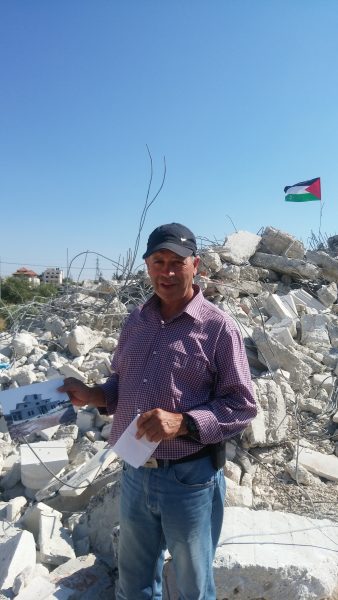
Sameeh Huseen holding a picture of his home that was ruined by the Israeli army.
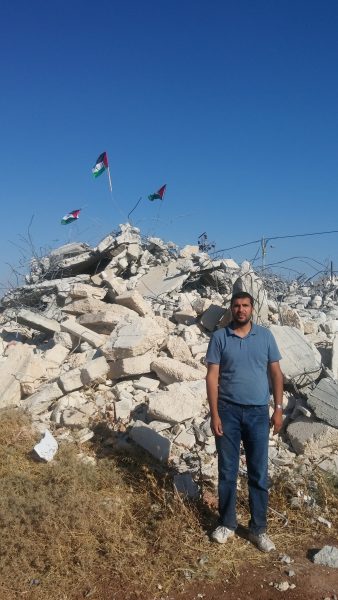
“How are we going to explain this to the next generation? How can we teach our kids about peace when this is what they see?” says Fadi Awadallah.
Leaked EU report reveals indirect approval of colonial Israel

By Ramona Wadi | MEMO |July 27, 2016
Once again, Israel is exerting a great deal of effort in order to prevent discussion of an EU paper among European institutions. The internal report, which was drafted in December 2015 and then endorsed by all EU member states, attributes the development of the Jerusalem Intifada (Uprising) to “Israel’s occupation”. It included reference to the living conditions of Palestinian citizens and the failure to implement the two-state paradigm.
The EU Observer, which has seen the 39-page report, has stated that the document is intended as a reference for EU foreign ministers and “for proposals put forward by the EU Foreign Service.”
While having a dearth of facts, the report is not lacking in the kind of contradictions that mark the constant cycle of condemnation and appeasement of Israel at the expense of withholding Palestinian narratives. The Jerusalem Post has deemed the EU document to be veering away from Israeli Prime Minister Benjamin Netanyahu’s claim that Israel and the rest of the world are facing the same terror threats. Rhetorically, the EU has distanced itself from Netanyahu’s sweeping statements that generalise every terrorist incident in order to normalise state violence against Palestinian resistance. Nevertheless, as on other occasions, the EU has devised its own strategies which uphold Israel’s narrative at a regional and international level.
The report is ambiguous in the extreme. “Some Palestinian perpetrators of individual attacks,” it explains, “have apparently been shot and killed in situations where they no longer pose a threat.” Despite Netanyahu himself publicly endorsing such extrajudicial killings, the EU has preferred to subjugate the facts to hypotheses through the use of terminology like “apparently”, “appeared” and “possibly amounting in certain cases to unlawful killings.” By not condemning such unlawful killing explicitly, the discourse suggests the EU’s tacit approval of Israeli state and settler violence. This is illustrated further in the report’s standard equivalence clause that “both sides” have indulged in “inflammatory rhetoric”, thus negating the fact that Palestinian resistance is a legitimate response to illegal Israeli colonial violence.
EU Foreign Relations chief Federica Mogherini has opposed the proposal that “known violent settlers and those calling for acts of violence” should be placed under EU visa bans. According to Mogherini: “There’s currently no question of sanctioning anybody. The question is rather how to motivate people to… restart peace talks.” Such leniency works in concordance with Israeli policy towards settler terrorists who are mostly shielded by the colonial state, enabling them to act with impunity.
Perhaps the most incriminating evidence of support for Israeli colonisation is the recommendation that the EU develops “further guidelines that differentiate between Israel and its illegal settlements,” according to the EU Observer. This distinction has been of interminable benefit to Israel and its implications are many, including the refusal to recognise the fact that Israel is a colonial entity and that its manifestation is contrary to the principles enshrined in international law. Referring to Israel as the “occupying power” without any reference to colonisation in effect absolves both Israel and the international community of accountability when it comes to recognising the Palestinian right to resistance and liberation. Unless this anomaly is rectified, all reports issued by the EU will be inherently biased towards Israel, regardless of the content. To treat colonial expansion as a recent phenomenon is a transgression of truth and an impediment to Palestinian struggle, although that is, after all, the apparent international intent behind such blatant deception.
Israel announces new resettlement plan for Negev Bedouins
Ma’an – July 26, 2016
BETHLEHEM – Israeli authorities Monday announced the approval of plans to build a new township for Israel’s Bedouin community in the Negev desert, according to Israeli media, in a continuation of what rights groups have said is Israel’s discriminatory policy of forcibly transferring Bedouins to Israeli-zoned townships to make room for Jewish communities.
The planned township is expected to be built just south of Segev Shalom, another Bedouin township, and would transfer at least 7,000 Bedouins from the unrecognized village of Wadi al-Naam, according to Israeli newspaper Haaretz.
The approved village would comprise of an area of approximately 9,000 dunams (2,224 acres), while providing housing to some 9,000 residents, The Times of Israel reported.
The proposal to expand the area of Segev Shalom was challenged in Israel’s Supreme Court last year, as the Association of Civil Rights in Israel (ACRI), who assisted in the court proceedings, argued that any expansion of the town would be followed by the forcible removal of Bedouins from unrecognized villages, particularly from Wadi al-Naam.
Wadi al-Naam residents and Israeli human rights groups presented an alternative planning proposal to the Supreme Court in April last year, which presented 15,000 dunams of land for a town separate from the densely populated neighborhoods of Segev Shalom.
According to Haaretz, Israel’s National Planning and Building Council recommended to the court the construction of the township in January in cooperation with village residents. However, residents of Wadi al-Naam have reportedly not been consulted about the approved plans.
Wadi al-Naam is one of 35 Bedouin villages considered “unrecognized” by the Israeli state. According to ACRI, more than half of the approximately 160,000 Negev Bedouins reside in unrecognized villages.
While Bedouins of the Negev are Israeli citizens, the villages unrecognized by the government have faced relentless efforts by the Israeli authorities to expel them from their lands in order to make room for Jewish Israeli homes.
The classification of their villages as “unrecognized” prevents Bedouins from developing or expanding their communities, as their villages are considered illegal by Israeli authorities. According to ACRI, entire Bedouin communities have been issued demolition orders in the past, while the village of al-Araqib has been demolished at least 100 times by Israeli forces in the past six years.
Israeli authorities have also refused to connect unrecognized Bedouin villages to the national water and electricity grids, while excluding the communities from access to health and educational services, and basic infrastructure.
Bedouins are considered a semi-nomadic group, as their way of life is dependent on access to wide areas of grazing land for their animals. Rights groups have argued that the relocation of Bedouins to permanent Israeli townships, oftentimes located in already stressed environments, severely disrupts their traditional lifestyles.
The Wadi al-Naam village was established in the 1950s soon after the 1948 Arab-Israeli war that established the state of Israel. Military officials forcibly transferred the Negev Bedouins to the site during the 17 year period when Palestinians inside Israel were governed under Israeli military law, which ended shortly before Israel’s military takeover of Gaza and the West Bank, including East Jerusalem, in 1967.
Now more than 60 years later, the village has yet to be recognized by Israel.
According to Israeli human rights group Bimkom, Wadi al-Naam, much like other unrecognized villages in the Negev, are “not connected to the water, electricity, sewage, telephone or road networks, and its inhabitants suffer from a severe lack of education, welfare and sanitation services.”
The group also pointed out that Israeli authorities have created hazardous conditions in the villages by establishing industrial zones near their vicinities. The Ramat Hovav Industrial Zone, for instance, was established near Wadi al-Naam, which residents have said releases bad odors into the air and pollutes the air, soil, and water, while a site purposed with burying explosive materials was also established near the village.
However, rather than working to remove the source of pollution from their communities, Israeli authorities have instead pushed for their eviction from the area.
Meanwhile, Israeli Jewish settlements in the Negev continuously expand, with five new settlements approved last year. According to an investigation undertaken by ACRI and Bimkom, two of the approved settlements are located in areas where unrecognized Bedouin villages already exist.
The plan would see the displacement of at least 7,500 Bedouins from the unrecognized villages of Katamat and Beer Hadaj.
Imprisoned Palestinian women and girls: Teen detained over Facebook posts, injured woman denied medical care

Samidoun Palestinian Prisoner Solidarity Network – July 25, 2016
Palestinian teen Qamar Manasra, 16, a Palestinian citizen of Israel, remains detained after she was arrested by Israeli forces who invaded her home in Reineh village on Tuesday, 19 July. Her home was ransacked and her father and two brothers assaulted. Qamar is allegedly being investigated for “incitement” for her posts on social media, specifically Facebook. Facebook “incitement” charges have been cited as the reason for arrests of hundreds of Palestinians.
Among those accused of “incitement” for social media posts is fellow Reineh resident and Palestinian poet Dareen Tatour, accused of “incitement” for posting her poetry on YouTube. Tatour has been supported by hundreds of writers around the world, including Pulitzer Prize winners and other world-renowned novelists, poets, and artists. She was imprisoned for three months and has since been held in house arrest for nine months; part of the original conditions of her house arrest included exile from her village of Reineh. Instead, her brother was forced to rent a separate apartment in Tel Aviv and her brother and sister-and-law forced to lose work in order to “guard” her 24/7. Finally, the prosecution dropped its objection to Tatour serving out her house arrest in Reineh last week; today, 25 July, her return to Reineh – still under house arrest – is expected to be approved, following significant international pressure on the case.
Israeli military courts ordered the continued detention of Taghreed Jabara al-Faqih, 43, for 11 days at the request of the military occupation prosecutor. Her family home was stormed and invaded by occupation forces on 12 July, who smashed and ransacked the contents of the home, including the cabinets and furniture.
 Taghreed’s husband, Khaled al-Faqih, said that he was shocked at the arrest of his wife, and that he and their young son, Muath, had been forbidden from seeing her since her arrest on the grounds that she is still under interrogation. Taghreed’s brother is accused of firing on Israeli occupation soldiers on 3 July.
Asra Media also reported that wounded Palestinian prisoner Abla al-Adam, 45, from the village of Beit Ula, continues to face medical neglect that endangers her life. She cannot turn her head without severe pain, yet receives only painkillers and sedatives, rather than treatment for the causes of her pain. Al-Adam was arrested on 20 December 2015 when she was shot in the head by Israeli occupation soldiers in al-Khalil, losing her right eye and sustaining serious injury to her head and face.
She was hospitalized but moved before the completion of her treatment to HaSharon prison. Much of her care comes from her fellow women prisoners rather than from any kind of medical personnel. She was accused of having a knife at a checkpoint in al-Khalil. Al-Adam has nine children; only her minor children have been allowed to visit her, not those over the age of 18, due to “security” denials.
They are among approximately 60 Palestinian women held prisoner or under house arrest by Israeli occupation forces, mostly in HaSharon and Damon prisons.
France Respects ‘Existing, True’ Right of Israel to Jerusalem – PM
Sputnik — 25.07.2016
France would never deny Israel’s right to Jerusalem, French Prime Minister Manuel Valls said in a letter sent to Shmuel Rabinovitch, the Rabbi of the Western Wall and the Holy Sites of Israel on Monday.
In April, UNESCO’s executive board released and then adopted a resolution, calling Israel “the Occupying Power” and urging it to “stop all violations against Al-Aqsa Mosque/Al-Haram Al-Sharif [the Arabic name of a holy site in East Jerusalem].”
At the same time the resolution did not include the Israeli name of the site, known as Temple Mount, nor did it reference its role in Jewish culture. France is among the 33 countries that voted for the resolution. Jerusalem protested the resolution and the French vote on it.
France will never deny the “existing, true” Jewish historical right to Jerusalem, Valls was quoted as saying by The Jerusalem Post. “Unfortunate and clumsy formulations befell the language of UNESCO’s decision to the point of insult. I believe that this should have been avoided and that the vote should not have happened.”
On May 11, Valls condemned the UNESCO resolution.
In the letter to Rabinovitch, he added that Jerusalem “symbolizes the unification of the three major monotheistic religions.”
Palestinians have been vying for the recognition of their independent state, proclaimed in 1988, in the territories of the West Bank, including East Jerusalem, and the Gaza Strip. The Israeli government refuses to recognize Palestine as an independent political and diplomatic entity, and continues to build settlements on the occupied land, despite objections from the United Nations.
Gary Spedding – Sabbos Goy or Israeli Agent?
By Gilad Atzmon | July 24, 2016
“We in the Palestinian Solidarity Movement Have a Problem With anti-Semitism,” writes Gary Spedding, a pro Palestinian ‘lobbyist’ in the Israeli outlet Haaretz. Spedding claims to be a Palestinian solidarity activist but his activism is better described as that of an ‘Israeli agent.’ Spedding’s article provides us with an extraordinary view of Left duplicity and its disastrous role in the solidarity movement.
“For me,” writes Spedding, “being equipped to recognize and call out anti-Semitism can only strengthen my Palestine advocacy.” And why? Because“having a clear definition of anti-Semitism helps to reassure the Jewish community.” The first question that comes to mind is why a ‘pro’ Palestinian wants to ‘reassure the Jewish community?’ If Spedding really wants to appease the Jews he should join AIPAC or enlist in the IDF’s Unit 300.
Pro Palestinian pretender Spedding doesn’t want us to use “anti-Semitic Jewish power tropes” he doesn’t want us to ‘vilify’ those “Jews who do identify with Zionism.” The obvious next question is, ‘what in hell makes Spedding think that he is a Palestinian solidarity activist?’ This guy is a text book ultra Zionist merchant, probably an Hasbara agent.
Spedding’s criticism of the solidarity movement is identical to the British Jewish Lobby’s campaign against Corbyn. “Some activists have tried to hide their intentions, again playing semantics, by replacing the word ‘Jew’ with ‘Zionist.’ It’s now ‘Zionists control the media’ or ‘Zionists already decided who the next US president will be’ instead of ‘the Jews.” For once, I completely agree with Spedding. Instead of referring to ‘Zionist power’ and ‘Zionist control,’ which are, in fact, misleading terms, we must be honest and straightforward and refer more properly to the ‘Jewish lobby’, ‘Jewish power’ and ‘Jewish interests.’
In total congruence with ardent Zionist Alan Dershowitz, Spedding argues that“Anti-Zionist Jews are also not immune from being complicit in, and promoting, anti-Semitism. If a Jewish person is repeating an anti-Semitic trope it doesn’t suddenly make it kosher for others to repeat.”
Spedding confesses, “when people like me raise concerns about anti-Semitism we are often told that we are ‘useful idiots’ for the Zionists and their agenda.” Well, yes, Spedding is an idiot and a very useful one. He tells us everything we need to know about the dysfunctional Palestinian solidarity movement and the deceitful Left. He helps us to spot the enemy within.
Spedding meticulously repeats the Hasbara guidelines: “We must also stop using the Israel – Nazi Germany analogy.” He support his inane call by quoting Israeli Zionist political commentator, Noam Sheizaf: “Saying someone is a Nazi means he represents the ultimate evil – something that shouldn’t be negotiated or compromised with, but only fought.”
Spedding needs to understand that for many of us Israel, its Lobby, the Neocons and their Zionist interventionist wars do represent the ultimate evil.
Spedding continues, “Activists should walk away from rhetoric that encourages the conflation of right-wing Zionism/Israel’s policies with Judaism and Jewish identity.” Spedding forgot to mention my name here. I claim some of the credit for this ‘conflation’ and I am proud of it. Israel defines itself as the Jewish State, its tanks are decorated with Jewish symbols. Accordingly, each of Israel’s crimes and its Lobby must be interpreted in light of Jewish culture, Jewish identity, Judaism and Jewish heritage!
Spedding insists that “Palestine activists should stop obsessing over identifying whether someone is Jewish or not, with the assumption that Jews must be given a litmus test on whether they’re pro-Israel, and thus assumed to be untrustworthy.” I wonder if Spedding would communicate the same advice to an anti Nazi group in the 1930’s. Would he advise the group not to be suspicious of supporters who, for some peculiar reason, identify politically as ‘Aryans?’
“We on the left” says the presumptive Israeli agent, “must stop procrastinating about anti-Semitism.” And the reason: “The Jewish community is an oppressed group.” I couldn’t agree more. Jews are amongst the poorest people, despite the fact that they are amongst the hardest working people. Jews make up 99% of the West’s population; but their representation in the media, politics, banking and academia is imperceptible. The Left must bring this discrimination to an immediate end. Jews must be proportionally represented once and for all.
Spedding continues, “by tackling anti-Jewish oppression on the left we actually strengthen our movement and allow it to grow.” Corbyn tried to do just that and saw his party reduced to dust. Instead of fighting Jewish power and emancipating his Party from it, Corbyn tried to appease Labour’s Jewish paymasters and the Jewish Lobby. The outcome was disastrous. The British Left is now a nostalgic interest.
Spedding ends his horrendous rant by addressing his comrades: “I urge my fellow activists to be sensitive to the concerns of Jewish individuals and communal groups whenever concerns about anti-Semitism are raised.” I recommend the complete opposite approach. Those who air the concerns of anti-Semitism, people like Spedding, Max Blumenthal, JVP and others, should be presumed to be tribal activists, Israeli agents and/or controlled opposition operatives.
Gary Spedding comes just short of admitting to being guilty of all the above.
Palestinians Lose Hope That Turkey Will Help to Solve Gaza’s Power Crisis
Sputnik | July 23, 2016
Ankara has pledged to help the Gaza Strip to tackle its decade-long electricity crisis as part of a deal to normalize ties with Israel that were severed six years ago, but Palestinians told Sputnik that they doubt that Turkish authorities will deliver on the promise.
Mustapha Al-Agha who lives in Gaza said that locals have lost their hope in Turkey after Ankara decided not to pressure Israel to lift the blockade which has been in place since 2007. Turkey’s “help is limited to humanitarian aid,” he said. “All promises given to the Gaza Strip have turned out to be a ‘downer pill’ meant to receive support for the agreement between Turkey and Israel.”
Itaf Mukhanna, a mother of seven, maintained that lifting the blockade was a priority, urging Arab nations to do something about it.
“Situation here is unbearable. Youth unemployment has worsened. Electricity, water and gas have become an everyday dream that each local is trying to fulfil,” she said.
On June 28, Turkey and Israel announced that they would restore diplomatic ties. Ankara has agreed to provide humanitarian aid to and build a power plant in Gaza as part of this deal. Two weeks later a Turkish delegation visited the region to discuss ways to resolve the crisis with Israeli and Hamas officials.
The delegation is expected to prepare a report that will be directed to Turkey’s Energy and Natural Resources Minister Berat Albayrak, the cabinet and President Recep Tayyip Erdogan. The government will then work on a roadmap to implement measures outlined in the report.
Last week Turkey delivered 11,000 tons of humanitarian aid meant for Gaza. The cargo was offloaded in the Israeli port city of Ashdod.
The Gaza Strip’s electricity crisis is acute. The region has a single power plant that has operated at less than 50 percent capacity since 2006 when Israel bombed the facility.
Gaza needs at least 450 megawatts per day, but it receives no more than 185 megawatts in the summer and 200 megawatts during the winter, Tare Lubbad, communications director at a Gazan electric company, told Sputnik.
“The energy crisis in the Gaza Strip has become worse since one of [four] generators at the power plant has not been working due to the lack of fuel,” he said.
The plant needs at least 500 tons of fuel per day to operate at its current full capacity, but the Palestinian Authority in Ramallah has imposed a tax on fuel purchased in Israel.
Latest on Tel Aviv-Riyadh Links: Saudi General Meets Officials in ‘Israel’
Press TV – July 23, 2016
A well-connected retired general in the Saudi military has traveled to Israel, in the latest indication of a growing link between Tel Aviv and Riyadh which has come to light in recent months.
Anwar Eshki made the visit earlier in the week, meeting with Israel’s foreign ministry director general Dore Gold Yoav Mordechai and a number of Knesset members, the daily Ha’aretz reported.
The daily called the visit “a highly unusual one,” as Eshki couldn’t have traveled to Israel without approval from the Saudi government.
Eshki and Gold raised an uproar first in June 2015 when they held a publicized joint event in Washington, after meeting privately several times over the preceding year.
Gold attended the event a few days before assuming the role of director general of the Israeli foreign ministry.
Israeli legislator Esawi Freige, who organized Eshki’s meeting with his fellow members of Knesset, shed some light on the trip. “The Saudis want to open up to Israel,” he said.
“This is a strategic step for them. They said they want to continue what former Egyptian President Anwar Sadat started. They want to get closer to Israel. This is clearly evident,” Fregie noted.
He was referring to the former Egyptian president’s negotiations with Israel, which culminated in the Egypt–Israel Peace Treaty in 1979 – the first between an Arab state and Tel Aviv at the time.
Haaretz said that during the meeting with the parliamentarians, Eshki encouraged dialog in Israel on Saudi Arabia’s Arab Peace Initiative.
The proposal was unveiled in 2002, offering normalized ties with Israel by 22 Arab countries in return for Tel Aviv’s withdrawal from the occupied West Bank.
During an interview with the Qatari news channel Al Jazeera in April, Eshki said Riyadh would open an embassy in Tel Aviv if Israel accepted the Saudi initiative. He also said the Saudis were not interested in “Israel becoming isolated in the region.”
Back in May, Israeli newspaper Arutz Sheva reported that Saudi Arabia and its Persian Gulf allies [sic], namely Jordan and Egypt, had been sending messages to Israel through various emissaries, including former British PM Tony Blair.
They had asked Tel Aviv to resume Middle East negotiations under new terms, which included changes to the Saudi initiative, the paper said.
Most Arab governments have no diplomatic relations with Israel. Even so, reports have indicated that several of them, including Saudi Arabia, have had secret relations with Tel Aviv.
Last November, the Associated Press reported that Israel was set to open a “permanent mission” in the UAE.
In May, the Middle East Eye news portal reported that Israel and some Arab countries, including the UAE, Egypt, and Jordan, were planning to overthrow Palestinian President Mahmoud Abbas and replace him with former leader of the Fatah movement Mohammad Dahlan.
Egyptian Foreign Minister Sameh Shoukry traveled to Jerusalem al-Quds for talks with Israeli leaders earlier this month.
The minister outraged many Egyptians for visiting Israeli Prime Minister Benjamin Netanyahu’s family, during which the two watched the Euro 2016 soccer final.
Palestinian student Donya Musleh sentenced to 10 months in Israeli prison for posting on Facebook

Samidoun Palestinian Prisoner Solidarity Network – July 21, 2016
Palestinian student activist Donya Musleh was sentenced to 10 months in Israeli prison and a fine of NIS 2,000 (approximately $500) on charges of “incitement” for posting on Facebook about the Israeli occupation and Palestinian resistance.
Musleh, 19, a Palestinian refugee from Dheisheh camp near Bethlehem, is a student at Palestine National University and an activist with the leftist student organization, the Progressive Student Labor Front. She was arrested in a raid on her home in the camp on 16 November 2015.
Musleh is one of hundreds of Palestinians arrested, charged, or ordered to administrative detention for posting their political opinions and views about their occupied homeland on social media. Just days ago, journalist Samah Dweik was sentenced to six months and one day in prison for posting on Facebook. Astrophysicist Imad Barghouthi is currently being charged with Facebook “incitement,” after winning an end to his administrative detention with the support of hundreds of international scientists. Poet Dareen Tatour is held in house arrest after three months in prison, for posting her poetry on Youtube.
The PSLF is currently calling for a World Student Day of Solidarity with Bilal Kayed and Palestinian Prisoners on 25 July. Bilal Kayed, 35, is on hunger strike for the 37th day in protest of his administrative detention without charge or trial, imposed upon him after 14.5 years of Israeli imprisonment.
The detention of two more Palestinian women, Banan Mahmoud Mafarjah, 21, a medical student at Al-Quds University in Abu Dis, arrested at an Israeli occupation “flying checkpoint” west of Ramallah on 16 July; and Samaher Abdul Qader Musalma, of Beit Awwa near al-Khalil, arrested on 18 July while visiting her husband Nabil in the Negev desert prison; were extended until Sunday, 24 July. There are approximately 61 Palestinian women currently held in Israeli jails.
Deir Qaddis resists ongoing theft of village land
International Solidarity Movement | July 21, 2016
Deir Qaddis, Occupied Palestine – On the morning of July 14th, Israeli excavators arrived on Majid Mahmoud’s farmland in Deir Qaddis to begin work on an illegal expansion of a wastewater facility for the nearby illegal settlement of Nili.
Construction vehicles and Occupation forces were met by about fifty Palestinians from Deir Qaddis and nearby Nil’in in protest of the theft and destruction of village land, who refused to leave until the construction was halted. Through nonviolent means the villagers managed to temporarily prevent the destruction of their grazing lands, though excavation and land clearing did resume in the days afterwards. Illegal settlements around Deir Qaddis have been expanding for decades, swallowing up thousands of dunams and dispossessing farmers and agricultural workers in the area.
Majid’s land, now on the other side of a settler road, has been rendered mostly inaccessible by both the expansion of illegal settlements and the threat of violence from Israeli forces and private settlement security.
“We have no rights under this Occupation. I cannot ask the soldiers why they are on my land. It is as if I am being beaten, but cannot question it or raise my hands to stop it,” Majid said. “We have all the papers to prove ownership, but it does not matter.”
Majid and members of the local council are planning to bring the case to court and have all the documentation necessary to do so. They are not optimistic, however, about their chances.
Though the people of Deir Qaddis did succeed in halting the illegal construction on Thursday, it has since resumed. Fares Naser, mayor of the village, has little confidence that the settlement expansion and illegal construction will ever end. “It will not stop,” said Fares, “and the next generation will wonder why it is this way.”
Deir Qaddis is surrounded on three sides by the Apartheid Wall and the illegal Israeli settlements of Nili, Modi’in Illit, and Na’aleh, cutting it off from much of the West Bank. According to Fares, only 4,000 of the village’s original 10,000 dunams have not yet been seized by Israeli forces and settlers. Over ninety percent of the Deir Qaddis is classified as “Area C,” territory in which Israel maintains full military and civil control.
In 1999, Israeli authorities assured the people of Deir Qaddis that all land lying west of the town would remain untouched. Israel has since broken that promise, with both state confiscation and private theft of valuable farmland within Deir Qaddis. According to international law, all Israeli settlements are illegal, as is nearly every piece of the Israeli colonial apparatus. Israel will continue to build, and the people of Deir Qaddis will continue to resist the ongoing theft of their land and livelihoods.
Featured Video

When Israel Is Mighty
or go to
Aletho News Archives – Video-Images
From the Archives
US murdering 1 million Iraqis is democracy, Iran giving yogurt to Iraq is “domination”
By Ali Salaam | American Herald Tribune | July 31, 2017
The New York Times, owned by the Zionist Jewish supremacist Ochs-Sulzberger family, has no problem with Iraqi suffering as long as Iran is not the one behind it.
The Iraq War was a genocide of the Iraqi people by Zionist supremacists in the Bush administration. Over 1 million innocent people were killed based on a lie. American soldiers died in an Israeli war and now an average of 22 soldiers commit suicide every day because their consciences cannot cope with the fact they committed crimes in an illegal war that served no purpose other than to benefit Israel, not America.
Benjamin Netanyahu, Prime Minister of the Zionist regime, once said “We are benefiting from one thing, and that is the attack on the Twin Towers and Pentagon, and the American struggle in Iraq.”
Paul Wolfowitz had his sights on Iraq since his time in the first Bush administration. Former Israeli official and Bush administration official Richard Perle had his eyes on Iraq since at least his authorship of the Clean Break white paper. The Zionist regime had their eyes on Iraq since the 1980s when strategist Oded Yinon wrote his white paper in support of dividing the Arab-Muslim world along ethnic and sectarian lines. The global Zionist lobby has had their eyes on Iraq since Theodor Herzl stated that Eretz Israel’s true borders go from the Nile River in Egypt to the Euphrates River in Iraq. … continue
Blog Roll
 Aletho News
- MEP blasts ‘Euro-Gestapo’ for lecturing Russia on democracy
- Syria May Send Troops to Saudi Arabia Amid War with Ansar Allah
- UK whines about losing billions to ‘Putin tax’
- Baghaei to Rubio: Distorted narratives cannot erase US record of broken commitments
- Houthis Don’t Have to Conquer Saudi Arabia to Make It Pay
- MOE: Nearly 22,000 Students and Education Workers Killed
- Guterres in Islamabad: Genocide, cowardice, and the cage of Imran Khan
- Johnson, Marandi say Yemen holds upper hand over Saudi Arabia
- False flags won’t save aggressors, Iran FM spokesman says
- The Makkah Pact Enters Into Force: The End of American Dominance or Its New Form?
- If Americans Knew
- Gaza ceasefire exists in name only, say more than 100 organizations
- Nearly 2 Million in Gaza Need Urgent Shelter Assistance as Winter Looms: IOM Chief Warns
- Suppressing Palestinian resistance: US charity under fire for AI monitoring of Gaza classrooms
- Thousands Are Held in Israeli Torture Camps. This Is What Happens Inside
- Israel puts Gaza’s sick, injured, newborn in peril – Daily Update
- Report claimed Mark Levin used by Israeli government to influence Trump
- Over 2,000 Gazans have died awaiting medical evacuation amid Israel’s continued siege
- How a U.S. Diplomat Suppressed and Altered Reports Critical of Israel
- 5 Palestinians Die from Israeli Strikes in Gaza as Relentless Attacks Continue
- Report: Ceasefire Slows Killing but Leaves Devastation Intact
- No Tricks Zone
- New Study: 50 Years Of The Most Aggressive ‘Net Zero’ Policies Can Only Affect The Global Climate By 0.03°C
- US September “Heat” Was No Record…Many Records Set Decades Ago
- Latest European Green Energy Debacle; Portugal’s Largest Flagship Solar Park Insolvent!
- Green Energy Debacle: German Expert Professor Fritz Vahrenholt Warns Of Severe Economic And Social Consequences
- Two More Paleo Reconstructions Affirm Meters-Higher Sea Levels Across Ireland, Brazil 7000-6000 Years Ago
- New Study: Earth And Venus Surface Warmth Largely Explained By Convection And Lapse Rate, Not CO2 Or Radiation
- 2025 Nature Paper Claiming Worsening Global Drought Gets RETRACTED …Heavily Flawed
- New Study: ‘Global Drought Shows No Detectable Recent Acceleration Under Climate Warming’
- Economic Masterminds: German Socialists Suggest Taxing Productivity Gains Stemming From Using AI
- The South China Sea Has Not Been Cooperating With The Climate Change Narrative

