Deir Qaddis resists ongoing theft of village land
International Solidarity Movement | July 21, 2016
Deir Qaddis, Occupied Palestine – On the morning of July 14th, Israeli excavators arrived on Majid Mahmoud’s farmland in Deir Qaddis to begin work on an illegal expansion of a wastewater facility for the nearby illegal settlement of Nili.
Construction vehicles and Occupation forces were met by about fifty Palestinians from Deir Qaddis and nearby Nil’in in protest of the theft and destruction of village land, who refused to leave until the construction was halted. Through nonviolent means the villagers managed to temporarily prevent the destruction of their grazing lands, though excavation and land clearing did resume in the days afterwards. Illegal settlements around Deir Qaddis have been expanding for decades, swallowing up thousands of dunams and dispossessing farmers and agricultural workers in the area.
Majid’s land, now on the other side of a settler road, has been rendered mostly inaccessible by both the expansion of illegal settlements and the threat of violence from Israeli forces and private settlement security.
“We have no rights under this Occupation. I cannot ask the soldiers why they are on my land. It is as if I am being beaten, but cannot question it or raise my hands to stop it,” Majid said. “We have all the papers to prove ownership, but it does not matter.”
Majid and members of the local council are planning to bring the case to court and have all the documentation necessary to do so. They are not optimistic, however, about their chances.
Though the people of Deir Qaddis did succeed in halting the illegal construction on Thursday, it has since resumed. Fares Naser, mayor of the village, has little confidence that the settlement expansion and illegal construction will ever end. “It will not stop,” said Fares, “and the next generation will wonder why it is this way.”
Deir Qaddis is surrounded on three sides by the Apartheid Wall and the illegal Israeli settlements of Nili, Modi’in Illit, and Na’aleh, cutting it off from much of the West Bank. According to Fares, only 4,000 of the village’s original 10,000 dunams have not yet been seized by Israeli forces and settlers. Over ninety percent of the Deir Qaddis is classified as “Area C,” territory in which Israel maintains full military and civil control.
In 1999, Israeli authorities assured the people of Deir Qaddis that all land lying west of the town would remain untouched. Israel has since broken that promise, with both state confiscation and private theft of valuable farmland within Deir Qaddis. According to international law, all Israeli settlements are illegal, as is nearly every piece of the Israeli colonial apparatus. Israel will continue to build, and the people of Deir Qaddis will continue to resist the ongoing theft of their land and livelihoods.
Legal centre slams Israeli parliament’s new Expulsion Law
MEMO |July 20, 2016
Adalah – The Legal Center for Arab Minority Rights in Israel has slammed a newly-passed Israeli law designed to facilitate the expulsion of publicly-elected Palestinian parliamentarians in the Knesset.
The law, approved overnight by a vote of 62 to 45, is described by Adalah as posing a “grave danger to basic democratic rights”, and intended to expel those Arab Knesset members “who ‘dare’ to stray beyond boundaries dictated to them by Israeli Jewish majority.”
As Adalah explains, under the new law, “a majority of 90 Knesset members may oust a serving Knesset member on two grounds, as enumerated in Section 7A of the Basic Law: The Knesset: 1) incitement to racism; and 2) support for armed struggle against Israel.”
In addition, “the law stipulates that when the Knesset decides on an expulsion, the statements of the ‘suspect’ Knesset member will also be examined and not only their aims or actions.”
The law also provides that: 1) a member’s expulsion lasts for the full period of the Knesset’s remaining term; 2) the commencement of expulsion proceedings requires the support of 70 Knesset members, including a minimum of 10 opposition members; and 3) suspension proceedings may not commence during an election campaign.
Described as “the latest attempt by the government to trample on the political rights of Palestinian citizens of Israel”, according to Adalah, “there are no existing laws in western democratic states comparable to Israel’s new Expulsion Law.”
The Expulsion Law is the latest expression in a disturbing national tendency over the past several years – including many attempts to disqualify Arab Members of Knesset and Arab party lists from participating in the elections, the government’s decision to outlaw the Islamic Movement in 2015, and the Knesset’s approval of a series of laws such as the ‘Electoral Threshold Law’, the ‘Nakba Law’, and the ‘Boycott Law’ – all intended, via varying means, to silence the Arab public.
Former hunger striker, brother of slain activist, among 18 Palestinians arrested by occupation forces

Samidoun Palestinian Prisoner Solidarity Network – July 19, 2016
In a series of late-night and pre-dawn raids, Israeli occupation forces seized at least 18 Palestinians between 18 and 19 July. They include Ghassan Zawahreh, former prisoner, hunger striker against administrative detention, and the brother of Moataz Zawahreh, shot dead by occupation forces as he participated in a protest in Dheisheh refugee camp on 15 October 2015.
In an invasion of Dheisheh camp by occupation forces, Zawahreh was seized in a pre-dawn raid with a massive military presence. Zawahreh has spent nearly ten years in Israeli prisons over various arrests, including many under administrative detention without charge or trial. He has permanent injuries to his right hand and left leg due to beatings by Israeli occupation forces during earlier arrests, including his first arrest in 2002; he was denied treatment for his knee injury for three years. Zawahreh was released on 30 November 2015, after being held in administrative detention since 4 August 2014. He was one of the initiators of the “Battle of Breaking the Chains,” the 40-day hunger strike by five Palestinians imprisoned without charge or trial under administrative detention.
Moataz, his brother, returned from a study program in France in order to support Ghassan’s strike; he was shot dead by Israeli forces during a demonstration in the refugee camp. When Ghassan was released, he immediately headed directly to his brother’s gravesite to pay his respects and two days later, spoke at a memorial for his brother, video here:
The invasion of Dheisheh camp followed a large protest action in the camp in support of hunger-striking prisoner Bilal Kayed, hospitalized after 35 days of hunger strike for freedom from administrative detention, imprisonment without charge or trial.
Four former prisoners – all students at An-Najah University in Nablus – were detained by occupation forces: Mahmoud Asida, Malek Bilal Shtayyeh, Mumin Munir Sabah, and Karam Kheir Bani Fadel.
Five Palestinians in Qalandia refugee camp north of Jerusalem were arrested: Muath Alayan, Mohammed Samih Muteir, Mahmoud Samih Muteir, Haitham Udwan, and Muhannad Kanaan. In the town of Taqua, east of Bethlehem, two Palestinians were seized by occupation forces, Mohammed Salim Abu Mafarah and Musa Mohammed Amour. Hussein Issa, of al-Khader village west of Bethlehem, was also arrested by occupation forces.
Also yesterday, Israeli occupation forces arrested two more An-Najah university students yesterday, Mohammed Shehadeh at Huwwara checkpoint south of Nablus, and Said al-Tawil in Far’ata village. Samaher Abdul Qader Musalma, of Beit Awwa near al-Khalil, was arrested while visiting her husband in the Negev desert prison, and her husband, Nabil Musalma, was transferred to an unknown prison.
Palestinian journalist Samah Dweik sentenced to six months in Israeli prison

Samidoun Palestinian Prisoner Solidarity Network – July 18, 2016
Palestinian journalist Samah Dweik has been sentenced by the Israeli Jerusalem court to six months and one day in prison, on charges of “incitement” for posting on her Facebook page. She was arrested on 10 April 2016 from her home in the Ras al-Amud neighborhood of Silwan, Jerusalem, in a pre-dawn raid in which occupation soldiers invaded and ransacked her home, accused of posting in support of the intifada on Facebook.
She is one of hundreds of Palestinians targeted for arrest and persecution on the basis of postings on social media. Dweik, 25, is a freelance journalist who works with Quds News Network. She is one of over 20 Palestinian journalists detained and imprisoned by Israel, including Palestinian Journalists’ Syndicate leader Omar Nazzal, Addameer media coordinator Hasan Safadi, and multiple journalists accused of “incitement” for posting on social media.
 Dweik is one of over 60 Palestinian women imprisoned by Israel, held in HaSharon and Damon prisons. On Saturday, 16 July, two more Palestinian women were arrested: Banan Mahmoud Mafarjah, 21, a medical student at Al-Quds University in Abu Dis, Jerusalem, was arrested at an Israeli occupation “flying checkpoint” west of Ramallah; while Amal Masalmah of al-Khalil was among 10 Palestinians detained in late night and pre-dawn raids on 17 July.
Palestinian journalist ordered to administrative detention, campaign launched for syndicate leader’s release

Samidoun Palestinian Prisoner Solidarity Network – July 18, 2016
The Israeli Ofer military court issued a thee-month administrative detention order against Palestinian journalist Adib al-Atrash on Sunday, 17 July, as the Palestinian Journalists Syndicate launched an international effort to free syndicate leader Omar Nazzal, also held under administrative detention without charge or trial.
Al-Atrash, who recently graduated from Eastern Mediterranean University in Cyprus, was arrested by Israeli occupation forces on Monday, 20 June from his family’s home in Al-Khalil. Al-Atrash and Nazzal are two of over twenty Palestinian journalists detained and imprisoned by the Israeli occupation.
Nazzal was arrested by Israeli occupation forces on 23 April 2016, as he attempted to cross at the Karameh crossing from Palestine’s West Bank to Jordan, to travel to the European Federation of Journalists’ annual general meeting in Sarajevo, Bosnia and Herzegovina. Nazzal, a member of the PJS’ general secretariat, was representing the syndicate at the conference; he was also ordered to four months’ administrative detention without charge or trial.
The Palestinian Journalists Syndicate is working with the International Federation of Journalists and international syndicates of journalists to campaign for freedom for Nazzal and his imprisoned colleagues. The IFJ has called for the release of Nazzal and other imprisoned Palestinian journalists, including former hunger striker and administrative detainee Mohammed al-Qeeq.
Al-Atrash and Nazzal are among nearly 750 Palestinians held under administrative detention without charge or trial, out of a total of 7,000 Palestinian prisoners in Israeli jails. Administrative detention orders, issued for periods of one to six months on the basis of secret evidence, are indefinitely renewable.
Holocaust Discourse and the Moral High Ground
By Barbara McKenzie | June 13, 2016
The Jewish Holocaust occupies a unique position in modern Western society, in that questioning the facts of the Holocaust is suppressed and vilified on a global scale as no other topic of human history. Why is research into the Holocaust so problematic? Why is it that serious research by scientists, historians and other academics is rejected out of hand as immoral? Why is the suppression of research into ANY aspect of history acceptable?
At present there are 14 countries that criminalise ‘Holocaust denial’, i.e. publicly questioning, or disseminating research that questions, any aspect of the approved Holocaust narrative: Canada plus 13 European countries including Germany, Austria and France. In many of these countries legislation was passed decades after the end of WWII, in France only in 1990. As recently as 2015 a German court convicted 87 year old Ursula Haverbeck of ‘Holocaust denial’ and sentenced her to 10 months prison. Other revisionists who have served jail sentences include the German publisher Ernst Zündel and the British historian David Irving, who was arrested, sentenced and imprisoned in Austria in 2005. Academic Robert Faurisson was convicted in France of holocaust denial in 2006 and given a three month suspended sentence. In Germany convictions are rising steadily: in 2000 there were more than 2,666 violations of the Holocaust denial law STGB 130, as compared with 437 in 1987.
Even where Holocaust revision is legal, those who are involved in it or support it in any way are liable to be vilified, persecuted and generally treated as lepers. British academics like Irving and Nicholas Kollerstrom saw their careers destroyed, and every effort is made to deny revisionists any sort of platform; it goes without saying that they are subjected to vindictive trolling on social media. Some, like Faurisson and Zündel, have been physically assaulted on more than one occasion. After pro-Palestine activist Paul Eisen wrote an article ‘The Holocaust Wars’ in which he suggested there were questions to answer about the Holocaust, he experienced an extraordinary campaign of vilification and ostracism, especially from the pro-Palestine movement he had given so much to. That he was Jewish himself was no defence against the charge of antisemitism. As Eisen himself says, ‘I had metamorphosed into that lowest of animal life forms, the maggot at the bottom of the food chain – a Holocaust denier’.
Paul Eisen saw an unexpected rise in his profile during the 2015 campaign for election of the leader of the UK Labour Party. It was discovered that Jeremy Corbyn had had some links with Eisen in the past, including appearing on the same platform as him. The media, who had hardly been supportive of Corbyn’s candidature, had a field day accusing Corbyn of associating with a Holocaust denier. Jeremy Corbyn’s response to accusations of an association with Eisen was unequivocal : ‘had I known he was a Holocaust denier I would have had nothing to do with him […]. Obviously Holocaust denial is vile and wrong’. (From 2.47 mins in the following)
There are two principle assumptions relating to the Holocaust, both implicit in Corbyn’s denial of Paul Eisen:
- It is an an indisputable fact that Adolf Hitler planned to exterminate the Jews of Europe, that he did so by gassing them with cyanide in specially constructed gas chambers, and that he was thus responsible for the deaths of 6 million Jews
- People who question any of these premises, do so ONLY because they are neo-Nazis and white supremacists, who wish to conceal the crimes of the Nazis while at the same time sharing their ideology. They are ‘Holocaust deniers’, and all Holocaust deniers are of necessity antisemitic.
The immutability of these two premises leads to another, that anyone who questions any aspect of the Holocaust or who supports the right of others to question the Holocaust, is at best morally compromised, and probably downright evil, deserving responses ranging from suspicion, condemnation, vilification, isolation, hate mail, through to arrest and imprisonment, sometimes for many years. Those who accept unreservedly the two premises are automatically morally superior to anyone who smells a rat.
In 2012 Piers Morgan interviewed the Iranian president Mahmoud Ahmadinejad, and asked him about his attitude to the Holocaust. I say ‘asked’, but Morgan puts his own position very clearly.
Morgan states that ‘it is an indisputable fact’ that over 6 million Jews were annihilated by Adolf Hitler and the Nazis. ‘Do you dispute that 6 million Jews died or no.’ Although Ahmadinejad tries to voice his suspicions about the narrative, aroused principally because so much effort goes into suppressing research, Morgan is unmovable: the Holocaust is a fact: either you believe in it or not (subtext: and if you don’t it’s because you choose to, because you are a bad person).
The biologist Richard Dawkins sees Holocaust debate in precisely the same terms as Piers Morgan:

So according to Richard Dawkins, too, the Holocaust’ is an immutable fact, and those who question it are intellectually on a par with people who think the earth is flat, and morally on a par with racists. Again, the Holocaust is presented as just one fact, a single package – you either believe in it or you don’t.
What is particularly interesting about Dawkins’ position is that he is one of the leaders of the New Atheist movement, ostensibly dedicated to pointing out all that’s wrong with religion. One might have thought he would be sensitive to the features of the Holocaust narrative and the protectors of its memory that are evocative of the most intolerant religions, for example Catholicism in medieval times. Criminalising Holocaust denial is like burning Bruno Giordano at the stake for claiming that the earth goes round the sun.
A number of writers have in fact analysed the parallels between the Holocaust and religion, most notably the Israeli writers Yeshayahu Leibowitz, Shraga Elam, Gilad Atzmon, and Yoshua Shalev. Their arguments have been summarised as follows: Most Jews today are either atheists or shun the religion of Judaism. Therefore, the Jewish people had to adopt belief in the ‘Holocaust’ as their new religion. They have spread this religion all over the world. ‘Holocaust’ museums are the new houses of worship and are present in most major cities. The new religion has its commandments, its decrees, its prophets, its high priests, its circle of saints, its rituals and its pilgrimages. It knows neither mercy, nor forgiveness, nor clemency but only the duty of vengeance. The Holocaust religion is coherent enough to define the new ‘antichrists’ (the Deniers) and it is powerful enough to persecute them (Holocaust denial laws).
The ‘Ten Commandments’ of this ‘Holocaust Religion’ have been enunciated as follows:
- Remember what Amalek (the Non-Jews) has done to thee.
- Thou shalt never compare THE HOLOCAUST with any other Genocide.
- Thou shalt never compare the Nazi crimes with those of Israel.
- Thou shalt never doubt the number of 6 million Jewish victims.
- Thou shalt never doubt that the majority of them died in gas chambers.
- Thou shalt not doubt the central role of SATAN Hitler in the extermination of the Jews.
- Thou shalt never doubt the right of Israel to exist as the Jewish state.
- Thou shalt not criticize the leading Jewish organizations and the Israeli government.
- Thou must never criticize Jewish organizations and the Zionist leadership for abandoning the European Jewry in the Nazi era
- Thou shalt take these commandments literally and never shew mercy to them that doubt!
So what if you question this Holocaust religion? There is an almost universal assumption that if you don’t believe in the Holocaust it is not because you have an inquiring mind, it’s because you are innately evil. The belief underlying the draconian legislation relating to Holocaust denial would seem to be that the Holocaust is only questioned by neonazis, whose ‘denial’ is motivated by hate and so they should be locked up before they contaminate anyone else.
I have to confess that when I recently learned of the existence of Ursula Haverbeck and her prison sentence for ‘Holocaust denial’, in a European country in the 21st century, for carrying out, as I saw it, serious research into history, I was shocked to the core. I mentioned this to various acquaintances here in Wellington, who were equally horrified, not at the imprisonment of Ursula Haverbeck, but at the thought that I appeared to be questioning the Holocaust narrative. I was quickly made to understand that if I thought there was something worrying, something odd about this punitive response to historical research, it indicated a moral flaw in my makeup.
Soon after I had a twitter exchange with one Daniel Finkelstein, peer of the British realm, ex-editor of The Times. I came across his savage indictment of a prolific tweeter, who had defended David Irving, the notorious ‘Holocaust denier’. When I commented that the said person ‘opposes land theft (in Palestine), ethnic cleansing and child abuse – what’s not to like? Finkelstein, twitter handle ‘Dannythefink’, responded by asking me what I thought of the Holocaust. The exchange continued as follows:
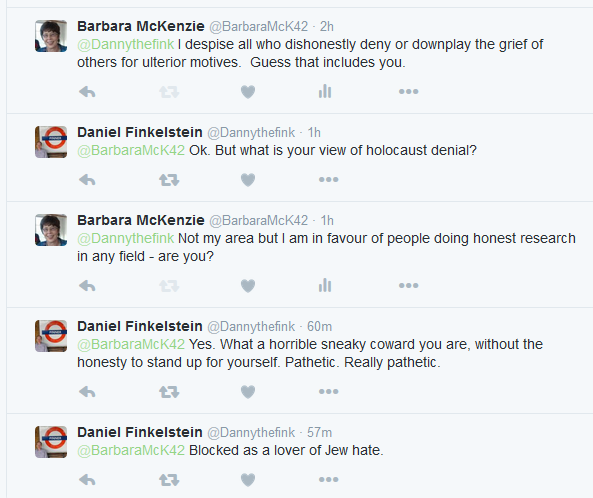
It comes as no surprise that Daniel Finkelstein, who is in total support of dispossession, ethnic cleansing and cruelty in Palestine, assumes morally superiority to me, since I have spoken in defense of a man who has spoken in defense of a man who does research into a field of history. And of course I have refused to commit myself to the undeniability of the Holocaust package …
One can assume that all these experts on the Holocaust, who know enough to be confident of the immutable truth of the Holocaust narrative, whether it be Piers Morgan, Dawkins, or Daniel Finkelstein, would also know another immutable truth about the Holocaust, that the Director of Auschwitz, Rudolf Höss was tortured for three days and three nights, and that his testicles were smashed beyond repair,as happened to 137 out of 139 Germans ‘interrogated’ before the Nuremberg trials. One can assume that this makes no difference to their perception of the Holocaust narrative, and they will remain confident of their moral superiority to those of us who are distressed and alarmed by the knowledge that German witness statements at Nuremberg were obtained under the most brutal torture. (From Höss’s confession was derived the figure of 4 million deaths at Auschwitz; the figure was later revised down to 1 million.)
‘Holocaust denial’ is generally conflated with antisemitism, ‘Jew hate’ or racism, and so automatically deserving of vilification. However, even if revisionism is considered to be intrinsically antisemitic, protectors of the Holocaust narrative like to bolster their case by pointing to more general indicators of racism in the culprit.
To the uninitiated the best-known Holocaust revisionist is probably the British historian David Irving, who was convicted of Holocaust denial in an Austrian court and sentenced to three years in prison. Irving was interviewed by Tim Sebastian on the BBC’s Hardtalk in 2000. The programme’s style is intended to be aggressive, but when I watched the programme in 2000, knowing nothing about either Irving or Holocaust denial, I was repelled by Sebastian’s overt hostility to Irving, and I believe that any other impartial person would be too. (Sebastian underlined his antagonism by refraining from shaking Irving’s hand at the end of the interview.)
Sebastian suggests that to deny the gas chambers is hurtful and tasteless (Holocaust denial is immoral per se). But like many others he feels the need to shore up this assumption by showing that there is other evidence that David Irving is a racist, and though he has few examples to work with he is relentless on this point. Irving’s suggestion that he is no more racist than millions of other people is brushed aside with the rather strange claim from the interviewer that there is no evidence for this whatsoever (so only Holocaust deniers are racist). Furthermore, it would appear that honest but naive David Irving confessed in an interview with the Independent that he once called someone a ‘nigger’, something he immediately regretted and remained bitterly ashamed of. As someone put it in the comments below the YouTube video, David Irving is probably the most honest person on the planet.
Another protector of the Holocaust narrative is Max Blumenthal, an American Jew who has a profile as a supporter of the rights of Palestinians. Blumenthal has attracted criticism from some pro-Palestine activists, who see him as an ‘antizionist’ zionist (AZZ), or gatekeeper, due to his attacks on other activists such as Alison Weir and Gilad Atzmon, his opposition to criticism of Jewish power, his prioritising of antisemitism and Holocaust denial, and his peddling of the NATO narrative on Syria; Gilad Atzmon sees him as racist, agressive and supremacist. In 2008 Blumenthal attended a meeting by David Irving when he was touring the States, and created this video:
The video is interesting for several reason. Blumenthal has interspersed his footage with clips from old German propaganda films promoting Germans superiority – of course if you question the Holocaust you must be a Nazi and white supremacist. Like Piers Morgan he presents the question of the Holocaust in bald holistic terms, with no allowance for individual aspects, or degrees of doubt. ‘Are you a Holocaust denier’, he asks, pretty much as one might ask ‘are you a paedophile?’
And as Holocaust denial is such a heinous crime, Blumenthal is justified in first finding out the location of the meeting (given freely to him by David Irving), and then outing Irving to the Vicar of the church hosting the meeting as a ‘Holocaust denier’. The smugness, the self-satisfaction of Blumenthal are palpable; he clearly sees himself as a hero, where others might just see a manipulative sneak. In any case we are left in no doubt that Max Blumenthal, the anti-German racist, the Palestine activist who along with Israel promotes the destruction of Syria, is morally superior to the ‘Holocaust denier’ David Irving, regardless of the latter’s transparent integrity.
The claim that ‘Holocaust denial’ is innately antisemitic was blown out of the water when Netanyahu, prime minister of Israel, took into his head to declare that the Holocaust was the brainchild of the Palestinian grand mufti of Jerusalem Haj Amin Husseini (so not Hitler afterall), that Hitler only wanted to expel the Jews, not exterminate them (thereby breaking Commandment 6, see above). There was anger and ridicule in Israel and amongst Jews abroad and Netanyahu was forced to climb down. Although Netanyahu was in general accused of ‘playing into the hands of Holocaust deniers’, he was actually guilty of Holocaust denial as it is defined, ie questioning an aspect of the Holocaust discourse – any German who made Netanyahu’s claim would be arrested. If one accepts the ruling that says ‘Holocaust denial’ is antisemitic, Netanyahu must be antisemitic. Which is clearly nonsense – Netanyahu’s racism does not lie in antisemitism, but in an overweening belief in Jewish exceptionalism.
Conclusion
It could be that those protecting the approved version of the Holocaust with such intolerance, aggression, and hate are absolutely right, that 6 million Jews died, in gas chambers, according to a plan drawn up by Adolf Hitler. I wouldn’t know – I haven’t done the research necessary for me to form an opinion.
However it is manifestly clear that those who question or deny the Holocaust are not united by a common neo-Nazi philosophy, of a type that on the one hand insists that Hitler was not guilty of the crimes attributed to him and on the other claims ‘Hitler was right’ to commit these crimes. Mainstream Holocaust revisionists are academics, philosophers, German patriots or Palestine activists. They do not necessarily support the far-right – many of them probably vote for left of centre parties. Some of them are notable for their immense compassion, such as Paul Eisen, who has always been a strong advocate of justice for Palestine. All of them have shown great courage and integrity, and are prepared to look for the truth and to speak it as they see it.
Regardless of the facts of the matter, criminalisation of responsible research into the Holocaust, and the vilification and isolation of those who carry it out, or even those who simply support their right to do so, is an outrageous denial of academic endeavour and historiography as a discipline. Anyone who supports such criminalisation, vilification and isolation is NOT morally superior but in fact morally and intellectually compromised. Furthermore, any honourable person with a modicum of intelligence and a modicum of courage will fight for the right of all people to carry out research into any branch of history, without treating one particular aspect as sacred and therefore exempt from scrutiny.
Right to play? Palestinian children in occupied al-Khalil
International Solidarity Movement | June 29, 2016
Hebron, Occupied Palestine – In occupied al-Khalil (Hebron), possibilities for Palestinian children to play are scarce. With the help of the Playgrounds for Palestine project, a brand-new playground was installed at Qurtuba school in the Tel Rumeida neighborhood of al-Khalil.
Right to play – can you imagine that as a child, when playing, you’d need to be scared of being attacked, your parents worried whenever you’re out playing, and playing with your friends and enjoying something that is denied to you by a foreign occupying army?
The Tel Rumeida neighborhood is in the H2 area of al-Khalil, under full Israeli military control. After more than six months of collective punishment by the means of a ‘closed military zone’, deliberately designed to affect only the Palestinian population, this measure was officially lifted on 14th May 2016. Despite the lifting of some of the measures intended to forcibly displace the Palestinian population – and thus only a slightly disguised attempt at forced displacement, many of the restrictions applying on Palestinians have remained in place.
A staircase leading to Qurtuba school at the end of the tiny strip of Shuhada Street where Palestinian pedestrians are still allowed to be, is still under a complete closure – for Palestinians, whereas settlers, Israeli forces and anyone resembling a tourist is allowed to pass freely. This apartheid measure severs all the families accessing their homes through these stairs, as well as visitors to the Muslim cemetery and a weekly second-hand market of their main access, forcing them to take long detours. The many restrictions have also forced the project to carry large amounts of the materials through the neighborhood, as Palestinian cars are not allowed in the area. On one day, the workers were prevented from continuing their work on the playground and forced to leave by Israeli forces.
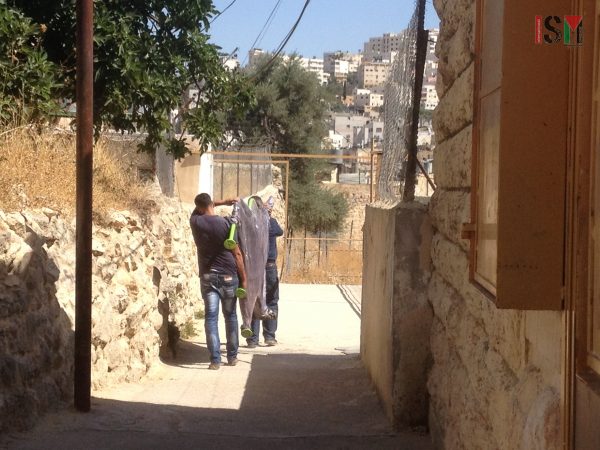
Palestinians carrying materials to the playground
For the children growing up in this area, childhood is short. Child-arrests, even of children less than 12 years and thus illegal even under Israeli military law that is universally applied on the Palestinian population in the Israeli occupied West Bank, are not uncommon, as are humiliations and intimidations by the Israeli forces and settlers under the full protection of the Israeli forces.
The right to play, for Palestinian children, is only a theoretical concept, that often lacks any practical meaning, when growing up next to illegal settlements under a foreign military occupation. Playing on the streets of their neighborhood for most children is dangerous, as settlers do not even restrain from attacking children. In a nearby Palestinian kindergarten, Israeli settlers overnight stole a large roll of artificial grass intended to be part of the play-area for the children attending the kindergarten. With no institution to address this, the artificial grass is merely lost and missing in the play-area.
The installation of the playground at Qurtuba school, thus, is a sign of hope for the Palestinian children. An opportunity for the children to be exactly that: children. To play with their friends and enjoy their childhood, have fun and laugh.
Israeli forces kill 1 Palestinian youth, injure 1, and detain 1 other

Fares Khader al-Rishq
Ma’an – July 13, 2016
RAMALLAH – A Palestinian youth was killed and another injured by Israeli forces while a third was detained early on Wednesday, as soldiers opened fire at the youths’ vehicle in the town of al-Ram in the occupied West Bank’s Jerusalem district.
The youth who was killed was identified as Anwar al-Salaymeh, 22, and the two survivors were identified as Fares Khader al-Rishq, 20, who remains critically injured, and Muhammad Nassar, 20, who was detained by Israeli forces after the incident.
Locals told Ma’an that Israeli forces opened fire at three Palestinians youths, all residents of al-Ram, in a vehicle inside the town around dawn, as the three were seemingly unaware that Israeli forces were deployed in the town and conducting raids.
An Israeli army spokesperson said that the presence of Israeli authorities in the town was due to the fact that Israeli forces, border guards and police reportedly found a blacksmith workshop in al-Ram that manufactured weapons.
Witnesses confirmed that Israeli forces and military vehicles raided al-Ram, closed the main street and raided a blacksmith workshop in the area.
The Israeli spokesperson added that during the military raid, border guards allegedly “saw a speeding vehicle heading towards them” and opened fire, killing one of the passengers and injuring another while a third was detained and transferred for interrogation.
According to locals, al-Rishq’s vehicle arrived near the area where the raid was taking place, and Israeli soldiers opened fire at the car from a close distance, injuring al-Rishq and al-Salaymeh, who later died.
Witnesses said that Israeli forces prevented Palestinian Red Crescent ambulances from reaching the injured.
The Palestinian Ministry of Health confirmed that an unidentified teen from al-Ram succumbed to his wounds after being critically injured by Israeli live fire aimed at the car, while another was injured during the same incident.
Locals added that clashes erupted between youths and Israeli forces, while soldiers opened live fire, rubber-coated steel bullets, stun grenades and tear-gas bombs.
An unidentified youth was also reportedly detained during clashes.
Lieberman Appoints IDF Chief Rabbi Who Endorses Rape to Improve Troop Morale
By Richard Silverstein | Tikun Olam | July 11, 2016

Yediot Achronot: “New Army Chief Rabbi: Rape in Wartime is Permitted”
Avigdor Lieberman, Israel’s new defense minister, has announced a series of military promotions. The most glaring one is the religious figure elevated to be the army’s new chief rabbi. He is Eyal Krim. His main claim to infamy is that in a religious publication (Hebrew), he was asked if the Book of Deuteronomy permits an Israelite to rape women of an enemy tribe, how does this correspond to modern military policy.
He told readers that it would be permissible for Jewish soldiers to rape attractive Arab women (Krim’s statement is translated into English here) among the enemy because it would improve military morale and redound to the greater good of the nation in pursuing its military objectives:
It is permitted to break the bounds of modesty [a series of halachic injunctions governing prohibited sexual relations] and training. So it’s permissible to eat treif and to satisfy evil [sexual] urges through having sexual relations with attractive non-Jewish women against their will, out of consideration for the hardships of war and for the good of the whole [army’s objectives].
In comparing treif to rape, it seems the holy rabbi struck a nice balance between consuming treif and “consuming” women (sarcasm intended).

IDF chief rabbi Krim, advocate of rape as tool of war (Nir Arieli)
The key to Krim’s reasoning is that most nations fight wars of choice whereas Israel’s wars are always wars of “obligation.” In other words, wars in which the entire life of the Jewish people is at stake (his thinking, not mine). Because the survival of the whole is paramount, then traditional religious commands concerning sexual relations may be abrogated to encourage the troops to fight their best. It goes without saying that the holy rabbi has no consideration for the woman involved as she is not Jewish and hence of no value or significance except as an object to satisfy the Jewish soldier’s “evil urge.”
Krim denounced the enlistment of “girls” (his word, not mine) in the IDF and said it was “absolutely forbidden,” because the harm done to the modesty of the woman and to the nation (as a result of women fighting) is the deciding factor.
Haaretz also reports that Krim told his Orthodox audience that wounded Palestinian attackers were not human, but rather animals who should be summarily executed. This is a criminal act for which Elor Azarya is now being prosecuted.
He also said homosexuals should be treated mercifully as if they were “sick or deformed.” Jews should hope that gays can redeem themselves from their unnatural behavior and return to a natural approach to sexuaity, meaning a relationship between man and woman. Homosexuality, he found, “destroyed” the natural order. Man, he believed, had free choice to behave according to nature and should choose to do so.
The ruling that women could not testify in court was intended to protect them, since their “sentimental” nature would not permit them to withstand the rigorous nature of cross examination.
When asked his views about the “Jewish jobs” movement which attempts to force businesses to employ Jews only, he responded that it was not racist since it’s intent was to help Jews.
If a Jew found a copy of the New Testament he should burn it. treating it with “extreme brutality.” Doing so was right and just since Christian doctrine was considered “idolatry” and harmed the world.
He was asked whether Druze or Bedouin should serve in the IDF. He replied that those who serve loyally were permissible, but that the lives of Jewish soldiers always “came first.”
The IDF Responds
When Haaretz asked the IDF public affairs office whether these statements represented the policies and values of the army, it refused to respond.
It’s worth nothing that when Yossi Gurvitz wrote his 972 post on the rabbi’s earlier statements and sought a response from the IDF public affairs unit, the response was that Krim made these statements when he was not in military service. Therefore they do not reflect on the army at all. Given the response below, that strategy seems to have changed. Now, they simply claim he didn’t mean what he said.
The official army response was that the rabbi’s statements were “taken out of context.” Krim doesn’t support the rape of women on the field of battle and affirms that the Torah does not sanction such an act. Anyone who says otherwise is mistaken. But there is the wee small problem of what he actually wrote on the printed page and what an army spokesperson now says second-hand in his name. Who’re you gonna believe? the IDF or your lyin’ eyes?
The IDF’s typical posture above is simply to lie and claim, against the evidence, that Krim doesn’t believe what he actually said. It’s been able to get away with such cynical obtuseness for decades and seems to be prepared to continue in this fashion indefinitely.
The army also notes in Krim’s favor that he’s ruled that male soldiers do not have to abandon military ceremonies at which women’s voices would be heard singing (a ruling proposed by other Orthodox rabbis), as long as the male soldiers don’t see the singers. But this distorts what he actually said: that IDF choirs performing at public ceremonies should be male and not female in order to respect the feelings of (male) Orthodox soldiers. He added that if such an arrangement was not practical, that male soldiers should be permitted to listen to a female choir.
His predecessor, Rabbi Avichai Rontzki, authorized war crimes including the murder of civilians in pursuit of IDF objectives. Rontzki was his rabbinic teacher and they both attended the Ateret Cohanim yeshiva. It appears Krim is in excellent company. One of Ateret Cohanim’s goals is to restore the sacred priestly rite of animal sacrifice and rebuild the Holy Temple, a project which would require demolition of the Muslim holy sites of Haram al-Sharif.
One way that the far-right Orthodox transform the army into an ideological-theocratic tool to advance their political interests is by founding military preparatory schools which feed directly into the officer corps. In this way, rabbis like Krim produce thousands of hard-right future officers who fill the ranks and determine the future strategy and orientation of the military. So it is no accident that IDF soldiers refuse to protect Palestinian civilians from the pogroms of settlers.
As far as I’m concerned, Meir Kahane in death has succeeded far beyond his wildest dreams. The Kahanist slogan: “Kahane was right” is wrong. The new slogan should be: “Kahane won.” He commands the IDF. The State is his. His followers have triumphed and they are positioned in almost every position of power and influence. They are turning Israel into a monstrous parody of a Jewish state. In which Kahanist racialism and ethnic cleansing are state policy. This isn’t a Jewish state. It’s a Judean state–of, by and for the settlers. It’s a form of idolatory where, instead of worshipping traditional Biblical prophetic values of tolerance, justice, and equality, it worships land and power.
While appointing a rabbi who endorses battlefield rape, Lieberman has made even more important appointments in the vital sector of Israeli defense industries. He just appointed a Yisrael Beitenu Party hack, Uzi Landau, as CEO of Rafael Industries. This will be a huge gravy train for the Party and its machine. Imagine the jobs the Party can dole out to the faithful, the contracts it can also distribute to businesses allied with the Party! This is the way business is conducted in a corrupt garrison state like Israel. If any of you are so naïve as to doubt this will happen, I have a bridge to sell you in Brooklyn.
Palestinian youth activist and former prisoner arrested by Israeli occupation forces
Samidoun Palestinian Prisoner Solidarity Network – July 12, 2016

Palestinian youth activist and former prisoner Hassan Karajah was arrested this evening, 12 July, by Israeli occupation forces at Beit Ur checkpoint west of Ramallah, reported family sources to Samidoun. They are concerned about his situation, especially because he spent 22 months in Israeli prisons after being targeted for his work as a human rights defender.
He was arrested on 23 January 2013 and freed on 19 October 2014, facing an Israeli military court on allegations of participation in a prohibited organization (all Palestinian political parties are prohibited organizations) and contact with an enemy state (frequently used to target Palestinians who travel to Lebanon for conferences and other events.)
Karajah, well known for his work in a number of civil society organizations, including the Stop the Wall Campaign and the Partnership for Development Project, and his advocacy for boycott, divestment, and sanctions (BDS) against Israel, was the subject of an international campaign for his release, which highlighted the Israeli targeting of Palestinian human rights defenders.
A letter Karajah wrote from prison was widely distributed: “Here, we draw our energy to continue from you. We, the newly detained prisoners, our hearts are full of happiness when, while being transported from prisons to court, we meet prisoners we have heard about for decades, whose photos and posters we have carried in the streets, prisoners from whom we learned our readiness to struggle since childhood.
In conclusion, I affirm to you that they will never be able to bring about our end. We are stronger than they are able to weaken us. We are higher than they are able to lower us. We are deeper than they are able to reach us. We continue.
I say to you at the end of this message – I will see you soon. I will come out as you have known me and better, and I will greet you with the single word, ‘Freedom.’”
Featured Video

When Israel Is Mighty
or go to
Aletho News Archives – Video-Images
From the Archives
US murdering 1 million Iraqis is democracy, Iran giving yogurt to Iraq is “domination”
By Ali Salaam | American Herald Tribune | July 31, 2017
The New York Times, owned by the Zionist Jewish supremacist Ochs-Sulzberger family, has no problem with Iraqi suffering as long as Iran is not the one behind it.
The Iraq War was a genocide of the Iraqi people by Zionist supremacists in the Bush administration. Over 1 million innocent people were killed based on a lie. American soldiers died in an Israeli war and now an average of 22 soldiers commit suicide every day because their consciences cannot cope with the fact they committed crimes in an illegal war that served no purpose other than to benefit Israel, not America.
Benjamin Netanyahu, Prime Minister of the Zionist regime, once said “We are benefiting from one thing, and that is the attack on the Twin Towers and Pentagon, and the American struggle in Iraq.”
Paul Wolfowitz had his sights on Iraq since his time in the first Bush administration. Former Israeli official and Bush administration official Richard Perle had his eyes on Iraq since at least his authorship of the Clean Break white paper. The Zionist regime had their eyes on Iraq since the 1980s when strategist Oded Yinon wrote his white paper in support of dividing the Arab-Muslim world along ethnic and sectarian lines. The global Zionist lobby has had their eyes on Iraq since Theodor Herzl stated that Eretz Israel’s true borders go from the Nile River in Egypt to the Euphrates River in Iraq. … continue
Blog Roll
 Aletho News
- Huckabee aide goes to ‘unusual lengths’ to portray ‘Israel’ positively
- Trump Announces Diesel Supply Deal With Putin Following Phone Call
- MEP blasts ‘Euro-Gestapo’ for lecturing Russia on democracy
- Syria May Send Troops to Saudi Arabia Amid War with Ansar Allah
- UK whines about losing billions to ‘Putin tax’
- Baghaei to Rubio: Distorted narratives cannot erase US record of broken commitments
- Houthis Don’t Have to Conquer Saudi Arabia to Make It Pay
- MOE: Nearly 22,000 Students and Education Workers Killed
- Guterres in Islamabad: Genocide, cowardice, and the cage of Imran Khan
- Johnson, Marandi say Yemen holds upper hand over Saudi Arabia
- If Americans Knew
- Gaza ceasefire exists in name only, say more than 100 organizations
- Nearly 2 Million in Gaza Need Urgent Shelter Assistance as Winter Looms: IOM Chief Warns
- Suppressing Palestinian resistance: US charity under fire for AI monitoring of Gaza classrooms
- Thousands Are Held in Israeli Torture Camps. This Is What Happens Inside
- Israel puts Gaza’s sick, injured, newborn in peril – Daily Update
- Report claimed Mark Levin used by Israeli government to influence Trump
- Over 2,000 Gazans have died awaiting medical evacuation amid Israel’s continued siege
- How a U.S. Diplomat Suppressed and Altered Reports Critical of Israel
- 5 Palestinians Die from Israeli Strikes in Gaza as Relentless Attacks Continue
- Report: Ceasefire Slows Killing but Leaves Devastation Intact
- No Tricks Zone
- New Study: 50 Years Of The Most Aggressive ‘Net Zero’ Policies Can Only Affect The Global Climate By 0.03°C
- US September “Heat” Was No Record…Many Records Set Decades Ago
- Latest European Green Energy Debacle; Portugal’s Largest Flagship Solar Park Insolvent!
- Green Energy Debacle: German Expert Professor Fritz Vahrenholt Warns Of Severe Economic And Social Consequences
- Two More Paleo Reconstructions Affirm Meters-Higher Sea Levels Across Ireland, Brazil 7000-6000 Years Ago
- New Study: Earth And Venus Surface Warmth Largely Explained By Convection And Lapse Rate, Not CO2 Or Radiation
- 2025 Nature Paper Claiming Worsening Global Drought Gets RETRACTED …Heavily Flawed
- New Study: ‘Global Drought Shows No Detectable Recent Acceleration Under Climate Warming’
- Economic Masterminds: German Socialists Suggest Taxing Productivity Gains Stemming From Using AI
- The South China Sea Has Not Been Cooperating With The Climate Change Narrative

