Israeli forces detain Palestinian lawmaker, former minister in Hebron
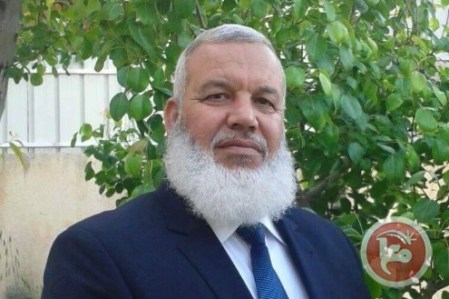
Palestinian security sources said Israeli forces detained Hatim Qafisha, a Hamas-affiliated member of the PLO’s Palestinian Legislative Council, from his home. (MaanImages)
Ma’an – January 24, 2016
HEBRON – Israeli forces detained at least six Palestinians, including a Palestinian lawmaker and a former Palestinian Authority minister, from their homes in the southern occupied West Bank district of Hebron overnight Sunday, Palestinian and Israeli sources told Ma’an.
Palestinian security sources said Israeli forces detained Hatim Qafisha, a Hamas-affiliated member of the PLO’s Palestinian Legislative Council, from his home in the Wadi al-Hariyya neighborhood of Hebron city.
Security sources added that unidentified assailants set fire to Qafisha’s private vehicle after he had been detained and Israeli forces had left the area.
Israeli forces also raided the Nimra neighborhood around dawn and detained Issa al-Jaabari, who served as the PA’s Minister of Local Governance in 2006.
Sources said Israeli forces blew the front doors off of al-Jaabari’s home before raiding the dwelling and detaining the former minister.
Furthermore, Israeli forces carried out a predawn raids in the al-Sheikh neighborhood of Hebron city and detained a former prisoner identified as Ibrahim Jamil Hassan after ransacking his home, along with several others in the neighborhood.
An Israeli army spokesperson did not confirm specific detentions, but said Israeli forces detained four Palestinians in Hebron city, all of which were reportedly detained for being “Hamas operatives.” The spokesperson added that two more Palestinians were detained in areas north and west of the city.
Israeli Rabbi Calls for Execution of Palestinians

“We must eradicate this evil from within our midst”
IMEMC News & Agencies | January 24, 2016
Chief Israeli Rabbi Shmuel Eliyahu announced Tuesday, on Facebook, that Palestinians should be executed in order to establish safety in Israel.
“Israeli army has to stop arresting Palestinians,” he posted on his Facebook wall, “but, it must execute them and leave no one alive.”
According to the PNN, Eliyahu is well known for his racist behavior and controversial statements about Arabs and Muslims. He has been calling on the government to carry out state-sanctioned revenge against Arabs in order to, in his words, “restore Israel’s deterrence.”
The hard-right wing and bloodthirsty Chief Rabbi of Safed, and also a member of the Chief Rabbinate Council additionally declared that the Palestinians are the enemy of the Israeli occupation state and they “must be destroyed and crushed in order to end violence.”
In 2007, according to the Jerusalem Post, Eliyahu was quoted saying that “If they don’t stop after we kill 100, then we must kill a thousand. And if they do not stop after 1,000 then we must kill 10,000. If they still don’t stop we must kill 100.000, even a million.”
In 2012, Eliyahu was charged for racist statements. Among these were, according to Israel national news: “The Arab culture is very cruel,” and “The Arabs behave according to different codes, and violent norms that have turned into ideology.”
The rabbi allegedly stated that examples of this new Arab “ideology” now include stealing farm equipment from Jews and blackmailing farmers for protection against thefts. He also supposedly said that “the minute you make room for Arabs among Jews, it takes five minutes before they start to do whatever they want.” The justice ministry dropped the charges because the statements ‘may’ have been altered by reporters.
The Jerusalem Post reported him saying: “Should we leave them alive in order to then free them in another gesture to Palestinian Authority President Mahmoud Abbas? The fact that they still have a desire to commit terrorist attacks shows that we are not operating strongly enough,” he said.
Explaining more about his fatwa, Eliyahu wrote, on his facebook, page that “the Israel Police officers who do keep terrorist Palestinians alive should be prosecuted under the law.”
He went on: “We must not allow a Palestinian to survive after he was arrested. If you leave him alive, there is a fear that he will be released and kill other people.” He added: “We must eradicate this evil from within our midst.”
Also of interest: 2015: 130 Palestinians Detained for Social Media Posts
Israeli sniper shoots Canadian citizen in West Bank
American Herald Tribune | January 21, 2016
In describing what she calls a lack of symmetry in recent escalations in Israel and the West Bank, Canadian-Palestinian artist and PhD student Rehab Nazzal told The Real News, “You have the Israeli occupation forces armed with all forms of weapons, and you have the youth, mainly the youth in their 20s, mostly they were born during what’s called, between quotations, the peace process.”
Nazzal is describing Palestinians born during the Oslo Accord negotiations of the 1990s, who have been protesting across Israel, the occupied West Bank and Gaza since the summer–and suffering for it.
Since 1 October 2015, 155 Palestinians have been killed by Israeli forces. 24 Israelis have been also been killed, many in stabbing or car ramming attacks.
Nazzal was photographing an Israeli skunk truck in the West Bank–an armored crowd control vehicle that shoots putrid water–when an Israeli sniper shot and wounded her on 11 December, 2015. Medics were prevented from attending to her because rounds of teargas were shot consecutively at them by Israeli forces.
She is recovering still in the West Bank, and plans to continue her Canadian federal government research council-funded research into “non-lethal” and crowd-control weapons.
Nazal contextualizes her shooting among the countless other shootings across the West Bank. “I am one of over 16,000 Palestinians who were injured during the past three months. Among these, over 6,000 with live bullets. Just yesterday, here in my neighborhood where I am now, there were tens of Palestinians who were injured, one seriously with live bullets, and one was killed. He was shot in the chest and was killed yesterday. Today was his funeral. And the city is just buried with tear gas and all forms of aggression,” she said.
She continues to speak about the inequity of aggression between Palestinian youths throwing stones and Israeli forces quelling the demonstrations with live bullets and the inability of nations–even her own nation–to act. “It’s very difficult. And the worst part of it, that the world is silent.”
According to Nazzal’s lawyer Dimitri Lascaris, there is little legal recourse to take because of “something called a State Unity Pact, which effectively bars a lawsuit against the government of Israel or any other government for human rights violations,” Lascaris said, clarifying that he is referring to the Canadian courts. He adds that what is “appalling about this law is that it does not provide immunity for states when they engage in commercial activities. But they could commit crimes against humanity, war crimes, you know, some of the most heinous offenses under international human rights law, and they’re completely immune from suit in the domestic courts of our country.”
Nazzal and Lascaris do intend to painstakingly document the event of Nazzal’s shooting, and in particular the impediment of medics by Israeli forces. And using political power, Lascaris said, “we’re going to call upon the government of Justin Trudeau to fulfill its promise of a more principled foreign policy than the predecessor Harper government, which was absolutely and unequivocally committed to supporting the government of Israel, no matter what atrocities it committed.”
As yet, the new Canadian prime minister Justin Trudeau has not provided a statement of support for the Palestinian struggle and continues to remain a close ally of Israel.
Trudeau is also principally opposed to the Boycott, Divestment and Sanctions movement, a Palestinian civil society-led grassroots movement to call on companies to end their complicity with the Israeli occupation.
Nazzal describes her disappointment with the Canadian government’s lack of response–she is a Canadian citizen–as well as the lack of response from the Canadian ambassador to Israel.
“Not even a condemnation to what happened… If we suppose that the Israeli soldiers don’t know I am a researcher doing work, but I am an unarmed civilian and standing away, far from protesters, even this, we haven’t heard any word… from the Canadian ambassador in Israel or the foreign minister.
Which brings that hypocrisy to our human rights violations in other countries. Why, why Israel is not being questioned. I am, again, a Canadian citizen. I have my career, my children there. I have my life there. Yeah, I am just in disbelief, as well.”
Netanyahu: Saudi Arabia sees Israel as an ally
Press TV – January 23, 2016
Israeli Prime Minister Benjamin Netanyahu says Saudi Arabia now sees Tel Aviv “as an ally rather as an enemy” as he claims “a great shift taking place” in the Arab policy toward the Palestinian issue.
“Saudi Arabia recognizes that Israel is an ally rather than an enemy because of the two principle threats that threaten them, Iran and Daesh,” he told CNN’s Fareed Zakaria on the sidelines of the World Economic Forum in Davos Friday.
Both Saudi Arabia and Israel are fiercely opposed to a nuclear accord between Iran and the West which came into force recently. They are worried the agreement could boost Iran’s role in the region.
Last week, The Wall Street Journal reported that Israel was actively seeking to strengthen ties with Arab powers in the wake of the nuclear deal with Iran.
Daesh ideology is rooted in Wahhabism which is widely promoted by Saudi clerics and tolerated by the kingdom’s rulers. Both Saudi Arabia and Israel support Takfiri groups fighting in Syria. Meanwhile, there is no known case of a Daesh attack on either Saudi or Israeli targets.
Netanyahu also said “there is a great shift taking place” in the Saudi-led policy toward the Palestinian issue, citing Israel’s “relationships” with unknown Arab states.
“By nurturing these relationships that are taking place now with the Arab world, that could actually help us resolve the Israeli-Palestinian conflict, and we’re actually working towards that end,” he said.
Netanyahu’s overtures to Saudi Arabia and its allies come in the midst of international outcry after Tel Aviv declared 154 hectares (380 acres) of Palestinian territory in the Jordan Valley as “state lands.”
Yuval Steinitz, Israel’s minister for national infrastructure, energy, and water, returned recently from an energy conference in the UAE, where Tel Aviv recently established a diplomatic mission. Israel’s Channel 2 suggested that the real aim of the trip may have been for the two sides to covertly conduct strategy meetings.
In recent months, Egypt returned its ambassador to Tel Aviv while a group of Jordanian pilots paid a “working visit” to Israel and trained closely with their Israeli counterparts during US-sponsored military exercises.
Turkish President Recep Tayyip Erdogan also recently expressed an interest in easing tensions with Israel after reaching an agreement to restore relations last month. Sudan is also said to be considering normalizing ties with Israel.
Israeli forces demolish homes in Jerusalem-area Bedouin neighborhood

Ma’an | January 20, 2016
JERUSALEM – Israeli bulldozers demolished three housing structures belonging to Palestinian Bedouins in Jerusalem district on Thursday, displacing 17 Palestinians, half of them children.
Israeli bulldozers escorted by Israeli forces raided and surrounded the Jabal al-Baba neighborhood of the village of al-Eizariya, forcibly evacuated residents, and demolished the houses.
Jabal al-Baba representative Atallah Mazaraa told Ma’an that the demolition was sudden and without prior notice, adding that an Israeli court had frozen all demolition orders in the area around a year ago.
Mazaraa said that he and the residents were held at gunpoint for hours while the demolition took place, causing fear and panic among the children present.
Mazaraa said the three demolished homes belonged to Hamda Muhammad Odeh Abu Kutaiba, her son, Ali Abu Kutaiba, and Ghassan Jahalin. The families’ furniture and possessions were still inside when the housing structures were destroyed.
Ali Abu Kutaiba and Jahalin had been living with their families in mobile homes donated by the European Union.
Mazaraa said the EU-donated structures could have easily been taken apart instead of demolished.
Israeli forces also leveled the lands on which the houses were standing in order to prevent any attempts at reconstruction, he added.
COGAT, the Israeli defense ministry unit in charge of civil administration in the Palestinian territories, only confirmed the demolition of two structures, saying in a statement that “enforcement steps were taken against two illegal constructions which were built without a permit.”
The statement added that the demolitions were carried out “after completing the supervision process and issuing the relevant factors.”
Mazaraa said the whole Jabal al-Baba area, which counts some 300 people, was being threatened with demolition.
Jabal al-Baba is one of several Bedouin villages facing repeated demolitions due to plans by Israeli authorities to build thousands of homes for Jewish-only settlements in the E1 corridor.
Although Israeli Prime Minister Benjamin Netanyahu was forced to suspend work on the housing units in 2013, settlement watchdog Peace Now reported last week that the Ministry of Housing has “quietly” continued planning 8,372 homes in the corridor.
Settlement construction in E1 would effectively divide the West Bank and make the creation of a contiguous Palestinian state — as envisaged by the internationally backed two-state solution to the Palestinian-Israeli conflict — almost impossible.
Palestinian Prime Minister Rami Hamdallah slammed the displacement of Palestinian Bedouin communities near Jerusalem in a press release on Wednesday, saying that “Israel’s systematic violation of international laws is no longer acceptable by the international community.”


Slovenia’s biggest supermarket chain takes Israeli products off shelves
Palestine Information Center – January 21, 2016
 OCCUPIED JERUSALEM – Mercator, Slovenia’s largest supermarket chain, has removed Israeli products from its shelves – including pomelos, dates and avocados, following pressure from the BDS movement, Ynetnews newspaper reported Wednesday.
The Slovenian ambassador to Israel was summoned this week for a discussion at the Foreign Ministry in Occupied Jerusalem, the same source added.
According to the newspaper, senior Israeli ministry officials explained the seriousness with which the Israeli occupation views the affair.
Israel’s ambassador to Slovenia, Shmuel Meirom, is expected to arrive in the country soon in order to raise the issue with Slovenia’s Foreign Ministry, as well as with Mercator’s management.
In 2014, the chain attempted to boycott Israeli “JAFFA”-branded grapefruits, again following pressure from BDS activists.
The move comes a couple of days after European Union Foreign Ministers pushed for boycotting Israeli products manufactured in illegal settlements, a move dubbed by observers a barefaced condemnation of Israel’s illegitimate settlement policies in the occupied Palestinian territories.
200 Brazilian academics pledge support for academic boycott of Israel
MEMO | January 21, 2016
It has taken just three days for 200 Brazilian academics to sign a letter in support for the academic boycott of Israeli institutions, in protest against Israel’s ongoing policies of occupation and discrimination. Professor and former UN rapporteur Paulo Sergio Pinheiro and physician and pharmacologist B. Boris Vargaftig are among the signatories.
In a statement released today the Palestinian Campaign for the Academic Boycott of Israel (PACBI) “salute” their solidarity: “Through these campaigns Brazilians continue to demonstrate that solidarity with the oppressed is the most politically and morally sound contribution to the struggle to end oppression.”
According to PACBI Brazilian movements, individuals and unions have long been committed to isolating Israeli academic institutions as part of the struggle against the Israeli settler colonial and apartheid regime.
Israeli forces rebuild roadblock in Kafr Qaddum

The reconstructed roadblock, in the village of Kafr Qaddum. Photo credit: ISM
International Solidarity Movement | January 16, 2016
Kafr Qaddum, Occupied Palestine – On the 16th of January, Israeli forces shot a young protester with live ammunition while the villagers of Kafr Qaddum were protesting the theft of their land. The Israeli military also rebuilt a roadblock, restricting the movement of the villagers even further.
Kafr Qaddum neighbours the illegal Israeli settlement of Kedumin that was established in 1976. The illegal settlement now occupies five hilltops next to Kafr Qaddum, and houses more than 3000 illegal Israeli settlers.
More than half of the village’s land is located in Area C, which makes it a part of the approximately 60% of the West Bank that is under full Israeli control. This means that many villagers need to get a special permission from the Israeli authorities to access their own land. Getting this permission is almost impossible, and a lot of villagers that do receive a permission complain that Israel only allows them to enter their land for a few days per year, thus not giving them enough time to cultivate their land.
In 2003 the Israeli military closed the entrance of the village by constructing a permanent roadblock. The residents are now forced to drive a 13km long detour in order to reach the main road into the village. In 2010, after waiting five years for a court decision, an Israeli court ruled that the closure of the road is illegal, but also stated, inaccurately, that the road is too dangerous to travel, and the Israeli army has used that as an excuse to keep the road closed ever since.
In addition to the permanent roadblock placed next to the entrance of the Kedumim settlement, Israeli forces have periodically put an extra dirt mound as a roadblock on the same road approximately 1 kilometer before the permament roadblock. One Palestinian family-home is closed of and isolated from the rest of the village by this dirt mound, and both cars and ambulances are prevented from driving to this particular home. This roadblock also limits the residents’ access to their farmlands even further. To reach their land in this part of the village, they now have to go by foot, and are forced to carry their harvest and all the tools that are necessary for the work by hand.
Every Friday and Saturday the residents of Kafr Quddum protest the road-closure and the theft of their lands. During last weeks Friday demonstration, Israeli soldiers together with an Israeli military bulldozer entered the village. One Israeli sniper hid on the bulldozer and shot a young protester in his leg as soon as the Israeli military entered the village. When protesters drew back to seek cover the bulldozer and the Israeli Forces started rebuilding the roadblock, that was removed only a few weeks ago.
Since July 2014, the Israeli Occupation Forces have been using live ammunition more frequently. To this day, more than 70 protesters have been injured with live ammunition. Protesters have also sustained serious injuries after being hit by ‘less-lethal ammunition’. One protester is blind on one eye after being hit by a rubber coated metal bullet, and protesters have sustained serious brain damage after being hit by this kind of bullet or tear gas canisters in their head.
During the Saturday protest on the 9th of January, a 60-year old villager was hit in his leg with live ammunition when he was walking back home from a visit at his neighbours house. An Israeli sniper hid behind a parked car, and international observers state that live ammunition was frequently used during the non-violent protest, even though the demonstrators posed no threat to the soldiers at all.
Conflict of Interest and the Israel Lobby: a Junket for State Senators
By L. Michael Hager | CounterPunch | January 20, 2016
Last December, the Jewish Community Relations Council of Greater Boston (JCRC), a pro-Israel lobbying organization, provided an expense-paid, ten-day trip to Israel for ten Massachusetts senators (including Senate President, Stanley Rosenberg).
As the trip, valued at more than $4,000 per senator, was being arranged in early October, the Senate passed a pro-Israel resolution that “strongly discourages any actions…that would… undermine… relations” with Israel. The intended target of that language was the growing BDS (Boycott, Divest, Sanction) movement in the U.S. In an October 26 press release, JCRC applauded passage of the resolution.
The resolution and gift travel to Israel raise two important issues. First, they imply unconditional state support of an apartheid regime. Why should state senators, who have no foreign policy role, feel compelled to endorse by their presence a nation that violates international law through its brutal occupation, its building of illegal settlements and its siege of Gaza?
Moreover, the senators ignored the inherent conflict of interest in accepting an expensive travel gift from an interested lobbying organization.
In both state and federal government, conflict of interest and the appearance of conflict of interest by elected or appointed employees erode citizen trust in government. Lobbyist gifts to public employees are a form of corruption.
Massachusetts laws prohibit such employees, including elected officials, from accepting gifts and gratuities “valued at $50 or more.” However, a regulatory exemption by the state Ethics Commission allows for the payment of travel costs where the travel has a “legitimate public purpose.” The regulations cite as an example of public purpose: travel that promotes state tourism, economic development or education goals.
Both the law governing lobbying organizations and their agents (administered by the State Secretary) and the law governing conflicts of interest (administered by the State Ethics Commission) emphasize disclosure. They rely on public complaints to generate enforcement recommendations to the State Secretary or the Commission.
A Massachusetts legislator accepting payment of travel expenses must file a form with the State Ethics Commission certifying that the travel serves a “legitimate public purpose” and that such purpose outweighs any personal benefit to the legislator or the organization giving the gift. The disclosure form requires the legislator, not the Commission to determine that the trip serves a legitimate public purpose.
The 2015 JCRC tour itinerary was filled with tourist visits to cultural sites and meetings on Israel’s political and security challenges. Almost nothing in the program addressed the economic development, business relations and technology issues cited in the senators’ written determinations of public interest.
Had the Ethics Commission reviewed the proposed trip itineraries, it might well have concluded that no “legitimate public purpose” was served–or that any public purpose was far outweighed by the evident conflict of interest.
Without Commission oversight of lobbying organization gifts to elected officials, legislators may be tempted to make self-serving determinations of “legitimate public purpose.” It is not enough to rely on the public to generate enforcement through the complaint process.
In a December 16 Boston Globe podcast, Senate President Rosenberg opined that state ethics laws are “way overreaching.” Given its lack of oversight of the JCRC gift travel, the State Ethics Commission would appear to agree. Indeed, the Senators’ ethical lapse has been compounded by the Commission’s tacit approval of the lobbying gift and its acceptance of what appear to be serious defects in ethics law regulation.
One may question the validity of the public purpose exemption. If a proposed trip serves a legitimate public purpose, why not require the elected official to use state funds rather than gift money from a lobbying organization?
The disclosure form that the Commission uses to document the travel exemption lacks sufficient information. Why not require the elected official to state whether the paying organization has an interest in any past or pending legislation and whether that organization has engaged in any lobbying with respect to such legislation?
Over 1,200 Massachusetts citizens and nonprofit organizations voiced objections to the JCRC Israel trip, in part because of its implicit endorsement of the Netanyahu regime and in part because of the evident conflict of interest. Disregarding such claims of inappropriateness and impropriety, the ten senators went ahead on what is now regarded by many citizens as a political junket, paid for by an interested lobbying organization.
The December gift trip (only the latest of what has become an annual junket) has highlighted the need for changes in the Commission’s administration of the Massachusetts Conflict of Interest Law.
The Commission should amend its regulations by deleting the “legitimate public interest” travel exemption.
In the meantime, it should begin to review the disclosure statements and stop any trips paid for by lobbying organizations that have an interest in specific legislation before the legislature. Other states with conflict of interest problems should take notice.
Contrary to Senate President Rosenberg, rules limiting conflict of interest and apparent conflict of interest are not “way overreaching.” Instead, they are under-reaching and under-enforced.
L. Michael Hager is cofounder and former Director General, International Development Law Organization, Rome.
Cameron to mark Balfour Declaration centenary with UK Jewish community
MEMO | January 19, 2016
Prime Minister David Cameron has told representatives of the UK’s Jewish community that he intends to “mark” with them the centenary of the Balfour Declaration next year.
 Cameron met members of the Jewish Leadership Council (JLC) on January 13, in what has become an annual meeting.
According to a Downing Street spokesperson, the PM “recognised how next year is a special year for the Jewish community with the centenary of the Balfour Declaration.”
In remarks quoted in the Jewish News, Cameron said of the anniversary: “I want to make sure we mark it together in most appropriate way.”
A statement issued by the JLC after the meeting said that topics covered also included “glorification of terrorists on campuses and student unions’ adoption of BDS policies”, and “the government’s approach to the Middle East conflict and the need to prepare people for peace rather than conflict.”
The JLC is an umbrella body made up of over 30 Jewish communal organisations.
Israeli violence continues as Palestinians protest recent killing of protester in Bethlehem

Medics standing in front of the ambulance with a broken windshield
International Solidarity Movement | January 17, 2016
Bethlehem, Occupied Palestine – This Friday, on the 15th of January, hundreds of Palestinians gathered on the main street of Bethlehem to protest against the recent killing of Srour Ahmad Abu Srour, who was killed by Israeli forces in nearby Beit Jala last Wednesday. Israeli forces fired tear gas, rubber-coated metal bullets and live ammunition at the protesters.
On Wednesday afternoon, 21-year-old Srour Ahmad Abu Srour, origanally from Aida refugee camp, was killed during protests against the Israeli military invasion of the western part of Bethlehem, Beit Jala. Palestine News Network reported that 4 Israeli army jeeps entered Beit Jala and set up a flying checkpoint and started raiding homes and shops on the busy Al-Sahl street in Beit Jala. Srour Ahmad Abu Srour was hit in his chest by a live bullet, and later succumbed at Beit Jala public hospital. The director of the Red Crescent ambulance and emergency crew in Bethlehem, Mohamed Awad, said that many young men were injured by rubber-coated metal bullets or by suffocation due to the large amount of tear gas fired during the protest.
Every day since the killing of Srour Ahmad Abu Srour, Palestinians from Bethlehem have marched the streets in protests of Israel’s ongoing violence. On this Friday demonstration Israeli forces entered the streets of Bethlehem and fired hundreds of tear gas canisters towards the protesters. Protesters, passersby and residents of the neighborhood were severely affected by the amount of tear gas that was fired. One passerby was taken away from the scene in an ambulance due to the excessive inhalation of tear gas.
Two injuries by rubber-coated metal bullets were reported, one of which was a journalist. One protester was shot in his lower leg with live ammunition, and was taken to hospital.
According to medics, 5 people were injured with rubber-coated metal bullets and 5 people with live ammunition during protests in Bethlehem with its surrounding villages. One medic was injured when a rubber-coated metal bullet was fired at the windshield of his Ambulance during protests in near by Em Rokbaa.
Did a Major US Union Overrule Members on Palestine Solidarity?
teleSUR | January 16, 2015
Members of a local Californian branch of United Auto Workers said Friday they were appealing a controversial decision by the larger union to overrule a pro-Palestine resolution backed by rank and file members.
The United Auto Workers Local 2865 (UAW 2865) made history in late 2014 when its members voted overwhelmingly to support a boycott of corporations accused of involvement in Israel’s occupation of Palestinian territories. The vote was one of the most well attended in UAW 2865’s history, and came after months of intense discussion among union members. The union’s boycott resolution was framed as part of the international Boycott, Divestment and Sanctions (BDS) movement, which has sought to use economic pressure to push Israel to end what human rights groups say are widespread human rights abuses in the occupied Palestinian territories. Supporters of the movement say their campaign is modeled on the 1980s anti-apartheid boycott of South Africa.
UAW 2865 was the first major union in the United States to endorse BDS through a vote put directly to ordinary members. Since then, the United Electrical Workers union has followed suit, endorsing BDS during its 2015 conference.
Internationally, BDS has also been backed by COSATU of South Africa and the Unite the Union in the U.K.
International UAW Steps In
However, in December 2015, UAW 2865’s parent union, International UAW surprised workers by nullifying the pro-Palestine vote, claiming the decision discriminated against Jewish union members.
Now, a group of UAW 2865 members have told teleSUR they have begun an appeals process against the International UAW board’s decision. The members said they are seeking to overturn the nullification through the union’s public review board, after filing an appeal Thursday.
They have argued the original UAW 2865’s BDS resolution was reached democratically by ordinary members, and said the larger union leadership should respect the demands of ordinary members.
teleSUR has obtained union documents that some members of UAW 2865 say indicate some of the fiercest supporters of BDS within UAW 2865 were rank and file members identifying as Jewish – calling into question the International UAW’s primary reason for overruling the vote. There is also evidence of at least one multinational firm weighing in on the union’s decision.
Speaking to teleSUR, UAW 2865 President Robert Cavooris said he firmly disagreed with the International UAW board’s decision to overrule the BDS resolution, stating, “Many Jewish members of our own local, like myself, took part in the campaign for BDS.”
He argued the board’s decision “conflates the state of Israel with a diverse global diaspora of Jewish people.”
Not all union members appear to agree. During the appeal hearing in December 2015, one union member alleged the BDS campaign was “rampant” with “anti-Semitism and active promotion of hate.”
In a complaint submitted to the International UAW’s board, another UAW 2865 member said, “The … local union (2865) pledged that it would not discriminate against members who are Israelis and stated that the academic boycott was aimed at ‘institutions’ and not individuals.”
“But this is a distinction without a difference: boycotting Israeli academic institutions can only be carried out by discriminating against individuals associated with those institutions,” the member argued.
However, internal union documents show the board was also contacted by a group of Jewish UAW 2865 members who firmly supported the BDS resolution.
“As an injustice anywhere is an injustice everywhere and none of us are free until all of us are free. As Jews, we understand from our own experiences with discrimination and our own history of resistance to oppression that standing on the right side of history necessitates standing in solidarity with Palestinians,” a petition in favor of BDS directed at the board stated.
The petition was signed by more than 40 UAW 2865 Jewish members who said, “We affirm our right and responsibility as Jews to oppose the state of Israel’s actions and policies that we believe to be unjust.”
The final International UAW’s decision also noted the UAW 2865 carried out its internal vote in a democratic matter, and “made an earnest effort” to engage all members in months of pre-vote discussions, but found the BDS resolution anti-Semitic nonetheless. The decision was based on the board’s conclusion that the BDS resolution unduly focused on Israeli policy and actions when discussing “atrocities against Palestinians.”
“Thus, the local union’s platform is apparent in its unfavorable stance against the state of Israel, Israelis and, invariably, Jewish union members,” the board said in its conclusion.
However, Cavooris said Israel hasn’t been singled out by his branch at all, pointing to an extrensive list of resolutions related to human rights issues from Mexico to China.
“For example, our local passed a resolution condemning the disappearance of 43 Mexican students at Ayotzinapa in 2014, and last fall we made a statement of support for South African students fighting against racism and for better university conditions. Just last week we signed a letter to condemn the repression of Chinese labor activists in Guandong,” he explained.
Cavooris continued, “We have also criticized political institutions in the U.S. for their repression of protests in Ferguson and elsewhere.”
“A brief scan of our political record shows that we are proud to stand against injustice against working people and others wherever it occurs,” he said.
Enter Caterpillar
Yet disagreements over the board’s decision to label the BDS resolution as anti-Semitic aren’t the only concerns raised by rank and file UAW 2865 members.
Also included in a collection of documents handed to teleSUR was a letter from industrial vehicle manufacturing giant Caterpillar. Caterpillar armored tractors have been used by Israeli forces to demolish Palestinian homes, sparking the ire of BDS activists and human rights advocates. Dated August 20, 2015, the letter from the firm’s labor relations head Jonathan Ginzel was addressed to International UAW Vice President Norwood Jewell. The letter denied allegations Caterpillar is “engaged in or complicit in human rights violations,” and warned BDS advocacy was viewed as an “attack on our business and our customers.”
“The actions taken by UAW Local 2865 are without merit and set a dangerous precedent in our relationship,” Ginzel wrote to Jewell.
The letter also included a paragraph supporting an appeal against UAW 2865’s resolution.
The International UAW’s final conclusion expressed similar concerns to those raised in Ginzel’s letter, stating the BDS resolution could have blow back on union members employed by companies like Caterpillar.
The UAW 2865’s rank and file BDS Caucus has accused the International UAW of effectively prioritizing the interests of companies like Caterpillar over the interests of union members.
“The (board of the International UAW) support for the profits of these companies – their prioritization of the so-called “flow of commerce” – trumps their support for other labor unions, such as the Palestinian labor unions that initiated the call for BDS, and their own members, like the 65 percent of affirmative voters from UAW 2865,” the caucus said.
The International UAW was invited to respond to these complaints, but didn’t respond by the time of publication.
The UAW 2865’s president, Cavooris described the International UAW board’s decision to “consider” Caterpillar’s input in internal union matters as “rather amazing.”
“When the (International UAW board) listens to executives at Caterpillar Inc. instead of workers in one of its locals, I think there is a clear breach of democracy and autonomy,” he said.
Cavooris continued, “This sort of deference to employers definitely raises the question: Who is the union supposed to represent? Are we an organization that fights for the rights of working people worldwide or are we an organization that makes sure our employers are happy?”
“When workers at Caterpillar demand a wage increase in their next contract, is the UAW (international board) going to ensure that this demand is okay with Caterpillar management as well? Because we held a democratic vote on BDS – and the (board) acknowledges that it was completely democratic – we know we are representing the views and interests of our members. I wonder if the (board) can say the same, given their deference to Caterpillar management,” he said.
Rank and file members of UAW 2865 that spoke to teleSUR likewise said they felt the International UAW was undermining local union democracy.
“I believe this decision not only calls into question the autonomy of local chapters, but it also exposes the contradictions that arise among labor unions that in theory are committed to social justice of those disenfranchised (ie: workers), but in practice are easily swayed by corporate interest and threats by oppressive powers,” said Jennifer Mogannam, UAW 2865 member and Ethnic Studies PhD candidate at University of California, San Diego.
“As stated, our efforts were transparent, honest and a two thirds vote in favor is telling of the commitment to justice that our generation of academic laborers upholds,” she said.
The dispute between UAW 2865 pro-BDS members and the International UAW leadership may not end anytime soon, with the appeals process only just beginning. Members that spoke to teleSUR said that irrelevant of the board’s decision, they will continue to push for greater support for Palestine solidarity.
“The struggle for Palestine is one symbol of struggle that we must continue to fight for and endure the repercussions of, alongside other struggles for true justice and liberation, because it is this commitment that may guide us to a new, just and better world,” Mogannam said.
Another rank and file UAW 2865 member, Beezer de Martelly, from the University of California Berkeley music department said, “The UAW 2865 BDS caucus will continue its work to educate students and union members about ongoing human rights violations, the intensifying climate of Islamophobia, and the Palestinian-led struggle for democracy.”
However, some members said the International’s decision could be a step backwards for workers’ and student rights.
“I am worried about the ramifications of this decision on the democratic spirit of Unionism, and this struggle is far from over,” said Irene Morrison, southern vice president of UAW 2865.
“It won’t end until Palestine is free,” she said.
Featured Video

Spain train disaster raises questions over Israeli-linked security contractors
or go to
Aletho News Archives – Video-Images
From the Archives
Are There 50,000 ‘Israeli-born’ Individuals Living in the UK?
By Professor David Miller | August 18, 2026
Recent disclosures by the Zionist regime show that some 2,069 British nationals were serving in the IDF as of March 2025, according to Freedom of Information (FoI) requests submitted to the occupation forces (1,686 dual British-Israeli, plus 383 multinational). We cannot tell from the figures how many of these were already settler colonists and intend to stay in the colony, and how many will return or have returned to the UK. Presumably, those returning to the UK will number far fewer than 2,000, since many are known to have become permanently residents of the colony.
Additionally, the IDF figures only provide a snapshot, and do not tell us how many have served in the Jewish supremacist military either before or after March 2025. One way into the question of how many genocidaires are living in Britain is to ask how many current British residents were born in the Zionist colony. There is data on that, as we shall see. … continue
Blog Roll
 Aletho News
- No, New York Times, California’s Climate Has Always Been a Land of Flood, Drought, and Fire
- Are There 50,000 ‘Israeli-born’ Individuals Living in the UK?
- German CDU MPs Seek Climate “Misinformation” List
- The ‘Gaza Treatment’: How Media Headlines Obscure Who is Bombing Yemen
- Ro Khanna urges Democrats to strip Israel ‘integration’ provision from defense bill
- Why Iran designated British MI6, Royal Navy, and RAF as hostile, terrorist organizations
- Armenian opposition politician dies in custody
- US still trying to recycle failed hypersonic missile programs
- France’s ‘Cold War’: Paris blames Tehran for supermarket fridge hacks
- Psywar no more? 77th Brigade’s sudden death
- If Americans Knew
- An error has occurred; the feed is probably down. Try again later.
- No Tricks Zone
- German Authorities Start Initiative To Evaluate Public Register For Climate “Disinformation” Spreaders!
- Zonal Asymmetry of Temperature Change in the Antarctic Circumpolar Current
- New Study: The Net Fossil Fuel Contribution To Rising Atmospheric CO2 Has Been Zero For 500 Years
- Germany’s Green Energy Transition Becoming Increasingly Expensive…Another 6 Trillion Euros!
- Sudden Stratospheric Warming, Powerful El Niño Combination May Lead To Extreme Europe Cold, Energy Crisis!
- Two New Studies Find Thwaites Glacier Melt Cannot Be Driven By Human Activity Or A Warming Ocean
- E-Cars Reduce CO2 Emissions By Only 41% Compared To Internal Combustion Engine Vehicles
- Predictions Made By Renowned Climate Professor Over Past Decades Have Been Proven To Be Poor
- New Study Suggests Large Regions Of The Pacific Ocean Have Been Cooling For The Last 80 Years
- Germany’s Green Energy Debacle: High Energy Costs Force Kahla Porzellan to Close After 182 Years!

