Jewish Terrorists Burned An Israeli Church, Now Israel’s Government Is Screwing The Church Out Of The Money It Needs To Rebuild
Failed Messiah | December 25, 2015
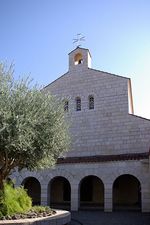 The Church of the Multiplication of Loaves and Fishes overlooking the Sea of Galilee in better times
National Geographic has a new article on Jewish extremist violence against Christians in Israel and the West Bank.
Much of it has already been long reported elsewhere, including here …
But one point made in the National Geographic report, which primarily focuses on the Church of Multiplication of Loaves and Fishes hate crime arson, hasn’t been made, and that point arguably shows how dishonest Israel’s government really is:
… Israeli Prime Minister Benjamin Netanyahu quickly designated the fire as a terrorist attack, making the church ineligible to draw on insurance but paving the way for government compensation. Two months later, the Israeli Tax Authority declared that the violent event did not qualify as terrorism, and therefore could not receive government funding.
When Israeli President Reuven Rivlin visited the church in early September, just before meeting Pope Francis in Rome, he promised to help reverse that decision. “He was shocked by the extent of damage,” said Father Matthias. “Since then there have been a lot of meetings with the government, but no compensation.”
In the meantime, a group of Israeli rabbis started a crowd-funding campaign that raised $13,000 so that the church can start work on a new reception area for pilgrims. Rabbi Alon Goshen-Gottstein, director of the Jerusalem-based Elijah Interfaith Institute, led the effort that included the head of the Knesset, Israel’s parliament.
“Israel still protects the rights of minorities, and events like this overshadow this fact,” said Rabbi Goshen-Gottstein, noting that Iraq and Syria are in the midst of ethnic cleansing. “These are disenfranchised youth with very few leaders who are messianic activists riding on waves of suspicion and ignorance.”
[These rabbis linked to Goshen-Gottstein are overwhelmingly non-Orthodox and make up only a small group. Despite public tittering against the hate crime by more mainstream non-Orthodox Jewish leaders, the US-based non-Orthodox movements and representative bodies like the UJA-Federation did not kick in to help this church (or, for that matter, any of the other vandalized churches and mosques) to be repaired.]
Some Israelis fear that the small group of violent extremists, made up mostly of young West Bank settlers, has been emboldened by the lack of prosecutions.…
Assaf Sharon, a philosophy professor at Tel Aviv University who has written about the history of Jewish terrorism, said the youth “are surrounded by institutions that condone, protect, and support them. And there is certainly authority behind them, including rabbis they look up to.”…
Follow the links posted below to read up on some of those rabbis the Jewish terrorists look up and follow.
As for the government, and especially Prime Minister Netanyahu (who is arguably the most dishonest man ever to hold high office in Israel), to use the Church of Multiplication of Loaves and Fishes hate crime arson for your own political ends and causing the church to lose its insurance money in the process, is truly vile. The Netanyahu needs to immediately pay to fully repair the church. If it doesn’t do so, no excuse – not even the standard (and often true) complaint about layers of Israeli government bureaucracy – should be accepted.
Related Posts:
Israeli soldiers kill Palestinian woman in Silwad
IMEMC News – December 25, 2015
 Israeli soldiers killed, on Friday evening, a Palestinian woman while driving her car near the main entrance of Silwad town, northeast of the central West Bank city of Ramallah.
The slain Palestinian woman has been identified as Mahdiyya Mohammad Ibrahim Hammad, 38. She is a married mother of four children.
Although the Israeli army claimed “she attempted to ram soldiers with her car,” eyewitness confirmed she was at least 30 meters away from the military roadblock, when the soldiers opened fire on her.
They added that the woman was not even speeding when the soldiers opened fire on her car, and that the army fired many live rounds at her.
Following the shooting, the soldiers left the woman to bleed to death, and held her body for more than two hours before handing her to the Palestinian side, near the Beit El military roadblock.
The family said the funeral ceremony and procession will be held on Saturday, after the noon prayers in Silwad.
The Palestinian Health Ministry said Hammad was shot with two live rounds in her face, five rounds in the chest and two in the pelvis.
Also on Friday, the army killed a young Palestinian man, identified as Hani Rafeeq Wahdan, 22, east of Gaza City. Wahdan was shot with a live round in the head.
The Palestinian Health Ministry said 137 Palestinians, including 26 children and 7 women, have been killed by Israeli fire since October 1, while more than 15000 have been injured, including 4500 who were shot with live fire and rubber-coated metal bullets.
Amnesty International: Imperialist Tool

By Prof. Francis A. Boyle | thewallwillfall
July 31, 1998
Dear Amnesty Friends:
I am in receipt of the response by three members of the AIUSA Middle East Coordination Group to my message that was entitled “NGOs As Western Tools.” You will note that they never denied any of the basic facts set forth in my original message. When Israel invaded Lebanon in 1982 and murdered 20,000 Arabs/Muslims with the full support of the United States, both Amnesty International and AIUSA said absolutely nothing at all despite vigorous efforts by AIUSA Members to get them both to say and to do anything. When it became clear that AIUSA was not going to say or do anything about Israel’s wholesale slaughter of Arabs/Muslims in Lebanon because of the marked pro-Israel bias by the AIUSA Staff, Board, and Funders, I called the Irish Nobel Peace Prize Winner Sean MacBride at his home in Dublin and asked him to intervene with AI/London. What little AI/London said and did about 20,000 Arabs/Muslims in Lebanon murdered by Israel with the full support of the United States was due to Sean MacBride.
MacBride then convinced the then AI Secretary General to appoint me a Consultant to Amnesty International on the human rights situation in the Middle East. In that capacity, I attended the founding meeting of what would become the AIUSA Middle East Coordination Group. In other words, I was one of the founders of the AIUSA Mid-East Co-Group, some of whose members are now defending its work. At that founding meeting I said quite emphatically that Amnesty International and AIUSA would have absolutely no credibility whatsoever in the Middle East unless they dealt forthrightly and vigorously with violations of the human rights of Arabs and Muslims by Israel, and, in particular, Israeli atrocities against the People of Lebanon and the Palestinian People. Soon thereafter, I found out that the Members of the AIUSA Mid-East Co-Group had been instructed to have nothing more to do with me by a direct order coming from the AIUSA Board of Directors.
It is fair to say that Amnesty International has quite recently released some reports dealing with Israeli violations of human rights of the Palestinian People and the Lebanese People. But Israel has been consistently murdering, torturing and destroying the Palestinian People since at least the time when the occupation of their lands began in 1967–and with the full support of the United States Government. And only now has Amnesty International got around to condemning it. Almost a decade ago while on the AIUSA Board, I tried to get AI/London and AIUSA to act on the basis of the infamous Landau Report whereby the Israeli Government officially sanctioned torture against Palestinians. Over a decade ago while on the AIUSA Board, I pointed out that this made Israel the only state in the world to officially sanction torture. It is nice to see that a decade later Amnesty International has finally agreed with me and said something about it.
Likewise, Israel has been rampaging around Lebanon with the full support of the United States to the grave detriment of the Lebanese People and Palestinians living there since at least the time when Israel first invaded Lebanon in 1978. The primary reason why Amnesty International has put out these latest reports condemning Israeli human rights violations in Lebanon and against the Palestinian People after decades of silence is because there are now several other human rights organizations which have acted against Israel when AI/London and AIUSA refused to act because of their marked pro-Israel bias. When it comes to protecting the human rights of Palestinians, Lebanese, Arabs/Muslims from atrocities by Israel, the United States, and Britain, AI/London and AIUSA have always been too little, too late, and on purpose.
While on the AIUSA Board I once saw the itinerary drawn up by AIUSA for the visit to the United States by the then AI Secretary General coming from London. On the list was almost every major pro-Israel group in New York and Washington and about one Arab Group. Given their standard operating procedures, I am confident the pro-Israel groups threatened the AI Secretary General that they would have their members withhold or reduce their contributions to AI and AIUSA if AI/London did not reign in its pathetic, pitiful, and meager criticisms of Israel. While I was on the AIUSA Board, AIUSA paid about 20% of the budget for AI/London. He who pays the piper calls the tune.
You will also note that the three AIUSA Mid-East Co-Group members’ response to my original message said absolutely nothing at all about the scandalous Kuwaiti Dead Babies Report and Campaign that both Amnesty International and AIUSA used for the purpose of promoting war against Iraq. As a Member of the AIUSA Board, I received a pre-publication copy of the Dead Babies Report. I read it immediately and quite carefully. First, this report contained technical errors that should have precluded its publication. Second, even if all these sensational allegations had been true, it was clear that publication of this report at that critical moment in time (December 1990) would only be used by the United States and Britain to monger for war against Iraq. I expressed these opinions in the strongest terms possible and that this report should not be published because it was inaccurate; or that if for some reason it were to be published, it must be accompanied by an errata sheet. Amnesty International published the Dead Babies Report anyway despite my vigorous objections, and launched their Disinformation Campaign against Iraq. From this episode I could only conclude that AI/London deliberately intended the Dead-Babies Report and Campaign to be used in order to tip the balance in favor of war against Iraq.
This is exactly what happened. In January of 1991 the United States Senate voted in favor of war against Iraq by only five or six votes. Several Senators publicly stated that the AI/AIUSA Dead Babies Report and Campaign had influenced their votes in favor of war against Iraq. That genocidal war waged by the United States, the United Kingdom and France, inter alia, during the months of January and February 1991, killed at a minimum 200,000 Iraqis, half of whom were civilians. Amnesty International shall always have the blood of the Iraqi People on its hands!
Once it became clear that there never were any dead babies in Kuwait as alleged by Amnesty International, AI/London proceeded to engage in a massive coverup of the truth. For all I know, the same people at AI/London who waged this Dead-Babies Disinformation Campaign against Iraq are still at AI/London producing more disinformation against Arab/Muslim states in the Middle East in order to further the political and economic interests of the United States, Britain, and Israel. Because of its Dead-Babies Disinformation Campaign against Iraq and its ensuing coverup, Amnesty International will never have any credibility in the Middle East!
During the past eight years, about 1.5 million People in Iraq have died as a result of genocidal sanctions imposed upon them primarily at the behest of the United States and Britain, including in that number about 500,000 dead Iraqi children. While on the AIUSA Board of Directors, I tried to get them and AI/London to do something about this genocidal embargo against the People of Iraq, and especially against the Iraqi Children. Both AI/London and AIUSA adamantly refused to act despite the grievous harm that their Dead-Babies Disinformation Campaign had inflicted upon the People of Iraq. It was clear to me at the time that there was no way AI/London and AIUSA were going to take on Britain and the United States on behalf of the completely innocent People of Iraq.
Now we are told that there is something in the AI Mandate that precludes AI action against such genocidal economic embargoes. Of course this is nonsense. While I served on the AIUSA Board, one of our Board Chairs personally put me in charge of handling Mandate issues for the AIUSA Board. I know all about the Mandate. It was my responsibility.
Generally put, when AI/London and AIUSA want to take action on a matter because it will bring them publicity, money, members, and “influence,” they pay no attention whatsoever to their so-called Mandate. Likewise, when AI/London and AIUSA decide for political or economic reasons that they will not work on human rights problem, they trot out their so-called Mandate to justify non-action.
The same type of bogus argument was used by AI/London and AIUSA to prevent the organizations and their memberships from taking any effective action against the criminal apartheid regime in South Africa that had been oppressing millions of Black People for decades. To the best of my knowledge, Amnesty International is the only human rights organization in the entire world to have refused to condemn apartheid and work against it. The spurious argument made here was that Amnesty International could take no position on a type of government. But the truth of the matter was that Amnesty International is headquartered in London, and AIUSA is headquartered in New York and Washington. The biggest political supporters of the criminal apartheid regime in South Africa were the governments of Britain, the United States, and Israel. Likewise, the biggest sources of economic investments in the criminal apartheid regime in South Africa came from Britain and the United States. Once again, he who pays the piper calls the tune.
There was no way AI/London and AIUSA were ever going to work against the political and economic interests of Britain, the United States, and Israel operating together in support of the criminal apartheid regime in South Africa. So AI/London and AIUSA concocted this spurious rationale for non-action. The same is being done today by AI/London and AIUSA to justify their non-action in light of the genocidal economic embargo imposed now primarily by the United States and Britain against the People of Iraq. There is no way AI/London and AIUSA will ever act against the political and economic interests of the United States, Britain, and Israel in the Middle East, and certainly not on behalf of the People of Iraq, whose blood AI and AIUSA now have on their hands.
Notice too how this latest specious justification for AI non-action fits in quite neatly with the strategic objectives of the United States around the world. Right now the United States Government is primarily responsible for imposing genocidal economic sanctions against the People of Iraq, the People of Cuba, and the People of North Korea. Amnesty International will do nothing at all about it. In other words, by their deliberate non-action AI and AIUSA are supporting the genocidal policies of the United States, Britain and Israel against these Third World countries–just as AI and AIUSA supported the criminal apartheid regime in South Africa by their deliberate non-action. If you want to do effective human rights work in opposition to the imperial, colonial and genocidal policies of the United States, Britain, or Israel, there is no point working with Amnesty International or AIUSA. You will simply be wasting your time, your efforts, your resources, and your enthusiasm.
Permit me to further substantiate this assertion that Amnesty International and AIUSA are imperialist tools by reference to other areas of the world. It is well known that AI/London has done little effective work to help Irish Catholics in Northern Ireland. As Sean MacBride once said: Amnesty International will never treat Irish Catholics fairly so long as it is headquartered in London. The long and sordid history of AI/London non-action in the face of genocidal violations of the most fundamental human rights of Irish Catholics living in Northern Ireland by Britain is well known among Irish Americans and Irish People living in Ireland, Northern Ireland, and around the world. For example, a letter by a former AI Secretary-General sabotaged public support for the defense of Joe Doherty here in the United States. Just recently, it required a massive internet campaign to force AI/London to do anything at all to save the life of Loinnir McAliskey and to obtain the freedom of Roisin McAliskey.
Let me now move from the British colony in Northern Ireland to the American colony in Puerto Rico. While I was still on the AIUSA Board, a fellow Board Member asked me to draft a resolution for adoption by the Annual General Meeting (AGM) of AIUSA calling for a comprehensive AI Campaign against human rights violations by the United States in Puerto Rico. This resolution passed the AIUSA/AGM overwhelmingly, and without any dissent that I could detect. I was then invited by Amnesty International/Puerto Rico to give the Keynote Address at their Annual General Meeting in San Juan on the subject of the right of Puerto Rican political prisoners in American jails to be treated as prisoners of war. Immediately thereafter, AI/London and AIUSA applied massive pressure on AI/Puerto Rico to prevent this speech. AI/Puerto Rico refused to cave in.
I went down to Puerto Rico to attend their AGM, gave the Keynote Address, and also investigated U.S. human rights violations in Puerto Rico, including torture, summary executions and disappearances. Upon my return home, AIUSA attempted to stiff me out of my expenses despite the fact that I was attending the AI/Puerto Rico AGM in my official capacity as an invited AIUSA Board Member. Perhaps I missed it due to the press of other duties at the time, but I am not aware of any comprehensive Amnesty International Campaign against U.S. human rights abuses in Puerto Rico as overwhelmingly called for by the AIUSA/AGM.
Finally, let me say a few words about the deliberate non-action of AI/London and AIUSA on behalf of indigenous peoples living in the United States and its imperial ally, Canada. Back when I was on the AIUSA Board, AI/London decided to launch an international campaign on behalf of indigenous peoples. As usual, I received a pre-publication copy of the campaign material. On reading it, I immediately noticed that almost nothing was to be done to help the indigenous peoples living in the United States and Canada. I protested this to AI/London and AIUSA, and demanded that the indigenous peoples living in the United States and Canada be added as an integral part of this campaign. To the best of my knowledge, this was never done. I leave it to the indigenous peoples living in the United States and Canada to decide for themselves how helpful AI/London and AIUSA have been to them.
I will not belabor the obvious any longer in this brief Memorandum. But based upon my over sixteen years of experience having dealt with AI/London and AIUSA at the highest levels, it is clear to me that both organizations manifest a consistent pattern and practice of following the lines of the foreign policies of the United States, Britain, and Israel. You can certainly see this in all of AI’s non-work with respect to the Middle East, Northern Ireland, Puerto Rico, South Africa, indigenous peoples living in North America, etc. Effectively, Amnesty International and AIUSA function as tools for the imperialist, colonial and genocidal policies of the United States, Britain, and Israel.
There are many people of good will and good faith working at the grassroots level of Amnesty International and AIUSA who genuinely believe that they are doing meaningful and effective work to protect human rights around the world. But at the top of these two organizations you will find a self-perpetuating clique of co-opted Elites who deliberately shape and direct the work of AI and AIUSA so as to either affirmatively support, or else not seriously undercut, the imperial, colonial, and genocidal policies of the United States, Britain, and Israel. The Leadership Elites of AI/London and AIUSA have always considered themselves to be the so-called “loyal opposition” to the imperial, colonial, and genocidal policies of the United States, Britain and Israel. I would ask the people at the grassroots of AI and AIUSA whether you want to continue being part of the “loyal opposition” to imperialism, colonialism and genocide perpetrated by the United States, Britain and Israel? It is not for me to tell those people of good faith and good will currently working with AI/London and AIUSA what to do. But I have found other organizations to work with and support.
Francis A. Boyle, Professor of International Law, Board of Directors, Amnesty International USA (1988-92), Co-Founder AIUSA Middle East Coordination Group, Consultant to Amnesty International on the Middle East
Cover Image: Courtesy of WrongKindofGreen.
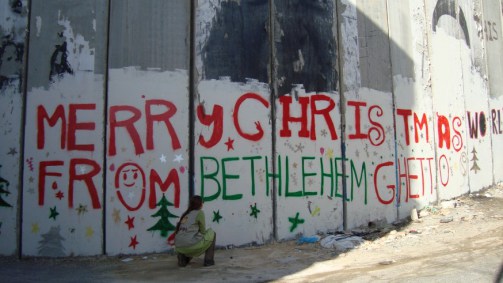
Bethlehem-area village sealed by Israeli military for weeks
Ma’an – December 23, 2015
BETHLEHEM – The movement of residents in Ras Al-Wad southwest of Bethlehem has been cut off for weeks by Israeli military forces, locals said Wednesday.
A resident told Ma’an that the forces closed off the main entrance to the small village with large mounds of dirt around three weeks ago, and the road has remained closed since.
The road was used by residents in Ras al-Wad to access a main highway nearby. While they have been able to find an alternate route — a one-way dirt road that connects to the nearby village of Beit Sahour — access to the highway is severely limited, locals said.
“They just don’t want Arabs accessing the highway,” a Ras al-Wad resident told Ma’an.
An Israeli army spokesperson did not have immediate information on the closure of Ras al-Wad, but in the past has told Ma’an that Palestinian towns and roads were sealed in accordance with “security measures” taken in the area.
The isolation faced by Ras al-Wad residents has taken place in Palestinian areas throughout the occupied West Bank and East Jerusalem that have been cut off in recent months.
Following attacks carried out by Palestinian individuals on Israeli military and civilians that began in October and have continued into December, the military has been sealing villages and cities in the area around the attack or hometown of attacker.
In the West Bank, where Palestinian movement is already placed under a myriad of Israeli restrictions, the recent closures have had wide-scale repercussions in what rights groups have termed collective punishment.
The military never contacted residents of Ras al-Wad with warning or reason of the closure, and locals told Ma’an they have no idea how long the dirt mounds will remain in place.
While Palestinians in other areas have removed dirt mounds shortly after their placement, locals told Ma’an that Ras al-Wad residents have yet to remove them.
Ras al-Wad is a relatively quiet village and locals told Ma’an that residents generally avoid confrontation with the military, locals said.
“They’re not confrontational and they’re not political,” a resident told Ma’an. “They would just rather try to live their lives than deal with any trouble.
“No one from the village has gone to move the dirt mounds, everyone here just turned their head and found alternate routes,” the resident continued.
NY Times Jerusalem Bureau Chief Turned a Deaf Ear to Palestinian Suffering
By Barbara Erickson | TimesWarp | December 22, 2015
As Jodi Rudoren exits the Jerusalem bureau of The New York Times, she leaves behind a series of gaping holes in coverage of Palestine-Israel, above all in her failure to expose the treatment of the most vulnerable, who suffer disproportionately under the constant brutality of the Israeli occupation.
Readers of the Times have never been told of the international outcry over the abuse of Palestinian children detained by Israeli security forces. They know nothing about the myriad Israeli breaches of the 2014 ceasefire with Gaza, especially the frequent attacks on fishermen and farmers; and they are uninformed of the cruel measures imposed on struggling Bedouin communities in the Jordan Valley and elsewhere.
Rudoren, who leaves her post as Jerusalem bureau chief at the end of this month, replaced Ethan Bronner nearly four years ago. She has written from inside an Israeli Jewish perspective, giving voice to official Israeli spin and omitting the stories that beg to be told.
Thus, although Rudoren visited Gaza, she had nothing to say about the numerous attacks on defenseless farmers and fishermen there, some of whom have died simply trying to do a day’s work. These attacks are in violation of the truce that ended the assault on Gaza in the summer of 2014 (as well as previous agreements), but Rudoren’s reporting from the enclave has strained to deflect the blame from Israel.
Instead of telling the stories we need to hear, Rudoren has written about individual Gazans who are anything but typical—a woman artist who defies the authorities, a man who goes against the grain by advocating for the two-state solution.
In this way she has given us the appearance of entering into Gazan society, of “balance” in covering both Israeli and Palestinian affairs, while she actually provided a smokescreen to avoid looking at the urgent issues.
The Bedouin of the West Bank received even less attention during Rudoren’s term in Jerusalem, but their stories are equally disturbing and compelling. In the Jordan Valley and east of Jerusalem (and also within Israel, in the Negev), Israeli forces often confiscate and destroy the basic necessities of life in these poverty-stricken communities.
The Israeli Civil Administration, a branch of the army, routinely destroys tents, latrines, animal shelters, water pipes, cisterns, wells, houses, solar panels and storage sheds, usually under the pretext that they lack building permits. Many of the confiscated and destroyed items have been donated by the International Committee of the Red Cross or other aid organizations.
The Israeli human rights organization, B’Tselem, has documented these acts of destruction and the many times Israeli troops have forced entire communities to leave their homes for hours and days at a time under the pretext of needing the area for “military training.” These live fire training sessions have more than once set the Bedouins’ fields on fire, destroying valuable crops and grazing land.
And yet, as she ignored these depredations, Rudoren chose to write about illegal settlers in the Jordan Valley, presenting them as plucky and determined and ignoring the plunder of indigenous communities in the area.
Although B’Tselem, the United Nations, Amnesty International and other monitoring groups have exposed the contemptible actions and policies of the Israeli government and its security forces, Rudoren has almost totally ignored the reports and even worked to undermine them.
Numerous groups, for instance, have raised alarm over the abuse of Palestinian children in Israeli custody, but Rudoren never saw fit to address the issue in the Times—except for a somewhat oblique attempt to defuse the charges. Thus, she wrote about stone throwing as a rite of passage in one West Bank village, presenting the youthful efforts at resistance and the Israeli response as a kind of game, nothing to be taken seriously.
The story mentions the arrests of children and military interrogations, but readers never learn that Israeli courts and security forces have been accused of serious mistreatment, amounting to torture: beatings, forced confessions, sleep deprivation, threats and more.
Instead, Rudoren says that it can be cold in those infamous interrogation rooms, as if that is the worst of it.
In the latest uprising, marked by a series of lone wolf stabbing and vehicular attacks, Rudoren continued to ignore the reports of monitoring groups, saying nothing about the well-documented charges that Israeli security forces are carrying out street executions of Palestinians who pose no threat.
This kind of news is deemed unfit to print in the Times. Rudoren, who goes on the join the international desk at the paper’s headquarters, played her part well, according to Times protocol, which expects that its reporters will maintain the Israeli narrative of victimhood, suppress anything that contradicts this claim and betray its readers under a camouflage of “balanced” reporting.
Israel has ‘deprived 23,000 orphans of monthly sponsorship’

MEMO | December 22, 2015
The Deputy Head of the Islamic Movement in Israel, Shaikh Kamal Al-Khatib, said on Monday that Israel’s banning of the group has deprived 23,000 orphans from their monthly sponsorship payments, Anadolu has reported.
“The Islamic Relief charity run by the movement,” explained Al-Khatib, “used to pay a minimum of $40 monthly sponsorship for each orphan spread around the West Bank, Jerusalem and Gaza Strip.”
The Israeli government banned the Islamic Movement on 16 November. Any person or group which associates with it officially is now subject to criminal penalties, including arrest. The authorities confiscated property belonging to the organisation and its bank accounts were frozen. Seventeen affiliated organisations, including charities, were closed down.
The sponsorships, explained Al-Khatib, were donated by Palestinians. He suggested that a solution for the problem is for wealthy Muslims to take over the orphan sponsorships and pointed out that efforts are being made in this regard, although, understandably, he gave no details.
The Palestinian Islamic Relief charity was established by the movement in 1988 and its main activity was sponsoring orphans; it has no connection to the UK-based Islamic Relief or Islamic Relief Worldwide. The charity has been closed by the Israeli authorities several times. “Israel seeks to crack down on all projects which lie behind the persistence of the Palestinians,” added Al-Khatib. He stressed that the charity’s accounts have always been subject to Israeli monitoring.
Sayyed Nasrallah Speech 21/12/2015
Regarding the assassination of the martyr Samir el-Kuntar
– After a few days, there will be the anniversary of the birth of Jesus Christ – and on this anniversary, we extend our greetings to all the Christians and Muslims. A few days later, is the anniversary of the birth of Prophet Mohammed, and we extend our greetings to all the Muslims on this occasion and we ask God for the blessings of both these two prophets to extend mercy and security and happiness to all the region and to open the hearts and minds of all to love and mercy that these two great leaders brought to the world.
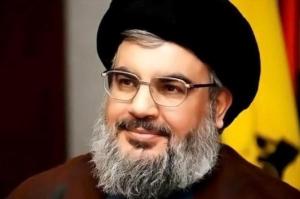 – Yesterday, we lost one of our brothers who shared in the birth of Hezbollah from its first hours and carried heavy responsibility for 33 years – el Sheikh Mohammed Khatoun. I shall speak more about him at the date of his funeral tomorrow. I extend condolences to his family and loved ones.
– Before I speak about the main event – I want to speak about what happened in Nigeria a few days ago – a massacre in Zariah. Hundreds were killed. Hundreds were injured. Hundreds were detained. We include our voice among the voices of all who condemned this massacre, and we condemn the silence of all those who chose to be silent – a horrific silence. There is talk of up to 1,000 killed. And we call on the Nigerian government and its political parties – to act with strength to hold those responsible and to have a national and humanitarian response. I worry that there are American or Israeli hands or Takfiri hands that are behind this horrific massacre – designed to create more bloodshed in Nigeria.
– Back to our main point of discussion
– The assassination of the General of the Political Prisoners in the Israeli Jails – the brother, the martyr, Samir el Quntar
– (1) The facts. We have no doubt that the Israeli enemy is the one behind the assassination. It was not a covert operation – but an open attack. The assassination was by Israeli jets – against a residential home, that specifically targeted Samir el Quntar and other fighters and civilians. Did the Israeli jets enter Syrian air space or the did the Israeli jets fly over occupied Golan Heights – that is a detail, one that does not change anything, unless the discussion is about Syria and Russia and today that is not our focus. What is clear is that it was an Israeli attack against a residential home in Geramana in the outskirts of Damascus. I extend condolences to all those martyred. Anyone who kills a man like Samir el Quntar does a service to Israel.
– (2) We know and Samir knew and the Israelis themselves did not hide – that Israel would not leave Samir el Quntar alive, from the first day of his release. The threat was alive throughout all the years, months, days. Israel was very open that it would not forgive him for his past nor on his strength and resilience in jail nor on his dedication to the resistance. Israel does not forgive – it is our governments that forgive the murderers of Deir Yassin to Qana. This talk by Israel was before the plan for building resistance in the occupied Golan Heights. We in Hezbollah hold the enemy Israel responsible for the assassination of Samir el Quntar
– (3) In this night I do not want to talk about the characteristics of this great martyr. I shall simply say tonight that Samir el Quntar was a lover of Palestine. Palestine was all his love and filled his heart and mind. Palestine’s destiny and the destiny of Palestine’s people and the future of the resistance was always his first and main focus. In our first visit upon liberation, he and I spoke – and we always leave options open – I told him that he has numerous options – politics, media, and military. He said then what he told others publicly: I left Palestine to return to Palestine. He told me that from this very moment I am ready to participate in any military operation, whether on the border with occupied Palestine or within occupied Palestine. I await my martyrdom, he said. It would be an honor to me to be a fighter, he said. That is Samir, that is his truth that we must say today. Does the enemy Israel imagine that by killing Samir and those like him that they can kill such love and passion and commitment and the vast sacrifice of the people of this nation? Many great leaders have been killed and tens of thousands of people have been martyred – in Palestine and Lebanon and Syria and Egypt and Jordan. And what was the result? Has this nation and these people and these generations given up on Palestine? NO. A generation grew up to inherit resistance and to give it to the next generation. The blood of Samir el Kuntar and those who passed before him – is that the resistance against Israel for liberation is a call that will not be broken, regardless of who will be killed and detained and tortured; this is a call that will not be broken. Look now at the people of occupied Palestine – this is a generation that is as old as Samir el Kuntar was when he went to occupied Palestine (i.e. 17). The youth of Palestine fight death with death. Tens of them have been martyred as they fight with knives – because that is their only option. They have entered terror in the hearts of the enemy. When we see a youth in her prime – such as (martyr) Ashraqat Tamami – and when I speak of her, I speak of all the youth of Palestine, I discovered that this youth (female) had a great deal of awareness and clarity and dedication and deep understanding to the cause that she wants to sacrifice for and to the understanding of the enemy and the friend, and for the calmness of her decision. Ashraqat is today a model for many of Palestine’s youth – who love with a passion the land and freedom. They carry the same passion that Samir el Quntar carried and it remained in his heart until a traitorous Israeli rocket killed him.
– (4) Our position. When Israel attacks, anywhere it chooses and how it chooses and in any time it does, it is the right of the resistance – anywhere, and any way, and in any place, and at any time. Today, I repeat: from now, any member of Hezbollah that is killed, we shall hold the responsibility to the Israelis and we shall consider it is our right to respond at any time, at any location, and in the manner we choose. We said this on the 30th of January 2015. Today, we say, to the enemy and to the friend, Samir el Quntar is one of us, and he is a leader in our resistance, and Israelis killed him, and it is our right to respond to his assassination in the time, place, and in the manner that we choose. That is our right. And I add – we, in Hezbollah, we shall fulfill this right.
– (5) In the same vein, the killing against Hezbollah and this resistance, comes the US actions that seek to target Hezbollah on a number of levels. Since the early 90s, we as a party have been on the terrorism list – as a political party and as individuals. And for decades, the Americans have tried to force this description on other countries; they were not successful. Such a description is not accepted by the UN, and the EU, only lately, considers the military wing on the terrorism list, and China and Russia do not consider us as such. What the Americans decided to do now – even though they support terrorism worldwide — is that they consider us a criminal organization and not terrorism, claiming that we are drug dealers and that we are money launderers and that the US Congress now seeks to investigate the accusation that we are human traffickers. These accusations are false and have no basis in truth. It is our duty to deny them. We are not due to show evidence of our innocence. It is their responsibility to show evidence – if they have any, although they have long made accusations without evidence. Clearly, these accusations are political – and it’s first objective is to show Hezbollah in a bad light. They are the ones who spent millions of dollars, as per their own Ambassador, to create propaganda against Hezbollah for the Arab youth. We have a strong example here: the international organization of nuclear energy presented a report about the Iranian nuclear energy – and they said that the Iranian nuclear energy is peaceful and at the very least, since 2009 until today, there is no evidence of anything military in the Iranian nuclear energy. They presented the evidence, and one of the panel of the international organization is an American and there was a consensus on the report! A full consensus. Let us remember that it was the Americans that accused Iran for years. Also the Europeans. And let’s not forget Netanyahu in many occasions, including his speech at the UN. Netanyahu should be a joke internationally and even for Israel – let’s remember his chart at UN when he said that Iran would have a nuclear bomb in a few months. And now we have this report – with consensus – that there is no evidence of military usage of Iran’s nuclear energy. Let’s remember that they were planning a war against Iran, and they enforced sanctions against more than 80 million people, and they threatened, unfortunately with some of their Arab collaborators. That is just one example of a political accusation. The accusations against us are small in comparison. With the battle against us, they won’t accuse us of getting nuclear weapons. This is what they have to say against – either terrorist or criminal. That is the end of their line. The line of their lie is short. The truth will eventually be exposed. We know, in front of God, in front of our people, in front of many people, this is not who we are. If they think their accusations are a propaganda war, it will fail. From a financial perspective, they have now forced upon international banks to freeze Hezbollah funds – well, this was closed a long time ago. We do not have funds in international banks. Now, they are also putting pressure on Lebanese banks and the Lebanese central bank – to put pressure on any organization that is claimed to be tied to Hezbollah. We also state today, and state it again, we have no funds in Lebanese banks, not in the past nor in the present, nor do we have funds that we put in any banks. Nor do we transfer our funds via Lebanese banks – so there is no need for either the Lebanese central bank or any Lebanese banks to feel fear of being chased by the Americans. Furthermore, as I have stated before and shall say again, we are not a business nor an investment. We do not have companies nor are we partners with any Lebanese merchants. Whatever funds we have, we give to our resistance and to the families of the injured and the martyrs. We do not have an extra penny that we invest or put in any fund.
– Based on this, we have to speak seriously about this – it is the responsibility of the Lebanese Central Bank and the Lebanese banks to protect the Lebanese consumers and merchants! It is enough that one sign come from the Americans for there to be an accusation against an individual, and these banks immediately follow. Does this country not have sovereignty? Not have its own courts? Its own state? There are Lebanese merchants and investors that are hurt. We are not hurt. But now if Americans want to target a particular political current or a particular community, all they do is give the names to the Lebanese banks! These are Lebanese who should be protected by the Lebanese State. I do not ask the Lebanese State to protect any member of Hezbollah – but at the very least, it is the responsibility of the State to protect the men and women of this country. No one is asking the State to declare war on the US, only to ask for evidence for these accusations and to take the evidence to the Lebanese courts. This has already begun — this subservience to the US!
– Furthermore, with regards to the media, whether it is part of our network (Manar and Nour) or accused of supporting us or even empathizing with us – they are being threatened! The US is accusing you and judging you in absentia and charging you and killing you and you are not allowed to speak and if you speak, your voice cannot reach anywhere in the world. That is the freedom and democracy of the United States. Your media is not allowed – and maybe it will reach the stage that any media that shows the truth will be accused of being pro-terrorism, while knowing of course that anyone with a Dish can see hundreds of channels that call for takfiri [intolerance] and for killing and raping and committing terrorism and destruction and occupation and violence; those channels are accepted. But you and your type of the resistance are targeted, and the real reason is Israel, and not our position in Yemen or otherwise, but the real reason is that you are a resistance! The intention is Resistance itself – the discourse, the culture, the knowledge base of Resistance!
– Media is part of the struggle. We will not surrender. We will look for all options and opportunities so that the voice of Resistance and the voice of all who reject the project of Israel and the US in the region – those voices will be heard. This is an ongoing struggle.
– What is more important about all these actions against us, is how we look upon all these actions. You can see the negative, but there is also the positive. The fact that Congress sits and meets and has consensus and continues to think about new ways to fight us – means that we are in the right place. They have given us more faith and strength. It shows that we are in the right struggle, the right battle, the right discourse. Who ever finds himself – knowingly or not – a partner with the US and Zionism, let him re-examine his nationalism and religion and ethics! These actions by the US are also a recognition of us, that we are not a small group with small consequences. It is a recognition that Hezbollah plays a large role in Lebanon and in the region in fighting the Israeli project and the hegemonic project. As part of the Resistance – and we don’t claim to fight alone, just as we didn’t fight alone in 1982 and since – there were many US projects of hegemony, we are part of this battle and not alone. That is why the US Congress needs to take these declarations with clear time lines — they take us seriously. We also say that we understand these actions, see how loving we are. We understand these actions. When we are enemies to each other, and this is a compliment to us – to be enemies to the US and to Israel and enemies to all who want to steal the riches of our people and to all who want to destroy our civilization, we understand that they would want to do all these things, and we also will not surrender in this battle. I say to the US and to Israel and to their allies in the region: all these actions against us, from sanctions and murders, you will not be able to erase us. All the actions against us and are planned against us – will only increase our commitment.
– May God have mercy on our great martyr Samir el Kuntar…
Translation by Rania Masri [not word for word]
Israeli Lies About Kuntar Murder Flow in Abundance

Samir Kuntar, before being released in Israeli prisoner exchange
By Richard Silverstein | Tikun Olam | December 20, 2015
Yesterday, Israel murdered Samir Kuntar, a Hezbollah militant involved with a terror attack that killed three Israeli civilians in 1979. Until he was freed in a prisoner exchange in 2008, he’d been the longest-serving security prisoner in Israeli jails.
In the years following the original attack, Kuntar became the embodiment of the bloodthirsty terrorist, supposedly personally bashing in the head of a little girl with a rifle butt. At least this is the story they told. But this narrative, like so many spun by Israeli military-intelligence circles, and lapped up so eagerly by an adoring Israeli media, is largely fiction.
According to Aviv Sela, a noted Israeli psychologist who served in that capacity for years with the police and Shabak, Kuntar did not kill the girl or her father. Instead, he claims he had left the boat to help his comrades who’d been attacked by Israeli security forces. The firing that killed the Israelis came via friendly (Israeli) fire and not the Palestinians. As with so many ugly facts Israel tries to conceal in such circumstances, it creates comfortable narratives that obscure the truth.
Something similar happened with the 300 Line bus hijacking in which the Israeli media initially dutifully reported that all the Palestinian hostage takers were killed in the bus assault. This concealed the fact that the Shabak chief personally approved the cold-blooded murder of the two surviving Palestinians. In this case, it was Israeli security forces who stove in their heads, this time with rocks instead of a rifle butt. The moral being: the only good Palestinian terrorist is a murdered one, the gorier the better.
Israel’s military is continuing the Kuntar charade to justify his execution in an Israeli air attack over Damascus, which destroyed the apartment building where he was living, killing eight others as well. He not only bashed a little girl’s head in way back. He continued his evil ways as a mastermind of terror in Assad’s regime. Read this fantasia:
Samir Kuntar, the notorious terrorist killed Saturday night near Damascus, was believed to be preparing a major terror attack against Israel from the Golan Heights, according to highly reliable Western sources.
According to these sources, last year Kuntar turned into a kind of independent terror entrepreneur and was considered by Israel and the West to be a “ticking bomb”. The sources said Kuntar had recently not been working on behalf of Hezbollah, but rather acting with increasing independence alongside pro-Assad militias in Syria.
The organization with which Kuntar was working was founded by the Syrian regime to replace the brutal Shabiha (an Alawite militia), which even the Syrian regime opted to reject. Assad’s regime therefore established a less vicious militia, the Syrian National Resistance Committee, which did not engage in the economic and criminal activities of the Shabiha. Farhan al-Shaalan, another senior leader killed Saturday night in the same building where Kuntar ran his secret operation, also belonged to the Syrian National Resistance Committee…
Western sources believe Kuntar was in the final stages of planning and carrying out another attack against Israel, which senior Hezbollah officials apparently did not know about…
Syria, Hezbollah, Iran and the Russians have no interest in a confrontation with Israel now, and certainly not a confrontation ignited by a “freelancer” such as Kuntar, driven by his hostility to Israel.
This suggests that Kuntar was eliminated because he was considered a ticking bomb by more than one entity in the Middle East.
One absolute trademark of Israeli disinformation is after such murders it always suggests the killing wasn’t necessarily Israel’s doing, but due to internal disputes within the ranks of the terrorists. It’s been used by Israel’s security apparatus from time immemorial (h/t to Joan Peters!).
I’ve often written about specific instances in which the Israeli security apparatus blatantly lies to cover up embarrassment or deflect from the truth of events. In the case of Kuntar, the IDF knows that I, and perhaps other journalists will begin calling this what it was, an extrajudicial execution. To pre-empt this inconvenient narrative, it puts forth yet another bubbeh meiseh portraying Kuntar as a revitalized terror mastermind. A man who had to die to save Israeli lives. He was a “ticking bomb.” Apparently, the ticking was in the ear of the beholder. What was he planning? A vague terror attack somewhere in the Golan. But it would’ve been big, trust me, or so they claim.
Note there is no proof whatsoever offered to support these claims. They are threads of narrative spun, not from gold, but from lead.
As I read the passage above, two possibilities struck me: one, the reporter really had a “western intelligence source” who offered this information. If that were the case, my money would be on the U.S. being the source. Since the Obama administration had placed Kuntar on a specially designated Global Terrorist list in September, it seemed entirely possible it would be monitoring his communications to keep track of him. It would be easy to share this information with the IDF thus enabling it to target him. If this were so, then the U.S. would be collaborating with Israeli targeted assassinations. Unlikely, but still possible.
Ronen Bergman claimed just such an intelligence collaboration enabled the Mossad to locate and track Imad Mugniyeh, who was similarly assassinated in Damascus in 2008.
But there was an even more probable scenario. Ron Ben Yishai, like most Israeli security reporters (and unlike most U.S. reporters covering the same beat) has only one set of sources: the military. Not only will he not question the veracity of these sources, he will not consult critics or skeptics in order to qualify the accuracy of his reports. So the chances were high that the story was entirely manufactured by Kuntar’s killers, the IDF.
Indeed, when I questioned an Israeli security source about the authenticity of the “western sources,” he replied “They are as western as Bogie!” In other words, the source of this story is most likely Defense Minister Bogie Yaalon.
Another media stenographer for the IDF is Roni Daniel. His report on this story had a different spin. Kuntar was a demon-mastermind. But not for Assad. Rather for Iran. In Daniel’s report it is not a western source who defines Kuntar as a ticking bomb but Israel itself. So either the two different sources miraculously came up with the same locution independently of each other; or the same source told two different journalists the same thing and told each to attribute them differently (or the journalists did so on their own). … Full article
Israeli Apartheid Wall destroys Palestinian lives

Palestine Information Center
On 29 March, 2002, the Israeli Occupation Forces (IOF) conducted a large-scale military operation in the West Bank, called “Operation Defensive Shield”. During the operation, the Israeli forces raided many Palestinian towns and villages and committed heinous crimes against the Palestinians.
The operation brought to light the Israeli government’s plans to conquer more Palestinian lands and to expel the Palestinians from their own homes. A major step in these plans was to build the Apartheid Wall, or what Israel calls the Separation Wall.
The Israeli government commenced building the Apartheid Wall on 23 June, 2002, at a planned length of 770 km. Now, around 406 km, i.e. 52.7%, of the Wall is completed.
The Wall in numbers
The Wall is 60-150 meters wide in some areas. This includes a buffer zone and roads on both sides of the Wall that the Israeli military uses to watch the Wall. The Wall is 8 meters high, and it contains:
1. Barbed wire
2. A 4-meter wide and deep trench, aiming to prevent the vehicles and pedestrians from passing
3. Military patrol roads
4. A sandy road to track footsteps
5. An electric fence with an 8-meter high cement wall
6. Watchtowers with cameras and sensors
The Wall separates an area of 733 km2 of the Palestinian lands that falls behind the Wall from the West Bank. In other words, these 733 km2 would be under full Israeli control, besides the occupied lands of 1948.
The Wall would also occupy 220 km2 of Jordan Valley, east of Palestine. The Valley is a main source of food for Palestinians, and is also known as their “food basket”.
The Wall passes through eight Palestinian governorates. In Jerusalem, building the Wall accelerated in 2006-2007. It separates a number of heavily populated Palestinian neighborhoods, like Shufat and Kafr ‘Aqab.
Effects of the Wall
In spite of the claimed Israeli security motives behind building the Wall, it negatively impacts the Palestinian people and cause.
First: Effects on the Palestinian daily life
As the Wall passes through the West Bank, it negatively impacts the lives of 210,000 Palestinians, who live in 67 Palestinian towns and villages.
Because of the Wall, 13 Palestinian neighborhoods would be isolated between the green line and the Wall. Furthermore, a second wall would create a security belt, stranding 19 Palestinian neighborhoods in isolated areas.
The Wall would also hinder the Palestinians’ movement and would prevent them from reaching their farms and selling their goods and produce.
Second: Economic and environmental effects
37% of the Palestinian villages, cut with the Wall, would lose their economic resources. Moreover, 12 km of irrigation systems were destroyed.
Confiscating and bulldozing Palestinian farms would cost the Palestinians 6500 jobs, in addition to harming the olive oil industry and fruit and vegetable farming.
The Apartheid Wall would affect the Palestinian water resources, as the West Bank would lose 200 million cubic meters of the Jordan Valley water.
Third: Effects on movement
Statistics show that the Wall would violate the right of movement of two million Palestinians. They will have to seek Israeli permits to be able to reach their houses and farms in different Palestinian areas. Such restrictions would force at least 2.8% Palestinians to leave their homes and find other places to live in.
Fourth: Effects on education and medical sectors
Many Palestinian students and teachers were affected by the Wall, as it prevented them from reaching their schools, forcing 3.4% Palestinians to drop out.
On the medical level, it is getting increasingly difficult for Palestinians to reach the hospitals and medical centers to the east of the Wall, and the Palestinian villages to the west of the Wall have no medical services at all.
Fifth: Effects on Palestinian water resources
The Israeli occupation has strategically chosen the path of the Wall in order to guarantee Israel as much water as possible and thus depriving Palestinians of a basic right. Once finished, the Wall will enable Israel to confiscate and control 165 water wells and 53 springs, which in total culminate into 55 million cubic meters annually. Furthermore, the Wall now means Israel controls an additional amount of 679 million cubic meters annually.
Israeli forces injure 3 Palestinians before shooting tear gas at passers-by in the market of Hebron
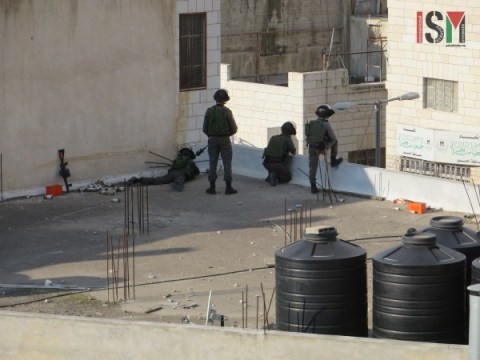
Israeli forces used the roof of a Palestinian family’s house to shoot
International Solidarity Movement | December 20, 2015
Al Khalil, Occupied Palestine – Sunday, 20th December 2015, Israeli forces shot and injured three Palestinians at Shuhada checkpoint in occupied al-Khalil (Hebron), before arbitrarily firing towards civilians and journalists in the area.
Israeli forces shot a girl in the head with live ammunition. A Palestinian bystander, trying to help the girl and pull her towards the Palestinian side of the checkpoint right after she was shot, was shot in the mouth by Israeli forces. The man was trying to help, knowing that Israeli forces would most likely deny the girl any medical aid if the Palestinian ambulance was unable to reach her. Another Palestinian bystander was shot. The Palestinian girl, according to eye-witnesses, did have a knife, but instead of trying to disarm her, Israeli forces directly shot her in the head.
Whereas the Palestinian Red Crescent ambulance, at the scene after only a few minutes, was denied access to the girl in order to deliver first aid, the two Palestinians injured were taken to hospital. After this happened, the Israeli forces threw stun grenades and shot tear-gas at passers-by and Red Crescent medics to prevent them from coming any closer and seeing what happened. Journalists that arrived at the scene were also attacked with stun grenades and threatened by Israeli forces with rubber coated steel bullets.
Israeli forces entered the H1-side of al-Khalil, that is under full Palestinian control, running into the Palestinian market and indiscriminately shooting tear gas at civilians going about their everyday life. They entered the roof of a Palestinian family’s home to use it as a base for shooting tear gas and rubber coated steel bullets at Palestinians in the street. A 5-year old boy was injured when Israeli forces fired directly at a school-bus passing by the checkpoint.
Shuhada checkpoint has recently been closed for ‘renovations’, stopping Palestinians from accessing the Palestinian neighbourhood of Tel Rumeida, located in the H2-area under full Israeli control. This neighbourhood, including the small stretch of Shuhada Street that Palestinians still had access to, has been declared a ‘closed military zone’ on November 1st. With the closure of the checkpoint, the restricted freedom of movement of Palestinians, has been completely brought to a halt.
Featured Video

The Search for Truth: Charlie Kirk’s Assassination One Year Later
or go to
Aletho News Archives – Video-Images
From the Archives
The 9/11 “Double-Cross” Conspiracy Theory
BY LAURENT GUYÉNOT • UNZ REVIEW • SEPTEMBER 6, 2022
Is it true that “9/11 was an inside job”? Yes, insofar as Israel is “inside” the U.S. But for the 9/11 truthers who have identified Israel as the main perpetrators, “9/11 was an inside job” is at best a half-truth, and at worst an integral part of the Zionist operation, like a secondary flag sewn as a lining under the false flag of Islamism. Victor Thorn (1963-2017) wrote in his book 9/11 made in Israel: The Plot Against America (2011): “In essence, the ‘9-11 truth movement’ was created prior to Sept. 11, 2001 as a means of suppressing news relating to Israeli complicity. . . . The slogan ‘9-11 was an inside job’ was quite possibly the greatest example of Israeli propaganda ever devised.” In milder terms, it is “controlled opposition”.
A genuine truth movement would have pointed to Israel as the prime suspect from the start. From day one, it was obvious who would benefit. … continue
Blog Roll
 Aletho News
- Europe’s mounting social chaos… chickens coming home to roost for proxy war against Russia
- US-Russia Diesel Deal Becomes Massive Defeat for Ukraine
- Hormuz and the Looming Economic Catastrophe
- Dhubab offensive, media blitz and the rapid unraveling of Saudi-backed coalition’s new gambit
- Putin Conveys to Trump Iran’s Vision on Possible Conflict Resolution – Kremlin
- The Search for Truth: Charlie Kirk’s Assassination One Year Later
- ‘Harsh reality’: Iran says France seeks monopoly on power and intimidation, not peace for all
- When Will This White House Madness End?
- Huckabee aide goes to ‘unusual lengths’ to portray ‘Israel’ positively
- Trump Announces Diesel Supply Deal With Putin Following Phone Call
- If Americans Knew
- Israeli forces kill another child in Gaza – Daily Update
- Gaza ceasefire exists in name only, say more than 100 organizations
- Nearly 2 Million in Gaza Need Urgent Shelter Assistance as Winter Looms: IOM Chief Warns
- Suppressing Palestinian resistance: US charity under fire for AI monitoring of Gaza classrooms
- Thousands Are Held in Israeli Torture Camps. This Is What Happens Inside
- Israel puts Gaza’s sick, injured, newborn in peril – Daily Update
- Report claimed Mark Levin used by Israeli government to influence Trump
- Over 2,000 Gazans have died awaiting medical evacuation amid Israel’s continued siege
- How a U.S. Diplomat Suppressed and Altered Reports Critical of Israel
- 5 Palestinians Die from Israeli Strikes in Gaza as Relentless Attacks Continue
- No Tricks Zone
- New Study: 50 Years Of The Most Aggressive ‘Net Zero’ Policies Can Only Affect The Global Climate By 0.03°C
- US September “Heat” Was No Record…Many Records Set Decades Ago
- Latest European Green Energy Debacle; Portugal’s Largest Flagship Solar Park Insolvent!
- Green Energy Debacle: German Expert Professor Fritz Vahrenholt Warns Of Severe Economic And Social Consequences
- Two More Paleo Reconstructions Affirm Meters-Higher Sea Levels Across Ireland, Brazil 7000-6000 Years Ago
- New Study: Earth And Venus Surface Warmth Largely Explained By Convection And Lapse Rate, Not CO2 Or Radiation
- 2025 Nature Paper Claiming Worsening Global Drought Gets RETRACTED …Heavily Flawed
- New Study: ‘Global Drought Shows No Detectable Recent Acceleration Under Climate Warming’
- Economic Masterminds: German Socialists Suggest Taxing Productivity Gains Stemming From Using AI
- The South China Sea Has Not Been Cooperating With The Climate Change Narrative

