Jewish settlers prevent Palestinian farmers from olive harvest
Ma’an – October 31, 2015
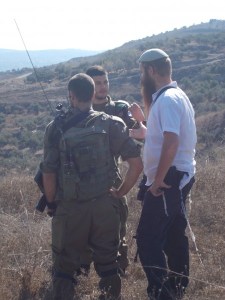 NABLUS – Israeli settlers on Saturday prevented Palestinian farmers from accessing their olive fields on the outskirts of Burin village near Nablus in the occupied West Bank, locals said.
Local sources told Ma’an that dozens of settlers blocked entrance of farmers to their land while Israeli soldiers stopped two buses carrying volunteers en route to assist Palestinians in the olive harvest.
The buses were stopped on the main road between Nablus and the illegal settlement Yitzhar.
The Palestinians and volunteers were stopped “despite coordination between the Palestinian liaison department and its Israeli counterpart,” locals said.
Locals added that Israeli settlers also stole olives and farming equipment from Palestinians in the Bab Sanna area of Burin, which is completely surrounded by illegal Israeli settlements to the north and west.
Settlers in the Nablus area — known by locals to be more extreme and violent — frequently prevent Palestinian access to their farmland, much of which lies under Israeli control in Area C.
Earlier this week, settlers from Elon Moreh threw rocks at farmers in the Azmut and Deir al-Hatab areas east of Nablus.
The week prior, settlers from the Yitzhar settlement threw stones at locals picking olives in Burin, injuring four Palestinians. Dozens of acres of Palestinian agricultural land was also burned.
Such attacks are regularly carried out in the presence of Israeli military who rarely act to protect Palestinians.
Palestinian leadership has repeatedly requested the UN Security Council to intervene in order to stop aggression by settlers as well as the implementation of a measure to disarm settlers.
Settler violence during the olive harvest has historically taken a heavy toll on the thousands of Palestinian families whose annual living depends on access to their land.
Photo Credit ISM
The U.S. Spends $35 Billion ‘Helping’ Out The World… But Where Does All this Money Really Go?
HowMuch.net | October 28, 2015
The United States provided approximately $35 billion in economic aid to over 140 countries* in fiscal year 2014. In the map below the relative size of each country is proportionate to the aid received from the United States and the color of each country indicates GDP per capita.
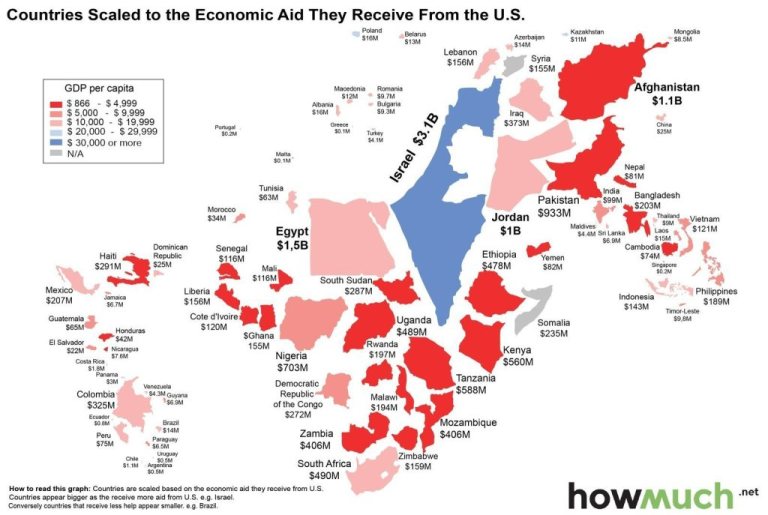
* For visualization purposes the map above reflects only 77 countries that received approximately $17 billion of the $35 billion in global aid. We chose top 40 by aid received and then manually selected different countries to illustrate geographic diversity.
Protecting Israel, Trashing Hebron: More Spin from The NY Times
By Barbara Erickson | TimesWarp | October 30, 2015
Today in The New York Times we have a look at Hebron, a blood-drenched city in the West Bank, a community besieged by violent settlers and trigger-happy Israeli forces. In this month alone, some 20 of its Palestinian residents have died at the hands of soldiers and police, their deaths sometimes caught on video that belies official accounts.
But this grim reality is not the focus in the Times. The article by Diaa Hadid and Rami Nazzal strips the full context of the occupation from Hebron and presents it, not as a city struggling to survive under crushing oppression, but as a hotbed of Palestinian radicals, a stronghold of the oft-demonized Hamas.
The story takes us to the funeral of Dania Irsheid (identified as Dania al-Husseini in the Times), a schoolgirl shot at a checkpoint on Sunday. It mentions other deaths in recent days, but it completely avoids the eyewitness accounts and human rights organization findings that show many of these deaths were extrajudicial executions.
Israel has callously refused to release the bodies of most of the 20 victims, and we read that residents feel “particular outrage” over the death of Dania and another girl, Bayan Oseili, 16, killed a week before, both accused of stabbing attacks. The story deftly avoids another compelling reason for this outrage: the fact that both obviously posed no threat and could have been arrested and that video footage in the case of Bayan and eyewitness accounts in the case of Irsheid contradict police claims.
Hadid and Nazzal, however, have nothing to say about these contradictions and write that residents are angry because the refusal to release the bodies is an “affront to the Muslim tradition of immediate burial and a defilement of their honor.”
This fits neatly into the Times’ attempt to spin the oppression in Hebron into more blaming of the victims, who are described as Hamas followers and culturally conservative. The article opens with a quote from a Hebron resident who applauds knife attacks on Israeli soldiers, and it closes with the same speaker who “was pleased to see the surge in violence turn to Hebron.”
Missing entirely are any comments from nonviolent Hebron activists and the accounts of eyewitnesses who say Israeli forces have planted knives near the bodies of victims. The story also omits some chilling reports of deliberate executions and the statements of human rights groups that raise the charge of extrajudicial killings.
One of the most disturbing accounts describes the death of a young man, Islam Ibeidu, 23, on Wednesday near the Kirya Arba settlement. The news outlet Middle East Eye noted, “According to the quoted eyewitness, Ibeidu was searched by Israeli soldiers by the checkpoint and released, before orders were given to execute him.”
One witness tweeted: “I saw everything. I saw soldiers loading the guns. He had his arms up and was shaking, he was unarmed and they just shot him.” A second tweet continues, “eyewitness overheard police woman say ‘he looks nice, shoot him’ before he was shot to death by m16 from 2 meters away.”
The accounts of other deaths are equally disturbing (see TimesWarp 10-27-15), but the Times story includes none of them. It states that the victims this month died “in demonstrations and attacks,” taking the official Israeli line as fact.
On the other hand, the article refers frequently to Hamas in an effort to tie the group to the violence in Hebron. It makes no mention of several non-violent groups active in the city, such as Youth Against Settlements, Christian Peacemaker Teams, the International Solidarity Movement and the UN mandated Temporary International Presence in Hebron.
All of these organizations are avowedly non-violent; they observe and document violence against Palestinians. Yet another group, Breaking the Silence, was founded by Israeli soldiers who had served in Hebron and now collect and document Israeli army abuses. None of these organizations has a voice in the Times story.
Much of Hebron’s agony dates back to March, 1994, when an American-born settler, Baruch Goldstein, massacred 29 worshippers in the Ibahimi Mosque. Hadid mentions this as part of the historical record but omits the brutal Israeli crackdown that followed.
Rather than act to protect Palestinians after this attack, Israeli security forces went on to kill some 20 more Hebron residents during protests and to lock them down under a round-the-clock curfew. The government also closed once bustling Shuhada Street to all Palestinian traffic, welded shut Palestinian shops, turned the street over to settlers and divided the mosque into Jewish and Muslim sections.
This finds no clarification in the Times story, which refers vaguely to a “volatile mix of Palestinians and Jewish settlers.” Instead, the newspaper has adopted the official playbook of the occupiers: Stick to the narrative of Israeli victimhood, ignore countervailing fact, and whenever possible blame Hamas.
71 Palestinians, Including 12 Children, 2 Infants And A Pregnant Woman, Killed This Month
By Celine Hagbard | IMEMC News | October 31, 2015
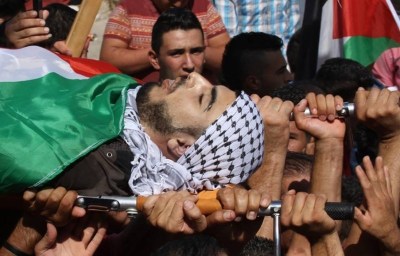
Three Palestinians were killed Friday, including a baby who suffocated to death from tear gas in Bethlehem a day after Israeli forces tore through a Bethlehem neighborhood shouting “We will gas you all to death”.
The Palestinian Health Ministry has reported that 921 Palestinians have been shot and injured with live Israeli army rounds, since the beginning of this month, in the West Bank and the Gaza Strip, while 855 were shot with rubber-coated steel bullets, and 208 suffered fractures and bruises after being assaulted and beaten by soldiers and fanatic settlers.
Palestinians Killed On Friday:
Baby Suffocates to Death from Tear Gas near Bethlehem
Palestinian killed near light rail station in Jerusalem following alleged stabbing of soldier
One Palestinian Killed, Another Seriously Injured, Near Nablus
The names of those killed by the army in October:
West Bank and Jerusalem:
1. Mohannad Halabi, 19, al-Biereh – Ramallah. Shot after allegedly grabbing gun and killing two Israelis. 10/3
2. Fadi Alloun, 19, Jerusalem. Israeli claim of ‘attack’ contradicted by eyewitnesses and video. 10/4
3. Amjad Hatem al-Jundi, 17, Hebron.
4. Thaer Abu Ghazala, 19, Jerusalem.
5. Abdul-Rahma Obeidallah, 11, Bethlehem.
6. Hotheifa Suleiman, 18, Tulkarem.
7. Wisam Jamal Faraj, 20, Jerusalem. Shot by an exploding bullet during protest. 10/8
8. Mohammad al-Ja’bari, 19, Hebron.
9. Ahmad Jamal Salah, 20, Jerusalem.
10. Ishaq Badran, 19, Jerusalem. Israeli claim of ‘attack’ contradicted by eyewitnesses. 10/10
11. Mohammad Said Ali, 19, Jerusalem.
12. Ibrahim Ahmad Mustafa Awad, 28, Hebron. Shot at protest by rubber-coated steel bullet in his forehead. 10/11
13. Ahmad Abdullah Sharaka, 13, Al Jalazoun Refugee camp-Ramallah.
14. Mostafa Al Khateeb, 18, Sur-Baher – Jerusalem.
15. Hassan Khalid Manassra, 15, Jerusalem.
16. Mohammad Nathmie Shamassnah, 22, Kutneh-Jerusalem.
17. Baha’ Elian, 22, Jabal Al Mokaber-Jerusalem.
18. Mutaz Ibrahim Zawahra, 27, Bethlehem. Hit with a live bullet in the chest during a demonstration.
19. Ala’ Abu Jammal, 33, Jerusalem.
20. Bassem Bassam Sidr, 17, Hebron.
21. Ahmad Abu Sh’aban, 23, Jerusalem.
22. Riyadh Ibraheem Dar-Yousif, 46, Al Janyia village Ramallah( Killed while harvesting olives)
23. Fadi Al-Darbi , 30, Jenin – died in Israeli detention camp.
24. Eyad Khalil Al Awawdah, Hebron.
25. Ihab Hannani, 19, Nablus.
26. Fadel al-Qawasmi, 18, Hebron. Shot by paramilitary settler, Israeli soldier caught on film planting knife near his body.
27. Mo’taz Ahmad ‘Oweisat, 16, Jerusalem. Military claimed he ‘had a knife’. 10/17
28. Bayan Abdul-Wahab al-‘Oseyli, 16, Hebron. Military claimed she ‘had a knife’, but video evidence contradicts that claim. 10/17
29. Tariq Ziad an-Natsha, 22, Hebron. 10/17
30. Omar Mohammad al-Faqeeh, 22, Qalandia. Military claimed he ‘had a knife’. 10/17
31. Mohannad al-‘Oqabi, 21, Negev. Allegedly killed soldier in bus station in Beer Sheba.
32. Hoda Mohammad Darweesh, 65, Jerusalem.
33. Hamza Mousa Al Amllah, 25, from Hebron, killed near Gush Etzion settlement.
34. Odai Hashem al-Masalma, 24, Beit ‘Awwa town near Hebron.
35. Hussam Isma’el Al Ja’bari, 18, Hebron.
36. Bashaar Nidal Al Ja’bari, 15, Hebron.
37. Hashem al-‘Azza, 54, Hebron.
38. Moa’taz Attalah Qassem, 22, Eezariyya town near Jerusalem. 10/21
39. Mahmoud Khalid Eghneimat, 20, Hebron.
40. Ahmad Mohammad Said Kamil, Jenin.
41. Dania Jihad Irshied, 17, Hebron.
42. Sa’id Mohamed Yousif Al-Atrash, 20, Hebron.
43. Raed Sakit Abed Al Raheem Thalji Jaradat, 22, Sa’er – Hebron.
44. Eyad Rouhi Ihjazi Jaradat, 19, Sa’er – Hebron.
45. Ezzeddin Nadi Sha’ban Abu Shakhdam, 17, Hebron. Shot by Israeli military after allegedly wounding soldier, then left to bleed to death.
46. Shadi Nabil Dweik, 22, Hebron. Shot by Israeli military after allegedly wounding the same soldier, then left to bleed to death.
47. Homam Adnan Sa’id, 23,Tel Rumeida, Hebron. Shot by Israeli soldiers claiming ‘he had a knife’, but eyewitnesses report seeing soldiers throwing a knife next to his dead body. 10/27
48. Islam Rafiq Obeid, 23, Tel Rumeida, Hebron. 10/28
49. Nadim Eshqeirat, 52, Jerusalem. 10/29 – Died when Israeli soldiers delayed his ambulance.
50. Mahdi Mohammad Ramadan al-Mohtasib, 23, Hebron. 10/29
51. Farouq Abdul-Qader Seder, 19, Hebron. 10/29
52. Qassem Saba’na, 20, shot on motorcycle near Zaatara checkpoint. 10/30
53. Ahmad Hamada Qneibi, 23, Jerusalem. Soldiers claimed ‘he had a knife’.
54. Ramadan Mohammad Faisal Thawabta, 8 month old baby, Bethlehem. Died of tear gas inhalation.
Gaza Strip:
55. Shadi Hussam Doula, 20.
56. Ahmad Abdul-Rahman al-Harbawi, 20.
57. Abed al-Wahidi, 20.
58. Mohammad Hisham al-Roqab, 15.
59. Adnan Mousa Abu ‘Oleyyan, 22.
60. Ziad Nabil Sharaf, 20.
61. Jihad al-‘Obeid, 22.
62. Marwan Hisham Barbakh, 13.
63. Khalil Omar Othman, 15.
64. Nour Rasmie Hassan, 30. Killed along with her child in an Israeli airstrike. 10/11
65. Rahaf Yihiya Hassan, two years old. Killed along with her mother in an Israeli airstrike. 10/11
66. Yihya Abdel-Qader Farahat, 23.
67. Shawqie Jamal Jaber Obed, 37.
68. Mahmoud Hatem Hameeda, 22. Northern Gaza. 69. Ahmad al-Sarhi, 27, al-Boreij.
70. Yihya Hashem Kreira.
71. Khalil Hassan Abu Obeid, 25. Khan Younis. Died from wounds sustained in protest earlier in the week.
Non-Palestinian killed by Israeli mob:
Eritrean asylum-seeker Haftom Zarhum killed in Beer Sheva bus station by angry mob who mistook him for a Palestinian- 10/18
Names of known Israeli casualties during the same time period:
1 & 2. 10/1 – Eitam and Na’ama Henkin, both aged around 30 years old, killed in drive-by shooting near Itamar settlement.
3. 10/3 – Nahmia Lavi, 41 – Rabbi for Israeli military. Killed in Jerusalem stabbing attack near Lion’s Gate when he tried to shoot the attacker but had his weapon taken.
4. 10/3 – Aaron Bennet, 24. Killed in Jerusalem stabbing attack near Lion’s Gate.
5. 10/13 – Yeshayahu Kirshavski, 60, bus shooting in East Jerusalem
6. 10/13 – Haviv Haim, 78, bus shooting in East Jerusalem
7. 10/13 – Richard Lakin, 76, bus shooting in East Jerusalem (died of wounds several days after the attack)
8. 10/18 – Omri Levy, 19, Israeli soldier with the Golani Brigade who had his weapon grabbed and turned against him by an Israeli resident.
An additional 2 Israelis that were initially claimed to have been killed in attacks were actually killed in car accidents.
Can Jeremy Corbyn make a difference to Palestine?
Press TV
The pro-Palestinian, anti-Israel candidate Jeremy Corbyn has become the new leader of Britain’s second biggest political force, the Labour Party.
Corbyn has often demonstrated against Israel’s wars on the Palestinian people. And he’s called for an economic boycott against Tel Aviv. When it comes to Palestine, historically there has been little to choose between Labour and the Conservatives, with both following a pro-Israel line for decades or more.
But now that Corbyn is Labour leader, will there at last be clear blue water between the major parties on this issue? And what implications does this have for British foreign policy and the Palestinian cause?
High Court lifts ban on protests at Israeli drone factory
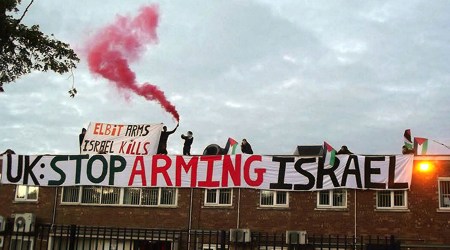
A UK arms factory was recently occupied by nine British activists in protest against the company’s alleged complicity in Israel’s Operation Protective Edge
RT | October 30, 2015
An injunction banning protests from taking place outside a drone factory in Staffordshire has been thrown out by Birmingham High Court. The factory has produced parts for drones used to attack Gaza in 2008, according to Amnesty International.
UAV Engines Limited in Shenstone, owned by an Israeli arms manufacturer Elbit Systems, is one of the world’s leading drone producers. The company says it produces “engines for various size tactical armed unmanned aerial vehicles [UAVs], target drones and single mission platforms.”
Angered by the factory’s unethical behavior, hundreds of protesters have staged demonstrations outside its industrial unit, calling on the manufacturer to stop contributing to the death of Palestinians.
In June, campaigners shut down UAV and another Israeli arms factory in Kent as part of a protest marking the one-year anniversary of the Israeli assault on Gaza.
Soon after, it became illegal for activists to protest within 250 meters of the Shenstone factory. The ban came in the form of a temporary injunction granted by the High Court.
However, Birmingham High Court scrapped the ban on Tuesday, ruling Elbit had failed to disclose information on the history of protests which have taken place at the factory since 2009.
Judge Purle at the High Court said the injunction is dismissed “as if it never existed.”
“I think it inconceivable you would have got the same injunction, possibly even any injunction, if you had disclosed relevant information to me,” she told the court. “Accordingly the injunction I granted on 30 June is dismissed ab initio [from the beginning] and it is as if the injunction never existed.”
‘It shouldn’t have been introduced’
A spokesperson for campaign group Block the Factory said the injunction should not have been imposed in the first place.
“This injunction should never have been imposed.It seems to have been designed to deter protest and campaigning around ending the UK’s deadly arms trade with Israel,” they told IBT.
“It’s Elbit Systems and its arms factories that should be facing a ban, not our protests. Today’s decision will bring even more energy to our campaigning in solidarity with ongoing Palestinian resistance and for a two-way arms embargo on Israel.”
War on Want, a charity fighting against the root causes of poverty and human rights violations, said it is pleased the ban has been lifted.
“It would have been a travesty for people to be criminalized for protesting against the sale of arms that are killing Palestinians. It just goes to show the depths UAV Engines will stoop to in order to protect the profits they make from the sale of deadly drones,” campaigner Ryvka Barnard said.
“We welcome the news that the judge has binned this draconian injunction and we will keep up the fight for an immediate two-way arms embargo between the UK and Israel,” he added.
In July, hundreds of activists protested outside the factory, which led to 19 people being arrested by Staffordshire police.
Photo © londonpalestineaction.tumblr.com / Tumblr
NY protest slams mayor over pro-Israel policy, police brutality
Press TV – October 30, 2015
American activists and protesters have staged a rally in New York City to condemn the stance of Mayor Bill de Blasio on Israel and police brutality in the US.
Pro-Palestine activists from the movement known as the ‘Black Lives Matter,’ likened US police forces in New York to Israeli soldiers in their violence and brutality against Palestinians.
They called for justice for Palestinians facing Israel’s aggression in the occupied territories.
The protesters rallied in front of the Sheraton Hotel in New York’s Times Square, where the city’s mayor was holding a re-election campaign.
At one point, about a dozen activists pushed their way into the lobby of the hotel before being repelled by security, local media reports noted.
The protesters were also angry over police brutality and their treatment of people of color.
Authorities in New York are under fire for the deaths of a number of unarmed citizens at the hands of US law enforcement officers. Most victims are usually African Americans.
Earlier in the day, the New York mayor dismissed the protesters as uninformed.
Blasio launched his re-election campaign toward the 2017 race on Thursday night, reportedly banking a million dollars during the hotel fundraiser, as other reports said the public opinion was evenly split on his job performance.
The event cost as much as some 5,000 dollars for each person in attendance.
Israel Redefines Terrorism
By Stephen Lendman | October 25, 2015
Rogue states make their own rules, mindless of inviolable international laws, norms and standards. On October 19, Israel’s repressive counter-terrorism bill passed its 2nd and 3rd readings – criminalizing legitimate resistance as terrorism, expanding regime authority to counter it extrajudicially.
Any activity can now be called terrorism or terrorist-related, innocent Palestinians subject to possible longterm imprisonment. Charity officials providing aid to anyone linked to or associated with Hamas or legitimate resistance groups can be arrested, charged and prosecuted.
Children wearing clothing bearing the Hamas name face arrest, detention, and grueling interrogations amounting to torture. The law authorizes Big Brother surveillance, more intrusive than already, replicating how the NSA operates, monitoring all phone and online communications.
Israeli Law Professor Yael Berda called the measure “scary and undemocratic…criminalizing an entire population for identifying with an organization that Israel considers terrorist (true or false)” – first introduced in 2011, redrafted several times, never brought to 2nd and 3rd readings until now, required for passage.
It expands the definition of terrorism to virtually anything considered a (real or invented) threat to public safety, well-being, property, infrastructure, the economy, religious sites or the environment.
It makes no distinction between alleged attacks against civilians, soldiers or police. Vandalism against (Israeli) religious sites is now terrorism.
Terrorist organizations are any authorities say so for any reason or none at all. Members or supporters face harsh punishment.
Any alleged terrorist crime incurs “double the penalty set for the same crimes, but no more than 30 years” imprisonment. Administrative detentions (without charges levied or trials) can be ordered more easily than before, subjecting victims to indefinite imprisonment.
Punishment for allegedly intending to conduct a terrorist act is equivalent to committing it. Noted Israeli lawyer, human rights champion Leah Tsemel calls the new law “not…about terrorism. It…remove(s) restrictions from everything to do with opposition to occupation,” criminalizing legitimate resistance.
“When it comes to the occupation, there is no rule of law,” she explained. Israel always operated extrajudicially – now with more police state authority than before.
A passage in the 100-page measure reads as follows:
“The law substantially strengthens and widens the powers of the police and the General Security Services (Shabak or Shin Bet) to suppress any legitimate protest activities against Israeli policies.”
“It also enables the use of ‘secret evidence’ in order to take preventative measures against these activities, which impedes the possibility of objecting to these repressive decisions based on their merits before the judiciary.”
According to Yael Berda, “(y)ou don’t have to do anything to be considered a terrorist. You can publish an article or make a comment in cyberspace, and you will be criminalized.”
“If you are located in the physical environment of terrorist activities, you are guilty.” The measure applies specifically for Palestinians and Arab Israeli citizens – Jews as well for opposing regime authority.
The Association for Civil Rights in Israel (ACRI) denounced the new measure, saying “in its current form, (it) seeks to perpetuate and normalise problematic arrangements that are currently set out in emergency legislation and regulations from the time of the British mandate.”
“(D)efinitions included in the bill are very broad and could apply to people and organizations who are not engaged in terrorism. Such broad definitions give excessive discretion to law enforcement authorities to determine ‘who is a terrorist,’ with potentially serious implications.”
“For example, the definition of ‘terrorist act’ may apply to protests, including ‘disturbances.’ The definition of ‘member of a terrorist organization’ includes people who did not take any active part in the organization. The broad definitions contained in the bill and the draconian powers that it gives to authorities could potentially lead to serious human rights violations.”
The Adalah Legal Center for Arab Minority Rights in Israel condemned the measure, saying it “substantially strengthens and widens the powers of the police and the Shabak to suppress any legitimate protest activities against Israeli policies.”
It’s specifically designed to criminalize legitimate resistance – “to further suppress the struggle of Palestinian citizens of Israel and the pursuit of their political activities in support of Palestinians living under Occupation in the West Bank and the Gaza Strip.”
Humanitarian and cultural activities are vulnerable. So is independent journalism, legitimately criticizing repressive state policies. Its passage assures greater collective punishment – all the more urgency to resist this vile, freedom-destroying regime.
Stephen Lendman lives in Chicago. He can be reached at lendmanstephen@sbcglobal.net.
His new book as editor and contributor is titled Flashpoint in Ukraine: US Drive for Hegemony Risks WW III.
Palestinian Teen Killed In Hebron, Second In Three Hours
IMEMC & Agencies – October 29, 2015
The Palestinian Health Ministry has reported, Thursday, that Israeli soldiers shot and killed a Palestinian teenager, in the southern West Bank city of Hebron, the second Palestinian to be killed in the city in less than three hours.
The Ministry said the slain Palestinian has been identified as Farouq Abdul-Qader Seder, 19 years of age.
He was shot dead in the Shuhada Street, close to the Beit Hadassah illegal Israeli colonialist outpost, in the heart of Hebron city.
The Israeli army claimed the Palestinian “carried a knife, and attempted to stab a soldier,” a claim that was strongly denied by eyewitnesses.
Eyewitnesses also said Israeli soldiers, and extremist colonizers attacked the dead body of the slain Palestinian, and opened fire on the home of resident Hajj Mofeed Sharabati.
The army claims several Palestinian activists, of the Independent Human Rights Committee and Youth Coalition against Settlements, “were hiding in the Sharabati home.”
Farid al-Atrash, head of the Independent Committee for Human Rights in the southern part of the West Bank, said the soldiers attacked him and many Palestinians who were with him when they rushed to the scene, where the Palestinian was killed, after hearing gunshots.
“The soldiers attacked us, and we ran to the home of Mofeed Sharabati,” he stated, “The soldiers and fanatic settlers followed us, and attacked us in his home.”
“We are here, and will remain here; we document the Israeli violations; we defend the legitimate rights of the Palestinians to live in peace and dignity,” he added, “The soldiers also fired a gas bomb targeting the Sharabati home, and surrounded it.”
Also Thursday, soldiers shot and killed Mahdi Mohammad Ramadan al-Mohtasib, 23 years of age, near the Ibrahimi Mosque, in Hebron.
The latest fatal shootings on Thursday bring the number of Palestinians, killed by Israeli army fire in occupied Palestine since the beginning of this month to 68, including 14 children.
49 Palestinians were killed in the West Bank, including Jerusalem, 17 in the Gaza Strip, including a mother and her two years of age child, and one in the Negev, the Palestinian Health Ministry said.
The Ministry added that at least 914 have been shot by live Israeli army fire, while 878 were shot with rubber-coated steel bullets.
It also said that 206 Palestinians suffered fractures and bruises after being beaten by Israeli soldiers and extremist settlers, 14 suffered burns due to Israeli gas bombs and concussion grenades, and more than 5000 Palestinians received treatment for the effects of tear gas inhalation.
Shot woman: Israeli police alter story again
By Jonathon cook | The Bog From Nazareth | October 29, 2015
 The official Israeli story about Israa Abed – the Nazareth woman who was shot six times on Oct 9 by Israeli security forces as she stood motionless in a bus station – has changed so many times, it’s difficult to know what to believe any more. By a small miracle she survived the shooting.
I raised many questions about this incident, based on two videos taken by bystanders, in a post on the day she was shot. That post, including the videos, is available here.
Israa is one of Israel’s 1.6 million Palestinian citizens. She lives in Israel, not the occupied territories.
Let’s be clear: the main reason the police have repeatedly revised their account of the events of Oct 9 is because the visual evidence has conclusively refuted their claims. They have been forced to back-pedal.
Without the video, Israa would have been charged with, and probably convicted of, terrorism offences. In line with threats from Israeli prime minister Benjamin Netanyahu, she would also have risked being stripped of her citizenship.
Originally the police said they “neutralised” Israa after she pulled out a knife and stabbed a security guard at the bus station in the city of Afula. When it was clear no one had been injured, the story changed: she had tried without success to stab the guard.
Then it was reported that the police had shot Israa not because of an attempted attack but because she behaved in a threatening manner towards other people at the bus station.
Now, in the latest version, the police say she did not intend to stab anyone. In the video footage, reports the Haaretz newspaper, she can be seen “standing next to a young ultra-Orthodox man without trying to hurt him”.
Instead, the police say she was depressed and / or mentally unstable and pulled out a knife because she wanted to “induce” the security forces to shoot her.
Pause for a second as you digest that argument. According to the police, Israa went to the bus station with the intention of pulling out a knife but not harming anyone, knowing that doing so would be enough to get her shot and maybe killed. And why would she think that? Because she looks Arab (she wears a headscarf), and, like most Palestinian citizens, understands that in any confrontation with the security services that is reason enough for the police to shoot without justifiable cause.
Even more disconcertingly, the Israeli police seem to agree that Israa’s assumptions were warranted.
Further, the claim that Israa wanted to be shot is pretty convenient for the four security staff who, even according to the official account, fired their weapons at a woman who posed absolutely no threat to anyone at the bus station.
Might they be disciplined, or, more properly, punished, for shooting a woman six times for no reason at all? Apparently not. They have been investigated and it has been decided that “there is no reason to take disciplinary measures against them, given the extenuating circumstances of the incident”. One might well ask: what were those “extenuating circumstances”?
Finally, the police are still claiming that Israa pulled out a knife. Given their series of bogus claims till now, there is no reason to assume even this part of their story to be true.
As I noted in my previous post, a video taken seconds after Israa was shot, when she is lying on the ground, appears to show a pair of sunglasses next to her. A man in jeans and T-shirt goes over to her, ignored by police, and kicks away the sunglasses. Who is that man and why is he interfering with evidence? No one seems to be asking these questions, so we are unlikely to get any answers.
www.haaretz.com/israel-news/1.682928
Young unarmed man murdered in cold blood in Hebron
International Solidarity Movement | October 28, 2015
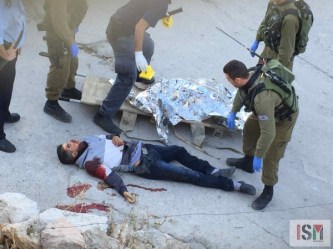 Hebron, Occupied Palestine – Wednesday 28th at 3.25pm a young Palestinian was shot in cold blood in the Tel Rumeida neighborhood in Hebron. Human rights observers from International Solidarity Movement witnessed the young man being murdered while walking in the street near the Gilbert Checkpoint.
The eyewitness from ISM, identified as Orion, states: “I am 100% sure he was unarmed. I saw the two soldiers creeping slowly along the road outside our apartment window with their guns cocked, so I looked down the street to see why. I saw an unarmed man walking normally towards the soldiers and suddenly they shot.”
The young man was shot at a distance of around two meters and at least 12 shots were fired. He died immediately after being shot.
No shouting or running was heard on the site prior to the murder. Minutes prior to the incident, a policewoman was overheard at the Shuhada Street checkpoint 56 saying on her radio “he looks like a good one, shoot him.”
Another activist from the ISM states: “It was just like last night, when they shot Hummam Said. Everything was quiet and suddenly we heard many shots outside our apartment. I am sure he was unarmed and they murdered him for no reason, just like Hammam”
Featured Video
The Search for Truth: Charlie Kirk’s Assassination One Year Later
or go to
Aletho News Archives – Video-Images
From the Archives
The 9/11 “Double-Cross” Conspiracy Theory
BY LAURENT GUYÉNOT • UNZ REVIEW • SEPTEMBER 6, 2022
Is it true that “9/11 was an inside job”? Yes, insofar as Israel is “inside” the U.S. But for the 9/11 truthers who have identified Israel as the main perpetrators, “9/11 was an inside job” is at best a half-truth, and at worst an integral part of the Zionist operation, like a secondary flag sewn as a lining under the false flag of Islamism. Victor Thorn (1963-2017) wrote in his book 9/11 made in Israel: The Plot Against America (2011): “In essence, the ‘9-11 truth movement’ was created prior to Sept. 11, 2001 as a means of suppressing news relating to Israeli complicity. . . . The slogan ‘9-11 was an inside job’ was quite possibly the greatest example of Israeli propaganda ever devised.” In milder terms, it is “controlled opposition”.
A genuine truth movement would have pointed to Israel as the prime suspect from the start. From day one, it was obvious who would benefit. … continue
Blog Roll
 Aletho News
- Europe’s mounting social chaos… chickens coming home to roost for proxy war against Russia
- US-Russia Diesel Deal Becomes Massive Defeat for Ukraine
- Hormuz and the Looming Economic Catastrophe
- Dhubab offensive, media blitz and the rapid unraveling of Saudi-backed coalition’s new gambit
- Putin Conveys to Trump Iran’s Vision on Possible Conflict Resolution – Kremlin
- The Search for Truth: Charlie Kirk’s Assassination One Year Later
- ‘Harsh reality’: Iran says France seeks monopoly on power and intimidation, not peace for all
- When Will This White House Madness End?
- Huckabee aide goes to ‘unusual lengths’ to portray ‘Israel’ positively
- Trump Announces Diesel Supply Deal With Putin Following Phone Call
- If Americans Knew
- Israeli forces kill another child in Gaza – Daily Update
- Gaza ceasefire exists in name only, say more than 100 organizations
- Nearly 2 Million in Gaza Need Urgent Shelter Assistance as Winter Looms: IOM Chief Warns
- Suppressing Palestinian resistance: US charity under fire for AI monitoring of Gaza classrooms
- Thousands Are Held in Israeli Torture Camps. This Is What Happens Inside
- Israel puts Gaza’s sick, injured, newborn in peril – Daily Update
- Report claimed Mark Levin used by Israeli government to influence Trump
- Over 2,000 Gazans have died awaiting medical evacuation amid Israel’s continued siege
- How a U.S. Diplomat Suppressed and Altered Reports Critical of Israel
- 5 Palestinians Die from Israeli Strikes in Gaza as Relentless Attacks Continue
- No Tricks Zone
- New Study: 50 Years Of The Most Aggressive ‘Net Zero’ Policies Can Only Affect The Global Climate By 0.03°C
- US September “Heat” Was No Record…Many Records Set Decades Ago
- Latest European Green Energy Debacle; Portugal’s Largest Flagship Solar Park Insolvent!
- Green Energy Debacle: German Expert Professor Fritz Vahrenholt Warns Of Severe Economic And Social Consequences
- Two More Paleo Reconstructions Affirm Meters-Higher Sea Levels Across Ireland, Brazil 7000-6000 Years Ago
- New Study: Earth And Venus Surface Warmth Largely Explained By Convection And Lapse Rate, Not CO2 Or Radiation
- 2025 Nature Paper Claiming Worsening Global Drought Gets RETRACTED …Heavily Flawed
- New Study: ‘Global Drought Shows No Detectable Recent Acceleration Under Climate Warming’
- Economic Masterminds: German Socialists Suggest Taxing Productivity Gains Stemming From Using AI
- The South China Sea Has Not Been Cooperating With The Climate Change Narrative

