Nablus activists to deploy on hilltops to prevent settlement expansion
Ma’an – June 3, 2015
NABLUS – Palestinian activists in the Nablus area of the northern West Bank are preparing to launch what they describe as the largest campaign against settlement expansion in the area.
Palestinian official Ghassan Daghlas, who monitors settlement related activities in the northern West Bank, told Ma’an Wednesday that the activists plan to install movable houses on hilltops in 35 villages and towns across Nablus district under threat of confiscation by Israeli authorities.
The move comes amid an ongoing takeover of private Palestinian land in the hills surrounding Nablus, where several Jewish-only settlements have been established throughout the area over the years.
After small groups of Israeli settlers claim the land and gradually grow outwards with the protection of the Israeli military, private Palestinian land is confiscated through legal processes, according to Israeli human rights group B’Tselem.
There are currently 12 illegal settlements and 27 settlement outposts in the Nablus area housing around 23,000 of the “most extremist settlers in the Palestinian Territory,” according to Daghlas.
The settlements and outposts surrounding Nablus have gained such reputation largely due to high rates of violent acts by settlement residents against local Palestinians, including uprooting and burning olive trees, vandalism against private property, in addition to violent physical attacks.
Last week, residents from the illegal Yitzhar settlement expanded onto local Palestinian land near the village of Huwwara.
Israeli security forces estimated that the majority of incidents during a 2014 wave of anti-Palestinian hate crimes were carried out by Yitzhar residents, Israeli media reported at the time.
The hilltop campaign, added Daghlas, is a preemptive move to protect Palestinian land from the ongoing settlement expansion especially as the newly-formed rightist Israeli government begins to fulfill promises made to the settler bloc in the run up to the March elections.
The activity was organized by the Nablus district Committee Against Settlements in cooperation with the Fatah movement’s recruitment commission headed by Mahmoud al-Aloul.
NY Times Covers Up Israel’s Attacks on Gaza Fishermen
By Barbara Erickson | TimesWarp | June 2, 2015
The New York Times has turned its sights on Gaza today with a page 1 article highlighting the miseries of life in the beleaguered enclave. The difficulties, we learn, have little to do with Israeli attacks and its crippling blockade: They are the fault of Hamas.
The article by Diaa Hadid and Majd el Waheidi, “Gazans’ Hopes for Rebuilding After War Give Way to Deeper Despair,” takes aim at the Islamist group in the lead paragraph, quoting an angry shopkeeper who resents a recent tax hike. The man is “enraged,” the story tells us, and he blames the government in charge.
This is where the Times wants to direct our attention: away from Israeli culpability for the humanitarian crisis in Gaza and directly onto the Palestinians themselves. Meanwhile, the paper has been silent as Israeli gunboats and snipers have frequently attacked fishermen and farmers, violating the terms of the August 2014 ceasefire.
Israel has blockaded the Gaza Strip since 2007 and made three sustained assaults on the enclave since then, inflicting more death and destruction on the population each time. But the Times article has only this to say: “Israel places severe restrictions on the import of building materials, saying they have been used to build tunnels to conduct attacks on Israel.”
In the first three months of this year Israel killed one Palestinian and wounded 16 in Gaza, carried out at least six military incursions into the strip and shot at Palestinians, by land and sea, at least 67 times. Since then the attacks have continued almost without pause.
The Times ignores nearly all of this, even as Israel levels farmland and sprays food crops, and the newspaper fails to report other developments, such as a long term ceasefire offer made by Hamas earlier this year through Qatar and Turkey or the launch of a flotilla now on its way to Gaza from Scandinavia, the third such attempt to break the siege.
But now, when Hamas has instituted an unpopular increase in import fees, the Times sees fit to send a reporter to Gaza, intending as usual to demonize the Islamist party. It seems, however, that the evidence hoped for was scanty: The entire story contains only this one example of blaming Hamas.
This does not deter the Times, however. This lone sample is played to the hilt, laid out in the opening paragraph. Close readers may notice this; others will let it color their perceptions of the entire article.
The Palestinian Authority also comes in for blame. We find one Gaza resident who says the rival to Hamas has “an interest in leaving Gaza like this.” Others mention the impasse between Hamas and the PA, but Israeli responsibility gets little mention.
The story goes on to devote two paragraphs to the Egyptian closure of Rafah crossing and Egypt’s destruction of smuggling tunnels. No more is said about Israel’s role except to mention the debris from the last summer’s conflict.
We don’t hear that Israel destroyed thousands of homes and businesses in 2014, along with crops, wells and the electrical plant, and left more than 2,000 dead. Nor do we hear anything about the context of the blockade—the fact that it is has been in place for nearly eight years and its effect on families torn by separation, patients in need of medical care and basic supplies of food and medicine.
No doubt Hadid heard from many despairing residents of Gaza who direct their anger at Israel (and the United States), but we find not a single quote to this effect. She most certainly heard about the attacks on fishermen and farmers, but none of this made its way into the story.
This is just as Israel wants it. As a recent article in the Israeli 972 Magazine notes, “These incidents — in which the Israeli army infiltrates the Gaza Strip, shoots at fishermen, confiscates their boats and fires at farmers near the border zone — they are part of daily life in the besieged Gaza Strip. They are the everyday aspects of living in a giant prison controlled by Israel. But we barely hear about them.”
The author of the 972 piece, Haggai Matar, emphasized the blackout in the Hebrew media: Israelis are not to be aware of the oppression of Gaza; they are only to hear of the occasional rocket, the hyped up discovery of a “terror tunnel” and the failings of Hamas and the Palestinian Authority.
Here in the United States, away from Israeli censors, the Times has chosen to comply with this news embargo. In our newspaper of record nothing is to be said about the shooting of unarmed Gazans and the constant attacks on their welfare. Israel’s reputation comes first; the ethics of journalism and the reader’s right to be informed come far behind.
Israeli forces demolish 3 houses in East Jerusalem

Ma’an – June 2, 2015
JERUSALEM – Israeli forces demolished three Palestinian homes in the Silwan neighborhood and Salah al-Din street in occupied East Jerusalem early Tuesday morning, the owners told Ma’an.
They were told that the houses were demolished because they had been built without necessary licenses from the municipal council.
Nidal Abu Rmeila said bulldozers under Israeli army escort had demolished two apartments, totaling 140 square meters, that he had been building in Silwan near the Moroccan Gate of the Al-Aqsa mosque compound.
Abu Rmeila said he had not been able to obtain a license from the Jerusalem municipality as the building was located close to the Al-Aqsa compound in an area he claimed the Israeli antiquities authority is “greedily” interested in.
He began construction in late 2014, after which the municipality inspectors ordered him to stop, issuing a demolition order.
Abu Rmeila said the order was postponed several times, adding that bulldozers had arrived two weeks ago to demolish the house, but left after it became clear they were too big to access the building.
Tuesday’s demolition was only possible, he said, after the Israelis “used a lift to carry small excavators and bring them close to the site.”
Abu Rmeila said Israeli troops had assaulted members of his family when they evacuated the home before the demolition.
He said that relatives Hashim Abu Rmeila, Izz al-Din Abu Rmeila and Nur al-Din Abu Rmeila sustained bruises, while his 70-year-old mother was injured when soldiers fired tear gas canisters into the house.
Separately on Tuesday, Israeli forces demolished the upper story of a house on Salah al-Din Street near the Old City belonging to Rafiq al-Salayma.
A relative of the owner Abu Jabir al-Salayma told Ma’an that Israeli troops raided the house at 6 a.m. and forcibly evacuated the family before workers set about demolishing the upper floor.
The family house was built long ago, al-Salayma said, but “because the house was too small” they had added a new floor and roofed it with clay tiles.
The demolitions come less than a week after another house was demolished in Silwan.
Silwan is one of many Palestinian neighborhoods in occupied East Jerusalem witness to an influx of Israeli settlers at the cost of ongoing demolition of Palestinian homes and eviction of Palestinian families.
While Jewish residents frequently take over Palestinian buildings with the protection of Israeli forces, government policies make it nearly impossible for Palestinian residents to obtain building permits, according to Israeli rights group the Association for Civil Rights in Israel.
The Israeli war crime that goes unmentioned
By Jonathon Cook | The Blog From Nazareth | June 2, 2015
Here set out in black and white in the Israeli media is a moral conundrum that western politicians, diplomats and international human rights organisations are resolutely failing to address – and one I have been highlighting since 2006.
It was then that Israel implemented for the first time its Dahiya doctrine – turning Lebanon back to the Stone Age. It launched an horrific assault that wrecked Lebanon’s infrastructure, killed 1,300 Lebanese – most of them, as ever in Israel’s wars, civilians – and made refugees of more than a million inhabitants of the country’s south. The exercise has been repeated in Gaza on a regular basis ever since.
Last month the New York Times kindly published an Israeli press release masquerading as a news report that the Israeli army had photographic evidence that Hizbollah was moving its military bases into villages all over south Lebanon. The evidence was paltry to say the least. And the New York Times, quite bafflingly, said it had not been able to “independently verify” the information, as though it lacked reporters in Lebanon who could visit the sites named by its correspondent in far-away Tel Aviv.
The clear implication of the story was that, when the next war with Lebanon arrives, as the Israeli army keeps promising is just around the corner, Israel will be able to blame Hizbollah when its attacks kill mostly civilians.
As Israel’s Haaretz newspaper pointed out – possibly inadvertently – in a headline, the New York Times was doing Israel’s propaganda work for it: “Israel’s secret weapon in the war against Hezbollah: The New York Times”.
Although the NYT’s propaganda role was noted by several observers, no one seemed to make the point that, if Hizbollah is only now moving its bases into these villages, how can one make sense of the prominent justification for the high civilian death toll in Lebanon in 2006? Then Israel argued – and was backed by the UN and others – that the civilian deaths were a result of Hizbollah’s “cowardly blending” with the civilian population by firing rockets from built-up areas, though no evidence was produced at the time.
Look at what Amos Harel, Haaretz’s military correspondent, writes now:
The [New York] Times reports that Hezbollah, as part of the lessons it drew in the Second Lebanon War, in 2006, moved its “nature reserves” – its military outposts in the south – from open farmland into the heart of the Shi’ite villages that lie close to the border with Israel. That in itself is old news.
Tell that to Jan Egeland, who was the United Nations Undersecretary-General for Humanitarian Affairs at the time (and later joined Human Rights Watch), as well as all those who echoed his accusation against Hizbollah of “cowardly blending”.
There is another, even more vital point unnoticed by most observers but highlighted in Harel’s report for Haaretz. One of the problems for those at the receiving end of these savage Israeli attacks has been: how to respond. Or rather: how to respond within the confines of international law. While Israel has been doing most of the killing, western politicians, diplomats and human rights groups like Human Rights Watch and Amnesty International have been more exercised by the efforts of Hizbollah and Hamas to retaliate in kind.
The international law argument supposedly goes something like this: Israel has the right to defend itself and so long as it is aiming for military targets with its precision armaments and acts proportionately then it is within its rights to launch attacks, whether civilians are killed or not.
The argument’s flip side goes like this: However terrible the suffering endured by their respective populations under this barrage, Hizbollah and Hamas have no right to respond with their imprecise rockets, whether they are aiming for a military target or not, because they cannot be sure their rockets will not hit civilians. In short, anything they fire over the border is a war crime by definition.
If that sounds problematic to you, check out my own public engagement with Sarah Leah Whitson of HRW back in 2006 debating this very issue.
The problem when dealing with asymmetrical confrontations is that traditional interpretations of international law are rigged to the advantage of the stronger, better-armed side.
So how does the Israeli army feel about Hizbollah’s efforts to improve its rockets to avoid this international law problem. Haaretz’s Harel explains what his military contacts have been telling him:
Israel is apparently deeply concerned by Hezbollah’s effort to improve the accuracy of its rockets. The organization has in its possession vast numbers of missiles and rockets – 130,000, according to the latest estimates – but upgrading its capability is dependent on improving the weapons’ accuracy, which would enable Hezbollah to strike effectively at specific targets, including air force-base runways and power stations.
In other words, Israel is “deeply concerned” that Hizbollah might soon be able to operate within the terms of international law as laid down by official arbiters like the UN and HRW.
How is Hizbollah trying to upgrade its rockets? Its allies, Iran and Syria’s Bashar Assad, are trying to deliver more sophisticated weapons to it through Syrian territory. How does Israel feel about this? Harel reports: “Israel is upset at the smuggling of weapons by the Assad regime in Syria to Hezbollah.” In fact, we know Israel is “upset” because it keeps violating Syria’s sovereign air space to launch attacks in Syria to stop convoys it claims are transporting such weapons reaching Hizbollah. It is similarly blockading Gaza to make sure upgraded, precise weapons do not get into Hamas’ hands.
So who will be to blame when Israel gets the next war with Lebanon or Gaza it wants and Hizbollah or Hamas respond by firing their imprecise rockets in retaliation? When Israeli civilians die under those rockets, will Hizbollah and Hamas be responsible or will it be Israel’s fault?
We will doubtless hear the answer from the United Nations, Human Rights Watch and the New York Times soon.
Prisoner Abdullah Barghouthi in solitary confinement after radio interview
Ma’an – May 31, 2015
GAZA CITY – Israeli prison services on Sunday stormed the cell of Hamas leader Abdullah al-Barghouthi in Rimon prison after it was revealed that he had given a telephone interview to a Gaza-based radio station from inside the prison.
An Israeli prison spokeswoman told Ma’an that the former al-Qassam Brigades commander had been sent into solitary confinement and would face trial for his actions.
Israeli media reported that prison officers searched the prison cell for the phone. Hebrew-language news sites questioned how a Palestinian prisoner had been able to access a mobile phone and give a radio interview.
During the interview with the Hamas-affiliated al-Rai radio station, Barghouthi called on Hamas and its military wing al-Qassam Brigades to take their time as they negotiate a prisoner swap deal with Israel.
“Don’t hasten, because we are firm and perseverant,” he said.
He added, “We won’t change and we shall remain firm regardless of whether we are released today or after a thousand years.”
In response, a spokesman for al-Qassam Brigades Abu Ubayda tweeted: “Freeing you (all prisoners) is a duty we are committed to, and your jailers will eventually vanish.”
Barghouthi is serving 67 life terms, the highest sentence ever handed down by an Israeli military court, after he was convicted of multiple attacks in Israel.
He has been detained since March 2003.
Does Egypt have a Government?
By Lawrence Davidson | To The Point Analyses | May 31, 2015
Military officers often take over countries, but only a fool would call the result a government. Governments do not have to be democratic, but they do have to be rule-based. The rules can come in the form of generic laws or customs, but in all cases they have to be promulgated, that is, be publicly set forth.
In addition, obedience to the rules has to rest on something more than fear. If whatever system is running the show is subject to the whim of an individual or group of individuals, or operates through rules known only to the police, or relies mostly on terror, it is not a true government. It is despotism of some sort. Most instances of military rule fit the description of despotism. Speaking of such regimes as governments is just so much nonsense.
By the way, dictionary definitions of government are usually inadequate, restricting themselves to vague statements like “a particular system used to control a country.“ If the mafia took over Italy, would you understand their form of control as government? There has been progress over the years as to what really constitutes a government, and the rule of the condottieri no longer fits.
Historically the United States and the politicians who create its foreign policy do not bother with such distinctions. Often they seem to prefer despotisms. Be it for ideological or economic reasons, the U.S. has indulged in regime change for almost 200 years, and a good number of times the beneficiaries of such change are the local military bosses.
This history has had a cumulative effect on U.S. credibility: today, when Washington proclaims its mission is to bring democratic government to an otherwise benighted world, almost no one outside of the USA believes it. This is a fact never mentioned by the mainstream American media.
An example of a current military despotism that has been, and is now again, the recipient of U.S. military largesse is the one in Egypt. The military has run things in Egypt since 1952, when a group of officers overthrew King Farouk and emasculated the Egyptian parliament. That situation lasted until 2011, when a popular revolt forced the resignation of Hosni Mubarak, an air force officer who had, for over 30 years, masqueraded as Egypt’s “fourth president.”
Mubarak’s fall was followed by a brief hiatus of democracy. During this time the Egyptian people actually engaged in a relatively free and fair election in which they selected a legitimate president in the person of Mohamed Morsi. The fact that Morsi was a religious Muslim did not make his election any less legitimate, though it did present those who did not vote for him with a choice:
Would they accept an elected government led by a devout Muslim, with the implied possibility of altering its orientation though future elections, or would they reject the electoral results and revert back to military despotism, with the explicit awareness that changing that form of rule would require another popular revolution? We now know that a good number of those who did not vote for Morsi chose to return to military control.
That sizable minority certainly has gotten what they wished for. Egypt is now back under the control of a military dictatorship, this time led by Abdel Fattah el-Sisi, a “field marshal” who became the “sixth president” of Egypt by pulling off a coup in 2013, followed by a rigged national election.
What have “President” el-Sisi and his lieutenants been busy doing since putting aside their uniforms for tailored suits? Here is a list of items based on recent news reports as well as anonymously released recordings, which (shades of Richard Nixon) the Egyptian strongmen were at once arrogant and stupid enough to make.
–They have been busy manipulating the Egyptian news media so as to construct a cult of personality in which el-Sisi is promoted as a heroic figure “carrying the responsibility of the country in an existential crisis.” The media have been instructed to describe el-Sisi as a “brave, special, free and patriotic Egyptian.” To criticize him is to “slander this beautiful thing we have found in our lives.” One can’t help wonder who dreamt up this terminology.
–They have been busy funneling money into special accounts controlled by the military. It is of particular interest that one of these accounts is named the “Tamarrod” account. Tamarrod was the name of a supposedly independent secular and “democratic” youth movement that was very active in calling for the removal of Mohamed Morsi. This raises the question of whether significant elements of Egypt’s so-called democratic movement opposing Morsi were no more than fronts funded and manipulated by the military.
–They have been busy manipulating the courts and legal system. This should come as no surprise, because at least since Mubarak’s time the Egyptian courts have been stacked with supporters of military rule. The elected Morsi government ran headlong into a so-called legal barrier when almost everything it attempted was overruled by a court system loyal to the deposed Mubarak dictatorship. Subsequently one of the charges being brought against Morsi by the restored military despotism is “insulting the judiciary.”
–They have been busy destroying any person or group who would oppose them, including the Muslim Brotherhood, which has been declared “a terrorist organization.” For the Egyptian military to call the Muslim Brothers terrorists is like Israel calling the Palestinians terrorists. At the very least it is an example of projecting onto your foes tactics that you yourself practice.
The el-Sisi cabal has also imprisoned and tried Mr. Morsi on a long list of manufactured charges, some of which may result in his execution. Last but not least, members of the truly independent secular democratic movement have been harassed and imprisoned.
–And, of course, el-Sisi, this “beautiful thing” that has come into the lives of all Egyptians, has allied with Israel to oppose Palestinian resistance to occupation. As a result he and his cabal are now actively complicit in the ruination of every Palestinian trapped in Gaza.
There are many names you can give the present nature of rule in Egypt. You can call it a dictatorship, a despotism, a tyranny, a garrison state, unlimited rule, or even a reign of terror carried on by thugs in suits. All of these would be relatively accurate.
What you can’t call it is a government. To do so would slander the centuries-long struggle against all forms of despotism that have taken place both in the West and in the East. And, even more to the point, it would slander all those Egyptians who have, at great personal risk, stayed loyal to the goal of democracy for their country.
NY Times Applauds While Israel Robs Palestine of Water
By Barbara Erickson | TimesWarp | May 30, 2015
The New York Times invites us to gaze with wonder on the miracles of Israeli technology today, with a page 1 photo and story touting the innovations that have saved the country from drought. Because of wise policies and applied science, we learn, “there is plenty of water in Israel.”
The Times never tells us, however, that a significant number of those who reside on the land are seriously deprived of water: Palestinians in some areas of the West Bank are forced to survive on only 20 liters of water a day per person, well below the World Health Organization minimum of 60 liters. In Gaza 90 percent of the water is unfit to drink.
Meanwhile, Israelis in West Bank settlements “generally have access to as much running water as they please,” according to the Israeli human rights group B’Tselem, and Israelis over all use three times as much water as Palestinians. Settlers also confiscate West Bank springs, and Israeli security forces destroy water equipment in Palestinian villages and prevent their residents from building cisterns and wells.
In the Times story, “Aided by the Sea, Israel Overcomes an Old Foe: Drought,” Isabel Kershner writes that Israel is thriving because it has adopted recycling and desalination. She quotes at length from Israeli officials but includes not a single Palestinian voice.
Kershner manages to dismiss Palestinian concerns in two sentences: “Israel, which shares the mountain aquifer with the West Bank, says it provides the Palestinians with more water than it is obliged to under the existing peace accords. Palestinians say it is not enough and too expensive.” She feels no need to address the humanitarian crisis Israeli has created in confiscating Palestinian water for its own use.
In fact, Israel steals the water from under the feet of Palestinians, draining West Bank aquifers, allocating 73 percent of this water to Israel and another 10 percent to settlers. Palestinians are left with 17 percent, and many are forced to buy from the Israeli water company at rates up to three times as high as the tariffs charged Israelis.
Kershner omits any mention of the obvious inequalities between Israeli West Bank settlements and the Palestinian villages nearby. Settlements often have swimming pools and green, watered turf, while villages remain dusty and dry, without enough water for agriculture or even for home gardens.
The Times has also turned its back on news that underscores the outright theft of water in Palestine. It had nothing to report, for instance, when settlers recently surrounded a Palestinian spring with mines and barbed wire. The paper also remained silent when security forces destroyed pipes providing water to an impoverished Jordan Valley herding community earlier this year.
Many organizations, however, have spoken out. The United Nations, the World Bank, Amnesty International, B’Tselem, church groups, If Americans Knew, and others. They have issued reports and press releases noting that Israel violates international law in confiscating Palestinian water resources and highlighting the striking disparities between West Bank villages and Jewish settlements.
Kershner found none of this worth mentioning in her story today. Instead, we find a promotional piece that should benefit Israeli water specialists now peddling their products in California and other drought-stricken areas of the United States.
Editors and reporters are complicit in this effort to tout Israel as an enlightened and technologically advanced country, even in the face of its flagrant theft of Palestinian water. The New York Times has found an Israeli puff piece on water technology to be worth a front page spread, but it deems the criminal confiscation of this basic resource unfit to print.
Never mind Israel, it’s time to show the red card to the PA
MEMO | May 30, 2015
For many observers, the fact that Sepp Blatter was re-elected as president of FIFA came as no surprise. As expected, he was determined to stay in office despite the arrests and corruption charges this week. That Israel, unlike the European countries, supported Blatter’s candidacy is also not surprising; it is a state whose own political leaders have been tainted by corruption charges over the years.
The most shocking news from the FIFA congress in Zurich was actually the decision by Palestinian Football Association chief Jibril Rajoub to withdraw the resolution for a vote to suspend Israel from world football’s governing body. Although the Palestinian Authority (PA) is notorious for its wanton squandering of international goodwill, this latest example is arguably the worst of all. It was a golden opportunity to take the international boycott of apartheid Israel to a new level. Rajoub’s claim that he was pressured by African and Asian countries is a lame and shameless excuse. His past history as head of the PA’s preventive security agency and thus a willing collaborator with Israel on security issues demonstrates clearly where his loyalties lie on such matters.
While much of what goes on at FIFA is often shrouded in secrecy, the universal support for the Palestinian case among the member federations was well known. If anyone doubts the level of international support that was there for the taking, just consider how petrified Israeli officials became in the days leading up to the Zurich meeting.
Israeli President Reuven Rivlin described the imminent suspension from FIFA and popular calls for a cultural boycott as a “strategic threat” to his country. Prime Minister Benjamin Netanyahu issued the now customary volley of threats to the PA, to Jibril Rajoub (he claims) and FIFA itself. To his credit, the Israeli leader did, at least, stand up to protect his country’s interests, which is more than can be said for the Palestinian leadership. Yet again, the PA proved that it desperately lacks the political will to do the same.
If nothing else, Rajoub’s farcical performance in Zurich confirms that the Ramallah authority cannot be trusted. It has now made it standard practice to betray the collective will and expectations of the Palestinian people. In 2008, for example, the PA obstructed the passage of a UN resolution proposed by the State of Qatar calling for an end to the blockade of the Gaza Strip. The following year, it abandoned a resolution for the Human Rights Council to forward Judge Richard Goldstone’s report on war crimes in Gaza to the UN Security Council. The PA has thus acquired a unique record of putting Israel’s interests before that of the Palestinians.
In a bizarre and theatrical manner, Rajoub took to the stage in Zurich carrying a red card – which he obviously had no intention of using – to announce that he was withdrawing the resolution because he was aware of the harm it would bring to Israel. His words amounted to an apology to the Israelis, as if their suspension from FIFA or a sporting boycott of the apartheid state was a crime.
Gideon Levy, the Israeli columnist for Haaretz newspaper, would have made a better representative for the Palestinians than Rajoub. “A soccer ban doesn’t kill anyone,” he wrote. “A boycott spills no blood. It is a legitimate weapon to establish justice and apply international law.”
That said, there are others, including Rajoub, who claim that politics should be kept out of sports. Of course, they would say that wouldn’t they, especially when it suits their interests to do so. But didn’t the US lead an international boycott of the 1980 summer Olympics in Moscow after the former Soviet Union invaded Afghanistan? Didn’t the Thatcher government in Britain as well as France and Australia support the boycott, leaving the decision about whether or not to compete to individual athletes? Similarly today, it is up to every individual citizen of the world to take a stand on Israeli apartheid. To advocate anything else would be sheer hypocrisy.
Whatever disappointment and outrage Palestinians and the thousands of people who had been campaigning vigorously for the ban may feel after Zurich, all is not lost. This latest encounter with apartheid Israel has placed the nuclear option of a sporting and cultural boycott of the rogue state well within the reach of the masses. They do not have to wait for the approval of FIFA or even the Palestinian Authority to set it in motion.
In retrospect, the failure of the PA to seek the suspension of Israel from FIFA has nothing to do with Israel’s “international effort” as Netanyahu claimed triumphantly. It was all about the spinelessness of the Palestinian Authority and its utter dependency on Israeli and Western largesse. Forget about showing Israel the red card; it is high time for the PA to be sent for an early bath for its repeated failures to represent the people of Palestine and defend their national interests.
With Courage and Anguish, A Gaza Athlete Speaks Out
By Barbara Erickson | TimesWarp | May 28, 2015
His name is Iyad Abu Gharqoud; he is a soccer player and a resident of Gaza, and he speaks to us directly from The New York Times today, allowing us to hear his anguish— as well as his courage—in telling his own experience of Israeli oppression. This is a rare occurrence in the newspaper of record, and we should savor the moment.
It is true that Abu Gharqoud’s op-ed piece “FIFA Should Give Israel the Red Card,” appears in print only in the international edition, but it is also to be found online, with a reasonably prominent position on the World page. The essay, calling on FIFA to suspend Israel for its treatment of Palestinians, is notable for its ring of genuine feeling: his love of soccer, his grief at the suffering he has endured and witnessed and his fear of Israeli reprisals for this moment of speaking out.
The young athlete writes to us from Bureij, a refugee camp in the Gaza Strip, where his family has lived since they were driven from their home near Beersheba in 1948. He has found “great joy” in playing soccer, but as a professional he has come up against the fact that Palestinians under occupation live “at the whim of Israeli officials.”
His teams, Hilal al Quds and the Palestinian national team, are often held up at check points or prevented from traveling altogether; players, coaches and referees are denied travel rights, harassed and imprisoned; and two athletes were permanently maimed last year when Israeli border police shot them in their feet.
Abu Gharqoud writes of the special agony of Gaza, where Israel bombed soccer fields and recreation areas last summer, where four boys died under Israeli shells as they played soccer on a sandy beach and where Israeli missile fire killed eight soccer fans as they watched a televised World Cup game.
When he calls for FIFA to suspend Israel, his plea has the force of a moral argument. “I have been stopped at too many checkpoints, held for too many hours and suffered too long on account of my Palestinian nationality to be silent at this crucial moment,” he writes.
Here it becomes clear that he is taking a serious risk by speaking out. He goes on: “I have dedicated much of my life to excelling at the sport I love, but there are more important things in life than success on the soccer pitch.” In other words, he knows that Israel could choose to ruin his career for what he has told the world.
This is an antidote to the usual Times reports on Palestine/Israel, where we find official commentary taking the place of on-the-ground reality. Abu Gharqoud speaks with an authentic voice, and he gives us one small piece of the crushing Israeli occupation of Palestine.
Although he writes of soccer, he links its struggle under Israeli rule to the larger picture of occupation, to the “subjugation of the Palestinian people.” Two states or one, he writes, is not important. “Equality is.”
The article should point us to Israel’s repressive policies beyond the game of soccer. We could substitute almost any other endeavor in its place and find similar stories: in education, for instance, where schools are attacked with tear gas and students detained on the way to exams, in agriculture, where crops are destroyed and market produce left to rot at checkpoints.
In this piece, the Times has lifted the curtain to give us a brief view of the crushing effect of the Israeli occupation. Readers would benefit from more of this, but past experience warns that we should not expect a repeat any time soon.
Activists Confront “Jerusalem Hug” March

IMEMC News & Agencies | May 28, 2015
Activists confronted participants in the so-called “Jerusalem Hug” march, in which Palestinian and Israelis participated in Jerusalem, on Thursday.
Palestinians from Jerusalem gathered near Damascus Gate, where the march took place, and started telling Palestinian participants in the event that it had “normalization” goals.
There were minor scuffles and exchanges of swearing between the two sides.
Head of Fateh’s Jerusalem youth council Ahmad al-Ghoul told Ma’an News Agency that Palestinian participants in the march — from the West Bank cities of Bethlehem, Ramallah, Nablus, and Tulkarem — were deceived into joining it by luring them with permits to enter Jerusalem.
Al-Ghoul said that the organization claimed that the march was a “humanitarian project for people in the West Bank” and provided them with permits and the necessary transportation without showing them the “normalization” goals of the visit.
He added that such organizations equate the “victim and the executioner” and show the world a picture of Palestinians and Israelis living in peace and love, spending millions of shekels in the process.
Israeli police detained Mahdi Abu Sbeih and Shadi al-Labban, who were trying to stop the march.
Private Palestinian land in Jerusalem slated for confiscation
Ma’an – May 28, 2015
JERUSALEM – Israeli authorities on Wednesday morning left posters in the occupied East Jerusalem town of al-Isawiya notifying owners that the property is needed for urgent military purposes for two and a half years.
The confiscation order comes amid increasing incidents of demolition of Palestinian homes throughout occupied East Jerusalem and transfer of property from Palestinian to Jewish Israeli ownership in the area.
A local committee member told Ma’an that Wednesday’s orders were posted by officers of Israel’s Civil Administration who classify the confiscation as “seizure for military purpose.”
The land, measuring 8,200 square meters, is located in the eastern side of the neighborhood Al-Isawiya near an Israeli military base established 10 years ago, Hummus told Ma’an.
The order has been signed by head of the Israeli forces Central Command Nitzan Alon and the land will be used for military purposes until Dec. 31, 2017, according to the order.
High-profile Israeli military officers are expected to arrive Thursday morning to delineate the land slated for confiscation.
Hummus explained that seizure orders such as the one issued Wednesday “temporarily” reclassify private land for military purposes orders, however orders are automatically renewed and such properties are eventually confiscated from their owners.
The land slated for confiscation Wednesday houses a farm owned by heirs of Radi Ahmad Issa Abu Riyala. Riyala passed away four years ago and has been buried in the farm.
In the last two weeks, several buildings have been demolished in the nearby Silwan neighborhood including a large three-story building newly built for Palestinian residents.
Municipal inspectors ordered the building’s demolition because the construction had been carried out without a permit from the municipal council.
In effort to gain and maintain a Jewish majority in the city, government policies make it near impossible for Palestinian residents to obtain building permits, while Jewish residents frequently take over Palestinian buildings with the protection of Israeli security, according to the Israeli rights organization the Association for Civil Rights in Israel.
The majority of Israeli PM Benjamin Netanyahu’s newly built right-wing coalition has vowed to expand settlements in occupied East Jerusalem and West Bank, with many opposing a future independent Palestinian state.
Wednesday’s seizure order move comes shortly after the newly assembled government allocated $25 million for settlement expansion in Jerusalem last week.
Ben Gurion ’48 letter barred return to Haifa
By Jonathon Cook | The Blog from Nazareth | May 27, 2015
Over many decades, Israel’s self-serving deceptions about the Nakba in 1948 have been exposed for the lies Palestinians already knew them to be.
It was long accepted in the west that, as Israel claimed, Palestinians left their homes because they had been ordered to do so by neighbouring Arab leaders. The lie usefully distracted diplomats and scholars from the much more pertinent question of why Israel had refused to allow 750,000 Palestinian refugees to return to their homes after the war finished, as international law demanded.
The myth about the Arab leaders’ order, which had been steadily undermined by the work of the “new historians” of the late 1980s, was decisively punctured two years ago by an Israeli scholar who was given the wrong file by Israeli army archivists. It showed the story of the Arab leaders’ order was concocted by Israeli officials.
The same files should also have ended an equally diverting and lengthy debate about how many Palestinian villages Israel ethnically cleansed in 1948. Most Palestinian scholars were agreed it was well over 500; Israeli experts variously claimed it was between 300 and 400. Not that hundreds of ethnically cleansed villages was not bad enough, but Israel was happy to engage in a debate designed to make Palestinians look like inveterate exaggerators. Again, Israel’s archives confirmed the Palestinian account, with 530 villages razed.
Now another, related deception has been exposed. For decades Israel’s supporters have been arguing that Haifa, one of Palestine’s most important cities, was not ethnically cleansed of its population. The tens of thousands of Palestinians who fled under Israeli attack in April 1948 were later urged to return, according to Israel’s supporters, but they chose not to. Further proof, it seemed, that the Palestinians had only themselves to blame for losing their homeland. They chose to stay away.
Strangely, none of Israel’s propagandists ever seriously tried to suggest that the other 700,000 or so Palestinian refugees had been invited back home. It seemed as if the welcome supposedly extended in Haifa was reason enough for all Palestinians in exile to put aside their fears of Israel’s shoot-to-kill policy at its new borders and make the journey home.
But now a letter signed by David Ben Gurion, Israel’s first prime minister and the engineer of its ethnic cleansing policy in 1948, shows that, far from Haifa’s doors being thrown open, Ben Gurion ordered that the refugees be barred from returning.
 Written on 2 June 1948, the letter was sent to Abba Khoushy, soon to become Haifa’s mayor. It states: “I hear that Mr. Marriot [Cyril Marriot, the British consul in Haifa] is working to return the Arabs to Haifa. I don’t know how it is his business, but until the war is over we don’t want a return of the enemy. And all institutions should act accordingly.”
Of course, that policy was not reversed after the war, as Ben Gurion hinted it might be. And one can wonder how much more specific his orders were to his army commanders if this was what he was telling civilian administrators.
The myth about Haifa was encouraged by Golda Meir, who wrote in her autobiography that Ben Gurion told her: “I want you to immediately go to Haifa and see to it that the Arabs who remain in Haifa are treated appropriately. I also want you to try and persuade the Arabs who are already on the beach to return home. You have to get it into their heads that they have nothing to fear.”
Meir added: “I went immediately. I sat on the beach there and begged them to return home… I pleaded with them until I was exhausted but it didn’t work.”
Heartbreaking – if only it were true.
How much longer must we wait to explode all the other myths associated with the Nakba, and much of Israel’s history ever since?
Featured Video
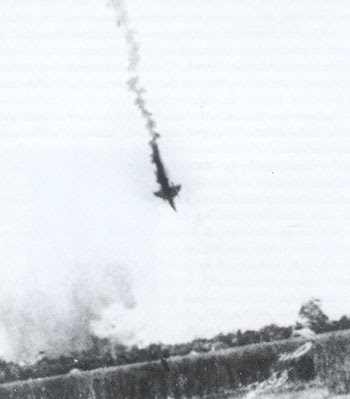
The Failed Air War Over Vietnam
or go to
Aletho News Archives – Video-Images
From the Archives
USS Liberty Massacre: A Pivotal Moment in the Hostile Takeover of America
By Kevin Barrett | Crescent | Dhu al-Qa’dah 24, 1445
In corporate America, hostile takeovers are commonplace. They occur when an aggressor—a larger corporation or rich individuals—seizes control of a smaller corporation without asking permission.
What few recognize is that the United States itself has been subjected to a hostile takeover. Since the aggressor, the illegitimate settler colony known as “Israel,” is much smaller than the US, the takeover has necessarily been surreptitious.
As of June, 2024, Israel’s gradual takeover of the US has become obvious and undeniable—a proverbial “elephant in the living room.” … continue
Blog Roll
 Aletho News
- Leaders Condemn Ansarallah Attack on Saudi Arabia While Ignoring Illegal War Against Yemen
- Leaked: Britain’s Covert Iraqi Psyops Network
- Yemeni Armed Forces Warn Airlines Against Using Saudi Airports, Exempt Mecca and Medina
- Iran security chief says powers greater than US tried to conquer Iran but ended in ‘dustbin of history’
- Europe’s mounting social chaos… chickens coming home to roost for proxy war against Russia
- US-Russia Diesel Deal Becomes Massive Defeat for Ukraine
- Hormuz and the Looming Economic Catastrophe
- Dhubab offensive, media blitz and the rapid unraveling of Saudi-backed coalition’s new gambit
- Putin Conveys to Trump Iran’s Vision on Possible Conflict Resolution – Kremlin
- The Search for Truth: Charlie Kirk’s Assassination One Year Later
- If Americans Knew
- For three years, Israel has killed a child in Gaza every 71 minutes – Daily Update
- Israeli forces kill another child in Gaza – Daily Update
- Gaza ceasefire exists in name only, say more than 100 organizations
- Nearly 2 Million in Gaza Need Urgent Shelter Assistance as Winter Looms: IOM Chief Warns
- Suppressing Palestinian resistance: US charity under fire for AI monitoring of Gaza classrooms
- Thousands Are Held in Israeli Torture Camps. This Is What Happens Inside
- Israel puts Gaza’s sick, injured, newborn in peril – Daily Update
- Report claimed Mark Levin used by Israeli government to influence Trump
- Over 2,000 Gazans have died awaiting medical evacuation amid Israel’s continued siege
- How a U.S. Diplomat Suppressed and Altered Reports Critical of Israel
- No Tricks Zone
- Germany’s Green Energy Debacle: High Energy Costs Force Kahla Porzellan to Close After 182 Years!
- New Study: 50 Years Of The Most Aggressive ‘Net Zero’ Policies Can Only Affect The Global Climate By 0.03°C
- US September “Heat” Was No Record…Many Records Set Decades Ago
- Latest European Green Energy Debacle; Portugal’s Largest Flagship Solar Park Insolvent!
- Green Energy Debacle: German Expert Professor Fritz Vahrenholt Warns Of Severe Economic And Social Consequences
- Two More Paleo Reconstructions Affirm Meters-Higher Sea Levels Across Ireland, Brazil 7000-6000 Years Ago
- New Study: Earth And Venus Surface Warmth Largely Explained By Convection And Lapse Rate, Not CO2 Or Radiation
- 2025 Nature Paper Claiming Worsening Global Drought Gets RETRACTED …Heavily Flawed
- New Study: ‘Global Drought Shows No Detectable Recent Acceleration Under Climate Warming’
- Economic Masterminds: German Socialists Suggest Taxing Productivity Gains Stemming From Using AI

