Private Palestinian land in Jerusalem slated for confiscation
Ma’an – May 28, 2015
JERUSALEM – Israeli authorities on Wednesday morning left posters in the occupied East Jerusalem town of al-Isawiya notifying owners that the property is needed for urgent military purposes for two and a half years.
The confiscation order comes amid increasing incidents of demolition of Palestinian homes throughout occupied East Jerusalem and transfer of property from Palestinian to Jewish Israeli ownership in the area.
A local committee member told Ma’an that Wednesday’s orders were posted by officers of Israel’s Civil Administration who classify the confiscation as “seizure for military purpose.”
The land, measuring 8,200 square meters, is located in the eastern side of the neighborhood Al-Isawiya near an Israeli military base established 10 years ago, Hummus told Ma’an.
The order has been signed by head of the Israeli forces Central Command Nitzan Alon and the land will be used for military purposes until Dec. 31, 2017, according to the order.
High-profile Israeli military officers are expected to arrive Thursday morning to delineate the land slated for confiscation.
Hummus explained that seizure orders such as the one issued Wednesday “temporarily” reclassify private land for military purposes orders, however orders are automatically renewed and such properties are eventually confiscated from their owners.
The land slated for confiscation Wednesday houses a farm owned by heirs of Radi Ahmad Issa Abu Riyala. Riyala passed away four years ago and has been buried in the farm.
In the last two weeks, several buildings have been demolished in the nearby Silwan neighborhood including a large three-story building newly built for Palestinian residents.
Municipal inspectors ordered the building’s demolition because the construction had been carried out without a permit from the municipal council.
In effort to gain and maintain a Jewish majority in the city, government policies make it near impossible for Palestinian residents to obtain building permits, while Jewish residents frequently take over Palestinian buildings with the protection of Israeli security, according to the Israeli rights organization the Association for Civil Rights in Israel.
The majority of Israeli PM Benjamin Netanyahu’s newly built right-wing coalition has vowed to expand settlements in occupied East Jerusalem and West Bank, with many opposing a future independent Palestinian state.
Wednesday’s seizure order move comes shortly after the newly assembled government allocated $25 million for settlement expansion in Jerusalem last week.
Ben Gurion ’48 letter barred return to Haifa
By Jonathon Cook | The Blog from Nazareth | May 27, 2015
Over many decades, Israel’s self-serving deceptions about the Nakba in 1948 have been exposed for the lies Palestinians already knew them to be.
It was long accepted in the west that, as Israel claimed, Palestinians left their homes because they had been ordered to do so by neighbouring Arab leaders. The lie usefully distracted diplomats and scholars from the much more pertinent question of why Israel had refused to allow 750,000 Palestinian refugees to return to their homes after the war finished, as international law demanded.
The myth about the Arab leaders’ order, which had been steadily undermined by the work of the “new historians” of the late 1980s, was decisively punctured two years ago by an Israeli scholar who was given the wrong file by Israeli army archivists. It showed the story of the Arab leaders’ order was concocted by Israeli officials.
The same files should also have ended an equally diverting and lengthy debate about how many Palestinian villages Israel ethnically cleansed in 1948. Most Palestinian scholars were agreed it was well over 500; Israeli experts variously claimed it was between 300 and 400. Not that hundreds of ethnically cleansed villages was not bad enough, but Israel was happy to engage in a debate designed to make Palestinians look like inveterate exaggerators. Again, Israel’s archives confirmed the Palestinian account, with 530 villages razed.
Now another, related deception has been exposed. For decades Israel’s supporters have been arguing that Haifa, one of Palestine’s most important cities, was not ethnically cleansed of its population. The tens of thousands of Palestinians who fled under Israeli attack in April 1948 were later urged to return, according to Israel’s supporters, but they chose not to. Further proof, it seemed, that the Palestinians had only themselves to blame for losing their homeland. They chose to stay away.
Strangely, none of Israel’s propagandists ever seriously tried to suggest that the other 700,000 or so Palestinian refugees had been invited back home. It seemed as if the welcome supposedly extended in Haifa was reason enough for all Palestinians in exile to put aside their fears of Israel’s shoot-to-kill policy at its new borders and make the journey home.
But now a letter signed by David Ben Gurion, Israel’s first prime minister and the engineer of its ethnic cleansing policy in 1948, shows that, far from Haifa’s doors being thrown open, Ben Gurion ordered that the refugees be barred from returning.
 Written on 2 June 1948, the letter was sent to Abba Khoushy, soon to become Haifa’s mayor. It states: “I hear that Mr. Marriot [Cyril Marriot, the British consul in Haifa] is working to return the Arabs to Haifa. I don’t know how it is his business, but until the war is over we don’t want a return of the enemy. And all institutions should act accordingly.”
Of course, that policy was not reversed after the war, as Ben Gurion hinted it might be. And one can wonder how much more specific his orders were to his army commanders if this was what he was telling civilian administrators.
The myth about Haifa was encouraged by Golda Meir, who wrote in her autobiography that Ben Gurion told her: “I want you to immediately go to Haifa and see to it that the Arabs who remain in Haifa are treated appropriately. I also want you to try and persuade the Arabs who are already on the beach to return home. You have to get it into their heads that they have nothing to fear.”
Meir added: “I went immediately. I sat on the beach there and begged them to return home… I pleaded with them until I was exhausted but it didn’t work.”
Heartbreaking – if only it were true.
How much longer must we wait to explode all the other myths associated with the Nakba, and much of Israel’s history ever since?
Arrests by US as FIFA mulls giving Israel boot
By Jonathon Cook | The Blog from Nazareth | May 27, 2015
FIFA, world football’s governing body, is due to meet this Friday in Zurich to decide whether to back a Palestinian motion to suspend Israel for its systematic violations of Palestinian footballers’ rights in the occupied territories, including preventing practice sessions and games, arresting players, denying entry to other teams, and bombing grounds, as well as for endemic racism towards non-Jewish players in Israeli football itself. I have written about this in the past: here and here.
Although a 75% majority is needed for the Palestinian motion to carry, there has been a growing sense that the mood at FIFA is shifting the Palestinians’ way. Israel and the US are, of course, deeply worried. Such a move would have strong overtones of the sports boycott against South Africa and further reinforce the idea that the description of Israel as an apartheid state holds. It would also disrupt FIFA tournaments Israel is due to host in the coming months, causing great embarrassment to Israel and FIFA’s president, Sepp Blatter.
Meanwhile, almost everyone quietly acknowledges that FIFA is corrupt from head to toe, and has been for as long as the game has been another branch of the big-business entertainments industry. Just think how impossible it would have been for a body not profoundly infected with corrupt practices to have backed desert emirate Qatar’s bid to host the 2022 tournament – in the middle of its stifling summer.
Today, however, the US decided it was time to call a halt to FIFA’s corruption. It ordered the high-profile arrest and extradition of six senior FIFA officials on corruption charges dating back to the early 1990s. The operation at the FIFA officials’ Zurich hotel, as they waited for Friday’s vote, was covered in detail by leading US media organisations after they were tipped off beforehand. Apparently it has taken the US the best part of 20 years to get round to doing the paperwork to make the arrests.
Doubtless, none of this was designed to have – or will have – the slightest effect on FIFA officials as they contemplate whether to infuriate Israel and the US by booting Israel out of world soccer.
In the meantime, you can try to shore up FIFA’s resolve by signing a petition here.
www.haaretz.com/news/world/1.658271
UPDATE:
Anyone who doubts how seriously Israel is taking the threat of being ousted from FIFA and how actively its supporters are working behind the scenes at the world body should read the comments of Avi Luzon, Israel’s representative to UEFA, European football’s governing body. Ominously, he says UEFA’s support for Israel is sown up and suggests that UEFA will prevent Israel’s suspension whatever the outcome of the vote.
I’ve said it before and I’ll say it again: UEFA will not let Israel be harmed, especially as there is no reason for it. An agreement has been reached on a four-point draft that is acceptable to [Israeli PM Benjamin] Netanyahu, [UEFA president Michel] Platini, [FIFA president Sepp] Blatter and now [Palestinian soccer chief] Jibril Rajoub.
In the worst case scenario, if the Palestinians do not agree to pull the proposal and the congress is held as planned, UEFA will prevent the suspension of Israel in a very clear way. From the conversations with important people, face to face here in Warsaw, I can say without a doubt that concern over Israel’s suspension through a vote will not happen.
Israel launches strikes across the Gaza Strip
Ma’an – May 27, 2015
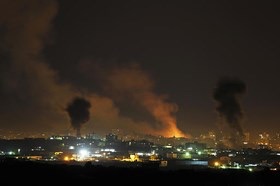 GAZA CITY – The Israeli air force attacked several targets across the Gaza Strip early on Wednesday morning, witnesses and Israel’s army said, with no casualties reported.
The first airstrike hit an agricultural area in eastern Gaza City near the ruins of Gaza International Airport at around 4:00 a.m, locals told Ma’an.
The second targeted a military site of the Hamas military wing Al-Qassam Brigades, also near the Gaza International Airport, and three missiles were fired at a Hamas military site in Beit Lahiya in the northern Gaza Strip.
Israeli fighter jets then fired a missile at a military site located in the southern Gaza Strip city of Rafah, used by Salah al-Din Brigades, the military wing of the Popular Resistance Committees.
The strikes came after a rocket fired from the strip struck southern Israel late Tuesday, causing no casualties or damage.
The Israeli army said it struck “four terror infrastructures in the southern Gaza Strip” in response to the rocket attack, according to AFP.
“The reality that Hamas’s territory is used as a staging ground to attack Israel is unacceptable and intolerable and will bear consequences,” military spokesman Lieutenant Colonel Peter Lerner said in a statement.
Hamas has not assumed responsibility for the attack, while Israel’s military initially believed Islamic Jihad to be behind the attack.
Shortly after the rocket was reported, the Palestinian Ministry of Interior decided to evacuate security headquarters in Gaza in anticipation of Israeli retaliation, while denying that Islamic Jihad leader Nafez Azzam had any link to the incident, according to a press release.
The incident comes as Palestinian residents of Gaza continue to recover from last summer’s war between Israel and Palestinian militant groups that left over 2,200 Palestinians dead, mostly civilians, and 73 dead on the Israeli side, mostly military personnel.
Tuesday’s rocket was the third fired from Gaza since the ceasefire, in addition to two mortar bombs reportedly fired at Israel since September, according to the Shin Bet internal security agency.
The UN Special Coordinator (UNSCO) released a report Monday saying the ceasefire that ended the latest war remains “perilously fragile.”
While Palestinian armed groups have test-fired around 150 rockets into the sea, Israeli forces have carried out a range of military incursions into the coastal enclave, including two air strikes, the report said.
Gaza-based Israeli watchdog Al Mezan documented Israeli forces opening fire in the border areas inside of the Gaza Strip six separate times during the first ten days of May, leaving four injured including one child.
Wednesday’s air strike was the third since the end of the 2014 war.
AFP contributed to this report.
Israeli court sentences Palestinian speaker to prison

Speaker of the Palestinian Legislative Council (PLC) Abdul Aziz Duwaik
Press TV – May 25, 2015
An Israeli military court has handed down a months-long prison term to the speaker of the Palestinian Legislative Council (PLC) and ordered him to pay more than a thousand dollars on charges on of delivering a speech at a pro-resistance celebration three years ago.
On Monday, the Ofer Court in northern Israel sentenced Abdul Aziz Duwaik to 12 months in jail and a fine of six thousand Israeli shekels (USD 1,550), Arabic-language Palestinian news agency Safa reported.
The Ahrar Center for Prisoner Studies and Human Rights condemned the verdict, demanding the immediate release of all Palestinian prisoners currently being held at Israeli detention facilities, the 67-year-old PLC speaker in particular.
Fuad al-Khafash, director of the Palestinian non-governmental organization (NGO), said the Tel Aviv regime has targeted the Palestinian parliament ever since the Palestinian resistance movement Hamas scored a landslide victory in Palestinian elections in 2006, preventing Palestinian lawmakers from serving their respective nation.
Khafash named Hassan Yousef, Mohammad al-Natsheh, Hassan al-Bourini, Mohammad Maher, Yousef Bader and Ezam Salhab as some of the Palestinian legislators that Israel holds captive in its jails.
Israeli soldiers abducted Duwaik in the occupied West Bank city of al-Khalil (Hebron) early on June 16, 2014. Palestinian sources said the senior Hamas official was taken away after his house in al-Khalil was stormed.
Meanwhile, Israeli forces have also arrested at least sixteen Palestinians, including a number of teenagers, during separate raids on a number of houses across the occupied West Bank.
Palestinian security sources, speaking on condition of anonymity, said Israeli military soldiers raided the town of Silwan, which lies on the edge of East al-Quds (Jerusalem) and al-Quds on Monday, and detained eleven Palestinians.
Israeli forces took away five other Palestinians from the entrance gate of the al-Aqsa Mosque compound in the occupied West Bank.
In recent months, Israeli forces have frequently raided the houses of Palestinians in the West Bank, arresting dozens of people, who are then transferred to Israeli prisons, where they are kept without any charges.
There have been many reports about the deteriorating health of Palestinian prisoners held inside Israeli jails.
More than 7,000 Palestinians are reportedly held in 17 Israeli prisons and detention camps. Moreover, 540 Palestinians are held without any trial under the so-called administrative detention, which is a sort of imprisonment without trial or charge that allows Israel to incarcerate Palestinians for up to six months. The detention order can be renewed for indefinite periods of time.
Hezbollah victories belong to all Lebanon: Nasrallah

Press TV – May 24, 2015
Hezbollah Secretary General Seyyed Hassan Nasrallah says the resistance movement’s success in forcing Israeli forces out of Lebanon’s soil 15 years ago was a victory for all Lebanese and Muslims.
Nasrallah made the remarks in the southern town of Nabatiyeh on Sunday during a televised speech celebrating the anniversary of the Israeli forces’ withdrawal from southern Lebanon.
He paid tribute to those who sacrificed their lives to bring victory to the resistance movement.
The Hezbollah chief added that if the the resistance movement had not risen against the Tel Aviv regime Israel would have occupied Lebanon.
Hezbollah forced the Israeli military out of the southern parts of Lebanon on May 25, 2000, after more than two decades of occupation.
People in Lebanon consider May 25 as a beginning of dramatic change in the region.
The Lebanese commemorate the day as a national holiday and see it as a transformation that changed the regional equations for good, and put an end to the invincibility myth of the Israeli military.
Nasrallah said after the Israeli regime attacked Lebanon, some groups in Lebanon hesitated to stand against the Zionist regime and even communicated with “the Israelis and considered them allies and friends.”
But, he added, some other Lebanese “did not wait for the Arab League, the United Nations Security Council, the UN, the US or the West. They rather relied on their capabilities, men, heroes and friends in Iran and Syria, and the resistance was launched.”
“This victory was achieved by some of the Lebanese who believed in resistance,” said Nasrallah.
“From the very first day, the resistance believed that it was defending all Lebanese,” he said, adding that “backstabbing and treason did not prevent it from dedicating its victory to all of Lebanon, the Arabs and the world.”
Takfiri threat
Nasrallah called on the international community and especially on the Lebanese authorities to step up fight against ISIL Takfiri group which is threatening mankind.
Nasrallah said “history is repeating itself” and a scheme spearheaded by ISIL Takfiri group is threatening the Middle East region.
“We are before a danger that is unparalleled in history,” Nasrallah said referring to ISIL terrorist group, adding, “We must understand the threat.”
Nasrallah stressed that all people in the region are facing the threat of the terrorist group, adding, “We are before a threat that does not tolerate the existence of others. All people in the region are facing this barbarous situation.”
The Hezbollah chief stated that remaining silent against the Takfiri threat would be unproductive, adding, “Those who believe that their silence would protect them and their sect are delusional. It is unacceptable to wait and we must take the initiative” against the Takfiri threat.
Nasrallah stressed that those refusing to counter the terrorist group will suffer a lot.
He said the US-led coalition allegedly fighting the terrorist group in Iraq and Syria has not been instrumental in putting an end to the brutalities of the Takfiri group.
“What has the US-led coalition done? The number of their airstrikes throughout a year is much less than the number of Israel’s raids on Lebanon in the [2006] July war or its raids on Gaza,” Nasrallah added.
He urged the Christians in Lebanon to fight the Takfiri group, asking, “Who will protect your women from enslavement and your churches from destruction?”
“We call on everyone in Lebanon and the region to shoulder their responsibilities in the face of the threat and to end their silence and neutrality,” he said, adding, “We call on you to defend your land, sovereignty and people.”
Nasrallah noted that people in the Lebanese city of Arsal are feeling the threat of the Takfiri group every day, calling on the Lebanese government to take action to save the people.
“We are ready to stand by Arsal’s people, but the state must shoulder its responsibility,” he said.
Nasrallah said Hezbollah fighters are present in Syria combating against terrorists, saying, “We are fighting alongside the Syrian army and popular resistance based on our vision that fighting there is aimed at defending everyone in Lebanon, Palestine and Iraq.”
He also called on Saudi Arbia, which has been pounding Yemen since March 26, to stop bombarding the impoverished Arab country.
Israeli interrogators use ‘brutal’ methods to obtain false confessions

Ma’an – May 24, 2015
BETHLEHEM – Israeli interrogators are using “oppressive and brutal” methods to frighten Palestinian detainees and force them into confessing to attacks against Israel, a Palestinian official said Sunday.
Issa Qarage, who heads the Palestinian Authority prisoners’ affairs committee, made his comments during a visit to prisoners’ families in the northern West Bank village of Qusin in Nablus district, where he met with former detainee Noor Muhammad Hilmi Hamamrah, 15.
Hamamrah told him that during his interrogation in the Etzion detention center, Israeli interrogators had made him open his mouth while they used pincers to forcibly pry out part of his braces, causing bleeding.
An interrogator then told Hamamrah that he would pull out all of his teeth if he didn’t confess to throwing stones at Israeli vehicles, Qarage relayed.
Qarage said that the boy eventually made the confession.
Hamamrah was detained from his family home on April 15 at 3:00 a.m. and was taken in a military truck to the nearby Beitar Illit settlement where he was held for three hours before being taken to the detention center.
An Israeli prison spokesperson could not be reached for comment on Hamamrah’s account.
Prisoners’ rights group Addameer has long reported that treatment of Palestinian detainees by Israeli forces tantamount to torture is “widespread and systematic.”
In 2014, international rights group Defense for Children reported that 93 percent of children detained by Israeli forces were denied access to legal counsel, while others endured prolonged periods of solitary confinement for interrogation purposes, a practice that amounts to torture under international law.
“Fail to obey and we will break your legs”

Baraa Kalaid Madhun in his home
International Solidarity Movement | May 24, 2015
Al Khalil, Occupied Palestine – On the 21st of May, a 16-year old Palestinian, Baraa Kalaid Madhun, was banned from his own home in Al Khalil (Hebron). Armed Israeli soldiers came to his house at 8 pm and told him to step outside. Allegedly stones had been thrown at the military base, which is adjacent to Baraa’s home, and the soldiers were accusing him of this incident.
For four hours the Israeli forces searched the house, whilst Baraa was held at gunpoint outside. They then told him that for the next 30 days, he was not allowed to be in his house between 6 in the evening and 11 in the morning. The logic behind this arrangement is based on the assumption that if during these 30 days no stones were thrown, then Baraa would be found guilty of the initial incident. The soldiers threatened to break his legs if he did not acknowledge these restrictions. Since then, armed Israeli soldiers have been searching his house each night, to see if he is there.
This latest incident is one of many. The family is constantly being harassed by the Israeli occupation forces. Baraa himself has already been arrested six times. During those previous arrests, the soldiers have been very violent, once even fracturing his shoulder.
Israel To Confiscate 820 Dunams For New Settlements’ Dumping Ground
By Saed Bannoura | IMEMC News | May 24, 2015
 The Israeli Authorities have decided to confiscate around 820 Dunams (202 acres) of privately owned Palestinian lands to establish new dumping grounds for its illegal colonies, in the central West Bank, in the Ramallah district.
The dump, according to the Israeli authorities, “would serve the settlements and the Palestinians in the area,” but would be run completely by Israel and Palestinians would have no access to it.
If the Israeli government manages to take control of the 820 Palestinian Dunams, the total impacted area from the new dumping grounds would be around 2,000 Dunams, which would be contaminated by runoff and debris.
These lands contain fertile soil and farmland, in addition to many water wells, Palestine TV has reported.
The residents plant their lands with various crops, mainly wheat, and use parts of this land as grazing grounds for their livestock. Some of the land is slated for development as residential areas, but this would be impossible once Israel takes control of the land and turns it into a dump.
Local villagers told Palestine TV that Israel is trying to push them out of the area to turn their land into a dump – many of these villagers have already lost land in past seizures by the Israeli military for the construction of illegal colonies.
NY Times Promotes Israeli Hypocrisy: “Outraged” Officials Deny Apartheid Label
By Barbara Erickson | TimesWarp | May 21, 2015
Israeli officials have backed off from a plan to bar Palestinians from West Bank bound buses, protesting in loud terms that this would smack of “apartheid,” and The New York Times has devoted much space to letting these spokespersons have their say.
We hear from Mark Regev, Prime Minister Benjamin Netanyahu’s preferred mouthpiece, from opposition leader Isaac Herzog, and—at considerable length—from Israeli president Reuven Rivlin. We also hear indirectly from Netanyahu himself. Palestinians, who bear the brunt of segregated transportation policies, are represented by a single voice—politician and physician Mustafa Barghouti.
The plan would have forced Palestinians working inside Israel (those few who manage to get permits) to use designated entry points on their return. It was put forth by settlers who objected to riding on the same buses with Arabs and was originally announced last fall but put off until after the election.
The author of the Times story, Isabel Kershner, quotes the settlers along with the officials who denounced the plan, but in spite of many column inches devoted to this debate, she omits a significant detail: Although she writes that the plan has been “shelved” or “ended,” it is actually on hold.
Where the Times story failed to take note of this, others spoke up. The newspaper Haaretz states that it is “frozen,” and the Israeli liberal advocacy group Peace Now has said that “the defense minister must announce the cancellation of the bus segregation plan rather than settle for a suspension.” Richard Silverstein of Tikun Olam predicted that “apartheid buses are what the government wants and will eventually get” and when this happens “the world be damned.”
Kershner’s story, however, leaves readers with the impression that the plan was withdrawn and skims over the inconvenient fact that it is not dead but merely in suspension. At the same time she emphasizes the rhetoric of denial emanating from Israeli officials.
Rivlin said it could have caused “an unthinkable separation between bus lines, for Jews and Arabs,” an idea that “goes against the very foundations of the state of Israel.” Herzog called it “a stain on the face of Israel and its citizens.”
Both men emphasized the harm it would cause to Israel’s image in the world, and to many observers this is precisely why the plan was put off at this moment. Its announcement came as Israel was in negotiations to prevent a suspension from the world governing body of soccer over the country’s discriminatory policies and as European Union foreign policy chief Federica Mogherini arrived to meet with Palestinian and Israeli officials.
The Israeli human rights group B’Tselem issued a press release noting that the temporary hold on the bus segregation plan was “probably due to the negative fallout for Israel’s public image,” and Silverstein wrote that the plan had been in the works for two years but was going into effect when “the time wasn’t right.”
B’Tselem also states that suspension of the bus plan leaves in place a longstanding “policy of segregation and discrimination against Palestinians that has existed on the ground.” It cited the two separate legal systems in the West Bank—one for settlers and another for Palestinians—separate roads for use by Palestinians and settlers and an “official policy of separation in downtown Hebron, and elsewhere.”
The organization notes that Palestinians who ride the buses now are already forced to arrive early in the morning to go through check points and that these are workers who have been lucky enough to get permits to enter Israel.
In the Times story the reality of segregation and discrimination in the West Bank only finds brief expression in a direct quote by Mustafa Barghouti, thus placing it in a context where readers could dismiss it as little more than rhetorical claims coming from a Palestinian opponent. The bus riders who would suffer most from the segregation plan have no voice at all.
The emphasis is on Israeli denials. We hear at length from those who are outraged by charges of apartheid, who speak in lofty terms of Israeli standards and show a sudden fit of indignation over a bus plan that has been in the works for over two years.
Readers would benefit from a look behind this rhetoric. Times reporters know, for instance, that Israel maintains separate roads and separate legal systems in the West Bank, but here we find no challenge to the official efforts to claim the high road, even in the face of obvious facts on the ground.
Lawyer: ‘Abandoned’ West Bank church compound was not sold to settlers
Ma’an – May 23, 2015
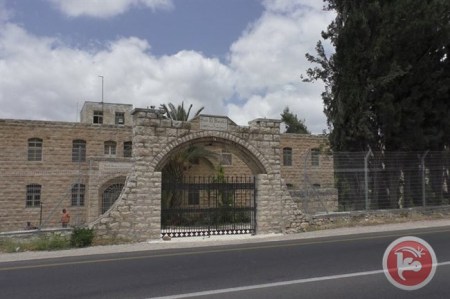
HEBRON – A Swedish-owned church compound between Bethlehem and Hebron has not been sold to settlers contrary to media reports on Friday, the church’s lawyer told Ma’an on Saturday.
Israeli news source Haaretz reported Friday that right-wing Israeli Aryeh King had purchased the abandoned church compound from the church’s owners three years ago in order to build a settlement outpost.
However, local sources refuted the report, saying that such a sale had not been made and that the current owners are in fact carrying out refurbishments to turn the compound into a hostel.
“The church owns the compound, and is fixing up the existing building to serve as a hostel for Christians, Muslims, and Jews who are passing through,” the church’s Swedish lawyer Ari Souko told Ma’an.
The lawyer also reportedly told Muhammad Ayyad Awad, a spokesman of a local popular committee in nearby village Beit Ummar, that the church “has not been sold to settlers,” and that the Haaretz report was “far from the truth.”
Awad told Ma’an that the compound had been built decades after the owners bought 35 dunams (9 acres) of land from Beit Ummar resident Abd al-Latif Jabir Ikhlayyil.
The building then served as a hospital offering free medical treatment to local residents. The hospital continued to operate until the early 1980s but closed due to financial difficulties. Since then the building has been deserted, Awad said.
While Haaretz reported Friday that Aryeh King had recently started to refurbish it ahead of establishing a new settlement outpost in the area, Souko told Ma’an that such refurbishments were being carried out and funded by the church for the planned hostel.
Although the church remains in Swedish hands, the Haaretz report reflects a current trend in Israeli settlement practices, particularly in occupied East Jerusalem.
Aryeh King is founder and director of Israel Land Fund, an organization that buys Palestinian property and homes for resale to Jews with the aim of ‘Judaizing’ occupied East Jerusalem as well as Palestinian neighborhoods in Israel.
The church lies in a sensitive location, which if settled, would see Israeli settlements stretch all the way from the Gush Etzion settler bloc south of Jerusalem to the cluster of settlements around Hebron.
Currently Karmei Tzur is the only large settlement between the two.
Palestinians living in occupied East Jerusalem face ongoing threat of being pushed out by groups such as Israel Land Fund.
While Israeli government policies make it nearly impossible for Palestinian residents to obtain building permits, Jewish residents frequently take over Palestinian buildings with the protection of Israeli security.
Israel’s deputy FM: ‘This land is ours. All of it is ours’
MEMO | May 22, 2015
Israel’s newly appointed Deputy Foreign Minister Tzipi Hotovely yesterday told ministry employees that all of the land of Israel belongs to Jews only.
Israeli media quoted Hotovely as saying that Israeli diplomats around the world need to begin acting according to the principle of “being right and not just smart”.
Hotovely, 36, who served as deputy transport minister in the previous government said: “Many times it seems that in our international relations, more than emphasising the rightness of our cause, we are asked to use arguments that play well diplomatically.”
“But at a time when the very existence of Israel is being called into question, it is important to be right,” she added.
She went on quoting late settler leader, Uri Elitzur, saying for “the last 40 years, while the Palestinians were demanding their lands, Israel responded that ‘we have strategic interests and security concerns’.” According to her, those arguments are the arguments of a robber.
“If I wear your coat because I’m cold, and I can prove pragmatically and analytically that it really is cold for me, the world will ask a primitive and analytic question: Who does the coat belong to? In this context, it is important to say that this coat is ours; this country is ours, all of it. We didn’t come here to apologise for that,” she said.
Hotovely claimed that the world understands Israel’s security needs, but arguments based on justice and morality always trump those dealing with security concerns.
“If the Jews were convinced in the righteousness of their path, and that is their land, they would manage with the world,” she said.
Israel’s Haaretz newspaper said several diplomats and ministry employees disapproved of Hotovely’s remarks.
Featured Video

Seyed M. Marandi: US-Iran War Inevitable: Kuwait and Bahrain May Fall
or go to
Aletho News Archives – Video-Images
From the Archives
Oil and the Israel Lobby
Reknowned economist M. Shahid Alam offers this excellent critique of Noam Chomsky’s defective analysis of the relative influence of Oil versus the Israel lobby over US foreign policy: … continue
Blog Roll
 Aletho News
- ICC ignored ‘very well-documented’ NATO crimes – ex-Libyan minister
- SNSC secretary dismisses US response to Iran’s conditions as ‘inadequate’
- Sanaa says Taiz roads open, secure for residents, warns Saudi forces
- Iraqi resistance group urges Saudi leadership to admit defeat, lift Yemen siege
- Trump’s Retreat: How Al-Aqsa Flood Took Down the US Empire
- Israel’s Military Actions in Lebanon Grossly Violate International Law — Lavrov
- Seyed M. Marandi: US-Iran War Inevitable: Kuwait and Bahrain May Fall
- Leaders Condemn Ansarallah Attack on Saudi Arabia While Ignoring Illegal War Against Yemen
- Leaked: Britain’s Covert Iraqi Psyops Network
- Yemeni Armed Forces Warn Airlines Against Using Saudi Airports, Exempt Mecca and Medina
- If Americans Knew
- How Israel Conquered the Latin American Right
- Agents search Rep. Omar’s Washington home in criminal probe as she vows she won’t ‘be silenced’
- “The Rule Was: ‘Shoot Everyone You See'”
- Israel goes ballistic over Nobel Laureate Navi Pillay
- U.S. May Join Yet Another Middle Eastern War — TCN
- Yellow Line moves again as Israel closes in on trapped Gazans – Daily Update
- Israeli Attacks Kill Seven Palestinians in Gaza Including Six-year-old Girl
- Gaza: Ceasefire Anniversary Marks Year of Failed Promises
- The American Conservative: Mike Huckabee Should Resign
- A C-Section in Shackles: A Palestinian Woman’s Harrowing Birth in Israeli Detention
- No Tricks Zone
- Germany’s Green Energy Debacle: High Energy Costs Force Kahla Porzellan to Close After 182 Years!
- New Study: 50 Years Of The Most Aggressive ‘Net Zero’ Policies Can Only Affect The Global Climate By 0.03°C
- US September “Heat” Was No Record…Many Records Set Decades Ago
- Latest European Green Energy Debacle; Portugal’s Largest Flagship Solar Park Insolvent!
- Green Energy Debacle: German Expert Professor Fritz Vahrenholt Warns Of Severe Economic And Social Consequences
- Two More Paleo Reconstructions Affirm Meters-Higher Sea Levels Across Ireland, Brazil 7000-6000 Years Ago
- New Study: Earth And Venus Surface Warmth Largely Explained By Convection And Lapse Rate, Not CO2 Or Radiation
- 2025 Nature Paper Claiming Worsening Global Drought Gets RETRACTED …Heavily Flawed
- New Study: ‘Global Drought Shows No Detectable Recent Acceleration Under Climate Warming’
- Economic Masterminds: German Socialists Suggest Taxing Productivity Gains Stemming From Using AI

