Sixteen Legislators Currently Imprisoned By Israel, Soldiers Kidnap Leftist Legislator Khaleda Jarrar
By Saed Bannoura | IMEMC News | April 2, 2015
The Palestinian Prisoners Society (PPS) has reported that Israel is currently holding captive sixteen democratically elected legislators, including Khalida Jarrar, who was kidnapped earlier Thursday.
The PPS issued a press release stating the nine of the imprisoned Palestinian legislators are held under arbitrary Administrative Detention, without charges or trial.
The Nine are Hasan Yousef, Abdul-Jaber Foqaha, Mohammad Jamal Natsha, Mohammad Bader, ‘Azzam Salhab, Nayef Rajoub, Bassem Za’arir, Mohammad Abu Teir and Abdul-Rahman Zeidan.
The PSS added that five legislators have been sentenced to different terms, including Marwan Barghouthi, who was kidnapped by the army in 2002, and was sentenced to five life terms, and legislator Ahmad Sa’adat, the secretary-general of the Popular Front for the Liberation of Palestine (PFLP), who was kidnapped in 2006, and was sentenced in 2008 to 30 years.
Israel is also holding captive legislators Nizar Ramadan, Hosni al-Bourini, Riyad Raddad, in addition to the head of the Palestinian Legislative Council (PLC) Dr. ‘Aziz Dweik.
Earlier on Thursday, soldiers stormed the home of legislator Khalida Jarrar, in the central West Bank city of Ramallah, and kidnapped her.
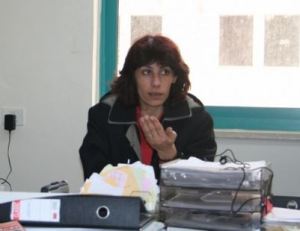 Media sources in Ramallah said at least sixty Israeli soldiers, and security officers, invaded Ramallah, before storming into the home of the feminist leader, and prominent human rights advocate, and violently searched her property, before kidnapping her.
The sources said the soldiers kicked down the door of Jarrar’s home, and held her husband in a separate room, while searching the property, and kidnapped the legislator.
Jarrar is also a senior political leader of the Popular Front for the Liberation of Palestine (PFLP), former executive director of the Addameer Prisoner Support and Human Rights Association, and a current member of its board.
The Legislator is also the chairwoman of the Prisoners’ Committee of the Palestinian Legislator Council (PLC).
The Palestinian Prisoner Solidarity Network has reported that Israel has been denying Jarrar the right to travel outside of Palestine since 1988, and that, in 2010, it took a public campaign lasting for six months before the Israeli Authorities allowed her to travel to Jordan for medical treatment.
On August 20 2014, Jarrar received an Israeli military order instructing her to leave Ramallah to Jericho, within 24 hours, but in September of the same year, the legislator managed to overturn the order.
Her abduction now raises concern that the Israeli Authorities might be planning to force her out of Ramallah, or to imprison her for an extended period.
Home demolition in Jerusalem: “They want our land. We need help to protect it.”
International Solidarity Movement | April 1, 2015
Jerusalem, Occupied Palestine – Nureddin Amro and his brother Sharif Amro and their families were awakened at 5:30 am by over a hundred Israeli soldiers who came to demolish their home in the Wadi Al-Joz neighborhood of occupied East Jerusalem on Tuesday, March 31, 2015. Both men are blind. The brothers live with their ill 79-year-old mother, their spouses and children. Nureddin has three young children, Sharif has four; all are under 14. Israeli soldiers pointed their guns in through the windows of the house while the children were still asleep and cut the electricity and phone lines to the house.
“We were asleep. They banged on the doors and shouted. Soldiers completely surrounded the neighborhood. There were dogs and aircraft. It was frightening,” said Nureddin. “There was no advanced notice. No reason given. They announced that they came to demolish the house and they started doing it while we were still inside.”
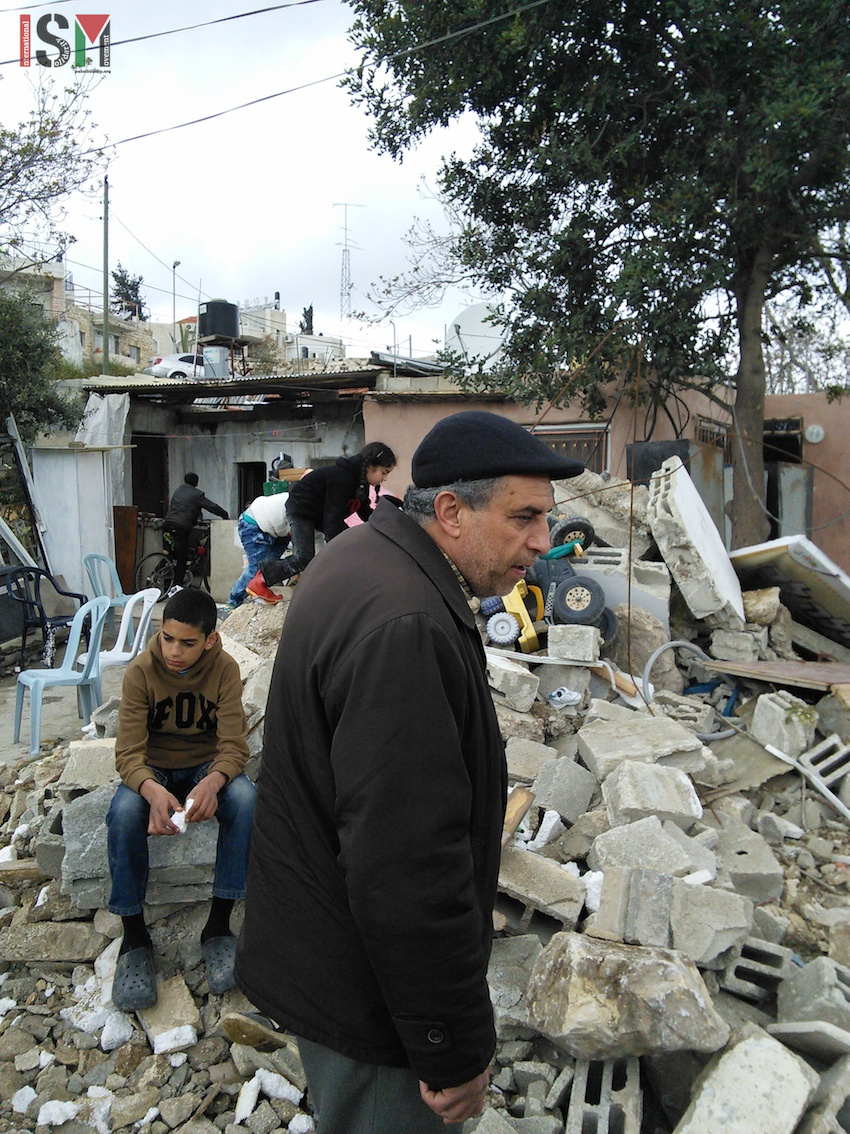
The Amro family stands in the rubble of their demolished home
Nureddin asked for time to go to court or the municipality for an explanation, but the soldiers refused. The soldiers assaulted the family, kicking Sharif and beating everyone, including the women and children. “They attacked us and locked us in one of the rooms. My son and brother were injured. They stayed for four hours and destroyed four rooms, the garden. They would not give us time to take anything from the rooms. All of our things, the children’s pets, their rabbits and chickens were killed under the rubble” Sharif was taken to the hospital after a soldier kicked the blind man hard in the ankle. Israeli forces refused to even let the family salvage their belongings before they tore it down.
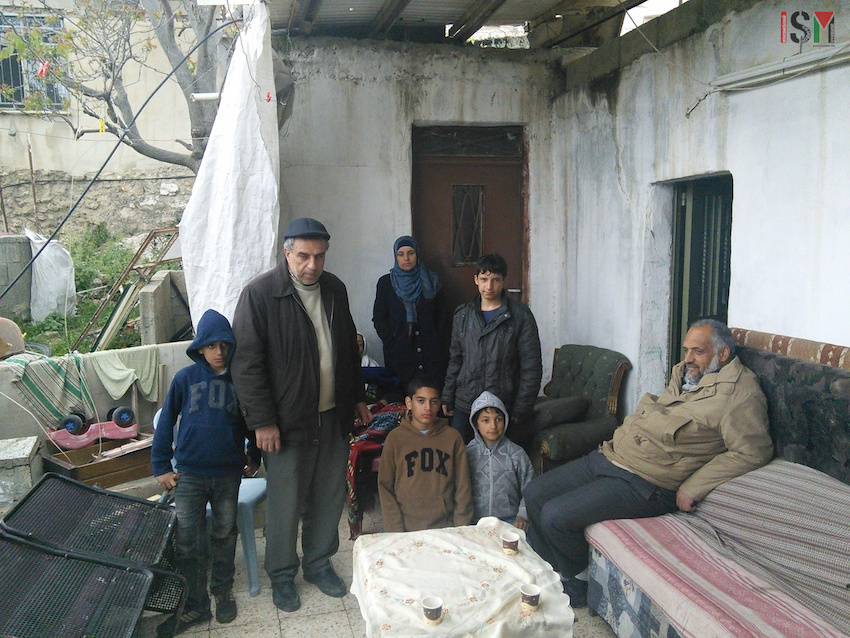
Members of the Amro family gathered beside the part of their home that is still standing
Nurredin is the founder and principal of the Siraj al-Quds School for visually impaired and sighted children in Jerusalem. He is a Synergos Institute Social Innovator and was recognized by the British Council for his leadership working for positive change and social development for people with special needs. According to Nureddin, there was no demolition order against the homes although there have been demolitions in the neighborhood before. They had received warnings a couple of months ago to clean up scrap wood, wires and materials that were around the house, and they did the cleaning as required.
While they were demolishing the rooms of the Amro family’s home Israeli forces destroyed a fence on the neighboring Totah family’s land, along with a shelter that housed a horse, chickens, and a dog. Soldiers also cut the family’s internet and broke the water line. The father of the Totah family was beaten, handcuffed, and arrested; he was later released.
As of this writing, the part of the house that remains standing where Nureddin and his brother are staying with their families; still has no electricity, water, sewage or telephone services. Soldiers returned to the family’s home again this morning, moving the rubble that was visible from the street and threatening that they would be back.
Israeli authorities have already annexed land across from the Wadi Al-Joz neighborhood, creating a national park which encompasses an illegal Israeli settlement. Local residents reported, speaking of the constant threat of settlement expansion under the Israeli occupation, that “they want to get rid of all the houses, all the neighborhood. They want to put their hands on this land from here to the Old City.”
Palestinian woman sentenced to 70 months in jail
Ma’an – 01/04/2015
 JENIN – An Israeli military court on Tuesday sentenced a Palestinian woman to 70 months in jail, with a suspended sentence of 24 months, a local foundation said.
Muhjat al-Quds Foundation for Prisoners and Martyrs said Muna Qadan, 43, was arrested from her house on Nov. 13, 2012 and has attended over 22 court hearings since. She is currently being held at Hasharon prison and has been ordered to pay a fine of 30,000 shekels.
Qadan, from Arraba village near Jenin, is the sister of jailed Islamic Jihad leader Tariq Qadan, and the fiance of another Islamic Jihad leader serving a life term in Israeli jails, Ibrahim Ighbariya.
Qadan has previously spent over four years in Israeli jails on several terms for being associated with the political group Islamic Jihad, and was one of the prisoners freed in the 2011 Shalit prisoner swap deal. Rights groups criticized Qadan’s rearrest as clear violation of the terms of the prisoner swap.
The Qadan family has been active in resistance activities within Israeli prisons. Tariq engaged in a life-threatening hunger strike in February 2013, while Muna threatened Israeli authorities with a jail-wide hunger strike in June 2013 in response to Israeli denial of medical treatment to fellow detainee Lina al-Jarbouni.
The majority of Palestinian political organizations are considered illegal by Israel, and association with such parties is often used as grounds for imprisonment, according to Prisoner Support and Human Rights Association Addameer.
The use by Israel of political affiliation as punishable by imprisonment has brought international criticism. Political prisoners held in Israeli jails routinely face isolation, torture, medical neglect, denial of family visits, as well as denial of fair legal processes, as reported by Addameer.
Last summer’s Israeli aggression is sending Gaza back to the Middle Ages
Zionist colonisers destroy the tools for self-sufficiency of Palestinians in Gaza
By Miguel Hernández | International Solidarity Movement | March 31, 2015
Gaza, Occupied Palestine – Months after the last massive Israeli aggression against the Gaza Strip, thanks to the social and independent media, everyone has read news and seen pictures of the attacks from the Zionist regime against residential buildings, United Nations shelter-schools, hospitals, ambulances, mosques, churches and thousands of family homes.
However, little has been said about the almost complete destruction of Gaza’s industry and economy. As the Israeli Minister of Interior Eli Yishai said, the objective of the last operation was to “send Gaza back to the Middle Ages, destroying all of its infrastructure.” One of the more terrible blows committed towards this end has been the total destruction of the Beit Hanoun industrial area.
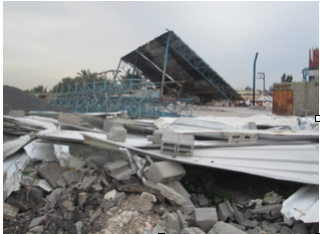 There were around 50 factories in Beit Hanoun, from which only three have been able to resume work seven months after the end of the assault.
 The factories in this industrial area provided work for 25% to 30% of Gaza’s population. Among the destroyed factories are those for paper, construction materials, clothing, medical equipment, plastic products, food and livestock products.
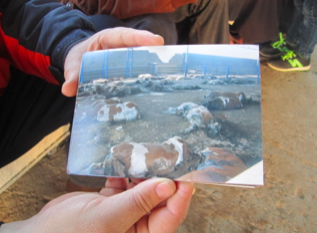 The agricultural industry has also been wounded by Israel’s summer attacks on Gaza. The owner of the Afanah Company showed us the pictures of his 800 cows killed by Israeli attacks during the last war on Gaza. Each cow was going to feed 7 families during the Eid holiday. Besides losing all his cows, Israel also destroyed the four fridges of the company, which contained 400 tons of meat.
Abu Fakhri Abu Ghais, from Beit Hanoun, explained how during the last massacre Israel killed his 17 sheep, and all his sons’ sheep, they destroyed all his farming equipment, worth over 15,000 US dollars. Israeli forces also destroyed the pumps for extracting the groundwater and the 20 tons of reserve of wheat seeds that Abu Fakhri had stored for the current year. The occupation also demolished the cabling that brought electricity to his village, Abu Safiya. He and his family now live in a tent without water or electricity, as his home was also destroyed.
 He and his family now live in a tent without water or electricity, as his home was also destroyed. Given the blockade imposed by Israel on the Gaza Strip, the struggling government of Hamas informed him that they don’t know when they’ll be able to restore the power supply, as they do not have available wire that is long enough.
In a Bedouin village located at the North of Beit Lahia, Hassan Sharadkha invited the author and his companions for a cup of tea in the wood cabin that he has built next to the rubble of his home. He showed us the pictures of everything he lost during the last summer at the hands of the Zionist occupation forces: 32 dunums of fruit and olive trees, 27 sheep and their stable, 2 cows, a 200 chicken farm, a horse, the water pump and the car he had just bought.
His older son, an electric engineer, was made unemployed because the solar panel company he worked for has also been bombed.
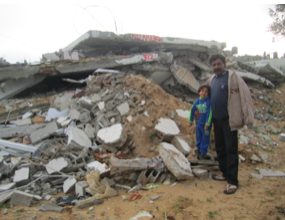 Ninety per cent of the Palestinian farmers in Gaza live in similar or worse circumstances.
 These attacks – against factories, farms, farming equipment and homes – were not by chance or accidental. These attacks demonstrate once again that the target of the genocidal Israeli colonialism is the Palestinian people itself, and that the war that Israel has been waging the last 66 years, under cover of Europe and the US, is against a nation, Palestine, that they seek to wipe off the map.
Israeli explosive artillery fired on Gaza up more than 500% in 6 years – UK study
RT | March 31, 2015
Civilians living under Israeli occupation in the besieged Gaza Strip face a greater risk to their lives in the wake of a recent shift in Israel’s “military rules of engagement,” a new study warns.
In a report released on Tuesday, British NGO Action on Armed Violence (AOAV) said theIsrael Defense Force’s (IDF) use of artillery on Palestinians is characterized by a“wide gap between public rhetoric and the reality on the ground.”
The think tank warned Gazan civilians face a greater risk of death from Israeli “artillery shelling” than they did prior to 2005.
As part of its research, AOAV examined regulations dictating where the IDF have deployed explosive weapons since 2005.
While Israel withdrew its ground troops from Gaza in 2005, the IDF’s air, land and sea blockade of the coastal strip remains steadfast.
AOAV’s research, ‘Under Fire’, examined suggestions made by Israeli officials that the IDF have greatly improved the protection of Palestinian civilians from the effects of its explosive artillery.
Israeli military experts often describe such artillery as ‘statistical weapons,’ according to AOAV. The think tank argues this terminology reflects the “inherent accuracy” of explosive weapons, which fire repeated rounds of “heavy, unguided shells.”
Because these explosive weapons lack accuracy, they require particularly robust rules to protect civilians from unintentional ‘collateral damage,’ AOAV says.
The think tank’s report reveals that rather than decreasing the risk of civilian deaths from Israeli explosive weapons, the IDF’s rules regulating such practices have been relaxed since its ground troops withdrew from Gaza in 2005.
As a result, Gazan civilians face a greater risk of dying from Israeli artillery shelling than they did nine years ago, AOAV said.
Director of policy at AOAV, Iain Overton, stressed unguided artillery shells are a “relic of a bygone day.”
He said there is no reason to prevent the IDF from scrapping its use of such dangerous and destructive weaponry in civilian populated areas.
The think tank’s research found 2014 was characterized by the heaviest use of “high-explosive artillery shells” in eight years.
Despite Israel’s investment in alternatives to the artillery it traditionally used, a minimum of 34,000 “unguided shells” were fired into Gaza last year, AOAV said.
This marks an increase on the number of unguided artillery shells launched in any IDF military campaign since the Lebanon War of 2006, it added.
The think tank’s report revealed the IDF launched almost five and a half times as many “high explosive artillery shells” during its military assault on Gaza in 2014 as it did during its military offensive against Gaza in 2008/09.
It added the IDF has dramatically reduced the distance that regulates how close artillery shells can land to residential homes in recent years. While this distance stood at 300 meters in 2005, the IDF shortened this limit to 100 meters in 2006.
AOAV said this policy shift puts civilians at greater risk because the estimated “casualty-producing radius of a 155mm artillery shell is close to 300 meters.”
The think tank’s report concluded the only policy to have yielded a clear improvement in the rate of civilian casualties in Gaza was a temporary suspension on artillery shelling implemented in December 2006. After 2008, however, this measure was scrapped.
“In recent years the IDF has shifted away from using other devastating weapons like multiple rocket launchers or globally-banned cluster bombs,” Robert Perkins, Senior Researcher at AOAV, said.
“It doesn’t seem like this shift has extended to unguided heavy artillery, but these wide-area effect weapons have no place in an urban populated area, where their effects cannot be controlled.”
A UN report published last week found more Palestinian civilians died as a result of the conflict with Israel in 2014 than in any year since 1967.
The report, published by the United Nations Office for the Coordination of Humanitarian Affairs (OCHA), claimed Israel’s Operation Protective Edge resulted in the death of over 2,220 Palestinians, 1,492 of whom were civilians.
In what the OCHA described as the “worst escalation of hostilities” since the Six-Day War in 1967, 71 Israelis were also killed, 66 of whom were soldiers.
Read more: Palestinian death toll in 2014 highest since 1967 – UN
University of Southampton cancels Israel conference, citing ‘health and safety’
MEMO | March 31, 2015
The University of Southampton has withdrawn permission for a conference next month on Israel and international law, citing “health and safety” concerns.
The university has been under significant pressure from pro-Israel lobby groups in the UK to cancel the conference, despite legal obligations to protect free speech.
Conference organisers confirmed Tuesday morning with “extreme astonishment and sadness” that Southampton authorities have pulled the plug on the gathering.
We were told that the decision was taken on the grounds of health and safety: a number of groups may be demonstrating for or against the conference which could present risks to the safety of the participants, students and staff. The University claims that it does not have enough resources to mitigate the risks, despite a clear statement from the Police confirming that they are able to deal with the protest and ensure the security of the event.
In their statement, organisers say that they are “extremely dissatisfied with the risk assessment conducted by the University”, where “high risks remained high even when seemingly effective mitigating measures were put in place.”
Organisers claim that the “security argument” has been used “to rationalise a decision to cancel the conference that has been taken under public pressure of the Israeli Lobby”, calling it a “sad decision for freedom of speech.”
Conference organisers say that they will now “explore legal emergency measures to prevent the University from cancelling the conference, to reverse its decision and to properly collaborate with the police so that the demonstrations can be managed.”
Declaring Independence from Israel
It’s Way Overdue!
By Philip Giraldi • Unz Review • March 31, 2015
When Republican Presidential contender Senator Ted Cruz announced his intention to run before a packed audience at Liberty University in Lynchburg Virginia, the one line in his speech that drew the most applause was “Instead of a president who boycotts Prime Minister Netanyahu, imagine a president who stands unapologetically with the nation of Israel.” I do not know if those who were cheering were really aware of what Cruz was saying, but the preposition “with” committing President Cruz to some kind of ad hoc equal partnership with a foreign government was both unseemly and ultimately un-American. A President of the United States should be prepared and expected to advance only American interests.
There is no ambiguity in Cruz. As keynote speaker for a conference held last September by the newly formed In Defense of Christians group, he demonstrated that even in front of Middle Eastern Christians it was necessary to play the Israel card, bringing Jewish “persecution” into the discussion before walking off stage. Just before exiting, he said, “If you will not stand with Israel and the Jews, then I will not stand with you. Good night, and God bless.”
A day after Cruz and Liberty it was Jeb Bush’s turn. He repudiated James Baker, his father’s secretary of state, after Baker had mildly criticized Netanyahu’s rejection of a possible Palestinian state, with Bush’s press spokesman asserting “Governor Bush’s support for Israel and Prime Minister Netanyahu is unwavering.” In a follow-up op-ed last Wednesday, Bush cemented his credentials as a worthy heir to his brother George in terms of intellectual vacuity by opposing nuclear negotiations with Iran before asserting “The Obama administration treats announcements of new apartment buildings in Jerusalem like acts of aggression.” Jeb is apparently unaware that there are half a million settlers on the West Bank on stolen Palestinian land.
Every Republican presidential wannabe makes an obligatory trip to Israel to kiss Netanyahu’s ring. And the neoconservative claque is meanwhile crowing about Bibi, calling him the “leader of the free world.” One blogger quipped “Has it got to the point that the GOP should cut through all the red tape and simply nominate Benjamin Netanyahu as their 2016 candidate?”
The most recent GOP presidential candidate Mitt Romney went so far as to pledge himself to take Israel’s advice before doing anything in the Middle East. Cruz, like Romney, has made very clear his willingness to be guided by Israel and it appears that Bush 3 will do more of the same. As will every other leading Republican, including Rand Paul who recently defended critics who claimed that he was applauding too slowly during the Netanyahu speech, saying “I gave the prime minister 50 standing ovations, I co-sponsored bringing him here.”
Marco Rubio another presidential aspirant, has already declared that if he is elected president, he would be willing to defy America’s European allies if necessary to revoke any deal with Iran he might inherit. Rubio’s foreign policy advisers feature Dan Senor, Elliot Abrams, Robert Kagan and Eric Edelman.
Selling out to Israeli interests has become de rigueur for Republican politicians and presidential hopefuls as well as for a heck of a lot of Democrats as well. Former Bill Clinton U.N. Ambassador Bill Richardson recently commented that Israel is “our anchor in the Mideast. Our beachfront is Israel. They’re our strongest ally” while Senator Chuck Schumer, who is poised to become Senate Minority Leader, has declared “One of my roles, very important in the United States senate, is to be a shomer – to be the shomer Yisrael (guardian for Israel). And I will continue to be that with every bone in my body …”
The description of Israel as a close ally is not true, of course. Though Israel is persistently referred to as America’s greatest friend by the chattering class it is not legally or practically an ally at all and never has been. And then there is the recent revelation that Israel not only spied on American officials negotiating with Iran but also used the information obtained with members of Congress to undercut the talks. It is quite possible that Netanyahu was getting his intelligence from someone inside the United States delegation, raising a perhaps more troubling issue about the loyalty of some senior officials. It also suggests that at least some Congressmen received briefings from the Israeli government that included classified information obtained from the U.S. negotiating team and did nothing about it.
That revelation of spying came on top of Benjamin Netanyahu’s apparent strategic decision to deal only with American leaders whom he likes and who like him in return. His 2012 endorsement of Romney preceded an unrelenting two year campaign excoriating the Obama Administration for its “weakness” regarding Iran. There have been two speeches by Netanyahu before Congress piling on more of the same but the coup de grace came when a desperate Netanyahu seeking reelection explicitly rejected the U.S. backed negotiations seeking to create a peaceful settlement for the Israel-Palestine problem. And then Netanyahu, confident that he can get away with anything without consequence, threw into the hopper a racist rant encouraging right wing support at the polls in Israel by creating fears over Israeli Arabs who might want to vote.
Senator John McCain inevitably accused President Obama of having a tantrum and told him “to get over it” after the White House expressed some concern regarding the extreme right wing Israeli election result. And now that the elections are over, it is reported that Israeli intelligence officers who exposed some of Netanyahu’s lies will be purged after the new government is formed. The GOP majority in Congress meanwhile has already rewarded Bibi for his enlightened statesmanship by giving him 50 ovations, thanking him for making the American Secretary of State and President look ridiculous. Forty-seven Senators subsequently signed a letter to the Iranian leadership warning that they would repudiate any nuclear agreement entered into by President Obama and Speaker of the House John Boehner will be traveling to Israel this week, presumably to personally thank Netanyahu for his understanding and continued support.
And meanwhile Washington continues to reward Israel with more than $3 billion per year in direct assistance plus billions more in tax exempt “charitable contributions” from American citizens, some of which goes to build illegal settlements. It continues to provide Israel with political cover at the United Nations; supplies it with weapons, some of which have been used in contravention of American law; and it regularly defers to Israeli concerns about the political situation in the Middle East.
As a reward for Washington’s largesse, Israel’s many enemies have made the United States a terrorist target. And then there is what the White House and Justice Department (DOJ) do not do. Israel is the number one “friendly” country in terms of the level of espionage directed against the United States but the federal government chooses not prosecute the hundreds of Israelis and Americans caught spying. The DOJ has even blocked any inquiries by concerned citizens into the details of Israeli espionage using mechanisms like the Freedom of Information Act.
One might well come to the conclusion that the American people are not very well served by all of this nonsense. Israel has sometimes been called the “fifty-first state” but it is worse than that as it pays no taxes, is never held accountable for anything, damages U.S. interests and is a net beneficiary at all levels. And all of Netanyahu’s subterfuge has taken place against a backdrop of repeated U.S. pledges of support for Israel coupled with fulsome assertions by policy makers that America “has Israel’s back” if there is any conflict in the region, a virtual commitment that Washington will join in any war that Tel Aviv initiates.
As Israel has done and continues to do grave damage to the United States through its actions, it is past time for an amicable divorce, to enable the dog to again wag its tail, as it were. It is quite possible to wish Israel and the Israeli people well without having to become an accomplice in war crimes. As there is more than sufficient justification to change the existing injurious special relationship, I would propose a new Declaration of Independence, this time not directed at King George III but at King Bibi Netanyahu and his associates in government.
As a prologue to the injuries suffered by the United States, I cannot put it any better than did America’s Founders: “When in the Course of human events, it becomes necessary for one people to dissolve the political bands which have connected them with another, and to assume among the powers of the earth, the separate and equal station to which the Laws of Nature and of Nature’s God entitle them, a decent respect to the opinions of mankind requires that they should declare the causes which impel them to the separation:”
- Washington wishes Israel and all other countries in the Middle East well and hopes that they will prosper, but from now on Israel, having abused its privileged position, must be treated just like any other country, with the depth of the bilateral relationship dictated by actual American interests.
- American taxpayer contributions to Israel’s high tech first world economy are both unnecessary and unwarranted and will cease.
- Diplomatic protection of Israel at the United Nations and in other international bodies damages American interests and will only be considered when Israeli and U.S. interests coincide.
- Israeli has violated U.S. laws regarding the use of American provided military equipment for defensive purposes only. Future sales of equipment will be reviewed and American military equipment prepositioned in Israel will also be removed.
- Because it is a violation of Article 4 of the U.S. Constitution American intelligence agencies will no longer share raw data obtained illegally on American citizens with Israel.
- Because funding the occupation of the West Bank is illegal, any private donations to Israel will only be considered charitable when it can be demonstrated that the recipients are actually eligible for that tax status.
- As it is in Washington’s interest to do so, the United States will be free to negotiate with Iran, Syria and all other countries in the Middle East. The United States will specifically respect the national integrity and sovereignty of all nations in the region, i.e. there will be no more threats that a “military option” is on the table.
- As there is a clear conflict of interest, trips to Israel funded by private foundations and lobbies to acquaint Congressmen, military officers, and other elected officials with the Israeli point of view will be considered gifts and subject to appropriate regulation and taxation.
- Israeli lobbying groups to include AIPAC, WINEP and JINSA have done great damage to the interests of the United States and will be required to register under the Foreign Agents Registration Act of 1938.
- How Israel conducts its domestic governance is its own business, but the United States will oppose the continuation of legal and administrative infringements on the fundamental rights of ethnic and religious minorities in any and all countries, including those that regard themselves as democratic, to include Israel’s treatment of its Arab minority.
- As it is in the United States interest to do so, Washington will support in international fora the creation of a sovereign and functional Palestinian state to include full recognition by Washington, understanding that the persistence of the Palestinian problem has been both an incubator of and recruiting poster for terrorism worldwide.
- Stealing American high technology and government secrets has done grave damage. Israelis and Americans caught spying against the United States will be arrested, charged and prosecuted under applicable statutes. There will be no exceptions.
I am convinced that a new Declaration of Independence will be good both for the United States and for Israel. The U.S. can remove the issue of Israel from its fractious political discourse and will at last be free of a major distortion in its ability to conduct foreign and security policy based on America’s own interests. Israel, which is militarily dominant in its region, can begin to think seriously of how to coexist with its neighbors rather than bomb them into submission. A reset for both countries would be healthy as well as the right thing to do.
Youth shot by Israel for waving flag and flashing V sign
Palestine Information Center – March 28, 2015
 Anas Qdeh, 21, had no idea that waving the Palestinian flag and flashing the V sign is a crime for which he will be shot by the Israeli Occupation forces (IOF) which fired explosive bullets directly at his legs while he was with scores of citizens about 10 meters away from the security fence separating Khan Younis from 1948 occupied lands.
We will never give up on our land
Qdeh told the PIC reporter: “On Friday March 20, I headed to our land east of al-Sanati in Greater Abasan where many youths gather every Friday to stress that this is our land and that we will never give up on it even if Israel isolated it.
The IOF imposed a buffer zone adjacent to the security fence along the borderline with the Gaza Strip stretching for distances ranging from 300-700 meters deep into the Strip and shoots whoever enters it.
Qdeh clarified the circumstances of his injury saying: “One of my friends wanted to take a picture of me waving the Palestinian flag with the V sign while we were in our land which the IOF is preventing us from reaching in Greater Abasan east of Khan Younis. However, the IOF soldiers started shooting at us and I was hit with an explosive bullet.”
Explosive bullet
The bullet hit one of the youth’s legs, and the shrapnel scattered to hit his other leg and his cousin Fawzi Qdeh who was nearby. Anas lied on the ground profusely bleeding before he was rushed to hospital to be urgently treated.
His cousin Fawzi Qdeh, 23, said with a smile drawn on his face that a piece of shrapnel is still lodged in his left shoulder and doctors told him that it is difficult to extract it at this stage.
He clarified that he was rearing his goats in al-Santai lush fields, and when he saw the youths gathering and chanting he joined them to see what was going on and to take photos.
Every Friday, scores of Palestinians spontaneously gather near the security fence waving flags and chanting anti-Israel slogans.
Israeli forces briefly hold, threaten Ramallah governor
Ma’an – 28/03/2015
RAMALLAH – Israeli forces briefly detained the governor of the Ramallah and al-Bireh district, Laila Ghannam, at the entrance of Nabi Saleh village in the northern Ramallah district on Saturday.
Soldiers reportedly threatened the governor of “direct targeting” if she continues to participate in the weekly march organized by the popular committee against settlements and the separation wall in Nabi Saleh.
Ghannam said “we will not be frightened of detention even if we are directly targeted; we will take part in the weekly march and will not be prevented from exercising our rights on our land.”
Ghannam was detained in a similar incident in February last year while travelling from Jericho to Ramallah.
She said then that her detention was a political message from the Israeli government to PA leaders that Israel wants to impose its authority in every way possible.
 The people of Nabi Saleh have been protesting weekly for five years, demanding that land confiscated by Israeli authorities to build the separation wall be returned.
Earlier this month, a local activist committee reported that 11 Palestinians were injured during the weekly march when Israeli forces shot one Palestinian with live fire and beat ten others.
Three activists were also reportedly detained by Israeli forces during the march.
In 2004, the International Court of Justice called on Israel to stop construction of the separation wall within the occupied West Bank.
When completed, 85 percent of the wall will run inside the West Bank.
The internationally recognized Palestinian territories of which the West Bank and East Jerusalem form a part have been occupied by the Israeli military since 1967.
Photo of Nabi Saleh girl injured by Israeli occupation forces during weekly demonstration on March 21, 2015, by International Solidarity Movement.
Israeli forces conduct military training in Palestinian town
Ma’an – 28/03/2015
BETHLEHEM – Israeli forces conducted military training exercises in the Ramallah district earlier this week, according to Israeli media.
The Israeli force’s Territorial Brigade allegedly raided the town of Birzeit, just outside the central West Bank city of Ramallah, in what was reported by Israeli news source Haaretz as “preparation for a possible escalation on the ground.”
The forces engaged in a variety of potential scenarios including confronting violent mass demonstrations, shooting attacks, and use of live fire by members of Palestinian security forces.
While Haaretz reported the exercise was planned with the intention to cause “relatively little disruption to the routine of Palestinian life,” the account included a training exercise in the home of a Birzeit University college student, whose house was searched during the night while he stood in his pajamas with an Israeli soldier.
An Israeli army spokeswoman did not have any immediate information about the training, but told Ma’an she would look into recent military training activity in the area.
Birzeit is in Area A, falling under full control of the Palestinian Authority. Israeli forces repeatedly enter Area A despite their obligation by the Oslo Accords not to do so, most often in military raids launched on a near nightly basis to detain Palestinians.
Israeli human rights organization Yesh Din reported that Israeli forces have upheld the practice of using populated Palestinian areas for Israeli military drills since at least 2007.
The group filed a complaint against the Israeli Military Advocate General’s Corps in 2013, arguing that such military exercises “sow fear and panic and violate the security and dignity of the residents,” particularly because exercises are often not announced to Palestinian locals in advance, and thus it is not always clear to nearby residents that these are mere drills.
Legal Advisor for the West Bank declared in February 2014 that military training exercises were no longer authorized to be held in Palestinian villages without giving prior notification to the civilian population, however the rights group continues to criticize the practice.
Manipulating security narratives and the two-state paradigm

By Ramona Wadi | MEMO | March 27, 2015
The US obsession with manipulating security narratives for political purposes has recently been manifested in Obama’s Executive Order dated 9 March, 2015 in which he declared Venezuela to be “an unusual and extraordinary threat to the national security and foreign policy of the United States”. Alleged threats by socialist governments against the US have been regurgitated throughout the decades – a trend which, although within a different context, has also been absorbed within Israel’s colonial narrative against Palestinians.
While the political scenario is different, both Venezuela and Palestine have faced the application of human rights discourse in an attempt to divert attention away from resistance struggles. As Venezuela battles the US-funded opposition and violence against the Bolivarian Revolution established by Hugo Chavez, Palestine is relegated to oblivion through the US’s and Israel’s collective efforts to raise security concerns above the reality of colonial surveillance and the usurpation of territory.
A recent article in the Wall Street Journal discussed US foreign policy with regard to Israel and Netanyahu’s refusal to consider a hypothetical Palestinian state. The article quoted US President Barack Obama as stating that: “We [the US] can’t continue to premise our public diplomacy based on something that everybody knows is not going to happen at least in the next several years.”
Once again, Obama hailed the two-state “solution” as “the best path forward for Israel’s security, for Palestinian aspirations and for regional stability.” Prioritising Israel’s security was also amalgamated into the prospect of a possible nuclear deal with Iran: “I have confidence that if there’s an agreement, it’s going to be a good agreement that’s good for American security, and Israel’s security and the region’s security.”
Despite the alleged political differences between Obama and Netanyahu that have been cited in mainstream media, the agreement to consolidate Israel’s colonial presence in the region remains evident. The issue of “security” as narrated by both Israel and the US remains a global issue, while Palestinians struggle to make their own articulations of independence and resistance heard as their narrative is suffocated by the prioritisation of Israel’s alleged concerns; not to mention the PA’s willingness to collaborate in this endeavour.
Whatever differences might emerge between Obama and Netanyahu, it is clear that US support for a diminished Palestinian state will not veer away from the farcical Oslo Accords. Hence Obama’s insistence upon supporting an illusion of statehood that is based upon flawed notions of Palestinian independence and the further colonial entrenchment of Israel.
According to Haaretz, UN Middle East Envoy Robert Serry urged the Security Council to work upon a framework that would address Israel’s settlement expansion, as it “may kill the very possibility of reaching peace on the paradigm of two states for two peoples.”
The paradigm, however, is already flawed. Without decolonisation, Palestinians will be unable to achieve their self-determination and independence – issues that the international community is unwilling to collaborate upon due to intrinsic complicity in aiding Israel’s oppressive policies against Palestinians. It should be remembered that the PA’s repetitive efforts in presenting draft resolutions based upon compromise have been rejected by the UN Security Council. Therefore, it is unlikely that – beyond fuelling further futile rhetoric – the two-state hypothesis will serve any purpose other than providing a constant clause for Israel’s perpetual lament regarding “security concerns”.
Featured Video

Seyed M. Marandi: US-Iran War Inevitable: Kuwait and Bahrain May Fall
or go to
Aletho News Archives – Video-Images
From the Archives
Oil and the Israel Lobby
Reknowned economist M. Shahid Alam offers this excellent critique of Noam Chomsky’s defective analysis of the relative influence of Oil versus the Israel lobby over US foreign policy: … continue
Blog Roll
 Aletho News
- ICC ignored ‘very well-documented’ NATO crimes – ex-Libyan minister
- SNSC secretary dismisses US response to Iran’s conditions as ‘inadequate’
- Sanaa says Taiz roads open, secure for residents, warns Saudi forces
- Iraqi resistance group urges Saudi leadership to admit defeat, lift Yemen siege
- Trump’s Retreat: How Al-Aqsa Flood Took Down the US Empire
- Israel’s Military Actions in Lebanon Grossly Violate International Law — Lavrov
- Seyed M. Marandi: US-Iran War Inevitable: Kuwait and Bahrain May Fall
- Leaders Condemn Ansarallah Attack on Saudi Arabia While Ignoring Illegal War Against Yemen
- Leaked: Britain’s Covert Iraqi Psyops Network
- Yemeni Armed Forces Warn Airlines Against Using Saudi Airports, Exempt Mecca and Medina
- If Americans Knew
- How Israel Conquered the Latin American Right
- Agents search Rep. Omar’s Washington home in criminal probe as she vows she won’t ‘be silenced’
- “The Rule Was: ‘Shoot Everyone You See'”
- Israel goes ballistic over Nobel Laureate Navi Pillay
- U.S. May Join Yet Another Middle Eastern War — TCN
- Yellow Line moves again as Israel closes in on trapped Gazans – Daily Update
- Israeli Attacks Kill Seven Palestinians in Gaza Including Six-year-old Girl
- Gaza: Ceasefire Anniversary Marks Year of Failed Promises
- The American Conservative: Mike Huckabee Should Resign
- A C-Section in Shackles: A Palestinian Woman’s Harrowing Birth in Israeli Detention
- No Tricks Zone
- Germany’s Green Energy Debacle: High Energy Costs Force Kahla Porzellan to Close After 182 Years!
- New Study: 50 Years Of The Most Aggressive ‘Net Zero’ Policies Can Only Affect The Global Climate By 0.03°C
- US September “Heat” Was No Record…Many Records Set Decades Ago
- Latest European Green Energy Debacle; Portugal’s Largest Flagship Solar Park Insolvent!
- Green Energy Debacle: German Expert Professor Fritz Vahrenholt Warns Of Severe Economic And Social Consequences
- Two More Paleo Reconstructions Affirm Meters-Higher Sea Levels Across Ireland, Brazil 7000-6000 Years Ago
- New Study: Earth And Venus Surface Warmth Largely Explained By Convection And Lapse Rate, Not CO2 Or Radiation
- 2025 Nature Paper Claiming Worsening Global Drought Gets RETRACTED …Heavily Flawed
- New Study: ‘Global Drought Shows No Detectable Recent Acceleration Under Climate Warming’
- Economic Masterminds: German Socialists Suggest Taxing Productivity Gains Stemming From Using AI

